Author: dbleagle

  • What’s up, Doc?

    The Moon, Jupiter, Jupiter’s moons through a binoculars-October 2019


    Editor’s Note: Some photos may be enlarged by clicking on them.


    Well, after the “downer” tone of my last piece, this piece will look up and away. The night sky captured the imagination of our ancestors. Every known culture has used the sky to capture reminisces of some of their tales. Every week Not Adahn pitches us on how the stars foretells our futures. But in the modern world many of us have lost our connections to the wonders of the night skies. We can go inside where it is warm and well-lit and we can amuse ourselves in ways that were undreamed of even 50 years ago. Our cities have also robbed the night sky of the ability to grab our attention. Ambient light obscures our chance to even see what is visible. None of this is bad. Warm, lit evenings with plenty of food and entertainment has been a goal of mankind for thousands of years. But sometimes you may wonder “What is that light up there in the night sky?”

    You can observe the night sky year round but the summer and fall are easier times to break the problem of not seeing the night sky. During the summer the night sky faces to center of our galaxy and the night sky has lots of things to look at. The evenings are warm. The autumn in some ways is even more favored because many people hunt and are arriving at dark locations away from cities before dawn and remaining until well after sunset. Others are out for morning or evening walks and night clings longer so the opportunity to see the night sky is more easily presented.

    This article is for the casual sky observer. I assume the readers have no precision telescopes, special software or the other equipment that serious amateur sky observers use. If you have an internet connection (if you don’t you’re not reading this anyway), working eyes, binoculars, maybe a spotting scope or a kid Xmas gift grade telescope* you have all the equipment you need.

    (* This is a smaller refraction telescope with no electronics and generally with pedestrian quality lenses. Typically they have low magnification around 35X and higher magnification around 80-90X.)

    What will you see when you look up? Stuff. Most of which is beyond the care and concerns of humanity. Some of the stuff is from mankind and can be humbling to see it whiz along. Some of it is our neighbors. The rocky or gassy planets which formed around us. Maybe you’ll see a visitor from the icy far suburb of the Solar System. I guarantee that you’ll see our companion orb. With patience and luck maybe you’ll see reminders of the power of the universe to alter life, planets or entire star systems.

    One word of warning. What you will see in with your own eyes is one sense, disappointing. You won’t observe the rich colors, incredible details and literally otherworldly viewpoints in the best images released by the elite observatories, NASA, or the ESA. But that will be more than made up by the fact you will be seeing the objects first hand with your own eyeballs and mind. You will be able to combine the seen with the presented and hopefully be able to better enjoy both.

    What do you need to observe the night sky? 1) A night without solid cloudiness.; 2) Your eyeballs at a minimum; 3) Something to tell you what is out where and when. (More in a bit); and it helps if 4) you have some type of optical aid. This doesn’t need to be a $10,000 telescope. It can be a decent pair of binoculars, a kid xmas present type telescope, a spotting scope, or even a decent rifle scope. The more magnification and light gathering ability device has the more detail it will enable you to see. It will also help if you give your eyes some time to adjust to the night away from lights.

    This scribbling will be broken down into Solar System sky objects and manmade objects. I’ll try to keep the jargon down so as the Hitchhikers Guide advises, “Don’t panic”. So let’s head out to the deer stand, or out for the evening walk, and make sure to look up from time to time.


    The Solar System and Manmade Sky

    Let’s start with the easy stuff in our immediate neighborhood of the universe. The Sun, Moon, planets, comets, manmade stuff and others. Seeing these objects rates from really easy to challenging (or lucky). For the most part these things are bright, it is easy to observe their movement, and they show details even with the most basic binoculars or scopes.


    The Moon

    This is the earliest known night sky object and for the most of a month it takes no great skill to find it, even in a city. The Moon is a delight to observe as the terminator (line of light and night) crosses the lunar surface. The area around the terminator is full of shadows which allows surface features to “pop” into view. Mountains thousands of feet tall cast their shadows miles deep into the cooled lava “Sea” that surround them. Large craters will have bight rims with inky black interiors, and occasionally you’ll see the top of a crater’s central peak poking into the sunlight from the dark void.

    So when is it best to observe the moon? Any time you can see it, except for the 4 days or so around a full moon. During that period the moon appears flat because the light doesn’t cast noticeable shadows
    Through binoculars or your scope the view changes by the hour as the edge of the night rushes along the surface. One cold, dark, and clear pre-dawn in Montana I got into position and waited for daylight and the elk. While I tried to stay, warm, quiet, and unscented I had a great view of the terminator and as I looked at the moon through my binos I caught the moment the sun rose high enough to pass through a breach in a crater wall and send a narrow beam of light spilling across the crater floor.

    Even with no optics the face of the moon changes between nights. If the moon is already up at sunset, you are approaching the full moon. If at sunset, it is the full moon. If there is a noticeable period between sunset and the moon- the moon is waning. Finally if the moon is bright and high in the sky around noon, it is about a week to no visible moon. AKA- the new moon.

    Fun fact about the Moon. Because of a small wobble in the lunar orbit an Earth observer over time can see almost 60% of the lunar surface as the wobbles (libration) let us peek around the corner of the Moon. Also, most lunar sea surface material is about the same color as a middle aged asphalt parking lot.
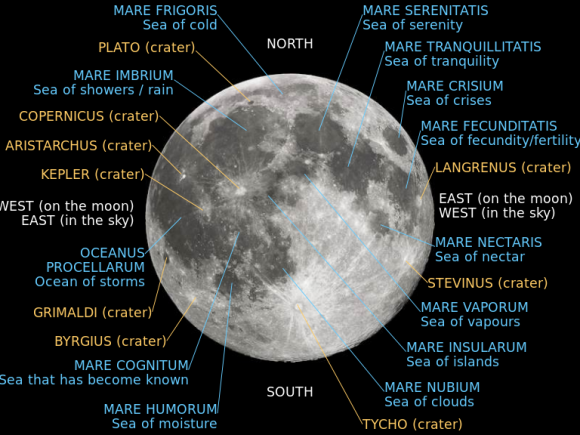
     

    The Moon’s features seen through binoculars


    The Sun

    In short don’t look at the sun without eye protection.  Especially now since even there are very few sunspots to see (aka solar minimum).  Welding goggles are not usually dark enough to protect you since most commercial welding goggles are a level 12 darkness and the sun requires level 14.   Small “XMAS Telescopes” usually come with a “solar filter” which can be used with the lowest power lens configuration.  In other times you can carefully observe the Sun’s face for sunspots.  Right now the risk is probably not worth the view.  But, unless you have specialized equipment, the Sun is best observed online from a solar observatory website.   There are three exceptions to this: solar eclipses, planetary transits, and the green flash.  I’ll discuss solar eclipses later.

    Planetary transits are the rare occasions when Mercury or Venus actually are seen crossing the face of the Sun for a few hours.  Because the planets don’t follow the Solar equator the geometry required for the Earth to experience this view are few and fleeting.   The last transit by Venus was June 5, 2012 and was fun to see.  The next will be December of 2117.  A Venus transit was how the atmosphere was discovered and that led to a rush to have observing sites around the world in 1769.  Today science has moved beyond transits for scientific purposes but watching the progress of a planet across the face of the Sun puts the scale of the Solar System in perspective.  While my bet is that I’ll miss 2117 transit of Venus, I am holding out hope for the Mercury’s November 11, 2019 transit of the Sun.  The transit will be visible from all of North America and much of Europe. Japan, you’ll have to catch it online.  I live near an east facing beach so I’ll be able to experience it at dawn.  What you’ll see is a black dot that moves across the face of the Sun.  This website will provide you the information for your location including where on the solar disk you will see Mercury.  If you miss this transit your next opportunity will be November 13, 2032.


    Venus Transit 2012


    To observe the “green flash” you need an unobstructed view of a flat horizon at sunset or sunrise.  It works best if you use an ocean or a Great Lake.  I have heard people have seen the “green flash” on the Great Plains, but I had no luck when I lived in the KC area.

    A “green flash” occurs because the atmosphere acts like a prism and just as the solar disk disappears (appears) at the horizon the prism causes a 1-2 flash of green to appear at the top of the solar disk.  Again, a fun thing to see if you are aware and lucky.


    Green Flash over Pacific Ocean


    Jupiter

    In the current night sky at sunset Jupiter reigns.  Venus is usually brighter but right now it is close to the Sun and hides in the glare of sunset.  In contrast if you look west of south after sunset the largest planet with be the first “star” to come out and remains the brightest object in that part of the sky.  With the naked eye Jupiter is very bright silver white “star”, while through even the smallest binoculars it appears clearly as a disk instead of a point of light like a star.  You can do a quick check if this.  Find Jupiter and check it out.  Now make a closed fist and extend your arm.  Place it just below Jupiter and look at 5 o’clock. That bright red star is Antares. Now look at Antares in your binos.  Antares is the 15th brightest star in the sky.  It a red super giant of about 12 solar masses only about 550 light years away and if it swapped places with the Sun it would fill the Solar System until midway between Mars and Jupiter.  It is truly big. Even that close and big Antares is a mere pinpoint of light.  Every major planet is clearly a disk and not a point of light. (See opening picture)

    In a dark location with good binos (with large front lenses to gather light) you can see Jupiter’s four large moons.  They appear as distinct “stars” along Jupiter’s equator.  With any scope these stand out.  Depending where they are in their orbits you can see up to four of the moons Galileo discovered.  All four are fascinating for their own reasons, but the inner two moons (Io and Europa) move so quickly that observing even an hour apart will reveal clear movement.  With a scope as well you’ll be able to make out some of Jupiter’s banding which look like brownish stripes north and south of the equator.   Jupiter takes about a year to move one zodiacal constellation.  So once you find it, it’ll be easy to follow.


    Jupiter and four largest moons through a small telescope


    If you look at Jupiter or Saturn near the horizon you may be tempted to say, “WTF Double Eagle?  Either you lied about where the moons (rings) are, or the planet tipped over.  Not to fear. This is just an optical illusion because you are essentially looking sideways at the planet.  Look closer to when it is at the highest point it’ll reach in the night sky (AKA zenith) and things will appear normally.

    Fun Fact: The gas giant Jupiter rotates so rapidly (a day is about 12 hours) that even though binos it visibly bulges along the equator.


    Io eclipse on Jupiter’s southern hemisphere from Juno pass Sep 2019


    Venus

    Venus is the Earth’s nearest twin in size and our closest planetary neighbor on average.  (Depending on locations in their respective orbits both Venus and Mars can be closer on any given day.) Because Venus is closer to the Sun it sometimes appears in the morning and other times in the evening (aka Morning and Evening Stars) and can never appear all night like the plants farther from the Sun than us.  Venus is even brighter than Jupiter and at peak times on moonless nights can cast a faint shadow.

    Unfortunately, Venus is not a fascinating view through your optics.  It appears as a silvery disk but with no moons so you don’t get the obvious movements as the moons parade around Jupiter.   The only real trick Venus will display for you is that it goes through phases like the moon, less a “full” Venus.  The fuller Venus appears, the farther it is from Earth; and the more crescent it appears, the closer it is. Because of this, the apparent brightness of the planet remains fairly constant.  A crescent Venus is noticeably larger in your optics than an almost full Venus.

    Venus is not much of a visual treat right now since it just passed behind the Sun.  It sets within minutes of the Sun and is not visible to the casual observer.  In a few months it will return to easy visibility.  In fact, Venus can be seen during daylight hours and is sometimes reported as an UFO near the Sun.  Here is how and where Venus will appear after sunset for the next few months.
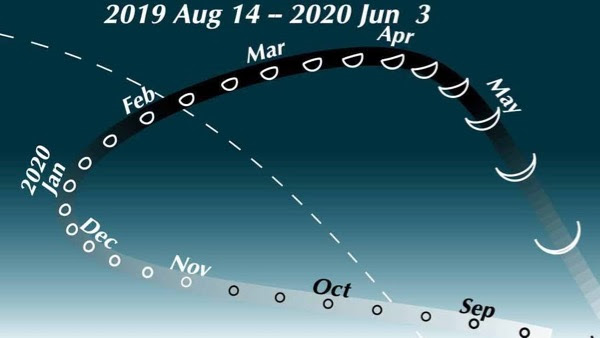
    Venus phases and location late 2019


    Fun Fact: Venus’s surface runs about 900F and the atmosphere is so dense that the pressure at the surface is the same as the deepest parts of the Marianas Trench.  The odd thing is that the planet rotates so slowly that a Venusian day is longer than a Venusian year.


    Venus surface in true colors from USSR Venera 14


    Saturn

    Saturn is the third brightest planet and is brighter than almost every star.  As a bonus, now it is near Jupiter in the evening sky so it is really easy to find.  To find Saturn locate Jupiter.  Using the same closed fist stretched out arm technique, go left a bit over two fists and up slightly (10 o’clock position).  That yellowish star is Saturn.  Through even a small scope Saturn will grab your attention because the rings are right there and easy to make out.  (Most binos make Saturn look like a yellowish football.  If you have high quality lenses and steady them against something you can just make out the rings in good conditions.)  Saturn and Jupiter are slowly closing together so over the next months they will be easier to see together. In December 2020 they will appear to almost touch they will be so close together in the night sky (AKA conjuction).

    Saturn’s rings are “open” and easier to see now.  In fact even a cheap telescope will reveal that there are “rings” and not a ring.  As the years continue on we will move more in line with the rings and they’ll almost disappear.  Then they’ll open to the other side.  (14 year cycle).  It takes a bit over two years for Saturn to move between constellations which is why Jupiter will “catch up” next year.

    Saturn through low power scope in poor conditions


    Fun Fact: Gallieo was the first to observe the planets though a telescope and discovered Jupiter’s moons and phases on Venus.  He could only make out that Saturn bulged and it was a later scientist who discovered the nature of the rings.  The rings are almost all small pieces of water ice ranging 1cm to 1M in size and the most visible rings are ~63,000 km wide, but only 10-30 meters deep.


    Night side of Saturn from Cassini. Earth visible at 10 o’clock through the rings.


    Mars

    Mars may not be our closest neighbor planet, but it is the most “earthlike” neighbor with seasons, clouds, snow, occasionally running water, and hosts of other similarities.  In the night sky Mars is an odd duck because it zips through the constellations (a Mars year is 687 Earth days) and changes brightness and apparent size dramatically over a short period of time.  Right now?  It is so close to the Sun it is hidden in the glare.  Come March it’ll escape the Sun’s glare to appear as a bright red point of light around dawn.  By as the months go on the distance between us and Mars will fall until October when we will be only 0.4 AU apart and Mars will be bright bloody red and one of the brightest objects in the sky.

    Mars through a year with the moon for scale.


    Through your binos or spotting scope Mars appears a red disk (Mars’ surface is covered with rust colored rocks).  As the months go on the disk will get larger and the white polar cap will become easier to see.   You need to keep your eye on Mars because it crosses constellations about every other month unlike the dawdling Jupiter (1 per year) and Saturn (1 every other year).  It also spends part of the year “going backwards” as the Earth catches up as it passes the planet.

    Fun Fact:  It has the largest known mountain, Olympus Mons, which is visible through a moderate sized telescope.  It was discovered on Earth in the 19th Century and named Nix Olympia but it was an unknown object. It took until Mariner 9 orbited in Mars in late 1971 to determine what it was.  Olympus Mons is a shield volcano that stands 14 miles high above the base and covers a surface area almost equal to the size of France.  In comparison, Mauna Kea in Hawaii is the tallest volcano on Earth and rises only 6.3 miles from the ocean floor to the summit.  Olympus Mons weighs so much that it has deformed the crust and sits in a 2km deep depression surrounding mountain.


    Curiosity photo of Murray Butte 2019.


    First photo from the surface of Mars July 1976.


    Mercury

    For your basic sky observer Mercury is like Venus but more so.  With a year of only 88 days it rapidly transitions between the morning and evening sky.  Because it is closer to the Sun it never gets far from the horizon.  But sometimes when you are out and the day is transitioning a “star” is seen low in the sky.  If the time of the year is right you are looking at Mercury.  Through our optics it appears as a small oddly shaped disk or crescent similar to Venus but much smaller. See “Transits” (above) to take advantage of the rare opportunity to watch Mercury cross the face of the Sun.

    Fun Fact: Mercury is smaller than some moons.  Both Ganymede (Jupiter) and Titan (Saturn) are all larger than Mercury.  Ice has been detected in several craters near Mercury’s poles in pockets that are perpetually in darkness.


    The Outer and Minor Worlds

    How about the rest of the solar system?  The planet Uranus is dimly visible to the naked eye in a dark location and “good seeing”.  (“Good seeing” is a dark night with little to no wind and a steady temperature gradient through the atmosphere so the atmosphere is moving very little.)  But for the casual observer Uranus is best seen when it is near an easier see thing.  During a lunar eclipse in 2014 Uranus was right below the moon and any observation of the moon meant you couldn’t miss a gray green disk.  That disk was Uranus.  My suggestion is don’t try and find Uranus without the aid of an easy object nearby.  Many websites will be happy to let you know when these days are approaching.


    Total lunar eclipse and Uranus 2014
    (Uranus at 5 o’clock)


    Fun Fact:  Early in the Solar System Uranus was smacked by another object near the same size.  Now it rotates on the side and essentially rolls around the Sun.  Uranus was not recognized as a planet by early astronomers and shows up as a “star” in several sky maps.

    Neptune is invisible to the naked eye but like Uranus can be found with optics when it is near something else.  One morning when I was out before dawn getting into position for a turkey hunt Neptune was near the crescent Moon.  In my binos I could make it out as a very small bluish disk.  Even with a small scope that is the best you can hope for.
    Neptune through small telescope


    Fun fact:  Neptune was discovered by two astronomers independently doing the math on small perturbations of Uranus.  It has been visited only once by an Earth launched space probe.  Voyager 2 passed by the planet in 1989.

    The dwarf plant Pluto.  Forgetaboutit.  Even through the largest earth based scopes Pluto is a speck of light that can only be made out by how it moves over several nights.

    Fun Fact: With a very elongated orbit, Pluto actually moves inside of Neptune’s orbit for 20 years every orbit (248 Earth years).  The last time it did so was 1979-1999 ce.

    The dwarf planet Ceres is another dwarf planet but is more conveniently located in the asteroid belt between Mars and Jupiter.  Under almost perfect conditions it can be made out as a dim star.  It is not worth the effort to find unless you start getting hooked by amateur astronomy.


    Eclipses

    I’ll discuss only the two most common, solar and lunar.  Solar eclipses only take place during a new moon, because that is when the moon is directly between us and the Sun.  Because of the tipping of our orbits it is only sometimes the Moon’s shadow crosses the earth’s surface.

    The next totality that will cross the US is April 8, 2024 and totality will cross Texas and cross west of the Appalachians through eastern NY and curve into eastern Canukistan.

    Solar eclipses – North America


    Lunar eclipses only take place at a full moon and only sometimes for the same reasons.  But since the earth’s shadow is so much larger the area for observed totality covers a larger part of the planet and for a longer time.   As the bulk of the Earth’s shadow hits the face of the moon it starts turning dark, usually orange-ish, but rarely black.  This is because our atmosphere always bends some light through.

    The next lunar totality for the US is January 21st.  The mainland will be in position for the entire thing, while on my island hideaway the moon will rise a bit before totality and I’ll get to observe the rest.  Convenient and warm for me, if not for some of you.

    Occultation

    These are when one object crosses in front of another.  It is the astronomy equivalent of the saying, “Standing there makes you a better door than a window. “  Almost all of the most visible of these events take minutes to a few hours and cover a fairly small portion of the surface of the Earth.  There are websites that highlight the most noteworthy of these.  No real science to be learned, but they are fun to see.  Watching a planet disappear and reappear from behind the moon is a kick.  Visible from naked eye to scope.

    Saturn about to go behind the Moon 2014 through small telescope


    Meteors and Meteorites

    A meteoroid is a small bit of metal, stone or a metal/stone mix in space. A meteor is a meteoroid burning up in the atmosphere.  A meteorite is a meteoroid that makes it to the surface of the Earth.  The average visible meteorite was the size of a marble when it hit the atmosphere.  Most meteoroids burn up at 75-50 miles above the Earth.

    Seeing a meteor is a matter of chance and luck.  You can improve your odds by watching after local midnight so your chunk of Earth is facing our direction of movement.  The other way is to watch during known periods of “meteor showers”.  (See a good website for info.) These are the times when the earth passes through the orbital paths of larger comets and sweep up the dust and small objects left behind comets in their flight.  If you get really lucky you can watch a fireball which is a larger meteor burning brightly. Sometimes they leave a visible smoke path, or even break apart into multiple pieces while you watch. The best fireball I ever saw was one early morning in 1992.  We were out for the Javalina hunt. I had left camp and was walking up a hill to get into position when the hill in front of me blazed white and I saw my shadow.  I quickly turned around and saw a huge fireball traveling across the sky.  As I watched it broke into 4 pieces and kept going, eventually blinking out far to the southwest.  The light from the still hidden Sun caught the smoke and lit it up in the pre-dawn sky.  I thought it was space debris but when I checked with the local observatory a few days later they confirmed it as a meteor.

    Fireball meteor


    As much as many of us hoped for the “Sweet Meteorite of Death” in 2016 and will do so again in 2020 the odds are small that the next extinction level meteorite strike will happen then.  You can play around with this website and find how your very own SMOD will impact you.  Have fun with it.  Can you design the next KT event?

    Fun Fact: The change of definition from meteoroid to small asteroid was formally defined only in 2017.  A meteoroid is grain sized to one meter in size. Smaller size are micrometeoroids and larger are small asteroids.

    Comets

    Here is Comet 1A.  Comets are dirty snowballs left over from the formation of the solar system.  Well outside of the planets there is a large cloud of dust and ice stretching out over 100,000 Astronomical Units (AU = roughly the distance from the Sun to the Earth).  This cloud is known as the Oort Cloud and is the home of the comets.  Passing objects and stellar events give the cloud gravitational nudges and some of these nudges eventually result in a dirty snowball to start to fall into the Sun’s gravity well.  (It may take millions of years between the nudge and the solar pass.)  Those snowballs which come in close to the Sun start to warm up and give off ionized gas and dust.  These are known as comets.  Every year dozens of comets are found and most remain faint and fuzzy telescope objects, but every few years (on average) a comet becomes a bino and naked eye object.  About once a decade a comet will shine bright and luminous thus becoming a spectacular sky show.  Since most bright comets take a long period to orbit the sun their arrival is a once in a lifetime event.  Even Halley’s Comet takes 76 years per orbit so at best you might get two chances to see it.  Spectacular Comet Hale-Bopp passed within 1 AU of Jupiter so the orbit was considerably shortened.  If you are around in 4380ce Hale-Bopp should put on a good a good show.

    Right now the night sky doesn’t feature any worthwhile comets for the casual observer.

    Comet Wirtanen- average visible comet Nov 2018


    Comet McNaugt in daylight Jan 2007


    Aurora

    Aurora form when Solar Wind particles hit the Earth’s magnetosphere and then ionize.   Lower energy particles are blue and green while high energy particles display red. The map shows the band of common occurrence over North America.  Especially energetic solar storms can result in red aurora appearing throughout the continental USA.       More here: https://en.wikipedia.org/wiki/Aurora


    Manmade Stuff

    There is a bunch of it up there, so much in fact that some areas of prime “real estate” are getting downright crowded.  Most manmade stuff is not easily visible to a casual observer, but some of it is.  The biggest and brightest object is the International Space Station (ISS).  This is my recommendation to try and find first.  It is BRIGHT, moves relatively slowly and is impressive.  It is often mistaken for an airplane heading to a nearby airport.  When you see the ISS, you will know you saw it.  Conveniently the nature of the ISS orbital parameters means that it will be visible for multiple days from your location before it goes dark again.  The ISS will be visible from your location during passes for several hours before dawn and after dusk.  I recommend using Heavens-Above.com for finding your visible passes.  (More info below).  For other satellites a find a dark location on a night with no moon.  Watch and you’ll see small lights than are too small to be passing planes moving along.  If you are ambitious yu can use Heavens-Above.com Db to find specific satellites.

    If you are near Commiefornia or the Floridaman Atlantic coast you can occasionally see launch vehicles heading to orbit.  It is impressive to watch a small object at the head of a rapidly lengthening cloud as it is gaining speed and altitude. After the vehicles cross the sky you can watch the remaining gas plumes be twisted by the winds alofy.  They often make surreal shapes with transient splotches of the spectrum. Both the Kennedy Center (FL) and Vandenburg Air Force Base (CA) will publicly announce non military launches to the public.  Most military launches may get only a few minutes, or no, public announcements.


    ISS passing in front of the moon. Time of transit less than two seconds.


    A Smattering of Websites

    There are scores of astronomy related websites out there.  In fact, there are more potential websites for you to visit than the number of fleshy globes that Q offers for viewing to the Glib community each month.  But here are a few websites that are easy to use and are geared toward the interested general public.

    Astronomy Picture of the Day.   You might as well visit it since your tax dollars pay for it.  This is a great site which features just what the name says.  Each picture has a clear description of what you are seeing.  The photos origins are diverse (in the good sense) from NASA, other space agencies, observatories from across the globe, and from amateurs sending in some incredibly artistic works.  The archive goes back to the mid 1990’s.  This has been my first website daily since 1997.

    EarthSkyNews.  This organization covers what is going on for the general sky observer.  You can sign up for a free daily email newsletter.  It has observing updates, news from space, photos, and only a small touch of occasional “climate change” stuff.  They also keep your subscription information tight.  I can’t think of a time when I got unsolicited emails that would have come from them selling my info.

    Heavens-Above.  This is a serious but easily accessible site. It is “THE” public website to track satellites, get sky charts, past and future night skies etc.  When you first visit this site note the upper right corner of the page.  There is a box there. Open it and set your location from a database.  It will not change all the data for your location and remember it.  Look down the left side and the ISS is highlighted.  Click on it and it will give you the visible passes for the next 10 days.  Click on the day and BINGO, there is a sky chart for that pass.

    Keep following down the left side and you get to the astronomy portion with easy to use interfaces.  You want to see what was going on the sky at the moment of your birth?  Just put in the data and there will be the sky for that time.  Want to see the sky for 4th of July 3000 years ahead?  It is there.

    These three websites will serve a casual observer.  There are hundreds of other websites out there from the USG, other governments, private organizations and amateurs. If there is interest after this article I can do a “Part Two” with easy to observe deep sky objects.   With just binos, or in some cases a deep dark sky, you can observe a host of objects, including a galaxy that will one day crash into our own.


    [No photos in this article are mine.]

  • Stumbling Along in Germany

    (All photos mine except for one- I am not that old)

    I promise this bit of scribbling will be shorter than my usual missives, but it will be more of a bummer than discussions of recreation and the early Apollo program. This article will also lack the flair of H&H or SugarFree but may intrigue some of you to learn more about a privately funded and executed memorial project.

    The National Socialist era (1933-1945) for Germany was a time of both governmental and non-governmental lawlessness. Everyone in this group is aware of the broad outlines (or intricate details) of the crimes perpetrated by the National Socialist German Workers Party, the government it controlled, and the people who supported the goals of those entities. With the end of that era in May 1945 Germany entered a period of denial and silence concerning the crimes committed in the national socialist era.

    Slowly, and by fits and starts, the government and people of West Germany (FRG) began to recognize the crimes committed in the name of the German State and the positive actions by those few who openly opposed the socialists. Even so, people like the July 20, 1944 conspirators were generally seen in a poor light by most of the German population for decades. In the International Socialist GDR the NSDAP past was even more hidden because “the new boss is like the old boss”. Any public remembrances had to be wrapped up in the glorification of the communists (mis)rule of the East. With the collapse of Warsaw Pact and the subsequent reunification of Germany a re-examination of how to remember the totalitarian era began to be debated and acted upon in Germany.

    One problem of this reexamination was how far removed from today the NSDAP’s crimes were. The crimes are entire generations removed from the people inhabiting Europe today. Today most of the perpetrators are in their graves and the surviving few are pushing 100 years of age. Even German prosecutors state the last of the Nazi trials probably has been conducted. The statistics for the victims are ever darker. Those who survived often had compromised health and suffered early deaths. It is rare to find any alive today, even in the populations of those who moved overseas after WWII ended. Various government agencies wrestled with the issue and the common solution was to memorialize the victims and keep quiet about the criminals. In Berlin for example, the memorial and museum to the July 20th 1944 Conspirators is well done, but limited. The Holocaust Memorial near the Brandenburg Gate is expansive, but the dead are nameless. Across the street there is also a small memorial to the homosexuals killed by the NSDAP- again nameless, but full of current politicization.

    Monument to Oberst Claus Von Stauffenberg and other conspirators at the site of their July 21, 1944 execution.


    Portion of the “Memorial to the Murdered Jews of Europe“ (aka Holocaust Memorial) near the Brandenburg Gate.


    Last month I was in Wiesbaden, Germany for business with a few extra days tacked on. The first night there, a group of my co-workers and I went out for dinner. We had different knowledge levels of Germany with some of us former residents and several on their first visit to Germany. After dinner we were walking back to the hotel and I noticed three small bronze squares in front of a building. I brightened since I had a chance to share with my co-workers a small aspect of German life. “Hey look! Here are three stumble stones.” We paused at the squares and I let them know that this was the last home of the “X-berg” family and it was from here the National Socialists seized them. I continued, “They were rounded up on X day and they were transported to Sobibor and arrived on Y day. They were probably all dead within the hour.” I heard a quiet groan and a, “Thanks Double for that bit of ruining our evening.”

    What had I described to my co-workers? It is a project by conceived and executed by Gunter Demnig to remind people of the names and fates of those persecuted by the national socialists. In 1992 he conceived the project to memorialize as many victims as possible at their last residence as a free person. The memorial stones pull no punches. They start “Hier wohnte” “Here lived” and tersely lay out the fates of the people who lived at that address. Since 1992 he has cast and placed over 80,000 (as of 2018) of these memorials across Germany and Europe making it the world’s largest decentralized memorial. He runs the private organization with donated funding that casts and emplaces the Stolpersteine.

    Anybody can nominate a victim of the national socialist’s. The victim(s) are not limited by category and can include Jews, homosexuals, Roma, “shirkers”, union members, etc. The key is that the victim must be a victim of the national socialists and not WWII in general. (e.g. Killed in a concentration camp- yes. Killed as a soldier or a civilian by combat operations- no.) Once the nomination is properly researched, documented, and validated- Gunter is German after all- a personalized monument is cast and is ideally placed in front of the last known residence of the victim. Sometimes a group monument will document the names at a known transportation site. Most German cities have supported this initiative- Munich has not- and a slowly growing number of other nations have permitted memorials placed in their locales. (Though often not without local controversy.)

    Why “stumble stone” or “Stolpersteine”? There are multiple reasons. Each block is 10 cm X 10 cm (~4in X4in) and is set close to flush with the sidewalk stones/concrete. While walking they are noticed when you closely approach them, or your shoes trod on a not uniform surface. The name also comes from a NS era anti-Semitic joke about un-uniform paving stones marking a Jew’s grave. Gunter Demnig also states that because you can’t decide to avoid them (like a conventional memorial) and come across them at close range a Stolpersteine “is a deeper intrusion of memory into everyday life.”

    After my business trip was over I took a few days of vacation to visit my son’s family in Berlin. In the morning I would walk the neighborhood, get some coffee, and explore while the rest of the apartment slept. (I am well trained on the prime directive- do not wake a sleeping infant.) My son’s family live in a nice but by no means remarkable neighborhood with an average history. By that I mean it was not a Jewish, International Socialist, Union heavy, or anything else neighborhood. Since the early 1900’s it has been a respectable middle class neighborhood. Almost as soon as I left the apartment building I came across my first stumble stone. It is literally next door and memorializes one of the first victims of the NS era. I wander down the street and buy my cappuccino and chocolate croissant, shortly thereafter I see another stumble stone- this time for a person seized on the street and shot by the Gestapo the day before Berlin fell to the USSR. That night I decided to walk every block immediately around my son’s residence and see how many people were killed by the NSDAP. This is a snapshot of an approximately five block by four block area of Berlin and includes only the Stolpersteine and not those killed because of air raids, military service, Soviet ground combat, or post war rape or disease.

    I am not going to show you all 17 of the stumble stones I found in that small area. (I may have missed some, but I hope not.) Here are some of the representative stumble stones to give you an idea of life and death to out groups under a socialist regime.


    Georg Stolt was a member of the German Communist Party and served on the Berlin City Council (1920) and was a member of the Prussian Parliament until 1932. In 1934 he was seized by the SA and placed in Protective Custody, shortly thereafter he was shot by the SA in an early version of a concentration camp (KL).


    Arthur Michelsson was seized and killed the same day. Most likely by a Gestapo run “flying court martial”. Less than 24 hours later this section of Berlin was captured by the Soviet Army.

    The picture below was taken on May 2, 1945 at the Reichstag about 1 km west of this spot.


    The Jaskulski family was deported to the Lodz Ghetto in occupied Poland. Edith was nine years old when she was taken from her house to Hamburger Platz and loaded into a freight car. The family was later selected for “transport to the east” and died at the Chelmno Extermination Camp. They most likely died in early 1942 during Operation Reinhardt which was initiated after the Wannsee Conference agreed upon the “final solution to the Jewish problem.”


    The Nartelski family was deported Auschwitz as part of Operation Reinhardt. Rita (~8 years old) and her mother Paula likely were gassed upon arrival. Gunther entered the main camp and later survived the evacuations to the west. After he was liberated, he moved to America and remarried. More about the Nartelski family here.


    The stumble stones are jarring whenever you see them. You can’t help but to remember that RIGHT HERE a person or persons lives were destroyed by a socialist regime. This ordinary building in front of you saw property seized, lives destroyed and parasites receiving ill gotten gains. Because of my knowledge of history and political outlook I fully realize that the stumble stones are not just a memorial to the past but a living warning for today. These memorials are a reminder of the ultimate goals of the democratic socialists and “warmnistas” living in our societies.

    If you want to find out more about the project, or if you have a relative/family friend to nominate you can visit here: http://www.stolpersteine.eu/en/home/


  • From the Home of FloridaMan to the Home of the Man in the Moon


    Here we are on the cusp of one of mankind’s greatest accomplishments and many Americans have never been taught what a big deal successfully landing men on the moon was.  Most of the Glibertariat know about the Apollo program and some of us probably know about it in much more and fascinating detail than I.  Because I was a planetary geology major as an undergraduate it fell upon me to write this short piece on Project Apollo.  So here is: “Plntry 101 Apollo Missions MWF 3-4”.  If this doggerel inspires you to learn more about Apollo there are plenty of sources for further reading and watching.

    The HBO series “From the Earth to the Moon” does a magnificent job with each episode concentrating on one portion of the effort. “In the Shadow of the Moon” is a great documentary which interviewed all the surviving astronauts (less Armstrong) and is purely archival NASA footage and interviews. Even Netflix’s “The Last Man on the Moon” is fantastic on Gene Cernan.  There are books, too many to mention, that cover the program from the first detail to the last; from an overview for teens to tomes with a Selenologist’s attention to detail on a handful of samples; and even a crime story about the largest ever heist of lunar material from NASA.  Okay, I’ll mention the last- “Sex on the Moon” by Ben Mezrich- covers how a world class BS’ing college student managed to steal samples directly from a NASA secure site.

    The Apollo missions can be broadly separated into two categories, the “engineering” missions and the “science” missions. Of course every mission involved both aspects, but the program was designed to work out how to get men safely to the moon and back; then to move on to missions in the more geologically interesting areas. . President Kennedy said we’d go to the moon so now the scientists and engineers asked, “Okay. How do we do this?” NASA was full of engineers and the astronauts were test pilots (and one geologist) with a well-known design and test philosophy of incremental testing and validation.  With no surprise this was the approach adopted for the Apollo Program. A series of missions would test aspects of the lunar mission profile culminating in a series of proof of principle landings before the serious science missions began.

    There are several ways to go to the moon but they break down to basic models- brute force and meet ups. The brute force option (direct ascent) would involve a missile that would dwarf the Saturn V and involved landing the entire manned portion on the moon.  This is what early SciFi films portrayed.  The engineering was way too formidable for the time and this plan was discarded.  The next version involved multiple launches with small existing launch vehicles and assembling the various parts and pieces in low Earth orbit.  The lunar portion would be assembled in orbit.  Another version had unmanned return craft sent to the moon with the manned portion landing nearby and returning in the first vehicle.  This was daunting, especially considering that our first lunar impact mission (Ranger 3) missed the moon.

    Easy, Just Do This and Visit the Moon

    The Apollo program adopted the Lunar Orbit Rendezvous (LOR) mission program.  Launch a large system that shed parts as they were no longer needed.  This system made sense but involved the US having to develop expertise at multiple skills (orbital rendezvous, docking, multiple firings of engines, people working outside of spacecraft, space navigation etc.) before attempting a lunar mission.  These were the goals of the two man Gemini missions.  NASA achieved these goals in a rapid two year series of ten missions which learned the required skills for a lunar mission despite multiple mishaps, “adventure learning”, and several near disasters.

    The workhorse of Apollo was the Saturn launch system. The smaller “little brother” Saturn IVB was used only for the Apollo 7 manned mission.  The Saturn V (ASV) was the monster brother used for the balance of the Apollo missions.  The ASV is still the most powerful vehicle ever used by mankind.  A full ASV “stack” was 363 feet tall, 33 feet wide (fins added additional width) at the base and could send a 103,600 pound payload into lunar orbit. In order get this machine off the Earth the five engines in the first stage generated 7,610,000 pounds-force.   To give an idea of scale, the escape engines atop the Apollo capsule generated more energy than the Redstone that the US used for the first two Mercury flights.  The small third stage alone of an ASV was taller than an entire Mercury-Redstone system.

    The first stage of the stack was 46 yards tall, weighed 5,100,000 pounds loaded. The five F-1 (or F-2) engines were independently gimbaled and controlled to keep the massive system upright within very small tolerances as it left the pad and powered up to 36 miles of altitude at an engine cutoff of ~160 seconds of flight.  The great precision was required both to clear the pad- at the tightest spots there was only 2 feet of space between the ASV and the gantry- and to keep the system from tearing itself apart as it climbed. Even a few feet of shift at the bottom would translate into many yards of movement over a football field higher where the crew was located.  This movement combined with the acceleration would have torn the stack apart in a huge fireball. As anybody has climbed even a small sailboat mast can attest, small changes at deck level quickly become manifest off the deck.  Add in acceleration, winds aloft, shifting center of gravity as millions of pounds of fuel is consumed, and the rotation of the system and you can see why each engine was gimbaled and computer controlled.

    This NASA closeup and ultra slomo of the Apollo 11 take off will explain the first stage is great detail and is awesome footage.  https://www.youtube.com/watch?v=DKtVpvzUF1Y&t=152s&app=desktop

    The second stage was slightly smaller and less powerful than the first stage.  It was fueled by burning a mix of liquid Hydrogen and liquid Oxygen through five J-2 engines.  This pushed Apollo through the upper atmosphere and into space with 1,100,000 pounds-force in up to six minutes of burn time.

    The famous footage of the separating booster and the ring shaped interstage (now on TV commercials) shows the ignition of the third stage of the ASV.  It had one J-2 engine and same fuel as the 2d stage.  The crucial difference was the third stage could be re-ignited in flight.  It would burn for 2.5 minutes to place the Apollo into a parking orbit where systems would be checked. Later it would burn for 6 minutes to accelerate Apollo into lunar insertion.  This meant the third stage accelerated the remaining stack from 25,000 feet/second (orbital velocity) to 35,545 f/s (lunar insertion) in under six minutes.

    The third stage also had two other crucial functions.  At the top of the 3rd stage was an instrument unit containing all the computers and instruments required for stages 1-3 to successfully function.  Also at the top of the third stage (inside a shroud) the Lunar Module (LM) rode into orbit.  The third stage followed parallel and near the Apollo to enter solar orbit after passing the moon.  After Apollo 11 most of the third stages were deliberately crashed into the moon to provide signals for seismographs to help determine the interior lunar makeup.

    The manned portions of Apollo consisted of the Command and Service Modules (CSM) and the Lunar Module (LM) which was the only true “spacecraft” that man has ever operated.  The three seat Command Module was much roomier than the earlier Mercury and Gemini capsules since it had to execute longer missions and have room to bring back “souvenirs” from the lunar surface. In addition to the standard hatches it had a nose hatch designed to mate with the LM to enable the crew to move between the two vehicles.  The coke can shaped Service Module had the long term fuel, oxygen, water, and other cells, onboard computers and an engine designed for multiple use.  The SM engine was key in retrieving the LM from the third stage, mid-flight corrections, slowing to lunar orbit and accelerating to lunar escape orbit so the mission can return to Earth. Shortly before reentry into the atmosphere the Command Module would separate from the Service Module leaving it in Earth orbit.

    CSM


    The LM was designed ride into orbit inside the ASV third stage then ferry two men to and from the surface of the moon.  The LM had two main parts.  The lower section had the legs, descent engine and carried instruments for the lunar surface.  It would then serve as the launch platform for the upper ascent stage.  The ascent stage was the “home” for the astronauts and could cycle between an atmosphere and no atmosphere.  It would carry the astronauts and lunar materials back to the CSM and then be abandoned in lunar orbit or crashed into the moon.  Everybody who operated the LM was impressed with the handling, but it could only operate in the vacuum of space.

    LM from CSM in lunar orbit

    I need to add a few words about Apollo’s computers. A current kid toy has more computing power than the entire computer system used onboard during an Apollo mission.  A current smart phone?  Forgitaboutit.  NASA would have given anything to have a cheap bottom line 2012 model.  If you every listen to the unedited complete mission transmissions you’ll hear hours of Houston reading numbers to the crew, the crew reading back the numbers, the crew confirming the numbers entered, a pause while the onboard computer ran one part of an equation, the crew reading the new number to Houston, Houston reading the number back, a pause while Houston checked the new number, Houston reading another number, the crew reading it back…….. That is correct.  The computers could not run an entire equation.

    The astronauts for the Apollo missions had a clear hierarchy.  All the Apollo missions were commanded by either Mercury or Gemini “class” selections and the junior mission members were often from one of the “Apollo” classes.  Deke Slayton (Mercury) had been grounded in 1962 for a heart murmur but was made “Director of Flight Crew Operations” and made the crew selections for all Gemini and Apollo missions.  His word was law.  The mission commander was always an experienced astronaut who had done well previously.  The CSM pilot was always an experienced astronaut because he would operating solo in lunar orbit while the others left in the LM.  The LM Pilot was the junior astronaut and was more accurately the LM Co-pilot because the Mission Commander actually flew the LM. In total 33 seats were flown by Apollo, 24 different men went to the moon (3 were repeats) and 12 walked on the lunar surface.

    Apollo 1

    Crew: Grissom (Cdr), White (CSM) Chaffee (2d pilot)

    This mission was designed to use the smaller Saturn IVB to achieve low earth orbit to conduct testing on the Command and Service Modules.  Slayton chose Grissom as the mission commander because he was considered the best engineering pilot.  Grissom was the second Mercury pilot in space, commanded the first Gemini mission, and was to take the first Apollo mission through the engineering paces.  During the workup the engineers grew increasingly unhappy with “Gloomy Gus” who was pointing out issue after issue with the capsule and the training apparatus.  Ed White flew on the 2d Gemini mission and was the first American to walk in space.  Roger Chaffee was the FNG and was a communications specialist.

    The crew was concerned about whether or not the capsule would have the deficiencies corrected in time to fly and Grissom was skeptical that the systems would work for the entire scheduled 14 day duration.  On Jan 27, 1967, less than a month prior to the scheduled flight date, the crew was conducting a dress rehearsal in the sealed capsule and in a pressurized (29 psi) pure oxygen environment.  During the test an electrical short under Grissom’s couch ignited a fire.  Nine seconds later a voice (likely Chaffee) announced over the circuits that there was “a fire in the cockpit”.  Fifteen seconds later the pressure from the fire caused the capsule to breech and then the nitrogen from outside led to increasing smoke while the fire burned itself out over the next hours.  Engineers and technicians outside of the capsule heard the radio call and noticed movement inside, briefly, but the crew was dead even before the capsule breeched.

    Apollo 1 Cabin Post Fire

    This disaster caused NASA to refocus and redesign numerous aspects of the capsule and systems.  Designs went from the major: redesign the door to open under pressure, changing the atmosphere from 100% to 40% oxygen and more carefully checking for friction points; to more mundane- spacesuits changed from nylon to fire resistant materials etc. NASA and the multiple contractors worked feverishly for the next year and a half until the CSM was declared to be flight ready for humans.  Meanwhile multiple unmanned launches continued to test the various systems of Apollo and the Saturn V.

    Apollo 7- October 1967

    Crew: Shirra (Cdr), Eisele (CSM) and Cunningham (LM)

    After 21 months of redesign of the CSM the mission of Apollo 7 was the same as Apollo 1.  Apollo 7 launched with the smaller ASIVB and conducted testing in low earth orbit for 11 days.  From a technical standpoint the mission was a complete success, the CSM flew extremely well and checked out.  From a personal management system the mission was a mess.

    Wally Shirra flew the Mercury and this was his third flight.  Both Eisele and Cunningham were on their first flight.  The larger capsule size (about the size of a standard closet) contributed to members suffering from space sickness. This combined with rations that weren’t sitting with the crew’s stomachs and Shirra coming down with a head cold led to “the mutiny”.  Shirra and the others started to “talk back” to the ground control team and decided not to perform some requested actions that Shirra didn’t consider crucial to the core mission.  The culmination of the mutiny was shortly before re-entry when Shirra decided that crew safety demanded that they not wear their helmets- which had been SOP since the first flight.  The new fishbowl type helmets prevented the astronauts from being able to clear their eardrums. Since he and others were suffering from congestion he believed the risks were worse from helmets on versus possible impacts from having the helmets off.

    After their return to Houston the crew had to defend their actions for when they didn’t follow directions from the ground.  Slayton rejected Eisele and Cunningham from all further flights and Shirra retired from NASA.  Their post flight medals were downgraded (the only crew to have that happen) and weren’t returned to the post flight standard awards until 2008.  Slayton’s actions had the desired impact on the rest of the astronaut roster, the mutiny was never repeated during the remaining Apollo missions.

    Apollo 8- December 1968

    Crew: Borman (Cdr), Lovell (CSM), Anders (LM)

    This flight is when Apollo started really attaining world prominence.  This mission originally was to be another low orbit test, this time with an ASV, to test the LM with a crew aboard.  The LM construction and testing was behind schedule so George Low basically said, “Well, we have the launch vehicle, so let’s flip missions and test the CSM under lunar conditions by going around the moon.”  The mission change was announced after Apollo 7 returned, the original crew slipped back to Apollo 9 since they were training on the LM and Anders crew was told, “Be ready to go to the moon in two months.”  The decision to undertake this mission on such short notice was influenced by having a complete ASV and not wanting to “waste it in low earth orbit”, combined with a recent Soviet mission (Zond 5) which sent some animals around the moon and back to Earth, and a rumored Soviet manned mission to orbit the moon.

    Borman and Lovell were both Gemini pilots with well-regarded missions under their belts.  Borman had commanded Gemini VII with Lovell as his crew.  GVII was designed to be a long term flight of two weeks to simulate the time for a lunar mission.  After Gemini VI’s aborted take-off the revised mission had GVII launch before GVI and then when GVI launched the two missions would rendezvous.  After the meeting GVI returned to Earth and Borman’s mission remained in orbit for the full 14 days.  (Imagine being in your front seat of your car for 14 days without a break.) Lovell later commanded Gemini XII (with Buzz Aldrin).  GXII is considered the most successful Gemini flight because they easily docked with a target vehicle, and most importantly Aldrin completed multiple successful EVA’s which finally demonstrated that an astronaut could complete precise tasks outside a spacecraft without undue hazard to themselves or their craft.  Michael Collins was originally scheduled to be the CSM pilot and had started training but developed back problems and got two vertebrae fused.  Since recovery took time, he was dropped and Lovell was added.

    The risks to Apollo 8 were real.  This was only the third launch of a Saturn V and the first manned mission with an ASV.  The two earlier unmanned launches had some serious issues including a compression problem (“pogo sticking”) that would have endangered the crew. Engineers had developed solutions and Apollo 8 was the test that the solutions worked.  The other risk was Apollo 8 had no “lifeboat” or spare engine from a LM.  This was the only time during Apollo no spare was flown and was done only because the LM was not ready to fly.  Apollo 13 validated having a spare was valuable.

    The mission launched on Dec 21, 1968 with no issues.  Twelve and a half hours later the crew was approved to conduct lunar insertion and they became the first humans to head to another body in the Solar System.  A8 had one issue on the way to the moon when the third stage was shadowing them too closely for comfort.  After several discussions with ground control the solution was to radio the abandoned stage to vent all remaining fuel.  This changed the trajectory enough to clear the hazard.

    Riding to the moon is in some ways like riding a roller coaster.  On the way there your initial velocity of 35,505 ft/sec gradually bleeds off as you climb out of the earth’s gravity well.  As you travel the craft also slowly rotates (1X hour) like a rotisserie chicken to balance heating and cooling and you can’t even see the moon.  Around 55 hours after lunar insertion the craft reaches ~39,000 miles from the moon and has slowed down to around 3,900 ft/sec.  At that point the craft enters the lunar gravity well and starts to speed up as it falls down the roller coaster towards the moon.   Now comes the odd part.  The decision to enter lunar orbit is made with communications to the ground, but the firing of the Service Module engine to slow down to lunar orbit occurs behind the moon and out of communications with the Earth.  The A8 CSM was only ~72 miles above the lunar surface and about to swing behind the moon when it got the okay. The CSM engine burn went without an issue and Apollo 8 settled in for 10 orbits (~20 hours) of quality time at the moon.

    Now that Apollo 8 was orbiting the lunar surface they started their recon. Apollo 8 was launched so that when they arrived the lighting would be the same as it would be when Apollo 11 arrived.  This was important because one key task was to photograph Apollo 11’s approach path and planned landing location.  Having completed all their tasks the return to Earth went according to plan.

    1968 would not be listed among the best years in America’s history. We were fighting a war in Vietnam and the “Tet Offensive” started off the year.  There were multiple assassinations and riots throughout the country.  The presidential election came down to Nixon, Humphries and Wallace.  It was a good year to have not to have lived through.  Apollo 8 was the one thing the country could look up to.  The mission was a worldwide phenomenon and totally at odds with the USSR space program.  The Soviets always kept their missions held close to the vest, Apollo was everywhere, for anybody anywhere, to watch.  The Apollo 8 crew were the first people to see the entire planet in one glance. They shared with us the view of our home planet as a blue marble in the total darkness of space.  They pointed the camera down and we all looked down on a totally alien world consisting of shades of grey.   This is what the world saw that Christmas Eve. https://www.youtube.com/watch?v=1aIf0G2PtHo&app=desktop

    One of the Most Important Photos of all Time

    One of the Most Important Photos of all Time

    Seeing the earth from space is a cliché now as evidenced by VW’s current automobile commercial. But when this photo was released it immediately grabbed the attention of people worldwide.  The contrast of the blues and whites of the planet against the dead moon in the foreground and the black of space was instantly understandable. In a blink of an eye that photo was everywhere, from commercial products to stamps issued by a dozen governments and it gave a major boost to the environmental movement.

    Apollo 9 March 1969

    Crew: McDivitt (CDR), Scott (CSM),  Schweickart (LM)

    Apollo 8 captured the World’s attention and was glamour personified.  It was the first time men journeyed to another body in the Solar System, reading Genesis at Christmas from lunar orbit, and the famous Anders “Earthrise” photo.  Apollo 9 returned to the relative humdrum of low Earth orbit, but accomplished critical engineering goals with élan.

    James McDivitt commanded Gemini IV on his first space flight and is often overlooked because he remained in the capsule while Ed White made America’s first EVA.  Scott was on his second flight after flying Gemini VIII with Armstrong. Schweickart was on his first flight.  Scott returned to space commanding Apollo 15.  McDivitt transferred to managing the Apollo Program office after this flight.

    Apollo 9 was the first time a complete Saturn “stack” was launched.  This was test one of a complete lunar mission profile and most importantly was the first time the LM performed in manned flight.  The LM was the reason and star of this mission.

    The Lunar Module is the only true spacecraft that has ever been flown by man. The LM was designed to only operate outside of the atmosphere, so unlike the Command Module, once the LM piggybacked into orbit inside the Saturn stack it would never return to the planet.  The LM was constructed with every ounce in mind and was robust, it was designed to fall the last three feet onto the lunar surface and the lower half was engineered to take the forces of the upper half launching from it.   At the same time it was frail and there were areas so thin that a careless move could punch an arm or leg through the skin of the spacecraft.

    The launch went well and so did the next 10 days as the crew put the LM through the test program.  The crew tested each phase of a lunar mission including safety backup procedures.  Schweickart wore the Lunar EVA suit designed for the moon outside the spacecraft and demonstrated that it didn’t “balloon out” which would have made walking on the surface impossible.  He also took it out the LM’s door and back along to the CSM proving that this could be a backup way to return astronauts in the event of a docking problem.  The testing highlight was flying the LM on a simulated lunar landing profile.  After reaching a distance of 115 miles from the CSM, McDivitt fired the ascent stage and returned to dock with the CSM.  After four further days of CSM based testing, Apollo 9 splashed down in the Atlantic, the last U.S. crew to do so (intentionally).

    After the complete success of this mission Apollo managers realized that (barring any unexpected problems) Apollo 11 would actually have a chance to land on the moon.  The only downside to this mission was Schweickart’s recurring space sickness.  He was the first astronaut so badly afflicted and the knowledge and protocols that were later adopted for dealing with even worse episodes were not in place.  He never was placed on a prime crew position again. His colleagues believed this was unfair and that he “suffered so the rest of us could have a chance.”

    Apollo 10 May 1969

    Crew: Stafford (Cdr), Young (CSM), Cernan (LM)

    Only two months after the success of Apollo 9 came the dress rehearsal for the lunar landing.  Apollo 10 was man’s second trip to the moon and it would rehearse the mission that followed it by two months. Stafford was on his third flight and Young and Cernan on their second.  This crew was assembled for their engineering and testing skills and might have been the most proficient Apollo crew ever to fly. (Apollo 10 and Apollo 11 were the only two missions to have all veteran crews.)

    Apollo 10’s mission profile was simplicity in itself.  Run the exact Apollo 11 mission profile to just short (8.4 miles above lunar surface) of the actual landing.  The mission was timed so the practice landing run to the planned Apollo 11 location had the same lighting conditions.  (You are noticing a theme here, right?) The ascent stage was light loaded with fuel so it would be at the same weight as the same point as in the actual ascent from the lunar surface. Cernan later said they were so close to Sea of Tranquility it looked like they could just reach out and touch the surface.

    The mission went well except for one serious issue.  The crew had accidently double loaded a command into the LM’s computer (weak computers are not your friend) and when they fired the ascent stage they started rolling.  After a few tense moments, and on camera oaths, they regained control of the LM and the mission continued successfully.  Years later it was revealed that the problem was more severe than NASA had publicly stated and that the crew was within several seconds of losing control and crashing into the surface.

    Apollo 10 from an astronaut perspective was the true Hall of Fame crew.  Only three men went to the moon twice.  Young and Cernan were two of them, both of them commanding later missions and walking on the moon.  (Lovell was the third two lunar mission vet.)  Young was the astronaut’s astronaut with six flights.  He was on the first Gemini mission, commanded Gemini X, was the CSM pilot for Apollo 10, commanded Apollo 16 and commanded the first Space Shuttle mission. For his swan song he commanded the 9th Shuttle mission.  Gene Cernan commanded Apollo 17 and was the last man to have walked on the moon.  Thomas Stafford flew one more mission after Apollo 10 when he commanded the Apollo-Soyuz mission.


    Apollo 11 July 1969

    (Do I really need to list them?) Crew: Armstrong (Cdr), Collins (CSM), Aldrin (LM)

    This was it.  The big one. The whole enchilada. El tutti mundi. Add the whipped cream and nuts to the sundae. Yadda yadda yadda.  The older Glibs need no reminding, the entire Nation was riding along with Apollo 11.  The younger Glibs probably could use an introduction to the scale of Apollo.  Approximately 400,000 US citizens were employed in various aspects of manufacturing or mission conduct during the Apollo program.  It was a huge part of the economy.  From 1961 to 1972, including Gemini and the unmanned lunar survey missions, the country spent $28B ($169B in 2018 dollars) on Apollo. The entire world followed Apollo 11.  A higher percentage of the world’s population watched or listened to Armstrong step onto the moon than any other event before or since.  Florida’s Atlantic coast was filled for miles and miles with 100,000s of people who came to watch the launch.  Hell, e Dbleagle’s father even sprung for a color TV to watch Apollo.  He was among the 400,000 working on Apollo.  His personal stake in Apollo was helping to design and inspect a set turbine blades in the LM’s descent module.

    For all the scientists, engineers and programmers of Apollo this was what years of work were culminating in.  All the theories, all the testing, all the inspections were coming down to this.  As Buzz Aldrin put it, “Can we really pull this shit off?”  The mission profile had been rehearsed in Earth orbit (9) and various aspects in lunar orbit (8 and 10), now the mystery of the last 8.4 miles were to be filled in.

    This was a specially selected crew of all veterans.  Armstrong had a military background but was a civilian member of the Gemini class.  He commanded Gemini VIII on his first flight, made the first successful docking of two spacecraft and then saved the mission (and their lives) by skillfully stopping unexpected rolling after a thruster stuck open.  Later while training for Apollo 11 he survived a literal last 2 second ejection from the LM landing trainer.  He caused a significant stir among the other astronauts by immediately going back to work after lunch.  Aldrin was “Doctor Rendezvous” and not the best guy to have around at parties.  He was well known for buttonholing anybody at a party to talk about rendezvous procedures.  Admittedly a difficult procedure but would you want your wife trapped in a corner while a coworker discussed Sugar Free stories in infinite detail?   But Aldrin had cracked the code on how to do a successful EVA and if somebody had to piece together getting the LM and CSM back together in the event of an “ahh shit” moment he would be the guy.  Collins had worked on the CSM since the beginning and was thought highly enough to had been the original primary for Apollo 8.  Collins later said when he had been tapped as the CSM pilot for A8 he knew he would probably never walk on the moon because of his skills with the CSM.

    Why the Sea of Tranquility?  Well it was the easiest and most boring spot to land a mission.  Remember incremental steps.  If Apollo 11 was to answer Aldrin’s question it meant going “How easy can we make this landing thing?”  Put it near the equator, with no mountains on the approach or nearby, no big craters, valleys or other stuff and close to lunar dawn so the features would stand out.  Plus if something went wrong the short and long areas were flat and open as well.  This meant the potential launch window opened up since the window for the primary site was less than twenty-four hours. Tranquility Base fit those requirements perfectly.

    Most Apollo missions had issues during launch until landing (or not landing- cough Apollo 13 cough) but for Apollo 11 the trip to the moon was surprisingly textbook, until it came time to land.  Now the shitbucket started filling up- and fast.  Computers overloaded with data and started blaring warnings, the Eagle was coming in long and steering directly for a crater.  Armstrong took over and manually flew the LM and landed with seconds of fuel before the abort point was reached.

    Watch it here.  https://www.youtube.com/watch?v=RONIax0_1ec&app=desktop  At home we only heard snippets and no video.  We never saw the contact light come on, the descent engine shut down or the LM as it falls the last three feet to the surface. We heard clipped language and suddenly there was a pause, “Tranquility Base here.  The Eagle has landed.”-and the world erupted.  Throughout the world people rejoiced.**  It was an impossible moment, but it just happened and we listened to it.  My great grandfather called to congratulate my dad. My great grandfather was born in a dirt poor Calabrian village before the Wright brothers and now his grandson had designed part of the “wonderful machine” on the moon.  During a break in the hours before the EVA I took my young Quarter Eagle personage outside with my telescope to look at a moon with men on it. It looked the same, but I knew just over from the terminator (line between day and night) there were two people and that made it different from any time in the history of the human species.

    Much of the EVA was difficult to see on TV.  But the world watched the blurry black and white images.  Unlike the later missions which traversed increasing segments of the lunar surface this was “Can we pull this shit off?” and nothing was known.  The best minds available had ideas, tested and formed hypotheses, but here was the first chance to live test.  The suits worked, bunny hopping became the preferred method to move, the surface dust layer was thinner than thought.  Houston extended the EVA because consumption of oxygen was lower than thought and the cooling system worked more efficiently than believed. Everything took longer than thought as well so the astronauts were working harder and faster until Houston saw their respiration rates climbing too much and let them know to slow down.   Finally, after around 2 hours Aldrin followed by Armstrong re-entered the LM an sealed the door.  It is estimated that 600,000,000 people watched the EVA.  See it here:  https://www.youtube.com/watch?v=CC3ncS-wXXI&app=desktop  The total area explored was about the size of a baseball diamond.

    Apollo 11 Landing Site


    Here are a few photos of the EVA.  Armstrong took almost all the pictures so the best photo of him is when he was reflected on Aldrin’s facemask.

    First Photo from Lunar Surface
    First Panorama After Landing
    Home from the Surface
    Armstrong Reflected in Aldrin’s Facemask (LM Pad and Contact Rod in Foreground)

    Much like on Shepard’s Mercury mission, when ya gotta go-ya gotta go.  So Aldrin did.  As he later said, “Neil took the first step on the moon, but I had my own first as well.”  After the EVA the crew had a sleep period which did not go well and forced NASA to think up a better plan for later missions.  The crew had just achieved the crowning moment of their professional lives and the sleep plan was “sleep on the floor.” All through the rest period A&A were keyed up, aware that they were 250,000 miles from home and the LM vented, turned on and off various pumps, motors and whatnot which they noticed.   Plus even at 1/6 gravity a metal floor was not comfortable.  Sleep was poor and badly fragmented.

    The “aw shit” moments weren’t over for LM crew. During EVA prep or recovery a backpack unit snapped off a critical switch.  If the crew couldn’t figure out a way to flip the switch there would be no take off.  Aldrin partially disassembled a pen and used a piece jammed into the console to flip the switch at the required time.  They docked with Columbia and transferred 47.5 pounds of lunar material and returned home without incident- or did they?

    The ten minutes hanging upside after splashdown until the inflation bags righted the Columbia was almost to be expected.  Part of the safety protocol to save the world from an “Andromeda Strain” incident was to seal the astronauts, all lunar material and all material exposed to lunar material in a quarantine.  So there were intricate procedures to put everything into isolation bags.  The crew was kept in a closed environment with a med team for three weeks.  So far so good, until somebody noticed one of the bags was forgotten and had remained outside of quarantine for several days. The answer? Crack open the door and chunk the bag in.

    After getting clearance that they would not bring Armageddon upon the Earth the crew of Apollo 11 was released and then started what has been described as a version of hell by all three men.  NASA sent them on a Nation- and world-wide goodwill tour.  All three men were private people by nature (less so for Aldrin) and this tour quickly wore them down.  The crew was described by Aldrin as “amiable strangers”.  They remained friendly but were not regulars at each other’s casas. Armstrong and Aldrin knew they would never fly in space again but Collins was told he could command a later mission.  He decided that the training demands were too much and said if Apollo 11 was successful he was done.

    So Apollo 11 answered Aldrin’s question.  The US could pull off this shit.  Besides bringing back the samples and photos from the surface Apollo 11 left an instrument package on the moon.  The laser reflector is still used to this day to make precise distance measurements.

    ** The North Vietnamese did not rejoice and knew that the Apollo missions would raise the morale of the POW’s.  So they ensured no word of Apollo reached the POW’s ears.  They only found out after later pilots were shot down and captured.  The Viet’s were correct.  The success of Apollo did raise the prisoners’ morale.

    Lunar Recon Orbiter Photo (2011) of Tranquility Base with tracks and instruments visible

    Apollo 12 November 1969

    Crew: Conrad (Cdr), Gordon (CSM), Bean (LM)

    While being on any Apollo crew would have been a highlight of any Glibs life, this would have been the most awesome crew to be on.  The three were known for their good humor with everybody they worked with and were routinely involved in hijinks (and matching Corvettes).  The three remained close friends for the rest of their lives.  Success during this engineering mission was critical to the remaining science missions visiting much more interesting areas than flat mare landing sites. This mission was also the victim of too much success too quickly for the Apollo program.

    Pete Conrad was in the Mercury selection program until he rebelled against the invasive biological testing by leaving his stool sample in a gift-wrapped box for the medical staff.  Even though he was not selected he was encouraged to apply again by Alan Shepard and was selected in the Gemini Class. He flew on Gemini V and commanded Gemini XI.  GXI used the docked Agena as a booster to change their orbit to 850 miles, which is still the highest low Earth orbit flown by man. Richard Gordon was a long time friend of Pete Conrad from their time in the Navy.  He also flew with Conrad on Gemini XI doing two EVA’s during the mission.  Al Bean was the FNG on his first flight but had quickly bonded with the two old friends.

    So Apollo 11 showed we could land in a huge open flat area. But to explore geologically interesting areas precision landing was required.  Apollo 12 was that test.  The chosen landing area had been intentionally crashed into by a Ranger mission, landed on by Surveyor 3, and accidently crashed landed by a Soviet mission.  It was nicknamed “Pete’s Parking Lot” since Apollo 12’s mission was to land near Surveyor 3 to prove precision landing navigation was possible.  The mission also was to test more extended durations on the surface since they would conduct multiple EVA’s. The crew would also test the sleeping hammocks to see if good sleep was possible on the lunar surface.

    Remember when I said Apollo 11 had been lucky on their way to the moon?  Apollo 12 wasn’t.  The skies were overcast and 36.5 seconds after launch the Saturn V was hit by lightning and started losing systems.  The stack was hit again at 52 seconds and more systems started dropping out.  The instrument unit atop of stage 3 (remember it from earlier?) continued to function keeping the stack upright and accelerating. One young engineer remembered an obscure command that wasn’t part of the procedures book and the FNG executed the command which cycled the system and brought all the systems back online.  All this excitement was while the first stage fired away.  After a careful check of the systems Apollo 12 fired for trans lunar insertion.  Houston decided not to inform the crew that the lightning may have screwed up the Command Module parachutes since there was no backup. You can’t see the strikes because of the clouds but can hear the crew and ground here: https://www.youtube.com/watch?v=eWQIryll8y8  or here: https://www.youtube.com/watch?v=9i6yD2c2Jho

    Apollo 12 successfully conducted their first mission when they landed just over 360 yards from Surveyor 3.    This is the only time that mankind has landed, manned or unmanned, alongside an earlier mission.  Like Apollo 11 the Apollo 12 crew took control and moved the landing site.  Here is the landing:  https://www.youtube.com/watch?v=kFSa6vUix70&app=desktop

    The EVA’s went well with one major OOPS.  NASA had upgraded to color TV for Apollo 12 but Bean accidently pointed the TV at the Sun while setting it up.  This exposure fried the tube and that was the end of TV transmissions.  When the team arrived at S3 they removed some parts to bring home but failed in one unstated mission.  The crew lived up to its joker reputation by sneaking a camera timer to the moon.  The plan was to use it to take an unannounced photo with both astronauts in the frame and let the scientists at home try to figure out how the crew did it.  Unfortunately the timer couldn’t be found in the equipment bag until too late for use.  Bean would not be your first choice for President of the AV Club since he fried the TV and accidently left a couple of exposed rolls of film on the surface.


    Apollo 12 site from the LRO (2011)
    Conrad at Surveyor 3 with LM in Background (Too bad the prank at this spot didn’t happen)
    Bean Stepping off LM

    The backup crew caught the spirit of the prime crew and smuggled Playboy centerfolds into the checklists worn during EVA 1 (and for Gordon on the CSM for his solo orbits).  The checklists (and all sorts of other mission information for all the lunar landings) are available here: https://www.hq.nasa.gov/alsj/main.html

    Checklist Page with Additional Visual Aid

    Apollo 12 set up a series of instruments designed for long term use.  As part of the testing, after they re-boarded the CSM the LM was crashed into the lunar surface where the seismograph recorded the impact. On the way home the crew experienced an unique eclipse when the Earth eclipsed the Sun.  One last OOPs happened when a camera broke free at splashdown hitting Bean in the head (helmets were no longer worn thanks to Apollo 7) knocking him briefly unconscious and required six stiches to close.

    Conrad was selected to command the first manned Skylab mission and led the effort repair Skylab for habitation.  On an EVA he used the “Warty method” aka brute force to open one solar panel and followed that up by adding a sun umbrella/micrometeoroid to Skylab so it could be inhabited.  Al Bean then commanded the second manned Skylab. Gordon was selected to command Apollo 18, but more about that in a bit.

    In the 1990s I had a chance to enjoy a pleasant 30 minutes with Pete Conrad.  My son was on a major Star Wars kick and wanted to visit a SciFi event.  My then wife wanted a quiet Saturday so I was elected to take both kids to Santa Barbara for the day to attend.  As is normal (I guess. I only went to one of these events.) there was a chance for autographs from the SciFi shows and the lines were huge for the TV actors.  Off to one side was a grey haired man sitting almost alone at a table.  As I wandered up I saw the sign saying it was Conrad.  We started talking Gemini, Apollo and Skylab (mainly A12) for almost 30 minutes until people came up to hustle him off to an event.  At the last second I grabbed a couple of signatures for my kids.  To this day I am confused by that event.  Here was the 3rd man on the moon, a veteran of 4 space flights, and an engaging and humorous person.  I had a chance for a half hour conversation with only a couple of brief interruptions because people were choosing to stand in lines for an autograph from an actor.  People are weird.

    Next Steps for Apollo

    In the decade leading up to the lunar landings all things space were the rage throughout American society.  The space effort was everywhere in culture.  It was in radio, TV shows (“I Dream of Jeannie” https://www.youtube.com/watch?v=gRNwv8opJT0  Is it just me or does Larry Hagman resemble Tom Brady?),  Snoopy gave up on the Red Baron and became an astronaut, worldwide advertising for just about anything, GI Joe and Barbie both had astronaut versions, plastic models, model rocketry, drinks, food (“Space Food Sticks” and “Tang”), motels, you name it- the space themes were there. But Apollo 11 popped the popularity balloon.  Space was old, the new thing was environmentalism, spurred on in part by Anders image from Apollo 8.

    NASA had four successful lunar flights in 11 months.  They made the entire enterprise seem routine when anybody involved in the program knew the risks and close calls that were avoided. While the entire planet thrilled to Apollo 11 the overall view of Apollo 12 was: “Why are we still doing this since we already beat the Russians?” Bringing home more rocks (~75 lbs) and used metal from an unmanned lander seemed not worth the cost to an increasing number of Americans. Apollo 13 was to be the first science focused mission because this stuff was now routine.

    Apollo had been conceived to run through Apollo 20 and the required ASV systems had already been purchased.  By when Apollo 12 returned, the Apollo 20 mission was cancelled and in 1971 Apollos 18 and 19 were scrapped.  (Sorry Gordon) After Apollo 15 returned Nixon tried to scrap the remaining two missions but was convinced to conduct them by Caspar Weinberger.

    The early missions proved man could work on the lunar surface.  The biggest scientific findings from Apollo 11 and 12 killed the lunar capture theory.  The moon is almost unique in the Solar System.  It is larger in proportion to the host planet than anywhere else (except for Pluto/Charon).  If the moon was captured then the chemistry of the rocks should show a different base chemistry.  The rocks from Apollo showed the rocks chemistry to be very similar to Earth in most respects.  This brought increased examination of the impact theory.  Summarized: Early in the Solar System a Mars sized object hit a glancing blow on Earth, badly shattering both.  The debris that was flung into a low orbit and rapidly impacted together forming the Moon.  More easy detail here: https://en.wikipedia.org/wiki/Origin_of_the_Moon

    Now let the serious Selenology commence!  To be continued……


  • A Fist Full of Bullion

    As good glibertarians, I know none of you actually touch pocket change unless it is a gold coin minted in Galt’s Gulch.  However, I also know all good glibs have an orphan with them at all times to carry your coinage in a monogrammed satchel.  This short piece may give you tips to convey in your “Daily Instructions” to your change orphan on what coins to save and which to circulate.

    Coinage is as old as the concept of money itself. In fact, it is thousands of years older than script, and until relatively recently, the most valued script was tied to specie.  “In Specie is a Latin term describing the provision of an asset in its physical form rather than in the cash value of the asset.” (Merriam-Webster)  The most common forms of coinage since ancient times have been gold and silver with copper reserved for small denominations.  The same was true for the United States from 1793 until 1933 when FDR withdrew gold coinage and the death blow was in 1965 when LBJ effectively killed silver coinage.  Today all general circulation US coinage, except for the nickel is clad. Some “real” money is still in circulation and I have given my change orphan “Warty strict” instructions to locate it and present it to me so I can remove these coins from circulation for the bullion value.

    The US does still mint some silver and gold coins for collectors, but that coinage is not designed for general use so I will not discuss them. These gold and silver coins have nominal denominations making them legal for use- but if they enter circulation it is because of a FU in a bitter divorce or family members not knowing what the recently dead relative had saved.

    I also won’t be covering obsolete coinage, it is still legal tender*, but your orphan won’t be getting any 2 or 3 cent pieces handed to them at your local store.  So bellow for your orphan to “Bring me my change satchel most ricky-tic and then get prostrate in front of me NOW!”  Let’s examine what we may find.


    The Cent

    The cent has traditionally been made of copper and Abe Lincoln has been going strong on the obverse (front) of the cent since 1909.  Your change handling orphan will see plenty of these.  The three versions are the Wheatback (1909-1958), Memorial (1959-2008), and the Union Shield (2010-date).  There was a special 4 different design issue in 2009 for Abe’s 200th birthday.  Most cents can be just put back into circulation without a second thought.  Cents were copper from 1793 on, but since 1983 they are a minted with a very thin copper plate over a zinc (spit) core.

    However, I advise you inform your coinage orphan to save all copper cents.  The test is easy.  All cents minted in 1981 and before are copper (with exception of 1943).  Also test all 1982 cents by dropping them on something hard and listening to the sound made. A dull sound means it is zinc, a good clear ring means copper. If you can’t tell the difference- drop a cent from a copper year with any post 1982 cent-after a couple of drops, the difference will be clear.  A copper cent has a $0.018 melt value so copper cents have almost doubled intrinsic value.  (All melt values are from Jun 26, 2019)

    Wheatback cents have an even higher numismatic (coin collector) value than their intrinsic (bullion) value.  Older Memorial cents in a shiny copper state and with little wear also have a higher numismatic value.  Among the zinc (spit) cents, only the 2009 series have any numismatic value.

    Your orphan will probably not find a 1943 cent in circulation since they were steel with a shiny zinc covering.  If one is found it will be nearly black.  The War demanded required lots of copper and this was an experiment on saving copper which failed.  The coin was hated by the public because of the similarity to a dime when new and turning dark quickly.  This bad idea was ditched before the end of the year.  In 1944 and 1945 cents were partially made with melted down shell casings from training ranges in the US in order to free up “fresh” copper. It doesn’t make them more valuable, but are interesting to see.   If your orphan finds a 1943 copper or 1944 steel cent you are doing very well since these rarities are worth north of $1,000,00 for a 43 and over $100,000 for a 44.  I will be called a softie for suggesting it, but you might consider giving your change orphan an entire White Castle burger for finding such a rarity for you.

    The melt value of the current cent is 0.0067¢, but today the cent costs almost two cents to make, so make of that what you will.

    The Nickel

    TJ, the man and not the store, has been rocking the front of the nickel since 1938.  The nickel has remained a 75% Copper and 25% alloy since it was first minted in 1866.  The exception is during WWII. Then the nickel was  minted with 35% silver and 9% manganese.  More about this later.

    The modern nickel hasn’t changed much with two exceptions.  During the Lewis & Clark bicentennial years (2004-2005) each year featured two different reverses for the Corps of Discovery.  They have a slight numismatic value so you might want your orphans to hold them out for you, but then again you may not.  In 2006 the traditional Monticello reverse returned but the obverse changed to Jefferson facing the observer.  This didn’t change the value but changed the look.

    Have your orphan hang onto all 1942-1945 war nickels they encounter since their bullion value is $0.86.  They are easy to tell since they have large mint marks (P, D or S) above Monticello’s dome on the reverse.  (See picture above) War nickels also have what I would call a streaky or greasy look from their alloy. Your orphans may want to follow metal prices since the nickel may get the content changed because the bullion value hovers around the 5¢ face value.  The mint has experimented with several designs but can’t get one that meets lifespan tests while being recognized by vending machines.

    When I was a kid in the 60’s you would find an occasional “Buffalo” nickel (1913-1938) in the change.  If your orphan finds one you might want to pretend to smack them for having a counterfeit, but then smile at them since the coin is real. But odds are the date is worn off and it is only worth face value. (You would think that with 120 years of minting experience the mint would have known not to make the date the highest point on a coin, but with government employees watchya’ going to do?)


    The “Clads” or Former Silver Coinage

    From 1793 until 1965 dimes and larger denominations were minted with a 90% silver content. The debasement of coinage in 1965 stemmed from the value of the silver exceeding the face value of the coins starting in 1963.  By 1964 there were severe shortages of coinage since people were saving the coins for their bullion value and not using them.  When the same issue happened in the 1800’s Congress just made the coinage slightly lighter. The new lighter coins were the same design but with arrows by the dates. The “with arrow” coins returned to a face value slightly greater than the bullion value so they remained in circulation-problem solved.  In 1965 Congress went a new direction and just debased the hell out of coinage.  Henceforth dimes and quarters would be cupronickel and the half dollar was debased from 90% silver to 40% silver.  In 1971 the half dollar was further debased to cupronickel.

    The most important thing about the older bullion coins is that they still have an intrinsic value that far exceeds their face value.  Currently it runs about 11 times face value.  Your change orphan can tell these coins at a glance because of two key qualities: 1) they have an obvious different color of real silver vice the current cupronickel tone which should attract their eye.  (If there were any libertarian women they could instantly tell you the difference in look between silver jewelry and “silver” jewelry and be happy to explain it while beating you for trying to give them junk.); 2) silver coins have a single color side and cupronickel coinage looks like a copper sandwich.  If your orphan’s eyesight is less than optimal (why is he your change orphan then?) just note the date.  Save any dime or quarter minted 1964 or before.  Again, silver is worth 11x face value and clad is worth 5-8% face value.

    If your vending machine orphan notes a young lass running a coin through a vending machine over and it is rejected each time have them be a gentleorphan.  They should approach the lass and ask if they could be of assistance. Have the orphan examine the coin and offer to trade the lass a shiny new coin to replace the icky old silver coin that stands between them and their stale vending machine Poptart. One of the last silver quarters I found in the wild was obtained with precisely this bit of generosity.  (Yes, I told her, and yet her hunger was more important than silver to her.) That is correct, vending machines may take a credit card but do not recognize legal silver coins.


    The Dime

    While it is tempting to demand your change orphan never let you see the obverse of the FDR dime, scratch that.  I advise you to tell your change orphan to never let you see this coin.  The likeness of FDR has been polluting change drawers since 1946 without a significant change- boring.  Have them save all dated 1964 and before since they have a bullion value of $1.11, the rest should be kept away from your gaze and returned to circulation.

    “Two Bits” or the Quarter

    George Washington has had his slave owning, cis-heteronormative face on the quarter since 1932 but the reverse of this denomination has been a palette of history in 1975-1976 and since 1999. This is the most interesting coin currently minted by the US.  It is very common and you will need to give your change orphan clear instructions on which quarters to save and which to place back into circulation.  The first instruction for your change orphan I recommend is to save all minted in 1964 and before since their bullion value is $2.77. Now the instructions will become more personal.   The Washington quarter is on track to have over 100 different reverses since 1999.  On one extreme is “Fey! All coins minted since 1965 shall be immediately returned to circulation less the cruel stench of cupro-nickel befoul me.” The other extreme is, “Save and classify each quarter then lay them before me on baby seal skins so I may admire them as I snack upon a bald eagle egg omelet and quaffing champagne.”  I recommend having your orphan identify any quarters you may like and circulate the rest.

    The first change was for the Bicentennial celebration.  Special quarters, halves and dollars were struck with 1776-1976 on the obverse and a bicentennial themed reverse- the quarter had a drummer boy.  Then in 1997, over the objections of the Treasury Department, the Congress mandated the 50 State Quarters program.  Five states were featured each year, in the order of entering the Union. The program was later expanded to include the territories and DC.  Congress liked the program so much it basically repeated the program with the “America the Beautiful” featuring natural highlights (national parks etc.) starting in 2010 and running through 2021.  There are too many images to show, but here are links to the various reverse sides.

    https://en.wikipedia.org/wiki/50_State_Quarters

    https://en.wikipedia.org/wiki/District_of_Columbia_and_United_States_Territories_Quarters

    https://en.wikipedia.org/wiki/America_the_Beautiful_Quarters

    The interesting thing about the state program is that each state developed and nominated the design for “their” quarter.  The mint then tweaked the design to meet the demands of mass production.  Some states clearly put effort into it, others not so much.  (I’m looking at you Michigan, Texas, and Wyoming.) The current quarters run to lots of damn birds looking pretty much the same, but the Louisiana quarter has a very good image of a wild turkey in flight.  My only advice to my fellow glibertarians is that if a particular reverse is striking to you, go ahead and have your change orphan save your choices and keep the rest in circulation.  In addition, you may want to have your orphan quickly check to make sure no silver proofs are in your change satchel. Proofs are struck in silver on specially prepared blanks and double struck to bring out all the details. No proofs are released into general circulation, but my orphan found a proof Iowa quarter which I kept.  Evidence once again of a bitter divorce or a family not realizing what grandpa left to them in his will.


    Half Dollars

    This coin is rarely encountered in the wild. Because of that, it is one of the easiest denominations to find bullion coins when your change orphan gets one.  I really dislike the Kennedy Half Dollar because it is an unapologetic suck up to the cult of the imperial presidency.  The reverse is nothing more than the presidential seal.  The Bicentennial version at least has Independence Hall on the reverse. The 1964 mintage were HUGE because of the recent assassination and were saved by the millions.  I recommend saving them because they are 90% silver and contain $5.54 in silver.  From 1965-1970 the coins were debased to 40% silver but are worth a respectable $2.26 in bullion. From 1971-2001 the coin was struck in cupro-nickel.  Since then it is no longer minted for general circulation. If your orphan finds a recent year half is from a cut apart uncirculated set (matte finish) or a silver proof.

    The half dollar was a popular coin and in wide circulation until the 1963 coin crises.  The large quantity of silver made this denomination the first to leave general circulation.  Then millions of the new Kennedy dollars went straight into collections for several years.  With the shortages of half dollars in daily use Americans grew out of the habit of using them. The lack of coins in circulation meant vending machines stopped accepting them and the coin withered away.  But this long term lack of use is a good situation for a glibertarian.  When your minions do actual in the bank banking have them ask for a roll of half dollars.  Chances are decent your help will identify some silver coinage.  My monetary orphans have even found earlier (Ben Franklin and Walking Liberty) halves in a roll handed over by unsuspecting bank tellers as recently as three months ago. If there is nothing but Kennedy Halves in the roll, enjoy watching clerks look at your orphan with WTF? faces when they use these coins to purchase goods and services.


    Dollars or “cartwheels”

    The true “silver dollar” of lore was last minted for general circulation in 1935 (melt value $11.84) and will not be found in your change from the “Mexican Pot and Ass Sex Shop”.  Your orphan might approach you with an Eisenhower Dollar (1971-1978).  This coin features the patch from the Apollo 11 mission on the reverse (except for the Bicentennial version).  Make a quick check for of the side to see if it is a 40% silver collector version and smile benevolently since your orphan found a $4.84 bullion coin; if it is a copper sandwich, curse them mightily for wasting your time.

    If your change orphan has been hanging around Post Offices, NY, SF or DC subways and other suspicious locations, get them deloused and their rags promptly replaced before checking the change satchel.  Inside you may find the modern small dollar coins. There is actually a law mandating that PO’s and transportation systems accepting Federal dollars must have vending machines able to accept and disburse dollar coins. Among the usual coins there might be some coins that look like a slightly oversized quarter with an angry woman on the front and dated from 1979-1981 and 1999.  These are the Susan B. Anthony dollars. The “Susie” is one of the stupidest outpourings from the government.  The vending machine and casino industries desperately wanted a dollar coin that was better sized for their customers and the government responded by making 1,500,000,000 or so coins that were almost exactly the same size and color of the quarter.  Casinos, merchants and the public were not amused and the coin was rarely seen.  Even today store clerks curse me when my change orphan offers Susies in exchange for a good or service.

    Congress told the Treasury Department to try again with a “gold colored” coin and in 2000 the Sacajawea Dollar was released.  Unfortunately, it is a clad coin of little intrinsic value. Fortunately, the mint designed well and this coin is quite striking.  It is easy to use and tell from smaller coinage, with smart designs on both sides of somebody besides a president.  In the 18 years since the Susie was thrust upon the American people the vending machine and casino industries developed other solutions to the shortage of dollar coins so the new dollar coin never became popular.  Since this was an attractive coin, Congress mucked around again and decided to change the reverse each year starting in 2009. Now this dollar is the most PC coin the nation produces. Each year a new Native American theme is on the reverse.  While none of the designs will make your orphan gag from ugliness (yet), they aren’t as striking as the original eagle in flight. (2019 features “Native Americans and the space program”)  But the law since 2007 requires that 1/5th of dollars produced each year must be in coins- so these dollars are stacking up in vaults by the many tens of millions annually since demand does not meet supply.

    The final coins that might emerge from the satchel are the Presidential Dollar coins. Why were these coins made? Because if a striking coin like the Sacajawea dollar isn’t being widely used it must be time to double down.**  In 2007 the new coins were released with four presidents a year until they caught up with the last dead president.  The reverse features the Statue of Liberty. The new coins caught fire like a water balloon and by 2011 there were 1, 400,000,000+ uncirculated coins stockpiled. So Washington (1) to Garfield (20) were released for circulation.  From Chester Arthur on the mint struck only smaller numbers (still around 10,000,000 each) for collectors.  These later coins are legal tender and occasionally found in general circulation as well.  Reagan was the last president on a coin. To satisfy my Glib heart, Jimmy Carter was never on a coin because of the requirement that the ex-president be actually dead. My orphan has found an occasional proof version of a presidential dollar and brought it to my attention.  They are worth about $2 each. So go ahead and circulate them freely since your tax dollars purchased hundreds of million extra.

    The GAO has published a report that if the Bureau of Engraving stopped making $1 bills and the country switched to dollar coins it estimates a savings of at least $5.5B over thirty years. With the billions of coins sitting in vaults and already produced I think that estimate is probably low. The vending industry is now fighting retiring the dollar bill because it invested heavily in adding bill readers to vending machines.

    That’s About It

    One other place that I have found silver coins for face value or less have been estate sales.  Families often don’t know what grandpa was saving so coins appear in a variety of ways.  I once picked up eleven Standing Liberty quarters for five cents each because they were in a bowl as “movie prop money.”  The selling agent clearly did not know what she had in the estate.  Another time my ex came home from an estate sale with a few minor purchases.  A few days later I needed some change and found two silver quarters that she just got as change at the sale. Of course it was too late for me to go back and get more real quarters in change.

    The story of America’s money changing from representing Liberty as an ideal to a collection of small scale tokens of presidential worship is an interesting one and perhaps the subject of another article in the future.  Now please excuse me while I go swim in my collection of gold coins.

    Oh yeah.  Here are a couple of websites to help you determine the melt value of your American coinage.

    https://www.ngccoin.com/price-guide/coin-melt-values.aspx

    or

    http://www.coinflation.com/coins/basemetal_coin_calculator.html

    ———————————————————————————————-

    *The Trade Dollar (1873-1885) was a dollar minted for overseas use, primarily in China.  It was demonetized by Congress in 1876 to prevent their use in the US.  Congress re-monetized the Trade Dollar in 1965 when it was too late to matter.


    ** Not really.  The dollar and quarters programs rely upon seniorage to “make” money for the Treasury.  Quarters cost around 4 cents to make, but the Treasury sells them to the bank for 25 cents. That means the Treasury has a reserve of 21 cents per coin which in theory reduces the amount of funding required from Congress.  Collectors also create seniorage by removing coins from circulation and then they are not turned in as damaged for replacement.  During the quarters program alone collectors have created an estimated $6B in seniorage.

  • South China Sea: Fair Seas or Foul Weather? Part 2

     
    Read Part 1


    Defense Treaties- who holds what wild cards?

    The Unites States has defense treaties with numerous nations with SCS interests: Japan, the Philippines, South Korea, Australia and Thailand.  We also have a loose quazi-treaty with Taiwan.  The common thread is that the US will help defend these nations if they are attacked.  For the SCS the Philippines and to a less extent Japan are the principle concerns.  As the maps show the Phils will be hugely impacted by the PRC’s claims.  In 2016 the Chinese lost in international arbitration under the United Nations Convention on the Law of the Sea (UNCLOS).  China has since stated that it doesn’t recognize the decision and continues to claim the Nine Dash areas.

    If a defense treaty nation is attacked the US has obligated itself to defend them with the US military.  That means China possesses the means to determine the timing and size of any first blow.

    In one example of the continuing tensions, the Phils and PRC have nearly started shooting at each other over the Second Thomas Shoal in the Spratley Islands. The shoal is within 200 miles of Palawan Island but well inside the Nine-dash Line so both countries consider the area within their respective economic zones.  The Phils intentionally grounded a WWII era ship in 1999 and have kept it manned with a detachment of soldiers since then.  Resupply and repair operations are routinely contested by the SCP and PAFMM.  Neither side has shot (yet) but the two sides play cat and mouse as the PRC tries to starve out the soldiers while waiting for the collapse of the ship.

    Other Situational Considerations

    Western analysts often examine security environments using DIME (Diplomatic, Informational, Military and Economic) considerations.  How does the SCS stack up?  Let’s start with the “M”.

    Military Aspects. The PLA as an institution remembers fighting the Americans in Korea.  During the Korean War the PLA suffered around 1,000,000 casualties (~400,000 KIA) and so realizes the cost of fighting a western power.  The PLA has long been the “first among equals” within the PRC’s military hierarchy but the current reforms significantly cut army end strength while expanding the PLAN and PLAAF.  The PLAN and PLAAF have no institutional memories of fighting the west and like all the world’s navies and air forces focus on their technological capabilities.  The PLARF is counting not just on the technological capabilities of their missiles but on the fact they are largely located on the Chinese mainland.  They can strike US forces without hitting the US homeland while knowing a counter strike means a homeland attack with the inherent strategic issues for the US.

    Neither country has lost a major warship in the memory of the sailors and civil leaders.  The US last lost major surface ships during the WWII.  During that war the US lost 466 major combat warships and since the Okinawa Campaign (Spring 1945) has lost zero large warships in combat. The PLAN hasn’t even possessed major combat vessels until recently.  Modern weaponry will cause large material and personnel losses that neither country has had to deal with within memory.  How this will impact tactical and strategic decision making is unknown.

    The surface combat ships and aircraft for a US Carrier Group costs $20B to $30B to build and equip and has around 8000 sailors. This does not count the costs and personnel of the CAG’s submarines or logistics ships. As the US moves to F-35’s the costs of the aircraft alone could run up to $120B per CAG.  Unclassified estimates are that it takes $400,000,000 annually to operate the carrier and aircraft during a peacetime training pace.  This does not include the operating costs of the other 7-10 warships and multiple support ships that make up a CAG.  The costs of the Chinese vessels and aircraft is unknown but is significant as well.

    China is not yet a peer competitor but it is rapidly developing the naval and aerial skills to be a peer.  Their missile forces are massive and as some point out “quantity has a quality all its own.” RAND concluded that in 2017 “China possessed 1,200 conventionally armed short-range ballistic missiles (600-800 km range), 108 to 274 medium-range ballistic missiles (1000 to 1500+ km), an unknown number of conventional intermediate-range ballistic missiles (5,000 km), and 450-1,250 land attack cruise missiles (1500+ km). RAND also estimated that improvements in the accuracy of China’s ballistic missiles may allow them to strike fixed targets in a matter of minutes with an accuracy of a few meters. RAND assesses that key U.S. facilities throughout Japan could already be within range of thousands of difficult-to-defeat advanced ballistic and cruise missiles.” Even US bases on Guam are now at risk from the DF-26 missile force.

    AKA: “Guam Killer”

     
    It is important to remind yourself that the US (and Russian) non-ICBM’s are limited to an effective range of 500km for air and ground launched systems. Neither party can possess missiles that range 500-5,500km.  China never signed the Intermediate Missile Treaty (aka INF) so they are free to build systems that are not in compliance with INF limitations.  For the US to design and build missiles to meet the Chinese threat is “problematic” because of Russian concerns. These concerns, and accusations of Russian non-compliance, are why the US is discussing withdrawing from the INF Treaty.

    Aircraft are no longer quick and relatively inexpensive to build.  In WWII the US produced ~300,000 aircraft (including 59,000 lend lease) and lost 53,000 in combat (95,000 losses in total). Even in Vietnam, the US lost 2,197 fixed wing and 5,607 helicopters. Since then fixed wing losses in combat have been very light and since 9/11 only 70 helicopter have been shot down and 305 lost from mechanical problems or accidents.  The issue with modern aircraft, especially modern fixed wing fighters, is there are few in service, production rates are slooooow and unit costs are high.  The US is buying F-35’s at around $85M per copy and the full production rate is ~100/yr.  (Some production is for allies and not US)  While the numbers vary as aircraft are replaced with newer models it is safe to say that the entire inventory of combat fixed wing aircraft for the USAF, USN, and USMC is less than the number of fixed wing aircraft lost in Vietnam.  China is aggressively purchasing modern fighters and bombers and want to have 200 of their new J-20 fighters in place for the SCS facing commands by 2025 which they believe will give them at least regional parity.

    The US has almost no ability to rapidly replace sunk/badly damaged shipping or warships.  The great industrial might we had in the Second World War has been outsourced or dissipated.  As a Nation we have moved to other economic drivers, but in the event of a protracted conflict with a peer competitor this lack of building capacity will be a factor.

    Diplomatic impacts of a fight within the SCS will roil the region.  A minor military incident could be initiated by China in the belief that if they just cut off this one piece of salami from a minor country , quickly announce they are done and thereby prevent a major escalation.  This might be accurate, or it might not be.  Other nations have tried this approach recently (e.g. Russia) and have not found the “fuck it, we are fighting” response from the West, But attacking a defense treaty nation is different from grabbing Crimea or parts of Georgia (the nation and not the state).

    Obama SecDef Ashton Carter was very critical of Obama ceding the initiative in the SCS to the Chinese.  Carter has stated “recommendations from me and others to more aggressively challenge China’s excessive maritime claims and other counterproductive behaviors’.” Carter further stated “Obama even bought into China’s vision of a G2-style arrangement with the US.”  This leaves the current and succeeding Administration’s in a difficult diplomatic position since the ASEAN and other regional nations saw the US inaction during the period before the military infrastructure was in place.

    Never has a permanent UN Security Council member directly attacked another SC member in a known, public and major way. Even during the Cold War 1.0 the USSR and US/GB/FR used proxy conflicts.  The best known case of a potential direct challenge, the Cuban Missile Crises, had all sides trying to defuse conflict.  The impacts of a Chinese missile strike on a single US cruiser are unknown.  If the Chinese were attack a Carrier Group in a systematic way the stakes would be exponentially higher. Presumably the entire diplomatic world would try to turn off the conflict as quickly as possible to spare a possible nuclear exchange. If the US went along with a cease fire without imposing major losses on the Chinese the diplomatic costs throughout the region would be immense.

    Informational impacts of a crises could be stark as well.  The Chinese again would hold the initiative and you can expect them to start coercive diplomacy via public media well before any military action.  After the start of conflict the world information environment would be loaded with Chinese and China proxies’ messaging.  One can consider that the “Great Firewall of China” would be expanded to limit internal knowledge of the conflict.  The US response would probably be muddled, slow and largely ineffective in the short-term.  This would largely be due to the overly bureaucratic “Whole of Government” interagency process combined with a very loose definition of “the truth” in Chinese messaging.

    Economic impacts of any China/US conflict would be huge and felt worldwide.  The economies of the SCS neighboring and ASEAN countries would tumble.  If the conflict went for any time the worldwide impact of just changing shipping patterns would jar economies throughout the world far beyond the indo-pacific region.  If blockades were established by either or both major combatant the cost of almost everything would rise. Markets throughout the Western World would soon face shortages of every product that either originated or passed through China.  China’s “One Road” trade system would make up for some shortages, to those countries that the PRC chose to continue doing trade with.  This in turn will build diplomatic pressures from both the US and China on nations to side with them for economic reasons.

    “Experience differential” China’s armed forces are not experienced in actual combat operations, are still developing how to fight carrier groups, and their training environment does not routinely conduct Joint or realistic exercises.  However the various parts of the Chinese military have taken efforts to increase the realism of training and introduce Joint operations.

    The US Army, and USMC, are both extremely experienced at conducting company to brigade sized combat operations.  The US armed forces are very experienced at conducting Joint operations to support disbursed small unit operations in a low threat combat environments, and are really the only nation able to routinely conduct extended carrier group operations.  Bottom line, the US military is damn good at what they do.

    The problem for the US is that a generation of service members have not seriously exercised how to conduct high end combat operations against a peer competitor.  The US is trying to re-learn how to fight outnumbered and win an extended fight.  So at the ground tactical level the US probably would curb stomp the PLA. However a fight over the SCS would be air and maritime dominated while fighting outnumbered against a foe fighting on short interior lines of communication. In addition the foe would be fighting over an issue considered close to existential for the China’s ruling class while being perceived as minor long term issue for the US home front.

    WAR! The details are hazy.  But in short, re-watch the series “Victory at Sea” and imagine it in color and high definition.  The biggest question will be what happens after the first shots are fired.  Will the two sides act like they touched a hot stove, pull back and spend more time blustering at each other?  Or will the remorseless calculus of combat assert itself and both sides get drawn more deeply in as subsequent losses make it increasingly difficult to stop without losing too much face? (In respect to Xi and his cabal. Lose their foreheads to exit wounds?)

    Guadalcanal 1.0

     
    Okay, so what?  All this wordiness might be interesting (or merely depressing) but why should I worry about my monocle mining orphans, pot and Mexican ass sex?

    This is the big question.  The accommodation of the rise of Germany in Europe bothered Russia, France and England and didn’t go very well in most people’s opinions.  The rise of the US was accommodated by England to the world’s betterment; and the fall of the USSR went better than most people feared.  The rise of China is presenting the world with a similar challenge.

    China is an illiberal socialist nation whose ruling Chinese Communist Party leaders need to keep the economy growing to stave off revolt and their own executions.  While the economy was growing at double digit annual rates, the CCP could keep the new internal “middle class” content enough.  Now that the economy has cooled (a discussion of that would be several books of material) the CCP is looking at how to re-spark growth and finding external enemies to distract the populace.  Xi as the “Authoritarian in Chief” stresses that by 2049 China will emerge from the “100 years of humiliation” as a recognized world power.  Xi is looking at Taiwan but recognizes that fighting for Taiwan may involve more risk to the ruling CCP powers than they are willing to accept at this time.  The SCS may offer a chance to throw off “humiliation” at much less risk and before 2049.

    Why less risk?  The SCS is close to the mainland and very far from the US mainland.  The Chinese would operate on shorter lines of communication and present the US with multiple dilemmas. The Chinese see opportunities to consolidate their gains with smaller and quickly completed military operations directed at the edges of US interests.  These operations present US and regional decision makers with having to respond fait accompli to CCP gains.  If the Chinese can keep away from direct PI and Japanese interventions then they steer clear of US treaty obligations.  It would be hard to mobilize the American people to support the claims of Vietnam, Malaysia or Brunei.  If China directly assails the PI and then coerce or bribe the Philippine government into disavowing combat or recognize the Chinese claims hoping to sate the dragon’s hunger then US reactions are massively limited.  The payoff for China for consolidating their claims in the SCS would be huge if they can do so without triggering a very destructive war with the US.  The map shows the scale of the economic benefit that would result from capturing the exclusive use of those resources and being able to restrict free trade.


    The military advantage gained would be huge as well.  China would gain unobstructed access to the Central Pacific and hold every regional economy at risk.  The diplomatic impact of success would demonstrate to the region and world that China must be accounted for and that their approval would be vital for local regime stability.

    So what are some options for the US concerning the SCS?

    The options presented to the US all have downsides because of baked in prior treaties and policy decisions.  The choices the US faces also involve multiple secondary and tertiary impacts that cannot be fully known at almost any point of decision.  A well-known truism of strategic decision making is: decisions made concerning one issue never completely solve that issue, they just help define the next issues that will need to be dealt with.

    Renouncing or changing defense alliances and treaties is always a possibility.  These changes come with known and unknown risks as all parties relook their internal and external calculus.  For example: The PRC and the PI are both confident that a major military action against the Philippines will bring the US into the conflict.  Any change to the US/PI defense treaty will be quickly known by all three countries and will change the decision calculus.  The PRC may take a more aggressive step and seize a PI claimed SCS feature confident that the US would not become involved.  But even under the new treaty, the US may still enter the conflict for its own reasons using the old, or revised, treaty as a public rational.  Strong defense treaties are made to reduce confusion on the part of potential adversaries, so any changes the US seeks will need to be carefully thought out.

    The US can withdraw from the SCS area and explicitly or implicitly recognize the PRC’s claims.  The US stepping away from the current global hegemon role in respect to the western Pacific Region could save us in current military related expenses (Carrier Groups are not cheap to own or operate) but again this COA will have second and third order impacts.  Except for the PRC’s designs on Taiwan, the modern history of China rarely features major grasps for territorial expansionism. Besides the current SCS efforts the PRC has demonstrated expansionism in the past in regards to Vietnam and the 1950 invasion of Tibet.  Xi and the CCP would most probably grab their entire SCS claims quickly filling any perceived vacuum left by the US.  The next steps are more a mystery but the economic impacts of preventing or regulating and taxing maritime and aerial transit of the SCS would rapidly roil the global economy.

    The US loss of access to the western Pacific will have diplomatic and defense impacts as well. The US currently is seen as the “cop on the beat” by nations all over the world.  If the US is seen voluntarily taking a major step away from that role in the SCS it will cause the rest of the world to relook all aspects of America’s role in defense.  As a matter of public debate leaving the SCS would quickly eclipse the worthwhile exit from Syria and drawdowns in Iraq and Afghanistan. Would pulling back from the SCS embolden Russia, Iran, or others in making additional extraterritorial grabs of terrain or establishing “satellite states” and thereby create new defense issues?

    The PRC already is attempting to establish their currency as an international benchmark and pulling away from a long term defense commitment would influence many nations to replace dollars for yuan in part or in whole.  This would impact interest rates and the relative strength of the dollar for us to buy Romanian wine, Japanese noodles or German hops.

    The US can maintain the status quo in the SCS.  The current US policy is that the SCS issues must be handled peacefully by the various claimants. The US also supports the international tribunal findings between the PRC and PI mentioned above.   The US has stated that we regard the SCS as non-territorial waters and not part of the territorial waters or EEZ by any claimant, but especially China.  The US deciding to continue maritime and aerial operations backing free navigation through the SCS waters and air will keep potential adversaries internal calculus including the question of “What if…?” around the world.

    The US can work with ASEAN and interested nations to draw a new path for the SCS which reduces US open ended commitments while securing the vital SCS transportation lines of communication and economic assets for all parties.  China will continue to oppose this COA and will regard this COA as a way to “fence in” proper Chinese aspirations and the US attempting to influence other states to gang up on China.  China dislikes any multilateral agreement unless they feel comfortable with their ability to ignore the agreement without serious repercussions.  (See the Paris Accords, MTO and IMF agreements.)  Despite the difficulties with this COA, it is probably the best way, over (significant) time to reduce the threat of war while maintaining economic progress.  Just don’t think that this way will be quick or easy.


  • South China Sea: Fair Seas or Foul Weather? Part 1


    Normandy, Argonne Forest, Anzio, and Iwo Jima are all names that many Americans recognize as American military campaigns. 

    Lesser known campaigns are recognized in the names Peleliu, Biak, and Khe Sahn.  There is an unfortunate possibility that the names Mischief Reef, Parcells and Woody Reef might enter the American lexicon of battlefields.  The last three names are all within the South China Sea (SCS), a Mediterranean sized body of water bounded by China, Vietnam, Malaysia and the Philippines.  Why might the US and China fight over a body of water far, far away?  (Except for our Japanese and Korean bridgeheads.) The SCS is a hot topic.  Recently “Foreign Policy” and “Foreign Affairs” have both weighed in, as well as many other authors.  So what the heck, here is a primer from me. This little bit of writing will hopefully help the Glibertariat to understand some of the issues and to be able to engage with others on what the US’s policy options are.


    So who are the players on this game board? 

    The biggest by far is China and primarily the People’s Liberation Army Navy (PLAN), People’s Liberation Army Air Force (PLAAF), Chinese Sea Police (aka Coast Guard), the People’s Armed Force Maritime Militia (PAFMM) and the People’s Liberation Army Rocket Force (PLARF).  China is also has one of the world’s largest merchant marine fleets and uses the SCS to bring and send resources and products to every continent.

    The PLAN is executing the world’s most extensive and aggressive fleet expansion and modernization campaigns.  It is estimated that by 2020 the PLAN will be the 2d largest navy in the world as counted by tonnage and frigate and larger warships. The PLAN will exceed the USN in the number of combatants. The PLAN is beginning to execute extended blue water operations, determining how to make carrier groups effective warfighting tools, and executing submarine operations well beyond their coastal water.  Their stated goal is to be capable of conducting “regional offensive operations” and they currently are part of the combined anti-piracy effort off of Somalia.  The PLAN also has two brigades of Marines, with a third being formed.  All these units are on Hainan Island or the adjacent mainland coastal region.

    The PLAAF is fielding large numbers of modern 4th generation aircraft that can go toe to toe with many US aircraft and outperform Taiwanese aircraft. The PLAAF is preparing to field significant numbers of 5th generation aircraft as well.  Like the PLAN they are expanding and modernizing faster than any other nation.  It appears that they are also loosening combat control of their formations to enable pilots to use more initiative.  The PLAAF is already large and still growing under recent PRC military reorganization.

    The CSP is really a second navy but painted white instead of gray. The Chinese recently transferred control of the CSP from the police to the military.  The CSP is by far the largest coast guard on the planet and its largest ships are the size of US guided missile cruisers.  The CSP operates throughout the SCS and not just around Chinese made features conducting both traditional coast guard missions and para-military operations.

    The PAFMM is a newer and less understood military component. They are almost unique in the world with the primary mission to engage in gray zone operations to frustrate effective response by the other parties involved. These vessels can be purpose built or much more frequently are reconfigured otherwise “civil” vessels. The PAFMM are widely seen participating in low-intensity coercion during maritime disputes including harassing or ramming vessels from other nations and even occupying disputed maritime features.

    The PLARF controls Chinese tactical to strategic, conventional and nuclear, rockets and missiles. Doctrinally the PLARF conducts deterrence, compellence, and coercive operations. In the event that deterrence fails, the missions of a conventional missile strike campaign could include “launching firepower strikes against important targets in the enemy’s campaign and strategic deep areas.” including command centers, communications hubs, radar stations, guided missile positions, air force and naval facilities, transport and logistical facilities, fuel depots, electrical power centers, and aircraft carrier strike groups. Writers also stress that, “In all, Chinese military writings on conventional missile campaigns stress the importance of surprise and suggest a preference for preemptive strikes.” Preemptive missile strikes to initiate active hostilities are also consistent with China’s overall military strategy of “active defense.”   Leaving aside strategic nuclear weapons, China has more conventional missiles than any other nation and is not signatory to the IMF. By being free of the IMF China is not constrained to distances and methods like the US (and Russia).  The PLARF like the rest of the PLA believes that “quantity is a quality itself” and so their missiles are in greater numbers, shoot longer distances and with bigger warheads than other nations.  Recently they have started fielding the DF-26 which can range Guam from the Chinese mainland with both conventional and nuclear warheads.  The PLARF makes no bones about their possible targets since their interior China test range uses model US airfields, ships and ports for targeting.

    It is useful to remember that the term “deterrence” is used differently by the US/West and China.  To us “deterrence” means taking actions to prevent another party from taking an action. So actions taken to keep the peace.  To the Chinese “deterrence” means the use of force to stop another party from continuing an action. This mismatch in definitions could lead to a dangerous situation.

    The People’s Liberation Army (PLA) is a relatively minor player in the SCS.  They are undergoing a large scale modernization campaign.  The PLA is also reducing in size as the other components are growing. Ground pounders are less of a player

    The second player in the SCS is the Republic of China (aka Taiwan). Their armed forces are small in number and nowhere as modern as the PRC’s new equipment.  Taiwan’s F-16’s are capable, but there are too few of them to make much difference.  The Taiwanese most likely would try to sit out any SCS brouhaha that does not directly impact them since any active participation would invite a major PRC attack or an invasion of Taiwan.

    The third major players are the Philippines, Malaysia and Vietnam.  They have smaller militaries than China, but have intense economic interests in the SCS. None of them has the mass or modern enough equipment to take on a concerted PRC effort in the SCS. Vietnam has demonstrated a long history of challenging the PRC while the PI has weakened their opposition under Duerte.  Despite winning their legal challenge the PI’s President has been very friendly with Xi and the PRC.

    The fourth major player is the United States.  Since our founding the United States has fought multiple wars over freedom of the seas, both declared and undeclared.  We have naval forces and aircraft that operate within the SCS for freedom of navigation (FONOPS) and intelligence reasons.  While we have no permanent military installations within the Philippines we do have Special Operations, Ground, Air and Maritime forces operating throughout the country on a regular basis. Our attack submarine force is very advanced, but the SCS is not a great operating area.  We, and several other countries, conduct FONOPS around the multiple features and we have been known to send one or more complete Carrier Groups through the Formosa Strait to deliver a point.

    These operations are not without risk.  During the early days of the Bush the Younger administration, a P-3 and a Chinese J-8 bumped over the SCS.  The J-8 was destroyed (the pilot died) and the P-3 made an emergency landing in the PRC on Hainan Island.  After much brouhaha we got the crew back and eventually most of the P-3 shipped back in crates. More recently we had military aircraft, surface combat ships and support ships repeatedly harassed and threatened with unsafe maneuvers by Chinese aircraft and vessels. The latest that made the news was in October and involved the USS Decatur and a PLAN destroyer near Gaven Reefs which are claimed by Vietnam, China and the Philippines and are located approximately 1000km from China’s Hainan Island.


    Gaven Reefs 2014 Construction


    Gaven Reefs Recent


    FONOPS also cause debate within the international defense community.  Some regard FONOPS as too provocative, while others regard them as too timid.  The two camps arguments can be summarized.  The provocative camp says why twist the dragon’s tail and ruin negotiations? The too timid camp’s thrust is that 12 mile nautical free passage FONOPS are granting recognition for rights that don’t exist under international law. Therefore FONOPS undercut the correct legal position that the features are not islands so have no exclusionary or economic zones. Under this viewpoint we could sail as close as we want while conducting military operations and be fully lawful.

    Other regional nations with a considerable interest in the SCS are Japan, Republic of Korea and Australia because of the importance of the SCS in trade and seaborne transportation. Japan is more concerned with their disputes with China over the East China Seas and islands.  While the Japanese does have a Self Defense Force with modern equipment, the SCS is only a secondary issue until the Chinese shut free transit of vessels.  The ROK concentrates on the Norks and their view of the SCS mirror Japans concerns.  Australia sits outside the island chains and has more concern over free access and Chinese interests in New Guinea and the Solomon Islands.  (Say hello to the Guadalcanal Campaign V2.0?)


    What does SCS playing board look like?

    The SCS is a salt water sea bounded at the north by Taiwan, the south by the Strait of Malacca area the east by the “first island chain and on the west by mainland Asia.  For an idea of scale the SCS, less the Gulf of Thailand, is roughly 1.4 times the size of the Mediterranean with China claiming sovereignty over almost the entire space.  They are doing this through the “nine dash line” and construction.  “The nine dash line” is the PRC’s claimed area of sovereignty and reaches throughout the SCS, at times encroaching on the 12 mile limits of the various states.

    “The first island chain” stretches from the Japanese home islands, through the Ryukus (home of US military bases on Okinawa), Taiwan, the Philippines, Borneo and closing at the Strait of Malacca. The Chinese view this as “their” lake and their military publications stress the first island chain as the area it must secure and disable from American bases, aircraft and aircraft carrier groups.  The PLA states that within this area it must be prepared to tactically unleash pre-emptive strikes against an enemy with the aim of sealing off the SCS and ECS.

    “The second island chain” stretches through the Japanese home islands, the US territory of Guam and the Northern Mariana Islands, the Federated States of Micronesia and to New Guinea and the Solomon Islands. This is the area that the PRC wants to achieve maritime and air dominance over to provide a buffer zone for the SCS and mainland.


    Sea lanes, fish and oil.  These three things are a large part of the why the PRC and the neighboring nations are squabbling about the SCS.  Fifty percent of all the oil shipped in the world transits the SCS; the bulk of the rest of the world’s maritime traffic moves through the SCS (the America’s), or the SCS and the Strait of Malacca to get to/from, India, Africa, Europe and the Middle East.  Over half of the planet’s population lives in nations near or adjacent to the SCS.  The SCS is one of the last great fishing grounds so everybody is interested in this source of protein.  And that brings us to oil.  There are large known or suspected oil fields in the SCS and the nation that controls them will gain a regional advantage. By not having to bring oil from the far side of the planet makes this resource cheaper to use or sell.


    SCS maritime trade routes and densities


    The fisheries in the SCS provide ~12-14% of all the commercially caught fish on the planet.  China harvests ~73% of all the fish they consume or sell from the SCS.  If you buy Chinese seafood you have most probably consumed animals harvested from the SCS. While there is some oil production in the SCS the fisheries are the here and now reason why the Nations surrounding the SCS all are concerned about China’s claims.


    Claimant EEZ 200 miles boundaries (blue) and Nine Hash Line (red)


    Twelve and 200 nautical miles.  International law states that a nation has sovereignty over large bodies of water out to 12 nautical miles.  That means that they can regulate “innocent passage” and in some cases prohibit transit of vessels and aircraft which are not registered to that nation out to that distance.  After that distance the water (and air above it) is open for the transit of any user, and for nation permitted commercial uses.  So a Russian or Chinese “oceanic research vessel” with a forest of antennas can hover 13 miles off of Cape Cod or Los Angeles with no legal objection.  By the same token a US Navy carrier strike group can transit the Formosa Strait between the PRC mainland coast and Taiwan.  Commercial aviation also makes use of this legal principle all over the world.  So a Singapore Air flight from Singapore to Tokyo can overflight the SCS seeking without permission of anybody except for Japan.  There are some exceptions to this law.  Where there is less than 12 nautical miles the border is equidistant.  For bays and gulfs the rules are a bit more convoluted.  Ronald Reagan and Qudafi famously disagreed about this point in the Gulf of Sidra.

    Why do we care about 200 nautical miles?  This is the exclusive economic zone for a country over salty water. Within that space a nation controls the use of natural resources above, in, and below the water.  They may reserve it for their exclusive use or set up means to regulate persons from other nations to use it.  This is why both the UK and Norway control only parts of the North Sea oil fields and there are no French platforms.  Like the 12 mile limit, if there isn’t 200 miles between nations the zone boundaries meet at the midline.

    Shoals, Rocks, Islands and manmade features.  See the illustration.  The key point being that features must be naturally occurring and not manmade. Manmade features receive no mileage around them.  China is taking shoals and rocks and constructing large manmade features within the SCS then claiming the features as islands and hence that the 12 and 200 miles laws apply.  The map shows China is claiming all the oil and fish within the Nine Dash Line in the SCS.  China’s opinion is that has exclusive use to the natural resources and it can close the SCS to maritime and aerial traffic. This has gotten the neighbors, and others like the USA, concerned because of the economic and free trade impacts.  To be clear the Chinese have not announced any maritime exclusion or air defense zones, yet.  They have claimed an air defense identification zone a bit farther north over the East China Sea which the US ignores and has stated it will not comply with.


    The Chinese efforts are not small scale.  They have created multiple square miles of “land” replete with jet capable runways, multiple military radars, missile farms and supporting structures.  More worrisome is that over the last half decade the pace and scope on construction steadily increases.

    Mischief Reef


    At first the Chinese claimed the features were to aid navigation and search and rescue, now they openly fly modern fighters in and out of them and increase their arming of the features by adding modern radar systems, as well as anti-ship and anti-aircraft weaponry.


    SCS Spratly outposts and Slightly old Claimant EEZ 200 miles boundaries (blue) and Nine Hash Line (red)


    The Chinese actions in the SCS started in 1974 when it seized the Vietnamese claimed Parcell Islands.  This led to a long term feud which culminated in 1988 when the Chinese machine gunned and killed 72 Viet fisherman and sunk two boats at South Johnson Reef.  China continues to dispute Vietnamese claims and has multiple steps top block fishing and drilling.  The PRC has carefully watched the international scene and in 2012 started making their move.  First they seized Scarborough Shoal from the PI. They watched what the US would do and when they saw acquiescence from the Obama administration they moved to the next phase to construct new features.  Their main dredger (the Tianjing) can dredge and hose out 4,530 cubic meters of soil per hour.  They first used it at South Johnson Reef where it created an 11 hectare “island” in less than four months.  Again the US, ASEAN and the West took no action.  The Chinese started building at an ever increasing pace and now have seven features in the SCS.

    Now these features have port facilities, military buildings, radar and sensor installations, hardened shelters for missiles, logistical warehouses for fuel, water and ammunition. Most tellingly these features now have heavy transport and military jet capable runways and airstrips and the PRC has landed these aircraft on them. The international tribunal ruled against China actions in 2016 and China ignored the ruling, again without any cost.  Now the PRC has expanded their control further by strong-arming the other SCS nations into suspending the exploitation of natural resources within their own 200 mile exclusive economic zones.  The new USINDOPACOM Commander during his confirmation hearings told the US Senate that for all practical purposes the PRC had won the race to develop a military capacity on these features in the SCS and now the US needs to determine the next steps to take.

    Fiery Cross Reef construction and recent


    Stay tuned for Part 2.