Author: wdalasio

  • SLD: The Libertarian Case for Section 230 Reform

    There’s a piece of legislation that has been invaluable in the rise of social media, the Communications Decency Act. In particular, Section 230 of the Act says “No provider or user of an interactive computer service shall be treated as the publisher or speaker of any information provided by another information content provider.” Without Section 230, it’s hard to fathom that Facebook or Twitter would ever have been able to surmount the potential legal liability they would otherwise face from civil lawsuits over IP infringements, libel claims, or threats that are posted to their websites on a regular basis. They’d be potentially liable for whatever anyone decided to post on their sites.
    Interestingly, though, the provision wasn’t even created with social media in mind. The Act was passed in 1996, before social media was even a glint in Mark Zuckerberg’s eye. The provision was included in the Act ensure that internet service providers or e-mail providers weren’t liable for anything that anyone decided to transmit on their services. And that makes sense. You wouldn’t hold Verizon or AT&T responsible for anything anyone says on the phone. They don’t control what people say on the phone, so they shouldn’t be responsible.

    The internet shouldn’t be any different.

    But, as the internet advanced, the logical extension of this principle went to websites themselves. And that still sort of makes sense, at least conditionally. If the owners of the website don’t control what is posted or not, they shouldn’t be liable for what people do post. The key distinction is whether the owners of the website are providing an internet service or whether they are providing internet content. In Fair Housing vs. Roommates.com, the courts said you couldn’t claim to be a service provider if you weren’t a passive pass-through of information provided by others or simply a facilitator of expression, you had moved on to become a content provider and weren’t immune from lawsuits under Section 230.

    Today, many conservatives, and even libertarians are concerned about the editorial lines that are increasingly taking hold in the social media universe. In their attempts to filter out “fake news” or “Russian bots” or “disruptive voices” or “hate speech”, they are increasingly deplatforming conservatives and libertarians for behaviors that they show no concern with coming from the left. We know that the social media giants are culturally very much aligned with the “woke” left and many claim that they’re rigging the public discourse in favor of the left.

    While some conservatives have suggested addressing this by breaking up the social media giants or subjecting them to regulation, an alternative that many of us have advocated is reform of Section 230 to make it clear that you’re a publisher if you’re pushing an editorial line. You can have rules of the road and can forbid threatening, harassing, or inciteful posts, but your rules have to be objective, viewpoint-neutral, and universally applied for you to retain Section 230 protection. Otherwise, you’re a publisher and should be treated as such.

    This isn’t an idea without some controversy. As believers in the free market, many argue, conservatives and libertarians should let the market sort itself out and take their business elsewhere. As private businesses, Facebook, YouTube and Twitter shouldn’t be under any obligation to provide a voice for those whose views they find abhorrent. And, as Ken White of Popehat argues, it’s a stretch to suggest that the social media providers are the people creating the content. Even many of the advocates of Section 230 reform suggest the move goes against the grain of their libertarianism, arguing that this is a situation just to rife with abuse.

    I think these concerns are misguided. Far from being a violation of libertarian principle, Section 230 reform would be a move to impose free market discipline on the social media giants. The question of whether the social media giants are original content creators is utterly beside the point. Of course they aren’t! But, Section 230 itself doesn’t address whether the service provider is the creator of the original content. It’s about whether they are to be treated as publishers.

    And it’s clear that they are acting as publishers If you’re maintaining an editorial line, you’re not acting simply as a passive pass-through or a facilitator of expression. You’re doing pretty much the opposite. You’re acting to define what is acceptable and what is unacceptable expression on your platform. If you’re demonetizing Stephen Crowder for making a side reference to homosexuality while maintaining a guy like Carlos Maza after he specifically encourages assaulting conservatives, you can’t honestly say you’re just an open platform for people to exchange ideas. If you’re banning Carl Benjamin while giving Antifa a pass, the last thing you’re doing is acting as a neutral pass-through. You’re acting as a publisher deciding what they will and will not publish.

    And that is and should be their right. On that, I completely agree with Section 230 reform sceptics. If you believe in free speech, then you have to believe that people cannot justly be compelled to speech any more than they can be censored. And demanding that social media provide a platform to conservatives is just as much a compulsion of speech as insisting Rush Limbaugh devote a show to singing the praises of Elizabeth Warren or that MSNBC devote a day to critiques of climate change.

    What the social media giants don’t have a right to is special favor from the government. If they’re acting as a publisher, then they should be subject to the same laws and same standards as any other publisher. To treat them more favorably is to grant a subsidy to established and entrenched interests over brick-and-mortar competitors, as well as new entrants in the social media space.

    For just about any other industry the injustice of such a policy would be glaringly obvious. Imagine if the government said the hotel industry or the movie theater industry would be exempt from labor laws or health and safety laws. Or worse still if the government said that certain hotels and certain movie theaters would be exempt from those laws. Libertarians would rightly be up in arms about such a policy. They’d rightly note such behavior as just the sort of crony capitalism that libertarianism rejects. The same applies to the social media giants acting as publishers. You might say that the laws holding publishers responsible for any libel or IP infringement or harassment they publish are bad laws. A libertarian case can be made for or against them. But, holding some publishers liable and exempting others is the least libertarian response. It is, simply put, the government openly picking winners and losers.

    Moreover, the social media giants’ hidden imposition of an editorial line has poisoned so much of social media culture. To understand this, imagine that, rather than the fashionable progressive causes of the day, the social media giants took an editorial line that was “pro-seltzer”. They’d happily let commentary advocating the benefits of drinking seltzer and actively deplatform anyone arguing to the contrary. The public relying on social media for information, believing they were getting truly decentralized discussion about seltzer would only see discussions about how great seltzer is and how terrible those awful people who want to suggest people might want to drink milk are. Without understanding that the social media are only telling you the pro-seltzer position, a good many readers would become convinced, not only of the pro-seltzer position, but also of the social media morality in advocating for seltzer. The non-seltzer people, unsurprisingly, only militate when they realize the public is being lied to about them and their positions. And the less radicalized, lacking a means to evaluate the claims of the genuine anti-seltzer extremists, since the entire anti-seltzer argument has been excised from the public discussion where ideas can be tested, tend to be pushed to the more radical position.

    I respect the social media giants. They took an ambiguity in the law and leveraged it to build a whole new means of communication that offers tremendous opportunity for public discourse. But, with success comes hubris. For the social media giants, that hubris has led them to abandon any claim to that ambiguity. They’re now acting as publishers in the most obvious and clear-cut manner one can find. And, in addition to being an injustice in its own right, that preferential treatment is leading them to behave in a way that is rendering our public discourse increasingly toxic. To set things right, we don’t need to regulate the social media giants and we don’t need to break them up. We simply need to resolve that ambiguity to make clear that they’re either publishers, with all the legal liabilities that any other publisher faces, or they’re public fora where they don’t get to dictate what viewpoints deserve an audience.
  • Muh Culture!!: Conservative Values in a Libertarian Society

    10Politics is downstream from culture.

    This has become a popular turn of phrase in conservative and libertarian circles.  And, by all means, there’s certainly a lot of truth to it.  But, I think it misses an incredibly important point.  It’s a mistake to treat culture itself as an entirely exogenous variable.  Culture doesn’t happen in a vacuum.  Culture itself is shaped and altered by policy, and consequently politics.  That is to say, if politics is downstream from culture, it’s also a tributary into the culture.

    But, how do politics shape culture, you might ask.  Well, you first have to consider the nature of what is culture.  Culture is the manifestation of the social beliefs, values, conventions and tastes shared by a group of people.  But, all of those things happen in the context of the success they produce for those who practice them.  A great many, if not all, cultural traits arise because they work.  They provide a practical advantage in the conditions in which they are adopted.  In fact, they very well may become elements of the culture precisely because they provide such advantages.  Success breeds imitation and imitation breeds institutionalization.  To the point that the initial advantage may well be beside the point.  But those conditions are hugely affected by the politics prevalent in the society in which they are adopted.

    As just one example, you see longstanding reputations for a poor work ethic for certain cultures.  Why would that be?  I’m not saying that it’s not just the random interplay of luck or providence with certainty.  But, you find a remarkable correlation of those cultures regarded as having poor work ethics and those cultures with high levels of official predation.  For the libertarian, this relationship should be obvious.  If the consequence of your busting your behind is just going to be that the guy with the club bashes you over the head and takes your stuff, busting your butt is a suckers’ game.  It’s not surprising, then, that you don’t see work elevated to a particularly high status in those societies.

    All of which brings us to a point of contention between libertarians and social conservatives.  “What sort of licentious den of iniquity would a libertarian society look like,” social conservatives ask, “without laws to uphold standards of decency and public morality”.  And if their solution is an abysmal one, their concerns aren’t necessarily unreasonable.  I think it is fair to say that, at least in some ways, we’ve become a coarser, less responsible (if more “genuine”, whatever the hell that means) society over the last few generations.

    I think the point they miss is not that politics is downstream from culture, but the fact that politics is a tributary into culture.  A libertarian society would create a particular form of culture.  And in many regards, that culture would be remarkably conservative in its values, habits and behaviors.  In many regards, libertopia would look much more like Mayberry than like Mad Max.

    This notion might seem counter-intuitive at first glance.  How can a society that provides less, or even no, enforcement of traditional values have more popular adherence to traditional values?  Because traditional values, for the most part, work.  Not universally.  Not perfectly flawlessly.  And developments might make them less useful over time.  But, as a general rule, adhering to them makes for a better life.  You’re more likely to be successful, happy, and fulfilled if you work hard, don’t philander, stay in school, exercise sobriety or at least moderation, and have an active spiritual life.

    And, in a libertarian society, you’re much more responsible for ensuring your own success than you are under the status quo.  Absent the mandated, state-sponsored, safety net, the consequences of vice are more likely to fall on those engaged in that vice.  Not only does that affect incentives, that change in incentives can change the culture.  If a behavior makes you less successful, that behavior becomes less popular and that change in popularity itself makes that behavior less acceptable.

    The cost of vice, though, regularly indulged in, isn’t trivial.  You don’t have a lot of prospects in the world if you regularly show up to work hung over or coming down from a cocaine bender.  Single motherhood, absent outside help, is a major life challenge to the single mother as much as the child.  And being a “player” is a bad reputation because it’s more likely to leave his female romantic prospects in that situation.  A liar or a cheat is something that you don’t want to be because your audience has significant incentive not to trust you.  In a libertarian society, simple reality provides strong incentives to avoid vice.

    But those incentives are not in play under the status quo.  The safety net provides a floor on the consequences of vice.  You don’t have to believe the cliché of the welfare mother pumping out babies to increase her welfare check to understand that that check does reduce her downside to having sex with a guy who isn’t going to support her.  And, on the margins, that matters.  You don’t have to be a teetotaler panicking about the dangers of demon rum to recognize that some people will indulge in the nightlife more aggressively if getting fired means they’ve lost their only source of income.

    Now, living with the consequences of your vices might seem a brutal, even vicious means of punishment.  Harsher, perhaps, than the legal penalties imposed by the social conservatives.  However, the removal of the state-sponsored safety net doesn’t mean the abandonment of any safety net.  It’s not the case that, before 1932, every minor transgression in human behavior meant certain ruin.  People relied on civil society for their safety net.  They turned to their churches, the local lodge of their fraternal organizations, their unions and private charities for help when they’d fallen on hard times.

    But, unlike the government, these institutions had an ability to draw distinctions, to discriminate.  They could demand the person asking for their help change his behavior and refuse him assistance if he didn’t change.  But, the government can’t do that.  And I’m not sure I’d want it to be able to.  Not only is there a real matter of equal protection to consider, but the concentrated political demands of those demanding assistance despite their vices provide a much more powerful constituency than the diffuse expectations of those expected to pay for it.

    Unfortunately, the space of civil society has fallen dramatically.  In his 1995 essay Bowling Alone, Robert Putnam discussed the decline in American “social capital” and civil society in the post-World War II era.  One of the examples he cites is the decline in bowling league participation even as the number of bowlers has increased (hence the title of his essay).  However, this was not always the case.  Consider this quote from Alexis de Tocqueville’s Democracy in America,

    “In the United States, as soon as several inhabitants have taken an opinion or an idea they wish to promote in society, they seek each other out and unite together once they have made contact. From that moment, they are no longer isolated but have become a power seen from afar whose activities serve as an example and whose words are heeded”

    The America that de Tocqueville was describing was the America of the 1830’s.  It was an America where the government played, at most, a negligible role in the life of the country of the life of most citizens.  And what he found astonished him.  This was in contrast to his experience in the more heavily ruled and governed Europe, where such institutions were much sparser.  Huge swaths of the American civil society that remain with us to this day were formed in this era preceding the rise of the government leviathan, the SPCA, the Red Cross, the Salvation Army, various local hospitals, various colleges.

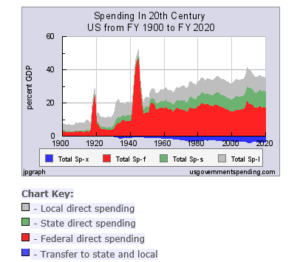
    Putnam examines and largely dismisses the notion that this phenomenon might be a result of women entering the workforce.  Instead, he suggests, the more likely cause is the rise of television.  What he misses is the explosion in the size and scope of government at all levels:

    Government grows at the expense of civil society.  There’s a crowding out effect.  And that reduced role for civil society translates to a diminished respect for traditional values.  It’s not shocking, to me at least, that the Baby Boom generation, the first to grow up with this expanded role of government as normal, was the first that turned away from both civil society and traditional values.

    “But,” a hypothetical social conservative might counter, “even if limited government will give us much the same thing, surely the right top men could institute policies that would get us there faster.”   But, that’s doubtful.  As I note before, vice will inevitably have a greater constituency than its absence.  Vice, after all, is fun, at least while you’re doing it.  And trying to tamp out others’ fun makes you, well, kind of a killjoy.  So, when you leave these decisions to the government, there’s going to be an inevitable drift toward vice.  That is unless there is an ongoing expenditure of energy on new moral crusades, which people tire of eventually, anyway, the inevitable trend is toward vice.

    So, in a world where politics is downstream from culture and where culture is downstream from politics, the sensible stand for social conservatives is actually libertarianism.  While it may not give them their ideal world, it is a world far closer to it than they can hope to achieve through ever-expanding government.