Category: Brewing

  • Mmmmm…Beeeerrrr

    Or, “How Nephilium Popped My (beer) Cherry”.

    So with all the posts by Nephilium and Kinnath, I decided to dip my toe into the beer making hobby. I don’t drink the quantities I used to (not a bad thing), so I opted to follow Nephi’s advice and go with nano brew kits from Brooklyn Brew Shop. The kit with brewing supplies was just under $60 but I will be making many batches with it. The recipe kits run about $16.

    Okay, before you IPA haters jump on your soapbox(and not a peep out of you, Ted), I chose single hop IPAs for a reason. I wanted to learn about the flavor and aroma profiles of the different hops. So there.

    Anyways, the kit comes with pretty much everything you need. Grains, hops, yeast, sanitizer. For the process, it has a gallon jug, an airlock, thermometer, plastic tubing, and a racking cane. Since I made this batch, I’ve added a beer hydrometer and grain bags(you’ll see why). Everything else I needed I had on hand.

    First off, everything gets sanitized. The instructions direct you to mix half the sanitizer with a gallon of water, the rest will be used during the bottling process. I’ve done a couple of modifications that I think make the process easier for me. I weighed the sanitizer and now I mix up a quart and also have a small spray bottle filled with sanitizer. It really made my life easier.

    After that, comes the mash in. It takes an hour, and you have to keep track of the temperature. It needs to stay between 144-152 degrees, with it being stirred every so often. You’re basically making oatmeal here. You don’t use the whole amount of water. There’s a pot of water at the right temperature waiting to be added later. You also need an extra pot because the “wort” that’s created by steeping the grains gets poured over the grains twice.

    So after an hour, “mashing in” is done. You raise the temperature to 170 degrees and strain into another pot. The liquid and additional four quarts of 170-degree water get poured over the grain twice.

    As you can see from the photo, this is why I went to grain bags. I made a bit of a mess.

    Next, we go to the boil. For this particular kit, it’s a 60 minute boil with hops added at specific times based on the recipe. Once the boil foams, you reduce to heat to a point where it’s just boiling, and start the process. I used the digital scale I use for charcuterie for weighing out the hops.

    You lose 20% of volume during the boil, which leaves you a gallon of wort. Cool it on ice to 70 degrees and into the jug. I added a hydrometer to my supplies because this is what tells you if you achieved the specific gravity(sugar content) the wort needs to ferment to the proper alcohol level. This is also where you add the yeast(“pitch”) and shake to mix and add oxygen.

    The sanitized tubing is stuck through the cap about an inch, and the other end sits in a bowl of sanitizer. The first couple of days is where the most aggressive fermentation takes place, and the airlock isn’t up to the task. After a couple of days, the tubing is replaced with the airlock, and then it’s time to wait for two weeks while fermentation does its thing. I’m using the guest bedroom closet that doubles as my “root cellar”. Close the vents and it stays a consistent 60 degrees during the winter.

    The other purpose for the hydrometer is the determine if the beer has reached the proper alcohol level. I didn’t have one for this batch, so I crossed my fingers and hoped the recipe was correct.

    At this point, the fermented beer is siphoned out of the jug and into a pot containing a half cup of water and three tablespoons of honey. The beer is flat, so this is the sugar that will ferment and provide carbonation. The beer is siphoned into sanitized bottles and placed back into the cool, dark closet for two weeks. I screwed up and lost my prime towards the end, so I ended up with six pints, instead of seven.

    After two weeks, it’s time to chill, pour, and see if I made something actually worth drinking.

    Hey! That ain’t half bad. Citrus notes from the Cascade hops, creamy mouthfeel with just a little bitterness on the finish and just the slightest hint of residual sweetness that will probably go away over time.

    I’m enjoying this hobby, so far. It’s not saving me any money and given that we’re in the Golden Age of craft brewing, it’s not like I can’t find dozens of awesome beers at the local grocery store. I chalk it up to my toddler “me do it!” mentality. It goes well with gardening, canning, charcuterie, etc. The second single hop IPA is in the closet and I have a Cream Ale cold fermenting in the bar refrigerator. Next up is a batch of raspberry mead from the recipe Kinnath posted. When Spring comes, other things will take place of brewing to keep me busy, but when it’s like this outside, might as well make beer!

  • And Now for Some Fabulous Fruit Mead


    I started making mead in 2003. Most people start with the Compleat Meadmaker by Ken Schramm. I did too. I have my signed copy, but I haven’t actually read it since about 2004. I started making wine from fresh grapes in 2008, and it influenced how I made mead. I started making beer in 2013, and it too influenced how I made mead. This article condenses my nearly 16 years of experience in making mead. It’s a long article, but I didn’t want to split up the content. So here it is.

    Let’s start with a few definitions: Session Mead (hydromel); Standard Mead; and Sack Mead. Per the 2015 Mead Style Guidelines from the Beer Judge Certification Program (BJCP), the “strength” of mead is classified as Hydromel, Standard, or Sack.

    Strength. A mead may be categorized as hydromel, standard, or sack strength. Strength refers to the alcohol content of the mead (and also, therefore, the amount of honey and fermentables used to make the mead).

    Personally, I hate the term “hydromel” which basically means watery mead. So, I prefer to use the term “Session Mead” for anything that I make in the 6% to 10% ABV range. The alcohol level of Standard Mead would be in the range of 12% to 16% ABV which is typical of table wine. And Sack Mead would be 18% ABV and beyond. There is an assumption that the higher the alcohol level, the more honey aroma and flavor will be present due to the increase in fermentable sugar. Yet a bone-dry mead at 16% ABV and dessert sweet mead at 8% ABV can have about the same amount of honey in the recipe. It all depends on the brewing process – what yeast is used; whether all the fermentable sugars are consumed in fermentation; whether or not the product is back-sweetened after fermentation; what the product is back-sweetened with (honey or cane sugar). But in general, a session mead is going to start with a lower original gravity (less fermentable sugar) than a standard mead which has a lower original gravity that a sack mead.


    Session Mead and Ale Yeast

    I use ale yeast when I am making a session mead. Ale yeast produces a different flavor profile than wine yeast. With the right ale yeast, the yeast can accentuate the honey character in the product to overcome the lower levels of honey in the recipe. I am particularly fond of Wyeast 1318 (London III). My second favorite is 1728 (Scottish Ale). I have had good results in yeast trials with 1335 (British Ale III); 1968 (London ESB); 1214 (Belgian Abbey Style); 1762 (Belgian Abbey Style II); and 3787 (Trappist Style High Gravity). The three Belgian style yeasts – 1214, 1762, and 3787 – are very good for making a stronger mead at 10% to 12% (nearly a standard mead) but with different flavors than you would get with a wine yeast.

    A key feature of ale yeast is “attenuation” which means the yeast does not consume all of the available sugar during fermentation. Most ale yeasts will consume between 65% and 80% of the available sugar during fermentation, and different ale yeasts attenuate at different levels. This allows a brewer to produce dryer or sweeter products by changing the yeast strain during fermentation. For any given yeast, there will be variations in the attenuation depending upon the type of sugar available – simple sugars vs complex sugars as well as the fermentation temperature and other factors.

    My favorite yeast, 1318, generally attenuates at around 75% in beer (malt sugars). It attenuates at dramatically different levels in other products. In cider, it attenuates at around 90% because apple juice is primarily simple sugars. In mead, the results are all over the place depending upon the type of honey used and the type of fruit used. This makes it nearly impossible to predict in advance whether the product will finish sweet or dry. It also makes bottle conditioning extremely unpredictable (can you say “gusher”?). While I love the flavor produced by the yeast, I have given up on bottle-conditioning anything I make with it. So, I almost always back-sweeten to taste; stabilize with potassium sorbate; then keg and force carbonate.


    Small-Scale Kegging

    A big challenge for beginners is how to keg and force carbonate small batches if you are not already set up to keg beer. The answer is that there is a growing marketplace for mini-keg and/or stainless-steel growlers which have lids with connectors for micro-regulators and picnic taps. There are many products available on the market (go peruse Amazon) and the variety of products can be confusing.

    A key issue is whether or not you want compatibility between small-scale kegging equipment and the standard kegging equipment used by most home brewers. In my case, I was already well-equipped with standard ball-lock equipment, so I focused on finding mini-kegs, micro-regulators and taps using ball-lock connectors. For me, I generally force carbonate in standard sized equipment. Yet, there are times when I want to dispense to a small system so that I take products to a party or class and then dispense under typical CO2 pressures. But I also want to be able to force carbonate an experimental batch without tying up my full-sized equipment. So, I looked for small-scale equipment with ball-lock connections.

    Here is a small sample of equipment you can find in the marketplace (these examples are all ball-lock connections):

    Small Cornelius kegs:

    • 1 ¾ gallon kegs (shorter versions of a standard 5-gallon keg) $85
    • Mini-regulator (get one that goes up to 25+ PSI to support force carbonation) $80
    • One-time use (non-refillable) 74gr CO2 cartridge $ 5
    • Keg Faucet (complete with ball-lock connector) $35

    Mini-kegs (growlers):

    • 5L stainless-steel growler/mini-keg (also available in 2L, 4L, and 10L sizes) $55
    • Ball-Lock lid for growler/mini-keg $35
    • Micro-regulator (get one that goes up to 25+ PSI to support force carbonation) $45
    • One-time use (non-refillable) 16gr CO2 cartridge (go buy in bulk on Amazon) $ 2
    • Picnic tap faucet and line $11

    Note: I have purchased from Williams Brewing in the past and have been happy with the quality and their prices. I have at least one of everything in the list above. I have also purchased from other suppliers and have been just as happy. All the ball-lock parts are standard and will work with any ball-lock keg or mini-keg. I have no idea if the size and threading of ball-lock lids for growler/mini-kegs is standardized so that products from different manufacturers will be compatible. As of this time, I have only purchased from the single manufacturer linked above.


    Session Mead Recipes:

    Finally, we get to the point. What do I put in the primary to make a nice fruit mead? Here is a generic recipe for session mead that will produce one gallon of finished product:

    • 2 lbs of honey
    • 3 lbs of frozen fruit
    • 1 gallon of water
    • 1 package of ale yeast

    This will produce about 8% alcohol by volume (ABV) assuming the product finishes nearly dry. You can bottle condition the product assuming you want semi-dry to dry product. Otherwise, you can back-sweeten to taste, then stabilize, keg, and force carbonate. For quick and simple fruit meads, I generally back-sweeten with cane sugar. If you back-sweeten with honey, it will get cloudy all over again and may not clear back up (depending on the honey you are using).

    One thing to note is that acid and tannin levels will vary dramatically by the type of fruit you use. I know some people that like dry mead, but they are in the minority, so most meads are packaged semi-sweet to sweet. Therefore, a decent level of acid (similar to wine) is pretty much a requirement to balance the sweetness of most meads. Tannins are optional in mead, but I think they are highly desirable. Thus, the mead maker needs to understand how much acid and tannin are in the fruits used to make mead to keep everything in balance. Fortunately, there are websites out there that provide detailed acid and tannin level information on a wide variety of fruits used to make wine and mead.

    The following are two example meads that I am making for a class this spring. All the ingredients, except for the yeast, were purchased at Walmart or Target.

    Blueberry Melomel

    • 2 lbs of Nature Nate’s Raw Unfiltered Honey (presumably clover)
    • 3 lbs of Wild Blueberries
    • 2 Meyer Lemons, zested and juiced (not shown)
    • 1 gallon of drinking water
    • 1 pkg of Wyeast 1318 London III ale yeast

    Blueberries are very low in acid. So, the zest and the juice of two large Meyer lemons is added to boost the acidity and provide a wonderful secondary aroma to the blueberry mead. Note that Meyer lemons have far less acid that normal lemons. Use only one large lemon if using regular lemons.

    All these ingredients will go into the primary. Fermentation is done on the whole fruit to provide the maximum extraction of color, aroma, and flavor from the fruit.

    This recipe produced a sugar concentration of 15.2° Brix (refractometer reading) which is equivalent to 1.062 S.G. and 8.3% potential alcohol.

    Raspberry Melomel

    • 2 lbs of Nature Nate’s Raw Unfiltered Honey (presumably clover)
    • 3 lbs of Raspberries
    • 1 gallon of drinking water
    • 1 pkg of Wyest 1318 London III ale yeast

    Raspberries are fairly high in acid. No adjustment is needed to make a well-balanced product. As before, all ingredients go into the primary. Note that raspberries mostly disintegrate in the primary. The product will probably need to be poured through a strainer at some point to remove all the bits and pieces of raspberry pulp from the product. This can be done as late as the final racking into a bottling bucket just before packaging.

    This recipe produced a sugar concentration of 14.8° Brix (refractometer reading) which is equivalent to 1.060 S.G. and 8.1% potential alcohol.


    Standard Mead and Wine Yeast

    Most mead makers try to make standard strength mead or sack strength mead and will use wine yeast to achieve anywhere from 12% ABV to 18% ABV or more. Some general considerations:

    • The strain of wine yeast used to make mead can have a dramatic impact on how long it takes the mead to mature (mellow out enough to be pleasant to drink).
    • The higher the alcohol level, the longer the mead takes to mature.
    • The higher the sweetness level, the easier it is to cover up the fact that the mead is still too young to drink.

    So, a sweet mead at 12% ABV will be pleasant to drink much sooner than a bone-dry mead at 16% ABV.

    Other important considerations:

    • Wine yeast can only survive until the alcohol concentration hits a certain level – its alcohol tolerance. Note that ale yeast also has an alcohol tolerance but it rarely comes into play in beer or session mead.
    • The alcohol tolerance of yeast varies by the strain of yeast – it typically ranges from 14% ABV to 18% ABV.
    • Wine yeast does not attenuate; it will consume all the available sugar until it hits its alcohol tolerance and then it will stop fermenting.

    One method to make sweet mead is to exceed the alcohol tolerance of the yeast. After the yeast hits is alcohol tolerance, any remaining sugar will not be fermented. So, you can start with a lot of honey or you can make honey additions during fermentation. Either way, this will result in the yeast hitting its tolerance and leaving residual sweetness in the product. This process is easy to abuse in my opinion. I know lots of people that will use champagne yeast to make syrupy-sweet mead at 18% ABV using this process. I generally loathe these meads.

    Another method is to start with just enough fermentable sugar to hit a desired alcohol level (somewhere lower that the alcohol tolerance of the yeast). The yeast will consume all the available sugar then fermentation will stall out leaving a dry product (basically how dry red wine is made). If sugar is added after this point, the yeast will start to ferment the added sugar. To prevent this, potassium sorbate is added first. The sorbate will prevent the yeast from fermenting any added sugar. Thus, one can make a sweet mead at a target alcohol level below the alcohol tolerance of the yeast. This is generally what I do.

    There are a lot of options out there for wine yeasts. I have only used the products from Lalvin. I have done yeast trails with five strains of yeast (shown below) that are commonly found in home brew shops:

    I’ve taken the results of my yeast trials to tastings when the products were about 4 months old, 9 months old, and 15 months old. In the earliest tasting (when the products were about 4 months old), 71B was the clear winner. It matures far sooner than any other yeast. RC-212 came in second place. D-47 was blah. K1V-1116 and EC-1118 (champagne yeast) were pretty terrible at that point. In the second tasting, (when the products were about 9 months old), RC-212 was considered the best having the richest, most complex flavor. But 71B was still a strong contender. D-47 and K1V-1116 were considered mediocre, and EC-1118 still was harsh and unpleasant. In the final tasting (when the products were about 15 months old), RC-212 was still in 1st place, and 71B was still a strong 2nd. K1V-1116 was finally maturing and pleasant to drink. D-47 was still bland and boring. EC-1118 still was harsh and unpleasant.

    Let me be clear. Champagne yeast is for making dry sparkling white wine, and it sucks in almost every other application (I don’t care what the chart up above says). Wine kits universally include EC-1118 because it is almost impossible to have fermentation failures using this yeast (it is aggressive, ferments fast, and will overcome most spoilage organisms unless you really, really fuck up sanitation). However, that does not make it a good yeast that produces good mead or wine. {Should you ever buy a wine kit, pick up a packet of 71B for a white wine or RC-212 for a red wine and throw away the EC-1118}

    In summary, if you are a beginner (I know you are not going to wait a year to drink your first batch) use Lalvin 71B. When you get to the point you have the patience to wait a year to drink your meads, both 71B and RC-212 are very good options. K1V-1116 produces nice characteristics in dark, bold fruits (think tart cherries, black currants, etc). D-47 will always be bland, so don’t bother. Don’t ever user EC-1118. {My opinions; your mileage may vary.}


    Bottling Standard Mead

    Bottle conditioning wine or mead that was made with wine yeast is a complex process (see méthode champenoise) that is an entire article by itself. This is not for beginners, so we will assume that everyone is packaging still (uncarbonated) products. There are three basic options at this point:

    • Wine bottles sealed with a cork
    • Beer bottles sealed with a cap
    • Beer bottles sealed with a swing top (grolsch bottles)

    Whether they are trying to cork or cap a bottle, most beginners start with the cheapest piece of equipment they can get their hands on. This results in poorly sealed bottles that tend to leak and also tend to produce grumpy brewers. I, on the other hand, have a habit of going big. My first corker was the little red “Portuguese” floor corker. I put 1500 or so corks through it. I eventually sold it and then went up scale to the blue “Italian” floor corker. I have put a couple thousand corks through it, and it is working great. I highly recommend starting with a floor corker if you have any intention of using standard wine bottles and corking them. My first capper was a light-weight bench capper that worked reasonably well, but one of the plastic parts broke after several hundred caps. There are no replacement parts, so I bought a second. Later, I bought two heavy-duty bench cappers on sale and gave away the one with the plastic parts. I bought two cappers so that I can bottle 12 oz and 22 oz (or 750 ml) bottles without resetting the equipment in the middle of a batch.

    For beginners, I would recommend the grolsch bottles. No equipment required to seal the bottle, and the product isn’t going to sit around long enough to benefit from bottle-aging in a standard wine bottle with a cork closure.


    Standard Mead Recipes

    One of the first considerations for the mead maker is to decide how to balance the honey and fruit characteristics in the final product. The honey can provide the primary aroma and flavor with the fruit in a supporting role. Or the fruit can provide the primary aroma and flavor with the honey in a supporting role. Or the honey and fruit can be in roughly equal balance. All three choices are considered legitimate, and I have made all three types of products. Some basic considerations:

    • Honey can be quite expensive. So, using a lot of high-sugar fruits or fruit-juices can allow less honey to be used thus saving a few bucks. Note that this skews the flavor profile towards the fruit in the finished product.
    • Fresh fruit is generally far to expensive to use in brewing unless you have direct access to the producer of the fruit and can buy it cheap. Store-bought fresh fruit is picked partially ripe and allowed to ripen on the way to the store with negative impacts on aroma, flavor, and sugar levels.
    • Frozen fruit is generally much less expensive than fresh fruit. And it is picked ripe and then flash frozen; so, it is actually better fruit for brewing. Freezing fruit also helps release the juice in the fruit. So, even if you acquire fresh fruit, it is still a good idea to freeze it.
    • Processed juices are generally much less expensive that frozen fruit. It is quick and easy way to add a lot of fruit flavor to mead. However, some of the nuance in the aroma and flavor is lost in the processing of the fruit into juice (see the wine article on how wine kits are made).
    • A nicely balanced product can be made at a reasonable price by using some combination of honey, frozen fruit, and fruit juice.


    Thus, we have three generic recipes that produce a gallon of finished product:

    Honey forward mead

    • 2 ¾ lbs (~1 qt) of honey
    • 2 to 3 lbs of frozen fruit
    • 1 gallon of water
    • 1 package of wine yeast

    This recipe will finish dry with any wine yeast and will produce 11% to 13% alcohol by volume (ABV) depending upon the fruit.

    Fruit forward mead

    • 2 lbs of honey
    • 2 to 3 lbs of frozen fruit
    • ½ gallon of fruit juice
    • ½ gallon of water
    • 1 package of wine yeast

    This recipe will finish dry with any wine yeast and will produce 12% to 14% alcohol by volume (ABV) depending upon the fruit and fruit juice.

    Balanced mead

    • 2 ¾ lbs of honey
    • 2 to 3 lbs of frozen fruit
    • ½ gallon of fruit juice
    • ½ gallon of water
    • 1 package of wine yeast

    This recipe will finish dry with most wine yeasts and will produce 13% to 16% alcohol by volume (ABV) depending upon the fruit and fruit juice.

    Any of these recipes can be back-sweetened with sugar or honey and stabilized with potassium sorbate prior to bottling.

    The following are two more example meads that I am making for a class this spring. Again, all the ingredients, except for the yeast, were purchased at Walmart or Target.

    Triple Berry Melomel

    • 2 lbs of Nature Nate’s Raw Unfiltered Honey (presumably clover)
    • 3 lbs of mixed Raspberries, Blackberries, and Blueberries
    • 2 quarts of White Grape Juice (Niagra)
    • 2 quarts of drinking water
    • 1 pkg of Lalvin 71B wine yeast

    Raspberries, blackberries, and white grape juice all have plenty of acid in them. The acid level in this product will be noticeably higher than in either of the two session meads above. This product will need to be back-sweetened to at least semi-sweet to be in balance. As always, all these ingredients will go into the primary.

    This recipe produced a sugar concentration of 20.4° Brix (refractometer reading) which is equivalent to 1.085 S.G. and 11.8% potential alcohol.

    Dark Sweet Cherry Melomel

    • 2 lbs of Nature Nate’s Raw Unfiltered Honey (presumably clover)
    • 3 lbs of Dark Sweet Cherries
    • 2 quarts of White Grape Juice (Niagra)
    • 2 quarts of drinking water
    • 1 pkg of Lalvin 71B wine yeast

    Dark sweet cherries have some acid, but not a lot. The white grape juice in the recipe provides the acid to give the finished product the proper structure. The acid level in this product will be similar to the two session meads above. This product can to be back-sweetened from semi-dry to semi-sweet and be in balance. As always, all these ingredients will go into the primary.

    This recipe produced a sugar concentration of 22.6° Brix (refractometer reading) which is equivalent to 1.095 S.G. and 13.3% potential alcohol. Note that cherries have a lot more sugar than most berries.


    Making the Example Recipes

    All these example recipes state they will make 1 gallon of finished product. A lot more than 1 gallon of volume is going into the primary, so the primary needs to have plenty of room for honey, water, juice, and whole fruit plus headspace for the foam that is produced during fermentation.

    I am using a 2 ½ gallon plastic bucket with a screw top as a primary fermenter for these small, experimental batches.

    A ½ inch hole is drilled in the lid for the bucket. A standard grommet (found on the lids of most commercial wine pails) is inserted into the hole. An airlock is inserted into the grommet to allow CO2 to escape during fermentation.

    After 3 weeks in the primary, I rack the product into a 4-liter wine jug from the plastic primary.

    I use a slotted spoon to remove the floating fruit from the product in the primary. I put the fruit into a standard kitchen strainer and press out as much juice as I can. Note that all my brewing equipment is dedicated to brewing. I never reuse my kitchen equipment in the brewing room.

    Depending upon how much juice is released from the fruit and how deep the sediment is on the bottom of the primary, there can be more than 4 liters of clear product in the primary.

    So, I start by racking part of the product into a pitcher then rack the remaining product into the jug. I top off the jug from the pitcher. Sometimes you have leftovers.

    After another three weeks in the 4-liter jug, the product is racked into a 1-gallon jug.

    There typically is enough clear liquid above the sediment in the 4-liter jug to fill the 1-gallon jug (sometimes not quite enough).

    The product will be left in the 1-gallon jug for another 3 weeks. Then it will be racked into a bucket and it will be back-sweetened to taste; sorbate will be added; and then it will be packaged (kegged or bottled).

    So, nine weeks from pitching yeast to packaging the product.

    All these products will be used as examples in a class less than three months after pitching the yeast. They will all be mature enough to enjoy, but a few more months of aging will be beneficial.

    There you have it. What are you waiting for? Go make some fabulous fruit mead.

  • The Nectar of the Gods


    So, what is mead?  Well, “mead” is a simple alcoholic beverage made with just honey, water, and yeast.  Or, alternatively, “mead” is a sprawling family of different types of alcoholic beverages where the primary fermentable sugar comes from honey.   Mead can be still or sparkling; bone dry or syrupy sweet; low or high in alcohol; and everything in between.  Thus, there are as many different ways to make mead as there are types of mead.  The following diagram shows which products generally fall under the umbrella of “mead”.


    Click to enlarge


    The common element in all these products is honey.  The color, aroma, and flavor of the honey used to make any given type of mead impacts the color, aroma, and flavor of the resulting product.  In a traditional mead, honey is the primary source of the aroma and flavor of the product although the choice of yeast can also have a dramatic impact on the final aroma and flavor as well.  In the other three types of products, we are trying to create a harmonious balance between the aroma and flavor of the honey and the aroma and flavor of the fruit, spice, and/or malt that you are pairing up with the honey.   Note that it is possible to screw this up and produce an unpleasant tasting product without suffering any actual brewing failures (yes, I have done this).  There can be a significant amount of trial and error involved.

    Monofloral versus polyfloral honey:

    The floral sources of the honey can and do have an enormous impact on the resulting mead.  If the bees visit many species of flowering plants when gathering nectar to make honey, the resulting honey is referred to as “polyfloral” honey – usually called “wildflower” honey.  If the bees visit a single species of flowering plant, then resulting honey is called “monofloral” honey – usually called a “varietal” honey.  Note that a product labelled as a “varietal” honey may include other floral sources, but at least 51% of the honey is from the named floral source.

    In general, varietal honeys are produced by placing the hives where commercial agriculture is producing vast fields of a specific crop (see alfalfa, buckwheat, avocado, blueberry, and clover below).  However, a single floral source honey can also be produced in the wild where large stands of a specific plant type – usually trees – are in bloom while few other plants are in bloom (see basswood below).


    Click to enlarge


    Note the dramatic difference in color of these honeys.  There is a corresponding difference in aroma and flavor as well.  Light colored honey tends to have a more delicate aroma and flavor.  However, there are exceptions such as basswood which has intense aroma and flavor in spite of being very light colored.  Dark colored honey tends to have a more robust aroma and flavor.  However, there are exceptions such as tulip poplar honey which is almost as dark as buckwheat but has a very mild, mellow flavor.

    I prefer to work with single-variety honey, because I think the results are more predictable and repeatable.  Wildflower honey can taste great and can make an awesome mead.  But you can only repeat the results if you buy from the same supplier who puts the hives in the same place every season of every year and harvests the honey at the same time each year.  Hobbyists and very small producers generally do this.  But wildflower honey from large-scale producers can be very different each time you buy honey.   In contrast, I have purchased single-variety honeys from different suppliers in different parts of the country in different years and the honey is always recognizable as being the same honey.  Note that terroir and climate affect honey production in the same way that it does grapes.  For example, your Napa Cab is different from your Aussie Cab, but they are both still recognizable as being Cab.  The same thing is true with single-variety honey.

    Let’s take a look at two of my favorite honey varieties to make mead with.  The following descriptions of the honey come from the National Honey Board.


    Tupelo Honey


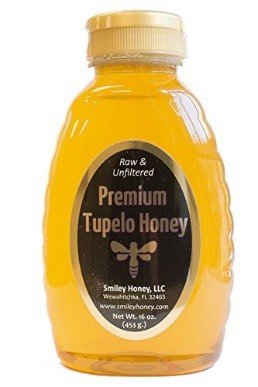
    Tupelo honey is a premium honey produced in northwest Florida. It is heavy bodied and is usually light golden amber with a greenish cast and has a mild, distinctive taste. Because of the high fructose content in Tupelo honey, it granulates very slowly.

    Blueberry Honey


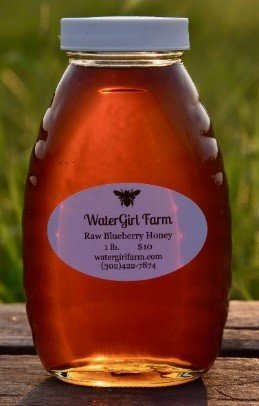
    Taken from the tiny white flowers of the blueberry bush, the nectar makes a honey which is typically light amber in color and with a full, well-rounded flavor. Blueberry honey is produced in New England and in Michigan.


    Note that blueberry honey gets it aroma and flavor from the nectar of the flowers of the blueberry plant (just like every other type of honey).  Blueberry honey does not taste like the berries that are produced later.


    As you can see, there are dramatic differences in the color of these two types of honey.  Thus, we expect to see dramatic differences in the color of the resulting mead.  Would it surprise anyone that there will also be dramatic differences in the aroma and flavor of each of the mead as well?

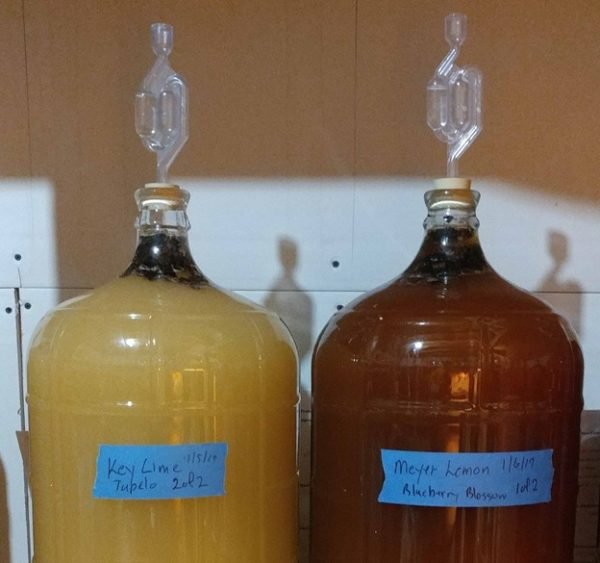
    The following picture shows two batches of mead made with roughly the same recipe but different varieties of honey.  The batch on the left is made with Tupelo Honey and Key Limes.  The batch on the right is made with Blueberry Honey and Meyer Lemons.


    These batches are two weeks old and are still actively fermenting.  They have just been racked from the primary and into the secondary.  They will stay in the secondary for 2 to 3 months.  For those with sharp eyes, there is 1 ounce of medium toast French oak beans (cubes) floating in the neck of the carboys.  The oak beans will eventually become water-logged and sink to the bottom of the carboy.

    So, color is all we need to worry about, right?  Well, no it doesn’t work that way.  See the two photos below: Orange Blossom Honey and Goldenrod Honey.  They look pretty much the same; but do they taste the same?

    Orange Blossom Honey is well known for having a bright citrusy aroma and a mildly citrusy flavor.  As for the goldenrod . . . let’s let the producer explain:

    The goldenrod blooms in late fall. It is one if the last flowers to bloom before winter sets in. This is one of the few types of nectar that we can smell as we enter the bee yard. Wikipedia calls the odor “rank”. It does smell like dirty gym socks. But do not let that turn you off to this unique honey.

    I have used goldenrod to make mead.  The honey is not particularly pleasant, but the mead turns out pretty good with a deep earthy aroma and flavor – the magic of fermentation and aging produces a transformation in the positive direction.  As a traditional mead, it works.  It might work in a braggot mixed with dark malts and suitably earthy hops.   But as a base for any fruit melomel, it probably isn’t going to work so well.

    Honey processing:

    The processing of the honey can also have an enormous impact on the mead produced from the honey.  The following definitions also come from the National Honey Board:

    Extracted honey:  Honey removed from the comb and presented in several forms, as defined in the United States Department of Agriculture Standards for Grades: (1) liquid, (2) crystallized or granulated, or (3) partially crystallized. This is commonly known, and referred throughout the document, as “honey.”

    Raw Honey: Honey as it exists in the beehive or as obtained by extraction, settling or straining without adding heat.

    Strained Honey: Honey which has been passed through a mesh material to remove particulate material (pieces of wax, propolis, other defects) without removing pollen.

    Filtered Honey: Honey processed by filtration to remove extraneous solids and pollen grains.

    And then, we’ll borrow a description from Bee Maid on pasteurizing honey:

    Pasteurizing honey is a very different thing than pasteurizing milk or other dairy products, and it’s done for very different reasons. Because of its low moisture content and high acidity, bacteria and other harmful organisms cannot live or reproduce in honey, so pasteurization is not done for that purpose. One of the few things that can live in honey is yeast, although if the moisture content is below 18% (as it normally is), the yeast cells cannot reproduce. All nectar (the source for all honey) contains osmophilic yeasts, which can reproduce in higher-moisture content honey and cause fermentation. While fermented honey does not necessarily pose any health risk, we try to discourage it, so Bee Maid pasteurizes its honey to kill any latent yeast cells that might be present and to remove any chance of fermentation.

    The bulk of honey that is available in grocery stores or big-box retailers has been pasteurized and filtered.  So that stuff in 8 oz jars you buy at the grocery store to put on your biscuits, well that has had the life processed out of it.  From a mead-maker’s point of view, the more processing that is applied to the honey, the greater the reduction in the aroma and flavor of the honey as well as the greater the reduction in the aroma, flavor, and mouthfeel of the finished mead.  To make mead, you need to buy minimally processed honey directly from the producer whenever you can.  The less heat involved in the processing, the better the honey will be for making mead.  {This thing here – the less heat involved – we’ll come back to this topic later.}

    Making Mead:

    Honey is full of yeast.  Dilute it with water and wait.  It will ferment.  Voilà.

    I have a friend that has done this.  He put a bucket of honey and water in his garage and left it there all summer in Missouri.  He came back in the fall and had mead.  He said it turned out pretty good, but I did not get a chance to sample the product.  And I can’t say that I would actually recommend anyone try this, but this is probably how mead was made for several thousands of years.

    At some point in the middle ages, people starting boiling honey and water and then pitching ale yeast.  The following is the oldest written recipe.

    ffor to make mede. Tak .i. galoun of fyne hony and to þat .4. galouns of water and hete þat water til it be as lengh þanne dissolue þe hony in þe water. thanne set hem ouer þe fier & let hem boyle and ever scomme it as longe as any filthe rysith þer on. and þanne tak it doun of þe fier and let it kole in oþer vesselle til it be as kold as melk whan it komith from þe koow. than tak drestis of þe fynest ale or elles berme and kast in to þe water & þe hony. and stere al wel to gedre but ferst loke er þu put þy berme in. that þe water with þe hony be put in a fayr stonde & þanne put in þy berme or elles þi drestis for þat is best & stere wel to gedre/ and ley straw or elles clothis a bowte þe vessel & a boue gif þe wedir be kolde and so let it stande .3. dayes & .3. nygthis gif þe wedir be kold And gif it be hoot wedir .i. day and .1. nyght is a nogh at þe fulle But ever after .i. hour or .2. at þe moste a say þer of and gif þu wilt have it swete tak it þe sonere from þe drestis & gif þu wilt have it scharpe let it stand þe lenger þer with. Thanne draw it from þe drestis as cler as þu may in to an oþer vessel clene & let it stonde .1. nyght or .2. & þanne draw it in to an oþer clene vessel & serve it forth

    A modern redaction of this recipe is:

    For to make mead. Take 1 gallon of fine honey and to that 4 gallons of water and heat that water til it be as long then dissolve the honey in the water, then set them over the fire and let them boil and ever scum it as long as any filth rises thereon. Then take it down off the fire and let it cool in another vessel til it be as cold as milk when it comes from the cow. Then take lees from the finest ale or else yeast and cast it into the water and honey and stir all well together, but first look before putting your yeast in that the water with the honey be put in a clean tub and then put in your yeast or else the lees for that is best and stir well together. Lay straw or else cloths about the vessel and above if the weather is cold and so let it stand 3 days and 3 nights if the weather is cold. And if it is hot weather, 1 day and 1 night is enough at the full. But ever after 1 hour or 2 at the most assay thereof and if you will have it sweet take it the sooner from the lees and if you will have it sharp let it stand the longer therewith. Then draw it from the lees as clear as you may into another vessel clean and let it stand 1 night or 2 and then draw it into another clean vessel and serve it forth.

    This is essentially the process that is used by most mead makers today.  Put honey and water in a pot; boil it; and remove the scum that rises to the top.  The only difference is that most modern mead makers will just raise the temperature of the honey water to 150 degrees or so to pasteurize the mixture and to remove the scum that rises to the top.  This is considered critical by many to getting the mead to clear properly after fermentation.

    Wait a minute.  What was that thing I said earlier – the less heat involved in the processing, the better the honey will be for making mead.  Why would I go to the trouble of getting unpasteurized honey only to put it into a pot with some water and then pasteurize it. This is where a big schism occurs between mead makers.  About two-thirds of mead makers “cook” their honey and water mixture.  The two primary arguments for cooking the honey and water are that it 1) provides a clean slate for pitching whichever cultured yeast you want to use and it 2) removes the proteins and waxes and whatnot that makes it very, very difficult to get mead clear.  The other one-third of mead makers say this is nuts because you are driving off all the aromatics that make the honey and the resulting mead so awesome.  So, I am in that one-third of mead makers that do not cook the honey and water.  I believe that a no-heat process produces superior aroma, flavor, and mouthfeel in the resulting products.

    And it is possible to get crystal clear mead without cooking the honey and water to remove the scum.  The key is using the right fining agents.   In wine making, the particles that cause haze in the wine carry a negative charge.  So fining agents that carry a positive charge will attach to the haze particles, and then they will drop out of suspension.  Wine makers will use egg whites (the proteins are positively charged) or gelatin (also proteins) or bentonite to clear wine.  It works great.  However, these types of fining agents fail miserably with mead because the particles in mead that cause the haze also carry a positive charge (being proteins and waxes and whatnot).  So, to clear mead, we need fining agents that are negatively charged.

    What works well is Super Kleer.  This product is actually two separate fining agents (Kieselsol and Chitosan) that get added to the mead at separate times.  From some website I have lost track of:

    Kieselsol (negative charge): Also known as silicon dioxide. Kieselsol works well with gelatine as a clearing agent, since it acts as a tannin substitute and works well to remove bitterness from white wines. When used with gelatine, the gelatine is added to the wine first, and then 24 to 48 hours later, a very small amount of Kieselsol is added, and should be racked off within 2 weeks. Kieselsol also works with chitosan.

    Chitosan (positive charge): As the name implies, it is composed of chitin, which is the structural element of the exoskeletons of crustaceans, such as crabs, shrimp and other shell fish. Chitosan is especially popular in clearing white wines, since it does not require the aid of tannins to clear, as do some fining agents like gelatine. When used with negatively-charged Kieselsol it is an effective remover of most suspended proteins and solids.

    Chitosan and Kieselsol are often sold as a set, in sealed liquid envelopes as fining A (negatively charged Kieselsol) which is added to the wine first, and then fining B (positively charged chitosan) added about a day afterwards. Chitosan has a reputation for being fairly gentle on the character of finished wine. 

    The following picture is an example of the results of using Super Kleer in mead.  Note that I frequently print out brew sheets to keep track of what I am doing.  I usually lean the brew sheet against the wall behind the carboy.  This image shows 12-point font printed on standard paper sitting just behind a five-gallon carboy full of mead.  When you can read a newspaper through a carboy full of product, the product is clear.


    Now someone out there is thinking “If negative particles make wine hazy and positive particles make mead hazy, will a mixture of wine and mead clear up on its own?”.  The answer is yes, in many cases.  This makes melomels (fruit meads) one of the easier categories of mead products for beginners to make, because melomels are more likely to clear up on their own without using fining agents.

    And that brings us to the end for today.  The next article will be on making melomels with a focus on how to be successful as a beginner with little prior brewing experience.


  • The Harvest – Making Wine

    The grape genus Vitis splits into three natural groups based on geographical location: North American, Eurasian, and Asiatic.  There are roughly 25 to 30 species of American origin and about the same number for Asia.  But there is only a single grape species for Eurasia, the Vitus viniferaVitis vinifera is itself comprised by the wild grape vine Vitis vinifera sylvestris (commonly referred to as V. sylvestris) and the cultivated grape vine Vitis vinifera vinifera (commonly referred to as V. vinifera).  So, all the well-known varieties/cultivars of grapes used for making wine today (such as Cabernet Sauvignon and Chardonnay) are members of a single species of grape vine, V. vinifera, and are the result of some combination of natural mutations and human tinkering over the course of several thousand years.

    There is no clear point in time where the cultivated V. vinifera became distinct from V. sylvestris.  In fact, hybridization occurs naturally between the two subspecies and occurred continuously throughout ancient times.  We know that the native range of that the wild grape vine V. sylvestris included the Mediterranean shores of modern Lebanon and Syria as well the border between Syria and Turkey.  However, there is archeological evidence of grapes being cultivated far outside the native range of V. sylvestris and into the far reaches of Israel, Egypt, and ancient Babylonia inside the geographical known as the ‘Fertile Crescent’.

    The cultivation of grapes did not occur in a vacuum, but was part of the overall development of agriculture in the Fertile Crescent.  Archeological finds indicate that wine was being made on a large scale as early as the 4th millennium B.C, in the ancient city of Godin Tepe in western Iran.  In addition to the traditional archeological evidence of wine making such as finds of broken pottery, some of the pottery still had residue that was subjected to an in-depth chemical analysis that confirmed the presence of grape products (assumed to be wine).  So, in the ongoing debate between wine people, beer people, and mead people over who started brewing first, the wine people now have scientific proof that puts start of intentional wine making back to at least the 4th millennium B.C.

    The cultivation of V. vinifera, and presumably the making of wine, spread from Iran and the Fertile Crescent throughout the Middle East and Turkey eventually making its way to Greece.  The Greeks spread viticulture to many locations around the Mediterranean including Italy and southern France; the Romans continued the spread viticulture throughout Western Europe.  Fast forward through several thousand years of history including the dark ages, the middle ages, and the renaissance and we get to modern viticulture (growing grapes) and viniculture (making wine) using any of several hundred cultivars of V. vinifera which humans have new carried around the globe.

    So how do we make wine.  It’s easy.  Crush the grapes; press out the juice; pour it into a vessel; and wait.  Wine will happen; it can’t not happen.  It might be good wine (lots of great commercial wine use spontaneous fermentation).  But it might be terrible wine as well.  To ensure success then, most wine makers inoculate with cultured yeast (someone got lucky with a spontaneous fermentation and has been culturing the yeast ever since).

    First off, we need to grab some grapes.  I guess we need white grapes to make white wine and red grapes to make red wine, right?  Not exactly.  V. vinifera grapes generally come in two types: green grapes and black grapes.  There are other colors as well, but they are just not as common as green or black grapes.  Regardless of the color of the skin, the flesh of the grapes is generally colorless ranging from pale green (green grapes) to pale grey (black grapes).  And the juice from V. vinifera grapes is also generally colorless ranging from pale green (green grapes) to pale grey (black grapes) – amazing how that works out.  Therefore, white wine can be made from almost any variety of V. vinifera grapes, but red wine is made from black grapes (or blends of grapes where the majority of the grapes are black).

    Thus, we can make white wine from Chardonnay grapes which are green; Gewürztraminer grapes which are dark pink; and Pinot Noir grapes which are black.  Yes, you really can make white wine (Blanc de Noirs); rosé wine (Sancerre Rosé); and red wine (Burgundy) from 100% black Pinot Noir grapes.  How can that be you ask?  Great question.  And the answer is that white wine is made with a white-wine process and that red wine is made with a red-wine process (duh).  The making of rosé wines straddles the fence.

    The white-wine process is as follows:

    1)	Crush the grapes
    2)	Press the juice from the crushed grapes
    3)	Clarify the juice (let the pulp from the crushed grapes settle in a tank)
    4)	Transfer the clarified juice to a fermentation tank
    5)	Inoculate with an appropriate wine yeast
    6)	Wait until fermentation is complete (with some caveats)
    7)	Clear the wine using fining agents or power filters
    8)	Bottle the wine


    Dry white wine is made by letting the yeast consume all the available sugar in the juice.  Semi-dry to semi-sweet wines are made by chilling the fermentation tank to just above freezing right before the yeast consumes all the sugar.  This puts the yeast into hibernation.  Then the wine is power-filtered through increasingly fine filter pads until the live yeast is filtered from the wine.  Finally, a big dose of potassium metabisulfite is added to ensure that refermentation does not occur once the wine is in the bottle.

    The red-wine process is as follows:

    1)	Crush the grapes
    2)	Transfer the mixture of juice and skins (known as must) to a fermentation tank
    3)	Inoculate with an appropriate wine yeast
    4)	Work the must until fermentation is complete
            a. The grape skins (and pulp) still have juice in them
            b. The yeast will ferment the juice in the skins
            c. The resulting CO2 will puff up the skins like little balloons so they will rise up from the liquid below
            d. The skins also form a cap which traps CO2 from the liquid below while it ferments
            e. Thus, the skins will rise up out of the liquid below and will begin to dry out
            f. Fermentation releases heat, so you get warm moist skins which can become a great environment to grow many bad organisms, so
                    i. You push the skins back into the cooler liquid below two or three times a day (punching down the cap)
                   ii. Or you pump cooler liquid from the bottom of the tank on top of the skins
    5)	Release the free-run wine from the tank (whatever wine flows out without pressing)
    6)	Transfer the skins to a press
    7)	Press out the remaining wine from the skins
    8)	Age the wine (typically in barrels, but tanks with wooden slats can be used)
            a. Premium wines typically age the free-run wine and pressed-wine separately to be blended to taste at the end
            b. Bulk wine will have the free-run wine and pressed-wine blended before aging
    9)	Clear the wine using fining agents or power filters
    10)	Bottle the wine  


    Some premium wines will have an extended period of maceration (soaking the finished wines on the skins) after fermentation is complete to extract as much color, aroma, and flavor from the skins as possible.  This is one way to make amazingly intense wines.  It is also a way to make hideously harsh crap.  Know what you are doing if you choose this path.

    Many red wines and some white wines will undergo malolactic fermentation at some point in the process.  Tartaric acid is the dominant acid in grapes, but grapes also have significant amounts of malic acid.  Malic acid is tart and harsh on the palate.  Certain bacteria (Oenoccocus Oeni) will convert malic acid to lactic acid which is softer on the palate and can provide a creamy, oily mouth-feel.  This malolactic conversion is not true fermentation, but it does release CO2 resulting in the appearance of a “secondary” fermentation in the wine.


    Alright, let’s go get some grapes Hmm, you better live on the west coast or near one of the handful of places in the Eastern or Southern US where the climate is moderated by proximity to an ocean, a river valley, or the Great Lakes.  Otherwise, you aren’t getting fresh V. vinifera grapes unless you have friends willing to jointly buy several tons of grapes and pay for refrigerated shipping.  Otherwise you are buying kits.

    Kits range in price starting around $160 for all-juice kits (no concentration); down to about $120 for high-quality concentrate kits; further down to around $80 for mid-quality concentrate kits; and at the bottom around $40 for crappy cans of concentrate.  What differentiates the kits is:

    • All juice is just that. 23 Liters (6 gallons) of pure wine grape juice.  You put it in a fermenter and go.  This provides the truest flavor profile for the wine.
    • High-quality kits are around 16 liters (4 gallons) of juice concentrate. You add 2 gallons of water to get to normal concentration and then ferment.
    • Mid-quality kits are around 10 to 12 liters (2.5 to 3 gallons) of juice concentrate. You have enough water to get to 6 gallons and then ferment.
    • The canned stuff is basically crap.  You add one or two cans of concentrate and a bunch of sugar into the primary.  Then add enough water to get to 5 or 6 gallons.

    The key is that the more concentrated the kit, the less of the true grape varietal flavor and aroma carries over into the final product.  It is possible to buy premium wine kits that have the juice still on the skins, but they are hard to come by.  You need to order in advance from some dealer, and the must comes refrigerated or frozen in 5-gallon pails.  I’ve seen friends use them, but I have no relevant experience.

    So how are wine kits made, in particular red wine kits?  We know that red wine is made by leaving the juice in contact with the skins during fermentation.  But kits aren’t fermented (otherwise, they would already be wine).  Here is one quick summary:

    White grapes are pressed, and the juice is pumped into a settling tank. Enzymes are added to break down pectins and gums, which would make clearing difficult after fermentation. Bentonite is added to the juice and re-circulated. After several hours the circulation is shut off, and the tank is crash-chilled below freezing. This helps precipitate grape solids, and prevents spoilage.

    Red grapes are crushed, sulfited and pumped through a chiller to a maceration tank, where special enzymes are added. These break down the cellulose membrane of the grape skins, extracting color, aroma and flavor. The tank is chilled to near freezing to prevent the must from fermenting. After two to three days the red must is pumped off, pressed and settled much the same way as the whites.        

    When the tank is settled, and the juice almost clear, it is roughly filtered, the sulfite is adjusted, and it is either pumped into tanker trucks for shipment to the kit facility, or into a vacuum concentrator.

    Vacuum concentrators work like the reverse of a pressure cooker. By lowering the pressure inside the tank, water can be made to boil at very low temperatures. By boiling the juice at low temperature browning and caramelization are prevented. The water comes off as vapor, leaving behind concentrated grape juice. Because some aromatic compounds can be carried away in this vapor, a fractional distillation apparatus on the concentrator recovers these essences, returning them to the concentrate after processing.

    Enzymes are used to extract color, aroma, and flavor from the skins of black grapes.  They do a good job of capturing the basic flavor profile of the grape variety, but it is not the same as fermenting on the skins.  It is similar to making beer with extracts versus all-grain.  You can get good products from extracts, but finesse is only achieved through total control of the mashing process.  It is the same story when making wine.  Concentrate kits make good wine.  Exceptional wine requires working with fresh grapes.

    So, what does an aspiring winemaker do if he doesn’t live where V. vinifera is grown and doesn’t want to work with kits?   The answer is hybrid grapes.

    Starting in the late 1800s, the French had a little problem.  Some “important person” in Germany imported grape vines from the United States to plant as curiosities.  Top Men did that kind of thing for amusement – creating gardens of plants from around the world.  The problem is that North American grapes evolved with a nearly microscopic insect called phylloxera which eats the roots and leaves of the grape vines (the insect lives underground all year except for a few weeks when they go airborne to reproduce).  It turns out that V. vinifera had a bit of trouble dealing with phylloxera, and phylloxera destroyed 3 million acres of vines in France.  Wine production was cut in half, and the trend was going from bad to worse.    Fortunately, some professor in Missouri figured out you could graft V. vinifera to American rootstock and the vines would survive, even thrive (and that’s an entirely different article).  European wine was saved!

    Until the gentlemen from Missouri saved the day, viticulturists (people that grow grapes) in France were frantically trying to hybridize V. vinifera with American grapes to get something to survive.  And they had some successes.  Several French/American grape hybrids were produced then that are now grown throughout the United States, but they have since been regulated out of existence in France to preserve the cultural integrity of French wine (and because the grapes aren’t anywhere near as good V. vinifera).  In the 1940s, a Wisconsin farmer named Elmer Swenson began hybridizing the French/American hybrids with American species found in the upper Midwest trying to find varieties that would survive in cold climates.  Elmer also had a lot of success.  Many of his grape varieties are in production around the Midwest.  In more recent years, Cornell University in Geneva, NY and the University of Minnesota have continued to have great success creating many new cold-hardy varieties.   Thus, wine grapes can now be grown in many places where V. vinifera cannot.  And while many of these varieties can produce wine that is quite good, none of them have reached equality with V. vinifera.  But if you live in Iowa and want to make wine with local grapes, you need to make do with the hybrids that grow close by.

    Finally, let’s make some wine.

    Remember that apple crusher we just bought to make cider.  I got bad news.  It won’t work.  You need to go drop another $500 on a grape crusher/destemmer.  You put the grapes in the hopper and turn the crank.  Crushed grapes fall out of the bottom, and the stems traverse a down a long tube of sorts to the end of the destemmer.  The destemmer part works, mostly.  But you still need to stick your arms into the crushed grapes and pull out the pieces of stems that make it all the way through.

    Crushing and destemming the grapes.


    Then we’ll splurge and buy a nice big wine press.   It’s big, and it’s heavy, and it’s awkward.  So, we’ll mount it to a platform with castors – castors that don’t lock.  Note when I say we, I mean the dude that bought the press; it ain’t mine.   Since the castors don’t lock, make sure you have 5 or 6 other people around that are willing to grab on to handles that don’t exit to hold the press in one place while you crank away.


    Pressing the grapes.


    And the beautiful juice flows out of the press.  Wait, why isn’t it colorless.  I was told that black grapes produce colorless juice.  Well, that’s V. vinifera.  This is a lovely French/American hybrid called Frontenac created by the wonderful folks at U of MN.  Unlike V. vinifera, the pulp of Frontenac is purple and the juice is a vivid red.  Even though we are following a “white-wine” process and pressing juice from the fresh grapes, we will be making a medium-bodied red wine.  The reason we are not fermenting on the skins is that Frontenac is notorious for smelling of green vegetation (i.e., like “someone just opened can of green beans”).  The common wisdom is that avoiding skin contact during fermentation reduces the undesirable aromas in the wine.


    Frontenac produces vivid red juice.


    Oh, and the acid level of Frontenac is about double the acid level of high-quality V. vinifera grapes.  So, don’t be thinking you’re making a nice dry red wine.  You’ll be making a sweet wine (or in my case, a type of mead called pyment).  There’s reason why no one pays 50 bucks for a nice bottle of Frontenac from Iowa.


    Disposing of the cake.


    Once all the juice has been extracted from the grapes, the outer frame is disassembled exposing the “cake” which is the dry, compacted grape skins.  In this case, a nylon bag is used as a screen to prevent the skins and seeds from being pushed out between the wooden slats in the frame.  The cake is dumped into a handy bin and then disposed of in a way that honors Gaia (e.g., composting, feeding to livestock, sending it FedX Ground to your Representative, etc.).

    Now you are ready to head to the brewing room.  Refer back to “Waiting is the hardest part”.  Fade to black.

  • Enslaving Yeast – Brewing an All Grain Beer

    That’s it.  We’re at the end.  Today we’ll go through the steps to make a beer starting with some malted barley, some hops, water, and yeast.  I just recently brewed up a batch of my Saison, which has been tweaked to my tastes, and is fairly popular with visitors:

    Saison:Three of the four ingredients

    Yield: 5 gallons

    Grain bill (assuming 80% efficiency)
    6 lb 2-row
    4 lb Pilsner (preferably Belgian)
    1 lb Crystal 8L
    1 lb Malted wheat

    Mash at 148 F for 90 minutes

    90 minute boil with the following hop additions:

    1.5 oz Saaz (2.8% AA) at 90 minutes
    .5 oz Saaz (2.8% AA) at 20 minutes

    This should end up with an OG of ~1.050, and a FG of ~1.008 for about 5.5% ABV

    Pitch with a saison yeast (I usually use 565, but used a new one for this batch).

    Mash TunSo what’s different with All Grain versus Extract?  For All Grain beer, you’ll be starting with malted barley, and need to convert the starches in it to sugars.  This is done in the mash. You’ll need a 10 gallon (or larger) insulated (or heated) container with some manner of filtering out the grain from the wort.  This can be done with a stainless steel false bottom, which is something like a colander with smaller holes that sits on the bottom of the mash tun over the spout where you’ll be draining the wort.  Or, you can use a bag that you attach to the side of the mash tun. The bags are cheaper, easier to clean, and prevent stuck sparges. The only problem is you’ll have to lift a heavy (water + grain) bag out of the mash tun in order to clean it.

    There are two main enzymes that will break the starches into sugars, Beta Amylase and Alpha Amylase.  Now, these two enzymes have different temperature ranges that they’re most active in, for Beta Amylase, that range is 131-149°F; for Alpha Amylase, that range is 145-158°F. Anything above those temperatures will denature (break) the enzymes, and they’ll stop working.  The lower the mash temperature, and the longer, the more fermentable sugars you will get from the grain. The higher the mash temperature, the more unfermentable sugars you’ll get. Too high of a temperature (or too short a mash time), and you’ll have unconverted starch in the beer instead of sugar.

    MaltUsing a calculator, we figure out what temperature we need to heat the water up to so that when it is mixed with Mashingthe malt, it’ll be at our expected mash temperature.  This is known as the strike temperature. In this instance, my strike temperature came out to be 160 F. We then take the malt and add the hot water to it.

    During this part of the process, you’ll want a mash paddle, which is used to stir up the mash and break up any dough balls that form.  You can use a big whisk (or spoon) if you want, but stay away from the $5 cheap plastic mash paddles, they do not work all that well for batches over 1 gallon..

    Then we put the top on the mash tun and wait, stirring it every once in a while if you so desire (which will up your efficiency a bit).  So since this is a 90 minute mash, we’ll take this time to discuss efficiency. There’s two main measures of efficiency that matter to the home brewer: Brewhouse efficiency – how much of the sugars did you get to out of the malt and into the fermenter at the end of the day (80% is a good standard to reach for); Conversion efficiency – How many of the sugars did you get out of the malt.  These numbers will be different, because there’s going to be some loss in water absorbed by the grain, left in the mash tun, and left in the boil kettle at the end.

    First RunningsThird RunningsSo while the mash is going, we’ll also heat up water for sparging (rinsing more sugars off the malt).  We want this water to be hot (I usually aim for 185 F and boiling), because we want to stop the conversion process, and because we need to get all of this wort up to a boil anyway.  I do a 2 step batch sparge. So after draining the mash tun, I’ll dump hot water over the grain and drain it twice.  You can do a single batch sparge, or even a continuous sparge (where you have a pump recirculating the mash over the grain).

    All of these runnings will go into the boil kettle and brought up to a boil.  At this point, you follow the same steps as you would for an extract batch. Now you just have to clean up your mash tun, and decide what to do with the spent grain.  The grain still will have some sweetness to it, and can be used to feed livestock, dried and ground into flour, or used in its current state to make spent grain bread.

    And for sitting through all of these columns, here’s a bonus recipe:

    English Mild

    Yield: 5 Gallons
    OG: 1.034
    FG: 1.008
    ABV: ~3.3%

    60 Minute boil

    Grain bill:

    4 lb Maris Otter
    1 lb Crystal 90 L
    1 lb Crystal 30 L
    1 lb Carapils

    Mash at 150 for 90 minutes.

    Hops:

    1 oz East Kent Golding (7.2% AA) at 60 minutes

    Ferment with a Dry English Yeast (I use WLP007 for this one)

  • Enslaving Yeast – All Grain Beer Part 3 – Water and Yeast

    Today, we’re at the last two ingredients used in beer.  Both of which are more complex than any of the ingredients we’ve talked about so far.  That’s right, now it’s time to talk about water and yeast.

    Water is usually the last thing most homebrewers start researching, which is somewhat strange since 90% of beer is water.  Water chemistry is why there are different styles of beers associated with different regions. The water sources used in those historic breweries were well suited for specific beer styles.  The brewers may not have understood the water chemistry, but they knew which beers tasted better when they made them. One of the most important of these towns is Burton-on-Trent and you can buy Burton salts to this day to adjust the chemistry of your brewing water.

    Most of the larger commercial breweries today will user reverse osmosis filters to make a neutral water, then adjust the water to what they want with additions.  Homebrewers do have the option to do this as well, but it increases costs, and prep time. If you want more visibility into what your tap water has in it, you can either contact your municipal water department, or ask at your local homebrew shop.  If you’re on a well or other water source, you may need to spring for the water test yourself.

    If you want to start making changes to your brewing water, Bru’n Water is a highly regarded site and source.  Be warned, it’s a deep subject and it can be really easy to get into the weeds here.  Another option is to brew a variety of styles, and see which ones you’re happy with and focus on them.  Then work on adjusting the water chemistry to better match the styles that you’re not happy with the results of.

    Yeast is the other dark art ingredient.  There’s an old saying in the brewing world that brewers make wort, yeast makes beer.  You’ve spent time and money to make this wort, and now you throw a living organism in there to spoil it in a very specific way.  While I named this series Enslaving Yeast, really you’re going to be building an all expense paid, luxury resort for the yeast and throwing them in.

    There’s two major families of yeast strains used in brewing: Ale, and Lager.  In general, Ale yeasts (top fermenting) can tolerate higher temperatures, and will produce more flavor notes.  Lager yeasts (bottom fermenting) need a lower fermentation temperature, and will generally be a slower ferment.

    The key to a good fermentation is healthy yeast.  The key to healthy yeast is making sure the proper nutrients are there, you pitch the correct amount of yeast, and the yeast is healthy to begin with.  One of the easier ways to do this is with a pitch rate calculator.  This will estimate how many healthy yeast cells you’re throwing into your wort, and how many you’ll need for a good clean fermentation.  The reason you want healthy yeast is to make sure they reproduce faster then wild yeast or bacteria, and you get the flavor profile you want.

    Another option is to make a starter (which you can also use to make extra yeast to set aside for a later batch).  To make a starter, mix up some fermentables (DME is the preferred one here) with water in a ½ to 1 gallon jug (or flask if you want to look fancy), put on an airlock, and shake it up on a regular basis.  You can also buy (or build) a stir plate to keep the yeast agitated for the day or so it will take for them to propagate enough. Then you can cold crash the starter, pour off the liquid (which would technically be a very flavorless beer), and pitch (or save) the yeast.

    If you want to harvest yeast from a commercial source, save some dregs of a bottle conditioned beer, and pitch those into a small starter.  Step that starter up a couple of times (say from 16 oz. to 32 oz. to 64 oz.) and you’ll have a viable amount of yeast to pitch. Keep in mind your sanitation here, and some brewers do use different strains of yeast to bottle condition their beers then they do to ferment them.  There’s quite a few threads around on the homebrewing forums talking about who uses what.  I’ll say that I detected no difference between the Saison DuPont yeast and the WLP565 in a batch I made.  Also, that if you go with Ommegang yeast, it ferments hard and fast… use a blow off tube.  Harvesting dregs is also one of the few ways you can attempt to culture some items such as the lambic blends (for sour beers).

    The last thing you’ll want for your yeast is a stable temperature range in their preferred temperature range.  Different yeasts have different preferences, and they will generate heat themselves as they go through the fermentation process.  While temperature control is generally believed to be really important, as long as you have stable temperatures, you’ll generally be able to make good beer (so don’t put it next to a heating/AC vent).

    That’s the ingredients, next we’ll go through the mash.  The only difference between all grain brewing and extract brewing.