Category: Congress

  • On the Composition of the US Military and Being a World Power

    In the comments on Pie’s article about the Internet (Thursday, 5 Dec Noon Post), I saw some comments in a subthread about the size and composition of the military that sparked some thoughts I decided to share because I find it a fascinating discussion topic for libertarians. I hope it hasn’t already been covered before, but even if it does, I hope I can offer something new on the subject for the Glibertariat.

    I first must ‘confess’ that I subscribe to agreeing (generally) with George Nash’s configuration of where libertarians fall in the political taxonomy in his seminal work “The Conservative Intellectual Movement in America since 1945.” First published in 1976 as a graduate thesis, it’s been reprinted and I’ve read a more recent, updated edition. Some of you may disagree and that’s fair enough, but in any serious consideration of the size and scope of the military, undergirding has to be some coherent theory of valid political action of the government in the area of foreign affairs, trade, and immigration, all of which impact what specie of military you think is valid to have. As a concrete example, do you think the US military should protect US commercial shipping the world over? The Founding Fathers themselves certainly did, and since I consider myself a ‘constitutional libertarian,’ I note that even President ‘Mr. Yeoman Farmer’ Jefferson was willing to “send in the Marines!” to “the Shores of Tripoli” to stop the Barbary pirates from playing around with US shipping. It was an issue that Jefferson explicitly ran on against John Adams – the payment of US tribute of to the “petty tyrant of Algiers.” This dated to the Founding of the republic, by the way, and so it can’t be claimed this didn’t inform the creation of the Constitution itself. From the wiki:

    The United States had signed treaties with all of the Barbary states after its independence was recognized between 1786-1794 to pay tribute in exchange for leaving American merchantmen alone, and by 1797, the United States had paid out $1.25 million or a fifth of the government’s annual budget then in tribute.[12] These demands for tribute had imposed a heavy financial drain and by 1799 the U.S. was in arrears of $140,000 to Algiers and some $150,000 to Tripoli.[13] Many Americans resented these payments, arguing that the money would be better spent on a navy that would protect American ships from the attacks of the Barbary pirates, and in the 1800 Presidential Election, Thomas Jefferson won against incumbent second President John Adams, in part by noting that the United States was “subjected to the spoliations of foreign cruisers” and was humiliated by paying “an enormous tribute to the petty tyrant of Algiers”.[14]

    Washington himself as the very first President asked Congress in 1794 – at the urging of the people – to appropriate money for a Navy to deal with the problem as the US tried to grow its economy by participating in international commerce.

    Which brings us back again to a serious question about the size and scope of the military and what capabilities should the US military have. Should the US have some capability to do Non-Combatant Evacuation Operations (NEOs, in military acronymese) from places like US Embassies around the globe? If so, what does that imply about the capability required to operate in the environments where embassies are found: from mountains, to jungles, to deserts, to large cities, to coastlines, in all weather conditions, in extremis, day or night? What about places from which one must be able to launch those operations if you don’t have bases around the world? Should this capability be expanded enough to cover the ability to pull out a large US expat population living abroad in a country that suddenly turns shitty in a short time? Or is your foreign policy one that includes the ability to tell the American people: “Meh. Tough shit. Shouldn’t live in those kinds of places.” Or does your foreign policy include only an economic response to such provocations? How about if someone shoots down/blows up a US commercial passenger jet in foreign airspace, for example, like the one over Locherbie, Scotland. As an interesting footnote, a high school classmate and friend of mine, Rob “Shaggy” Schlageter (with a pair of burgundy corduroys and green shirt, he would was a dead ringer for Sccoby’s partner!) was killed aboard that plane.

    Which brings us to a much more interesting question, I think, about the size and scope of the US military and its capability. Most of us have grown up for most, if not all, of our lives with the US as an (or THE) unquestioned military superpower. It isn’t just the nukes, either. We can put a missile in your bedroom window or men with guns over your bed while you sleep anywhere in the world on relatively short notice. It is a truly awesome capability and I give you my solemn vow it is true as someone who has seen and been a part of what we can do at the very, very pointy tip of that spear. But it has always been an article of faith for me that the most powerful military in the world should be commanded, led by, and serve the most moral/ethical people. And I can’t envision any sane theory of morals or ethics in which it is any other way. That is to say, I would like to hear Sam Harris, or Zombie Hitchens, or any moral relativist defend the notion that it makes no difference whether the US had the stronger military or Imperial Japan did. Or Nazi Germany. Now if this all seems a bit farfetched or Ivory Tower, let me offer up the thought experiment that really has formed the basis for this entire piece:

    Close your eyes and try imagine that the United States is NOT the world’s pre-eminent military. Imagine instead that Jane’s and all of the other publications that track such things consider the U.S. to be the 6th strongest/most capable military in the world. Once you have really got that in your head, the first thing that pops into my mind is ‘who are numbers 1 through 5?’ And if you can’t imagine five countries above you that make your blood run cold, I hope you will take my word and know it comes from a place of love when I say that you haven’t traveled enough to have an informed opinion on the debate about the size and scope of the U.S. military. Because I can sure imagine 5 countries I wouldn’t want to see above us on that list; and I can also imagine what it might mean if the list ever looked like that in some dystopian future, and what that would mean for human suffering the world over, much less right in our own backyards.

    I am staunchly against military adventurism the world over because it costs lives and for over two decades a good chunk of those were my friends. Or at least it sure does seem like it because I have and know of a fair number of dead guys and gals, including some by their own hand. I have also seen the horrors of what people are capable of doing to each other the world over and I know that the US military acts as some kind of brake on those horrors, even if it’s just in an ancillary way by protecting sea lanes of commerce, for example. Piracy still claims a measurable chunk of the world’s commerce every year. I believe I’ve read that rust destroys 10% of the world’s (steel) infrastructure every year in a book called, boringly, “Rust.” It’s the bane of any salt-water Navy. For perspective, in the mid-1980’s Ronald Reagan’s Secretary of the Navy James Webb – yes, later Senator Webb (D. Va) and Dem. Presidential-candidate – quit in protest over the refusal of Congress to fund a 600-ship Navy. We are currently at 430 ships.

    I want to add one final coda to this piece and that is to state that even in the principle of self-defense you can’t escape the costs necessary to engage in it. Thus, I believe any discussion about the Nation’s military should also include a discussion of how much GDP (as a percentage) one is willing to spend on it. The budget need not be anywhere near as complicated as it is if we simply allocated as a percentage of prior year’s GDP. It’s how NATO allocates its member funding requirements. Trump has made the point recently that we spend “4.2% GDP in real numbers” for our military. Google claims it is 3.145%. Whatever the number is, we could likely agree that some % is sufficient for our needs, set it there as a matter of statute or even Amendment,  and allow for additional spending only in the event of a Congressional Declaration of War or contingency for 60 days or less (tie the Amendment to the War Powers Act for all I care). I will also set aside for the moment the notion that these kinds of discussions

    The point is that if there is a justification for having a military then we, as a Nation, should have a conception of what that is in both a philosophical and a practical sense, which informs its missions and capabilities, as well as its costs. Clausewitz said famously: “We see, therefore, that War is not merely a political act, but also a real political instrument, a continuation of political commerce, a carrying out of the same by other means. War is the continuation of politics by other means.” While one can argue about definitions enough to perhaps find some kinds of violence between people that doesn’t quite fit the definitions, for my purposes and those of this article it suffices to describe the relationship between a military and the political institutions of a modern nation-state. The Founding Fathers found out quite early on that the world would not simply let us ply our trade and mind our own isolationist business. The realities of modern shipping and aviation, along with the number of Americans living abroad, suggest that we must have some kind of military with some kind and level of capability, which implies training, equipment, etc. (It also implies a certain level of economy to produce material in peacetime sufficient to support those military capabilities, a place for them to be stationed, places to train, etc.)

    Could it and should it cost less? Absolutely. I could tell stories to make you blush from my friends at the Pentagon in procurement. My own experiences in the military validate the notion of September splurging in order to maintain at least last year’s funding, as just one example. But I think sweeping statements about wiping out entire branches of the military need to be considered in light of both the needs and the capabilities of a military and what that really means. In my opinion, too many libertarians (at least that I’ve seen) simply wave this all away or argue for absolutes with nary a word turned toward what I see as essential considerations that any serious person would at least mention in broad discussion of these subjects.

    Wanting to end the military adventurism abroad is a laudable goal, towards which we should all be working, but we undermine its cause with simplistic screeds. The people who wrote the Constitution were rightfully leery about standing armies, having just expelled one. They also conceived of – and led – a nation of independent-minded citizens who could and would defend themselves by force of arms on their own account and believed, as a people of commerce, that they would rather pay for a military than pay tributes to warlords attacking and kidnapping US citizens abroad.

    I’ll let the Glibertariat hash out the details and point out the flaws in my thinking in the comments.

    Ozy

  • Term Limits, Part III (Fin)

    Read the previous installments: Part 1, Part 2

    Reduce the Market Itself

    Donald Trump campaigned explicitly on term limits. His proposal was that Senators serve only two terms (for a total of 12 years) and that Congressmen and Congresswomen serve only 3 terms (a total of 6 years, for those of you who slept during civics class). This might be the smartest idea that Donald Trump has ever had (proving – yet again – the wisdom in the aphorisms about the blind squirrel and the broken clock).

    The surest way to drastically reduce (notice I said “reduce,” not “rid”) the political system of the vast sums of money that pour in from both Democrat and Republican PACS, SuperPACs, Unions, lobbyists, etc., is to make the “market” for politicians be so low that the amounts involved wouldn’t rise high enough to finance a political campaign. You want to discourage both buyers and sellers from even attempting the transaction by making the transaction worth as close to zero as possible.

    I have one friend who believes the answer is what I consider the “death penalty” for re-election campaigns: one term only for all politicians, effectively killing the re-election campaign market entirely. Senators would serve their single 6 year term and Congress-critters would get only 2, then it’s just like they say at the barber shop: “Next!” No one would then be able to use the cover of a re-election campaign as their primary vehicle for soliciting donations – and, more importantly, for paying off those donations by changing the legal status of either the donor or the rest of the citizenry, via legislation, or favorable tax status, or whatever form the payoff takes. I believe this is too radical an approach and undermines some of the institutional considerations that led the Founders to structure the government the way they did. My friend’s idea is too much like Congress’ approach for me. “When all you have is a hammer, everything looks like a nail” to quote Maslow’s Law of the Instrument.

    Congress’ approach to things they don’t like, as illustrated in part II, is simply to declare it illegal and then order the King’s Men to enforce the edict. What has been repeatedly demonstrated, however, is that simply prohibiting something by declaration – even with draconian enforcement methods and penalties – is an abysmal failure in every instance, including campaign finance reform. Prohibition of alcohol didn’t stop drinking; the War on ________ hasn’t stopped ________. Feel free to fill in your pet cause: Poverty rates are the same today as they were right before Lyndon Johnson declared “War!” on it, notwithstanding the billions and perhaps trillions spent on that war. It’s even worse for Drugs.

    I think this attempt to obliterate the entire re-election market has too much downside, no matter how much it personally appeals to me. There are valid arguments for some continuity and retained “corporate knowledge” in the legislative arm of the U.S. government. I believe a middle-ground between the current system and the “no re-election” position is – and I can’t believe I’m saying this – exactly what Trump campaigned on: 12 years for Senators, though I would give 8 years (4 terms) to Congressman, because of the shorter terms. While it doesn’t completely eliminate re-election campaigns, what it would do – along with staggered elections every two years for one-third of each legislative chamber – is drastically reduce the “value” of any given legislator to near zero, because:

    1. There  is a “lag time” required for new legislators to build up their graft mechanisms er, re-election campaigns. It takes some time to find one’s way around. I would give the incoming Senators and House members the benefit of the doubt for one Senatorial term. Twelve years is plenty of time to pursue something, do some legislative “good”… and then it’s time to go back to the productive/working class. The same is true of the 8 year limit for Congressman. After that, as far as I’m concerned, you’re a government welfare recipient of the worst kind.
    2. Term limits act as a natural check on legislative overreach and ambition. Legislators know that 90% reelection stat and they all are “banking” that they won’t be in the 10% who get sacked. The law is NEVER applied to Senators and House members like it is to the rest of us, as Obamacare showed everyone. (No Senator waits in line at the DMV like you do, either). If, however, the clock is already set for a fixed term, old Congressman Know-Nothing might think twice about what he does to you and me with his pen if he knows in the not-very-distant future, someone may very well be looking at his or her cell phone records, just like yours and mine.
    3. Large donors would have to take far greater risks with the possibility of no payback for their dollars. Given the current system involves tiered rates for those higher up in the food chain, the time compression of term limits would mean that by the time someone gains the experience to become a Committee Chair, they would likely no longer be facing a re-election campaign to solicit donations, perhaps one or two in Congress. In other words, as one spent more time in the Senate or House with the clock ticking in the background, one’s “value” (measured as the ability to control a legislative agenda, pass legislation, or the like) would get lower with the passing of each day because of dwindling chances for re-election.
    There are other means to fortify this Amendment, in my opinion, but those are best left to a different post.

    More Possible than Ever?

    Term limits has been an issue many times in the past. It typically draws favorable polling from both sides of the political aisle. Republicans currently control 33 state legislatures and hold 32 governorships. It takes 34 states (2/3) to call for a Constitutional Convention. It takes 38 to ratify an Amendment. If Trump – and Republican allies – are truly the party of limited government, or want to leave a legacy that would make everything else they ever do pale in comparison, they should be activating on this issue. If the people of these United States want to begin the process of taking their Freedom back, this should be what is one everyone’s lips and on their state and federal representative’s agenda: Term Limits. The Chicago Tribune pointed this out just after the election. They – as a mouthpiece for Democrats since their inception – lament such an idea, but it’s the only form of “campaign finance reform” that will ever work. Given Democrats (and most Republicans) complete ignorance of economics and free-, gray-, and black-markets (the latter two of which are created by politicians via taxes and legislation), don’t expect a big push for this forgotten promise any time soon. Politicians know how their bread gets buttered and they aren’t anxious to see that change. It’s the one campaign promise Trump made – and got right – without sticking his foot in his mouth. We should actually hold him to this one.

  • Term Limits, Part II

    Filthy Lucre
    A. Take money/donation; then 1. Gin up angst; 2. Claim “dire consequences, UNLESS;” 3. Pass law; 4. Start Over at A

    How to Justify Legislation

    Every problem, no matter how small or inconsequential, can never fail to be magnified, exaggerated, or – with a suitably agenda-driven Media – simply concocted out of whole cloth by partisan hacks and flacks, and then subsequently painted as requiring government intervention of one kind or another. This typically take the form of regulation, spearheaded by those fearsome warriors of the quill, our legislators! Boies Penrose, the PA legislator and US Senator (quoted in Part I) was famous for his “squeeze bills.” These were essentially extortion threats to businesses within a given industry that they would be strictly regulated by Congress…unless they paid a certain fee to the re-election campaign of a given politician. If you think this is some relic of the past, please understand: your Congressional representatives do this to businesses ALL. OF. THE. TIME. In other words, Virginia, not only is there not a Santa Claus, but Congress is also not very different in result from the Mafia in its shakedowns of legitimate businesses. It is nothing more or less than the same ol’ protection rackets, except the armed thugs who enforce it will not be Bent-Nose Tony or One-Eyed-Vito, instead it will be the police who, like good soldiers, will dutifully take to the streets to ensure the dictates of their legislative masters are not being ignored by the tax-donkeys citizenry.

    If this seems unduly harsh on the police, consider the underlying circumstances that instigated the encounter between Eric Garner and New York police in 2014. All of the hoopla was around choke holds, police training, and racism, but flushed down the memory-hole is the reason police had an interaction with Eric Garner in the first place: he had been picked up previously in that same area for selling “loosies,” a term for single cigarettes. “Why is selling loose cigarettes a crime in the first place?” you might ask. Well, that was made a crime by the New York legislature, which came on the heels of massive sin taxes they placed on cigarettes, which created the black market for “loosies” in the first place. In summary then, the police killed a man, Eric Garner, who wasn’t even selling cigarettes at the time, but was in the same location where he had been arrested for it previously, and when the police encountered him trying to break up a fight, the fatal encounter began. The real tragedy goes unaddressed amidst all of the hoopla over whether the encounter/actions of the police were racially motivated or not. It wasn’t racially motivated: it was economically motivated… by the legislature. Tobacco companies, demonized (justly or not) by the public because of their actions in hiding what they knew about tobacco’s addictive properties and higher statistical propensity to cause lung cancer, became easy, easy targets for legalized extortion by your elected representatives: the legislative branch. No one stood up in defense of those companies’ rights – and that is exactly how everyone’s rights are diminished. If you won’t stand up for the rights of the most odious among us, then you don’t really believe in those rights. You just like to tell yourself that you do.

    Only a rare few magazines or authors have focused on this point.

    Why were the cops so hell-bent on stamping out the sales of loosies, which typically sell for 75 cents a pop in Staten Island (and two times or more that in Manhattan)? New York City boasts the highest cost for cigarettes in the nation, with a pack ranging anywhere from $12 and up. The city lays its own taxes on top of the state’s, in an effort both to raise revenue and discourage use of tobacco.

    The result is a thriving market in sales of loosies and black-market cigarettes more generally. Since 2006, the tax on cigarettes in New York have risen 190 percent and cigarette smuggling has risen by 59 percent, writes Lawrence J. McQuillan of the Independent Institute. Whether it’s liquor, drugs, or cigarettes, when you try to stamp out something consenting adults want, you cause as many or more problems as you ameliorate.

    – Nick Gillespie (from the above-linked article).

    And if you didn’t believe these phenomenon are in any way related, note this article from the Wall Street Journal, subtitled, “The New York Police Department has made nearly 33% fewer arrests citywide so far this year for selling untaxed cigarettes.”

    The police enforce the will of the legislature. The legislature sells legislation to political donors. Political donors, both corporate and individual, become ‘constituents’ only one way… You aren’t a recognized constituent until you start donating to politicians’ campaigns. Prior to that time, the only time politicians can “hear you” is if you manage to make a big, loud, angry mess that gets picked up by the Media and either (a) they see an opportunity to leverage you/your issue, or (b) might harm their reelection chances.

    In summary thus far, we know that (a) even the previously-believed-to-be-a-saint Father of the Country, George Washington, bribed the voters in his district to win election; (b) no modern legislator comes anywhere moderately close to being even half of the gentlemen that George Washington genuinely was; (c) and Lord Acton was entirely correct.

    Devalue Politicians by Changing the Economics

    Having identified the root of the problem, the question becomes how to control the flow of money into politicians’ coffers. Every attempt has failed because even honest and well-intentioned reformers seek to attack the “money” – and not the underlying economics that are at the heart of the entire corrupt enterprise. It is unfortunately the same kind of animist thinking that sees banning guns as the only way to stop shootings, or banning drugs as the way to lower drug addiction, etc. The simplest, most effective solution is to attack the basis of the underlying economy: in this case, to make politicians not worth buying. (In the other examples, it’s to stop re-enacting Prohibition by legislative fiat over and over again, but those are separate subjects for their own space another time.)

    What does it Cost for Legislation?

    The primary method politicians use to avoid the sticky problem of being directly bribed by their political donors has been the “re-election campaign as front for political quid pro quo.” That is the current popular way to solicit money from paying customers. (i.e. political constituents who would be affected by a given piece of legislation). While it is true some politicians have found other, more ingenious variations on this theme, political campaigns continue to be the primary vehicle for buying legislation.*

    (*One could, however, set up a really bizarre shell Foundation/corporation/non-profit with subchapters in other countries, and then launder your political payoffs through said Foundation, where all of your friends, family, political lackeys, and supporters also happen to work and draw a handsome salary… some while simultaneously drawing a government salary! You might even get your disbarred spouse to give highly-paid speaking engagement in countries where you might be able to affect United States foreign policy in favor of those paying for said speaking gigs… just an idea, of course.)

    Buying legislation (i.e. making a large donation to a campaign) for your own benefit, or to the detriment of your competitors or smaller businesses, always comes with the possibility that the legislative promise can’t be kept. The best thing the Founding Fathers did was to spread the legislative power out over a wide geographical and political area, and make it procedurally difficult to gain a consensus. Congress is filled with a myriad of committees and subcommittees and byzantine rules of procedure. That reality is already priced into the market for legislation. It’s why politicians are constantly campaigning – they don’t just get big sacks of money by promising they’re going to pass a law. It’s not that simple.

    The junior Congresswoman from Nebraska, for example, is unlikely to be able to do squat legislatively for several terms. Thus, what she can expect to solicit in campaign donations is not very much. Committee Chairs, however, have power to control agendas for their committees, including what legislation gets “tabled” or considered. Consequently, those committee chairs are “worth” more on the market for legislation/campaign donations. Speakers, the Whip, and other senior party members are obviously worth even more again, and so on up the line, which is why Presidential elections are like the Super Bowl of political campaigns: the money spent is a direct reflection of the power that the “marketplace” for political control sees in the Presidency: the veto power, the right to appoint Supreme Court justices for life, foreign policy, the military, etc.

    Now that we start to understand how the legislative sausage is made, or perhaps more importantly, who actually pays to have the legislative sausage made, we’re in a better position tot understand what real “reform” would look like. It also helps explain why reform never really happens: because the people who pass the laws are in no way going to slaughter their own cash cow. In the next part I explain how to change the economics around politics.

  • Chapter 15 – The Stay

    “Well, if they’re going to issue the stay at all, now would be a good time! I mean, if no stay today, by tomorrow night my guy is eating with the big metal spoon, if you know what I mean.” I’m on the phone to appellate defense in Washington, D.C. I look at my watch. The digital face reads 00:31. Ten-thirty in the morning east coast time.

    “Alright, bye.” I hang up. I’m looking at documents, but I’m not really seeing anything – David Ponder’s record book, letter from his wife, character statements, and I’m trying to imagine how I’m going to defend him tomorrow. I’ve got one last motion that I’ll bring at the close of the government’s case. One last grasp that has a sound basis in law, but the judge will deny it, at this point. It’s a technicality.

    From the beginning I’ve had the sense that they have mischarged the offense, perhaps intentionally. The prosecution has charged it as willful disobedience of a superior commissioned officer. Under the UCMJ, that has a stiffer penalty than the more general charge of violating a lawful general order, such as the order from the Secretary of Defense, to take the anthrax shot. The government has charged it as violating the specific Navy Lieutenant’s order, but there is an old case that stands for the proposition that merely repeating a higher order can not make an orders violation the more egregious willful disobedience of a superior commissioned officer. It is called the “ultimate offense doctrine,” but it probably isn’t going to work. Nothing else has.

    I’m tired. I haven’t slept much, I need a shave, and my back is killing me from my tiny desk chair at home and my broken desk chair at work. I need to get David’s sentencing case together, review my opening statement and closing argument, and make sure all of the documents are in my case file, with necessary copies for each of the jurors…

    My head nods and I realize I’ve drifted off at my desk. I look at my watch and see it’s 2:33 am. I rub my face and decide to take a walk.

    The building is dark and empty, except for me and the feisty Okinawan cockroaches. I stroll the dark corridors, my sneakers making a light tread on the tile. I stretch my arms over my head as I walk to the entrance. Out the window, the open field beside our building is dark. I can barely see the slope that I know rises up to a road that runs next to the next set of office buildings and the barracks.

    I hear the phone in the clerk’s office ring, but there’s nothing particularly unusual about that at this hour because of the time difference; people frequently fax documents from the States during our nighttime in Okinawa. The fax ticks away, a counterpoint to the flying bugs banging into the glass on the door and the light just outside of it. Tick-tick-tick. In seven hours, David Ponder is going to be facing a jury, and likely going to jail. Unless that fax. . .

    I walk hurriedly to the defense clerk’s office and go to the fax machine behind the clerk’s desk. Letter-sized sheets are spitting out, face down. I grab one and flip it over to see if it has anything to do with me. The cover sheet is from the Washington Navy Yard. I grab the whole stack while more keep sliding out.

    My eyes flick over the words.

    “YEAHHHHHHHHHHH!!!!!” I let out a guttural yell that echoes throughout the empty building. “Can you feel that, huh!?! Baby, can ya’!?” My best Ace Ventura, hips thrusting, fist pumping. I want to cry with relief. We beat the clock by seven hours. I’ve kept my promise to David and his wife, to Jason Stonewall, and Vittolino Arroyo. We have a stay from the Navy Marine Corps Court of Criminal Appeals. No one’s going to jail tomorrow.


    I take my time packing up and make a few copies of the stay. Before I leave, somewhere near 3 am, I take a ten-penny nail and hammer the stay to the prosecution’s office door. I don’t do it right through the middle, however, because I’m still a Marine Officer and someone might bitch to the CO about a nail in the door. I hammer the nail just deep enough to look like someone was careless; but not all the way through the door, for example. I also place the nail an inch or two above the middle of the sheet, close enough to the top of the sheet that it doesn’t look like it was intentionally in the middle, but far enough down that someone will have to either rip the paper in half to get it off or pry out the nail. It’s an asshole move, to be certain, but I know it might be all the satisfaction I’m going to get in the long run, so I indulge myself. It’s the little “fuck yous” that matter in life. It won’t be the last laugh, but it’s enough to make me smile as I walk to my car for the drive back to Kadena Air Base officer housing and my wife and four daughters.

  • Chapter 14 – Secretary Cohen’s “Four Points”

    In December of 1997, the anthrax vaccine manufacturer was shut down and could not manufacture anything related to the AVA. Notwithstanding that hurdle, Secretary of Defense William Cohen announced that before the mandatory program would begin, it would have to meet four prerequisites:

    1. Supplemental testing, consistent with Food and Drug Administration standards, to assure sterility, safety, potency and purity of the vaccine;
    2. Implementation of a system for fully tracking personnel who receive the anthrax vaccinations;
    3. Approval of appropriate operational plans to administer the immunizations and communications plans to inform military personnel of the overall program;
    4. Review of health and medical issues of the program by an independent expert.

    (My emphasis added). One cannot help but wonder why condition number one would need to be in place if the DoD was confident in the safety and potency of the AVA, as it had started saying publicly. In fact, this appears to have been nothing more than a media campaign to assuage fears because none of these four “prerequisites” were ever met before the program kicked off, which is exactly why the manufacturer had been shut down in the first instance. Each of these factors revealed fundamental flaws with the program from its inception.

    With regard to point 1, “supplemental testing” may well have been the worst idea for the DoD could have ever come up with because what it demonstrated, unequivocally, was failure of lot, after lot, after lot of the vaccine.[1] One of the first findings in CBER’s February 1998 inspection was that “there is no validation of the length of time sublots are held until they are used in a lot. Sublots have been held longer than three years prior to use. There is no stability data to support this hold time.”[i] Lest this seem picayune, consider a little more history of one particular Sublot:

    Sublot AV456 was produced . . . in 5/95 [and stored] until 3/97 at which time it was transported to the formulation room . . . with other sublots to make FAV039. Here it was discovered that AV456 was contaminated with mold, and it was destroyed.[ii]

    While some may say that the fact that it was caught is good news, it ignores the other, older sublots where mold or other impurities were not caught. One finding (among many like this) is particularly noteworthy:

    Lot FAV023 was filled on 12/13/93 and passed a potency test on 3/29/94. It was submitted for redating on 4/2/97 and was placed in the stability program (zero time) at the same time. It is reported as failing potency on 4/2/97. It was tested again on 8/12/97 and is reported as failing potency. A fourth potency test conducted on 10/6/97 is listed as passing by 0.01. There is no investigation into the original result and justifying the additional testing.[iii]

    This finding is most disturbing because it indicates a testing regime that ignores negative test results – twice! – and somehow chooses to validate a subsequent positive after two negatives. How can one know which test result is correct with two failing and two passing results? And how many people would like to line up, roll up their sleeve, and take their shots from that particular vial of the vaccine? Stability testing of biological products is crucial because of the possibility for these products to break down over time. Note that this lot was “filled” in 1993. Four years later it passes a test by .01 after having failed twice previously. This particular finding is in no way isolated: Lots FAV 010, 011, 018, 021, 022, 025, 028, 040, 041, 042, 043, and 044 all had at least one failed potency test that was not investigated and then a passing result was somehow chosen over the negative one.

    FAV016 has its own uniquely disturbing history.

    Lot FAV016 had 6579 vials rejected due to particulates during post-filling inspection. These particulates were not identified, nor was an investigation conducted. The batch was released.

    Someone, somewhere, had unidentified “particulates” injected into them. As a practical aside, one has to wonder how those individuals will get VA compensation if they have an illness as a result of this contaminated product being injected into them in light of the DoD’s positions that there had only been 74 adverse events from the vaccine.

    The list of violations goes on and on and includes several different lots being tested and found with such contaminants as “penicillum species” – a danger to anyone allergic to penicillin; cladosporium – a fungus that can cause infections leading to “rough skin, black lesions on the hands, and sometimes a brain abscess”; altenaria – a fungus that can cause dermatitis in humans; micrococcus – a contaminant that is relatively harmless to humans; staphylococcus saprophyticus – a significant cause of urinary tract infections; staphylococcus epidermis – a significant cause of opportunistic infections, usually for those with some skin puncturing, such as needle/IV intrusions, medical appliances, or surgery; and staphylococcus capitis – another infection causing bacteria.

    Despite all of these findings and more in February of 1998, the program was launched on May 15, 1998, with Secretary Cohen claiming, with a straight face, that “all conditions for implementing the anthrax vaccination program for the total force have now been met.”[iv] There is simply no possible way Secretary Cohen could have said that in good conscience if he was aware of the inspection results in February. And given everything going on around the program, it is impossible to imagine that he didn’t know – because he manufacturer “voluntarily” shut down for “renovations” in January 1998. In reality it shut down as a result of the Notice of Intent to Revoke letter by the FDA, otherwise the February inspection results would have resulted in the facility’s license revocation.

    The second condition of the program was tracking of immunizations. Two DoD briefers talked extensively on November 6th, 1997, about a new program that would be used to track immunizations and of the terrific job the new system had done in Bosnia.[v] At a March 1998 Senate Armed Services Committee hearing, however, Dr. Randolph Wykoff, the Associate Commissioner for operations at the FDA, and Mark Gebicke of the GAO, pointed out that the Bosnia experience left a lot to be desired, particularly of the tracking of immunizations under an IND protocol for an investigational encephalitis vaccine.[vi] In fact, one report used the word “abysmal” to describe it.[vii] Once again, the Assistant Secretary of Defense for Health Affairs promised to get better, but also talked about a new procedure for getting relief from the FDA from the requirements of an IND.  The FDA associate director maintained that the “FDA firmly believes the IND process, as defined in our rules and regulations, is sufficiently flexible [for DoD’s needs]. Additionally, FDA is convinced the Department of Defense has the scientific, clinical, and logistic capability necessary to comply with the requirements of the IND process.”[viii] Evidently, however, they could not and did not do it in Bosnia. A GAO report issued the same day stressed the importance of being able to track vaccine immunizations in order to ensure “that (1) sufficient supplies of vaccines will be available at the various worldwide immunization sites; (2) vaccines that are older than their 1-year shelf life are destroyed; and (3) records of vaccines received, administered, and destroyed are kept to allow for monitoring and tracking.”[ix] Worse yet, the GAO found that during the “Bosnia deployment in 1997 . . . DOD could not account for more than 3,000 (20 percent) of the total number of doses sent to Bosnia.”[x]

    Requirement number three was that there would be approved operational plans to communicate to service members about the anthrax vaccine program. Whatever the operational plans were, in May 1999, the Department of the Air Force circulated a memo to its judge advocates, specifically defense counsel, telling them that “a small number of military members have refused to follow their commander’s direct order to take the [anthrax] vaccine” and that the cause of their fear in taking the shot is “misinformation obtained from web sites set up by special interest groups[.]”[xi] This was a frequent refrain of the DoD, in front of Congress and in the press. The memo also points members to the DoD’s own website, which was established after the program had begun, in order to “counter” in DoD parlance “internet misinformation.” Evidently then, in March of 1998, when the program was about to begin, prong number three hadn’t been met, either.

    It is worth noting that the Army’s AVIP Agency existed solely for the promotion of the anthrax vaccine. It was budgeted at $74 million over a six-year period (FY99-FY05).[xii] No other military medicine program has ever needed to be forced on servicemembers with an orchestrated campaign of this type. William Arkin, a defense writer and former Army intelligence officer observed that “. . . this is the Pentagon versus its own service members. It is a depressing window into the breakdown of discipline and basic confidence in the political and military leadership. That has nothing to do with the Web.”[xiii]

    Criterion number four probably cost the DoD as much credibility (if one can say it had any to begin with) as number one. It would be comical were it not for the stakes involved. Secretary of Defense Cohen announced that there would be a “review of the health and medical aspects of the program by an independent expert.”[xiv]

    Doctor Gerard N. Burrow was the doctor who allegedly reviewed the program at the request of Deputy Secretary of Defense Rudy DeLeon. Dr. Burrow concluded that “[t]he anthrax vaccine appears to be safe and offers the best available protection against wild-type anthrax as a biological warfare agent.”[xv] Unfortunately, Dr. Burrow is a professor of gynecology at Yale University School of Medicine, a specialty that one would not normally associate with some expertise in weaponized anthrax toxins. When that unfortunate snippet from his CV leaked out, Dr. Burrow was subsequently asked by Congress to testify about his review at a 29 Apr 1999 hearing. He declined to appear. Instead, in a 26 Apr 1999 letter to Representative Christopher Shays (R-CT), Burrow stated that

    “[t]he Defense Department was looking for some [sic] to review the program in general and make suggestions, and I accepted out of patriotism. I was very clear that I had no expertise in Anthrax and they were very clear they were looking for a general oversight of the vaccination program.”[xvi]

    The DoD’s claims of misinformation on the internet had a particularly hollow ring in light of its blatant lack of honesty and candor in having something as simple as an independent review conducted. Nothing was ever done about this lie that was foisted off on American servicemembers. No one has ever been taken to task for this laughably blatant fraud perpetrated on U.S. military members and the broader American public.

    Thus, in the end, the DoD’s four-point plan to reassure the public and servicemembers of the safety of the anthrax program – as a prerequisite to beginning inoculation – was nothing more than a PR campaign that ultimately cost the DoD credibility that it did not have to spare. As the truth came out, and was certainly made available on the internet and elsewhere, the DoD’s cries of “misinformation” went unheeded. Service members on active duty and in the reserves began to refuse or leave the service rather than take the anthrax shot.

    If the DoD’s actions appear incredible, the FDA’s inaction is equally baffling.  The FDA is charged, under the Administrative Procedures Act, with the duty and authority to regulate, among many other things, the safety of drugs and biologic products. The FDA has had no hesitation in cracking down on manufacturers who do not comply with its regulations or decisions. The cases in the D.C circuit are legion with the FDA disciplining manufacturers who try to market a drug for a purpose not clearly delineated on the approved labeling or who otherwise fail to comply with IND protocols.[xvii] For some reason, however, in the case of the AVA, the FDA had an absolutely incestuous relationship with the DoD, a third-party who was NOT even the manufacturer! Letters were exchanged between the two agencies regarding non-compliance with IND protocols after the IND protocol was not properly administered in Bosnia. At the March 17, 1998, hearing, the following colloquy took place on this issue between Senator Rockefeller and Dr. Wykoff, the FDA’s associate director for operations.

    Rockefeller:  . . . It’s also not clear to me that FDA’s shoes are entirely clear or clean on this matter. In fact, some would say lax.  I think that FDA and DoD have been exchanging letters about all of this for some months now. And the fact is that seven years after the Gulf War, the situation is still not resolved. If DoD does not adequately answer FDA’s questions with respect to these matters and others, what is FDA going to do about it?  . . . And why, for example, was it necessary for the Presidential Advisory Commission to address the waived informed consent matter six years after the end of the war? So I put to you what FDA would recommend and would do if DoD does not come in compliance more?

    Wykoff:  . . . We have tried very hard to make sure that they are absolutely clear what our rules and regulations are and what our expectations are. We believe that they understand that. We believe that they have the capability of complying with all of our IND rules and regulations. As to whether they will comply in the next deployment situation, obviously we can’t predict that.

    Rockefeller: And if they don’t, is there anything that you can do about it?

    Wykoff: Yes, sir. Obviously, there are a range of options that we have. We would have to determine what the specific concerns are. That drives what are specific actions would be.

    Rockefeller: What are some of the options?

    Wykoff: Well, as we interact with any trial sponsor, we learn more about their ability to conduct IND trials, we would be more or less willing to grant waivers or exemptions to particular requirements.  We could hold them to more – all of the requirements as outlined in the rules and regulations – based on their performance.[xviii]

    It boggles the mind to think that the first words out of the FDA’s mouth are talk of waivers for non-compliance with regulations, particularly in light of DoD’s history in this area. There was, and is, a clearly documented squeamishness on the part of the FDA to step in and bring the DoD into compliance. In downright shocking testimony before a House Committee, Dr. Kathryn Zoon of CBER was questioned by Rep. Christopher Shays (R-CT) about the FDA’s regulatory responsibility.

    ZOON: This is a licensed vaccine. If a physician uses it or DoD uses it, that does not really fall under our jurisdiction.

    SHAYS: So it’s your statement before us now that if DoD doesn’t abide by the protocol, you have no responsibility? That you have set out a requirement? Who is responsible then? Who’s going to make sure that DoD abides by the protocol, if you don’t do it?

    ZOON: We don’t have the authority.

    SHAYS: I can’t believe – I just want to say, Dr. Zoon, I cannot believe that you have just said under oath that you do not have the responsibility to deal with this issue or the authority. You said you don’t have the authority.

    ZOON: I said – yes, that’s correct.

    SHAYS: That is your testimony.

    ZOON: We don’t have the authority.

    SHAYS: Well then who is going to protect our men and women if you aren’t going to do it? Who? Who has the authority?

    The tricky part of this testimony is that it is partly correct. The FDA does not regulate end-users of a product, normally. That is, they do not tell an individual doctor, for example, that he cannot use a drug off-label. Two important caveats to that “normal” example, however. First, the normal patient can’t and isn’t being compelled by their doctor to take anything; they can decline, and they can also sue if something happens as a result of the doctor’s malpractice. A military member has neither of those options. Second, and more directly on point, if the end-user is participating in a clinical protocol, then the FDA does regulate that user. Thus, the DoD’s participation in BioPort’s IND application in order to get an indication against aerosolized anthrax should make them subject to FDA regulation, just as the DoD was during the Gulf War when applying for a Rule 23(d) waiver. FDA’s willingness to accede to DoD’s interpretation essentially allowed the DoD to completely slide on their responsibilities. Some lawyer’s or regulator’s intentional misinterpretation of the FDA’s own regulations resulted in an open abdication of the FDA’s regulatory role over the AVA.

    FDA officials have repeatedly acceded to DoD doctors’ interpretations of the anthrax vaccine label, as well. This is an absurdity, particularly appalling in light of the DoD’s involvement in the manufacturing process. The DoD fundamentally became a manufacturer, for all intents and purposes, and the FDA looked the other way, hiding behind the fiction that the DoD was an “end-user” when convenient. The DoD was involved from the very beginning in the development of the anthrax vaccine. Additionally, when problems arose with the manufacturer, the DoD sent in its own ‘inspection’ teams to ensure the supply of the vaccine. The DoD had paramount liens on every piece of equipment that the manufacturer has. A GAO report in June 1999 found that

    DOD has made a significant investment in renovating BioPort’s biologic facility to meet the military’s requirements for anthrax vaccine . . . Since 1988, DOD has provided about $112 million in contracts, including options, to help ensure the viability of the anthrax vaccine biologic facility. As shown in figure 1, DoD’s contracts provided monies to (1) produce the vaccine, (2) renovate and expand the production facility, (3) provide various support services, and (4) purchase equipment to enhance production capacity. DoD has also provided contract terms and conditions to help ensure the success of the anthrax vaccine program. For example, under Public Law 85-804, which allows for government indemnification of contractors for unusually hazardous risks, DoD indemnified BioPort against product liability. In addition, DoD agreed to allow the company to sell up to 200,000 doses of anthrax vaccine to others, using government-furnished equipment rent-free, after DoD’s requirements are met.[xix]

    Amazingly, this is chump change compared to what the Defense Contract Auditing Agency found in 2000! That report led to an Inspector General Investigation. Notwithstanding numerous audits that found that the company was not financially viable, BioPort requested contract amendments that included $1.28 million in bonuses for senior management that amounted to 109% of the managers’ base salary. This was deemed an “unreasonable expenditure” by the DCAA in light of “BioPort’s current financial condition.”[xx] Okay, so someone disapproved, right? Well, sort of, because the manufacturer had almost no real financial incentive to produce an FDA approved vaccine under its contracts with DoD to begin with: the contract paid the manufacturer 90% of the contract price before the FDA ever inspected the vaccine. Yes, read that again.

    Put another way, BioPort only got paid 10% more for the product being approved by the FDA. At one point, the Department of Justice was looking into criminal charges as some $6 to $8 Million of the money provided to the manufacturer was unaccounted for.  Additionally, the fact the former Chairman of the Joint Chiefs of Staff Admiral William Crowe was a co-owner of the facility, as well as Dr. Robert Myers, (formerly of MDPH and MBPI) can hardly escape attention. Crowe was the first senior military officer to have come out publicly in support of then-Democratic party candidate for the Presidency, Arkansas governor Bill Clinton. While both Crowe and Myers disavowed any “inside” preferential treatment from the DoD, one must wonder if the decision to award BioPort the contract had anything to do with either’s presence as an owner. Finally, emails from inside the DoD suggest that the agency actually had its own people “on site.” During hearings held by Representative Christopher Shays in May 1999, an email was sent from Brigadier General Eddie Cain, the Director of the Joint Program Office for Biological Defense, to an Army Colonel John V. Wade. In the email Cain warned that “[I]f you think Congressman Shays was critical of the current relationship between FDA & DOD, wait until he finds out that DOD is calling the shots on-sight.” [sic][xxi] When this email surfaced during the court-martial of Air Force Captain (and medical Doctor) John Buck, the FDA had “no comment.”

    The FDA has, for whatever reasons, backed down from the DoD to the point that after the warning letters, the notice of intent to revoke, and a failed inspection thereafter, the agency still withheld pulling the manufacturer’s license because the DoD interceded on behalf of the company. In a June 25, 2000, interview with the Vancouver newspaper The Province, Mark Elengold, the Deputy Director for CBER, explained what happened.

    The FDA held off pulling the licence, in part because it would have left the U.S. Department of Defence [sic] – which had just announced that all soldiers were to receive anthrax vaccine – with no domestic source.

    “This is a one-source product so we tend to try to work with firms and put additional monitoring steps in to avoid revoking the licence,” said Elengold.  The prestigious British medical journal Lancet reported at the time that ‘a plea from the Pentagon has prevented an ‘eleventh-hour’ closure of the only U.S. producer of anthrax vaccine,” according to an e-mail to DND [DOD?] medical headquarters in February 1998.

    Elengold confirmed the Pentagon sat in on a crucial call to the company in which he discussed revoking the licence.”[xxii]

    Electronic mails surfaced in and around 2000 show not only did the DoD convince the FDA not to revoke the license, but DoD also attempted to bully both the manufacturer and the Government Accounting Office at the same time. In one e-mail, a Pentagon official discusses how other agency supervisors were urging the U.S. Food and Drug Administration and the manufacturer of the vaccine to release lots that had been held up for scrutiny by them (the FDA). This despite Secretary Cohen’s public insistence on supplemental testing to ensure safety of the vaccine, one should remember.

    On Feb. 22. 1999, Dr. Michael Gilbreath, a civilian Pentagon biological defense employee sent an email to U.S. Army Brig. Gen. Eddie Cain, then Director of the Joint Program Office of Biological Defense (JPOBD). Gilbreath wrote that he had “received information this morning from BioPort that individuals within the DOD contacted them and threatened that DOD would circumvent BioPort and contact the FDA regarding availability of anthrax vaccine lots currently under review at the FDA . . . Any such actions by DOD would be inappropriate.”[xxiii]

    E-mails also reveal that the Pentagon was having trouble countering the U.S. General Accounting Office’s assertion that the vaccine is improperly licensed, and that it has not been proven safe and effective. Cain indicated in one e-mail that then Secretary of Defense William Cohen would be writing to the GAO, whose findings have consistently gone against the Pentagon, to protest “the expertise put on this (vaccine) project” by the watchdog agency.

    “If we cannot answer these questions, we (DOD and the Administration) are in big time trouble,” Cain said in the May 3 e-mail. “…We are digging ourselves a hole that will be too difficult to crawl out of.”[xxiv]

    The FDA also stood by when adulterated vaccine was shipped to the Canadian military and when 59 Marines were given shots from expired lots of the vaccine.[xxv] The FDA’s complicity with the DoD’s actions has left service members with no recourse but to either take the shot, be court-martialed for refusing, or leave the service somehow if their commitment allows it. If the service member simply will not take the chance on the vaccine’s safety, the penalty for refusing is court-martial with a certain conviction. Military Judges simply would not hear that the vaccine is investigational, nor would they even allow service members to present that information to a jury. The FDA’s refusal to act leaves the judge with an out: if the FDA thought it was investigational, why wouldn’t they just issue an opinion to that effect? Worse yet, some military judges would not wade through the necessary materials in order to understand the FDA regulatory process and what an IND is, or they would find that the Secretary of Defense’s actions were in legal parlance “non-justiciable” disputes between “co-equal branches of government.”

    The member who fights will be convicted and punished. When an Air Force Doctor, John Buck, tried to submit evidence that the specific lot that he was to have received, FAV044, was subject to a recall because it was expired, the judge did not allow the evidence to come into court. The only option left for service members was to resign quietly, leave at the end of a service obligation, or fight behind the scenes to ensure that the law is followed. That is what a group of persistent officers had been doing from the word go.

    Endnotes

    [1] It would take up too much space to detail all of the failed lots, for their various reasons during the February 20, 1998, CBER inspection on the lots of AVA. Some of the more egregious violations are listed. See CBER Inspection report dtd 2/20/98 for a complete listing.

    [i] FDA Form 483 Inspectional Observations Feb. 4-20, 1998.

    [ii] Id.

    [iii] Id.

    [iv] May 15, 1998, SecDef memo.

    [v] Nov 6, 1997, background briefing

    [vi] Mar 17, 1998 Senate Hearing, Committee on Veterans Affairs Holds Hearing on the Nomination of Togo West as Secretary of Veterans Affairs and on U.S. Biologic Vaccines for Gulf War Veterans.

    [vii] “Abysmal” tracking job quote ????

    [viii] Id.

    [ix] GAO Report T–NSIAD-98-83 p.8 (March 17, 1998).

    [x] Id.

    [xi] 18 May 99 AF memo

    [xii] Charles Cragin, PDASD Reserve Affairs, testimony, 3 Oct 2000.  See: http://www.house.gov/reform/hearings/healthcare/00.10.03/cragin.htm

    [xiii] William Arkin, “Bugged by the Net”, Washington Post online, 27 Sep 1999.  See: http://www.washingtonpost.com/wp-srv/national/dotmil/arkin092799.htm

    [xiv] AVIP Impl ltr 18 May 98

    [xv]  See: http://www.defenselink.mil/other_info/burrows.html

    [xvi] Id.

    [xvii]

    [xviii] Mar 17, 1998 Senate Hearing, Committee on Veterans Affairs Holds Hearing on the Nomination of Togo West as Secretary of Veterans Affairs and on U.S. Biologic Vaccines for Gulf War Veterans.

    [xix] GAO Report GAO T-NSIAD-99-214,  (June 30, 1999)

    [xx] IG Report dtd March 22, 2000.

    [xxi] Dave Eberhart, Stars and Stripes.  May, 2001.

    [xxii] Ann Rees, “Their Dangerous Dose”, The Province [Vancouver, Canada], 25 Jun 2000

    [xxiii] E-mails Suggest Pentagon Pressured FDA On Anthrax Vaccine, Thomas D. Williams, Hartford Courant, May 17, 2001.

    [xxiv] Id.

    [xxv] See Most Dangerous Dose (Canadian article on vaccine) and GAO report on Marines T-NSIAD-00-36.

  • House Resolution 660: Congress Formalizes the Impeachment Inquiry

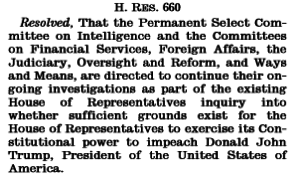
    H. Res 660 (complete text here) was approved 232-196, and lays out the rules of the investigation for two of those certain committees. At some point the investigations will conclude. The house can then choose to vote to impeach. Or not. Upon impeachment by the house, the Senate conducts a trial which ends with a vote on whether to remove the impeachee from office. So we are on step one of a three-step process. Let’s do a quick march through H. Res 660 and see what it actually says.

    “[It] bein’ the biggest crime of the last fifty Years and everybody wanted to get in the newspaper story about it,” as Arlo Guthrie once famously said. The ponderously-named House Permanent Select Committee on Intelligence is Chaired by Adam Schiff; the ranking minority member is Devin Nunes.

    (1), the chair and ranking minority member of the Permanent Select Committee shall be permitted to question witnesses for equal specified periods of longer than five minutes, as determined by the chair.

    This seems hopeful. A congressman from each of the two political parties gets to question each witness – the chairman (a Democrat since that party currently is in the majority in the House), and the ranking minority member (the party not in the majority, ie currently Republican). The “ranking member” may also subpoena witnesses subject to the approval of the chairman, and should the chairman deny the subpoena request the ranking member may appeal that decision to the committee as a whole. Currently this committee consists of thirteen Democrats and nine Republicans. There is also a provision for questioning of witnesses by employees of the permanent select committee upon request from the chair or the ranking member, though apparently other members of the committee may not question witnesses. The chairman is authorized, though notably not required, to release to the public transcripts of depositions, properly redacted. Finally, the committee is directed to issue a report with its findings and recommendations.

    The Judiciary Committee is chaired by Jerrold Nadler, who the author would like to personally thank for making his research easier by listing his name at the top of the committee’s homepage in all caps, then repeating it liberally throughout the site; other chairs made me dig for that info. Somewhat harder to find was the name of ranking member Doug Collins. The primary duty of the committee is overseeing the administration of the federal courts and federal law enforcement agencies. This committee traditionally conducts impeachment investigations. H. Res 660 outlines an investigation protocol for the Judiciary Committee which is similar to that imposed on the Intelligence Committee.

    So what about those other committees? Is your author slacking? No, the “guidance” of H. Res 660, to use the bureaucratese term of art, stops with the standing committee on the Judiciary and the permanent select committee on Intelligence. That open and transparent thing is not defined for those other named committees, who we shall now briefly introduce.

    The Financial Services Committee is chaired by the charming and stateswomanly Maxine Waters, with Patrick McHenry of North Carolina as the ranking minority member. Foreign Affairs is chaired by the Eliot L. Engel of the Bronx with Michael McCaul as the ranking member; Ilhan Omar is also on the committee.

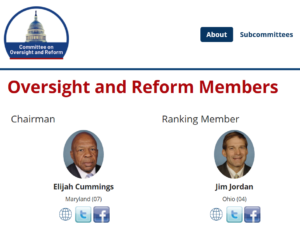
    The Oversight and Reform Committee webpage, at of the time this article was written, still lists the late Elijah Cummings of Maryland as its chairman with Jim Jordan of Ohio as ranking member. Resigned member Katie Hill of California is also still listed. The committee also includes such congressional luminaries as longtime nonvoting member Eleanor Norton from the District of Columbia, IT-savvy Debbie Wasserman Schultz of Florida, crusading freshman Alexandria Ocasio-Cortez of New York, Ayanna Pressley of Massachusetts, and Rashida Tlaib of Michigan.

    The Committee on Ways and Means is the oldest committee of the United States Congress, and is the chief tax-writing committee in the House of Representatives. The Committee derives a large share of its jurisdiction from Article I, Section VII of the U.S. Constitution which declares, “All Bills for raising Revenue shall originate in the House of Representatives.” -Committee Website

    While seemingly unimportant, the House Ways and Means Committee is the committee which writes tax legislation and claims jurisdiction over basically everything because of that. The committee is chaired by Richard Neal and the ranking member is Kevin Brady.

    So there you have it. The stage is set. The roles cast. The House Select Committee on Intelligence seems to be taking the lead on this, and is the seeming star of the show. The House Committee on the Judiciary, though the traditional lead is cast in a supporting role. But keep an eye on the Oversight and Reform Committee; the committee contains three-quarters of the squad, and it will be interesting to see who replaces Cummings and Hill. Enjoy the show.

  • Chapter 11: United States v. Stonewall, July 2000

    “Are you ready?’  Justin and I collected our paperwork. I had defended Marines and sailors facing a lot more time or charged with much more serious crimes, yet I was more nervous than I had ever been before walking into court.

    “Hope so.” I muttered. I did not have my usual confidence. It wasn’t because I didn’t believe I would give a good presentation, or that the law and facts weren’t on my side – which is the norm in criminal defense. It was because I knew that it wouldn’t matter. I had reached the inevitable conclusion that no matter what I did, the judge was not going to find the order to take the anthrax vaccine unlawful or, even a lower standard, allow us to overcome the government’s presumption of lawfulness and get in front of a jury. It simply wasn’t going to happen.

    “Are you ready, Lance Corporal Stonewall?” I turned to Jason Stonewall, who sat in the chair, hands folded in his lap. He had a slight, beatific smile on his face. Jason Stonewall had four plus years of college and was a bright young man; he also had a sterling reputation as a machine-gunner. He believed in the Marine Corps, in its officers, and in its legal system.

    “Yes, sir!” He stood up. Whenever Stonewall spoke, he reminded me of Cuba Gooding, Jr. He looked a bit like the actor except that Stonewall was broader in the face and chest. His voice even had the same raspy quality. I once told him this and he laughed.

    “Captain S,” Stonewall began, “if anybody was ever ready for this argument, it’s you.” I wanted to say thank you, but I just smiled in return, the pinched kind, the one I knew I used to avoid having to say anything inadequate or lie. Lance Corporal Stonewall also believed in us – in Justin and me – so completely and that was what disturbed me the most. I felt like an actor in a badly written play.

    “Let’s go.” We headed to the courtroom.

    We took our seats, me on the inside, closest to the opposing counsel and the judge, Justin at the far end of the table, with Stonewall in between us. Just yesterday we had sat here with our expert witness, Doctor Michael Cohen, on the stand, explaining the microbiology of the anthrax vaccine in detail. While his testimony helped, it hadn’t won the day, which we knew anyway. Mike Cohen wasn’t an anthrax expert. In fact, when he first walked into my office, I pegged him as something else entirely. He had a briefcase and an inquisitive manner and he had read about my court case involving Petty Officer Ponder.

    Reporter, I had thought, except something was a bit…eccentric about him. After a bit of conversation, I finally figured out he was a scientist and felt guilty. I could easily have been Mike Cohen had it not been for choices earlier in my life. I once wanted to be a research scientist and had spent the summer between my junior and senior years of high school studying astronomy at the University of Georgia under the Director of the Astronomy and Physics Department.  Later, I submitted a paper based upon that research to the annual Westinghouse Science Talent Search. I came in the Top Forty in the Nation and was invited to Washington, D.C. to compete with 39 other students for some serious scholarship money. I learned two things at that week-long competition: first, that there were some incredibly smart high school scientists out there(!); second, I was not cut-out to be one of them.

    Mike Cohen reminded me of some of those students. Incredibly intelligent, knowledgeable about his chosen subject matter, but not necessarily able to communicate it outside of the circle of academia to the layperson. Mike had come through when the court refused all of our experts from the states to come testify. A biology professor at the University of Maryland, he had his Ph.D. in microbiology and had offered his help in Petty Officer Ponder’s case because of his belief that the anthrax vaccine was not properly made, nor safe, and nor based upon scientifically valid data. He had Marines in his biology class who had adverse reactions form the vaccine and as a scientist, he had to investigate. I was grateful for his help, but he was just another actor in the U.S. military’s comedy of errors.

    “All rise,” Captain Kolomjec intoned as the Judge came in.

    After getting through the preliminaries, Judge Stone got down to business.

    “Okay. Let’s talk about who should begin first. It is, after all, the government’s motion in limine, but the defense has the burden of rebutting a presumption in the government’s favor. I think we could probably cut to the chase and let the defense go first, given that presumption, unless either party objects.”

    There were no objections. Major Stone turned to me.

    “Sir, you have the floor.”

    I stood up and moved out away from our table and out into the well, the middle of the courtroom.

    “Thank you, sir. First, I would like to point out where we are and where we are going. The government has a presumption in its favor, a rebuttable presumption, which is not impossible to overcome. The defense need only put on enough evidence to overcome that presumption in order for the accused, Lance Corporal Stonewall,” I turned and gestured to Jason, who looked studious with his glasses on, “to get his day in court.”

    “What’s the quantum? I mean, clearly you can rebut, but what is the quantum of evidence required?” Thankfully, I had looked into this. My law school civil and criminal procedure professor had prepared me well.

    “Sir, the case law isn’t clear that it’s a preponderance, but it would certainly seem contrary to notions of fairness if it were beyond a reasonable doubt. Having analyzed this–”

    “Well, is it just some evidence? A scintilla, as it were?”

    “Sir, it is the defense’s opinion that procedurally this is like a motion for summary judgment in the civilian legal system. The government has essentially asked you to find that there are no genuine issues of material fact with respect to the lawfulness of the order and that the accused therefore has no right to get into court at all, sir. Thus, we find ourselves procedurally, in a similar situation to a motion for summary judgment.” I waited for the Judge’s reaction.

    “In reverse, you mean.” He caught right on. That’s what I liked most about Judge Eric Stone.

    “Exactly, sir – in reverse. Therefore, if the accused can show there is or are genuine issues of material fact, then the case should be allowed to go forward. Support for that, sir, comes form the case of Unger versus Ziemniak, which we think is a propos of our current circumstances.” I paused a moment to see if he was following, and as I gathered myself for the crux of this first part, Justin quietly slipped a copy of the Unger case onto the podium for me. Thank you, I mouthed silently, as I tuned to pick it up from the lectern behind me.

    This was the most clever play I had, something I had labored over, discussed with other lawyers, researched, and thought was the one chance we had to win this case. I would never be able to convince the judge straight up to say the order was illegal. It would throw the entire Anthrax Vaccine Program into disarray. A military judge in some obscure outpost on the edges of the Empire – Camp Foster, Okinawa, Japan – was not going to invalidate the entire DoD Anthrax program. I thought I was good, but I wasn’t that in love with my arguments. No, instead, I was simply trying to get the judge to give me one, small thing: let me put what evidence I had before a jury. I might not trust “the system” to get it right, but I did trust military juries. Even though I had only a few months as a lawyer, I had interned as a prosecutor, been a legal officer in my squadron, and been an officer for almost ten years. That experience convinced me of one ineluctable fact: Marines, especially on juries, want to do the right thing and will do so regardless of what it means to broader equities, if they’re allowed to see the evidence.

    I just needed to convince the judge that we were entitled to an opportunity to at least put on some evidence to a jury.

    “In Unger, sir, a female Navy Lieutenant refused a mandatory urinalysis test. Appellate case law by then had made clear the validity of the order to submit to a urinalysis in the military. There was no question about the validity of that order. Such orders had already been challenged on Fourth Amendment and a number of other grounds and failed.

    Lieutenant Unger specifically challenged the validity of the provision in the military’s urinalysis program – in the written order – that required direct observation of the act of urinating into the cup. She filed a motion that the order was unlawful as a matter of law. The trial judge ruled against her and she took an extraordinary writ, an appeal of the judge’s decision, all the way to the Court of Appeals for the Armed Forces.” Judge Stone was leaning forward, squinting, and appeared genuinely interested… or so I hoped.

    “Interestingly, sir, CAAF decided against Lieutenant Unger on the lawfulness of the order. The Court said, as we would all expect, that the order was lawful. However, the Court did not dismiss her claim. Instead the Court found, essentially, that there still existed ‘genuine issues of fact’ about the circumstances under which she would be required to take the test that a jury might find violated her statutory and Constitutional rights. The Court pointed out, for example, while direct observation might be lawful, if the direct observation were required by a male, that might be an “unreasonable” seizure under the Fourth Amendment. Or, if the order in question had a procedure or was being conducted such that the observer was required to watch from within 18 inches, their face, um, right there, as it were,” I held up my hands as if I were a Hollywood director framing a shot, or at least like I had seen other people mimic, “then the Court noted that a factfinder might conclude that was unreasonable.” I had gotten through that entire exposition with no disagreements, no argument from the Bench, which could mean one of two things – either he agreed or didn’t care.

    “This is exactly where we find ourselves today, sir. The defense has, under four prongs I will address in a moment, put forth sufficient evidence to show that there exist genuine issues of material fact about the lawfulness of the order. Like Lieutenant Unger, the process under which the shot is given could be viewed by a finder of fact as unlawful because of matters that the defense has submitted. This does not mean that we will win at trial. It might be that a jury decides, after hearing the defense evidence, that it still was lawful and therefore we lose. But for the purposes of this motion and whether you should find that as a matter of law the order was lawful, there exist genuine issue of material fact about the lawfulness. I would like to turn to those matters now.” Still no disagreement, so I ploughed on.

    “First of all sir, we turn to 10 USSC, section 1107.” I was warmed up now and somewhere I still believed that a military judge, this military judge, might do the right thing. Justin put the statute in front and sat back down.

    “Sir, there is no straight-faced argument that the anthrax vaccine is not an investigational new drug or a drug unapproved for its applied use. Those are the words of the statute. If it is either an IND or a drug unapproved for its applied use, then there is a real question about the lawfulness of the order to take the shot. You have, sir – the defense has given you in previous submissions, the 1996 application by the manufacturer of the drug that requests an amendment to the existing license to get an indication for aerosolized anthrax. This is presumptive – conclusive evidence, I would say – that the drug is an IND.” I paused and Justin slid the affidavit of Mr. Sammie Young onto the podium, another gift from Lou Michels and several other persons who were involved in fighting this back in the states. Sammie Young had been Deputy Director of the FDA during the time that AVA had been licensed and the procedures for licensing a vaccine had been developed. He simply couldn’t believe that the FDA had given the DoD a pass on the whole issue.

    “The idea being why would the manufacturer put it in an IND status if you yourself, if the manufacturer, didn’t think it was an IND,” the military judge supplied.

    “Exactly, sir. Also, it’s an IND because, as you can see from the affidavit of Mr. Sammie Young, former Deputy Director of the FDA, that once a company submits an IND, the drug becomes an IND thirty days after the submission when used for the purposes listed in the IND. Thus, one of the listed reasons for the IND is an aerosolized indication, if it I being used for an aerosolized indication, it’s an IND. Period.”

    “Okay,” the judge held up his hand, “suppose I agree with you.”

    “Yes, sir.” Suddenly this seemed to be going too well and I was wary. I had never had a time, in any real or mock proceeding where a judge began with “suppose I agree . . .” or “suppose I grant your point . . .” that ended particularly well.

    “…That it’s an investigational new drug in accordance with 1107. I mean, you can put on, it appears, a lot of evidence on that and it may in fact, be the case. What I’m really interested in is why should this accused be able to, in law, use 1107 in a military court-martial?” There was a strange moment after that question, of complete Zen-like clarity, where I saw exactly where this was all leading, but my mind simply refused to acknowledge it. I had only had two of those moments of satori, of seeing into the heart of things, in my life. The first was as a troubled teenager, not long after I had run away from home, but the second one was the only other time in my life where I could recall a moment, a specific, measurable instant, where my mind simply refused to accept what I could see was about to happen: that other time, I was in a hover at one-hundred and fifty feet when the second engine on my helicopter quit and we started to lose turns on our rotor head and fallout of the sky. I felt connected across time in that instant in the courtroom, and then my mind walled it off.

    The judge must have caught that something was wrong.

    “I don’t mean to cut you off, but –”

    “No… No, sir.”

    “Your evidence in support of the argument you have just made is extensive, and it is before me to consider. And I’m telling you that I understand the logic of your argument. But I’m interested in why this accused should be able to raise that federal law in this court-martial in the absence of a direct statutory conferral of rights.”

    “Yes, sir, then I’m more than happy to move on to save the court’s time.” But this was a lie, I was not more than happy. Nothing could have been further from the truth. I knew then that the case was over. I should have responded the way I immediately wanted to – “Because it’s a fucking federal law, you honor. You mean we get to ignore federal law we don’t like in courts-martial now? I can’t point out the LAW in a military court, that’s what you’re saying?” I stopped, picked up a pen off of the lectern, and pretended to write something.

    Suddenly, an idea popped into my head that I hadn’t thought of before. I had been reading a ton of constitutional law and perhaps…

    “I would point out, sir, that when we’re talking about substantive rights, it is the history of our country that rights are not stated in the affirmative, as in ‘you have a right to X’, but rather are listed as limitations upon the acts of others, particularly the government. For example, the Fourth Amendment doesn’t say you have a right to privacy, but instead says that you have a right to be free from unreasonable searches and seizures. The Bill of Rights, sir, is almost entirely comprised of limitations on government, not as positive statements of rights. But let’s move on to the more concrete, to 1107.”  My thoughts started to coalesce.

    “Okay.” He paused and wrote something down.

    “First of all, the DoD has always held the position, and still does today, that ‘soldiers are citizens first’ and have the same Constitutional rights as other citizens –’”

    “But that’s a non-lawyer speaking about ethics.”

    “True, sir, but the rule – the law – since Nuremberg has been that informed consent is a prerequisite to experimenting on human subjects. And that was adopted into federal law, sir, at 50 U.S.C. section 1520a. It prohibits military medical experimentation.”

    “But it’s not your position that the force protection argument by the government is somehow a cover for an experiment?”

    “Sir, the motives may be well-intentioned –”

    “– but you’re saying it could be an experiment de facto or something?”

    “No, sir, I am saying it is an experiment. By definition. When you are giving someone a vaccine and you have parts of it that are, by Dr. Cohen’s testimony and the DoD’s own words ‘not well-defined’, you don’t know what’s going to happen. You have a hypothesis that this should provide some protection, but the DoD doesn’t know that. You might have a hypothesis that it doesn’t cause long-term reactions, but you don’t know that because we know there have been no long-term studies. And we also know this: we know that there is a lot of research in the peer-reviewed literature that suggests a connection to Gulf War Illness, that the vaccine causes bad things to happen to the human body, like the reaction to the amount of aluminum in the vaccine that Doctor Cohen talked about, or the high antigen load that he discussed and its possible adverse effect on the immune system.”

    “So, yes, it is an experiment, sir, and unfortunately, the results aren’t in yet. And 2.4 million service members are going to be the guinea pigs.” I should have left the point there, but I couldn’t.

    “We tend, sir, to put ourselves above this – we say Nuremberg was passed because of the Nazis, and we tend to forget that many of their experiments were non-lethal and some of them produced important knowledge for medicine today. But the harm is not just what was done as a result of the experiment; it’s not just the experiment, it’s that informed consent was not obtained from the human beings on the other end of the needle. That itself is the harm.” The judge’s face told me all I needed to know; he thought I was loony. We had had this same argument in Ponder’s case since he was the same judge for all three anthrax refusal cases. His view was that the Nuremberg Code applied to Nazis, not “good guys” in the U.S. military. I decided to move on.

    “Now, sir, why does 1107 apply is the real question?”

    “Well, not necessarily ‘why.’ Let’s assume that Congress wanted consent to be derived in this class of drugs.”

    “Yes, sir.”

    “And that does seem reasonable. I’m with you that Congress wanted to have an informed consent procedure in place.”

    “It’s an individual right, sir. It doesn’t belong to the Secretary of Defense.” He held up his hand.

    “Why should this court not assume that they were putting constraints on the Secretary of Defense? Why should I assume that they weren’t – I mean, what is the intended mechanism of enforcement? It’s silent on it. You’re asking this court to believe – or to infer – that the mechanism to enforce or uphold this right – is to judicially confer rights upon the accused. That is, recognizing the matter on paper and allowing a defendant to use this law to defend himself against such an inoculation.” I was confused.  To this day I still am.

    “To read it otherwise, sir, is to put a strained interpretation on it. Because what else can be done? What else can this person do when they are told to take a drug that is clearly investigational, or experimental? If it is interpreted to mean that it confers nothing to service members, the SecDef could order them injected with anything – arsenic – as long as he thinks it’s a good force protection measure. What do they do in the meantime?  Go to jail while they wait for Congress to hold the SecDef in contempt of Congress?”

    There were a lot better, more eloquent arguments. As I sit here today, I can think of several. But I was spent. I could hear my own incredulity. I could not believe that the judge was saying that if a military order that violates a federal law, even if you can prove it violates federal law, unless that law says specifically that the law is meant or allowed to be used in courts-martial, he simply wouldn’t look at it.

    I felt like a drowning man who knows he is too far from shore to make it, but swims on anyway because of the organism’s instinct for survival. I argued on, but it was fruitless. We took a recess. Back in my office, I fell into my chair.

    “Dale, I think that was one of the best arguments I’ve seen.” Justin patted me on the back. I appreciated the compliments, but I had a feeling he was trying to prop me up.

    “Thanks, man.” Lance Corporal Stonewall sat watching me. I couldn’t look him in the eyes.

    “Lance Corporal Stonewall, can you give us a minute. I want to discuss some other stuff with Captain Constantine?” Stonewall replied yes, stood up, came to attention, and then stepped out. When he was gone I swore.

    “I just couldn’t sit here with him looking at me, knowing that we’re going in the tank.” Justin didn’t say anything for a minute.

    “Think he’s going to rule against us?”

    “It’s a bet. I had a talk with him and Kolomjec in his office, might have been regarding Ponder’s case, but I kept arguing with him about this conferral of rights crap that he says you need. I threw out the hypothetical in our brief, that what if a Lance Corporal is a driver and the General orders him to speed, to do fifty-five in a school zone and the driver refuses and then he’s later court-martialed. Under Stone’s theory, the Lance Coolie can’t plead the speed limit as a defense to the lawfulness of the order; it doesn’t confer any rights! The state legislature never intended it to be used as a defense in a court-martial! Fuck.”

    “Then he started lecturing me about paradigms and how the military is different than the civilian world. ‘It’s a different paradigm, he said.’ Fuck. Fuck.” I was rambling and Justin knew me well enough to let me blow off some steam.

    “Well, what do we do now?” he asked. A pragmatic question.

    “Let me think.” I rubbed my forehead. “Well, he’ll announce his findings and then we’ll probably take pleas. Then, maybe, we’ll set a date for the court next week or something. Once he rules, I don’t think he’s going to give us a lot of time before the court. What’s today, the 25th?” I no longer could keep track of days. I wasn’t sleeping much at all, and when I did sleep it was usually because I had dozed off at the desk in my base housing quarters, with my office in a section of the living room, where my wife would find me in front of the computer if she happened to get up in the middle of the night.

    Justin looked at his watch. “Twenty-six July.”

    “Oh. Okay. Well, let’s get back into court.” I stood up.

    “Dale?” I looked back at Justin and raised my eyebrows. “We gave it our best shot, man. You… we couldn’t have done any more than we did.” I nodded my head, but it didn’t make me feel any better. I walked out the door feeling like a man on his way to his execution.


    “The defense contends that the order to submit to anthrax vaccination violates a Presidential Executive Order and Federal and International Laws and is therefore an illegal order, so the accused could lawfully refuse to obey. As the court sees it, there are four issues presented. We’ll discuss them in order.” I sat watching as Major Stone read from a sheet he had prepared. He hadn’t written it in the recess since our last session, so I knew that he had been drafting it before I had finished my argument. He’d already decided before oral argument and I’d done nothing to change his mind. I already knew the outcome.

    “The first one, does Executive Order 13139 confer legal rights upon the accused enforceable at courts‑martial?” Just the way he framed the question bothered me. The question wasn’t who got what conferred, it was whether the order was lawful or not. That question had been lost a long time ago and it wasn’t going to get answered in this courtroom.

    “Answer: no. The Executive Order in question is a policy decision of the President taken in his capacity as Commander‑in‑Chief of the Armed Forces. Also, violations of an Executive Order are not judicially enforceable unless the Constitution or Federal Law otherwise requires enforcement.

    “Two: Does 10 U.S.C. 1107 confer legal rights upon the accused enforceable at courts‑martial? No. 10 U.S.C. 1107 imposes obligations on the Secretary of Defense to obtain the informed consent of service members in the event that the Secretary desires to employ an investigational new drug or to use a drug in a manner inconsistent with its FDA approved usage. The text of the law does not directly state that the Secretary’s obligations are also legal rights of service members enforceable at courts‑martial, nor does the statute provide a fair basis for conferral of rights by implication because the statue does not employ wording typically associated with such a legislative conferral of rights. Other federal statutes, in particular, criminal statutes expressly provide for the conferral of rights upon service members. Given that Congress has in the past specifically provided for the rights of service members in other‑statutes and could have done so in 10 U.S.C. 1107, it would be judicial speculation to presume that Congress would desire to do so in this case. In fact, it may well be that Congress does not desire to grant individual rights to two million or so service members, but rather chose to make one officer, the Secretary of Defense, accountable for obtaining the informed consent of service members.”

    I looked down and noticed I was scribbling notes. Habit. None of it made any sense.

    “Finally, along the same lines, any inquiry as to whether or not the Secretary of Defense, a civilian political appointee, has complied with 10 U.S.C. 1107 is a non-justiciable political issue between Congress and the Secretary, that is, it is beyond the reach of decision by military courts‑martial.” There it was. I had known that was coming. There was no way he was going to rule that the Secretary of Defense had violated the law, no matter how clear it was.

    “Issue 3: Does the Nuremberg Code as codified at 50 U.S.C. 1520(a) confer rights on the accused enforceable at courts‑martial?” Now this was the real coup. The Nuremberg Code, despite its clear language, did not apply to one class of persons:  second class citizens, known as U.S. service members.

    “Answer of this court: No. 50 U.S.C. 1520(a) prevents experimentation on service members without their informed consent. The defense claims that the anthrax vaccination program is essentially a large‑scale medical experiment and, therefore, 50 U.S.C. 1520(a) applies. More specifically, the defense argues that because there have been no long‑term studies of the effects of the anthrax vaccination, the DoD ­inoculation program is a de facto medical experiment. This court declines to adopt that view.

    “The DoD vaccination program on its face appears to be a reasonable and time‑tested force protection measure. That is, inoculation against disease designed to counter a real‑world threat of biological attack.” I looked over at Lance Corporal Stonewall. He looked back at me and gently put his hand on my arm, grimacing a little, but other than that, no reaction. It was all I could do not to cry. Some lawyers would say that I had become too personally involved in my case, something I had thought about a lot in my brief time as a defense attorney: my reply would be “so what?”

    “Four: Is an order for a service member to submit to the anthrax vaccination so inherently unsafe and dangerous in light of its proper justification as to make it arbitrary or capricious and, therefore, illegal? Answer: No. The defense has provided no evidence of any death or serious bodily injury that has resulted from administration of the anthrax vaccine to over 1.7 million service members. The government, on the other hand, has presented evidence that anthrax is 100 percent fatal if inhaled, that several actual military adversaries presently have the capability to attack U.S. Armed Forces with aerosolized anthrax, and that animal modeling studies suggest that inoculation may provide a significant measure of protection against aerosolized anthrax attack.” I had heard a Navy doctor explain that he read the DoD website, but we hadn’t been allowed to bring an expert to show the falsity of those statements and conclusions.

    “In sum, then, I find the order to submit to the anthrax inoculation was a legal order as a matter of law and will so instruct the members if that is the forum selected in this case. Accordingly then, based on the reasoning above, as for the two defense requests for experts in this case, those requests are denied.” The cart had come before the horse. We were denied experts to rebut the government’s doctor and that had led to a ruling that our requests were denied. The ol’ Catch-22.

    “Does the defense have any other motions to present?” I stood up slowly.

    “No, sir.” At that point, I finally believed what Lou Michels, our helpful Reserve Air Force attorney and partner in big-time law firm, had said to me on the phone one day: no military judge was going to find the order to take the anthrax vaccine illegal. It wouldn’t matter how twisted the reasoning it took to get there.

    “Then this court is in recess.”

     

  • Checks and Balances

    Civics 101: The United States of America is a Constitutional Republic, set up as a federation, with the federal government divided into three branches with separated, enumerated powers, and additional specific limits on the exercise of those enumerated powers.

    I think that single sentence is a fair synopsis of the intention of the framers of the Constitution, but what did they mean by that? And what does it mean today in practice?

    First we have to understand some of the terms in use:

    Sovereignty is the authority of a state to govern itself independent of any outside source of authority. In a monarchy the king is sovereign and all authority ultimately comes from the crown.


    A Republic is form of government in which the sovereignty lies with some portion of the citizenry, not in a Monarch. A Republic is not necessarily democratic; the portion of the citizenry holding the sovereign power may be a small minority, but it can be democratic, if the portion of the citizenry holding sovereignty is extensive.


    A constitution is a framework law, supreme over all other laws in the state, and which sets limits on those other laws and establishes the procedures for their creation and enforcement.

    A Constitutional Republic is a state that has a republican form of government subject to the limitations, procedures, and powers set out in a constitution.


    A Federation is a sovereign conglomerate state made up of other states, provinces, or administrative districts which either retain, if the federation was from the bottom up with sovereign states coming together, or are granted, if the federation was from the top down with a sovereign state dividing itself, some portion of, but less than all, sovereignty.


    Enumerated powers are limited sovereignty. In a government of enumerated powers the State is sovereign only with regard to those areas enumerated in some list; the remainder of the sovereignty resides elsewhere.


    The General Police Power, is the largest component of sovereignty. It is the authority of a government to declare various actions criminal and set forth punishments for those acts in order to promote the morality, safety and health of the populace. As such it is limited only by the power and whim of the sovereign. Libertarians generally regard the General Police Power with disfavor, preferring enumerated police powers limited to policing direct harms to the person, property, or liberty of another, but historically the General Police Power has extended to any objective desired by the sovereign.

    In 1787 a Constitutional Convention was called into session and created the system of government that persists (however weakly) to this day. The framers of the United States Constitution were attempting to sail between the Scylla of the newborn Nation dividing into 13 completely independent polities and the Charybdis of a centralized Leviathan. The 13 States were sovereign and the prior federation under the Articles of Confederation explicitly recognized that sovereignty. The federal ‘government’ under the articles had almost no independent authority to act and it acted more as a standing conference of the States than as a sovereign power. It rapidly became clear that something more was needed to prevent the 13 States from going their own ways, although it is less clear that such a separate development would have been the disaster feared at the time.

    The Federal Government that came out of that convention had sovereignty over matters set out in Article 1, section 8:

    1: The Congress shall have Power To lay and collect Taxes, Duties, Imposts and Excises, to pay the Debts and provide for the common Defence and general Welfare of the United States; but all Duties, Imposts and Excises shall be uniform throughout the United States;

    2: To borrow Money on the credit of the United States;

    3: To regulate Commerce with foreign Nations, and among the several States, and with the Indian Tribes;

    4: To establish an uniform Rule of Naturalization, and uniform Laws on the subject of Bankruptcies throughout the United States;

    5: To coin Money, regulate the Value thereof, and of foreign Coin, and fix the Standard of Weights and Measures;

    6: To provide for the Punishment of counterfeiting the Securities and current Coin of the United States;

    7: To establish Post Offices and post Roads;

    8: To promote the Progress of Science and useful Arts, by securing for limited Times to Authors and Inventors the exclusive Right to their respective Writings and Discoveries;

    9: To constitute Tribunals inferior to the supreme Court;

    10: To define and punish Piracies and Felonies committed on the high Seas, and Offences against the Law of Nations;

    11: To declare War, grant Letters of Marque and Reprisal, and make Rules concerning Captures on Land and Water;

    12: To raise and support Armies, but no Appropriation of Money to that Use shall be for a longer Term than two Years;

    13: To provide and maintain a Navy;

    14: To make Rules for the Government and Regulation of the land and naval Forces;

    15: To provide for calling forth the Militia to execute the Laws of the Union, suppress Insurrections and repel Invasions;

    16: To provide for organizing, arming, and disciplining, the Militia, and for governing such Part of them as may be employed in the Service of the United States, reserving to the States respectively, the Appointment of the Officers, and the Authority of training the Militia according to the discipline prescribed by Congress;

    17: To exercise exclusive Legislation in all Cases whatsoever, over such District (not exceeding ten Miles square) as may, by Cession of particular States, and the Acceptance of Congress, become the Seat of the Government of the United States, and to exercise like Authority over all Places purchased by the Consent of the Legislature of the State in which the Same shall be, for the Erection of Forts, Magazines, Arsenals, dock-Yards, and other needful Buildings;—

    And

    18: To make all Laws which shall be necessary and proper for carrying into Execution the foregoing Powers, and all other Powers vested by this Constitution in the Government of the United States, or in any Department or Officer thereof.

    The very next section of Article 1, makes it abundantly plain that the power of the Federal Government is limited to the enumerated powers and is not general, and that it is subject to other additional limits even when being used according to a section 8 power:

    1: The Migration or Importation of such Persons as any of the States now existing shall think proper to admit, shall not be prohibited by the Congress prior to the Year one thousand eight hundred and eight, but a Tax or duty may be imposed on such Importation, not exceeding ten dollars for each Person.

    2: The Privilege of the Writ of Habeas Corpus shall not be suspended, unless when in Cases of Rebellion or Invasion the public Safety may require it.

    3: No Bill of Attainder or ex post facto Law shall be passed.

    4: No Capitation, or other direct, Tax shall be laid, unless in Proportion to the Census or Enumeration herein before directed to be taken.

    5: No Tax or Duty shall be laid on Articles exported from any State.

    6: No Preference shall be given by any Regulation of Commerce or Revenue to the Ports of one State over those of another: nor shall Vessels bound to, or from, one State, be obliged to enter, clear, or pay Duties in another.

    7: No Money shall be drawn from the Treasury, but in Consequence of Appropriations made by Law; and a regular Statement and Account of the Receipts and Expenditures of all public Money shall be published from time to time.

    8: No Title of Nobility shall be granted by the United States: And no Person holding any Office of Profit or Trust under them, shall, without the Consent of the Congress, accept of any present, Emolument, Office, or Title, of any kind whatever, from any King, Prince, or foreign State.

    Further there is no mention of the most important portion of sovereignty, the General Police Power. This is made explicit in the 1st through 8th and 10th Amendment:

    Article [I] (Amendment 1 – Freedom of expression and religion)
    Congress shall make no law respecting an establishment of religion, or prohibiting the free exercise thereof; or abridging the freedom of speech, or of the press; or the right of the people peaceably to assemble, and to petition the Government for a redress of grievances.

    Article [II] (Amendment 2 – Bearing Arms)
    A well regulated Militia, being necessary to the security of a free State, the right of the people to keep and bear Arms, shall not be infringed.

    Article [III] (Amendment 3 – Quartering Soldiers)
    No Soldier shall, in time of peace be quartered in any house, without the consent of the Owner, nor in time of war, but in a manner to be prescribed by law.

    Article [IV] (Amendment 4 – Search and Seizure)
    The right of the people to be secure in their persons, houses, papers, and effects, against unreasonable searches and seizures, shall not be violated, and no Warrants shall issue, but upon probable cause, supported by Oath or affirmation, and particularly describing the place to be searched, and the persons or things to be seized.

    Article [V] (Amendment 5 – Rights of Persons)
    No person shall be held to answer for a capital, or otherwise infamous crime, unless on a presentment or indictment of a Grand Jury, except in cases arising in the land or naval forces, or in the Militia, when in actual service in time of War or public danger; nor shall any person be subject for the same offence to be twice put in jeopardy of life or limb; nor shall be compelled in any criminal case to be a witness against himself, nor be deprived of life, liberty, or property, without due process of law; nor shall private property be taken for public use, without just compensation.

    Article [VI] (Amendment 6 – Rights of Accused in Criminal Prosecutions)
    In all criminal prosecutions, the accused shall enjoy the right to a speedy and public trial, by an impartial jury of the State and district wherein the crime shall have been committed, which district shall have been previously ascertained by law, and to be informed of the nature and cause of the accusation; to be confronted with the witnesses against him; to have compulsory process for obtaining witnesses in his favor, and to have the Assistance of Counsel for his defence.

    Article [VII] (Amendment 7 – Civil Trials)

    In Suits at common law, where the value in controversy shall exceed twenty dollars, the right of trial by jury shall be preserved, and no fact tried by a jury, shall be otherwise re-examined in any Court of the United States, than according to the rules of the common law.

    Article [VIII] (Amendment 8 – Further Guarantees in Criminal Cases)
    Excessive bail shall not be required, nor excessive fines imposed, nor cruel and unusual punishments inflicted.

    Article [X] (Amendment 10 – Reserved Powers)
    The powers not delegated to the United States by the Constitution, nor prohibited by it to the States, are reserved to the States respectively, or to the people.

    And the fact that even the States were not to possess an unlimited General Police Power is made clear by the specific limitations on the States found in Article 1, section 10 and Article IV:
    Section 10

    1: No State shall enter into any Treaty, Alliance, or Confederation; grant Letters of Marque and Reprisal; coin Money; emit Bills of Credit; make any Thing but gold and silver Coin a Tender in Payment of Debts; pass any Bill of Attainder, ex post facto Law, or Law impairing the Obligation of Contracts, or grant any Title of Nobility.

    2: No State shall, without the Consent of the Congress, lay any Imposts or Duties on Imports or Exports, except what may be absolutely necessary for executing it’s inspection Laws: and the net Produce of all Duties and Imposts, laid by any State on Imports or Exports, shall be for the Use of the Treasury of the United States; and all such Laws shall be subject to the Revision and Controul of the Congress.

    3: No State shall, without the Consent of Congress, lay any Duty of Tonnage, keep Troops, or Ships of War in time of Peace, enter into any Agreement or Compact with another State, or with a foreign Power, or engage in War, unless actually invaded, or in such imminent Danger as will not admit of delay.

    Article IV (Article 4 – States’ Relations)
    Section 1
    Full Faith and Credit shall be given in each State to the public Acts, Records, and judicial Proceedings of every other State. And the Congress may by general Laws prescribe the Manner in which such Acts, Records and Proceedings shall be proved, and the Effect thereof.

    Section 2
    1: The Citizens of each State shall be entitled to all Privileges and Immunities of Citizens in the several States.

    2: A Person charged in any State with Treason, Felony, or other Crime, who shall flee from Justice, and be found in another State, shall on Demand of the executive Authority of the State from which he fled, be delivered up, to be removed to the State having Jurisdiction of the Crime.

    3: No Person held to Service or Labour in one State, under the Laws thereof, escaping into another, shall, in Consequence of any Law or Regulation therein, be discharged from such Service or Labour, but shall be delivered up on Claim of the Party to whom such Service or Labour may be due.

    Section 3
    1: New States may be admitted by the Congress into this Union; but no new State shall be formed or erected within the Jurisdiction of any other State; nor any State be formed by the Junction of two or more States, or Parts of States, without the Consent of the Legislatures of the States concerned as well as of the Congress.

    2: The Congress shall have Power to dispose of and make all needful Rules and Regulations respecting the Territory or other Property belonging to the United States; and nothing in this Constitution shall be so construed as to Prejudice any Claims of the United States, or of any particular State.

    Section 4
    The United States shall guarantee to every State in this Union a Republican Form of Government, and shall protect each of them against Invasion; and on Application of the Legislature, or of the Executive (when the Legislature cannot be convened) against domestic Violence.

    and the text of the 9th Amendment:
    The enumeration in the Constitution, of certain rights, shall not be construed to deny or disparage others retained by the people.

    The General Police Power is the power to regulate behavior in general and not with regard to some specific enumerated power. The Federal Government does not have this. The States do, subject only to limits found in their several constitutions, the Articles above, and under the doctrine of incorporation, the Bill of Rights.

    So far everything I have discussed has centered around the Article I powers and the limits thereon, since Article I, sets out only the Legislative power and form of Congress, why have I not discussed the Judicial or Executive branch in my discussion of the extent of Federal Authority? Quite simply because, all of the power to initiate action by Government is vested in the Legislative body. The Executive and Judicial branches are concerned with implementing and enforcing laws. The laws that are to guide their actions are meant to come from the Congress. I plan to discuss the other branches further in future pieces, but when talking about the enumeration of powers and limits on their exercise it is the legislative power that is the driver.

    So the bulk of Federal Authority is vested in Congress, and that authority is specifically limited by explicit prohibitions on actions, as well as being generally limited to the enumerated powers, but the structure of Congress is in itself another check on Federal authority. The framer’s biggest difficulty in balancing the need to preserve the States as sovereign entities with the need for a centralized authority to make us a Nation in more than name, was in determining how to select and shape the legislature. It was decided to create a bicameral legislature, each body having certain exclusive powers, but both bodies assent being needed to pass general legislation.

    This Congress was loosely modeled after the British Parliament, with the House of Representatives serving as the equivalent to the House of Commons, and the Senate an even looser equivalent to the House of Lords.

    The House was given the sole authority to initiate the exercise of the power to raise revenue, either by taxation or borrowing, and the power to initiate impeachments of officers of the other branches. The Senate was given the power of advising the Executive on treaties and appointments of officers, and the more significant power of consenting to such treaties and appointments, without which the treaty or appointment fails, and additionally the power of trying impeachments. The assignment of powers reflects the founders view of the House as being the People’s voice in the Government and the Senate being the States’ voice.
    The Great Compromise, sometimes called the Connecticut Compromise because Connecticut delegates Roger Sherman and Oliver Ellsworth proposed and fought for it, is what finally brought the framers through the channel between Scylla and Charybdis. It provided that the States would each have two Senators, appointed by the State Legislature and serving a six year term. House terms were deliberately kept short at 2 years in order to try and keep the representatives easily subject to replacement if they acted in opposition to the will of the People.

    The general plan was that the House was to be the democratic body and the Senate the more aristocratic. The power of the purse was left to the people (subject to the specific prohibition of Article I section 9:4 which was meant to prevent exactly the sort of “loot the rich” tax schemes we are suffering today), because any money spent was coming from the people. The combination of a ban on direct taxes on any terms except equal payment from each person, with turning the budget over to the popularly elected House was meant to enforce fiscal responsibility. The XVIth amendment broke this system and gave the mob the power to vote themselves largess at the expense of various minority groups, and spending has steadily climbed ever since.

    The power of impeachment was also given to the House, but the power of trying impeached officers was given to the Senate. Splitting the power to remove officials between the democratic House and the aristocratic Senate was intended to simultaneously prevent the elites from protecting their own, and to prevent the passions of the mob from removing good officials for not catering to popular demands.
    The power of advice and consent was given to the Senate. This was a bit of a compromise intended to give the States, which were surrendering their power to enter treaties to the new Federal Government, input into, and veto power over foreign agreements. The XVIIth amendment broke this compromise and did a great deal of harm to our system in the name of democracy.

    Basically the framers set up a Government in shackles. It was capable of decisive action in moments where the various parts of the country were aligned and much more restrained when they were not. Much of our history since has been a series of loosenings of those shackles, for the most part to our detriment.

  • Chapter 7 – Congress Acts: 10 U.S.C. §1107

    More can and must be done, however, to rebuild trust, to avoid repeating past mistakes, and to prevent future health consequences similar to those experienced during and after the Gulf War. Our troops must be assured that when we send them into battle, they will be protected by the best military technology, the best leaders, and the best medicine. Protection also means proper education and training, as well as provision of critical information, including information about investigational new drugs that may be administered to our troops for their protection against chemical and biological threats.[i]

    At the end of multiple hearings on Gulf War Syndrome and many inquiries into the DoD’s use of experimental and investigational drugs during the Gulf war, in 1997 Congress (finally) decided that enough was enough. Representative Patrick Kennedy (D, RI), introduced a bill on the floor of Congress to provide some small measure of protection for service members. In its original form, the bill imposed three requirements on the DoD: either prior to, or within 30 days of, administering an investigational new drug, the DoD would have to inform military members that

    1. The drug being administered is investigational;
    2. The reasons why the drug is being administered;
    3. The potential side effects of the drug, including side effects resulting from interactions of the drug with other drugs or treatments being administered to the individual.

    Representative Kennedy’s remarks made clear that the bill was the direct result of inquiries into the Gulf War and what he perceived as a DoD cover-up of possible chemical exposures of U.S. troops. He noted that the trust between soldiers and the government

    “has been called into question. One need merely read newspaper articles surrounding the Persian Gulf war to see what I mean. On February 28, the New York Times ran an article entitled: ‘Pentagon Reveals It Lost Most Logs on Chemical Arms;’ ‘Missing From Two Sites: Gulf War Veterans Now Raise Questions of Cover-Up or Criminal Incompetence.’”[ii]

    Mr. Kennedy went on to cite another article that revealed that the Army had been warned by the CIA five years prior (to the article) about the possible exposure of troops to chemical agents and that the DoD had claimed that it only became aware of the exposures the prior year. Additionally, Kennedy referenced the DoD and FDA negotiations that took place prior to the Gulf War regarding a waiver of informed consent detailed in the previous chapter. He criticized the DoD for failing to comply with the conditions the FDA had set forth in order to grant the waiver of informed consent that the DoD legally needed and had negotiated in order to use both pyridostigmine bromide and botulinum toxoid on troops. Oddly enough, however, Kennedy then seemed to concede that the DoD could now use investigational drugs without informed consent because “[u]nfortunately, for our troops, the threat of chemical and biological weapons have become an increasing reality[.]” Mr. Kennedy seemed to believe that, at the least, “the men and women who served in the Gulf War had a right to know that the vaccines administered to them were investigational” and that “[t]he same service members had a right to know about the side effects of the investigational drugs.”[iii] As an author’s note, I feel compelled to add that Representative Kennedy did swear an oath to “defend the Constitution of the United States of America against all enemies foreign and domestic” and “to bear true faith and allegiance to the same.” Which can only mean that either (a) Kennedy believed that it is perfectly fine for the U.S. government to experiment on its troops, or (b) he doesn’t know very much about the Constitution. (‘Both’ is also an acceptable and likely answer).

    To his credit, however, Kennedy did introduce the bill in order “to ensure that in the future our troops are informed of investigational drugs, and to help ensure that our service members can and will trust their government.”[iv] The legislation received some discussion on the floors of both the Senate and the House, always with reference to the Congressional investigations surrounding Gulf War Illness and the mistakes made with pyridostigmine bromide.[v] Finally, as part of the National Defense Authorization Act for fiscal year 1998 (from October 1997 to October 1998), Mr. Kennedy’s proposed bill became 10 U.S.C. §1107. In something that couldn’t be made up, within a year of this bill being approved and becoming law, Secretary of Defense William Cohen announced that he would begin the inoculation of all U.S. military personnel with the anthrax vaccine.

    As this vaccination program was kicking off, the Senate Armed Services committee was already calling high-ranking DoD officials to explain how the program was going to work in light of the Persian Gulf experience and even the then recent deployment of troops to Bosnia. In fact, members of the committee pointed to the Presidential Advisory Committee’s review of the DoD’s efforts in Bosnia and pointed out that they were deemed “an abysmal failure.”[vi] This committee even addressed the issue of how the DoD proposed to handle the administration of clinical protocols in accordance with FDA regulations. It is important to note that here the DoD was acknowledging that it had to comply with clinical protocol requirements of the FDA if it administered a drug in such a way as to render it an investigational new drug. An FDA official opined that “we [the FDA] believe that they [DoD officials] understand… [the need to comply with IND procedures]. We believe that they have the capability of complying with all of our IND rules and regulations.  As to whether they will comply in the next deployment situation, obviously we can’t predict that.”[vii]

    The Acting Secretary of Defense for Health affairs, Gary Christopherson, tried to assuage the concerns of committee members by admitting that the Bosnia experience[1] was a “situation where we believed we ought to be able to do an IND and do it well, it still did not come off 100 percent. It did not meet their standards. It did not meet our standards in there.”[viii] He went on to add that the DoD and the FDA were engaged in a “conversation” to improve their compliance with the FDA’s regulations. In a bit of backpedaling, Mr. Christopherson implied that there was some kind of agreement between the FDA and DoD that there would not need to be full compliance with the requirements of the Nuremberg Code, the FDA’s regulations, and the DoD’s own internal regulations. He offered that “[t]he one thing that I think both FDA and we have come to somewhat – not necessarily a conclusion, but close to – is that in real combat situations it’s very difficult if not impossible to do a full investigative new drug protocol.” This did not seem to arouse much comment from any of the Senators, despite the clear implication that DoD was not going to comply with the requirements for informed consent for an IND procedure. One other question not raised (of course) was how combat would be defined. Even if the DoD were granted a waiver for combat exigencies, would Bosnia and other peacekeeping operations fit the justification given for the Gulf War?

    At the same time that the Senate hearings were going on and the anthrax program (AVIP) was going forward, the FDA was also trying to determine if the interim rule that it had published to allow DoD to use investigational drugs without informed consent should become a final rule. That rule, granting the DoD waiver, was still “on the books” as the interim rule pending finalization. The FDA solicited comments by October 29, 1997. This means that (legally speaking) as late as autumn of 1997, the DoD still had a waiver from the FDA’s requirements of informed consent. The language of the rule was broad and did not specifically exempt just those two products, although that was the agreement reached in 1990. Now, as the DoD was preparing to use another investigational drug in Bosnia and not doing it particularly well, the FDA was asking whether or not the DoD should be allowed to maintain the waiver. This produced some interesting exchanges in committee hearings in Congress. In 1996, the Director of the FDA brought forward Ms. Mary Pendergast, a doctor at the FDA’s Center for Biologics Evaluation and Research (CBER), to answer the question about this rule.

    REP. NETHERCUTT:  So your conclusion five years later is that waiving the Informed consent requirements is acceptable?

    PENDERGAST: Yes, basically. It’s not the preferred option, but there are some products that you cannot ethically test. . .

    REP. NETHERCUTT:  Okay. I’m trying to get to now. . . as to why you feel it’s acceptable to do that.

    PENDERGAST: If there is another war —

    REP. NETHERCUTT: Which is prospective.

    PENDERGAST: Yes. If there is another war and if there is a circumstance where the military might need to give prophylactic treatment to its troops, then we would create simply the framework that would give them the opportunity to come to the FDA to ask for permission to waive informed consent. It’s not saying that we would waive it during peacetime; it’s not that we would automatically waive it, rather, we would create a framework that would permit them to ask for permission.

    KESSLER: I think the presumption is, if it is at all possible, you get informed consent. That certainly is my personal position.[ix]

    In this exchange, the head of the FDA, Dr. Ronald Kessler, asserts that informed consent would not be waived during peacetime at the same time that the FDA has on the books an interim rule that allows the DoD to waive informed consent, not just for combat, but also for the “the immediate threat of combat.”[x] How immediate would the threat have to be and what level of combat would it have to be? One can only envision that the DoD would get to make both of these determinations; certainly the FDA is not going to question a military officer’s determination that combat is imminent or immediate or of sufficient ferocity to be deemed combat.[2] Thus the rule is really no rule at all in terms of limiting the application of when the DoD can waive informed consent.

    In a 1997 Congressional hearing on Bioethics, this issue also came up by Dr. Arthur Caplan, a professor of Bioethics at the University of Pennsylvania. He offered quite simply that “the handling of the waiver with respect to the troops was unethical.”[xi] His opinion was that even with the waiver of prior informed consent, the DoD should have informed troops after the fact, if nothing else; that “the Defense Department – and those military agencies have not – did not do what they needed to do to after the fact inform people when they were exposed to innovative or experimental substances.”[xii]

    His second point of contention was that “there’s still been no formulation of a policy about what we do with respect to research on our troops. We don’t have it today. We didn’t have it six years ago. And I find it incredible that we have not had more than an interim rule to guide us with respect to research in the military.” At the time he said this, the FDA’s interim waiver rule for 50.23(d) was still in effect. Another doctor looked back even further and questioned the underlying assumption of the waiver, which, unfortunately, more people have not done.

    BENJAMIN WILFOND: I think I was not convinced this morning that they ever gave a clear reason why it was not feasible to have given – asked for consent in the first place. I mean, presumably if you ask the soldiers: You may be exposed to nerve gas. This medication may help you, but we really don’t know and would like to do a project. Would you like to participate? Most of them would probably say yes.[xiii]

    Some discussion ensued and there was the usual deference about the “quick” mustering up of forces, but Dr. Wilfond continued to question the assumption: “my point is that there’s still no – it’s not clear that they couldn’t have done it ahead of time either.”[xiv]

    This is an important issue that seems to get swept away amidst the rhetoric and large questions, but it is a particularly pragmatic point but deserves some attention. Every member of the Armed forces has, at one time or another, stood in line awaiting some inoculation. There is absolutely no explanation by these people in Congress why – if a member of the Armed Forces has to stand in line to get the shot – there would not be sufficient time to obtain the member’s informed consent? Even if the requirement for written consent were waived, if medical records have to be annotated anyway, how much more difficult would it be for the corpsman or medical personnel to hand a sheet out to everyone as they are standing in line? Or, how hard would it be to include a standard medical brief along with all of the other briefs that servicemembers have to receive when deploying, during which the ranking surgeon explains that this is the only possible treatment for the known threat. As both Doctor Wilfond and another doctor pointed out in their testimony to the Congressional committee:

    CAPLAN:  We took a lot of testimony at the Presidential Advisory Committee on this matter, and it was summed up fairly well by one of our people who came to testify to us who said, if someone is shooting very large bullets at you which may be filled with biological weapons, the likelihood of your refusing an antidote is zero.[xv]

    This may or may not be true: indeed, my own informal surveying concludes quite the opposite. The troops will take the known risks of being shot over the unknown risks of (yet another) DoD boondoggle with unproven chemicals being shoved into one’s body (a point to which I will return in detail later in this book). Despite these committee hearings, most of which had an FDA  representative attending and concurring in the recommendations of others, the FDA had still not issued a new rule to replace the interim waiver rule from the Gulf War in late 1998. By this time, Congress had held so many hearings on the issue of informed consent and military members that it moved from the committee level onto the floor of Congress.

    Representative Christopher Shays, a vocal opponent to the waiver granted to the FDA, rose as the speaker pro tempore in the House on June 16, 1998. He pointed out that there had been 13 hearings in three and-a-half years looking into Gulf War Illness. During this time, various agencies had testified in order to “try to get a handle on the problems that our Gulf War veterans have faced when they returned home. Out of the 700,000 that have returned, almost 100,000 have had some types of physical problems to deal with and have sought to have their illnesses be dealt with by the Department of Veterans Affairs.”[xvi] Mr. Shays noted that after 11 hearings, there had been a number of findings and recommendations made, among them that

    “the VA and the Pentagon did not properly listen to sick Gulf War veterans in terms of the possible causes of their illness[;] [that] there is no credible evidence that stress or Post Traumatic Stress Disorder caused the illnesses reported by many Gulf War veterans[; and] that Congress should enact legislation establishing the presumption that veterans were exposed to hazardous materials known to have been present in the Gulf War theater.”[xvii]

    Most importantly, Congressman Shays recommended that “the FDA should not grant a waiver of informed consent requirements allowing the Pentagon to use experimental or investigational drugs unless the President signs off and approves.[xviii] This recommendation would become the cornerstone of a new version of Representative Patrick Kennedy’s first, more modest legislation. Interestingly, all it really did was seek a return to the “common rule” set forth in the Department of Defense’s own regulations, the Department of Health and Human Services regulations, the FDA’s regulations (prior to the waiver), the Nuremberg Code, and the federal statute passed which codified the Nuremberg Code. All of these regulations and laws have always stated that “the informed consent of the subject is absolutely essential” and all of them stated a presumption that “informed consent is feasible except . . .” in certain limited circumstances, usually when the subject was incompetent or incapable of giving consent or in a life threatening situation where the subject could not consent.[xix] As an example, the DoD’s own regulations state, unequivocally:

    Except as provided elsewhere in this policy, no investigator may involve a human being as a subject in research covered by this policy unless the investigator has obtained the legally effective informed consent of the subject or the subject’s legally authorized representative. An investigator shall seek such consent only under circumstances that provide the prospective subject or the representative sufficient opportunity to consider whether or not to participate and that minimize the possibility of coercion or undue influence. The information that is given to the subject or the representative shall be in language understandable to the subject or the representative. No informed consent, whether oral or written, may include any exculpatory language through which the subject or the representative is made to waive or appear to waive any of the subject’s legal rights, or releases or appears to release the investigator, the sponsor, the institution or its agents from liability for negligence.[xx]

    The FDA and DHHS regulations are identical, almost word-for-word. Additionally, the same regulation goes on to assure the subject that the only way that informed consent could be waived is if an appropriate Institutional Review Board, composed of doctors and other experts and members of the given community, determined that

    • The research involves no more than minimal risk to the subjects;
    • The waiver or alteration will not adversely affect the rights and welfare of the subjects;
    • The research could not practicably be carried out without the waiver or alteration; and
    • Whenever appropriate, the subjects will be provided with additional pertinent information after participation.[xxi]

    This language is hard to reconcile with the policy in the Gulf war that Mr. Shays noted that “our troops were ordered to take an experimental drug referred to as PB . . . It was used . . . as an experimental drug to do something it was not designed to do. Our troops did not have the option to decide whether or not to do this. They were under order. If they did not live by their order, they would be prosecuted by the military.”[xxii] Congressman Shays, looking back at that moment, probably had no idea that his words actually foreshadowed what was to come under the anthrax vaccination program that had just begun in April of 1998. Notwithstanding his intent to prevent just such occurrences – the threat of forced/coerced inoculation – embodied in the legislation that was to pass later that year, courts-martial were already beginning for those who would try to exercise the very rights being re-issued to them under the new version of 10 U.S.C. §1107.

    The 1998 version of 10 U.S.C. §1107 was passed as part of the National Defense Authorization Act for fiscal year 1999, in October 1998. The differences between the 1997 version and the 1998 version are startling and important to note, not only for their legal effect, but for what they reveal about the rational for making the changes. The original (1997) 10 U.S.C. §1107 required the Secretary of Defense to provide written notice to service members of the use of an investigational new drug or a drug unapproved for its applied use “unless the Secretary of Defense determines that the use of written notice is impractical because of the number of members receiving the investigational new drug or drug unapproved for its applied use, time constraints, or similar reasons.”[xxiii]  This means that the Secretary of Defense had almost unfettered discretion to determine that written notice was not feasible. The only condition or enforcement mechanism was that the Secretary was supposed to provide Congress a written explanation if written notice was not used. The 1998 version, however, in sharp contrast, would strike that language out (from “unless” to the end), thus eliminating anything except written notice.  The new version would then add one significant paragraph, (f) and change the current (f), the definitions section, to (g). The new paragraph, unchanged since 1998, reads as follows:

    (f) Limitation and Waiver.—

    1. In the case of the administration of an investigational new drug or a drug unapproved for its applied use to a member of the armed forces in connection with the member’s participation in a particular military operation, the requirement that the member provide prior consent to receive the drug in accordance with the prior consent requirement imposed under section 505(i)(4) of the Federal Food, Drug, and Cosmetic Act (21 U.S.C. 355(i)(4)) may be waived only by the President. The President may grant such a waiver only if the President determines, in writing, that obtaining consent–

    (A) is not feasible;

    (B) is contrary to the best interests of the member; or

    (C) is not in the interests of national security.

    2. In making a determination to waive the prior consent requirement on a ground described in subparagraph (A) or (B) of paragraph (1), the President shall apply the standards and criteria that are set forth in the relevant FDA regulations for a waiver of the prior consent requirement on that ground.

    This portion of the statute vests the decision to use or not use investigational drugs with one person and one person alone, the President of the United States. While the President appoints a cabinet member, the Secretary of Defense, to be his representative on military affairs, this law specifically lifts the power to make these decisions out of the Secretary’s hands and placed it squarely on the President.

    3. The Secretary of Defense may request the President to waive the prior consent requirement with respect to the administration of an investigational new drug or a drug unapproved for its applied use to a member of the armed forces in connection with the member’s participation in a particular military operation. With respect to any such administration –

    (A) the Secretary may not delegate to any other official the authority to request the President to waive the prior consent requirement for the Department of Defense; and

    (B) if the President grants the requested waiver, the Secretary shall submit to the chairman and ranking minority member of each congressional defense committee a notification of the waiver, together with the written determination of the President under paragraph (1) and the Secretary’s justification for the request or requirement under subsection (a) for the member to receive the drug covered by the waiver.

    The crucial portion of this new law is that only the President could waive the requirement for informed consent. Furthermore, even if the Secretary wishes to request a waiver, he cannot delegate that request, putting him- or herself on the hook, as well, if something were to go wrong. The President could also only grant the waiver in writing, and then the Secretary has to submit a copy of the waiver and his justification for requesting it in writing to both the House and Senate Committees involved that have cognizance over military affairs AND appropriate the money for such operations.

    This section thus vests political liability for the decision to waive informed consent with the President. Second, it provides Congress with the weapon to veto the Presidential decision with its mightiest tool – control over the appropriations to conduct such an operation. While there is still an ongoing battle over the two provisions of the Constitution that vest control of the military in two different branches of government,[3] ultimately Congress could win such a battle by denying the funding for any military operation under its plenary power to appropriate money. Perhaps the most important aspect of the statute comes from the enabling public law. The National Defense Authorization Act for FY 1999, which passed and enacted the second version of 10 U.S.C. §1107, contained two notes that would affect any existing waivers of the requirement for informed consent. The first paragraph (paragraph (2) of the 1998 act) explains that the new paragraph (f) applies to any new operation involving service members. The second of these two clauses addressed the possible “grandfathering” of any pre-existing waivers and states that

    (3) <10 USC 1107 note> A waiver of the requirement for prior consent imposed under the regulations required under paragraph (4) of section 505(i) of the Federal Food, Drug, and Cosmetic Act (or under any antecedent provision of law or regulations) that has been granted under that section (or antecedent provision of law or regulations) before the date of the enactment of this Act for the administration of a drug to a member of the Armed Forces in connection with the member’s participation in a particular military operation may be applied in that case after that date only if

    (A) the Secretary of Defense personally determines that the waiver is justifiable on each ground on which the waiver was granted;

    (B) the President concurs in that determination in writing; and

    (C) the Secretary submits to the chairman and ranking minority member of each congressional committee referred to in section 1107(f)(4)(C) of title 10, United States Code (as added by paragraph (1)) –

    (i) a notification of the waiver;

    (ii) the President’s written concurrence; and

    (iii) the Secretary’s justification for the request or for the requirement under subsection 1107(a) of such title for the member to receive the drug covered by the waiver.

    Thus, the statute not only looked forward to future operations, it also reached back and effectively wiped out the existing interim FDA rule and waiver that the FDA still had not changed. The FDA would update its regulations in May 1999, incorporating all of the requirements of 10 U.S.C. §1107, some 7 months after the passage of the act and some eight plus years after it issued an “interim” rule for Desert Storm.

    Endnotes

    [1] In the Bosnia deployment, the DoD vaccinated troops against a tickborne encephalitis with an investigational drug.

    [2] This is not a game of semantics, either. Our predecessor veterans in Vietnam, having spent time in the “Arizona Valley” near Da Nang or serving near the DMZ, might not characterize the role of our troops in Bosnia as “combat”, yet any time a bullet flies from a hostile rifle, there is the possibility for death and harm. The FDA is certainly not going to gainsay the military in such matters.

    [3] The Constitution, in Art. I, §2, names the President as Commander-in-Chief of the armed forces. Art. II, §8 grants Congress the power to make rules for the land and naval forces, to raise armies, and the power to make all necessary rules in carrying out its duties under Art II.

    [i] 143 Cong. Rec. E 637, April 10, 1997 (remarks of Representative Patrick Kennedy of Rhode Island).

    [ii] Id. See also https://www.nytimes.com/1997/02/28/us/pentagon-reveals-it-lost-most-logs-on-chemical-arms.html

    [iii] Id.

    [iv] Id.

    [v] See, e.g., 143 Cong. Rec. H. 9137 (Oct. 23, 1997).  Section 766 of the National Defense Authorization Act for fiscal year 1998 contained this bill under the subtitle Persian Gulf Illness (Subtitle F).

    [vi] U.S. Senate Committee on Veterans’ Affairs Holds Hearings on the Nomination of Togo West to be Secretary of Veterans’ Affairs and U.S. Biologic Vaccines for Gulf War Veterans.  Statement of Senator Rockefeller.  March 17, 1998.

    [vii] Id.  Testimony of Mr. Randolph Wykoff, Associate Commissioner for Operations, Food and Drug Administration.

    [viii] Id.  Testimony of Mr. Gary Christopherson.

    [ix] Testimony before the House Committee on Appropriations Subcommittee on Agriculture, Rural Development, Food and Drug Administration, and Related Agencies, (March 12, 1996).

    [x] 21 C.F.R. 50.23(d) (1990).

    [xi] House Government Reform Committee and Subcommittee on Human Resources Holds a Hearing on Biomedical Ethics, (May 8, 1997).

    [xii] Id.

    [xiii] Id.

    [xiv] Id.

    [xv] Id.

    [xvi] 144 Cong. Rec. H. 4616 (June 16, 1998).

    [xvii] Id.  Remarks of Congressman Shays.

    [xviii] Id. (emphasis added)

    [xix] See 32 CFR 216.107, 46 CFR Part 45, 21 CFR 50.23(d), 50 USC 1520a and The Nuremberg Code.

    [xx] 32 CFR 219.116 (2001).  These regulations have been in place since 1991.

    [xxi] Id.

    [xxii] 144 Cong. Rec. H. 4616 (June 16, 1998).

    [xxiii] 10 USC 1107 (1997).

  • Chapter 2 – The Nuremberg Code

    Members of the military are not shorn of their constitutional rights while they remain in the military service. Blackstone said: ‘. . . he puts not off the citizen when he enters the camp; but it is because he is a citizen, and would wish to continue so, that he makes himself for a while a soldier.’[i]

    After the Germans were defeated in World War II, it was not long before both an International War Crimes Tribunal was created, and a separate Military Tribunal, to try members of the German High Command and others for their “War Crimes, Crimes Against Peace and Against Humanity.”[ii] These military tribunals were held under the auspices of the four individual Zone Commanders, into which Germany had been divided at the end of the war. The Chief Prosecutor for the military tribunals in the American Zone was General Telford Taylor, U.S. Army. There were twelve separate trials held at Nuremberg by the American Military Governor, promulgated by Military Government Ordinance Number Seven, dated 25 October 1946. This ordinance was passed pursuant to the authority granted by Control Council Law Number 10, which set forth exactly who and what could be prosecuted and how the process was to occur (including that someone sentenced to death would be executed no later than 30 days after the “decision has become final”).[iii] It was in the American occupation zone that the second “series” of trials occurred in 1947 against the doctors who performed medical experiments on Jews, Poles, and other persons who were being held prisoner. These trials came to be known as the “Doctors Trials” or the “Medical Trials”. German scientists, some of them renowned in their fields, were tried as war criminals because of the experiments they had performed on behalf of the German High Command on unwilling victims.

    Some of the experiments named in the indictment against the German doctors were startlingly similar to those detailed previously in Chapter 1. For example, Count II of the indictment, entitled War Crimes, [specification] Number 6 alleges that

    Between September 1939 and April 1945 all of the defendants herein unlawfully, willfully, and knowingly committed war crimes, as defined by Article II of Control Council Law No. 10, in that they were principals in, accessories to, ordered, abetted, took a consenting part in, and were connected with plans and enterprises involving medical experiments without the subjects’ consent, upon civilians and members of the armed forces of nations then at war with the German Reich and who were in the custody of the German Reich in exercise of belligerent control.[iv]

    The indictment goes on to list a number of different experiments, the most similar to American experiments of which were the lost (mustard) gas experiments. These were “[c]onducted at Sachsenhausen, Natzweiler, and other concentration camps for the benefit of the German Armed Forces to investigate the most effective treatment of wounds caused by Lost gas. Lost is a poison gas which is commonly known as mustard gas.”[v] One of the most horrifying aspects of the experiments was the scientific precision, and simultaneously the complete disregard for the subjects’ humanity, with which they were carried out – as if they were being conducted on mice. Many of the experiments had obvious utility for all Armed Forces. The U.S. prosecutor acknowledged as much in his opening statement.

    A sort of rough pattern is apparent on the face of the indictment. Experiments concerning high altitude, the effect of cold, and the potability of processed sea water have an obvious relation to aeronautical and naval combat and rescue problems. The mustard gas and phosphorous burn experiments, as well as those relating to the healing value of sulfanilamide for wounds, can be related to air-raid and battlefield medical problems. It is well known that malaria, epidemic jaundice, and typhus were among the principal diseases which had to be combated by the German Armed Forces and by German authorities in occupied territories.

    To some degree, the therapeutic pattern outlined above is undoubtedly a valid one, and explains why the Wehrmacht, and especially the German Air Force, participated in these experiments. Fanatically bent upon conquest, utterly ruthless as to the means or instruments to be used in achieving victory, and callous to the sufferings of people whom they regarded as inferior, the German militarists were willing to gather whatever scientific fruit these experiments might yield.[vi]

    The high altitude tests were done to determine how high pilots would be able to fly; freezing tests on human subjects were done to learn how cold a person could get before dying, as well as what the best ways were to re-heat a freezing person. This had important implications for the Germans fighting on the brutally cold Russian front. Of more specific import for the anthrax vaccine herein discussed, the Germans also conducted a number of experiments involving chemical and biological warfare.

    The most basic mustard gas tests involved simply gassing subjects and measuring its effect upon them. The Germans operated with the complete permission and authority of both their government and the society generally; the subjects weren’t even German soldiers, but captured enemy civilians or belligerents, so some of the tests went a step further and wounded some prisoners first to determine the effect the gas would have upon a wound under battlefield conditions. While it is important to state that none of the experiments involving the U.S. Department of Defense (of which we are aware) involved this kind of treatment, the ‘baseline’ experiments conducted by the German doctors were identical to the U.S. Department of Defense’s ‘man break’ tests conducted in the late Forties and Fifties. In fact, the lawyers for several of the Nazi doctors argued at trial that the German experiments were identical to the experiments conducted by the U.S. and Britain using human subjects in the period between World Wars War and Two. Of course, as has already been shown, the U.S. experiments were conducted, in most cases, AFTER the Nuremberg Trials, and in secret, and on U.S. citizens.


    During their trial, the Nazi doctors offered several legal defenses to their actions, chief among these was that the doctors had not known that anything they were doing was wrongful because the experiments (in some cases) were no different than ones which had been regularly carried out by the Americans and Germans prior to the War. In other words, the argument is essentially a combination of challenging the war crimes tribunal’s charges as ex post facto laws, as well as a challenge to the notion of being on ‘notice’ that one’s actions are prohibited. i.e. The doctors argued that there existed no agreed-upon international common law on the use of human beings as subjects. While the world might say now, after victory, that the German doctors’ actions were wrongful, there was no law in existence prior to their actions to let them know what they were doing was criminal. This is a fundamental tenet of criminal law generally: the necessary existence of some law making the act criminal before it is committed, in order to provide notice to the actor that such acts are forbidden. This isn’t merely a matter of legal theory; while the reasons aren’t given, four of the seven defendants charged with experiments involving lost gas were acquitted.

    Two doctors who worked with the U.S. prosecution team at Nuremberg, Drs. Andrew Ivy and Leo Alexander, were concerned with the defense arguments about there being no previous international statement or standard regarding the treatment of human subjects and their consent in medical experimentation. In April 1947, Dr. Alexander submitted a memorandum to the American Counsel of six points regarding medical experimentation on human subjects. The verdict against the doctors was returned on August 19, 1947. In the verdict, each of the six points was covered and expanded into ten points under a section entitled “Permissible Medical Experiments.” This came to be known as “The Nuremberg Code.” The Nuremberg Code’s first principle was that “the voluntary consent of the human subject is absolutely essential.” The principles of the Nuremberg Code were adopted by the U.S. Department of Defense in 1953 when the Secretaries of the Army, Navy, and Air Force all adopted a memorandum entitled “Use of Human Volunteers in Experimental Research.” The first principle was verbatim from the Nuremberg Code. In 1964, the World Medical Association in its “Helsinki Declaration” adopted the Nuremberg Code. Eventually, these principles were codified in U.S. law as Title 50, section 1520a, but this didn’t happen until 1977, two years after the famous Church Committee hearings on the CIA and DoD experiments herein discussed.

    There is, however, a seminal case from the Supreme Court called The Paquete Habana, which international law professors will say stands for the proposition that international law, in the form of treaties, executive agreements, and international norms and customs, are an essential part of U.S. domestic law.[vii] If that legal proposition is true, then the DoD’s experiments on its own soldiers without their informed consent was pushing up against the propositions that had been adopted in the aftermath of the Nuremberg Trials. It is certainly clear that by 1977, Congress thought something ‘wrongful’ had happened with the CIA’s MKULTRA program. At the opening of the hearings regarding the program, Senator Inouye, presiding, stated that “[i]t is also the purpose of this hearing to address the issues raised by any additional illegal or improper activities that have emerged from the files and to develop remedies to prevent such improper activities from occurring again.”[viii] Notice, however, what is conspicuously absent from that statement: any mention of holding people accountable for those putative violations of the law.

    Admiral Stansfield Turner, director of the CIA, also seemed to believe that something illegal had happened because he conspicuously noted that (a) he was cooperating with the Attorney General, and (b) reminded the committee that MKULTRA did not occur on his watch, but was a program of another director and that the events were some 12-24 years past at the time of the hearings. MKULTRA lasted from 1953 to 1964 and was conducted in concert with the Department of the Army.[ix]

    Interestingly, no one ever stated exactly what law they believed had been broken, nor what the penalty was for this crime. There was not then, and is not now, any federal criminal statute prohibiting a person or agency from conducting experiments on military members or ordinary citizens without their informed consent. Some members of the committees invoked the  then-newly passed that was the product of a 1975 initial inquiry into these matters, but it wasn’t a criminal statute – it simply mandated informed consent with no actual punishment or remedy listed for violations. Chapter 3 delves into judicial remedies  against a government agent or agency conducting such experiments. Technically, an unconsented medical procedure would constitute a battery or an assault consummated by a battery, but there is no federal “battery” statute; criminal law is almost entirely a matter for the states.

    This raises an uncomfortable moral/ethical/legal question: which is worse, the German doctors who operated (they claimed) out of a genuine ignorance that their actions were wrong – and historically speaking they have a fair case for it – or the DoD and its doctors who clearly knew that their actions were wrongful in light of the German doctors’ trials? Someone will undoubtedly want to take me to task for comparing the CIA’s or DoD’s doctors to the Nazi doctors of World War II, however, either the principles of the Nuremberg Code are the standards of the medical profession or they are not – they cannot be called principles if they can be bent to the will of the doctor performing the particular tests, or justified and waived away after-the-fact with vague references to ‘national survival’ because short of the Revolution or the War of 1812, the U.S. has never faced the kind of military pressure against the homeland as Germany did in WW2.

    The first principle enunciated in the Nuremberg Code is that “the informed consent of the subject is absolutely essential.” There is nothing equivocal about that statement. It does not say, for example, that “the informed consent of the subject is somewhat or mostly essential.” Nor does it manifest any limitation to only Nazi doctors or doctors of defeated Axis powers. As one author has noted, “[t]here is no exception for soldiers or for wartime.”[x] Which all goes to this simple point: there is no “greater good” exception or argument against the principle, because that is exactly what the Nazi doctors said they were doing.

    Sidney Gottleib’s statement that it was considered a matter of ‘national survival’ has two dangerous flaws in it, one obvious, the other insidious. The first, obvious flaw is that it is exactly the same argument that the U.S. and other Allied powers forbade as a defense in Control Council Law Number 10. The Wehrmacht doctors certainly performed a number of experiments whose results had only one possible practical application and that was in the war effort in which they were engaged. In fact, the German doctors, involved as their country was in a losing battle against foreign powers with bombs dropping on them daily, probably had a much better claim to Gottleib’s “national survival” argument than the CIA or DoD had in the continental United States post World War II with the U.S. as one of the world’s only two (nuclear) superpowers.

    More insidious, and hidden in Gottleib’s argument, however, is a claim of moral superiority. Gottleib’s argument allows that either he, or someone else on behalf of the state, can take away the subject’s right to decide the most fundamental question of humanity: the right to live. It is an objectification of the person – the person as tool of the State. As was pointed out by Supreme Court Justice William Brennan’s dissent in the Stanley case, quoting a law review article,

    [Human experimentation authorized by the state] dramatizes the notion that the state is free to treat its nationals in the manner it chooses because it perceives itself as the source of all rights, and therefore as beyond the reach of law, rather than regarding rights as inalienable, that is, not subject to arbitrary cancellation by the State.[xi]

    This is more insidious because it sounds academic and benign, perhaps even agreeable, because, after all, doesn’t each of us owe our way of life to the state? This simple, yet bankrupt, logic, and consequent objectification of human beings can easily be turned on particular groups and yields exactly the kind of thinking that helped create the Holocaust in the first instance. I do not want to oversimplify a tragedy on the scale of the Holocaust into one short sentence; it doesn’t do it justice nor does it take into account the myriad other factors in involving anti-Semitism in Europe that help account for what happened in Europe from 1933 to 1945. It is, however, critical to recognize arguments like Gottleib’s “national survival” and follow them to their logical conclusion, otherwise tragedies like the Holocaust get put aside as historical anomalies and when programs like MKULTRA, the Tuskegee experiments, and yes, even the current DoD anthrax program are announced, apologists differentiate them because, clearly, WE are not in any way morally comparable to the (gasp!) Nazi doctors… even when government actors are violating the exact same principle in the same way.

    It may be that our government agents do not use specifically identical means that the Nazi doctors did: that is, brute force at the point of a gun. Instead, however, the CIA doctors in the MKULTRA program and the DoD doctors in the mustard and lewisite gas tests, or the Atomic Energy Commission in its radiation tests on soldiers, used deception or trickery, additionally backed by the very credible threat of future punishment (court-martial), in order to silence those who might bring their actions to light. In normal criminal trials, attempting to hide conduct is frequently admissible as “consciousness of guilt” – that is, evidence that the actor was aware of the wrongfulness of their actions. Worse than Gottleib’s public justification, however, is that in some cases, government actors consciously change history or the law: destroy documents, close test sites, classify evidence they don’t want to become public, and then offer some higher moral calling as justification – the threat of an invisible enemy, international terrorism, the ticking time bomb, etc. The end result is that these excuses either gain public acceptance, or create a sense of public indifference, to the rights of their fellow citizens.

    Lest there be any question about whether this line of reasoning was ever explored by the Army or CIA doctors at the time, internal documents that were accidentally discovered because they were mis-filed and did not get destroyed like the rest of the more direct source documents became public and put a finer point on it. In 1977 hearings in front of the Senate, internal CIA documents revealed that the CIA believed that it must “conceal these activities from the American public in general,” because public knowledge of the “unethical and illicit activities would have serious repercussions in political and diplomatic circles and would be detrimental to the accomplishment of its mission.”[xii]

    In a 1959 Staff Study, the United States Army Intelligence Corps (USAINTC) even more candidly explained its justification for abandoning the principles of the Nuremberg Code.

    It was always a tenet of Army Intelligence that the basic American principle of dignity and welfare of the individual will not be violated . . . In intelligence, the stakes involved and the interests of national security may permit a more tolerant interpretation of moral-ethical values, but not legal limits, through necessity . . . Any claim against the US Government for alleged injury due to EA 1729 [LSD] must be legally shown to have been due to the material. Proper security and appropriate operational techniques can protect the fact of employment of EA 1729.[xiii]

    That is to say, legal liability could be avoided by covering up the LSD experiments. If no one could prove they had been given the drug, no one on the administering side would ever have to pay the consequences for their actions.

    Putting aside the moral reprehensibility of this position, the issue of the legality of the DoD’s tests is beyond cavil: the experiments violated a slew of laws. They certainly violated the spirit and letter of the Nuremberg Code. They violated any number of state criminal battery or assault statutes: an unconsented drug in one’s drink is a battery. By common law, the person administering such a treatment would be criminally liable for whatever happened to the person taking the drug.[1] These batteries would also be actionable in a tort suit for damages were the doctors in private practice. They violated the “common rule” and accepted standards of medical practice. They violated the civil rights of U.S. citizens, yet no one was ever prosecuted for these (and other) acts; no government agent or agency was ever forced to pay a service member a dime by any court for the harms done to them. The explanation as to why is a sobering bit of legal legerdemain.


    [1] “During the Rockefeller Commission and Church Committee investigations in 1975, the cryptonym [MKULTRA] became publicly known when details of the drug-related death of Dr. Frank Olsen were publicized. In 1953 Dr. Olsen, a civilian employee of the Army at Fort Dietrick, leaped to his death from a hotel room window in New York City about a week after having unwittingly consumed LSD administered to him as an experiment at a meeting of LSD researchers called by CIA.”  Prepared statement of Adm. Stansfield Turner, Director of the CIA, before a Senate Committee, August 3, 1977.

    [i] U.S. v. Manuel, 43 M.J. 282, 286 (C.A.A.F. 1995)(citations omitted).

    [ii] Trials of War Criminals before the Nuremberg Military Tribunals under Control Council Law No. 10., Nuremberg, October 1946–April 1949. Washington, D.C.: U.S. G.P.O, 1949–1953.

    [iii] Control Council Law No. 10, Dec. 20, 1945.

    [iv] From the indictment, U.S. v . Brandt, et al. (The Medical Case), 2 Trials of War Criminals Before the Nuremberg Military Tribunals Under Control Council Law No. 10, (1949).

    [v] Id.

    [vi] U.S. v . Brandt, et al. (The Medical Case), 2 Trials of War Criminals Before the Nuremberg Military Tribunals Under Control Council Law No. 10, p. 37 (1949).

    [vii] The Paquete Habana, 175 U.S. 677 (1900).

    [viii] Project MKULTRA:  The CIA’s Program of Research in Behavioral Modification, Hearings Before the Senate Committee on Intelligence and the Subcommittee on Health and Scientific Research of the Committee on Health and Human Resources, p. 2, August 3, 1977.

    [ix] Id. at pp. 9-14.

    [x] G.J. Annas, Changing the Consent Rules for Desert Storm, 326 New Eng. J. Med. 770 (1992).

    [xi] Bassiouni, Baffes, & Evrard, An Appraisal of Human Experimentation in International Law and Practice: The Need for International Regulation of Human Experimentation, 72 J. of Crim. L. & C. 1597, 1607 (1981).

    [xii] S. Rep. No. 94-755, Book I, p. 385 (1976)(quoting CIA Inspector General’s Survey of the Technical Services Division, p. 217 (1957)).

    [xiii] Id., at 416-417 (emphasis added)(quoting USAINTC Staff Study, Material Testing Program EA 1729, p. 26 (Oct. 15, 1959)).


    beginning | previous | next