Category: Crime

  • The Loss of American Social Power – Homelessness (with an aside on the racist origins of gun control)


    Asks a man for what he can spare with shame in his eyes...


    I have to confess to being interested in politics, perhaps unhealthily so. I wasn’t always. It wasn’t like I had some childhood fascination with my local senator. In truth, I think I’ve only ever voted in one Presidential election. (I may have voted for Perot, but I can’t honestly say for sure). Which is a nice way of saying that the current election cycle is a nightmare for me,* as it is for many thinking and principled Americans. It feels like the devolution of our country. To those who see politics as the public barometer of the state of a Nation, it feels like a forceful bellwether of decline, the dying gasp of a once great and moral Country.

    We’ve all seen the man at the liquor store beggin’ for your change
    The hair on his face is dirty, dreadlocked and full of mange
    He asked a man for what he could spare with shame in his eyes
    “Get a job, you fuckin’ slob” ‘s all he replied

    [CHORUS]
    God forbid you ever had to walk a mile in his shoes
    ‘Cause then you really might know what it’s like to sing the blues
    Then you really might know what it’s like…

    I had occasion to find myself in South Bend, Indiana, (yes, the one where Notre Dame is) for work. Driving up and down a particular main avenue running some errands, I noticed a man standing on the corner near the onramp to a highway. He was disheveled, though not too badly, and holding the ubiquitous sign that told his (alleged) story: “Homeless and I need to feed my family” read the message in red paint on the cardboard. I passed him in the afternoon without too much thought, though the prevalence of veterans among the homeless always makes me hesitate and ponder long after I’ve passed. Sometimes, if the timing is right, I’ll give what I can or have on me, though not always. I would imagine I’m like most people in both my thoughts and deeds with regard to the homeless. Perhaps better than some, certainly worse than some others. I’ve worked the odd soup kitchen or two for a church function or for a community service project that my kids had to and I rolled along.
    Albert Jay Nock was a brilliant and radical philosopher of the early 20th century. Born in 1870, he lived to see the First World War and died just as the Second one ended in 1945. One of his more well-known and seminal works was “Our Enemy, The State.” Finished and published during the height of FDR’s “New Deal” in 1935, Nock believed that the most effective form of government, and protective of individual rights, was the tribal “anarchism” of the early Native Americans. In an earlier work, titled simply, Jefferson, Nock argued that Thomas Jefferson was a firm believer that the smallest possible governmental units, or wards, allowed the people to, in Jefferson’s own words, “crush regularly and peaceably the usurpations of their unfaithful agents.”

    Nock’s later work in Our Enemy, The State focused on the difference between the spontaneous “social power” of individuals coming together for common cause and the forceful usurpation of social power by “State power.” His central thesis was set forth very clearly in the early part of the book and, in three short pages, Nock compels even the casual, disinterested, or even adverse reader to reconsider their entire understanding of State intervention in human affairs.

    One might wonder just what the hell all of this has to do with an (apparently) homeless guy standing on a corner in South Bend, Indiana, in mid-October, as I drove by him more than once over the course of several hours. Fair question. Let me convince you by pointing to one of the most trenchant parts of Nock’s argument that stuck with me:

    …just as the State has no money of its own, so it has no power of its own. All the power it has is what society gives it, plus what it confiscates from time to time on one pretext or another; there is no other source from which State power can be drawn. Therefore every assumption of State power, whether by gift or seizure, leaves society with so much less power. There is never, nor can there be, any strengthening of State power without a corresponding and roughly equivalent depletion of social power.

    Our Enemy, The State, p. 5 (emphasis added).

    The thesis seemed interesting to me, but I wasn’t quite sure what Nock meant by “social power” versus “State power.” I thought I quite understood the latter, but I wasn’t quite sure what the former was. Nock’s examples left me with a permanently-altered view of government attempts to intercede to “help” the citizenry. Nock provided two (then)-contemporary examples to illustrate his point more clearly.

    …it follows that with any exercise of State power, not only the exercise of social power in the same direction, but the disposition to exercise it in that direction, tends to dwindle. Mayor Gaynor astonished the whole of New York when he pointed out to a correspondent who had been complaining about the inefficiency of the police, that any citizen has the right to arrest a malefactor and bring him before a magistrate. ‘The law of England and of this country,’ he wrote, ‘has been very careful to confer no more right in that respect upon policemen and constables than it confers on every citizen.’ State exercise of that right through a police force had gone on so steadily that not only were citizens indisposed to exercise it, but probably not one in ten thousand knew he had it.

    (emphasis mine). We discussed the idea of a citizen’s arrest in law school, but I couldn’t and can’t recall much of what was said. My initial reaction reading Nock was to recoil at the thought that we all had the same powers of arrest as against each other as any officer of the law does, but then again, how much of the current problems in troubled neighborhoods stems from the fact that the local citizens who live there have abandoned even the most modest attempts at reducing the crime, violence, poverty, homelessness, drug abuse, etc., in their neighborhoods? The rejoinder is that the people are not armed and the drug dealers and gangs are and thus the people are at a distinct disadvantage, and hence comes the justification for military-grade police forces armed as well as or better than combat troops for the national defense; yet aren’t their some fundamental factors missing from that analysis? If the drug dealers and gang members inhabit those self-same neighborhoods, who is giving them succor? How do they put their heads on their pillows at night and feel secure in these same neighborhoods where they prowl and prey? These are, perhaps not coincidentally, the very same issues that confronted me while I was in Afghanistan, attempting to “police” a particular area that was rife with terrorism (and narco-traffickers, as well). I’ve watched many a frustrated military member talking to village elders asking, “Why are there rockets being launched from this area at our base every week? How is that happening?? Where do these people come from and sleep??”

    Upon careful inspection, what one finds is: first, the police do not actually live in the same neighborhoods that they patrol. In point of fact, they live in suburban outposts, miles and miles from the streets they pass through in their cars, as distant from the citizenry they supposedly serve and protect as they are from the gangs they are supposed to be interdicting. A lot of that is economics and has to do with the pay disparity between cops and the average inner city neighborhood they’re patrolling. Second, the people are at an “arms disadvantage” specifically because the State has disarmed them! It is a well-established historical fact that modern gun control suddenly became vogue during the late-1960s after armed blacks showed up to the California State Capitol armed with – (gasp) – “assault rifles!” (and shotguns, and pistols, as the above-linked article notes). As an aside, Clayton Cramer, a software engineer, does about as good a job as a law professor could in explaining that virtually ALL gun control laws have been racist in their origins and intent. This might seem self-evident when one considers that the right of a freeman to own weapons goes back to the days of sword ownership in England. If not still convinced, the Supreme Court made this explicitly clear in Dred Scott v. Sanford, 60 U.S. 393 (1857). Yes, that Dred Scott. The case itself should be required reading as a part of any basic civics course because of just how many incredible statements of historical significance for Constitutional law are in it – including statements by the Court about what defines a “citizen” and the Congressional power to “naturalize;” the right of states to admit immigrants, the status of descendants of slaves in free states vs. those of native Americans, the limits of judicial construction, and more – but of paramount importance for this discussion is what the Supreme Court used as one of its Constitutional justifications for finding Dred Scott could not sue for his freedom:

    More especially, it cannot be believed that the large slaveholding States regarded them as included in the word citizens, or would have consented to a Constitution which might compel them to receive them in that character from another State. For if they were so received, and entitled to the privileges and immunities of citizens, it would exempt them from the operation of the special laws and from the police regulations which they considered to be necessary for their own safety. It would give to persons of the negro race, who were recognised as citizens in any one State of the Union, the right to enter every other State whenever they pleased, singly or in companies, without pass or passport, and without obstruction, to sojourn there as long as they pleased, to go where they pleased at every hour of the day or night without molestation, unless they committed some violation of law for which a white man would be punished; and it would give them the full liberty of speech in public and in private upon all subjects upon which its own citizens might speak; to hold public meetings upon political affairs, and to keep and carry arms wherever they went.

    Dred Scott, 60 U. S., 416-17.

    To return to Nock’s point about social power and state power, what has happened in inner city black, and other minority, neighborhoods more broadly, is that the state has systematically usurped the “social power” – and the ability to wield it – that was originally resident in most neighborhoods and replaced with state power, which is only intermittently there “on patrol,” but not resident in that area.

    If you’re still not sure about Nock’s thesis, he provides many more examples that will shock the modern sensibility about how this country used to work.

    Heretofore in this country sudden crises of misfortune have been met by a mobilization of social power. In fact — except for certain institutional enterprises like the home for the aged, the lunatic asylum, city hospital, and county poorhouse — destitution, unemployment, “depression,” and similar ills, have been no concern of the State, but have been relieved by the application of social power. Under Mr. Roosevelt, however, the State assumed this function, publicly announcing the doctrine, brand new in our history, that the State owes its citizens a living.

    Students of politics, of course, saw in this merely an astute proposal for a prodigious enhancement of State power; merely what, as long ago as 1794, James Madison called “the old trick of turning every contingency into a resource for accumulating force in the government”; and the passage of time has proved that they were right. The effect of this upon the balance between State power and social power is clear, and also its effect of a general indoctrination with the idea that an exercise of social power upon such matters is no longer called for.

    Our Enemy, p. 5.

    Nock’s second example involved natural disasters and this is a matter I have given some thought, particularly in light of the revelations regarding the Clinton Foundation’s actions in Haiti.

    It is largely in this way that the progressive conversion of social power into State power becomes acceptable and gets itself accepted. When the Johnstown flood occurred, social power was immediately mobilized and applied with intelligence and vigor. Its abundance, measured by money alone, was so great that when everything was finally put in order, something like a million dollars remained.

    If such a catastrophe happened now, not only is social power perhaps too depleted for the like exercise, but the general instinct would be to let the State see to it. Not only has social power atrophied to that extent, but the disposition to exercise it in that particular direction has atrophied with it. If the State has made such matters its business, and has confiscated the social power necessary to deal with them, why, let it deal with them[!]

    Id.(emphasis added)

    I think the power of this example is that it has been repeatedly demonstrated through the modern era, considering the string of well-publicized failed federal disaster relief efforts through FEMA. A fairly comprehensive history of US disaster relief efforts proves the exact point that Nock was trying to make. Over time, as the federal government has increasingly intervened, local disaster relief efforts have tailed off and, in the ultimate slap-in-the-face, have even been prohibited and physically turned away by FEMA, most notably during the Katrina debacle in New Orleans.

    Nock’s final example of this diminution of social power was the one that stuck with me, though. Writing during the horrors of the Depression, Nock opined:

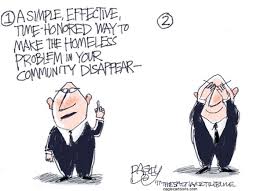
    We can get some kind of rough measure of this general atrophy by our own disposition when approached by a beggar. Two years ago we might have been moved to give him something; today we are moved to refer him to the State’s relief agency. The State has said to society, “You are either not exercising enough power to meet the emergency, or are exercising it in what I think is an incompetent way, so I shall confiscate your power, and exercise it to suit myself.” Hence when a beggar asks us for a quarter, our instinct is to say that the State has already confiscated our quarter for his benefit, and he should go to the State about it.

    Id.
    Guilt-free?
    Humor works best as a vector for Truth.

    And NOW we come back around to our homeless man on the street in South Bend, Indiana. (And Thanks! for sticking around).

    As I drove by him for the final time, it was past sunset, but not quite fully dark yet. He stood there in the same place holding the same sign. I couldn’t even tell if he had moved. I started to reach for my wallet but then the light turned green, so I accelerated away, leaving the man dwindling in my rearview mirror.

    “Aaaaahhhh….” I looked in the mirror as I went under the overpass, headed toward the comfort and warmth of my hotel. It was a rather warm October night, one of those last gasps of Summer before Fall fully settles in, he’d be alright… I thought of Nock’s words. “Fuuuuuck….” I muttered, rubbing my chin.

    I made an abrupt U-turn like any person who learned to drive in Rhode Island would, went past him, “banged another U-ee,” and there I was – and there he was – still holding his sign. It wasn’t the nicest part of town, but it wasn’t the worst, either. All I had was a ten and twenty dollar bill in my wallet.

    While stopped at the light, I looked left quickly where another car had pulled up to the light. There were three young black kids, all teenagers, ranging from perhaps thirteen to seventeen. The car was a bit dented up and they were watching me as I fumbled with my money, then tried to find the window unlock button in my rental car. I finally managed it all and motioned the man on the corner over; I handed him the ten as he leaned in my passenger window. He didn’t see it at first in the dark, but as he stepped back he said, “Oh My God, thank you. Thank you!” He started to walk away and I could hear his voice crack as he said: “I’ve been standing here for hours…”

    “I know,” I started to say, but it died on my lips. I’d driven by him all those times…

    I looked left and the three black kids were holding their thumbs up. The young kid in back was clapping. I just shrugged sheepishly. Then the car door opened and for a moment I thought, “Aw, fuck. Here we go. He’s going to ask for what I have left.” Then it became clear as I looked at the car it was because the window wouldn’t roll down. The teen leaned out and yelled: “I wanted to give him something, but I don’t have any money!”

    “Well…good on ya.” I said back. I couldn’t think of anything clever to say. “He needed that more than I did,” I yelled. “And I had it, so…” They smiled, waved, honked, and drove away as the light changed.

    And that was it.

    At a time when our country is rife with divisions over political parties, where we are told which lives matter, where we are no longer allowed to speak without fear of retribution if someone should be offended, where “hate speech” is now all the rage, and where I am told a car full of black teens should concern me because they are “superpredators,” where statisticians write papers claiming that abortions of black kids have helped drive down crime rates, where 1 in 4 or 5 or 7 homeless folks are military veterans, I think the “soft revolution” is what I now hope for…

    I hope that people will recognize that we all could and would be far more inclined to be charitable to our fellow man if we got to keep a little  more of our hard earned money, if our government wouldn’t tell us that IT is the ONLY possible solution to our problems, and if we all decided to simply act more charitably toward our fellow man – to take back our “social power” instead of waiting for the State to fix whatever the need is of the moment. Individual US citizens gave $258 Billion (yep, with a “B”) in 2014 – a record. At a time when the economy isn’t exactly humming. We should be proud of that, but how much better could we do if we got to keep more and decided to “just do it” ourselves, locally?

    Regardless of which shitheel gets elected, we should ignore their grand plans to “cure” _______ (drug use, poverty, racism, school shootings, or whatever the issue du jour is) and start exercising our social power. We don’t need to be told what the right thing to do is. We don’t need government to tell us to be kind to one another.

    We need to realize that we have to be the change we seek in the world and start doing it in the small ways that we can. Maybe eventually we’ll figure out we don’t need a three or four or five-letter federal agency to fake like it’s doing something while it hands out contracts to favored political donors and the people who really need help go wanting. Else I fear we risk continuing to ignore those in need among us because we have the excuse that “someone else” – like some bureaucratic agency or even the police – is going to do it. They’re not and they never have – and even if they did solve a problem, when was the last time you heard of some federal agency announcing that it had accomplished its purpose and thus was folding up so as not to waste taxpayer money? I won’t hold my breath waiting for the numerous examples…I’ll just try to exercise Nock’s social power to make the world around me a little bit better.


    *This post was originally written in the lead-up to the 2016 election.


    _____________

    Liked it? Take a second to visit www.theabjectlesson.com and support The Abject Lesson via Patreon.

  • A day at the park

    In the summer of ’81, I was 15 years old. I wasn’t your average teen. I was a committed juvenile delinquent and drug “enthusiast,” with a somewhat troubled past. My parents were hippies who–like many counter culture rebels–became hard core drug addicts. They divorced during a state mandated custody battle. The cops seized my siblings and myself because my parents refused to snitch on their dealer, basically. I spent two years (’76-’77) with my grandmother, who was a vicious and mean, high-strung stress case with an extreme superiority complex. My Mom eventually regained custody of us and we returned to our outlaw life. After a few years, and developing a drug habit, I tired of the poverty and stress of it all. I was offered to return to my Grandma’s house and I accepted. I returned much more street smart and ready to party it up.

    The San Fernando valley in the early eighties was a great place to party. Cruising Van Nuys Blvd (if you google “cruising Van Nuys Blvd” you can see what it was like) had been shut down about a year earlier and that scene had moved to a large park called Balboa Park. The lot would fill with cars, all of which would tune their radios to KMET, and a huge party would happen. Every once in awhile, the cops would drive through and everyone would hide their beers and what have you. It was a great scene.

    My friends and I would buy six packs of Mickey’s big mouths and split them. You’d put one beer in each back pocket and drink the third. That way, if you had to run, you only lose one beer. We had a plan for everything. This informal gathering happened every Wednesday night, just like the Van Nuys Blvd scene it replaced. We had many memorable times there, and this story centers around the last one I had there, during the summer of ’81.

    This photo was actually taken at Balboa Park on a Wednesday in 1981 or 1982 . Obviously it’s early in the day and things were just getting started.


    I had a friend named Marvin. Marvin was far more criminally minded than I. He had been to juvie a few times and had a huge record. He’d dive right in to any criminally oriented situation with aplomb. He pushed me to expand my lack of respect for the law. I was positively small-time by comparison.

    Marvin was very small. I was about 6” taller than him. I was kind of a protector of his. He’d get belligerent often and at ill-advised times, and I’d usually smooth things over with whomever wanted to kill him this time. Sometimes a fight would be unavoidable. Those times we’d just fight it out.

    This particular Wednesday night was off to a good start when I ran into Marvin. I was already a little drunk, had my three Mickey’s big mouths and was raring to go. Marvin pulls out some ‘ludes and gives me two of them. I was starting to feel really good about things, a feeling later proven to be misguided. As we walked the rows of cars, talking to girls and checking out hot-rods, this big dude runs up and starts hassling Marvin. Here we go again.

    I go to assess the situation. It seems that the ‘ludes Marvin had given me earlier had been fronted to him and he had no plan to pay for them. The big dude seemed very agitated and was demanding his 20 bucks. I sprang into negotiating mode and asked what he needed that we could maybe actually get for him. After some back and forth, we agreed that Marvin and I would go steal a car battery as payment. This seemed like an easy was to avoid violence, and we were sure it’d be quick and painless.

    There was really only one option for stealing car batteries near this park, a row of apartment buildings across the street. We went to the first car, in the first space of the first building. It turned out to be a horrible choice. There was an overhead storage locker which covered the front half of the hood. I told Marvin to be the lookout, so he stood at the edge of the lot watching out. I had no tools, but I figured I could just wind the clamps off. The hood crashed loudly into the storage bin when opened. I got the negative cable off as planned, but the positive side would not budge more than a slight partial turn. Eventually, I decided to just yank it out and hope the inertia would pop it off. Drugs and booze famously spawn bad decisions. We had both the former and the latter.

    Well, after one particularly loud crashing noise I see Marvin waving at me frantically. I start waving back to say, “I can’t help it,” but he responds as if to say, “NO, not that.” Then, he raises both his hands like a stick-up victim from the movies. I was perplexed until I saw the three people with guns pointed at him. They told me to come out with my hands up, so I did. They ushered us into one of the apartments and sat us on the couch inside. There were more armed residents inside and now we had about 6 guns pointed at us. I remember one of them looked like a flint lock taken from a plaque off the wall. Anyway, they held us until the cops arrived. I’m sure the proximity of the park caused them much concern, with all the partying and such, explaining the guns and quickness with which they used them.

    The cops took us down to the station and handcuffed us to bench. After about an hour, Marvin’s Mom came and picked him up. I assumed my grandmother would come for me next. Well, an hour later, she still hadn’t come. Finally the cops came and told me that she had told them to keep me. I was going to be driven to Juvenile Hall. Whoo-hoo! After another hour on the bench, they walked me out to a waiting car and we were on our way.

    Juvie was pretty much what I expected. It was a huge concrete building with only tiny windows way up high on one wall. It was three floors high and the lesser offenders like me were on the upper floor. That meant we could watch the traffic on the overpass through our window slits, if we stood up on our beds. The food was disgusting and the place was noisy and smelly and fucking cold all the time. We stayed in our cells almost all day. Ate in there and everything. There were some tables in the hall area outside the cells and we’d go out for about an hour every day. I spent about two months there going to trial and then waiting to get shipped out. I remember the radio played the Stevie Nicks/Tom Petty duet over and over because it had just came out. I will always connect that song to that place and time.

    This is the actual juvenile hall I was in, as seen from one of the cars we would watch pass by.


    Juvenile court is (or, at least, was…) unlike any other depiction or reality of court I had ever seen. As a minor, you have NO rights at all. There’s no concerns about proportionate punishments, rights to confront accusers, even the right to defend oneself. Marvin’s Mom had hired a lawyer for him and he (the lawyer) was the only one who spoke, other than the judge and, briefly, some kind of social worker/probation person, who made recommendations to the judge. Marvin’s lawyer gave a dissertation on what a good kid he was and how the only reason he was in trouble was because of my bad influence. I was steaming mad and kept raising my hand. The judge seemed irritated by me and kept waving me to shut up. After awhile he proclaimed that he had heard enough. Marvin was sentenced to house arrest and probation and I was sentenced to “suitable placement.” For how long, I had no idea. What suitable placement was, again, no clue. All I knew was I got jacked in that courtroom.

    Well, one day they drove me out to my “suitable placement.” It was a large group of brick buildings arranged like a school, with a quad, dorms and a cafeteria. It was run by Catholic monks. Everyone was “Brother X, Brother Z,” etc. There weren’t any walls or fences, so escape was always an option. Only the knowledge that I would be hunted down kept me from just leaving, well, that and the constant reminders that the next place was gonna be much worse. There was a school adjacent to the facility and we would spend regular school hours there. I was assigned a job in the kitchen and a dorm space with a cabinet and a bed. We had group therapy every day, where we’d talk about our problems and receive any news about our status, etc. The staff got to determine how long we would have to stay. We got weekend passes which we could earn in various ways. I had to talk my grandma into letting me go to a few at her house (I’m pretty sure the staff called her and made it happen). I got two weekend passes, one of which turned out to be transformative.

    There was three things that stood out as notable events while there. First, when I had just arrived, a guy in the kitchen had a half a joint. He was gonna share it with me. I figured we could put a ladder all the way up to the vent so the smoke could escape without smelling the place up. Then, we decided to cover any remaining smell with a mixture of all the cleaning products available, particularly the strong smelling ones.

    It turns out that mixing these chemicals can cause a variety of symptoms, including loss of consciousness and even death. Who knew? All the fumes rose to the top of the room, where we were atop the ladder. The fumes were so overwhelming, I couldn’t tell if the pot had any effect. The other guy fell off the ladder, hurt himself and I had to go get him help. The whole thing was viewed as us mixing the wrong chemicals and we never got into trouble because they never found out about the pot.

    The second thing was much more consequential. On my second weekend pass, I was out looking to get high. I ran into a friend and asked if he had any dope. He said he didn’t but he was going to a meeting and I was welcome to go. I had to cram as much into my time as possible and there was nothing going on so I said, “yes.”

    We drove to some little room in a church. I walked in and immediately thought, “there’s no way these are my kind of people.” They all had cars and jobs and they seemed like normal people. Then they started talking. They talked about all the things I was doing as a delinquent and how they had done similar and felt bad about it. They talked about having a conscience and how it seemed no-one else did. They talked about how it felt to know you were gonna keep doing dope, no matter if it killed you and how hopeless it felt. They seemed to have a window into my soul and made me look at myself in ways I never thought I could.

    Prior to that I had all those thoughts and feelings, I just never considered saying them so out loud. I watched people (in my fucked up outlaw world, anyway) go steal, fight, scam and do any manner of devious stuff and never seem to have any feelings of guilt. I assumed that I had to do these things and I would force myself to, but I was wracked with guilt. I thought my guilt was a personal defect which kept me from being all I could be. My life to that point had been a constant battle with my morality to overcome its influence and finally feel the way others looked like they felt. I had never imagined that they all experienced the same turmoil. Now I had proof. I was hooked. I got sober and stayed that way for 30 years.

    I was the only one at my placement who had gotten sober. I began to explore my soul and how it worked to regulate my morality. I completely changed my outlook and focus. In the group therapy sessions, I started actually being helpful to the other kids. I started helping them to solve their problems or at least begin to. The average stay there was about 6 months. Some people stayed 5 and some 7. I stayed a whole year. I’m pretty sure some of that was to find a suitable foster home (more on the “suitability” later) but I’m pretty sure my effectiveness at counseling the other kids played a part in extending my stay, as well. In any case, I set the record for longest stay for at least that era. Even a couple of other kids who went to foster homes were released after 6 months.

    It was during this time that I developed an ulcer. I was taken to the doctor who injected me with some dye and then x-rayed me. Back then, they had no real drugs for this so they just gave me a list of what not to eat. It was basically everything. Because I was institutionalized, they made me actually stick to it. I spent the last month there eating plain mashed potatoes and egg whites with no seasonings. It was hell. Every meal was a plate of bland whiteness. It sucked balls. I was getting really fed up with the system and wanted out bad.

    Eventually, the day came when I was allowed to leave. I was to move to a foster home in a good neighborhood with one other kid who already lived there. Oddly, the “parent” was just a single man, not a couple. I was happy to be leaving and ready to go out into the world. The guy seemed nice enough and the other kid was OK, I guess. I was happy to able to go to meetings and be out in the world, finally. It was about 14 months after I had tried to steal the car battery, and I was finally free to walk the streets, or so I thought.

    The other kid that lived there was a full-on fuck-up. He would waltz in with a shiny new stereo and claim he found it in an alley. He’d say that he hoped it worked and then try it out. Amazingly they always worked. The “parent” seemed to buy all of this hook, line and sinker. This kid never got in any trouble whatsoever. He even got brought home by the cops once for some crime or another. The guy never even asked about any of this. In my case, however, if I was a few minutes past curfew, there’d be handcuffs on the tables and endless threats to send me back. It was clear that the other kid was immune from trouble and I had a target on my back. I was young and at least somewhat naive, so I never really understood what was going on until after I decided to leave.

    One day I had had enough. I decided to find my bank book with my kitchen job earnings (about $300.00) and split. It was over a year and a half since my crime. I figured that I had paid my debt and was not going to live under this cloud of threats any more. I ditched high school and went hunting for my bank book. As I rifled the drawers in the “parent’s” room, I hit one that was locked. I assumed my stuff was in there, so I used a playing card to open it. Inside was a huge cache of gay porn and some sex toys that seemed like they were aimed towards women, IYNWIMAITYD. That’s when I started to remember a bunch of details. I would come home in the middle of the day and both the “parent” and the other kid would be in bath robes. Sometimes the kid would be taking a bath and the parent guy would go into the bathroom and stay 20 minutes or so. I realized that this guy was fucking the kid and knew I wasn’t going to be down with that. He was trying to get rid of me to cover it up. At that moment, he came in and started yelling about me being a thief, because I jimmied open his drawer. I really wanted to beat the living hell out of him with a lamp. I mean badly. The guy was a minister at a huge church, someone who convinced the state he could look after wayward teenaged boys, and this was what he did. I restrained myself and just left, not even bothering to find my bank book.

    It was not easy, being alone on the streets at 16 years old. On top of that, I had a warrant for going AWOL. I started using a fake name, at least for anything official (like talking to the cops). I slept in an abandoned bar across the street from my AA clubhouse for a few months. I would put 4 bar stools together for a bed. I spent my days in bookstores reading book after book. I really can’t remember how I fed myself.

    Eventually, I started getting jobs doing drywall or framing houses. Back then, you could buy a tool belt full of tools and just walk up to a jobsite and ask for work. 8 or 10 bucks an hour and if you worked really hard, they’d keep you. Nobody asked for ID or social security info. I did phone sales, auto repos and a bunch of other crap, too. Eventually, I got a job from a guy at the meeting in title insurance. It paid OK and I started saving a bit. Finally, I went to trade school for auto repair and became a mechanic.

    One day, I hitchhiked to Santa Barbara with a friend of mine. We just went to hang out and have fun. We were walking down State Street and as we walked, I was cleaning my finger nails with a buck knife. My friend bumped into me a few times. I kept telling him to watch where he was going, but he persisted. Finally, I stopped and adamantly told him to knock it off. Right as I was doing this, a guy walks up and asks, “what are you doing?” He was just a regular looking guy with a Levi’s jacket on. I said, “nothing, just messing around,” and realized I had my knife in my hand, so I folded it and put it away. Well, he opened his coat and pulled out a gun and yelled, “Freeze!” which was silly, because we weren’t moving. We put our hands up and he took his coat off to reveal a Santa Barbara Police shirt. He arrested me for “disturbing the peace.” I used my middle name for a first name and my Mom’s maiden name for the last one. I told him I was 18 years old, so they took me to the county jail. This was on a Friday night.

    I sat in jail until Sunday evening, when they called out my alias. I had forgotten it by then so there was significant lag time in my responding. Eventually, I caught on and answered up. The officer told me to roll ’em up because I had made bail. I was shocked. The only one who even knew I was there was my friend and he was 16 also and penniless. The cop walked me down some halls and finally stopped me in a quiet spot. He told me that some friends from L.A. had come up to look for me after my friend hitched back down there and told them what happened. They went to juvenile hall, the police station, the hospital, basically everywhere before ending up at the jail. They tried every combination of my name with no luck (they didn’t know what my alias was).

    Finally, they asked to see pictures of arrestees from Friday night and found me that way. The cop said they told him my whole story and he was impressed. He said he was gonna let me them bail me out, but first he took me on a scared straight tour. This guy killed his mom, that guy stole a car, etc. Then he gave me a hundred bucks and said, “don’t come back to my jail,” and I was out.

    I tried to make good on his admonition, but it wasn’t to be. About 2 years later, I was riding my motorcycle around and got pulled over. I had long since stopped using fake names, so I gave them my real name. They gave me a chicken shit ticket for loud pipes or dim tail lights or something and after I signed it, they whipped my hands behind my back and handcuffed me. I asked what they were doing and they said I had a warrant from Santa Barbara. Damnit!

    This time, I went to L.A. County Jail and had to sit there for 5 days until a bus left for up north. I rode up with all the people who were sentenced to state prison. I got to Santa Barbara jail on Friday, so I had to wait until Monday to see a judge. When I finally did, he seemed pissed that I was there. He said, “years ago you did basically nothing on State Street, there’s not even any peace on State Street to disturb! Now, you’ve spent ten days in jail, and forfeited $100.00 bail for no good reason. I apologize and the case is dismissed.” So now, I get released at like 11 p.m. in Santa Barbara with no money and no way home. I hitched home and it took all fucking night. When I finally got home, my motorcycle had been impounded and cost me about $600.00 to get it out.

    I could go on, but this seems like as good of a place as any to end this story. My life, both before and after these events, has been filled with the similar craziness, this is just one sliver of it. BTW, Santa Barbara County Jail, circa early 1980s, was a WAY better place to be an inmate than either L.A. County Jail or Sylmar Juvenile Hall.


    P.S. When I adopted my son 7 years ago, I told this story in somewhat abbreviated form, to our social worker. She was amazed, not by that fact that it happened, but by the fact that I turned out OK. She said, basically, “ most of those kids end up spending their whole lives in prison.”


  • A Dark July

    No alt; just a shirt


    As I write this, it is the third anniversary of the ambush attack on police in downtown Dallas, in 2016.  As a by-product of the incident, I no longer work at the job I had when the attack occurred. While I have recounted parts of the story for others, I haven’t really done so for the glib crew.  It’s not my intent to walk you through the attack itself—three years has blurred a lot of what happened.  Rather, I want to talk about the part I played in this mess and the fallout from it in my life.  If you’d like a good report on the attack, this link offers the most comprehensive look at the attack of any I’ve seen.

    At the time of the attack, I was the senior Police Communications Supervisor for the Dallas County Community College District.  I was at just about 11 years on the job, with eight of them as supervisor.  To help paint this picture, let me give a brief explanation as to how DCCCD operated at the time.  There are seven ‘main’ campuses, along with satellite campuses, and various other locations that handle administrative, technical, and/or other educational matters.  At the time, the seven main campuses all had their own police departments—seven different chiefs, seven different ways of doing things.  The dispatch center is located at a campus in the northwest section of the county, and, it was at that campus’ police department that I was employed, followed chain-of-command, etc.  However, the functions of the dispatch center were considered ‘District’ functions:  all campuses paid to fund us, and, we dispatched for all seven PDs.  It was a pretty messy situation, and I will discuss some of it later on.  (If you have questions on anything I don’t cover, feel free to ask me in the comments.)

    Being the supervisor, I rarely did the normal dispatching functions.  I was mostly a baby-sitter, and did more to ensure things ran as smoothly as could be expected.  I had plenty of fires that I battled in regards to employees, along with trying to increase professionalism in a place where it was often opposed.  Due to the design limitations of the center, my helping out usually came in the form of call-taking.  If I had to be on the radio, it was usually on a portable radio (walkie-talkie).  Most of the time, when I helped out, it was because we were short-handed.

    On Thursday, July 7th, 2016, we were short-handed.

    That day, it was just me and one other dispatcher, V (not Xer real name).  V was, and, is, a very capable dispatcher, with no previous dispatching experience prior to her being hired at the college.  What V does have is a Masters’ in Criminal Justice, and a really good work ethic.  Xe would be handling dispatching duties that evening, while I took phone calls.  For some reason, Thursdays were always the busiest day of the week for us.  It was an odd situation, and I came to dread Thursdays, even though I wasn’t usually doing much of the heavy lifting in the center.  I don’t recall it being a particularly bad shift, prior to the notification we received from an officer at El Centro (the campus located in downtown Dallas) about yet another protest scheduled to take place that evening.

    There had been other protests in the area of the college, none of which had been an issue.  So, hearing that there was a scheduled protest that evening didn’t really mean anything for us, presuming everyone behaved as they had previously.  V and I just presumed that we would hear various radio chatter from the El Centro officers, while all the other campuses went about their normal activities.  We were very wrong.

    What I remember is that, not long into the protest march, we heard an officer report that they heard something that sounded like gunfire, and that Dallas PD was reporting shots fired in the area. Once we heard that, I think we both sort of tightened up internally, and prepared for…well, something to happen.  This was just after 9:00 p.m., as I recall, and it continued on until well after midnight, as it went from the street into the actual campus building.  We ended up being tasked with helping the El Centro officers communicate with the Dallas PD units that responded by taking phone calls and relaying information over the radio.  While there are state-based emergency radio channels that any agency can use for coordinating with other agencies, I can tell you that Dallas Police does not believe in sharing their radio frequencies with other agencies.  The 800-pound gorilla does what it wants, regardless of the other animals.

    Since I was handling telephones, I was dealing with incoming calls, as well as having to make calls to various college personnel to help the responding SWAT units negotiate the building safely.  I also took a call from people in a classroom on the campus that were essentially trapped inside as the madman made his way into the building, trading gunfire with various officers.  We told the El Centro Chief about the people in the classroom, but, in the chaos, the officers must have forgotten about them.  It took about another 1.5-2 hours before I got another call from the group, asking if it was safe for them to leave.  At that point, the decision had been made for Dallas PD to use explosives (honest-to-God C4), and they needed the building cleared.  The class would finally be getting out, just in the nick of time.

    During this time, we had a shift change in Dispatch.  This happens at 10:00, and V’s relief, J, walked in on what was probably one of the most chaotic shifts xe’s ever had.  J had previous experience dispatching private security, so xe hadn’t experienced anything of this magnitude before.  I can say, proudly, that they were absolutely fantastic in their performances, and I was able to handle my work without having to constantly monitor them.

    I should point out here that the most significant thing about working the phones that night was how busy it wasn’t.  In a situation like this, I would normally expect tons of calls by the media, as well as calls from frantic parents out of their minds over their children.  This would even include high school-age teens who were taking classes on campus.  In this situation, though, it was late enough in the evening that most classes had begun to let out.  Add to this the fact that it was mid-Summer, which isn’t exactly the busiest time of year for attending college.  As for media calls, most local news was already on scene when the shooting began.  They all witnessed what was happening in real time, and didn’t need to call us to try to get a statement.  This facet of the incident has always felt surreal to me, since things were, in all honesty, easier on us than it should have been.  Far be it from me, though, to look the proverbial gift horse in the mouth-any mercy is appreciated a situation such as that night.

    The standoff ended just before 1:30 a.m.  I was ordered to stay until 2:00, when the other supervisor came in to relieve me.  I left knowing that the shooter was dead, and that the team of officers from the various agencies was attempting to secure the area to ensure there were no other threats.  I also left knowing that things were going to be very different in the aftermath.  The district hadn’t lost any officers in the shooting, although a couple had sustained minor/medium injuries.  Truth be told, I had officers at other campuses that had been wounded more severely in a stabbing attack a few years earlier.  However, I wasn’t ready for what wouldn’t happen after this.

    Two weeks after the shooting, my Chief popped in to the room with an email in hand.  It turns out that the Chief from El Centro was mad as hell because no incident report had been written, and my Chief wanted to know if I could explain why.  When I looked at the call sheet of the incident in our CAD (computer aided dispatching), there was no report number attached to it.  The process was (and always will be) that an officer, who will be writing a report, asks Dispatch to issue them a report number.  The CAD has a button on each call sheet to do just that, and the dispatcher clicks it, and a few other tick boxes, and voila’!  In this case, though, no officer had ever requested a report number.  Dispatchers don’t determine who’s writing a report—we respond to a request from an officer.  If no one asks for it…well, it’s not on Dispatch’s shoulders to move this along.  However, the El Centro Chief, who was supposed to have had several years command experience at other agencies outside of Texas, apparently didn’t understand this.  The FBI wanted El Centro’s report, and he was in the spotlight with a certain appendage in his hand.  And, by God, Dispatch needed to answer for this!  It didn’t help matters that my Chief didn’t understand this protocol, and that I had to explain it to him first.  This resulted in my having to whip up an email explaining the steps to two Chiefs, who should have known about them before this point.

    Did I mention that V was on duty, and heard when our Chief brought this issue up?  Did I also mention that, other than a verbal pat on the back from my Captain (my direct supervisor) at the end of the shooting, there had been not one bit of positive feed-back about our efforts that night?  Yeah, it was a shit situation.  One of the two dispatch superstars from that night heard the only feedback from outside our office, and it was a Police Chief complaining about something we didn’t do.  It was also at this point that I realized that my boss hadn’t said anything to me in regards to recognizing the ladies for their work.  This was odd, because every other time an award was brought up for a dispatcher, it started with an order from the Captain to put it together.  When I realized that he hadn’t said anything to me about it, I questioned him, and got a, “Well, go ahead and make something up.”  His blasé attitude was shocking, considering that, for the last eight years, I had to run everything past him, and he had always initiated any awards.

    On top of this, things began to seriously change on a larger scale.  The District had previously planned to hire a Police Commissioner to be over the entire District.  It was a newly designed position that had already been created and approved, with a candidate set to start at the beginning of the fiscal year.  However, they decided to rush her hiring, and she started around the beginning of August.  This, in turn prompted my Chief to retire early.  He had become fed up with the direction the District was moving in regards to the Commissioner, and plans to unify the seven departments into one.  He told me that, on top of removing college administrative duties from his role, the powers-that-be had lied to him about what the Chiefs’ positions would be like when the Commissioner came into play.  He had planned to retire in January or February of 2017, but he decided he had had enough, and nope out at the end of August.

    It took two months to get the awards designed, approved, and printed in-house.  TwoMonths.  It might have only taken one month if my Captain hadn’t kept them sitting on his desk for weeks.  The speed at which he wasn’t moving on these things was breath-taking.  Of course, we had to wait for my Chief to get back from his pre-retirement vacation, so that he could sign the awards, which then had to be framed before I could present them.

    The entire time I was waiting, I was growing more and more enraged at the deafening silence around the work my dispatchers did that night.  Other than a quick, “good job” from my Chief and Captain, nobody outside our office said a positive word about them.  Of course, we don’t do the job looking for recognition.  But, a certificate in a frame is really just bupkis.  I tried to tell them every time I saw them that I was proud of the work they did, and that I was sorry no one else had given them any recognition.  We all understood that the El Centro officers were going to be in the limelight—they were the ones in the line of fire.  To us, though, it just seemed like we didn’t exist in the eyes of the District’s Board of Trustees.  We already knew how the El Centro Chief saw us.  Hell, the District never even offered a debriefing or counseling for us, which is standard practice for events like this.  I don’t know if I would have attended if it had been offered, but, it would have been nice to have the opportunity. Once I had the certificates in my possession, I was able to schedule V and J on the same shift.  I arranged with the officers from our shift at our campus to have a family meal from Babe’s Chicken, and I bought them dinner to go along with the awards.

    At some point after the arrival of the new Commissioner, my boss held a meeting where he told us that there were plans to eventually move the dispatch office to the downtown area of Dallas.  It was just a plan, but, one on which they would be going forward.  It was going to be a five-year plus time frame, but, we would end up with new digs, and a much longer commute.  I live in another county, quite a ways north of Dallas.  There was no way in Hell I was going to make that commute for that job.  The writing was on the wall, and thus began my search for another agency.  I didn’t want to be a supervisor with DCCCD any more, and, stepping down wasn’t really an option.  I had made enough enemies with some of the people I supervised, and going back to a peer status with them would have been untenable. As it was, another college district—one I had actually applied to about four years prior—was hiring.  I decided to move forward with the process and am actually their most senior dispatcher.  Of course, that’s its own story.

    I hesitated for a long time in talking about my job in comments on the site.  I may not be a sworn officer, but police work isn’t usually a pleasant topic amongst libertarian types, for good reason (ahem).  However, it was during my time at DCCCD that I became a libertarian, and I began to see the profession for what it currently is.  Interestingly, college-based policing is quite a bit different in many respects, and, I’m fortunate that my current agency is far more service-oriented, and, far less punitive than standard municipal/county policing. On top of that, none of my fellow glibs has ever treated me poorly over my employment, for which I am grateful.

    I realize that I probably skipped over a lot of points that would make for a more in-depth article.  As I stated earlier, if you have questions, I’ll answer to the best of my ability.  It was a surreal night, and I’ve not dwelled on it that much since I left the District.  I’ve tried to utilize what I witnessed/experienced for training others, so, it’s not for nothing.  When I left, I recommended V for my position, which xe got.  As far as I know, xe settled into the work easily enough.  The last I heard, J was still working overnights, just as I do now.  While I stay away from old work haunts, I wish the best for them.  They deserve it, regardless of who notices.


    **Thanks to CPRM, for helping me protect against some gender presumption

  • Mentally Incompetent to Stand Trial – What does it mean?

    There’s a few concepts about mental states, and how they affect a defendant during legal proceedings.

    Let’s cover the first : Mentally Incompetent to Stand Trial. What does that mean?

    Here’s the scenario: State of Michigan is charging that the Defendant committed a crime (duh). Defendant meets with attorney. After the first meeting, the attorney wonders a few things about the defendant, based on the D’s behavior.

    Such as: he can’t remember facts of the alleged crime. Sure, he could have been too intoxicated . . . . however, he can’t remember where he lived before he moved here. He knows he’s in jail, and he doesn’t like that, but can’t really seem to keep the conversation going to help his attorney understand his version of events. And maybe he has a few odd gestures, expressions. (More signs of mental illness are listed here, from the national alliance for mental illness).

    You see, the idea of “due process” is broad. It includes that the defendant, to have due process, has to understand the proceedings and be able to assist his attorney in defending the case. If the D can’t do that, then he is mentally incompetent.  And if a defendant is  mentally incompetent, then the proceedings are halted (but not dismissed).

    Any questions about a D’s competence should be raised by the attorney as soon as apparent. (However, the prosecutor or the judge can raise the issue as well). The defense attorney should make a motion regarding competence that asserts that 1. the D can’t assist his attorney in defending the case and 2. possibly, the D lacked the capacity to appreciate that his conduct was wrong, or didn’t conform to requirements of law. That last sentence is the lead-in for the affirmative defense of NGI, or not guilty by reason of insanity. Also called “legally insane.”

    After that motion is made, the court will refer the D to an interview by a forensic psychologist to make a determination of competency. The report of the psychologist is then released to the court, attorneys, etc.

    Option 1: the Defendant is found not competent. Just because a D is found incompetent does not mean that there will never be a trial. Instead, the next step is that the D has to have mental health treatment – and the court issues an order for this – so that he will become competent to stand trial, at a later date.

    This idea seems to also offend the D’s right to speedy trial, as guaranteed in the Sixth Amendment. However, dismissing the case based on competence is not fair to the state (sadly). Also, the speedy trial right has never been interpreted to have a definite deadline by the Supreme Court. For example, the Supreme Court hasn’t ruled that “any delay to trial longer than 24 months would prejudice justice.” Michigan however, does limit the amount of time a D can be treated, (MCL 330.2034) to no longer than 15 months, or 1/3 of the maximum sentence which the D would have if convicted, whichever is shorter.

    Also, technically speaking, the D is not being punished by receiving treatment, as he is no longer in jail, he’s in the hospital, receiving treatment.

    Option 2: Defendant is found competent. If a defendant is interviewed, and found to be competent, an alternative to halting trial for D’s treatment  is a “no contest” plea, which would be based on the idea that he was too intoxicated/ abusing substances, etc, to be able to recall the crime. But use of alcohol /substances is not a defense, and does not make a person legally insane at the time of the crime.

    Also, some crimes are open to alternative sentencing, through mental health treatment courts. This is a diversion program, that is essentially the same as sobriety court. It requires that the offender plead to a crime, then complete mental health treatment for a period of months. In exchange, the state will “nolle prosse” the charges, once the program is completed by the offender. The likelihood of repeat offenses goes down significantly when the program is completed. However, it is much like intensive outpatient, and requires a lot of participation by the offender, such as 3-4 weekly appointments at counseling, group therapy, probation /parole appointments, and regular medication review.

    Next installment: legally insane – or Not Guilty by reason of Insanity.

  • Prison / Jail slang -You Got Me Bang to Rights, Guv’nor

    Be aware of what the people say! And interpret their slang so you feel, cool, and shit.

    I get to hear and read a lot of slang in my line of work, so bear with me while I provide a guide to prison/ jail slang.

    Snitch / Plant: One inmate trying to tell on another, in order to get a better plea deal. Advice to new inmates is often: be careful who you talk to, it could be a snitch.

    Kite: a jail letter. This can be between inmates, or from an inmate to a department in the jail, or his or her attorney. If it’s a kite between inmates, its a tiny paper football, with tiny writing on it, that sometimes is “shot” between cells. Inmates also pass them to other inmates while they are walking to meals, etc.

    If it’s a kite to a jail department, then it is usually about something the inmate needs to have done. For example “I kited a letter to accounting because I think they have my out date wrong. I should get credit for more good time.

    Out date: This is the date an inmate will be released. Inmates often write to their attorneys, the court, etc regarding their out dates.

    Good time: No, this is not what the inmate did to get in jail. This is “credit” toward the out date. For example, a month in custody (with no incidents) usually results in 4 days “good time.”

    Get a play, do a play: This means sell /buy some drugs.

    Rillo, rello: These are the small cigars that party stores sell. Users often rip off the cigarello, and use the plastic tip that’s left  to smoke a controlled substance.

    On paper: This means on probation, or on parole. If you are on paper, don’t go posting facebook photos of yourself with money, guns, or drugs, as your PO will see that shit, and bust you for a PV.

    PO: probation /parole officer. PV: probation violation, parole violation. Sometimes the inmate is PV, parole violator.

    Trusty/ trustees. These are the inmates who get to 1. wear more comfortable clothing and 2. do jobs in the jail. The jobs can earn them more credit sometimes, or commissary. Plus the inmate gets a little more freedom, can sometimes leave the facility, as long as they report back at the scheduled time.

    Color code (not a slang term) There’s also a clothing color code that goes along with inmate status. Low-level inmates are usually in the bright orange/  teal. Trustees get comfy brown scrubs to wear instead, or even a plain white tee to wear with the scrub bottoms. If you’re being transported to court, you might have to wear the traditional “stripes” uniform. If you’ve been caught fighting, then you might go back to orange/ teal and be put in lockdown /solitary. Sometimes called “greens.”

    Lockdown: This is what it sounds like: the section an inmate stays in is “locked down” due to an infraction. Lock down means no activities, no phone calls – for the whole section – until the lock down status is clear. Infractions can be something dumb, like toothpaste on the walls, messy cells, etc. Or it could be fighting, or contraband in the cells.

    Chore Boy: Users put this in pipes to smoke crack with. It keeps the crack in one place. So when users are arrested, the search often reveals Chore Boy in the pockets, vehicle, etc.

    Bond! This is something set at arraignment, depending on the case. Typical bonds are between $1,000 to 100,000 or more. $1,000 might be set for a simple (non-aggravated) assault case, while  $100,000 or more might be set for a rape/ CSC charge. PR Bond means “personal recognizance,” or the defendant is not a flight risk, and needs only to show up at court.  PR bonds can still have an amount attached to them, so if Defendant no-shows at court, then the cash has to be paid. 10% bond means that the bond is set at $5,000 but the defendant can get a bail bondsman to guarantee it, so the defendant only has to pay $500. C/S is short for Cash/surety – defendant has to put up the whole amount.

    Usually bond has other conditions. For example, a defendant can submit to SCRAM, tether/ surveillance or GPS monitoring to make sure conditions are kept.

    Bid: this is the term or sentence an inmate has. 5 year bid = 5 year sentence.

    Well, that’s all I got for now folks. Enjoy!