I have noticed on the interwebz a lot of back and forth talk of the Enlightenment. What was it, was it good, was it bad and how does it affect us. Well my fine fellows, Pie is here, yet again, to give the knowledge to the masses. After carefully studying the debate on the merits of the Enlightenment for about 10 minutes or so, I am going to drop a few ideas here.
Wait! Is that really sufficient research on such a complex topic? Yes, but more importantly I noticed a lot of stuff about it on the internet and felt this site also needs more posts on the Enlightenment, otherwise we will have a post gap on our hands. We need more scholarly, profoundly intellectual pieces around here anyways. What is the Enlightenment? What does it mean? What does the future hold?
Where shall we begin? Well at the beginning if you will.
In the beginning God created the heaven and the earth. And the earth was without form, and void; and darkness was upon the face of the deep. And the Spirit of God moved upon the face of the waters. And God said, Let there be light: and there was light. And God saw the light, and it was good; and God divided the light from the darkness. Or the big bang happened followed by billions of years or random particles doing random particle shit and out of this whole mess, plus some soup along the way, here we all are, dicking around on the internet. I may have skipped a bit over the boring parts.
Let there be light. But it was not light all the time. Sometime it was night. And a few measly stars and the moon don’t cut it, especially inside or when it is cloudy or rainy or snowy or murky or generally unpleasant. Hupersons (let’s not be sexist y’all) have always had strange relationship with the dark. It was dangerous and mysterious. It caused fear and awe and inspiration and fascination. And while the dark was not necessarily bad, humans fought against in since they mastered fire. The dark was worse in winter, and often accompanied by the cold, so warmth was needed as much as light. But with fire, both were more or less achieved.
Fire was the first push against the dark. The bonfire and the hearth; the torch and the primitive lamp, made of stone or bone or shell, likely using resins or animal fats as fuel. As human civilization advanced, oil lamps and candles and rushligths – if you were poor and basic- appeared. Followed by gas lamps of various shapes and forms and, finally, after one hundred thousand years of struggle or more, glorious electricity.
Electricity was a game changer. It made night into day, it extended the time and scope of human activity, it changed biorhythms and habits and it, in a way, remade civilization. After electricity, we could say we conquered the darkness. We may have conquered it a bit too much, if you count light pollution and the fact that some people searched the darkness. You want, off course, what you are missing, and the world and its dangers were tamed in many ways.
Fire and electricity brought, besides light, other comforts against the cruel world, heat and cold, depending on what you want, chiefly among them. This was later called by historians The Enlightenment, the mass bringing of light and comfort into human civilization. Because what else would the enlightenment be? It has light right there in the name, so don’t you @ me, as the olds say on twitter these days, I am sure the kids have moved on to whatever bullshit goes on tik tok.
I mention comfort because, despite the fight against the dark and the cold, more or less successful, for the majority of human history people lived in dwellings that, unless the season was just right, were either cold or hot or damp, and most definitely dark. Because, while fire and lamps and candles and stoves worked some, they worked in a very limited fashion, creating an oasis of light and warmth in the cold and dark, and people huddled inside it.
But the darkness is fighting back. In the form of the modern green movement. Like the puritans of yesteryear, only weirder, they do not like what the Enlightenment brought. Demons and witches ahem CO2 is lurking in the miracles of the age, which are nothing but a Trojan horse for a magnum destruction of the entire world. Repent, ye heathens, the end is nigh.
Now don’t get me wrong. I like the environment. I even live in it. I like mountains and forests and lakes and rivers as such. I am not pro pollution, although CO2 as pollution is sort of debatable. What I do not like is the quasi-religious aspect of the movement and, in reference to the text I have written, the miserabilist aspects. The green movement does not seem to be “let’s see what we can do to best preserve the world and keep our comfort, given the various trade-offs”. Nonono my friends, this is not what the Khmer Vert (h/t K. Niemitz) are all about. Besides being more or less a front for socialism, with little if at all to do with saving the world, they are so damn anti-inspirational. What happened to dreaming of a world where we can have all the things we want? Their solutions are mostly towards poverty. Turn off the lights! Turn down the heat! No AC! Go back to living in to cold, to hot, to damp dark dwellings. No meat. Shower every other day. No flying. I am going to have to go with “no” on this one. If fact Hell No. The devil Marx take these people!
I do not want to live in a cold, damp, dark home. I don’t want to live in a tiny home. I want to eat food I like and drink good wine and get the occasional vacation in. I want to have the freedom to decide my life, what I do, where I work, keep my money and decide how I spend it. I am open to preserve the environment, because it is obvious I, like many people, do not want to live on a devastated planet. Not that the planet is currently devastated or anywhere near it, at least not in the civilized world. So I will take a movement serious as long as they preserve this things.
We have the most technologically advanced civilization in human history. We should be able to find a solution to lowering CO2 if so we wish. Hint: nuclear. Now I may be excessively optimistic on nuclear. But I do not think so. I think there are plenty of promising techs. Some say it is expensive or dangerous. Dangerous I doubt it, not truly, not if you are a bit careful. For storing the waste there are solutions. Although a lot of the issues would be solved by molten salt reactors. I am not even talking fusion or such. Personally, I think it is silly to burn coal for power in the 21st century. Maybe it is the techno optimist in me. I think nuclear could give sufficient cheap power, enough to replace fossil fuel heating in most places with electrical. And nuclear is a much more elegant solution than anything else.
But nuclear is dismissed out of hand. This makes it very hard for me to take the greenies seriously in any fashion. Even if it was dangerous now, the view should be let’s see if we can get it safe. It is not, which makes me think that CO2 is not the real reason. The real reason is socialism and misery and cold and dark and stupid shit like wind mills and solar panels.
We put a goddamn man on the goddamn moon, to be all cliché about it. I would say have a damn moonshot on nuclear. But that is just me. Enlightenment now. Fiat lux!
The Moon, Jupiter, Jupiter’s moons through a binoculars-October 2019
Editor’s Note: Some photos may be enlarged by clicking on them.
Well, after the “downer” tone of my last piece, this piece will look up and away. The night sky captured the imagination of our ancestors. Every known culture has used the sky to capture reminisces of some of their tales. Every week Not Adahn pitches us on how the stars foretells our futures. But in the modern world many of us have lost our connections to the wonders of the night skies. We can go inside where it is warm and well-lit and we can amuse ourselves in ways that were undreamed of even 50 years ago. Our cities have also robbed the night sky of the ability to grab our attention. Ambient light obscures our chance to even see what is visible. None of this is bad. Warm, lit evenings with plenty of food and entertainment has been a goal of mankind for thousands of years. But sometimes you may wonder “What is that light up there in the night sky?”
You can observe the night sky year round but the summer and fall are easier times to break the problem of not seeing the night sky. During the summer the night sky faces to center of our galaxy and the night sky has lots of things to look at. The evenings are warm. The autumn in some ways is even more favored because many people hunt and are arriving at dark locations away from cities before dawn and remaining until well after sunset. Others are out for morning or evening walks and night clings longer so the opportunity to see the night sky is more easily presented.
This article is for the casual sky observer. I assume the readers have no precision telescopes, special software or the other equipment that serious amateur sky observers use. If you have an internet connection (if you don’t you’re not reading this anyway), working eyes, binoculars, maybe a spotting scope or a kid Xmas gift grade telescope* you have all the equipment you need.
(* This is a smaller refraction telescope with no electronics and generally with pedestrian quality lenses. Typically they have low magnification around 35X and higher magnification around 80-90X.)
What will you see when you look up? Stuff. Most of which is beyond the care and concerns of humanity. Some of the stuff is from mankind and can be humbling to see it whiz along. Some of it is our neighbors. The rocky or gassy planets which formed around us. Maybe you’ll see a visitor from the icy far suburb of the Solar System. I guarantee that you’ll see our companion orb. With patience and luck maybe you’ll see reminders of the power of the universe to alter life, planets or entire star systems.
One word of warning. What you will see in with your own eyes is one sense, disappointing. You won’t observe the rich colors, incredible details and literally otherworldly viewpoints in the best images released by the elite observatories, NASA, or the ESA. But that will be more than made up by the fact you will be seeing the objects first hand with your own eyeballs and mind. You will be able to combine the seen with the presented and hopefully be able to better enjoy both.
What do you need to observe the night sky? 1) A night without solid cloudiness.; 2) Your eyeballs at a minimum; 3) Something to tell you what is out where and when. (More in a bit); and it helps if 4) you have some type of optical aid. This doesn’t need to be a $10,000 telescope. It can be a decent pair of binoculars, a kid xmas present type telescope, a spotting scope, or even a decent rifle scope. The more magnification and light gathering ability device has the more detail it will enable you to see. It will also help if you give your eyes some time to adjust to the night away from lights.
This scribbling will be broken down into Solar System sky objects and manmade objects. I’ll try to keep the jargon down so as the Hitchhikers Guide advises, “Don’t panic”. So let’s head out to the deer stand, or out for the evening walk, and make sure to look up from time to time.
The Solar System and Manmade Sky
Let’s start with the easy stuff in our immediate neighborhood of the universe. The Sun, Moon, planets, comets, manmade stuff and others. Seeing these objects rates from really easy to challenging (or lucky). For the most part these things are bright, it is easy to observe their movement, and they show details even with the most basic binoculars or scopes.
The Moon
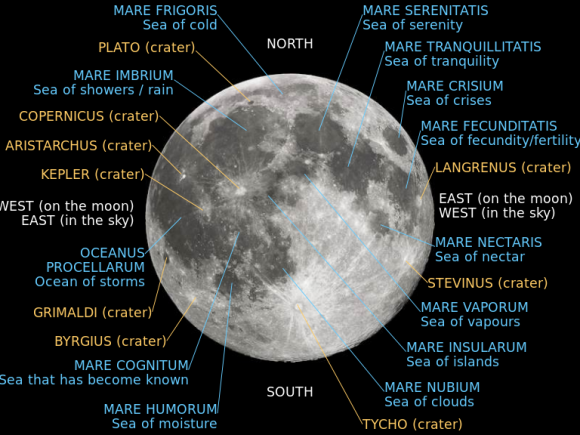
This is the earliest known night sky object and for the most of a month it takes no great skill to find it, even in a city. The Moon is a delight to observe as the terminator (line of light and night) crosses the lunar surface. The area around the terminator is full of shadows which allows surface features to “pop” into view. Mountains thousands of feet tall cast their shadows miles deep into the cooled lava “Sea” that surround them. Large craters will have bight rims with inky black interiors, and occasionally you’ll see the top of a crater’s central peak poking into the sunlight from the dark void.
So when is it best to observe the moon? Any time you can see it, except for the 4 days or so around a full moon. During that period the moon appears flat because the light doesn’t cast noticeable shadows
Through binoculars or your scope the view changes by the hour as the edge of the night rushes along the surface. One cold, dark, and clear pre-dawn in Montana I got into position and waited for daylight and the elk. While I tried to stay, warm, quiet, and unscented I had a great view of the terminator and as I looked at the moon through my binos I caught the moment the sun rose high enough to pass through a breach in a crater wall and send a narrow beam of light spilling across the crater floor.
Even with no optics the face of the moon changes between nights. If the moon is already up at sunset, you are approaching the full moon. If at sunset, it is the full moon. If there is a noticeable period between sunset and the moon- the moon is waning. Finally if the moon is bright and high in the sky around noon, it is about a week to no visible moon. AKA- the new moon.
Fun fact about the Moon. Because of a small wobble in the lunar orbit an Earth observer over time can see almost 60% of the lunar surface as the wobbles (libration) let us peek around the corner of the Moon. Also, most lunar sea surface material is about the same color as a middle aged asphalt parking lot.
The Moon’s features seen through binoculars
The Sun
In short don’t look at the sun without eye protection. Especially now since even there are very few sunspots to see (aka solar minimum). Welding goggles are not usually dark enough to protect you since most commercial welding goggles are a level 12 darkness and the sun requires level 14. Small “XMAS Telescopes” usually come with a “solar filter” which can be used with the lowest power lens configuration. In other times you can carefully observe the Sun’s face for sunspots. Right now the risk is probably not worth the view. But, unless you have specialized equipment, the Sun is best observed online from a solar observatory website. There are three exceptions to this: solar eclipses, planetary transits, and the green flash. I’ll discuss solar eclipses later.
Planetary transits are the rare occasions when Mercury or Venus actually are seen crossing the face of the Sun for a few hours. Because the planets don’t follow the Solar equator the geometry required for the Earth to experience this view are few and fleeting. The last transit by Venus was June 5, 2012 and was fun to see. The next will be December of 2117. A Venus transit was how the atmosphere was discovered and that led to a rush to have observing sites around the world in 1769. Today science has moved beyond transits for scientific purposes but watching the progress of a planet across the face of the Sun puts the scale of the Solar System in perspective. While my bet is that I’ll miss 2117 transit of Venus, I am holding out hope for the Mercury’s November 11, 2019 transit of the Sun. The transit will be visible from all of North America and much of Europe. Japan, you’ll have to catch it online. I live near an east facing beach so I’ll be able to experience it at dawn. What you’ll see is a black dot that moves across the face of the Sun. This website will provide you the information for your location including where on the solar disk you will see Mercury. If you miss this transit your next opportunity will be November 13, 2032.
Venus Transit 2012
To observe the “green flash” you need an unobstructed view of a flat horizon at sunset or sunrise. It works best if you use an ocean or a Great Lake. I have heard people have seen the “green flash” on the Great Plains, but I had no luck when I lived in the KC area.
A “green flash” occurs because the atmosphere acts like a prism and just as the solar disk disappears (appears) at the horizon the prism causes a 1-2 flash of green to appear at the top of the solar disk. Again, a fun thing to see if you are aware and lucky.
Green Flash over Pacific Ocean
Jupiter
In the current night sky at sunset Jupiter reigns. Venus is usually brighter but right now it is close to the Sun and hides in the glare of sunset. In contrast if you look west of south after sunset the largest planet with be the first “star” to come out and remains the brightest object in that part of the sky. With the naked eye Jupiter is very bright silver white “star”, while through even the smallest binoculars it appears clearly as a disk instead of a point of light like a star. You can do a quick check if this. Find Jupiter and check it out. Now make a closed fist and extend your arm. Place it just below Jupiter and look at 5 o’clock. That bright red star is Antares. Now look at Antares in your binos. Antares is the 15th brightest star in the sky. It a red super giant of about 12 solar masses only about 550 light years away and if it swapped places with the Sun it would fill the Solar System until midway between Mars and Jupiter. It is truly big. Even that close and big Antares is a mere pinpoint of light. Every major planet is clearly a disk and not a point of light. (See opening picture)
In a dark location with good binos (with large front lenses to gather light) you can see Jupiter’s four large moons. They appear as distinct “stars” along Jupiter’s equator. With any scope these stand out. Depending where they are in their orbits you can see up to four of the moons Galileo discovered. All four are fascinating for their own reasons, but the inner two moons (Io and Europa) move so quickly that observing even an hour apart will reveal clear movement. With a scope as well you’ll be able to make out some of Jupiter’s banding which look like brownish stripes north and south of the equator. Jupiter takes about a year to move one zodiacal constellation. So once you find it, it’ll be easy to follow.
Jupiter and four largest moons through a small telescope
If you look at Jupiter or Saturn near the horizon you may be tempted to say, “WTF Double Eagle? Either you lied about where the moons (rings) are, or the planet tipped over. Not to fear. This is just an optical illusion because you are essentially looking sideways at the planet. Look closer to when it is at the highest point it’ll reach in the night sky (AKA zenith) and things will appear normally.
Fun Fact: The gas giant Jupiter rotates so rapidly (a day is about 12 hours) that even though binos it visibly bulges along the equator.
Io eclipse on Jupiter’s southern hemisphere from Juno pass Sep 2019
Venus
Venus is the Earth’s nearest twin in size and our closest planetary neighbor on average. (Depending on locations in their respective orbits both Venus and Mars can be closer on any given day.) Because Venus is closer to the Sun it sometimes appears in the morning and other times in the evening (aka Morning and Evening Stars) and can never appear all night like the plants farther from the Sun than us. Venus is even brighter than Jupiter and at peak times on moonless nights can cast a faint shadow.
Unfortunately, Venus is not a fascinating view through your optics. It appears as a silvery disk but with no moons so you don’t get the obvious movements as the moons parade around Jupiter. The only real trick Venus will display for you is that it goes through phases like the moon, less a “full” Venus. The fuller Venus appears, the farther it is from Earth; and the more crescent it appears, the closer it is. Because of this, the apparent brightness of the planet remains fairly constant. A crescent Venus is noticeably larger in your optics than an almost full Venus.
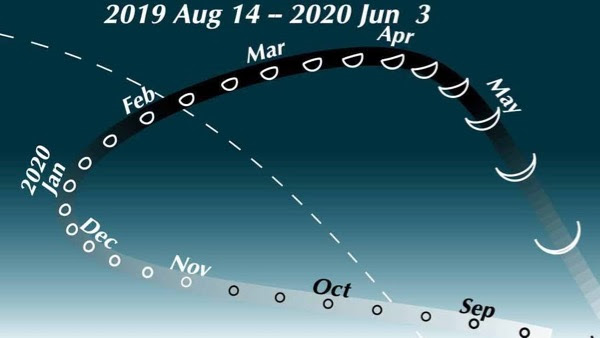
Venus is not much of a visual treat right now since it just passed behind the Sun. It sets within minutes of the Sun and is not visible to the casual observer. In a few months it will return to easy visibility. In fact, Venus can be seen during daylight hours and is sometimes reported as an UFO near the Sun. Here is how and where Venus will appear after sunset for the next few months.
Venus phases and location late 2019
Fun Fact: Venus’s surface runs about 900F and the atmosphere is so dense that the pressure at the surface is the same as the deepest parts of the Marianas Trench. The odd thing is that the planet rotates so slowly that a Venusian day is longer than a Venusian year.
Venus surface in true colors from USSR Venera 14
Saturn
Saturn is the third brightest planet and is brighter than almost every star. As a bonus, now it is near Jupiter in the evening sky so it is really easy to find. To find Saturn locate Jupiter. Using the same closed fist stretched out arm technique, go left a bit over two fists and up slightly (10 o’clock position). That yellowish star is Saturn. Through even a small scope Saturn will grab your attention because the rings are right there and easy to make out. (Most binos make Saturn look like a yellowish football. If you have high quality lenses and steady them against something you can just make out the rings in good conditions.) Saturn and Jupiter are slowly closing together so over the next months they will be easier to see together. In December 2020 they will appear to almost touch they will be so close together in the night sky (AKA conjuction).
Saturn’s rings are “open” and easier to see now. In fact even a cheap telescope will reveal that there are “rings” and not a ring. As the years continue on we will move more in line with the rings and they’ll almost disappear. Then they’ll open to the other side. (14 year cycle). It takes a bit over two years for Saturn to move between constellations which is why Jupiter will “catch up” next year.
Saturn through low power scope in poor conditions
Fun Fact: Gallieo was the first to observe the planets though a telescope and discovered Jupiter’s moons and phases on Venus. He could only make out that Saturn bulged and it was a later scientist who discovered the nature of the rings. The rings are almost all small pieces of water ice ranging 1cm to 1M in size and the most visible rings are ~63,000 km wide, but only 10-30 meters deep.
Night side of Saturn from Cassini. Earth visible at 10 o’clock through the rings.
Mars
Mars may not be our closest neighbor planet, but it is the most “earthlike” neighbor with seasons, clouds, snow, occasionally running water, and hosts of other similarities. In the night sky Mars is an odd duck because it zips through the constellations (a Mars year is 687 Earth days) and changes brightness and apparent size dramatically over a short period of time. Right now? It is so close to the Sun it is hidden in the glare. Come March it’ll escape the Sun’s glare to appear as a bright red point of light around dawn. By as the months go on the distance between us and Mars will fall until October when we will be only 0.4 AU apart and Mars will be bright bloody red and one of the brightest objects in the sky.
Mars through a year with the moon for scale.
Through your binos or spotting scope Mars appears a red disk (Mars’ surface is covered with rust colored rocks). As the months go on the disk will get larger and the white polar cap will become easier to see. You need to keep your eye on Mars because it crosses constellations about every other month unlike the dawdling Jupiter (1 per year) and Saturn (1 every other year). It also spends part of the year “going backwards” as the Earth catches up as it passes the planet.
Fun Fact: It has the largest known mountain, Olympus Mons, which is visible through a moderate sized telescope. It was discovered on Earth in the 19th Century and named Nix Olympia but it was an unknown object. It took until Mariner 9 orbited in Mars in late 1971 to determine what it was. Olympus Mons is a shield volcano that stands 14 miles high above the base and covers a surface area almost equal to the size of France. In comparison, Mauna Kea in Hawaii is the tallest volcano on Earth and rises only 6.3 miles from the ocean floor to the summit. Olympus Mons weighs so much that it has deformed the crust and sits in a 2km deep depression surrounding mountain.
Curiosity photo of Murray Butte 2019.
First photo from the surface of Mars July 1976.
Mercury
For your basic sky observer Mercury is like Venus but more so. With a year of only 88 days it rapidly transitions between the morning and evening sky. Because it is closer to the Sun it never gets far from the horizon. But sometimes when you are out and the day is transitioning a “star” is seen low in the sky. If the time of the year is right you are looking at Mercury. Through our optics it appears as a small oddly shaped disk or crescent similar to Venus but much smaller. See “Transits” (above) to take advantage of the rare opportunity to watch Mercury cross the face of the Sun.
Fun Fact: Mercury is smaller than some moons. Both Ganymede (Jupiter) and Titan (Saturn) are all larger than Mercury. Ice has been detected in several craters near Mercury’s poles in pockets that are perpetually in darkness.
The Outer and Minor Worlds
How about the rest of the solar system? The planet Uranus is dimly visible to the naked eye in a dark location and “good seeing”. (“Good seeing” is a dark night with little to no wind and a steady temperature gradient through the atmosphere so the atmosphere is moving very little.) But for the casual observer Uranus is best seen when it is near an easier see thing. During a lunar eclipse in 2014 Uranus was right below the moon and any observation of the moon meant you couldn’t miss a gray green disk. That disk was Uranus. My suggestion is don’t try and find Uranus without the aid of an easy object nearby. Many websites will be happy to let you know when these days are approaching.
Total lunar eclipse and Uranus 2014 (Uranus at 5 o’clock)
Fun Fact: Early in the Solar System Uranus was smacked by another object near the same size. Now it rotates on the side and essentially rolls around the Sun. Uranus was not recognized as a planet by early astronomers and shows up as a “star” in several sky maps.
Neptune is invisible to the naked eye but like Uranus can be found with optics when it is near something else. One morning when I was out before dawn getting into position for a turkey hunt Neptune was near the crescent Moon. In my binos I could make it out as a very small bluish disk. Even with a small scope that is the best you can hope for.
Neptune through small telescope
Fun fact: Neptune was discovered by two astronomers independently doing the math on small perturbations of Uranus. It has been visited only once by an Earth launched space probe. Voyager 2 passed by the planet in 1989.
The dwarf plant Pluto. Forgetaboutit. Even through the largest earth based scopes Pluto is a speck of light that can only be made out by how it moves over several nights.
Fun Fact: With a very elongated orbit, Pluto actually moves inside of Neptune’s orbit for 20 years every orbit (248 Earth years). The last time it did so was 1979-1999 ce.
The dwarf planet Ceres is another dwarf planet but is more conveniently located in the asteroid belt between Mars and Jupiter. Under almost perfect conditions it can be made out as a dim star. It is not worth the effort to find unless you start getting hooked by amateur astronomy.
Eclipses
I’ll discuss only the two most common, solar and lunar. Solar eclipses only take place during a new moon, because that is when the moon is directly between us and the Sun. Because of the tipping of our orbits it is only sometimes the Moon’s shadow crosses the earth’s surface.
The next totality that will cross the US is April 8, 2024 and totality will cross Texas and cross west of the Appalachians through eastern NY and curve into eastern Canukistan.
Solar eclipses – North America
Lunar eclipses only take place at a full moon and only sometimes for the same reasons. But since the earth’s shadow is so much larger the area for observed totality covers a larger part of the planet and for a longer time. As the bulk of the Earth’s shadow hits the face of the moon it starts turning dark, usually orange-ish, but rarely black. This is because our atmosphere always bends some light through.
The next lunar totality for the US is January 21st. The mainland will be in position for the entire thing, while on my island hideaway the moon will rise a bit before totality and I’ll get to observe the rest. Convenient and warm for me, if not for some of you.
Occultation
These are when one object crosses in front of another. It is the astronomy equivalent of the saying, “Standing there makes you a better door than a window. “ Almost all of the most visible of these events take minutes to a few hours and cover a fairly small portion of the surface of the Earth. There are websites that highlight the most noteworthy of these. No real science to be learned, but they are fun to see. Watching a planet disappear and reappear from behind the moon is a kick. Visible from naked eye to scope.
Saturn about to go behind the Moon 2014 through small telescope
Meteors and Meteorites
A meteoroid is a small bit of metal, stone or a metal/stone mix in space. A meteor is a meteoroid burning up in the atmosphere. A meteorite is a meteoroid that makes it to the surface of the Earth. The average visible meteorite was the size of a marble when it hit the atmosphere. Most meteoroids burn up at 75-50 miles above the Earth.
Seeing a meteor is a matter of chance and luck. You can improve your odds by watching after local midnight so your chunk of Earth is facing our direction of movement. The other way is to watch during known periods of “meteor showers”. (See a good website for info.) These are the times when the earth passes through the orbital paths of larger comets and sweep up the dust and small objects left behind comets in their flight. If you get really lucky you can watch a fireball which is a larger meteor burning brightly. Sometimes they leave a visible smoke path, or even break apart into multiple pieces while you watch. The best fireball I ever saw was one early morning in 1992. We were out for the Javalina hunt. I had left camp and was walking up a hill to get into position when the hill in front of me blazed white and I saw my shadow. I quickly turned around and saw a huge fireball traveling across the sky. As I watched it broke into 4 pieces and kept going, eventually blinking out far to the southwest. The light from the still hidden Sun caught the smoke and lit it up in the pre-dawn sky. I thought it was space debris but when I checked with the local observatory a few days later they confirmed it as a meteor.
Fireball meteor
As much as many of us hoped for the “Sweet Meteorite of Death” in 2016 and will do so again in 2020 the odds are small that the next extinction level meteorite strike will happen then. You can play around with this website and find how your very own SMOD will impact you. Have fun with it. Can you design the next KT event?
Fun Fact: The change of definition from meteoroid to small asteroid was formally defined only in 2017. A meteoroid is grain sized to one meter in size. Smaller size are micrometeoroids and larger are small asteroids.
Comets
Here is Comet 1A. Comets are dirty snowballs left over from the formation of the solar system. Well outside of the planets there is a large cloud of dust and ice stretching out over 100,000 Astronomical Units (AU = roughly the distance from the Sun to the Earth). This cloud is known as the Oort Cloud and is the home of the comets. Passing objects and stellar events give the cloud gravitational nudges and some of these nudges eventually result in a dirty snowball to start to fall into the Sun’s gravity well. (It may take millions of years between the nudge and the solar pass.) Those snowballs which come in close to the Sun start to warm up and give off ionized gas and dust. These are known as comets. Every year dozens of comets are found and most remain faint and fuzzy telescope objects, but every few years (on average) a comet becomes a bino and naked eye object. About once a decade a comet will shine bright and luminous thus becoming a spectacular sky show. Since most bright comets take a long period to orbit the sun their arrival is a once in a lifetime event. Even Halley’s Comet takes 76 years per orbit so at best you might get two chances to see it. Spectacular Comet Hale-Bopp passed within 1 AU of Jupiter so the orbit was considerably shortened. If you are around in 4380ce Hale-Bopp should put on a good a good show.
Right now the night sky doesn’t feature any worthwhile comets for the casual observer.
Comet Wirtanen- average visible comet Nov 2018
Comet McNaugt in daylight Jan 2007
Aurora
Aurora form when Solar Wind particles hit the Earth’s magnetosphere and then ionize. Lower energy particles are blue and green while high energy particles display red. The map shows the band of common occurrence over North America. Especially energetic solar storms can result in red aurora appearing throughout the continental USA. More here: https://en.wikipedia.org/wiki/Aurora
Manmade Stuff
There is a bunch of it up there, so much in fact that some areas of prime “real estate” are getting downright crowded. Most manmade stuff is not easily visible to a casual observer, but some of it is. The biggest and brightest object is the International Space Station (ISS). This is my recommendation to try and find first. It is BRIGHT, moves relatively slowly and is impressive. It is often mistaken for an airplane heading to a nearby airport. When you see the ISS, you will know you saw it. Conveniently the nature of the ISS orbital parameters means that it will be visible for multiple days from your location before it goes dark again. The ISS will be visible from your location during passes for several hours before dawn and after dusk. I recommend using Heavens-Above.com for finding your visible passes. (More info below). For other satellites a find a dark location on a night with no moon. Watch and you’ll see small lights than are too small to be passing planes moving along. If you are ambitious yu can use Heavens-Above.com Db to find specific satellites.
If you are near Commiefornia or the Floridaman Atlantic coast you can occasionally see launch vehicles heading to orbit. It is impressive to watch a small object at the head of a rapidly lengthening cloud as it is gaining speed and altitude. After the vehicles cross the sky you can watch the remaining gas plumes be twisted by the winds alofy. They often make surreal shapes with transient splotches of the spectrum. Both the Kennedy Center (FL) and Vandenburg Air Force Base (CA) will publicly announce non military launches to the public. Most military launches may get only a few minutes, or no, public announcements.
ISS passing in front of the moon. Time of transit less than two seconds.
A Smattering of Websites
There are scores of astronomy related websites out there. In fact, there are more potential websites for you to visit than the number of fleshy globes that Q offers for viewing to the Glib community each month. But here are a few websites that are easy to use and are geared toward the interested general public.
Astronomy Picture of the Day. You might as well visit it since your tax dollars pay for it. This is a great site which features just what the name says. Each picture has a clear description of what you are seeing. The photos origins are diverse (in the good sense) from NASA, other space agencies, observatories from across the globe, and from amateurs sending in some incredibly artistic works. The archive goes back to the mid 1990’s. This has been my first website daily since 1997.
EarthSkyNews. This organization covers what is going on for the general sky observer. You can sign up for a free daily email newsletter. It has observing updates, news from space, photos, and only a small touch of occasional “climate change” stuff. They also keep your subscription information tight. I can’t think of a time when I got unsolicited emails that would have come from them selling my info.
Heavens-Above. This is a serious but easily accessible site. It is “THE” public website to track satellites, get sky charts, past and future night skies etc. When you first visit this site note the upper right corner of the page. There is a box there. Open it and set your location from a database. It will not change all the data for your location and remember it. Look down the left side and the ISS is highlighted. Click on it and it will give you the visible passes for the next 10 days. Click on the day and BINGO, there is a sky chart for that pass.
Keep following down the left side and you get to the astronomy portion with easy to use interfaces. You want to see what was going on the sky at the moment of your birth? Just put in the data and there will be the sky for that time. Want to see the sky for 4th of July 3000 years ahead? It is there.
These three websites will serve a casual observer. There are hundreds of other websites out there from the USG, other governments, private organizations and amateurs. If there is interest after this article I can do a “Part Two” with easy to observe deep sky objects. With just binos, or in some cases a deep dark sky, you can observe a host of objects, including a galaxy that will one day crash into our own.
I think that environmental law is the single biggest issue I “struggle” with when I do thought experiments about the philosophy of libertarianism. How does self- and property ownership interact with the externalities caused by the things that you do pursuant with your ownership of yourself and your property? There are many answers, but the currently implemented one is the EPA.
[Insert Standard Libertarian Disclaimer Here]
Everybody has that annoying neighbor. The one who shoots off fireworks at 2am on Thursday April 17th. The one who blows all of the lawn trimmings into your vegetable garden. The one who honks his horn every time he drives past his friend’s house (yeah, I’m looking at you, jackass!). A core competency of government is balancing your annoying neighbor’s habits with your want for peace and quiet. Noise ordinances keep the fireworks to a reasonable hour, trespass laws keep the lawn trimmings out of your food, and I’m pretty sure I’ll be given the keys to the city when I complete my horn-triggered IED.
One could argue, however, that a well-constructed civil court system may prevent the need for all of these laws and regulations. Between monetary damages and injunctive relief, a civil court could restore me to whole and prevent my annoying neighbor from further annoying me. Tort law has been a hallmark of government for millennia, and its classic application is neighbor v. neighbor.
Great! We’re done! Torts take care of annoying neighbors. On to minarchy!
Not so fast, my friend!
There is a genre of annoying neighbor that is downright toxic. Let’s say, for example, that I have a well pulling groundwater from the regional aquifer, and my neighbor’s in-ground heating oil tank leaks heating oil into the aquifer. If the amount of heating oil is enough to spoil the aquifer and make it non-potable, tort law make for an easy, albeit inefficient, resolution to the issue. Neighbor pays everybody who uses the aquifer enough money to get them hooked up to an alternative water source, and voila! Everybody is restored to whole!
Oh wait, the neighbor is living in a house still using heating oil in 2019, and the aquifer supplies 15,000 people. Neighbor is judgement proof, and those 15,000 people will not be made whole again.
Not For Sale
This exposes one of the core issues with the tort system as currently formulated. The default relief from damages is cash money. If, for some reason or another, the cash judgment is insufficient or left unpaid, many people are left damaged by the negligence/recklessness/idiocy of Neighbor.
I can hear the rejoinder already. In beautiful harmony, a thousand libertarians belt out “Insurance!” There are two issues with that answer, though.
First, insurance is protection against bearing the full consequences of an injustice. It doesn’t prevent the injustice. Insurance may pay out enough money to tap into the local city’s water system, but it can’t unpollute the aquifer. Insurance still doesn’t make the person whole again, because the insured is paying for the service. Insurance is akin to hanging a portrait over a hole in the drywall. As long as you’re happy with that portrait staying there for the foreseeable future, it’s a decent restoration. However, there’s still a hole in the wall.
Second, insurance operates on the convenient fiction that everything has an objective value. It’s a fine assumption for commodities and furniture, but it starts to break down when more unique property is involved. The easiest example is life insurance. That’s not an even trade. I’m not gonna off myself for a few hundred thousand dollars. Even if the insurance pays way over the “market value” of unique property (like a family farmhouse), the sentimental value can’t be replaced. Properties that are “not for sale” are not easily compensated for when they are damaged.
If the aquifer under my “not for sale” 5th generation family homestead is poisoned to the point that there is no convenient way to get potable water to the house, Neighbor has done irreparable, uninsurable harm to me. I may have some of the harm reversed through cash payments, but nothing is going to restore me to being able to live in that house again.
There are three solutions that come to mind for handling this issue. The first one isn’t all that appealing: tell victims of such environmental harm to suck it up and deal with it. Maybe you can get some traction telling somebody displaced from a sentimental property to get over it and smile about your payday, but this one doesn’t translate well when the damage is to people instead of things. “Suck it up and deal with your 5 year old dying of leukemia” isn’t a winning argument.
The second option is prevention. There may theoretically be some libertopian way to do this without using government force, but color me skeptical. Unfortunately for libertarians, the two most effective ways to prevent environmental damage are 1) an expansive growth of the use of injunctions by courts; or 2) a regulatory agency (e.g. the EPA). Self-policing doesn’t work. Communities usually don’t even know enough about the issue (because it’s occurring on a company’s private property) to be able to gin up an angry mob in time. Heck, the injunctive power of the court only works if the community knows that the polluter is planning on polluting. Short of a whistleblower giving his/her best Louis Armstrong impression, it’s too late for injunctive relief by the time it ends up in court. That only leaves the regulatory option. Hello EPA!
The third option is remediation. This is a “sometimes” solution in cases where pollution can be reduced or made inert using chemical or mechanical processes. It’s great when it works, but it’s not all encompassing, and it’s not a substitute for prevention. As they say, “an ounce of prevention is worth a pound of cure.”
A Wafting Stench of Statistical Significance
Another issue causes the reactive systems of justice to bind up. Risk factors. In a car accident, for example, it’s pretty easy to prove that Neighbor swerved out of his lane, causing his car to impact my car, causing me to smack my head into the steering wheel, breaking my nose. It doesn’t always work that way with environmental contaminants. To take an obvious case, not everybody got cancer in Hiroshima and Nagasaki. However, epidemiological surveys show a massive uptick in the amount of certain cancers and birth defects.
Exactly how much is a 3x elevated risk of leukemia worth in Benjamins? Can you even say that it was caused by environmental contaminant X if somebody gets lung disease after being exposed to it? Again, the reactive system of justice fails when these unique harms are merely compensated ex post facto with greenbacks.
Libertarians apply the NAP in situations where somebody employs force, fraud, or coercion, but it may be appropriate to expand that to “risk” as well. It’s a bit of a blurry line, and it’s rife with totalitarian pitfalls, but risk is just diluted force, and the pollution itself is a form of force and/or coercion. Much like celebratory gunfire, the lack of a guaranteed harm doesn’t prevent the community from proactively stopping behavior that presents a high risk to others.
The EPA may be a bloated monstrosity these days, but the preventative justice it affords to the community is a unique form of protection for land, life, and limb that would otherwise be sacrificed to short-sighted and irresponsible polluters.
More than a few times upon viewing a freshly harvested tract of timber I have heard people exclaim in horror, “Oh my God! They raped the land!” Soon after they regret saying that because that really pushes my buttons. However, barely a quarter into my explanation they realize I am right. I don’t know why it has to be explained. It seems self-evident to me.
There are about seven and half billion people in the world and like you they all want toilet paper in their bathroom and a roof over their head. They all want goods packaged, stored and shipped in boxes. When you look at a tract of timber you aren’t looking at “the woods,” or “the forest,” or “the land.” You are looking at a field. Growing in that field is a crop just like corn, soybeans or cotton. It is planted, tended and harvested like any other crop. Timber is one of the top ten crops in the world.
When Europeans began to migrate to the Americas they found a howling wilderness with boundless timber. Because the European powers at the time used wooden sailing ships as weapons of war, that timber was seen as a valuable resource of national security importance so shipyards were built. Unfortunately for them, primitive transportation methods put much of that timber out of their reach.
Connecticut, 1909
For settlers attempting to build farms, forest was seen as a hindrance so it was cut with impunity. They built houses, barns and fences. They kept their home fires burning twenty four hours per day year round. Everyone agreed that the forests had to be replaced with fields. The appearance of railroads allowed much more timber to be harvested and transported. By the time of the Civil War, most of the eastern seaboard resembled a prairie. The last virgin timber in Louisiana was cut near Woodworth in the early 1950s. My father as a young boy stood with his father and watched it being cut.
Realizing that much of a valuable resource had been squandered, The Civilian Conservation Corps was formed and tasked with restoring much of the forests. The family farm was a dying institution and most of the acreage from the farms that had checkered the land were replanted in timber. In just a few years the army of CCC workers had planted over three billion seedlings. The private timber operations, usually a division of railroads, began splitting off as separate companies and specializing in timber for uses other than rail ties. Today Louisiana produces between one and a quarter and one and a half billion board feet of lumber annually. It accounts for nearly half of the agricultural output of our state measured in dollars.
Every square inch of that harvested is replanted.
Timber planters are contractors for timber companies and for private owners. It is highly specialized work. Finding them is not easy as there aren’t very many of them. Finding a good one is even more difficult. The one we have used for decades is top notch. He has assembled a crew of 18 young men, mostly from Guatemala. To get them in on a work visa he has to screen them strenuously. No criminal record. No family here in the states. They must go back home after planting season. References to vouch for them. On top of that he personally screens them, trains them and watches their work. Those that can’t cut it are sent packing. He claims it took him years to assemble the crew he wanted. He is kinda pricey, but worth every penny. I also slip each of the crew an extra envelope at the end of the job. They can cover forty acres in four hours. The trees are spaced properly and every one of them lives. No bent roots and no tipped over seedlings.
Because we are planting a cultivar known as the super pine they grow incredibly fast. Hell, if you don’t get out of the way it grows so fast it will knock you down. After planting one patch it was five years before I returned. I didn’t recognize the place because it had grown so much. After only five years the road was barely passable and you couldn’t see the sky for the canopies.
The trees are acquired from commercial nurseries in bundles of 1000, a bundle being about the size of a square hay bale and weighing around 100 lbs. They are between one and two feet tall and their roots are dipped in gelatin to keep them from drying. The crew lines up with each man about eight to ten feet apart. Each man has a dibble and about half of a bundle of seedlings on his back. They begin marching in time shoulder to shoulder they take three steps, stop, put the dibble in the ground with their foot, wiggle it, place a tree in carefully so as not to bend the root tips up, then stomp their foot next to the hole to close it up. Then they take three steps making sure everyone keeps up with the line and then repeat. It is very physically demanding and tedious work. I stand by a fire and watch. Four hours and they are finished. I am tellin’ ya, those guys are machines, but I have never seen one of the crew over 30 years old.
I tried it once myself alone. I got approximately 100 yards by 100 yards planted…in two weeks. I was nearly crippled from it. I will gladly pay the 15K to have ol’ Joe and his crew do it.
Planting approximately 8×8 feet apart it works out to about one bundle per acre. That may seem too close but over time the trees will thin themselves out. Planting close causes them to grow tall and straight. If they are too far apart they will branch out and have too many knots making poor saw logs.
I have had success by casting seed. A forestry company here locally sells super pine seed which you buy by the pound. Each seed is coated with fertilizer and bug killer. It’s not cheap but I can do that myself. I found that the mechanical caster they sold me would put the seed out too thick no matter how I adjusted it so I cast the caster in the creek and started spreading/throwing by hand. I successfully planted 5 forty-acre plots that way over the years, each one taking me about two days to finish. On one hilly plot the day after I finished casting out the seed, a huge rainstorm came up. “Oh, hellfire,” I thought. “All of my seed washed away.” So I bought more and replanted it. Apparently, I was mistaken and double planted. Today the trees are so close together you have to turn sideways to walk through there.
I estimate we have planted around one million trees over the decades. Some of the first timber I planted is now ready to harvest. I don’t know if I can cut it. If hunting leases will pay the property taxes I may just leave it for my grandchildren.
Show us on the doll where the PV system touched you.
A few weeks ago Suthenboy expressed a strong opinion on the effectiveness of photovoltaic (PV) power systems, or solar electricity[1]. Reading between the lines I surmise he had a bad experience with one once.
I cannot deny Suthenboy’s lived experience but I can present an alternative experience. I’ve been living in my off the grid[2] PV-powered cabin for over 20 years.
I’ve designed four off the grid PV power systems: two for cabins and two for recreational vehicles. The largest is a one kilowatt PV array for a neighbor’s camp. All four systems work perfectly except for my neighbor’s because he doesn’t maintain his battery bank. He’s probably going to install utility power this summer which doesn’t bother me because he’ll certainly make me a good offer for his big PV array.
How It Works
If you were promised there would be no math then you can skip the next paragraph.
A PV array is composed of several photovoltaic panels. A PV panel is composed of several photovoltaic cells. When illuminated by bright sunlight each PV cell produces about 0.5 volts[3] of electromotive force with an amperage[4] proportional to the cell’s area. My cabin’s ancient PV array consists of eight panels. Each panel has 33 cells. The cells are connected in series so the voltage adds up to (33 cells) * (0.5 volts) = 16.5 volts. Each cell puts out about 2 amps of current to a single panel provides (16.5 volts) * (2 amps) = 33 watts[5] of power. With eight panels my PV array puts out (8 panels) * (33 watts) = 264 watts. My cabin’s PV array is tiny by modern standards. These days you can get a single PV panel with more power than my entire array.
But you can ignore the details and think of a PV array simply as a free source of battery bank charging power because a PV system of the type I’m describing is more accurately called a battery bank system. The battery bank extends power into the nighttime. The battery bank expands the consciousness of one’s energy usage. The battery bank is vital to the PV system.
The battery bank is composed of one or more deep cycle batteries. My battery bank has two that look like car starter batteries but are designed to be charged and discharged (cycled) many times. Car starter batteries aren’t designed to be cycled and won’t last long in a battery bank application.
In a modern PV system the battery bank powers a single device: the inverter. The inverter converts low-voltage DC[6] power from the battery bank into high-voltage AC[7] power like the kind that comes out of a wall socket. A modern inverter can be plumbed into a home with standard AC wiring without having to make any wiring changes.
How It Works II: The Diagram
This diagram can be used as an actual schematic for a PV system because all the parts and connections are shown. Power flows from right to left. Blue lines are AC power. Black and red lines are DC power, black is negative (minus) and red is positive (plus). The equipment to the right of the battery bank is the “charge” section from which power comes. The equipment to the left of the battery bank is the “load” section to which power goes. The independent charge and load sections mean half the system still works while the other half is down for whatever reason.
At the upper right corner is a PV array consisting of two PV panels wired in parallel. Simple PV systems use 12-volt deep cycle lead-acid batteries and PV panels sized to charge such batteries. More panels can be added to the array as long as they’re wired in parallel, plus-to-plus and minus-to-minus.
The PV array is connected to a PV Charge Controller which ensures that the PV array doesn’t overcharge the battery bank.
The PV array is usually not the only battery bank charging source. Nearly all PV systems have a backup generator for long stretches of cloudy weather. A gasoline generator and a battery charger are shown in the lower right corner. My backup generator is a 1KW Honda.
If the site has sufficient wind then a windmill is an excellent additional charging source. Windmills come in AC and DC varieties; the one on the diagram is DC. A windmill needs its own charge controller.
The plus outputs and minus outputs of the battery charger and charge controller(s) are connected together to make a single positive/negative wire pair. The positive wire is connected to a fuse (or breaker) that prevents the battery bank from exploding in case of a short in the charge section. The negative wire is connected to a current shunt that is used by the “Charge Meter” to calculate the amperage coming from the charge section.
A modern DC electric meter shows voltage, amperage, wattage, and cumulative watt-hours. This PV system design has two meters, one for the electricity coming in from the charge section and one for the electricity going out to the load section.
The other sides of the charging section’s fuse (plus) and current shunt (minus) are connected to the battery bank.
In the middle of the diagram is a battery bank consisting of two lead-acid batteries wired in parallel. Like the PV array, additional batteries can be added as long as they’re connected in parallel, plus-to-plus and minus-to-minus. The battery bank includes a desulfator which is a clever circuit that puts a high-frequency pulse over the battery bank leads. The pulse encourages any sulfur crystals that may be forming on the batteries’ lead plates to dissolve back into the acid. A desulfator increases a battery bank’s life many times.
The load section is a mirror-image of the charge section. A fuse and a current shunt are connected to the battery bank. The other sides of the fuse and current shunt are connected to the inverter which in this design is the only DC-powered device. The inverter turns low-voltage DC power into high-voltage AC power. The AC output of the inverter is wired into the household AC distribution box.
If the house has utility power then a special synchronizing inverter is required. A synchronizing inverter synchronizes its AC output with the AC output of the utility. A synchronizing inverter will also turn itself off if the utility power is out. This is a safety measure so that linemen working on the utility wires outside won’t be electrocuted by unexpected sources of battery power.
Modern PV systems often don’t have a battery bank and dump excess power on the grid. This runs the electric meter backwards, effectively using the grid as a battery bank, storing power during the day and drawing it back again at night.
Maintenance
A PV system is remarkably stable. There’s little that can go wrong.
If a PV panel is well-built and the cells protected from the elements then the panel will last a long time.[8] I bought my panels used in 1990 and they were about five years old at the time. They still work fine.[9] The only maintenance is sweeping snow off of them in the winter.
A well-maintained battery bank can last a long time too. Thanks to the desulfator my first set of batteries lasted 20 years before they simply refused to take a charge. My batteries have always been the sealed maintenance-free type.
One time my generator battery charger stopped working so I replaced it.
My neighbor’s camp is at the top of a hill in a clearing and he has had instances of his charge controller and inverter getting fried by nearby lightning ground strikes. Lightning protectors work by shunting the power into the ground. I don’t know of a way to protect equipment when the lightning surge is coming up from the ground.
Footnotes
[1] Electricity is really hard to describe. An approachable, but bad, conceptual model is “Electricity is the movement of electrons through a conductor (wire).”
[2] The “grid” is the telephone and electric companies’ wiring and infrastructure. A location enjoying these services is “on the grid”.
[3] Voltage (volts) is a measure of force. Electrons are compelled to move along a conductor when they’re subject to a voltage differential. The higher the voltage the faster electrons move.
[4] Amperage (amperes or amps) is a measure of flow. From an amperage, one can calculate the number of electrons per second passing a point on a conductor.
[5] Power (watts) is calculated by multiplying voltage and amperage. High power applications are measured in thousands of watts (kilowatts) or millions of watts (megawatts).
[6] Direct Current (DC) electricity is produced by a battery, PV array, or the power supply/charger of most common electronic devices. There’s a positive wire and a negative wire. DC electricity is generally low voltage most commonly 24 volts or less.
[7] Alternating Current (AC) electricity is produced by generators large (nuclear plant) and small (gasoline backup) and inverters. AC electricity is distributed on the grid and comes out of your home’s wall socket. AC electricity alternates positive/negative voltage on the two wires quickly, 60 times a second in the U.S. AC electricity is generally high voltage with 120 volts and 240 volts being most common in the U.S.
[8] This article from 2010 is about testing a 30-year-old PV panel of the same model I have in my PV array. My PV panels are a few years newer than the one in the article and not in such good shape:
[9] I recently measured 234 watts coming from my PV array in a high-power use situation. My record is 262 watts in a high-power use situation in 2009. I’ve never done a maximum-power test on my PV array.
 Where shall we begin? Well at the beginning if you will.
 Fire and electricity brought, besides light, other comforts against the cruel world, heat and cold, depending on what you want, chiefly among them. This was later called by historians The Enlightenment, the mass bringing of light and comfort into human civilization. Because what else would the enlightenment be? It has light right there in the name, so don’t you @ me, as the olds say on twitter these days, I am sure the kids have moved on to whatever bullshit goes on tik tok.
 We have the most technologically advanced civilization in human history. We should be able to find a solution to lowering CO2 if so we wish. Hint: nuclear. Now I may be excessively optimistic on nuclear. But I do not think so. I think there are plenty of promising techs. Some say it is expensive or dangerous. Dangerous I doubt it, not truly, not if you are a bit careful. For storing the waste there are solutions. Although a lot of the issues would be solved by molten salt reactors. I am not even talking fusion or such. Personally, I think it is silly to burn coal for power in the 21st century. Maybe it is the techno optimist in me. I think nuclear could give sufficient cheap power, enough to replace fossil fuel heating in most places with electrical. And nuclear is a much more elegant solution than anything else.








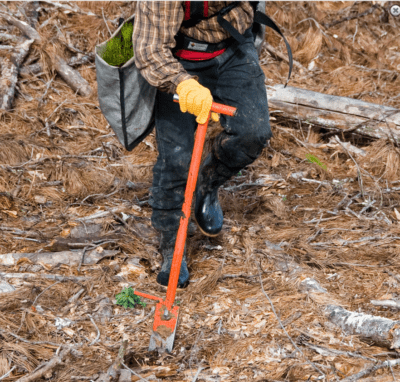 The trees are acquired from commercial nurseries in bundles of 1000, a bundle being about the size of a square hay bale and weighing around 100 lbs. They are between one and two feet tall and their roots are dipped in gelatin to keep them from drying. The crew lines up with each man about eight to ten feet apart. Each man has a dibble and about half of a bundle of seedlings on his back. They begin marching in time shoulder to shoulder they take three steps, stop, put the dibble in the ground with their foot, wiggle it, place a tree in carefully so as not to bend the root tips up, then stomp their foot next to the hole to close it up. Then they take three steps making sure everyone keeps up with the line and then repeat. It is very physically demanding and tedious work. I stand by a fire and watch. Four hours and they are finished. I am tellin’ ya, those guys are machines, but I have never seen one of the crew over 30 years old.
