Category: Family

  • Romanian Christmas Traditions: the Pig


    Trigger warning: images of butchered animal of the porcine variety.

    Not unlike the US and the Thanksgiving turkey, Romania has the Christmas pig. As tradition goes, get one before Christmas and eat it head to tail over the winter months. I have covered some of uses of such beasts in my Christmas food post. This has origins in the times when meat was not a regular meal for many most of the year, but winter was a time for feasting and , I assume, the cold meant the meat kept better. While it was done for Christmas since time immemorial, I assume the origins are older. Families would spend all year fattening the critter, to get the proper use of it. There is even a saying “to fatten a pig the night before Christmas” referring to jobs left to late and half-assed in the last moments, often applied to students studying for exams or the process of morning links on certain websites. A fatter pig was prized, as it had higher not-bones to bones ration, and the abundant lard had many uses.

    The pig is traditionally slaughtered close to Christmas, on the Orthodox Christian feast day of Ignatius of Antioch, also known as Ignatius Theophorus, which is the 20th of December. That left time to prepare everything, but the meat was fresh enough on the 25th. Since modern refrigeration exists, and people no longer grow their own pig, the date is now flexible.

    The habit is still to avoid so called factory farmed animals for this, and many people have a pig guy in the countryside, who raise some 10 to 20 pigs earmarked for various city families. You generally ask for one in the previous winter/spring, so a piglet can be acquired. As such, the day of the kill depends, as all pigs get their turn. This can be time consuming if done traditionally, with the pig seared on a straw fire in order to scrape the hairs, then washed with hot water. The whole affair usually involves many people and mulled Țuică.

    Fat has less uses these days, and a fatter pig is sometimes older and harder to process. My family always got a pig in the 100 to 120 kg range, unlike the 200+ of some. After my father died, we no longer bought a pig, but shared one with my aunt and uncle, getting half for me and my mom. Additional things, like extra liver, are bought from the butchers. My aunt and uncle have two children with families of their own who buy 200+ kilogram pigs each, and so extra meat and fat can be obtained if needed.

    That being said, this year’s pig was a bit on the small side, at 90 kg, too small to be honest. But it was what the pig guy gave us. Pigs like this, bought whole with bones and guts and everything, cost about 12 Lei (USD 3) per kilogram this year in Romania. So about USD 125 for the half. The pig was split in quarters for easier handling, and here we have a quarter of small pig

    We got it home for the final processing, and these are the images I want to show. Keep in mind this is not how the typical Romanian butcher processes a pig, but how my family does it for the purpose of Christmas. The Day of the Pig day is ended with Pomana Porcului, which translates as the pig’s funeral feast. The Romanian word pomana can refer to either charity in general, or a funeral feast when extra food is made and given to the poor to honor the deceased.

    The meat is processed in a few categories.

    Some of the skin is taken off and eaten as it is. Not much suet from this pig, but enough it is kept for a bit of dough. Some of the fat is left skin on and processed as slăninuţă (similar to Italian lardo), which is eaten as a cold cut. It is either packed in salt for a while to cure, or smoked, depending on the preference.

    The grilling category has the ribs and the loins. For roasting, the large muscle meat from the ham. Most of the rest and various scraps go towards ground meat for sausage.

    The spine and various bones with remaining meat on them are used for stock or soups.

    The head, tail and feet are saved up to make headcheese and meat in aspic.

    The guts are cleaned for sausage.

    Parts of the fat are melted and used to make jumari and cooking lard. Jumari are a traditional local winter food. How you make them is basically make small cubs of the fat, usually with some scraps of meat remaining. You put them in a pot on the fire, and after about 15 minutes when the fat begins melting, add a bit of water.

    Allow some of the fat to render, and the remaining pieces to get nice and brown, about an hour or so, and you are done. Salt em, eat a few hot and put them in a jar that’s about it. Mmmmm pig fat deep fried in pig fat.

    It is fatty, piggy, savory, salty and an acquired taste, in the end. This was originally a preservation method, and it is also done with larger pieces of actual meat, covered in lard – hence the English word larder. This was a staple back in the day, although it is rare and sort of a specialty product these days. Confit de canard, which in some places is a fancy dish, was also meat preserved in lard.  They can be eaten as a snack or used when cooking cabbage or beans, and should keep for several months, especially in a cold pantry. Lard is also kept separately for cooking.

    Now on to the meal of the day, it is simple. People are usually tired at the end of the day and do not want to cook something complicated. A few pieces of fatty meat and liver are kept from the pig, fried in a bit of lard, eaten with lots of garlic and polenta. Țuică and wine make an appearance, and usually cheese is on the table because cheese is always on the table in Romania, in this case a very fresh cow’s cheese bought from the same farm as the pig. The meat has just a bit of salt an pepper added, because the point is to enjoy the fresh fatty taste.

  • Le roi est mort; vive le roi


    It was warm for November, at least by the standards of most of the men who had just arrived at Camp Kilmer, New Jersey, for the pending Trans-Atlantic voyage. The temperature on November 2, 1944, was in the mid-fifties throughout the day, even made it into the sixties. Two transport ships – the MS John Ericsson and the SS Santa Maria – waited at a pier not far away in New York, both bound for England and the War. The men, most of whom hailed from Ohio, Pennsylvania, New York, and New Jersey, spent a comparatively idyllic twelve days in the area, using twelve and twenty-four hour passes to visit the Big City. The average age of the men was twenty-one. At least one of them came from the small town of Johnston, in the smallest state, Rhode Island. That was my grandfather. If he was unusual, it was only by his comparative age: his twenty-fifth birthday had passed a week earlier and at home waited a wife and three children.

    The 272nd Infantry Regiment officially became a part of the 69th Infantry Division on May 15, 1943, with its activation at Camp Shelby, Mississippi. The original cadre of 23 officers and 228 enlisted men came from the 96th Infantry Division at Camp Adair, Oregon. By the time the unit received its reinforcements from the Northeast and finished training in Mississippi, it was “the Fighting 272nd, the Battle Axe Regiment,” under the command of Colonel Walter Buie, United States Army.

    The men sweated under a special kind of nervous anticipation; it comes only from knowing you are headed to War. There is some of the bravado often associated with high school sports, as young men fall back on the only remotely analogous contest-of-wills they have ever known. The thoughtful ones are almost always quiet; they know that sports do not contemplate Death and Destruction as their ultimate objective. Despite this, however, optimism reigned.

    While the War in Europe was raging, it had been turning steadily in the Allies’ favor. Even the Japanese were beginning to lose ground to the U.S. in the Western Pacific: in early October, the Allies landed forces on Crete; Canadian forces crossed into the Netherlands; and the Soviet Red Army entered Hungary. By mid-October, the first battle on German soil – at Aachen – began. On October 20th, 1944, MacArthur landed in the Philippines to announce that he had returned, good to his word.

    By the time the men of the 272nd make it across the Atlantic and establish their headquarters near Salisbury, England, the war appears to be firmly in hand for the Allied powers. It is now being fought on the German homeland; the men of the 272nd are almost jovial as the word gets to them about the course of events.


    *     *      *      *     *     *      *      *     *     *      *      *


    Fraaann-cisss!” The kids yelled my middle name as a taunt. I tried to hide in the bushes, but they know I’m in there. Every day going to and coming home from school is like this. It’s a girl’s name some older kids say. Fraaann-sisss. It always came out that way. My first name – Dale – hardly made the case against me any better. The kids who do it are older, bigger, and worst of all, they come from money. Their family name is on local stores. I curse them from the bottom of my soul every day, wishing them horrible misfortune. Years later when passing through town I notice the stores have changed names. I ask around and learn the family suffered terrible tragedy and lost everything; the feeling of schadenfreude that comes over me can only be described as decadent and sinful.

    At some point I remember asking my father why my name was what it was: just why (oh why?) did you name me this, Dad?

    “You got your first name from my Staff Non-Commissioned Officer in Charge. He was a really good man when I was young Airman in the Air Force. His name was Dale. And, of course, your middle name came from my father, your grandfather, Francis Norman Saran.”

    None of that meant anything at five years young.


    *     *      *      *     *     *      *      *     *     *      *      *


    The morale in the 272nd whipsaws on December 16, 1944 when the German Army launches a massive counteroffensive into the Ardennes forest in Belgium, beginning what will come to be known as the “Battle of the Bulge.” The German military had used the exact same tactic in the exact same place three times previously – September 1870, August 1914, and May 1940. Despite this, the Allies leave the Ardennes lightly defended by two inexperienced and two battered American divisions and the Germans catch them flat-footed. Three German armies – more than 410,000 men, along with all of the supporting arms – launch the deadliest and most desperate battle of the European campaign in the heavily wooded, rugged terrain of the Ardennes. The once-quiet region is overrun with the German counter-offensive. The 1st SS Panzer Division takes the town of Malmedy on December 17, 1944, and eighty-four U.S. soldiers are executed in the Malmedy Massacre. The U.S. 106th Infantry Division will be decimated before the battle’s end, as it seeks to buy precious time for Patton’s Eighth Army to execute an impossible ninety-degree pivot from the town of Lorraine to protect the American flank at Bastogne.

    The Wehrmacht, led by Hitler’s own disciple, Sepp Dietrich along with SS Troops, penetrates the Allied lines along an eighty mile front. Only at Elsenborn Ridge do the Americans hold. The possibility exists that the German Army will run all the way to the Belgian coast at Antwerp – that is indeed Hitler’s plan – severing the line between the U.S. and British forces and leaving four entire Allied Armies trapped behind German lines. The hope for the Germans is a separate peace with the Allies and then a chance to fight their arch-nemesis Russia – alone – on the Eastern Front.
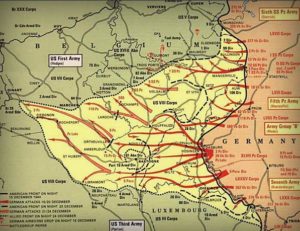


    My grandfather’s unit yearbook grimly records the events:

    Morale was high, and war seemed to be far away during the first part of December. Then came the newsflash of the German breakthrough in Belgium on 16 December 1944. War now seemed close at hand, and our attitude changed from one of the casual interest to one of serious personal regard. On Christmas Day, 700 men were taken from the Regiment for immediate shipment to Belgium to help stop the German onslaught. It was about this time that the Regiment was warned to prepare for shipment to the battlefront. During the remainder of the cold days of December and the first part of similar January days, we continued to train and readjust from the Christmas Day losses.


    *     *      *      *     *     *      *      *     *     *      *      *


    My father leaves the Air Force in 1968 while the Vietnam War rages on; we wind up near his sister and I am born in a small town in Eastern Texas. That doesn’t last during the tumult of civil rights marches and desegregation and my mother home alone with two infants. We move back home to the Northeast – back to the home my father helped build, alongside his father and brothers: my grandfather’s house.

    We don’t stay there long, but my early childhood revolves around my father’s parents and the family headquarters, as it were, on a small plot in Johnston, Rhode Island. My grandmother, the family matriarch, presides over the chaos of her six children with all of their kids, while my grandfather is the very definition of the kind, gentle Stoic in the midst of it all.  His pipe smoke – first Borkum Riff, later Captain Black Apple-flavor – are like incense in the front room, where he can be found staring out the front door into the trees beyond the driveway. He stands like that for long moments, for what seems like forever to my young eyes, and I can never figure out what he’s seeing.

    The Red Sox are always on in the background, either on the television set if we can get reception with the proper combination of rabbit ears, tin foil, and luck; or on the radio, if none of the above coalesce for visuals. On Sundays, my grandfather attends the church where he helped lay the cornerstone. When he returns, we all know we’re getting “dough-boys” – Pèpè’s special “recipe” of bread dough with a whole cut or ripped in the center, fried in some oil. Every once in a while he’ll gift us with french toast if we beg.

    He smiles, his blue eyes clear and twinkling, never looking past you, always right into yours.

    “Alright, my boy!” he says with unadulterated enthusiasm. “Here we go!” as he puts the plate of steaming fried dough on the table and we all chafe to cover ours with whatever we like: my father eats his with butter and jelly, carefully preparing each bite, while my sister and I rip the dough into pieces, lightly burning our fingers with impatience, and then slathering the bits with maple syrup.

    My grandfather always sits patiently at the table with us, or hangs around the kitchen watching us eat, a smile across his face. He listens, watches, sometimes participates in the conversation, but always smiles watching us eat. It doesn’t dawn on me until decades later that having been born in 1919, his childhood would have been right in the middle of the Great Depression. Once over some holidays one of my grandfather’s brothers comes by to visits and I hear the adults in the kitchen from where I am snooping, just outside of the threshold:

    “Remember those lard sandwiches, Frank? We used to take those to school every day.” Everyone turns to my grandfather – I can hear it by the silence.

    “Oh yeah,” he answers evenly. “Yeah. Every day…” The other adults – my father’s generation – turn to my great-uncle and urge him to explain.

    “Mom would cook the bacon in the morning,” he begins, “and then when it cooled to a solid, she’d put that right on some bread and that’s what we brought to school: lard, with some of those bits in it, on bread.” You can hear the recoil and disgust from my father and his siblings. I cringe where I’m standing.

    “Ehh, I didn’t think it was so bad…” I hear my grandfather’s voice into the silence and the room erupts in laughter and jeers. My grandfather almost sounds sheepish, but it’s so genuine I’m filled with sorrow for him, though I can’t quite articulate why in my six-year-old mind.

    Later, I realize that my grandfather is the only person who could express such simple, genuine gratitude for eating leftover lard. He doesn’t know how to be ungrateful.


    *     *      *      *     *     *      *      *     *     *      *      *


    The 272nd is rushed to the front in January of 1945, while the Allies try to hold the bulge in the lines and contain the German break. The Regiment crosses the English Channel during a blizzard. They land at Le Havre on D+189. The 3rd Bn Commander recorded their rush to the lines in his reports:

    The remark, “That truck ride,” will never refer to any but the one from Le Havre in open trucks.  “Standing room only” and “Destination unknown” are both understatements, although the application is sufficient.  If people scoff at your tale of standing on only one foot during an eight-hour ride at night in a blinding snowstorm while the convoy was lost, any doctor will admit it is possible if the near-corpse is frozen stiff.

    Leaving the Château de Vallalet, an 18th-century edifice that had seen rough usage under the Boche occupation, and the surrounding area of Romescamp and Gaillefontaine, the Battalion squeezed into boxcars that jerked along for days.  No fiendish torture device could have left the Battalion’s body in worse shape.  At last, the arrival was made at port, and the historic events of the present 3rd Battalion began with a muddy boot, a sloppy tent, and the foreign sounds of “Oui, oui” and “Cidre.”

    Those ‘foreign’ sounds would have been native to my Quebecois grandfather. I imagine him quietly speaking the pidgin French of his ancestors, and of his wife (née Messier), who used to switch to the French whenever she didn’t want the kids to know what she was saying. We were raised in an English-speaking household, but it frequently swore in French.

    By the time the 272nd reaches Belgium, the German offensive has spent itself. The Wehrmacht Army has run out of fuel, men, and momentum, in large part due to heroic losses sustained and inflicted by the Americans in thwarting the blitz. The defense at St. Vith, at Elsenborn Ridge, and famously portrayed at Bastogne, coupled with Patton’s impossible 90 degree right-wheel of his entire 8th Army, is enough to hold the Allied defenses. My grandfather’s unit now moves forward to confront Der Fuhrer’s Army as it pulls back to its defensive positions at the Siegfried Line. The 272nd, along with its sister units, will have to punch through it to finish off Hitler’s war machine.


    *     *      *      *     *     *      *      *     *     *      *      *


    After I complete Officer Candidate School, I pass by my grandfather’s house just to say hi. I visit far less than I should and rationalize it a million ways, but the truth is that it’s because they are old – like, really old, and I am young. I don’t know how to talk to them. They want to reminisce about the child I was… while I am trying desperately to prove that I no longer am. I want to talk my upcoming commissioning as an Officer of Marines, Leader of Warriors…

    “My boy, whatever you do, you don’t volunteer for nothing, okay!?” My grandfather is serious. “I am telling you. Whatever you do, you don’t volunteer for anything, okay?”

    “I promise, Pep. Not me.” I make a solemn vow.

    “The only thing I ever volunteered for in the Army…boy, they got me, I tell you.” He jabs in the air with his pipe for emphasis. He shakes his head and I can see he is looking somewhere far away, somewhere I haven’t been…

    He looks toward the television set, but it’s turned off.

    “We came back from a long march and boy, I tell you, was it hot in Mississippi!? Whew! With our packs and rifles…” He shakes his head at the memory. “The drill sergeant got up in front of us and said, ‘Okay, is anyone here tired? Does anyone want to volunteer for a different job where you won’t have to carry your pack and rifle?’ My boy, I was so tired… and I’m a little guy!”

    My grandfather turns to me with his eyebrows raised. I laugh because at 5’9″, he’s three inches taller than I am, but I know what he means. He is still healthy at 80, but he slight-framed, always has been, unlike his own sons, who are tall, broad-shouldered, and thick of chest and limb.

    “Those packs and rifles and all the stuff they made us carry… it was so heavy!” It is the infantryman’s lament and I have had a nice heaping spoonful of it over the last weeks, but I shut my mouth out of respect. I know where he has been and where I haven’t.

    “So…so I looked around and I says, ‘Sure! Sure thing Drill Sergeant. I’ll do it!’” My grandfather stops staring, turns back and looks at me, genuine surprise in his eyes, like he still can’t believe this happened.

    “I stepped forward, and the Sergeant said, ‘Okay. Now you’re now a bazookaman. You carry the bazooka.’ And I knew he got me. Boy, he sure got me good.”

    I laugh out loud so hard that it comes out as a bark, myself having just returned from a summer at the hands of Marine Corps Drill Instructors. As I look into his eyes, however, I can see, my blessed grandfather is and was genuinely hurt by that. He was, and maybe still is, that trusting. He cannot believe his Drill Sergeant pulled one over on him like that.

    “So don’t you volunteer for nothing, my boy.” He says, pointing his pipe at me. It’s the final word on the matter. I enjoy his presence for a few minutes while he puffs and stares peacefully, the clouds of smoke with apple and spices float over, and I try to be as patient as a twenty year-old can be. I want badly to ask him about what that was like, but I just can’t bring myself to do it. The gap is too wide; the chasm too deep… I don’t know how.


    *     *      *      *     *     *      *      *     *     *      *      *


    Nevertheless, a night in the woods isn’t housing, and nothing short of a steam radiator could have made the bivouac area among the Belgium firs a comfortable one. These were the most miserable of the bad nights spent. Foxholes were to be dug, but the spadework never passed the slit trench depth. The ground was frozen, and even all the ponchos and blankets that could be mustered were little help. Teeth still chattered between fits of sleep. Moreover, the puddle in the bottom of the hole got deeper and deeper. Nevertheless, it felt less damaging than the wind that blew overhead.

    One night, the darkness was so intense that men wandered away towards both the enemy and the rear. Pfc. Arnold of B Company walked 10 yards from his tent and spent the next 15 minutes trying to get back. Guard reliefs that night were unreliable, too. Even when the relief was to be called by the guard himself, there was no certainty that his tent could be located. Just before dark, S Sgt. Slaich carefully marked the path he was to walk to awaken the next guard, but two hours later, that path was invisible. After an hour’s fruitless search, with nothing to show but scratched hands and face, he returned to his post and the easiest choice – to take the next guard shift.

    “But those nights weren’t the worst,” Pfc. Nyland constantly repeats. “I remember a short jaunt of 13 miles we were to take through the woods one afternoon. Trucks were to pick us up at 2 o’clock. We were waiting beside the road long before that time rolled around. About 9 o’clock that night, the buggies finally arrived. It was raining harder than I’ve ever seen over here, and the wind blew it cold into our faces.”

    “After the duffle bags were thrown into the truck, we piled on – 25 of us with our packs on our backs. I sat on top of the cab, where I thought I could find plenty of room. But when the rain came down harder and it grew colder later that night, I regretted that move. To keep warm, I cursed everything connected with the Army, with Europe, and with winter warfare.” Those 13 miles took 12 hours to cover, and the rain never stopped as long as the ride went on. History of 1st Bn, 272nd Infantry Unit

    My grandfather carried a bazooka as a member of “King” Company in the 3rd Battalion, 272nd Infantry. I’ve stared at the picture that has his name underneath it and no matter how hard I try, I can’t tell who he is. The picture is black and white and the men are too far away to see more than dark slits for eyes. There’s a large building in the background with “Apotheke” on it – the German word, derived from the Greeks, for “Pharmacy.” The men are in neat rows, like every military picture ever taken or painted, row upon row, tallest in the back, shortest up front, and somewhere conspicuously out front or at the sides are the leaders… but this is an after picture, of that there can be no doubt. These men are different than the men who started in Le Havre…

    On moving into positions opposite the Siegfried Line, the Battalion climbed the muddiest, steepest and longest hills in our history.  The going was so rough that walking on knees was nothing unusual.  Even though there was a possibility that the shoulders were mined, everyone had to stop for occasional breaks on the way up.  The entire Battalion started off in regular formation, but within an hour each company was spread over at least 800 yards.  In another month, though, the troops were to wish that they could have gotten that much dispersion.

    At Kamberg, the Battalion received its first real baptism of fire, with no wish remaining for further communion.  The troops were told what to expect and what to look for by the group being relieved.  They gave constructive and helpful advice.  This in itself gave everyone a feeling of confidence; the men were getting first-hand information from the boys who knew.

    The first day there, a patrol of Lt’s Cox and Young, Sgt Johnson, Pfc’s Hagquist, Fulcher, and Schellman of King were pinned down by mortar and 88 fire.  Two days later, 2nd Lt Entzminger, leading his 1st Platoon patrol, was caught in the crossfire of two pillboxes.  The Lieutenant observed the enemy position 200 yards to his immediate front and, upon ordering his patrol to withdraw to safety, he remained in a forward, exposed position, calling for and adjusting artillery fire upon the enemy pillboxes.  Although subject to danger from friendly artillery as well as enemy small-arms fire, he remained in the position until after the supporting artillery barrage was lifted.  Immediately after the barrage, while shifting his position, he was mortally wounded by enemy small-arms fire.  Two others were wounded, and several men of the Platoon distinguished themselves by their efficient and courageous leadership.

    Immediately afterwards, 1st Lt Coppock was ordered to take out a Battle Patrol of four enlisted men to determine the strength of the enemy in the immediate front of his position from which artillery, Nebelwerfer and intense machine-gun fire were being received across the entire Regimental front.  Lt Coppock* pursued his task with such vigor and disregard for danger that, during the night, he succeeded in penetrating 1,200 yards from the Siegfried defenses into the enemy position.  Having collected the information he sought, he then led his patrol safely back with vital information necessary for military operations.  As a result of 1st Lt Coppock’s action and report, a decision was reached in higher headquarters that greatly accelerated the advance of our troops through this sector. –History of the 3rd Bn, 272nd Infantry Unit

    (*) Lt Coppock won the Silver Star for his actions, the 3rd highest award for valor in the U.S. military


    *     *      *      *     *     *      *      *     *     *      *      *


    Life in the military takes me away, as it does to everyone who makes it a career. We move our own young family all around the country and the world at the whims of the Marine Corps and my career. Holidays are a chance to reconnect, but with not a lot of leave on the books and a passel of kids to bring along, we rarely see my grandparents. I spend some time off of the Bosnian coast in 1995 during that unpleasantness. We hear the war, read it intel reports, study it, study the geography, plan routes, even rescue an Air Force pilot, but we don’t see the war… We don’t live it. At the time, the notoriety of the rescue and the relative dearth of conflict gives us what we think is “cred.” People chase “red ink” – combat time in pilot logbooks is logged in red ink – because we are fools.

    I talk to my grandmother about that 6 month deployment aboard ship. She’s lamenting the time away from my kids and then she makes a backhanded comment that pulls me up short.

    “I remember when your grandfather was away at the war…” She begins.

    “Oh? Really? What was it like?”

    “Ohh, he used to write me all the time… Such letters! Oh. Your pèpè, he would send me such romantic letters…” She exaggerates the word to the point of absurdity. I laugh.

    “How long was he gone for?” I ask.

    “Ohhh…psshh… I think about three years or something like that…?”

    Gulp. Holy shit.

    “Saving Private Ryan” comes out in July of 1998. I am in law school at the time with four children. By the time the Bar is over, and Naval Justice School completed, we have orders for Okinawa, Japan and are gone the day after I swear into the Bar. I finally see the movie at Marine Corps Air Station Iawakuni, Japan, while working on a case with a colleague and friend. I am as awed by it as every other American seems to be. It is an amazing movie and I vow to talk to my grandfather about his service after seeing it.

    When we return from Okinawa for Christmas of 2000, we visit my grandparents. I want them to meet our daughters, so we trek the whole carload up those same roads of my childhood. Except now the woods seem impossibly thin, the distances far shorter than I remember, the driveway and the big spruce in the front yard… are not very big.

    At some point my grandfather is standing by the door, talking to the parakeets in their cages, whistling to them while they chirp back. They know his voice and always respond when he talks to them. Outside the wind whips at the screen door.

    “Hey, Pep?” I am sitting in his chair.

    “Yes, m’boy?” He looks up from the birds and smiles.

    “You hear about that movie – ‘Saving Private Ryan?’” He squints at me and then seems to finally have heard my question.

    “Oh. Yeah… yeah, I did.” He stands up and puts his hands in his pockets, fumbling with some change and walks to the door.

    “Would you like to go see it… together… uh, with me?” He never turns around, and he talks at the door, but I can still hear his voice today, like he’s in my room right now.

    “Naaaahhh, my boy… I don’t wanna go see that… I… I seen all that already.” He turns back to me and smiles, but his eyes are pinched at the corners.

    The shame washes over me. What an arrogant thing to ask, to assume… I regret asking that question to this day.


    *     *      *      *     *     *      *      *     *     *      *      *
     

    Third night at Kamberg was the busiest for the outpost.  At about 2130, the King (K) Patrol returned, bearing two casualties.  About midnight, the demolitions patrol of T Sgt Farley came by the OP (Operations Post) for last-minute instructions before jumping off on their attempt to blow up the pillboxes.  The patrol soon left and returned about 0300 with their mission accomplished.  The outpost had front-row seats for this exhibition, and can testify that those boys did a good job.

    In addition, Item Company is justly proud of its Aid Men.  Their deeds shine brightly through the darkness as memories take the place of battle life.  One day, as mortar shells were coming in pretty thick, Jenkins of Item was wounded.  Out there could be seen the figure of a man running swiftly and without hesitation – Mike DiCubellis.  A medic was needed, and mortar fire or not, Mike was going to where he was needed.  In just a moment he had reached the fallen Doughboy.  Working feverishly in a field where individual movement meant danger, the Medic never flinched, seemingly not realizing that death flew through the air with each burst.  After the engagement, he remarked, “Didn’t have time to dig in.  The guy was hurt bad; had to work fast.”

    The Communications Section must be praised especially for its fine job at Kamberg.  Although harried by mortar fire day and night, the lines between the rear and forward CPs and each line company were in service at all times.  The whole week at Kamberg was, as one man put it, a thin solution of night.  We were like owls, having eyes only for darkness.

    Leapfrogging nimbly over the last perimeter of the Siegfried line, the Battalion took Dahlem, our first town, in a walk – literally – and what a walk.  The troops were loaded down like a convoy of one-man bands. Mind you, at that time, it was mostly GI equipment, not boodle!

    Leaving Waldorf, the Battalion went on First Army Security Guard al the way to Stolberg and Aachen, big cities wrecked by American bombing.  This meant working with engineer guards with white SGs on their helmets.  This was the Battalion’s chance to get in on some of the luxuries of rear echelon – beer, movies, showers.  That good deal was over in five days, and the Battalion crossed the Rhine in trucks on the 28th of March.

    Arriving in the ancient town of Arzbach near the Lahn River late at night, the Battalion settled down for a few days with little action except intensive patrolling of the area.  For the next week, the Battalion moved by vehicle or foot from town to town, trying to catch up with the Krauts.  Leaving the town of Dehrn, which is memorable for the 100 slave workers who were living in a lice-infested seven-room house, the troops rode the TDs (Tank Destroyers) and other vehicles 100 miles to Lohne without incident.  The second day at Lohne, the order came for a march to Altenstadt and surrounding villages, a 10-mile jaunt with full field and boodle. Everyone soon swore off, “No more loot.”

    An early call the following morning started the Battalion on its unforgettable 28-mile march to Kassel, even though aching and blistered feet characterized the day.  The men made it, however, and pulled into Bettenhausen on the outskirts of Kassel.  Nevertheless, boodling that night took sheer guts.  The troops had not been so exhausted since the aftermath of forced marches at Camp Shelby.  –History 3rd Bn, 272nd Infantry Unit


    *     *      *      *     *     *      *      *     *     *      *      *


    My grandmother and grandfather’s wedding picture hangs on their wall, as it always has. When I was young, I once looked at the picture and asked my mother, “Who are those people?” I could not reconcile the young woman in the picture – blonde-haired, blue-eyed, and statuesque – 5’10” anyway, with the woman in the kitchen smoking Virginia Slims – imagine Ursula from “The Little Mermaid” with a flower print dress … but my grandfather is unmistakable in the picture. I know the look on his face – I recognize it instantly – because I’ve seen it reflected back at me in the mirror before; he is crazy in love with that woman next to him…my grandmother.

    Sixty-four years later they’re still together, but now the dementia or Alzheimer’s has left my Mèmè, the powerful matriarch, a shade of her former self. She has been in and out of the hospital and ultimately is back in the house at my grandfather’s insistence. The last time I was there, she had about 10 minutes where she recognized me and we were able to communicate, but now… now she has only one word. She rocks back and forth and calls my grandfather’s name: “Franny. Franny. Franny.”

    “I’m right here.” He pats her hand and smiles. She only stops when he touches her, or talks to her, or coos at her, like the birds. I realize in that moment it’s not what he says, it’s how soothing his voice is, how much love he outs into the sounds. It’s like baby-talk, but this isn’t cute or funny, or self-aware at all; it’s a man trying to convey over 60 years of love while he watches his wife dissipate before his eyes. Fifteen minutes is almost more than I can take, but it’s not her calling “Franny” that affects me: it’s being present. I feel like a voyeur. This is theirs and theirs alone.

    My grandfather and I talk about the Red Sox, our family history – his family history – and he mentions that he is the only one left. I’m not sure what he means.

    “Of my brothers and sisters… I’m the last one,” he says.

    “How many brothers and sisters did you have, Pep?”

    “There were twelve of us.”

    I can’t fathom any of that; not eleven siblings, not growing up in the Depression, not carrying a bazooka in World War 2, and not outliving all of my family at age 82.

    I just stand next to him and put my hand on his shoulder while he looks outside.

    My grandmother passes while I am in training to go to Afghanistan.


    *     *      *      *     *     *      *      *     *     *      *      *


    The 272nd Infantry Regiment’s history is a surreal walk through war, told by the men who lived it. There is the time the 3rd Battalion gets shelled by German artillery after crossing the Werra River and takes shelter in the basement of a building… that turns out to hold cases and cases of wine and French champagne. Two men are killed and three wounded, but the 272nd pushes on to Eichenberg. “Love” Company takes the town and King mops up.

    They push on toward a town called Nieder-Gandern, but receive Tiger tank fire beginning in a town called Hebenhausen all the way to their objective. Even after they take Nieder-Gandern, the Tigers never stop their fire and four men are killed during the night and morning. A German night counter-attack is repulsed at close quarters.

    Early the next morning, the Battalion bypassed all the dead Krauts who had counterattacked during the night. King Company led over a circuitous route, through the woods and onto the road. One sniper was flushed out by the lead squad under S Sgt Smith, Sgt Jonassen and Pfc Tarkington, and in the second town, 21 men were captured and 10 wounded or killed. The light machine gun section of the 4th Platoon of King accounted for one man. Along the way, M Company caught a group of the Boches running up a hill. The HMGs (Heavy Machine Guns) gave ‘em the hot foot, and the Company proceeded unmolested, leaving behind over a dozen dead Krauts. That night was spent in almost forgotten comfort, complete with soft beds and electric lights in Heiligenstadt.

    Bad Kösen. Naumburg. Kottochau. The names of towns tick of as a checklist of objectives. The Regiment continues to pursue the Wehrmacht ever deeper into German territory. At Thiessen, the Regiment narrowly avoids walking into an ambush when a patrol discovers some wounded Germans from a nearby village, who explain that Thiessen is going to be a “last stand” for that unit. The Regiment hastily forms up and attacks the German 88mm dual purpose machine guns emplaced in the town. There are 36 of the anti-aircraft/anti-tank guns, which are considered among the best guns ever made, given their ability to take down allied aircraft or destroy allied tanks. The 272nd catches the German gunners by surprise and, along with some excellent gunnery from supporting artillery, it takes 249 enemy prisoners.

    Germany’s 5th largest city, Leipzig, is the next target on the Regiment’s checklist. It takes hand-to-hand combat, but the 272nd captures a German barracks, and over the course of a day and night of fighting, another 234 enemy soldiers are captured.

    The activities were climaxed the next morning when a feminine voice was heard rendering some smooth English. The voice belonged to a gal from Boston named the Countess de Maduit, the former Roberta Lorrie of Boston.  She could not believe the Yanks were there until a few cuss words cinched the fact.  The perfect portrait of an overjoyed woman, even though she bore the scars of an unforgettable past, she showed Love Company the concentration camp.  Tears rolled down the cheeks of the men as they were shown the sea of people subjected to the barbarous treatment.  The worst came when they saw what remained of a building the SS had burned to the ground.  To keep the record of the Krauts straight, they had crowded some 200 patients into it before igniting the fireworks.  The sight was not a pleasant one.  The troops realized that the enemy was all and more than anyone had ever imagined.

    It is not long after that the 272nd makes contact with the Soviets coming from the east. The German Army is vanquished.


    *     *      *      *     *     *      *      *     *     *      *      *


    When the Red Sox come back from three games down against the Yankees and win the American League Pennant, I have to choke back tears. I am in Afghanistan at the time. The tears are not for me; baseball has never been my love the way it is for my grandfather. I break protocol and sneak a phone call; I can dial the number to my grandfather’s from memory. His 85th birthday is just weeks away and now, one year removed from another Yankees heartbreak that I thought might kill him. I know the Sox will beat the Cardinals. They have to.
    I hear his voice over the scratchy connection.

    “Hello?”

    “Pèpè? Hello? It’s me, Dale.”

    “Yes?” We step on each other’s voices because of the delay, but finally I can hear his recognition that it’s me. I start shouting like a fool.

    “They did it, Pep! They did the impossible!”

    “I KNOW IT, MY BOY!! I THINK THEY’RE GONNA DO IT THIS YEAR!” I can hear the joy in his voice. I look around to see that no one is there and I let the tears run freely down my face.

    He was born the year after they won their last World Series (1918) and he has watched eighty years or more of Red Sox tragedies, one piled upon another. He has borne it all with a patience that would make Job nod in approval. I’ve endured a good deal of it with him and never, not once, have I ever heard him swear. Not a single curse word. We watch Bucky Dent rip our hearts out in ’78 and all he does is throw his hands up, look at me in complete disbelief, and turn off the little black and white television set. He walks to the door and stares while he puffs away. I come to hate the Red Sox for the pain they inflict upon him…

    When they sweep the Cardinals in ’04, I almost don’t care if I die in Afghanistan. He finally got to see them win it all. Finally.


    *     *      *      *     *     *      *      *     *     *      *      *


    By the time my wars have ended, the Red Sox win their second World Series and when I visit my grandfather, we discuss Mike Lowell for governor of Massachusetts, the ’04 win… we relive our favorite parts in glorious detail. His sad-sack Patriots are now officially a dynasty and even the Celtics are looking good. Neither of us can believe this new world we inhabit.

    He’s switched from a pipe to cigars, much to the chagrin of his children.

    “I’m worried about these cigars he’s smoking,” says a relative about my grandfather’s new habit, to which I riposte that he is now in his late 80’s, and entitled to pick up a heroin habit, as far as I’m concerned… it’s no one’s business.

    I happily indulge my Pepe with illicit Cohibas I’ve managed to get my hands on from a friend who is a ship’s captain in a country that doesn’t have an embargo on Cuban rum or cigars. I hate cigars, but we smoke them together in celebration. It’s the best smoke of my life.


    *     *      *      *     *     *      *      *     *     *      *      *


    Under the experienced command of Lt Col Edward J. Thompson, the 3rd Battalion of the “Battle Axe Regiment” had proven itself well in combat.  Over hill, trails, and to the magnificent woods that spelled digging, smoky fires, makeshift shelters and excitement, the 3rd Battalion has caught in its wake of fire, memories that surround themselves with flesh and blood, with hope and sorrow, and with laughs and experience.  During that time, a Battalion changed from a carefree, bivouac-inured herd to a confident, battle-tried team of fighting men.  Only one medium can effect the change; only one process can bring about the metamorphosis.  That one process is war.  The actual struggle of meat and bone remains, as through the centuries, the unique method of shaping troops from the whims and idiosyncrasies of rear echelon to the positive qualities need to fight a battle.  The way has been hard; it could have been harder.  A spirited Battalion now exists that will function well under any conditions.


    *     *      *      *     *     *      *      *     *     *      *      *


    A little while after my grandfather’s return from Germany, he and Meme conceive their fourth child – my father. A true “Baby Boomer,” he is born in the shadow of that terrible war. Twenty-two years after his birth, I am born in the shadow of the Vietnam War.

    My grandfather lived quietly and simply, occasionally growing peppers and tomatoes in the garden out back. He loved purely, his blue eyes windows into the soul of a godly man. He helped build the nearby church, never missed a Mass while I was growing up, and yet I never heard him preach, judge, nor condemn a single person. I never heard him swear, nor lie, either.

    He was an exceptional man from what feels like a bygone era, when decency, and good manners, were considered essential traits of all citizens. It’s hard to fathom the changes he saw in his ninety-eight years, but no matter what the fashions or trends, from the Flappers to the Hippies, from Disco to Heavy Metal, his brand of kindness never went out of style. It was never old-fashioned and neither was he – just the purest font of light, with a whistle for the birds and a smile for your troubles.

    On Thursday, July 26, 2018, Francis Norman Saran, 98, passed away peacefully in his home, the one he built with his own hands. No palace of Versailles or manse for a Lord, it nevertheless sheltered generations of my family – his family – through stormy summers, hurricane season, and the bitter cold New England winters.

    He will be remembered and missed.


    _____________

    Liked it? Visit www.theabjectlesson.com and take a moment to support The Abject Lesson on Patreon.
  • Misadventures in Bikepacking


    Recently, my family and I went on a bikepacking trip. The idea for this trip actually came from a fellow Glib (I don’t recall which one) who linked to bikepacking.com. Bikepacking is as it sounds – it is backpacking, but on a bike. While bike touring is long distance biking over roadways, bikepacking is on rural or single track trails, and nights are spent in tents rather than hotels. Bikepackers rarely carry backpacks instead supplies are stored in a variety of bags around the bike. The trips vary from a short overnighter to a 2,700 mile epic ride from western Mexico to Canada. My wife and I have been very interested in trying a longer bikepacking trip. Biking Murphy to Manteo North Carolina is at the top of our bucket list as we are both love our state. This summer, we thought we would start smaller and bikepack New River State Park in Virginia with…our 3 and 1 year old children literally in tow in 2 bike trailers.

    Throughout the summer we biked once or twice a week, usually up to 16 to 18 miles. The point was more for the kids to get used to 1.5-2 hours in the trailer. To facilitate their willingness to ride with us, we bribed them with a stop at a playground near the end of our route.

    The New River trail is an approachable first time trail. It is a largely flat, 56 mile long, rails to trail set up. It has many bridges that were formerly train trestles, and it also has two tunnels (something we knew our train-loving son would be crazy about). There is a campsite partway through. For us, this particular trail had the added benefit of being about 40 minutes away from the home of my wife’s best friend. We decided to cheat a little, and my wife’s friend agreed to meet us for dinner at the campsite and manage bringing our food and our car. Things were set. I reserved a campsite right on the river, and the weather seemed like it would be cooler than the 90s we usually suffer through in my part of NC. The big day was approaching and we were all excited.

    Then the gods gave me signs that things would not go well. First, my dog developed an allergic reaction on his paw the night before “go” time. I didn’t want to go on this trip or be midway through the ride and get a call from the boarding kennel about him. We decided to cancel, and it all went downhill from there.

    Our two alternative dates did not work for my wife’s friend – which meant we would need to carry our own food and figure out how to get our car from the beginning of the trail to the end of the trail. The bike shuttles were absurdly expensive, even for just one person. Taking both our cars to shuttle ourselves would not work due to the travel time both from NC to VA, and then the back and forth along the trail. We decided to reserve a spot at the campsite, and do an out and back overnighter rather than complete the whole trail.

    The big day 2.0 arrived. Things seemed to be going well. It was hot, but the weather was good enough. All of our gear fit (phew!), and there was even room for the kids!

    16 month old in the Burley D’Lite pulled by me


    3 year old in the Burley Solo pulled by my wife


    So we sped off. Much of the trail was shaded. At times, the scenery looked like western movies with large cliffs and small rapids rushing by below (unfortunately, not pictured). Our kids loved going over the bridges and through the tunnels. Things seemed to be going well.


    There were more scenic views, but I wasn’t able to get a picture of them


    At 12 or 14 miles, my wife asked at what mile marker the campsite was. I had looked at so many different trails lately, that I couldn’t remember exactly where it was. I figured it was doable anyway. I told her I thought I was sometimes around the 16 mile point. 14 miles in, I was starting to feel the ride. I kept telling myself, we were almost there. But then, 16 miles came and went with no campsite. It was at this point that I really started lagging. I told myself that had to be close – it was probably at the 20 mile mark. 20 miles came and went. At this point, I was sore and exhausted. I couldn’t even afford to stop and ask any passersby where the campsite was. (I let my wife do that.) At 25.29 miles, we finally reached the campground.

    By then, I just felt bad and wrong. I wasn’t sure if it was dehydration or what. I felt like STEVE SMITH HAD WAY WITH ME SEVERAL TIMES. What I did know was that there was no way I could bike 25 miles back to the car the next day. The question was could I survive the night. Did I mention that my training was just weekly rides. Apparently, I am not 22 anymore where I can just jump into some athletic event and be ok. Besides, we were both hauling close to 75lbs between our gear and children.

    My wife was pretty worried at how sick I felt. We decided we should just head back home. At this point, it was 6pm and our children had spent the day cooped up in bike trailers. My wife’s friend – who would have come to get us so that we could get to our car – was out of town. We tried Uber and Lyft and there was nothing available for as remote as we were. My wife desperately called her friend to try to find someone local to get her back to the car so she could pack us up. We were finally able to find someone. So, after a three hour bike ride, followed by another hour at the campsite with two stir crazed children, we were on our two hour car ride back home.

    Now that I scared you away from ever bikepacking, I would like to say the first 12 miles were fun. The kids seemed to enjoy the trip – at least the part they were awake for. They definitely loved the marshmallows at camp. Riding with two toddlers and two trailers isn’t too bad, but the gear really adds a lot of weight to the ride. I do want to try to bikepack again, but with more reasonable goals. I am thinking about riding the Jamestown end of the Capital Trail in Virginia or tackling the New River again from a shorter trail head.


    Not the stats of a champion
  • How I Became a Libertarian: Southern Child Edition

    I didn’t have a eureka moment.  I didn’t get fed up with a political party.  A well-read child of resourceful, simple, and hard-working parents who had escaped generations of small, impoverishing family farms, my first notion was always independence.  Before any formal concept of agency, utility, or property ever washed into an ear, I knew I valued my own counsel above all others, and my strongest urge and desire was simply to be left alone.

    We moved around a lot for Dad’s work until I was nine.  Over the years I went to school, to church, to everything expected save prom.  I dressed like my farmer uncles and ignored top 40 and drugs.  We were quiet Primitive Baptists and as such unmoved by many worldly notions; particularly, we rejected religious bureaucracy, hierarchy in the church, and evangelism; we had no catechism, no articles or rules save the King James Version, and often shared a preacher amongst our rare and remote congregations.  My first social organization was based on individual interpretation and responsibility.

    Early on, I was forced to lead a prayer in school a full decade after Engel in the civilized place (Tennessee) in which we finally landed, far away from the redneck places and institutions I thought I had escaped.  Maybe I could have objected, but the expectation was clear and direct, and the unanimous opinion of my peers meant that I had finally landed in a situation from which there was no retreat.  The task was easy enough and not unpleasant; I merely resented being forced, being put upon, and not being left alone.  I began to cultivate a distrust of institutions and the force they could wield.

    From this I launched into a childhood a bit defensive and cautious, my clannish hill instincts mixing poorly in the factory towns my father was transferred betwixt.  He was a produce clerk, decent and humble, so Christmas only came once a year at our house, and I learned to jealously hoard and defend every crumb and opportunity.  I never learned to loan or share as a child, and I dug emotional fallback trenches for every possible social situation that life in town might thrust upon me.  I preferred rifles, guitars, spinning reels, engines and, eventually, a tiny blonde thing from Kansas, but mostly I liked reliable devices that didn’t have opinions, and I spent most of my free time with a trusted few, mostly in the field with rod or gun.  I kept my pocketknife razor keen, earned my merit badges, and paid my speeding tickets quietly.

    Whence money:  waxing store floors on second shift, mowing yards, pizza delivery, shoveling snow, fry cook, farm hand, electrician’s mate.  Money meant more independence, and I loved it more than words can describe, much more than free time after school.  Money also meant deserving the blonde thing who, amazingly, had a humbler situation than mine.  I had always identified with farmers and merchants, and, the more I knew of work and money, the more respect I had for proprietors and the more contempt I had for regulation.  I learned there were federal rules and minimums for most things, and it all seemed silly to me:  my employment was an arm’s length transaction between me and my boss, and no other opinions were needed.

    So I strained at the bit in some ways . . . . and just didn’t care in others.  My hair grew to my shoulders and I seldom shaved.  I learned that homosexuality and interracial marriage existed . . . . and could find no reason to care the way all the adults exhibited that I should care:  that these things were morally wrong and there ought to be a law.  Mostly I hated speed limits and not being able to shoot inside the city limits.  I hated how a cop asked me stupid questions about where I worked while he wrote out my ticket, but I loved how he got enraged when I refused to answer, when I just glared at him while he got hysterical and tried to bluff me into submission.  People and institutions needlessly meddling in others’ lives put me off, and I never got over it.  A flavor of #resist became my base assumption and attitude when I wasn’t on the clock, and I eventually started to notice that government operations were seldom executed to serve and protect . . . and began to constantly ask myself to guess the true motives of those actors.  This was the beginning of my suspicion that I would generally be better off and happier with less government.

    I didn’t like a lot of other things going on around me outside of government, either.  Racism and littering were normal in my culture, but I knew they were wrong, so I figured out that adults were often unethical and hypocritical.  Uncles came back from VietNam with no report of triumph or purpose, neighbors in turn defended and abandoned Nixon, farms failed, and neighbors’ cars were repossessed.  Interest rates soared, and I kept to my books and learned to drive a tractor and to string barbed wire.

    You’d think this sort of environment would have made me a conservative, but few of the conservatives I knew outside my quiet church fell into the live-the-example version of virtue; most were of the bluster and control version, and it seemed like their only goal was to make kids obey the very rules that their parents had mostly skipped.  Abortion was a hot issue with the Catholics, but my people tended to simply marry a girl if love brought along a child a few months before the acceptable plan.  I never had any problems interpreting the operating instructions for a condom, so abortion was just a quiet problem that other people had.  That said, my instinct was and remains that a woman should figure out what was appropriate for her:  it’s not a government panel’s responsibility.  I took good care of my own business, and the Kansas blonde would need to move on to less responsible men before bundles would come into her life.  It never occurred to me to push my opinion in this area on others much less codify it, but I always respected the personhood argument from the pro-lifers because it was rational and genuinely altruistic.  Later I would evolve to think about the family as the base unit for rights in this area, but meanwhile I would be increasingly annoyed by the politicization of the issue.  I would never begrudge anyone’s right to speech or protest, but what was coming across strongest was the energy some people have to regulate border issues.  From this issue I learned that reasonable people can find themselves of opposite views, but I also began to worry about the frontier of public versus private interest and how many would inflate the public sphere to import authority over their neighbors.

    One of the hallmarks of the southern brand of conservatism was militarism.  I had pored over maneuver from Agincourt to Dien Bien Phu as a child; my people had sacrificed in the war of northern aggression, Europe, Korea, and VietNam.  But it never caught on with me:  Dad had been miserable as a cold warrior, a pointless clerk spending at one point a year on a Pacific Island two miles long and two thousand feet wide; he had his pay, but he had nothing else but ridiculous orders and frivolous achievements to show for it.  Mustering out, he was unwanted for his few martial skills and made his way to grocery, and his son learned to love drab canvas only as cheap and handy surplus.  When 200 Marines were blown up in Beirut, I couldn’t think of any rationale that their parents would stand to hear.  I began to revisit and question VietNam, of course, but then:  why Korea?  Many things began to smell like Remember the Maine and the Gulf of Tonkin to me from then on.  Other than retaliating for Pearl Harbor, I came to view most foreign adventures as boondoggles:  the list of military projects that had achieved the desired goals and had respected the original rationales were infinitesimal so far as I could see.  Looking back over a steady chain of deceit and failure, I could hardly see newly posited plans as anything other than American self-deception or power grabs.

    As is surely clear, my politics are in no small part an outgrowth of my underclass surroundings, hillbilly paranoia, and poor potty training, but I read a lot and pretty much every political party had a chance to get the upper hand in my brain . . . but none ever earned it.  I read the paper every day, watched Cronkite if home in time (seldom), and took in several longer forms on TV, including Brinkley on Sunday mornings and Wall $treet Week with Louis Rukeyser on Friday evening.  From these I was learning something critical that my father, who had never finished high school, could not tell me:  what was up in the world, and who was pulling the strings; I might not know everything, but the framework of countries and corporations was becoming clear to me, and I had ceased to couch the actions of the day purely in terms of the mindless patriotism that was stock in the small-town  discussions I might overhear.  Follow the money and similar suspicions become my primary tools to dissecting anything; this didn’t always lead to the quickest answers or the healthiest perspectives, but the shoe fit and paid off more times than not if I just waited and kept reading.

    Further, much further, though, I was propelled by Buckley’s Firing Line.  I shared so many of his religious and reactionary urges and was thunderstruck by his repertoire:  he had towering metaphors for every situation, wrung from history, religion, and mythology.  My vocabulary was skyrocketing, but there was something off:  he was a man who would be king.  I agreed with him on almost everything except the notion that everyone else should necessarily agree with us all the time and live like us and bow at our feet; my journey was convincing me that others should have their own journeys, not that I had found all the answers and should bring them down from the mountain to impose.  Mostly, I learned the appeal to first principles as Buckley wrangled with Galbraith and ombudsman-interlocutor Kensley.  I found calm and respectful debate addictively delightful; even today, the first page I turn to in any publication is the letters to the editor, and I simply don’t consider journals that don’t run them:  honest debate has been more important to me than winning for four decades now.  But as clear-headed as Buckley seemed to me, I couldn’t be attracted to a man or a party that didn’t lead with the freedom card; the arrogance left me suspecting that control was more important to Buckley . . . any by extension to Republicans . . . than baseline liberty.

    Then there were practical and historical problems to weigh.  After Asia ruined everyone’s uncles, the world still wasn’t saved from the commie dominos after all and some divisions never even came home, so it wasn’t clear to me what the plan was or whether it had been worth it.  While I dutifully signed up for Selective Service and did my homework, I couldn’t imagine enlisting in any military nonsense.  I read Catch-22 for about the third time since I was 12 and came to over-identify with Yossarian and became infected with his fear of being trapped in bureaucracy by patriotism.  I came to despise jingoistic declarations and even avoid any movies or other glamorization of warfare; Top Gun came and went, but I took a pass.  I noticed that a love of military toys was crowding out any discussion of when and why the toys should be used.

    I went through a bunch-o-bullets in those days.  I have a Winchester 94 in 22LR, and the barrel’s probably shot out at this point, maybe six minutes of angle now with good ammo and the iron sights, but in those days it was fresh from the factory and I was taking rabbits almost as far out as I could see them.  Usually I bought my Federals, like my Levi’s, at the hardware store (whose rural sales staff thought nothing of it) and then pedaled away to do my damage.  Over at another store, they wouldn’t sell that same caliber because I had to be 21 to buy “pistol ammunition.”  The vacuity of laws and their random implementations were already evident to me before I could legally drive.

    We didn’t heed Carter’s thermostat settings, and I was embarking on life at 14MPG because that’s how work gets done.  That said, monkey actors from California didn’t appeal to me, either; my mother could shoot and swing an ax better than Ronald Reagan, and, having never had much of anything in the first place, I wasn’t hurt by the oil shocks and was just working my way to being my best me and taking little notice of the implosions in the rest of the country.  Unlike my neighbors, I wasn’t motivated to cling to this president any more than I had to Ford or Nixon (who had been figureheads in my childhood and nothing more); I was too busy growing up.  And, anyway, flimsy red baiters were a turn-off:  posers (like the race baiters I also hated), they convicted people for what they said and believed when it seemed to me that any truly dangerous citizen should be prosecuted for what he had done.  I was still stuck on honest debate, but the national mood and its leadership preferred the hysterical; the rule of the day was passion and, it seemed, everyone in my Hooterville was happily going along with whatever Reagan and Falwell told them to believe and do.

    In this time, the rising War on Drugs scared me; I feared the machine’s ruining my life.  Cousins had long-since reported that there were indeed no good chain gangs, and I planned for college while avoiding complications.  Then the WoD hit close to home:  some classmates went down on marijuana charges.  My people had been making their own joy juice in the hills for centuries, so I had inherited no right to second-guess others’ jollies and gave adherents of the weird weed a pass.  I have still never taken an illicit drug, but I never much cared what others did with themselves:  just don’t run into me drunk or stoned and we’re good.  But suddenly lives were being wrecked over victimless crimes.  It was more and more clear:  the government often operated expressly at odds to individual pursuit of happiness, no matter what the Declaration declared.  But don’t drugs destroy lives:  probably, but so did a thousand other things that were somehow still legal.  The arbitrariness of it all with no clear appeal to first principles taught me that probably most of Reagan’s yapping was also unprincipled or should be held in suspicion at a bare minimum.  I wasn’t necessarily gunning for Reagan:  he was simply the first of many grandstanders who would fail to earn my respect.

    I did have progressive urges:  I saw poverty firsthand, wanted more for everyone, and entertained social policies that hoped to improve things.  I didn’t mind the URW’s negotiating as a block if that’s what workers wanted, but I feared that many members had been coerced into signing a union card the way I had been directed to lead a prayer.  The housing project was just a half mile from home, so I also saw multi-generational reliance on the dole up close.  I paid a bit of tax on some W2 jobs, but half of my income was generally cash deals with farmers, and I wasn’t so Eagle Scout as to keep up with it, report it, or give Uncle Sam a cut;  the fiscal and operational mistakes of the government weren’t really hitting me in a way to make me second-guess New Deal residues.  I also saw the Knights of Columbus doing good works around town, and I threw my nickels in the Saint Jude barrow when the frat boys wheeled it through town every year; alms in private were clearly capable of delivering excellence.  Meanwhile the great Republicans (motto:  we understand economics) had literally billions upon billions of reasons why the deficit that they talked about didn’t really need any work on their watch.  From this grand mishmash one could only conclude that there were no general answers, no panacea:  the policies and attitudes and structures were veneers.

    So off to college and marriage and profession I went, and I paid my taxes and stayed on my side of the road.  That included a bit of business school where I came to respect macroeconomics and mastered finance at night while taking a turn in code enforcement during a recession.  I did good work:  decent and serious review and accountability that added no more than 1% value to the work I oversaw; I was working hard, and clearly was more useful than anyone else in my office, and still it came to nearly nothing.  Others were less productive and even less impactful, and I suspected that ours was one of the more serious departments in the entire city government.  Of course, as soon as a going concern and I found each other, I was snapped up by the private sector and, to the dismay of all my relatives, quickly escaped the security of government employment.

    The national numbers came to mean more to me, and I came to respect federal programs less and less the more I knew about them.  Government meant that milk cost easily twice what it should; meanwhile, a new generation had taken to the old housing project as normal as rain.  The fruitlessness of public housing was unavoidable, and paying taxes came to remind me of the Baer line about alimony:  “like buying oats for a dead horse.”  At work, I was managing huge budgets, aligning to product strategies, and capitalizing operations; it was far from clear that any similar diligence was applied at government agencies.  I was deadly serious about capital, but it seemed like a full third of the economy was dedicated to propping up less serious, less productive folks.  I decided that enlightened self-interest was the best management theory and inferred that all government work must therefore be less efficient than deferring to market forces.  In short, minimizing government was necessarily a public good.

    That’s where I remain:  unimpressed by political parties and yearning for autonomy and free markets.  It’s a rich life on the debate side, though:  I gun for everyone, but people only hear when I gun for their guy.  Nobody, no politician, can be perfect, so it continues to boggle my mind why folks get so defensive about balls and strikes called fairly.  My grandmothers would have told you that there was enough sin to go around; I’ll tell you there still is.  I vote pragmatically:  to stymy efficient government as much as possible while resisting as many brakes on freedom as possible.  I hope everyone gets rich, finds love, and leaves content children behind them. . . on their own dime . . . and I hope I can be left alone just as much as is decent and possible.

  • What To Expect When You Are Expecting A Death

    Everybody wants to go to heaven, but nobody wants to die.

    ~ Unknown


    At least twice here at my home away from home someone has raised the prospect of the imminent death of someone close to the them and their concerns about what would follow.  Since this is what I do for a living, I’m an attorney with a practice limited to probate and trust litigation, I thought a primer on what occurs after death may be helpful.

    I’m licensed in California and haven’t practiced in any other state.  I have had plenty of contact with attorneys in other states.  What I discuss will occasionally have a different name in other states, but the substantive law seems to be pretty similar from one state to the next.  Needless to say, if you are actually dealing with a problem then speak with a local attorney.


    When You Know Death Is Imminent

    A terminal cancer diagnosis, hospice placement, or dementia diagnosis (barring divine intervention) is a signal the end is coming.  Depending on the condition, it may come fast or slow.  If your parent is still mentally competent and has the wherewithal, putting an estate plan in place or reviewing the existing plan is a good idea.  If that’s not the case, then now is not the time to prod Mom or Dad to put an estate plan in place or change the plan they have.  Every state has laws of intestate succession if there is no plan.  That’s gibberish for “since you didn’t put a plan in place, the government has one for you.”  I know I’m supposed to hate government, and generally I do, but having the government impose a plan when the soon to be departed didn’t is far better than letting the family club each other bloody over the estate.

    What you should do right now is find the estate plan, if there is one, and pertinent financial records.  All of this assumes Mom or Dad want some help and are willing to cooperate.  If they don’t then leave it alone.  Interposing yourself when it’s unwanted is an excellent way to cause a lot of stress during an already stressful time.  Want to cause a permanent rift with your parent or siblings? Keep trying to “help” when your help has been declined.  People aware of their impending end can be prickly.  Unless you think someone is trying to financially benefit themselves at your loved one’s expense, leave it alone if you’ve been told to stay out of it.

    If Mom or Dad will share the estate plan then read the trust, will, and durable powers of attorney to find out who is in charge in the event of mental incapacity and upon death.  If it’s you, then congratulations! You have an absolutely thankless road ahead.  A local probate judge has a sardonic joke.  “You know what’s the second worst job in the world?  Serving as trustee.  You know what’s the worst?  Serving as co-trustee.”  She’s right.  Having two people in charge usually makes things worse.

    If you are in charge then you will be amazed how everyone else in the family is suddenly an expert in medicine and finance while you are a bumbling oaf who doesn’t devote enough time, effort, or energy to the task at hand.  My jaundiced view is based on the cases that come into my office.  They represent the minority of families.  There are in fact families that help and support each other.  Let’s hope that describes yours.  And it’s worth noting, if you don’t want the job or can’t handle it then decline it.  You aren’t doing anyone any favors by taking a job you can’t or won’t do.  That’s another lesson from the rightfully aggrieved siblings I have represented over the years.

    If you are in charge in the event of death or incapacity, then scan a copy of the estate plan.  You will likely need more than one copy to provide to various entities as you go along.   You can be sure the hospital will lose the durable power of attorney for health care you gave them three times before and the bank will have misplaced the trust or certification of trust just before they give you the new account agreement to sign.  If you aren’t in charge, then while Mom or Dad are alive it’s very unlikely you have a right to see the documents.  Curious to know what you will inherit?  Wait.  When death comes all will be revealed.  Until then it’s Mom or Dad’s money and is going to be used for them.  At least it’s supposed to be but that’s a separate discussion.

    Whether you are serving as trustee or attorney in fact/agent under a durable power of attorney, keep track of every penny you spend.  Yes, I am being literal.  Keep every bill, receipt, invoice, bank statement, cancelled check, etc.  Expect to have to account for it later.  


    When Death Comes

    Stephen Franklin: It’s all so brief, isn’t it? Typical human lifespan is almost a hundred years, but it’s barely a second compared to what’s out there. It wouldn’t be so bad if life didn’t take so long to figure out. Seems you just start to get it right and then…it’s over.

    Ivanova: Doesn’t matter. If we lived 200 years we’d still be human, we’d still make the same mistakes.

    Franklin: You’re a pessimist.

    Ivanova: I’m Russian, doctor. We understand these things.

    “Soul Hunter” Babylon 5

    Dr. Steven Franklin and Lt. Commander Susan Ivanova


    Whether you are in charge (i.e. trustee, executor, or administrator) or not.  Grieve.  The day after your parent has died is not the time to call the attorney.  Depending on your family dynamics, religious beliefs (or lack thereof), family geography, and financial ability you will have to put some time into the disposition of your loved one’s remains and gathering family to do so.  You may have rituals around grieving.  Observe them if this is important to you.

    If you don’t, then take a tip from (((this))) lawyer.  Take some time to grieve.  I don’t care who you are or what your relationship was. You have feelings you need to address or process.  Was it a warm, close, loving relationship?  Then you probably have stories to tell and to hear.  There are tears to be shed and people to embrace.  Unless a foreclosure sale for the family home has been set, then the financial stuff will wait. Was the relationship distant and cold?  Your grieving is going to be different.  Grieving may not even be the right word. You still have some feelings to address.  Do it.  


    Getting Down To Business

    Money, money changes everything

    I said money, money changes everything

    We think we know what we’re doing

    We don’t know a thing

    Tom Gray

    “Money Changes Everything”


    All that stuff you’ve seen in movies from the 1930s is garbage. (I’m looking at you Ted S.)  The lawyer who drafted the will does not schedule a meeting with the entire family, there is no wood paneled room with a bunch of leather high back chairs, and there is no reading of the will.  Depending on where you live, there is a good chance the will is irrelevant.  Trusts have become the most common estate planning document in lots of places.  The higher the cost of probate the more likely a trust was used to avoid the cost.  A hat tip to Texas for making the costs and burdens of probate de minimus.  If you are in Texas and there is a will your probate will move quickly.  There are still good reasons to use a trust in there but I digress.

    If the trustee, executor, or administrator, does his/her/xer job correctly then you will get a copy of the operative document in the mail. In the Golden State (*cough* bullshit *cough*) a trustee is required to mail out notice to the beneficiaries within sixty days of being informed of the settlor’s death.  That notice identifies the trustee, provides their contact information, and tells the beneficiaries they have a right to request a copy of the trust.  Most of the time a copy of the trust is mailed out with the notice making life easier for everyone involved.  If it’s not, then make a written request to the trustee and/or the trustee’s attorney.  This doesn’t mean sending a text or an email.  Send a letter and keep a copy.  It’s exhibit one to your petition to the probate court if the trustee doesn’t send you a copy of the trust.

    If a will is the operative document, then the will must be deposited with the probate court for the county in which the decedent resided before their death and a petition for probate should be filed within 30 days if there is a need to open probate.  Attached to the probate petition is a copy of the will (if there is one) and it gets served by mail on all the beneficiaries.  Why do I keep saying executor or administrator?  Are the overlords paying me by the word?  By ZARDOZ, no.  The person in charge of the estate when there is a will is the executor.  The person in charge when there is no will is the administrator. Same position, same duties, same process, different name.  I blame the British.

    Whether you are dealing with a trust or a will, if it was written in the last few decades,then you shouldn’t find a lot of legalese in it unless it involves some significant tax planning or it was written by a kook (i.e. shitty attorney, paralegal with an inflated ego, or *shudder* a legal document preparer). If the document seems disjointed, contradictory, or otherwise incomprehensible for no good reason then I would check to see if Legal Zoom or Suze Orman’s horrible estate planning software is involved.

    It’s usually easy enough to read the document to see who is nominated to serve as trustee or executor and how the estate will be distributed.  If you really can’t tell, then get to an attorney.  There may be a genuine problem that needs to be addressed sooner rather than later.

    The large majority of the time the document itself is fine and anyone who can fog a mirror understands how this comes out in the end. What isn’t so obvious to anyone who isn’t in charge is what has to be done in order to get to distributing the estate.

    Regardless of the document, creditors must be addressed.  But you know Mom and Dad paid all their bills when they came in and had very simple finances.  Great.  Then things will go quicker if there is a trust.  Oh, by the way, Mom and Dad may not have been entirely forthcoming with you.  Credit cards are a form of debt even if they didn’t want to acknowledge it.  They paid their bill every month… or so you thought.  They paid the minimum and kept enjoying life as long as they were able.  That final hospital stay that Medicare pays for… it didn’t pay the whole thing.  Expect bills from the ambulance, hospital, and a slew of doctors to come in over the next few months. Surprisingly, mortgage holders don’t really care about the death.  They expect to be paid.  If they aren’t then they will go through the state specific foreclosure process.  

    What can the creditors get?  It depends on whether the debt is secured or unsecured.  If it is secured then the house, car, or boat is going back to the lender if the debt is unpaid.  Assuming there is equity to be preserved but a cash shortage, then if anyone can pay until the asset is sold they should.  The estate will repay them after it sells the asset and has cash on hand.

    If the debt is unsecured then it depends on how title to the estate property was held at the time of death and what notice was given to creditors.  If title was held by the trustee to the trust or solely in your parent’s name, then the trust or probate estate can be liable for the debts.  If an account at a financial institution was held in joint tenancy, pay on death, or has a designated beneficiary, then it is going to that person.  It doesn’t belong to the trust and it isn’t going through probate.  A creditor can try to chase it but unless there is a lot of money at stake they won’t.

    California has a very severe creditors claim process.  In probate, the executor or administrator is responsible for sending a creditor claims notice to all known or suspected creditors.  The creditor has sixty days in which to file their claim.  Miss it by a day and they are out.  No exceptions.  The creditor gets nothing.  There is an optional procedure trustees can use for the same purpose with the same effect.

    If the creditor does file a claim then the trustee, executor, or administrator has to accept it, reject it, or partly accept it and partly reject it. If the claim is rejected in whole or in part then the creditor can file a civil lawsuit against the estate for the amount they claim is owed.  If they don’t file within 90 days of getting the rejection of their claim, then they are barred from collecting.

    At this point, all the property has been gathered and creditors have been paid.  There is some net amount left in the estate.  Presumably, there are still attorneys fees to be paid (thank you state government) and the trustee, executor, or administrator also needs to be paid from the remaining estate.  There are two ways to get to distribution.  First, everyone who inherits can waive an account.  Second, an account can be provided and is usually subject to court approval.

    Whether to waive an account entirely depends on your level of trust and the transparency that’s been shown during the process.  I commonly advise clients who have at least a half way decent relationship to send out copies of all the underlying financial records to the beneficiaries and ask them to waive an account.  If they do waive then it speeds things up and saves everyone some money.  If they won’t waive then the expense and delay is on them.

    If there is going to be an account, then it only makes sense to petition the court for approval.  It’s the only guaranteed way to cut off liability once it is approved.

    With that done, the check is in the mail.  When you get it, you may also be asked to sign a receipt.  Attorneys who play it straight send out receipts that say exactly what you would expect.  Please sign here to acknowledge receiving these items of tangible property and a check for $X.  If that’s what you got, then sign the receipt.  

    That’s it.  You’re done.  Hopefully, everyone got along and the family relationships are no worse for wear.  


    I really appreciate Sloopy’s music links that somehow relate to the daily links. I’ll do my part to follow suit. This is more or less how I think about death.

  • Violins of Hope

    A couple of years ago my mom asked if I would be interested in building a workbench for the Violins of Hope display that came to Nashville in 2018. The symphony (where she volunteers) organized it with the library.  Sure, why not. I like to build stuff and after meeting with those heading the project I had absolutely no idea what to build for them. So I did what I do best. I build something and hope they like it.

    A brief background in the Violins of Hope project from the Wikipedia page- “The Violins of Hope collection is a collection of Holocaust related string instruments in Tel Aviv, Israel. The instruments serve to educate and memorialize the lives of prisoners in concentration camps through concerts, exhibitions and other projects. The collection is owned by father and son team Amnon and Avshalom Weinstein, who are both violin makers.”

    My task was to replicate a luthier’s (fancy talk for violin maker) workbench like the ones the Weinsteins have at their workshop in Israel. Since money was tight (non-existent actually) I didn’t get to fly to Israel and visit their workshop. Instead I got to look at a few photos, and go from there. The only problem with the photos is they don’t really show the workbench. Instead they show the master craftsmen and the astounding number of violins in their shop. And really, does anyone want to see their workbench? Well, me actually. I figured it would look something like this –

    Next, I got to thinking about workbench theory – size, use, material, sturdiness, etc. This involved lots of research on the internet, of which only a small portion was beneficial. So I started with material and research on which woods are native to Israel, but are also available here in the United States and narrowed it down to cypress, cedar, and pine. Cypress is too nice, cedar is too fragrant and didn’t seem like the right choice so I picked pine. Easy enough. Home Depot here I come.

    I didn’t take as many pictures of this project like I normally would, but it started with giving everything a nice sanding. Not to make it smooth, but to get rid of the logos and stamps that were visible. Nothing says old workbench like a new Weyerhauser logo. Also, I figured nails would give it a nice detail, and I ran the 2x4s through the table saw to remove the rounded edges. This would make each board nice and square and make the bench look like it was made quickly using the cheapest materials around. After all, your time and money is spent on your projects not your workbench. Unless you are actually doing the old style woodworking with hand planes, bench dogs, and stuff like that. Then you want a sturdy bench. I don’t do that and I don’t think that is needed to build and repair violins.

    I used some screws to attach the legs to the frames in case it needed to be disassembled. Now I just needed to make it look old by darkening the wood.

    The museum curators wanted to be able to hang stuff from from the back so I attached this old sheet of pegboard I had laying around. 

    And then it was time to put a few coats of poly on it.

    And the final product…

    It went on display at the downtown branch of the Nashville library for a good 2 or 3 months. Lots of visitors came to see the display…

    …but also to look at the violins the Weinsteins have repaired.

    They made a little picture book and the workbench made it in…

    There is one violin that has a swastika and a Heil Hitler scribed inside of it that the owner likely didn’t know was in there. It was only discovered when the Weinsteins took it apart to repair it.  Did whoever do that wake up that morning and think about how he could be a dick that day? Christ, what an asshole. 

    The Nashville Symphony held a meet and greet for local luthiers that donated a bunch of the odds and ends for the display and the Weinsteins came and spoke at it. Afterwards I was riding in the elevator with the Weinsteins and the elder asked who made the workbench. We had a brief, but fun conversation about it and I felt honored that it was appreciated.

  • Genetic Genealogy

    [et_pb_section bb_built=”1″ inner_width=”auto” inner_max_width=”none”][et_pb_row][et_pb_column type=”4_4″][et_pb_text admin_label=”Ancestry DNA image” _builder_version=”3.26.6″ text_text_shadow_horizontal_length=”text_text_shadow_style,%91object Object%93″ text_text_shadow_horizontal_length_tablet=”0px” text_text_shadow_vertical_length=”text_text_shadow_style,%91object Object%93″ text_text_shadow_vertical_length_tablet=”0px” text_text_shadow_blur_strength=”text_text_shadow_style,%91object Object%93″ text_text_shadow_blur_strength_tablet=”1px” link_text_shadow_horizontal_length=”link_text_shadow_style,%91object Object%93″ link_text_shadow_horizontal_length_tablet=”0px” link_text_shadow_vertical_length=”link_text_shadow_style,%91object Object%93″ link_text_shadow_vertical_length_tablet=”0px” link_text_shadow_blur_strength=”link_text_shadow_style,%91object Object%93″ link_text_shadow_blur_strength_tablet=”1px” ul_text_shadow_horizontal_length=”ul_text_shadow_style,%91object Object%93″ ul_text_shadow_horizontal_length_tablet=”0px” ul_text_shadow_vertical_length=”ul_text_shadow_style,%91object Object%93″ ul_text_shadow_vertical_length_tablet=”0px” ul_text_shadow_blur_strength=”ul_text_shadow_style,%91object Object%93″ ul_text_shadow_blur_strength_tablet=”1px” ol_text_shadow_horizontal_length=”ol_text_shadow_style,%91object Object%93″ ol_text_shadow_horizontal_length_tablet=”0px” ol_text_shadow_vertical_length=”ol_text_shadow_style,%91object Object%93″ ol_text_shadow_vertical_length_tablet=”0px” ol_text_shadow_blur_strength=”ol_text_shadow_style,%91object Object%93″ ol_text_shadow_blur_strength_tablet=”1px” quote_text_shadow_horizontal_length=”quote_text_shadow_style,%91object Object%93″ quote_text_shadow_horizontal_length_tablet=”0px” quote_text_shadow_vertical_length=”quote_text_shadow_style,%91object Object%93″ quote_text_shadow_vertical_length_tablet=”0px” quote_text_shadow_blur_strength=”quote_text_shadow_style,%91object Object%93″ quote_text_shadow_blur_strength_tablet=”1px” header_text_shadow_horizontal_length=”header_text_shadow_style,%91object Object%93″ header_text_shadow_horizontal_length_tablet=”0px” header_text_shadow_vertical_length=”header_text_shadow_style,%91object Object%93″ header_text_shadow_vertical_length_tablet=”0px” header_text_shadow_blur_strength=”header_text_shadow_style,%91object Object%93″ header_text_shadow_blur_strength_tablet=”1px” header_2_text_shadow_horizontal_length=”header_2_text_shadow_style,%91object Object%93″ header_2_text_shadow_horizontal_length_tablet=”0px” header_2_text_shadow_vertical_length=”header_2_text_shadow_style,%91object Object%93″ header_2_text_shadow_vertical_length_tablet=”0px” header_2_text_shadow_blur_strength=”header_2_text_shadow_style,%91object Object%93″ header_2_text_shadow_blur_strength_tablet=”1px” header_3_text_shadow_horizontal_length=”header_3_text_shadow_style,%91object Object%93″ header_3_text_shadow_horizontal_length_tablet=”0px” header_3_text_shadow_vertical_length=”header_3_text_shadow_style,%91object Object%93″ header_3_text_shadow_vertical_length_tablet=”0px” header_3_text_shadow_blur_strength=”header_3_text_shadow_style,%91object Object%93″ header_3_text_shadow_blur_strength_tablet=”1px” header_4_text_shadow_horizontal_length=”header_4_text_shadow_style,%91object Object%93″ header_4_text_shadow_horizontal_length_tablet=”0px” header_4_text_shadow_vertical_length=”header_4_text_shadow_style,%91object Object%93″ header_4_text_shadow_vertical_length_tablet=”0px” header_4_text_shadow_blur_strength=”header_4_text_shadow_style,%91object Object%93″ header_4_text_shadow_blur_strength_tablet=”1px” header_5_text_shadow_horizontal_length=”header_5_text_shadow_style,%91object Object%93″ header_5_text_shadow_horizontal_length_tablet=”0px” header_5_text_shadow_vertical_length=”header_5_text_shadow_style,%91object Object%93″ header_5_text_shadow_vertical_length_tablet=”0px” header_5_text_shadow_blur_strength=”header_5_text_shadow_style,%91object Object%93″ header_5_text_shadow_blur_strength_tablet=”1px” header_6_text_shadow_horizontal_length=”header_6_text_shadow_style,%91object Object%93″ header_6_text_shadow_horizontal_length_tablet=”0px” header_6_text_shadow_vertical_length=”header_6_text_shadow_style,%91object Object%93″ header_6_text_shadow_vertical_length_tablet=”0px” header_6_text_shadow_blur_strength=”header_6_text_shadow_style,%91object Object%93″ header_6_text_shadow_blur_strength_tablet=”1px” border_radii=”on|0px|0px|0px|0px” box_shadow_horizontal_tablet=”0px” box_shadow_vertical_tablet=”0px” box_shadow_blur_tablet=”40px” box_shadow_spread_tablet=”0px” z_index_tablet=”500″]

    [/et_pb_text][et_pb_divider _builder_version=”3.26.6″ color=”#ffffff” divider_weight=”9px” box_shadow_horizontal_tablet=”0px” box_shadow_vertical_tablet=”0px” box_shadow_blur_tablet=”40px” box_shadow_spread_tablet=”0px” z_index_tablet=”500″ /][/et_pb_column][/et_pb_row][et_pb_row][et_pb_column type=”1_5″ custom_padding__hover=”|||” custom_padding=”|||”][/et_pb_column][et_pb_column type=”3_5″ custom_padding__hover=”|||” custom_padding=”|||”][et_pb_text _builder_version=”3.26.6″ text_text_shadow_horizontal_length=”text_text_shadow_style,%91object Object%93″ text_text_shadow_horizontal_length_tablet=”0px” text_text_shadow_vertical_length=”text_text_shadow_style,%91object Object%93″ text_text_shadow_vertical_length_tablet=”0px” text_text_shadow_blur_strength=”text_text_shadow_style,%91object Object%93″ text_text_shadow_blur_strength_tablet=”1px” link_text_shadow_horizontal_length=”link_text_shadow_style,%91object Object%93″ link_text_shadow_horizontal_length_tablet=”0px” link_text_shadow_vertical_length=”link_text_shadow_style,%91object Object%93″ link_text_shadow_vertical_length_tablet=”0px” link_text_shadow_blur_strength=”link_text_shadow_style,%91object Object%93″ link_text_shadow_blur_strength_tablet=”1px” ul_text_shadow_horizontal_length=”ul_text_shadow_style,%91object Object%93″ ul_text_shadow_horizontal_length_tablet=”0px” ul_text_shadow_vertical_length=”ul_text_shadow_style,%91object Object%93″ ul_text_shadow_vertical_length_tablet=”0px” ul_text_shadow_blur_strength=”ul_text_shadow_style,%91object Object%93″ ul_text_shadow_blur_strength_tablet=”1px” ol_text_shadow_horizontal_length=”ol_text_shadow_style,%91object Object%93″ ol_text_shadow_horizontal_length_tablet=”0px” ol_text_shadow_vertical_length=”ol_text_shadow_style,%91object Object%93″ ol_text_shadow_vertical_length_tablet=”0px” ol_text_shadow_blur_strength=”ol_text_shadow_style,%91object Object%93″ ol_text_shadow_blur_strength_tablet=”1px” quote_text_shadow_horizontal_length=”quote_text_shadow_style,%91object Object%93″ quote_text_shadow_horizontal_length_tablet=”0px” quote_text_shadow_vertical_length=”quote_text_shadow_style,%91object Object%93″ quote_text_shadow_vertical_length_tablet=”0px” quote_text_shadow_blur_strength=”quote_text_shadow_style,%91object Object%93″ quote_text_shadow_blur_strength_tablet=”1px” header_text_shadow_horizontal_length=”header_text_shadow_style,%91object Object%93″ header_text_shadow_horizontal_length_tablet=”0px” header_text_shadow_vertical_length=”header_text_shadow_style,%91object Object%93″ header_text_shadow_vertical_length_tablet=”0px” header_text_shadow_blur_strength=”header_text_shadow_style,%91object Object%93″ header_text_shadow_blur_strength_tablet=”1px” header_2_text_shadow_horizontal_length=”header_2_text_shadow_style,%91object Object%93″ header_2_text_shadow_horizontal_length_tablet=”0px” header_2_text_shadow_vertical_length=”header_2_text_shadow_style,%91object Object%93″ header_2_text_shadow_vertical_length_tablet=”0px” header_2_text_shadow_blur_strength=”header_2_text_shadow_style,%91object Object%93″ header_2_text_shadow_blur_strength_tablet=”1px” header_3_text_shadow_horizontal_length=”header_3_text_shadow_style,%91object Object%93″ header_3_text_shadow_horizontal_length_tablet=”0px” header_3_text_shadow_vertical_length=”header_3_text_shadow_style,%91object Object%93″ header_3_text_shadow_vertical_length_tablet=”0px” header_3_text_shadow_blur_strength=”header_3_text_shadow_style,%91object Object%93″ header_3_text_shadow_blur_strength_tablet=”1px” header_4_text_shadow_horizontal_length=”header_4_text_shadow_style,%91object Object%93″ header_4_text_shadow_horizontal_length_tablet=”0px” header_4_text_shadow_vertical_length=”header_4_text_shadow_style,%91object Object%93″ header_4_text_shadow_vertical_length_tablet=”0px” header_4_text_shadow_blur_strength=”header_4_text_shadow_style,%91object Object%93″ header_4_text_shadow_blur_strength_tablet=”1px” header_5_text_shadow_horizontal_length=”header_5_text_shadow_style,%91object Object%93″ header_5_text_shadow_horizontal_length_tablet=”0px” header_5_text_shadow_vertical_length=”header_5_text_shadow_style,%91object Object%93″ header_5_text_shadow_vertical_length_tablet=”0px” header_5_text_shadow_blur_strength=”header_5_text_shadow_style,%91object Object%93″ header_5_text_shadow_blur_strength_tablet=”1px” header_6_text_shadow_horizontal_length=”header_6_text_shadow_style,%91object Object%93″ header_6_text_shadow_horizontal_length_tablet=”0px” header_6_text_shadow_vertical_length=”header_6_text_shadow_style,%91object Object%93″ header_6_text_shadow_vertical_length_tablet=”0px” header_6_text_shadow_blur_strength=”header_6_text_shadow_style,%91object Object%93″ header_6_text_shadow_blur_strength_tablet=”1px” box_shadow_horizontal_tablet=”0px” box_shadow_vertical_tablet=”0px” box_shadow_blur_tablet=”40px” box_shadow_spread_tablet=”0px” z_index_tablet=”500″]

     
    I have a dilemma. I would love the information theoretically available from a medical and genealogy DNA test, however I am unwilling to voluntarily give up the genetic material to have it done.*

    But, does that really matter?

    Probably not.

    All it takes is a sibling, a parent, an aunt, a cousin to have given up their own, and I am now effectively in the database anyway.

    In spite of my reluctance to give up my own DNA for a database, genetic genealogy absolutely fascinates me. Indeed, I am a member of the International Society of Genetic Genealogy. As someone who has helped adoptees find birth parents, I love the possibilities of the tool. It’s exhilarating to track down and solve family history mysteries and to help people find information they have long sought.

    However, I have some very large privacy concerns.

    In spite of the existence of the Genetic Information Nondiscrimination Act (2008), if you read the Terms of Service on the various websites, it quickly becomes clear that the services will be doing pretty much whatever they want to do with your most intimate, fundamental information. It would become difficult to track any alleged discrimination back to the test.

    Typical statements, these examples from 23andme, which was founded with medical genealogical research as a primary mission:

    Genetic Information you share with others could be used against your interests. You should be careful about sharing your Genetic Information with others.

    In a following section, however, it goes on to explicitly state:

    Further, you acknowledge and agree that 23andMe is free to preserve and disclose any and all Personal Information to law enforcement agencies or others if required to do so by law or in the good faith belief that such preservation or disclosure is reasonably necessary to: (a) comply with legal process (such as a judicial proceeding, court order, or government inquiry) or obligations that 23andMe may owe pursuant to ethical and other professional rules, laws, and regulations; (b) enforce the 23andMe TOS; (c) respond to claims that any content violates the rights of third parties; or (d) protect the rights, property, or personal safety of 23andMe, its employees, its users, its clients, and the public. In such event we will notify you through the contact information you have provided to us in advance, unless doing so would violate the law or a court order.

    Of course, everyone here expects that various government agencies have access, or could at any time in the future obtain access, to your information in “private” DNA databases.

    I’m sure most of you are aware that law enforcement agencies are already routinely using public genealogy databases to find matches to DNA collected in criminal cases. One of the most prominent examples was the Golden State Killer case.

    Within five minutes of reviewing the results, the investigators had located a close relative among the million or so profiles in the database.

    …..

    Within three years, the DNA of nearly every American of Northern European descent — the primary users of the site — will be identifiable through cousins in GEDmatch’s database according to a study published on Thursday in the journal Science.

    This is huge for adoptees seeking birth families, as well as actual kidnapped persons, as in this fascinating and informative case. Of course, I am of two minds about being able to track down birth parents. People who gave up a child while being promised privacy and, perhaps, anonymity have a reasonable expectation that this will persist.

    However, I also believe that people have a right to know who they are and from whence they came, and the genetic medical tendencies and/or conditions they may have inherited. There are many cases where having this information has potentially saved lives, in birth families and for adoptees.

    How do we balance these competing needs? I don’t know.

    What I do know is that the genie is out of the bottle and there is no putting it back in, so I fervently hope society figures out how to manage this. I remain skeptical.


    To learn more about this topic, I highly recommend accessing the free resources on the wiki of the International Society of Genetic Genealogy.


    * There are various methods available to try to accomplish this anonymously, one of which is simply to buy the kit commercially in a location remote from one’s home with cash and then follow the other suggestions to access the results. So far, it is more trouble than it is worth to me, since there are very few family history questions I haven’t answered in taking my own family lines back 200+ years, and in some cases, far more.

    [/et_pb_text][/et_pb_column][et_pb_column type=”1_5″ custom_padding__hover=”|||” custom_padding=”|||”][/et_pb_column][/et_pb_row][/et_pb_section]

  • Siblings and Rivalry

    Families come in all different packages, especially in today’s world. Many of us, perhaps most of us have brothers or sisters or both. Some have step siblings, some have half brothers or sisters and various combinations of all the possibilities. Some, I believe the less fortunate, are from a one child family. I say this because I was lucky enough to have two brothers, both older.

    There were times however that conflicts arose, petty jealousies or maybe out right dislike. My oldest brother, we’ll call him Bob ’cause that was his nickname for Robert, was seven years older than me. That’s a big age difference when one is young. He was in junior high as I started school. While it was nice to have an older brother we really didn’t play together and my first memories of him are probably when I was seven or eight.

    Resources were rather limited in our household but it seemed that a teen age Bob had more access to things than I did. In retrospect I realize that older kids have more responsibilities than the younger ones. For example, he might have to stay home to sort of babysit his kid brother(s) which probably he didn’t get compensated for (other than my sparkling personality) when he’d rather have been out playing with his own friends. Teenagers need more trendy clothes, though I doubt they were very trendy in our family. Bob also needed cash to take his romantic interests to the Friday night movie and my Dad would always find him a paying job, baling cardboard boxes at a grocery store or some such thing.


    I recall that during WW2 we all played WAR, Bob got to be Mike, the pilot or sergeant while I was always a Kraut, a Hynie or a Nip. I was never on a winning team. Since I didn’t know what any of those were it probably didn’t leave any lasting trauma in my life. I did know that Mike or sergeant was something to aspire to be, otherwise why would he pull rank on me. Sometimes we played a card game called War which was just each player turning a card over and the highest card won the rest of the players’ cards that had been turned up.. The beauty of that was all the broken decks of cards could be used and it didn’t matter. The winner was declared by whoever ended up with the most cards when supper was announced.


    Bob was a big kid, played high school football but his academic career was cut short because of algebra. His high school grades reflected more interest in football and romance and he convinced our parents that he should drop out of school half way through his junior year and join the army the day he was 17.
    He was disappointed that his birthday fell on a Sunday but Monday morning Dad took him downtown Minneapolis to the recruiting office and signed his permission and Bob had his wish come true. Thus ended any sibling rivalry,if there ever really was any. I was 10 and though I missed him it wasn’t bad because we had never been friends, only brothers.

    Brother William or Bill was two years older and the one I followed around. He was sort of my teacher or coach when it came to sports. He too was a big guy for his age but we played together, handy to have a play mate in the same house. After Bob had left Bill and I didn’t have to share the same bed, Bill moved into Bob’s area, I stayed in the bedroom.


    Bill wasn’t academically oriented either so my mother would tell me to help him with his math homework but I usually just ended up doing it so we could get outside faster to play . There wasn’t really much homework back then, I guess teachers taught during the classroom time.

    Hand-me-down clothes were the norm in our household, Bill had grown into whatever Bob had left and my mother was always busy making the larger sizes smaller so the clothes could be used. Because I was a skinny kid not much fit without a major re-tailoring. I was envious of Bill because he seemed so self assured, being bigger and all. He was a good ice skater while I was barely able to stand up. He always got chosen first at our pick up games while I was hoping not to be picked last. No one really is chosen last, the last one standing goes to the team whose turn it was to pick.


    It was good though to have a big brother that could guide me through the intricacies of junior high, walk to school and a ready play mate. We had the squabbles like most siblings but since he always won the physical matches I learned quickly not to go that route. I could out debate (argue) him until my mother couldn’t stand it anymore and would either separate us or make us go outside.

    My Dad’s health was in decline and we moved from Minneapolis to a farm in northern Minnesoda. It was a cultural shock for two city kids but we took to the rural life in a big way. We’d always had guns but now we could shoot, hunt and fish. The sort of rivalry continued on but now on a more equal footing. I learned to trap, Bill didn’t care much about that. We lived 16 miles from school. Bill was now a senior, big, good looking, and played a good game of high school football and football players could get a ride home after practice.

    My folks were not keen on school sports because of the injury possibility and it took away from our work schedule at home. Anyway, Bill’s interest in the ladies continued while I was still a skinny, introverted kid. He graduated, left home but missed his romantic interests and came back soon. By this time I was a very tall skinny introverted kid. Though I was very shy, my SIL, Bob’s wife, had taught me how to dance. Many of my contemporaries were still a little awkward and embarrassed but when the music started I was the first one to get a partner and do some steppin’. Of course, the girls had taught one another how to dance and wanted to dance with a boy and didn’t want to get chosen last or not chosen at all. I was a different person on the dance floor while my brothers were holding back and waiting for a slow tune.

    Then school is over, the birds had to leave the nest, learn to fly on their own. As with many families we moved in different directions, my brothers and I rarely got back to see our parents. We seldom saw one another for thirty years and then it was only for a day or so.

    As we aged we found ourselves living closer to each other, sort of migrating back towards our roots. I retired near my brother Bill, Bob would make several trips each year to visit, fish and hunt with us. We always ended up at my house, I had room, Mrs Fourscore would put up with us. She said she enjoyed having them around because they ate everything. We would laugh and tease each other again, much as we had done when we were growing up. It was great having two brothers again. We had about 25 good years of camaraderie and then reality set in.


    Both left this earthly world about 8 years ago. I hung up my dancing shoes a long time ago. I have two old friends from high school that live nearby, they too have become their family patriarchs and we’ve sort of adopted each other.

    I’m grateful for the Glib community, having younger friends even if we don’t know one another on a really personal level. Its a good place to trade ideas, ask questions and not feel so alone in the libertarian wilderness. TPTB have done a magnificent job.

    *We’ll be having the Honey Harvest on Sunday, Sep 15th. All glibs and lurkers are invited. We live in North Central MN, draw a line from Duluth to Fargo and we’re ½ way in between, 100 miles in each direction. Pot luck, family friendly, a little educational. Friends, family and neighbors will be in attendance as well and we hope some of you good folks can make it. It’ll be a great way to meet new people. If you are interested give a shout out for directions.

    There are several glibs that should be here so you’ll meet someone you know from these pages.

  • A day at the park

    In the summer of ’81, I was 15 years old. I wasn’t your average teen. I was a committed juvenile delinquent and drug “enthusiast,” with a somewhat troubled past. My parents were hippies who–like many counter culture rebels–became hard core drug addicts. They divorced during a state mandated custody battle. The cops seized my siblings and myself because my parents refused to snitch on their dealer, basically. I spent two years (’76-’77) with my grandmother, who was a vicious and mean, high-strung stress case with an extreme superiority complex. My Mom eventually regained custody of us and we returned to our outlaw life. After a few years, and developing a drug habit, I tired of the poverty and stress of it all. I was offered to return to my Grandma’s house and I accepted. I returned much more street smart and ready to party it up.

    The San Fernando valley in the early eighties was a great place to party. Cruising Van Nuys Blvd (if you google “cruising Van Nuys Blvd” you can see what it was like) had been shut down about a year earlier and that scene had moved to a large park called Balboa Park. The lot would fill with cars, all of which would tune their radios to KMET, and a huge party would happen. Every once in awhile, the cops would drive through and everyone would hide their beers and what have you. It was a great scene.

    My friends and I would buy six packs of Mickey’s big mouths and split them. You’d put one beer in each back pocket and drink the third. That way, if you had to run, you only lose one beer. We had a plan for everything. This informal gathering happened every Wednesday night, just like the Van Nuys Blvd scene it replaced. We had many memorable times there, and this story centers around the last one I had there, during the summer of ’81.

    This photo was actually taken at Balboa Park on a Wednesday in 1981 or 1982 . Obviously it’s early in the day and things were just getting started.


    I had a friend named Marvin. Marvin was far more criminally minded than I. He had been to juvie a few times and had a huge record. He’d dive right in to any criminally oriented situation with aplomb. He pushed me to expand my lack of respect for the law. I was positively small-time by comparison.

    Marvin was very small. I was about 6” taller than him. I was kind of a protector of his. He’d get belligerent often and at ill-advised times, and I’d usually smooth things over with whomever wanted to kill him this time. Sometimes a fight would be unavoidable. Those times we’d just fight it out.

    This particular Wednesday night was off to a good start when I ran into Marvin. I was already a little drunk, had my three Mickey’s big mouths and was raring to go. Marvin pulls out some ‘ludes and gives me two of them. I was starting to feel really good about things, a feeling later proven to be misguided. As we walked the rows of cars, talking to girls and checking out hot-rods, this big dude runs up and starts hassling Marvin. Here we go again.

    I go to assess the situation. It seems that the ‘ludes Marvin had given me earlier had been fronted to him and he had no plan to pay for them. The big dude seemed very agitated and was demanding his 20 bucks. I sprang into negotiating mode and asked what he needed that we could maybe actually get for him. After some back and forth, we agreed that Marvin and I would go steal a car battery as payment. This seemed like an easy was to avoid violence, and we were sure it’d be quick and painless.

    There was really only one option for stealing car batteries near this park, a row of apartment buildings across the street. We went to the first car, in the first space of the first building. It turned out to be a horrible choice. There was an overhead storage locker which covered the front half of the hood. I told Marvin to be the lookout, so he stood at the edge of the lot watching out. I had no tools, but I figured I could just wind the clamps off. The hood crashed loudly into the storage bin when opened. I got the negative cable off as planned, but the positive side would not budge more than a slight partial turn. Eventually, I decided to just yank it out and hope the inertia would pop it off. Drugs and booze famously spawn bad decisions. We had both the former and the latter.

    Well, after one particularly loud crashing noise I see Marvin waving at me frantically. I start waving back to say, “I can’t help it,” but he responds as if to say, “NO, not that.” Then, he raises both his hands like a stick-up victim from the movies. I was perplexed until I saw the three people with guns pointed at him. They told me to come out with my hands up, so I did. They ushered us into one of the apartments and sat us on the couch inside. There were more armed residents inside and now we had about 6 guns pointed at us. I remember one of them looked like a flint lock taken from a plaque off the wall. Anyway, they held us until the cops arrived. I’m sure the proximity of the park caused them much concern, with all the partying and such, explaining the guns and quickness with which they used them.

    The cops took us down to the station and handcuffed us to bench. After about an hour, Marvin’s Mom came and picked him up. I assumed my grandmother would come for me next. Well, an hour later, she still hadn’t come. Finally the cops came and told me that she had told them to keep me. I was going to be driven to Juvenile Hall. Whoo-hoo! After another hour on the bench, they walked me out to a waiting car and we were on our way.

    Juvie was pretty much what I expected. It was a huge concrete building with only tiny windows way up high on one wall. It was three floors high and the lesser offenders like me were on the upper floor. That meant we could watch the traffic on the overpass through our window slits, if we stood up on our beds. The food was disgusting and the place was noisy and smelly and fucking cold all the time. We stayed in our cells almost all day. Ate in there and everything. There were some tables in the hall area outside the cells and we’d go out for about an hour every day. I spent about two months there going to trial and then waiting to get shipped out. I remember the radio played the Stevie Nicks/Tom Petty duet over and over because it had just came out. I will always connect that song to that place and time.

    This is the actual juvenile hall I was in, as seen from one of the cars we would watch pass by.


    Juvenile court is (or, at least, was…) unlike any other depiction or reality of court I had ever seen. As a minor, you have NO rights at all. There’s no concerns about proportionate punishments, rights to confront accusers, even the right to defend oneself. Marvin’s Mom had hired a lawyer for him and he (the lawyer) was the only one who spoke, other than the judge and, briefly, some kind of social worker/probation person, who made recommendations to the judge. Marvin’s lawyer gave a dissertation on what a good kid he was and how the only reason he was in trouble was because of my bad influence. I was steaming mad and kept raising my hand. The judge seemed irritated by me and kept waving me to shut up. After awhile he proclaimed that he had heard enough. Marvin was sentenced to house arrest and probation and I was sentenced to “suitable placement.” For how long, I had no idea. What suitable placement was, again, no clue. All I knew was I got jacked in that courtroom.

    Well, one day they drove me out to my “suitable placement.” It was a large group of brick buildings arranged like a school, with a quad, dorms and a cafeteria. It was run by Catholic monks. Everyone was “Brother X, Brother Z,” etc. There weren’t any walls or fences, so escape was always an option. Only the knowledge that I would be hunted down kept me from just leaving, well, that and the constant reminders that the next place was gonna be much worse. There was a school adjacent to the facility and we would spend regular school hours there. I was assigned a job in the kitchen and a dorm space with a cabinet and a bed. We had group therapy every day, where we’d talk about our problems and receive any news about our status, etc. The staff got to determine how long we would have to stay. We got weekend passes which we could earn in various ways. I had to talk my grandma into letting me go to a few at her house (I’m pretty sure the staff called her and made it happen). I got two weekend passes, one of which turned out to be transformative.

    There was three things that stood out as notable events while there. First, when I had just arrived, a guy in the kitchen had a half a joint. He was gonna share it with me. I figured we could put a ladder all the way up to the vent so the smoke could escape without smelling the place up. Then, we decided to cover any remaining smell with a mixture of all the cleaning products available, particularly the strong smelling ones.

    It turns out that mixing these chemicals can cause a variety of symptoms, including loss of consciousness and even death. Who knew? All the fumes rose to the top of the room, where we were atop the ladder. The fumes were so overwhelming, I couldn’t tell if the pot had any effect. The other guy fell off the ladder, hurt himself and I had to go get him help. The whole thing was viewed as us mixing the wrong chemicals and we never got into trouble because they never found out about the pot.

    The second thing was much more consequential. On my second weekend pass, I was out looking to get high. I ran into a friend and asked if he had any dope. He said he didn’t but he was going to a meeting and I was welcome to go. I had to cram as much into my time as possible and there was nothing going on so I said, “yes.”

    We drove to some little room in a church. I walked in and immediately thought, “there’s no way these are my kind of people.” They all had cars and jobs and they seemed like normal people. Then they started talking. They talked about all the things I was doing as a delinquent and how they had done similar and felt bad about it. They talked about having a conscience and how it seemed no-one else did. They talked about how it felt to know you were gonna keep doing dope, no matter if it killed you and how hopeless it felt. They seemed to have a window into my soul and made me look at myself in ways I never thought I could.

    Prior to that I had all those thoughts and feelings, I just never considered saying them so out loud. I watched people (in my fucked up outlaw world, anyway) go steal, fight, scam and do any manner of devious stuff and never seem to have any feelings of guilt. I assumed that I had to do these things and I would force myself to, but I was wracked with guilt. I thought my guilt was a personal defect which kept me from being all I could be. My life to that point had been a constant battle with my morality to overcome its influence and finally feel the way others looked like they felt. I had never imagined that they all experienced the same turmoil. Now I had proof. I was hooked. I got sober and stayed that way for 30 years.

    I was the only one at my placement who had gotten sober. I began to explore my soul and how it worked to regulate my morality. I completely changed my outlook and focus. In the group therapy sessions, I started actually being helpful to the other kids. I started helping them to solve their problems or at least begin to. The average stay there was about 6 months. Some people stayed 5 and some 7. I stayed a whole year. I’m pretty sure some of that was to find a suitable foster home (more on the “suitability” later) but I’m pretty sure my effectiveness at counseling the other kids played a part in extending my stay, as well. In any case, I set the record for longest stay for at least that era. Even a couple of other kids who went to foster homes were released after 6 months.

    It was during this time that I developed an ulcer. I was taken to the doctor who injected me with some dye and then x-rayed me. Back then, they had no real drugs for this so they just gave me a list of what not to eat. It was basically everything. Because I was institutionalized, they made me actually stick to it. I spent the last month there eating plain mashed potatoes and egg whites with no seasonings. It was hell. Every meal was a plate of bland whiteness. It sucked balls. I was getting really fed up with the system and wanted out bad.

    Eventually, the day came when I was allowed to leave. I was to move to a foster home in a good neighborhood with one other kid who already lived there. Oddly, the “parent” was just a single man, not a couple. I was happy to be leaving and ready to go out into the world. The guy seemed nice enough and the other kid was OK, I guess. I was happy to able to go to meetings and be out in the world, finally. It was about 14 months after I had tried to steal the car battery, and I was finally free to walk the streets, or so I thought.

    The other kid that lived there was a full-on fuck-up. He would waltz in with a shiny new stereo and claim he found it in an alley. He’d say that he hoped it worked and then try it out. Amazingly they always worked. The “parent” seemed to buy all of this hook, line and sinker. This kid never got in any trouble whatsoever. He even got brought home by the cops once for some crime or another. The guy never even asked about any of this. In my case, however, if I was a few minutes past curfew, there’d be handcuffs on the tables and endless threats to send me back. It was clear that the other kid was immune from trouble and I had a target on my back. I was young and at least somewhat naive, so I never really understood what was going on until after I decided to leave.

    One day I had had enough. I decided to find my bank book with my kitchen job earnings (about $300.00) and split. It was over a year and a half since my crime. I figured that I had paid my debt and was not going to live under this cloud of threats any more. I ditched high school and went hunting for my bank book. As I rifled the drawers in the “parent’s” room, I hit one that was locked. I assumed my stuff was in there, so I used a playing card to open it. Inside was a huge cache of gay porn and some sex toys that seemed like they were aimed towards women, IYNWIMAITYD. That’s when I started to remember a bunch of details. I would come home in the middle of the day and both the “parent” and the other kid would be in bath robes. Sometimes the kid would be taking a bath and the parent guy would go into the bathroom and stay 20 minutes or so. I realized that this guy was fucking the kid and knew I wasn’t going to be down with that. He was trying to get rid of me to cover it up. At that moment, he came in and started yelling about me being a thief, because I jimmied open his drawer. I really wanted to beat the living hell out of him with a lamp. I mean badly. The guy was a minister at a huge church, someone who convinced the state he could look after wayward teenaged boys, and this was what he did. I restrained myself and just left, not even bothering to find my bank book.

    It was not easy, being alone on the streets at 16 years old. On top of that, I had a warrant for going AWOL. I started using a fake name, at least for anything official (like talking to the cops). I slept in an abandoned bar across the street from my AA clubhouse for a few months. I would put 4 bar stools together for a bed. I spent my days in bookstores reading book after book. I really can’t remember how I fed myself.

    Eventually, I started getting jobs doing drywall or framing houses. Back then, you could buy a tool belt full of tools and just walk up to a jobsite and ask for work. 8 or 10 bucks an hour and if you worked really hard, they’d keep you. Nobody asked for ID or social security info. I did phone sales, auto repos and a bunch of other crap, too. Eventually, I got a job from a guy at the meeting in title insurance. It paid OK and I started saving a bit. Finally, I went to trade school for auto repair and became a mechanic.

    One day, I hitchhiked to Santa Barbara with a friend of mine. We just went to hang out and have fun. We were walking down State Street and as we walked, I was cleaning my finger nails with a buck knife. My friend bumped into me a few times. I kept telling him to watch where he was going, but he persisted. Finally, I stopped and adamantly told him to knock it off. Right as I was doing this, a guy walks up and asks, “what are you doing?” He was just a regular looking guy with a Levi’s jacket on. I said, “nothing, just messing around,” and realized I had my knife in my hand, so I folded it and put it away. Well, he opened his coat and pulled out a gun and yelled, “Freeze!” which was silly, because we weren’t moving. We put our hands up and he took his coat off to reveal a Santa Barbara Police shirt. He arrested me for “disturbing the peace.” I used my middle name for a first name and my Mom’s maiden name for the last one. I told him I was 18 years old, so they took me to the county jail. This was on a Friday night.

    I sat in jail until Sunday evening, when they called out my alias. I had forgotten it by then so there was significant lag time in my responding. Eventually, I caught on and answered up. The officer told me to roll ’em up because I had made bail. I was shocked. The only one who even knew I was there was my friend and he was 16 also and penniless. The cop walked me down some halls and finally stopped me in a quiet spot. He told me that some friends from L.A. had come up to look for me after my friend hitched back down there and told them what happened. They went to juvenile hall, the police station, the hospital, basically everywhere before ending up at the jail. They tried every combination of my name with no luck (they didn’t know what my alias was).

    Finally, they asked to see pictures of arrestees from Friday night and found me that way. The cop said they told him my whole story and he was impressed. He said he was gonna let me them bail me out, but first he took me on a scared straight tour. This guy killed his mom, that guy stole a car, etc. Then he gave me a hundred bucks and said, “don’t come back to my jail,” and I was out.

    I tried to make good on his admonition, but it wasn’t to be. About 2 years later, I was riding my motorcycle around and got pulled over. I had long since stopped using fake names, so I gave them my real name. They gave me a chicken shit ticket for loud pipes or dim tail lights or something and after I signed it, they whipped my hands behind my back and handcuffed me. I asked what they were doing and they said I had a warrant from Santa Barbara. Damnit!

    This time, I went to L.A. County Jail and had to sit there for 5 days until a bus left for up north. I rode up with all the people who were sentenced to state prison. I got to Santa Barbara jail on Friday, so I had to wait until Monday to see a judge. When I finally did, he seemed pissed that I was there. He said, “years ago you did basically nothing on State Street, there’s not even any peace on State Street to disturb! Now, you’ve spent ten days in jail, and forfeited $100.00 bail for no good reason. I apologize and the case is dismissed.” So now, I get released at like 11 p.m. in Santa Barbara with no money and no way home. I hitched home and it took all fucking night. When I finally got home, my motorcycle had been impounded and cost me about $600.00 to get it out.

    I could go on, but this seems like as good of a place as any to end this story. My life, both before and after these events, has been filled with the similar craziness, this is just one sliver of it. BTW, Santa Barbara County Jail, circa early 1980s, was a WAY better place to be an inmate than either L.A. County Jail or Sylmar Juvenile Hall.


    P.S. When I adopted my son 7 years ago, I told this story in somewhat abbreviated form, to our social worker. She was amazed, not by that fact that it happened, but by the fact that I turned out OK. She said, basically, “ most of those kids end up spending their whole lives in prison.”


  • Gone Fishing….

    I know that many of you Glibs are fishermen or have had some experiences fishing, hopefully with your father or older brother as a teacher or guide. I remember with fondness the first time my Dad took me fishing, alone, with no older brothers along, just the two of us. An old wooden boat that leaked a bit (with a soup can to bail it out once in a while).

    Small lake in Minnesoda, no cabins on it, appropriately called Mud Lake and for a reason. We got our feet wet walking through the swamp grass to the boat, but it was a going to be a glorious day. My Dad was fishing with minnows and he probably put one on my line. At some point of not catching any fish I found a skinny angle worm crawling in the bottom of the boat. I knew that those things caught fish so I rigged a worm on my short cane pole and before long caught a HUGE sunfish/perch/bream about 5 or 6 inches long. It was the first fish I’d ever caught! I was excited and happy. I pleaded with my Dad and he let me keep it, telling me I’d have to eat it and so on.

    A while later I caught a bullhead, 7-8 inches long, and we repeated the process of keeping the fish. Now I was onto something, but no more worms in the boat but I didn’t care, I had caught fish! Not one but two! When we got back to the cabin I gave my Mom, who wasn’t a fisherperson, a blow-by-blow description of how men catch their fish. I was hooked and no pun.

    I knew that I had to make some changes if I was going to be competitive with two older and experienced brothers the following year. I started saving money, begging, running cash errands, whatever it took because I needed a rod and reel, like my Dad, if I was going to chase the big ones the next summer. By Springtime I had put together a treasure chest of about 5 dollars, enough for some decent equipment. Not a Pfleuger or a Shakespeare maybe but some quality gear anyway. One thing I knew for certain, though, it had to have a level wind, not some kid reel but a real grown up reel like my Dad’s. By this time WWII was over and products of all sorts were available.

    My Dad worked a half day on Saturdays, but agreed to stop on his way home and chose the best one he could find for my money. I gave him my life’s savings and one Saturday afternoon in May he came home with the nicest and best piece of fishing gear I’d ever seen, better than either brother’s, and the reel had a level wind. He’d thoughtfully bought a roll of 50 yards of black line, a bobber, some leaders and a small round tin with 50 assorted hooks. I was ready! I couldn’t wait ’til we went Up North to a lake cabin on vacation.


    Like all things, vacation came, Saturday morning in June we had the ’35 Chevvie packed up and headed north. We were going to an honest-to-goodness resort on a small lake with beautiful clear water. My Dad would take the brothers out early in the morning, I could cast and catch fish off the dock and he would take me later in the day and we caught fish! I caught fish! Mostly sunfish, a few bass and northerns, maybe some perch and bullheads, I don’t know but I pulled my weight. The week flew by, but I was equal to anyone and my Dad bragged equally about my fishing skills.

    As time went by I learned a lot watching and reading about fishing and hunting. We had lots of sports magazines around, reading the stories and exploits were a great winter’s pastime and summer fishing always was good times.


    Time passes and as I got older I did more and more fishing with my next older brother, but he wasn’t quite as passionate as I was. As we drifted off to explore the world the fishing opportunities sort of receded into the background. I ended up in Spain sitting at the next desk to a man that was consumed with fishing and hunting. He lived to fish and quickly made me his sidekick. We talked all day and spent many Saturdays fishing in the nicer weather and hunting ducks when the rain fell in the winter. He taught me about quality equipment, got me interested in skeet/trap shooting and brought me up to date on all the latest techniques and I was back on board, adding reloading to my repertoire.


    As life progressed and I got back to my old neighborhood I had the opportunity to be that kid again, only now with a boat and motor and lots of quality equipment. Instead of one bait casting reel I have a dozen and more, 3-4 tackle boxes with stuff I will never use, the folly of every fisherman. Now the problem is not finding the time but rather the difficulty of getting out of the recliner. 


    Yesterday was one of those life’s moments that a person wants to relive over and over. My youngest grand daughter came and wanted to go fishing. She hasn’t had much of an opportunity in doing some fun things because of school and other interference in her life but she recently graduated from college and has a little time. Anyway, we fished and talked about life, I outfitted her with some quality stuff and we caught enough fish for lunch today. She helped me clean the fish, didn’t mind the guts and smell, though her skill level needs to be upgraded some what but that will come in time.

    She wants to get the hunting /shooting class done so she can sit in a deer stand this fall. We’ll start the gun handling in a couple weeks and with enough practice and patience (on my part) she will be ready by fall. My own kids never expressed much interest in hunting so this will be enjoyable for both of us. She’s an outdoor girl and if things work out the way I hope she’ll be the owner of a Marlin 336 this fall.

    I think she will work on her oldest sister and encourage her to join us for the shooting fun. Both of them claim libertarian leanings so we’re off to a good start already.

    Oh yeah, we had venison sausage for breakfast, Grandma cooked the fish for lunch. This girl knows how to pull on a Grandpa’s heart strings and make Grandma happy by eating everything on the menu. I’m so glad that my own parents put up with my nonsense and let me spear suckers in the spring and how to run when I saw headlights on the road. These kinds of memories will be lost to the kids with their phones and games.