Category: Military

  • A History of Bolt Guns, Part Two

    History Repeats Itself

    Meanwhile, in Switzerland

    When most folks – well, most non-gun folks – think of Switzerland, they think of discreet banking, skiing and chocolates.  But Switzerland is a country with a martial tradition as well as a tradition of turning out fine firearms; for example, the Sig P-210 may well be the finest semi-auto pistol ever made.

    In 1866, well before the P-210 came into being, the Swiss Federal Council were looking around their neighbors and seeing the various brass-cartridge, single-shot breechloaders that were coming into vogue in military circles.  They looked at the Dreyse and Gras bolt guns fielded by the Germanic states and France.  Being Swiss, they figured they could do the others one better; being Swiss, they were right.  But the original idea came from an American innovation.  Being Swiss, they would never admit that.

    At the time the Swiss Army was using the Eidgenössischer Stutzer 1851 (Federal Carbine 1851) which was an Amsler-Milbank metallic cartridge conversion from the previously used muzzle loading rifle/musket.  The Federal Carbine 1851 was a trapdoor action roughly similar to the U.S. 1874 Springfield rifle, but firing a 10.4mm (.41 caliber, more or less) cartridge.  This single-shot arm put the Swiss on an even footing with their neighbors, rifle-wise, but that situation wasn’t destined to last.

    The M78 Swiss Vetterli.

    In 1867 the Swiss military adopted the Repetiergewehr Vetterli, Modell 1867 (Model 1867 Vetterli Repeating Rifle).  The 1867 and the various iterations of the same rifle that followed, the 1868, 1869, 69/71, 1871, 1871 carbine, 1878 and 1881, all had several things in common.  First among them was a different locking mechanism; unlike the guide rib-locking lug combo seen on the Dreyse, Gras and early Mauser rifles, the Vetterli guns had two locking lugs at the rear of the bolt.  While the 1867 version had an external hammer, the 1868 and later models used a coil spring-driven striker inside the bolt.  But the major innovation was an 11-round tubular magazine under the barrel that was loaded through a loading gate on the right-hand side of the action.

    Sound familiar?

    Now, I’m not saying the folks at Vetterli looked across the Atlantic and noticed the feeding setup of the highly successful 1866 Winchester repeater, but if they had, it would certainly explain their adoption of a very similar mechanism for their repeating rifle.

    The Vetterli was very successful but had a few drawbacks.  It fired the .41 Swiss rimfire cartridge, which only developed slightly more performance than the .44 Henry round used in the ’66 Winchester.  Its tubular magazine worked well but limited the soldier to topping up the magazine one round at a time.  For a hunting rifle this isn’t anything more than an inconvenience, but in a military weapon a fast reload could literally be the difference between life and death.

    But in 1870, an Italian artillery Captain named G. Vitali looked at the Swiss Vetterli and had an idea; what about a box magazine under the receiver, rather than a Winchester-style tubular magazine?  The result of this was the Modello 1870/87 Vetterli-Vitali, an adaptation of the Swiss design with a fixed box magazine, which was charged with a four-round stripper clip.  While this innovation reduced the rifles’ capacity, it greatly reduced reloading time.  This was the first mass-produced bolt-action repeater with a box magazine.

    Mauser Steps Up

    Over in Oberndorf, Paul Mauser wasn’t missing the trend.

    The Vetterli rifle had given a European power a bolt-action repeater for the first time.  Mauser was at that time cranking out the 1871 Mauser single-shot, but the engineer in Paul Mauser saw room for improvement; it took an alliance with an Austrian to make that happen.

    Alfred Ritter von Kropatschek was a general in the Austrian Army as well as a weapons designer of note.  One of his own designs, the Kropatschek rifle, a bolt-action repeater with a tubular magazine, was adopted by the Kingdom of Portugal in 1886; Kropatschek also dabble in revolvers, and had several other rifle designs used by France and Portugal manufactured at the Steyr/Mannlicher works in what was then the Austrian Empire.

    In fact, one of Krotpatschek’s contemporaries in his affiliation with the Steyr company would soon have significant impact on the bolt gun world; that contemporary’s name was Ferdinand Mannlicher.  We’ll talk more about him in a later segment.

    1871 Mauser.

    Back to Mauser.  In 1884, Mauser-Werke updated with 1871 Gewehr 71 with an 8-round tubular magazine designed by Alfred von Kropatschek.  This new rifle became known as the Gewehr 71/84 and was the first production Mauser repeater.

    Peter Mauser, the marketing side of the Mauser family, had died in 1882 but Mauser’s marketing effort before and after the alliance with von Kropatschek had led to company to look beyond the military market.  Germany has a long-standing outdoor tradition as well, with German sportsmen going afield after red deer, roebuck and wild boar; the powerful 11mm Mauser black-powder round was well suited for the larger game of the German states.

    Speaking for myself; I’ve never fired one of the black-powder Mausers, but I once had the chance to examine a very interesting sporting rifle, this one a 71/84 repeater with a carbine-length barrel, butter-knife bolt handle, a nice European walnut stock with a half-length forearm that left much of the 6-shot magazine tube exposed, and some kind of aftermarket open sights that I couldn’t recognize and which were presumably contemporary with the rifle’s origins.  I would have loved to have fired it, but the venue (a Denver-area gun show) and the difficulty in obtaining 11mm Mauser ammo in this modern era precluded it.  But I would have enjoyed taking this carbine into the game fields.  The rifle was light and handy and, in a tribute to Mauser engineering, even after well over a hundred years the action was still tight and crisp.

    The 1871 and 71/84 were the first big commercial successes for Mauser.  Beside civilian sales, the 1871 and its descendant saw service in the German armies as well as those of the Ottoman Empire, Serbia, Transvaal.  The 1871 was used by the Irish Volunteers in the Easter Rising; the Japanese samurai used 1871 Mausers in the Satsuma Rebellion.  Other nations that used this rifle included Honduras, Venezuela, Ecuador, Uruguay and on the other side of the planet, China and Korea.  All in all, almost two million of these guns were made.

    With the 71 and 71/84 Mauser had made their mark in the military world as a bolt gun designer.  That mark would only broaden and improve as the world turned into the late nineteenth and early twentieth centuries.

    Speaking of Japan

    The Murata.

    Its important to remember that Japan was a country with a proud martial tradition and was, in fact, a rather militarized culture up until about 1945, when the thrashing they received at the hands of folks like Douglas MacArthur, Chester Nimitz and Curtis LeMay forced them to re-think that stance.

    But in 1880, Japan was just pulling their military structure and equipment into what was then the modern era.  They had been importing various weapons for their army, including French Chassepot and Gras rifles, British Snider-Enfields and even some American Spencer repeaters.  The experiences the Japanese Army had in the Boshin War brought home the need for a domestically produced, standardized infantry weapon.

    At this time a young fellow named Murata Tsuneyoshi was a Major of infantry in the Japanese Imperial Army, and in addition to his military duties, he fancied himself a designer of infantry rifles.  He had examined a number of French Gras rifles and adapted their design to local production, producing a single-shot bolt gun that became the Murata Model 13, named so as it was adopted in the 13th year of the reign of the Emperor Meiji, the standard by which Japan reckoned calendar years.

    Like their European counterparts, the Japanese were not long content with a single-shot rifle.  The Murata rifle went through several innovations including experimentation with box and tubular magazines; these experiments culminated with the Murata Type 22, which had a tubular magazine under the barrel.  The Type 22 entered service in 1889.  Murata rifles saw service in the first Sino-Japanese war, the Donghat Peasant Rebellion, the Boxer Rebellion, the Russo-Japanese War, the Siberian Intervention and the Great War.

    Meanwhile, in Russia

    An oddball: The Berdan.

    The Russian Empire’s first breechloader was known as the Berdan 1, another trapdoor breechloader which was manufactured in the United States by our old friends at Colt.  Adopted in 1868, the Berdan 1 fired a .42 caliber Berdan-primed (obviously) black-powder cartridge.  But in 1870 Russia adopted the Berdan 2, a single-shot bolt gun.  As seems often to be the case with Russian designs, the Berdan 2 was something of an odd duck.  Like the Dreyse, Gras and 1871 Mauser, it used the guide rib as a locking lug; unlike the other guns, when the action was closed the bolt handle projected upwards about 30 degrees above the horizontal.  The reasons behind this are unknown.

    But in the meantime, the French were once again about to set a new standard for martial bolt guns.

    The French Break New Ground

    In 1884, the same year that the brothers Mauser were converting their successful 1871 model into a repeater, a Frenchman named Paul Vielle was experimenting with cartridge propellants based on nitrocellulose.  In case you weren’t aware, this was the basis for the first smokeless gun powders, which was what Vielle came up with, inventing Poudre B, which packed about triple the punch of black powder.  Two years prior to that another Frenchman, this one an Army Captain by the name of Eduard Rubin, had come up with a rather interesting new bullet that had a protective copper jacket completely wrapped around the lead core, allowing the bullet to be fired at high velocities without deforming.

    In 1886 the French Minister of War, one General Georges Ernest Boulanger, determined that these two French inventions, combined, could be the basis for a fine new infantry rifle.  He wasn’t wrong.  The result of his intentions was given form in the 1886 Lebel rifle, a bolt-action repeater with an 8-roung tubular magazine under the barrel.  The Lebel used the 8mm Lebel cartridge, which fired a fully-jacketed spitzer bullet at about 2200 feet per second, a pretty impressive performance for the time.

    The 1886 Lebel.

    Incidentally, it’s a common worry among those who shoot guns with tubular magazines that a pointed bullet in the magazine may set off the round ahead of it under recoil, which in spite of a lot of ink spilt on the topic, most gun cranks can’t produce an example of this actually happening.  The Lebel used just such a pointed, full-jacketed bullet, and got around it with the expedient of a groove around the primer of the 8mm Lebel cartridge that caught and held the point of the bullet to the rear in the magazine, preventing any possible chain fire.  This was a solution that, while awkward, would appear to be successful inasmuch as there are no known examples of a chain-fire in the Lebel rifle.

    The Lebel proved popular among the soldiers of the French Army despite the difficulty of loading its tubular magazine one round at a time.  The rifle and its 8mm smokeless powder cartridge were clearly superior to the black-powder 71/84 Mauser, the Swiss and Italian Vetterli and the Russian Berdan rifles in use elsewhere at the time.  The Lebel rifle was used to good effect in several pre-Great War conflicts such as the Boxer Rebellion, the first Italo-Ethiopian War and the Monegasque Revolution.  When the Great War broke out it was still the standard French infantry rifle and turned in a good performance in that war to end all wars.  Lebels found their way into military service from Algeria to Vietnam, and civilian versions without the bayonet lug and stacking rod were sold all over to sportsmen as well.

    But while the Lebel denoted the entry of bolt guns into the smokeless powder era, it was soon eclipsed by developments in German, Russia and elsewhere.

    And Then This Happened

    We’ve already examined how the introduction of smokeless powders and the resulting increase in performance and chamber pressures changed the lever gun world.  The changes were even more dramatic in the bolt gun world, as the simple design of the bolt-action repeater allowed for some very tough actions capable of withstanding serious chamber pressures.

    Both military and civilian arms would take advantage of this innovation.  Rifles were now built for the new propellants whose names would live on in gun making history; besides the Mauser folks, such names as Mannlicher, Lee-Enfield, Mosin-Nagant, Krag and Springfield were now about to come to the fore.

    Also, in 1914, the Great War would begin.  This, the world’s largest war of attrition in history (so far), would be more than any other the war of the bolt gun.  Big things were about to happen – but that’s a story for Part 3.

  • Secret Squirrel

    I recently took a short road trip to California…sorry, I didn’t try to light it on fire or anything.  I was there for a wedding.  Fortunately for me I managed to squirrel away an hour or so to meet up with another Glib to administer each other a Turing Test.

    This is my review of Smog City Saber-Tooth Squirrel Amber Ale (H/T:  Jesse.in.mb)

    With such a freakish label, this was a interesting gift considering the typical Glib’s fear of squirrels.  Fear not!  This gets better.  I actually misread it at first thinking it said “Secret Squirrel.”

    “Secret Squirrel” is a slang term.  It is one of those phrases that comes up from time to time that brings a small chuckle, because seriously how we make up words and phrases like this and give it random meaning?

    Slang has a bad rep; gets a bad rap. Negative value judgments: “sub-standard,” “low,” “vulgar,” “unauthorized”. The word we are seeking is street. Street as noun, more recently street as adjective. The vulgar tongue. The gutter language. It’s a truly man-made language. Women are objects, never subjects. Maybe it’s not just the street but that corner where the guys hang.

    Slang has a story, and that story has universal themes. Slang’s thematic range is not wide, though its synonymy runs very deep, and one can see the same ideas recurring from classical Greek and Latin onwards. Even if the individual terms that make up the vocabulary may be dismissed as “ephemeral” — and more stay than disappear — the persistence of these themes ensures that slang lasts.

    That totally doesn’t answer my question, and since it’s Huffpo I don’t blame you for skipping that link altogether.  Now my English teacher informed me this type of speech came about in small communities, often as technical jargon.  While this is true to a point, slang terms as part of language was developed in the 16th century among gamblers, in saloons, and among people that were otherwise deemed criminal. This led to the discouragement of such terms among academics and the elite, because of its association with societal miscreants.

    “Secret Squirrel” of course, means something that should be kept secret, like basic mission plans, troop movements, flight schedules, and the like.  I like to think the origin is from Ill Will Press, where the character Foamy the Squirrel partakes in missions to spread his squirrely rage among things he hates the most…like Starbucks.  Foamy is hilarious.

    Nope, its origin actually dates to the first Gulf War:

    Secrecy was vital for several reasons. The Air Force wanted the CALCMs to be a complete surprise if they were ever employed. Also, externally, the AGM-86Cs were almost indistinguishable from their nuclear counterparts and might, if revealed, derail or at least complicate pending arms control agreements with the USSR. Lastly, only a few GPS satellites were in operation in the late 1980s and an enemy, knowing when the satellites would be in position, might also know when to expect the missiles and thus when to prepare for them.

    Flight testing began in August 1987, and a year later the CALCM was declared operational. More than three dozen were put into storage igloos at Barksdale, where they waited for three years.

    When Iraqi forces rolled into Kuwait on August 2, 1990, US forces in the region were few and certainly not up to the task of repelling an invasion of Saudi Arabia.

    The CALCMs were unsheathed. “We stood them up on alert because we were trying to give the national command authorities some options,” recalled Lt. Gen. Buster C. Glosson, one of the Persian Gulf air war’s chief architects and targeters.

    Air Force leaders advised the National Security Council that CALCMs were available to send against Iraq’s command, control, and communications nodes, its electrical grid, and other high-value targets, all within a day’s flying time.

    “We wanted to give them a capability, even though admittedly it was limited,” General Glosson said, “because at that point in time there weren’t that many other options available for any action the President might have wanted to take.”

    Because of the limited number of CALCMs, and the inability to follow through immediately with a wider air campaign, the weapon chiefly offered a chance to make “a political statement” rather than deal a crippling blow, General Glosson said.

    Lt. Col. Jay Beard, commander of the 596th Bomb Squadron, was ordered to get ready. Access to the CALCM had been kept “to an absolute minimum,” Colonel Beard said. Only one crew–which had flight-tested the weapon–was available to operate it. More would be needed to carry out the kind of strike Strategic Air Command had offered the White House.

    In just a few weeks, fifteen crews were introduced to the “Secret Squirrel,” a moniker picked because “we couldn’t say the real code name [“Senior Surprise”] out loud, and it had the same initials,” noted Maj. Steve Hess, chief weapon system officer for the unit.

    TL/DR version:  In the late 80’s the Air Force shoved a cruise missile into a B-52, and decided to drop them on strategic targets in the opening days of the war.  Knowledge of the project was kept to a minimum number of people.

    The sad part is as I looked into this, I found blurbs of an old cartoon by Hannah-Barberra.

    Is this beer any good?  Of course it is, but not just because it was a gift.  It is an amber ale.  It had been a while since I had an amber since it is somewhat out of season in Arizona and I simply was not interested in picking up Fat Tire.  This one is overall balanced to the hoppy end of the spectrum, but not overpowering.  If it is available in the area, I highly recommend it.  Smog City Saber-Tooth Squirrel Amber Ale:  4/5

  • A History of Bolt Guns, Part One

    In the Beginning…

    There Were Needles.

    Johann Nikolaus von Dreyse.

    Unlike our previous two historical studies, this one begins in Europe.  The story of bolt-action guns begins in 1824, with a German inventor named Johann Nikolaus von Dreyse.

    This was a time when the percussion ignition system was just beginning to replace the flintlock in the game fields and militaries of the civilized world.  Most of the guns using the newfangled fulminate ignition systems didn’t change much from the flintlock pattern; they were still single-shot front-stuffers, differing only in a slightly cleaner and more reliable means of igniting the powder charge.  Across the Atlantic, the Rocket Ball self-contained cartridge was not yet a gleam in Walter Hunt’s eye, but Johann von Dreyse was already thinking of what the percussion ignition system might allow one to do.

    It’s important to note that, at this time, breech-loaders were hardly a new thing.  Henry VIII owned a breech-loading fowling piece.  In the American Revolution, some British troops were even armed with Ferguson flintlock breech-loaders, a single-shot affair where the trigger guard rotated to lower a plug to allow ball and powder to be loaded. In 1811, an American named John Hancock Hall invented another breech-loading flintlock, this one using a lever to raise a portion of the breech that loaded from the front.

    In 1824, in his home stadt of the Archbishopric of Mainz, von Dreyse started a factory to manufacture the new percussion caps.  Not content to supply the demand for fulminate ignitors, Von Dreyse wanted to make a breech-loader for sale to the Prussian Army, but the new percussion system led to better ideas than the previous flintlock breechloaders were capable of; what von Dreyse came up with was quite a bit better, in fact, than Hunt’s anemic Rocket Ball.

    Needle Gun Cartridge

    The cartridge resulting from von Dreyse’s work was a real oddball by today’s reckoning.  The new round used an 15.4mm (roughly .60 caliber) egg-shaped bullet held in a paper sabot, with a black powder charge in a paper case behind the bullet.  The percussion primer was placed at the base of the bullet, requiring a striker to pierce the paper case and pass through the entire powder charge to ignite the primer.  This required something longer and thinner than what we are accustomed to nowadays as firing pins; it was, in fact, something very needle-like.  What von Dreyse came up with in 1836 and the Prussians adopted five years later (apparently military procurement in those days was several orders of magnitude more efficient than today, requiring only five years to test and approve a new service weapon) was the Leichtes Perkussionsgewehr Model 1841 (Light Percussion Rifle Model 1841) but which became better known as the Zündnadelgewehr, or Needle Gun.

    The Dreyse Needle Gun had several virtues.  It was simple, the breechloading mechanism being a cylindrical receiver in which the breechblock rotated and drew to the rear to load the paper cartridge; the breechblock was moved with a simple projecting handle with a round knob, forming the first bolt-action breechloader to be adopted by a major military.  The Dreyse breechloader allowed Prussian troops, no slouches by any measure, to increase their rate of fire and therefore be even more efficient at slaughtering their enemies.

    The needle gun cartridge even had an advantage that cannot exist with metal-case ammunition.  Igniting the powder charge at the front of the load actually results in a more efficient burn, with the propellant gas expanding from just behind the bullet and consuming more of the charge within the barrel rather than blowing a portion of the unburnt powder from the muzzle, making the flash so characteristic of black-powder arms.

    Dreyse Needle Gun

    But the Dreyse Needle Gun likewise had several weaknesses.  The needle, while designed for easy replacement, was fragile and prone to breakage.  The gun, like most black-powder pieces, fouled quickly.  When hot and dirty from repeated firing, the bolt took considerable strength to open.  But the needle gun was successful enough to warrant an upgrade to cast steel barrels and a stronger action in the 1862 model, and eventually the factory in Mainz was cranking out 30,000 rifles a year; all in all the various militaries of the German states fielded over a million needle guns, and orders came in from as far away as Romania and even Japan.

    In one of history’s little ironies, it was in a Prussian triumph that the Dreyse needle gun saw its end.  In 1870 the Franco-Prussian War broke out.  While the Prussians won that war, the French Chassepot breechloader, also based on a turn-bolt action, proved so superior to the Dreyse as to make the German states look to upgrade.

    How they would do that would lead to the rise to prominence of one of the most famous names in gun-making.  But before we examine that, let’s look at the French pieces that led to this decision.

    The French?  Yes, the French.

    In the 1870 Franco-Prussian war, the Prussian troops found themselves facing French soldiers armed with the Chassepot rifle.  That weapon’s history has some interesting parallels with the Dreyse.

    Chassepot Rifle and Cartridge.

    In the mid-1850s, a French inventor and gunsmith named Antoine Alphonse Chassepot was, like the German von Dreyse, messing about with breechloaders.  Like von Dreyse, he had ambitions of selling a breech-loading rifle to the military, albeit the French Army rather than the Prussian.

    What he came up with was the single-shot bolt-action breechloader adopted by the French Army as the Fusil modèle 1866.  Like the Dreyse, it used a paper cartridge, firing an 11mm (more or less .44 caliber) bullet at a higher muzzle velocity than the bigger bullet of the Dreyse; this led to greater accuracy at longer ranges.  Like the Dreyse, the Chassepot was technically a needle gun, using a long, sharply pointed firing pin to fire the primer located inside the paper case, although in the French arm the primer was loaded at the rear of the cartridge.

    Unlike the Dreyse, the Chassepot had a better gas seal in the form of a rubber “obdurator” on the bolt, which along with the lighter bullet led to higher muzzle velocities.  The French rifle also had sights marked up to 1,600 meters as opposed to the Dreyse’s 600 meters.  However, like the Dreyse, the Chassepot rifle was prone to fouling in the action, making the rifle difficult to use when heated and dirty.  This was in large part due to the paper cartridge’s inability to form a good gas seal.  The addition of the rubber gas seal helped, but the paper cartridge was the problem.

    Because of this, the Chassepot rifle was only used in its original form for eight years.  To properly examine what came next, we must first look across the English Channel, and across the Atlantic.

    A New, Better Cartridge

    Paper cartridges had several disadvantages.  They were fragile, unsuited for use in any kind of repeater, primers were difficult to fix in place, and they could not form a good gas seal in the action.  In the Americas at this time several gunmakers like Spencer and Henry were experimenting with rimfire cartridges, but those also had the limitations of only being suitable for low-powered rounds due to the weakness of the case head and not being reloadable.

    But in 1866, two men were working on a solution to that problem and, in an inarguable case of convergent evolution in technology, the solutions they came up with were very similar.

    In the United States, the man in question was a New Yorker named Hiram Berdan, who patented a solid-head brass case with a centerfire primer.  Berdan’s primer was a simple cap that tightly fit the aperture in the case head, forming a good seal, while the anvil for the primer formed part of that case head, while the flash from the primer entered the case through two small holes on either side of the anvil.

    Meanwhile, in Great Britain, Colonel Edward Mounier Boxer of the Royal Arsenal in Woolrich, came up with a primer that, like Berdan’s, fit tightly in an aperture in the solid brass case head; unlike Berdan’s primer, the anvil was contained in the primer, while the flash entered the case though a central aperture.  This made the Boxer primer better suited for reloading, as the central flash hole made de-capping much easier.

    In one of life’s little ironies, today the Berdan primer is used primarily in Europe, while modern American ammunition uses almost exclusively Boxer primers.

    As was true with lever guns in the United States, the advent of brass-cased, fixed ammunition would have significant influence on the development of bolt guns in Europe.

    The French Adapt

    In 1870 the British Army adopted the famous falling-block Martini-Henry rifle, immortalized by Rudyard Kipling in his poem The Young British Soldier:

    When ‘arf of your bullets fly wide in the ditch,
    Don’t call your Martini a cross-eyed old bitch;
    She’s human as you are — you treat her as sich,
    An’ she’ll fight for the young British soldier
    .

    1874 Gras rifle

    Cross-eyed old bitch the Martini-Henry may have been, but the .450/577 paper-patched brass cartridge it used caught the attention of the French.  France responded by adapting the Chassepot design to use a new brass cartridge, the 11x59R Gras, resulting in the Fusil Gras Modèle 1874.  This was a singular improvement over the paper-cartridge Chassepot, and Gras rifles were used up until the Great War, at which point 140,000 or so Gras rifles were modified to use the 8mm Lebel cartridge then in front-line use.

    The Gras was a very successful single-shot bolt gun, and there was even a repeating version, wherein the regular Gras rifle was fitted with an awkward, cumbersome gravity-feed hopper.  That part was not successful; but the Gras saw service with many armies besides the French, including Greece, Monaco, Russia and Spain, among others.

    But while all this was going on, across the Rhein in Bavaria, two brothers were looking at the success of the Gras and thinking they could go one up on the French designers.  Those brothers were Paul and Wilhelm Mauser, and theirs was a name that would end up as one of the most significant in firearms history.

    Back to Germany – Two Brothers Named Mauser

    Paul and Wilhelm Mauser

    Back in Germany, in the little village of Oberndorf am Neckar, two brothers were getting into the gun business.  Paul (given name Peter Paul, but generally referred to as Paul in documentation I’ve seen) and Wilhelm Mauser were a good team of industrialists; Paul was the engineer and designer, while Wilhelm was the businessman.

    I’ve had the good fortune to have visited Oberndorf.  It remains a pleasant, scenic little town along the Neckar River south by southwest of Stuttgart, home not only to the original Mauser-Werke but also to the Heckler & Koch plant – or, at least it was all those things in 1997 when I was there.  It’s a typically beautiful little Bavarian village, set in a valley in the Bavarian forest; the Neckar river winds placidly through the town, and there are several wonderful gasthauses where one can enjoy a plate of schnitzel and an early-afternoon pilsner.  I was lucky enough to have done so and would love to do so again.

    I think the H&K works has moved, but Mauser is still there, now part of the enormous German Rheinmetall complex of factories.  It’s an interesting note that the main guns used in the American M1A1 and M1A2 main battle tank is a Rheinmetall design, making that formidable 120mm smoothbore main tank gun a first cousin to the Mauser bolt guns found in armies and game fields all over.

    Oberndorf was no doubt an equally pleasant place in 1870, when the brothers Mauser put the finishing touches on a single-shot bolt rifle intended for the various German militaries.  Their final design became the Infanterie-Gewehr 71 (Infantry Rifle 71) and was the first commercial success for Mauser in a rifle design.  Firing an 11mm (.44 caliber) black-powder cartridge, the single-shot 71 Mauser didn’t look much like the iconic Mauser rifles of later years.  The action lockup was accomplished by combining a single locking lug with a bolt guide rib, and of course the piece had no magazine.  The one feature the Model 71 had was the over-the-top Mauser wing safety on the bolt shroud, which would eventually become one of Mauser’s more recognizable features.

    The 1871 Mauser would see several modifications and variations over the years, until it was eclipsed by later designs.  But the famous name Mauser started here, with that single-shot 11mm infantry rifle.  Wilhelm Mauser died in 1882 but lived to see the 71 and its variations used all over Europe, by the Ottoman Empire, Serbia, Austria, by the Irish Volunteers and in as far-flung places as China and Uruguay.  His brother Paul would continue designing bolt guns, eventually coming up with the model that would set the standard for bolt rifles until… well, today.

    For the best history on Mauser rifles available, I cannot recommend Ludwig Olson’s Mauser Bolt Rifles strongly enough.  A copy of that work is in my permanent arms-reach desktop reference collection.

    And Then This Happened

    All over Europe, the various militaries were switching to single-shot bolt guns firing brass black-powder cartridges.  But in Switzerland, a nation better known by most folks for discreet banking and chocolates, the Swiss Army was quietly adopting a different kind of bolt gun, one that borrowed an idea from an American design.  We’ll examine the rest of Europe’s forays into bolt guns in Part Two.

    But there was another big change in firearms technology on the horizon.  Remember the big impact smokeless powders had on the development of sixguns and lever guns?  Well, the impact on bolt guns was no less profound, and while many manufacturers were about to spring on this new technology, when it comes to bolt guns the designers at Mauser-Werke were ahead of the pack.  But that’s a subject for Part Three.

  • A History of Lever Guns, Part Four

    Himself.

    It was John Browning’s Industry, Everyone Else Just Worked in It

    The Winchester/Browning guns

    John Browning’s first design from Winchester was a world-beater.  The famed Ogden gun builder dumped the toggle-link action that originated with the Henry and instead designed a locking-block lever action, producing what was finally an American express rifle, a repeater capable of handling the most powerful cartridges of the late black-powder era.  This was the 1886 Winchester, originally offered in the popular .45-70 Government, the .45-90 Winchester Center Fire (WCF) and the steamrolling .50-110 Winchester.

    At a stroke, then, Winchester and Browning not only matched Marlin’s .45-70 Model 1881 but surpassed it in the power stakes by offering not only the more powerful .45-90 but the big .50 buffalo gun cartridge.  The 1886 was later offered in the .40-82 WCF, .40-65 WCF, .38-56 WCF,.40-70 WCF, .38-70 WCF and finally the smokeless-powder .33 WCF.

    The 1886 Winchester.

    The Winchester 1886 would be made until 1935, when it was redesigned and released as the Model 71, chambered for a new generation of high-performance cartridges.  But more importantly, the Browning-designed 1886 and its locking-block action was to form the basis for an entirely new generation of Winchester lever guns.

    Remember that neat little pistol-caliber carbine the folks at Marlin brought out in 1889?  Turns out that three years later, the Browning-Winchester alliance had brought out a competing product, the great Model 92 Winchester, which was to become seen in countless Western movies and television shows.  No less than John Wayne favored the 92 in action—packed Westerns, but outside of Hollywood the 92 found a big following as well.  Chambered in the .44-40, .38-40, .32-20 and .25-20 WCF rounds.  Later, the .218 Bee cartridge would be offered as well.


    The 1892 Winchester.

    The ’92 Winchester was and is (the company that calls itself Winchester today has re-introduced the gun, and many companies make replicas) a light, handy little rifle, slick and fast-handling.  It’s something of a minor mystery that the ’92 was never offered in the cartridge that the U.S. Army was using in revolvers at that time, the .45 Colt, but the modern Winchester and replica manufacturers have addressed that need.  Cimarron makes a big-loop Winchester 92 replica with a 20” barrel in .45 Colt called the Rio Bravo, and best of all, Cimarron’s version lacks the idiotic add-on “safeties” found on the Rossi and Winchester models.  They are neat little things, and one of these days I’ll probably buy one.

    Winchester and Browning were far from done.  Two years later, the first lever gun to properly be called “America’s Rifle” was introduced.

    The 1894 Winchester was a slightly elongated version of the 92, released originally chambered in two black-powder cartridges, the .32-40 WCF and the .38-55 WCF.  In 1895 Winchester changed the composition of the steel used in action and barrel and released the ’94 in two new smokeless-powder rounds, the .25-35 and the .30-30.  This made the 94 Winchester the first repeating rifle to be offered chambered for dedicated smokeless powder cartridges.  Finally, in 1899, Winchester also introduced the .32 Winchester Special; it’s a matter of “common wisdom” in the shooting community that the .32’s slower rifling twist and larger bore size was more friendly for black-powder loads and so was intended for hand loaders who had a big store of black powder laying around – or maybe for some stubborn holdouts who thought this newfangled smokeless powder wasn’t really around to stay.

    It was with the .30-30 that the Winchester 94 hit its major success.  If you mention “Winchester” to most shooters, the ‘94 is the first rifle that will come to mind.  The ’94 Winchester in .30-30 is, especially east of the Mississippi, almost synonymous with “deer rifle,” and even today, “.30-30” is damned near synonymous with the Winchester ’94.  There are damned few rifle/cartridge combinations better suited to hunting whitetails in thick woods than the fast-handling, agile ’94 chambered for the .30-30.  It’s not often a manufacturer hits on such an ideal combination of gun and cartridge.

    The Great ’94.

    The ‘94 was so popular, in fact, as to become the first American-made sporting rifle to sell over 7,000,000 copies.  The 1,000,000th Model 94 was ceremoniously presented to President Calvin Coolidge; the 1,500,000th copy to President Harry Truman and the 2,000,000th to President Dwight Eisenhower.

    The U.S. War Department even bought a quantity of ‘94s during World War 1 and issued them to Army Signal Corps troops stationed in the Pacific Northwest overseeing the harvesting of timber for aircraft. If you can find one of these ‘94s with the Ordnance Corp symbol and “US” stamp, it will command a fancy price from Winchester collectors.  In World War 2 the Canadian government bought a number of ‘94s to issue to forces guarding the West Coast against a possible Japanese incursion, thus freeing up the standard Lee-Enfield rifles for Europe-bound troops.

    In recent years the fate of the Model 94 has become somewhat mixed, as we’ll discuss in Part 6.  But if you can lay hands on a Model 94 Winchester chambered for the .30-30, preferably one made before 1964, you have a world-class timber rifle that will easily handle big whitetails and black bear out to 150 yards or so, and best of all, if you give it even a little care your grandchildren will still be using it for its true and intended purpose.

    But only a year after the immortal ’94 burst onto the market, Winchester was to release something different.

    Big Medicine.

    In 1895, the final Winchester/Browning lever gun hit the market.  The Model 1895 was the first lever-action Winchester designed and produced solely for smokeless powder cartridges; not only that, it was offered chambered in some real powerhouse rounds.  Eventually offered in chamberings including the 7.62×54mmR, .303 British, .30-03, .30-06, .35 Winchester, .38-72 Winchester, .40-72 Winchester and .405 Winchester, the 1895 took a step away from what was a piece of Winchester tradition in loading from a box magazine, thus allowing the use of spitzer bullets.

    No less a famous – or maybe notorious, depending on who you talk to – sportsman than Theodore Roosevelt favored the ’95, carrying one chambered in the .405 Winchester on outings in North America and Africa.  Teddy killed animals up to the caliber of African lions with his “Big Medicine” and often spoke fondly of this new modern lever gun.  And like the ’04, the ’95 saw some martial use, as the Russian government bought around 300,000 of them chambered in the 7.62x54R round better known as fodder for the Mosin-Nagant.

    So, in the late Nineteenth century and in the opening years of the Twentieth, Winchester truly dominated the lever gun market.  But the still weren’t alone.  The folks at Savage and Marlin were still patiently cranking out guns.

    Savage’s Single-Minded Success

    While the original 1895 Savage had been chambered only for the .303 Savage, a proprietary round roughly the equal of the much more popular .30-30 in performance, Savage saw the light quickly.  When the 1899 Savage was released, Savage added the .30-30 as well as the .25-35, .32-40 and .38-55 chamberings to the line.

    Savage never sold as many guns as Winchester, but they had a latent prize in the 99.  It’s beefy, tough action would stand the test of time better than the lighter Winchester guns, as it was better suited for the more powerful smokeless powder cartridges that would be introduced in the early- to mid-Twentieth century.  The solid striker-fired Savage, with its signature rotary magazine, cartridge counter and side ejection, would only gain ground as time went on, and the 99 in a wide variety of chamberings is still a common sight in game fields across North America today.

    Marlin’s Steady March

    During these years Marlin didn’t innovate overly much.  The big-bore 1881 was made until 1922.  The 1893 and 1894 rifles would continue in production, the 1893 until it was redesigned as the 1936 (later just the 36) and the 1894 and the .22 caliber Model 39 until, well, now.

    During these years Marlin seemed content to play second fiddle to Winchester.  They sold rifles that were roughly the equivalent to Winchester’s in performance; they were a little cheaper, a little less popular, but they kept Marlin going through to the early Twentieth century, when a key little difference in gun design would begin to give them a slowly-increasing advantage over the 900-pound gorilla in New Haven.

    And Then This Happened

    In the early years of the Twentieth century, shooters began to see the beginnings of a revolution in sighting equipment.  Optical sights – scopes – weren’t really a new thing, having been used to good effect in the Civil War, but the original models were long, cumbersome, heavy and unreliable.  But in the early years of the new century, scopes began to become more practical.  Improvements in lens-making and in scope bodies would turn the telescopic sight from an expensive novelty to something within the reach of the average shooter.  This would tip an advantage away from the company that had dominated the lever-gun market since 1866, as the side-ejecting Marlins and Savages were better suited for scope mounts than the top-ejecting Winchesters.

    There was news on the ammo front as well.  In 1915, a fellow named Charles Newton (who would by himself be a good subject for a gun article) had been messing around with some groundbreaking bolt guns and designing cartridges for them.  In that year he brought out a new cartridge, not a big-bore black-powder thumper but just the opposite; this was a medium-caliber, high-velocity round for the newest smokeless powders that were still coming into the market.

    The cartridge came to be known as the .250 Savage or the .250-3000, and it was the first rifle cartridge to break the 3,000 feet per second muzzle velocity level in a factory load.

    The .250 Savage was the first but wouldn’t be the last.  Gunmakers and shooters were still learning the possibilities of the new smokeless powders.  Muzzle velocities and chamber pressures were rising, but American shooters would find gunmakers up to the challenge.  Lever guns would be a part of this; as the world moved into the smokeless powder era, old designs would be modified, and new designs would be produced to meet the new ammunition.  It was an exciting time to be a shooter.  More on this in Part 5.

  • A History of Lever Guns, Part Two

    Oliver Winchester.

    Winchester Ascendant

    No, Not That Henry – the Original Henry

    In 1857 Oliver Winchester had taken the remnants of Volcanic to New Haven, Connecticut, where he reformed the manufactory as the New Haven Arms Company.  He employed a new design guy, and that designer, Benjamin Tyler Henry, designed a rifle and cartridge that significantly improved on the Volcanic.

    44 Henry cartridges.

    First, the cartridge:  The copper-cased .44 Henry Flat rimfire cartridge was anemic by today’s standards, firing a 200-grain lead bullet at 1125 fps for a muzzle energy of 570 ft-lbs.  But compared to the old Rocket Ball ammo fired by the Jennings and Volcanic repeaters, the .44 Henry was a real powerhouse, roughly the equivalent of the modern .45ACP; here, at last, was a repeating rifle cartridge with enough power for medium-sized game at close range and even for work against two-legged antagonists.

    Second, the rifle:  The brass-framed 1860 Henry retained the better features of the Volcanic, namely, the tubular magazine, the large underlever with a separate trigger, the external hammer, and front and rear sights mounted on the barrel, although a tang sight was also available on the Henry.  The Henry’s tubular magazine was the first “high-capacity” magazine to be mass produced.  Henry rifles were favored by skirmishers, scouts, and cavalry during the War of the Northern Aggression, and many a common soldier saved his pay to buy one, back in those innocent times when a soldier could bring his personal weapon to the fray.  A Confederate soldier named John Singleton Mosby famously (and apocryphally) said that the Henry “let the Yankees load up on Sunday and shoot at us all week.”

    The 1860 Henry

    Some 14,000 rifles were built by the New Haven Arms Company during the war, and a great number of these found their ways into the hands of soldiers, who quickly learned the advantage of rate-of-fire.  The Rebels managed to get ahold of a handful of Henrys, mostly by capture, but the Confederacy’s arms industry couldn’t scrounge enough copper to replicate any useful amounts of the .44 Henry cartridge.  So, the Henry’s advantages were mostly realized by the North, who used it along the Spencer repeaters and various single-shot breechloaders.  This was the first en masse use of repeating rifles in a major war.

    But the Henry had a weakness.  Like the Volcanic before it, the magazine loaded from the front.  This meant taking the gun out of commission to top up the load; one had to unshoulder the piece, withdraw the magazine follower and spring and load new rounds in from the front.  The follower was withdrawn by a tab protruding from the magazine tube, which withdrew along an open slot, which allowed dust, dirt, grit, and moisture into the magazine tube.  This was a less than ideal situation; a better way to load the piece was necessary.

    It is one of the greater ironies of the gun world that a company today, calling itself Henry, makes lever guns with a very similar weakness.

    The Henry rifle had a successful run, but when the War Between the States finally wrapped up in 1865, a nation looking West was going to need repeating rifles and plenty of ‘em.

    The 1866 Winchester

    1866 Wnchester

    A year after the end of the War of The Northern Aggression, Oliver Winchester was (for reasons I have not been able to determine) in Europe.  His employee Henry, apparently disgruntled with his compensation, petitioned to have the Connecticut Legislature seize the New Haven Arms Company and turn it over to him.

    Oliver Winchester returned home and put a stop to this early attempt at crony capitalism by reorganizing the New Haven Arms Company into something bigger, better and Henry-less.  He gave this new organization his name: The Winchester Repeating Arms Company.

    Thus, was a firearms industry legend born.

    As part of the reorganization, Winchester caused the basic Henry rifle to be redesigned.  The new rifle, released in 1866, was the first rifle to carry the Winchester name; it differed from the Henry in having a bronze-alloy frame instead of brass, and in loading through a gate in the side of the receiver.  This innovation allowed for the addition of a wooden fore-end to make the rifle easier to handle while making it possible for the magazine tube to be completely sealed against the elements.

    In the 1866 Winchester the basic form of the lever-action rifle was complete; a sealed tubular magazine that loaded through a spring-loaded gate in the side of the receiver, a trigger separate from the lever, an external hammer and sights on the barrel.  This pattern would remain the standard until the very last years of the 19th century.

    But the 1866 retained the Henry’s .44 rimfire cartridge.  Settlers, guntwists and other folks moving West were going to need more power in a repeater.  Just a few short years after the introduction of the 1866, Winchester was set to give it to them.

    1873 Winchester

    The Gun That Won the West – The 1873

    If the year 1873 rings a bell, it’s because we looked at it in the recent series on sixguns.  That was the birth-year of a true American legend in sidearms, the Colt Single Action Army.

    1873 was also the year Winchester released the next iteration of the lever gun, the steel-framed 1873.  This rifle used the same toggle-link action as the 1866 Wincheste, but had a beefier, stronger steel frame.  Best of all, it used a new, more powerful centerfire cartridge, the .44 Winchester Center Fire (WCF) later known as the .44-40 Winchester.

    Often referred to as the Gun That Won the West, the 1873 was made until 1923 and was later offered in .38 WCF (.38-40) and .32 WCF (.32-20) calibers.  Eventually, Winchester reworked the 1866 to fire the newer .44 WCF cartridge, and that rifle sold well until 1899, partly because the bronze-alloy framed 1866 was cheaper than the 1873.

    .44 WCF ammo box.

    The real genius of the 1873, though, was in its alliance with that famous revolver that introduced that same year.  Colt quickly began building the Single Action Army in .44WCF, calling that version the “Frontier Six-Shooter.”  Remington quickly followed by building their 1875 revolver chambered for the .44WCF.  Now, a horseman, prospector, lawman or outdoorsman could carry one cartridge for both rifle and revolver.  The system was well-regarded and received enthusiastic endorsements from such folks as William F. Cody.  There was even a movie made about the ’73 Winchester, starring Jimmy Stewart and Shelley Winters and co-starring a “One Of One Thousand” special-edition rifle.  This set a trend of movies where an actor shares top billing with a rifle, a trend that continued with such films as Carbine Williams and Quigley Down Under.

    Today, despite the large number of guns built, original 1866 and 1873 Winchesters command some fancy prices.  Fortunately for the hobby shoote,r there are several companies making replicas, and some offer varieties not seen in the original guns, like chamberings in the popular .357 and .44 Magnums as well as the venerable old .45 Colt.  I’ve handled a couple of these guns and shot one, a Uberti 1873 carbine replica in .45 Colt.  They retain the feel of the originals while employing better metallurgy, closer tolerances and using more powerful ammo.

    It was ammo, in fact, that led to the next major innovation to come out of the New Haven works.  While the 1873 was solid, reliable and (for its time) accurate, it still fired a handgun cartridge.  The .44 WCF was an order of magnitude more powerful than the .44 Henry Flat it replaced, but the sportsman afield after elk, moose or bison was still pretty much bound to a single-shot like the Remington Rolling Block and, of course, the Sharps.

    So far no truly successful repeater handling full-power cartridges like the .45-70 was being mass-produced.  That left a big, gaping hole in the market.  Shooters wanted a repeating rifle with some thump, and Winchester was about to let them have it.

    The Centennial – the 1876

    The young Roosevelt with his Centennial rifle.

    Until 1876, the outdoor adventurer faced with two bison would have nothing more to do than look down at his Sharps or Remington single-shot rifle and pick one bison to shoot.  But after Winchester introduced the Model 1876, he could shoot both!

    The 1876 was an 1873 Winchester writ large, retaining that basic toggle-link design in a bigger, heavier frame capable of handling full-length, full-power rounds.  The ‘76 was introduced in the Winchester .45-75 cartridge, loading 75 grains of black powder behind a 500-grain .45 caliber bullet, delivering that thump that shooters were looking for in a repeater.  Four versions were offered; the 22” barreled carbine, the 26” Express with a half-length magazine, the 28” Sporting Model and the 32” Musket.

    Not only sportsmen found the ’76 appealing.  The Canadian Mounties bought a number of them, as did the Texas Rangers; Geronimo was in possession of a ‘76 when he surrendered to the Army in 1888.  The “Centennial” Winchester even caught the eye of a certain young New York whippersnapper name of Theodore Roosevelt, who had come west to try his hand at ranching.

    The ’76 was popular enough, but despite Winchester’s expansion of its loadings to include the .40-60, .45-60 and .50-95 rounds, the ’76’s toggle-link action still wasn’t quite long enough to handle the popular .45-70 Government rounds, meaning that users had to depend on Winchester’s proprietary ammo.

    The Centennial represented the last of the first-generation Winchester rifles.  The company continued making the ’76 until 1897, but well before that, it was overshadowed by a new generation of Winchesters.  This first generation saw its heyday but of late has seen something of a renaissance, as several manufactories have resumed production of the 1866, 1873 and 1876 Winchesters.  These new guns, made with modern metals, modern manufacturing techniques and firing modern ammo, would drive any 19th century hunter, gunslinger or cowboy green with envy.  It’s a testament to their lasting design that they are still useful on the range and in the field.

    Oliver Winchester died in 1880 at seventy years of age.  Ownership of the Winchester Repeating Arms Company passed to his son, William Wirt Winchester, who died four months later of tuberculosis.  William Winchester’s widow, Sarah Winchester, believed the family was cursed by the spirits of people killed by Winchester rifles, and so moved to San Jose, California and used her portion of the inheritance and income from the Winchester Repeating Arms Company to open the Winchester Mystery House.  This house was intended to confuse and discombobulate those spirits who were (perhaps understandably, if you believe in that sort of thing) peeved at having been sent to their rewards with the products of the New Haven gunmakers.  The Winchester House still stands in San Jose; that area is still known for anti-gun sentiment and general kookery of all sorts.  It is interesting to reflect that a Winchester and Winchester money may have started off the trend of Bay Area lunacy.

    Winchester Repeating Arms Company continued humming along, though, and three years after Oliver Winchester’s death, big things were to happen.

    And Then This Happened

    Winchester had a fair amount of competition from the late 1850s through the late 1890s.  In 1860 Christopher Spencer brought out a solid, rugged repeating rifle that used an underlever to operate the gun but was nevertheless very different than the Henry and Winchester offerings.  Later, in the mid-1870s, a man named John Marlin entered the gun trade, building an inexpensive pocket revolver, a few shotguns – and lever-action rifles.  Marlin’s guns sold for a bit less than Winchester offerings but were good, solid, accurate rifles for their time.  A few other makers get involved as well, including classic six-gun maker Colt – but that’s a story for Part 3.

    Meanwhile:  The folks at Winchester had a plan, a plan that was so clever you could paint it red and call it a fox.  As of 1883, they had a brand-new partnership with a certain gun designer out of Ogden, Utah, fellow name of John Moses Browning.  That relationship with the DaVinci of Firearms would prove long and profitable for both parties.  Some honest-to-gosh American firearms legends were about to start rolling off Winchester’s lines, and American shooters would be richer for it.  More on that in Part 4.

  • Profiles in Toxic Masculinity I: W.D.M. “Karamojo” Bell

    Appearances Can Be Deceiving

    See the sedate, mild-mannered looking guy to the right?  He looks like a banker, maybe, or an accountant; maybe a shopkeeper.

    Who he was, was something very different. This 1915 photo depicts Walter Dalrymple Maitland Bell, a Scottish adventurer, big game hunter, prospector, fighter pilot, competition sailor and one of history’s premiere badasses, and the first in a series of Profiles in Toxic Masculinity.

    I use this term ironically, of course.  All the subjects to be portrayed in this series are products of their time and should be judged accordingly.  In today’s world, though, there is a distinct tendency to downplay the value of general ballsiness, and I intend to choose the subjects of this series by one standard:

    They must have had grit.  True grit.

    Bell had that and more.

    His Maculate Origin

    Born in 1880 to a wealthy family of mixed Scots and Manx descent, Bell lost both parents before his tenth birthday.  His older brothers attempted to raise the fractious youth but, after the young Bell was ejected from several schools, he decided that a posh life on a luxurious Scottish estate wasn’t for him and ran away to sea.

    At thirteen years of age.

    In 1896, having evidently found life at sea tedious, the young Bell turned up in Uganda, where a railroad building crew was being pestered by lions, who liked to snack on their workers.  The railroad wanted someone to help with the lion problem; the sixteen-year-old Bell had a single-shot .303 rifle, and so said to the railroad “hold my beer” and proceeded to slaughter the man-eaters.

    Remember marveling at the fortitude of the two guys depicted in the 1996 film The Ghost and The Darkness?  Bell did the same thing.  Only instead of two lions, he killed a mess of them.  Alone.  With a single-shot rifle.  In a caliber normally considered good for deer.  At age sixteen.

    Eventually the task of hunting down slavering 500-pound apex predators with a taste for human flesh got too boring for the young Bell, so he determined to go halfway around the planet to join the gold seekers in the Yukon Gold Rush.  But it turns out that gold-seeking was about the only thing that the young Bell couldn’t get the hang of, so after enlisting a partner to equip him he went back to what he did best:  Killing things, in this case spending the winter of 1897-98 shooting deer and moose to keep the denizens of Dawson City eating.  For that purpose, he had obtained a .35 caliber Farquharson single-shot rifle, but when spring came his partner absconded with the cash from the winter’s hunting, leaving Bell with nothing but the rifle and the clothes he stood in.  A letter to his family seeking funds to return to Africa yielded nothing.

    The now nineteen-year-old W.D.M. Bell wasn’t about to let the mere condition of poverty keep him from going where he wanted to be, namely, halfway around the planet (again) to Africa.  So, he did what any young man of gumption would do under the circumstances:  Joined the Canadian Mounted Rifles.  At this time the British Empire was pulling in men from all over to fight a bunch of pesky Afrikaans guerillas in the Second Boer War, so much to his satisfaction, Bell soon found himself on a ship back to Africa.

    In South Africa Bell discovered his was just as good at shooting Boers as he had been at shooting lions, at least until he had a horse shot out from under him and was taken prisoner.  Being a prisoner of the Boers evidently bored him as much as hunting down man-eating lions by himself, so he escaped, made his way back to the British lines and served the rest of the conflict as a scout.

    But it was after the Boer war that Bell embarked on the career that would make him famous.

    His Adventurous Career

    The Boer War ended in 1902.  W.D.M. Bell found himself unemployed, but he had a rifle, he had his wits, he had his enormous pair of solid brass balls; so, he did what any enterprising young man of 22 would do and became a professional ivory hunter.

    Bell of Africa

    Remember what I said about judging people by the standards of their time?  As a young tad, reading the works of such lights as Ruark, Hemingway and Capstick, I often thought of one day hunting elephants.  Nowadays, knowing what I do of the intelligence, social structure and empathy of pachyderms, I don’t think I could bring myself to shoot one.  And there can be no doubt that the ivory trade did great damage to the elephant herds of Africa in the early 20th century.

    In 1902, though, the ivory trade was in full sway.  The enormity of the Dark Continent made the supply seem inexhaustible.  Bell waded into the business and, as was usual for him, eschewed the popular wisdom and did things his own damn way.  His favorite elephant rifle wasn’t a big-bore double as was popular at the time, but rather a 98 Mauser chambered in the .275 Rigby – better known as the 7x57mm Mauser.  He also used a single-shot .303 British rifle and a Westley-Richards bolt gun chambered in the .318 Westley-Richards.

    Using such light rifles on elephant presented a considerable challenge, but Bell was up to the task, experimenting with various angles and examining the skulls of slain beasts until he perfected the “Bell Shot,” a difficult shot angling from the beast’s rear, putting the small-bore full-patch slug through the neck muscle into the brain.  He was an expert with his chosen rifles, having once been observed shooting fish jumping from a lake as well as shooting birds on the wing.

    In his career Bell killed over a thousand elephants, all bulls but 28.  He once estimated that he walked over seventy miles for each bull killed, which makes an impressive total and no doubt used up a lot of good shoe leather.  In the course of his travels he also killed over 800 Cape buffalo and countless smaller game for camp meat and hides.

    It was during this time that he hunted in the lawless wilderness in northern Uganda that was known as the Karamojo; he was thereafter known as “Karamojo” Bell, a name that would accompany him into the broader fame that awaited.

    Karamojo Bell hunted from 1902 until 1915.  If that date rings a bell, that’s because there was an event going on in Europe at the time, one big enough to draw W.D.M. Bell away from hunting all over Africa; that event was, of course, the Great War.

    His One-Man War

    In 1915 Bell laid aside his elephant hunting rifles and headed for England, where he talked his way into pilot training.  Given that this was a time when aircraft were made of wood and canvas and had engines only slightly more reliable than the parking brake on a rowboat, that took guts, but I think we’ve already established that Bell had a surfeit of those.

    His first wartime posting was back in Africa, where he served as a reconnaissance pilot in Tanganyika, spying on German East African troops from above and sometimes leaving his observer behind so he could take potshots at German aircraft from his unarmed recon plane with a hunting rifle.  But as the war in Europe heated up, he was assigned first to Greece then to France, where he shot down several German aircraft – and, by mistake, one French one.

    By war’s end, Bell had five Mentions in Dispatches, but had fallen ill for the first time – what lions, elephants and German pilots failed to do, a case of “nervous asthma” did.  The illness succeeded in taking Bell out of action for a brief time, allowing him enough time at home to marry one Kate Soares, the daughter and sole heir of Sir Ernest Soares.

    His Golden Years

    The Older Bell

    After the war, Bell went back to Africa only briefly; just long enough to knock out a 3000-mile canoe trip through the Gold Coast and Liberia.  He then retired to Corriemoillie, his 1,000-acre highland estate at Garve in Ross-shire, Scotland.  But retirement say heavily on Karamojo, so he and Lady Kate decided to become competitive racing sailors, commissioning the steel hulled racing yacht Trenchmere and competing in cross-Atlantic races until the outbreak of the Second World War put an end to the fun.

    During his life he managed, somehow, to write three books on his adventures; The Wanderings of an Elephant Hunter (1923), Karamojo Safari (1949), and Bell of Africa (1960).  All are, of course, highly recommended reading.

    Walter Dalrymple Maitland Bell suffered a heart attack in 1947 which confined him to his Scottish estate.  He passed away in 1954, full of years and tales of adventure.  A sailor, hunter, soldier, fighter pilot and general badass, Bell was of a type not often seen today; his good friend, the American Colonel Townsend Whelen, may well have been speaking of Karamojo Bell when he said “Unless a man has considerable skill with and reliance in his weapon, he will not remain cool in the presence of dangerous game close by.”

    Karamojo Bell had that and then some.

  • IFLA: The Horoscope for the Week of Feb 17

    This week’s sky is probably the most complicated one we’ve seen yet (most of the sky omitted for clarity)

    "Don't blame me Doc, you're the one with all the dirty pictures!"
    It is amazing that anyone was able to do SCIENCE before Powerpoint existed. For an example of someone doing amazing work without even the benefit of algebra, see https://youtu.be/vUWKMo5scKY?t=175

    On the first level we have four alignments:  Jupiter-Venus-Earth-Luna (in green–change in marital status); Jupiter-Sol-Mars (magenta — state level conflicts, officers, military rulers); Saturn-Mercury-Mars (purple — bad news about war, ending of a conflict, death of a soldier); and Venus-Sol-Mercury (gold — love letters, pornography, gossip).  On the second level, we have interactions indicating that a divorce degree will be finalized that gives possession of the house; A general’s mistress will lose her baby; A war comes to an end because a leader (the one that wins) changes strategies; and a foreign correspondent gets lucky with a local.  The third and fourth levels are both very similar indicating that this will be the most important happening of the week:  A media organization will go completely to shit.  There will be scandals, layoffs, and lawsuits all hitting it at the same time.  I’m very curious to see which one it will be.

    Of course, the Sun is in Aquarius.  Also the same as last week Jupiter is in Aquarius so bonus to self control.  Which is good, because Mercury is in Pisces, indicating that events around you are not going to respond to your efforts.  The moon in Cancer indicates that secrets will feature prominently.  Venus and Saturn are fighting it out in Capricorn, the end result (probably) being that you are going to stumble into something good purely by accident.  I hesitate to make this last reading for liability reasons, but Mars in Taurus advises just bulling through any fights you may get into this week.

    Aquarius:  9 of Coins – Safety, success, riches

    Pisces:  4 of Coins, reversed – Suspense, delay, opposition

    Aries:  Wheel of Fortune, reversed – Decrease, bad luck, rapidity, loss of control

    Taurus:  8 of Cups – Timidity, abandonment, surrender

    Gemini:  The Hermit, reversed – Concealment, disguise, fear

    Cancer:  3 of Cups – Successful conclusion, perfection, merriment, celebration, healing

    Leo:  Ace of Cups (again!) – Joy, contentment, fertility, nourishment

    Virgo:  7 of Cups – Desire, determination, will

    Libra:  Queen of Cups – A good woman, an honest woman, aid offered.

    Scorpio:  The World, reversed – Inertia, stagnation, status quo

    Sagittarius:  5 of Wands, reversed – Trickery, litigation, disputes, contradiction

    Capricorn:  10 of Cups, reversed – A false sense of security, indignation, violence.

  • South China Sea: Fair Seas or Foul Weather? Part 2

     
    Read Part 1


    Defense Treaties- who holds what wild cards?

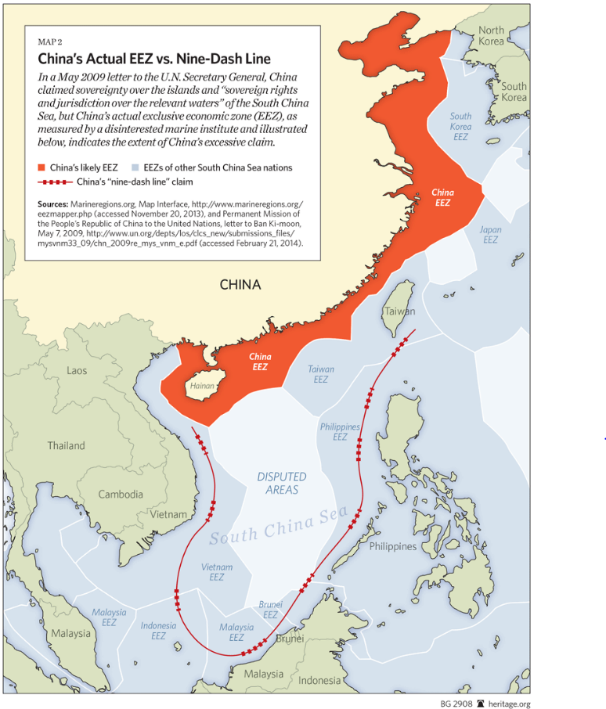
    The Unites States has defense treaties with numerous nations with SCS interests: Japan, the Philippines, South Korea, Australia and Thailand.  We also have a loose quazi-treaty with Taiwan.  The common thread is that the US will help defend these nations if they are attacked.  For the SCS the Philippines and to a less extent Japan are the principle concerns.  As the maps show the Phils will be hugely impacted by the PRC’s claims.  In 2016 the Chinese lost in international arbitration under the United Nations Convention on the Law of the Sea (UNCLOS).  China has since stated that it doesn’t recognize the decision and continues to claim the Nine Dash areas.

    If a defense treaty nation is attacked the US has obligated itself to defend them with the US military.  That means China possesses the means to determine the timing and size of any first blow.

    In one example of the continuing tensions, the Phils and PRC have nearly started shooting at each other over the Second Thomas Shoal in the Spratley Islands. The shoal is within 200 miles of Palawan Island but well inside the Nine-dash Line so both countries consider the area within their respective economic zones.  The Phils intentionally grounded a WWII era ship in 1999 and have kept it manned with a detachment of soldiers since then.  Resupply and repair operations are routinely contested by the SCP and PAFMM.  Neither side has shot (yet) but the two sides play cat and mouse as the PRC tries to starve out the soldiers while waiting for the collapse of the ship.

    Other Situational Considerations

    Western analysts often examine security environments using DIME (Diplomatic, Informational, Military and Economic) considerations.  How does the SCS stack up?  Let’s start with the “M”.

    Military Aspects. The PLA as an institution remembers fighting the Americans in Korea.  During the Korean War the PLA suffered around 1,000,000 casualties (~400,000 KIA) and so realizes the cost of fighting a western power.  The PLA has long been the “first among equals” within the PRC’s military hierarchy but the current reforms significantly cut army end strength while expanding the PLAN and PLAAF.  The PLAN and PLAAF have no institutional memories of fighting the west and like all the world’s navies and air forces focus on their technological capabilities.  The PLARF is counting not just on the technological capabilities of their missiles but on the fact they are largely located on the Chinese mainland.  They can strike US forces without hitting the US homeland while knowing a counter strike means a homeland attack with the inherent strategic issues for the US.

    Neither country has lost a major warship in the memory of the sailors and civil leaders.  The US last lost major surface ships during the WWII.  During that war the US lost 466 major combat warships and since the Okinawa Campaign (Spring 1945) has lost zero large warships in combat. The PLAN hasn’t even possessed major combat vessels until recently.  Modern weaponry will cause large material and personnel losses that neither country has had to deal with within memory.  How this will impact tactical and strategic decision making is unknown.

    The surface combat ships and aircraft for a US Carrier Group costs $20B to $30B to build and equip and has around 8000 sailors. This does not count the costs and personnel of the CAG’s submarines or logistics ships. As the US moves to F-35’s the costs of the aircraft alone could run up to $120B per CAG.  Unclassified estimates are that it takes $400,000,000 annually to operate the carrier and aircraft during a peacetime training pace.  This does not include the operating costs of the other 7-10 warships and multiple support ships that make up a CAG.  The costs of the Chinese vessels and aircraft is unknown but is significant as well.

    China is not yet a peer competitor but it is rapidly developing the naval and aerial skills to be a peer.  Their missile forces are massive and as some point out “quantity has a quality all its own.” RAND concluded that in 2017 “China possessed 1,200 conventionally armed short-range ballistic missiles (600-800 km range), 108 to 274 medium-range ballistic missiles (1000 to 1500+ km), an unknown number of conventional intermediate-range ballistic missiles (5,000 km), and 450-1,250 land attack cruise missiles (1500+ km). RAND also estimated that improvements in the accuracy of China’s ballistic missiles may allow them to strike fixed targets in a matter of minutes with an accuracy of a few meters. RAND assesses that key U.S. facilities throughout Japan could already be within range of thousands of difficult-to-defeat advanced ballistic and cruise missiles.” Even US bases on Guam are now at risk from the DF-26 missile force.

    AKA: “Guam Killer”

     
    It is important to remind yourself that the US (and Russian) non-ICBM’s are limited to an effective range of 500km for air and ground launched systems. Neither party can possess missiles that range 500-5,500km.  China never signed the Intermediate Missile Treaty (aka INF) so they are free to build systems that are not in compliance with INF limitations.  For the US to design and build missiles to meet the Chinese threat is “problematic” because of Russian concerns. These concerns, and accusations of Russian non-compliance, are why the US is discussing withdrawing from the INF Treaty.

    Aircraft are no longer quick and relatively inexpensive to build.  In WWII the US produced ~300,000 aircraft (including 59,000 lend lease) and lost 53,000 in combat (95,000 losses in total). Even in Vietnam, the US lost 2,197 fixed wing and 5,607 helicopters. Since then fixed wing losses in combat have been very light and since 9/11 only 70 helicopter have been shot down and 305 lost from mechanical problems or accidents.  The issue with modern aircraft, especially modern fixed wing fighters, is there are few in service, production rates are slooooow and unit costs are high.  The US is buying F-35’s at around $85M per copy and the full production rate is ~100/yr.  (Some production is for allies and not US)  While the numbers vary as aircraft are replaced with newer models it is safe to say that the entire inventory of combat fixed wing aircraft for the USAF, USN, and USMC is less than the number of fixed wing aircraft lost in Vietnam.  China is aggressively purchasing modern fighters and bombers and want to have 200 of their new J-20 fighters in place for the SCS facing commands by 2025 which they believe will give them at least regional parity.

    The US has almost no ability to rapidly replace sunk/badly damaged shipping or warships.  The great industrial might we had in the Second World War has been outsourced or dissipated.  As a Nation we have moved to other economic drivers, but in the event of a protracted conflict with a peer competitor this lack of building capacity will be a factor.

    Diplomatic impacts of a fight within the SCS will roil the region.  A minor military incident could be initiated by China in the belief that if they just cut off this one piece of salami from a minor country , quickly announce they are done and thereby prevent a major escalation.  This might be accurate, or it might not be.  Other nations have tried this approach recently (e.g. Russia) and have not found the “fuck it, we are fighting” response from the West, But attacking a defense treaty nation is different from grabbing Crimea or parts of Georgia (the nation and not the state).

    Obama SecDef Ashton Carter was very critical of Obama ceding the initiative in the SCS to the Chinese.  Carter has stated “recommendations from me and others to more aggressively challenge China’s excessive maritime claims and other counterproductive behaviors’.” Carter further stated “Obama even bought into China’s vision of a G2-style arrangement with the US.”  This leaves the current and succeeding Administration’s in a difficult diplomatic position since the ASEAN and other regional nations saw the US inaction during the period before the military infrastructure was in place.

    Never has a permanent UN Security Council member directly attacked another SC member in a known, public and major way. Even during the Cold War 1.0 the USSR and US/GB/FR used proxy conflicts.  The best known case of a potential direct challenge, the Cuban Missile Crises, had all sides trying to defuse conflict.  The impacts of a Chinese missile strike on a single US cruiser are unknown.  If the Chinese were attack a Carrier Group in a systematic way the stakes would be exponentially higher. Presumably the entire diplomatic world would try to turn off the conflict as quickly as possible to spare a possible nuclear exchange. If the US went along with a cease fire without imposing major losses on the Chinese the diplomatic costs throughout the region would be immense.

    Informational impacts of a crises could be stark as well.  The Chinese again would hold the initiative and you can expect them to start coercive diplomacy via public media well before any military action.  After the start of conflict the world information environment would be loaded with Chinese and China proxies’ messaging.  One can consider that the “Great Firewall of China” would be expanded to limit internal knowledge of the conflict.  The US response would probably be muddled, slow and largely ineffective in the short-term.  This would largely be due to the overly bureaucratic “Whole of Government” interagency process combined with a very loose definition of “the truth” in Chinese messaging.

    Economic impacts of any China/US conflict would be huge and felt worldwide.  The economies of the SCS neighboring and ASEAN countries would tumble.  If the conflict went for any time the worldwide impact of just changing shipping patterns would jar economies throughout the world far beyond the indo-pacific region.  If blockades were established by either or both major combatant the cost of almost everything would rise. Markets throughout the Western World would soon face shortages of every product that either originated or passed through China.  China’s “One Road” trade system would make up for some shortages, to those countries that the PRC chose to continue doing trade with.  This in turn will build diplomatic pressures from both the US and China on nations to side with them for economic reasons.

    “Experience differential” China’s armed forces are not experienced in actual combat operations, are still developing how to fight carrier groups, and their training environment does not routinely conduct Joint or realistic exercises.  However the various parts of the Chinese military have taken efforts to increase the realism of training and introduce Joint operations.

    The US Army, and USMC, are both extremely experienced at conducting company to brigade sized combat operations.  The US armed forces are very experienced at conducting Joint operations to support disbursed small unit operations in a low threat combat environments, and are really the only nation able to routinely conduct extended carrier group operations.  Bottom line, the US military is damn good at what they do.

    The problem for the US is that a generation of service members have not seriously exercised how to conduct high end combat operations against a peer competitor.  The US is trying to re-learn how to fight outnumbered and win an extended fight.  So at the ground tactical level the US probably would curb stomp the PLA. However a fight over the SCS would be air and maritime dominated while fighting outnumbered against a foe fighting on short interior lines of communication. In addition the foe would be fighting over an issue considered close to existential for the China’s ruling class while being perceived as minor long term issue for the US home front.

    WAR! The details are hazy.  But in short, re-watch the series “Victory at Sea” and imagine it in color and high definition.  The biggest question will be what happens after the first shots are fired.  Will the two sides act like they touched a hot stove, pull back and spend more time blustering at each other?  Or will the remorseless calculus of combat assert itself and both sides get drawn more deeply in as subsequent losses make it increasingly difficult to stop without losing too much face? (In respect to Xi and his cabal. Lose their foreheads to exit wounds?)

    Guadalcanal 1.0

     
    Okay, so what?  All this wordiness might be interesting (or merely depressing) but why should I worry about my monocle mining orphans, pot and Mexican ass sex?

    This is the big question.  The accommodation of the rise of Germany in Europe bothered Russia, France and England and didn’t go very well in most people’s opinions.  The rise of the US was accommodated by England to the world’s betterment; and the fall of the USSR went better than most people feared.  The rise of China is presenting the world with a similar challenge.

    China is an illiberal socialist nation whose ruling Chinese Communist Party leaders need to keep the economy growing to stave off revolt and their own executions.  While the economy was growing at double digit annual rates, the CCP could keep the new internal “middle class” content enough.  Now that the economy has cooled (a discussion of that would be several books of material) the CCP is looking at how to re-spark growth and finding external enemies to distract the populace.  Xi as the “Authoritarian in Chief” stresses that by 2049 China will emerge from the “100 years of humiliation” as a recognized world power.  Xi is looking at Taiwan but recognizes that fighting for Taiwan may involve more risk to the ruling CCP powers than they are willing to accept at this time.  The SCS may offer a chance to throw off “humiliation” at much less risk and before 2049.

    Why less risk?  The SCS is close to the mainland and very far from the US mainland.  The Chinese would operate on shorter lines of communication and present the US with multiple dilemmas. The Chinese see opportunities to consolidate their gains with smaller and quickly completed military operations directed at the edges of US interests.  These operations present US and regional decision makers with having to respond fait accompli to CCP gains.  If the Chinese can keep away from direct PI and Japanese interventions then they steer clear of US treaty obligations.  It would be hard to mobilize the American people to support the claims of Vietnam, Malaysia or Brunei.  If China directly assails the PI and then coerce or bribe the Philippine government into disavowing combat or recognize the Chinese claims hoping to sate the dragon’s hunger then US reactions are massively limited.  The payoff for China for consolidating their claims in the SCS would be huge if they can do so without triggering a very destructive war with the US.  The map shows the scale of the economic benefit that would result from capturing the exclusive use of those resources and being able to restrict free trade.


    The military advantage gained would be huge as well.  China would gain unobstructed access to the Central Pacific and hold every regional economy at risk.  The diplomatic impact of success would demonstrate to the region and world that China must be accounted for and that their approval would be vital for local regime stability.

    So what are some options for the US concerning the SCS?

    The options presented to the US all have downsides because of baked in prior treaties and policy decisions.  The choices the US faces also involve multiple secondary and tertiary impacts that cannot be fully known at almost any point of decision.  A well-known truism of strategic decision making is: decisions made concerning one issue never completely solve that issue, they just help define the next issues that will need to be dealt with.

    Renouncing or changing defense alliances and treaties is always a possibility.  These changes come with known and unknown risks as all parties relook their internal and external calculus.  For example: The PRC and the PI are both confident that a major military action against the Philippines will bring the US into the conflict.  Any change to the US/PI defense treaty will be quickly known by all three countries and will change the decision calculus.  The PRC may take a more aggressive step and seize a PI claimed SCS feature confident that the US would not become involved.  But even under the new treaty, the US may still enter the conflict for its own reasons using the old, or revised, treaty as a public rational.  Strong defense treaties are made to reduce confusion on the part of potential adversaries, so any changes the US seeks will need to be carefully thought out.

    The US can withdraw from the SCS area and explicitly or implicitly recognize the PRC’s claims.  The US stepping away from the current global hegemon role in respect to the western Pacific Region could save us in current military related expenses (Carrier Groups are not cheap to own or operate) but again this COA will have second and third order impacts.  Except for the PRC’s designs on Taiwan, the modern history of China rarely features major grasps for territorial expansionism. Besides the current SCS efforts the PRC has demonstrated expansionism in the past in regards to Vietnam and the 1950 invasion of Tibet.  Xi and the CCP would most probably grab their entire SCS claims quickly filling any perceived vacuum left by the US.  The next steps are more a mystery but the economic impacts of preventing or regulating and taxing maritime and aerial transit of the SCS would rapidly roil the global economy.

    The US loss of access to the western Pacific will have diplomatic and defense impacts as well. The US currently is seen as the “cop on the beat” by nations all over the world.  If the US is seen voluntarily taking a major step away from that role in the SCS it will cause the rest of the world to relook all aspects of America’s role in defense.  As a matter of public debate leaving the SCS would quickly eclipse the worthwhile exit from Syria and drawdowns in Iraq and Afghanistan. Would pulling back from the SCS embolden Russia, Iran, or others in making additional extraterritorial grabs of terrain or establishing “satellite states” and thereby create new defense issues?

    The PRC already is attempting to establish their currency as an international benchmark and pulling away from a long term defense commitment would influence many nations to replace dollars for yuan in part or in whole.  This would impact interest rates and the relative strength of the dollar for us to buy Romanian wine, Japanese noodles or German hops.

    The US can maintain the status quo in the SCS.  The current US policy is that the SCS issues must be handled peacefully by the various claimants. The US also supports the international tribunal findings between the PRC and PI mentioned above.   The US has stated that we regard the SCS as non-territorial waters and not part of the territorial waters or EEZ by any claimant, but especially China.  The US deciding to continue maritime and aerial operations backing free navigation through the SCS waters and air will keep potential adversaries internal calculus including the question of “What if…?” around the world.

    The US can work with ASEAN and interested nations to draw a new path for the SCS which reduces US open ended commitments while securing the vital SCS transportation lines of communication and economic assets for all parties.  China will continue to oppose this COA and will regard this COA as a way to “fence in” proper Chinese aspirations and the US attempting to influence other states to gang up on China.  China dislikes any multilateral agreement unless they feel comfortable with their ability to ignore the agreement without serious repercussions.  (See the Paris Accords, MTO and IMF agreements.)  Despite the difficulties with this COA, it is probably the best way, over (significant) time to reduce the threat of war while maintaining economic progress.  Just don’t think that this way will be quick or easy.


  • South China Sea: Fair Seas or Foul Weather? Part 1


    Normandy, Argonne Forest, Anzio, and Iwo Jima are all names that many Americans recognize as American military campaigns. 

    Lesser known campaigns are recognized in the names Peleliu, Biak, and Khe Sahn.  There is an unfortunate possibility that the names Mischief Reef, Parcells and Woody Reef might enter the American lexicon of battlefields.  The last three names are all within the South China Sea (SCS), a Mediterranean sized body of water bounded by China, Vietnam, Malaysia and the Philippines.  Why might the US and China fight over a body of water far, far away?  (Except for our Japanese and Korean bridgeheads.) The SCS is a hot topic.  Recently “Foreign Policy” and “Foreign Affairs” have both weighed in, as well as many other authors.  So what the heck, here is a primer from me. This little bit of writing will hopefully help the Glibertariat to understand some of the issues and to be able to engage with others on what the US’s policy options are.


    So who are the players on this game board? 

    The biggest by far is China and primarily the People’s Liberation Army Navy (PLAN), People’s Liberation Army Air Force (PLAAF), Chinese Sea Police (aka Coast Guard), the People’s Armed Force Maritime Militia (PAFMM) and the People’s Liberation Army Rocket Force (PLARF).  China is also has one of the world’s largest merchant marine fleets and uses the SCS to bring and send resources and products to every continent.

    The PLAN is executing the world’s most extensive and aggressive fleet expansion and modernization campaigns.  It is estimated that by 2020 the PLAN will be the 2d largest navy in the world as counted by tonnage and frigate and larger warships. The PLAN will exceed the USN in the number of combatants. The PLAN is beginning to execute extended blue water operations, determining how to make carrier groups effective warfighting tools, and executing submarine operations well beyond their coastal water.  Their stated goal is to be capable of conducting “regional offensive operations” and they currently are part of the combined anti-piracy effort off of Somalia.  The PLAN also has two brigades of Marines, with a third being formed.  All these units are on Hainan Island or the adjacent mainland coastal region.

    The PLAAF is fielding large numbers of modern 4th generation aircraft that can go toe to toe with many US aircraft and outperform Taiwanese aircraft. The PLAAF is preparing to field significant numbers of 5th generation aircraft as well.  Like the PLAN they are expanding and modernizing faster than any other nation.  It appears that they are also loosening combat control of their formations to enable pilots to use more initiative.  The PLAAF is already large and still growing under recent PRC military reorganization.

    The CSP is really a second navy but painted white instead of gray. The Chinese recently transferred control of the CSP from the police to the military.  The CSP is by far the largest coast guard on the planet and its largest ships are the size of US guided missile cruisers.  The CSP operates throughout the SCS and not just around Chinese made features conducting both traditional coast guard missions and para-military operations.

    The PAFMM is a newer and less understood military component. They are almost unique in the world with the primary mission to engage in gray zone operations to frustrate effective response by the other parties involved. These vessels can be purpose built or much more frequently are reconfigured otherwise “civil” vessels. The PAFMM are widely seen participating in low-intensity coercion during maritime disputes including harassing or ramming vessels from other nations and even occupying disputed maritime features.

    The PLARF controls Chinese tactical to strategic, conventional and nuclear, rockets and missiles. Doctrinally the PLARF conducts deterrence, compellence, and coercive operations. In the event that deterrence fails, the missions of a conventional missile strike campaign could include “launching firepower strikes against important targets in the enemy’s campaign and strategic deep areas.” including command centers, communications hubs, radar stations, guided missile positions, air force and naval facilities, transport and logistical facilities, fuel depots, electrical power centers, and aircraft carrier strike groups. Writers also stress that, “In all, Chinese military writings on conventional missile campaigns stress the importance of surprise and suggest a preference for preemptive strikes.” Preemptive missile strikes to initiate active hostilities are also consistent with China’s overall military strategy of “active defense.”   Leaving aside strategic nuclear weapons, China has more conventional missiles than any other nation and is not signatory to the IMF. By being free of the IMF China is not constrained to distances and methods like the US (and Russia).  The PLARF like the rest of the PLA believes that “quantity is a quality itself” and so their missiles are in greater numbers, shoot longer distances and with bigger warheads than other nations.  Recently they have started fielding the DF-26 which can range Guam from the Chinese mainland with both conventional and nuclear warheads.  The PLARF makes no bones about their possible targets since their interior China test range uses model US airfields, ships and ports for targeting.

    It is useful to remember that the term “deterrence” is used differently by the US/West and China.  To us “deterrence” means taking actions to prevent another party from taking an action. So actions taken to keep the peace.  To the Chinese “deterrence” means the use of force to stop another party from continuing an action. This mismatch in definitions could lead to a dangerous situation.

    The People’s Liberation Army (PLA) is a relatively minor player in the SCS.  They are undergoing a large scale modernization campaign.  The PLA is also reducing in size as the other components are growing. Ground pounders are less of a player

    The second player in the SCS is the Republic of China (aka Taiwan). Their armed forces are small in number and nowhere as modern as the PRC’s new equipment.  Taiwan’s F-16’s are capable, but there are too few of them to make much difference.  The Taiwanese most likely would try to sit out any SCS brouhaha that does not directly impact them since any active participation would invite a major PRC attack or an invasion of Taiwan.

    The third major players are the Philippines, Malaysia and Vietnam.  They have smaller militaries than China, but have intense economic interests in the SCS. None of them has the mass or modern enough equipment to take on a concerted PRC effort in the SCS. Vietnam has demonstrated a long history of challenging the PRC while the PI has weakened their opposition under Duerte.  Despite winning their legal challenge the PI’s President has been very friendly with Xi and the PRC.

    The fourth major player is the United States.  Since our founding the United States has fought multiple wars over freedom of the seas, both declared and undeclared.  We have naval forces and aircraft that operate within the SCS for freedom of navigation (FONOPS) and intelligence reasons.  While we have no permanent military installations within the Philippines we do have Special Operations, Ground, Air and Maritime forces operating throughout the country on a regular basis. Our attack submarine force is very advanced, but the SCS is not a great operating area.  We, and several other countries, conduct FONOPS around the multiple features and we have been known to send one or more complete Carrier Groups through the Formosa Strait to deliver a point.

    These operations are not without risk.  During the early days of the Bush the Younger administration, a P-3 and a Chinese J-8 bumped over the SCS.  The J-8 was destroyed (the pilot died) and the P-3 made an emergency landing in the PRC on Hainan Island.  After much brouhaha we got the crew back and eventually most of the P-3 shipped back in crates. More recently we had military aircraft, surface combat ships and support ships repeatedly harassed and threatened with unsafe maneuvers by Chinese aircraft and vessels. The latest that made the news was in October and involved the USS Decatur and a PLAN destroyer near Gaven Reefs which are claimed by Vietnam, China and the Philippines and are located approximately 1000km from China’s Hainan Island.


    Gaven Reefs 2014 Construction


    Gaven Reefs Recent


    FONOPS also cause debate within the international defense community.  Some regard FONOPS as too provocative, while others regard them as too timid.  The two camps arguments can be summarized.  The provocative camp says why twist the dragon’s tail and ruin negotiations? The too timid camp’s thrust is that 12 mile nautical free passage FONOPS are granting recognition for rights that don’t exist under international law. Therefore FONOPS undercut the correct legal position that the features are not islands so have no exclusionary or economic zones. Under this viewpoint we could sail as close as we want while conducting military operations and be fully lawful.

    Other regional nations with a considerable interest in the SCS are Japan, Republic of Korea and Australia because of the importance of the SCS in trade and seaborne transportation. Japan is more concerned with their disputes with China over the East China Seas and islands.  While the Japanese does have a Self Defense Force with modern equipment, the SCS is only a secondary issue until the Chinese shut free transit of vessels.  The ROK concentrates on the Norks and their view of the SCS mirror Japans concerns.  Australia sits outside the island chains and has more concern over free access and Chinese interests in New Guinea and the Solomon Islands.  (Say hello to the Guadalcanal Campaign V2.0?)


    What does SCS playing board look like?

    The SCS is a salt water sea bounded at the north by Taiwan, the south by the Strait of Malacca area the east by the “first island chain and on the west by mainland Asia.  For an idea of scale the SCS, less the Gulf of Thailand, is roughly 1.4 times the size of the Mediterranean with China claiming sovereignty over almost the entire space.  They are doing this through the “nine dash line” and construction.  “The nine dash line” is the PRC’s claimed area of sovereignty and reaches throughout the SCS, at times encroaching on the 12 mile limits of the various states.

    “The first island chain” stretches from the Japanese home islands, through the Ryukus (home of US military bases on Okinawa), Taiwan, the Philippines, Borneo and closing at the Strait of Malacca. The Chinese view this as “their” lake and their military publications stress the first island chain as the area it must secure and disable from American bases, aircraft and aircraft carrier groups.  The PLA states that within this area it must be prepared to tactically unleash pre-emptive strikes against an enemy with the aim of sealing off the SCS and ECS.

    “The second island chain” stretches through the Japanese home islands, the US territory of Guam and the Northern Mariana Islands, the Federated States of Micronesia and to New Guinea and the Solomon Islands. This is the area that the PRC wants to achieve maritime and air dominance over to provide a buffer zone for the SCS and mainland.


    Sea lanes, fish and oil.  These three things are a large part of the why the PRC and the neighboring nations are squabbling about the SCS.  Fifty percent of all the oil shipped in the world transits the SCS; the bulk of the rest of the world’s maritime traffic moves through the SCS (the America’s), or the SCS and the Strait of Malacca to get to/from, India, Africa, Europe and the Middle East.  Over half of the planet’s population lives in nations near or adjacent to the SCS.  The SCS is one of the last great fishing grounds so everybody is interested in this source of protein.  And that brings us to oil.  There are large known or suspected oil fields in the SCS and the nation that controls them will gain a regional advantage. By not having to bring oil from the far side of the planet makes this resource cheaper to use or sell.


    SCS maritime trade routes and densities


    The fisheries in the SCS provide ~12-14% of all the commercially caught fish on the planet.  China harvests ~73% of all the fish they consume or sell from the SCS.  If you buy Chinese seafood you have most probably consumed animals harvested from the SCS. While there is some oil production in the SCS the fisheries are the here and now reason why the Nations surrounding the SCS all are concerned about China’s claims.


    Claimant EEZ 200 miles boundaries (blue) and Nine Hash Line (red)


    Twelve and 200 nautical miles.  International law states that a nation has sovereignty over large bodies of water out to 12 nautical miles.  That means that they can regulate “innocent passage” and in some cases prohibit transit of vessels and aircraft which are not registered to that nation out to that distance.  After that distance the water (and air above it) is open for the transit of any user, and for nation permitted commercial uses.  So a Russian or Chinese “oceanic research vessel” with a forest of antennas can hover 13 miles off of Cape Cod or Los Angeles with no legal objection.  By the same token a US Navy carrier strike group can transit the Formosa Strait between the PRC mainland coast and Taiwan.  Commercial aviation also makes use of this legal principle all over the world.  So a Singapore Air flight from Singapore to Tokyo can overflight the SCS seeking without permission of anybody except for Japan.  There are some exceptions to this law.  Where there is less than 12 nautical miles the border is equidistant.  For bays and gulfs the rules are a bit more convoluted.  Ronald Reagan and Qudafi famously disagreed about this point in the Gulf of Sidra.

    Why do we care about 200 nautical miles?  This is the exclusive economic zone for a country over salty water. Within that space a nation controls the use of natural resources above, in, and below the water.  They may reserve it for their exclusive use or set up means to regulate persons from other nations to use it.  This is why both the UK and Norway control only parts of the North Sea oil fields and there are no French platforms.  Like the 12 mile limit, if there isn’t 200 miles between nations the zone boundaries meet at the midline.

    Shoals, Rocks, Islands and manmade features.  See the illustration.  The key point being that features must be naturally occurring and not manmade. Manmade features receive no mileage around them.  China is taking shoals and rocks and constructing large manmade features within the SCS then claiming the features as islands and hence that the 12 and 200 miles laws apply.  The map shows China is claiming all the oil and fish within the Nine Dash Line in the SCS.  China’s opinion is that has exclusive use to the natural resources and it can close the SCS to maritime and aerial traffic. This has gotten the neighbors, and others like the USA, concerned because of the economic and free trade impacts.  To be clear the Chinese have not announced any maritime exclusion or air defense zones, yet.  They have claimed an air defense identification zone a bit farther north over the East China Sea which the US ignores and has stated it will not comply with.


    The Chinese efforts are not small scale.  They have created multiple square miles of “land” replete with jet capable runways, multiple military radars, missile farms and supporting structures.  More worrisome is that over the last half decade the pace and scope on construction steadily increases.

    Mischief Reef


    At first the Chinese claimed the features were to aid navigation and search and rescue, now they openly fly modern fighters in and out of them and increase their arming of the features by adding modern radar systems, as well as anti-ship and anti-aircraft weaponry.


    SCS Spratly outposts and Slightly old Claimant EEZ 200 miles boundaries (blue) and Nine Hash Line (red)


    The Chinese actions in the SCS started in 1974 when it seized the Vietnamese claimed Parcell Islands.  This led to a long term feud which culminated in 1988 when the Chinese machine gunned and killed 72 Viet fisherman and sunk two boats at South Johnson Reef.  China continues to dispute Vietnamese claims and has multiple steps top block fishing and drilling.  The PRC has carefully watched the international scene and in 2012 started making their move.  First they seized Scarborough Shoal from the PI. They watched what the US would do and when they saw acquiescence from the Obama administration they moved to the next phase to construct new features.  Their main dredger (the Tianjing) can dredge and hose out 4,530 cubic meters of soil per hour.  They first used it at South Johnson Reef where it created an 11 hectare “island” in less than four months.  Again the US, ASEAN and the West took no action.  The Chinese started building at an ever increasing pace and now have seven features in the SCS.

    Now these features have port facilities, military buildings, radar and sensor installations, hardened shelters for missiles, logistical warehouses for fuel, water and ammunition. Most tellingly these features now have heavy transport and military jet capable runways and airstrips and the PRC has landed these aircraft on them. The international tribunal ruled against China actions in 2016 and China ignored the ruling, again without any cost.  Now the PRC has expanded their control further by strong-arming the other SCS nations into suspending the exploitation of natural resources within their own 200 mile exclusive economic zones.  The new USINDOPACOM Commander during his confirmation hearings told the US Senate that for all practical purposes the PRC had won the race to develop a military capacity on these features in the SCS and now the US needs to determine the next steps to take.

    Fiery Cross Reef construction and recent


    Stay tuned for Part 2.


  • A History of The Six-gun, Part Four

    The Cartridge Era Begins

    At the end of the Civil War, big changes were coming to the world of sixguns, and those changes were originating in Springfield, Massachusetts.  Still, revolver manufacturers in general were about to see some busy times – and the state of the art in revolvers was destined to change dramatically over the next forty-odd years.

    Smith & Wesson

    The Smith & Wesson #1 and #2 revolvers served as proof of concept, but the pipsqueak factor didn’t do S&W’s sales any favors.  If a pistolero wanted something that packed a real punch, he still had to go to a cap and ball revolver.  So, in 1870, the Springfield company brought out the #3, the gun that would change things for the cartridge revolver market.

    Bear in mind that Smith & Wesson still held Rollin White’s patent at this time, guaranteeing them to be the only ones that could make a revolver with a bored-through cylinder in the United States.  This did White little good, as the terms of the patent agreement with S&W required White to defend against patent infringement, a bonehead move on White’s part that left him penniless while Smith & Wesson was coining a lot of money with their modern revolvers.

    The S&W #3 with a famous user.

    The #3 was made in two versions.  The first was the Russian, chambered for the .44 Russian cartridge, and the second became known as the Schofield after Major George W. Schofield, who offered design advice to Smith & Wesson; the latter arm was initially chambered for the .44 S&W American, which later became the basis for the .44 Special and the .44 Remington Magnum cartridges.  S&W later offered the Schofield in .44 Henry Rimfire, .44-40, .32-44, .38-44, and .45 Schofield.

    Unlike the #1 and #2, the #3 guns were hinged at the bottom of the frame in front of the cylinder.  This removed the necessity of removing the cylinder for loading and allowed the addition of an extractor to make the removal of spent brass easier.  Now the soldier, hunter or pistolero had a gun that was quick to load, reliable and powerful.  Quite a few notorious personages favored the big Smith, including Jesse James, John Wesley Harding, Pat Garrett, Wyatt Earp, Billy the Kid and a young fellow named Theodore Roosevelt.

    Later, Smith & Wesson continued to innovate, bringing out some of the first production double-action revolvers.  The New Departure double-actions were offered for sale beginning in 1887 in .32S&W and .38S&W calibers, with the break-top design of the #3.  Also known as the “Safety Hammerless,” these guns were striker-fired and had a grip safety.

    But while Smith & Wesson was cranking out revolvers, the competition wasn’t idle.  During the post-war years the folks at Colt went through some bad times but were about to come roaring back in spectacular fashion.

    Colt Wasn’t Just Sitting Around

    Smith & Wesson notwithstanding, the late 19th century story of revolvers is largely Colt’s story.

    An old Colt ad.

    Sam Colt’s decision to sell a mess of sixguns to the newly-formed Confederacy was to end up costing the company badly.  Sam Colt had been derided in the press as a traitor, and the Colt manufactory lost both reputation and revenue due to that decision.  But when Rollin White’s patent expired in 1869, the folks at Smith & Wesson soon learned that the Colt people hadn’t just been sitting on their hands; they were planning a comeback in their own cartridge revolvers.

    The first production cartridge-firing Colt, the 1871-72 Open Top, firing the .44 Henry Flat cartridge.  The Open Top seemed as much as anything like a reason to use up a bunch of old cap & ball parts, and indeed prior to its introduction Colt did convert a lot of old percussion guns.  The Open Top was never a big seller, carrying over the percussion Colt’s open topped frame and primitive sights.  Colt also offered two versions of a pipsqueak revolver chambered in .41 Rimfire, the 5-shot House Gun and the 4-shot Cloverleaf.

    But in 1873, everything in Colt’s past was wiped away when they introduced a gun the likes of which only comes along a few times in a century, a gun that was to become the stuff of legend:  The Single Action Army.

    Also known as the Model P, the Peacemaker, the M1873, the Frontier Six-Shooter (in .44-40 caliber) and the Gun That Won the West, the SAA was quickly adopted by the U.S. Army, who purchased many of these guns in two forms, the 7 ½” barreled “cavalry” revolver and the 5 ½” barreled “artillery” version.  A 4 ¾” version was available for civilians, and quickly became much sought after by lawmen, cowboys and guntwists of all sorts.  Colt’s new single action was remarkably well balanced, had a grip that was admirably suited to be fired one-handed while the shooter’s other hand was holding reins.  In fact, many modern shooters may look at the Colt and wonder about the placement of the loading gate on the strong side of most shooters which can make reloading a bit awkward, but it’s important to remember that the gun was designed for military use – and in those days, that meant use by horsemen.

    The SAA was initially offered in .45 Colt but later also chambered in over thirty calibers, from the .22 rimfire to the .44-40, .44 Special and .357 Magnum.  In 1890 Colt offered a flat-t

    If it’s good enough for The Duke…

    op target model with improved sights, and in 1894 the Bisley model was brought out, named for the famous Bisley pistol range in England a

    Patton with his SAA.

    nd intended to appeal to target shooters.  Barrel lengths were eventually offered ranging from the 3” “Shopkeeper” to the 18” “Buntline” versions.

    The Peacemaker quickly overshadowed Smith & Wesson’s offerings for several reasons.  First, the solid frame of the Colt was generally regarded as much stronger than the hinged-frame Smith.  If a cowboy or gunsel ran out of ammo and had to settle a scrap by banging his sidearm over an opponent’s head, the Smith was liable to break at the hinge or the catch; the solid-frame Colt was far more likely to survive being abused in this manner.  But the primary reason was that the Colt was much handier, better balanced and performed better under conditions of dust, dirt, damp and cold.  It was a one-in-a-thousand design, one that persists today not only from Colt but from a dozen or more replica manufacturers.

    Colt didn’t neglect the double-action market, either; in 1877 they introduced the 1877 double-action, which loaded through a gate in the same manner as the Peacemaker; it was offered in .32 Colt (the Rainmaker) .38 Long Colt (the Lightning) and .41 Long Colt (the Thunderer.)  No less than Billy the Kid favored the Thunderer, carrying a brace of them on his adventures.  In 1878 they brought out the last of their rod-ejector double-actions, the big Colt Alaskan in .45 Colt.

    In 1889, Colt made another technological innovation when they introduced the M1889, the first production double-action revolver with a swing-out cylinder released by a sliding latch; thus, was the modern form of the double-action revolver completed.  The .38 Long Colt cartridge it used, however, was sorely lacking.  But in 1898 Colt addressed that by releasing the New Service revolver, a big, tough handgun chambered in            .38-40, .44 Russian, .44-40, .45 Colt, .455 Webley, and later .45 ACP, .38 Special, .357 Magnum and .44 Special.  This was the first modern combat magnum and following the much-discussed failure of the Colt 1889 revolver and its anemic .38 Long Colt cartridge in the Philippines and other venues, both Army and Marines bought a number of .45 Colt New Service revolvers as the Model 1909, which remained in use even after the adoption of the 1911 automatic.

    M1889 Colt.

    A few years back I ran into a guy on our gun club’s pistol range who had an old 1909 Colt.  I fired a couple cylinders through it, and while this big gun was adequately tough for its day, I wouldn’t run any of my own heavy .45 Colt loads through it; in an abundance of caution I restrict those to my own modern revolvers.  With factory ammo, the New Service points naturally, shoots well one-handed or two, and the gun’s weight makes the recoil very manageable and quick follow-up shots are easy.  It’s a damned fine piece.

    Meanwhile, though, while Colt was moving from triumph to triumph, those folks up in Ilion were busy as well.

    Remington Stays in The Fray

    Remington Arms was beginning to transition more and more into a company that made rifles and shotguns more than handguns, but in 1875 they did introduce their answer to Colt’s Single Action Army.  The 1875 Remington Improved Army revolver was a near-copy of Colt’s more successful Single Action Army, using most of the lockwork of the old 1858 Army revolver and retaining that gun’s removable cylinder.  The 1875 was later refined into the 1890 Army, but Remington never succeeded in landing any big U.S. Army contracts, and so the Ilion company’s revolver line eventually fizzled out.

    And a Surprise Entry!

    A Winchester prototype.

    It’s not widely known, but Winchester made a few prototype revolvers, intending to market them alongside the company’s famous lever-action rifles.  Four prototypes were built, including one double-action with a swing-out cylinder; the prototypes were designed by Winchester engineer Hugo Borchardt.  If that name sounds familiar, it is because he also was the brain behind the toggle-action Borchardt pistol, which formed the basis for the Luger.  So, it isn’t unreasonable to say that the Winchester revolver prototypes were first cousins to the European P-08.

    Even so, no Winchester revolvers ever saw production.  While the history is uncertain, word is that a gentleman’s agreement was struck between Colt and Winchester, the result of which was Colt discontinuing their Colt-Burgess lever-action rifle, and Winchester giving up on the revolver market.  This agreement still holds true today.

    And Then This Happened

    In 1908, a combination of events occurred that would once again shake up the sixgun market.  The first was Smith & Wesson’s introduction of the very fine First Model New Century and its .44 Special cartridge.  The New Century became known as the Triple Lock, due to its three locking mechanisms.  It was by many accounts the best revolver made to date.  In fact, some consider it to be the finest double-action revolver ever made, and it’s true that the Triple Lock with its redundant mechanisms and fair amount of hand-fitting would likely cost several thousand dollars were the identical gun made today.  (In 1908 the gun sold for the princely sum of $21.)

    The second thing that happened had longer-lasting implications.  The excellent Triple Lock caught the attention of a young Montana cowboy, pistolero and novice gun writer.  That young man’s name was Elmer Keith, and his work with the Triple Lock and his own heavy loads for Smith & Wesson’s “38-44” and .44 Special cartridges, along with his own trademark hard-cast, flat point bullets, would change the rules for handgunners once again.  In fact, Keith’s bullets and his loads for various rounds are in large part the basis for my own experiments with heavy .45 Colt loads.

    More on that in the penultimate segment of this history, Part 5.