Category: Opinion

  • Inequality and The Great Decoupling

    Introduction
    In this series, I will be examining an economic event known as The Great Decoupling its causes, and how they drive economic inequality. The first part of the article will deal solely with delving into the background of the Great Decoupling and developing a theory for what caused it. Part 2 will go into wealth and income inequality and how they are caused/driven by those factors.

    What is The Great Decoupling
    The Great Decoupling is a term that has been coined to describe the sudden divergence between productivity growth and wage growth in the early 1970s. Prior to that going back to at least the end of World War 2 wages and productivity moved in lockstep indicating that they were tightly coupled and that in effect workers were claiming a constant percentage of their growing productivity. You can see this graphically in images like the one below.

    There are other versions of this graph comparing different wage metrics, they all tell the same basic story however so there is no need to go into them.

    And that graph does tell us that something profound happened to the economy in the early 1970s and if you look closely at the graph that it is clear that this event was not a form of slow gradual change but rather a specific event that occurred between 1972 and 1974. What the event was the cause for the decoupling of wages from productivity is not so clear.

    Before I go into my own theories for what is behind this event, I will go over the 2 most commonly promoted/believed theories and examine them to see if they have any validity to explain the phenomenon.

    There are a few other theories for what caused the Great Decoupling but none of them are particularly widespread or developed as these and so I will not go into them but suffice it to say that every theory I have seen proposed for the cause of the Great Decoupling has been lacking and not backed up by any evidence that fits the evidence

    Theory 1: Automation driving workers out of their jobs
    The basic idea behind this theory is that as automation of factory jobs grew demand for labor shrank and while it never shrank enough to create mass unemployment, it did deprive workers of the negotiating power needed to demand higher wages. Being an essentially neo-Luddite theory, you will often see this mixed with some claims about declining union membership/power as an aggravating factor.

    In fairness, there is some validity to this theory as automation was a growing force in the economy in the post-war years that have accelerated as time went on. There are some flaws to the theory. First, automation did not come onto the scene from nowhere in the early 1970s, it had been an ever-growing force in the economy since the industrial revolution. Had this been the primary driving cause of the Great Decoupling you would not see a sharp line of demarcation where wages and productivity diverged, rather you would see a slow departure as wages gradually fell behind productivity growth. In other words, as automation grew steadily since the 1880’s wages and productivity would never have been coupled in the first place. Second, the growth in automation would have only impacted a few sectors of the economy, primarily manufacturing and farming. Over the period of the Great Decoupling those 2 sectors represented a shrinking portion of the overall economy and as a result, there were plenty of jobs for the workers impacted by automation to go to in other sectors of the economy to find work leaving them with plenty of bargaining power to increase wages.

    Ultimately this theory is used to back either an Organized Labor narrative or to support dire predictions of a coming singularity where automation renders huge percentages of the workforce obsolete and while that may or may not have some validity going forward it is a very poor fit to describe what actually happened to the economy between 72 and 74. The best you can say is that Automation was one factor among many that helped keep wage growth decoupled from productivity growth, it could not have been the causal factor which initiated the decoupling.

    Theory 2: Deregulation and tax cuts for the wealthy transferred ever-growing wealth from workers to capitalists
    This is your standard Progressive/Neo-Marxist talking point. Basically, the greedy rich people convinced the government to change the rules so that they can seize ever more money from the proletariat. Often by having government itself redistribute the income/wealth upwards through cuts in services to the poor being funneled into tax cuts for the rich. Unlike with Theory 1 however, there is pretty much no validity to this claim whatsoever.

    As the graph shows, the deviation between real wages (real wages have been adjusted for inflation) and productivity are clearly indicated to have occurred suddenly between 1972 and 1974. For government regulation or tax changes to be the driving force, there would by necessity have had to have been some major new legislation on taxes or regulations that drove the change within a handful of years immediately prior to the time period in question. What we instead see in the years immediately prior to the decoupling event is a period of massive increases in regulation with the government going so far as to impose wage and price controls as well as the creation of 2 of the largest and most powerful regulatory bodies in our government, OSHA and the EPA. On Taxes the only significant changes being the imposition of entirely new payroll taxes and while those taxes were not progressive in nature, they were small and offset by massive increases in welfare spending transferring income to the poor. You do not see significant tax cuts or pushes for deregulation going into effect until 1982 a full decade after the decoupling event.

    The best factual case that progressives and left-wing economists can make is that the decoupling was initiated by something else and then reinforced by the tax and regulatory changes of the Reagan administration and even that is a weakly supported claim based on the evidence.

    What really happened
    Admittedly not being a trained economist or having access to all of the data to back this theory up or prove it this is just a theory but what I can say about what is to follow is that it is a far more complete vision of what happened and is totally consistent with all of the evidence which I took into account.

    Before we can really understand what drove the decoupling we must understand when and how it happened. If you look very closely at the graph in the image you will see that in 1972 productivity and wages remained in synch, in 1973 they had begun to diverge however the divergence was within what was expected based on how the 2 metrics had moved in the past and by 1974 the 2 metrics were moving along completely different curves. This is a very sharp line of demarcation it can be placed to somewhere in an 18-month period from the start of 1972 through mid-1973 that a 24-year-old trend suddenly changed. Since it was not some kind of a gradual event there must have been a specific change that drove it and it had to have occurred no earlier than 1970 and no later than 1973. When we look at history there happens to be just 1 significant political-economic event that matches this time period, the end of the Bretton Woods system.

    Breton Woods
    What was the Breton Woods System? Following World War 2 the major nations of the world agreed to a system of international currency valuations with other currencies being marked to the dollar and the dollar being directly convertible into gold. The system worked well enough for a while, but it was originally based on the political and economic realities of 1944 where most of the economies of the world had been smashed to rubble and the only significant industrial economy remaining was the US. By the 1960s that was no longer true, England and France had resumed their prewar positions as major economic players, Germany was not far behind and Japan was an up and comer hot on their heels. Compounding this was the fact that the global economy was growing so much faster than the US economy that the US lacked the gold reserves to sufficiently guarantee the currency.

    In 1971 the G10 held a summit to try and rescue the Bretton Woods system devaluing the dollar from $35 to $38 per oz of gold and in August of that year the US stopped the practice of allowing dollars to be directly exchanged for gold by closing the “Gold Window”. These steps did not help, and the dollar reached $44 per oz of gold in 1972. The end came in 1973 when the US and the rest of the world abandoned the Bretton Woods system and the gold standard altogether for a system of fiat currency backed by nothing where exchange rates would be determined by market forces. Under this system, a country can manipulate its currency by just creating new money as needed without the need to worry about whether they have the gold reserves to back that new money. Basically, the end of Breton Woods was the birth of the Inflationary monetary regime.

    So now we have a candidate that at least could, in theory, cause the decoupling and fits the timeline, but this is still not a complete enough explanation as a move from fixed to floating currency can merely cause inflation, there is no real mechanism for it to suppress wages in relation to productivity changes, or at all for that matter. While wages generally trail inflation, they do rise with it. So, If the end of Breton Woods were the sole cause of the decoupling event then what we not have seen a decoupling between real wages and productivity as there would have been nothing to prevent workers from continuing to capture the same portion of productivity growth as they had in the past

    What’s missing?
    Now we have a temporal event that acted as a trigger in the decoupling but that event is not in and of itself capable of producing the result we have seen so there must also be other forces at play here, we have to come up with a reason why wages are not only not rising with productivity but also not rising with inflation as they always have in the past and economic theory says they should. We need to come up with some kind of economic force or combination of forces that are capable of completely counteracting inflation and productivity growth which are working to pull wages up and results in wages that have essentially flatlined for 45 years.

    The link between wages and prices
    Before we can get into what is driving the wage stagnation there is an important relationship we need to understand, the link between prices and wages. Economists argue over whether wages drive prices or prices drive wages, but they all agree that prices and wages are intimately linked. The actual evidence seems to say that the link is bi-directional, that is, an increase in wages in an economy will drive a corresponding increase in prices and an increase in prices will drive a corresponding increase in wages. There is good reason to believe in this bi-directional link between the two as it fits in with much we know about human motivations.

    When a worker accepts a wage, he is not really agreeing to the absolute magnitude of the wage he is evaluating that wage in relation to what it costs him to live and the lifestyle that the wage will afford him. If prices are rising, then he will eventually decide that the current wage no longer satisfies his needs and seek a higher one. On the reverse side when a company offers a wage for a position, they are taking the same factors into account and if prices are falling they may not be able to get their current workers to accept lowered wages but they certainly will offer new workers lower wages in response and in extreme cases will replace current higher paid workers with new workers at lower wages. So, this is how wages respond to changes in price levels within an economy.

    Prices also respond to changes in wages. If a worker’s wages are increasing, he will be more willing to spend increasing amounts on goods and services that he was in the past with the lower wage, companies seeking to maximize profit will note this increased financial flexibility within the market and adjust their prices higher accordingly. Additionally, if a company finds itself having to pay higher wages for workers that represents an increase in costs and therefore they have a strong incentive to raise prices to compensate for the increase In cost.

    So as you can see there are multiple forces on each side of the wage-price equation that work to keep the two in close correlation and when one looks at real wages (that is wages adjusted for price inflation) over this time period one does indeed see that both wages AND prices have been flat.

    We find ourselves in a world driven by inflationary fiat currencies which according to pretty much all economic theories should be producing increasing prices and wages, but we find that neither are really increasing at all and so the questions that must be answered are why neither is increasing because if either was increasing then the other would be.

    What has been keeping wages down?
    In addition to there not having been any upward pressure on wages from increasing prices it boils down to supply and demand. Coming out of World War 2 the US had a rapidly growing labor force as productivity increases in farm work freed up large numbers of workers to go to work in more valuable endeavors and the number of women in the workforce began to grow steadily. This trend was then reinforced by improvements in public health driving up the median age as well as the age to which one was healthy enough to work and eventually the Baby Boomer generation entering the workforce. This was not a problem in the immediate postwar years as the US had a massive export economy and virtually no import economy to compete with thanks to the US being the sole remaining industrial power in the world. Even in the face of this rapidly growing workforce, there was still plenty of work to go around.

    By the mid 1960s this began to change, even though the growth in the US workforce was not slowing countries had largely rebuilt from the war and not only could satisfy many of their material needs themselves they were beginning to export large quantities of goods into the US so while there was still plenty of work to go around companies and consumers began to have alternatives to just paying higher prices for US labor.

    As time has gone by this trend has only continued to accelerate as more and more countries became first major export players and eventually economic powers in their own right. At the same time technology has been expanding to make the world a more global place. Yes, the US is still the leading economic power, but it is no longer the only economic power so that workers in the US are no longer just competing with their neighbors but with people across the globe who often can work for a tiny fraction of what a US worker needs to earn and still survive. The result of this is massive downward pressure on wages, there is plenty of work and we do not see widescale unemployment but there is little flexibility for workers to place upward pressure on wages because if US workers ask for too much the work will just go overseas.

    What is keeping prices low?
    The first thing to recognize is that a fiat currency regime need not be inherently inflationary. It is only inflationary to the extent that the money supply grows faster than the growth in goods and services produced within the economy which means that new money created up to the level of the gains in productivity + population growth would simply have the impact of counteracting the natural deflationary tendency of productivity and population growth and work to hold prices steady. It is only money creation beyond this level which could cause actual inflation in prices.

    That said with the monetary policies created following the end of Bretton Woods were significantly beyond this point and so a common refrain you hear to challenge economists opposed to the monetary policies of the Fed and US Government is “Where is the inflation”? Prices have been essentially flat for decades even though the monetary base has been increasing near exponentially, so those theories are falsified, right?

    Not so fast. The first thing that needs to be realized is that both increases in productivity and population exert deflationary pressure on prices.

    Given that an increase in population represents more workers producing goods and services however while this represents a deflationary pressure on prices as there are fewer dollars available for each unit of production in the economy so the monetary supply had to grow by the same proportion as population growth (more specifically workforce growth but they are interchangeable if we assume a steady portion of the population in the workforce) before you would see any price inflation.

    Additionally, an increase in productivity means a decrease in production cost. Growing productivity will by necessity produce some combination of a decrease in price, an increase in wages, or an increase in profits the question becomes what proportion of each. That is, who claims the benefit from the growing productivity, the workers, the owners, or the consumers?

    All other things being equal standard economic theory says that competition in the market place will result in the companies benefiting from productivity growth trying to realize the increased profits but over time being forced to cut prices to stave off competition and in the end the consumer receiving the benefit in the form of lower prices for goods and services. Workers will also try to claim a portion of this windfall from increased productivity by demanding increased wages. Historically this could be seen by the link between productivity gains and wages. Workers claimed a constant portion of the productivity gains, the company’s owners received a short-term benefit and over time prices would fall so that in the long term the remaining benefit would flow to consumers in the form of a decrease in prices.

    Over the period of the Great Decoupling, we have seen quite large gains in both productivity and population which in the absence of an inflationary monetary policy would have served to drive prices down, these trends have been in effect canceling out some of the price inflation that you would have expected to see.

    Finally just as workers began to find themselves in competition with other workers all over the globe companies also began to find themselves in the same position. You no longer had to contend with one or two competitors inside your own country you also had to deal with foreign competition both in the form of a foreign entity beginning to import products that compete directly with yours as well as competitors cutting costs and prices by outsourcing their work to foreign workers. This increased environment between companies acted to make it harder for those companies to raise prices to stay in line with inflation and so in order to maintain their bottom line they began to actively find ways to cut production costs which both drove some of the gains in productivity and worked to place yet more downward pressure on wages.

    Putting the pieces together
    Now we can tell a complete story of how the Great Decoupling came to be.

    As a result of a growing workforce and globalization, there has been persistent downward pressure on wages starting in the mid to late 1960s. Due to technological growth and the aforementioned globalization economic productivity began to grow at never before seen rates. The end of the Bretton Woods system and a switch from hard currency to fiat currency accompanied by an inflationary monetary policy acted as the trigger event that allowed those two forces to cause both wages and consumer prices to stagnate in real terms. As productivity continued to grow and the gains from the productivity growth are no longer being divided between workers (in the form of higher wages) and consumers (in the form of lower prices) but are rather being counteracted by inflation. The net impact has been growing productivity with stagnant wages and low consumer price inflation.

    Now I cannot prove this theory is true, not being a professional economist, I do not have easy access to the data which could do that but what I can say is that this theory is both more complete and fits the actual historical data better than any other theory as to what is behind this economic event. To the extent that what I have laid out here is true, it shatters the progressive claim that the Great Decoupling is an inevitable result of “unfettered capitalism and proof that we live in an era of unbridled greed.”

    Up next, looking into how these factors are the key drivers of income and wealth inequality.

  • 1,703 Words

    1,703 words.

    Christ, what an asshole!
    Christ, what an asshole!

    That is the amount CNN columnist, John Blake used to express what could have been expressed in four: Lynn Patton is a coon.

    Progressives, typically academics, as well,  often labor under the delusion that they can mask their slimy, bile-coated race-hatred with verbosity. Indeed, the laconic honesty of a simple racial or ethnic slur hurled in impotent rage seems refreshing to utterly craven attempt at slur through obscurantism.

    What rankles the most, however, is that not only will Blake continue to build a career out of dehumanizing black and brown folk who don’t march in lockstep with his radical left-wing societal and political views, but he will continue to be well-compensated for serving as hatchet-man for the vastly majority-white CNN editorial board by running interference for one of their newest poster-children, Rashida Tlaib who, to the delight of progressive media,has helped to successfully bring Jeremy Corbyn ‘Wolf-Who-Cried-Boy’-style antisemitism to American politics. Blake represents just one member of a brigade of CNN’s house, ahem, ‘slaves’ that at the order of their paymasters rushed to spew racial grievance and divisiveness all over its Op-Ed page in a frantic attempt to steer their narrative out of its nosedive after Tlaib beclowned herself at Michael Cohen’s first appearance before the congressional committee by unwittingly insulting the (Democratic) chairman’s “best friend,” which prompted Elijah Cummings to speak eloquently against the identity politics trafficked by this newest crop of elected sea-monsters that make up the progressive wing of the Democratic Party.

    And this dusty ass lookin’ motherfucker has the balls to call Patton a ‘token Negro’? This is all I have to say about that, and notice I took only 290 words to say what I could have said in two.

  • Glib is a social construct

    Hello and welcome back to “Pie ponders”, in which Pie – that is me, for those who are well… slow – raises questions on various topics of great importance. Today, we talk about social constructs and their role in the world. The usual disclaimers apply, this is not an academic opinion (for whatever those are worth) cause the internet is full of them. It is just some random musing.

    First things first… What do you mean, social constructs? Well a social construct means, conveniently, whatever you need it to mean to suit your argument. I will analyze but a minor aspect of this vast topic, in my typical way of doing such things. But let’s start by giving The Grandfather of All Knowledge, Wikipedia, and a quick quote

    A social construct or construction concerns the meaning, notion, or connotation placed on an object or event by a society, and adopted by the inhabitants of that society with respect to how they view or deal with the object or event.[citation needed] In that respect, a social construct as an idea would be widely accepted as natural by the society.

    A major focus of social constructionism is to uncover the ways in which individuals and groups participate in the construction of their perceived social reality. It involves looking at the ways social phenomena are developed, institutionalized, known, and made into tradition by humans.

    Alt text is disrespectful for things Holy

    Social constructs seem, in my experience, to have a more prominent role in the discourse of the more progressive part of the political mess. This is part of a fairly straight forward strategy: declare things they do not like as being social constructs imposed by some sort of oppressive structure and decide those things can be changed at will, to suit whatever social justice goals. I want to try to have a quick look at this claim and all the activism it underlies.

    There are two ways, in my view off course, to address social construct. The wrong way, which comes from the frankly ridiculous purely social constructionist / blank slate view of humanity, and the correct way, by looking at human history and how social contracts appeared and evolved.

    In past posts I have briefly mentioned the nature vs nurture debate of the individual human – with my view that it is combination of both and the boundary is blurry at this time (time is a social construct). Nature can have two components human nature, which was built by millions of years of evolution, and non-human environment which shapes the underlying human material.  As a side note, I have always found the blank slate view on the left curious, given those people mock the religious for not believing in evolution, but somehow think that evolution created a total blank slate human. It is awful silly.

    Now… to address the concept of social constructs. To a point, and depending on definitions, everything is a social construct in human interaction. Humans are, after all, social being and they have enough intelligence and self-awareness to go beyond pure nature and instinct, this is what makes humans human.

    A good number of social constructs have their origin in some biological / environmental factor or other and have evolved slowly over the years. They are old and similar in many civilizations, some of which evolved independently throughout history.  So how did they come to be? Chance? The social construct fairy? For others, the “social” element is stronger, especially when the origin is let us say murky. I would give, as an example of this, various rituals and superstitions and taboos born out of the general human fear of the unknown and of the supernatural. They can take a wide variety of forms from the same deep roots.

    Many social changes came after technological changes, which took humans further from nature and, as such, less constrained by pure biology. Social constructs of the hunter gatherer pack may have existed for many years until the first village came to be. Those villages had their social constructs until the town, the city, the kingdom, the empire made their way. Social constructs, for the most part, did not change suddenly and randomly. And while they were shaped by various humans – especially ones in position of influence – to suit their wishes, this was a slow process and, for most cases, not in any way designed or planned in advance.

    Off course, there being a lot of variables, there were differences between various cultures. Some of this influenced by environment, some by small random divergences which accumulated over many years. But you can also find plenty in common.

    The more technology and economy evolved, the more population grew – all interlinked things – the more humans moved away from the pure natural world. Humans began to shape the world as the world shaped them. Societies and forms of organization became more complex, and social constructs kept pace, to the point that some have very little purely biological origin, or better said very little tApparently puff puff pass is not a social cosntructhat can be easily discerned.

    There is no underlying patriarchy permeating human society and molding social constructs to oppress women by imposing purely social gender roles, as your friendly neighborhood feminist may tell you. There are, however, patriarchal organizations of human society, that being a different thing.  It is not like men secretly got together in 11345 BC and held a council in which they decided to start oppressing the wymminz and formulated a plan to that effect. Off course, no one with half a brain actually suggests this, but the interwebz are vast and much derp exists. Most of the gender roles had some of their roots in biology and were slowly shaped – for better or worse – over the years.

    It is, off course, absolutely true that social organizations throughout human history had oppressive elements, sometimes fewer, sometimes more, depending. But while this is true, it is, in isolation, meaningless. There are oppressive elements, so what? If you do not understand them properly, you will not be able to fix them. And ignoring biology and environment stops that understanding in its tracks.

    One can say religion in general has roots in human biology, while acknowledging that the different forms of many religions have less of a direct root in nature. But many of those religions started as basic animism and were molded by a developing humanity over many thousands of years to reach the current state where any random Sci-Fi writer can start his own cult.

    The fact that something may be a social construct does not mean it is necessarily bad or that needs be changed or that it does not have a serious reason for existing, this is something that needs proving. It does not mean it does not have strong roots in nature and environment. It does not mean it can be changed at will and, if it can be change, maybe not to whatever idealistic view some have. There may be many ramifications and secondary effects. A lot of social constructs are well established, old, powerful and difficult to alter. On the other side of things, this does not necessarily mean one should give up on change, just that one needs be very careful with it. Change what to what how and can we have a metric of a successful change?

    Many things exist for a reason and you cannot just tear them down and replace them with nothing. You can rebuild some from the ground up, but not all at once. A revolutionary approach to social change rarely works. To use a meaningless analogy – if the pillars to a building need repair, you do not knock them down all at once.

    And in the end, if what you are trying to build strays too much from human nature as constrained by the current environment, you will fail. Fortunately, in such cases, you need never admit failure because it was not the concept that failed, but just that the wrong people were involved, there was a vast conspiracy against them, and yes some eggs may have been broken but that does not mean you give up, you try again even harder.

    I was going to write more about it but I decided to keep it short. Brevity is the soul of Pie. To leave one last though to illustrate the point, we can agree big boobs – broadly speaking, thicc-ness in general – and large penises are pure social constructs, while on the other hand, the NBA being better than MLB is simply objective reality. Discuss.

  • Economics Corner with Winston’s Mom & Paul Krugman

    Note from the Glibertarians.com editing staff:  Here at Glibertarians.com, we are constantly searching for new features.  We noticed a niche in our features was lacking:  macroeconomic analysis.  Because of this, we reached out to Yaron Brook of the Ayn Rand institute.  Unfortunately, that guy wants to get paid for his work.  So we found the next best thing:

    Winston’s Mom.

    First thing I want to say is, hi Winston, Mom got a new gig!

    Now that we got thst out of the way, let me begin here,

    In 1961, America faced what conservatives considered a mortal threat: calls for a national health insurance program covering senior citizens. In an attempt to avert this awful fate, the American Medical Association launched what it called Operation Coffee Cup, a pioneering attempt at viral marketing.

    Here’s how it worked: Doctors’ wives (hey, it was 1961) were asked to invite their friends over and play them a recording in which Ronald Reagan explained that socialized medicine would destroy American freedom. The housewives, in turn, were supposed to write letters to Congress denouncing the menace of Medicare.

    In 1961, I recall a doctor that would send his wife down to Biloxi, MS with her girl friends.  He was into fisting for some reason but that didn’t stop him from penetrating everything.  He was a lousy (((tipper))) as I recall.

    What do Trump’s people, or conservatives in general, mean by “socialism”? The answer is, it depends.

    Sometimes it means any kind of economic liberalism. Thus after the SOTU, Steven Mnuchin, the Treasury secretary, lauded the Trump economy and declared that “we’re not going back to socialism” — i.e., apparently America itself was a socialist hellhole as recently as 2016. Who knew?

    Ever try telling the lady at the methadone clinic you’re on Medicaid?  What a bitch.

    Other times, however, it means Soviet-style central planning, or Venezuela-style nationalization of industry, never mind the reality that there is essentially nobody in American political life who advocates such things.

    That broad from NY, always on TV, always smiling with her squeaky voice.  Whats her name?

    Trump’s economists clearly had a hard time fitting the reality of Nordic societies into their anti-socialist manifesto. In some places they say that the Nordics aren’t really socialist; in others they try desperately to show that despite appearances, Danes and Swedes are suffering — for example, it’s expensive for them to operate a pickup truck. I am not making this up.

    What about the slippery slope from liberalism to totalitarianism? There’s absolutely no evidence that it exists. Medicare didn’t destroy freedom. Stalinist Russia and Maoist China didn’t evolve out of social democracies. Venezuela was a corrupt petrostate long before Hugo Chávez came along. If there’s a road to serfdom, I can’t think of any nation that took it.

    Who was it that wrote that book and who was he writing about anyway?

    So scaremongering over socialism is both silly and dishonest. But will it be politically effective?

    Probably not. After all, voters overwhelmingly support most of the policies proposed by American “socialists,” including higher taxes on the wealthy and making Medicare available to everyone (although they don’t support plans that would force people to give up private insurance — a warning to Democrats not to make single-payer purity a litmus test).

    On the other hand, we should never discount the power of dishonesty. Right-wing media will portray whomever the Democrats nominate for president as the second coming of Leon Trotsky, and millions of people will believe them. Let’s just hope that the rest of the media report the clean little secret of American socialism, which is that it isn’t radical at all.

    I do have a story from 1973 about a Danish john named Viggo.  We bargained a bit, but he started small.  First he asked how much to finger my ass, so I said 5 Kroner, and when he said he had real money i said $5.  Then he asked how much to finger his ass and I’m all well the first one is free dear, but the second will cost another $5.  One thing lead to another, and eventually we built up a lather using the hotel soap and I had an bottle of vodka in his ass while I was rubbing him out.  Doesn’t seem so weird now, but back then I might not have opened up the bottle and taken a swig after the fact.

    What were we talking about?  Right, slippery slopes.  It starts small but if you keep slipping, it might net you $58 in the end.


  • Super Bowl Controversy

    One Sunday, I took it upon myself to create a set of links I believe were worthy of discussion amongst those otherwise uninterested in a prominent sporting event that occurred that day.  Predictably, most of you decided it was better to discuss the sporting event anyway.  Which brought on this brief moment of inspiration, brought on by a silly commercial.

    This prompted me to research what the big deal was.  While I provided an answer, the gentleman asking didn’t seem to appreciate it as such.

    This is my review of Oskar Blues Dale’s Pale Ale

    Adjuncts are ingredient used in the wort to create an environment the yeast can easily metabolize.  Most people subscribe to the idea the German Reinheitsgebot created the perfect balance with the four allowed ingredients.  For good reason:  German beer is typically pretty good.  Adding an adjunct however, does not have to be a bad thing.

    It is fashionable among homebrewers to dismiss adjuncts as unworthy ingredients in beer. They often cite the German “Reinheitsgebot,” a purity law promulgated in 1516 that allowed only the use of water, malted barley and hops. Yet adjuncts are viewed differently around the world. Köln and Brussels are both world-famous brewing centers. Although located within 165 miles of each other, the brewing philosophies of these cities are light years apart. While German brewers were restricted for centuries by the Reinheitsgebot, Belgian brewers have long obtained fermentables from a wide variety of sources. In fact, adjuncts play a role in some of the world’s great beer styles.

    […]

    Adjuncts can be divided into two broad groups: kettle adjuncts and mashable adjuncts. Kettle adjuncts, like honey or candi sugar, contain fermentable sugar and are added to the kettle in the boil. Mashable adjuncts contain starch. This starch needs to be converted to sugar before it can be used by brewer’s yeast. These starchy adjuncts must be mashed, which means that enzymes degrade the starch to fermentable and unfermentable sugars and dextrins.

    Most adjuncts — including rice, corn and kettle sugars — contain very little protein and they are reluctant to yield the protein they do have during mashing. So they also can be considered in terms of their ability to dilute the protein in a wort made from low-protein adjuncts and malted barley. All the protein in this wort comes from the barley, so adding a source of extract that carries no protein effectively dilutes the total protein in the wort. Protein in barley can cause haze. People generally prefer beers to be crystal clear and they expect that clarity to last for months. So by diluting protein with the proper amount of adjuncts, brewers can increase clarity and stave off the onset of chill haze.

    Fuck off slaver!

    In other words, there is probably a pretty good reason to use an adjunct.  Don’t dismiss a beer offhand just because it does not conform to the Reinheitsgebot.  A good example is The Samurai from Great Divide, which uses rice as its source of malt.  It’s been a few years since I had it while I was stationed in Colorado, but from what I remember it is actually quite good.

    The adjuct in question however, is the use of corn syrup.  First, in my personal opinion, high fructose corn syrup is not necessarily any worse for you than any other sugar—in fact high fructose corn syrup is defined as a sugar that is half fructose and half glucose…this dissacaride is known as sucrose—which is a fancy name for table sugar.  The problem is most people eat a shit load of sugar, regardless of the type of sugar in question.

    Warty is going to kick my ass…

    That said, the use of corn based sugar is not a new thing at all.  In fact many brewers in the United States began using it around World War II for a variety if reasons, but rationing was the rationale behind using it, and the reason why they continue to use it is obvious…people buy it!

    When Miller & Coors first started using corn they used simple flaked corn which adds a wonderful perceivable sweet cornbread-like flavor while continuing to dry out the beer, like Batch 19. Anheuser-Busch wanted to stand out and try something lighter so they went with rice, which can have a slight diacetyl and acetaldehyde flavor but for the most part keeps the same ABV content but imparts, again, a dryness and lower color.”

    The rest, as they say, is history.

    “A-B’s new light beer or reformulated Budweiser sold like mad! A lighter more thirst quenching lager that people could drink all day made people go crazy for the stuff,” said Kelly. “With the success of AB’s beer Miller started making their beer lighter and the watering down war began its vicious battle until they both started using enzymes to lower the final gravity. [Then] the zombie war of calories took over bringing an end to caring about the best tasting beer and a beginning to MGD 64 and Bud 55.”

    It’s not hard to see why corn doesn’t get much respect amongst the brewing community[…].

    The fact several craft brewers use adjuncts, including corn, should be enough reason not to freak out over corn syrup in your beer.  This is just a marketing ploy designed to entice the faux-health nuts into buying Bud Light over Coors Light…if you don’t like it…don’t buy it.  I personally can’t stand either, which brings us back to the beer in question.

    Dale’s Pale Ale is a standard American Pale Ale.  Oskar Blues has a wide enough distribution most people can find it on the same shelf as the dilly dilly beer in question but does so in a manner that I am under no delusion I am being healthy by drinking it.  Its cheap, it’s tasty, it does the job.  Oskar Blues Dale’s Pale Ale:  3.5/5


  • Enter the Twatter!

    Last Friday Twitter Founder and CEO, Jack Dorsey was interviewed by Joe “that’s a complex issue” Rogan.  Should you be of a mind to actually listen to the podcast, the YouTube link is here:  Joe Rogan Experience #1236

    …but be warned.  It is two hours long, Joe is in an exceptionally passive mood, and Jack is pretty much the pompous bullshitter you expect him to be.

    This is my review of Pizza Port Brewery Bacon and Eggs Imperial Coffee Porter.

    To my understanding, Joe has a bit of a marmite effect around here.  Much of the criticism of Rogan’s show is that he rarely challenges his guest, accepts facts from his guests with little question, engages in conspiracy theory, and overall he can be a bit of a meathead.  It is the first item here I wish to focus.  The reason I like his show, aside from constantly having UFC fighters on the show, is Joe does not drive the conversation.  He mostly has a few questions that act as prompts and lets the guest yammer away.

    This allows me to determine if the guest if full of shit in a reasonable amount of time.  For example, prior to the multiple episodes where he interviewed Jordan Peterson, I thought Peterson was just a guy writing self help books and wasn’t particularly interesting.  Boy was I wrong.  Another example is Peter Schiff, where my only exposure was a brief video from TOS where he yells at Occupy Wall Street.  Its cool he did that, but who didn’t want to yell at those idiots?

    Ban me from twatting…. I’m starting my own twatter! With gay frogs! Blackjack, and Green Hookers! AH! The hell with it!

    Back to Dorsey.  Where I want to focus is around the 48 minute mark where Joe asks him about why Alex Jones was banned…if you don’t know what he said by now I’ll let you hit the link here, where his explanation begins.  I’ll wait.

    My ass he doesn’t know!  “It’s just my platform, I don’t always know what goes on in the day to day…..”  whatever Jack.  “Oh, he didn’t violate the terms of service, there was a succession [incoherent mumbling] [more mumbling]…”  Okay, that makes a lot of sense, Alex does have a history of getting in people’s faces, and saying stupid things.  A history that predates Twitter….  No matter what you think of Jones he has the right to say stupid things, excommunicating only feeds the perception social media companies are silencing dissenting voices.  It certainly doesn’t help they enforce their code of conduct subjectively and only seem to drop the hammer on conservatives.  Keep on bullshitting Jack, we get it.

    The problem people have with Joe here is he didn’t challenge Dorsey at all.  He has acknowledged Twitter’s subjectivity in enforcing its rules in the past and that social media is overwhelmingly left wing.  He is even perfectly capable of challenging his guests when he wants to, such as arguing with Dave Rubin over enforcement of building codes, Steven Crowder over his ambivalence with marijuana use, Candace Owens over her “wrong” opinion on Climate Change, or Gavin McInnes for of all things—being Catholic.  Okay, Gavin was either intentionally being an idiot or a troll.

    Jack is full of shit.  Even if one of Dorsey’s companies sponsors Joe’s show (Cash App), Joe could’ve at least pointed out the inconsistencies.  He even apologized for it earlier this week…sort of.

    For a guy that constantly tells people not to be a bitch, Rogan sure bitched out. As of this writing, the ratio is ?11k to ?73k.

    This beer is rather expensive but at least you get six full pint cans.  It is really heavy on the coffee, which means its probably a good choice for day drinking.  Your wife, boss, and mother-in-law will never know the difference.  Pizza Port Brewery Bacon and Eggs Imperial Coffee Porter: 3.5/5.

  • Cartoon Network: English tutor to 90’s Romanian kids

    This may come as a great surprise to most people, but television did not exactly flourish in communist Romania. The equipment was bad, there were only a few hours a day of programming and it was mostly the Great Leader speaking. Romania, for whatever reason, was generally worse than other European socialist countries in this respect. Back then cable was not a thing in this region and antennas were all the rage. If you were lucky enough, so to speak, to live near a border – Bulgaria, Serbia or Hungary – and had a tall antenna, you could catch some extra programing from those countries.

    Children, Pie being no different, liked cartoons. It was a great misfortune in my young mind that my parents had to pick me up from kindergarten in the middle of the only daily cartoon shown – if I remember correctly something with a girl call Heidi, and I frequently missed the ending of the episode. There was also something Russian with a wolf and rabbit. My parents owned a VCR – a significant thing, most were black market and quite expensive – and a couple of cassettes with cartoons – some classic Disney, some Asterix and Obelix, some Tom and Jerry – which I must have seen 100 times. In fact, a few years before 1989 my parents had a JVC VCR which also had the capacity to record, and that was a rare beast indeed, they sold it for half the money of a new car.

    BC: Before Cartoon Network

    After communism ended, things changed reasonably fast. One day, I would say about 1992 or so, I do not remember the particulars, after coming home from school, I noticed an unfamiliar black shape – a new Panasonic TV set, and with it came cable and with cable came Cartoon Network. Cartoons, all sorts of them, all day every day. It was truly a revolution.

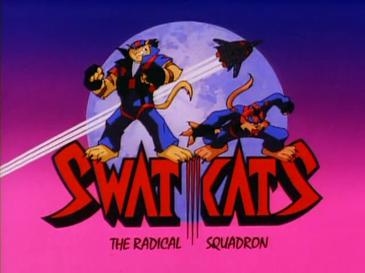
    My first one was an episode of Birdman, which at first I thought it was Batman – I did not know either, but had vaguely heard of Batman and it sounded familiar enough. Soon, for as long as I was allowed, I watched everything else shown on Romania’s Cartoon Network in the early 90s. Everything. There was still some drama. My parents watched the nightly news on the TV every day at 8 PM, right when Swat Kats was on, which I loved as a kid.

    Back in that time, cable was young and there were no local subsidiaries of the big foreign networks, so there was no dubbing or subtitles. I had some knowledge of English – my parents got me a tutor for the duration of first grade that actually taught me a lot, and there was some in school. The problem with learning a language in Romanian school is that you learn rules, grammar, and some vocabulary in a formal way that does not always tie together. I had the same experience with trying to learn French, I knew some words and could read and somewhat write, but struggled to form sentences when speaking. The tutor helped more than school, a young woman who brought cassettes of English people speaking, and focused on that not on grammar rules. Learning this way was better – and I did real well at the grammar tests in school because, without really knowing the rules, picking what sounded right to me was usually right. I feel the same for Romanian, I would struggle right now to explain to a foreigner grammatical rules –although I studies them extensively in school.

    Being the guy who just shot the weapons was kinda lame.

    Whatever learning I did before, it was accelerate greatly by Cartoon Network. At first I did not understand everything spoken. But I didn’t need to. Just having cartoons was so great, nothing else mattered. And I watched and I watched. And slowly, I started understanding more and more each time. Episodes tended to repeat on Cartoon Network, but for me it was quite alright, I liked them and I understood better as each month passed. And I learned organically for lack of a better word. This is important, as phrases often have cultural meaning and just knowing what the words mean is not enough, and this way I learned both. Sticks and stones does not mean sticks and stones, paying the piper does not involve singers and currency.

    This also had had a positive effect on verbal skills. To be fluent in a language you just speak, you do not need to think of the rules. I was never fluent in French, though I learned words and verbs and conjugation. They just didn’t come together when I needed them. In English, on the other hand, I never really thought of the rules. If it sounded right, it probably was.

    Not all kids in Romania were like this, but my generation of urban middle income kids were. By high school, movies and TV shows kicked in, praise be bit torrent and DC++. My generation talked a lot in what we called romglish, Romanian peppered with English words and phrases, mostly movie quotes. There were nationalist politicians that wanted to ban English words in advertising, to somehow preserve the purity of the language. Hell, there still are in several countries. But, for us, in a country with a native language that is, to be frank, useless internationally, learning English was a huge help. Most of people my age use it daily in their work; use it on vacation or watching movies, reading books not translated in Romanian, and off course writing fabulously. And many of us hold a debt of gratitude to Cartoon Network.

    Cartoon Network is dubbed these days. I can understand why, but I still think it is a damn shame. Kids these days take cartoons for granted and maybe do not have the patience to watch a language they do not understand. Or maybe they do, if they were left at it, but the parents try too hard to make it easy on them. Who knows? Of course with internet, they have ample opportunity to learn English – but just internet often leads to broken English. And if they watch cartoons, why not get some benefit from it, hearing the language young and trying to understand. A bit of struggle grasping it might even help.

    Did they find all of them? We will never know. I am generally opposed to dubbing. It is rarely good enough and always takes away part of whatever you watch. In fact, for movies, I find delivering good lines is harder than facial expressions, and the way the actors speak are important for what the director want to achieve. And a lot of the subtlety is lost for those who happen to speak the language, and unlike you Americans we can handle subtitles. I have met Austrians who saw The Godfather only dubbed and were like: what is the point? Or just imagine hearing “We’re gonna need a bigger boat” in German… Of course the new cartoons are often crappy, not like back in my day. They don’t make ’em like they used to. Damn kids these days! But seriously, the recent cartoons are crap.

    Now, my fine fellow glibs. You have all read, I assume, at least one of my pieces and maybe a few of my comments, and such know of my writing. What you clamor to know is: how does Pie speak? Does he have an Eastern European accent? The short answer is yes. Unlike some people I know, I never made any special effort to change my accent. Some went to great lengths to sound British, and most sound reasonably well but kind of pretentious. I do not have a very strong accent, due to all the movie and cartoon watching I did. I, for example, pronounce “the” with a silent Z, which cannot be said of many Easter Europeans. I think, were I to live for an extended period of time in an English speaking country, my accent would greatly improve. But, as things are, every English and American I spoke to understood me without issue and as far as language flow and grammar, I speak just as I would in Romanian. So, in conclusion, I speak well enough for practical purposes, good enough for government work, so no need to spend time fine tuning my accent. I mean, I would be othered anyway in the States for my exotic good looks, so language would not necessarily make me blend in. Without further ado, for the ending of this little piece… Pie speaks. I recorded myself on my phone, just for you.

    I did not want to say random bullshit or use too little word variety, and as such for my first piece I have picked something that is explicitly going through a large variety of English words. SOURCE

    For my second, I decided to quote the classics. SOURCE

    And for my third, something short and personalized for the glibertariat.

  • Aligning the incentives in the Union

    I liked Not Adahn’s post on changes to the political system enough that I thought I’d write one of my own. While I could wax philosophical about democracy and republicanism and the like, that’s all been hashed through 1000x by people much smarter than me.

    Instead, I wanted to approach some moderate changes that could be made to the current system to make them much more responsive to citizens’ revealed preferences and personal priorities rather than their stated preferences and social priorities. I’m under no illusion that any of this could ever happen, but it’s a fun discussion to have.

    I mentioned in Not Adahn’s post that barriers to entry aren’t going to affect the incentive to acquire power because power, once acquired is lucrative enough to render those barriers to entry useless.

    I wrote:

    The only way to curb abuses is to kill the incentive to accumulate power via fedgov. That’s an incentive that cant easily be counterbalanced with barriers to entry or other disincentives. It’s also very hard to reduce or kill that incentive. As long as fedgov is the sovereign, no amount of legislation will prevent power seekers from eventually maximizing the reach of their institution.

    What’s the best way to curb the social greed of those who seek power and the complacency of the electorate that gives the power to the seekers? How about an even stronger and more acute incentive? Personal greed.

    Perhaps not this half-cocked.

    My half-cocked idea is as follows. Tax day is now election day. The total government budget is set by popular vote, but with a twist. You have 5 choices: Budget stays the same as last year (zero based, no adjustments). Budget plus 5%, Budget minus 5%, Budget plus 10%, Budget minus 10%. Once you are done voting, you get a receipt for your votes (like usual), as well as a bill for your taxes owed at the percentage you voted for. Taxes are due immediately, and there are representatives of the IRS and the various localities in the building to take payment.

    If you do not pay, your vote is marked provisional and you have 30 days to pay your bill (plus interest) and have the vote counted. After 30 days, your vote no longer counts, and while you still owe the money (and interest), it is no longer considered part of the annual budget and is saved in a rainy day fund that requires massive agreement to access (2/3 states and 2/3 of each legislative body).

    This delineation is important because the federal budget is given to Congress based on actual tax receipts within the 30 day window. Balanced budget is constitutionally required, but Congress has the authority to allocate the specific expenditures within the money received on voting day. However, once you run out of money, you’re done.

    Obviously, it would require a massive simplification of the tax code. It would probably also require some sort of assurance that everybody has to contribute at least something.

    The benefit of this plan is that it aligns incentives for the populace limiting taxation and government expenditures.  Of course, it would never happen because 1) it takes away the meticulously crafted system where costs of government are hidden and benefits are touted; and 2) anything that associates taxation with voting will be lambasted as “POLL TAXXXXX!!!!”

  • What Are We Reading

    OMWC

    Hardly anything because, well, new job and moving. But my bathroom book for the past week has been Steven Weinberg’s The First Three Minutes, a short tome on the Standard Model of cosmology. Come prepared for some real mental challenge.

    While I was flying back and forth to Arizona, I indulged in a fantastically depressing and wonderful collection of stories, novellas, and a couple of complete novels by my favorite (((author))), A Malamud Reader. Although Malamud is usually lumped with contemporaries like Philip Roth, he really was a far better writer.

    One day, I’ll have time to read again.


    SugarFree

    I have retreated to childhood, reading Piers Anthony’s Split Infinity series for the dozenth or so time. I’m going to be honest: he’s not a great writer, but damn can he churn out enjoyable fiction, and the kind that gets creepier to read the older you get, which is an aspect I like. I started with the Xanth series when I was nine or ten, picking up A Spell For Chameleon–mostly off the Darrell K. Sweet cover, familiar from Ballentine’s paperback series of Heinlein Juveniles–at a bookstore going out of business sale. (My dad’s way of dealing with me over my parent’s divorce was to give me money and turn me loose in a bookstore.) I wandered away from Anthony in high school, around the time I realized was reading books about the panties of little girls in the Xanth books, and the rampant sister-fucking of the Bio of A Space Tyrant series got a little weird, and the Incarnations of Immortality ran out of steam. And, I’ll be honest, I was done with fantasy after, um, certain works were read (Seriously, fuck The Elfstones of Shannara,) and it took years for me to bother reading high or epic fantasy again.


    Riven

    Well, I’ve definitely slowed down some on the Dresden Files, but that shouldn’t be a reflection on the books/stories themselves. It’s my fault for not making time for the important things. I finished White Night, moved on to Small Favor, and then rapidly consumed four short stories set between Small Favor and Turn Coat: Day Off, Backup, The Warrior, and Last Call. I’ve been on the first page of the last short story between Small Favor and Turn Coat for a couple weeks now, but I’m confident that one day, eventually, maybe I’ll finish reading Curses.  … Probably. No promises.


    mexican sharpshooter

    Once again, the only thing of note that I read is a children’s book for my 4 year old.  Today’s entry is Yertle the Turtle by Dr. Seuss.  Yertle of course, really is a turtle.  It is a story I particularly like, because Dr, Seuss explains to children how to deal with assholes, particularly the ones that declare themselves king.

    The story begins when Yertle realizes if he stands upon the shell of another turtle, he can see farther than he could if he stood on his own feet.  Why stand on another turtle’s back?  FYTW.  Yertle eventually declares himself king of all that he sees and continues to enslave more turtles in his quest to obtain more power.  Surprisingly, they all seem to agree to his terms.  Stand upon each other’s shoulders, and let Yertle stand atop them all.

    Except for one.  A turtle named Mack, protested and explained multiple times how much it sucked being at the bottom of the pile.  Yertle responded he was the king, so FYTW.

    Until Mack sneezed.  The entire stack of turtles came tumbling down with Yertle on top falling the farthest distance to Earth.  Yertle spent the rest of his days being king of the mud.  Honestly, this is probably the perfect allegory to explain 2016 to a child.


    jesse.in.mb

    Back in September 2017, I read Marie Kondo’s The Life-Changing Magic of Tidying Up: The Japanese Art of Decluttering and Organizing due to interesting roommate-related circumstances and the pending possibility of moving. My roommate successfully got a job outside of the country and so I figured I’d revisit themes of throwing away all of my shit as I make room for my boyfriend to move in. In that vein I finally picked up The Life-Changing Manga of Tidying Up: A Magical Story. It’s probably a great way to introduce kids to the idea of keeping things tidy and letting go of stuff they don’t want/need. I didn’t really get anything new out of it, but my boyfriend realized most of his instrument collection no longer “sparked joy” and is only bringing his uilleann pipes. 

    The Ruin by Dervla McTiernan was a fun procedural drama set in Galway and its environs that tied together a few disparate stories in pleasing ways. It was an audiobook and the narrator (Aoife McMahon) did a superlative job jumping between different characters in a way that gave them dimension without getting in the way of the story.


    SP

    Inventories of household goods. Bills of lading. Real estate listings and leases. Insurance documents. Utility terms of service. Receipts. Checking account and credit card statements. Truck rental contracts. Google Maps. Hotel booking sites.


    Brett L

    It was a slow month for me. I read the latest of John Conroe’s Demon Accords novel. I can’t really understand why I keep reading them at this point, except that they’re fast, and they don’t take themselves too seriously. Oh, and he’s good a blowing up his fake worlds real good. This one was kind of… not mailed in, exactly, but he needed to move some players from A to B to write the book he really wants to write. Contrived is a better word. Still fun, although he did kind of Harry Dresden genocide most of an alien race. What else? Oh, I did a re-read of Stross’s Iron Sunrise. I’m still sad he couldn’t really salvage that universe, but totally see his point about it being irretrievably broken. And lots and lots of MS Azure documentation.


  • A Close Shave

    A lot of chatter happening this week, which made me postpone what I planned to write about for another week.  As many are undoubtedly aware Gillette, a company that markets razors to both men and women, aired a controversial commercial linked here.

    This is my review of Full Sail Malted Milkshake IPA:

    Many took the message as a negative, saying the commercial insults their customer base.  Making a statement like this their critics say, will drive their customers away, that disagree with the social statement being made.  Strange, given the company itself profits from one of the defining physical characteristics of men—having a beard.

    Gillette itself is not a stand alone company that will suffer as a result of this, rather they are a subsidiary of Proctor & Gamble.  As of this writing P&G was not immediately shorted by a large number of investors, like what happened with Nike. Their stock price was rather flat for the week. Unlike Nike, their product lines are diverse and are necessities that nearly everyone uses.  People will continue buying their soap, their toothpaste and Double Quilted Charmin Toilet Paper.  While it can be argued this is not the first time P&G made such a social statement with one of its brands (remember the ‘like a girl’ campaign?) this is different because they did not criticize previously.  Rather they took what was a pejorative often used by men toward other men (i.e. you play ball like a girl!) and turned it into something positive. Here it appeared to be open criticism, constructive or not.

    Interestingly enough, another P&G brand is Old Spice, whose marketing campaign a few years ago appealed to the lighter side of masculinity, to great success.  

    H/T: You know who you are, you MAGNIFICENT….

    The merits of the message itself, and whether it was intended to insult is not a question to be answered here. As usual such interpretation is best left to the individual.  Will I buy Gillette’s products?  No.  Recently, a fellow Glib challeneged me with an incredibly thoughtful gift.  Should I do what I always do and pick up yet another skill, I may never need to buy a razor again.

    A better question is, are the attributes commonly associated with men something we evolved beyond?  Men typically are more predictable than women at any given time, more assertive, are motivated by physical things, are driven to compete and succeed at different interests than women.  The downside to this, is men more often than women will behave recklessly, and aggressively. These characteristics though are even now being portrayed as positive attributes—in women, as this recruiting commercial for the United States Marines Corps suggests.

    Have we moved past the point where the potential for the negative is too much of a liability for any benefit it can provide?  Competition often breeds adversity, which does not have to be a bad thing. Teaching others in that sense, to overcome adversity and handle it when it defeats them while they are young may be in their best interests later on. Others might be less assertive, and might have a more difficult time adjusting so the argument to show respect for the brainy kid also has merit, because one might not grow up and cure cancer if he or she is always being put down.  Is developing confidence through physical strength best frowned upon, to allow for the more cerebral, even one that might go so far as to act (ahem) like a girl?

    Why does it have to be one or the other?  As I write this, I am at my son’s Tae Kwon Do class.  I am reminded of last week while he was sparring a older boy, with a higher belt.  My son comes across as the brainy kid; in fact he takes an advanced math course because it comes easy to him.  That day, his opponent moved to strike with a round kick.  In response, he stepped in closer to avoid the kick’s impact and landed a front kick to his opponent.  His opponent, a larger and more experienced martial artist, lost his balance and found himself on the floor.  At that moment, my son beat his opponent by outsmarting him.  He learned more about himself than I could ever teach, but he’s still a math geek.

    In the end they shook hands and moved to their next opponent.  No hard feelings.

    If men acting like men are frowned upon, perhaps a way to fight this perception is to understand why those attributes are positive and where to apply them.  The fact these attributes are being encouraged in women is proof enough then are a benefit to society.  The attributes cannot be negated, unlearned, or taken away, they are hard wired psychologically and genetically.  The trick then becomes learning how and when to strike, and use the inherent strengths tactically.  Perhaps then, critics will see the problem is not masculinity, but in their own shortcomings.

    As for the beer, it appears Full Sail went and rebranded unfiltered Sculpin.  Which for the IPA…people is not a bad thing.  Not the hoppiest of IPA out there, but if you dig grapefruit and texture this will not dissapoint. Full Sail Malted Milkshake IPA:  2.7/5