Category: Outdoors

  • The Marvelous Mr. Weatherby

    The Velocity Race Part Two

    Consider this something of an epilogue to my History of Bolt Guns series.

    The shooting sports is a place where one man can have a big influence.  In the post-World War II sporting rifle market, few people can claim to have had as big an influence as Roy Weatherby.  His iconic guns and cartridges weren’t to everyone’s tastes, but they made a big mark on the American sporting gun scene.

    The Man

    Roy Weatherby.

    Born in Kansas in 1910, 1945 found the young Roy Weatherby in Huntingon Beach, California, fortunately before that state became a garbage- and feces-covered shithole.  He and his wife Camilla had a house there, and Roy had a business – a 25×70 foot closet that bore the name “Weatherby’s Sporting Goods.”

    Weatherby was an incorrigible tinkerer.  It is not known if the late Charles Newton had any influence on the young Weatherby, but it would not be surprising if that was the case, because Weatherby’s first efforts were directed at the development of high-velocity centerfire rifle cartridges.  In 1945, the velocity race that Newton had started was about to shift into high gear; Roy Weatherby was positioned to take a commanding lead in that race.

    The Plan

    In 1945, many gun writers like Elmer Keith were proponents of large-bore rifles firing heavy bullets at moderate velocities.  The .30-06 was already something of a standard in the game fields of North America.  A few people used the .300H&H, a real powerhouse for the time, and the .35 Whelen, using the .30-06 case necked up to .35 caliber, was a popular wildcat.

    Around 1945, Roy Weatherby’s tinkering produced his first proprietary cartridge, the .220 Weatherby Rocket.  This was something of an “improved” .220 Swift, based on that case but blown out some to increase powder capacity.  Until this point the .220 Swift had been the velocity champion in bolt-action (and indeed, any) rifles, firing a 40-grain .22 slug at over 4,000 fps.  The Weatherby round improved on this some, managing to drive a 50-grain slug at the speeds achieved in the Swift with a bullet 20% lighter; but the Rocket wasn’t to be the pattern Weatherby would follow.

    The Cartridges

    In that same year of 1945, Weatherby was looking to introduce his high-velocity ideas into the world of big game cartridges.  He hit upon the big belted .300 and .375 H&H cases as the idea starting point, as they had considerably greater powder capacity than the .30-06 family of cases.  To improve gas flow in the cartridge, he came up with a double-radius shoulder, something new that made forming the cases a little more complicated and therefore a little more expensive; but Weatherby rounds and rifles were never budget items.

    Weatherby saw the advantages of celebrity endorsements.

    In 1944 and 1945, Weatherby introduced three new cartridges:

    The .257 Weatherby Magnum was based on the .375 H&H cartridge shortened to 2.5 inches, blown out with the double-radius shoulder and necked down.  This round, rumored to have been Roy Weatherby’s personal favorite, can launch a 115-grain bullet at 3,400 fps.  That, folks, is smoking, even by today’s standards.

    The .270 Weatherby Magnum drove a 130-grain bullet at 3,300 fps, about 400 fps than the standard .270 Winchester load favored by Jack O’Connor.  This round was, again, based on the .375H&H case shortened and necked down.

    The .300 Weatherby Magnum is the most popular of Weatherby’s proprietary cartridges.  The big .300, until recently the most powerful .30 caliber commercial rifle cartridge made, was based on a blown-out .300 H&H case and launched a 180-grain pill at over 3,200 fps.

    Weatherby was looking for velocity, and his new cartridges gave shooters that, in spades.  In marketing his cartridges and later, his rifles, Weatherby maintained that high-velocity cartridges gave more killing power than lower-velocity rounds firing bigger, heavier slugs.  In this he ran afoul of some of the older-school gun scribes like Elmer Keith, but Weatherby stuck to his guns, and gradually his cartridges gained a following.  Quite a few notable people endorsed Weatherby’s rifles, John Wayne among them; the resulting publicity sold more rifles and funded development of more high-velocity rounds.

    In 1947 Weatherby came out with two more cartridges, again based on the H&H case:

    The 7mm Weatherby Magnum was next; the big 7mm on the same case as the .300 Weatherby launched a 140-grain 7mm slug at 3,200 fps and would heft even the big 175 grain A-Frame slugs at over 3,000.

    In that same year Weatherby broke into the heavy rifle market, blowing out the .375 H&H case with the double-radius shoulder and naming this the .375 Weatherby Magnum.  In this round Weatherby actually missed the mark a bit; while the new heavy round would loft a 270-grain projectile at 2,800 fps, pretty respectable for a rifle intended for African plains game, its performance wasn’t enough greater than the time-tested .375 H&H to gain a lot of traction.  The Weatherby did have the advantage of being able to fire .375 H&H rounds in the rifle, thus fire-forming the case to Weatherby’s specs for use thereafter, making it in essence a “.375H&H Improved,” but this wasn’t to prove popular; that may well have led Roy Weatherby to his next step.

    Southgate Weatherby.

    In 1955 Weatherby scaled up, with two new cartridges based on a new, larger case of Weatherby’s design.  As the basis of his new rounds, Weatherby basically took the .416 Rigby case, added a belt, and introduced two versions:  The .378 Weatherby Magnum and the .460 Weatherby Magnum.  The latter round was, at the time of its introduction, the most powerful commercial rifle cartridge in production.  Now, at last, Weatherby caught the attention of the safari market.  Within a few years, the big .460 was as popular among African safari guides and professional hunters as the old reliable .458 Winchester.

    One other well-known dangerous game cartridge resulted from this, but it wasn’t a Weatherby product; in 1976 Colonel Arthur Alphin necked up the .460 case to produce his .500 A-Square.

    1963 Saw the introduction of the .340 Weatherby Magnum, introduced as a response to Winchester’s .338 Magnum.  This new round left the .338 Winchester Magnum in the dust, firing a 225-grain slug at over 3,000 fps.  With my own .338, I’ve never broken 2,800 with a bullet of that weight, and I’m not shy about pushing my loads up to the line.

    In 1964, Weatherby introduced the only .22 caliber belted magnum at that time, the .224 Weatherby Magnum.  This foray into small bores finally displaced the .220 Swift as the velocity champion of the .22 calibers.  And finally, in 1968, Weatherby’s last magnum, the .240 Weatherby Magnum, set new speed records for commercial 6mm cartridges.

    Still, cartridges are of little use without a rifle, and Weatherby’s rifles were as distinctive as his cartridges.

    The Guns

    To be honest, I was never a fan of Weatherby’s style in bolt rifles.  The appearance of his first rifles was very distinctive.  Weatherby used beautiful wood and fine, high-polished bluing, but the stocks feathered a high Monte Carlo and a big cheekpiece, contrasting rosewood fore-end and pistol grip caps with white spacers, and white spacers on the butt pad.  Many people liked them, based on how they sold, but even back in the Seventies when I was coming up, I always found them a little garish.

    But you can’t argue with success.  Shiny Weatherby rifles may have been, and on the expensive side to boot, but the combination of solid bolt actions and powerful, high-velocity cartridges was a seller.

    Weatherby’s first rifles, the so-called “Southgate” rifles after Roy’s big new store in Southgate, California, were built on FN ’98 Mauser actions.  Most of the Southgate rifles were built for Weatherby calibers, but old Roy would turn out a fine rifle in a standard caliber as a custom item if a customer asked for one.  In 1956, Weatherby contracted with Schultz & Larsen to build rifles for the big new .378 and .460 Magnums on their beefy Model 54 bolt action, but that situation only lasted a couple of years, as Roy Weatherby’s crowning achievement was in the works.

    The Mark V.

    In 1958, Roy Weatherby’s ideal rifle finally took form with the introduction of the Mark V.  This was something unlike the Mauser 98 and Schultz & Larsen actions of previous Weatherby rifles; the Mark V had nine small locking lugs at the front of the big, hefty bolt.  When carefully fitted, as was generally the case with Weatherby rifles, this made for a very strong action.  The first Mark V actions were made by Pacific Founders, Inc and assembled at South Gate, but demand quickly outstripped Pacific’s capacity, so Weatherby moved production to Sauer, who was similarity unable to keep up, and then to Howa in Japan.

    Mark V production muddled along unchanged from 1958 to 1963, the only notable difference being the relocation of the safety from the receiver to the bolt shroud when the manufacture moved from Pacific to Sauer.  But in 1964, Weatherby determined the need for a scaled down version to go with the new .224 Weatherby Magnum, and so the six-lug “Varmintmaster” was born.  The six-lug Varmintmaster was later offered in .22-250, the first production Weatherby in a non-Weatherby commercial caliber (the company would build a Mark V custom in almost any caliber) and later the full-size Mark V was offered in the immortal .30-06.

    Some years later Weatherby would begin offering the Mark V in a variety of non-Weatherby calibers, but only in the six-lug versions.  This has added some collector’s value to the few nine-lug .30-06s out there.  If you have one, let me know; I’d happily give you a couple hundred bucks for it.

    This new Weatherby had some significant things going for it.  The nine locking lugs were placed on a reduced bolt head, meaning there was no necessity for locking lug races in the action; this made the action very smooth in operation.  As the action was designed for high-pressure, high-velocity rounds, the bolt body had three holes to vent hot gases in the event of a case failure, and the oversize bolt shroud likewise shielded the shooter’s face from hot gas in such an event.  The later bolt-mounted safety was robust, locking the firing pin in place – although I maintain to this day that the only safety that one should rely on is the one between your ears.

    The Mark V was a fine rifle if a bit showy, but it was also expensive.  So, in 1970, Weatherby made a deal with Howa to produce a rifle with the traditional Weatherby style using Howa’s Model 1500 action, chambered in standard, non-Weatherby calibers.  This became the Weatherby Vanguard, and with this rifle Weatherby took aim (hah) at the market held firmly by the Remington 700 and Winchester Model 70 rifles.

    Weatherby didn’t neglect the rimfire market, either.  In 1964, Weatherby released the semi-auto Mark XXII, a slick, pretty rifle firing from a 10-round detachable magazine.  My oldest friend Dave had one for some time and enjoyed it, but it was an expensive proposition for killing squirrels, so he eventually traded it off; but I remember it as a real tack-driver.

    Current Mark V barreled actions are built by ATEK of Brainerd, Minnesota, while the Vanguard continues to be manufactured by Howa in Japan.  The semi-auto Mk XXII, sadly, has gone out of production as of 1989, although currently Weatherby offers an Anschutz .22 bolt gun bearing the “Weatherby Mk XXII” label.

    The Legacy

    The Orion over/under shotgun.

    Roy Weatherby died in 1988 at age 77, having changed the American sporting rifle world forever.  Five years earlier he had passed leadership of Weatherby, Inc. to his son Ed Weatherby, who still runs the company today.  Last year the company announced it was finally leaving southern California for the more gun-friendly environs of Sheridan, Wyoming.  A portion of the Weatherby estate went to fund the Weatherby Foundation International, a non-profit organization dedicated to educating the non-hunting public of the benefits of ethical, scientifically managed sport hunting.

    Most of Weatherby’s current rifles – and shotguns – are a tad more subdued, most of the current production bearing synthetic stocks.  These have many advantages on a hunting rifle, and indeed my hunting rifles tend to wear synthetic stocks, but I’m still pleased that Weatherby does continue to offer the Mark V and the Howa-actioned Vanguard, as well as the Orion shotguns, with fine walnut furniture as well.  The same applies for Weatherby’s current scattergun offerings, which include the very fine Orion over/under and the 181, Element and SA-08 semi-autos.

    And the Weatherby Magnum line of cartridges has been expanded by two, the 6.5-300 Weatherby Magnum and the .30-378 Weatherby Magnum.

    The pairing of a Weatherby rifle and an appropriate Weatherby cartridge will still serve as a fine rifle for the game fields anywhere on the planet.  John Browning or Sam Colt he wasn’t, but he broke some new ground in sporting rifles and founded a company that persists today.  That’s not a bad legacy; not bad at all.  And not too shabby for a guy who started building rifles in his garage.

  • A History of Bolt Guns, Part Six

    Today in Bolt Guns

    Let’s take a highly condensed look at the state of the bolt gun market as it stands today.

    Remington

    The Remington 700 SPS

    Winchester got first billing last time, so this time we’ll give it to Remington.

    The Remington 700 is still going strong, offered in a variety of configurations from wood-stock sporters to full-up Tacticool.  The great old BDL is still for sale, along with the lower-priced, blind-magazine ADL.  And Remington is still offering the carriage trade, $2400 Model 700 200th Anniversary Limited Edition Model 700, of which rifles only 2,016 have been made.  Remington even offers a muzzle-loader on the Model 700 action, in which the bolt opens to allow a 209 shotgun primer to be placed into the breech for ignition.

    Remington also offers the light and handy little Model 7, a short-action, light-barreled carbine in several varieties with wood, laminate and synthetic stocks.  I considered one of these rifles for Mrs. Animal and handled several although I didn’t take the chance to shoot one.  It’s a neat little rifle and would be great for close-quarters work, as they handle quickly and point very naturally.

    The Model 783 is something new.  This rifle started out life as the Marlin X-7 rifle and was absorbed into Big Green when Remington acquired the old lever gun manufacturer.  The 783 and continues that weapon’s floating bolt head, detachable box magazine and small ejection port, which makes for a very strong receiver.  The 783 more or less fills the role once held by the old Model 788.

    Winchester

    The Immortal Model 70

    This great old company now offers two bolt rifles.  The first is of course the Rifleman’s Rifle, the Model 70, now only offered with the blade ejector and controlled-feed claw extractor.  An improved trigger was recently added.  You can get this fine old rifle in Super Grade with a French walnut, American black walnut, or fine blonde maple stocks.  Stainless versions are offered, with wood or synthetic stocks.

    If you’re on a budget Winchester has the XPR, a push-feed, synthetic-stocked, no frills hunting rifle.  The XPR, like the Remington 783, departs from the traditional Model 70 with its 3-lug bolt, detachable magazine and slide safety.

    One thing I find interesting about Winchester is that they have eschewed the Tacticool craze in their bolt guns.  While Remington offers several Tacticool varieties of the Model 700, Winchester’s rifles are sporting rifles, pure and simple.  Mind you I’m not saying that’s good or bad, but it’s interesting, speaks somewhat to the new Winchester’s marketing strategy, and honestly, makes me like that company just a little bit more.

    It’s probably a bit odd that I don’t have a Model 70 in the rack.  If I could find a Safari-grade, pre-64 rifle in .375 H&H, I might just be tempted to buy it – if I could get it for a price that wouldn’t put me in Mrs. Animal’s sights.

    There are, of course, lots of other bolt guns on the market.

    The Other Guys

    It should come as a surprise to no one that I’m a fan of Browning products.  While the modern-day Browning and the modern-day Winchester share their corporate owners, their bolt gun offerings are quite different.

    The Browning A-bolt has been discontinued, but the general pattern of the action lives on in the AB3 and, to some extent, the X-bolt, both of which shares the earlier rifle’s three locking lugs and 60-degree bolt throw.  Both rifles feature detachable magazines, but while the AB3 uses the traditional style box magazine, the X-bolt uses a new design, a rotary magazine roughly like that of the Savage 99.

    While both rifles have good reputations, I haven’t fired or handled either, so can’t offer any personal recommendation.  Ruger bolt guns, on the other hand, I am more familiar with, and I have to say my experiences have been positive.

    Of all the American manufacturers, Ruger probably has the largest lineup of bolt guns.  Ruger’s supply covers a very wide range, so I’ll mention a couple I find particularly interesting.

    The latest version of the basic Model 77 platform is the Hawkeye Standard Rifle.  Like the original M77, it uses an updated, modernized version of the 98 Mauser action, but unlike the original M77 it uses a Winchester-style three position four-and-aft safety.  It comes in a good variety of calibers and finishes.  Ruger sells cheaper rifles on the same basic action, but the American has a cleaner finish and is available with some good wood furniture.

    Ruger Gunsite Scout.

    An interesting variant on the M77 is the Gunsite Scout, made to the concept first floated by the late Colonel Jeff Cooper.  This bolt gun has an 18” barrel, muzzle brake, a Picatinny rail allowing for an intermediate eye relief scope, a ten round detachable magazine and either a laminated wood or synthetic stock.  Unlike the late Colonel Cooper, I see little application for this rifle in a modern military, but it is even so a short, handy rifle; five round mags are available to meet most state’s hunting rifle restrictions.  The Scout was first put out in .308 Winchester and .243 Winchester but is available now in the thumping .450 Bushmaster, which would make an interesting brush gun.  If they only made it in .358 Winchester, I would probably own one by now.

    Both rifles, along with most of Ruger’s stable, are available in left-handed versions for you southpaws.

    Mossberg may be better known for their shotguns, but after some experimentation that old family-owned company offers a couple of good bolt guns.  The Mossberg Patriot is a standard push-feed bolt gun offered in traditional wood furniture as well as synthetics.  The bolt body is cut with spiral flutes for some reason; the Patriot also has a good, clean externally adjustable trigger unique to Mossberg.  Also available is the MVP, which mates the Patriot action to a synthetic stock and detachable, AR-pattern magazines.  If you live in a jurisdiction that is hostile to AR-pattern rifles, you can at least get a bolt gun to use your stockpile of AR magazines.

    And then we have Savage.  Their entry into riflery may have been the Model 99 lever gun, but we have already discussed their 110 bolt gun.  Savage these days seems to be in competition with Ruger for the biggest variety of bolt guns for sale; they still offer the 110 in a great variety of finishes and calibers but also the Axis bolt gun and the Savage 11 hunting and 12 target rifles.  Like the original 110, Savage offerings tend to be robust, reliable and affordable.  Better, their more recent offerings are more attractive than the original, clunky 110, but only the 11 and 111 Hunter rifles feature wood stocks.

    I’ve only scratched the surface of standard domestic bolt gun offerings, but I wanted to take a little space to describe some upscale offerings as well.

    The Semi-Customs

    The Cooper.

    Up in Kalispell, Montana, there is a company making high-end bolt guns based on what is essentially a 98 Mauser action with a Winchester 70-style fore and aft safety.  Their basic model, the American Standard Rifle, starts at about $1,500; the price of the fancier models rises rapidly from there.  I’ve toyed with the idea of buying their American Legends Rifle in my favored .338 Win Mag, and in so doing gain a rifle that for all intents and purposes is a brand-new pre-64 Model 70 Winchester.  But given our pending move north to the Great Land, I may instead look at The Alaskan, a stainless steel and synthetic rifle made for wet, cold climates.  One of these in .375 H&H would be good medicine for big bears and moose.

    A step up the price and fanciness ladder will get you another Montana production from the Cooper Firearms company.  Their Model 21 (.17 Fireball through .300 Blackout) and Model 22 (.22BR through .35 Whelen, including belted magnums) Classic rifles carry a ½ MOA accuracy guarantee, AA Claro walnut stocks, hand-cut checkering and a detachable box magazine for quick reloads.

    Kimber is a company known for some fancy 1911 clones, but they also produce some high-end bolt guns.  The Kimber bolt action, like the Montana, is a well-made clone of the pre-64 Model 70.  Kimber offers their Traditional and Dangerous Game versions with fine walnut furniture, along with the likes of the Hunter and Mountain series with synthetic stocks.

    Meanwhile, in other parts of the world, more great bolt guns are being cranked out.

    Around the World

    Advertising themselves as Das Original, Mauser is still in the bolt gun game, producing their Mauser 12 bolt gun.  It’s interesting that this latest Mauser lacks the classic big claw extractor of the classic Model 98, but the M12 is gathering a good reputation as a solid, smooth reliable rifle, especially in those European nations where the peasantry is still allowed to own firearms.

    Best of all, though, is the fact that Mauser still – still, after almost 120 years – offers a Model 98 sporting rifle.

    The M98 Expert. I have to show this one page width.  Boy howdy do I want one.  I really, really want one.

    The new Model 98 presents that classic action in both standard and magnum versions, featuring a fully milled action, a cold hammer-forged barrel, plasma nitride finish on the steel parts, a three-position safety and a gorgeous European walnut stock.  The Magnum version features a beefy square-bridge, double cross-bolted action and one of the highest capacities in a dangerous-game bolt gun; six shots in the .375 H&H, five in the .416 and .450 Rigby calibers.  And if you really want to drop some bucks into a beauty, Mauser offers the 98 Standard Diplomat with Grade 7 walnut furniture, guaranteed to cause excess salivation in anyone who loves fine guns.

    Mind you these rifles start at the $7-8,000 range, so much as I’d love to own one, it’s probably not in the cards any time soon.

    The Blaser R8.

    Mauser isn’t the only German manufactory to produce bolt guns I can’t afford.  Blaser produces their pricey R8 and R93 bolt guns, which couldn’t be more different than the great old Mauser.  The Blaser is a straight-pull bolt gun, very fast in operation, and with one big advantage:  The action has no ejection port, instead opening the top of the action when the bolt is withdrawn.  This is a neat feature in a hunting rifle, as when the action is in battery it is sealed up, with no way for moisture or dirt to get in and gum things up.  The Blaser action is also shorter than traditional bolt guns, allowing for a shorter overall length with a standard barrel.  Combine that with a smooth, simple trigger and coil spring throughout, and you’ve got an innovative, well-made sporting rifle.

    Still, tradition has a place in the gun world, and across the Channel, the Brits are big on tradition.  Rigby offers three classes of bolt guns, all on 98 Mauser actions:  The Highland Stalker, The Big Game, and The London Best.  Were I suddenly discovered to be a long-lost heir of John Rockefeller – unlikely, as the Animal family tree is already pretty well documented, and not a billionaire in the bunch – I would be interested in The London Best, hand-fitted from end to end, with Grade 7 Turkish walnut and London Best oil finish, hand-blued and hand-fitted.  Given that one of these costs as much as a good-sized house, I suspect I will have to keep wishing.

    The Rigby London Best. I have to show this one page width too. I really, really love this rifle.

    Holland & Holland is still in the game as well.  H&H today still offers the what they call “The Bolt Action Magazine Rifle” (those Brits just aren’t big on euphemistic names) in standard and magnum versions.  Like the Rigby, Holland & Holland rifles are based on Model 98 actions; like the Rigby, they are hand-built and hand-fitted, with high-grade walnut stocks; like the Rigby, I can’t afford one, and neither can you, so we’re going to have to settle for looking longingly at the pictures.

    European companies seem to be determined to produce expensive bolt guns, but in Japan, a company called Howa is aiming at the middle-class trade.  Howa has a history in martial arms, having produced Arisaka rifles during World War II and copies of the M1 Garand and M1 Carbine after the war for the Japanese Self Defense Forces.  Nowadays they produce the M1500 bolt gun; Howa bolt guns have been imported into the U.S. as the Smith & Wesson 1500 and now under Howa’s own name.  Mrs. Animal once owned a Howa 1500 rifle in .270 Winchester; it was a decent, solid push-feed bolt gun, nothing fancy but certainly reliable and reasonably accurate, regularly turning in 1.5 MOA groups.

    Again, I’ve barely scratched the surface of the non-U.S. bolt gun market.  Doing the topic justice would make a fair-sized book.  But we’re not done yet; the modern Tacticool craze hasn’t left the bolt gun market behind.

    The Tacticool Stuff

    I commented earlier that Winchester seems to have eschewed the hardcore Tacticool market, and that I like that about them – I do.  But other American gun companies have shown no such restraint.

    The Remington 700 is available with what that company calls a “Tactical Chassis,” with an adjustable, telescoping stock, a Picatinny rail running from the dear of the action to the front of the fore-end, a pistol grip and a muzzle brake.

    Mossberg offers the MVP, which we discussed previously, in a Tacticool version with (again) an adjustable stock, a Picatinny rail atop the action and, like the sporter version, the ability to use AR-style magazines, something unique among bolt guns.

    Ruger has their Precision Rifle series, in standard and magnum calibers.  This piece, as the other Tacticool offerings, offers an adjustable stock, an abundance of Picatinny railage, and a muzzle brake; but the Precision has the look of a dedicated sniper piece.  Personally, I’ll stick with my M77 Mk IIT for long-range riflery, but given Ruger’s reputation, I don’t doubt this piece would likewise get the job done at extended distances.

    The Savage 110 Tactical.

    Savage offers tactical versions of their 110 bolt gun, most notably the 110 Tactical with their AccuFit stock and AccuFit adjustable trigger, a barrel threaded for suppressors and a 10-round detachable magazine.

    There are, of course, many more.

    It’s been a while since the bolt gun market was given a book-length treatment.  It certainly merits one; were my personal bandwidth a little less crowded, I might consider taking the project one.  Meanwhile, I hope I have at least given you a good thumbnail sketch here.

    And Then This Happened

    Another series draws to a close.

    I’ve noted previously the omission of Roy Weatherby from this series.  People either seem to love Weatherby’s work or hate it, and while I admire his marketing acumen and his innovation with the old Mark V action and his stable of high-velocity, proprietary cartridges, I didn’t care for the flashiness of the first couple of generations of Weatherby rifles.  I also don’t care for the direction the company has gone now that old Roy is gone.  But that’s a story for another day.

    So, what’s next?  Honestly, I don’t have another six-part history in me for a few weeks, at least.  But I have the Weatherby piece and at least one more Profile in Toxic Masculinity in the works, as well as a couple more (hopefully) amusing tales of my mis-spent youth in northeast Iowa.  So, stay tuned!  I find I really enjoy bringing all you folks this stuff and will try to keep up the pace to the extent my meat-space workload and my aging and partially fossilized brain allows.

  • The Park: Revisited

    The Park

    We live in a motel right next to I-10 in Ontario Cali; not a bad place and it seems they built a park.  Why? We’ll get to that.  Bella has insisted we go behind the building next door when walking, so we did, and found this

    Then we noticed a larger park on the other side of the street and went there, and found this.

    Founders Garden:  A tribute to the Chaffey Brothers and Segundo Guasti, who basically made Ontario bloom into the city it became.  Let’s continue…

    The Plaque.

    The rest is Roses by Armstrong, Olives by Graber, and Grapes by Guasti.

    A nice park in the middle of a commercial area:  A gem in the sea of buildings and concrete that make up most of SoCal; glad we found it—take a look.

    Sluices and water towers[of course] olive treesand some roses,

    This is a walking park.  No facilities, recreation or even trash cans.  It is however, spotless, and we saw very few people walking.

    In the retaining pond for the water tower we found a few ducks hanging out; not an easy picture to take with Bella on the leash.

    There are nice benches scattered throughout amongst the olive trees; suitable for quiet contemplation or just chillin’ with my little villain, Bella.

    Considering where its located, there is a serenity, maybe a zen kinda feel to the place.  If your ever stuck in the IE, I recommend a visit.

    Oh yeah, there are no signs prohibiting alcohol.  Just to be safe I brought a Dogfish Head Sea Quench session sour ale; really good beer. Even though its 4.9% abv.

    Note from glibertarians.com legal team: Drunk in public is a misdemeanor in California. If convicted, you may face up to six (6) months in county jail and/or a fine of up to one thousand dollars ($1,000).

    Until next time, the Gallery

    Cheers!


  • Allamakee County Chronicles I: Coyotes

    Note:  A preview from my upcoming autobiography, Life’s Too Short to Smoke Cheap Cigars (Or to Drink Cheap Whiskey.)

    The Critters

    The beasts in question.

    You all know what coyotes are.  Technically a small wolf and holder of the same ecological niche in North America as the golden jackal in Eurasia, Canis latrans is nowadays ubiquitous across North America, but when I was a kid back on my folks’ place on Bear Creek in Allamakee County, they weren’t nearly as common.

    Back in those days (the mid to late Seventies) in those hardwood-covered hills of northeast Iowa, we had a few bobcats around, and occasionally a bear or mountain lion would wander in from Minnesota or Wisconsin.  We once even had a small wolf pack move in to the area for part of the winter.  But coyotes were a thing of the West, of open prairies.  Our primary predators ran more to hawks, owls, raccoons, foxes, minks, skunks, weasels and the occasional feral housecat.

    Note one thing some of those critters have in common?  Some of them – raccoons, foxes and minks – had fur that was valuable in those days.  Hunting and trapping them, along with muskrat and beaver, kept me in pizzas and shotgun shells during much of my mis-spent youth.

    Mind you the wildlife picture then was different in other ways.  Wild turkeys were being slowly re-established all over the Midwest.  When I was a little tad seeing a deer was unusual enough to prompt some excitement, although by the time I was in high school they were approaching their current semi-pestilential status.

    And it was around that time that coyotes, those yellow-eyed bastards, started to establish themselves in the area.

    Their Arrival

    When coyotes came to the area around Bear Creek, they announced their presence with a serenade – sort of.

    Lots of city folks seem to think that the woods are silent at night.  Ours weren’t.  In the summer, up on the tall oaks at the top of the hills and ridges, barred owls would gibber, shriek and wail.  Evenings and early mornings whippoorwills would call from the brush, and in the spring, woodcock would peent in the edges of the meadows and do their twittering, corkscrew mating flights.  Deep in winter great horned owls and long-eared owls would issue their deep hoots from deep in the darkest parts of the forest.

    In good weather, I sometimes wouldn’t sleep indoors for weeks at a time.  In the summer I rarely came in the house at all, except maybe to grab my dinner plate to take out to the picnic table.  I often slept in the big tree house my Dad and I had built up in a big box elder hanging over the creek.  No little kid’s tree house this, but a big, enclosed, screened-in thing holding a double bed and a small end table; it was even wired for electricity.  That’s where I spent many a summer night, listening to the owls and the whippoorwills.  And that’s where I was the first time I heard a coyote howl.

    Over forty years have passed but I still remember it very well.  It was maybe an hour after sunset, and I’d been lying in the tree house, reading something or other and listening to a whippoorwill call across the creek.  That’s when I heard it, a yapping howl coming down through the woods from one of the meadows.

    The tree house.

    That first coyote song only lasted a few moments, with one coyote answering the first until down the road my brother’s old farm mutt started barking at the noise.  The coyotes fell silent, but I wasn’t the only one that had heard them.

    The next morning, I climbed down from the tree house and went inside looking for breakfast to find the Old Man at his usual morning spot at the table with his coffee.  “Did you hear the howling last night?” I asked.

    “Coyotes,” he agreed.  “They’ll be hard on the grouse and turkeys,” he predicted.

    He was right.  Wild turkeys are big enough to resist a coyote after their nest, but our ruffed grouse population started to suffer almost immediately after coyotes started moving in; the prairie wolves were hard on the ground-nesting game birds’ efforts at reproduction.  But that first morning, with the memory of that howl still fresh, my teenaged mind immediately turned to face another problem:  Come winter, how best to gather prime coyote pelts?

    The Problem of Control

    Come early winter when pelts are prime, I looked to my tools for harvesting same.  I had a pretty good string of traps and a new Marlin .22 Magnum rifle that was a real tack-driver.  Also, in the tool kit was a selection of predator calls, wood and plastic calls intended to imitate the sound of a rabbit, bird or mouse being slowly eaten alive.

    My traps were by far the more productive means.  All my efforts at predator calling over the four or five years I’d been trying it at that point had yielded precisely two gray foxes, while my trapline yielded a regular supply of muskrat and raccoon pelts, and occasionally a fox or mink.  In those days, green muskrat pelts were going for from two to four dollars, while a raccoon would net you from twenty to thirty dollars.  A prime red fox would grab you fifty bucks if it was in good shape – serious money for a fifteen-year-old country kid in the mid-Seventies.  A mink would get you that much, maybe ten more if it was a big buck with prime fur.

    One time when I was in town selling off a half-dozen or so muskrat pelts, I asked the old man who bought furs from farm kids all around how much he’d give for a coyote pelt.

    “Prime winter pelts?” he looked thoughtful for a moment.  “Not in as much demand as fox, but, oh, I suppose forty bucks or so.”

    My intentions for the local coyotes.

    That was enough to get me interested in taking coyotes.  Problem is, that would prove easier to imagine than to do.

    That first fall I took a good look at my trap string with coyotes in mind.  Most of my lot was #1 and #2 long spring and coil spring traps.  A #1 is great for muskrat and a #2 will take a raccoon or fox, but I needed a #3 for coyotes, so the next time I went to the fur buyer I sunk the money from a couple of raccoon pelts and a few muskrats into three #3 coil spring traps.  I took them home, boiled them, let them gather a little patina (traps shouldn’t be shiny) waxed them and started thinking about how to trap coyotes.

    I tried the works.  Pit sets and cubbies baited with carp from the creek or squirrel guts; trail sets, scent lures.  All I netted were raccoons.

    I tried wandering the hills with predator calls and rifle, finding good places to hide and calling.  I tried every predator call I had, every variation on a call I could think of.  I tried to make every call sound as though blood was literally dripping, but the coyotes obviously saw through that.

    In those years I didn’t yet appreciate how canny a little song-dog could be.  But while I couldn’t call coyotes with any success, some other folks in the area were learning the art.

    How It Was Done

    Spring came soon enough.

    It’s important to remember that in those years I was, probably because of some misdeed early on in my career, sentenced to serve Monday through Friday in a tedious occupation called “school.”  “School” was supposedly preparing me to be a functional adult but was mostly seriously cutting into my hunting and fishing time.

    So, it was a Saturday afternoon that found me wandering around the countryside between several of my favored fishing spots when I stopped in at the little village of Highlandville for some gasoline and a bottle of pop.

    Old Myron Petersen, who ran the general store in Highlandville, was familiar with my efforts to take coyote pelts, and so asked me how the winter’s effort had gone.

    “Nothin’,” I admitted.  “Can’t trap ‘em, can’t call ‘em.”

    Now it happened that on this afternoon, ensconced on the old bench on the decking in front of Petersen’s General Store, was an old man whose name slips my mind at this distance in time but who I do remember was a cousin of the expansive Hamill clan who owned great swathes of farmland in Winneshiek and Allamakee counties.  I noticed him paying attention to my admission of failure, and he spoke up as I started down the stairs to my truck.

    “You can’t call coyotes?” he asked.

    “Never had any luck,” I admitted.

    “Could be that you’re not doing it the right way,” the old man said.  “Using store calls?”

    “Yup.”

    “See, that’s the problem.  I’ve called in a few coyotes.  Yessir, called in a few.  Just use a big blade of grass.”

    “Bullshit,” I opined.

    “Nope.  No bullshit.  I can show you, if’n you want.”

    I looked to the west.  The sun was growing low in the sky.  Not a bad time to be set up to calling predators.  Now, in early summer, pelts wouldn’t be worth anything, but at least I figured I might learn something.  Still, I was skeptical.  “All right,” I said.  “but I don’t think you can do it.”

    “Well, boy, you want to put a bet on that?”

    We agreed on five dollars, a not-insubstantial bet in those days.  After securing Myron Petersen’s permission to walk through his timber to a big meadow at the top of the hill, I suddenly remembered that my tack-driving .22 Magnum was back at the house.

    I wasn’t completely unarmed.  Before we set out, I opened the truck’s toolbox and extracted the one firearm I had with me that day, an old replica .36 caliber ’51 Colt Navy.  I loaded the gun, belted it at my waist, and off we went.

    It took maybe half an hour to get in place.  “Set yourself down there,” the old man pointed, “just behind them raspberry brambles.  I’ll be right behind you here.”  He sat down with his back against a big oak tree on the edge of a large meadow.  What he did next was remarkable.

    After a moment’s careful study of the tall meadow grasses around him, the old man pulled off a long, broad strand.  He ran it between his work-hardened old fingers a couple of times, stretched the blade tight in between his two cupped hands, raised hands to mouth and blew.

    A piercing, awful shriek resulted.  He blew a prolonged blast, then another.

    “Now we wait a spell,” he whispered.  This was something I was familiar with; patience is essential in hunting and fishing.

    We waited maybe fifteen minutes.  I was beginning to doze when the old man let out another horrible shriek with his grass blade, startling me almost upright.

    This went on until it was growing dark.  The cardinals, always the last birds go to roost, were chirping their good-nights in the woods, when I heard the old man let out a sharp hiss.  “Look there,” he said, “over t’the right.”

    Where the tree-line curved around the big meadow to the right, a big dog coyote stood maybe a hundred yards away, eyes, ears and nose focused on our position.

    The old man let out a quiet, subdued squeak with his grass blade.

    The big dog coyote trotted maybe another thirty yards closer, all his senses focused.  I raised my head a little to get a better look; he saw the movement, tensed to run…

    …it was a long shot, but it was all the shot I was going to get.  I jumped to my feet with the speed borne of youth, yanked the old Navy .36 from its holster and loosed three booming shots at the coyote as he swapped ends and made for the horizon.  When the black-powder smoke cleared, I saw the coyote disappear into the woods, ears and tail held high, running well, unscathed.

    After the old man finally stopped laughing, he looked at me with a big grin, “Well, boy,” he demanded, “ya aint’ forgot that bet, have you?”

    I hadn’t.  I handed him a fiver; we walked back down to Petersen’s store, where old Myron and his wife Esther were sitting on the front deck awaiting the outcome.  They’d heard the shots and were amused to hear of my three clean misses.  The old man took my five dollars, bought a twelve-pack of Miller High Life from Myron, and disappeared into the dark.  I stowed the old Navy sixgun back in the toolbox, climbed into my truck and went home.  I never did kill a coyote in northeast Iowa.

    As It Stands

    Colorado has a lot of coyotes.  As I’ve grown older, pests though they can be at times, I haven’t tried hunting them.  I enjoy hearing them sing at night when I’m bumming around in the mountains (to evade suspicion I usually describe my woods-bumming as “hunting” or “fishing” to make it sound like I’m doing something worthwhile), and I find their quick-witted, adaptable presence in my stomping grounds something to be appreciated.

    I like coyotes.  They’re great survivors.  They may well be around after we’re gone.  And from my brief experience trying to hunt and trap them, I can sure see why.

  • Growing Fruit

    Let’s talk about growing your own fruit. I have been doing it on a small to medium scale for about 20 years. First off, like everything else I have ever had an actual interest in learning about, it is more complicated than it appears at first glance. I started reviving a small neglected orchard (about 250 apple trees) which came with the home we had just bought. I killed many a tree with my “pruning” methods before I got my first apple. In that time I devoured everything I could find at the library on apples, then the agricultural extension agent helped me, but the real breakthrough was the internet. This was the late 1990s and university research programs were just starting to get their info online. I found out that “organic” doesn’t mean just letting the damn things grow on their own. At least in Tennessee, we have more pests and diseases than other areas, and you will not harvest an apple without some type of spray program. Over the years I became competent if not an expert, and I definitely know that I don’t have an answer for every problem. I will start with apples. A lot of the lessons from apples applies to other tree fruit. There is a lot of information, and I thought to break it down into four segments: Planning, Planting and Training, Pest Control, and Pruning and Harvest.


    Planning

    What? I don’t plan, I just plant and reap bushels of natures bounty! Err, No. This is the time to make decisions. Things are complex. The very basic thing you need to know is how much land you have and how much fruit you want. Is it on a hill or in a valley, clay or loam soil, wet or dry? A gentle hill is best, with clear air drainage path to allow cold air a path away from the trees. Any soil that has trees can support tree fruit, but you may need to have supplemental support for certain rootstock/soil types (more on this later). Wet soil is pretty much a no go, the roots of fruit trees are prone to root rots which thrive in wet soils.

    So how much fruit do you want and when? The smallest trees at maturity will produce a bushel (about 45lbs) of apples each. A medium size tree may produce between 4 to 10 bushels. In most cases, all the apples on the tree will be ripe at the same time. What are you going to do with it all? Apples are the most versatile fruit. You can eat it fresh, dry it, make cider (sweet and hard), can it, and store it; but you need a plan. If you just have three medium size trees of different apples, but they all ripen at the same time, you could have 500lbs of fruit to do something with! If you want more than one type of apple, which you should, try to select cultivars that ripen at differing times of the year. This allows you to utilize each apple to the best of its ability. In general, summer apples don’t store well and turn mushy very quickly. They should be eaten quickly, dried, or used for cooking. Fall apples are your mainstay. They will vary, but will usually keep fairly well and are good for most purposes. Winter apples store the best, and storage may actually improve their flavor and sweetness. Cider of varying quality can be made from any apple. Cider making can be very simple, but good cider making is again, complex.

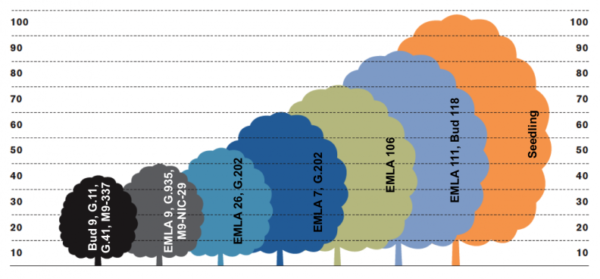
    Now you know where you are going to plant and how much fruit you want, here comes the technical part. What size trees do you want? Since apples reproduce sexually, the seeds of the fruit are not copies of their parents, and their fruits are usually nasty tasting, small, and bitter. Apples are propagated by grafting, meaning that the living limb (scion) of a selected cultivar is attached to the root (rootstock) of another tree, allowing the tree to produce the selected cultivar. In this way, the genetic material from the first cursed red delicious tree is still alive in the orchards of Washington. Most stores and some online retailers list trees as being “dwarf”, “semi-dwarf”, or “standard”. These definitions are based on the type of rootstock the trees are on. A “standard” rootstock is usually just a tree grown from seed with the scion grafted to it. The size is unknown but could be anywhere from 20 to 40′ tall. That’s a big tree. “Semi-dwarf” refers to a range of rootstocks that produce a tree anywhere from 10 to 25′ tall. There is a large number of rootstocks in this category. It would do you well to know what the rootstock is exactly. An ELMA 26 rootstock will grow a tree of about 12′, an ELMA 111 rootstock will grow a tree of about 25′, both are considered semi-dwarf. “Dwarf” rootstocks can usually keep the tree under 10′ and are the mainstay of new commercial plantings. They absolutely require support and are not free-standing, but can produce quickly and in great quantities per acre.

    The mature size of the tree must be taken into consideration prior to planting. If you are planting a “standard” size orchard, the trees need to be at least 30′ apart. That’s a lot of unused space for the first 10 years of the trees life. In my opinion, smaller trees are the way to go. They are easier to prune, spray, and pick fruit. ELMA 26 or ELMA 7 on 10 or 12′ spacing makes for a tree that can be mostly managed without a ladder and doesn’t need support.

    All of this comes before you decide what apple variety to buy. There are a lot of really good varieties that work well in some climates and not at all in others. I can’t grow Macintosh, it is simply too hot here and they fall off the tree before ripening. The best bet would be to investigate a local orchard and see what they are growing or ask for recommendations from other fruit growing people in the area. The big box stores here sell Honeycrisp apple trees, which are notoriously difficult to grow even in their preferred northern climate, and wouldn’t have a chance in the southeast. Speaking of where to buy your trees, I would recommend mail ordering bare root trees. The box store trees sold in pots may have been in those pots for 2-3 years, are likely rootbound, and you usually cannot tell what rootstock they are on. Also, a bare root branchless tree (a whip), will usually outperform a larger tree from a pot planted in the same ground. The larger trees do not adapt as well to the shock of transplanting.

    Now that you have a planting plan, it is time to think about equipment. If you have less than 20 trees, a backpack sprayer is probably all you need. Any more trees than this and I would suggest that you have some type of power equipment, such as a pull behind sprayer on a garden tractor or, for bigger orchards, a tractor with an airblast sprayer. You will also need good quality bypass loppers for pruning, tree support stakes for the early years, and string to train the tree branches. But most importantly, you need to keep the deer away from the young trees. The bastards will eat every leaf and then rub their antlers on the tree, snapping every branch. I hates deer.

  • Hillbilly B’Day: Or Pop Imparts Wisdom

    Growing up in the foothills of North Carolina, I spent a good deal of time with my maternal grandparents.  Like many rural southern families the week revolved around church and the extended family having Sunday dinner together.  (For those that don’t know, dinner is lunch, and supper is dinner, and breakfast is any time you damn well feel like it.)  My grandparents were, to say the least, colorful characters.  They loved basketball, family, and God and I’m not sure in what order you would put that.  Known to me as Granny and Pop, I adored them.  They spoiled their grandchildren within their means, but mostly it was with food and indulgence.  Pop had a horse a friend stabled and he taught me to ride.  He, allegedly, was something of a star point guard in high school, but showboating in front of a scout and the outbreak of WWII left him unable to attend college.  He was a known by everyone in town and half the people in the county, and when he died 20 years ago, we were at the funeral home nearly 6 hours shaking hands with all the people who came to pay their respects.  By the time I knew him he was a mostly respectable pillar of the church.  But he had some wild moments in his past and one of those stayed with him.

    Behind his house was a large section of undeveloped woodland.  Though at the back of their property was a little dirt road not much more than a trail.  And the cool, inviting, mysterious woods always beckoned to us youngsters.  We were allowed down the road, but there was a path that broke off to the east that we weren’t allowed down.  All we knew was that The Camp was down there.  And while my Pop was a king of indulgence, he had a stern side, and it was clear that violating that rule would earn us a hidin’.  It was important and as the oldest and most adventurous of our passel of kids, I didn’t lead to any peremptory explorations, so the rule stayed inviolate.

    On my 16th birthday, however, Pop told me to come take a walk with him in the woods, which weren’t unusual.  We often did this.  But this walk was different.  We veered off toward The Camp.  I had gained enough wisdom to realize this was a momentous occasion, so I simply followed his lead.  By this time, he had a walking stick that he used for support, though he was grinnin’ his Cheshire cat grin, clearly looking forward to what was to come.

    We got to The Camp and one might think it was a bit disappointing.  A fire-pit, a bit of a clearing near the fast-flowing creek, and a couple of shed type buildings somewhat rudely constructed.  Until I saw the Still.  And then much became clear.  The Camp was where Pop and all his friends had their rig for making ‘shine.  After the war, he’d actually run ‘shine and was part of that whole culture, but by this time in the late 80’s he’d settled down and only made small batches for his friends and a few select others.  The other three or four guys I’d seen him around with were there.  Overalls and trucker hats were still de rigueur for these gents.  I was allowed to wander around a bit before Pop started teaching me a few things.

    Now, this is imparted wisdom from my grandfather and is still, sadly, illegal to do.  So fortunately the statute of limitations is over and even if they weren’t, it’s a bit hard to put a dead man in prison, though ‘the got damn revenuers’ would likely try anyway.  Good luck to them if they do.  You may have notice where I get some of my, shall we say lack of respect, for the law from.  I am merely carrying on the family tradition in that regard.


    Preparing the Wash

    He taught me that making delicious white lightning is an exercise in patience, as much art as science, and that it took, like many of the best things, time to do it right.  Distilling is in some ways easier than brewing beer, and in other wars more difficult.  Making the wash, at least the way Pop did it, was pretty bullet proof.  Really, you just wanted to use the yeast to make as much alcohol as possible.  Now, cause Pop believed that all moonshine was made from corn, you were also trying to get some of the unique fusels that can bring in the mix, but that happens naturally.  Before you can get to fermenting though, you have to prep things.  You needed your ingredients; corn, sugar, yeast, and water.

    As I said, only corn will do, and Pop was a little cavalier about what kind of corn, as he got it from the feed store.  He often went for a medium corn meal.  I imagine had it been available he’d have used something like https://www.bobsredmill.com/shop/gluten-free/gluten-free-medium-cornmeal.html instead. I don’t know if this is optimal, I just know that’s what he did, and it worked for him.  Anyway, once he had the cornmeal he’d pour in some hot water with the cornmeal and sugar and let that soak for a good day or two.  It didn’t have to stay hot, simply needed to be hot to dissolve the sugar.  Then let it soak.

    Next you’d put the yeast in some warm water. He told me he liked to keep it in that below 90 degree range as that was the right temperature for the type yeast he liked to wake up.  Yeast varies, of course, and some like higher or lower temperatures so I reckon that is going to depend.  Either way, he’d mix things in and add the yeast-water to the corn/sugar mix.  Then add even more warm water that had been heated over an open fire, then wrap things in old horse blankets and let it sit.  And since this is here the fermentation was happening, it would bubble and fart up a storm.  Like an old lady with a delicate stomach that had a spicy Mexican dish three meals running.

    I imagine, had the home brewing craze been on grandpas radar he’d have loved those,  fancy buckets with spigots on the bottom and airlocks on the top.  But he’d jury-rigged some old trash can with a hole in the lid, a tube through the hole, and the other end of the hose beneath some water in a different, smaller bucket.  And he’d let that go on for four or five days until it had stopped bubbling the water.


    Cookin’

    So that lesson done, it was the next week after dinner that we went out to learn to actually cook a batch of shine.  Now, a modern moonshiner would probably enjoy one of those fancy bags to put the corn in at the beginning, the ones with the fine mesh that lets water through just fine.  I suppose one would be able to simply lift the spent grains up and out and only really have to filter the dead yeast.  But Pop and his friends were dealing with a different eras techniques.  He had  multiple filters set up and would use gravity to drain it through.  We spent quite a bit of time pouring wash through cheesecloth of different grades until Pop was satisfied it was filtered well enough.

    Once that was done, we poured it into the copper pot still he had that sat on top of an out door propane burner.  He claimed they use to use wood-fueled fires, but I can’t imagine that shit.  Anyway, here’s a picture of a copper pot still for making distilled water that’s similar in design if not size to the one my Pop used.

    It’s actual distillation stage where the patience and artistry comes in. That liquid sitting in that pot is a mix of water, various alcohols and fusels.  Now, all those things have different boiling points.  Methanol burns off first.  You do not want to drink methanol. It’ll give you headaches and tastes like shit in low doses.  In higher doses it can cause blindness or even death.  Bad stuff that Methanol.  Interesting thing is though, the treatment for methanol poisoning?  Ethyl alcohol.  Apparently the receptors that grab methanol prefer our good friend ethyl and will let those molecules go in exchange.  Anyway, methanol starts evaporating around 150 degrees. So now is the time where you get busier than a one legged man in an ass-kicking contest.

    Once the pot was up to that temp, based on the gauge we had, Pop would start diverting water from the crick into the tun.  This cools the copper down and encourages the evaporated liquid to condense and run down the coils and out of the tun.  Pop would turn the heat back what he reckoned was a good piece; wanting it hot enough to continue heating the wash, but at a slower rate.  As about the time the pot hits 165 degrees, the methanol would have condensed and starts flowing out.  Some math comes in and there’s a formula for calculating exactly how much methanol will be produced per gallon of wash.  And it’s somewhere between .6 and .8 ounces per gallon.  Anyway, Pop was the type who tended to free-hand things and didn’t want to poison no one.  So he just figured for every gallon in the pot, he’d take 2x as many ounces from the beginning and dispose of it.   Usually it got just tossed in the ground.

    So once he was done with the Methanol, there’d be a tapering off and the temp would climb to the 175-180 degree mark.  That’s where the Ethanol is being produced and begins to flow. The heat would be turned down to the minimum at this point and the water should be flowing strong and cold over the condenser coils.   Again, if Pop were running a formal operation here, he might have gotten this down to a more detailed amount, but he’d collect a quarter of the expected run or so and set that aside, usually based on testing with his finger in the drip and getting a taste.  Those were the heads and they were higher proof, and didn’t taste as good.

    But now..now we’re into the Heart of the run and it should be the good stuff.  Sweet and cool right out of the tap and small little taste of heaven.  The pot would be sitting in that 176-178 degree range and the ethyl produced is about 10% of the total amount of the wash. (So a 5 gallon wash would make about a gallon run, with a quart of heads, two quarts of heart, and a quart of tails.)  This is what you want to keep.  And while a half a gallon doesn’t sound like much, that’s 130 proof sweet corn liquor and will go a ways.  Especially as grandpa ran much larger batches and he’d do several runs from spring into the summer.  More on what can be done with this later.

    As the temp hit 180 or so, the proof fell off, and again more fusels are included and he was into the tails of the run.  Usually this’d be about the same amount as the heads and would be combined with it.  If you ever had turpentine tasting moonshine, it’s usually some cheap asshole mixing his heads and tails into his heart run, or simply selling that outright. As you might imagine, Pop, being a man who took pride in his law breaking, had no truck with such foolishness.


    Afterwards

    The heads and tails would be poured into the next batch of wash to up the alcohol content and extend out the hearts.  Of course, with his experience at it, he could tell by dabbing his finger where things needed to change, as I mentioned.  And he showed me how that would work.  Again, it’s part of the art of it doing it this way. He’d also take the heart run and divide it up.  Some of it he’d mix with apple cider and put cinnamon sticks in.  Others spring or summer fruit and a bit of juice or water and put up to let it age.

    Once the pot had cooled, often he’d simply dump the leftover wash in there.  The heads and tails would get mixed into the next batch as I mentioned.  And the spent grains would be used by Granny to make some outstanding cornbread.  Fresh blackberry preserves on some moonshine spent grain cornbread that had just come out of the oven in a iron skillet was a consistent treat growing up.  And while both of them are gone now and have been for sometime, any time I find some moonshine and some cornbread, it is a chance to connect with them, and that wonderful spring twenty odd years ago.

  • Profiles in Toxic Masculinity I: W.D.M. “Karamojo” Bell

    Appearances Can Be Deceiving

    See the sedate, mild-mannered looking guy to the right?  He looks like a banker, maybe, or an accountant; maybe a shopkeeper.

    Who he was, was something very different. This 1915 photo depicts Walter Dalrymple Maitland Bell, a Scottish adventurer, big game hunter, prospector, fighter pilot, competition sailor and one of history’s premiere badasses, and the first in a series of Profiles in Toxic Masculinity.

    I use this term ironically, of course.  All the subjects to be portrayed in this series are products of their time and should be judged accordingly.  In today’s world, though, there is a distinct tendency to downplay the value of general ballsiness, and I intend to choose the subjects of this series by one standard:

    They must have had grit.  True grit.

    Bell had that and more.

    His Maculate Origin

    Born in 1880 to a wealthy family of mixed Scots and Manx descent, Bell lost both parents before his tenth birthday.  His older brothers attempted to raise the fractious youth but, after the young Bell was ejected from several schools, he decided that a posh life on a luxurious Scottish estate wasn’t for him and ran away to sea.

    At thirteen years of age.

    In 1896, having evidently found life at sea tedious, the young Bell turned up in Uganda, where a railroad building crew was being pestered by lions, who liked to snack on their workers.  The railroad wanted someone to help with the lion problem; the sixteen-year-old Bell had a single-shot .303 rifle, and so said to the railroad “hold my beer” and proceeded to slaughter the man-eaters.

    Remember marveling at the fortitude of the two guys depicted in the 1996 film The Ghost and The Darkness?  Bell did the same thing.  Only instead of two lions, he killed a mess of them.  Alone.  With a single-shot rifle.  In a caliber normally considered good for deer.  At age sixteen.

    Eventually the task of hunting down slavering 500-pound apex predators with a taste for human flesh got too boring for the young Bell, so he determined to go halfway around the planet to join the gold seekers in the Yukon Gold Rush.  But it turns out that gold-seeking was about the only thing that the young Bell couldn’t get the hang of, so after enlisting a partner to equip him he went back to what he did best:  Killing things, in this case spending the winter of 1897-98 shooting deer and moose to keep the denizens of Dawson City eating.  For that purpose, he had obtained a .35 caliber Farquharson single-shot rifle, but when spring came his partner absconded with the cash from the winter’s hunting, leaving Bell with nothing but the rifle and the clothes he stood in.  A letter to his family seeking funds to return to Africa yielded nothing.

    The now nineteen-year-old W.D.M. Bell wasn’t about to let the mere condition of poverty keep him from going where he wanted to be, namely, halfway around the planet (again) to Africa.  So, he did what any young man of gumption would do under the circumstances:  Joined the Canadian Mounted Rifles.  At this time the British Empire was pulling in men from all over to fight a bunch of pesky Afrikaans guerillas in the Second Boer War, so much to his satisfaction, Bell soon found himself on a ship back to Africa.

    In South Africa Bell discovered his was just as good at shooting Boers as he had been at shooting lions, at least until he had a horse shot out from under him and was taken prisoner.  Being a prisoner of the Boers evidently bored him as much as hunting down man-eating lions by himself, so he escaped, made his way back to the British lines and served the rest of the conflict as a scout.

    But it was after the Boer war that Bell embarked on the career that would make him famous.

    His Adventurous Career

    The Boer War ended in 1902.  W.D.M. Bell found himself unemployed, but he had a rifle, he had his wits, he had his enormous pair of solid brass balls; so, he did what any enterprising young man of 22 would do and became a professional ivory hunter.

    Bell of Africa

    Remember what I said about judging people by the standards of their time?  As a young tad, reading the works of such lights as Ruark, Hemingway and Capstick, I often thought of one day hunting elephants.  Nowadays, knowing what I do of the intelligence, social structure and empathy of pachyderms, I don’t think I could bring myself to shoot one.  And there can be no doubt that the ivory trade did great damage to the elephant herds of Africa in the early 20th century.

    In 1902, though, the ivory trade was in full sway.  The enormity of the Dark Continent made the supply seem inexhaustible.  Bell waded into the business and, as was usual for him, eschewed the popular wisdom and did things his own damn way.  His favorite elephant rifle wasn’t a big-bore double as was popular at the time, but rather a 98 Mauser chambered in the .275 Rigby – better known as the 7x57mm Mauser.  He also used a single-shot .303 British rifle and a Westley-Richards bolt gun chambered in the .318 Westley-Richards.

    Using such light rifles on elephant presented a considerable challenge, but Bell was up to the task, experimenting with various angles and examining the skulls of slain beasts until he perfected the “Bell Shot,” a difficult shot angling from the beast’s rear, putting the small-bore full-patch slug through the neck muscle into the brain.  He was an expert with his chosen rifles, having once been observed shooting fish jumping from a lake as well as shooting birds on the wing.

    In his career Bell killed over a thousand elephants, all bulls but 28.  He once estimated that he walked over seventy miles for each bull killed, which makes an impressive total and no doubt used up a lot of good shoe leather.  In the course of his travels he also killed over 800 Cape buffalo and countless smaller game for camp meat and hides.

    It was during this time that he hunted in the lawless wilderness in northern Uganda that was known as the Karamojo; he was thereafter known as “Karamojo” Bell, a name that would accompany him into the broader fame that awaited.

    Karamojo Bell hunted from 1902 until 1915.  If that date rings a bell, that’s because there was an event going on in Europe at the time, one big enough to draw W.D.M. Bell away from hunting all over Africa; that event was, of course, the Great War.

    His One-Man War

    In 1915 Bell laid aside his elephant hunting rifles and headed for England, where he talked his way into pilot training.  Given that this was a time when aircraft were made of wood and canvas and had engines only slightly more reliable than the parking brake on a rowboat, that took guts, but I think we’ve already established that Bell had a surfeit of those.

    His first wartime posting was back in Africa, where he served as a reconnaissance pilot in Tanganyika, spying on German East African troops from above and sometimes leaving his observer behind so he could take potshots at German aircraft from his unarmed recon plane with a hunting rifle.  But as the war in Europe heated up, he was assigned first to Greece then to France, where he shot down several German aircraft – and, by mistake, one French one.

    By war’s end, Bell had five Mentions in Dispatches, but had fallen ill for the first time – what lions, elephants and German pilots failed to do, a case of “nervous asthma” did.  The illness succeeded in taking Bell out of action for a brief time, allowing him enough time at home to marry one Kate Soares, the daughter and sole heir of Sir Ernest Soares.

    His Golden Years

    The Older Bell

    After the war, Bell went back to Africa only briefly; just long enough to knock out a 3000-mile canoe trip through the Gold Coast and Liberia.  He then retired to Corriemoillie, his 1,000-acre highland estate at Garve in Ross-shire, Scotland.  But retirement say heavily on Karamojo, so he and Lady Kate decided to become competitive racing sailors, commissioning the steel hulled racing yacht Trenchmere and competing in cross-Atlantic races until the outbreak of the Second World War put an end to the fun.

    During his life he managed, somehow, to write three books on his adventures; The Wanderings of an Elephant Hunter (1923), Karamojo Safari (1949), and Bell of Africa (1960).  All are, of course, highly recommended reading.

    Walter Dalrymple Maitland Bell suffered a heart attack in 1947 which confined him to his Scottish estate.  He passed away in 1954, full of years and tales of adventure.  A sailor, hunter, soldier, fighter pilot and general badass, Bell was of a type not often seen today; his good friend, the American Colonel Townsend Whelen, may well have been speaking of Karamojo Bell when he said “Unless a man has considerable skill with and reliance in his weapon, he will not remain cool in the presence of dangerous game close by.”

    Karamojo Bell had that and then some.