Category: Yoots

  • Allamakee County Chronicles XI – The Duck Blizzard

    Aix sponsa, the Wood Duck, in (of course) winter.

    Note:  A preview from my upcoming autobiography, Life’s Too Short to Smoke Cheap Cigars (Or to Drink Cheap Whiskey.)

    No Ducks!

    This One Time…

    The howling November wind screamed in from the frigid, ice-choked river, blasting against the sides of my friend Jon’s rickety old van, rocking the vehicle back and forth.  Jon and I hunched down, pulling our sleeping bags over our heads; the temperature was dropping precipitously.  Our breath plumed out in the light of the Coleman lantern; Jon’s tiny catalytic heater sputtered weakly, lending almost no heat to the freezing interior.  The remnants of a large saucepan of pork and beans bubbled softly on the propane stove; the beans were a last-ditch effort to bring some warmth to our frozen bodies.

    “Man” Jon observed, “We really put ourselves through all this just for a few dang ducks?”

    “You tell me.” I replied. “We didn’t see any ducks today.”

    “That’s for sure.  Whose idea was this anyway?”

    It had in fact been Jon’s idea.

    “Well, maybe we’ll get into the birds tomorrow,” I offered.  “This storm should bring a fresh bunch down from Minnesota.”

    This storm will probably bring polar bears down from Canada, too,” Jon muttered.  “We gonna hang around and wait for them?”

    “Quit griping and pass the beans.”

    Whose Idea Was This, Anyway?

    The weekend had started with promise.  We had been planning the Great Upper Mississippi Duck Hunting Trip for weeks.  Several Saturdays were spent touching up Jon’s tiny string of decoys, replacing old anchor lines with new, repainting Jon’s tiny johnboat, sorting and packing camping and hunting gear.  When the great day finally came, the excitement had built to a crescendo; we were primed and ready for a legendary duck-shooting weekend.  Jon and I packed his ancient, arthritic Dodge van on Thursday night, rode to school together Friday morning, and on that glorious, sunny, warm Friday afternoon, left school and drove straight to the Waukon Junction entrance to the Upper Mississippi Wildlife Refuge.

    When we arrived at the boat ramp parking area where we intended to camp, the sun was already low in the sky, but the air was warm.  We kindled a large campfire and sat in our T-shirts, lazily toasting hot dogs on green willow sticks.

    Jon leaned back in his lawn chair, yawned pleasurably, and looked up at the sky.  “Hope we get a few clouds tomorrow.  Don’t want to hunt on no blue-bird day.”  Jon’s observation was destined to fall into the ‘be careful what you wish for’ category, but now all was well with the world.

    We stayed up until a little past ten o’clock, drinking bottles of pop, toasting hot dogs, passing a bag of potato chips back and forth.  The johnboat rocked slowly where it lay against the bank, secured with rope to a large tree; the decoys were already loaded; our shooting vests shell loops were filled with newly purchased steel shot shells.  We were ready to go forth and seek web-footed fowl.   Then, with the stars winking companionably overhead, we decided to toss our sleeping bags out on the grass and sleep next to our dying fire; the last thing I remember of that evening was the sight or the glowing bed of coals, and the cooling air of a remarkable early November Indian Summer evening.

    The Next Day

    The air had cooled quite a bit more by morning.  When my little battery alarm clock buzzed at four o’clock, I awoke pulled down inside my old sleeping bag; when I opened the bag a little, a blast of ice-cold air hit my nose.  I opened up a little farther, trying to get a look out over the Mississippi; the stars were gone, and only darkness greeted my searching eyes.  I leaned over and smacked Jon’s sleeping form.

    “Wake up!”  I prodded.  “You got your wish, it clouded over!”

    Jon muttered something under his breath, rolled over, struck a match and lit his Coleman lantern.  The sputtering light glimmered off the crystalline sheen of a hard frost all around us, on the grass, on the fallen leaves, on our sleeping bags.  We hopped about in the pre-dawn blackness, frantically pulling on every scrap of clothing we’d brought, our invective accompanied by the hissing of the propane lantern.  I attempted to rekindle the fire without success; apparently the wood was too cold to burn and matches only sputtered fitfully for seconds before dying out.  Breakfast consisted of toaster pastries, frozen to the consistency of marble.

    “Well,” Jon finally offered, “let’s get the boat loaded and shove off, OK?”  Already in the distance we could hear the drone of outboard motors; competition for good spots was fierce.

    “Yeah, I suppose so!  Hope it warms up some.” I replied, using a piece of frozen pastry to scrape some mud off my boot.

    It was the work of moments to load guns, ammo, decoys and lunch, and then we pushed off into the black icy water.  Jon grabbed the pull-cord for the motor and yanked.

    Nothing.

    With the weak beam of a flashlight older than he, Jon checked the spark plug wire and the gas level.  All fine.  With a frown, he yanked the cord again.  And again.  And again.

    Still nothing.

    We looked at each other with dread.  The wind was slowly pushing us back towards the bank, the johnboat rotating slowly in the sluggish backwater current.

    “Guess we’ll have to row for it, huh?”  I ventured.

    We took turns on the oars.  The exertion soon had us shedding outer garments, sweating even as we squinted into the icy wind.  The eastern horizon was already starting to brighten by the time we got to a decent spot, a U-shaped inlet on a small island.  The bank was hidden by a tall stand of cattails, forming a natural blind.

    The actual by-gosh Upper Mississippi Wildlife Refuge in winter.

    I cast a nervous eye at the slowly brightening sky as we set out Jon’s ten decoys.  As far as you could see, the sky was an angry mass of low, scudding gray snow clouds.  The river water was icy, black, and choppy with the freshening wind.  A few snowflakes began to drift down as we finished and set up our folding stools behind an improvised screen of cattails.  Still, things seemed brighter once we were set up, ready and comfortable, guns, food and hot drinks at hand.

    “Well, this ain’t so bad, is it?” Jon wanted to know.

    “Hey, this’ll be great!”  I was mostly speaking for my own benefit, sort of a whistling in the dark comment.  “At least it isn’t a blue-bird day, huh?”  We both chuckled.  It was time to get into some birds.

    Trouble was that the ducks weren’t cooperating.

    Our first sighting of waterfowl was a coot, who swam through our paltry decoy layout and picked in a desultory fashion at some waterweed, mildly insulted a large drake mallard decoy, and puttered away.

    Another hour later, the next sign of life came in the form of a muskrat, nosing along through the cattails.  He gazed at us myopically for a moment, panicked and dove with a loud splash.

    “Should have bought some muskrat traps,” Jon groused, “might have got some more action that way.”

    The Storm

    Just as things were starting to get boring, the wind picked up, and a hard, gritty snow began to pelt us.  We had still – still – seen no ducks; in fact, there had been no shots fired that we could hear, despite the hundreds of waterfowlers camouflaged in this stretch of backwater.  With uncommon fortitude, we hunkered down to tough it out.

    At eleven o’clock, we heard a shot in the distance.  Then, another, slightly closer; more followed, a series of shots working their way down the river towards us.  Jon looked at me, wincing comically under the weight of the ice forming on his eyebrows.

    “Birds comin’ in!”

    No birds came in.  Whatever the other hunters were shooting at didn’t make it as far as our stand.

    By noon, our thermos jugs of hot chocolate were drained.  Jon had demonstrated uncommon foresight in placing his propane stove in the boat; together we discovered the logistical difficulties in warming up a ham-and-cheese sandwich over the open flame of a propane burner, using no tools but a mittened hand.  We finally gave up and ate the sandwiches cold.  Jon chipped a front tooth on a bit of frozen ham.

    Around one, the wind picked up.  The cattails behind which we were trying to hide bent flat against the roiled surface of the water.  Jon’s decoys pulled tight against the anchor lines.  Since the spread no longer looked too realistic, with all the blocks facing upwind with military precision, we rowed out and gathered the ten fake fowl in.

    “M-m-m-maybe we’ll still get some p-p-p-pass shooting.”  Jon hoped.

    “I s-s-s-s-ure hope so,” I shivered in reply.  “Hate t-t-t-o think we d-d-did all this f-f-for nothing.”

    Two o’clock came and went, and all the ducks were apparently still in Minnesota.  The temperature, on the other hand, was something right off Hudson Bay, or perhaps points north of that.  A skim of ice now clung to the sides of Jon’s johnboat.  A similar skin of ice now clung to my face.  Jon had chipped two more teeth due to violent chattering.

    Three o’clock rolled around.  Jon’s teeth had finally stopped chattering, because they were frozen together.  Both of us hunched in the boat, our shivering forms covered with snow.  Life had assumed the proportions of a Norse saga, with the two heroic figures battling wind, snow, ice, and the elements in an epic duel.  The only thing missing was the end-goal of our quest, the web-footed fowl we sought, our Golden Fleece, our El Dorado, our Holy Grail.  The wind now drove the snow sideways, blasting it under our parka hoods, ripping away at our tender, frozen skin.

    Four o’clock.  The light was fading from the birdless sky.

    “We may as well start back,” I offered.

    Jon growled in reply, “I reckon we might.  Maybe rowing will warm us up.”  He tossed an angry epithet at the failed outboard motor, which I won’t repeat here.

    Amazing as it may seem, we had a spot of bad luck rowing back to the boat ramp.  If you look at a map of the Upper Mississippi Wildlife Refuge, you’ll note that Iowa lies on the west side of the river; that afternoon, the gale-force wind was howling out of the west.  Several boats with functioning outboards were tacking into wind at angles, trying to fight their way back to the ramp; even powered boats were having difficulty.  Jon strained at the oars to get us out of our inlet and into open water, but the moment he faced into the wind the howling gale spun us sideways, pushing us back east.

    “GET ON AN OAR!”  Jon shouted over the roaring storm.  I hopped onto the middle seat next to Jon; he took one oar, I the other, and we strained away until our muscles popped.  Our progress was painfully slow; we’d make a few yards headway, and a gust of wind would blow us back.  About halfway across the channel, fighting current and wind, we were overflown by the only bird of the day, a hen wood duck, screaming downwind at approximately Mach Two.  Both of us grabbed shotguns, and blasted away at the hurtling form, with predictable results; the duck was probably traveling faster than the shot leaving our gun barrels.  While we were thus engaged, the wind pushed us back a hundred yards.  Groaning in frustration, we took to our oars again.

    “One duck, and it got away clean.”  Jon grumped.

    It was past seven o’clock, and pitch dark, when we finally arrived back at the boat ramp.  My face was frozen into a grim mask, my parka covered with a rime of ice, my arms felt as though I had soaked them in molten lead.

    Against our better judgment, we elected to camp overnight and try again in the morning.  Jon hauled the motor up into the back of his van, and an hour’s tinkering had it sputtering to life; at least we wouldn’t be rowing.  We repasted on still more frozen ham sandwiches, and the aforementioned pork and beans.  The van was still icy cold when we crawled into our sleeping bags, hoping to shiver ourselves warm and try to sleep.  Exhaustion eventually overcame the cold.

    And Then This Happened

    The actual by-gosh Bear Creek, right in front of our house, one January morning.

    Four AM Sunday came all too soon, announced again by the buzzing of my tiny alarm clock.  I cautiously opened the top end of my sleeping bag and poked my nose out.  The air was frigid, and my abused nose protested the exposure to the cold; but there was something else, something it took my sleep-befuddled mind a few moments to catch onto.

    Silence.

    “Hey, Jon!”  I smacked the side of his sleeping bag.  “Hear that?”

    “Whaa?” Jon muttered sleepily.  “Don’ hear nothing.”

    “That’s what I mean, nitwit.”  I shot back.  “The storm stopped.”

    Jon sat up, rubbing his eyes.  “Yeah.  Doesn’t feel as cold, either.”

    We popped open the back door of the van and looked out on a winter wonderland.  A good four inches of snow had fallen, coating everything in white; large flakes continued to drift down silently in the light of the lantern.  The wind had stopped, and all was dead still.  The only break in the blanket of snow was the black muddy river itself, carrying a burden of ice chunks downstream.

    “You want to try to take the boat out in that?”  I asked.

    Jon considered the churning black water, the gray chunks of ice, the still-falling snow.

    “Hell, no!” he reached his decision.  “We crash out a few more hours and go over to the State forest and shoot some grouse.”

    “Works for me.”  I pulled my sleeping bag back up over my head.

    Late that afternoon, I burst in my parent’s front door, a brace of ruffed grouse in hand, and began stomping snow off my boots.  The white stuff was a good foot deep by now.

    “Funny looking ducks,” Dad commented.

    “You should have seen the one that got away.”  I assured him.

    We eventually mastered the art of hunting the Mississippi, but never again did we go out that late in the season.  Although it might be a stretch to say that we learned something as proved when, a week later, the mercury dropped to twenty below and stayed there or lower for three days.  School was cancelled not for snow, but because all the school buses were hors de combat from the Arctic cold.  At seven o’clock the first morning, with the temperature at twenty-eight below, the phone rang; it was Jon on the other end.

    “No school!” he exulted.  “Let’s go shoot some pheasants!”

    “I’m in!”  More than ready to make the most of our free day, I raced for my parka and shotgun.

    It was half-past spring before we thawed out all the way.

  • Allamakee County Chronicles X – The Skunk

    Note:  A preview from my upcoming autobiography, Life’s Too Short to Smoke Cheap Cigars (Or to Drink Cheap Whiskey.)

    Skunks

    Walking a Trapline With Your Pals the Other Day…

    Trapping was a fine old pastime for me and my friends back in the day.  Through most of my teenage years proceeds from my winter trapline kept me in pizzas as well as shotgun and .22 shells most of the year, although around the age of seventeen I gave up the trapline in favor of more consistent and better-paying work on local farms and in town.  I do still have all my traps and some day may take the hobby up again, but for now, my traps are idle.

    My old buddy Jon, on the other hand, went to great lengths to keep his trapline active until he was in his twenties, when a new wife objected to his having to run the line twice a day all winter.  But when we were in high school, he still ran the line, and his trapline was the location for many a city kids’ outdoor education.  On one Sunday when we were seniors in high school, it was Jon’s cousin Albert’s turn.

    Waterloo Creek in winter.

    Albert had already been introduced to late-night cat fishing on the Mississippi.  For our crew of outdoor bums and misfits, this mainly involved running a trotline between two backwater islands, retiring to one island, and sitting around a bonfire drinking beer all night.  (This was back in the days when the drinking age was 18, and many a high school senior was legal.)  He had earned our respect by his sporting acceptance of his introduction to that inveterate outdoor tradition, the Snipe Hunt.

    But on this sub-zero January Sunday at 6AM, the three of us – Jon, Albert, and I – were out running Jon’s trapline on the upper reaches of Waterloo Creek.

    The morning was frigid, but as veterans of the Northeast Iowa winters, we were prepared for it; and the bag already contained two raccoons, a mink, and four squirrels brought down by the inevitable .22 rifles we carried everywhere.  We were walking towards a fox set Jon had set in a fencerow, talking about crows and laughing over the occasional crude joke, when Jon first spotted the skunk.

    Mephitis mephitis, the Striped Skunk

    “Hey, guys, I think I’ve got a skunk in my fox set” Jon warned.

    I peered ahead, made out black fur against the snow, and the telltale white V was moving.  “Yep, you do,” I replied, “And it’s still kicking.”

    “Know what my Dad told me about skunks?”  Albert asked.  Jon and I both gave him a blank look.  “He says if you grab ‘em by the tail and hoist ‘em up fast, they can’t spray you.  Ever try it?”

    Mephitus mephitus, the Striped Skunk.

    I immediately saw the opportunity to test that assertion.  “I never heard that, but heck, Jon, if Albert’s Dad said it’ll work, I think you ought to try it.”  Jon gave me a baleful look – Albert’s Dad ran a hardware store in town and wasn’t exactly renowned for his vast knowledge of wildlife habits.  “What’s more, you’ve got the perfect opportunity right there.  That skunk’s still alive, and he’s facing the other way – you can probably sneak right up on him down the fencerow.  And we can put him in your trapline sack.  Here, I’ll put your ‘coons and the mink in my coat.”

    “I think you ought to do it, man.”  Jon replied.  “You’re a lot better at sneakin’ than I am.”

    “Can’t do it, sorry” I answered with a grin.  “New coat.  If I get skunk on it, it’ll be my hide.”  That was a good dodge – I made a mental note to always wear a piece of recently purchased clothing when on Jon’s trapline.

    “Go on and try it, Jon.”  Albert persisted.  “Otherwise we’ll never know if it works.”

    Jon was hesitant, but on some instinctual level he knew his reputation was at stake, such as it was.  With a frown, he handed me his .22.

    “Hold this.  I don’t want skunk all over it, too.”  I guess he wasn’t too optimistic.

    To give credit where credit was due, few people were as sneaky as Jon, and on a skunk hunt, his sneakery was unsurpassed.  He drifted down the fencerow like a puff of smoke on the breeze, placing each foot with great care, freezing every time the skunk lifted its head.  He worked his way right up behind the skunk, and in no time, he was impossibly close, the skunk still oblivious; and then Jon’s gloved hand flashed out, grabbing the skunk’s tail and yanking it skywards.

    Wonder of wonders!  It worked!

    The skunk dangled, popping its teeth and growling.  A faint drift of odor escaped, but no more.  “Get over here!” Jon shouted, “And bring that sack!  I don’t believe this works!”  We ran to his side, hooting with praise for our hero of the moment, and Jon grinned broadly in triumph.  We removed the #2 fox trap from the skunk’s front leg – there was nothing but a little bruising on the skunk.  And then, into the sack he went.

    Amazingly, the skunk settled down in the sack, facing his predicament with a certain philosophical air.  After we finished the morning’s run, we took the skunk to Jon’s parent’s place.  Jon had an old abandoned rabbit hutch, and the skunk went into it.  A pan of water, a little dog food, and the hutch was hidden in the back of the Hooper’s machine shed.  After a day or two he became quite reasonable, only threatening for a moment with his upraised tail when Jon came in with more dog food.

    But a captive skunk, weaponry intact, was too good an asset to go unused.  In those days, “de-scented” skunks had a certain popularity as pets and could be quite tame and gentle if raised from kits.  Our skunk, though, was an independent, tough old male, and all his natural defenses were in place – which, after a few days, began to tell on the back end of the machine shed.  Jon knew that only a matter of days remained before the skunk was discovered.  We had to come up with something good, and fast.

    The Plan

    The inspiration.

    It came to us one day at school, as Jon, Albert and I were hanging out in the parking lot behind the school building.

    “You guys going to the dance this Saturday?”  Albert asked.  Jon and I responded with amused snorts – we weren’t the kind of guys who went to school dances.  “Well, I’m not.” Albert continued.  “I got no date, and I don’t care anyway.  Nothing there but bad disco music and the school gym full of all the “popular” kids talking about how great they are.”

    Jon’s expression changed, suddenly; I could almost see the light bulb go off, right over his head.

    “Are you thinking what I’m thinking?”  I asked him.

    Jon grinned back at me.  “You bet I am!  You think we can do it?”

    “I think so.” I answered, feeling the beginnings of a plan.  “You know what, Albert?  You’re going to the dance after all.  You don’t need a date.  It’ll be worth it.”

    Albert looked skeptical, but I won him over with the immortal words that would have immediately spelled GREAT DANGER to anyone who knew Jon and I a little better.  “Trust me!”  I assured him.

    He really should have known better.

    The night of the big dance, Jon and I saw to it that Albert was all fitted out – shiny blue disco shirt, gold chain, white pants, white shoes.  “How do I look?”  Albert asked.

    Jon and I looked at each other, both of us clad as usual in worn jeans, engineer boots, black t-shirts and denim jackets.  “Uh, you look great, Al, no kidding” we assured him.  “You’ll be a chick magnet.  No fooling,” Jon added.

    “Now,” I reminded Albert, “Remember – at exactly ten-thirty, you’ve got to go around and open the back door next to the bleachers.”

    “I don’t know about this, guys.  Are you sure this is a good idea?”  Albert’s second thoughts threatened to ruin our whole evening, so Jon and I jumped on it hard.  “No, it’ll be great!  Trust us!

    Albert looked skeptical.  He wasn’t a complete fool.  Still, he went off to the dance, ticket in hand, doubts about his sanity in mind.

    The Execution

    Ten-thirty eventually rolled around.  Jon and I were waiting silently outside the back door to the gym, using the dumpster for cover.  In Jon’s hand was the original trapline sack, once again containing the skunk.  Right on time, the door opened, and Albert strolled out.

    “Look, guys, I don’t think…” Albert let out a “YOWP” as I grabbed his arm, pulled him out of the way, and caught the door before it could swing shut.  Jon, reacting with a speed rarely seen in him at any time, reached in the sack and grabbed the skunk’s tail.  The skunk came out of the bag enraged and was immediately tossed in through the open door.  I slammed the door home, hearing the latch click into place.

    “Oh, boy!”  Jon exulted.  “This oughtta be good!”

    For a long moment, nothing happened.  We heard the faint strains of the Bee Gees stop suddenly.  There was silence, a moment of silence, but only that brief moment.

    Then, as the saying goes, all Hell broke loose.

    “SKUNK!” came the shout, form a dozen or more teenage throats at once.  The sound of pounding feet roared inside the gymnasium, all headed for the front door on the opposite side of the building.

    “Suppose we better get the hell outta here, huh?” Jon noted, and we all thought that a wise idea, so we legged it on away form the door and up to the shelter of a row of shrubs on the edge of the school property.  From there we were treated to a rare live-action re-enactment of a Pepe LePew cartoon.

    From what we were able to find out later, Monsieur Skunk hit the floor in the gymnasium in a state of confusion.  That didn’t last long – his confusion turned to rage, possibly at being subjected to bright lights, loud disco music, and around fifty teenagers dancing to the questionable talents of the Bee Gees.  (I can’t blame him for being enraged at the disco music, myself.)  Being a skunk, he reacted as skunks do.  In fact, he reacted with great abandon, casting all restraint to the winds and firing wildly in all directions; no skunk had ever found himself faced with a more target-rich environment.  His reaction was so profligate, in fact, that the entire gymnasium had to be repainted and the wood floor re-varnished.  The school’s janitor resigned in protest; contract workers had to be imported from Waterloo and lavishly paid to restore the gym to some semblance of usability, although the odor lingered for months, maybe years; in fact I would not be surprised if one could still detect it today.

    But back then:  as we watched from the safety of the bushes, the doors were thrown open and a flood of teenagers, teachers, and chaperons flooded out of the building and onto the snow-covered lawn.  Gagging, screeching, and retching, the flood of bodies continued for several seconds.

    We observed several notable performances.  One such was particularly satisfying.  My old girlfriend, Rhonda Walters, staggered onto the lawn clutching the arm of her latest, one William Jeffries.  Master Jeffries came from a family with money, and so was enthusiastically approved by Rhonda’s father as being a much better companion than a certain longhaired woods bum.  So, it was with a certain vengeful glee that I watched Will turn to Rhonda, adopt a thoughtful expression, and then suddenly throw up on Rhonda’s white strapless dress.

    Nasty dousings in skunk spray have been known to have that effect.

    Being vomited upon tends to exacerbate the effect.  Rhonda threw up in return, right onto Will’s shiny red shirt.

    Jon nudged me in the ribs, grinning.  “You see that?  Watch ‘em all go now.”

    All around the unhappy couple, teenagers looked upon the spectacle and reacted in kind.  Even the kids who hadn’t been hit directly were caught up in the wave; when everyone around you is discharging their latest meal into the snow, it becomes difficult to keep from following suit.  The sounds of retching reached us in our hideout.  We did our best to keep from laughing, but the crowd below us wouldn’t have heard a 747 revving its engines in our hedgerow hideout.  The school lawn was littered with bent, retching teenagers.

    Several started scrubbing themselves frantically with snow; the temperature being right around ten degrees, the snow didn’t have much effect.  Several others abandoned the scene to race for cars and pickups, presumably in search of large cans of tomato juice.  A few who lived nearby just plain ran.

    The back door stood open now, where several people had crashed out. The skunk, his anger discharged in spectacular fashion, strolled casually out and made his way into the nearby woods.

    Then, through the chaos, came the imposing figure of Mr. Dean, the vice principal.  Seemingly immune to both the skunk stench and the display of serial vomiting, Mr. Dean strode through the spectacle like an avenging angel, shouting, “They’re near that back door someplace!”  Pointing to three of the larger teen boys still on their feet, he ordered, “You, you and you!  Come with me!”  With uncanny instinct, he headed for our row of shrubs.

    “Time to go!”  Jon and Albert were of a similar mind, and we slipped quietly down the slope of the hill to our rear.  With all the skill gained in a lifetime of stalking sharp-eyed squirrels and wary, wily deer, we evaded our pursuers and arrived back at Jon’s van an hour later.

    The best part of the entire exercise was our satisfaction in having completely one-upped the previous year’s senior class, who had only managed to turn loose a half-grown feeder pig into the same dance.

    The Aftermath

    It’s fortunate that a certain burden of proof is required, even for school systems that suspect a certain pair of young miscreants in the commission of a heinous act.  It was widely known that Jon ran a trapline, and skunks will get caught in traps; it was widely known that the two of us had what were at best twisted senses of humor.  It wasn’t hard to put two and two together, but the only witness that could place us at the scene – Albert – was likewise incriminated, and there’s no Fifth Amendment in detention proceedings.  Albert kept his mouth shut.  Reprisals from our classmates were limited to a few hallway scuffles; for good or bad, we were a pair of big, tough country kids, and that discouraged physical confrontations.  Mr. Dean insisted that he’d get even with the culprits if it took him the rest of his life.  At this distance in time, forty years later, I wouldn’t be a bit surprised if he’s still looking for evidence of our guilt.

    And so, eventually, the whole thing blew over, at least until the following winter, when Jon managed to capture a badger.  But that’s another story.

  • Allamakee County Chronicles IX – Daughters

    Note:  A preview from my upcoming autobiography, Life’s Too Short to Smoke Cheap Cigars (Or to Drink Cheap Whiskey.)

    Daughters

    I’m the father of four daughters.

    A wise man once said that daughters are God’s way of punishing us for being men.  That may well be the case; I look at what passes for teenage boys today with a mixture of incomprehension and puzzlement.  Fortunately, my daughters are now all grown, with three of the four married or on the way to becoming so, so these days I’m thinking of these things in a happy past tense.

    But back in the day, I only had two simple rules for any would-be suitors of my daughters:

    • Our house has a front door, beside which is a doorbell. If you are taking my daughter anywhere, you will park your car, walk up to the door, ring the bell, and come in to talk to me before I do you the great personal favor of letting you take my baby girl anywhere.  If you pull into my driveway and honk the horn, you’d better be delivering a pizza or something, because you’re sure as hell not picking anything up.  You will be sent away to try again later.
    • If you attempt to put your hands anywhere on my baby girl’s body, I will remove them, slowly and messily. This is not a threat, it is a promise, and I keep a large axe sharpened and handy for precisely this purpose.

    Those two rules worked out rather well.  It doesn’t hurt that I’m not a small man, and that twelve years in the Army taught me indelible lessons in intimidating young men.

    Years ago, there was nevertheless a time when the shoe was on another foot.

    Back Then…

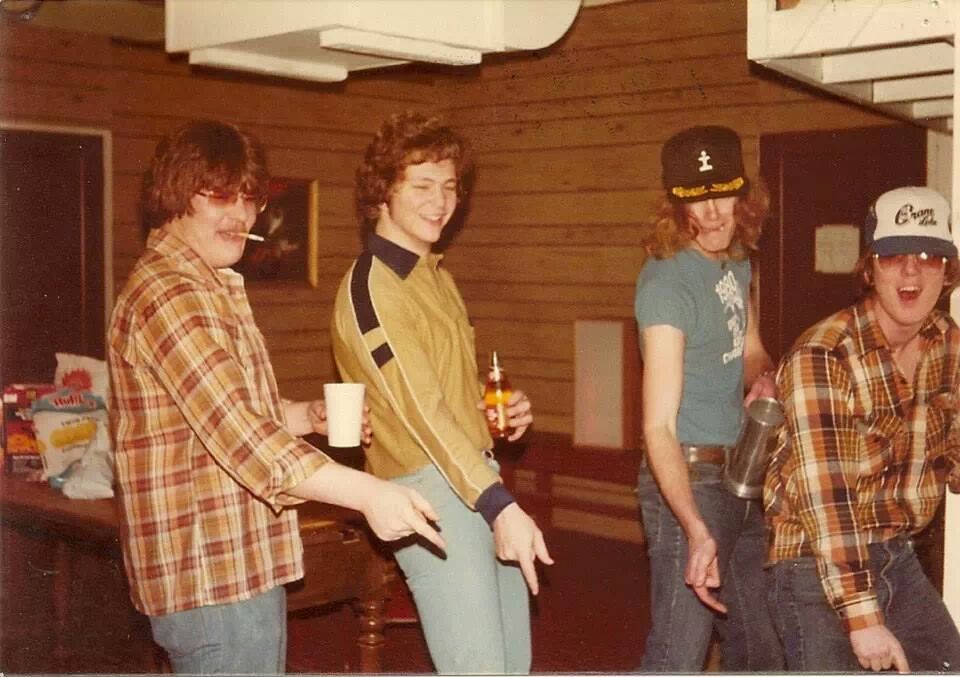
    Me and my buddies, 1979

    Picture if you will a raffish young fellow.  A tall lad, long hair well past his shoulders, mirrored sunglasses, blue jeans with the knees worn through, worn long enough that the excess drags on the ground behind steel-toed engineer boots.  A Buck knife in a sheath on the belt, and a well-worn black pocket t-shirt complete the picture of a young man who would not look at all out of place waiting in line for tickets to a Kiss concert.

    That was me at 17.  The embodiment of every father’s nightmares, standing there in size 11 black engineer boots.

    Unfortunately for my friends and me, we were teenagers in an era when the typical father of a teenage daughter was well up to the challenge we posed.  Take Mr. Walters.

    Rhonda Walters was from a family with money, and Mr. Walters expected more of his daughter than a liaison with a longhaired woods bum.  Still, Rhonda seemed to find me interesting; I certainly found her interesting.  (Of course, being 17 and male, it’s more than likely I’d find something interesting about almost any female between the ages of 16 and 50.)  Rhonda was cute, pert, leggy, had dark hair, dark eyes, and a tendency to dress in tantalizingly short cut-offs and tight T-shirts.  Rhonda also showed every indication of interest in certain longhaired, raffish woods bum types.  Namely, me.

    The fly in the ointment was this:  To get to take Rhonda out on a date, I had to be introduced to and interviewed by Rhonda’s father.

    Mr. Walters had the kind of urban sophistication that I was totally unprepared to deal with.  He also had a short fuse, a voice that sounded much like breaking boulders in the deepest recesses of a cave and fists the size of babies.  What’s more, he had a deep, profound and abiding distrust and dislike for certain longhaired, raffish woods bum types.  Namely, me.  And that was only the beginning.

    How It Started

    It all started one Friday afternoon, as I was leaning against my locker in the high school hallway, shooting the breeze with my hunting partner Dave.

    “So, man, what’re we doing tonight?”  Dave asked.  “Want to go out to the river and catch some catfish?  I’ve got a quart jar of chicken livers I’ve been leaving out in the sun all week.”

    Tempting as that offer was, I had to demur.  “Sorry, pal.  Got a date.”  I responded, with a knowing leer for emphasis.  At that moment, Rhonda wiggled down the hallway, shooting me a big grin.  “See you at seven!”  She practically sang the words to me.

    Dave gave me an incredulous look, once he tore his eyes away from the aft portion of Rhonda’s blue jeans.  “Rhonda Walters?  Oh, man, how did you ever get her to go out with you?  She’s got class!”

    The nerve!  “You asshole!  I’ve got class!”

    “Slow class, maybe.”  Dave said.  “Low class, for sure!  No way have you got enough class for Rhonda Walters.  You taking her out in your car?”

    “Figured on it.”  I replied, uncertain now.  I hadn’t thought of that one.  My old Ford was somewhat on the shy side of respectable.

    A great classic, the 1966 Galaxie 500 2-door hardtop. This one’s in better shape than mine was.

    “Better try to borrow your old man’s pickup, bud.  Rhonda’s used to nice stuff.  That Galaxie of yours got rust holes you could drop a good-sized dog through, and you never did get the skunk smell outta the back seat.  And you’d have to take all your fishing gear out of the back.”

    Dave wasn’t a genius by any stretch, but he had me there.  I suddenly remembered a can of catfish bait, my Grandpa’s own special recipe, which I had been fermenting on my dashboard for several days.  And Dave wasn’t finished yet.

    “Another thing, bud.  You ever seen her Dad?  Old man Walters’ got a lot of money, and he’s mean as the Devil hisself.  He ain’t gonna like seeing someone like you showin’ up at the door.”

    Crap.  Dave was right.  Much as I hated to admit it, Dave was right.  My old Ford was out.  On everything else, he had to be wrong.  What father could resist someone of my wit and winning charm?  I figured if I could solve the vehicle problem, I was in like Flint.

    Funny how our illusions can be shattered so quickly.

    Later that afternoon, at my folks’ place, my old ’66 Galaxie 500 “unexpectedly” suffered a breakdown – a breakdown facilitated by the simple expedient of yanking a couple of plug wires.

    I burst into the house with the news.  “DAD!”  I shouted, trying to get a desperate edge in my voice.  “The Galaxie is dead as a doornail, and I’ve got a date in two hours!  You gotta let me use your truck!”

    Dad’s pickup wasn’t the typical battered farm utility wagon common in Northeast Iowa in those days.  A year earlier, Dad had found a newly rebuilt 1970 Chevy pickup, bright orange with a hand-made wooden bed, reworked ground-up by a particularly talented body shop.  It was shiny, smooth, and clean, and Dad’s pride and joy.  Dad reluctantly agreed.  I imagine he was unwilling to stand in the way of true romance.

    That’s how I came to be driving Dad’s bright orange pickup when I pulled into the Walters’ driveway that Friday evening.  Visions of Rhonda in tight blue jeans assailed me; little did I know what was in store for me inside the front door of the expansive Walters residence.

    And Then This Happened

    A long driveway greeted me, followed by an equally long sidewalk leading to the massive, double door of white oak at the front of the Walters estate.  A doorbell button loomed; this was surely the moment of truth.

    I figured I was as ready as I’d ever be.  I rang the bell.  I wasn’t even remotely prepared for what happened next.

    There were, in those days, certain conventions to be expected when a young man came calling on a family’s daughter.  Those conventions involved the father meeting the young man at the door, upon which the intimidation and subtle threats began immediately.  The Walters family broke with that tradition in a very significant manner.

    Not really the Walters house, but close.

    Rhonda’s mother answered the door.

    In that moment, I realized where Rhonda got her charm and good looks.  Mrs. Walters was still on the sunny side of forty, tall, willowy, shining dark hair and a smile that doubtlessly brought many a man to his knees.

    “Hello!”  She breathed, beaming stunningly on me, bringing me metaphorically and immediately to my knees.  “You must be here for our daughter!  We’ve been expecting you.  Come on in, Rhonda’s getting ready.”

    At this tender age, I was still possessed of some instinctual knowledge that a teenage girl “getting ready” could take at least an Ice Age, I was prepared to wait; the late show of Animal House wasn’t for two hours yet anyway.  I had planned for that, you see.

    What happened next brought my euphoria crashing to earth.  Mrs. Walters had ushered me through the living room, and her glowing smile turned on me again as she raised a perfectly groomed, graceful hand to indicate an open door.  “If you want to wait in the study,” she purred, “You can chat with Rhonda’s Dad while you’re waiting.”

    Well, I’d expected this, and had been through a few fairly uncomfortable interviews in living rooms, farm kitchens and barnyards before this.  The normal process was a moment or two of more or less friendly intimidation, a required recitation of plans for the evening, of which we boys generally left out a few hoped-for details.  I knew what to expect.

    Or so I thought.

    Mr. Walters was ensconced in his expansive study, behind a large oak desk.  Reading glasses were perched on his nose; he was looking over some papers.  Without looking up he motioned to a wooden chair drawn up to the desk.  “Sit down.”  He growled.

    I sat uncomfortably for a few silent moments.  Then Mr. Walters, finally, looked up at me.

    It was amazing; at first, Mr. Walters had the usual expression, the usual frown of a loving father about to shrivel his daughter’s date.  Then, as he took in my long hair, black t-shirt, the Buck knife at the belt of my badly worn jeans, his frown turned to a disgusted scowl.  He dropped his reading glasses on the desk and leaned back in his chair.

    “So,” he snarled at me, “You sure don’t look like much of a catch.  Why in the world do you think you should be taking my daughter out?”

    “Uh, well sir, I asked her, and she said yes?”  I ventured.

    Mr. Walters balled up a fist the size of a basketball and tapped it gently on the desktop.  “She did, did she?”  Suddenly he stood up and leaned over the desk.

    “Listen, boy, you didn’t come to MY house to take my daughter out on a date.  You came here to ask ME a great personal favor.  That favor is taking my baby girl out in YOUR car, to God knows where, until God knows when, to do God knows what, and frankly you don’t look like someone I’d trust to find his way out of a shithouse.  So, once again, why in the world do you think you should be taking my daughter out?”  My pulse started to hammer in my temples.

    “Sir,” I replied, having been taught from an earlier age how to address an older man not related to me, especially when asking a favor, “I may not look like much, but I’m a stand-up guy.  I’ve got my Dad’s truck, and if I have it out late, he’ll kill me.  I’m figuring I’ll take Rhonda to the Burger Five and to the movies, and we’ll be back by eleven-thirty, and you got my word on that.”

    He regarded me with bloodshot eyes.  My blood pressure was edging towards the redline.

    “Eleven-thirty, eh?”  He finally growled.  “Well, boy, this is against my better judgment.  You look pretty worthless, and I hear you spend most of your time bumming around in the woods with your delinquent buddies.  The only reason I’m giving you a chance is because I know your Dad, and he’s as good a man as they come.”

    Way to go, Dad!  I was in!

    The fist slammed down on the desk, rattling the windows and knocking several knick-knacks off the bookshelves behind me.

    “But if you’re ONE MINUTE past eleven-thirty, or if I’ve got ONE REASON to think you’ve laid one finger on my girl, I’ll HAVE YOUR HIDE, boy, YOU UNDERSTAND THAT?”

    “Uh, yes, sir…” I stammered.

    He leaned closer, and snarled, “I mean it, boy, you better not be even a minute late, or so help me…”

    At that moment Rhonda came in, a vision in a white silk blouse and tight black pants.  “Oh, Daddy, are you giving him your mean act?  Don’t worry about it, Daddy’s a big softie.  He wouldn’t hurt a fly.”

    I wasn’t convinced; if I’d been a fly, I would certainly have feared for my life.  Mr. Walters continued to spike me into my chair with an angry glare.

    “Well, go on.  Eleven-thirty.  Rhonda, eleven-thirty, not a minute later, you hear?”  By this point, I had a fine sheen of sweat on my forehead, and at these words I bounded out of the chair.  “Thanks, sir, we’ll be on time!”  I assured Mr. Walters, with what I hoped was a calm, confident demeanor.  Rhonda walked over to kiss her father on the cheek.  I caught his sotto voce comment to her as she bent down:

    “He’s worthless, Rhonda, I don’t know what you’re thinking.”

    “Oh, Daddy, don’t worry.”

    Mr. Walters wasn’t worried.  I was worried.  I was, in fact, feeling more like a fly every moment I spent in Mr. Walter’s presence.

    We walked down the long front sidewalk, Rhonda happily describing something that had happened at school that afternoon; behind us, Rhonda’s Mom smiled and waved, and Mr. Walters glared, his eyes stabbing into my back like twin laser beams.

    The rest of the evening went wonderfully.  Dad’s pampered pickup purred like a kitten, and so did Rhonda; the local burger joint was up to standard, turning out piping-hot pizza burgers and fries; and we laughed all the way through Animal House.  And, during the movie, Rhonda’s hand stole over and took hold of mine – and didn’t let go.  Bliss!  We even had time for half an hour of hanging out in the Safeway parking lot with the other kids.  I even ended up leaning back against the bright orange side of the pickup, with Dave and the other guys glaring enviously at my arm draped comfortably around Rhonda’s shoulders as she leaned against me, laughing at all my horrible jokes.

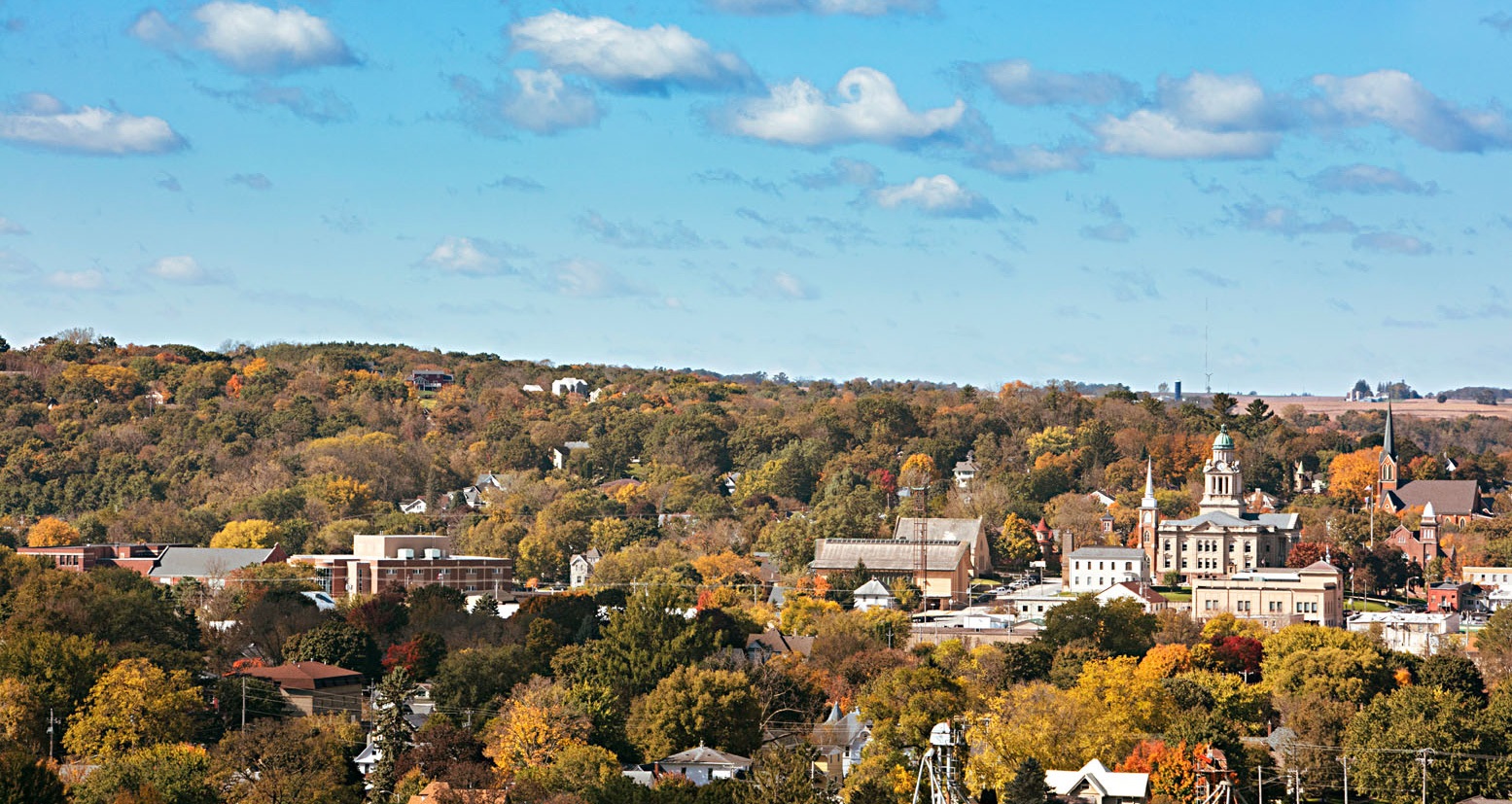
    The actual by-gosh Decorah, Iowa.

    There’s a moment in each teenage relationship where a line is crossed, a line between friends and boyfriend/girlfriend.  Years later the two kids involved will still recall that moment, that first time that line is crossed; that happened on this night, right on Rhonda’s doorstep.  Promptly at eleven-twenty-eight, I walked Rhonda up the long sidewalk to her parent’s house.  She turned to me in the light from the bulb above the door.

    “This was so much fun!  I think we should do it again next week, don’t you?”

    YOU BET!  I thought in a loud internal shout, but instead suavely replied, “Yeah, I think we probably should.”  I was slowly becoming aware of two glaring eyes peering through the front window curtains.

    Rhonda leaned close, grabbing my shoulders and planting a warm kiss on my cheek.  “I can’t wait.  I’ll be looking forward to it all week.”  The door suddenly popped open, and Mr. Walters stood imposingly framed in the light from the front room.   He growled ominously, “Eleven-thirty.”  Rhonda smiled sweetly at me as I stood, grinning like an ape, and then she turned and went inside.  Her father shot me one last murderous look before he slammed the door.

    As I walked away, one thought came to mind.

    It was worth it.

    Shoe on The Other Foot

    Sadly, the relationship came to an end, as most teenage affairs do; in fact, the whole thing ended rather spectacularly, but that’s another story (and one I’ve already told here.)  The lesson of Rhonda’s father wasn’t lost on me, though, and has served me well in later years, as the father of daughters of my own.  In fact, it served me well the first time I faced a fidgeting, grungy young potential boyfriend in my own home.

    I glared at the young man, as he stood there in his backwards-facing cap and baggy pants.  Finally, after letting him stew a moment, I snarled at him:

    “Listen, boy, you didn’t come to MY house to take my daughter out on a date.  You came here to ask ME a great personal favor.  That favor is taking my baby girl out in YOUR car, to God knows where, until God knows when, to do God knows what, and frankly you don’t look like someone I’d trust to find his way out of a shithouse.  So, now, tell me why in the world you think you should be taking my daughter out?”  I struggled to suppress a grin as the boy shriveled before my eyes.

    Thanks, Mr. Walters.  At long last, I owe you one.

  • Allamakee County Chronicles VIII: Hold My Beer!

    Note:  A prologue from my upcoming autobiography, Life’s Too Short to Smoke Cheap Cigars (Or to Drink Cheap Whiskey.)

    You Ever Wonder Why…

    It’s well known that teenage boys are driven by testosterone; your typical teenage boy is basically a pair of testicles with legs, and I was certainly no exception.  At this sensitive age boys are prone to doing stupid things, sometimes to impress girls (that rarely works out like intended) or sometimes just because.

    Country kids, of course, have many opportunities to risk life and limb in pursuit of… well, who knows?  I certainly don’t.  Back then, in the glory days of the late Seventies back in Allamakee County, I didn’t know either.  And that probably explains a lot.

    This One Time…

    One of those “just because” times came in the autumn of 1976.  My grandfather had passed away the year before, and my grandmother was preparing to pass off the big farmhouse to my uncle and move into a smaller structure on the property, and so had been clearing out a lot of my late grandfather’s stuff.

    By the early November day when my cousin Jeff and I went out to the farm to shoot some pheasants, most of Grandpa’s stuff was already gone, but after we had knocked over a few birds, we went in to the house where Grandma had offered to feed us lunch.  As we were eating, Grandma let us know about the few things left.

    “Boys,” she told us, “out in the barn, there are a couple of old boxes of Grandad’s things.  You two go look through them when you’re done eating.  If there’s anything you want, take it; I’m going to have your uncle Norman haul all the rest to the dump.”

    So, once we finished eating, we went back outside.  We stood in the drive for a few moments.  As Jeff was lighting a cigarette, I walked over and poked my head in the small entry door on the side of the barn.

    “Hey,” I told Jeff, “there’s a couple boxes in there, just like Grandma said.”

    “Well, let’s have a look,” Jeff responded.

    Old dynamite. Fortunately we didn’t find this much.

    There wasn’t much of any use in the boxes.  As I recall at this distance in time, there was a small stash of Grandpa’s girlie magazines that gave us a chuckle (a few years later I was mildly horrified when I suddenly realized why Grandpa kept that stash in the barn and not the house), a broken socket wrench and, down in the bottom of one of the boxes, two old sticks of dynamite.

    Lots of folks who haven’t worked with explosives don’t know that old dynamite sweats.  This isn’t sweat in the human sense, it’s more like an old D-cell battery breaking open.  A gritty, crystalline white crust exudes from the paper covering of the dynamite sticks, eventually heavily covering the stick.  The main substance of that gritty crust?  Nitroglycerine.

    This, understandably, makes these old sticks of dynamite tetchy to handle.

    Now, then and there, the smart thing to do would have been to leave the sticks where they were, to tell Uncle Norman, who was taking over the farm, about them, and leave him to find someone experienced and equipped to deal with these hazardous objects.  But not us – oh, no, not us!

    Holding one of the sticks, my cousin looked at me.  “Hey,” he said, “I’ve got my .22 in my truck.  I wonder if these would go off if we shot ‘em?”

    Jeff was four years older than me, and, I assumed, wiser.  So, my reply seemed obvious: “Let’s find out!”

    Some instinct made us go a good way from the house before commencing our experiment, so once Jeff retried his old .22 bolt gun, we walked through the orchard and out to the far side of the south cornfield.  There we propped the sweaty old dynamite sticks up against a dirt clod, backed off about fifty yards and commenced experimenting.

    We each had fired off a five-round magazine at the two sticks with no result.  After carefully approaching the sticks, we saw several inarguable bullet holes through them.  But no explosion had commenced.

    It was this moment that Jeff realized the real, physical danger of what we were doing.  “You know,” he said, “if Grandma hears the .22 and comes out here and sees what we’re doing, she’ll cut a switch and wallop the tar of us both.”

    Jeff and I were big tough country boys.  Jeff was about 5’10”, maybe 160 pounds, and hard as rock; at fifteen, I was already a six-footer pushing 200 pounds and could easily toss around 75-pound hay bales.  Grandma was 4’10”, weighed maybe a hundred pounds soaking wet, and was in her middle seventies, and we had no doubt whatsoever that she could beat the hell out of us both without breaking a sweat – or that she would certainly do so if she figured out what we were up to.

    “Yeah,” I agreed.  “We’d better do the smart thing, I guess.”

    So, Jeff got a shovel from the tool shed, we dug a four-foot deep hole in the fencerow and buried those two sticks, tamping the dirt down good and hard and scattering dry leaves over the filled hole.  Nothing more was said about the incident by either of us for many years, and as far as we know nobody ever got blown up, so presumably the damp earth rendered the dynamite, eventually, inert.

    I’m no expert on dynamite, though.  For all I know those sticks, buried in the ground all these years, may well still be ert.  Personally, even now, I don’t think I’d go back and try digging in that fencerow, but then there’s lots of things I wouldn’t do nowadays.

    Youth, Testosterone and Beer

    Now, add a couple years and some beer to the mix.

    Back in these days, the age of majority for almost everything was still eighteen.  I could buy beer at eighteen, any kind of alcohol for that matter, which resulted in my being a legal drinker through most of my senior year of high school.  This was the cause of some consternation on the part of teachers, especially since my high school had open campus for seniors.  We generally went downtown for lunch, usually grabbing a sandwich and a brew at one of the local taverns.

    “These boys are coming to afternoon classes smelling of beer!” the teachers protested to the principal.  Bear in mind that this was a time when some semblance of common sense still held sway in a significant portion of the population.  So, the principal’s reply was, shall we say, principled; “Are they drunk?”

    “No,” the teachers replied.

    “Are they disruptive?”

    “No.”

    “They’re legal.  If they have a beer with lunch, and they’re paying attention after that, there’s nothing you can do about it.”

    The teachers withdrew their complaints, we went on having a beer or two with lunch, and everybody was, if not content, at least accepting the inevitable.

    On schooldays at lunch, see, we were mostly responsible.  But add girls to the mix!  That’s when the old saying about “hold my beer and watch this” really gains some traction.

    At This Dance…

    The actual by-gosh Highlandville General Store.

    Fast forward to the summer after I was manumitted from high school.  That summer of 1980 I was working at some odd jobs (bouncer, car repo guy, various farm jobs) while I tried to decide what to do next.  But the highlights of that long-ago summer took place in the little town of Highlandville, about six miles from the Old Man’s place.  That little unincorporated village contained an old one-room schoolhouse that had been converted into a little social center and, that summer, there were danced there every Saturday night.  There was always a local band, usually a few unofficial kegs of beer in crates of ice, and local farm boys and girls from miles around came in to check out the other farm girls and boys.

    One particular Saturday found my folks leaving to go to an Audubon Society conference down in Decorah.  Dad was annoyed with me for some reason I can’t recall and so, when he and Mom left in Mom’s car, he took the keys to his pickup.  He knew my old 66 Ford’s gas tank was dry as a fart and the big gas tank out by the shed was likewise empty, and so presumed I’d be left to sit out a Saturday night at home.

    But there was one thing he forgot.

    After the folks left, I walked around a little bit, grumbling to myself and considering possibilities.  It was a beautiful July afternoon getting along towards evening; the afternoon heat was giving way to the cool of the evening, and the cicadas were still calling from the big box-elders along the driveway; a perfect evening to find a girl and enjoy some of the finer things in my eighteen-year-old life.

    For a few mad moments I considered getting my old bike out of the shed and riding it to Highlandville, but I would not garner any respect from the other local kids if  I had to resort to that, and so dismissed the idea out of hand.  It was too far to walk, and I wasn’t interested in driving the tractor that far.

    Then, as I stood irresolutely in the yard, a bright light dawned:  It was the sun, glancing off the windshield of Dad’s 1954 F-500 six-yard dump truck, parked in the orchard.

    I hopped in.  The old truck, being an unlicensed farm vehicle that had nevertheless seen many years of hard use on northeast Iowa’s graveled roads and farm fields, didn’t have a conventional ignition switch any more, the key switch being replaced by a simple old Radio Shack toggle.  To start the truck, one had to flip the toggle to On, pump the gas pedal three times – not twice, not four times, but three times – and then step on the starter button on the floor, at which point the truck’s old 312 Y-block engine would cough, sputter and come to life with a flatulent roar.

    The actual by-gosh old Highlandville schoolhouse.

    At least, it did so on this occasion.  I had been driving the truck for several years already, hauling dirt and gravel for various jobs around the place, and so was already well familiar with its operation.  I crawled the old vehicle out to the road, stuck the two-speed rear axle in High, and headed for town.

    I arrived without incident.  The old dumper, parked at the edge of the parking lot, occasioned some comment from the dancegoers, but otherwise my evening went well.  I danced with a few girls, drank more than a few beers.

    About ten o’clock, having had no luck with the local girls at the dance, I went outside to grab a beer.  A group of local rowdies were gathered around the keg in the back of Miles Duffy’s pickup.  As I was filling my cup, one of them asked me, “Hey, are you the guy who drove the dump truck in?”

    “Yup,” I agreed.  “Was either that or walk.”

    “I hear ya,” he agreed easily.  He drained his beer at a single pull.  “Say,” he went on, “if a fella was to climb in the back of that, and you were to dump it out, how long you reckon a guy could hang on?”

    “I can’t think of but one way to find out,” I answered.

    We found out.  Not one guy but about six climbed in the back of the truck.  I started the old monster up and, after letting the engine run a moment to build up hydraulic pressure, pulled the knob to dump the box out.

    Not actually Dad’s dumper, but much the same.

    Bear in mind that this vehicle, like a lot of old dumpers, had a tailgate that was hinged not at the bottom but at the top, allowing it to swing open at the bottom to release the contents.  I had undogged the latches on the tailgate before climbing in the cab.  As the box upended, I heard scrabbling as the fellows tried to hold on to the rusty surface of the dump box, and then sliding sounds, followed by a few hard thumps as a couple of them hit the tailgate hard before sliding out.

    Leaving the engine running, I climbed out to see the results.  The first guy to have the idea had a welt on his forehead and a swelling under one eye that looked like it would turn into a beautiful shiner.  “Hey!” he yelled.  “Let’s go again!  I think I can do better!”

    We ended up trying it four or five times.  At one point I tried a run in the back myself and managed to slide out without breaking any bones.

    None of the local gals were impressed, of course, even though at the time we young guys had considered it a serious possibility that they would be.  Eventually an older fellow, certainly on the wrong side of twenty and therefore expected to be responsible, walked over and pointed out, “you know, if you guys keep doing that, someone is gonna get hurt.”

    We all looked at each other, with our collection of bruises, scrapes, cuts and sprains, and agreed that he was likely right.

    Thus, ended the great dump truck experiment.  Eventually, girl-less and bruised, I finished my last beer, climbed in the old dumper, put the axle in Low to keep the speed down to match my impaired reflexes, and guided the waddling, farting old beast back home.

    As It Stands

    Many years later I told my Mom of the incident, one in a series of things that I revealed to the folks after enough years had passed that they would hopefully find the stories amusing rather than enraging.  I had generally been surprised to find out how much they already knew of my escapades, but that one they weren’t too sure of, although Mom remembered one time when they came back from a weekend in town when Dad swore the dump truck wasn’t quite where he left it.

    Nowadays I’m a much more settled sort of fellow, and a phrase like “hold my beer and watch this” will only pass my lips in jest.  Then again, there’s the time I crossed a flooded Arizona creek in the middle of the night in my old Bronco by hitting the stream at about sixty miles per hour and skipping the truck like a rock across the water…

    …but that’s a story for another time.

  • Friday Afternoon Links – Monkey County, MD edition

    Back when I was a wee-lad in college, answering the call for a fun-filled life in journalism, I did an internship at a local newspaper.  “Sweet!” wee-JW said to himself.  It turned out that the paper didn’t have too much oversight from the owner, and the 20-something dude they hired as the editor-in-chief wanted it to be a tabloid-style scandal rag, to separate it from the crush of the other local newspapers (I’m not sure if there actually were any.)

    Baby Doc Duvalier had recently been deposed as the head criminal in charge of Haiti, so I was assigned to find Haitians who had been tortured by his goon squads.  How hard can that be, you ask.  The rub was that they had to live in Montgomery County, MD, since it was a paper that focused on the county and only on the county.  So, after a not-insignificant amount of hard-bitten legwork and old fashioned gumption, I found my guy.  (Part of this gumption was asking my former French professor (3 whole weeks in the class!) to call the residence of a former Haitian ambassador in Miami for me.   I didn’t speak more than 4 words of French and the woman answering the phone didn’t speak any English and kept hanging up on me.  He graciously made the call for me, but came back with bupkis from the ambassador.)

    Was my guy grimly tortured by Baby Doc’s meat handlers?  No.  Someone in his family?  No.  His dog?  No.  He was a low-level flunky in a failed coup attempt on Papa Doc.  In 1971.  But he lived in Monkey County and was assigned a .45 revolver during the not-coup.

    RUN THAT BABY!!!!  I got the front page and 75 bucks for the story.  And so endeth my illustrious career in journalism (which in hindsight, was a good fucking call).

    In the spirit of my misspent yout’, I’ve revived the format of news of my stupid, stupid county for the links (it ain’t Florida, but we do what we can).  Enjoy!


    Slimy old pol to hopeful home buyers:  Drop dead.

    Group of slimy old pols to business owners:  drop even deader.

    Local man beats the rush to the next sure-fire strategy to beat the underwear gnomes at their own game.  State gubmint only too happy to help.

    I got this!

    Gilligan!

    Smooooooth operator.

    Who doesn’t like a little country dick heading into the weekend?

  • Allamakee County Chronicles VI: Bull!

    Note:  A preview from my upcoming autobiography, Life’s Too Short to Smoke Cheap Cigars (Or to Drink Cheap Whiskey.)

    Bull!

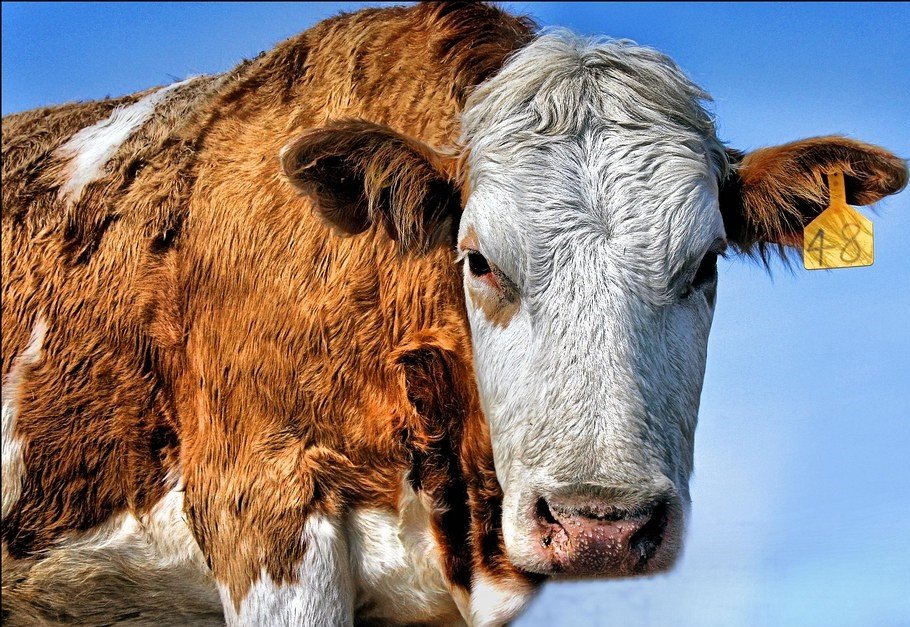
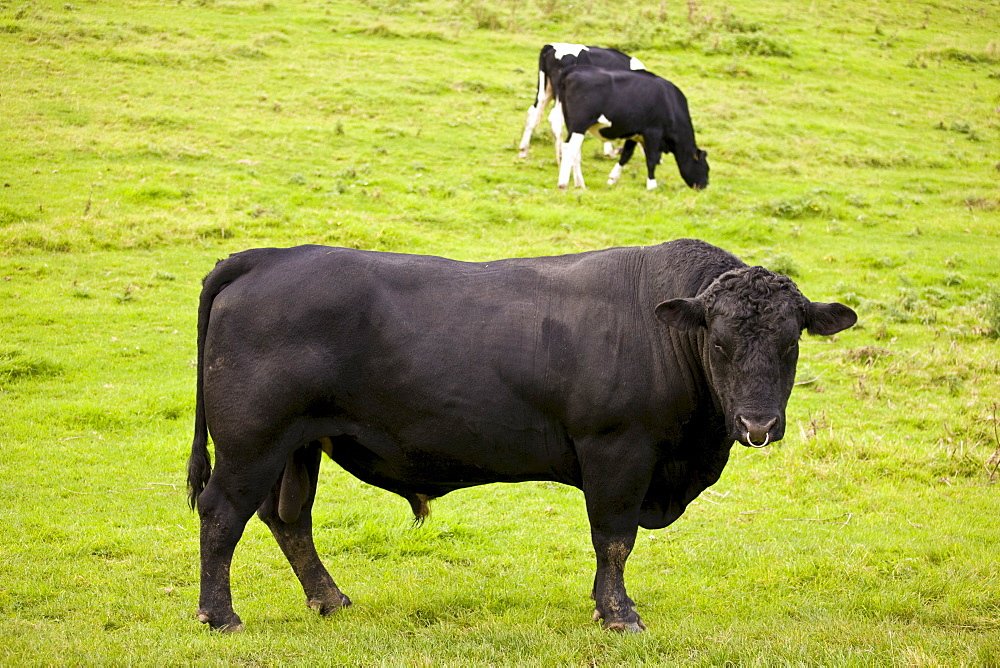
    Can you tell which ones are mean? Me neither.

    Most folks these days don’t think about cattle much.  Our increasingly urbanized populace knows, vaguely, that beef and dairy products come from cattle.  They may have a half-way decent mental image of what most cattle look like – big, boxy critters, basically a perambulating digestive system with beef mounted around the periphery, a head on one end and a big bag for producing milk and cheeses on the other.  There are other things that go on at the end across from the head, things which are best not discussed in polite company.  That will not, of course, prevent me from discussing them here.

    But what these urban and suburban dwellers don’t understand is the bovine species’ largely unsuspected and malicious intelligence, nor how quickly they can turn that malice into action.  But when I was a young fellow, back in Allamakee County, in the heart of northeast Iowa’s dairy country, we understood it all too well.

    As for the city-dweller’s misconceptions of the nature of cows, this is something I learned from the first good friend I ever had who hailed from a big city – something that had to wait until I joined the Army.

    Fort Dix, New Jersey – sometime in the early Eighties

    It was a hot, sweaty, humid day at Fort Dix, New Jersey – the exact wrong sort of day to be suffering through an Army Basic Training field exercise.

    Not that there is a right sort of day to be suffering through an Army Basic Training field exercise.

    At the end of a “lane” that featured lots of pyrotechnics and tear gas, we were given five minutes to rest and recover before the next bit of training.  The moment the Drill Sergeant yelled “Fall out,” I staggered to a tree and crashed to the ground under the shading branches.

    My buddy, a skinny city kid from Philadelphia, dropped down to the sandy ground beside me, groaning.  “I think I cracked a rib,” he complained.  “Damn grenade simulator went off right behind me.  Knocked me right over.  Think I hit a rock when I went down.”  He rubbed his ribs.  “Man, imagine if this was real.  I mean, real people shooting real shit at us.  Can you imagine that?  Scare the crap out of me, I tell you that.”

    “Oh, I don’t know,” I replied, with big-tough-country-kid nonchalance.  “I’ve faced stuff more frightening that bullets and grenades.”

    “The hell you say,” my buddy said.  “What’s scarier than bullets and grenades?”

    “Cows.”

    Back in Allamakee County

    Back The F*** Off.

    The Old Man had raised Black Angus cattle for many years but had mostly foregone farming by the time I was old enough to wander around much on my own.  Black Angus cattle are compact, even-tempered beasts, but are still big enough and unpredictable enough to cause problems, but all in all, Dad didn’t have too much trouble with them.

    Later, though, his timbered acreage in Allamakee County was surrounded by dairy farms, the favored breed for which in those days were Holsteins – big cattle, heavy, sometimes bad-tempered.  Most of my friends’ families were involved in the dairy business to some extent or another, and the neighbor’s cattle had the uncanny ability to break fences and would frequently wander onto our property, at which point it became my job to run them off.

    I once broached the subject of using my .30-30 to run them instead into the big freezer in the workshop but was rebuffed with a loud roar.

    Instead, I experimented with a few other means of chasing errant bovines off the Clark property.  One of my early efforts involved an old fiberglass recurve bow and blunt arrows, which I bounced off bovine rib cages and hindquarters.  This had less than positive results, either merely annoying the cattle or angering them.  After spending half an hour about twenty feet up a big box-elder tree one afternoon with four or five angry cows milling about beneath, I gave up on the archery solution.

    We finally settled on light skeet loads of #9 shot from a 12 gauge, delivered from about 20-30 yards.  The light shot warmed the cows’ hindquarters without penetrating the skin, and that usually moved the cows along – except for the odd instance that saw the Old Man or myself running around the flat ground across the creek with a few cows in pursuit.

    Holsteins were cows to watch out for.  But there was one local bovine, not a cow as such but most emphatically a bull, the very thought of whom struck terror into the hearts of all the local kids.

    A Local Legend

    This huge Holstein bull lived on one of the farms belonging to the expansive Duffy clan.  Unfortunately, the farm in question lay in a pleasant little valley through which ran the pleasant little waterway of Waterloo Creek, in which swam a pleasant little population of pleasant little trout.  The bull maintained a constant vigil of what he thought of as his personal stretch of Waterloo Creek.  His zeal in pursuing trespassers made him a constant problem for those of us with a passion for fishing; his evil disposition, vast size and uncanny deviousness made him dangerous for even his owner.  The bull was a killer, and only the board full of blue ribbons and large sums he earned his owner in stud fees had preserved him to this point.  His back was as broad as a ’69 Cadillac, his head larger than a twenty-gallon washtub topped by needle-tipped horns.  His eyes glittered red and angry, full of hate for any moving object that was not one of his cows.

    This bull was notorious enough, in fact, that all the local folk had unanimously given him a name.  He had some long, fancy pedigree name that nobody knew or cared about; instead, he was known locally as The Antichrist.

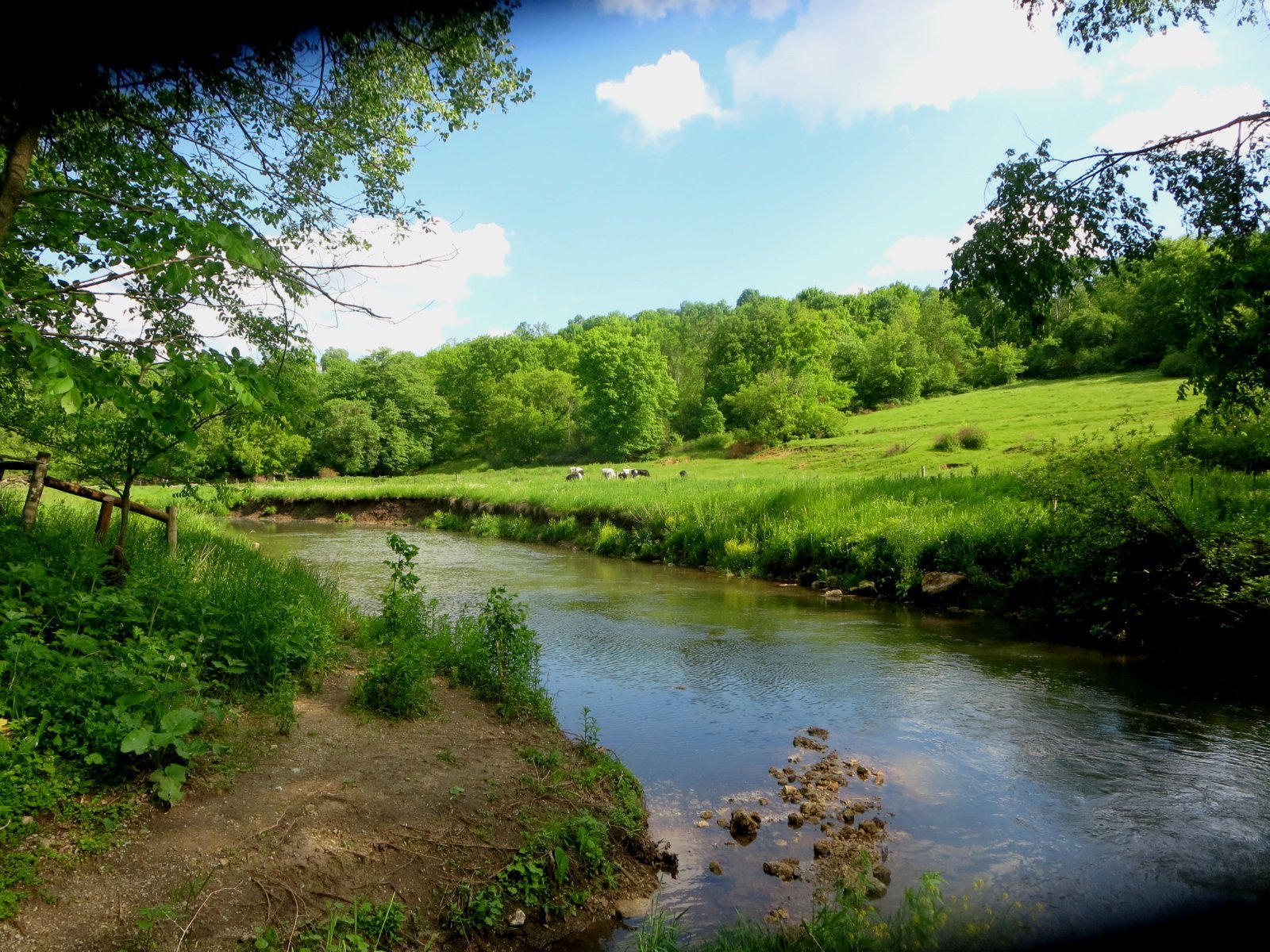
    The actual Waterloo Creek. Really.

    My first encounter with The Antichrist occurred when I was about fifteen.  I was mooching around in the Waterloo Creek valley looking over some favored fishing spots.  There was a beautiful big pool in a pasture on the back reaches of one of the Duffy farms that always held fat brown trout.

    I was just climbing over the fence when I heard a strangled bellow.  I froze in place, the top strand of barbed wire uncomfortably close to some delicate real estate and looked over to the trees along the creek.

    There stood The Antichrist, a massive, menacing presence.  He lifted a front hoof and dropped it.  He let out a snort that could as easily come from some massive, primeval monster.

    I disengaged from the fence and stole quietly away.  No amount of trout was worth chancing The Antichrist.  Several of my friends had already had close calls with him, and I had no desire to repeat their experiences.

    But the closest call we ever had with The Antichrist happened two or three years later and involved my friend Jon’s big-city cousin Albert and a time-honored country kid tradition:  A snipe hunt.

    Now most folks nowadays wouldn’t fall for this stunt.  Even the most urbane of urban dwellers have heard of this old trick, I suspect in part because of this Internet thing all the kids are doing these days.  But back in the late Seventies, the Internets weren’t even a gleam in Al Gore’s eyes yet, and precautionary information traveled more slowly.

    So, when my buddy Jon’s cousin Albert was coming to visit from Chicago, we had no trouble selling him on the exciting adventure of a nighttime snipe hunt.  Albert’s family were staying with Jon’s aunt and uncle in town, but Albert had spent quite a bit of time hanging out with us out in the boonies, and was taking rather enthusiastically to fishing, camping and woods-bumming; in other words, a typical summer.

    We set the date for our snipe hunt on a warm July weekend.  Albert’s folks dropped him off at the Hooper place that Saturday afternoon.  I was already in residence; Jon and I had been plotting for two hours before Albert showed up.  All was in readiness.

    Jon had through mysterious means obtained a large burlap sack, big enough to contain a small elephant.  I had a small, cheap plastic flashlight.  The hill we chose for the exercise contained some of the nastiest brush to be found in northeast Iowa – acres of blackberry brambles, sumac thickets, and towering oaks that blocked out the sun even on the brightest of days; the evening coming promised only the thinnest of sliver moons to light the forest.  Perfect!

    The day ended, and after supper the three of us were standing in the Hooper barnyard planning strategy.

    “OK, since you’re new, Albert,” Jon was saying, “You’ll have to stand in the brush and hold the sack.  The thing is, you can’t shoot at night, so what we’ll do is to loop around up to the top of the hill and sort of drive the snipe down to you.  You stand and hold the sack and catch the snipe as they come a-runnin’ down the hill.”

    “Won’t they fly?”  Albert wanted to know.

    “Nope.”  I assured him.  “Snipes only fly in daylight.  They’d rather run after dark, that way they don’t run into trees and such.”

    Albert looked around at the gathering gloom.

    “Are you sure?” he quavered.

    “Hey!”  Jon protested, using a phrase that foretold unspeakable horror to anyone who knew Jon and I better.  “Trust us!”

    We drove out to a quiet stretch of country road.  “Up there,” Jon indicated one particularly large, dark hillside covered with hardwood timber.  “That’s where were going.”

    We climbed out of The Van, hopped a barbed wire fence, and headed up the hill.  It was a good mile from the road that we placed Albert, holding his sack, on the edge of a blackberry thicket.

    “We’ll have to take the flashlight, Albert.”  Jon informed our victim.  “We’ll need it to see our way up to the top.”

    “Uh, ok….” Albert sounded doubtful.  There under the trees it was darker than a crow’s wing in a pile of coal on a dark night.  We left Albert holding the bag, and aided by the anemic flashlight beam, trooped on up the hill.

    Jon and I had forgotten one crucial detail about this hillside, where this evening there grazed a herd of Holstein cattle.  We had neglected to consider who owned this hill overlooking the Waterloo Creek valley.

    Once we were out of earshot of Albert’s stand, we could no longer contain our glee at his predicament.

    “Now,” Jon was telling me, “we can loop around over the top of the hill and down the other side, and then we’ll follow the road back to The Van.  We can go into town and have something to eat.  We’ll go back and get old Albert about 2AM, hawhawhawhaw!!”

    “Hawhawhawhaw!!”  I replied.  “I can’t wait to see the look on his face after four hours in those woods!!  This is gonna be great!!”

    We’d forgotten about the lynchpin of the Duffy dairy herd.

    “Hawhawhawhaw!” Jon and I laughed our way through the woods, up the hill to the meadow on the top.

    As Jon and I entered the open meadow at the top of the hill, we were still filled with mirth.  We had forgotten that his father was grazing his cattle in the high meadow.

    A deep, rolling snort echoed across the dark meadow.  We strained to see the source of the sound; even in the open it was too dark to see much of anything.

    “Haw?”  Jon querulously asked the darkness.

    Somewhere out in the darkness, The Antichrist stomped one foot.  A tremor went through the ground beneath our feet; several branches fell from the trees behind us.  Jon looked at me, his eyes wide with terror.

    He was like this, but with more horns.

    “It’s The Antichrist!”  Jon shouted at me.  “I forgot about him!”

    “What should we do?”  I shouted back.

    “RUN!!!”  Jon screeched.

    The thunder of hoofbeats was already drumming in the dark, getting louder by the second.

    To say that we ran for our lives is the grossest of understatements.  We flew down that hill.  We crashed through thickets in which a bulldozer would have helplessly bogged down.  We ran over and snapped off saplings four and five inches thick, without notice.  About one-third of the way down was a ravine; on the way up we’d been required to climb carefully down one side and scramble up the other.  On the way down, both of us leaped the 20-foot chasm without missing a stride.  Behind us was the ever-present thunder of hooves, slowly gaining on us; The Antichrist plowed a 6-foot wide swath through the trees; the farmer who owned the place in fact gained a full winter’s worth of firewood from the felled timber.

    At one point during our headlong flight, dimly in the recesses of my subconscious, I recalled that we’d left Albert on the edge of a thicket nearby.  He must have heard our headlong rush to escape a ton of pounding, snorting death; he called out to us.

    “Are there any snipe, guys?  Are the snipe coming?”  I had a sudden flashed mental image of Albert standing, holding his sack, unaware of the onrushing Death in the darkness.

    “RUN!”  I shouted at Albert.

    “What?  Why?” he shouted back.

    “BULL!” both Jon and I bellowed at once.

    Albert had been wearing new white sneakers.  As I flashed past Albert’s stand, I saw only a glimpse of two white sneakers and two huge, white eyes staring.  The hoofbeats were getting closer; I reached deep inside myself, pulled out a little bit of extra energy from some unknown place, and put on some speed.

    The pounding behind me had doubled somehow; then, suddenly, I was passed in the dark by a flying pair of white sneakers.

    It seems Albert had been a varsity sprinter on his Chicago school’s track team.  In his big-city ignorance of country ways, he didn’t realize how the ability to run like the very wind was frequently of great use in our hunting, fishing and camping adventures.  At least not until the thundering sound of The Antichrist’s charge reached his ears.  The very air crackled as Albert ran past us; a faint smell of ozone followed his flight.  Jon and I homed in on the trail of acrid odor and followed it all the way back to the road where Jon’s van was parked, where we easily cleared the 3-strand barbed wire with single, effortless arching leaps.

    The Antichrist skidded to a stop, frustrated by the barbed wire, his intent of reducing us to minor portions of the landscape deterred.  We managed to halt our flight about 50 feet from the fence; the three of us turned to see The Antichrists’ beady, hateful eyes glittering at us in the faint glow of the moonlight.  The bull casually lowered his head, scored out a foot-long sliver from a wooden fencepost with one horn, and let out one more mighty snort which blew Albert’s hat off; then he slowly turned, and ponderously made his way off into the darkness, towards his waiting cows.

    Albert bent over suddenly.  Jon grabbed for his arm, fearing he was fainting from terror.  I grabbed his other arm; Albert was shaking uncontrollably.  We both shook him, hoping to break him loose from whatever horror assailed him.

    “Ha!  Ha!  HAHAHAHAHAA!!!!  Albert was laughing!  Not just laughing but laughing uproariously!  Not a terrified, hysterical laugh, but a wild, carefree laugh, as one who’s just witnessed what was very possibly the greatest act of comedy he’d ever see in his life.

    “You guys…” he panted, when he finally regained the ability to speak, “you guys, you told me…”

    “What?”  Jon demanded.  “What did we tell you?”

    “You told me it was the most exciting hunting there was!” Albert giggled.  “I guess you sure showed me!  It was sure exciting after all, it sure was!”  Albert collapsed into the dust of the graveled road, clutching his sides.

    Over Albert’s convulsing form, Jon and I looked at each other.  We were witnesses to a Phenomenon; one we’d never expected.  Despite all his citified manners, despite his pitiful lack of knowledge of fishing, shooting, hunting, tanning hides, running a trapline, or pretty much anything useful, Albert had the one quality that would gain him acceptance faster than any.

    Albert was a good sport.

    In time, he learned the rest.

    Back at Fort Dix

    Yeah, it’s best to stay away.

    “Cows,” my old Army buddy scoffed.  “The hell you say.  Ain’t nobody afraid of cows.”

    Nearby, a kid from upstate New York suddenly popped upright.  “Cows? Where?”

    Another guy, this one from rural Wyoming, snapped out of a doze.  “Cows?  I don’t want to get mixed up with cows.  They’ll have calves this time of year.  They get mean when they have calves.”

    A third kid, this one from central Missouri, chimed in.  “Cows, oh, man, this is bad enough already without a bunch of damn cows wandering around.”

    “Come on,” my big-city buddy replied to us all.  “You’re all a bunch of big corn-fed farm boys, and you’re telling me you’re afraid of cows?”

    “Not afraid, so much,” the guy from Wyoming said.  We all knew he came from a long line of ranchers.  “Just real, real cautious.”

    I could tell my big-city buddy didn’t believe us.  Most folks these days don’t think about cattle much. But even at the thought, my head came up automatically, scanning the open woods around us, not for Soviet soldiers, armored vehicle or even drill sergeants, but for cows.

    As It Stands Today…

    I’m still cautious around cows.

    The stretches of Colorado landscape where I do my woods-bumming these days is frequently shared with cattle.  These are beef cattle, usually Herefords or the Hereford-Angus crosses known as black baldies.  These are reasonably tolerant cattle, and the fact that they spend summers on open range makes them cautious themselves and prone to staying away from people.

    Also, bulls these days are mostly kept confined; AI (no, not that AI – Artificial Insemination) has replaced the need for most ranchers and farmers to herd a bull with their cows.  But occasionally, usually in the distance, I can hear the ringing bellow of a bull.  It’s a weirdly primal sound, one that still makes the hair on the back of my neck stand up.

    Most of the folks hereabouts, though, fish and hike unmolested by cows, and so miss out on the chance to amass tales of adventure.  They really don’t know what they’re missing.

  • Allamakee County Chonicles V – The Goat Tree

    Note:  A preview from my upcoming autobiography, Life’s Too Short to Smoke Cheap Cigars (Or to Drink Cheap Whiskey.)

    The Goat Tree

    Goats have a sort of, well, aura.

    Some folks refer to it as a stench.  Personally, I don’t think that word quite covers it.  Goats are worse than skunks by almost any measure.

    The really unique thing about goats is that, unlike skunks, have a predilection to spread their aura across the countryside, on the wings of the breeze.  They do this by climbing – barns, trees, fence posts, rocks, almost anything higher than their natural stance.  The purpose of this is to spread the cloying smell of goat as far as possible across the countryside.

    In the Beginning…

    When I was a small and innocent boy, the route my parents took to get to town passed by a small farm that was home to several goats, including one old Billy known locally as “Old Stinky.”  That any goat, of all goats, was sufficiently rank to gain such an appellation as “Old Stinky” speaks volumes; in fact, there was muttering around the neighborhood about the owner of said farm, old man Andresen, conducting chemical warfare to drive down property values.  The fact that old man Andresen bought up a couple neighboring farms at bargain-basement prices seemed to bear that view out; at least that gave him room to run a few more goats, over which Old Stinky presided as uncontested patriarch.  Old Stinky took an inordinate amount of pride in his ability to drive away all manner of animals, insects, trespassers, and to turn green plants brown for twenty yards downwind.  He sure seemed to enjoy himself; nobody was certain how old man Andresen was able to take it.  Perhaps having the only fly and mosquito-free farm in northern Iowa was some compensation; flying insects of all sorts steered well clear of the Andresen place.  Not even horseflies braved Old Stinky’s presence.

    The road to town, as it passed the Andresen place, first dropped into the Canoe Creek valley and then made a sharp turn right at the driveway to the farm house.  At the end of the driveway, right next to the road, was the Goat Tree.  It was in this giant old oak tree that Old Stinky preferred to climb to announce his odiferous presence to the land.  To get past the Andresen place to town, you had to drive down into the valley, slow down to make the sharp turn, cross the bridge and then race up the steep hill on the other side of Canoe Creek to get away from Old Stinky’s presence.  The speed required to negotiate this obstacle was determined by how long the individual driver could hold his/her breath.

    The actual Canoe Creek, taken from that actual bridge. Really.

    Odoriferous things.

    Anyone who was blessed in having a rural upbringing gets pretty used to some nasty smells.  Some of my friends had parents who kept hogs, for example, and the domestic swine can make eyes water for several hundred yards downwind, even in the cleanest and best-kept of farms.  There are also skunks, the stuff of legend as far and nasty smells; skunks of course combine one of Nature’s foulest odors with the capacity to project that odor in a form that sticks with you for weeks.

    On one memorable occasion, my father found an injured turkey vulture.  The bird had a broken wing, and we determined that the right thing to do would be to catch it in Dad’s jacket, wrap it up and transport it some 40 miles to Elkader, where the Iowa Department of Natural Resources ran a rehab facility.

    The capture went fairly smoothly, and we were relieved when the bird didn’t smell too badly.  We placed him, wrapped tightly in Dad’s jacket to prevent injury (to him and us) placed him in the back of Dad’s station wagon, and set off southward.

    It seems incredible that a bird, accustomed to riding wind currents so gracefully hundreds of feet above the ground as turkey vultures do, would be subject to carsickness.

    We hadn’t covered one mile of the journey when our rescued vulture began to vomit.  And, dear reader, I ask you to contemplate the items that constitute fine dining to a vulture; throw in a few hours of digestion, and you still couldn’t possibly imagine the havoc this resulted in.  Prodigious quantities of partially processed vulture foodstuff were quickly deposited in the back of the car, until it seemed that surely there was more of it than bird.

    Tempting as it was to abandon car, bird and all, we stuck it out; Dad driving with his head out the window, eyes squinted against the wind, Mom hanging out the passenger side window, gulping in fresh air; and myself, gagging in the back seat, threatening to join the bird at any moment.

    Turkey Vulture. They stink, too.

    It seemed things couldn’t possibly get any worse, but then we turned the bend and began the descent into the Canoe Creek valley.

    As we approached the Goat Tree, Dad let out a yelp and pulled his head in.  Mom did likewise; even in a car filled with vulture vomit, the presence of Old Stinky pervaded the auto, seeping in even as we frantically rolled up the windows. Old Stinky was in place; sensing a challenge, he had climbed out on a stout limb overhanging the road where he stood proudly, head thrown back in a victorious bleat.

    On a hunch, I risked a look over the back of my seat.  The vulture was trying to get his head stuck under a wing, and his normally red head was showing a distinct green tinge.  Somehow I don’t think the ride was responsible.  Old Stinky had written another chapter in his legend; no other animal could make even a vulture gag.

    His Greatest Coup

    Old Stinky lived for many a year, and it was not until I had reached the age of 17 that the final episode in his legend took place.  Old Stinky went out in style, though; his demise involved a pretty brunette from town, a halter-top, a convertible, and a steep ditch.

    The story began a few weeks before my 17th birthday, when I took to keeping company with a cute little dark-haired girl from town.  Rhonda had a trim figure, long legs, dark hair, dark eyes, and parts that protruded and curved in all the right places, in all the right ways.

    Rhonda’s father, Mr. Walters, (“but you best call me ‘Sir,’ boy”) was less than enchanted with the liaison; Rhonda came from a town family with money, and her Dad wasn’t too pleased with his baby girl taking up with a long-haired, slightly bedraggled woods bum who earned extra money by trapping muskrats, ate with his Buck knife and dressed up for company by putting on a clean black t-shirt and knocking the dirt off his steel-toed engineer boots.  I never did figure out why Mr. Walters could never seem to remember my name, and made up for his memory lapse by referring to me as “Worthless.”

    Still, Rhonda and I went out for several weeks, and enjoyed each other’s company a great deal.  Things had progressed to the point of exchanging smooches in the front seat of my ancient Ford when Rhonda’s Dad presented her with the gift of a nicely restored 1966 Mustang convertible.  This was too good to be believed; on the great day that Rhonda took delivery of the Mustang, she called me to announce the great news, and offer me a spin around the countryside.

    Early October in Northeast Iowa brings some of the most beautiful Indian summer days you’ll see anywhere.  The day that saw Rhonda pull into my folk’s driveway in her new Mustang, the sun was shining, the thermometer was in the eighties, the Mustang’s top was down, and Rhonda was enchantingly dressed in cut-off shorts and a white halter top.  I was decked out in my finest; jeans that still had knees, a black t-shirt with no holes, and I even stopped to knock the mud off my engineer boots before vaulting over the door into the passenger seat.  And away we went!

    The day was indeed wondrous; occasional stops for a bit of cuddling made it more wondrous still.

    Not Rhonda, but much the same.

    I guess it was the halter-top that was to blame.  For those of you who don’t remember, halter-tops in the late Seventies generally consisted of a small triangle of cloth with four strings; the cloth was just large enough to cover the strategic portions of a girl’s chest, and two ties at the nape of the neck and two at the mid-back secured the whole thing in place.  It was probably due to Rhonda’s halter-top commanding my entire attention (to be honest, it was the bow-knotted string ties I found particularly intriguing) that I didn’t notice her taking the turn down into the Canoe Creek valley.

    The nose of the Mustang dipped as the road took the first turn down towards the Andresen place, and I noticed the aura…  ever so faintly, the aura, of…

    Old Stinky.

    Rhonda seemed oblivious as we rounded the last bend, chatting happily away, one arm on the top of the door, one on the steering wheel, her left knee raised in a manner to take the breath away from a young man.

    But it wasn’t the sight of Rhonda’s thigh that was taking my breath away.  It was the sight of Old Stinky, out on his favored limb on the Goat Tree, casting his evil gaze at the oncoming Mustang.

    Old Stinky was wise in the ways of cars.  Old Stinky knew that, in a convertible with the top down, there was no escape.  Old Stinky was ready.  Out on the end of his favored limb, right over the road, Old Stinky threw back his head and bleated his triumph once more to the world.  His miasma descended to cover the road to our immediate front.

    “Say,” Rhonda asked, “Do you smell something?”

    “HIT THE GAS!”  I shouted.  Rhonda turned to me, a concerned look on her face, and then we both looked upwards.  As we passed under the Goat Tree, we heard the sound; the awful sound, the horrifying sound.  The sound of Old Stinky’s limb breaking.

    It seems Old Stinky had been putting on some weight as he got on in years.  The limb that safely supported him in his prime was dangerously fragile now.  I was told some time later by a saddened old man Andresen that Old Stinky hadn’t been out on his perch in a year or more.  It was only the irresistible sight of an oncoming convertible that drove Stinky, in spite of his advanced age, to one last feat of stenching.

    With a loud crack, the limb gave way, pitching Old Stinky into the Mustang’s back seat.

    Rhonda let out a screech that would have made a wildcat green with envy.  She yanked the Mustang to the left, then to the right.  Old Stinky staggered to his feet on the back seat, and fighting to keep his balance, grabbed in his long, snaggled teeth the only thing that presented itself, that being the top ties to Rhonda’s halter.

    Rhonda screeched louder still.  In what I imagined to be a chivalrous move, I started hammering Old Stinky’s head with my left fist; it was then I learned that an aged Billy goat’s skull is the approximate hardness of marble.  The only result was a badly bruised fist.  I had to some up with another course of action, fast; my vision was starting to get blurry, and Rhonda was starting the dry heaves.  A plan came to mind, and I shouted it at her.

    “STOP THE CAR!”

    Rhonda’s right foot came down hard on the brake pedal, and the Mustang’s wheels locked, sending the car careening into the steep ditch on the opposite side of the road.  The Mustang slammed hard against the side of the ditch; Rhonda’s seat belt held, and she only bounced off the steering wheel enough to give her a slight bruise on her forehead.  As for myself, in a display of teenage machismo I hadn’t fastened my seat belt, and so was slammed against the dashboard with rib-cracking force.

    Old Stinky, though, fared least well of all.  Still gripping the top ties to Rhonda’s halter, he was catapulted upwards, over Rhonda’s head, over the windshield, and a good fifty feet into the cornfield just ahead.  A trail of stench followed Old Stinky overhead, much like the wake of a boat; as he passed, he kept his grip on Rhonda’s halter ties.  The top ties held, but the bottom ties gave way; my last sight of Old Stinky was of his airborne figure, trailing Rhonda’s detached halter top, sailing into the rows of golden cornstalks.

    Not Old Stinky, but much the same.

    I’m saddened to report that Old Stinky didn’t survive his first experience with unassisted flight.  After all his malign intent, after all his evil smell, Old Stinky was a local institution, and it’s always sad to see a legend pass on.

    I’m still more saddened to report that, while we didn’t dare follow Old Stinky into the corn in search of Rhonda’s halter, she did have a blanket in the trunk of the Mustang, in which she wrapped herself up tightly and drove me in silence back to my parent’s house.  The thoughts of what the original intent Rhonda had in placing a blanket in the back of her car frustrated me for years afterwards.

    I didn’t see Rhonda again after that.  I guess the initial attraction was overcome by the association with the trauma of her banged-up Mustang and the odoriferous presence of Old Stinky, which never did come out of the upholstery.  Rhonda instead took up with a boy from town, a boy from a family with money.  I’m told that Mr. Walters (“I always told you he was worthless”) was pleased with the way things turned out.

    And Then…

    It turned out that Old Stinky left a legacy, after all.  A genetic legacy, one that curses the Canoe Creek valley to this day.  It was many years later, on a visit to my parents at my childhood home with my own family, that I learned that Old Stinky’s name is not forgotten.  During the course of a pleasant vacation at my Mom and Dad’s home, with my wife and two little girls, we decided one afternoon to take a drive to town.  As we turned our truck into the Canoe Creek valley, my wife turned to me.

    “Honey,” she asked, “Do you smell something?”

    “It stinks, Daddy!” our little girls chirped from the back seat.

    I looked up, and there, on the Goat Tree, stood a younger version of Old Stinky, on another limb overhanging the road, head thrown back, a victorious bleat ringing forth from a young and healthy set of lungs.

    A strange feeling came over me, and not just because of the smell.  It was a feeling that combined nausea, nostalgia, and an overall warm, fuzzy feeling that some things, some legends, can never die.

    My wife didn’t understand my expression, even as we drove through the clinging cloud of stench Young Stinky let loose to waft down onto the road, even as we all were gagging and our eyes watering…

    I was smiling.

  • A day at the park

    In the summer of ’81, I was 15 years old. I wasn’t your average teen. I was a committed juvenile delinquent and drug “enthusiast,” with a somewhat troubled past. My parents were hippies who–like many counter culture rebels–became hard core drug addicts. They divorced during a state mandated custody battle. The cops seized my siblings and myself because my parents refused to snitch on their dealer, basically. I spent two years (’76-’77) with my grandmother, who was a vicious and mean, high-strung stress case with an extreme superiority complex. My Mom eventually regained custody of us and we returned to our outlaw life. After a few years, and developing a drug habit, I tired of the poverty and stress of it all. I was offered to return to my Grandma’s house and I accepted. I returned much more street smart and ready to party it up.

    The San Fernando valley in the early eighties was a great place to party. Cruising Van Nuys Blvd (if you google “cruising Van Nuys Blvd” you can see what it was like) had been shut down about a year earlier and that scene had moved to a large park called Balboa Park. The lot would fill with cars, all of which would tune their radios to KMET, and a huge party would happen. Every once in awhile, the cops would drive through and everyone would hide their beers and what have you. It was a great scene.

    My friends and I would buy six packs of Mickey’s big mouths and split them. You’d put one beer in each back pocket and drink the third. That way, if you had to run, you only lose one beer. We had a plan for everything. This informal gathering happened every Wednesday night, just like the Van Nuys Blvd scene it replaced. We had many memorable times there, and this story centers around the last one I had there, during the summer of ’81.

    This photo was actually taken at Balboa Park on a Wednesday in 1981 or 1982 . Obviously it’s early in the day and things were just getting started.


    I had a friend named Marvin. Marvin was far more criminally minded than I. He had been to juvie a few times and had a huge record. He’d dive right in to any criminally oriented situation with aplomb. He pushed me to expand my lack of respect for the law. I was positively small-time by comparison.

    Marvin was very small. I was about 6” taller than him. I was kind of a protector of his. He’d get belligerent often and at ill-advised times, and I’d usually smooth things over with whomever wanted to kill him this time. Sometimes a fight would be unavoidable. Those times we’d just fight it out.

    This particular Wednesday night was off to a good start when I ran into Marvin. I was already a little drunk, had my three Mickey’s big mouths and was raring to go. Marvin pulls out some ‘ludes and gives me two of them. I was starting to feel really good about things, a feeling later proven to be misguided. As we walked the rows of cars, talking to girls and checking out hot-rods, this big dude runs up and starts hassling Marvin. Here we go again.

    I go to assess the situation. It seems that the ‘ludes Marvin had given me earlier had been fronted to him and he had no plan to pay for them. The big dude seemed very agitated and was demanding his 20 bucks. I sprang into negotiating mode and asked what he needed that we could maybe actually get for him. After some back and forth, we agreed that Marvin and I would go steal a car battery as payment. This seemed like an easy was to avoid violence, and we were sure it’d be quick and painless.

    There was really only one option for stealing car batteries near this park, a row of apartment buildings across the street. We went to the first car, in the first space of the first building. It turned out to be a horrible choice. There was an overhead storage locker which covered the front half of the hood. I told Marvin to be the lookout, so he stood at the edge of the lot watching out. I had no tools, but I figured I could just wind the clamps off. The hood crashed loudly into the storage bin when opened. I got the negative cable off as planned, but the positive side would not budge more than a slight partial turn. Eventually, I decided to just yank it out and hope the inertia would pop it off. Drugs and booze famously spawn bad decisions. We had both the former and the latter.

    Well, after one particularly loud crashing noise I see Marvin waving at me frantically. I start waving back to say, “I can’t help it,” but he responds as if to say, “NO, not that.” Then, he raises both his hands like a stick-up victim from the movies. I was perplexed until I saw the three people with guns pointed at him. They told me to come out with my hands up, so I did. They ushered us into one of the apartments and sat us on the couch inside. There were more armed residents inside and now we had about 6 guns pointed at us. I remember one of them looked like a flint lock taken from a plaque off the wall. Anyway, they held us until the cops arrived. I’m sure the proximity of the park caused them much concern, with all the partying and such, explaining the guns and quickness with which they used them.

    The cops took us down to the station and handcuffed us to bench. After about an hour, Marvin’s Mom came and picked him up. I assumed my grandmother would come for me next. Well, an hour later, she still hadn’t come. Finally the cops came and told me that she had told them to keep me. I was going to be driven to Juvenile Hall. Whoo-hoo! After another hour on the bench, they walked me out to a waiting car and we were on our way.

    Juvie was pretty much what I expected. It was a huge concrete building with only tiny windows way up high on one wall. It was three floors high and the lesser offenders like me were on the upper floor. That meant we could watch the traffic on the overpass through our window slits, if we stood up on our beds. The food was disgusting and the place was noisy and smelly and fucking cold all the time. We stayed in our cells almost all day. Ate in there and everything. There were some tables in the hall area outside the cells and we’d go out for about an hour every day. I spent about two months there going to trial and then waiting to get shipped out. I remember the radio played the Stevie Nicks/Tom Petty duet over and over because it had just came out. I will always connect that song to that place and time.

    This is the actual juvenile hall I was in, as seen from one of the cars we would watch pass by.


    Juvenile court is (or, at least, was…) unlike any other depiction or reality of court I had ever seen. As a minor, you have NO rights at all. There’s no concerns about proportionate punishments, rights to confront accusers, even the right to defend oneself. Marvin’s Mom had hired a lawyer for him and he (the lawyer) was the only one who spoke, other than the judge and, briefly, some kind of social worker/probation person, who made recommendations to the judge. Marvin’s lawyer gave a dissertation on what a good kid he was and how the only reason he was in trouble was because of my bad influence. I was steaming mad and kept raising my hand. The judge seemed irritated by me and kept waving me to shut up. After awhile he proclaimed that he had heard enough. Marvin was sentenced to house arrest and probation and I was sentenced to “suitable placement.” For how long, I had no idea. What suitable placement was, again, no clue. All I knew was I got jacked in that courtroom.

    Well, one day they drove me out to my “suitable placement.” It was a large group of brick buildings arranged like a school, with a quad, dorms and a cafeteria. It was run by Catholic monks. Everyone was “Brother X, Brother Z,” etc. There weren’t any walls or fences, so escape was always an option. Only the knowledge that I would be hunted down kept me from just leaving, well, that and the constant reminders that the next place was gonna be much worse. There was a school adjacent to the facility and we would spend regular school hours there. I was assigned a job in the kitchen and a dorm space with a cabinet and a bed. We had group therapy every day, where we’d talk about our problems and receive any news about our status, etc. The staff got to determine how long we would have to stay. We got weekend passes which we could earn in various ways. I had to talk my grandma into letting me go to a few at her house (I’m pretty sure the staff called her and made it happen). I got two weekend passes, one of which turned out to be transformative.

    There was three things that stood out as notable events while there. First, when I had just arrived, a guy in the kitchen had a half a joint. He was gonna share it with me. I figured we could put a ladder all the way up to the vent so the smoke could escape without smelling the place up. Then, we decided to cover any remaining smell with a mixture of all the cleaning products available, particularly the strong smelling ones.

    It turns out that mixing these chemicals can cause a variety of symptoms, including loss of consciousness and even death. Who knew? All the fumes rose to the top of the room, where we were atop the ladder. The fumes were so overwhelming, I couldn’t tell if the pot had any effect. The other guy fell off the ladder, hurt himself and I had to go get him help. The whole thing was viewed as us mixing the wrong chemicals and we never got into trouble because they never found out about the pot.

    The second thing was much more consequential. On my second weekend pass, I was out looking to get high. I ran into a friend and asked if he had any dope. He said he didn’t but he was going to a meeting and I was welcome to go. I had to cram as much into my time as possible and there was nothing going on so I said, “yes.”

    We drove to some little room in a church. I walked in and immediately thought, “there’s no way these are my kind of people.” They all had cars and jobs and they seemed like normal people. Then they started talking. They talked about all the things I was doing as a delinquent and how they had done similar and felt bad about it. They talked about having a conscience and how it seemed no-one else did. They talked about how it felt to know you were gonna keep doing dope, no matter if it killed you and how hopeless it felt. They seemed to have a window into my soul and made me look at myself in ways I never thought I could.

    Prior to that I had all those thoughts and feelings, I just never considered saying them so out loud. I watched people (in my fucked up outlaw world, anyway) go steal, fight, scam and do any manner of devious stuff and never seem to have any feelings of guilt. I assumed that I had to do these things and I would force myself to, but I was wracked with guilt. I thought my guilt was a personal defect which kept me from being all I could be. My life to that point had been a constant battle with my morality to overcome its influence and finally feel the way others looked like they felt. I had never imagined that they all experienced the same turmoil. Now I had proof. I was hooked. I got sober and stayed that way for 30 years.

    I was the only one at my placement who had gotten sober. I began to explore my soul and how it worked to regulate my morality. I completely changed my outlook and focus. In the group therapy sessions, I started actually being helpful to the other kids. I started helping them to solve their problems or at least begin to. The average stay there was about 6 months. Some people stayed 5 and some 7. I stayed a whole year. I’m pretty sure some of that was to find a suitable foster home (more on the “suitability” later) but I’m pretty sure my effectiveness at counseling the other kids played a part in extending my stay, as well. In any case, I set the record for longest stay for at least that era. Even a couple of other kids who went to foster homes were released after 6 months.

    It was during this time that I developed an ulcer. I was taken to the doctor who injected me with some dye and then x-rayed me. Back then, they had no real drugs for this so they just gave me a list of what not to eat. It was basically everything. Because I was institutionalized, they made me actually stick to it. I spent the last month there eating plain mashed potatoes and egg whites with no seasonings. It was hell. Every meal was a plate of bland whiteness. It sucked balls. I was getting really fed up with the system and wanted out bad.

    Eventually, the day came when I was allowed to leave. I was to move to a foster home in a good neighborhood with one other kid who already lived there. Oddly, the “parent” was just a single man, not a couple. I was happy to be leaving and ready to go out into the world. The guy seemed nice enough and the other kid was OK, I guess. I was happy to able to go to meetings and be out in the world, finally. It was about 14 months after I had tried to steal the car battery, and I was finally free to walk the streets, or so I thought.

    The other kid that lived there was a full-on fuck-up. He would waltz in with a shiny new stereo and claim he found it in an alley. He’d say that he hoped it worked and then try it out. Amazingly they always worked. The “parent” seemed to buy all of this hook, line and sinker. This kid never got in any trouble whatsoever. He even got brought home by the cops once for some crime or another. The guy never even asked about any of this. In my case, however, if I was a few minutes past curfew, there’d be handcuffs on the tables and endless threats to send me back. It was clear that the other kid was immune from trouble and I had a target on my back. I was young and at least somewhat naive, so I never really understood what was going on until after I decided to leave.

    One day I had had enough. I decided to find my bank book with my kitchen job earnings (about $300.00) and split. It was over a year and a half since my crime. I figured that I had paid my debt and was not going to live under this cloud of threats any more. I ditched high school and went hunting for my bank book. As I rifled the drawers in the “parent’s” room, I hit one that was locked. I assumed my stuff was in there, so I used a playing card to open it. Inside was a huge cache of gay porn and some sex toys that seemed like they were aimed towards women, IYNWIMAITYD. That’s when I started to remember a bunch of details. I would come home in the middle of the day and both the “parent” and the other kid would be in bath robes. Sometimes the kid would be taking a bath and the parent guy would go into the bathroom and stay 20 minutes or so. I realized that this guy was fucking the kid and knew I wasn’t going to be down with that. He was trying to get rid of me to cover it up. At that moment, he came in and started yelling about me being a thief, because I jimmied open his drawer. I really wanted to beat the living hell out of him with a lamp. I mean badly. The guy was a minister at a huge church, someone who convinced the state he could look after wayward teenaged boys, and this was what he did. I restrained myself and just left, not even bothering to find my bank book.

    It was not easy, being alone on the streets at 16 years old. On top of that, I had a warrant for going AWOL. I started using a fake name, at least for anything official (like talking to the cops). I slept in an abandoned bar across the street from my AA clubhouse for a few months. I would put 4 bar stools together for a bed. I spent my days in bookstores reading book after book. I really can’t remember how I fed myself.

    Eventually, I started getting jobs doing drywall or framing houses. Back then, you could buy a tool belt full of tools and just walk up to a jobsite and ask for work. 8 or 10 bucks an hour and if you worked really hard, they’d keep you. Nobody asked for ID or social security info. I did phone sales, auto repos and a bunch of other crap, too. Eventually, I got a job from a guy at the meeting in title insurance. It paid OK and I started saving a bit. Finally, I went to trade school for auto repair and became a mechanic.

    One day, I hitchhiked to Santa Barbara with a friend of mine. We just went to hang out and have fun. We were walking down State Street and as we walked, I was cleaning my finger nails with a buck knife. My friend bumped into me a few times. I kept telling him to watch where he was going, but he persisted. Finally, I stopped and adamantly told him to knock it off. Right as I was doing this, a guy walks up and asks, “what are you doing?” He was just a regular looking guy with a Levi’s jacket on. I said, “nothing, just messing around,” and realized I had my knife in my hand, so I folded it and put it away. Well, he opened his coat and pulled out a gun and yelled, “Freeze!” which was silly, because we weren’t moving. We put our hands up and he took his coat off to reveal a Santa Barbara Police shirt. He arrested me for “disturbing the peace.” I used my middle name for a first name and my Mom’s maiden name for the last one. I told him I was 18 years old, so they took me to the county jail. This was on a Friday night.

    I sat in jail until Sunday evening, when they called out my alias. I had forgotten it by then so there was significant lag time in my responding. Eventually, I caught on and answered up. The officer told me to roll ’em up because I had made bail. I was shocked. The only one who even knew I was there was my friend and he was 16 also and penniless. The cop walked me down some halls and finally stopped me in a quiet spot. He told me that some friends from L.A. had come up to look for me after my friend hitched back down there and told them what happened. They went to juvenile hall, the police station, the hospital, basically everywhere before ending up at the jail. They tried every combination of my name with no luck (they didn’t know what my alias was).

    Finally, they asked to see pictures of arrestees from Friday night and found me that way. The cop said they told him my whole story and he was impressed. He said he was gonna let me them bail me out, but first he took me on a scared straight tour. This guy killed his mom, that guy stole a car, etc. Then he gave me a hundred bucks and said, “don’t come back to my jail,” and I was out.

    I tried to make good on his admonition, but it wasn’t to be. About 2 years later, I was riding my motorcycle around and got pulled over. I had long since stopped using fake names, so I gave them my real name. They gave me a chicken shit ticket for loud pipes or dim tail lights or something and after I signed it, they whipped my hands behind my back and handcuffed me. I asked what they were doing and they said I had a warrant from Santa Barbara. Damnit!

    This time, I went to L.A. County Jail and had to sit there for 5 days until a bus left for up north. I rode up with all the people who were sentenced to state prison. I got to Santa Barbara jail on Friday, so I had to wait until Monday to see a judge. When I finally did, he seemed pissed that I was there. He said, “years ago you did basically nothing on State Street, there’s not even any peace on State Street to disturb! Now, you’ve spent ten days in jail, and forfeited $100.00 bail for no good reason. I apologize and the case is dismissed.” So now, I get released at like 11 p.m. in Santa Barbara with no money and no way home. I hitched home and it took all fucking night. When I finally got home, my motorcycle had been impounded and cost me about $600.00 to get it out.

    I could go on, but this seems like as good of a place as any to end this story. My life, both before and after these events, has been filled with the similar craziness, this is just one sliver of it. BTW, Santa Barbara County Jail, circa early 1980s, was a WAY better place to be an inmate than either L.A. County Jail or Sylmar Juvenile Hall.


    P.S. When I adopted my son 7 years ago, I told this story in somewhat abbreviated form, to our social worker. She was amazed, not by that fact that it happened, but by the fact that I turned out OK. She said, basically, “ most of those kids end up spending their whole lives in prison.”


  • Allamakee County Chronicles III – The Van

    Note:  A preview from my upcoming autobiography, Life’s Too Short to Smoke Cheap Cigars (Or to Drink Cheap Whiskey.)

    The First Longings

    When I was a young man, facing the first hints of adulthood at the ripe age of 15, it dawned on me that I had the urge for independence.  This urge was somewhat hampered by my lack of a driver’s license, and that the areas I wished to be independent in were separated from my Northeast Iowa childhood home by twenty or thirty miles, minimum.

    To every problem, however, there is a solution, if only one is willing to search for it; in my case, the solution was my hunting partner Del.  Del had the distinction of being 16 and possessing that great prize of 16-year-oldness, a driver’s license.

    To every solution, though, there is generally an underlying problem.  In Del’s case, it was the vehicle in which we made our teenage journeys, questing after ducks, squirrels, grouse, and teenage girls with similar longings for independence.  (Of course, we always hoped to meet girls with other longings as well, longings that sort of corresponded with certain of our own.  That sort of luck rarely materialized until I was in college.  But I digress.)  Every silver lining has a big fat cloud, and the cloud behind the silver lining of Del’s driver’s license was The Van.

    Every Problem Has a Solution

    It looked something like this, but more beat-up.

    The Van was an ancient, asthmatic, arthritic Dodge, of indeterminate age, rusted fenders, flat front, and a slant-six engine that produced slightly less horsepower than a treadmill run by an aged gerbil with a bad heart murmur.  The Van’s muffler was a masterpiece of coat hangers and duct tape; the transmission, a three-speed manual so full of ancient, stiffened grease that it required using both hands to shift gears.  This made driving The Van on steep and winding roads somewhat of an exercise in contortion.

    Northeast Iowa is, of course, full of steep and winding roads.

    On the plus side, The Van had four tires that held air for several days, and enough room behind the two bucket seats and engine cover for a case of cheap motor oil, a set of jumper cables, a spare tire and a week’s worth of camping gear.

    Del, being a teenager possessed of greater imagination than means, spent considerable time planning the dramatic conversion of The Van.  This was in the late Seventies, when conversion vans first became popular, and “If This Van’s a-Rockin’” bumper stickers became de rigueur.  Del’s plans included wood paneling, foldaway beds, murals, and megabuck sounds systems based on eight-track tape players.  It probably would have been better if Del’s plans had included a new engine, a new transmission, a new exhaust system, and several thousand dollars of bodywork.

    Of course, Del’s plans would have been better served by the purchase of a less ancient vehicle, and indeed that was eventually what happened; but in our teenage years, a newer vehicle, say, one manufactured at any point more recent than the Upper Cretaceous, wasn’t practical financially.  For us, purchasing enough gas to drive from the house to the barn was frequently impractical financially.

    So, we bravely made do with The Van, and of such stuff are legends born.

    As pointed out earlier, Northeast Iowa is full of steep, winding roads.  Along the Mississippi River, they frequently run along some pretty spectacular drop-offs.  Navigating these roads in The Van frequently involved Del steering with his right knee, pushing the clutch pedal with his left foot and using both hands to drag the reluctant shift lever from first gear to second.  We did this frequently enough that Del even became pretty accomplished at adjusting the drivers’ door mirror with his forehead.

    It was on just such a trip that a large, short-tempered bumblebee somehow blundered in through the driver’s side window of The Van, just as we were approaching a particularly nasty turn.  The bee caught Del just as he was attempting to downshift from second to first.

    Bumblebee behavior may just make a young biologist’s fortune some day.  I, for one, would love to hear speculation from one such learned person, as to what motivation drove this bee to fly in the sleeve of Del’s t-shirt, and proceed from there to the approximate location of his left pectoral muscle.  The bee, after some contemplation, decided then to plant one of the most excruciating stings ever in the history of teenage boys and bumblebees.

    Del let out a whoop and let go of the shift lever, then stuck partway between second and first.  The Van responded by freewheeling towards the curve, and thence towards the Mississippi River some forty feet below.

    Yes, Iowa has hills. Like this.

    The fact that a similar drop-off awaited on the right side of the van persuaded me away from my first instinctive choice of action, which involved my bailing out the door and going it alone.  In most circumstances, I’d have preferred the odds of my not being a passenger in The Van at that point, but the fact that the right-side wheels were pinging bits of gravel into space dissuaded me.

    At this point, it had sunk in that my fate was irretrievably interlaced with Del and The Van, so I began to consider my options.  Option One, a bloodcurdling shriek, made the most sense as a first course of action, and since Del was likewise engaged in a scream that reached the approximate decibel level of a jet on takeoff, I followed my instincts as well.  Option Two, grabbing the steering wheel, seemed impractical, as Del’s right knee was still there, and wise people of all ages and genders kept their hands well away from any portions of Del’s anatomy at the best of times anyway.

    But the fact that The Van was rolling towards a forty-foot drop into the Mississippi caused me to disregard that rule.  Even though Del’s feet, the most dangerous part of his anatomy for reasons I won’t go into in case any readers have just eaten, were perched near the brake pedal, Option Three involved diving for the brakes.

    Exercising Option Three probably saved our lives, but unfortunately it involved a quick dive over the engine cover and under the dash, where I slammed my hand down on the brake pedal.  While I managed to bring The Van to a halt, having my face in close proximity to Del’s feet caused migraine headaches and hallucinations for weeks afterwards.  Had I known of the serious consequences of Post-Traumatic Stress Disorder I might have been inclined to seek psychiatric help.

    That event paled in significance in short order, however, as traveling in The Van was a constant stream of near-death experiences.  Even in such times of peril, some episodes stand out with unnatural clarity as truly terrifying.

    Sometimes the Solution is Worse Than the Problem.

    The Van’s electrical system, such as it was, had the unique property of reducing brand-new batteries to junk in a matter of months.  In the instance a battery failed, and finances disallowed a new one, The Van was started by the simple expedient of the “Pop-Start.”  This, for those of you who aren’t familiar with the term, involved rolling The Van forward until the speed reached approximately five miles per hour, and “popping” the clutch to start the engine.  Unfortunately, this frequently caused several backfires before the engine caught.

    On one bright Iowa summer Saturday, Del stopped by in his father’s pickup with a question.

    “Hey, The Van’s carburetor linkage is busted.  Come on help me fix it.  I need you to help me get the coat hanger wired up right from the gas pedal.”  It’s a testament to teenage bravery – or perhaps stupidity – that this request didn’t send me screaming for the hills.  Instead, I accompanied Del to where The Van sat at the top of his parent’s long, steep drive awaiting repair.

    Something like an hour was spent in the creative fabrication of a coat-hanger repair to the fragmented remains of the carburetor linkage.  It was then that the excitement began.  Repairs supposedly complete, The Van was ready to be fired up.

    “Let’s leave the engine cover off,” Del said.  “That way you’ll be able to watch the linkage to make sure it’s not bending or anything.”  Resisting the urge to sprint for the treeline, I agreed.

    Unfortunately, all my bad premonitions about the upcoming event were about to be proved out, in spades.

    Del hopped behind the wheel of The Van and turned the key in the ignition.  Only a buzzing from the direction of the starter motor rewarded him.

    “Dang.  Guess the battery’s dead.  We’ll have to pop-start it.”  Fortunately, The Van was located nicely at the top of Del’s family’s driveway, known locally as Suicide Hill.  The Van’s recurring electrical problems left Del inclined to park The Van on a slope whenever possible, and the driveway in question provided a slope that would make mountain goats shudder in terror just from looking at it in a photograph.

    “Del,” I warned, “The Van’s facing up the hill.  Shouldn’t we try to turn it around?”

    “Naw,” Del replied.  “I’ll only have to roll a few feet, I’ll just pop start it in reverse.”

    The sense of foreboding had now drawn around me, like a dark, dark cloud.  All my fight-or-flight instincts were screaming at me to run, run, RUN!

    These guys would have been terrified.

    We don’t always listen to our better judgment.  Teenage boys almost never do.  I remained in the passenger seat of The Van as Del struggled the shift lever into reverse, left the key on, and released the brake.  The Van began the roll.

    About ten feet into the roll, at a speed of roughly ten miles per hour, Del stepped down on the gas pedal and popped the clutch.  The Van, ever a seemingly sentient construct, chose this moment to let the games begin.

    A hearty backfire began the trauma, accompanied by a jet of flame a good three feet from the exposed carburetor.  Since I was sitting about eighteen inches from the flame, which was approximately the temperature of a thermonuclear device at ground zero, I leaned away against the door, which popped open.  In a moment, I was suspended between my right hand on the window frame of the open door, and my buttocks, which were still on the seat.  My left hand had nowhere to go that wasn’t near the carburetor/flame thrower.  That being the case, I held on to the door with a grip that left permanent finger marks in the sheet metal and tried as best as I could to maintain a grip on the seat with my rear.

    The engine sputtered to life, but the situation had not yet begun to deteriorate.  At that moment, Del’s heroic fabrication of coat hanger wire gave way, and the gas pedal went to the floor with no effect.

    We were now encased in a van, rolling backwards down a steep slope towards the highway, with a volcano erupting in between the front seats.  Del stomped down hard on the brakes – too hard, in fact, as a brake line that was originally installed using tools chipped from flint gave way and the brake pedal slammed uselessly down, much like the gas pedal, to the floor.  The Van picked up speed.

    “I’m gonna shift gears, you’ll have to hit the gas!”  Del shouted.  I carefully considered my reply, and calmly opined, “WWWAAAUUGGHHH!” or some such.

    Del got a firm grip on the steering wheel with his right knee, shoved his left foot down on the clutch, and began the torturous process of hauling the shift lever into first gear.

    The shift lever broke off in his hand.

    The Van was now hurtling backwards down the slope at forty miles an hour.  The screams emanating from within The Van cause dogs to howl in agony for miles around.

    With a strength borne of desperation, Del grabbed the stub of the shift lever and managed to haul it into first gear.  Del began to slip the clutch.

    “Hit the gas!!” Del shouted at me.

    “WWWAAAUUGGHHH!” I shouted back.  My left hand was still free, and so I grabbed the carburetor linkage remnant and hauled the gas open.

    The Van’s rear tires began to bite into the dirt of the drive.  However, since we were at this point rolling backwards down a steep slope at over forty miles per hour, this had a predictable effect.  The Van began to tip over backwards.  The front wheels left the ground, and the view through the windshield changed from dirt driveway, grass and trees to sky, sky, and nothing but sky.

    “WWWAAAUUGGHHH!”  I shouted at Del.

    “WWWAAAUUGGHHH!” Del shouted back.

    The carburetor, unperturbed, continued its impersonation of Mt. St. Helens.

    At the ultimate point, during which Del and I both came very close to an involuntary physical reaction that would have led to the embarrassing necessity of clean underwear, The Van stopped, upright at approximately a forty-five-degree angle.  Then, with the grinding slowness of a glacier, it began to tip, slowly…  forwards.

    The Van’s front wheels slammed back down on the dirt drive.  My hand, by now fused to the red-hot metal of the carburetor linkage, yanked down hard, racing the engine, and putting out the fire.  Del held the clutch in against the engine until I could bail out the door and, resisting the urge to run screaming for home, brace a large rock under a rear tire.  Del then shut off the engine, and we both collapsed in the grass, hearts pounding like a herd of stampeding bison.

    “Well.”  Del gasped.  “Guess I’ll have to get another coat hanger.  Can you help me push The Van back up to the house?”

    I may have over-reacted, but I don’t really think so.  After all, Del was back on solid food again only two weeks later.

    But Then…

    Eventually, (and perhaps amazingly) I myself reached the ripe old age of 16 and was duly awarded with the coveted driver’s license.  This enabled me to drive legally on my own, something I had been doing for several years on farm equipment and the Old Man’s dump truck.  A year earlier I had already completed the purchase of my own car, for the considerable sum of fifty dollars.  It was an ancient, asthmatic, arthritic Ford, of indeterminate age, rusted fenders, badly dented front end, and a straight-six engine that produced slightly less horsepower than a treadmill run by an aged gerbil with a bad heart murmur…  But, surely that’s a story for another day.

  • Allamakee County Chronicles II – Hoot Owls

    Note:  A preview from my upcoming autobiography, Life’s Too Short to Smoke Cheap Cigars (Or to Drink Cheap Whiskey.)

    Modern Wildlife

    Modern “wildlife watchers” are amazing.

    Urban Wildlife.

    We used to call such folks “birdwatchers,” but now they watch all manner of wildlife.  In the stretch of mountains where I regularly spend days and long weekends loafing around, (I disguise my loafing by calling it ‘fishing’ or ‘elk hunting’) even the skunks are beginning to complain about the retinues of binocular-wielding humans that follow them around all day.

    Not even urban wildlife is safe from the prying eyes of humans.  I recently saw a couple engaging in some wildlife watching in the urban environs of Denver:

    “See, just to the left of that dumpster.  It’s a Bearded Wino.”

    “No, honey, check your Field Guide.  That’s a Mustachioed Dumpster Crawler.”

    I quickly stepped in to correct the wildlife watching couple.  “You’ve got the older edition of Urban Wildlife of the Western United States,” I told them.  “You should check the new politically-sanitized edition.  What you have there is a Facial-Hair Enhanced Residentially Challenged Person.”

    In the Beginning

    My own bird and wildlife watching began at an early age, at least in part because I was surrounded most of the time by various birds and critters; it was hard not to watch them.  In fact, sometimes the wildlife would watch you, which could get downright unnerving.

    At the tender age of twelve, a youth spent mostly in the hardwood forests of Northeast Iowa had taught me about most of the local flora and fauna, including the ubiquitous Barred Owl. These birds were known locally as “hoot owls” after one of their calls, a characteristic series of deep hoots, boomed out in a ringing, “Who cooks for you – who cooks for you-ALL.”

    I’m not sure why the locals chose that name, though, because no other bird alive today is capable of the cacophony of screeches, wails and howls as the Barred Owl of the upper Midwest. The very presence of this virtuoso of the nighttime woods was the source our terror that dark night, as it was on many other nights in the deep forest.

    I don’t know what possesses young boys to wander around in the woods at night. A nighttime forest can be a rather friendly place at times. In winter, when the leafless trees allow the moonlight in to reflect off the snow, the light will be bright enough to cast sharp shadows against the snow. But, in the late summer, when the trees have grown thick canopies of leaves that block out all but glimpses of the stars and the moon is new, the woods can be so deeply pitch black that navigation gets hazardous.

    It was on just such a pitch-black night that my cousin, childhood friend, fishing buddy and partner in various mischief Bill and I decided to take a short cut through the woods, up a steep hill and across a meadow belonging to the Girl Scouts of America. The reason we decided to take this hike was simple, we had been fishing on the lower reaches of Bear Creek and my parent’s house was a good three miles if we followed the road back, but only a mile if we cut over a ridgeline, across the Girl Scout camp land and through my parent’s woods down to the house. Simple, right?

    Twelve-year-old boys never undertake anything simple.

    Whippoorwill.

    The hike started out great. In the relatively open ground of the creek bottom and the power line cut leading up to the Girl Scout land, starlight provided enough light even in the new moon. We couldn’t see much, but it was enough, and the friendly calls of whippoorwills accompanied us.

    Not many people these days get to hear whippoorwills, their numbers have sadly diminished, due in large part to agricultural chemicals and habitat loss. In our youth they were legion, and the endless repetition of their namesake call rang through the woods at night all summer long. They called back and forth across the meadows on the hilltops, “whip-poor-will, whip-poor-will” and if you got close enough, you could hear the faint “chuck” at the end of each call. You might even catch a glimpse of the cigar-shaped body and rounded wings of the birds as it fluttered to a new calling spot.

    Bill and I had a great time walking across the open ground leading up to my folk’s upper meadow, trying to locate each whippoorwill as it flushed. But that changed when we entered my parent’s woods, under the great overhanging oaks and hickories. The whippoorwills stayed out on the edges and didn’t venture far into the thick forest. In the tall trees our vision was useless as even the faint starlight was blocked out. The darkness was a tangible presence as we slipped silently through the forest night. Our eyesight was useless, but we knew danger was everywhere. Strange sounds echoed through the trees, eerie presences whisked by overhead, and small things scuttled past underfoot. A cold breeze rattled through the tree branches.

    “I can’t see a dang thing!” Bill exclaimed.

    I was waving my hands out front, feeling my way from tree to tree. “Don’t worry about it, I know every tree in these woods.”

    Bill wasn’t too comforted by my show of confidence.

    But Then…

    The Barred Owl.

    The silence of the forest was broken by a series of eight deep, booming hoots from the hillside above and behind us.

    “Hoooo-hoo-hoo-hoo. Hoo-hoo-hoo-hoo-awww.”

    “Hoot owl!” I told Bill. “I ever show you how I can call hoot owls?”

    “No,” Bill replied, “But right now I’d rather you show me the way back down to your house.”

    “Aw, c’mon.” I insisted. “Watch this, it’s great.” I tipped back my head and howled back at the owl: “Hoooo-hoo-hoo-hoo. Hoo-hoo-hoo-hoo-awww.”

    Three answering series of hoots sounded from varying directions. “Geez, Bill, I got three of ‘em answering! This will be great!” In the silent darkness, I somehow got the impression Bill was adopting a skeptical expression.

    “Hoooo-hoo-hoo-hoo. Hoo-hoo-hoo-hoo-awww.” I howled again at the birds. Three answering series of hoots rang out, closer now.

    “See, they’re coming right in! Watch this, I’ll call them right in on top of us.”

    “I don’t think I like this. Maybe you oughtta leave the owls alone.” Bill advised. Despising Bill’s sudden display of the better part of valor, I belted out another owl call.

    “Hoooo-hoo-hoo-hoo. Hoo-hoo-hoo-hoo-awww.”

    Silence.

    “Maybe we better head on back now.” Bill whispered. An ominous presence seemed to be gathering around us.

    Owls, you see, can fly in complete silence, due to soft downy edges on their flight feathers. This feature enables them to float softly up on an unsuspecting rabbit or mouse; it also enables them to drift in on what seems to be a strange, rival owl calling threateningly on the edge of their hunting range. They will do this even if the strange rival is really a twelve-year old boy.

    As much as I can reconstruct from the awful moments that followed, three owls drifted in on silent wings, each expecting a rival, and each finding one – the other two owls, in fact, that I’d likewise tolled in with my patented owl call. The first owl to sense the others must have reacted in typical hoot-owl fashion.

    One moment Bill and I were crouched silently under the giant oaks, listening carefully to a night where a few insects seemed to be the only other living things about. The next, a horrifying sound split the night wide; a cross between the wailing of a lost soul, and the enraged screech of a wildcat attacking to defend her young, cast forth at the decibel level of a train whistle. The other two owls responded in kind.

    The scream of an enraged hoot owl facing an adversary would cause an axe murderer to cringe in terror. We were two twelve-year old boys with three of them sending horrifying challenges ringing back and forth in the trees above our heads. Only one course of action lay open to us.

    “RUN!” Bill shouted.

    “FOLLOW ME!” I shouted back, already shifting into high gear. “I KNOW EVERY TREE IN THESE…”

    WHAMM!!!

    A rock-hard object hit me in the face, an explosion of light resolved slowly into a constellation of stars, wheeling slowly in front of my face. “Funny, I thought the trees were too thick to see the stars here, and why are they spinning?” Then I realized I was laying on my back. I’d run headlong into a white oak tree.

    The shrieks of three maddened banshee owls rang through the night; faintly, I could hear the crashing of Bill’s fleeing tennis shoes. Then, WHACK! Bill charged into a shagbark hickory with enough force to drive bits of bark into his forehead.

    I managed to get to my feet, terror of the horrible wailing driving me on. I’d gone perhaps ten feet when I clipped another tree trunk in the pitch dark and went spinning to the ground again. A few feet away, I heard Bill using language that would have caused his mother to run for a stout switch, as he proceeded to slam into tree trunk after tree trunk like a small, frightened ball in a giant, darkened pinball machine.

    Somehow, slamming from tree to tree in the pitch dark, we managed to make it back down the creek bottom to my parent’s house. In the dim light shining from the porch, we splashed across the creek to collapse gasping in the front yard. The owls still screeched faintly in the background.

    “Well,” I informed Bill, in between gasps, “I told you I knew where every tree was.”

    I’m amazed to this day that Bill had the strength to attack me after our ordeal, but attack he did, and I fought him off at the cost of a black eye and two badly bruised fists.

    As It Stands

    In years following, I spent many a night in the woods, listening with great enjoyment to the wailing of hoot owls in their nocturnal battles, and I even called a few more in by mimicking their eight-hoot call. I exchanged a few conversations with owls perched in trees right overhead, their sudden challenges never frightened me again the way they did that first time. To this day, the call of a hoot owl fills me with nostalgia. Deep inside, though, somewhere down in the recesses of my psyche, there remains a twelve-year old boy who will always know a few moments of panic, recalling that night. I generally get over that moment of dread. Of course, I do have my confident knowledge of the northeast Iowa forests to my advantage.

    After all, I know every tree in those woods.