In the last chapter we discussed ‘Is Libertarianism inherently self-reliant?’ Well, I did anyway, you lot mostly went straight to commenting on the pizza sauce and some sportsball game. This time around let us look at environmentalism. It seems to me that many libertarians and conservatives are dismissive or outright hostile to environmentalism, and I get it… to a point. Environmentalists are generally annoying smug asshats, or annoying filthy hippies. Many of the ‘movement’,or Big ‘E’ Environmentalists are outright commies, hence the watermelon tag. What I don’t get is when this animosity is turned from the people to behavior, actions which in and of themselves are pretty sensible – being frugal, conserving energy, not polluting, that kind of thing. Heck, not long ago four out of the ‘5 R’s of sustainability’ would have made a decent mantra for conservatives. I’m always amused come Earth Day when some redneck proclaims that he’s fixin’ to leave every light in his house on, open all his faucets, let his cars idle in the drive, and burn a pile of tires out back to cap off the evening. I know 90% of that is just bluster, an effort to trigger the green crowd, but I suspect there are a few Bubbas out there angry enough to actually do it. Wasting money and inhaling toxic fumes to own the libs! Anyway, there is literally tons of waste on a home building/renovation job, I try and do my part. I set aside scrap metal and old fixtures for Big Joe, the local rag and bone man, I keep old windows and cabinets, scrap lumber, sheathing, siding and shingles until I have enough to build a storage shed, and when I come across some old two by four handrails that turn out to be redwood I find a new and exciting purpose for them.
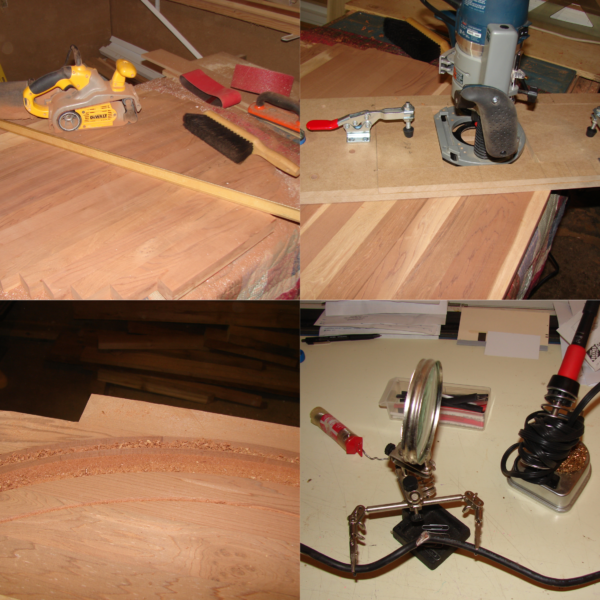
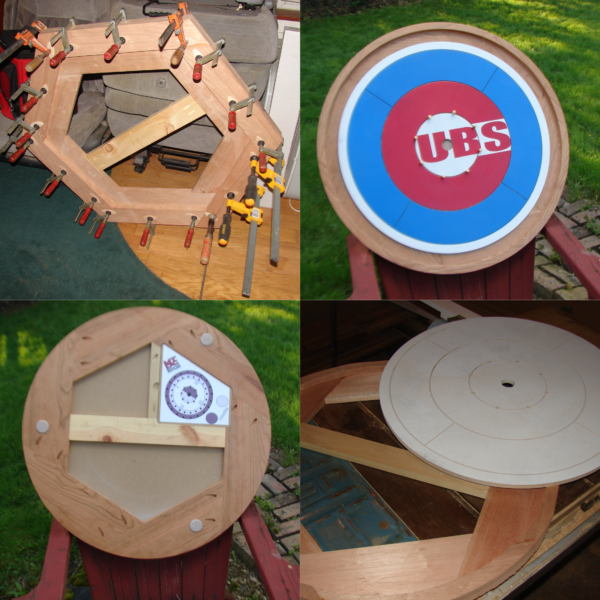
Crokinole Boards
Step 1. (not pictured) Get a job replacing some 2×4 handrails, discover that under the white paint is some beautiful redwood.
Step 2. Recall the game that Nephilium mentioned a while back, do some design work and determine that with careful resawing you have just enough material to make two crokinole boards.
Step 3. Select the best looking sides and layout and glue up the ~2×2’s into blanks.
Step 4. Build a jig for your router, you could of course use a store bought circle jig, but I wanted mine to also be a template for the peg holes and to use it as a guide for the straight lines as well
Step 5. Wish you owned a 32″ drum sander (or any drum sander) and attempt flattening the blanks with your belt and disc sanders.
Step 6. Get to routing, spinning router and jig round and round, round and round, round and round.
Step 7. Marvel at how well your jig is working, start round and rounding too fast and have an accident.
Step 8. Off to the soldering iron and the shrink tubing
Step 9. Get back to routing.
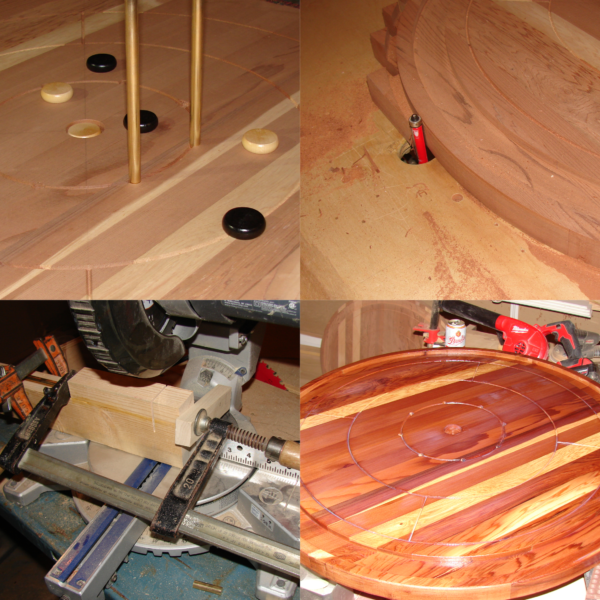
Step 10. Drill peg holes
Step 11. Glue sandpaper onto curved pieces of wood for some custom sanding blocks.
Step 12. Get to sanding
Step 13. Take time out to test drive your new game board.
Step 14. Use a flush cutting bit to trim excess.
Step 15. Make another jig to hold and cut brass pegs to size.
Step 16. put on a few coats of Poly.
Step 17. Glue in the pegs. Et voila, Bob’s your uncle, and there you have it.
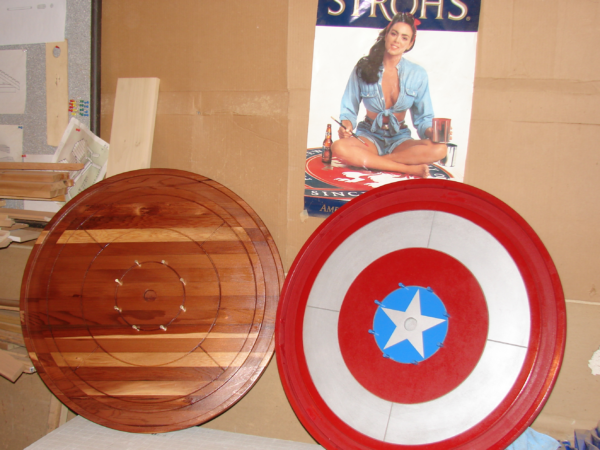
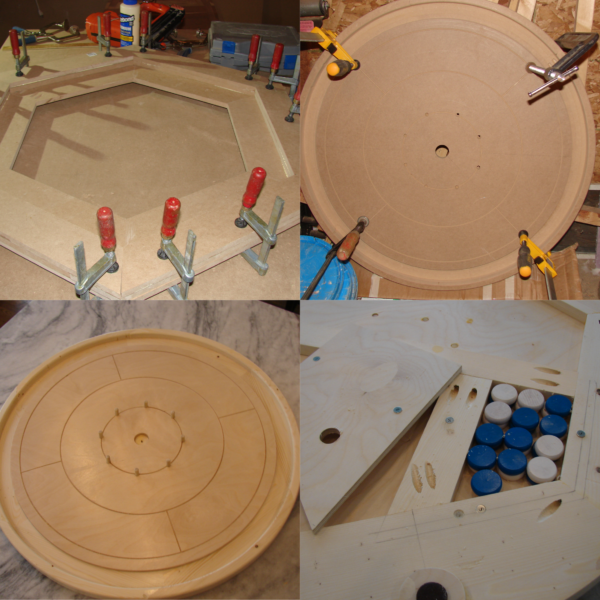
As you can see I also built a ‘Murica!! themed board for my Jarhead bother, I made it out of MDF built up in several rings to save material, which also allowed me to have the outermost lip higher than the playing surface which is a better design than the redwood ones, where sometimes over-shot or ricocheting biscuits will fly off the table instead of into the ditch. Since then I have built one out of standard pine 1×6’s for the frame and birch plywood for the top. I integrated storage for the biscuits on the underside.
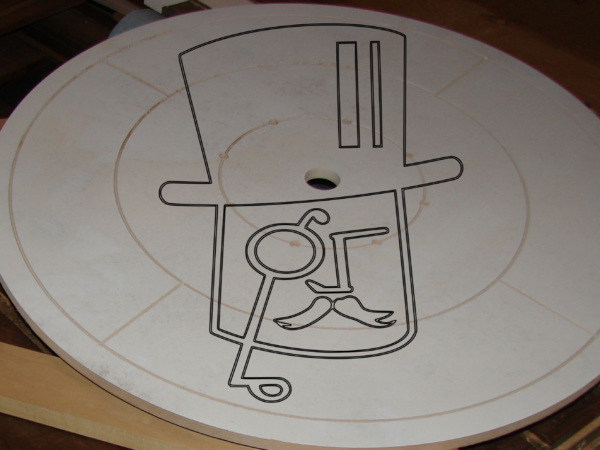
You may want to customize your tops and due to the circular nature of the playing surface one might be tempted to use any number of the many sports team or popular product logos that are often circular as well. Don’t do that, it would violate copyrights, and IP law. But don’t let that curb your creativity, for example, I made this one for the Ubs family, with a cherry frame. I inset the storage area lid which I also made into a scoring peg board. Currently I’m working on a mahogany frame and still have a blank playing surface, I wonder what I should put on there?
Yoots. True story: SugarFree and I were in a Walgreens near my house to pick up a few items. We got into a conversation with the kid at the register after SF made a joke about “dine and dash at Walgreens.” Apparently, their policy is not just forbidding workers from chasing thieves, but they are actually supposed to say, “Have a nice day!” as the perp runs out the door. We all had a good laugh, and as we were leaving, the kid ostentatiously said, “Have a nice day!”
Old Guy Music is a sweet piece from one of my favorite songwriters that SP reminded me about last night. The fact that the resolution to this story is left hanging is part of the charm of the song.
I know that many of you Glibs are fishermen or have had some experiences fishing, hopefully with your father or older brother as a teacher or guide. I remember with fondness the first time my Dad took me fishing, alone, with no older brothers along, just the two of us. An old wooden boat that leaked a bit (with a soup can to bail it out once in a while).
Small lake in Minnesoda, no cabins on it, appropriately called Mud Lake and for a reason. We got our feet wet walking through the swamp grass to the boat, but it was a going to be a glorious day. My Dad was fishing with minnows and he probably put one on my line. At some point of not catching any fish I found a skinny angle worm crawling in the bottom of the boat. I knew that those things caught fish so I rigged a worm on my short cane pole and before long caught a HUGE sunfish/perch/bream about 5 or 6 inches long. It was the first fish I’d ever caught! I was excited and happy. I pleaded with my Dad and he let me keep it, telling me I’d have to eat it and so on.
A while later I caught a bullhead, 7-8 inches long, and we repeated the process of keeping the fish. Now I was onto something, but no more worms in the boat but I didn’t care, I had caught fish! Not one but two! When we got back to the cabin I gave my Mom, who wasn’t a fisherperson, a blow-by-blow description of how men catch their fish. I was hooked and no pun.
I knew that I had to make some changes if I was going to be competitive with two older and experienced brothers the following year. I started saving money, begging, running cash errands, whatever it took because I needed a rod and reel, like my Dad, if I was going to chase the big ones the next summer. By Springtime I had put together a treasure chest of about 5 dollars, enough for some decent equipment. Not a Pfleuger or a Shakespeare maybe but some quality gear anyway. One thing I knew for certain, though, it had to have a level wind, not some kid reel but a real grown up reel like my Dad’s. By this time WWII was over and products of all sorts were available.
My Dad worked a half day on Saturdays, but agreed to stop on his way home and chose the best one he could find for my money. I gave him my life’s savings and one Saturday afternoon in May he came home with the nicest and best piece of fishing gear I’d ever seen, better than either brother’s, and the reel had a level wind. He’d thoughtfully bought a roll of 50 yards of black line, a bobber, some leaders and a small round tin with 50 assorted hooks. I was ready! I couldn’t wait ’til we went Up North to a lake cabin on vacation.
Like all things, vacation came, Saturday morning in June we had the ’35 Chevvie packed up and headed north. We were going to an honest-to-goodness resort on a small lake with beautiful clear water. My Dad would take the brothers out early in the morning, I could cast and catch fish off the dock and he would take me later in the day and we caught fish! I caught fish! Mostly sunfish, a few bass and northerns, maybe some perch and bullheads, I don’t know but I pulled my weight. The week flew by, but I was equal to anyone and my Dad bragged equally about my fishing skills.
As time went by I learned a lot watching and reading about fishing and hunting. We had lots of sports magazines around, reading the stories and exploits were a great winter’s pastime and summer fishing always was good times.
Time passes and as I got older I did more and more fishing with my next older brother, but he wasn’t quite as passionate as I was. As we drifted off to explore the world the fishing opportunities sort of receded into the background. I ended up in Spain sitting at the next desk to a man that was consumed with fishing and hunting. He lived to fish and quickly made me his sidekick. We talked all day and spent many Saturdays fishing in the nicer weather and hunting ducks when the rain fell in the winter. He taught me about quality equipment, got me interested in skeet/trap shooting and brought me up to date on all the latest techniques and I was back on board, adding reloading to my repertoire.
As life progressed and I got back to my old neighborhood I had the opportunity to be that kid again, only now with a boat and motor and lots of quality equipment. Instead of one bait casting reel I have a dozen and more, 3-4 tackle boxes with stuff I will never use, the folly of every fisherman. Now the problem is not finding the time but rather the difficulty of getting out of the recliner.
Yesterday was one of those life’s moments that a person wants to relive over and over. My youngest grand daughter came and wanted to go fishing. She hasn’t had much of an opportunity in doing some fun things because of school and other interference in her life but she recently graduated from college and has a little time. Anyway, we fished and talked about life, I outfitted her with some quality stuff and we caught enough fish for lunch today. She helped me clean the fish, didn’t mind the guts and smell, though her skill level needs to be upgraded some what but that will come in time.
She wants to get the hunting /shooting class done so she can sit in a deer stand this fall. We’ll start the gun handling in a couple weeks and with enough practice and patience (on my part) she will be ready by fall. My own kids never expressed much interest in hunting so this will be enjoyable for both of us. She’s an outdoor girl and if things work out the way I hope she’ll be the owner of a Marlin 336 this fall.
I think she will work on her oldest sister and encourage her to join us for the shooting fun. Both of them claim libertarian leanings so we’re off to a good start already.
Oh yeah, we had venison sausage for breakfast, Grandma cooked the fish for lunch. This girl knows how to pull on a Grandpa’s heart strings and make Grandma happy by eating everything on the menu. I’m so glad that my own parents put up with my nonsense and let me spear suckers in the spring and how to run when I saw headlights on the road. These kinds of memories will be lost to the kids with their phones and games.
Good morning my Glibs and Gliberinas! And what a glorious morning it always is as politicians and the media suddenly give a shit about Epstein. So stunning. So Brave.
As good glibertarians, I know none of you actually touch pocket change unless it is a gold coin minted in Galt’s Gulch. However, I also know all good glibs have an orphan with them at all times to carry your coinage in a monogrammed satchel. This short piece may give you tips to convey in your “Daily Instructions” to your change orphan on what coins to save and which to circulate.
Coinage is as old as the concept of money itself. In fact, it is thousands of years older than script, and until relatively recently, the most valued script was tied to specie. “In Specie is a Latin term describing the provision of an asset in its physical form rather than in the cash value of the asset.” (Merriam-Webster) The most common forms of coinage since ancient times have been gold and silver with copper reserved for small denominations. The same was true for the United States from 1793 until 1933 when FDR withdrew gold coinage and the death blow was in 1965 when LBJ effectively killed silver coinage. Today all general circulation US coinage, except for the nickel is clad. Some “real” money is still in circulation and I have given my change orphan “Warty strict” instructions to locate it and present it to me so I can remove these coins from circulation for the bullion value.
The US does still mint some silver and gold coins for collectors, but that coinage is not designed for general use so I will not discuss them. These gold and silver coins have nominal denominations making them legal for use- but if they enter circulation it is because of a FU in a bitter divorce or family members not knowing what the recently dead relative had saved.
I also won’t be covering obsolete coinage, it is still legal tender*, but your orphan won’t be getting any 2 or 3 cent pieces handed to them at your local store. So bellow for your orphan to “Bring me my change satchel most ricky-tic and then get prostrate in front of me NOW!” Let’s examine what we may find.
The Cent
The cent has traditionally been made of copper and Abe Lincoln has been going strong on the obverse (front) of the cent since 1909. Your change handling orphan will see plenty of these. The three versions are the Wheatback (1909-1958), Memorial (1959-2008), and the Union Shield (2010-date). There was a special 4 different design issue in 2009 for Abe’s 200th birthday. Most cents can be just put back into circulation without a second thought. Cents were copper from 1793 on, but since 1983 they are a minted with a very thin copper plate over a zinc (spit) core.
However, I advise you inform your coinage orphan to save all copper cents. The test is easy. All cents minted in 1981 and before are copper (with exception of 1943). Also test all 1982 cents by dropping them on something hard and listening to the sound made. A dull sound means it is zinc, a good clear ring means copper. If you can’t tell the difference- drop a cent from a copper year with any post 1982 cent-after a couple of drops, the difference will be clear. A copper cent has a $0.018 melt value so copper cents have almost doubled intrinsic value. (All melt values are from Jun 26, 2019)
Wheatback cents have an even higher numismatic (coin collector) value than their intrinsic (bullion) value. Older Memorial cents in a shiny copper state and with little wear also have a higher numismatic value. Among the zinc (spit) cents, only the 2009 series have any numismatic value.
Your orphan will probably not find a 1943 cent in circulation since they were steel with a shiny zinc covering. If one is found it will be nearly black. The War demanded required lots of copper and this was an experiment on saving copper which failed. The coin was hated by the public because of the similarity to a dime when new and turning dark quickly. This bad idea was ditched before the end of the year. In 1944 and 1945 cents were partially made with melted down shell casings from training ranges in the US in order to free up “fresh” copper. It doesn’t make them more valuable, but are interesting to see. If your orphan finds a 1943 copper or 1944 steel cent you are doing very well since these rarities are worth north of $1,000,00 for a 43 and over $100,000 for a 44. I will be called a softie for suggesting it, but you might consider giving your change orphan an entire White Castle burger for finding such a rarity for you.
The melt value of the current cent is 0.0067¢, but today the cent costs almost two cents to make, so make of that what you will.
The Nickel
TJ, the man and not the store, has been rocking the front of the nickel since 1938. The nickel has remained a 75% Copper and 25% alloy since it was first minted in 1866. The exception is during WWII. Then the nickel was minted with 35% silver and 9% manganese. More about this later.
The modern nickel hasn’t changed much with two exceptions. During the Lewis & Clark bicentennial years (2004-2005) each year featured two different reverses for the Corps of Discovery. They have a slight numismatic value so you might want your orphans to hold them out for you, but then again you may not. In 2006 the traditional Monticello reverse returned but the obverse changed to Jefferson facing the observer. This didn’t change the value but changed the look.
Have your orphan hang onto all 1942-1945 war nickels they encounter since their bullion value is $0.86. They are easy to tell since they have large mint marks (P, D or S) above Monticello’s dome on the reverse. (See picture above) War nickels also have what I would call a streaky or greasy look from their alloy. Your orphans may want to follow metal prices since the nickel may get the content changed because the bullion value hovers around the 5¢ face value. The mint has experimented with several designs but can’t get one that meets lifespan tests while being recognized by vending machines.
When I was a kid in the 60’s you would find an occasional “Buffalo” nickel (1913-1938) in the change. If your orphan finds one you might want to pretend to smack them for having a counterfeit, but then smile at them since the coin is real. But odds are the date is worn off and it is only worth face value. (You would think that with 120 years of minting experience the mint would have known not to make the date the highest point on a coin, but with government employees watchya’ going to do?)
The “Clads” or Former Silver Coinage
From 1793 until 1965 dimes and larger denominations were minted with a 90% silver content. The debasement of coinage in 1965 stemmed from the value of the silver exceeding the face value of the coins starting in 1963. By 1964 there were severe shortages of coinage since people were saving the coins for their bullion value and not using them. When the same issue happened in the 1800’s Congress just made the coinage slightly lighter. The new lighter coins were the same design but with arrows by the dates. The “with arrow” coins returned to a face value slightly greater than the bullion value so they remained in circulation-problem solved. In 1965 Congress went a new direction and just debased the hell out of coinage. Henceforth dimes and quarters would be cupronickel and the half dollar was debased from 90% silver to 40% silver. In 1971 the half dollar was further debased to cupronickel.
The most important thing about the older bullion coins is that they still have an intrinsic value that far exceeds their face value. Currently it runs about 11 times face value. Your change orphan can tell these coins at a glance because of two key qualities: 1) they have an obvious different color of real silver vice the current cupronickel tone which should attract their eye. (If there were any libertarian women they could instantly tell you the difference in look between silver jewelry and “silver” jewelry and be happy to explain it while beating you for trying to give them junk.); 2) silver coins have a single color side and cupronickel coinage looks like a copper sandwich. If your orphan’s eyesight is less than optimal (why is he your change orphan then?) just note the date. Save any dime or quarter minted 1964 or before. Again, silver is worth 11x face value and clad is worth 5-8% face value.
If your vending machine orphan notes a young lass running a coin through a vending machine over and it is rejected each time have them be a gentleorphan. They should approach the lass and ask if they could be of assistance. Have the orphan examine the coin and offer to trade the lass a shiny new coin to replace the icky old silver coin that stands between them and their stale vending machine Poptart. One of the last silver quarters I found in the wild was obtained with precisely this bit of generosity. (Yes, I told her, and yet her hunger was more important than silver to her.) That is correct, vending machines may take a credit card but do not recognize legal silver coins.
The Dime
While it is tempting to demand your change orphan never let you see the obverse of the FDR dime, scratch that. I advise you to tell your change orphan to never let you see this coin. The likeness of FDR has been polluting change drawers since 1946 without a significant change- boring. Have them save all dated 1964 and before since they have a bullion value of $1.11, the rest should be kept away from your gaze and returned to circulation.
“Two Bits” or the Quarter
George Washington has had his slave owning, cis-heteronormative face on the quarter since 1932 but the reverse of this denomination has been a palette of history in 1975-1976 and since 1999. This is the most interesting coin currently minted by the US. It is very common and you will need to give your change orphan clear instructions on which quarters to save and which to place back into circulation. The first instruction for your change orphan I recommend is to save all minted in 1964 and before since their bullion value is $2.77. Now the instructions will become more personal. The Washington quarter is on track to have over 100 different reverses since 1999. On one extreme is “Fey! All coins minted since 1965 shall be immediately returned to circulation less the cruel stench of cupro-nickel befoul me.” The other extreme is, “Save and classify each quarter then lay them before me on baby seal skins so I may admire them as I snack upon a bald eagle egg omelet and quaffing champagne.” I recommend having your orphan identify any quarters you may like and circulate the rest.
The first change was for the Bicentennial celebration. Special quarters, halves and dollars were struck with 1776-1976 on the obverse and a bicentennial themed reverse- the quarter had a drummer boy. Then in 1997, over the objections of the Treasury Department, the Congress mandated the 50 State Quarters program. Five states were featured each year, in the order of entering the Union. The program was later expanded to include the territories and DC. Congress liked the program so much it basically repeated the program with the “America the Beautiful” featuring natural highlights (national parks etc.) starting in 2010 and running through 2021. There are too many images to show, but here are links to the various reverse sides.
The interesting thing about the state program is that each state developed and nominated the design for “their” quarter. The mint then tweaked the design to meet the demands of mass production. Some states clearly put effort into it, others not so much. (I’m looking at you Michigan, Texas, and Wyoming.) The current quarters run to lots of damn birds looking pretty much the same, but the Louisiana quarter has a very good image of a wild turkey in flight. My only advice to my fellow glibertarians is that if a particular reverse is striking to you, go ahead and have your change orphan save your choices and keep the rest in circulation. In addition, you may want to have your orphan quickly check to make sure no silver proofs are in your change satchel. Proofs are struck in silver on specially prepared blanks and double struck to bring out all the details. No proofs are released into general circulation, but my orphan found a proof Iowa quarter which I kept. Evidence once again of a bitter divorce or a family not realizing what grandpa left to them in his will.
Half Dollars
This coin is rarely encountered in the wild. Because of that, it is one of the easiest denominations to find bullion coins when your change orphan gets one. I really dislike the Kennedy Half Dollar because it is an unapologetic suck up to the cult of the imperial presidency. The reverse is nothing more than the presidential seal. The Bicentennial version at least has Independence Hall on the reverse. The 1964 mintage were HUGE because of the recent assassination and were saved by the millions. I recommend saving them because they are 90% silver and contain $5.54 in silver. From 1965-1970 the coins were debased to 40% silver but are worth a respectable $2.26 in bullion. From 1971-2001 the coin was struck in cupro-nickel. Since then it is no longer minted for general circulation. If your orphan finds a recent year half is from a cut apart uncirculated set (matte finish) or a silver proof.
The half dollar was a popular coin and in wide circulation until the 1963 coin crises. The large quantity of silver made this denomination the first to leave general circulation. Then millions of the new Kennedy dollars went straight into collections for several years. With the shortages of half dollars in daily use Americans grew out of the habit of using them. The lack of coins in circulation meant vending machines stopped accepting them and the coin withered away. But this long term lack of use is a good situation for a glibertarian. When your minions do actual in the bank banking have them ask for a roll of half dollars. Chances are decent your help will identify some silver coinage. My monetary orphans have even found earlier (Ben Franklin and Walking Liberty) halves in a roll handed over by unsuspecting bank tellers as recently as three months ago. If there is nothing but Kennedy Halves in the roll, enjoy watching clerks look at your orphan with WTF? faces when they use these coins to purchase goods and services.
Dollars or “cartwheels”
The true “silver dollar” of lore was last minted for general circulation in 1935 (melt value $11.84) and will not be found in your change from the “Mexican Pot and Ass Sex Shop”. Your orphan might approach you with an Eisenhower Dollar (1971-1978). This coin features the patch from the Apollo 11 mission on the reverse (except for the Bicentennial version). Make a quick check for of the side to see if it is a 40% silver collector version and smile benevolently since your orphan found a $4.84 bullion coin; if it is a copper sandwich, curse them mightily for wasting your time.
If your change orphan has been hanging around Post Offices, NY, SF or DC subways and other suspicious locations, get them deloused and their rags promptly replaced before checking the change satchel. Inside you may find the modern small dollar coins. There is actually a law mandating that PO’s and transportation systems accepting Federal dollars must have vending machines able to accept and disburse dollar coins. Among the usual coins there might be some coins that look like a slightly oversized quarter with an angry woman on the front and dated from 1979-1981 and 1999. These are the Susan B. Anthony dollars. The “Susie” is one of the stupidest outpourings from the government. The vending machine and casino industries desperately wanted a dollar coin that was better sized for their customers and the government responded by making 1,500,000,000 or so coins that were almost exactly the same size and color of the quarter. Casinos, merchants and the public were not amused and the coin was rarely seen. Even today store clerks curse me when my change orphan offers Susies in exchange for a good or service.
Congress told the Treasury Department to try again with a “gold colored” coin and in 2000 the Sacajawea Dollar was released. Unfortunately, it is a clad coin of little intrinsic value. Fortunately, the mint designed well and this coin is quite striking. It is easy to use and tell from smaller coinage, with smart designs on both sides of somebody besides a president. In the 18 years since the Susie was thrust upon the American people the vending machine and casino industries developed other solutions to the shortage of dollar coins so the new dollar coin never became popular. Since this was an attractive coin, Congress mucked around again and decided to change the reverse each year starting in 2009. Now this dollar is the most PC coin the nation produces. Each year a new Native American theme is on the reverse. While none of the designs will make your orphan gag from ugliness (yet), they aren’t as striking as the original eagle in flight. (2019 features “Native Americans and the space program”) But the law since 2007 requires that 1/5th of dollars produced each year must be in coins- so these dollars are stacking up in vaults by the many tens of millions annually since demand does not meet supply.
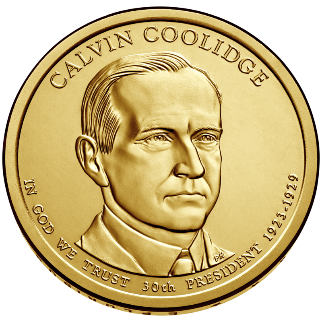
The final coins that might emerge from the satchel are the Presidential Dollar coins. Why were these coins made? Because if a striking coin like the Sacajawea dollar isn’t being widely used it must be time to double down.** In 2007 the new coins were released with four presidents a year until they caught up with the last dead president. The reverse features the Statue of Liberty. The new coins caught fire like a water balloon and by 2011 there were 1, 400,000,000+ uncirculated coins stockpiled. So Washington (1) to Garfield (20) were released for circulation. From Chester Arthur on the mint struck only smaller numbers (still around 10,000,000 each) for collectors. These later coins are legal tender and occasionally found in general circulation as well. Reagan was the last president on a coin. To satisfy my Glib heart, Jimmy Carter was never on a coin because of the requirement that the ex-president be actually dead. My orphan has found an occasional proof version of a presidential dollar and brought it to my attention. They are worth about $2 each. So go ahead and circulate them freely since your tax dollars purchased hundreds of million extra.
The GAO has published a report that if the Bureau of Engraving stopped making $1 bills and the country switched to dollar coins it estimates a savings of at least $5.5B over thirty years. With the billions of coins sitting in vaults and already produced I think that estimate is probably low. The vending industry is now fighting retiring the dollar bill because it invested heavily in adding bill readers to vending machines.
That’s About It
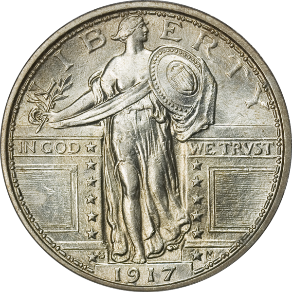
One other place that I have found silver coins for face value or less have been estate sales. Families often don’t know what grandpa was saving so coins appear in a variety of ways. I once picked up eleven Standing Liberty quarters for five cents each because they were in a bowl as “movie prop money.” The selling agent clearly did not know what she had in the estate. Another time my ex came home from an estate sale with a few minor purchases. A few days later I needed some change and found two silver quarters that she just got as change at the sale. Of course it was too late for me to go back and get more real quarters in change.
The story of America’s money changing from representing Liberty as an ideal to a collection of small scale tokens of presidential worship is an interesting one and perhaps the subject of another article in the future. Now please excuse me while I go swim in my collection of gold coins.
Oh yeah. Here are a couple of websites to help you determine the melt value of your American coinage.
*The Trade Dollar (1873-1885) was a dollar minted for overseas use, primarily in China. It was demonetized by Congress in 1876 to prevent their use in the US. Congress re-monetized the Trade Dollar in 1965 when it was too late to matter.
** Not really. The dollar and quarters programs rely upon seniorage to “make” money for the Treasury. Quarters cost around 4 cents to make, but the Treasury sells them to the bank for 25 cents. That means the Treasury has a reserve of 21 cents per coin which in theory reduces the amount of funding required from Congress. Collectors also create seniorage by removing coins from circulation and then they are not turned in as damaged for replacement. During the quarters program alone collectors have created an estimated $6B in seniorage.
Tomorrow my wife takes a guild test that determines whether or not she’ll be allowed to practice in the field she spent two years in school for. Things are a little… tense… around here today. We don’t have a cat to kick, so I’m filling that role for the household. “See that scar? Its about the size of a cigar. That’s what happens when you fail to make breakfast properly in my house.” Kidding. She’s just freaking out and not really talking to me.
If it is true that the Trump administration has learned restraint… the world may never recover.
Duke Nukem is dropping out of the Dem primary. Seriously, if you can’t make it to Iowa or New Hampshire, what the fuck are you doing declaring your candidacy?
39 warning shots? Is this guy a cop? Nice that his 12 year old son saved the day with a wrench. (h/t FdA)
Note: A preview from my upcoming autobiography, Life’s Too Short to Smoke Cheap Cigars (Or to Drink Cheap Whiskey.)
Modern Wildlife
Modern “wildlife watchers” are amazing.
Urban Wildlife.
We used to call such folks “birdwatchers,” but now they watch all manner of wildlife. In the stretch of mountains where I regularly spend days and long weekends loafing around, (I disguise my loafing by calling it ‘fishing’ or ‘elk hunting’) even the skunks are beginning to complain about the retinues of binocular-wielding humans that follow them around all day.
Not even urban wildlife is safe from the prying eyes of humans. I recently saw a couple engaging in some wildlife watching in the urban environs of Denver:
“See, just to the left of that dumpster. It’s a Bearded Wino.”
“No, honey, check your Field Guide. That’s a Mustachioed Dumpster Crawler.”
I quickly stepped in to correct the wildlife watching couple. “You’ve got the older edition of Urban Wildlife of the Western United States,” I told them. “You should check the new politically-sanitized edition. What you have there is a Facial-Hair Enhanced Residentially Challenged Person.”
In the Beginning
My own bird and wildlife watching began at an early age, at least in part because I was surrounded most of the time by various birds and critters; it was hard not to watch them. In fact, sometimes the wildlife would watch you, which could get downright unnerving.
At the tender age of twelve, a youth spent mostly in the hardwood forests of Northeast Iowa had taught me about most of the local flora and fauna, including the ubiquitous Barred Owl. These birds were known locally as “hoot owls” after one of their calls, a characteristic series of deep hoots, boomed out in a ringing, “Who cooks for you – who cooks for you-ALL.”
I’m not sure why the locals chose that name, though, because no other bird alive today is capable of the cacophony of screeches, wails and howls as the Barred Owl of the upper Midwest. The very presence of this virtuoso of the nighttime woods was the source our terror that dark night, as it was on many other nights in the deep forest.
I don’t know what possesses young boys to wander around in the woods at night. A nighttime forest can be a rather friendly place at times. In winter, when the leafless trees allow the moonlight in to reflect off the snow, the light will be bright enough to cast sharp shadows against the snow. But, in the late summer, when the trees have grown thick canopies of leaves that block out all but glimpses of the stars and the moon is new, the woods can be so deeply pitch black that navigation gets hazardous.
It was on just such a pitch-black night that my cousin, childhood friend, fishing buddy and partner in various mischief Bill and I decided to take a short cut through the woods, up a steep hill and across a meadow belonging to the Girl Scouts of America. The reason we decided to take this hike was simple, we had been fishing on the lower reaches of Bear Creek and my parent’s house was a good three miles if we followed the road back, but only a mile if we cut over a ridgeline, across the Girl Scout camp land and through my parent’s woods down to the house. Simple, right?
Twelve-year-old boys never undertake anything simple.
Whippoorwill.
The hike started out great. In the relatively open ground of the creek bottom and the power line cut leading up to the Girl Scout land, starlight provided enough light even in the new moon. We couldn’t see much, but it was enough, and the friendly calls of whippoorwills accompanied us.
Not many people these days get to hear whippoorwills, their numbers have sadly diminished, due in large part to agricultural chemicals and habitat loss. In our youth they were legion, and the endless repetition of their namesake call rang through the woods at night all summer long. They called back and forth across the meadows on the hilltops, “whip-poor-will, whip-poor-will” and if you got close enough, you could hear the faint “chuck” at the end of each call. You might even catch a glimpse of the cigar-shaped body and rounded wings of the birds as it fluttered to a new calling spot.
Bill and I had a great time walking across the open ground leading up to my folk’s upper meadow, trying to locate each whippoorwill as it flushed. But that changed when we entered my parent’s woods, under the great overhanging oaks and hickories. The whippoorwills stayed out on the edges and didn’t venture far into the thick forest. In the tall trees our vision was useless as even the faint starlight was blocked out. The darkness was a tangible presence as we slipped silently through the forest night. Our eyesight was useless, but we knew danger was everywhere. Strange sounds echoed through the trees, eerie presences whisked by overhead, and small things scuttled past underfoot. A cold breeze rattled through the tree branches.
“I can’t see a dang thing!” Bill exclaimed.
I was waving my hands out front, feeling my way from tree to tree. “Don’t worry about it, I know every tree in these woods.”
Bill wasn’t too comforted by my show of confidence.
But Then…
The Barred Owl.
The silence of the forest was broken by a series of eight deep, booming hoots from the hillside above and behind us.
“Hoooo-hoo-hoo-hoo. Hoo-hoo-hoo-hoo-awww.”
“Hoot owl!” I told Bill. “I ever show you how I can call hoot owls?”
“No,” Bill replied, “But right now I’d rather you show me the way back down to your house.”
“Aw, c’mon.” I insisted. “Watch this, it’s great.” I tipped back my head and howled back at the owl: “Hoooo-hoo-hoo-hoo. Hoo-hoo-hoo-hoo-awww.”
Three answering series of hoots sounded from varying directions. “Geez, Bill, I got three of ‘em answering! This will be great!” In the silent darkness, I somehow got the impression Bill was adopting a skeptical expression.
“Hoooo-hoo-hoo-hoo. Hoo-hoo-hoo-hoo-awww.” I howled again at the birds. Three answering series of hoots rang out, closer now.
“See, they’re coming right in! Watch this, I’ll call them right in on top of us.”
“I don’t think I like this. Maybe you oughtta leave the owls alone.” Bill advised. Despising Bill’s sudden display of the better part of valor, I belted out another owl call.
“Hoooo-hoo-hoo-hoo. Hoo-hoo-hoo-hoo-awww.”
Silence.
“Maybe we better head on back now.” Bill whispered. An ominous presence seemed to be gathering around us.
Owls, you see, can fly in complete silence, due to soft downy edges on their flight feathers. This feature enables them to float softly up on an unsuspecting rabbit or mouse; it also enables them to drift in on what seems to be a strange, rival owl calling threateningly on the edge of their hunting range. They will do this even if the strange rival is really a twelve-year old boy.
As much as I can reconstruct from the awful moments that followed, three owls drifted in on silent wings, each expecting a rival, and each finding one – the other two owls, in fact, that I’d likewise tolled in with my patented owl call. The first owl to sense the others must have reacted in typical hoot-owl fashion.
One moment Bill and I were crouched silently under the giant oaks, listening carefully to a night where a few insects seemed to be the only other living things about. The next, a horrifying sound split the night wide; a cross between the wailing of a lost soul, and the enraged screech of a wildcat attacking to defend her young, cast forth at the decibel level of a train whistle. The other two owls responded in kind.
The scream of an enraged hoot owl facing an adversary would cause an axe murderer to cringe in terror. We were two twelve-year old boys with three of them sending horrifying challenges ringing back and forth in the trees above our heads. Only one course of action lay open to us.
“RUN!” Bill shouted.
“FOLLOW ME!” I shouted back, already shifting into high gear. “I KNOW EVERY TREE IN THESE…”
WHAMM!!!
A rock-hard object hit me in the face, an explosion of light resolved slowly into a constellation of stars, wheeling slowly in front of my face. “Funny, I thought the trees were too thick to see the stars here, and why are they spinning?” Then I realized I was laying on my back. I’d run headlong into a white oak tree.
The shrieks of three maddened banshee owls rang through the night; faintly, I could hear the crashing of Bill’s fleeing tennis shoes. Then, WHACK! Bill charged into a shagbark hickory with enough force to drive bits of bark into his forehead.
I managed to get to my feet, terror of the horrible wailing driving me on. I’d gone perhaps ten feet when I clipped another tree trunk in the pitch dark and went spinning to the ground again. A few feet away, I heard Bill using language that would have caused his mother to run for a stout switch, as he proceeded to slam into tree trunk after tree trunk like a small, frightened ball in a giant, darkened pinball machine.
Somehow, slamming from tree to tree in the pitch dark, we managed to make it back down the creek bottom to my parent’s house. In the dim light shining from the porch, we splashed across the creek to collapse gasping in the front yard. The owls still screeched faintly in the background.
“Well,” I informed Bill, in between gasps, “I told you I knew where every tree was.”
I’m amazed to this day that Bill had the strength to attack me after our ordeal, but attack he did, and I fought him off at the cost of a black eye and two badly bruised fists.
As It Stands
In years following, I spent many a night in the woods, listening with great enjoyment to the wailing of hoot owls in their nocturnal battles, and I even called a few more in by mimicking their eight-hoot call. I exchanged a few conversations with owls perched in trees right overhead, their sudden challenges never frightened me again the way they did that first time. To this day, the call of a hoot owl fills me with nostalgia. Deep inside, though, somewhere down in the recesses of my psyche, there remains a twelve-year old boy who will always know a few moments of panic, recalling that night. I generally get over that moment of dread. Of course, I do have my confident knowledge of the northeast Iowa forests to my advantage.
I hope all of our Kaleforniuh Glibs are safe, after the earfquakes and aftershocks. A lot of ill-will is sent CA’s way on these pages, but I would think we could all agree that we don’t want people hurt and things broken.
There, with the kind thoughts expressed, time to link (not so kindly):
Yes, because Georgia is clearly looking to pick a fight with its smaller neighbor… Russia. Like the Russians need some cheap excuse to pry another piece off of the “near abroad”. @#$% slavers.
Looks like UK Labour has decided to mimic TEAM BLUE here in the US. What on Earth is the matter with these people?
No word if STEVE SMITH has vacationed in the Balearic Islands.
STEVE SMITH STILL HAVE TROUBLE CRYPTIDS LOCAL 701. SOMETHING MAKE LEADERS #RESIST. THEM MORE AFRAID SOMETHING THAN STEVE SMITH. STEVE SMITH CHANGE THAT. HIM ASK FRIEND ZARDOZ VISIT. HIM HAVE “CHAT” WITH LEADERS. BY CHAT, MAY MEAN CLEANSE. BUT YOU NO HERE LISTEN STEVE SMITH WOE. YOU WANT PREVIEW. SO HERE IS PREVIEW. OF WEEK.
MONDAY – ANIMAL TELL US MORE OF HOME PLACE. HAVE OWLS IN IT. DBL EAGLE TALK COINS. STEVE SMITH NO USE COINS. HIM LEARN SOMETHING.
TUESDAY – FOURSCORE GO FISH. STEVE SMITH CAN FISH! THEN, THE HYPERBOLE TEACH WORK ON BOARDS.
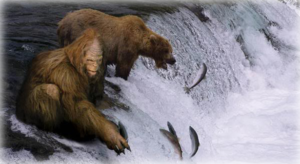
STEVE SMITH FISH BETTER THAN BEAR!
WEDNESDAY – BRAIN GET SCARED BY HAT AND HAIR. BUT ALSO LAUGH. THEN Q HAVE BRAIN DUMP.
THURSDAY – NEW SERIES? IT HAVE ZOMBIE, BUT IT SECRET ZOMBIE. BY TRSHMNSTR. LATER, NAPTOWN BILL TALK SOCIAL MEDIA.
FRIDAY – WINSTON MOM STOP BY, SAY HI. BY “SAY HI” MEAN MAKE FUN GOOFY NYT MAN. AND STEVE SMITH SEE IF STILL BUSY WITH TROUBLE. IF CAN, WILL POST.
WEEKEND – OMWC, NOT ADHAN AND SPUDALICIOUS POST GOOD THINGS. MAN WITH TINY DOG THAT STEVE SMITH TAKE, AND THEN HIM TICKLE STEVE SMITH WITH AR-15, HAVE GOOD POST TOO.
Happy skies this week! First off We have Venus and Mercury aligned with the Sun. This is an astrology 101 sign: “Lucky in Love.” Also related is Saturn retrograde in alignment with the sun and the earth which signifies a new beginning at home, or that your house will be swallowed by a sinkhole. Consult your local geologist. Trying to have a little somethin’ somethin’ on the DL? Venus in Cancer has got you covered… this week at least. Leo plays host to both Mars and Mercury which is pretty awesome news for my chances at the action pistol tournament and for anyone else engaging in games of chance, speed or martial skill. The moon in Virgo sends out powerful feminine energy and helps with navigation and medicine.
While the skies are happy, the cards aren’t. Three quarters of the cards are reversed, but on the not-quite-as-bad side, most of these cards aren’t terribly potent. Also, Lachowsky will get that job offer.
Cancer: King of Swords reversed – Cruelty, evil intentions, breach of faith, barbarity, perversity
Leo: The Sun reversed – Material happiness, fortunate marriage, contentment, though less than if the card had been upright
Virgo: 8 of Coins reversed – Voided ambition, usury, vanity
Libra: 7 of Cups reversed – Desire, will, determination
Scorpio: 6 of Wands – Triumph, great news, hope
Sagittarius: The Tower reversed – Oppression, imprisonment, tyranny
Capricorn: The Emperor reversed – Benevolence, compassion, credit, confusion to enemies, immaturity, obstruction
Aquarius: 3 of Swords – Removal, absence, delay
Pisces: 4 of Coins reversed – Suspense, delay, opposition
Aries: 9 of Swords reversed – Imprisonment, doubt, fear, shame
Taurus: 3 of Cups – Conclusion of a project, plenty, merriment, healing
Gemini: The World – Assured success, voyage, flight