Author: Animal

  • Thirty-Something Rifle Cartridges II – The Thirty-Threes

    Thirty-Something Rifle Cartridges I:  The 33s

    I find the thirty-threes to be some of the most useful of the thirty-something calibers for the North American game fields.  Most of them are easily capable of taking the largest American big game.  There is a wealth of projectiles available.  Some of them, like Winchester’s excellent .338 Winchester Magnum, have been around for decades, and as a result there is a great deal of loading data available.

    As a result, there are a lot of .33 caliber rounds out there to discuss.  So, without further ado…

    At the End of the Black-Powder Era…

    As we saw back in the series on level guns, the famous John Browning/Winchester collaboration started with a big, tough lever gun called the Model 1886, which could handle some pretty heavy cartridges.  In 1902 Winchester made this rifle available for a new cartridge, the first commercially available thirty-three, the smokeless-powder .33 WCF.

    This was a pretty hot load for its time, launching a 200-grain cast bullet at 2,200 fps.  With more modern, jacketed bullets, it quickly gained a reputation as a hard hitter, ideal for deer, elk and bear at ranges out to about 200 yards.  Besides the Model 1886 Winchester, it was also available in the 1885 single-shot and the lever-action 1895 Marlin.

    The .33 WCF was interesting because it came at a transitional moment in American shooting.  As we’ve noted previously, the end of the Great War resulted in a lot of American shooters and hunters returning home with the memory of their issue 1903 Springfield and Pattern 17 Enfield bolt guns in mind, along with the powerful .30-06 round they fired.  The lever gun was due to lose some popularity; the age of the bolt gun was dawning.

    And the .33 WCF, while a groundbreaking round, was a rimmed lever-gun cartridge.

    The .33 WCF was offered in the Model 1886 until 1935, when Winchester replaced the 1886 with the beefier Model 71 and its .348 Winchester cartridge.  But this first of the thirty-threes had set the stage for some modern bolt-gun rounds to come, and one of those pioneering bolt-gun rounds came (in part) from the mind of someone we’ve discussed before:  Elmer Keith.

    The Mid-Century

    Early in the 20th century Elmer Keith, along with his colleagues Charles O’Neil and Don Hopkins, developed a new .33 wildcat based on the .30-06 case necked up.  The .333 OKH was intended to use the same .333 diameter bullets as the .333 Jeffries then popular in Britain, and while it delivered some good performance it was hampered by the lack of bullets, and since wildcatters live and die by the availability of suitable projectiles, this didn’t bode well for the .333.  The logical evolution was to increase the bullet size to .338, resulting in the .338-06 wildcat.

    This same trio also developed the .334 OKH, based on the .375 H&H case; this ended up being remarkably similar to the .340 Weatherby Magnum, about which we’ll talk in a moment.

    In fact, the tale of the mid-twentieth century thirty-threes is somewhat convoluted, with plenty of wildcats and experiments mixed into the developments by major gun and ammo manufacturers.  But one thing very quickly became apparent – launching a big, heavy projectile at significant velocity called for a magnum-sized case.

    Precedent was already in place.  During WW2 Roy Weatherby had introduced three standard (2 ½”) length cartridges based on the .375 H&H belted case, shortened and necked down.  These three were the .257, .270 and 7mm Weatherby magnums, and they soon gained a following among those fond of high-velocity rounds.

    In 1958, at the urging of Elmer Keith, Winchester took that precedent and applied it to Keith’s and others work with the medium bores.  They followed Weatherby’s example, took the .375 H&H case, shortened it to fit standard-length actions, straightened the case walls a tad and necked it down to take a .338 pill.

    The result of this was the great .338 Winchester Magnum, introduced along with the .264 Winchester Magnum and the .458 Winchester Magnum as a family of cartridges.

    Now the American sportsman had a real world-beater.  The big new medium-bore magnum put out a 225-grain projectile at 2,800 fps in factory loadings, and with the right slug would easily handle any North American big game, including big Alaskan grizzlies and moose.

    The .375H&H, .338 Win Mag, and a quarter for scale.

    It should come as no surprise to anyone that’s been paying attention that this round is a favorite of mine.  My .338, Thunder Speaker, is built on a 1908 DWM large-ring Mauser action with a Douglas barrel and a Bell & Carlson stock.  The .338, while delivering plenty of punch, does it on both ends, having a reputation for recoil as well as hitting power.  Thunder Speaker, in addition to the big, wide recoil pad on that B&C stock, is Mag-Na-Ported and weighs almost ten pounds loaded, which makes it very manageable – at least for me.  I’m large and not recoil-sensitive, so your mileage may vary.

    My favorite load in that big, tough Mauser action is a 225-grain Barnes TTSX boat-tail over 67 grains of IMR 4350.  This gives me about 2,800 fps for almost two tons of muzzle energy.  This load will easily lengthwise an elk or moose, and that’s what Winchester intended the round should be able to do, so I’m pretty satisfied; in Thunder Speaker, with me at the wheel, it will also put three rounds into a 3” circle at 200 yards.  The best shot I’ve ever made on a game animal was with this rifle; a fat meat mulie buck in the open sage country south of Parshall, Colorado.  The buck paused to look back on the edge of an arroyo; I tossed my cap on a flat rock, laid down in the snow, laid my rifle on the rock, took aim and sent one round down the hill.  The .338 slug hit the mulie at the base of the neck, dropping him in his tracks at 280 yards.

    She still does kick, though.  My son-in-law once got a case of Kaibab eye after asking to try out Thunder Speaker off the bench-rest; I warned him not to choke up on the scope!

    The .338 Winchester Magnum was quickly a big commercial success.  In addition to its introductory chambering in another shooting legend, the pre-64 Winchester Model 70, it was quickly picked up in the Remington and eventually, the Ruger, Savage and many other lines.  Browning made it available in the BAR, making it the most powerful semi-auto rifle available at the time.  Wildcatters quickly picked up on the usefulness of the case, bringing about among other things the .30-338 Magnum, which Winchester later legitimized as the .300 Winchester Magnum – bringing the standard-length magnum case back to America’s caliber.

    But the competition was paying attention.

    Only four years after Winchester brought out their thirty-three, Roy Weatherby upped the ante.  His entry into the field was the .340 Weatherby Magnum, on the same magnum-length case as the .378 Weatherby Magnum.  This was a real whopper, sending the same .338 225-grain slug forth at 3,100 fps.  But the .340 Weatherby suffered from the same issues as the 8mm Remington Magnum we discussed in the last installment:  It was limited to a magnum-length action.  What’s more, it was a proprietary round.  When the .340- Weatherby was introduced one could only have one in the Weatherby Mark V, with factory ammo initially only available from Weatherby.  Even today, the only company loading this round besides Weatherby is A-Square, and the ammo is pricey.

    The place of the thirty-three in the American shooting scene was now secure.  But the explosion of rounds to come was to prove an embarrassment of riches.

    Today

    In the magnum world, the .338 Winchester Magnum and the .340 Weatherby Magnum have been joined by some new contenders.  The .338 Ruger Compact Magnum came out in 2008, a 2,700fps thumper intended to be chambered in short-action rifles like the M77 Mk II Compact.

    There are a couple of newer Weatherby-level steamrollers available as well.  In 1989, A Norwegian/Finnish munitions company named NAMMO (Nordic Ammunition Company) saw a market for a powerful, long-range military sniper round; their answer was the .338 Lapua, which was adopted in civilian as well as military applications.  The Lapua is a real rocker, sending out a 250-grain slug at over 3,000 fps.

    In 2002 Remington responded with an expansion of their Ultra Magnum line, the .338 RUM (Remington Ultra Mag.)  This fell a bit short of the .338 Lapua and produces very similar ballistics.

    But both ultra-mag rounds have the same shortcomings:  They both require magnum-length actions, and they both run at very high pressures, resulting in significant barrel wear at a much lower round count than the older .338s.  Still, there’s still news in the non-magnum world.

    2006 saw the introduction of the .338 Federal, which was simply the .308 Winchester case necked up to the .338.  This introduction not only gave .33-caliber thumping to short-action bolt guns, but it also added a medium-bore alternative to the AR-10 platform that was becoming popular as the Tacticool craze accelerated.  The Federal round yielded only modest performance compared to the magnums, propelling a 210-grain slug at about 2,600 fps.  But the use of the .308 case made for a versatile round that punches well above its weight class.

    Finally, in 2009, Marlin brought the thirty-threes full circle by introducing the .338 Marlin Express, a semi-rimmed lever-gun round intended to punch up the power level of that company’s 336-series rifles well above the original .30WCF level.  In fact, at ranges up to about 200-250 yards, the Marlin Express round delivers performance in excess of most .30-06 loads, which makes the 336 rifles far more versatile on bigger, thicker-skinned game – and brings the lever-gun world back to the levels of punch known in the original 1886 Winchester.

    The thirty-threes are many, powerful and versatile. The late 20th-early 21st century proliferation of .338-caliber rounds has been interesting, but none of them have quite managed to knock the good old .338 Winchester Magnum off the top of the heap.

    In the next installment, we’ll examine a group of rifle cartridges that are a little lighter on the long-range magnum loudenboomers and a little heavier on the short-range woods rounds – so stay tuned for an in-depth look at the thirty-fives.

  • Thirty-Something Rifle Cartridges I – The Thirty-Twos

    Thirty-Something Rifle Cartridges I:  The 32s and 8mms

    Mid-caliber rifle cartridges are very useful.

    A qualifier:  I’ve said before that if you can only afford one rifle for big game in North America, buy a .30-06.  That fine old round, properly loaded, can handle any game in North America, even though it’s a tad on the light side for big Alaskan grizzlies and moose.

    But there are a whole family of rifle cartridges that are useful, solid, and versatile; these are generally known as the mid-range or mid-caliber cartridges.  I’ll refer to them in this series as the Thirty-Somethings.  These rounds launch bullets ranging from the .32 to the .375 and have a wide range of power selections for almost any eventuality.

    In this series we’ll focus mostly on rounds widely used in North America.  So, while we’ll look mostly at American cartridges, we’ll also examine some from other parts of the world that have seen a lot of use here, like the 8X57mm Mauser and the great old .375 H&H.  So, let’s start with the first group – the Thirty-Twos.

    At the End of the Black-Powder Era…

    Remember when we were talking about the history of lever guns?  In 1894 Winchester Repeating Arms Co. and the DaVinci of firearms, John Browning, brought out the great Model 1894 Winchester lever gun.  While that rifle is so intimately associated with the .30WCF cartridge that the terms “.30-30” and “94 Winchester” are damn near synonymous, it’s rather less well-known that the Model 94 wasn’t originally introduced in that caliber; instead, it was chambered in its first year for two thirty-somethings, the .32-40 and the .38-55.

    In 1894 the .32-40 Ballard was a popular round.  It had been introduced ten years earlier in the Ballard Union Hill #8 and #9 target rifles, loaded with a 165-grain cast bullet over 40 grains of black powder, resulting in a muzzle velocity of about 1,450 fps.  The long, straight-tapered case allowed for a smooth, even powder burn and resulted in a good reputation for accuracy.  Famed barrel-smith Harry Pope was fond of the round and made it the basis of his .33-40 wildcat.  This round looks somewhat odd by today’s standard but it successfully made the transition into the smokeless powder era, and was offered in a sporadic manner in Winchester lever guns through most of the twentieth century, although mostly in the commemorative editions of which Winchester was so fond.

    The .32-40 was overshadowed in 1895 when Winchester released the Model 94 in the smokeless powder .30WCF, but the New Haven gunmakers weren’t done with .32s yet.  In 1901 they released the Model 94 chambered for the .32 Winchester Special, which took the .30WCF case and expanded the neck to take a .321 bullet.

    At first glance it’s hard to see a reason for this round.  The .32 WS, in its primary load, fired a 170-grain bullet, like its smaller-bored cousin.  Ballistics were near-identical, with the .32WS having less power past 150 yards or so due to the lower sectional density of the bullet.

    But for the hand-loader who was sitting on a big supply of lead and black powder – not an uncommon thing in 1901 – the prevalent wisdom of the day claimed that the .32 had a couple of advantages.  First, its slightly larger bore was claimed to make for easier cleanup of the messy black powder residue.  Also, Winchester used a 1-16 rifling twist in the Model 94s chambered for the .32, as opposed to the 1-10 twist of the.30WCF; this, again, supposedly made for easier cleaning.

    So, the .32 Special may have been just the ticket for the guy with a lot of black powder to burn, or maybe for the occasional recalcitrant old coot who thought that smokeless powder wasn’t here to stay.

    Like the .32-40, the .32 Special hung on through most of the twentieth century, in later years mostly in commemorative Winchester models.

    Another variation came from Remington, who was determined not to be outdone by Winchester.  In 1905 Remington introduced their Model 8 autoloader, followed in 1914 by the Model 14 pump-gun.  Both rifles saw a fair amount of market, and both were chambered for (among other rounds) the .25, .30 and .32 Remington cartridges, essentially rimless versions of the .25-35, .30-30 and .32 Special.  Unlike Winchester, Remington didn’t fiddle around with different twist rates in their guns and the Model 8 auto – the famed old Remington “piano leg” – was fussy about ammo, fouling and hanging up quickly if black-powder loads were used.  It’s hard to see what Remington had in mind with this range of cartridges other than ensuring that they had an offering in every bore size to compete with Winchester.

    Winchester did have another .32 caliber round, the .32WCF, better known as the .32-20.  This was mostly a small-game round of modest power; while it’s a great old cartridge for big hares, bobcats or raccoons, I’m going to restrict this discussion to big-game rifles – in spite of the fact that I’d love to have an original Model 92 Winchester in .32-20 or .25-20 for hunting snowshoe hares and jackrabbits.

    In 1914, as we’ve seen, the shooting world saw some new influences hit, and the thirty-something rifle cartridges were affected along with everything else.

    The Mid-Century

    In 1898 the famous Mauser-Werke, down in the small town of Oberndorf in Bavaria’s Neckar River valley, introduced a world-changing bolt gun, the Model 1898.  We’ve already discussed this rifle and its significance, so now let’s look at the cartridge that was paired with this rifle for use by the German military – the 7.92x57mm, more commonly known as the 8mm Mauser.

    The 8mm Mauser predates the Mauser 98 by ten years, having been first introduced in the 1888 Commission rifle.  The original cartridge was the Patrone 88, launching a .319, 227-grain round-nose jacketed bullet at about 2,000 fps.  As a first-generation smokeless powder cartridge, the Patrone 88 carried over the heavy, round-nose bullet design common in the last generation of black-powder rounds.  In 1895 the bullet/bore size was changed slightly to reduce barrel wear and ease cleaning (supposedly) resulting in the .323 bullet diameter that would stick with the cartridge in military loadings.

    In 1904 and 1905, the cartridge got a facelift; the neck dimensions were slightly altered, and the brass thickness increased a tad.  The new round was loaded with a 153-grain spitzer bullet, producing about 2,700 fps.  This made the new round, the S Patrone, more effective at extended ranges due to the higher velocity and better bullet design.

    The 7.9×57 S Patrone was the standard German military’s rifle and machine gun cartridge in both World Wars.  Interestingly, after the Great War, the Treaty of Versailles forbade the use of the round in civilian arms, but by 1930 or so the German manufacturers were roundly ignoring the Treaty, and the cartridge again became popular in civilian hunting rifles; a rimmed version, the 7.9x57mm IRS, was even developed for single-shot and multi-barreled rifles.

    The 7.9x57mm remains a popular hunting cartridge in Europe today, at least in those jurisdictions that still allow the unwashed peasantry to own rifles.  In the United States, the round gained a significant following when surplus Mausers became widely available at bargain prices; the 8mm Mauser offers performance very similar to the .30-06, and in fact the round is still loaded by many American ammunition makers today.  In fact, the 8mm Mauser remained the only .32/8mm bolt-gun round commercially loaded in the United States until 1978.

    In the latter half of the twentieth century, Big Green had realized a commercial success with its excellent (then) Model 700 rifle and with their 7mm Remington Magnum cartridge.  I always thought the 7mm Magnum a tad overrated; an old elk-hunting friend of mine shot one and was fond of bragging about its velocity and flat trajectory with his favorite factory load, until I pointed out that in my big commercial Mauser I was shooting a .30-06 handload that ran a 165-grain Barnes bullet at only 100fps less than his factory 140-grain 7mm loads, and took to his brother’s chronograph to prove it.

    In the late Seventies, Remington determined that they wanted to compete with Winchester’s beefier .300 and .338 Winchester Magnums.  Remington’s engineers came up with the 8mm Remington Magnum, but they made one key mistake:  They used the full-length .375 H&H case as the basis for their new round, mandating its use only in Magnum-length actions.  The new 8mm round was intended to compete with the excellent .338 Winchester Magnum, but Winchester’s offering had a thirty-year head-start and could be chambered in standard-length actions.  While the 8mm Remington Magnum was a powerful round that could easily handle any game in North America, launching a 200-grain pill at a bit over 3,000 fps, it never gained much following.  The .32/8mm was generally considered a European bore size, and components (chiefly bullets) were not available in as many options as either .30 or .338 offerings.  The 8mm Remington Magnum is still in use today, but as sporting rifle cartridges go, it’s a footnote.

    Today

    Speaking of footnotes; since the new century dawned, the American shooting scene has seen only one new .32/8mm round.

    In 2000, Winchester and Browning introduced American shooters to the .300 Winchester Short Magnum, a fat round with a rebated rim that provided magnum horsepower in a short-action rifle.  The “short fat” case supposedly allowed powder to burn quicker and cleaner, and soon the WMS rounds gained a modest following.  In 2005, Winchester introduced the .325 Winchester Short Magnum, which actually fired a .323 180-grain bullet at about 3,000 fps.

    After its release, Winchester engineers allowed that the .32/8mm bullet was the largest that could be efficiently paired with the WSM case, and so no larger offerings were forthcoming.  Unlike the 8mm Remington Magnum, the .325 WSM did gain some following, and like its older brother, the .338 Win Mag, it is capable of taking any game in North America with the right load.

    The .32/8mm bore diameter has never been overly popular with American shooters.  If any caliber is America’s caliber, it’s the .30.  It doesn’t help that American manufacturers have never really gone in for this bore size in a big way, and it helps even less that one of the few major offerings was a commercial flop.

    But step up one bore size to the thirty-threes, and the picture changes quite a bit.  My own favorite hunting rifle is one of those; I’ve described my .338 Win Mag, the inestimable Thunder Speaker, in these virtual pages before.  So stay tuned for the next installment, in which will examine the Thirty-Threes.

  • Allamakee County Chronicles XI – The Duck Blizzard

    Aix sponsa, the Wood Duck, in (of course) winter.

    Note:  A preview from my upcoming autobiography, Life’s Too Short to Smoke Cheap Cigars (Or to Drink Cheap Whiskey.)

    No Ducks!

    This One Time…

    The howling November wind screamed in from the frigid, ice-choked river, blasting against the sides of my friend Jon’s rickety old van, rocking the vehicle back and forth.  Jon and I hunched down, pulling our sleeping bags over our heads; the temperature was dropping precipitously.  Our breath plumed out in the light of the Coleman lantern; Jon’s tiny catalytic heater sputtered weakly, lending almost no heat to the freezing interior.  The remnants of a large saucepan of pork and beans bubbled softly on the propane stove; the beans were a last-ditch effort to bring some warmth to our frozen bodies.

    “Man” Jon observed, “We really put ourselves through all this just for a few dang ducks?”

    “You tell me.” I replied. “We didn’t see any ducks today.”

    “That’s for sure.  Whose idea was this anyway?”

    It had in fact been Jon’s idea.

    “Well, maybe we’ll get into the birds tomorrow,” I offered.  “This storm should bring a fresh bunch down from Minnesota.”

    This storm will probably bring polar bears down from Canada, too,” Jon muttered.  “We gonna hang around and wait for them?”

    “Quit griping and pass the beans.”

    Whose Idea Was This, Anyway?

    The weekend had started with promise.  We had been planning the Great Upper Mississippi Duck Hunting Trip for weeks.  Several Saturdays were spent touching up Jon’s tiny string of decoys, replacing old anchor lines with new, repainting Jon’s tiny johnboat, sorting and packing camping and hunting gear.  When the great day finally came, the excitement had built to a crescendo; we were primed and ready for a legendary duck-shooting weekend.  Jon and I packed his ancient, arthritic Dodge van on Thursday night, rode to school together Friday morning, and on that glorious, sunny, warm Friday afternoon, left school and drove straight to the Waukon Junction entrance to the Upper Mississippi Wildlife Refuge.

    When we arrived at the boat ramp parking area where we intended to camp, the sun was already low in the sky, but the air was warm.  We kindled a large campfire and sat in our T-shirts, lazily toasting hot dogs on green willow sticks.

    Jon leaned back in his lawn chair, yawned pleasurably, and looked up at the sky.  “Hope we get a few clouds tomorrow.  Don’t want to hunt on no blue-bird day.”  Jon’s observation was destined to fall into the ‘be careful what you wish for’ category, but now all was well with the world.

    We stayed up until a little past ten o’clock, drinking bottles of pop, toasting hot dogs, passing a bag of potato chips back and forth.  The johnboat rocked slowly where it lay against the bank, secured with rope to a large tree; the decoys were already loaded; our shooting vests shell loops were filled with newly purchased steel shot shells.  We were ready to go forth and seek web-footed fowl.   Then, with the stars winking companionably overhead, we decided to toss our sleeping bags out on the grass and sleep next to our dying fire; the last thing I remember of that evening was the sight or the glowing bed of coals, and the cooling air of a remarkable early November Indian Summer evening.

    The Next Day

    The air had cooled quite a bit more by morning.  When my little battery alarm clock buzzed at four o’clock, I awoke pulled down inside my old sleeping bag; when I opened the bag a little, a blast of ice-cold air hit my nose.  I opened up a little farther, trying to get a look out over the Mississippi; the stars were gone, and only darkness greeted my searching eyes.  I leaned over and smacked Jon’s sleeping form.

    “Wake up!”  I prodded.  “You got your wish, it clouded over!”

    Jon muttered something under his breath, rolled over, struck a match and lit his Coleman lantern.  The sputtering light glimmered off the crystalline sheen of a hard frost all around us, on the grass, on the fallen leaves, on our sleeping bags.  We hopped about in the pre-dawn blackness, frantically pulling on every scrap of clothing we’d brought, our invective accompanied by the hissing of the propane lantern.  I attempted to rekindle the fire without success; apparently the wood was too cold to burn and matches only sputtered fitfully for seconds before dying out.  Breakfast consisted of toaster pastries, frozen to the consistency of marble.

    “Well,” Jon finally offered, “let’s get the boat loaded and shove off, OK?”  Already in the distance we could hear the drone of outboard motors; competition for good spots was fierce.

    “Yeah, I suppose so!  Hope it warms up some.” I replied, using a piece of frozen pastry to scrape some mud off my boot.

    It was the work of moments to load guns, ammo, decoys and lunch, and then we pushed off into the black icy water.  Jon grabbed the pull-cord for the motor and yanked.

    Nothing.

    With the weak beam of a flashlight older than he, Jon checked the spark plug wire and the gas level.  All fine.  With a frown, he yanked the cord again.  And again.  And again.

    Still nothing.

    We looked at each other with dread.  The wind was slowly pushing us back towards the bank, the johnboat rotating slowly in the sluggish backwater current.

    “Guess we’ll have to row for it, huh?”  I ventured.

    We took turns on the oars.  The exertion soon had us shedding outer garments, sweating even as we squinted into the icy wind.  The eastern horizon was already starting to brighten by the time we got to a decent spot, a U-shaped inlet on a small island.  The bank was hidden by a tall stand of cattails, forming a natural blind.

    The actual by-gosh Upper Mississippi Wildlife Refuge in winter.

    I cast a nervous eye at the slowly brightening sky as we set out Jon’s ten decoys.  As far as you could see, the sky was an angry mass of low, scudding gray snow clouds.  The river water was icy, black, and choppy with the freshening wind.  A few snowflakes began to drift down as we finished and set up our folding stools behind an improvised screen of cattails.  Still, things seemed brighter once we were set up, ready and comfortable, guns, food and hot drinks at hand.

    “Well, this ain’t so bad, is it?” Jon wanted to know.

    “Hey, this’ll be great!”  I was mostly speaking for my own benefit, sort of a whistling in the dark comment.  “At least it isn’t a blue-bird day, huh?”  We both chuckled.  It was time to get into some birds.

    Trouble was that the ducks weren’t cooperating.

    Our first sighting of waterfowl was a coot, who swam through our paltry decoy layout and picked in a desultory fashion at some waterweed, mildly insulted a large drake mallard decoy, and puttered away.

    Another hour later, the next sign of life came in the form of a muskrat, nosing along through the cattails.  He gazed at us myopically for a moment, panicked and dove with a loud splash.

    “Should have bought some muskrat traps,” Jon groused, “might have got some more action that way.”

    The Storm

    Just as things were starting to get boring, the wind picked up, and a hard, gritty snow began to pelt us.  We had still – still – seen no ducks; in fact, there had been no shots fired that we could hear, despite the hundreds of waterfowlers camouflaged in this stretch of backwater.  With uncommon fortitude, we hunkered down to tough it out.

    At eleven o’clock, we heard a shot in the distance.  Then, another, slightly closer; more followed, a series of shots working their way down the river towards us.  Jon looked at me, wincing comically under the weight of the ice forming on his eyebrows.

    “Birds comin’ in!”

    No birds came in.  Whatever the other hunters were shooting at didn’t make it as far as our stand.

    By noon, our thermos jugs of hot chocolate were drained.  Jon had demonstrated uncommon foresight in placing his propane stove in the boat; together we discovered the logistical difficulties in warming up a ham-and-cheese sandwich over the open flame of a propane burner, using no tools but a mittened hand.  We finally gave up and ate the sandwiches cold.  Jon chipped a front tooth on a bit of frozen ham.

    Around one, the wind picked up.  The cattails behind which we were trying to hide bent flat against the roiled surface of the water.  Jon’s decoys pulled tight against the anchor lines.  Since the spread no longer looked too realistic, with all the blocks facing upwind with military precision, we rowed out and gathered the ten fake fowl in.

    “M-m-m-maybe we’ll still get some p-p-p-pass shooting.”  Jon hoped.

    “I s-s-s-s-ure hope so,” I shivered in reply.  “Hate t-t-t-o think we d-d-did all this f-f-for nothing.”

    Two o’clock came and went, and all the ducks were apparently still in Minnesota.  The temperature, on the other hand, was something right off Hudson Bay, or perhaps points north of that.  A skim of ice now clung to the sides of Jon’s johnboat.  A similar skin of ice now clung to my face.  Jon had chipped two more teeth due to violent chattering.

    Three o’clock rolled around.  Jon’s teeth had finally stopped chattering, because they were frozen together.  Both of us hunched in the boat, our shivering forms covered with snow.  Life had assumed the proportions of a Norse saga, with the two heroic figures battling wind, snow, ice, and the elements in an epic duel.  The only thing missing was the end-goal of our quest, the web-footed fowl we sought, our Golden Fleece, our El Dorado, our Holy Grail.  The wind now drove the snow sideways, blasting it under our parka hoods, ripping away at our tender, frozen skin.

    Four o’clock.  The light was fading from the birdless sky.

    “We may as well start back,” I offered.

    Jon growled in reply, “I reckon we might.  Maybe rowing will warm us up.”  He tossed an angry epithet at the failed outboard motor, which I won’t repeat here.

    Amazing as it may seem, we had a spot of bad luck rowing back to the boat ramp.  If you look at a map of the Upper Mississippi Wildlife Refuge, you’ll note that Iowa lies on the west side of the river; that afternoon, the gale-force wind was howling out of the west.  Several boats with functioning outboards were tacking into wind at angles, trying to fight their way back to the ramp; even powered boats were having difficulty.  Jon strained at the oars to get us out of our inlet and into open water, but the moment he faced into the wind the howling gale spun us sideways, pushing us back east.

    “GET ON AN OAR!”  Jon shouted over the roaring storm.  I hopped onto the middle seat next to Jon; he took one oar, I the other, and we strained away until our muscles popped.  Our progress was painfully slow; we’d make a few yards headway, and a gust of wind would blow us back.  About halfway across the channel, fighting current and wind, we were overflown by the only bird of the day, a hen wood duck, screaming downwind at approximately Mach Two.  Both of us grabbed shotguns, and blasted away at the hurtling form, with predictable results; the duck was probably traveling faster than the shot leaving our gun barrels.  While we were thus engaged, the wind pushed us back a hundred yards.  Groaning in frustration, we took to our oars again.

    “One duck, and it got away clean.”  Jon grumped.

    It was past seven o’clock, and pitch dark, when we finally arrived back at the boat ramp.  My face was frozen into a grim mask, my parka covered with a rime of ice, my arms felt as though I had soaked them in molten lead.

    Against our better judgment, we elected to camp overnight and try again in the morning.  Jon hauled the motor up into the back of his van, and an hour’s tinkering had it sputtering to life; at least we wouldn’t be rowing.  We repasted on still more frozen ham sandwiches, and the aforementioned pork and beans.  The van was still icy cold when we crawled into our sleeping bags, hoping to shiver ourselves warm and try to sleep.  Exhaustion eventually overcame the cold.

    And Then This Happened

    The actual by-gosh Bear Creek, right in front of our house, one January morning.

    Four AM Sunday came all too soon, announced again by the buzzing of my tiny alarm clock.  I cautiously opened the top end of my sleeping bag and poked my nose out.  The air was frigid, and my abused nose protested the exposure to the cold; but there was something else, something it took my sleep-befuddled mind a few moments to catch onto.

    Silence.

    “Hey, Jon!”  I smacked the side of his sleeping bag.  “Hear that?”

    “Whaa?” Jon muttered sleepily.  “Don’ hear nothing.”

    “That’s what I mean, nitwit.”  I shot back.  “The storm stopped.”

    Jon sat up, rubbing his eyes.  “Yeah.  Doesn’t feel as cold, either.”

    We popped open the back door of the van and looked out on a winter wonderland.  A good four inches of snow had fallen, coating everything in white; large flakes continued to drift down silently in the light of the lantern.  The wind had stopped, and all was dead still.  The only break in the blanket of snow was the black muddy river itself, carrying a burden of ice chunks downstream.

    “You want to try to take the boat out in that?”  I asked.

    Jon considered the churning black water, the gray chunks of ice, the still-falling snow.

    “Hell, no!” he reached his decision.  “We crash out a few more hours and go over to the State forest and shoot some grouse.”

    “Works for me.”  I pulled my sleeping bag back up over my head.

    Late that afternoon, I burst in my parent’s front door, a brace of ruffed grouse in hand, and began stomping snow off my boots.  The white stuff was a good foot deep by now.

    “Funny looking ducks,” Dad commented.

    “You should have seen the one that got away.”  I assured him.

    We eventually mastered the art of hunting the Mississippi, but never again did we go out that late in the season.  Although it might be a stretch to say that we learned something as proved when, a week later, the mercury dropped to twenty below and stayed there or lower for three days.  School was cancelled not for snow, but because all the school buses were hors de combat from the Arctic cold.  At seven o’clock the first morning, with the temperature at twenty-eight below, the phone rang; it was Jon on the other end.

    “No school!” he exulted.  “Let’s go shoot some pheasants!”

    “I’m in!”  More than ready to make the most of our free day, I raced for my parka and shotgun.

    It was half-past spring before we thawed out all the way.

  • Profiles in Toxic Masculinity VIII – Ernest Hemingway

    Young Hemingway.

    Profiles in Toxic Masculinity, Part 8

    Appearances Can Be Deceiving

    The young fellow to the right doesn’t look like anything special, does he?  A young man probably away from home for the first time, looking a little uncomfortable in his uniform, looking a little apprehensive about what lies ahead.

    I have a pretty good idea what that feels like, having been in much the same situation myself.

    But this young man, while he may well have felt the way I have described when he posed for this photo, ended up being something else entirely.  This is the young Ernest Hemingway, one of America’s greatest novelists, an adventurer, outdoorsman and bon vivant, winner of a Pulitzer Prize and the Nobel Prize in Literature, one of my personal literary heroes and today’s Profile in Toxic Masculinity.

    His Maculate Origin

    Ernest Miller Hemingway was born to Clarence Edmonds and Grace Hall Hemingway in Oak Park, Illinois, on July 21, 1899.  Named for his paternal grandfather, young Ernest attended school in Oak Park, excelling in boxing, track, football and water polo.  He also took a journalism class and worked with the newspaper of his school, the River Forest High School.

    As a youth, Hemingway spent summers with his family in their vacation home near Petoskey, Michigan.  The home was called Windemere, and it was located on Walloon Lake.  This setting was to have great influence on the young man and would become the location for many of his later works, especially the semi-autobiographical Nick Adams stories.  In this setting he grew to love fishing, camping and hunting, which avocations he would pursue throughout his life.

    I’ve been to Walloon Lake.  It’s a rather idyllic setting, even today; a quiet, medium-sized lake surrounded by the deep pine woods of the north.  I would have liked to have spent more time there; it reminded me of the Boundary Waters canoe area, where I spent some time myself as a young man.  On that same trip Mrs. Animal and I went up to Petoskey, where I drank a beer seated on a barstool that Hemingway reportedly occupied regularly as a young man.

    From such humble beginnings came one of America’s greatest writers.

    Hemingway wrote of those early days often, both literally and in his semi-autobiographical Nick Adams stories; in Fathers and Sons he describes an early encounter with an Indian girl named Trudy:

    “Could you say she did first what no one has ever done better and mention plump brown legs, flat belly, hard little breasts, well-holding arms, quick searching tongue, the flat eyes, the good taste of mouth, the uncomfortably, tightly, sweetly, moistly, lovely, tightly, achingly, fully, finally, unendingly, never-endingly, never-to-endingly, suddenly ended, the great bird flown like an owl in the twilight, only it daylight in the woods and hemlock needles stuck against your belly.”

    But Michigan wouldn’t contain the young Hemingway for long.  While the environs of Michigan had ample opportunities for hunting, fishing and screwing Indian girls, all things the young Hemingway enjoyed, there was a larger world out there for the exploring.

    His Adventurous Career

    After graduating high school, the young Hemingway went to work for the Kansas City Star.  That newspaper at the time had a brief style guide:

    • Use short sentences.
    • Use short paragraphs.
    • Use vigorous English.
    • Be positive.

    It was this writing style that would characterize his work for the rest of his life.

    Come 1918, with America’s entry into the Great War, young Ernest attempted to volunteer.  He went in turn to the Army, the Navy and the Marine Corps, but was turned down due to poor eyesight.

    Determined to get into action, in 1918 Hemingway answered an advertisement and ended up as a Red Cross ambulance driver on the Italian front.  He arrived in Paris as the city was under bombardment from German artillery and moved quickly on to Italy, where one of his first tasks was removing body parts of civilian workers after a Milan munitions factory explosion, which incident he later described in Death in the Afternoon.

    On July 8th, Hemingway was hit in the legs by mortar fragments.  Despite his wound he refused immediate evacuation, instead moving to assist injured Italian soldiers to safety, for which action he was given the Italian Silver Medal of Bravery.

    He was eighteen years old at the time.

    Later, Hemingway again used his avatar of Nick Adams to describe his own return home in one of the best outdoor stories ever written.  The Big Two-Hearted River, interestingly, does not take place on the Lower Peninsula’s Two-Hearted River but rather on the You-Pee’s Fox River north of the town of Seney; one of my bucket list items is to fish that same stretch of river.  In that story Hemingway describes Nick’s first night in camp:

    Out through the front of the tent he watched the glow of the fire when the night wind blew on it. It was a quiet night. The swamp was perfectly quiet. Nick stretched under the blanket comfortably. A mosquito hummed close to his ear. Nick sat up and lit a match. The mosquito was on the canvas, over his head. Nick moved the match quickly up to it. The mosquito made a satisfactory hiss in the flame. The match went out. Nick lay down again under the blankets. He turned on his side and shut his eyes. He was sleepy. He felt sleep coming. He curled up under the blanket and went to sleep.”

    Reporter Hemingway.

    After the war Hemingway accepted a position with the Toronto Star Weekly, where he met and started a romance with his roommate’s cousin, Hadley Richardson.  In time, the two married and relocated to Paris, which this time wasn’t under fire from German artillery.  During the Paris years Hemingway hung around with several other well-known literary and artistic figures, such as F. Scott Fitzgerald, Gertrude Stein, Ezra Pound, James Joyce and Pablo Picasso.  It was from this period that arose a famous and yet apocryphal exchange between Fitzgerald and Hemingway in which Fitzgerald observed, “…the very rich, they are different than you and I,” to which Hemingway supposedly replied, “Yes, they have more money.”  His first son Jack (nicknamed “Bumby,” because why not) was born in 1923 and became father to some of Hemingway’s most famous descendants, the actors and models Margot and Mariel Hemingway.

    It was during this time in Europe that Hemingway first visited Spain, where he became interested in bullfighting; he also published his first successful book, Three Stories and Ten Poems, and his first major novel, The Sun Also Rises.

    In 1927 Hemingway published his third work, Men Without Women, divorced his first wife Hadley, married his second wife Pauline Pfeiffer, and moved to Key West, Florida.  He announced that thereafter he would never again live in a big city, which he never did.

    For the next ten years Hemingway split his time between Key West in the winters and Wyoming in the summer.  He described in Wyoming “the most beautiful country I’ve seen in the American West,” and spent a considerable amount of time fishing and hunting deer, elk and bear.

    In this time, he wrote such works as A Farewell to Arms, Death in the Afternoon and The Green Hills of Africa, among others.  With his wife Pauline, he embarked on an extensive African safari in 1933, which yielded much of the background for that latter book.

    In 1937, Hemingway covered the Spanish Civil War for the North American Newspaper Alliance.  After that he sailed his yacht, the Pilar, to Cuba, where he lived for some time in the Hotel Ambos Mundos.  While in Cuba he was inspired (somehow) by a woman named Martha Gellhorn to write his most famous work, For Whom the Bell Tolls, of which book I have a first edition on my bookshelf.  This work, on publication, sold a half-million copies within the first year and resulted in Hemingway’s nomination for a Pulitzer prize.  His success did not translate into his personal life, however; in 1939 he divorced second wife Pauline and married Martha Gellhorn.

    But in 1941, events unfolded that would see Hemingway on some of his greatest adventures.

    His One-Man War

    In Wyoming.

    Hemingway had been fascinated by war and how men behave in war for most of his life.  When the Great War Part Two broke out, he seized the opportunity to see the raw face of war up close and personal.

    Traveling to London as a journalist, he flew several missions cross-Channel with the Royal Air Force.  His wife Martha was forced to seek passage on a munitions ship to join him, which apparently fazed Hemingway very little.  While in London he fell hard for an American correspondent for Time magazine, one Mary Welsh.  In 1945 he would finally divorce Martha Gellhorn and marry Mary Walsh, with whom he would spend the rest of his turbulent life.

    But before that:  In 1944, Hemingway wangled a spot on a ship bound for the Normandy landings.  He was not permitted to go ashore until the second day, although he was within sight of the landings for some time aboard the ship Dorothea Dix.

    When he finally was allowed ashore, Hemingway attached himself to the 22nd Infantry Regiment, commanded by Colonel Charles Lanham.  On the drive to Paris, Hemingway befriended a small band of French partisan fighters in the small village of Rambouillet; he acted, as some of the American infantry claimed later, as their de facto commander until the liberation of Paris.  One American infantryman, Paul Fussel, who would later become a well-known author himself, remarked that “…Hemingway got into considerable trouble playing infantry captain to a group of Resistance people that he gathered because a correspondent is not supposed to lead troops, even if he does it well.”

    Ernest Hemingway was present at the liberation of Paris.  He covered the vicious fighting in the Hürtgenwald where the U.S. First Army clashed with Walter Model’s 275th and 353rd infantry divisions.  He was present at the Battle of the Bulge until a bout of pneumonia forced his evacuation.

    His “leadership” of the French partisans in the summer of 1944 yielded unexpected fruit, as Hemingway was formally charged with a violation of the Geneva Convention for acting as a civilian partisan, but he was acquitted after insisting that he “only provided advice.”

    The professionals in the American Army recognized Hemingway for his courage and his knowledge of military matters, and in 1947 he was awarded the Bronze Star for his courage and willingness to come under fire to cover the movements of the troops.

    After the war, however, Hemingway’s life took a darker turn.

    His Golden Years

    Partying in Cuba.

    After the war Hemingway returned to Cuba.  In 1950 an unconsummated affair with the 19-year old Adriana Ivanovich led to Hemingway’s writing and publishing his novel Across the River and Into the Trees, which was not well received; in a fit of pique, Hemingway produced the novella The Old Man and the Sea, which finally netted him the Pulitzer Prize in 1952.

    In those post-war years, Hemingway’s life continued to deteriorate.  In 1954, during another African safari, he and wife Mary narrowly escaped death in two plane crashes in as many days; these left Hemingway with a severe concussion.  Later that year he suffered burns in a brush fire.  These injuries resulted in the author increasingly turning to alcohol.

    In October 1954 Hemingway received the Nobel Prize in Literature, about which he remarked that “…Writing, at its best, is a lonely life.  Organizations for writers palliate the writer’s loneliness for I doubt they improve his writing.  He grows in public stature as he sheds his loneliness and often his work deteriorates.  For he does his work alone and if he is a good enough writer he must face eternity, or the lack of it, each day.”

    This loneliness may have been one of the demons that plagued him in his final years.  He moved to his home in Ketchum, Idaho, where he compiled his observations of Paris into the novel A Moveable Feast.  He grew increasingly paranoid, thinking that the FBI was monitoring him (they were.)  In 1960 he underwent electroshock therapy in the Mayo Clinic, which did little good, and finally, in April of 1961, Hemingway took his favorite shotgun, a 12-gauge double (possibly a Browning Superposed, but that bit is unclear), from the safe and shot himself.

    In A Farewell to Arms, Hemingway wrote:  The world breaks everyone and afterward many are strong in the broken places. But those that will not break it kills. It kills the very good and the very gentle and the very brave impartially. If you are none of these you can be sure it will kill you too but there will be no special hurry.

    Unfortunately, Hemingway was one of the ones the world killed.

    He was an interesting man; he faced German bullets with great courage and produced many works of literature that are still regarded as some of the best in American literature.  But his own life was a train wreck; he could find happiness neither in marriage nor in his work.  Success in a chosen field, obviously, is not a panacea.  If we learn nothing else from the life of Ernest Hemingway, we can learn that.

    His Bibliography

    On the cover of Life.

    Below are all of Hemingway’s works (some, obviously, were published posthumously.)  I’ve read most of them and enjoyed them all.

    Fiction Books

    • (1926) The Torrents of Spring
    • (1926) The Sun Also Rises
    • (1929) A Farewell to Arms
    • (1937) To Have and Have Not
    • (1940) For Whom the Bell Tolls
    • (1950) Across the River and into the Trees
    • (1952) The Old Man and the Sea
    • (1970) Islands in the Stream
    • (1986) The Garden of Eden
    • (1999) True at First Light

    Nonfiction Books

    • (1932) Death in the Afternoon
    • (1935) Green Hills of Africa
    • (1962) Hemingway, The Wild Years
    • (1964) A Moveable Feast
    • (1967) By-Line: Ernest Hemingway
    • (1970) Ernest Hemingway: Cub Reporter
    • (1985) The Dangerous Summer
    • (1985) Dateline: Toronto
    • (2005) Under Kilimanjaro

    Short Story Collections

    • (1923) Three Stories and Ten Poems
    • (1925) In Our Time
    • (1927) Men Without Women
    • (1933) Winner Take Nothing
    • (1938) The Fifth Column and the First Forty-Nine Stories
    • (1947) The Essential Hemingway
    • (1961) The Snows of Kilimanjaro and Other Stories
    • (1969) The Fifth Column and Four Stories of the Spanish Civil War
    • (1972) The Nick Adams Stories
    • (1979) 88 Poems
    • (1979) Complete Poems
    • (1984) The Short Stories of Ernest Hemingway
    • (1987) The Complete Short Stories of Ernest Hemingway
    • (1995) The Collected Stories (Everyman’s Library)
    • (1999) Hemingway on Writing
    • (2000) Hemingway on Fishing
    • (2003) Hemingway on Hunting
    • (2003) Hemingway on War
    • (2008) Hemingway on Paris
  • Gold Standards IV – The 1851 Colt Navy

    The Perfect Single-Action Revolver

    Resolved:  The 1851 Colt Navy is the standard by which all succeeding single-action revolvers must be judged.  Now that that’s established, let’s take a look at this ground-breaking product of the mind of Colonel Colt, how it changed forever the concept of what a revolver should be, and how it affected every single-action sixgun model that followed – including its famous offspring, the Single Action Army.

    The Forerunners

    The 1849 Colt Pocket Model

    Colt’s production of revolvers up to this point had not yielded a reliable, effective piece for belt holsters.  The Paterson guns were underpowered and had fragile folding triggers; their popularity was mostly due to their being the only effective mass-produced revolver available in the 1830s and 1840s.

    The Paterson guns had five-shot cylinders, but prudence dictated loading only four and leaving the hammer down on an empty chamber; this precaution was required for Colt revolvers up to and including the Single Action Army.  Further, the Paterson guns were loaded using a separate tool for seating bullets.  If that tool was lost, what the shooter was left with was an expensive and rather ineffective hammer.

    The later Colt Walker and First, Second and Third Model Dragoon revolvers were significant improvements.  They had a loading lever attached to the gun under the barrel.  They were also big, powerful guns, firing a .44 caliber ball propelled by a stiff charge of black powder from a six-round cylinder.  The Walker and Dragoon guns were reliable and powerful, but they were also heavy and cumbersome, so much so that many were fitted with shoulder stocks, making rather effective carbines.  But it’s important to note that these were, as named, dragoon pistols, meant to be carried in saddle holsters by mounted troops.

    Contemporaneous with the Dragoon guns were a small selection of Colt “Pocket” revolvers, .31 caliber six-shot revolvers that began with the 1847 Baby Dragoon and continuing with the 1849 and 1850 Pocket Models.  These were, effectively, scaled-down versions of the Dragoon pistols.  Barrel lengths ran from four to six inches, allowing for a decent sight radius for the small-framed guns, but the .31-caliber cylinder put them back in the Paterson level for power; most loads yielded performance roughly equivalent to a modern .32 ACP full-metal-jacket round.

    So as of 1850, your choice in Colt revolvers faced a strange dichotomy; you could either have a big, powerful, heavy horse pistol, or a pocket-sized pipsqueak.  Clearly something new was needed.  Colt decided the answer was obvious:  Split the difference.

    The New Holster Gun

    An original Colt Navy

    In 1851 Colt revealed their new gun.  The 1851 Colt Navy revolver was a scaled-up 1849 Pocket Model, but it differed in several significant ways:  It fired a .36-caliber ball, yielding power roughly equivalent to the later .38 Special 158-grain RNL standard loads; it had a 7 ½” barrel, yielding a good sight radius while maintaining portability; and it was lighter than the Dragoon models, making it easily portable in a belt holster.  It did retain the odd sighting arrangement from the earlier guns, using a small conical brass front sight and a notch on the hammer as the rear sight; despite the rather crude sighting arrangement the new gun quickly developed a reputation for accuracy.

    Another innovation, oddly, didn’t quite catch on; some early Navies were made with a “safety peg” in between chambers on the six-shot cylinder that fit into a recess on the hammer face, allowing the gun to be safely carried with all six chambers loaded.  For some reason this feature wasn’t carried over into later models, and even the famous Single Action Army is only safely carried with the hammer down on an empty chamber.

    Rooster Cogburn’s pair of Colt Navy sixguns, correctly depicted as in Charles Portis’ novel.

    The new revolver was well received, and with good reason.  It was more powerful than the Pocket Models or the Paterson guns, while still being light enough to allow easy carry in a belt holster.  Its grip frame, adapted from the earlier guns, was designed for a one-hand shooting style, making it easily usable either on horseback or on foot.  Further, the curved grip meant that, like later single-actions from Colt, revolved upwards on recoil rather than slamming into the web of the hand.  This made follow-up shots a fraction slower but was much easier on the hand and wrist in repeated shot strings.

    While the majority of Colt Navies were made in the Colt works in Hartford, Connecticut, some were also made in the London Armoury near Vauxhall Bridge; a few other copies were made in Belgium and (unlicensed) in Russia.  They say imitation is the sincerest form of flattery, and that holds true for guns as well as people.  During the war, the Confederate Army widely used the Leech & Rigdon revolver, an unlicensed copy of the 1851 Navy made in several locations throughout the war.

    Interestingly, the appellation “Navy” was not intended to denote a sidearm designed for naval use.  In fact, the production 1851 Colt revolvers cylinders were engraved with a scene of the victory of the Second Texas Navy at the Battle of Campeche on May 16, 1843; this decoration was intended to commemorate the Republic of Texas’ purchase of Paterson Colt revolvers, which was Colt’s first major commercial success.  In fact, most of the Colt Navy revolvers were sold to Army and civilian customers.

    The 1851 Navy proved a great commercial success, remaining in production until 1873, when its niche as a fast-handling holster gun was taken by the next Colt Legend:  The Single Action Army.  It’s important to note that while the SAA improved in several ways over the Colt cap-and-ball guns, it retained the grip shape introduced with the Colt 1851 Navy.  You don’t mess with success, and it was largely the shape of the grip that made the Navy handle so well.

    The Gunfighters

    Wild Bill with his pair of Colt Navy revolvers.

    During the years leading up to the Civil War, the 1851 Navy gained a strong following.  The new gun was popular among outdoorsmen and Army officers, but it also gained a powerful following amongst professional guntwists and outlaws.  Why?  The Navy Colt, even today regarded as perhaps the best-handling single-action sixgun ever made, was the ideal model at that time for the gunfighter.

    The 1851 Navy was the best sidearm yet made for the guntwist.  It was lighter than the Dragoons and thus faster to place into operation.  It was more powerful and, with a longer sight radius, more accurate than the pocket models.  It could be carried on a saddle or in a belt holster and was slim enough to be well concealed beneath a long coat or vest if one was of a mind to do so.

    Famous users of the Navy sixgun were legion, including such historic names as John Henry “Doc” Holliday, Jack Hays, Ned Kelly, John “Rip” Ford and Frank Gardiner.  And, not least, one of the West’s more notorious professional guntwists also favored the Navy Colt:  John Butler “Wild Bill” Hickok.

    Bill Hickock and the Navy Colt

    Wild Bill would be a great subject for a future Profile in Toxic Masculinity, but a lengthy discussion of his life is probably well outside the scope of this article.

    Suffice it to say that Hickock was one of the more notorious figures of the Old West; in his career he worked as a scout for the Army, a cattle drover, a wagon master, a lawman, a gambler and, not least, a gunfighter.  He was involved in several high-profile gunfights and was said to prefer the Navy Colt for its power, light weight and accuracy.

    Unlike many of his contemporaries, Hickock took shooting seriously as an art unto itself, reportedly practicing quick-draw, rapid-fire and slow fire for an hour or more each day.  This served him will on July 21, 1865, when he took part in one of the few actual, recorded instances of the kind of quick-draw duel generally only seen in movies.

    Wild Bill’s guns

    On that day Hickock was playing cards in the Lyon House Hotel in Springfield, Missouri.  Another gambler, one Davis Tutt, stood nearby.  Tutt was known to dislike Hickock and was continually lending the other gamblers money as they continued to lose to Wild Bill.

    One thing led to another and, eventually, the two repaired to the street to settle their differences.  They faced each other at the range of 25 yards; when hostilities commenced, Hickock drew his Navy Colt and promptly plugged his adversary between the fifth and sixth ribs.  Tutt shouted to his friends, “Boys, I’m killed,” and collapsed.

    Eventually Wild Bill was himself killed over a card game, yielding the famous “dead man’s hand” legend, but his death was not due to any failure of his pair of Navy Colts, who continued to serve him well until the end.

    Today

    There are a wealth of 1851 Navy replicas for sale today.  Colt themselves reintroduced the 1851 Navy in the late 1970s and made them for a while, but it was a pricey item and had difficulty competing with the many cheaper versions.  I had one for a while, a brass frame model made by an outfit called Early Modern Firearms (EMF), about which I’ve written here before.  It was a neat piece and I shot it until the brass frame deformed so badly that it wasn’t safe to operate.

    The Uberti Navy model.

    Uberti makes a great steel-frame replica.  So does Cimarron.  There is a wealth of replica guns on the market, but I’d give one precautionary note based on my own experience:  Avoid the brass-frame guns if you intend to do a lot of shooting.  A steel-frame gun will last a lot longer.

    As time goes on, I’m thinking more seriously of picking up one of the Uberti replicas.  I’ve handed a few Uberti guns and find them to be excellent pieces, and I still remember my original Navy Colt replica fondly.  As I’ve written before, it was light, accurate, fast to clear leather and slick as a snake.  Even at the age of fourteen, when I bought the gun and started practicing quick-draw and reflex shooting, I could easily see why the old gunfighters preferred this piece.

    The 1851 Colt Navy was a ground-breaking gun, one which set the pattern for all single-action sixguns that followed.  It was a seminal piece, changing the sixgun market and the expectations of sixgun shooters more than any preceding gun.  The Navy Colt also had long-lasting impact on sixgun design, not just by Colt but also Remington and later, Ruger, as well as Great American, Cimarron, Uberti and other replica makers; this qualifies it as the Gold Standard of single-action revolvers.

  • Allamakee County Chronicles X – The Skunk

    Note:  A preview from my upcoming autobiography, Life’s Too Short to Smoke Cheap Cigars (Or to Drink Cheap Whiskey.)

    Skunks

    Walking a Trapline With Your Pals the Other Day…

    Trapping was a fine old pastime for me and my friends back in the day.  Through most of my teenage years proceeds from my winter trapline kept me in pizzas as well as shotgun and .22 shells most of the year, although around the age of seventeen I gave up the trapline in favor of more consistent and better-paying work on local farms and in town.  I do still have all my traps and some day may take the hobby up again, but for now, my traps are idle.

    My old buddy Jon, on the other hand, went to great lengths to keep his trapline active until he was in his twenties, when a new wife objected to his having to run the line twice a day all winter.  But when we were in high school, he still ran the line, and his trapline was the location for many a city kids’ outdoor education.  On one Sunday when we were seniors in high school, it was Jon’s cousin Albert’s turn.

    Waterloo Creek in winter.

    Albert had already been introduced to late-night cat fishing on the Mississippi.  For our crew of outdoor bums and misfits, this mainly involved running a trotline between two backwater islands, retiring to one island, and sitting around a bonfire drinking beer all night.  (This was back in the days when the drinking age was 18, and many a high school senior was legal.)  He had earned our respect by his sporting acceptance of his introduction to that inveterate outdoor tradition, the Snipe Hunt.

    But on this sub-zero January Sunday at 6AM, the three of us – Jon, Albert, and I – were out running Jon’s trapline on the upper reaches of Waterloo Creek.

    The morning was frigid, but as veterans of the Northeast Iowa winters, we were prepared for it; and the bag already contained two raccoons, a mink, and four squirrels brought down by the inevitable .22 rifles we carried everywhere.  We were walking towards a fox set Jon had set in a fencerow, talking about crows and laughing over the occasional crude joke, when Jon first spotted the skunk.

    Mephitis mephitis, the Striped Skunk

    “Hey, guys, I think I’ve got a skunk in my fox set” Jon warned.

    I peered ahead, made out black fur against the snow, and the telltale white V was moving.  “Yep, you do,” I replied, “And it’s still kicking.”

    “Know what my Dad told me about skunks?”  Albert asked.  Jon and I both gave him a blank look.  “He says if you grab ‘em by the tail and hoist ‘em up fast, they can’t spray you.  Ever try it?”

    Mephitus mephitus, the Striped Skunk.

    I immediately saw the opportunity to test that assertion.  “I never heard that, but heck, Jon, if Albert’s Dad said it’ll work, I think you ought to try it.”  Jon gave me a baleful look – Albert’s Dad ran a hardware store in town and wasn’t exactly renowned for his vast knowledge of wildlife habits.  “What’s more, you’ve got the perfect opportunity right there.  That skunk’s still alive, and he’s facing the other way – you can probably sneak right up on him down the fencerow.  And we can put him in your trapline sack.  Here, I’ll put your ‘coons and the mink in my coat.”

    “I think you ought to do it, man.”  Jon replied.  “You’re a lot better at sneakin’ than I am.”

    “Can’t do it, sorry” I answered with a grin.  “New coat.  If I get skunk on it, it’ll be my hide.”  That was a good dodge – I made a mental note to always wear a piece of recently purchased clothing when on Jon’s trapline.

    “Go on and try it, Jon.”  Albert persisted.  “Otherwise we’ll never know if it works.”

    Jon was hesitant, but on some instinctual level he knew his reputation was at stake, such as it was.  With a frown, he handed me his .22.

    “Hold this.  I don’t want skunk all over it, too.”  I guess he wasn’t too optimistic.

    To give credit where credit was due, few people were as sneaky as Jon, and on a skunk hunt, his sneakery was unsurpassed.  He drifted down the fencerow like a puff of smoke on the breeze, placing each foot with great care, freezing every time the skunk lifted its head.  He worked his way right up behind the skunk, and in no time, he was impossibly close, the skunk still oblivious; and then Jon’s gloved hand flashed out, grabbing the skunk’s tail and yanking it skywards.

    Wonder of wonders!  It worked!

    The skunk dangled, popping its teeth and growling.  A faint drift of odor escaped, but no more.  “Get over here!” Jon shouted, “And bring that sack!  I don’t believe this works!”  We ran to his side, hooting with praise for our hero of the moment, and Jon grinned broadly in triumph.  We removed the #2 fox trap from the skunk’s front leg – there was nothing but a little bruising on the skunk.  And then, into the sack he went.

    Amazingly, the skunk settled down in the sack, facing his predicament with a certain philosophical air.  After we finished the morning’s run, we took the skunk to Jon’s parent’s place.  Jon had an old abandoned rabbit hutch, and the skunk went into it.  A pan of water, a little dog food, and the hutch was hidden in the back of the Hooper’s machine shed.  After a day or two he became quite reasonable, only threatening for a moment with his upraised tail when Jon came in with more dog food.

    But a captive skunk, weaponry intact, was too good an asset to go unused.  In those days, “de-scented” skunks had a certain popularity as pets and could be quite tame and gentle if raised from kits.  Our skunk, though, was an independent, tough old male, and all his natural defenses were in place – which, after a few days, began to tell on the back end of the machine shed.  Jon knew that only a matter of days remained before the skunk was discovered.  We had to come up with something good, and fast.

    The Plan

    The inspiration.

    It came to us one day at school, as Jon, Albert and I were hanging out in the parking lot behind the school building.

    “You guys going to the dance this Saturday?”  Albert asked.  Jon and I responded with amused snorts – we weren’t the kind of guys who went to school dances.  “Well, I’m not.” Albert continued.  “I got no date, and I don’t care anyway.  Nothing there but bad disco music and the school gym full of all the “popular” kids talking about how great they are.”

    Jon’s expression changed, suddenly; I could almost see the light bulb go off, right over his head.

    “Are you thinking what I’m thinking?”  I asked him.

    Jon grinned back at me.  “You bet I am!  You think we can do it?”

    “I think so.” I answered, feeling the beginnings of a plan.  “You know what, Albert?  You’re going to the dance after all.  You don’t need a date.  It’ll be worth it.”

    Albert looked skeptical, but I won him over with the immortal words that would have immediately spelled GREAT DANGER to anyone who knew Jon and I a little better.  “Trust me!”  I assured him.

    He really should have known better.

    The night of the big dance, Jon and I saw to it that Albert was all fitted out – shiny blue disco shirt, gold chain, white pants, white shoes.  “How do I look?”  Albert asked.

    Jon and I looked at each other, both of us clad as usual in worn jeans, engineer boots, black t-shirts and denim jackets.  “Uh, you look great, Al, no kidding” we assured him.  “You’ll be a chick magnet.  No fooling,” Jon added.

    “Now,” I reminded Albert, “Remember – at exactly ten-thirty, you’ve got to go around and open the back door next to the bleachers.”

    “I don’t know about this, guys.  Are you sure this is a good idea?”  Albert’s second thoughts threatened to ruin our whole evening, so Jon and I jumped on it hard.  “No, it’ll be great!  Trust us!

    Albert looked skeptical.  He wasn’t a complete fool.  Still, he went off to the dance, ticket in hand, doubts about his sanity in mind.

    The Execution

    Ten-thirty eventually rolled around.  Jon and I were waiting silently outside the back door to the gym, using the dumpster for cover.  In Jon’s hand was the original trapline sack, once again containing the skunk.  Right on time, the door opened, and Albert strolled out.

    “Look, guys, I don’t think…” Albert let out a “YOWP” as I grabbed his arm, pulled him out of the way, and caught the door before it could swing shut.  Jon, reacting with a speed rarely seen in him at any time, reached in the sack and grabbed the skunk’s tail.  The skunk came out of the bag enraged and was immediately tossed in through the open door.  I slammed the door home, hearing the latch click into place.

    “Oh, boy!”  Jon exulted.  “This oughtta be good!”

    For a long moment, nothing happened.  We heard the faint strains of the Bee Gees stop suddenly.  There was silence, a moment of silence, but only that brief moment.

    Then, as the saying goes, all Hell broke loose.

    “SKUNK!” came the shout, form a dozen or more teenage throats at once.  The sound of pounding feet roared inside the gymnasium, all headed for the front door on the opposite side of the building.

    “Suppose we better get the hell outta here, huh?” Jon noted, and we all thought that a wise idea, so we legged it on away form the door and up to the shelter of a row of shrubs on the edge of the school property.  From there we were treated to a rare live-action re-enactment of a Pepe LePew cartoon.

    From what we were able to find out later, Monsieur Skunk hit the floor in the gymnasium in a state of confusion.  That didn’t last long – his confusion turned to rage, possibly at being subjected to bright lights, loud disco music, and around fifty teenagers dancing to the questionable talents of the Bee Gees.  (I can’t blame him for being enraged at the disco music, myself.)  Being a skunk, he reacted as skunks do.  In fact, he reacted with great abandon, casting all restraint to the winds and firing wildly in all directions; no skunk had ever found himself faced with a more target-rich environment.  His reaction was so profligate, in fact, that the entire gymnasium had to be repainted and the wood floor re-varnished.  The school’s janitor resigned in protest; contract workers had to be imported from Waterloo and lavishly paid to restore the gym to some semblance of usability, although the odor lingered for months, maybe years; in fact I would not be surprised if one could still detect it today.

    But back then:  as we watched from the safety of the bushes, the doors were thrown open and a flood of teenagers, teachers, and chaperons flooded out of the building and onto the snow-covered lawn.  Gagging, screeching, and retching, the flood of bodies continued for several seconds.

    We observed several notable performances.  One such was particularly satisfying.  My old girlfriend, Rhonda Walters, staggered onto the lawn clutching the arm of her latest, one William Jeffries.  Master Jeffries came from a family with money, and so was enthusiastically approved by Rhonda’s father as being a much better companion than a certain longhaired woods bum.  So, it was with a certain vengeful glee that I watched Will turn to Rhonda, adopt a thoughtful expression, and then suddenly throw up on Rhonda’s white strapless dress.

    Nasty dousings in skunk spray have been known to have that effect.

    Being vomited upon tends to exacerbate the effect.  Rhonda threw up in return, right onto Will’s shiny red shirt.

    Jon nudged me in the ribs, grinning.  “You see that?  Watch ‘em all go now.”

    All around the unhappy couple, teenagers looked upon the spectacle and reacted in kind.  Even the kids who hadn’t been hit directly were caught up in the wave; when everyone around you is discharging their latest meal into the snow, it becomes difficult to keep from following suit.  The sounds of retching reached us in our hideout.  We did our best to keep from laughing, but the crowd below us wouldn’t have heard a 747 revving its engines in our hedgerow hideout.  The school lawn was littered with bent, retching teenagers.

    Several started scrubbing themselves frantically with snow; the temperature being right around ten degrees, the snow didn’t have much effect.  Several others abandoned the scene to race for cars and pickups, presumably in search of large cans of tomato juice.  A few who lived nearby just plain ran.

    The back door stood open now, where several people had crashed out. The skunk, his anger discharged in spectacular fashion, strolled casually out and made his way into the nearby woods.

    Then, through the chaos, came the imposing figure of Mr. Dean, the vice principal.  Seemingly immune to both the skunk stench and the display of serial vomiting, Mr. Dean strode through the spectacle like an avenging angel, shouting, “They’re near that back door someplace!”  Pointing to three of the larger teen boys still on their feet, he ordered, “You, you and you!  Come with me!”  With uncanny instinct, he headed for our row of shrubs.

    “Time to go!”  Jon and Albert were of a similar mind, and we slipped quietly down the slope of the hill to our rear.  With all the skill gained in a lifetime of stalking sharp-eyed squirrels and wary, wily deer, we evaded our pursuers and arrived back at Jon’s van an hour later.

    The best part of the entire exercise was our satisfaction in having completely one-upped the previous year’s senior class, who had only managed to turn loose a half-grown feeder pig into the same dance.

    The Aftermath

    It’s fortunate that a certain burden of proof is required, even for school systems that suspect a certain pair of young miscreants in the commission of a heinous act.  It was widely known that Jon ran a trapline, and skunks will get caught in traps; it was widely known that the two of us had what were at best twisted senses of humor.  It wasn’t hard to put two and two together, but the only witness that could place us at the scene – Albert – was likewise incriminated, and there’s no Fifth Amendment in detention proceedings.  Albert kept his mouth shut.  Reprisals from our classmates were limited to a few hallway scuffles; for good or bad, we were a pair of big, tough country kids, and that discouraged physical confrontations.  Mr. Dean insisted that he’d get even with the culprits if it took him the rest of his life.  At this distance in time, forty years later, I wouldn’t be a bit surprised if he’s still looking for evidence of our guilt.

    And so, eventually, the whole thing blew over, at least until the following winter, when Jon managed to capture a badger.  But that’s another story.

  • Allamakee County Chronicles IX – Daughters

    Note:  A preview from my upcoming autobiography, Life’s Too Short to Smoke Cheap Cigars (Or to Drink Cheap Whiskey.)

    Daughters

    I’m the father of four daughters.

    A wise man once said that daughters are God’s way of punishing us for being men.  That may well be the case; I look at what passes for teenage boys today with a mixture of incomprehension and puzzlement.  Fortunately, my daughters are now all grown, with three of the four married or on the way to becoming so, so these days I’m thinking of these things in a happy past tense.

    But back in the day, I only had two simple rules for any would-be suitors of my daughters:

    • Our house has a front door, beside which is a doorbell. If you are taking my daughter anywhere, you will park your car, walk up to the door, ring the bell, and come in to talk to me before I do you the great personal favor of letting you take my baby girl anywhere.  If you pull into my driveway and honk the horn, you’d better be delivering a pizza or something, because you’re sure as hell not picking anything up.  You will be sent away to try again later.
    • If you attempt to put your hands anywhere on my baby girl’s body, I will remove them, slowly and messily. This is not a threat, it is a promise, and I keep a large axe sharpened and handy for precisely this purpose.

    Those two rules worked out rather well.  It doesn’t hurt that I’m not a small man, and that twelve years in the Army taught me indelible lessons in intimidating young men.

    Years ago, there was nevertheless a time when the shoe was on another foot.

    Back Then…

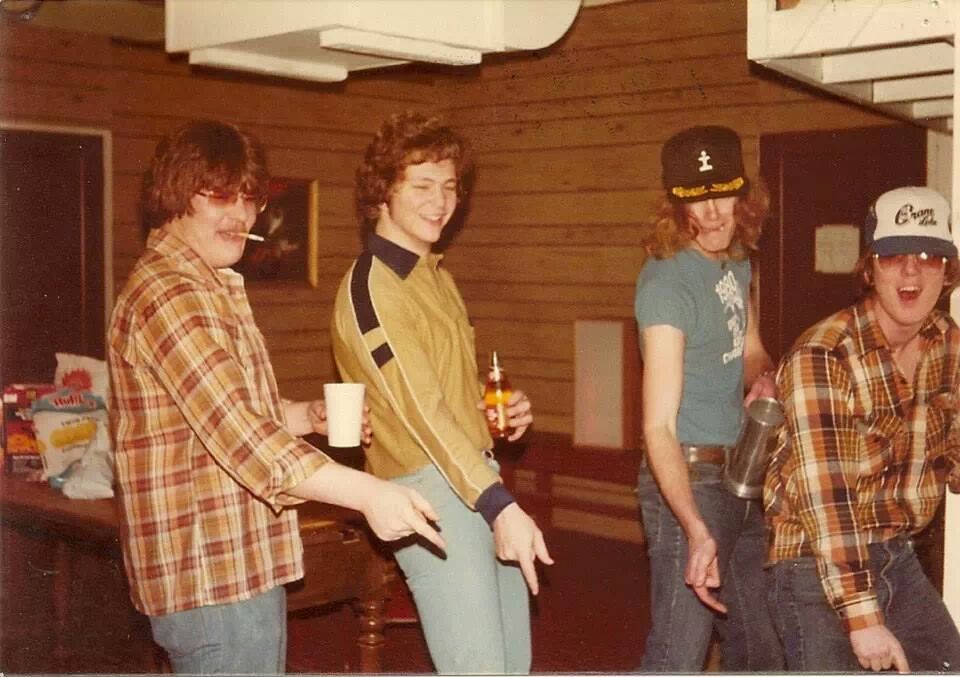
    Me and my buddies, 1979

    Picture if you will a raffish young fellow.  A tall lad, long hair well past his shoulders, mirrored sunglasses, blue jeans with the knees worn through, worn long enough that the excess drags on the ground behind steel-toed engineer boots.  A Buck knife in a sheath on the belt, and a well-worn black pocket t-shirt complete the picture of a young man who would not look at all out of place waiting in line for tickets to a Kiss concert.

    That was me at 17.  The embodiment of every father’s nightmares, standing there in size 11 black engineer boots.

    Unfortunately for my friends and me, we were teenagers in an era when the typical father of a teenage daughter was well up to the challenge we posed.  Take Mr. Walters.

    Rhonda Walters was from a family with money, and Mr. Walters expected more of his daughter than a liaison with a longhaired woods bum.  Still, Rhonda seemed to find me interesting; I certainly found her interesting.  (Of course, being 17 and male, it’s more than likely I’d find something interesting about almost any female between the ages of 16 and 50.)  Rhonda was cute, pert, leggy, had dark hair, dark eyes, and a tendency to dress in tantalizingly short cut-offs and tight T-shirts.  Rhonda also showed every indication of interest in certain longhaired, raffish woods bum types.  Namely, me.

    The fly in the ointment was this:  To get to take Rhonda out on a date, I had to be introduced to and interviewed by Rhonda’s father.

    Mr. Walters had the kind of urban sophistication that I was totally unprepared to deal with.  He also had a short fuse, a voice that sounded much like breaking boulders in the deepest recesses of a cave and fists the size of babies.  What’s more, he had a deep, profound and abiding distrust and dislike for certain longhaired, raffish woods bum types.  Namely, me.  And that was only the beginning.

    How It Started

    It all started one Friday afternoon, as I was leaning against my locker in the high school hallway, shooting the breeze with my hunting partner Dave.

    “So, man, what’re we doing tonight?”  Dave asked.  “Want to go out to the river and catch some catfish?  I’ve got a quart jar of chicken livers I’ve been leaving out in the sun all week.”

    Tempting as that offer was, I had to demur.  “Sorry, pal.  Got a date.”  I responded, with a knowing leer for emphasis.  At that moment, Rhonda wiggled down the hallway, shooting me a big grin.  “See you at seven!”  She practically sang the words to me.

    Dave gave me an incredulous look, once he tore his eyes away from the aft portion of Rhonda’s blue jeans.  “Rhonda Walters?  Oh, man, how did you ever get her to go out with you?  She’s got class!”

    The nerve!  “You asshole!  I’ve got class!”

    “Slow class, maybe.”  Dave said.  “Low class, for sure!  No way have you got enough class for Rhonda Walters.  You taking her out in your car?”

    “Figured on it.”  I replied, uncertain now.  I hadn’t thought of that one.  My old Ford was somewhat on the shy side of respectable.

    A great classic, the 1966 Galaxie 500 2-door hardtop. This one’s in better shape than mine was.

    “Better try to borrow your old man’s pickup, bud.  Rhonda’s used to nice stuff.  That Galaxie of yours got rust holes you could drop a good-sized dog through, and you never did get the skunk smell outta the back seat.  And you’d have to take all your fishing gear out of the back.”

    Dave wasn’t a genius by any stretch, but he had me there.  I suddenly remembered a can of catfish bait, my Grandpa’s own special recipe, which I had been fermenting on my dashboard for several days.  And Dave wasn’t finished yet.

    “Another thing, bud.  You ever seen her Dad?  Old man Walters’ got a lot of money, and he’s mean as the Devil hisself.  He ain’t gonna like seeing someone like you showin’ up at the door.”

    Crap.  Dave was right.  Much as I hated to admit it, Dave was right.  My old Ford was out.  On everything else, he had to be wrong.  What father could resist someone of my wit and winning charm?  I figured if I could solve the vehicle problem, I was in like Flint.

    Funny how our illusions can be shattered so quickly.

    Later that afternoon, at my folks’ place, my old ’66 Galaxie 500 “unexpectedly” suffered a breakdown – a breakdown facilitated by the simple expedient of yanking a couple of plug wires.

    I burst into the house with the news.  “DAD!”  I shouted, trying to get a desperate edge in my voice.  “The Galaxie is dead as a doornail, and I’ve got a date in two hours!  You gotta let me use your truck!”

    Dad’s pickup wasn’t the typical battered farm utility wagon common in Northeast Iowa in those days.  A year earlier, Dad had found a newly rebuilt 1970 Chevy pickup, bright orange with a hand-made wooden bed, reworked ground-up by a particularly talented body shop.  It was shiny, smooth, and clean, and Dad’s pride and joy.  Dad reluctantly agreed.  I imagine he was unwilling to stand in the way of true romance.

    That’s how I came to be driving Dad’s bright orange pickup when I pulled into the Walters’ driveway that Friday evening.  Visions of Rhonda in tight blue jeans assailed me; little did I know what was in store for me inside the front door of the expansive Walters residence.

    And Then This Happened

    A long driveway greeted me, followed by an equally long sidewalk leading to the massive, double door of white oak at the front of the Walters estate.  A doorbell button loomed; this was surely the moment of truth.

    I figured I was as ready as I’d ever be.  I rang the bell.  I wasn’t even remotely prepared for what happened next.

    There were, in those days, certain conventions to be expected when a young man came calling on a family’s daughter.  Those conventions involved the father meeting the young man at the door, upon which the intimidation and subtle threats began immediately.  The Walters family broke with that tradition in a very significant manner.

    Not really the Walters house, but close.

    Rhonda’s mother answered the door.

    In that moment, I realized where Rhonda got her charm and good looks.  Mrs. Walters was still on the sunny side of forty, tall, willowy, shining dark hair and a smile that doubtlessly brought many a man to his knees.

    “Hello!”  She breathed, beaming stunningly on me, bringing me metaphorically and immediately to my knees.  “You must be here for our daughter!  We’ve been expecting you.  Come on in, Rhonda’s getting ready.”

    At this tender age, I was still possessed of some instinctual knowledge that a teenage girl “getting ready” could take at least an Ice Age, I was prepared to wait; the late show of Animal House wasn’t for two hours yet anyway.  I had planned for that, you see.

    What happened next brought my euphoria crashing to earth.  Mrs. Walters had ushered me through the living room, and her glowing smile turned on me again as she raised a perfectly groomed, graceful hand to indicate an open door.  “If you want to wait in the study,” she purred, “You can chat with Rhonda’s Dad while you’re waiting.”

    Well, I’d expected this, and had been through a few fairly uncomfortable interviews in living rooms, farm kitchens and barnyards before this.  The normal process was a moment or two of more or less friendly intimidation, a required recitation of plans for the evening, of which we boys generally left out a few hoped-for details.  I knew what to expect.

    Or so I thought.

    Mr. Walters was ensconced in his expansive study, behind a large oak desk.  Reading glasses were perched on his nose; he was looking over some papers.  Without looking up he motioned to a wooden chair drawn up to the desk.  “Sit down.”  He growled.

    I sat uncomfortably for a few silent moments.  Then Mr. Walters, finally, looked up at me.

    It was amazing; at first, Mr. Walters had the usual expression, the usual frown of a loving father about to shrivel his daughter’s date.  Then, as he took in my long hair, black t-shirt, the Buck knife at the belt of my badly worn jeans, his frown turned to a disgusted scowl.  He dropped his reading glasses on the desk and leaned back in his chair.

    “So,” he snarled at me, “You sure don’t look like much of a catch.  Why in the world do you think you should be taking my daughter out?”

    “Uh, well sir, I asked her, and she said yes?”  I ventured.

    Mr. Walters balled up a fist the size of a basketball and tapped it gently on the desktop.  “She did, did she?”  Suddenly he stood up and leaned over the desk.

    “Listen, boy, you didn’t come to MY house to take my daughter out on a date.  You came here to ask ME a great personal favor.  That favor is taking my baby girl out in YOUR car, to God knows where, until God knows when, to do God knows what, and frankly you don’t look like someone I’d trust to find his way out of a shithouse.  So, once again, why in the world do you think you should be taking my daughter out?”  My pulse started to hammer in my temples.

    “Sir,” I replied, having been taught from an earlier age how to address an older man not related to me, especially when asking a favor, “I may not look like much, but I’m a stand-up guy.  I’ve got my Dad’s truck, and if I have it out late, he’ll kill me.  I’m figuring I’ll take Rhonda to the Burger Five and to the movies, and we’ll be back by eleven-thirty, and you got my word on that.”

    He regarded me with bloodshot eyes.  My blood pressure was edging towards the redline.

    “Eleven-thirty, eh?”  He finally growled.  “Well, boy, this is against my better judgment.  You look pretty worthless, and I hear you spend most of your time bumming around in the woods with your delinquent buddies.  The only reason I’m giving you a chance is because I know your Dad, and he’s as good a man as they come.”

    Way to go, Dad!  I was in!

    The fist slammed down on the desk, rattling the windows and knocking several knick-knacks off the bookshelves behind me.

    “But if you’re ONE MINUTE past eleven-thirty, or if I’ve got ONE REASON to think you’ve laid one finger on my girl, I’ll HAVE YOUR HIDE, boy, YOU UNDERSTAND THAT?”

    “Uh, yes, sir…” I stammered.

    He leaned closer, and snarled, “I mean it, boy, you better not be even a minute late, or so help me…”

    At that moment Rhonda came in, a vision in a white silk blouse and tight black pants.  “Oh, Daddy, are you giving him your mean act?  Don’t worry about it, Daddy’s a big softie.  He wouldn’t hurt a fly.”

    I wasn’t convinced; if I’d been a fly, I would certainly have feared for my life.  Mr. Walters continued to spike me into my chair with an angry glare.

    “Well, go on.  Eleven-thirty.  Rhonda, eleven-thirty, not a minute later, you hear?”  By this point, I had a fine sheen of sweat on my forehead, and at these words I bounded out of the chair.  “Thanks, sir, we’ll be on time!”  I assured Mr. Walters, with what I hoped was a calm, confident demeanor.  Rhonda walked over to kiss her father on the cheek.  I caught his sotto voce comment to her as she bent down:

    “He’s worthless, Rhonda, I don’t know what you’re thinking.”

    “Oh, Daddy, don’t worry.”

    Mr. Walters wasn’t worried.  I was worried.  I was, in fact, feeling more like a fly every moment I spent in Mr. Walter’s presence.

    We walked down the long front sidewalk, Rhonda happily describing something that had happened at school that afternoon; behind us, Rhonda’s Mom smiled and waved, and Mr. Walters glared, his eyes stabbing into my back like twin laser beams.

    The rest of the evening went wonderfully.  Dad’s pampered pickup purred like a kitten, and so did Rhonda; the local burger joint was up to standard, turning out piping-hot pizza burgers and fries; and we laughed all the way through Animal House.  And, during the movie, Rhonda’s hand stole over and took hold of mine – and didn’t let go.  Bliss!  We even had time for half an hour of hanging out in the Safeway parking lot with the other kids.  I even ended up leaning back against the bright orange side of the pickup, with Dave and the other guys glaring enviously at my arm draped comfortably around Rhonda’s shoulders as she leaned against me, laughing at all my horrible jokes.

    The actual by-gosh Decorah, Iowa.

    There’s a moment in each teenage relationship where a line is crossed, a line between friends and boyfriend/girlfriend.  Years later the two kids involved will still recall that moment, that first time that line is crossed; that happened on this night, right on Rhonda’s doorstep.  Promptly at eleven-twenty-eight, I walked Rhonda up the long sidewalk to her parent’s house.  She turned to me in the light from the bulb above the door.

    “This was so much fun!  I think we should do it again next week, don’t you?”

    YOU BET!  I thought in a loud internal shout, but instead suavely replied, “Yeah, I think we probably should.”  I was slowly becoming aware of two glaring eyes peering through the front window curtains.

    Rhonda leaned close, grabbing my shoulders and planting a warm kiss on my cheek.  “I can’t wait.  I’ll be looking forward to it all week.”  The door suddenly popped open, and Mr. Walters stood imposingly framed in the light from the front room.   He growled ominously, “Eleven-thirty.”  Rhonda smiled sweetly at me as I stood, grinning like an ape, and then she turned and went inside.  Her father shot me one last murderous look before he slammed the door.

    As I walked away, one thought came to mind.

    It was worth it.

    Shoe on The Other Foot

    Sadly, the relationship came to an end, as most teenage affairs do; in fact, the whole thing ended rather spectacularly, but that’s another story (and one I’ve already told here.)  The lesson of Rhonda’s father wasn’t lost on me, though, and has served me well in later years, as the father of daughters of my own.  In fact, it served me well the first time I faced a fidgeting, grungy young potential boyfriend in my own home.

    I glared at the young man, as he stood there in his backwards-facing cap and baggy pants.  Finally, after letting him stew a moment, I snarled at him:

    “Listen, boy, you didn’t come to MY house to take my daughter out on a date.  You came here to ask ME a great personal favor.  That favor is taking my baby girl out in YOUR car, to God knows where, until God knows when, to do God knows what, and frankly you don’t look like someone I’d trust to find his way out of a shithouse.  So, now, tell me why in the world you think you should be taking my daughter out?”  I struggled to suppress a grin as the boy shriveled before my eyes.

    Thanks, Mr. Walters.  At long last, I owe you one.

  • Animal’s 2019 Hunt Report

    My hunt this year got cut short.  Loyal sidekick Rat and I ascended into the Routt National Forest early on the Friday before Opening Day; Tuesday at noon we passed through the dusty little mountain town of Kremmling, where I checked my phone and discovered my daughter was to give birth to my fifth grandchild that evening.  So we broke camp and, venison-less, headed back to town.

    My new grandson, of course, made that all worthwhile.

    This was what it was like Friday when we set up.

    There’s not too much to report from the hunt.  Saturday was clear and warm, and we enjoyed wandering around in the woods even though it wasn’t good weather for hunting.  Saturday night the snow started, sending the deer and elk into the dark timber, where the only way you’ll find them is to look literally under every tree.  By the time we left mid-day Tuesday there was over a foot of snow on the ground.

    But since I don’t have much to report, I thought I’d present something else.

    Some years back I wrote an article for a U.K. waterfowling website, which site I let have the article gratis.   Well, that little article has grown legs, as it has been reproduced in several academic point/counterpoint publications, all of whom actually paid me for secondary/tertiary/variousotheriary publishing privileges.

    That being the case, it seemed logical to reproduce it here.

    Why hunt?

    Modern hunters seem to find they are answering that question frequently.  Sometimes the question is put by the genuinely curious; sometimes it is a hostile demand for justification.  In the first case, the answer is complex and thought provoking.  In the second, the answer is simple – “because it suits me to do so.”  Hunting in and of itself requires no justification.  The hunt is not only natural and healthful; it’s an inextricable part of our heritage as human beings.  Man is and has long been a terminal predator, as marvelously equipped for hunting by our intellect as a lion is by his claws and fangs, as a wolf by his swift legs and pack instinct.  No matter whether humans today hunt directly, or employ middlemen to prepare their prey for them on farms and meat packing plants, the fact of our status as predator is in our very DNA.  We owe the very fact of our world-conquering intellect on the hunt, on the stimulus that drove us to overcome the handicap of our clawless, blunt-toothed bodies, to develop weapons to match the feats of the greatest of animal predators; we owe our great brains to the access to high-quality diets of meat, marrow, and fat that predatory behavior allowed.

    But, the question remains nonetheless.  Why, now, do we hunt?

    Some hunt for the meat.  A good reason in itself; game meat is lean, healthy, and free from additives; the process of obtaining it provides exercise and time in the outdoors, away from work pressures and the temptations of couches and televisions.  The fruits of the hunt, properly cared for, are welcomed on the most discriminating of tables.

    Some hunt for the camaraderie, another fine reason; for many of these, the actual hunt is secondary to the outing with friends, sharing the campfire with others of like mind and feeling.  Another good reason; it is in the enjoyment of fine companions that we grow as social animals.  The annual ritual of the mountain elk camp is a vital part of the year for many.

    But, there is frequently another reason.  A reason that’s more compelling, and at the same time harder to explain.

    This was what it was like Monday afternoon.

    Henry David Thoreau, in the great classic Walden, wrote “Go fish and hunt far and wide day by day — farther and wider — and rest thee by many brooks and hearth-sides without misgiving.  Remember thy Creator in the days of thy youth.  Rise free from care before the dawn, and seek adventures.  Let the noon find thee by other lakes, and the night overtake thee everywhere at home.  There are no larger fields than these, no worthier games than may here be played.”  Thoreau spoke for many hunters in those words, hunters who hunt not solely for the meat, or for the company, but for the ageless, timeless experience of the hunt itself.

    For it’s true that for some of us the hunt is an answer in itself.  It’s enough to awake hours before the dawn, and to know the utter silence of a late autumn morning.  To hear the crunch of snow under your boots as you begin the hike into the distant, silent mountains.  To smell the pines along the trail, and see the silent sentinel spruces on the ridges, barely glimpsed in the pre-dawn dark.  It’s enough to sit, shivering, at that best spot on the top rim of a remote basin, watching the east grow bright, waiting for the first rays of warm sunshine to break though the trees and drive away the bitter cold of night.

    But those moments, treasured as they are, pale before the ultimate goal of the hunt.  It’s a part of the hunter’s soul, to carry the knowledge that somewhere, out among the pines, in the dark timber or the frost-covered meadows, a bull awaits, and the chance of the day may bring him within your awareness.  The snap of a branch, the ghosting shape of antlers through the aspens, the sudden ringing bugle of a bull elk, as he appears, suddenly, where no bull was a moment before.  His breath plumes out in the cold as he screams his challenge, and your hands and will freeze momentarily in awe of his magnificence.

    It’s enough to know that the day may bring the chance of a stalk, through the darkness under the trees, along the edges of the golden grasses of a meadow, creeping, creeping, under the streamside willows, silently, slowly, ever closer, testing the wind, watching underfoot for twigs, whispering a silent prayer to the forests and fields to allow you to close the gap, to make the shot.

    With luck, you’ll raise your rifle or draw your bow, and make your shot.  More often than not, though, the bull escapes, to play the game of predator and prey another day, in another valley.

    You can’t buy moments like that; you can’t find them on the Internet, or at the movie theatre.  When the alarm rings in the icy cold of a pre-dawn tent at 9,000 feet, this type of hunter doesn’t groan at the prospect of climbing out of the warm sleeping bag; instead, the prospects of the day are enough incentive to brave the cold, to pull on wool and leather, to step into the pitch-black outdoors, under ice-chip stars.  It is with pleasure and anticipation that this hunter begins a day that will likely end back at the same tent, in the freezing dark, hours after sunset, at the end of a long hike out of the wild.

    For hunting requires a level of participation unknown in any other human venture – hunting requires a communion with the very primal forces of Nature, taking life so that life may be.  Hunting requires a contact that the non-hunter can never know, a contact with life itself.  The hunter eschews supporting his or her life through a middleman; knowing the cost of one’s diet, engenders respect for the lives that must be taken to sustain one’s own life.

    Early hunters knew this very well, as they revered their primary prey.  For example, Plains Indians referred to the bison as “uncle” and “brother.”  Paleolithic cave drawings of game animals and hunt scenes are rendered with a loving reverence that is still evident today, thousands of years later.  Modern hunters are much the same.  Enter a hunter’s home, and you’ll likely find framed prints of deer and elk, waterfowl sculptures, photography of upland birds.

    To some it seems contradictory; to express respect, reverence, even love for an animal that you pursue, hunt, kill, and eat.  It’s true that this seeming contradiction is as hard for hunters to explain as it is for non-hunters to understand.

    Perhaps the answer lies in the very understanding of our role in nature. nature has but one law; life feeds on life, and life gives life to life.  People who obtain their steaks, chicken, and burgers from supermarkets and butcher’s shops can lose sight of this fundamental truth, and perhaps they would prefer to have that process sanitized in just such a manner.  In our modern, urbanized society, many like to imagine their own existence is bloodless, clean, and sanitary.  But such an outlook is self-deluding.

    The hunter knows very well the cost for the steaks that grace his plate.  A year has been spent in preparation for the hunt, planning, caring for equipment, and practicing marksmanship.  Without complaint or reservation, the hunter has arisen before dawn, as described above, and walked the many miles to where the game awaits.  In the bright sun of a meadow, in the twilight of dusk, or in the shadows of the forest he has made the stalk, taken the shot with painstaking care, and dressed the animal.  He has packed out quarters of elk, perhaps a two or three-day process, often through rough, grueling country.  The hunter has cared for hides and antler and meat, and the price for the meal of elk steak is ever with the one for whose life the elk’s life has given way.

    Loyal sidekick Rat contemplates another stretch of dark timber.

    Most of all, the hunter has seen the sudden transition from a living animal to an inanimate food source, from animate life to meat for the table.  The non-hunting urbanite likely has never seen this take place, and would not care to do so; but the hunter knows, with bittersweet regularity, the price that must be paid for continued existence.

    It is for this very reason that the hunter reveres his prey.  The intimate, timeless knowledge that Life springs from Life can only lead to reverence for the source of that Life.  The bull elk in the dark timber, ghosting through the trees silently as smoke, will live on in the blood, bone and sinew of the hunter waiting on the ridge above; and the hunter, in his turn, will return to the Earth, to nourish the soil, to give rise to the grasses that will feed the elk.  And how can the hunter not revere the greathearted bull, revere the magnificence of the great deer that will go to feed the hunter’s family in the winter to come?  Reverence for the game, reverence for the wellspring of life, reverence for the great, largely unknowable cycles of the Earth, all come from the intimacy with Nature found in the hunt.

    Hunting is indeed what makes us human; hunting is what led humans to cooperate, to plan, to anticipate, to form society.  The first great turning point in Mankind’s development was when two unrelated families found they could hunt large animals by working together, and so be more efficient at obtaining high-quality food; thus was the first tribe born.  Hunting has made us what we are.

    It’s unfortunate that the non-hunter often cannot see past the fact that the hunt results in the death of an animal.  The death of an animal, it’s true, is the goal of the hunt; but a greater goal is to be found in the overall experience, of which the actual kill is only the climactic moment.  The hunter’s soul often thrills as much, if not more, to the blown stalk, the bull that senses something amiss and vanishes into the mountains like a puff of smoke on the breeze, leaving no trace in his wake.  Fond memories include the grouse that explodes from underfoot at the worst possible moment, the squirrel that set up a warning chatter in the penultimate seconds of a carefully planned approach.  The vista of a great gulch viewed from the rim, with a herd of elk grazing peacefully, undisturbed, and totally unapproachable on the far side.  And, indeed, in the final moment of success, when the hunter approaches, cautiously, the downed bull, lying still now against the bed of needles; the heart-pounding thrill of success, weighted against the bittersweet regret of the necessity of taking the life, facing the final truth that for life to be, another life must give way.

    Life feeds on life, and life gives life to life. The hunter in success understands this great truth as no other human possibly can.

    Why hunt?

    We hunt to pay homage to nature, to life, to the earth.  To make our annual pilgrimage to our beginnings, to lay hands on our heritage as members of the biotic community.  To affirm once more that life feeds on life, and life gives life to life.  We hunt for the gift of an elk to a family, the gift of life from the earth.  In the hunt lies an affirmation, a recognition that we too will one day return to the earth that has fed and nurtured us, and the elk will then feed on the minerals and nutrients returned to the soil from our bodies.  That affirmation alone is enough for many of us who hunt, to send us once more out of our tents, trailers, and ranch houses, out into the freezing darkness under the glittering stars, to climb an unseen mountain for the chance at an elk.

    Hunting has a fundamental truth that few non-hunters understand.

    It’s not about death.  It’s about life.

    That’s why.

  • Gold Standards III – The Smith & Wesson Triple Lock

    The Perfect Double-Action Revolver

    A very fine Triple Lock.

    Resolved:  The Smith & Wesson .44 Hand Ejector 1st Model “New Century,” otherwise known as the “Triple Lock” is the standard by which all double-action revolvers must be judged.  Now that that’s established, let’s take a closer look at this scion of modern double-action sixguns, how it came to be, who used it, who made it famous, how it changed the way shooters looked at sixguns and what they expected from them; and not least, let’s take a closer look at why it remains today perhaps the most significant double-action revolver ever made.

    The Forerunners

    First, we must cast our optics back to the year 1889.  During and since the War of the Northern Aggression, the folks at Colt had dominated the military sidearm market, leaving Smith & Wesson to fend off the civilian trade.  Their offerings were all variations of a kind; top-break revolvers that were fast to reload but had a significant weakness in their hinged frames.

    The first, a .32 Hand Ejector.

    But in 1889, Colt introduced something new.  This (as we saw in the History of Sixguns series) was the Colt Model 1889, the first production double-action revolver with a solid frame and a swing-out cylinder.  Colt quickly followed this up with the M1892 Army and Navy and the excellent, big, tough Colt New Service, which was available in heavy revolver rounds like the .44WCF and .45 Colt.

    Smith & Wesson rose to the challenge, but their first swing-out double-action was a pipsqueak; in 1896 they introduced the .32 Hand Ejector in .32 Long, and in 1905 they followed up with the 1905 Hand Ejector in .38 Special.  This last gun was to give rise to the K frame revolvers and the near-immortal Model 10, but that’s not the gun we’re here to discuss.

    It was in 1908 that Smith & Wesson hit the home run.

    The New .44

    It’s not often that a gun manufacturer comes up with the perfect blending of gun and cartridge.  Winchester did it with the .30WCF and the M1894 lever gun.  Colt and John Browning did it with the M1911 and the .45 ACP.  And Smith & Wesson did it with the Triple Lock and the .44 Special.

    A 1905 Hand Ejector, in .38 caliber

    The .44 Hand Ejector First Model’s designers did more than just scale up Smith & Wesson’s smaller .32 and .38 revolvers.  The new gun retained the swing-out cylinder, but added the feature that gave the gun its nickname; in addition to the lockup at the cylinder face and the end of the ejector rod, taken from the earlier Smiths, the new gun added a locking lug on the crane that locked into a recess in the frame.

    This was the first of Smith & Wesson’s big-frame revolvers.  This frame, which would become known as the N frame, would go on to yield such famous pieces as George Patton’s Registered Magnum and Harry Callahan’s Model 29, but the Triple Lock was the first.

    This combination of three locking features – the Triple Lock – yielded a revolver that was strong enough for the new load, which was took the old .44 Russian case that Smith & Wesson had chambered in the break-top Schofield revolvers, and lengthened it, adding powder capacity.  The first loads used 26 grains of black powder and a 246-grain round nose lead bullet, but in these early years hand-loaders were already experimenting.  New bullets and newfangled smokeless powders were becoming available, new power levels were being achieved, and the big, tough new Smith made a perfect test bed.

    The First Model guns were expensive.  The Triple-Lock required a lot of careful hand-fitting and tuning to make it lock up properly and maintain cylinder timing, but when well-set up it was utterly reliable with almost any ammunition.  And the Triple Lock is a joy to handle; smooth, with a long but glassy double action pull and a crisp single-action trigger.  Over the years I’ve had the opportunity to handle and shoot two .44 Special Triple Locks, and I’ve been watching for the opportunity to add one to my own collection for some time.

    Elmer Keith and the .44 Special

    One of Keith’s Triple Locks, along with some of his other works.

    As much as any of Smith & Wesson’s marketing people, it was a Montana cowboy, hunter, guntwist and adventurer named Elmer Keith that was responsible for the fame of the new revolver and cartridge.

    Keith had cut his teeth on single-action sixguns and always remained fond of the Colt Single Action Army and the .45 Colt round, but he was also quick to see the advantages of the big new Smith and its swing-out cylinder.  A committed big-bore fan, Keith liked to stoke his sixgun handloads up plenty strong, and the big-framed Smith was plenty tough enough for the hot loads he cooked up.

    In his benchmark work Sixguns, Keith wrote of the Triple Lock and its cartridge:

    Daniel B. Wesson, after fifty-two years of distinguished service, passed away in 1906. In 1907 Smith & Wesson brought out their Triple Lock, perhaps the finest revolver ever manufactured anywhere, at any time. Today no example of finer revolver making is to be had. The rear end of the barrel and the cylinder steel of the old triple lock are not as strong as in the present 1950 model Target S&W. .44 calibers or the .357 S&W. Magnum, but the old New Century was, and still is, one fine gun in any company.

    They designed the .44 Special cartridge for this arm with 26 grains of black powder, instead of the 23 used in the .44 Russian cartridge. The .44 Special is simply a longer version of the .44 Russian and no more accurate sixgun load exists.[i]

    The Triple Lock mechanism.

    Keith experimented extensively with heavy loads for the .44 Special in both Triple Locks and the later N-frame Smith & Wesson 1950 Target revolvers.  He pressured friends at Remington and Smith & Wesson to legitimize his efforts until, in 1955, Smith & Wesson introduced an offspring of the Triple Lock that would become the Model 29.  While Bill Ruger had beat Smith & Wesson to the punch by a few months, making the single-action Ruger Blackhawk the first production .44 Magnum, Smith & Wesson’s Model 29 caught on quickly, not least of which was because of Elmer Keith’s enthusiastic advocacy – and thus, the Triple Lock’s legacy lived on.

    The Triple Lock itself, however, was gone by this time.  The gun, as we noted, was expensive to make.  In 1915, after only seven years of production, the revolver was redesigned.  The Second Model did away with the third locking lug and the ejector shroud, making the gun cheaper to build and sell, and the Triple Lock production ended with a total of only 15,376 copies built.

    The N Frame Revolvers

    The true legacy of the Triple Lock, of course, is in its descendants, those being all the various N-frame sixguns that Smith & Wesson has produced and continues to produce to this day.  The third locking lug has not been seen since the original .44 Hand Ejector 1st Model New Century, but the N-frame remains perfect for heavy sixgun loads; a big, beefy steel frame with a strong topstrap, stout crane and thick sidewalls, more than capable for hot handloads in the .44 Special and .45 Colt, not to mention the .44 Magnum.

    The CCW market has driven handgun producers to an ever-increasing diversity of small, light concealable pieces, mostly semi-autos; I own a few such and favor the Glock 36 for everyday carry.  But there will always be a place for a heavy holster sixgun for serious work in forest and field, and the N-frame guns are admirably suited for just that.

    As I have described here before on several occasions, my own favorite holster iron for outdoor work is a grandchild of the Triple Lock; mine is a 1970s-vintage Smith & Wesson 25-5 in .45 Colt, heavy but not too heavy to carry all day without complaint, and plenty tough enough for the hot .45 Colt loads I push through it.

    The Triple Lock’s children and grandchildren are even tougher, mostly due to greatly improved machining techniques and metallurgy, but the Triple Lock remains, as Keith pointed out, a fine gun in any company.

    Today

    The big N-frame Smith & Wessons are still made.  The big sixguns are no longer offered new in the .44 Special but, of course, the .44 Magnum is still available.

    I confess, though, to being a little disappointed in the new Smith & Wessons.  In 2000, Smith & Wesson added to all their revolvers an internal safety lock actuated by a key via an aperture above the cylinder lock slide; this bit of lawyerly pettifoggery has a bad reputation for failing at the wrong moment.  Triggers are heavier than on older guns, although Smith & Wesson’s fit and finish remains generally good.

    Happily, the various online auction and sale sites have plenty of older guns for sale.  Triple Locks are scarce and command high prices, but there are enough other, less scarce N-frame guns to satisfy the collecting urges of almost any big-bore sixgunner.

    The Triple Lock was a once-in-a-century sidearm – innovative, well-made, well-fitted, reliable and tough, with a new cartridge that proved to have great potential.  From its initial design descended an entire series of handguns, used by millions in forests, fields, streets and battlefields.  We haven’t seen its like since, which is why the Smith & Wesson .44 Hand Ejector 1st Model “New Century” remains the standard by which all double-action revolvers must be judged.

    [i] Keith, Elmer. Sixguns. Sportsman’s Vintage Press. Kindle Edition.

  • Profiles in Toxic Masculinity VII: Mad Jack Churchill

    Profiles in Toxic Masculinity, Part 7

    Appearances Can Be Deceiving

    The fellow to the right is a respectable-looking chap, isn’t he?  Maybe a bit stern, but all in all, a good steady sort; the kind you’d find running a major business enterprise or maybe a bank; a solid, reliable type, not the kind of man who would attempt anything wild or risky.

    That assessment couldn’t be more off base.  Who that gentleman is, is no less than John Malcolm Thorpe Fleming “Mad Jack” Churchill, a man who went into battle with a sword, a revolver, a longbow and bagpipes.  He was one of the ballsiest men to ever draw breath, and thus richly deserving of this week’s Profile in Toxic Masculinity.

    His Maculate Origin

    Jack Churchill was born on September 16, 1906, in Colombo, British Ceylon, to Alec Fleming Churchill later of Hove, East Sussex and Elinor Elizabeth, daughter of John Alexander Bond Bell, of Kelnahard, County Cavan, Ireland, and of Dimbula, Ceylon.  There was no family connection to another famous example of toxic masculinity who shared the last name of Churchill, although the two men were contemporaries.  When young Jack was only four, the family moved to Hong Kong.  Seven years later, in the thick of the Great War, the Churchills returned to England, settling in Surrey.

    Determined to pursue his education in the most masculine setting possible, Jack Churchill determined he would attend university at King William’s College on the Isle of Man.

    That’s right – the Isle of Man.

    Jack went on to the Royal Military College at Sandhurst and on his graduation in 1926, rode off to serve as an infantry officer in the Manchester Regiment in Burma.

    His Adventurous Career

    Being in an infantry regiment with a long and storied history wasn’t enough to keep the young Churchill entertained.  To remedy this, he bought a motorcycle and spent his spare hours careering around Burma, on main roads, side roads, dirt tracks, or wherever else struck his fancy.  He was already a crack shot with rifle and revolver as well as the English longbow, which was to serve him well in years to come.

    In between motorcycle trips and military maneuvers, he taught himself how to play bagpipes, because why not?

    Leaving the Army in 1936, Jack headed for Kenya, where he worked as a newspaper editor.  Because editing a colonial newspaper wasn’t enough, the young Churchill embarked on a brief film career.  He had already parlayed his archery and bagpipe proficiency into a small part in 1924’s The Thief of Bagdad, and he expanded on that by appearing in A Yank at Oxford in 1938.

    He also represented Britain in the 1939 World Archery Championships in Oslo.

    But events that unfolded in 1940 were to deliver to this stalwart combination of Rob Roy, Robin Hood and a Terminator the best opportunities yet to (figuratively) show off his enormous adamantine pair of cojones.

    His One-Man War

    Even when he’s seated at a desk, that glare increases pucker factor by 122.5%.

    When Germany invaded Poland in 1939, Churchill rejoined his regiment.  The Manchester Regiment was assigned to the British Expeditionary Force in France, which was in the process of having its ass kicked all the way to the English Channel by the German blitzkrieg.  Churchill, of course, was having none of that “retreat” nonsense and resisted at every turn.  One on occasion Churchill led a small group of Brit soldiers into ambushing a German patrol near the French town of L’Épinette.

    After letting the Krauts get in good and close, Churchill gave the order to attack by brandishing his claymore, chucking a grenade and bellowing “CHARGE!”  The Brits charged, led by the possibly mad Churchill and his broadsword, and routed the German patrol.  When asked later by a higher-ranking officer why he insisted on carrying the Scottish sword, Churchill replied “In my opinion, sir, any officer who goes into action without his sword is improperly dressed.”

    Incidentally it was this action that began the rumor of Churchill’s having killed a German with a longbow, hence becoming the only Allied solider in WW2 to do so, but Churchill himself denied that claim, noting that his longbow had been crushed underneath a lorry some time before this incident.

    He went on going into battle properly dressed, leading his men on a series of rear-guard and guerilla actions against the Germans until the BEF was evacuated at Dunkirk.  He was wounded in the neck by a machine-gun bullet but refused evacuation and went on fighting.

    At this point he decided that the ongoing unpleasantness would offer more opportunities to kill Germans if he joined a unit even more elite than the Manchester Regiment, so he volunteered for the Commandos, eventually becoming second-in-command of No. 3 Commando.

    An exercise, not the real raid, but still a maniacal badass with a sword leading the way.

    In 1941 No. 3 Commando, including the now Lieutenant-Colonel Churchill, took part in Operation Archery.  In this action, on December 27, 1941, in a daytime amphibious landing, the No. 3 Commando raided a German garrison at Vågsøy, Norway.  Lieutenant-Colonel Churchill was on the first landing craft.  When the ramp dropped, he was the first off, and promptly scared the living bejeezus out of the Germans by standing in the surf playing March of the Cameron Men on his bagpipes as the rest of the Commando stormed ashore.  When all were present, Churchill chucked a grenade at the German positions, apparently his favorite way to begin an attack, and drew his sword, leading the Commando into battle.  After the action was awarded the Military Cross with Bar for conspicuous gallantry, and likely also because the British Army didn’t dare fail to award a man with Churchill’s combination of courage and insanity.

    1943 found Colonel Churchill in command of No. 2 Commando.  That unit landed and fought in Sicily and Salerno.  In that second action, Churchill was ordered to silence a mortar position and eliminate a German observation post that controlled a pass overlooking the Salerno beachhead.  Most officers would have assembled a patrol and moved on the positions with fire and maneuver in a traditional infantry operation, but not Jack Churchill.  He led No. 2 Commando to encircle the German observation post, then drew his sword, brandished it, bellowed “COMMANDO!” and charged the post, easily taking it and killing or capturing the German troops.  He then went on to take out the mortar post by capturing one guard, then moving on to the others in turn, shoving his Scottish sword in their faces and demanding their surrender.  He later commented:   “I maintain that, as long as you tell a German loudly and clearly what to do, if you are senior to him he will cry ‘jawohl’ (yes sir) and get on with it enthusiastically and efficiently whatever the situation.”

    In 1944, his luck ran out, but his courage didn’t fail him.  Churchill was leading Commandos in Yugoslavia in support of Marshall Tito’s partisans.  In May of 1944 he was ordered to raid the German-held island of Brač.  Despite having assembled a considerable force of 1500 partisans and 44 Brit Commandos, the attack was unsuccessful.  On the second morning of the mission, Churchill led a flanking attack on the German positions while the Partisans remained behind.  By the time the Commandos reached the objective only six were left alive, of which Churchill, still toting a rifle along with his sword and bagpipes, was one.  Mortar fire swept their positions, killing all remaining members but Churchill.  Out of grenades and ammo as the Germans closed in, he stood and began playing Will Ye No Come Again on his bagpipes until a grenade knocked him unconscious.

    The Germans, noting the name on this identity disk and incorrectly assuming a family connection to the British Prime Minister, sent him to Berlin.  There he was interrogated until, in frustration of having learned nothing from the stalwart officer, the Germans sent him to the Sachsenhausen concentration camp near Oranienburg, Germany.

    By September 1944 Mad Jack had enough of a prisoner’s life.  Enlisting a Royal Air Force officer, Bertram James, to help in the attempt, he and James crawled under the wire around the camp and into an abandoned drainpipe.  Making their way away from the camp, they headed for the Baltic coast but were recaptured only a few miles from the sea.

    Mad Jack in Action.

    Probably because of his predilection for escaping and also probably because he intimidated the shit out his Wehrmacht guards, in April of 1945 Churchill was sent to an SS-run concentration camp near Tyrol.  After a delegation of Allied prisoners complained to a passing Wehrmacht officer, one Hauptmann (Captain) Wichard von Alvenslaben,  that they were worried about being murdered by the SS, the German captain (perhaps looking ahead to the consequences of Germany’s looming defeat) surrounded the camp and “advised” the SS to get the hell out.  They did so, and soon after the German regulars did as well.  Churchill and some others promptly decamped and walked 90 miles to Verona, Italy, where they found an American armor unit.  On rejoining Allied forces in this manner, Churchill was disappointed to find the Germans had surrendered, and so wasted no time demanding reassignment to Burma, where the Japanese were still kicking up their heels.

    The assignment was granted, but by the time Churchill made his triumphant return to Burma, Hiroshima and Nagasaki had both been wiped off the map.  The Japanese Emperor, realizing that the tide of battle had irreversibly turned against Japan now that Mad Jack Churchill was in the theater of operations, surrendered.

    Churchill was miffed, to say the least, complaining that “…. if it weren’t for those damn Yanks, we could have kept this war going another ten years!

    After the war Churchill continued to demonstrate badassery of a kind not much seen in British men today.  He qualified as a paratrooper and was assigned to the Seaforth Highlanders in Palestine, where he performed such feats as assisting a medical convoy under attack by Arab partisans.

    In 1952 he resumed his film career, appearing alongside Robert Taylor in MGM’s production of Ivanhoe.

    Churchill retired from the British Army in 1959, but he wasn’t done yet; not by a long shot.

    His Golden Years

    On retirement, Churchill went home to Sussex with his wife, Rosamund Margaret Churchill nee Denny, and their children, Malcolm Leslie and Rodney Alistair.  He hung his Army awards up, and they made quite a list:

    • Distinguished Service Order with bar
    • Military Cross with bar
    • 1939-1945 Star
    • Italy Star
    • Burma Star
    • War Medal 1939-1945
    • General Service Medal with “Palestine 1945-1948” bar

    His eccentricity continued.  He went on bagpiping and longbowing his way through life. Even in retirement he maintained an office and, in the afternoons on his return home, startled train passengers by hurling his briefcase out of the train window some ways before his stop.  When someone finally worked up the nerve to ask why, he calmly explained that he was chucking the thing into his back garden so he wouldn’t have to carry it home from the station.

    John Malcolm Thorpe Fleming Churchill died on March 8th, 1996, at 89 years of age, in Sussex.  The Royal Norwegian Explorers Club named him as “one of the finest explorers and adventurers of all time,” and to this day, he has yet to be outmatched in that regard.  His legacy remains today as one of the toughest, most fearless, possibly craziest soldiers Britain has ever produced; a legacy that almost certainly would have pleased him.