Some time back I stumbled across an interesting discussion on the appropriate firearm for the farm or country home, much like the country home my folks maintained for many decades.
The Old Man was, of course, a farmer for much of his life, and an old school country gentleman. His attitude towards firearms reflected most of his type and his generation; firearms were tools essential to the maintenance and protection of homestead and crops, in the same order as a chainsaw, a scythe, or a tractor. They were selected and maintained as such, with strictly utilitarian considerations. Childhood in the Great Depression and young adulthood during WW2 made most of the Old Man’s generation practically minded people.
That being the case, the Old Man maintained three firearms on and about the place. They were a 12-gauge pump shotgun, a .22 rimfire rifle, and a .22 handgun. The shotgun was his first purchase with his demobilization pay when he returned from the Army in 1946, the .22 rifle was a third anniversary present from my mother in 1950, and the .22 pistol he bought for recreational shooting sometime in the mid-1960s. I still have all three firearms, and no amount of money could persuade me to part with them, so don’t ask. And, in what should come as a surprise to no one, these are the three types of guns I think are most useful around your typical country home.
If You Can Have Only One Gun
Winchester Model 12 and Stevens 520A.
Now, on to the country home: If a family can only maintain one firearm on a country homestead, one would be wise to pick up something along the lines of the Old Man’s first post-war purchase, a simple 12-gauge pump-action shotgun. The Old Man’s Stevens pump-gun hasn’t been manufactured for many years, although used examples are sometimes available at bargain prices. The old Stevens 520/620 series are great guns, John Browning designed take-down pump guns with solid steel receivers. They’re reliable and brutally tough, and if you can find them around, come pretty cheap.
The Mossberg 500 series or the Remington 870 are likewise solid guns that will give long service; my own pair of Mossbergs, a 12 and a 20, have been functioning flawlessly in the game fields for 35 and 40 years now. There are plenty of others on the market, but were I equipping an outpost myself, I’d probably go for a Mossberg or a Remington, for the primary reason that parts will be easy to find.
The advantages of the 12 gauge are many. Ammo is readily available anywhere and various loads/shot sizes can handle anything from garden pests to turkeys, while a slug will dispatch a deer or even a bear. Pump guns are solid, reliable and easy to operate. Most hold five or six rounds in the magazine, which should be enough ammo for most chores.
I’m a big fan of old shotguns, particularly the pre-64 Winchester Model 12 and the Belgian Browning Auto-5s. I have a fair stable of those pieces and over time will probably buy more. But these are collector’s pieces, and while I shoot them and hunt with them, I would not necessarily drag them through mud and bad weather. For that, a rougher piece is in order – a utility shotgun, suitable for the only gun on a country homestead.
Even though I will always love my old Brownings and Winchesters, I will always keep the old Mossbergs around as utility shotguns, especially after our move north. Of course, my attitudes towards firearms are somewhat different than the Old Man’s, and so the Mossbergs will still have plenty of company in the rack.
I’ve seen some great shooting done with simple 12-gauge pumps, too. Despite his utilitarian attitude towards shotguns, the Old Man was nevertheless as artist with his old Stevens. He was known to go 100 straight on the skeet range in his Army days, and he was highly skilled at making a shot charge arrive in the same location as a fleeing pheasant or grouse. In his early 80s he cut off the tip of his trigger finger in a jointer, and since that time firing a gun with any recoil caused a stab of pain through his shooting hand, but before moving to town he capped his hunting career in a blaze of glory by stalking and killing four wild turkeys with a bolt-action .410, causing our old friend Dave to comment, “if anyone but your Dad told me that, I’d call him a damned liar.” I was always disappointed by my failure to catch up to Dad on the trap range, although he would have admitted I was better than he with a rifle.
Which brings us to…
If You Can Have Only Two Guns
Mossberg 44US. Not the one I had but one just like it.
But let’s say you can have two guns around your place. I’d recommend the second be a .22 rifle.
Oddly enough, while my gun rack contains several .22LR semi-autos, if you were to keep a .22 rifle in a rural setting, I’d recommend a bolt gun. Why? Several reasons:
Bolt guns are simple, they generally break down easily and are easy to clean and repair.
Even in a .22LR, bolt guns are accurate. Not that semi-autos can’t be accurate – but bolt guns are generally a hair ahead.
Simplicity leads to reliability. Fewer moving parts means less wear, although any well-maintained firearm should last a lifetime.
Some semi-autos, like my own slicked-up Ruger 10/22, can be finicky about ammo. Bolt guns generally digest any ammo with aplomb, and generally give you the option to run quiet .22 Shorts if you are shooting at close quarters. A subsonic .22 Short round fired from a rifle isn’t much louder than a finger-snap, and that can come in downright handy.
The other advantage to a .22LR bolt gun is price. There are literally millions of inexpensive and yet reliable and accurate .22 bolt guns around. You don’t need high polish or fancy walnut for accuracy in a .22 (although those things sure are nice). Anyone who has handled an old Mossberg or Marlin bolt .22 should be able to attest to that. Back in the day I bought a Mossberg bolt-action .22 with US Government markings for the grand sum of ten dollars, and I could shoot pop-bottle caps off fence posts at 25 yards with it – with iron sights. That Mossberg today would cost you more than that, even adjusted for inflation, but not all that much more. In fact, the same gun without the US Government markings, for some reason, will cost you a lot less.
A lot of the comments above will apply to a lever gun as well, except that .22LR lever guns are generally pricier and more complicated to maintain.
If You Can Have Only Three Guns
For your third gun, I’d recommend a medium-to-major power handgun, one you can carry in a belt holster and shoot accurately. Anything from a 9mm auto to a .44 Magnum will work; it’s far more important that you can handle the sidearm well. Revolvers, though, are generally simpler, easier to maintain and less fussy about ammo than autos. Revolvers also have the capability of handling more powerful loads in a reasonably sized piece. Bear in mind that if you’re in a remote location, you may have to repair the thing yourself. Some of us are better tinkerers than others.
With the above in mind, though, take into consideration any possible uses you might be putting that sidearm to – caliber considerations in Georgia may be quite different than those in Alaska.
Most people find handguns more difficult to handle well than a rifle or shotgun, so be prepared to spend some money on practice ammo.
Parts Is Parts
In a rural home, it’s a good idea to keep some parts on hand. Firing pins, springs, screws and action pins, all good things to keep a supply of. You’ll also need tools, as gunsmithing tools are somewhat specialized; Brownell’s Basic Gunsmith Tool Kit contains a good assortment of tools, gauges and so on to keep your shooting irons shooting. Keep a good supply of cleaning solvents and lubricant on hand.
If your pump shotgun has a barrel that can be swapped out easily, as does the Remington 870 and the Mossberg 500, an extra barrel isn’t a bad idea. And speaking of barrels, while I’m fond of Briley choke tubes and run them on a lot of my shotguns, an ugly but solid Poly-Choke type collet choke may be a better idea for a country-homestead gun; you can lose choke tubes, but that Poly-Choke is there for keeps.
Last-Ditch
No, I’m not kidding.
If “prepping” is your thing, or you’re just very remote and are worried about supplies being hard to get, here’s something to think about: What would you do if cut off from a supply of ammo?
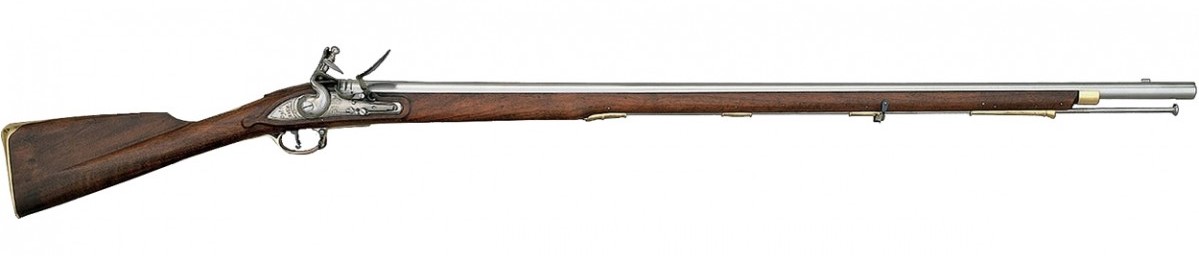
The answer may be to scale your technology back some – say, to about 1800. A smooth bore flintlock musket is versatile, will kill birds with shot or moose with round balls, and if you have bar lead, a mold, flint and a supply of sulfur you can make everything else you’ll need to keep shooting. Charcoal isn’t hard to come by, and if you have a latrine, you can make saltpeter. You’ll need a fair amount, as the recipe is generally 75% saltpeter, 15% charcoal and 10% sulfur.
That’s something to think about, anyway.
And So…
A country home requires a lot of tools to keep the place maintained, safe and tidy. Even if you’re not a hobby shooter or (like me) a collector, a firearm is one of those essential tools. Whether your immediate need is rabbit stew, pest control, dissuading something big and toothy or something two-legged and belligerent, sometimes a firearm is the only thing that will work.
I thought that I’d profile someone a little more palatable – indeed, admirable – this time.
Appearances Can Be Deceiving
The fellow in this photo to the right looks a distinguished figure; a bank president, perhaps, or a judge, a governor, maybe a college professor. He is a figure of great dignity and gravitas, indeed.
Well, he was a college professor and a Governor (of Maine), in fact, but that’s the least of his story. The old man here is Brigadier General Joshua Chamberlain, hero of Gettysburg, one of America’s premiere military heroes, a man who may have single-handedly saved the Union on a fateful day in 1863.
His Maculate Origin
Lawrence Joshua Chamberlain (for unknown reasons he is best known by his middle name) was born on September 8, 1828, in Brewer, Maine, to Joshua and Sarah DuPree Brastow Chamberlain. A studious and deeply religious child – his mother raised him in a strict Congregationalist household – he was shy and spoke with a pronounced stammer. His father instilled in the young Lawrence an understanding of the importance of educating one’s self, as well as an abiding interest in military matters. This was to lead to one of the most remarkable feats of American arms in our history.
As a young man he pursued various occupations including lumberjack (hardly a novelty in Maine) and bricklayer, meanwhile studying Greek and Latin, because lumberjacking and bricklaying are both occupations that give you plenty of spare time for studying Greek and Latin. At age twenty he entered Bowdoin College, graduating in four years. Then, perhaps remembering his mother’s insistence on rigid Calvinism, Chamberlain entered the Bangor Theological Seminary. On his graduation from that institution, however, he declined the ministry and returned to Bowdoin, where he was hired as a professor, teaching Rhetoric and Natural and Revealed Religions. In 1855, he married his childhood sweetheart Frances “Fanny” Adams, and no, I will not speculate as to the source of her nickname.
Then, in 1862, Chamberlain was to embark on his military career, and it is possible that no other American Army officer has ever led a more distinguished career with so little preparation.
His Adventurous Career
Chamberlain in Uniform.
On the outbreak of the war, Chamberlain lectured his students on the necessity of preserving the Union and, being one to put his money where his mouth was, then wrote to the Governor of Maine, one Israel Washburn Jr., “I fear, this war, so costly of blood and treasure, will not cease until the men of the North are willing to leave good positions, and sacrifice the dearest personal interests, to rescue our country from desolation, and defend the national existence against treachery.” Chamberlain then proceeded to do just that, declining the command of the 20th Maine Volunteer Infantry until, as he put it, he could “start a little lower and learn the business first.” He didn’t start that much lower, serving first as Lieutenant Colonel of the regiment under Colonel Adelbert Ames. The 20th was assigned to the 3rd Brigade, 1st Division, V Corps of the Army of the Potomac under the command of Brigadier General Dan Butterfield. With these men Joshua Chamberlain went to war.
The 20th saw first action at Fredericksburg, where the inept General Burnside ordered repeated attacks against the Confederates entrenched on Marye’s Heights. The entire mess could have been avoided had Burnside, who despite his impressive facial hair and his invention of a successful breech-loading carbine was only a fair general, allowed one of his subordinates, Winfield Hancock, to cross the river the day before. Had they done so, Hancock’s men could have occupied the heights before Lee’s men arrived; but that was not to be the case, and so the 20th Maine charged the heights.
The charge of the 20th came late in the day, and like the units before them, they failed to take the heights. They were still on the long, deadly slope when night fell and the men of the 20th, with Chamberlain in their midst, spent a cold and uncomfortable night using the bodies of slain soldiers as shields from the Confederate bullets that kept probing their lines throughout. Come morning, they withdrew.
A faulty smallpox vaccine that made much of the regiment ill spared them from the debacle at Chancellorsville, but about this time Colonel Ames was promoted away from the 20th, and Chamberlain ascended to Colonel and command of the regiment.
The next July, Lee invaded Pennsylvania, and the 20th Maine marched towards a little Pennsylvania town called Gettysburg.
His One-Man War
To call what happened on July 2nd, 1863 as a one-man war is perhaps a bit of a misnomer. The entire 20th Maine fought that action, after all, and their commander, Colonel Chamberlain, thereafter, always insisted that credit for their victory on that day properly went not to him but to the regiment. But the command was his, the responsibility was his, and the decisions were his. On that day, Chamberlain prevented another Chancellorsville-style disaster and may have saved the Union.
On that fateful morning the 20th Maine was ordered to secure a hill called Little Round Top, which formed the extreme far left of the Federal line. “You may not withdraw under any circumstances,” Colonel Chamberlain was ordered by his Brigade commander, Colonel Strong Vincent. Realizing that if his men faltered and lost Little Round Top, the entire Union line could be flanked out and rolled up like a cheap carpet, Chamberlain spoke to his men, ordering them to prepare positions, to pile up rocks, to be ready for a stubborn fight.
The attack was not long in coming. The 15th Alabama attacked in force, charging up the steep hill several times. The 20th suffered losses, but for the most part the men fared well in their defensive positions. As the Alabama men probed for the 20th Maine’s flank, Chamberlain reportedly ordered his left flank to refuse the line, forming a new line at a 90-degree angle to the old.
“Bayonets Forward!” Gettysburg, PA, July 2, 1863 – Little Round Top – Colonel Joshua Chamberlain, his 20th Maine almost out of ammunition, orders a bayonet charge against a superior force of attacking Confederates. Original Commissioned by the U.S. Army War College, Carlisle, PA.
During the fighting, Chamberlain was hit twice, both minor injuries; a bullet struck his sword scabbard, leaving a large bruise on his leg, and a spent bullet hit his boot.
After several charges by the Alabama men convinced Chamberlain that the Confederates didn’t intend to give up, he decided to change tactics. The Maine men were running low on ammo, and Chamberlain reckoned that charging down a hill beat the daylights out of charging up it, so he ordered his men to fix bayonets.
The 20th fixed bayonets and charged. As they charged, the left flank wheeled forward like a slamming door, hitting the 15th Alabama’s flank. In the charge the 20th took over a hundred prisoners, including an Alabama captain captured personally by Chamberlain.
Thus, ended the Battle of Little Round Top and the threat to the Federal left flank. But while the battle ended that day, the history has stayed with us; when I was a U.S. Army officer candidate in the mid-Eighties, we studied this battle as an example of what thoughtful, courageous and committed leadership can achieve on the battlefield.
The 20th Maine went on to fight at Cold Harbor, Second Petersburg, White Oak Road, Five Forks and Appomattox. Chamberlain was badly wounded at Second Petersburg, taking a bullet through the hip. The brigade surgeon predicted he would die, but he survived and, after an extended leave, during which he was promoted to Brigadier General – an honor that was intended to be posthumous – returned to duty.
Because of his well-known bravery and gallantry, General Grant personally named General Chamberlain to accept the surrender of the arms of the Army of Northern Virginia. Chamberlain, seeing the defeated Confederates lining up to surrender their muskets, raised some eyebrows when he ordered his men to attention, showing respect for a valiant foe.
Thirty years after the Battle of Little Round Top, Chamberlain was belatedly presented with the Medal of Honor for his defense of the Federal flank; the citation described his “extraordinary heroism,” and “daring heroism and great tenacity.” Fewer citations were delivered with such accuracy. By war’s end, Chamberlain had served in twenty battles, been cited for courage four times, had six horses shot from under them and was wounded six times. His biography, The Passing of the Armies, details all these things with much more detail that I could present here.
His Golden Years
Professor Chamberlain
After the war, Chamberlain returned to Maine, where he won four one-year terms as Governor, in 1866, 1867, 1868 and 1869. He eventually tired of political service and, in 1871, returned to Bowdoin College as President of the institution, a position he held until 1883, when complications of his Civil War wounds forced his resignation.
But a few old wounds weren’t enough to keep Chamberlain at home. He served as the Surveyor of the Port of Portland, Maine, dabbled in real estate, and even traveled to the West Coast to supervise the building of a railroad. In 1898, he volunteered for service in the Spanish-American War, figuring that even a seventy-year-old man could serve in some way, but was rejected due to his age and the wounds from which he never fully recovered.
Chamberlain died in 1914, not long before the explosion of the Great War in Europe.
This is a particularly interesting piece for me to write. The first two men portrayed in this series were remarkable in many ways; W.D.M. Bell was a man of iron courage and endless lust for adventure and possessor of an enormous set of brass balls, while John Johnston was an unsavory, drunken lout who nevertheless was tough, resolute and fearless.
But unlike them, Joshua Chamberlain is one of my personal heroes, and has been since I first read an account of the battle of Little Round Top. He possessed many admirable qualities, not least among them iron courage. His is an example that young men today would do well to emulate.
Note: A preview from my upcoming autobiography, Life’s Too Short to Smoke Cheap Cigars (Or to Drink Cheap Whiskey.)
The First Longings
When I was a young man, facing the first hints of adulthood at the ripe age of 15, it dawned on me that I had the urge for independence. This urge was somewhat hampered by my lack of a driver’s license, and that the areas I wished to be independent in were separated from my Northeast Iowa childhood home by twenty or thirty miles, minimum.
To every problem, however, there is a solution, if only one is willing to search for it; in my case, the solution was my hunting partner Del. Del had the distinction of being 16 and possessing that great prize of 16-year-oldness, a driver’s license.
To every solution, though, there is generally an underlying problem. In Del’s case, it was the vehicle in which we made our teenage journeys, questing after ducks, squirrels, grouse, and teenage girls with similar longings for independence. (Of course, we always hoped to meet girls with other longings as well, longings that sort of corresponded with certain of our own. That sort of luck rarely materialized until I was in college. But I digress.) Every silver lining has a big fat cloud, and the cloud behind the silver lining of Del’s driver’s license was The Van.
Every Problem Has a Solution
It looked something like this, but more beat-up.
The Van was an ancient, asthmatic, arthritic Dodge, of indeterminate age, rusted fenders, flat front, and a slant-six engine that produced slightly less horsepower than a treadmill run by an aged gerbil with a bad heart murmur. The Van’s muffler was a masterpiece of coat hangers and duct tape; the transmission, a three-speed manual so full of ancient, stiffened grease that it required using both hands to shift gears. This made driving The Van on steep and winding roads somewhat of an exercise in contortion.
Northeast Iowa is, of course, full of steep and winding roads.
On the plus side, The Van had four tires that held air for several days, and enough room behind the two bucket seats and engine cover for a case of cheap motor oil, a set of jumper cables, a spare tire and a week’s worth of camping gear.
Del, being a teenager possessed of greater imagination than means, spent considerable time planning the dramatic conversion of The Van. This was in the late Seventies, when conversion vans first became popular, and “If This Van’s a-Rockin’” bumper stickers became de rigueur. Del’s plans included wood paneling, foldaway beds, murals, and megabuck sounds systems based on eight-track tape players. It probably would have been better if Del’s plans had included a new engine, a new transmission, a new exhaust system, and several thousand dollars of bodywork.
Of course, Del’s plans would have been better served by the purchase of a less ancient vehicle, and indeed that was eventually what happened; but in our teenage years, a newer vehicle, say, one manufactured at any point more recent than the Upper Cretaceous, wasn’t practical financially. For us, purchasing enough gas to drive from the house to the barn was frequently impractical financially.
So, we bravely made do with The Van, and of such stuff are legends born.
As pointed out earlier, Northeast Iowa is full of steep, winding roads. Along the Mississippi River, they frequently run along some pretty spectacular drop-offs. Navigating these roads in The Van frequently involved Del steering with his right knee, pushing the clutch pedal with his left foot and using both hands to drag the reluctant shift lever from first gear to second. We did this frequently enough that Del even became pretty accomplished at adjusting the drivers’ door mirror with his forehead.
It was on just such a trip that a large, short-tempered bumblebee somehow blundered in through the driver’s side window of The Van, just as we were approaching a particularly nasty turn. The bee caught Del just as he was attempting to downshift from second to first.
Bumblebee behavior may just make a young biologist’s fortune some day. I, for one, would love to hear speculation from one such learned person, as to what motivation drove this bee to fly in the sleeve of Del’s t-shirt, and proceed from there to the approximate location of his left pectoral muscle. The bee, after some contemplation, decided then to plant one of the most excruciating stings ever in the history of teenage boys and bumblebees.
Del let out a whoop and let go of the shift lever, then stuck partway between second and first. The Van responded by freewheeling towards the curve, and thence towards the Mississippi River some forty feet below.
Yes, Iowa has hills. Like this.
The fact that a similar drop-off awaited on the right side of the van persuaded me away from my first instinctive choice of action, which involved my bailing out the door and going it alone. In most circumstances, I’d have preferred the odds of my not being a passenger in The Van at that point, but the fact that the right-side wheels were pinging bits of gravel into space dissuaded me.
At this point, it had sunk in that my fate was irretrievably interlaced with Del and The Van, so I began to consider my options. Option One, a bloodcurdling shriek, made the most sense as a first course of action, and since Del was likewise engaged in a scream that reached the approximate decibel level of a jet on takeoff, I followed my instincts as well. Option Two, grabbing the steering wheel, seemed impractical, as Del’s right knee was still there, and wise people of all ages and genders kept their hands well away from any portions of Del’s anatomy at the best of times anyway.
But the fact that The Van was rolling towards a forty-foot drop into the Mississippi caused me to disregard that rule. Even though Del’s feet, the most dangerous part of his anatomy for reasons I won’t go into in case any readers have just eaten, were perched near the brake pedal, Option Three involved diving for the brakes.
Exercising Option Three probably saved our lives, but unfortunately it involved a quick dive over the engine cover and under the dash, where I slammed my hand down on the brake pedal. While I managed to bring The Van to a halt, having my face in close proximity to Del’s feet caused migraine headaches and hallucinations for weeks afterwards. Had I known of the serious consequences of Post-Traumatic Stress Disorder I might have been inclined to seek psychiatric help.
That event paled in significance in short order, however, as traveling in The Van was a constant stream of near-death experiences. Even in such times of peril, some episodes stand out with unnatural clarity as truly terrifying.
Sometimes the Solution is Worse Than the Problem.
The Van’s electrical system, such as it was, had the unique property of reducing brand-new batteries to junk in a matter of months. In the instance a battery failed, and finances disallowed a new one, The Van was started by the simple expedient of the “Pop-Start.” This, for those of you who aren’t familiar with the term, involved rolling The Van forward until the speed reached approximately five miles per hour, and “popping” the clutch to start the engine. Unfortunately, this frequently caused several backfires before the engine caught.
On one bright Iowa summer Saturday, Del stopped by in his father’s pickup with a question.
“Hey, The Van’s carburetor linkage is busted. Come on help me fix it. I need you to help me get the coat hanger wired up right from the gas pedal.” It’s a testament to teenage bravery – or perhaps stupidity – that this request didn’t send me screaming for the hills. Instead, I accompanied Del to where The Van sat at the top of his parent’s long, steep drive awaiting repair.
Something like an hour was spent in the creative fabrication of a coat-hanger repair to the fragmented remains of the carburetor linkage. It was then that the excitement began. Repairs supposedly complete, The Van was ready to be fired up.
“Let’s leave the engine cover off,” Del said. “That way you’ll be able to watch the linkage to make sure it’s not bending or anything.” Resisting the urge to sprint for the treeline, I agreed.
Unfortunately, all my bad premonitions about the upcoming event were about to be proved out, in spades.
Del hopped behind the wheel of The Van and turned the key in the ignition. Only a buzzing from the direction of the starter motor rewarded him.
“Dang. Guess the battery’s dead. We’ll have to pop-start it.” Fortunately, The Van was located nicely at the top of Del’s family’s driveway, known locally as Suicide Hill. The Van’s recurring electrical problems left Del inclined to park The Van on a slope whenever possible, and the driveway in question provided a slope that would make mountain goats shudder in terror just from looking at it in a photograph.
“Del,” I warned, “The Van’s facing up the hill. Shouldn’t we try to turn it around?”
“Naw,” Del replied. “I’ll only have to roll a few feet, I’ll just pop start it in reverse.”
The sense of foreboding had now drawn around me, like a dark, dark cloud. All my fight-or-flight instincts were screaming at me to run, run, RUN!
These guys would have been terrified.
We don’t always listen to our better judgment. Teenage boys almost never do. I remained in the passenger seat of The Van as Del struggled the shift lever into reverse, left the key on, and released the brake. The Van began the roll.
About ten feet into the roll, at a speed of roughly ten miles per hour, Del stepped down on the gas pedal and popped the clutch. The Van, ever a seemingly sentient construct, chose this moment to let the games begin.
A hearty backfire began the trauma, accompanied by a jet of flame a good three feet from the exposed carburetor. Since I was sitting about eighteen inches from the flame, which was approximately the temperature of a thermonuclear device at ground zero, I leaned away against the door, which popped open. In a moment, I was suspended between my right hand on the window frame of the open door, and my buttocks, which were still on the seat. My left hand had nowhere to go that wasn’t near the carburetor/flame thrower. That being the case, I held on to the door with a grip that left permanent finger marks in the sheet metal and tried as best as I could to maintain a grip on the seat with my rear.
The engine sputtered to life, but the situation had not yet begun to deteriorate. At that moment, Del’s heroic fabrication of coat hanger wire gave way, and the gas pedal went to the floor with no effect.
We were now encased in a van, rolling backwards down a steep slope towards the highway, with a volcano erupting in between the front seats. Del stomped down hard on the brakes – too hard, in fact, as a brake line that was originally installed using tools chipped from flint gave way and the brake pedal slammed uselessly down, much like the gas pedal, to the floor. The Van picked up speed.
“I’m gonna shift gears, you’ll have to hit the gas!” Del shouted. I carefully considered my reply, and calmly opined, “WWWAAAUUGGHHH!” or some such.
Del got a firm grip on the steering wheel with his right knee, shoved his left foot down on the clutch, and began the torturous process of hauling the shift lever into first gear.
The shift lever broke off in his hand.
The Van was now hurtling backwards down the slope at forty miles an hour. The screams emanating from within The Van cause dogs to howl in agony for miles around.
With a strength borne of desperation, Del grabbed the stub of the shift lever and managed to haul it into first gear. Del began to slip the clutch.
“Hit the gas!!” Del shouted at me.
“WWWAAAUUGGHHH!” I shouted back. My left hand was still free, and so I grabbed the carburetor linkage remnant and hauled the gas open.
The Van’s rear tires began to bite into the dirt of the drive. However, since we were at this point rolling backwards down a steep slope at over forty miles per hour, this had a predictable effect. The Van began to tip over backwards. The front wheels left the ground, and the view through the windshield changed from dirt driveway, grass and trees to sky, sky, and nothing but sky.
“WWWAAAUUGGHHH!” I shouted at Del.
“WWWAAAUUGGHHH!” Del shouted back.
The carburetor, unperturbed, continued its impersonation of Mt. St. Helens.
At the ultimate point, during which Del and I both came very close to an involuntary physical reaction that would have led to the embarrassing necessity of clean underwear, The Van stopped, upright at approximately a forty-five-degree angle. Then, with the grinding slowness of a glacier, it began to tip, slowly… forwards.
The Van’s front wheels slammed back down on the dirt drive. My hand, by now fused to the red-hot metal of the carburetor linkage, yanked down hard, racing the engine, and putting out the fire. Del held the clutch in against the engine until I could bail out the door and, resisting the urge to run screaming for home, brace a large rock under a rear tire. Del then shut off the engine, and we both collapsed in the grass, hearts pounding like a herd of stampeding bison.
“Well.” Del gasped. “Guess I’ll have to get another coat hanger. Can you help me push The Van back up to the house?”
I may have over-reacted, but I don’t really think so. After all, Del was back on solid food again only two weeks later.
But Then…
Eventually, (and perhaps amazingly) I myself reached the ripe old age of 16 and was duly awarded with the coveted driver’s license. This enabled me to drive legally on my own, something I had been doing for several years on farm equipment and the Old Man’s dump truck. A year earlier I had already completed the purchase of my own car, for the considerable sum of fifty dollars. It was an ancient, asthmatic, arthritic Ford, of indeterminate age, rusted fenders, badly dented front end, and a straight-six engine that produced slightly less horsepower than a treadmill run by an aged gerbil with a bad heart murmur… But, surely that’s a story for another day.
Note: A preview from my upcoming autobiography, Life’s Too Short to Smoke Cheap Cigars (Or to Drink Cheap Whiskey.)
Modern Wildlife
Modern “wildlife watchers” are amazing.
Urban Wildlife.
We used to call such folks “birdwatchers,” but now they watch all manner of wildlife. In the stretch of mountains where I regularly spend days and long weekends loafing around, (I disguise my loafing by calling it ‘fishing’ or ‘elk hunting’) even the skunks are beginning to complain about the retinues of binocular-wielding humans that follow them around all day.
Not even urban wildlife is safe from the prying eyes of humans. I recently saw a couple engaging in some wildlife watching in the urban environs of Denver:
“See, just to the left of that dumpster. It’s a Bearded Wino.”
“No, honey, check your Field Guide. That’s a Mustachioed Dumpster Crawler.”
I quickly stepped in to correct the wildlife watching couple. “You’ve got the older edition of Urban Wildlife of the Western United States,” I told them. “You should check the new politically-sanitized edition. What you have there is a Facial-Hair Enhanced Residentially Challenged Person.”
In the Beginning
My own bird and wildlife watching began at an early age, at least in part because I was surrounded most of the time by various birds and critters; it was hard not to watch them. In fact, sometimes the wildlife would watch you, which could get downright unnerving.
At the tender age of twelve, a youth spent mostly in the hardwood forests of Northeast Iowa had taught me about most of the local flora and fauna, including the ubiquitous Barred Owl. These birds were known locally as “hoot owls” after one of their calls, a characteristic series of deep hoots, boomed out in a ringing, “Who cooks for you – who cooks for you-ALL.”
I’m not sure why the locals chose that name, though, because no other bird alive today is capable of the cacophony of screeches, wails and howls as the Barred Owl of the upper Midwest. The very presence of this virtuoso of the nighttime woods was the source our terror that dark night, as it was on many other nights in the deep forest.
I don’t know what possesses young boys to wander around in the woods at night. A nighttime forest can be a rather friendly place at times. In winter, when the leafless trees allow the moonlight in to reflect off the snow, the light will be bright enough to cast sharp shadows against the snow. But, in the late summer, when the trees have grown thick canopies of leaves that block out all but glimpses of the stars and the moon is new, the woods can be so deeply pitch black that navigation gets hazardous.
It was on just such a pitch-black night that my cousin, childhood friend, fishing buddy and partner in various mischief Bill and I decided to take a short cut through the woods, up a steep hill and across a meadow belonging to the Girl Scouts of America. The reason we decided to take this hike was simple, we had been fishing on the lower reaches of Bear Creek and my parent’s house was a good three miles if we followed the road back, but only a mile if we cut over a ridgeline, across the Girl Scout camp land and through my parent’s woods down to the house. Simple, right?
Twelve-year-old boys never undertake anything simple.
Whippoorwill.
The hike started out great. In the relatively open ground of the creek bottom and the power line cut leading up to the Girl Scout land, starlight provided enough light even in the new moon. We couldn’t see much, but it was enough, and the friendly calls of whippoorwills accompanied us.
Not many people these days get to hear whippoorwills, their numbers have sadly diminished, due in large part to agricultural chemicals and habitat loss. In our youth they were legion, and the endless repetition of their namesake call rang through the woods at night all summer long. They called back and forth across the meadows on the hilltops, “whip-poor-will, whip-poor-will” and if you got close enough, you could hear the faint “chuck” at the end of each call. You might even catch a glimpse of the cigar-shaped body and rounded wings of the birds as it fluttered to a new calling spot.
Bill and I had a great time walking across the open ground leading up to my folk’s upper meadow, trying to locate each whippoorwill as it flushed. But that changed when we entered my parent’s woods, under the great overhanging oaks and hickories. The whippoorwills stayed out on the edges and didn’t venture far into the thick forest. In the tall trees our vision was useless as even the faint starlight was blocked out. The darkness was a tangible presence as we slipped silently through the forest night. Our eyesight was useless, but we knew danger was everywhere. Strange sounds echoed through the trees, eerie presences whisked by overhead, and small things scuttled past underfoot. A cold breeze rattled through the tree branches.
“I can’t see a dang thing!” Bill exclaimed.
I was waving my hands out front, feeling my way from tree to tree. “Don’t worry about it, I know every tree in these woods.”
Bill wasn’t too comforted by my show of confidence.
But Then…
The Barred Owl.
The silence of the forest was broken by a series of eight deep, booming hoots from the hillside above and behind us.
“Hoooo-hoo-hoo-hoo. Hoo-hoo-hoo-hoo-awww.”
“Hoot owl!” I told Bill. “I ever show you how I can call hoot owls?”
“No,” Bill replied, “But right now I’d rather you show me the way back down to your house.”
“Aw, c’mon.” I insisted. “Watch this, it’s great.” I tipped back my head and howled back at the owl: “Hoooo-hoo-hoo-hoo. Hoo-hoo-hoo-hoo-awww.”
Three answering series of hoots sounded from varying directions. “Geez, Bill, I got three of ‘em answering! This will be great!” In the silent darkness, I somehow got the impression Bill was adopting a skeptical expression.
“Hoooo-hoo-hoo-hoo. Hoo-hoo-hoo-hoo-awww.” I howled again at the birds. Three answering series of hoots rang out, closer now.
“See, they’re coming right in! Watch this, I’ll call them right in on top of us.”
“I don’t think I like this. Maybe you oughtta leave the owls alone.” Bill advised. Despising Bill’s sudden display of the better part of valor, I belted out another owl call.
“Hoooo-hoo-hoo-hoo. Hoo-hoo-hoo-hoo-awww.”
Silence.
“Maybe we better head on back now.” Bill whispered. An ominous presence seemed to be gathering around us.
Owls, you see, can fly in complete silence, due to soft downy edges on their flight feathers. This feature enables them to float softly up on an unsuspecting rabbit or mouse; it also enables them to drift in on what seems to be a strange, rival owl calling threateningly on the edge of their hunting range. They will do this even if the strange rival is really a twelve-year old boy.
As much as I can reconstruct from the awful moments that followed, three owls drifted in on silent wings, each expecting a rival, and each finding one – the other two owls, in fact, that I’d likewise tolled in with my patented owl call. The first owl to sense the others must have reacted in typical hoot-owl fashion.
One moment Bill and I were crouched silently under the giant oaks, listening carefully to a night where a few insects seemed to be the only other living things about. The next, a horrifying sound split the night wide; a cross between the wailing of a lost soul, and the enraged screech of a wildcat attacking to defend her young, cast forth at the decibel level of a train whistle. The other two owls responded in kind.
The scream of an enraged hoot owl facing an adversary would cause an axe murderer to cringe in terror. We were two twelve-year old boys with three of them sending horrifying challenges ringing back and forth in the trees above our heads. Only one course of action lay open to us.
“RUN!” Bill shouted.
“FOLLOW ME!” I shouted back, already shifting into high gear. “I KNOW EVERY TREE IN THESE…”
WHAMM!!!
A rock-hard object hit me in the face, an explosion of light resolved slowly into a constellation of stars, wheeling slowly in front of my face. “Funny, I thought the trees were too thick to see the stars here, and why are they spinning?” Then I realized I was laying on my back. I’d run headlong into a white oak tree.
The shrieks of three maddened banshee owls rang through the night; faintly, I could hear the crashing of Bill’s fleeing tennis shoes. Then, WHACK! Bill charged into a shagbark hickory with enough force to drive bits of bark into his forehead.
I managed to get to my feet, terror of the horrible wailing driving me on. I’d gone perhaps ten feet when I clipped another tree trunk in the pitch dark and went spinning to the ground again. A few feet away, I heard Bill using language that would have caused his mother to run for a stout switch, as he proceeded to slam into tree trunk after tree trunk like a small, frightened ball in a giant, darkened pinball machine.
Somehow, slamming from tree to tree in the pitch dark, we managed to make it back down the creek bottom to my parent’s house. In the dim light shining from the porch, we splashed across the creek to collapse gasping in the front yard. The owls still screeched faintly in the background.
“Well,” I informed Bill, in between gasps, “I told you I knew where every tree was.”
I’m amazed to this day that Bill had the strength to attack me after our ordeal, but attack he did, and I fought him off at the cost of a black eye and two badly bruised fists.
As It Stands
In years following, I spent many a night in the woods, listening with great enjoyment to the wailing of hoot owls in their nocturnal battles, and I even called a few more in by mimicking their eight-hoot call. I exchanged a few conversations with owls perched in trees right overhead, their sudden challenges never frightened me again the way they did that first time. To this day, the call of a hoot owl fills me with nostalgia. Deep inside, though, somewhere down in the recesses of my psyche, there remains a twelve-year old boy who will always know a few moments of panic, recalling that night. I generally get over that moment of dread. Of course, I do have my confident knowledge of the northeast Iowa forests to my advantage.
See that handsome, rugged fellow to the right? Looks like the very picture of an old-time mountain man, doesn’t he? Hirsute and tough, yet still ruggedly good-looking; no doubt a wilderness gentleman, a man of good breeding and manners.
Of course, he’s nothing of the sort. That is, of course, Robert Redford, in his role as Jeremiah Johnson, from the movie of the same name. His character was based on a man who was none of the things described above, save perhaps hirsute and tough. He was John Jeremiah Garrison “Liver-Eating” Johnston, and his story is quite different than the movie version – and a lot more interesting. Johnston was no heroic figure; in today’s world he probably would have landed in prison. But it’s an interesting contrast, between Redford’s noble character and the unsavory, drunken, violent lout on whom Redford’s character was based.
His Maculate Origin
Johnston was born John Jeremiah Garrison. He emerged into the world in Little York, New Jersey, in 1824, and if anyone could be said to be living proof of the maxim “what doesn’t kill you, makes you stronger”, it is the young Johnston. His father, one Isaac Garrison, was a violent, abusive alcoholic who sent his young sons to neighboring farms to labor to pay off his drinking and gambling debts.
It didn’t take long for the young John Jeremiah to tire of this treatment. At age twelve or thirteen – the record is unclear – he signed up to be a crewman aboard a whaler, which occupation he followed until the outbreak of the Mexican War, when he signed up with the U.S. Navy.
It was during this tenure that the course of young John Jeremiah’s life changed. He had matured into a massive, intimidating figure; six foot two inches tall, heavily bearded, two hundred and sixty pounds of solid muscle. His Navy service ended when an officer reprimanded a friend of John Jeremiah’s with the flat of his sword; Garrison knocked the lieutenant ass over teakettle and, facing court-martial, fled ashore.
Now he faced a crossroads. Twenty-two years old, with his only skills being sailing and fighting, he decided to head inland, making the obvious choice for a youth in his position: To make a living in the Rockies. He adopted the surname “Johnston,” because why not, and struck out for the West.
His Adventurous Career
The Real Deal.
Johnston surfaced in 1846 in Alder Gulch, Montana Territory, working as a woodcutter supplying the steamboats on that Missouri River port. One story of Johnston from around this period describes him lounging on the Missouri River dock with a partner. Johston was wearing only mule-ear trooper boots and “a filthy red woolen union suit that he had apparently been living and sleeping in for several years.” While he was thus occupied, a riverboat arrived bearing wealthy tourists from St. Louis who were taking in the sights, of which Johnston and his partner were not the least. Several prominent ladies of that city found Johnston and his unnamed partner fascinating, and invited him into the steamboat’s parlor for luncheon, with the understanding that he put on some trousers first.
Johnston and his partner were nonplussed by the luxurious dining salon, and their confusion was heightened at the end of the meal, when dishes of ice cream were passed out.
“John, what is this stuff?” the partner asked.
“Don’t look ignorant,” Johnston told him. “It comes in cans.”
1863 found him signing up with the Second Colorado Cavalry, to serve as a scout. He was with the cavalry for only a few days before going AWOL to spend his enlistment bonus on a drinking binge, but eventually returned to the regiment in time to ride east, where he took part in the battles of Westport and Newtonia. Johnston was shot in the leg but recovered and continued to ride with the Second until his discharge in September 1965.
Set at liberty again, Johnston returned to the Montana Territory, where he worked at almost any occupation that would make money: Trapper, fur trader, woodcutter, carpenter, whiskey trader. He viewed the law as only a set of mild suggestions, engaging in running liquor to the various Indian tribes and selling Indian skulls to tourists. In 1868 Johnston formed a partnership with one J.X. Biedler to run liquor to the Indians in an extremely hostile area known as the Whoop Up Territory, which had the reputation of being extremely dangerous for white men; that information bothered Johnston not a jot, and he continued in the illegal whiskey trade until 1873, when he executed an adroit 180-degree turn and got himself appointed as Sheriff in Coulson (now Billings) Montana. Johnston worked as a lawman more or less consistently – again, the record is not complete – until he retired in 1894 at age 70.
Incidentally there is no record of Johnston’s preferring the Hawken rifle. The movie not only got that wrong, they got it badly wrong; a “.30 caliber Hawken gun,” as referenced in the film, would be suitable only for rabbits and squirrels. The only armed photos of Johnston I have found shows him with what appears to be a Sharps rifle and, later, an 1876 Winchester.
As to the source of those Indian skulls, that is the part of Johnston’s legend that is best known.
His One-Man War
Legend has it that, in 1847, Johnston took a woman of the Flathead tribe to wife, only to have her killed by a man of the Crow nation; in this respect, the story is much like the one in that movie. But Johnston’s revenge on the Crow was far more brutal than Hollywood’s imaginings.
According to the book Crow Killer: the Saga of Liver-Eating Johnson, taken from the accounts of people who knew Johnston, this one-man vendetta claimed the lives of over three hundred Crow Indians over the course of twenty-five years.
One account has it that Johnston was captured by the Crow. Held prisoner in winter in the norther Rockies, stripped to the waist, tied with thongs and left in a tepee with a single guard, Johnston managed to work himself free of his bonds. He knocked his guard senseless with a kick, took the brave’s knife, scalped him, then proceeded to cut off one of his legs. Taking the guard’s leg with him, he fled shirtless into the winter wilderness with only the Indian’s leg for provisions; he lived by this act of cannibalism to reach his partner Del Gue’s cabin, some two hundred miles away.
The appellation “Liver-Eating Johnston” derives from this vendetta, during which Johnston was said to have eaten the livers of the Crow he killed. He may have fostered this reputation, as to the Crow it was a deadly insult, as they could not go to the afterlife without their livers; but reportedly the incident dates to the early days of the quarter-century conflict when Johnston and several other men fought a Crow war party. Johnston later claimed to have shot an Indian, and then ran his knife into the brave to finish him. When he withdrew the knife, there was a bit of the Indian’s liver stuck to the blade; Johnston noticed a young tenderfoot watching, so he pretended to nibble at the liver, then extended it to the young man, asking if he wanted a bite. The tenderfoot, as Johnston put it, proceeded to “sick up his guts,” to the amusement of the other members of the party. However, other than this account, there is no actual record of any acts of liver-eating.
Johnston’s taste for revenge (and human legs) ran out in the early 1870s, when he formally made peace with the Crow, referring to them thereafter as his brothers. After that he limited his killing to members of the Sioux and Blackfoot nations.
His Golden Years
The Older Johnston.
Johnston’s health declined after his retirement. His former great strength was eroded by alcoholism and the several wounds he had received in the Civil War and his years of fighting Indians. He moved into a veteran’s hospital in Los Angeles in 1899, at age 74, and died a year later.
John Jeremiah Garrison Johnston was a much more interesting sort than Redford’s far less colorful depiction. He was a product of his times, as are we all, but even for his times, he was a violent, profane man. A thoroughly unsavory character, he did nevertheless possess determination and great tenacity, traits of which we should all study up on. And again, even for his times, his career of adventuring seems like one big caper across the most dangerous areas of the West, where he fearlessly engaged in the most dangerous occupations around.
We should not overlook the contemptible parts of Johnston’s personality. He was not a man to be respected or held up as a role model. But we shouldn’t overlook his courage and tenacity, either. Maybe, one day, some Hollywood producer will make a movie that more accurately depicts Johnston as he was, one of the toughest, roughest, shootin’est, most colorful characters our nation has ever produced.
On a small wooden stand in my office, there is an old watch. It’s nothing special and has no value to anyone but me. It’s an old Westclox Pocket Ben, which probably cost a couple of bucks back in the 1930s; an old windup tin case watch with a little second hand and a fob hand-braided out of nylon string. The crystal is cracked, and the watch will run when wound but only for an hour or so.
It’s an old, cheap, busted watch, with a market value of zero. But Bill Gates couldn’t buy that watch from me. It was my grandfather’s watch, and aside from a few old letters and postcards my mother saved, it’s the only tangible thing I have from him.
Back in The Day…
When I was a little tad, there were several figures that loomed large in my young life. My Dad, of course, and his father, my Grandpa Clark; our neighbor, who had the farmstead down the road, Brownie, a WW1 veteran who was a great surrogate grandfather. But my Grandpa Baty figured very high among that lot.
Grandpa in 1915.
It is no understatement to say that Grandpa was, as they put it in those days, “a bit of a character.” Born in 1896, he had attended college and obtained a degree (exactly at what level, I never have known) in business, and worked in a bank in Waterloo for a few months around the time of the Great War. But he found he hated being indoors all day, and so went back to the family farm and ended up taking it over from his father; he was a farmer and carpenter for the rest of his life. He was widely known around northern Lynn County for his dry wit, his skill at shoring up old barns, and his uncanny ability to pull harvests of corn and soybeans out of the dry, sandy soil of the old farm.
The Baty family farm was a century farm, having been homesteaded by my great-great-great-grandfather, one William Baty, in the 1830s. It was passed on in turn to his son Thomas Jefferson Baty, who served in the Civil War; then to my great-grandfather, Andrew Jackson Baty, and thence to Grandpa. My mother was fond of pointing out that when she was growing up during the Depression, that farm families may not have had much money but they always had enough to eat; she was also fond of paraphrasing a Patrick McManus quote, pointing out that her family was among “…the landed gentry of eastern Iowa during the Depression; we owned the wall we had our backs to.” During those hard years Grandpa kept a bunch of laying hens, a milk cow and a few pigs, and they got along just fine.
The farm was fifty acres of sandy bottomland along the Wapsipinicon River in northern Lynn County, Iowa. I spent a good part of my youth wandering around that old farmstead.
When I was a little kid, I remember watching Grandpa shave, which he did every day, even if he was just choring around the farm. I’d watched my Dad shave with a safety razor, but Grandpa used shaving soap with a badger-hair brush and a straight razor, which he touched up on a leather strop before each use. I thought that was pretty cool. Grandpa always wore his old hickory Key bib overalls, and he always had his old pocket watch stuck in the bib pocket, secured with a fob he had tied up out of coarse nylon string. Whenever I remember my Grandpa, I remember the smell of his shaving soap and the sound of that watch ticking.
The Great Outdoors
A string of Minnesoda fish, 1968. Grandpa, Mom, Dad and me.
Like most of my family, Grandpa didn’t care much for hanging around the house. With a good fishing river only a ten-minute walk from the house, there just wasn’t any reason not to go try to catch a mess of smallmouths for supper.
Not content with his friendly little stretch of the Wapsi, Grandpa accompanied my Mom, Dad and I on adventures fishing in Minnesota and Wisconsin. A family friend had a cabin on the edge of the Red Lake Indian reservation, and it was a favorite destination. While he was a better-than-average angler, Grandpa always opined that the best part of fishing was just being outdoors, along the river, on a nice day, with his family.
Grandpa taught me how to roll cornmeal and strawberry jam doughballs for carp bait. He taught me that those same doughballs made decent snacks. He taught me how to cook up corn dodgers to pack along for solid fare in a cold camp. He taught me how to start a fire with two sticks, as long as both were matches. He taught me the importance of dry socks before even the Army did. He taught me more outdoor lore than anyone except my Dad, and I’m happy to say that the most important lesson, just how great it was to be outdoors and not mucking about inside, has stuck with me better than all the others combined.
Spinning a Yarn or Two
Ever heard of flying snakes? Grandpa had them on his farm, or so he told me when I was seven or eight years old. One summer day we spent the better part of the afternoon tramping around the place looking for flying snakes, which he had convinced me really existed. We didn’t find any. When we returned to the house, my Mom called me away for a moment, explaining, “Grandma wants to talk to Grandpa for a minute.” I remember not being quite able to make out words, but I had the distinct impression that Grandma, a tough old farm wife, was giving Grandpa a damn good piece of her mind.
But his wife’s disapproval would never stand in the way of a good yarn.
On one visit Grandpa handed me a badly worn chunk of what appeared to be hard black rubber. “I was out working on the tractor,” he explained, “and this fell out of the sky and hit me on the head. I saw on the news last night that one of the Apollo spaceships flew over yesterday. I think this fell off its steering wheel when they went by.” This was a stretch too far for me to quite believe, even coming from my Grandpa to the eight-year-old me, especially when I noticed later that Grandpa’s ancient John Deere was missing a chunk of the hard rubber coating for its steering wheel that was suspiciously the same size as the chunk off “the Apollo spaceship.”
Endless were the tales of Grandpa’s adventures. Fish would poke their heads out of the river and talk to him. Once a raccoon woke him up and warned him that the neighbor’s cows were in his cornfield. He was on a first-name basis with every squirrel on the farm and conversed with them all regularly. In that case I suspect he may have been telling some sort of truth, as after I started hunting in earnest, he reminded me of the rule that all my cousins and I had to follow, namely that no squirrels were to be harmed on his place.
A Work Ethic
But most of all, Grandpa was a man who couldn’t abide other people butting into his business, whether those people carried a government-issued title or not. He was an old-fashioned sort of man who minded his yard, his farm and his family, and didn’t bother anyone if they just left him alone.
Watching Grandpa fish, 1970
My first paying job came along when I was about ten years old. I had a brand-new pellet gun and took it along when we were down at the farm visiting the grandparents for the weekend. Grandpa eyed the pellet gun and asked me if I was a good shot.
“Pretty good,” I bragged, full of ten-year-old bravado.
“Good,” Grandpa grinned at me. “Come on.”
We walked across the barnyard to where Grandpa’s corncrib sat, full of the recent harvest. “I’ve got some problems with rats,” he told me. “Sit quiet here on this old tractor tire and watch for a while, and you’ll see them. I’ll give you, oh, a dime for every dead rat you can pile up.”
“OK,” I said, “I’ll get a bunch.”
I made five dollars that weekend, my first foray into the gig economy. This would have been around 1971, when five dollars would keep a kid in pop and candy bars for quite a spell. I was happy to have the cash, Grandpa was pleased with the pile of dead rats (although not so pleased that he didn’t leave it to me to bury them out in the cornfield) and my folks were pleased that I had learned a lesson in exchange of value.
A few years later, I was about thirteen, and Grandpa offered to buy me a bottle of pop in town if I’d help him rig up the galvanized metal chutes in that same corncrib; the corncrib had two sides, and Grandpa’s little PTO-driven elevator would dump the corn in through a hatch in the roof, through the chutes to one side or the other for storage. We spent about an hour rigging the Rube Goldberg contraption up; when we finished, Grandpa flashed his characteristic grin at me and said, “those cobs will go through that like shit through a tin horn.”
I realized then and there that I must be growing up, as Grandpa would never swear in front of a woman or a child.
Grandpa put in his last corn crop the year before he died at 78. He worked, always, well past the age that people nowadays think of retirement; but I honestly don’t think the idea ever occurred to him. He gave up carpentry for hire about the time he turned 70, but he honestly loved farming and saw no reason to quit; he loved muddling around the place, plotting next year’s allocation of land to field corn and popcorn for the popcorn works at Vinton. He enjoyed fiddling with his ancient John Deere Model A, patching up the fences and occasionally sneaking down to the Wapsi for a spot of fishing. He had a simple life but a great life. He taught me more than I have time to tell you here, but all of that is paying off now that I’m the Grandpa.
And Then…
Grandpa’s Watch
The summer I was fourteen, in 1975, Grandpa died, of complications of diabetes. It’s useless to think about how these days, improvements in treatment may have resulted in a longer life for this man I loved and admired; that was then, he died, and that was that.
But for the fourteen-year-old me, it was a hell of a bad time. It was the first time I lost anyone I loved. Since then, that instance has come along more often, but that was the first time.
A few months after the funeral, Dad and I were out fishing. We walked down a favorite northeast Iowa trout stream, fishing as we went, until we came across a spot Grandpa had called a favorite. It made me feel bad, and I said so. But Dad, with wisdom typical of him, said I shouldn’t feel bad. He had, after all, loved and admired his father-in-law, as so many people did, but he also knew the way to see things. “We should feel glad,” he said, “that your Grandpa was here to enjoy these days with us. He’d want us to keep doing that.”
So, we did.
That’s how Grandpa left us. Last year, after my Dad passed, Mom dug out Grandpa’s old pocket watch, which she had put away all those years for this moment. “I want you to have Daddy’s watch,” she told me. “Take care of it.” I promised her I would; now Mom is gone too, but my promise to her holds.
Now, once in a while, I take the old Pocket Ben off the stand, wind it up, put it to my ear and listen to it ticking for a few minutes… And suddenly, I’m a little kid again, sitting on my Grandpa’s lap at the kitchen table, hearing his watch, smelling his shaving soap, and listening to one of his tall tales.
Consider this something of an epilogue to my History of Bolt Guns series.
The shooting sports is a place where one man can have a big influence. In the post-World War II sporting rifle market, few people can claim to have had as big an influence as Roy Weatherby. His iconic guns and cartridges weren’t to everyone’s tastes, but they made a big mark on the American sporting gun scene.
The Man
Roy Weatherby.
Born in Kansas in 1910, 1945 found the young Roy Weatherby in Huntingon Beach, California, fortunately before that state became a garbage- and feces-covered shithole. He and his wife Camilla had a house there, and Roy had a business – a 25×70 foot closet that bore the name “Weatherby’s Sporting Goods.”
Weatherby was an incorrigible tinkerer. It is not known if the late Charles Newton had any influence on the young Weatherby, but it would not be surprising if that was the case, because Weatherby’s first efforts were directed at the development of high-velocity centerfire rifle cartridges. In 1945, the velocity race that Newton had started was about to shift into high gear; Roy Weatherby was positioned to take a commanding lead in that race.
The Plan
In 1945, many gun writers like Elmer Keith were proponents of large-bore rifles firing heavy bullets at moderate velocities. The .30-06 was already something of a standard in the game fields of North America. A few people used the .300H&H, a real powerhouse for the time, and the .35 Whelen, using the .30-06 case necked up to .35 caliber, was a popular wildcat.
Around 1945, Roy Weatherby’s tinkering produced his first proprietary cartridge, the .220 Weatherby Rocket. This was something of an “improved” .220 Swift, based on that case but blown out some to increase powder capacity. Until this point the .220 Swift had been the velocity champion in bolt-action (and indeed, any) rifles, firing a 40-grain .22 slug at over 4,000 fps. The Weatherby round improved on this some, managing to drive a 50-grain slug at the speeds achieved in the Swift with a bullet 20% lighter; but the Rocket wasn’t to be the pattern Weatherby would follow.
The Cartridges
In that same year of 1945, Weatherby was looking to introduce his high-velocity ideas into the world of big game cartridges. He hit upon the big belted .300 and .375 H&H cases as the idea starting point, as they had considerably greater powder capacity than the .30-06 family of cases. To improve gas flow in the cartridge, he came up with a double-radius shoulder, something new that made forming the cases a little more complicated and therefore a little more expensive; but Weatherby rounds and rifles were never budget items.
Weatherby saw the advantages of celebrity endorsements.
In 1944 and 1945, Weatherby introduced three new cartridges:
The .257 Weatherby Magnum was based on the .375 H&H cartridge shortened to 2.5 inches, blown out with the double-radius shoulder and necked down. This round, rumored to have been Roy Weatherby’s personal favorite, can launch a 115-grain bullet at 3,400 fps. That, folks, is smoking, even by today’s standards.
The .270 Weatherby Magnum drove a 130-grain bullet at 3,300 fps, about 400 fps than the standard .270 Winchester load favored by Jack O’Connor. This round was, again, based on the .375H&H case shortened and necked down.
The .300 Weatherby Magnum is the most popular of Weatherby’s proprietary cartridges. The big .300, until recently the most powerful .30 caliber commercial rifle cartridge made, was based on a blown-out .300 H&H case and launched a 180-grain pill at over 3,200 fps.
Weatherby was looking for velocity, and his new cartridges gave shooters that, in spades. In marketing his cartridges and later, his rifles, Weatherby maintained that high-velocity cartridges gave more killing power than lower-velocity rounds firing bigger, heavier slugs. In this he ran afoul of some of the older-school gun scribes like Elmer Keith, but Weatherby stuck to his guns, and gradually his cartridges gained a following. Quite a few notable people endorsed Weatherby’s rifles, John Wayne among them; the resulting publicity sold more rifles and funded development of more high-velocity rounds.
In 1947 Weatherby came out with two more cartridges, again based on the H&H case:
The 7mm Weatherby Magnum was next; the big 7mm on the same case as the .300 Weatherby launched a 140-grain 7mm slug at 3,200 fps and would heft even the big 175 grain A-Frame slugs at over 3,000.
In that same year Weatherby broke into the heavy rifle market, blowing out the .375 H&H case with the double-radius shoulder and naming this the .375 Weatherby Magnum. In this round Weatherby actually missed the mark a bit; while the new heavy round would loft a 270-grain projectile at 2,800 fps, pretty respectable for a rifle intended for African plains game, its performance wasn’t enough greater than the time-tested .375 H&H to gain a lot of traction. The Weatherby did have the advantage of being able to fire .375 H&H rounds in the rifle, thus fire-forming the case to Weatherby’s specs for use thereafter, making it in essence a “.375H&H Improved,” but this wasn’t to prove popular; that may well have led Roy Weatherby to his next step.
Southgate Weatherby.
In 1955 Weatherby scaled up, with two new cartridges based on a new, larger case of Weatherby’s design. As the basis of his new rounds, Weatherby basically took the .416 Rigby case, added a belt, and introduced two versions: The .378 Weatherby Magnum and the .460 Weatherby Magnum. The latter round was, at the time of its introduction, the most powerful commercial rifle cartridge in production. Now, at last, Weatherby caught the attention of the safari market. Within a few years, the big .460 was as popular among African safari guides and professional hunters as the old reliable .458 Winchester.
One other well-known dangerous game cartridge resulted from this, but it wasn’t a Weatherby product; in 1976 Colonel Arthur Alphin necked up the .460 case to produce his .500 A-Square.
1963 Saw the introduction of the .340 Weatherby Magnum, introduced as a response to Winchester’s .338 Magnum. This new round left the .338 Winchester Magnum in the dust, firing a 225-grain slug at over 3,000 fps. With my own .338, I’ve never broken 2,800 with a bullet of that weight, and I’m not shy about pushing my loads up to the line.
In 1964, Weatherby introduced the only .22 caliber belted magnum at that time, the .224 Weatherby Magnum. This foray into small bores finally displaced the .220 Swift as the velocity champion of the .22 calibers. And finally, in 1968, Weatherby’s last magnum, the .240 Weatherby Magnum, set new speed records for commercial 6mm cartridges.
Still, cartridges are of little use without a rifle, and Weatherby’s rifles were as distinctive as his cartridges.
The Guns
To be honest, I was never a fan of Weatherby’s style in bolt rifles. The appearance of his first rifles was very distinctive. Weatherby used beautiful wood and fine, high-polished bluing, but the stocks feathered a high Monte Carlo and a big cheekpiece, contrasting rosewood fore-end and pistol grip caps with white spacers, and white spacers on the butt pad. Many people liked them, based on how they sold, but even back in the Seventies when I was coming up, I always found them a little garish.
But you can’t argue with success. Shiny Weatherby rifles may have been, and on the expensive side to boot, but the combination of solid bolt actions and powerful, high-velocity cartridges was a seller.
Weatherby’s first rifles, the so-called “Southgate” rifles after Roy’s big new store in Southgate, California, were built on FN ’98 Mauser actions. Most of the Southgate rifles were built for Weatherby calibers, but old Roy would turn out a fine rifle in a standard caliber as a custom item if a customer asked for one. In 1956, Weatherby contracted with Schultz & Larsen to build rifles for the big new .378 and .460 Magnums on their beefy Model 54 bolt action, but that situation only lasted a couple of years, as Roy Weatherby’s crowning achievement was in the works.
The Mark V.
In 1958, Roy Weatherby’s ideal rifle finally took form with the introduction of the Mark V. This was something unlike the Mauser 98 and Schultz & Larsen actions of previous Weatherby rifles; the Mark V had nine small locking lugs at the front of the big, hefty bolt. When carefully fitted, as was generally the case with Weatherby rifles, this made for a very strong action. The first Mark V actions were made by Pacific Founders, Inc and assembled at South Gate, but demand quickly outstripped Pacific’s capacity, so Weatherby moved production to Sauer, who was similarity unable to keep up, and then to Howa in Japan.
Mark V production muddled along unchanged from 1958 to 1963, the only notable difference being the relocation of the safety from the receiver to the bolt shroud when the manufacture moved from Pacific to Sauer. But in 1964, Weatherby determined the need for a scaled down version to go with the new .224 Weatherby Magnum, and so the six-lug “Varmintmaster” was born. The six-lug Varmintmaster was later offered in .22-250, the first production Weatherby in a non-Weatherby commercial caliber (the company would build a Mark V custom in almost any caliber) and later the full-size Mark V was offered in the immortal .30-06.
Some years later Weatherby would begin offering the Mark V in a variety of non-Weatherby calibers, but only in the six-lug versions. This has added some collector’s value to the few nine-lug .30-06s out there. If you have one, let me know; I’d happily give you a couple hundred bucks for it.
This new Weatherby had some significant things going for it. The nine locking lugs were placed on a reduced bolt head, meaning there was no necessity for locking lug races in the action; this made the action very smooth in operation. As the action was designed for high-pressure, high-velocity rounds, the bolt body had three holes to vent hot gases in the event of a case failure, and the oversize bolt shroud likewise shielded the shooter’s face from hot gas in such an event. The later bolt-mounted safety was robust, locking the firing pin in place – although I maintain to this day that the only safety that one should rely on is the one between your ears.
The Mark V was a fine rifle if a bit showy, but it was also expensive. So, in 1970, Weatherby made a deal with Howa to produce a rifle with the traditional Weatherby style using Howa’s Model 1500 action, chambered in standard, non-Weatherby calibers. This became the Weatherby Vanguard, and with this rifle Weatherby took aim (hah) at the market held firmly by the Remington 700 and Winchester Model 70 rifles.
Weatherby didn’t neglect the rimfire market, either. In 1964, Weatherby released the semi-auto Mark XXII, a slick, pretty rifle firing from a 10-round detachable magazine. My oldest friend Dave had one for some time and enjoyed it, but it was an expensive proposition for killing squirrels, so he eventually traded it off; but I remember it as a real tack-driver.
Current Mark V barreled actions are built by ATEK of Brainerd, Minnesota, while the Vanguard continues to be manufactured by Howa in Japan. The semi-auto Mk XXII, sadly, has gone out of production as of 1989, although currently Weatherby offers an Anschutz .22 bolt gun bearing the “Weatherby Mk XXII” label.
The Legacy
The Orion over/under shotgun.
Roy Weatherby died in 1988 at age 77, having changed the American sporting rifle world forever. Five years earlier he had passed leadership of Weatherby, Inc. to his son Ed Weatherby, who still runs the company today. Last year the company announced it was finally leaving southern California for the more gun-friendly environs of Sheridan, Wyoming. A portion of the Weatherby estate went to fund the Weatherby Foundation International, a non-profit organization dedicated to educating the non-hunting public of the benefits of ethical, scientifically managed sport hunting.
Most of Weatherby’s current rifles – and shotguns – are a tad more subdued, most of the current production bearing synthetic stocks. These have many advantages on a hunting rifle, and indeed my hunting rifles tend to wear synthetic stocks, but I’m still pleased that Weatherby does continue to offer the Mark V and the Howa-actioned Vanguard, as well as the Orion shotguns, with fine walnut furniture as well. The same applies for Weatherby’s current scattergun offerings, which include the very fine Orion over/under and the 181, Element and SA-08 semi-autos.
And the Weatherby Magnum line of cartridges has been expanded by two, the 6.5-300 Weatherby Magnum and the .30-378 Weatherby Magnum.
The pairing of a Weatherby rifle and an appropriate Weatherby cartridge will still serve as a fine rifle for the game fields anywhere on the planet. John Browning or Sam Colt he wasn’t, but he broke some new ground in sporting rifles and founded a company that persists today. That’s not a bad legacy; not bad at all. And not too shabby for a guy who started building rifles in his garage.
Let’s take a highly condensed look at the state of the bolt gun market as it stands today.
Remington
The Remington 700 SPS
Winchester got first billing last time, so this time we’ll give it to Remington.
The Remington 700 is still going strong, offered in a variety of configurations from wood-stock sporters to full-up Tacticool. The great old BDL is still for sale, along with the lower-priced, blind-magazine ADL. And Remington is still offering the carriage trade, $2400 Model 700 200th Anniversary Limited Edition Model 700, of which rifles only 2,016 have been made. Remington even offers a muzzle-loader on the Model 700 action, in which the bolt opens to allow a 209 shotgun primer to be placed into the breech for ignition.
Remington also offers the light and handy little Model 7, a short-action, light-barreled carbine in several varieties with wood, laminate and synthetic stocks. I considered one of these rifles for Mrs. Animal and handled several although I didn’t take the chance to shoot one. It’s a neat little rifle and would be great for close-quarters work, as they handle quickly and point very naturally.
The Model 783 is something new. This rifle started out life as the Marlin X-7 rifle and was absorbed into Big Green when Remington acquired the old lever gun manufacturer. The 783 and continues that weapon’s floating bolt head, detachable box magazine and small ejection port, which makes for a very strong receiver. The 783 more or less fills the role once held by the old Model 788.
Winchester
The Immortal Model 70
This great old company now offers two bolt rifles. The first is of course the Rifleman’s Rifle, the Model 70, now only offered with the blade ejector and controlled-feed claw extractor. An improved trigger was recently added. You can get this fine old rifle in Super Grade with a French walnut, American black walnut, or fine blonde maple stocks. Stainless versions are offered, with wood or synthetic stocks.
If you’re on a budget Winchester has the XPR, a push-feed, synthetic-stocked, no frills hunting rifle. The XPR, like the Remington 783, departs from the traditional Model 70 with its 3-lug bolt, detachable magazine and slide safety.
One thing I find interesting about Winchester is that they have eschewed the Tacticool craze in their bolt guns. While Remington offers several Tacticool varieties of the Model 700, Winchester’s rifles are sporting rifles, pure and simple. Mind you I’m not saying that’s good or bad, but it’s interesting, speaks somewhat to the new Winchester’s marketing strategy, and honestly, makes me like that company just a little bit more.
It’s probably a bit odd that I don’t have a Model 70 in the rack. If I could find a Safari-grade, pre-64 rifle in .375 H&H, I might just be tempted to buy it – if I could get it for a price that wouldn’t put me in Mrs. Animal’s sights.
There are, of course, lots of other bolt guns on the market.
The Other Guys
It should come as a surprise to no one that I’m a fan of Browning products. While the modern-day Browning and the modern-day Winchester share their corporate owners, their bolt gun offerings are quite different.
The Browning A-bolt has been discontinued, but the general pattern of the action lives on in the AB3 and, to some extent, the X-bolt, both of which shares the earlier rifle’s three locking lugs and 60-degree bolt throw. Both rifles feature detachable magazines, but while the AB3 uses the traditional style box magazine, the X-bolt uses a new design, a rotary magazine roughly like that of the Savage 99.
While both rifles have good reputations, I haven’t fired or handled either, so can’t offer any personal recommendation. Ruger bolt guns, on the other hand, I am more familiar with, and I have to say my experiences have been positive.
Of all the American manufacturers, Ruger probably has the largest lineup of bolt guns. Ruger’s supply covers a very wide range, so I’ll mention a couple I find particularly interesting.
The latest version of the basic Model 77 platform is the Hawkeye Standard Rifle. Like the original M77, it uses an updated, modernized version of the 98 Mauser action, but unlike the original M77 it uses a Winchester-style three position four-and-aft safety. It comes in a good variety of calibers and finishes. Ruger sells cheaper rifles on the same basic action, but the American has a cleaner finish and is available with some good wood furniture.
Ruger Gunsite Scout.
An interesting variant on the M77 is the Gunsite Scout, made to the concept first floated by the late Colonel Jeff Cooper. This bolt gun has an 18” barrel, muzzle brake, a Picatinny rail allowing for an intermediate eye relief scope, a ten round detachable magazine and either a laminated wood or synthetic stock. Unlike the late Colonel Cooper, I see little application for this rifle in a modern military, but it is even so a short, handy rifle; five round mags are available to meet most state’s hunting rifle restrictions. The Scout was first put out in .308 Winchester and .243 Winchester but is available now in the thumping .450 Bushmaster, which would make an interesting brush gun. If they only made it in .358 Winchester, I would probably own one by now.
Both rifles, along with most of Ruger’s stable, are available in left-handed versions for you southpaws.
Mossberg may be better known for their shotguns, but after some experimentation that old family-owned company offers a couple of good bolt guns. The Mossberg Patriot is a standard push-feed bolt gun offered in traditional wood furniture as well as synthetics. The bolt body is cut with spiral flutes for some reason; the Patriot also has a good, clean externally adjustable trigger unique to Mossberg. Also available is the MVP, which mates the Patriot action to a synthetic stock and detachable, AR-pattern magazines. If you live in a jurisdiction that is hostile to AR-pattern rifles, you can at least get a bolt gun to use your stockpile of AR magazines.
And then we have Savage. Their entry into riflery may have been the Model 99 lever gun, but we have already discussed their 110 bolt gun. Savage these days seems to be in competition with Ruger for the biggest variety of bolt guns for sale; they still offer the 110 in a great variety of finishes and calibers but also the Axis bolt gun and the Savage 11 hunting and 12 target rifles. Like the original 110, Savage offerings tend to be robust, reliable and affordable. Better, their more recent offerings are more attractive than the original, clunky 110, but only the 11 and 111 Hunter rifles feature wood stocks.
I’ve only scratched the surface of standard domestic bolt gun offerings, but I wanted to take a little space to describe some upscale offerings as well.
The Semi-Customs
The Cooper.
Up in Kalispell, Montana, there is a company making high-end bolt guns based on what is essentially a 98 Mauser action with a Winchester 70-style fore and aft safety. Their basic model, the American Standard Rifle, starts at about $1,500; the price of the fancier models rises rapidly from there. I’ve toyed with the idea of buying their American Legends Rifle in my favored .338 Win Mag, and in so doing gain a rifle that for all intents and purposes is a brand-new pre-64 Model 70 Winchester. But given our pending move north to the Great Land, I may instead look at The Alaskan, a stainless steel and synthetic rifle made for wet, cold climates. One of these in .375 H&H would be good medicine for big bears and moose.
A step up the price and fanciness ladder will get you another Montana production from the Cooper Firearms company. Their Model 21 (.17 Fireball through .300 Blackout) and Model 22 (.22BR through .35 Whelen, including belted magnums) Classic rifles carry a ½ MOA accuracy guarantee, AA Claro walnut stocks, hand-cut checkering and a detachable box magazine for quick reloads.
Kimber is a company known for some fancy 1911 clones, but they also produce some high-end bolt guns. The Kimber bolt action, like the Montana, is a well-made clone of the pre-64 Model 70. Kimber offers their Traditional and Dangerous Game versions with fine walnut furniture, along with the likes of the Hunter and Mountain series with synthetic stocks.
Meanwhile, in other parts of the world, more great bolt guns are being cranked out.
Around the World
Advertising themselves as Das Original, Mauser is still in the bolt gun game, producing their Mauser 12 bolt gun. It’s interesting that this latest Mauser lacks the classic big claw extractor of the classic Model 98, but the M12 is gathering a good reputation as a solid, smooth reliable rifle, especially in those European nations where the peasantry is still allowed to own firearms.
Best of all, though, is the fact that Mauser still – still, after almost 120 years – offers a Model 98 sporting rifle.
The M98 Expert. I have to show this one page width. Boy howdy do I want one. I really, really want one.
The new Model 98 presents that classic action in both standard and magnum versions, featuring a fully milled action, a cold hammer-forged barrel, plasma nitride finish on the steel parts, a three-position safety and a gorgeous European walnut stock. The Magnum version features a beefy square-bridge, double cross-bolted action and one of the highest capacities in a dangerous-game bolt gun; six shots in the .375 H&H, five in the .416 and .450 Rigby calibers. And if you really want to drop some bucks into a beauty, Mauser offers the 98 Standard Diplomat with Grade 7 walnut furniture, guaranteed to cause excess salivation in anyone who loves fine guns.
Mind you these rifles start at the $7-8,000 range, so much as I’d love to own one, it’s probably not in the cards any time soon.
The Blaser R8.
Mauser isn’t the only German manufactory to produce bolt guns I can’t afford. Blaser produces their pricey R8 and R93 bolt guns, which couldn’t be more different than the great old Mauser. The Blaser is a straight-pull bolt gun, very fast in operation, and with one big advantage: The action has no ejection port, instead opening the top of the action when the bolt is withdrawn. This is a neat feature in a hunting rifle, as when the action is in battery it is sealed up, with no way for moisture or dirt to get in and gum things up. The Blaser action is also shorter than traditional bolt guns, allowing for a shorter overall length with a standard barrel. Combine that with a smooth, simple trigger and coil spring throughout, and you’ve got an innovative, well-made sporting rifle.
Still, tradition has a place in the gun world, and across the Channel, the Brits are big on tradition. Rigby offers three classes of bolt guns, all on 98 Mauser actions: The Highland Stalker, The Big Game, and The London Best. Were I suddenly discovered to be a long-lost heir of John Rockefeller – unlikely, as the Animal family tree is already pretty well documented, and not a billionaire in the bunch – I would be interested in The London Best, hand-fitted from end to end, with Grade 7 Turkish walnut and London Best oil finish, hand-blued and hand-fitted. Given that one of these costs as much as a good-sized house, I suspect I will have to keep wishing.
The Rigby London Best. I have to show this one page width too. I really, really love this rifle.
Holland & Holland is still in the game as well. H&H today still offers the what they call “The Bolt Action Magazine Rifle” (those Brits just aren’t big on euphemistic names) in standard and magnum versions. Like the Rigby, Holland & Holland rifles are based on Model 98 actions; like the Rigby, they are hand-built and hand-fitted, with high-grade walnut stocks; like the Rigby, I can’t afford one, and neither can you, so we’re going to have to settle for looking longingly at the pictures.
European companies seem to be determined to produce expensive bolt guns, but in Japan, a company called Howa is aiming at the middle-class trade. Howa has a history in martial arms, having produced Arisaka rifles during World War II and copies of the M1 Garand and M1 Carbine after the war for the Japanese Self Defense Forces. Nowadays they produce the M1500 bolt gun; Howa bolt guns have been imported into the U.S. as the Smith & Wesson 1500 and now under Howa’s own name. Mrs. Animal once owned a Howa 1500 rifle in .270 Winchester; it was a decent, solid push-feed bolt gun, nothing fancy but certainly reliable and reasonably accurate, regularly turning in 1.5 MOA groups.
Again, I’ve barely scratched the surface of the non-U.S. bolt gun market. Doing the topic justice would make a fair-sized book. But we’re not done yet; the modern Tacticool craze hasn’t left the bolt gun market behind.
The Tacticool Stuff
I commented earlier that Winchester seems to have eschewed the hardcore Tacticool market, and that I like that about them – I do. But other American gun companies have shown no such restraint.
The Remington 700 is available with what that company calls a “Tactical Chassis,” with an adjustable, telescoping stock, a Picatinny rail running from the dear of the action to the front of the fore-end, a pistol grip and a muzzle brake.
Mossberg offers the MVP, which we discussed previously, in a Tacticool version with (again) an adjustable stock, a Picatinny rail atop the action and, like the sporter version, the ability to use AR-style magazines, something unique among bolt guns.
Ruger has their Precision Rifle series, in standard and magnum calibers. This piece, as the other Tacticool offerings, offers an adjustable stock, an abundance of Picatinny railage, and a muzzle brake; but the Precision has the look of a dedicated sniper piece. Personally, I’ll stick with my M77 Mk IIT for long-range riflery, but given Ruger’s reputation, I don’t doubt this piece would likewise get the job done at extended distances.
The Savage 110 Tactical.
Savage offers tactical versions of their 110 bolt gun, most notably the 110 Tactical with their AccuFit stock and AccuFit adjustable trigger, a barrel threaded for suppressors and a 10-round detachable magazine.
There are, of course, many more.
It’s been a while since the bolt gun market was given a book-length treatment. It certainly merits one; were my personal bandwidth a little less crowded, I might consider taking the project one. Meanwhile, I hope I have at least given you a good thumbnail sketch here.
And Then This Happened
Another series draws to a close.
I’ve noted previously the omission of Roy Weatherby from this series. People either seem to love Weatherby’s work or hate it, and while I admire his marketing acumen and his innovation with the old Mark V action and his stable of high-velocity, proprietary cartridges, I didn’t care for the flashiness of the first couple of generations of Weatherby rifles. I also don’t care for the direction the company has gone now that old Roy is gone. But that’s a story for another day.
So, what’s next? Honestly, I don’t have another six-part history in me for a few weeks, at least. But I have the Weatherby piece and at least one more Profile in Toxic Masculinity in the works, as well as a couple more (hopefully) amusing tales of my mis-spent youth in northeast Iowa. So, stay tuned! I find I really enjoy bringing all you folks this stuff and will try to keep up the pace to the extent my meat-space workload and my aging and partially fossilized brain allows.
When it comes to 20th century bolt-action sporters in the American market, it’s fair to say that you can list them in three categories: The Winchester Model 70, the Remington 700 and everything else. There’s more to the shooting world than that, of course, so this time out we’ll look at those three and some non-U.S. models as well.
Remember the Pattern 14 and 17 Enfield rifles, built by American manufacturers for the British and American armies? It should come as no surprise that, having tooled up to build those Mauser-style actions, that the two major American rifle builders would use that action for their first round of bolt-action sporters.
As we have previously noted, Remington was first with their Model 30 sporter, initially offered in .30-06 and later in other calibers. What is less known is that Winchester dabbled in a sporter based on the Pattern 17 action as well.
Oh, man, I want one of these.
The Winchester Model 51 “Imperial” rifle was a hand-made, carriage trade piece. Only twenty-four were made in 1919, in .30-06, .35 Whelen and “.27 caliber,” a forerunner of the .270 Winchester. Four of these were hand-made pre-production prototypes, with the remaining twenty being hand-made Gunsmith Shop items.
I’ve long lusted after one of these first Winchester bolt-action sporters, but I doubt one will ever appear at a price that I could manage without resulting in Mrs. Animal phoning a divorce lawyer. The very first of these, Serial Number 1 (pictured) a take-down version in .27 caliber, just sold in November 2018 at auction for $24,675. So, I doubt one of these twenty-four rifles will be gracing my gun rack any time soon, and that’s a pity.
Here’s where it gets interesting. One of Winchester’s VPs at the time was a fellow named Frank G. Drew, a staunch proponent of lever guns who considered the very idea of a bolt action sporter to be a trifle silly. He had some influence on the Board of Directors, who cancelled the Model 51 project in 1920.
The Winchester 54
That didn’t last, obviously. Drew became the President of Winchester Repeating Arms Company in 1924. He was observing success competitor Remington was having with their bolt-action Model 30, and so caused the development of another Winchester bolt gun, also made with the leftover machines and tooling used in the Pattern 17 actions and the Model 51. This new, more economic mass-produced repeater was the Model 54 Winchester, manufactured from 1925 to 1930, and offered in the .22 Hornet, .220 Swift, .250-3000 Savage, .257 Roberts, .270 Winchester, 30-30 Winchester, .30-06 Springfield, 7x57mm Mauser, 7.65x53mm Argentine, and 9x57mm Mauser. The Model 54 retained the Pattern 17’s heavy two-stage trigger and had a factory bolt handle and safety that made scope mounting awkward. Primary production on the Model 54 ended in 1930, although a few were assembled from 1930 to 1935.
Happily, in 1936, Winchester improved on the Model 54 when they brought out their immortal Model 70 in 1936, based on a cock-on-open, Mauser 98-type action. Aptly known as the Rifleman’s Rifle, everything a sportsman could want in a bolt-action rifle can be summed up in these words: “Pre-64 Model 70.” Chamberings from 1936 to date have included the .22 Hornet, .222 Remington, .223 Remington, .22-250 Remington, .223 WSSM, .225 Winchester, .220 Swift, .243 Winchester, .243 WSSM, .250-3000 Savage, .257 Roberts, .25-06 Remington, .25 WSSM, 6.5×55mm, .264 Winchester Magnum,6.5mm Creedmoor, .270 Winchester, .270 WSM, .270 Weatherby Magnum, .280 Remington, 7mm Mauser, 7mm-08, 7 mm Remington Magnum, 7mm WSM, 7mm STW, .300 Savage, .30-06 Springfield, .308 Winchester, .300 H&H Magnum, .300 Winchester Magnum, .300 WSM, .300 Weatherby Magnum, .300 RUM, .325 WSM, .338 Winchester Magnum, .35 Remington, .358 Winchester, .375 H&H Magnum, .416 Remington Magnum, .416 Rigby, .458 Winchester Magnum, and .470 Capstick. A great variety of grades and finishes have been available; the U.S. Army and Marines have used Model 70s as sniper rifles (Gunnery Sergeant Carlos Hathcock used a Model 70 Winchester in .30-06 with an 8x Unertl scope in his famous exploits in SE Asia.)
In 1964 Winchester’s cost-cutting measures affected the Model 70 as it did many other arms. The big Mauser claw extractor was replaced with a hook extractor, along with other manufacturing and cosmetic changes including the adoption of a simple push-feed action over the old controlled-feed; note that Remington rifles had been using a push-feed design by decades by this point, but the various changes resulted in the Marines cancelling their contract for Model 70 sniper rifles, as the new Winchesters no longer met the Corps’ quality standards. The “classic” Model 70 was reintroduced in 1999 with the controlled feed restored, but at least in the mind of this old gun crank, if you want a Model 70, look for a pre-64.
The Model 70 still has turned in a long and impressive history. Shooting Times magazine in 1999 named it the “Rifle of the Century,” and it’s hard to dispute that assessment.
Remington, though, was likewise producing a classic. Their Model 30 rifles were manufactured until 1940 (from 1926 to 1940 as the Model 30 Express, mounting a Lyman peep sight). In 1940 Remington introduced the final version of a rifle on the Pattern 17 action, the Model 720, which changed to a cock-on-close operation.
About 26,000 Model 20 and 30 Express rifles were built, but only about 2,500 Model 720s. World War 2 interrupted Remington’s production, but in 1948 the Ilion gunmakers came out with two new rifles, really one design in short and long action versions; these were the Models 721 (short action) and 722 (long action.)
Remington 721
During the second World War, Remington’s experience with mass-producing weapons quickly and efficiency had taught their engineers some great lessons. Two of these engineers were a pair of prescient fellows named Mike Walker and Homer Young, who took a look at the traditional Mauser-style action, machined from a forged billet, and came up with another idea: A tubular receiver was easier and quicker to produce, while still allowing great strength and precision. The 721 and 722 were the first products of this design, followed in 1958 by the Model 725. All were push-feed guns with the usual fixed box magazine, small hook extractor and a spring-loaded plunger ejector.
In 1961, Walker and Young’s basic design evolved into one of the best-selling sporting rifles in history, the Remington 700, still manufactured today in a wild variety of calibers and configuration. The 700 has a great reputation for strength, accuracy and reliability, leading to its adoption by military and police forces all over the globe. Loyal sidekick Rat carries one in the game fields, a pre-1993 DuPont Model 700 wearing a Six Enterprises fiberglass stock and a Redfield scope, and has had good success with it.
While my personal preferences lean towards older Winchesters, a beginning, intermediate or experienced shooter or sportsman simply couldn’t go wrong with a Remington 700. No matter your desires in caliber or trim, it’s probable even in the late 20th century, that Remington made a 700 that matched them.
Remington then took a different tack in 1967, introducing the economical Model 788. This was a nine-lug, rear-locking, short action bolt gun with a plain stock and a 3-round detachable box magazine, available in calibers from the .222 Remington to the .308 Winchester. This rifle had a great reputation for accuracy, supposedly in part from the fact that the rear-locking bolt eliminated the locking lug raceways, making the action stiffer and stronger.
Remington and Winchester dominated the 20th century bolt gun world, but they weren’t alone. While the Model 70 and the various Remington models were being admired by the shooting press, some other American companies were learning the bolt gun angle as well.
The Other Guys
We have discussed Savage Arms before in the context of their excellent Model 99 lever gun, but Savage learned the art of building bolt guns in World War 2, when they built #4 MkI Lee-Enfield rifles for the British. With this experience under their belt, Savage rather belatedly turned to the bolt gun market in 1950, with the economical Savage 340. This rear-locking rifle had a plain hardwood stock and a detachable box magazine and was available only in lower-performance rounds like the .22 Hornet .222 and .223 Remington and the .30-30 Winchester. The 340 was serviceable but nothing much to look at, but Savage had a more lasting impact on the bolt gun in 1958, when their engineer Nicholas Brewer devised and (posthumously) patented the rifle that became the first of the Savage 100 series. While lacking some of the polish of Winchester’s and Remington’s offerings, Savage rifles proved solid and reliable, and because of that, when Winchester closed their New Haven plant in 2007 the Savage 110 surpassed the Winchester Model 70 as the oldest continuously manufactured bolt-action rifle on the American market. Another fact of note; in 1959, the Savage 110 became the first American bolt-action rifle to be commercially produced in a left-handed version.
About this same time, Ogden gunmaker of note Browning entered the commercial bolt gun market with the High-Power series of rifles. The story of the Browning High-Power bolt guns is a complicated one, with the larger calibers (up to the .458 Winchester) on FN 98 Mauser actions, while the smaller rounds like the .222 were set up on the Finnish SAKO action.
The Browning High Power.
The High-Power Brownings were beautiful pieces. The FN Mauser and the SAKO actions were finely made, the bluing was high polish, stocks were fine European or American Claro walnut. Three grades were available, Safari, Medallion and Olympian, featuring progressively nicer finishes and fancier wood.
But the High-Power, beautiful as it was, suffered from two flaws: A cheap plastic buttplate and too much drop at the heel of the stock, which made recoil unpleasant, and thin barrels that heated quickly and resulted in less than optimal accuracy. The High-Power was replaced in 1978 or so by the Japanese-made push-feed Browning BBR, which yielded only mediocre sales. But then, in 1984, Browning introduced the A-bolt, with three locking lugs and a short sixty-degree bolt throw. This was at last a bolt gun fully worthy of the Browning name, fast in action, reliable and accurate. The A-Bolt has been made in calibers from .223 Remington to .458 Winchester and is still being made as the AB3 today.
Colt may be best known for handguns and the AR-pattern rifles, but in 1973 Colt struck an agreement with the famous Austrian manufacturer, and the Colt/Sauer rifle was introduced to the American market. This was the Sauer Model 80 on the European market and Colt merely imported it, but the Colt Sauer rifle was unique in one respect: It had a non-rotating bolt with retracting locking lugs, which removed the necessity of locking lug traces in the receiver. This not only made for a strong receiver but also for a very smooth action. Even so, the Colt/Sauer rifle never really caught on competing against the Remington 700 and (even the post-64) Winchester 70; in the end only about 27,000 were imported.
A Ruger M77 in .416 Rigby.
One cannot talk about the twentieth century sporting gun market without mentioning Ruger, and the bolt gun market is no exception. In 1968, Bill Ruger had a designer working for him that took the Model 98 Mauser action, replaced the forged receiver with an investment casting, replaced the bolt block safety with a tang safety and replaced the blade ejector with a plunger ejector. Sullivan also redesigned the trigger and used a rater novel angled front action screw that, in recoil, served to seat the action more solidly into the stock. Bill Ruger approved of the design, and the original M77 Ruger was born.
But Ruger wasn’t done. In 1991 the company almost completely redesigned the M77 as the Mark II, retaining the Mauser-style claw extractor but reverting to a Mauser blade-type ejector, converting to controlled-feed rather than push-feed and changing to a Winchester 70-style fore-and-aft safety that allowed for loading and unloading the rifle with the safety engaged.
I have never owned an original M77 but I have a Mark II in the “T” configuration, with a heavy laminated target stock and a 26” heavy sporter barrel, firing the .243 Winchester; this is a rifle that will send a 6mm pill 400 yards on time and on target. Mrs. Animal has a Mark II Compact in the .260 Remington, a fine, lightweight, light-recoiling little rifle.
These were and are the major players; but there are few American companies that didn’t take a swing at the bolt gun market. Mossberg has produced a few; Smith and Wesson imported some Howa rifles from Japan and slapped the S&W name on them. Even lever-gun maker Marlin has produced a bolt gun. The bandwidth allowed to me here simply won’t allow me to list them all, so I’ve tried to name the major players in the American centerfire bolt gun market.
Before anyone mentions my omission of Roy Weatherby, fear not, I have an article dedicated just to him in the works.
The Europeans
Continental European sporting bolt guns in the 20th century can, in large part, be summed up, like a popular candy, by saying simply “M&M.” Mauser and Mannlicher. Some Finnish upstarts got into the mix, and an Austrian company also got involved. But across the Channel, the Brits were turning out some real masterpieces.
Mauser 66.
Mauser suffered badly at the end of World War II, for reasons which should be apparent. But in the early 1950s they managed to reform, and one of their first offerings was a design by a fellow named Walter Gehmann, which became the Mauser 66. The 66 couldn’t have departed much further from its Model 98 predecessor; it had an odd telescoping bolt, a set trigger and came as a take-down rifle for easy transport. To my thinking it wasn’t an attractive rifle, but folks who have handled them (I’ve not had the chance) say they have a butter-smooth action and bench-rest accuracy.
Mauser followed up with the Model 77, a more conventional looking bolt gun with three rear locking lugs and a detachable magazine, and then several commercial and military variations on the 66 and the 77. Then, in 1996, they brought out the M1996 straight-pull bolt gun, using a forward-mounted bolt handle at the front of the ejection port to operate its action. The M1996 was an awkward looking thing and didn’t exactly take the market by storm.
But in Austria, another company also rebounded after the war.
Prior to World War II, the Mannlicher-Schoenauer rifles had a strong following all over the world. In fact, if one wishes to read of one used in an unorthodox fashion, read the Ernest Hemingway short story The Short, Happy Life of Francis Macomber.
The M-S rifle’s full-length stock became so iconic, in fact, that the design became known on all makes and models as a “Mannlicher stock.” The combination of the very first Mannlicher-Schoenauer rifle and its 6.5x54mm cartridge became something of a European equivalent of the Winchester 94 and the .30WCF round, an ideal combination of rifle and cartridge such that one can scarcely think of one without the other.
Steyr Mannlicher Luxus
Following the war, Mannlicher re-established themselves as a sporting gun manufacturer. Stoeger imported their rifles into the United States, said imports including the Models 1950, 1952, 1956 and 1961; but it was hard to top that original, the pre-war Mannlicher-Schoenauer.
Up in Finland, the Suojeluskuntain Ase- ja Konepaja Oy (Civil Guard Gun and Machining Works) or SAKO, spent the post-war years marketing the excellent Vixen (short action) and Finnbear (long action) bolt guns. Interestingly, and a bit off topic, SAKO in 1961 introduced the only European-made lever gun I’m aware of, the foll-stocked Finnwolf. In 1992 SAKO intriduced the first of their renovated line with the 591 and finally, in 1997, they brought out the 75, followed in 2006 by the improved M85, which is still made today.
Across the Channel, the Brits were indulging in something they are very good at – producing works of art in walnut and blued steel. In olden times, the Brits had a great tradition of gun making, and two of their finest companies have a considerable history. But the first company we see across the Channel started in Ireland.
We can first cast ourselves back to 1775, when a chap named John Rigby went into business as a gunsmith in Dublin. I won’t go into all of Rigby’s history – that would take an article unto itself – but I will talk about their bolt guns. Rigby bolt guns were and are made on 98 Mauser actions, mostly big, beefy square bridge magnum actions, with walnut stocks you could fall in love with. Calibers are offered up to and including the .416 and .450 Rigby, so if you want to hunt Cape Buffalo or, maybe, a mid-size tyrannosaur, Rigby can set you up.
A lovely Holland & Holland bolt gun.
Over in London is a company bearing a name we must speak in an awed whisper: Holland & Holland. Founded by Harris Holland in 1835, Holland & Holland are the standard by which fine guns everywhere are measured. Their bolt guns, post-World War II, like Rigby use a modified Mauser action, but each rifle is assembled and tuned by hand, by some of the best gunsmiths in the world. Calibers up to the .500 Nitro Express are available, and if you are willing to spend an amount of money that would otherwise buy you a pretty substantial house, you won’t find a more beautiful work of art in a rifle.
There are many more. In Serbia, the Zastava works turns out a pretty fair 98 Mauser action. These have been imported into the US in a variety of names, including the Herter’s J9 and the Interarms Mk X. I have one of the latter rifles, in .30-06, and it’s a solid rifle. Herter’s also imported a BSA bolt gun as the U9, and those rifles also enjoy a good reputation, as evidenced by how few are available on the various auction sites; people who have them are keeping them.
And Then This Happened
The modern era with its attention to all things tactical hasn’t excluded the bolt gun market. Indeed, some of the things that make a good tactical rifle also make a good hunting rifle, especially synthetic stocks, which may be ugly but are also tough and impervious to moisture and dirt. So, while the Tacticool craze encompassed bolt action rifles as well as other weapons, in the case of bolt guns that wasn’t all to the bad. We’ll examine that and other modern trends and the current state of the bolt gun world in general in the ultimate part of this series, coming up next.
I probably haven’t covered half of the notable bolt guns made for the sporting market in the 20th century. From the Great War onward, bolt guns have simply dominated the game fields world over; they are cheaper and easier to make well than doubles, stronger and easier to adapt to heavy cartridges than lever guns, and acceptable in jurisdictions that disapprove of semi-autos. Doing justice to the history of the bolt gun and the state of the market today would require a book rather than a series of articles. In fact, if that’s what one was looking for, one could do a lot worse than to pick up a copy of Wayne Zwoll’s Bolt Action Rifles. Or maybe I’ll write one myself.
I also have not covered .22 rimfire bolt guns at all. That may be an omission, but I can always do an article or two on rimfire rifles alone, and the more I think on it, that may be worth doing.
Meanwhile – stay tuned! We have one more segment in this history to go.
The 1914-1918 War was a horrific, world-changing event. I won’t go into the causes of the conflict or the issues that arose from it, as that’s a story to be told some other time. But whatever else it was, the Great War was the war of the bolt gun. The War to End All Wars was the crucible in which the modern bolt-action rifle was formed, hardened and tempered.
In this conflict, all the major players were using bolt-action rifles. Autoloaders were at this time a novelty, considered too unreliable for martial use. (There was at least one exception, which we’ll note later.) Single-shot breechloaders were obsolete. With a few exceptions lever guns never caught on as primary battle rifles. World War I introduced the horrors of the machine gun, the airplane and the tank, but the primary soldier’s weapon was a turn-bolt rifle.
The Allies
Possibly a relative of mine.
Britain and her Empire entered the war with the No. 1 Mk III Short Magazine Lee-Enfield (SMLE) as their primary service rifle. The “Smelly” was a good infantry rifle, reliable, powerful and with twice the magazine capacity of most of its competition. Its smooth action, rear-mounted bolt handle that placed the firing hand near the bolt handle when in operation, and the high magazine capacity for the time all combined to make for a high rate of fire. Lee-Enfield rifles were at this time made around the Empire, mostly in the UK at not only the Enfield arsenal but also at the Royal Small Arms Factory at Smallbrook, the BSA and LSA small arms companies, the Lithgow Small Arms factory in Australia and the Ishapore Arsenal in British India. Post Great-War variants were also made at the Long Branch Armory in Canada and by Savage Arms in the United States.
France entered the war with a few older Gras, Kropatschek and Lebel rifles in inventory, but their primary Great War arm was the various marks of the Berthier rifle, a 3 or 5 round bolt gun firing the good old 8mm Lebel cartridge and later adapted to the new 7.5x54mm French service round. The Berthier-pattern rifles were invented by a French civil engineer, Emile Berthier, whose primary occupation was the building of railroads; nevertheless, he came up with a pretty fair infantry weapon. About two million of these guns were made in various configurations.
In 1917, though, France did something unexpected; preceding America’s famous M1 Garand by quite a while, France adopted an autoloader, the Fusil Automatique Modèle1917. I know this is discussion of bolt guns, but this merits a mention; the Model 1917 was a gas-operated semi-auto that held five rounds of 8mm Lebel ammo in a clip-fed internal box magazine. The rifle had some serious issues with reliability; from 1917 to 1921 only about 90,000 were made.
Those Belgians and their wacky hats.
The Kingdom of Belgium used a variety of rifles in the Great War, including the French Gras and Lebel rifles, but their primary arm was the 1889 Belgian Mauser, which were produced for the Belgian Army by the famed Fabrique Nationale until that works was overrun by the Germans, the first of two times that would happen in the 20th century. While FN was in German hands, the Kingdom outsourced manufacture of the M89 rifle to Greener in England and Hopkins & Allen in the United States. The M89 Belgian Mauser proved to have some serious staying power, as some were still in use by the Republic of Congo/Leopoldville as late as 1960.
Russians, pre-Trump collusion.
The Russian Empire’s participation in the Great War was cut short by two uprisings that saw the Tsar and his family dead and, in time, a new Bolshevik government in place. The result of this was the formation of the Soviet Union in 1922, but the primary arm of the Red Army didn’t change; the Mosin-Nagant served Red Army soldiers as it had Imperial Russian soldiers before.
I’m probably overly fond of twitting Mosin-Nagant aficionados with the roughness of that arm. (All in good fun, of course.) But the fact is that the Mosin-Nagant is a rifle admirably suited for what it was designed for: Rough use in the field and casual maintenance by poorly educated peasant soldiers. Years after the Mosin-Nagant first saw service a Soviet designer named Mikhail Kalashnikov designed a select-fire, medium-power short rifle with much the same types of soldiers in mind, and that arm was as successful in peasant armies worldwide as the Mosin-Nagant before it.
It’s the mark of a good martial rifle that it suits the intended user.
The Central Powers
A German lad with his Gewehr 98.
The GEW 98 saw the Imperial German Army through the Great War for the most part. But the need for a shorter, lighter arm for cavalry and artillery units had led to the development of the kar98a in 1902, and that small-ring 98 carbine saw service with those mobile units in the Great War. Some years ago, I managed to obtain a kar98a with an original bayonet. I ran a few boxes of 8mm ammo through it – it kicked like a mule – and eventually, regrettably, ended up trading it off.
I really need to think twice before selling/trading away a gun, given how often I end up wishing I hadn’t; but I also lack a giant Scrooge McDuckian vault to store my collection in, so…
We’ve already discussed the Gewehr 98 in the last segment, so I won’t revisit that ground. It’s worth remembering that the Gewehr 98 was produced and fielded in great numbers, over nine million being made. It’s not particularly hard to find decent examples of this rifle today. This first of the 98 Mauser service rifles was a great success, and it proved to only be the beginning of the career of this famous bolt gun action.
In 1918, with the British beginning to field the MkI tank in some numbers, Mauser responded with their first attempt at a anti-armor weapon, that being the 13.2mm Mauser 1918 T-Gewehr, or anti-tank rifle. This single-shot behemoth fired a .525 caliber, 795 grain bullets at about 2500 fps, and proved dangerous to the armor of the time. While post-Great War advances in armor would swiftly make the anti-tank rifle obsolete, the T-Gewehr nevertheless remained in use until 1933.
Meanwhile, the Ottoman Turks were building their own version of the Gewehr 98. The M1903 Turkish Mauser was more or less a clone of the German rifle, using a large-ring 98 Mauser action and much of the same specifications. There was one oddity in the Turkish guns; while they had a large-ring action, they used a barrel threaded to the pattern used for small-ring actions.
When examining the Turkish Mausers, it’s important to note the manufacturer. Guns made by Mauser were of good quality, but the guns I have examined that were built at Turkey’s Ankara appear to be of rather slapdash workmanship. Also, late in the Great War and for a few years afterwards, some guns were assembled from parts with little regard for such things as tolerances and headspace.
While the Turks were whiffing at the quality pitches, the Austro-Hungarian Empire had examined the rifles produced by one Ferdinand Mannlicher and found them worthy, and that evaluation was spot-on. The Mannlicher designs included the M1890 carbine and the M1893 rifle, both traditional bolt guns, and the M1895 straight-pull bolt rifle.
The United States: Early Player, Late Entry
By the time the Great War’s western front had settled into an entrenched, fixed war of attrition, the British Empire was having trouble producing enough Lee-Enfield rifles to meet the needs of the troops. In what was to prove a prescient move, they looked across the Atlantic to one of the Empire’s estranged offspring, who had grown mighty.
The United States already had a substantial firearms industry by 1914. Designers like John Browning and Sam Colt had made their name on the firearms world, so it wasn’t unreasonable for the British to think that America may be able to help supply their Tommies with shooting irons.
The Pattern 17 Enfield.
For a bit of relevant history, we must go back to 1899, to the Second Boer War. The British were faced in that conflict by sharp-shooting Boer farmers mostly equipped with 1893 and 1895 Mausers firing the high-velocity 7x57mm cartridge. To match that performance, in 1910 the British War Department developed their own 7mm cartridge, the .276 Enfield, and built a Mauser-pattern bolt gun to fire it, which was designated the Pattern 13 Enfield. But the outbreak of the Great War dissuaded the War Department from attempting to field a new rifle and a new cartridge, so production of the No. 1 Mark III SMLE continued.
But the pattern was not forgotten. In 1914, the British Army contracted with the American manufacturers Remington and Winchester to produce a version of the Pattern 13 Enfield modified for the standard .303 cartridge. This new rifle, the Pattern 14 Enfield, was slow in the developing and the British Army received no rifles until 1916. Relatively few of these guns were delivered, and their long barrels and excellent accuracy resulted in most of them being used as sniper rifles. The Pattern 14 was well suited for this, with a long (26”) barrel, good sights with the rear peep solidly protected by big steel mule-ear projections and the front sight likewise surrounded by steel guards. It was a heavy, long piece but not unusually so for the time, and proved to be a good shooter.
But the Enfield pattern didn’t end there. When the United States entered the Great War in 1917, Remington, Winchester and the Eddystone Arsenal (a Remington property) quickly retooled to produce the Enfield design in the standard American rifle cartridge, the redoubtable caliber .30 Model of 1906.
This new piece became the Pattern 17 Enfield rifle, and with three manufactories putting them out, the Enfield surpassed the standard issue 1903 Springfield in numbers supplied to American doughboys. In fact, no less a figure than Alvin York performed his famous acts of marksmanship not with a Springfield, as has been shown in movies, but with a Pattern 17 Enfield.
A bit over two million Pattern 17 rifles were built, and about one and a quarter million of the earlier Pattern 14 guns. Later, the Pattern 14 actions became popular for rebarreling to the big new belted magnums that were making their appearance, as the .303 case head was similar in diameter to the belted magnums introduced by Holland & Holland. Any reasonably-sized gun show in the United States to this day will have a few of these rifles on display.
The Aftermath
On the eleventh hour of the eleventh day of the eleventh month, the Great War ended.
1903 NRA Springfield Sporter
In the United States, 4.7 million doughboys returned home, bringing their new-found familiarity with the Springfield 03 and Pattern 17 Enfield rifles with them. Many of them who were outdoorsmen and shooters, a proportion of the populace likely higher today than now, had cut their teeth on lever guns, but the accuracy and power of the military bolt guns and the .30-06 cartridge had made an impression.
The Springfield Armory got in on the action, producing a civilian-sale version of the 1903 rifle known as the NRA Sporter, and plenty of surplus rifles were converted to sporters, as were many captured and surrendered Mausers and Mannlichers as well as Smellies and others.
But that wasn’t going to keep up with demand. American gun companies responded, and Remington was an early bird, adapting the Pattern 17 action into a civilian sporter and releasing it in 1921 as the Remington Model 30, initially available only in .30-06 but later in a variety of chamberings. This was, of course, just the beginning. Winchester and many other manufacturers were quick to follow; things were, as the kids say nowadays, about to get real.
And Then This Happened
It begins – the Remington Model 30.
The War to End All Wars… didn’t. The sequel, World War II, again saw most of the major players operating bolt guns at the outset; the Brits used their updated Lee-Enfield throughout that conflict, the Soviet Union and Germany started with bolt guns and experimented with autoloaders The United States mostly used the ground-breaking semi-auto M1 Garand throughout, although a fair number of 1903 and the later, cheaper 1903A3 bolt guns saw service early in the war. And, of course, today, the bolt gun is absent from military use except in certain highly specialized applications, like snipers.
But the Great War Part Two didn’t see much change in martial bolt guns. There were some minor updates to Enfield, Mauser, Carcano, Mosin-Nagant and other rifles, but the form was pretty much set, and the rise of the military autoloader would see the bolt gun slowly phased out of the world’s armed services.
On the civilian side, though, things were just getting started in 1918. The bolt gun, with its strong, solid action capable of handling high-pressure cartridges, with its solid attachment of barrel to receiver with sights permanently fixed in place, had proven to be reliable, accurate and powerful. What’s more, that solid receiver was ideal for mounting the newfangled telescopic sights that were becoming popular.
The new trend in the game fields post WWI was towards bolt-action sporters, and a great expansion of rifles and cartridges was about to take place. More on that in Part Five, in which we shift focus from military rifles to civilian sporters, which in my opinion are more fun. And finally, in Part Six, we’ll examine the state of the bolt gun today. Stay tuned.