Category: Economy

  • Economics Corner with Paul Krugman and Winston’s Mom

    Here it is, sorry about the paywall gents.

    I’d like to make an important announcement to New York retailers: NEW JERSEY HAS AGREED TO IMMEDIATELY BEGIN BUYING LARGE QUANTITIES OF WHITEFISH SALAD FROM OUR GREAT PATRIOT GOURMET MARKETS.

    What’s that you say? There was no such agreement? New Jersey doesn’t even have any kind of centralized purchasing mechanism for food products? I say fake news! Conspiracy by the deep state!

    *Crosses legs.  Pulls skirt down slightly*

    Listen asshole!  I live in Jersey and own/operate a somewhat legitimate business there, you have any idea what I can do with such a deal?  I’d corner that (((Market))) with cheap, plentiful whitefish and bagels to sweeten the deal.  I’d make a killing!

    OK, you know that I’m not serious. But Donald Trump was serious when he tweeted this: “MEXICO HAS AGREED TO IMMEDIATELY BEGIN BUYING LARGE QUANTITIES OF AGRICULTURAL PRODUCT FROM OUR GREAT PATRIOT FARMERS!”

    This tweet raises two immediate questions:

    1. Why, like so many Trump tweets, does it read like a bad translation from Russian?

    2. What the heck is he talking about?

    Listen, I only pick on you every so often.  I don’t have that kind of time to go after everything you write, and quite frankly you have a long history of saying stupid things.  Nobody goes through every damn thing you throw into the ether, every twat, every article behind a fucking paywall, and asks you to explain this shit.  Is it not possible the President ate 6 pounds of cold McNuggets at 4 am and twatted out horseshit half asleep on the shitter?

    There was, after all, no mention of agricultural products in the statement of agreement. And Mexico, while a big buyer of U.S. farm goods, is a market economy: Private businesses, not government officials, decide how much Iowa corn Mexico will buy in a given year.

    For what it’s worth, my guess is that Trump vaguely remembered the terms of an abortive trade deal with China, which he claimed included a commitment by China to buy 5 million tons of U.S. soybeans. If my guess is right, Trump is confusing Mexico with China and has forgotten that talks with China have broken down.

    Think about how much events like the Mexican standoff weaken America’s position in the world.

    That’s racist.

    To be a great power, of course you need the material basis for power — a big economy, a military big enough to make you a force to be reckoned with. But you also need to be a country others can take seriously — a nation that stands by its promises but also makes good on its threats.

    So think about what just happened.

    First, Trump recently negotiated a trade deal with Mexico — a deal barely different from the previous deal, which Trump called the “worst in history,” but put that on one side. The whole point of trade deals is that they’re supposed to provide some certainty. The United States-Mexico-Canada Agreement, like NAFTA, amounts to a promise by all three participants that they won’t arbitrarily impose new barriers to cross-border trade.

    Then Trump went ahead and threatened major new tariffs on Mexico, not because it had violated its trade agreements but because he didn’t like something that was happening on the border, a situation that has nothing to do with trade policy. So the USMCA appears, in practice, to be a solemn promise by the U.S. government not to impose tariffs on Mexican products — unless it feels like it.

    The wisdom of such as action is debatable, and one I not about to straddle my legs across.  Playing Russian Roulade with tariffs and reneging on trade deals is not the most practical or even ethical way to go about this.  That said, it did produce a result that in some circles is desirable.  That necessity of that result of course, is also up for debate.

    If that’s what you get out of making a deal with America, why bother?

    And then, after all the dire warnings of what would happen if Mexico didn’t give Trump what he wanted, Trump appears to have backed down in return for a declaration that Mexico will do pretty much exactly what it had already promised to do before the threats.

    Like shoot Micaraguans?  You heard it from Winston’s Mom first.  Telemundo:  Mexican Army guns down migrants!

    Now, the business world is extremely pleased that the trade war appears to have been called off. But it does look as if a Trump threat is worth about as much as a Trump promise: There’s no particular reason to believe that he’ll actually go through with it.

    The only thing we can be sure of is that whatever happens, Trump will claim to have achieved a great victory.

    Yeah, that has pretty much been his MO since the 80’s.

    In the case of the Mexican standoff, this may not seem too bad. But think about what it means when foreign leaders know that the president of the United States is: (a) gullible (b) easily susceptible to flattery and (c) eager to proclaim victory and unwilling to admit that he didn’t actually get anything significant.

    That’s still racist, you cock-tease.

    Basically, this turns America into a systematic chump. Hold a summit, flatter Trump’s vanity, let him issue a communique claiming vast achievement, then go on doing whatever you wanted to do. Just ask North Korea’s Kim Jong Un, who snookered Trump into thinking he’d made major concessions, went right back to building up his nuclear attack capacity and still gets praised by Trump as our allies watch in horror.

    You mean like Iran did with Obama?

    Again, it’s a good thing that we seem to have avoided a Mexican trade war for now. But the China trade war still appears to be on. And I’m worried about confrontation with Europe, partly because European nations are democracies with free presses, which makes it harder for them to give Trump the kind of imaginary victories he craves.

    In any case, the bottom line from the Mexico fiasco is that the U.S. is now significantly less credible and less respected than it was a few weeks ago. And things will probably keep getting worse.

    I’m sure it’s not the Diet Coke that keeps Trump up at night.  Obviously, its deteriorating credibility he holds with European “Allies” and the wailing of journalists from Der Speigel think…because he doesn’t speak any German.  Now maybe he lies awake on the shitter thinking about the Guardian and how much they hate him…Now wait just a goddamn minute, that’s what journalists do here!

  • This is Fake. All of it.

    Today’s focus of ire is this piece originally published in NY Times but thankfully republished on elsewhere (so no paywall.)  The author is arguing that we need fully automated…luxury communism?

    This is my review of Council Brewing Beattitude Guava  Tart Saison

    He starts in an odd place and seems to forget how economies of scale are a tenet of capitalism:

    It starts with a burger.

    In 2008 a Dutch professor named Mark Post presented the proof of concept for what he called “cultured meat.” Five years later, in a London TV studio, Mr. Post and his colleagues ate a burger they had grown from animal cells in a laboratory. Secretly funded by Sergey Brin, a co-founder of Google, the journey from petri dish to plate had cost $325,000 — making theirs the most expensive meal in history. Fortunately, the results were promising: Hanni Rützler, a nutrition scientist, concluded that the patty was “close to meat but not as juicy.” The next question was whether this breakthrough could be made cheaper. Much cheaper.

    The first “cultured beef” burgers are likely to enter the market next year, at approximately $50 each. But that won’t last long. Within a decade they will probably be more affordable than even the cheapest barbecue staples of today — all for a product that uses fewer resources, produces negligible greenhouse gases and, remarkably, requires no animals to die.

    It’s not just barbecues and burgers. Last year Just, a leader in cellular agriculture, cut a deal to start producing one of the world’s tastiest steaks, Wagyu. A company called Endless West, which also makes grapeless wine, has started to produce Glyph, the world’s first “molecular whiskey.” Luxury could be coming to all.

    The case of cultured food and drink, far from a curiosity, is a template for a better, freer and more affluent world, a world where we provide for the needs of everyone — in style.

    But how do we get there?

    Thus far, each example he gave was capitalism.  Somebody identified a need or a niche in the market that was currently missing:  meat products for people that for whatever reason cannot eat meat (personal ethics, religion, medical issues).  Whether or not other examples such as “molecular whiskey” may or may not have market demand, remains to be seen.  There is however, demand for lab grown meat, give the existence of Beyond Burgers, and the Impossible Burger, but both of these are plant based, therefore not really meat.  One thing to point out, these alternatives were also developed for the same reasons, a market niche was unfilled, so each company produced a product to fill it.  Beyond in particular uses pea protein but is put through a few processes that mimic the protein structures of meat.  It is an elegant solution really, because most meatless meats fail at tasting like meat.  More on this later.

    The problem of course, is even if they do manage to make something to replace meat, there is still going to be markets for actual meat.  Unless of course this guy somehow gets elected dictator and forces his worldview on everyone, which is thankfully unlikely.

    Later in the article he goes on to say that resource scarcity and how it will become a thing of the past once we are able to mine all the resources we would ever need from the heavens.  Of course, he goes on to describe his misunderstanding of thermodynamics:

    What’s more, renewable energy, which has been experiencing steep annual falls in cost for half a century, could meet global energy needs and make possible the vital shift away from fossil fuels. More speculatively, asteroid mining — whose technical barriers are presently being surmounted — could provide us with not only more energy than we can ever imagine but also more iron, gold, platinum and nickel. Resource scarcity would be a thing of the past.

    The consequences are far-reaching and potentially transformative. For the crises that confront our world today — technological unemployment, global poverty, societal aging, climate change, resource scarcity — we can already glimpse the remedy.

    But there’s a catch. It’s called capitalism. It has created the newly emerging abundance, but it is unable to share round the fruits of technological development. A system where things are produced only for profit, capitalism seeks to ration resources to ensure returns. Just like today’s, companies of the future will form monopolies and seek rents. The result will be imposed scarcity — where there’s not enough food, health care or energy to go around.

    Well, I guess that’s one point of view.  I kind of doubt we can run our spaceships on wind turbines, and last I checked rationing for healthcare occurs in socialized systems.  I would know, I used to work for one of them.  You know what, screw it.  I’m hungry and I am not paid enough to argue against crazy.  I’m getting a burger…

    I have tried Beyond products before, due to weird religious rules that I still follow and really don’t care what others here think of that regard.  I also considered investing when they went public but instead thought a robotics ETF was a better long term investment (thus far I am wrong…so very wrong).  I am unaware of anybody discussing this here, so I am going to find out if somebody else can make a better fake burger than I.  But where to find one?


    Upfront, I will say it doesn’t really look or smell any different.  The one time I tried it at home, it smelled awful out of the package, but that goes away immediately after cooking.  I am definitely not happy with how it was prepared, they seem to have burned one side of it, but its fast food.  They added mayo, which I am okay with.  Just a basic burger thus far.

    The fries suck.

    My overall opinion is it works well as a hamburger patty.  A feature of hamburgers are the toppings you put on it, as such it works in combination with everything on it.  Other Beyond products I find have the texture right, but don’t quite taste like chicken.  This made perfect sense to me, as it is processed legumes and not chicken.  About an hour or two later, I was hungry again.  The sausage is slightly better and all of these products are expensive; Carl’s Jr. charged $2 extra for it.  But then again, economies of scale will likely drop the price down in the next few years, and it will only come down to personal preference whether or not people will want to eat meat.  For now, I will take that over waxing poetic over a show better described as “communists in space” (TW TOS).

    This beer is terrible due to the use of guava.  Depending on the type of guava you have it can be sweet or sour. This is sour, much more than a garden variety saison. If you are into sour you will probably like this.  I however did not, but will give them points for trying.  Council Brewing Beattitude Guava  Tart Saison 2.0/5


  • Economics Corner with Paul Krugman and Winston’s Mom

    The editors tell me since this is a midday post I need to keep the fucking language to a minimum.  Sorry, my bad.

    Well…”Gentleman”. Krugnuts took a two week hiatus in May for some reason.  Now that his S&M Session is over, he put out a double dose of lunacy last week.  Sadly, I only get so many free articles to NYT.  So here it is.

    I gotta say, it was very clever of Nancy Pelosi to steal Donald Trump’s strawberries, pushing him over the edge into self-evident lunacy.

    Reference to The Caine Mutiny.  For our younger readers.

    As everyone knows, Trump stormed out of a meeting on infrastructure, apparently out of uncontrollable rage over Pelosi’s remarks pointing out that the administration’s stonewalling on all fronts, including raw defiance of the law requiring that it provide the president’s tax returns, obviously amount to a coverup of something (and maybe multiple things.) And Democrats should be grateful.

    And I don’t just mean that they should be grateful to see Trump displaying his unfitness for office, which has long been clear to close observers, in such a dramatically unhinged way that only cultists can fail to see it. He’s also helped them with a political dilemma.

    Yeah, there is no law requiring the President to release his tax returns.  Just ask this law firm, or these people here, even MSNBC says it.  Stop lying.

    You see, a major infrastructure push is a very good idea, one that Democrats would find it hard to oppose in good conscience. Yet it would also be politically good for Trump, helping the economy, giving the public a sense of progress, and also making him seem more like a normal president. And Democrats would have had a hard time avoiding making him this gift.

    True, Republicans seem able to get away with blatant economic sabotage when a Democrat is in the White House. But Democrats, in part because they don’t have Fox News to insist that black is white and up is down, are much less able to pull this off. Luckily, Trump has solved their problem.

    First things first: Why is an infrastructure push such a good idea? Partly because we have been underinvesting for years. The state of our roads, rail lines, water systems, and so on speaks for itself. Beyond that, private investment demand remains weak, leading to low government borrowing costs; investors are effectively begging the government to take some of their money and do something useful with it.

    Muh ROAAAADDDDZZZ

    On top of these considerations, infrastructure spending is especially desirable in a depressed economy, when it puts idle resources to work in a way that promotes long-run growth. But, you may argue, the U.S. economy isn’t depressed right now. Indeed it isn’t; but it’s more fragile than many realize. When the next recession comes – and there is always a next recession – the conventional response, cutting interest rates, will almost surely be inadequate. On average, when recession strikes, the Federal Reserve cuts rates by 5 percentage points. Currently, however, rates are only half that high, so the Fed doesn’t have enough room to cut.

    Yes, its much easier to prog harder while you are already progging.  Kind of the reason why they invented buttplugs.  A better question in all of this, is what if we just cut the FED out of the equation altogether?

    And when recession does strike, it will be too late to get a major infrastructure program going. Better to have it already underway.

    So a big infrastructure push makes a lot of sense; it would also be good politics for Trump. Yet 2 ½ years after Trump took office, and after a series of “infrastructure weeks” that seem to come almost as often as the president’s golfing trips, nothing has happened. Why not?

    Because the only thing the party of retards and the party of dumbfucks can agree on, is how much they hate Trump?  Oooops.  Sorry.

    One answer is that Republicans in Congress have no interest in infrastructure spending. They see any form of public expenditure, no matter how justified in terms of narrow economics, as problematic because it may seem to legitimize a larger role for government in general.

    Another answer is that until now Trump officials have been completely unwilling to consider a traditional, clean infrastructure program – you know, just build stuff. Instead, they have proposed complex public-private partnerships that would in effect subsidize the privatization of public assets. It has been easy for Democrats to reject such ideas, as not really being about infrastructure at all.

    Right.  Not enough room for unionized graft or enough time for construction companies to grease their palms if the whole thing is privatized.  Its easy to just kick the can down the road.

    After the 2018 midterms, however, it began to look as if Trump, wanting a policy win, might finally be willing to talk about a genuine infrastructure plan. And this had the potential of becoming a trap for Democrats, who would have trouble denying him that policy win.

    But it was not to be. Let’s not try to pretend that there was any clever political strategy in Trump’s walkout; it was just his immaturity and insecurity, but even more obvious than usual. And the attempt to portray Pelosi as out of control is so ludicrous that only totally deluded people – i.e., around a third of the country – could possibly believe it.

    So if I were Pelosi and Schumer, I would be quietly expressing thanks to Trump for throwing a tantrum, and extricating them from a potential political trap.


    TL/DR Version:  ORANGE MAN IS STILL BAD.  TRUST ME I HAVE A NOBEL PRIZE HIDDEN IN MY ASS.

  • Hard work or luck, which is it? The pathway to prosperity.

    Setting aside every ounce of cynicism that I possibly can, I’m able to address the economic left and economic right on their stated views of prosperity.

    Specifically, the economic left assumes that extraneous factors (luck) are the driving force behind prosperity (and paucity). The economic right assumes that hard work is the driving force behind prosperity, and the lack of hard work is the driving force behind paucity.

    As is always the case, reality is somewhere in the middle. For every Jobian sob story the left trots out in their parade of horrors and for every Paris Hilton they shame, there are thousands… tens of thousands… of everyday people who have worked hard, weathered the uncertainties of life, and retired comfortably as millionaires.

    Personally, I think the economic right is closer to the truth than the economic left. As Roger Penske said, “(Good) luck is when preparation meets opportunity.”  A barista with an oppression studies degree isn’t a victim of bad luck. She’s suffering the consequences of her poor decision making. Somebody who makes a ton of money in the stock market isn’t “lucky” as much as they’re reaping the benefits of their preparation.

    This isn’t to say that I don’t think that people get royally fucked or incredibly lucky. However, my personal observation is that most “bad luck” is a result of shortsightedness and a lack of risk management. Most “good luck” is observed by an envious person who doesn’t see the hard work required to achieve good things. The one situation where my belief in personal responsibility wavers ever so slightly is in kids and teenagers. It’s a tall task to ask an 18 year old who has grown up in a financially illiterate family and a financially illiterate culture, with all of the incentives pointing in the direction of financial ruin, to grow up, make good decisions, and not fuck up.

    However, there are three reasons why government has no business getting involved. First is that when you’re the primary cause for fucking up the culture, you shouldn’t have a voice in the solution. The modern economic left fucked up a variety of American cultures’ perception of money over the past 75 years. They have no leg to stand on when they complain about the results of their own idiocy. Second is this is exactly the right place for private charity. Cutting financial illiterates a check is idiotic and amplifies the cultural defects that cause the financial illiteracy. However, private charities are much more likely to condition any financial assistance on learning financial literacy. Third is that in 21st century United States of America, you get to fuck up quite a few times financially before you’re screwed for life. People have come around at age 50 or later and still have been able to retire with dignity. An 18 year old has 40 years to have their “come to Jesus” moment and live on less than they earn, and they’ll still be able to shop in the produce section for groceries instead of the cat food section.

    “Oh, but they can’t get a decent job with a living wage.” Bullshit. First, that’s exactly the kind of “bad luck” that is actually poor decision making causing completely foreseeable consequences. If you haven’t gotten your GED, it’s not bad luck keeping from getting beyond minimum wage. Second, I’ve met people who have saved enough for a comfortable retirement as janitors, in retail, and in fast food. Y’know what they did? They lived austere lives, took very few risks, spent less than they made, and invested for decades. I remember hearing a story of a janitor who averaged less than $50k annually over his career, and retired a millionaire.

    “Oh, but the American dream is dead, you can’t do that anymore.” Bullshit, again. I think there’s a massive divide in my millennial cohort, and I think that this divide articulates why the American dream isn’t dead. Looking at my classmates from high school and college, the divide is simple. Those who learned uncommon skills are making bank and those who did not learn uncommon skills are mooching off their parents and supporting Bernie. Obviously the dividing line isn’t as stark as I’m describing it, but it’s a pretty strong difference. Classmates with education and humanities degrees are struggling to progress beyond beverage arts. Classmates with STEM and business degrees are finding career jobs.

    Where’s the luck in that? Well, I guess you could call being born to parents who cared enough to call a spade a spade good luck. I guess you could call a mathematical aptitude and a disdain for the easy way good luck. However, that massively undercredits personal agency. That’s really the issue, isn’t it? The left seems to believe that agency occurs where opportunity fates it. If you succeed, it’s because you are privileged with good fortune (in the traditional Greek conception of the term). If you fail, it’s because the fates have conspired against you. They double down on this rejection of agency for young people. They assume that a 15-20 year old (or 26 year old) is incapable of exerting control on their own life. Nevermind the fact that adolescence is a new concept, teenagers are made out as completely unequipped to make adult decisions. Much of this is the fault of a failed education system and a culture of irresponsibility, but the fact remains that the average 17 year old is treated more like their 12 year old sibling than like their 21 year old sibling.

    I often think back to my high school and college days. There were many times when I passed up fun (as a 15-20 year old) to achieve something more important. I remember getting out of bed at 5am on a Saturday to hop on a bus and drive up to Testicle State for a math competition and to hop on a bus to Rose Hulman for a robotics competition. I remember sitting in a restaurant across from the campus bars on a Tuesday night, watching the education major girls lined up for another night of drunken dancing , knowing full well that I’d pass them during their walks of shame the next morning as I walked back from then engineering lab after pulling an all-nighter. We both got fucked, them much more literally than me. I had my fun, I wasn’t anhedonic, but when the left tries to paint my millennial cohort as victims of a student loan crisis, I think back to those images burned in my memory. Are they victims of bad luck, or were they just immature idiots poorly prepared for adulthood?

    Once you cut out all the fluff, it comes down to a simple piece of introspection. Are you a victim in your personal narrative, or are you a hero? The left self-identifies as victims. The right self-identifies as heroes. As with all things in the real world, the truth is a bit of both.

  • Economics Corner with Paul Krugman and Winston’s Mom

    Sometimes I consider what would happen if I took that flight attendant job, but then I wouldn’t be here, reading this asshole.

    I made a bad economic call on election night 2016, predicting a Trump recession. But I quickly realized that political dismay had clouded my judgment, and retracted the call three days later. “It’s at least possible,” I wrote on Nov. 11, 2016, “that bigger budget deficits will, if anything, strengthen the economy briefly.”

    What I didn’t realize at the time was just how much bigger the deficits would get. Since 2016, the Trump administration has, in practice, implemented the kind of huge fiscal stimulus followers of John Maynard Keynes pleaded for when unemployment was high — but Republicans blocked.

    NO.SHIT.

    Contrary to what Donald Trump and his supporters claim, we are not seeing an unprecedented boom. The U.S. economy grew 3.2 percent over the past year, a growth rate we haven’t seen since … 2015. Employment has been growing steadily since 2010, with no break in the trend after 2016. Still, the long stretch of growth has pushed the unemployment rate down to levels not seen in decades. How did that happen, and what does it tell us?

    The strength of the economy doesn’t reflect a turnaround of the U.S. trade deficit, which remains high. Nor does it reflect a giant boom in business investment, which proponents of the 2017 tax cut promised, but didn’t happen. What’s driving the economy now is, instead, deficit spending.

    Nice deflection on the unemployment rate, which is indeed at near unprecedented levels.  At 3.8%, it is the lowest since 1969.  I should also point out you are citing the GDP growth rate.  What Trump and his supporters are pointing out, is the GDP itself is at levels we have not seen, as this graph suggests.  The truth is, citing either of these statistics without any further context is disingenuous.

    Economists often use the cyclically adjusted budget deficit — an estimate of what the deficit would be at full employment — as a rough measure of how much fiscal stimulus the government is providing. By that measure, the federal government is now pumping as much money into the economy as it was seven years ago, when the unemployment rate was more than 8 percent.

    The explosion of the budget deficit isn’t just a result of that tax cut. After Republicans took control of the House in 2010, they forced the federal government into austerity, squeezing spending despite high unemployment and low borrowing costs. But once Trump was in the White House, spending was suddenly O.K. again (as long as it didn’t help poor people). In particular, real discretionary spending — expenditures other than those on Social Security, Medicare and other safety net programs — has surged after years of decline.

    So there’s really no mystery about the economy’s continuing strength: It’s a Keynesian thing. But what do we learn from the experience?

    Politically, we’ve learned that the G.O.P. is deeply hypocritical. After all that Obama-era shrieking about the dangers of debt and the looming threat of inflation, the party cheerfully opened the spigots as soon as it had its own man in the White House. You still see news reports that describe prominent Republicans as “deficit hawks,” and puzzle over their relaxed attitude toward the current flood of red ink. Come on, everyone knows what that was all about.

    *Yawns*

    We already knew that. Try to keep up, cunt.

    This has been said for years by people you have publicly decried as fanatics.  Glad to seen you took time away from massaging your prostate with your Nobel Prize to notice.  Once team icky is out of power, I suppose you will just shove the prize back up your ass.

    Beyond that, we now know that the long period of high unemployment that followed the 2008 financial crisis could easily have been avoided. Those of us who warned from the beginning that the Obama stimulus was too small and short-lived, and that austerity was hobbling the recovery, were right. If we had been willing to provide the same kind of fiscal support in 2013 that we’re providing now, unemployment that year would probably have been under 6 percent, not 7.4 percent.

    But at the time, what I used to call the Very Serious People offered many reasons we couldn’t do what textbook economics said we should be doing. The V.S.P. said there was a debt crisis, even though the U.S. government was able to borrow at incredibly low interest rates. They said high unemployment was “structural,” and couldn’t be solved by increasing demand. In particular, workers didn’t have the skills needed for a modern economy.

    None of these claims were true. But together with Republican obstructionism, they helped postpone a return to full employment for many years.

    If only we tried to prog harder…you sound like that old joke about a medical intern that was visiting a psych ward.  He came across a patient that was furiously masturbating and asked the doctor what his problem was.  “Oh, he has a condition where he needs to constantly ejaculate, it keeps him busy at least.”  Then they came across another patient getting fellated by a nurse, and the intern again asked what his problem was: “Same condition, he just has commercial insurance.”

    You’re the first patient.

    So are the Trump deficits a good thing? It turns out that two years ago the U.S. was further from full employment than most people thought, so there is a case for fiscal stimulus even now. And the risks of debt are far lower than the Very Serious People claimed.

    PROG HARDER!

    If we’re going to run up debt, however, it should be for a good purpose. We could be using deficits to rebuild our creaking infrastructure. We could be investing in children, making sure they have adequate health care and nutrition, and lifting them out of poverty.

    But Republicans are still blocking any kind of useful spending. Not only are Senate Republicans opposed to infrastructure investment, the Trump administration is proposing big cuts in aid to children, especially health care and education. Deficits are apparently good only if they’re incurred giving huge tax breaks to corporations, which use the money to buy back their stock.

    So that’s the story of the economy in 2019. Employment is high and unemployment low, because Republicans have embraced the kind of deficit spending they claimed would destroy America when Democrats held power. But none of that spending is being used to help those in need, or make us stronger in the long run.

    Wait…Team Red is opposed to funding infrastructure?  And again with the goddamn stock buybacks.  Does the Times give you a 401k?  If the Times (FINRA Symbol NYT) buys back some of their own shares on the open market, that creates scarcity for their stock, which in turn raises the price of their stock…assuming anybody wants to buy shares in the New York Times.  This in turn adds value to any firm or individual that invests in NYT.  Given that such investment vehicles, like a 401K, are provided as a source of compensation by many companies, it stands to reason this benefits an awful lot of working-class schlubs.

    To continue to promote the fallacy that stock buybacks only benefit the wealthy suggests you are either you are a shitty economist, or a disingenuous cunt.  I’ll let you decide which.

  • That’s No Forest!

    More than a few times  upon viewing a freshly harvested tract of timber I have heard people exclaim in horror, “Oh my God! They raped the land!”  Soon after they regret saying that because that really pushes my buttons. However, barely a quarter into my explanation they realize I am right. I don’t know why it has to be explained. It seems self-evident to me.

    There are about seven and half billion people in the world and like you they all want toilet paper in their bathroom and a roof over their head. They all want goods packaged, stored and shipped in boxes. When you look at a tract of timber you aren’t looking at “the woods,” or “the forest,” or “the land.” You are looking at a field. Growing in that field is a crop just like corn, soybeans or cotton.  It is planted, tended and harvested like any other crop. Timber is one of the top ten crops in the world.

    When Europeans began to migrate to the Americas they found a howling wilderness with boundless timber.  Because the European powers at the time used wooden sailing ships as weapons of war, that timber was seen as a valuable resource of national security importance so shipyards were built. Unfortunately for them, primitive transportation methods put much of that timber out of their reach.

    Connecticut, 1909

    For settlers attempting to build farms, forest was seen as a hindrance so it was cut with impunity. They built houses, barns and fences. They kept their home fires burning twenty four hours per day year round. Everyone agreed that the forests had to be replaced with fields. The appearance of railroads allowed much more timber to be harvested and transported.  By the time of the Civil War, most of the eastern seaboard resembled a prairie.  The last virgin timber in Louisiana was cut near Woodworth in the early 1950s. My father as a young boy stood with his father and watched it being cut.

    Realizing that much of a valuable resource had been squandered, The Civilian Conservation Corps was formed and tasked with restoring much of the forests. The family farm was a dying institution and most of the acreage from the farms that had checkered the land were replanted in timber. In just a few years the army of CCC workers had planted over three billion seedlings. The private timber operations, usually a division of railroads, began splitting off as separate companies and specializing in timber for uses other than rail ties. Today Louisiana produces between one and a quarter and one and a half billion board feet of lumber annually. It accounts for nearly half of the agricultural output of our state measured in dollars.

    Every square inch of that harvested is replanted.

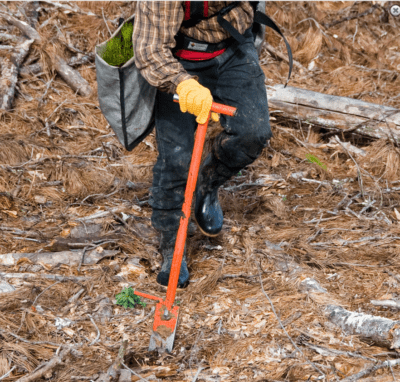
    Timber planters are contractors for timber companies and for private owners. It is highly specialized work. Finding them is not easy as there aren’t very many of them. Finding a good one is even more difficult. The one we have used for decades is top notch. He has assembled a crew of 18 young men, mostly from Guatemala. To get them in on a work visa he has to screen them strenuously. No criminal record. No family here in the states. They must go back home after planting season. References to vouch for them. On top of that he personally screens them, trains them and watches their work. Those that can’t cut it are sent packing. He claims it took him years to assemble the crew he wanted. He is kinda pricey, but worth every penny. I also slip each of the crew an extra envelope at the end of the job. They can cover forty acres in four hours. The trees are spaced properly and every one of them lives. No bent roots and no tipped over seedlings.

    Because we are planting a cultivar known as the super pine they grow incredibly fast. Hell, if you don’t get out of the way it grows so fast it will knock you down. After planting one patch it was five years before I returned. I didn’t recognize the place because it had grown so much. After only five years the road was barely passable and you couldn’t see the sky for the canopies.

    The trees are acquired from commercial nurseries in bundles of 1000, a bundle being about the size of a square hay bale and weighing around 100 lbs. They are  between one and two feet tall and their roots are dipped in gelatin to keep them from drying. The crew lines up with each man about eight to ten feet apart. Each man has a dibble and about half of a bundle of seedlings on his back. They begin marching in time shoulder to shoulder they take three steps, stop, put the dibble in the ground with their foot, wiggle it, place a tree in carefully so as not to bend the root tips up, then stomp their foot next to the hole to close it up. Then they take three steps making sure everyone keeps up with the line and then repeat. It is very physically demanding and tedious work. I stand by a fire and watch. Four hours and they are finished. I am tellin’ ya, those guys are machines, but I have never seen one of the crew over 30 years old.
    I tried it once myself alone. I got approximately 100 yards by 100 yards planted…in two weeks. I was nearly crippled from it. I will gladly pay the 15K to have ol’ Joe and his crew do it.

    Planting approximately 8×8 feet apart it works out to about one bundle per acre. That may seem too close but over time the trees will thin themselves out.  Planting close causes them to grow tall and straight. If they are too far apart they will branch out and have too many knots making poor saw logs.

    I have had success by casting seed. A forestry company here locally sells super pine seed which you buy by the pound. Each seed is coated with fertilizer and bug killer. It’s not cheap but I can do that myself. I found that the mechanical caster they sold me would put the seed out too thick no matter how I adjusted it so I cast the caster in the creek and started spreading/throwing by hand. I successfully planted 5 forty-acre plots that way over the years, each one taking me about two days to finish.  On one hilly plot the day after I finished casting out the seed, a huge rainstorm came up. “Oh, hellfire,” I thought. “All of my seed washed away.” So I bought more and replanted it. Apparently, I was mistaken and double planted. Today the trees are so close together you have to turn sideways to walk through there.

    I estimate we have planted around one million trees over the decades. Some of the first timber I planted is now ready to harvest. I don’t know if I can cut it. If hunting leases will pay the property taxes I may just leave it for my grandchildren.


    Links of interest

    Super pines

    More super pines

    Forestry dibble

    Seedlings

    Seedling prices

  • Economics Corner with Paul Krugman and Winston’s Mom

    What?  I’m on?   I’m sorry.  Let me get a clean pair of skivvies, I’m not quite ready yet…

    So here is the column of bullshit from last week.

    “If you live in the Midwest, where else do you want to live besides Chicago? You don’t want to live in Cincinnati or Cleveland or, you know, these armpits of America.” So declared Stephen Moore, the man Donald Trump wants to install on the Federal Reserve’s Board of Governors, during a 2014 event held at a think tank called, yes, the Heartland Institute.

    The crowd laughed.

    Moore is an indefensible choice on many grounds. Even if he hadn’t shown himself to be extraordinarily misogynistic and have an ugly personal history, his track record on economics — always wrong, never admitting error or learning from it — is utterly disqualifying.

    His remarks about the Midwest, however, highlight more than his unsuitability for the Fed. They also provide an illustration of something I’ve been noticing for a while: The thinly veiled contempt conservative elites feel for the middle-American voters they depend on.

    This guy again? Stephen Moore.  Stephen Moore?  Stephen Moore!  Motherfucking STEPHEN MOORE.  How many moore of these columns are you going to dedicate to STEPHEN MOORE

    Seriously, did he sleep with your wife or something?

    This is not the story you usually hear. On the contrary, we’re inundated with claims that liberals feel disdain for the heartland. Even liberals themselves often buy into these claims, berate themselves for having been condescending and pledge to do better.

    But what’s the source of that narrative? Look at where the belief that liberals don’t respect the heartland comes from, and it turns out that it has little to do with things Democrats actually say, let alone their policies. It is, instead, a story line pushed relentlessly by Fox News and other propaganda organizations, relying on out-of-context quotes and sheer fabrication.

    Conservative contempt, by contrast, is real. Moore’s “armpit” line evidently didn’t shock his audience, probably because disparaging views about middle America are widespread among right-wing intellectuals and, more discreetly, right-wing politicians.

    Hey dumbass.  Everyone makes fun of Cleveland.  It’s an easy target, plus people there cheerful and have pretty good humor about it..  Contrast this with Chicago where walking in the wrong neighborhood will get you shot by the locals, or some asshole says you have weed and the cops break down the door of your business looking for kickbacks and shooting my workers.

    …and lets be real, I hate fucking cops.  They think they can get everything for free…

    …and he’s making me defend Cleveland.  Christ, what an asshole…

    Let’s be clear: There is a real economic and social crisis in what one recent analysis calls the “Eastern Heartland.” This region suffers from persistently low employment among working-age men and has seen a surge in mortality from alcohol, suicide and opioids — “deaths of despair,” in the phrase of Anne Case and Angus Deaton.

    What lies behind this crisis? The view of most liberals, as far as I can tell, is that it reflects declining economic opportunity, changes in the economy that have favored metropolitan areas over rural communities. On this view, declining opportunity has led to social disruption, in the same way that the disappearance of urban industry undermined inner-city communities a half century ago.

    Those industries didn’t disappear, they went to Texass.

    Many conservatives, however, blame the victims. They attribute the heartland’s woes to a mysterious collapse in morality and family values that somehow hasn’t affected coastal cities. Moral collapse is the theme of books like Charles Murray’s “Coming Apart: The State of White America,” and of innumerable articles. One widely read essay in National Review went so far as to label the troubled Eastern Heartland “the white ghetto,” whose people are too indolent to move to where the jobs are.

    So who, exactly, doesn’t respect middle America?

    When it comes to politicians, of course, what they say is much less important than what they do. So what do the policy choices of liberal and conservative pols say about how they value the heartland?  Some Democrats, notably Elizabeth Warren, have been offering real proposals to help rural areas. They’re probably not enough to reverse rural and small-town economic decline, which would be hard to do even with plenty of money and the best will in the world. But they would help.

  • I was a Union Guy

    The year was 1955, I had graduated from high school that May. I was a month shy of 18 at the time. I had joined the National Guard the year before, a lot of my friends had also joined as soon as we could. At the time the draft was still going on and by being in the Guard we weren’t draft eligible.

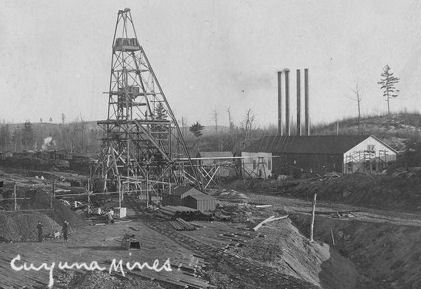
    I lived in a northern Minnesota community, on the Cuyuna Iron Range, the smallest of the three Minnesota ranges. Many of my friends and classmates’ fathers were miners. Jobs were scarce and because I was not 18 I couldn’t even apply. I went off to Guard camp and was 18 when I came back at the end of June so I applied around but because I was late all the vacancies had been filled, but some of my school friends had gotten on. Nepotism was useful, having a family member working in a mine was a real help.

    Anyway, I soon got a call at one of the mines, the father of the girl I had been dating was hiring foreman and my brother also worked at the same mine so the nepotism was alive and well. It was one of the smaller open pits. My first day on the job was blaster’s helper which allowed me to fill the charged holes with the handy wheel barrow and a #2 long handle shovel I’d been provided. Not romantic but still…

    After one day I’d pretty well mastered the shovel/wheelbarrow operations so I got transferred to driller’s helper at the same pay level, #5. This was not a promotion. I carried water by the bucketful to the driller who seemed to not care how much he spilled as he was using it. I helped empty the mud from the drilled holes, meaning I got in the mud’s way as it splashed out of the mud bucket. I took samples and recorded the info in a log book. Hey, I was a high school graduate so I could do that administrative stuff. If you’ve ever met an open pit iron miner his clothes are rust color, his car is rust color, his wife is rust color, his kids are rust color. A driller is the top of the line rust color because he works in red mud all day.

    I was like a pig in mud, so to speak. I had a job, I was making $1.86 @ hour, a grown up wage. Now I could get a car, some beer and with a little luck a girl friend since my old one had gone to school in Minneapolis and didn’t get home too often. After a few weeks I noticed my pay check had been docked a few dollars, I can’t remember how much but I’m thinking about 4 bucks. I asked the guys at work why that happened and they told me, “Oh, union dues” WTF is up with that? I don’t remember joining a union. “Oh, we have to belong to the Steel Workers Union to keep our job, it’s a closed shop”

    “Well, what do we get for our money?” The driller said, “We are protected, no one can bump us, unless they have more seniority” “But” I said, “you may have noticed that I’m the youngest guy working here, everyone has more seniority than I have”. He said, “Yep, everyone here can bump you but since drilling is the crappiest job here and no one else wants it, you’re safe.”

    Anyway, I was now a union member. The weeks went by, uneventful, pay was good, work was dirty but after Monday one didn’t get much dirtier the rest of the week. My mother took my clothes to the laundromat ’cause she didn’t want to get her wash machine filled with the red color. As we entered into fall the discussions were “I wonder when we get our pink slips” since the open pits didn’t work in the winter after freezing set in. Sometime around the first of November the foreman met us after our shift was over, handed out the pink slips. At that point many of the miners were happy, get their rocking chair money, do a little logging, fishing, many had small farms and could wait out the winter. I was not happy, I didn’t want to work in the cold but I still wanted a paycheck.

    Then, sometime in January/February I got called back to work, we couldn’t drill but I got assigned to an older guy to lay a pipeline from the bottom of the pit, up the side and over the edge in to a holding pond. Every thing had to be ready by spring when the snow/ice was gone. Pipeline was about 4 inch diameter, maybe 20 ft long to a section. It was unbelievably cold, trying to work in the snow, climbing the sides of the pit. The other guy knew what was going on, I did what he told me but mostly I stayed in the little shack we had and kept throwing coal into a little stove to keep warm. I think it took us (the other guy did 90% of the work) about 2-3 weeks to do the job, I was miserable.

    Then I got put on a jack hammer crew with my brother and a couple other young guys. We drilled holes in a road bed that was then blasted and dug out so the ore below the road could be mined when spring came. After one day on the jack hammer my wrists hurt so bad I could hardly work. The next day I shammed it, pretending to do a little and after 3-4 days I could actually produce a few holes in the frozen dirt. We did that for about 3 weeks and got laid off again, probably about the first of March, 1956. Jack hammer operators got driller’s wages so I was getting about $2.25 @ hour.

    Finally, Spring came and we got called back to work, the company had a contract for the type of ore we had so a second shift was put on, a third shift on the drills. I was promoted to driller at 18, working with the old guys. The proverbial pig in mud, now I had a helper. Overtime, week ends, etc, money was good for a kid. Then Guard camp came and I needed a break, took my vacation so I got paid for both work and Guard.

    Then strike talk! Our contract was over on June 30th, for the whole Cuyuna Range. Most of the old timers weren’t concerned, they lived like that their whole lives, a few days unpaid summer vacation and go back to work.

    Not me! I ran around telling everyone that I wasn’t going to put with this crap. If the strike lasted over a week I was going to Man Up and join the Army! Well, the 8th day came, no sign of the strike being over. I convinced my brother that we both should go in the Army. We were both in the Guard so we volunteered to be drafted, that was only a 2 year commitment plus it allowed the draft board to meet the quota for the month a little easier.

    The strike lasted 5 weeks, then back to work for 5 weeks before we got our military orders. Now I wasn’t too happy, we’d lost 5 weeks pay, got a modest pay increase, like 20 cents @ hour. The older guys got another week or two vacation but I’d lost 500 bucks at a job that lasted about 7 months a year at best and some years never saw the mines open for lack of a contract.

    We did our Army time, I ended up in Germany, my brother in Greenland. When we go home the mine was closed that year, as were most on the Cuyuna Range. I walked across the street from the State Employment office to the Army Recruiter, got lined up with a long tech school and re-enlisted, my brother hung around, thinking something would change.

    I did my 20 years Army time, a lot of it overseas. I had started going to college while I was in service and when I retired finished my last two years with a BS Ed. I never taught, my kids said I had no class. I was able to turn my education into second career in business.

    If it had not been for the union and going on strike I might never have had a reason to leave Podunkville and learn all the things that experience and travel provide. I went from being a farm kid in the woods full circle and ended up about 4 miles from where I’d started in 1955. Now though, my wife and I are comfortable as the years pass us by. I credit the union with giving me the reason to look beyond the limited horizons that I had at 18. I can not thank the union enough. I never looked back except to wave good bye.

  • Economics Corner with Paul Krugman and Winston’s Mom

    Hey fellas?  How ya been?

    Here’s tonight’s drivel from your favorite Nobel Laureate!

    A peculiar chapter in the 2020 presidential race ended Monday, when Bernie Sanders, after months of foot-dragging, finally released his tax returns. The odd thing was that the returns appear to be perfectly innocuous. So what was all that about?

    The answer seems to be that Sanders got a lot of book royalties after the 2016 campaign, and was afraid that revealing this fact would produce headlines mocking him for now being part of the 1 Percent. Indeed, some journalists did try to make his income an issue.

    This line of attack is, however, deeply stupid. Politicians who support policies that would raise their own taxes and strengthen a social safety net they’re unlikely to need aren’t being hypocrites; if anything, they’re demonstrating their civic virtue.

    This criticism is perfectly valid as Bernie’s entire message is the wealthiest among us should pay for every tom, dick, and harry snatch of a government program that he never seems to have an issue supporting.  If he himself makes more money than nearly all Americans and programs where he can pay more in taxes than is required by law, yet fails to do so demonstrates hypocrisy on his part. He can’t even say he donated to charity, as he donated a pittance compared to what he made.  Bernie is no saint and neither are you for defending him.

    But failure to understand what hypocrisy means isn’t the only way our discourse about politics and inequality goes off the rails. The catchphrase “the 1 Percent” has also become a problem, obscuring the nature of class in 21st-century America.

    Focusing on the top percentile of the income distribution was originally intended as a corrective to the comforting but false notion that growing inequality was mainly about a rising payoff to education. The reality is that over the past few decades the typical college graduate has seen only modest gains, with the big money going to a small group at the top. Talking about “the 1 Percent” was shorthand for acknowledging this reality, and tying that reality to readily available data.

    But putting Bernie Sanders and the Koch brothers in the same class is obviously getting things wrong in a different way.

    This is absolutely correct.  The Kock brothers donate generously to charity, as well as have a number of foundations in their name, including educations grants, research, k-12…. How much did Bernie donate again?

    True, there’s a huge difference between being affluent enough that you don’t have to worry much about money and living with the financial insecurity that afflicts many Americans who consider themselves middle class. According to the Federal Reserve, 40 percent of U.S. adults don’t have enough cash to meet a $400 emergency expense; a much larger number of Americans would be severely strained by the kinds of costs that routinely arise when, say, illness strikes, even for those who have health insurance.

    $400?  Sounds like a personal problem.  Even I have $2000 in cash hidden in my ass.

    So if you have an income high enough that you can easily afford health care and good housing, have plenty of liquid assets and find it hard to imagine ever needing food stamps, you’re part of a privileged minority.

    But there’s also a big difference between being affluent, even very affluent, and having the kind of wealth that puts you in a completely separate social universe. It’s a difference summed up three decades ago in the movie “Wall Street,” when Gordon Gekko mocks the limited ambitions of someone who just wants to be “a $400,000-a-year working Wall Street stiff flying first class and being comfortable.”

    Even now, most Americans don’t seem to realize just how rich today’s rich are. At a recent event, my CUNY colleague Janet Gornick was greeted with disbelief when she mentioned in passing that the top 25 hedge fund managers make an average of $850 million a year. But her number was correct.

    One survey found that Americans, on average, think that corporate C.E.O.s are paid about 30 times as much as ordinary workers, which hasn’t been true since the 1970s. These days the ratio is more like 300 to 1.

    Why should we care about the very rich? It’s not about envy, it’s about oligarchy.

    With great wealth comes both great power and a separation from the concerns of ordinary citizens. What the very rich want, they often get; but what they want is often harmful to the rest of the nation. There are some public-spirited billionaires, some very wealthy liberals. But they aren’t typical of their class.

    Its not about millionaires like Bernie.  No, the problem is billionaires.  You’re starting to sound like this guy.

    The very rich don’t need Medicare or Social Security; they don’t use public education or public transit; they may not even be that reliant on public roads (there are helicopters, after all). Meanwhile, they don’t want to pay taxes.

    …but…but…muh ROOOOOOAAAAAAAADZ.  Billionaires never use ROOOOOOOOAAAAAAADZ.

    Sure enough, and contrary to popular belief, billionaires mostly (although often stealthily) wield their political power on behalf of tax cuts at the top, a weaker safety net and deregulation. And financial support from the very rich is the most important force sustaining the extremist right-wing politics that now dominates the Republican Party.

    Well shit.  Could it be prominent politicians in the Democrat Party, like Bernie, having anything to do with that?

    That’s why it’s important to understand who we mean when we talk about the very rich. It’s not doctors, lawyers or, yes, authors, some of whom make it into “the 1 Percent.” It’s a much more rarefied social stratum.

    None of this means that the merely affluent should be exempt from the burden of creating a more decent society. The Affordable Care Act was paid for in part by taxes on incomes in excess of $200,000, so 400K-a-year working stiffs did pay some of the cost. That’s O.K.: They (we) can afford it. And whining that $200,000 a year isn’t really rich is unseemly.

    But we should be able to understand both that the affluent in general should be paying more in taxes, and that the very rich are different from you and me ­— and Bernie Sanders. The class divide that lies at the root of our political polarization is much starker, much more extreme than most people seem to realize.

    Last I checked, with a single exception, none of the billionaires you are lambasting are running for president.  The number of billionaires is also such a tiny number in comparison to the general population that simply taking their money will never pay for his programs.  No, he will have to tax people like him, like you and nearly everyone else to pay for turning the entire country into a marauding gang of whores.  When given the chance to pay more than his “fair share” of taxes, or even to charities that do a lot of good helping the poor and downtrodden, he chose not to.  This is what makes him a hypocrite, because he knows better than everyone else who actually produced anything of value to society and was rewarded with wealth beyond what any one person might require, until it cums to his own money.

    Which is fine for you to defend him, you advocate the same bullshit he does, and as it turns out, you also donated absolutely nothing to charity, either.

  • Economics Corner with Paul Krugman and Winston’s Mom

    Here’s the link.  Apparently Krugabe thinks Trump is trying to kill us all.

    There’s a lot we don’t know about the legacy Donald Trump will leave behind. And it is, of course, hugely important what happens in the 2020 election. But one thing seems sure: Even if he’s a one-term president, Trump will have caused, directly or indirectly, the premature deaths of a large number of Americans.

    C’mon now, that doesn’t sound the least bit hyperbolic.  Its not like somebody is going to put a black bag over my head, and tie me up and beat me…..well at least not somebody from the Government.

    Some of those deaths will come at the hands of right-wing, white nationalist extremists, who are a rapidly growing threat, partly because they feel empowered by a president who calls them “very fine people.”

    I see you support your claim with a link to Vox.  I’m going to escalate this by throwing Jihadwatch at you!

    Some will come from failures of governance, like the inadequate response to Hurricane Maria, which surely contributed to the high death toll in Puerto Rico. (Reminder: Puerto Ricans are U.S. citizens.)

    Reminder:  Puerto Rico received $16 Billion last year to recover from Hurricane Maria.  Assuming the population statistics from the Census Bureau are correct that is approximately $5007 per Puerto Rican in response to a single event…

    Some will come from the administration’s continuing efforts to sabotage Obamacare, which have failed to kill health reform but have stalled the decline in the number of uninsured, meaning that many people still aren’t getting the health care they need. Of course, if Trump gets his way and eliminates Obamacare altogether, things on this front will get much, much worse.

    But the biggest death toll is likely to come from Trump’s agenda of deregulation — or maybe we should call it “deregulation,” because his administration is curiously selective about which industries it wants to leave alone.

    Krugman — or maybe we should call Krug”man”…

    Consider two recent events that help capture the deadly strangeness of what’s going on.

    One is the administration’s plan for hog plants to take over much of the federal responsibility for food safety inspections. And why not? It’s not as if we’ve seen safety problems arise from self-regulation in, say, the aircraft industry, have we? Or as if we ever experience major outbreaks of food-borne illness? Or as if there was a reason the U.S. government stepped in to regulate meatpacking in the first place?

    Now, you could see the Trump administration’s willingness to trust the meat industry to keep our meat safe as part of an overall attack on government regulation, a willingness to trust profit-making businesses to do the right thing and let the market rule. And there’s something to that, but it’s not the whole story, as illustrated by another event: Trump’s declaration the other day that wind turbines cause cancer.

    Yeah, because meat is the same thing as aircraft.  Besides, organizations outside of government are more than capable of providing food safety standards.  Not like there are any cultural or religious standards that have thousands of years of success that we can point to.  In Krug”man’s” world, it was the great salmonella outbreak of the 1940s that nearly eradicated (((them))).

    But when it comes to renewable energy, Trump and company are suddenly very worried about supposed negative side effects, which generally exist only in their imagination. Last year the administration floated a proposal that would have forced the operators of electricity grids to subsidize coal and nuclear energy. The supposed rationale was that new sources were threatening to destabilize those grids — but the grid operators themselves denied that this was the case.

    So it’s deregulation for some, but dire warnings about imaginary threats for others. What’s going on?

    Part of the answer is, follow the money. Political contributions from the meat-processing industry overwhelmingly favor Republicans. Coal mining supports the G.O.P. almost exclusively. Alternative energy, on the other hand, generally favors Democrats.

    There are probably other things, too. If you’re a party that wishes we could go back to the 1950s (but without the 91 percent top tax rate), you’re going to have a hard time accepting the reality that hippie-dippy, unmanly things like wind and solar power are becoming ever more cost-competitive.

    I see you linked to Forbes.  Wanna see what else Forbes has to say about the market viability of hippie-dippie, unmanly things like wind and solar power?

    A study by the University of Texas projected that U.S. energy subsidies per megawatt hour in 2019 would be $0.5 for coal, $1- $2 for oil and natural gas, $15- $57 for wind and $43- $320 for solar. Many of the renewable energy subsidies come in the form of a Production Tax Credit (PTC) of 2.3 cents per kilowatt hour. Wholesale prices for electricity in 2017 were between approximately 2.9 cents to 5.6 cents per kilowatt hour. Therefore the wind production tax credit covers 30% to 60% of wholesale electricity prices.

    …that means it is only competitive because of the scale of subsidies.  That means it is not competitive.  So how does Krug”man”end it?

    Whatever the drivers of Trump policy, the fact, as I said, is that it will kill people. Wind turbines don’t cause cancer, but coal-burning power plants do — along with many other ailments. The Trump administration’s own estimates indicate that its relaxation of coal pollution rules will kill more than 1,000 Americans every year. If the administration gets to implement its full agenda — not just deregulation of many industries, but discrimination against industries it doesn’t like, such as renewable energy — the toll will be much higher.

    So if you eat meat — or, for that matter, drink water or breathe air — there’s a real sense in which Donald Trump is trying to kill you. And even if he’s turned out of office next year, for many Americans it will be too late.

    WERE ALL GONNA DIE….putz.