As OFFICIAL COMPTROLLER for this insane asylum I’m pleased to report that we held a meeting of the Supreme Council of Masters of the Universe and decided this year to disburse our excess funds to a pair of charities that we believe you, the filthy lumpen-proletariat, will really approve of.
Minutes ago (as of my writing this; God only knows when it will be published) we donated $500 to FIRE (the Foundation for Individual Rights in Education), which dedicates itself to fighting off the worst excesses of the Kampus Kommunist Kids and their lackey administrators. We also donated $1,000 to the Institute for Justice, which has done so much to fight the army of radioactive bears that have overrun the western 1/3 of our once beautiful continent.
Thank you all for continuing your generous donations, which makes all this possible.
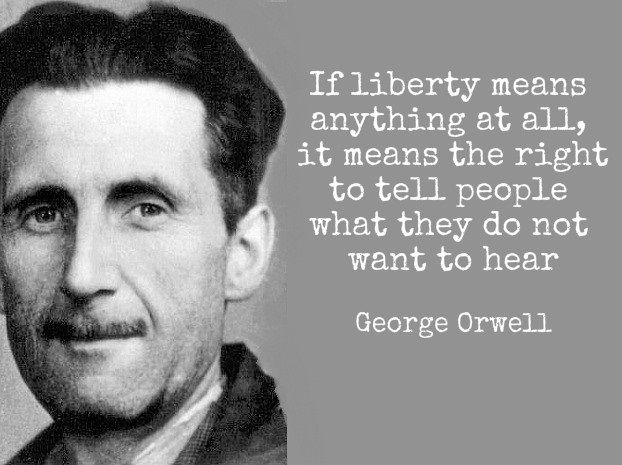
Imagine being arrested and thrown in jail merely for expressing an unpopular opinion. Okay, now analyze and explain “hate speech.”
Campaign Finance Reform – A Primer
All attempts at Campaign Finance Reform in these United States have failed. ALL. Every single one of them.
If that sounds like exaggeration, just consider that attempts to limit the influence of money in politics is typically taught in history or civics classes as beginning (in earnest) shortly after the presidency of Andrew Jackson, the pro-slavery founder of the Democratic party whose administration ultimately produced the political “spoils system.” That would put us back to the mid- to late- 1830’s. Good ol’ “Honest Abe” himself was bankrupted trying to personally finance his first Senatorial campaign in 1858, so he had to rely upon businessman from Philadelphia and New York to finance his Presidential campaign in 1860. According to some historians, however, money was in politics from the beginning of the Republic.
In the United States, concerns over financing campaigns for public office have been around since before the writing of the Constitution. Candidates traded influence, power, and gifts, for constituents’ money and votes even before the dawn of the Republic. George Washington – later President, but at the time, a candidate for the Virginia House of Burgesses – bestowed upon the 391 voters in his district the “customary means” of winning votes: “28 gallons of rum, 50 gallons of rum punch, 34 gallons of wine, 46 gallons of beer, and 2 gallons of cider royal.” James Madison lost his reelection campaign to the Virginia legislature 20 years later because he refused to provide voters with the customary whiskey.
Gardner and Charles, “Election Law in the American Political System,” p. 637.
In 1867, just two years after the Civil War, the first legislative attempt at campaign finance reform appeared in a Naval Appropriations bill. It forbade government officials from soliciting (i.e. “shaking down”) Navy Yard workers for money to finance the ruling party’s election campaigns. This had become a routine practice in prior years. So routine was it that federal employees would have some portion of their pay directly “assessed” by the government to the Party’s re-election fund. The protections of the 1867 Navy yard workers were eventually extended to all civil service workers… (But not the rest of us, evidently.) The Presidential campaign of 1896 was so openly a case of dueling donors obtaining political promises from each Parties’ respectively well-financed candidates – William Jennings Bryan for Team Blue and William McKinley for Team Red – that the public began yelling for campaign finance reform… and here we are 120 years later. This brief timeline of attempts at reform shows just how fruitless they all have been.
Modern, seemingly sophisticated attempts at campaign finance reform, by people from both political parties in Congress, have ultimately been set aside by Supreme Court decisions. While it may be unpalatable or politically inexpedient to say this, the Supreme Court’s rulings in these cases are very solid reads of the First Amendment… proving yet again the old adage that “sometimes even a blind squirrel finds a nut” or that “even a broken clock is right twice a day.” Lawsuits by public interest groups have ultimately failed to produce anything even close to a good result. Now the public feels so desperate for something to happen that they’ll embrace even nonsensical calls for reform by (of all people!!) Hilary Clinton. The much-ballyhooed, and almost totally misunderstood, case of Citizens United, 558 U.S. 310 (210) was about a non-profit movie company that made a film about then Senator Clinton. The Federal Election Commission agreed that the movie would be subject to a federal campaign finance law that would have imposed criminal and civil penalties on the movie company. That is to say, the law as it was made it a crime for a collection of people – using a corporate form – from expressing their political opinions, quintessential First Amendment conduct. Hard to imagine that the words “Congress shall make NO LAW” are ambiguous, but here we are, with a mountain of laws collectively regarding each and every one of the subjects specifically listed as exempt from regulation in the First Amendment.
Either We Are a Republic With a Charter To Be Faithfully Followed, or We Are Not.
Understanding How the (Legislative) Sausage Gets Made
To understand why campaign finance reform doesn’t work – and what simple fix would work – you have to understand some basic economics around how the political sausage gets made, so to speak.
First, you must know what politicians all know: there has only been one time in the last 42 years that the rate of re-election for Congressional incumbents dipped below 90% – that was 1974, when it was only 89.7%, a rounding of tenths away from being 90%. Muse on that for minute – Congress has had historically bad approval ratings – like below 20%, for decades, by any polling company. Everyone thinks Congress sucks; yet Congressional incumbents get re-elected over 90% of the time. It’s a near-certainty. Many people have speculated or offered reasoned opinions about this phenomenon, but I don’t really care about the “why” because the mere statistical truth of it is all that matters for my argument.
Second, we must make the rather short “hop” of faith and assume that politicians are at least as self-interested as the rest of us… one might humbly suggest that they are (perhaps) even a bit more self-interested than the rest of us, or make the claim that the job attracts the type, but I don’t need to prove that as crucial to my theory. Suffice it that my claim rests on what I believe to be a rather well-observed phenomenon about the self-interest of politicians. Lord Acton wrote an entire tract explaining this, but unfortunately no one reads it and all that we remember (if at all) is this quote: “Power corrupts, and absolute power corrupts absolutely.” My own observation from many years of government service and being an American is simply that the government does not choose its prospective employees from some magical pool of magnanimous, morally benevolent, and personally-disinterested human beings. If you think I am incorrect, you’ve obviously never been to the Department of Motor Vehicles to register your car, or change the title, or correct a typo on a Vehicle Identification Number (VIN). Try to manage that over your lunch break and let me know how it goes; and ask yourself about how good the customer service is while you’re there.
The Currency of the Politician is Law – Legislation For Some and Against Others
Rep. Chuck Schumer (D, NY) explains how he can’t read, doesn’t understand, and doesn’t care about the 1st Amendment.
To the above facts we have to add some economics. In my opinion, the best way to begin to understand this is to ask a very simple question: if you were a legislator looking to raise some cash, what would you have to sell? (Think about it seriously for a moment).
ANS: Legislation. i.e. Laws.
Legislation is the only thing that a lawmaker can offer any prospective “buyer.” It is the medium of exchange (i.e. the currency) of the political class and a specific instance of the more general “Law of the Instrument.”* In return for a piece of favorable legislation, or a clause in the next omnibus bill – or exemption from cuts or regulation – political donors deposit sums into re-elections campaigns, or exchange different favors with lobbyists – the “middlemen” of the entire Money-for-Favor-for-Reelection Triangle.
If this seems unduly cynical, it shouldn’t be. If you have a friend who is a cop, who hasn’t heard of, or considered, asking him or her to “look into” a ticket…? Now magnify that onto a scale where instead of your hundred-fifty bucks plus court costs being at stake, it’s someone else’s multi-million dollar, multinational business and a piece of legislation that would ensure government contracts flowing that direction for the next 10 years. Or a promise to keep government regulators out of your business for at least your friendly Senator’s next 6 years of office. If all of this seems speculative or just too much to swallow at once, consider this quote right from the horse’s mouth, as it were:
You send us to Congress; we pass laws under which you make money…and out of your profits, you further contribute to our campaign funds to send us back again to pass more laws to enable you to make more money.
— Senator Boies Penrose, (R, PA) 1896 (quoted in Id., Gardner and Charles, p. 638.)
I always hear people complain about the influence of “corporate money” in politics and yet no one ever seems to consider that if their Senator wasn’t offering legislation for sale, the corporation wouldn’t be able to make a purchase. And it is in no way solely corporations buying-off politicians. Unions are at least as powerful and well-off as any corporation and billionaires with agendas sit on both the left and the right of the political spectrum. In fact, if we’re dealing in generalities, it is worth wondering: if corporations are filled with greedy, capital-obsessed Scrooges, why would any of those money-grubbers ever voluntarily give their money to a politician in the first place? To ask the question is to destroy the premise.
When you’re starting a company in your garage you don’t start by setting aside your political lobbying budget, then make whatever widget, software, computer, or other item that is the money-making aspect of your new venture. You first have to make something that a large enough number of people are willing to voluntarily pay you such that you have a growing enterprise, be it a successful song, an iPhone, the personal computer, or a rubber tire. Legislators don’t enter your mind until well down the road in the business cycle. Thus, perhaps it is enough to agree that legislators aren’t the unfortunate victims of a “system” that is foisted upon them. What Senators and Congressman do to fill the coffers of their re-elections campaigns is a perfectly natural, foreseeable byproduct of the funding of the political system.
California mother and serious writer Joanna Schroeder recently got her fifteen minutes of fame courtesy of breathless CNN reporter Sara Sidner. Why, exactly? You see, Ms. Schroeder is very, very concerned about the well-being of her teenage sons, as a good mother should be, and wanted to raise the alarm for other mothers of teenage boys to be aware of the insidious reach of right-wing propaganda. She valiantly warned her fellow naive do-gooders about the sinister extremist messaging being used to target youth, lest they be “drawn in by snarky memes.”
Words to watch for
Snowflake: used to mock people deemed too sensitive, especially about issues impacting minorities
SJW: stands for “social justice warrior,” a term used to mock civil rights activists
Sidner does offer the rote, perfunctory disclaimer that Schroeder “does not shun mainstream conservative thought,” yet curiously fails to provide any evidence of that, or any example of what constitutes mainstream conservative thought. This claim is completely and laughably undermined by the inclusion of the terms “snowflake,” and “SJW” in the sidebar list of forbidden speech.
Those terms have been part of conservative dialogue for years. National Review is the leading organ of that mainstream conservative thought which Schroeder claims to not shun, yet of which she is blissfully unaware. A quick web search of the National Review website yielded articles from early 2015 by James Lileks and Jennifer Kabbany with the contemporary usage of “snowflake” as a term for overly-sensitive, nominally adult humans. Rather prophetically, Kabbany’s piece is titled “The Death of College Humor.” The term “SJW” was first used by National Review in late 2015 in articles by George Leef and Katherine Timpf.
Those who use the phrase sarcastically, as most do, imply that the snowflakes’ sensibilities are impossibly delicate, and shatter when confronted with the horrible realities of the world, such as capitalism or people who are insufficiently troubled by the link between climate change and industrial lettuce production. –James Lileks
Four and a half years is forever ago in the age of internet and twenty-four hour news. Yet, somehow, concerned mother Schroeder and professional journalist Sidner both missed those and all the subsequent references in National Review and other conservative media. And all the serious, informed, and rational discussion about the chilling effect of speech codes, and the erosion of first amendment rights.
Words to watch for
Beta… Cuck…
Femenoid/femoid…
Redpilled…
Blood and Soil…
14 or 88…
((( )))…
That’s quite an impressive list that they have assembled, and some of them are actual white supremacist dogwhistles: “Blood and Soil;” 14; 88; and the “echo,” those three nested parentheses denoting the thing contained within is (((Jewish))). But it should be noted that the echo has also been coopted by Jews and is often used ironically. Schroeder is right to be concerned about teenagers using those phrases. But including the phrases “SJW,” “snowflake,” and “triggered” in that laundry list only fans the flames of hysteria and undermines Schroeder’s already dubious credibility.
The first word I heard was “triggered,” and that’s a tough one. You may hear this from your conservative uncle, and you may also hear this from a kid who’s getting a lot of alt-right messaging online, and that’s everyone’s too sensitive today. -Schroeder, CNN interview
About the term “triggering” – Schroeder seems unaware that the term was originally a legit feminist term, explained to us back in June, 2015, by Gillian Brown on that unimpeachably feminist website Everyday Feminism. That the term has been so thoroughly co-opted by relentless parody that she is only familiar with its ironic usage must be as disappointing to Schroeder as having her lack of familiarity with feminist rhetoric exposed.
This guy understood the role of media in creating moral panics all the way back in 1964. He would have referred to Schroeder as a “moral entrepreneur.”
Schroeder does grudgingly acknowledge during her CNN interview that not all those “words to watch for” are racist, but some are “gateways.” The slippery slope argument, hinted at. Just like Marijuana is a “gateway drug” and every person who takes a puff from a “reefer” will eventually end up a heroin addict. And then there is the slippery conflation of mere mockery with inevitable racism and homophobia, since according to the article the term Snowflake is used to mock people “especially [emphasis added] about issues impacting minorities.” SJW, we are informed, “is a term used to mock civil rights activists.”
These terms are being used to mock and push back against the speech police, wannabe censors and their enablers such as Schroeder. The whole point of “triggering,” in the original usage anyway, is the conflation of speech with actual physical violence. This is unacceptable to those of use in the Liberty community, and moral scolds such as Schroeder must always be seen as enemies of free speech.
This year, plenty more ideas came to mind at Glib HQ for libertarian costumes. Because if you can’t go around town without insulting somebody, you may as well insult everybody.
This is my review of Leinenkugel’s Harvest Patch Shandy.
We’ll put these in no particular order…
10. Undead David Koch.
For this one, a Dracula costume will probably work. It’ll probably be expensive buying everyone off in the neighborhood.
9. The Hat & The Hair
This is a good couples costume idea, but if you’re going to do it, take it to the next level. A modified Lidsville costume should prove useful in creeping everyone out. A standard Cousin It will suffice for the hair, and should prove confusing to everyone under 25.
8A. Hong Kong Protestor
8B. Slutty Hong Kong Protestor
Party like its 1989…
7. Steve Bannon
Trump’s former campaign chairman, or a homeless man? I don’t know, does it really matter if you can tell the difference?
6. Log Cabin Republican
Because one of you needs an excuse to walk around shirtless in a pair of jorts.
5. Hillary Clinton
Okay, this might just be a Chulthu mask and a Mu-mu but be honest, have you ever seen Chulthu and Hillary in the same room? I contend this is not a coincidence!
4. John Bolton’s mustache
Find one of these old man disguises and run around convincing everyone of all the countries we need to bomb.
3. The tooth fairy
Because why not?
2. Justin Trudeau
Is it donning brown-face if you are simply portraying the infamous, serial brown-face Justin Trudeau? If that isn’t meta enough, if one accuses you of being racist, inform them you are 1/1024th Indian—as in not Native American!
1. Slutty Greta
Did you know the age of consent in Sweden is 15? We were going to go with Pope Greta the Rheeeeeeeee, but decided if you have the hips and the blank face to pull this one off…
Leinenkugel for whatever reason thinks it can pull off this whole “Shandy” thing. It most certainly does not pull off a “pumpkin shandy” in any sense. It smells like vanilla, and is far too sweet to be called beer. It does not give me any reason to change my opinion of their shandy line, which remains: whoever thought of this deserves to be shot. Leinenkugel’s Harvest Shandy: 1.9/5
This type of portrait is known as a head shot. The flag is obligatory for federal officials, but the pattern is a visual distraction and it divides the picture into two fields.
Preet Bharara inserted the business end of the nose hair trimmer into his left nostril, held his breath and pressed the power button. The unit whirred and he worked it around then pulled it out and blew out that nostril onto the small towel hung round his neck by the chain and clamps rig a former lawclerk had left behind in her desk.
He was still stinging from the Woodchipper Incident. He could have gotten away with that, too, for at least for long enough to have gotten their addresses, if it hadn’t been for the pesky internet. He had been publicly humiliated, even called a “muttonhead,” by a prominent First Amendment attorney. His attempt to use a court order to prevent them from even talking about it had backfired spectacularly. But he had taken the heat and managed to keep Judge Forrest’s profile as low as possible; something the bench was sure to notice.
He trimmed inside his right nasal passage and blew out his right nostril productively. He removed the thin towel with the words “US GOVERNMENT” woven into one end and shook it out over the trashcan before dropping it in the official government hamper. He washed his face and took a fresh towel from the stack. He inspected himself again in the mirror.
Fortune had smiled upon him unexpectedly. At that very moment his top man was strolling through the offices of Thought! magazine tagging along with NYPD on a crazy girl call that had come in that morning during the taskforce meeting. No warrant needed. Even if they were squeaky clean, and he knew they weren’t, NYPD would manage to find something.
Having found no flaw, he opened the dry cleaning bag hanging from the back of the door and removed a black robe which he slipped over his head. Next, the wig, from its wooden stand next to the mirror. Once properly enrobed and bewigged he examined himself one final time. Perfect.
Preet exited the bathroom into the robing room. He pressed the button that caused a light on the court clerk’s bench to flash, then slowly walked to the door to the courtoom. Sarah was right on time with the gavel; three perfectly timed raps. He was foregoing the “oyez” and formal opening of court for the occasion. Richard and Corey, the courthouse technicians, were crouched behind their video cameras, grinning. Court staff loved to torture interns and lawclerks whenever possible, and this was a welcome break from taping oral arguments and portrait ceremonies.
Interns Dorian, Raymond and Ming stood awkwardly behind the lawclerk bench wearing robes and wigs shorter and less ornate than his own, making their tights and silver-buckled shoes more prominent. Mediocre legal scholars, but gifted singers, all. Last June he had had Ramesh assemble all of the serious resumes into a single pdf document so he could search that for “choir,” “chorus,” and so on. Once he had his backup singers chosen he read their resumes and created notes justifying his hiring decisions based on their legal merits – just like creating a parallel construction for a prosecution.
Ramesh. His favorite. His protege. A brilliant legal mind, but the boy couldn’t carry a tune in a sack. He so wanted to text Rami to ask for a progress report, but he had resolved to let Rami conduct this all by himself. He trusted Rami, despite the boy’s penchant for independent, sometimes unorthodox, thought. He was glad Ramesh was soon to be married, a good, practical Indian wife would whip him into shape.
The robing room door opened behind the judge’s bench, the judge’s chair had been removed for the taping. He strode measuredly towards the bench to give the door a chance to close; Richard flashed him the thumbs up to cue him that the door had shut. The guys were really good at what they did; he’d have never thought about the open door and robing room lights being a distracting background.
He daintily grasped the slender shaft of the judge’s gavel, raising it theatrically and miming a rap in the air. Sarah hit the play button on the Karaoke machine and everyone started to sway to the doo-wop beat. The interns had been rehearsing for months. This was their big moment, the culmination of their internships. The next few minutes would determine their careers, if not the future course of American jurisprudence.
Lyrics appeared on the screen in the back of the courtoom behind the cameras. He waited for the ball to touch the first letter, and began singing.
Oh, yes, I’m the Great Preetinder,
He remembered hearing the song on the radio as a young boy in Eatontown, New Jersey. He had always thought the song was about someone named Preetinder, someone like him. Until the day in sixth grade when Angus Cohen had slammed him up against a locker. “That song isn’t about you, fag, it’s about pretending to be something you’re not.”
He had abandoned the song until one day it occurred to him that it didn’t matter what the actual lyrics said; what mattered was the interpretation which sounded right to a contemporary audience. The song should be interpreted in manner that made the most sense the context of today, author’s original intentions be damned. By the time he was in high school it had become his personal fight song which he hummed to psych up for tests and debate matches.
Do, Re, and Mi, as they were known throughout the courthouse, harmonized “woo, woo,” sweat running down their faces under the hot television lighting.
Preetinding that I’m doing well,
Doing very well indeed, thank you. And not pretending, in either sense of the word, but Preetinding. A special sort of thing that only someone named Preetinder could do. Preetidude. The Preetness.
He was getting interviewed on Thursday by Judy Woodruff about his take-down of Silk Road. Normally he wouldn’t grant an interview, but PBS was respectable television. And it didn’t hurt that Ms. Woodruff was still quite attractive. Washington had not only approved of the Woodruff interview, but had broadly hinted that it would be a very good thing for him. That could only mean he was being groomed for something higher.
He’d instantiate the humble civil servant saving the internet from organized crime. Unfortunately, a website which just moved money around didn’t sound very sinister. But DOJ had prepared a slideshow explaining why untraceable financial transactions were a Very Bad Thing. And illegal. And drugs.
Woodruff’s people had asked if they could redo the slideshow with “higher production values,” to which DOJ headquarters had also, surprisingly, agreed provided that DOJ got to review the final for accuracy. Media people were notorious for wanting to “simplify” things which meant sexing them up at the expense of accuracy.
My need is such I Preetind to much,
It had been a long, hard climb to get to where he was today. Chess club. Forensic speaking. Debate club. Law review. Internships.
He had worked not only for himself, but for all Indians. The Indian-American community was strongly self-policing. They were determined to prove themselves as a hard-working, modern people. Doctors, lawyers, small merchants. Indians left all that village shaman bullshit back in India. And the swastikas. The woodchipper people had trolled him hard on that. They had no sense of restraint; there was nothing funny about Nazism or even the snarky implication thereof, and there was particularly nothing funny about debating which way to feed a federal judge into a woodchipper.
A headshot with a uniform background. This is a female US Supreme Court justice from the early Twenty-First century wearing much simpler court dress.
I’m lonely but no one can tell,
Someone who was lonely because he spent too much time on work to have real friends. But loneliness and hard work were the price for becoming the man of the hour. He’d show Jindal and Haley who was the chief Indian; national office beckoned him like a Seventh Avenue whore.
Laughing and gay like the clown.
He’d have the last laugh over the Woodchipper people, and clowns were sinister after all. They’d never see this, but in his heart he’d know that he could put on a better production number than them. Rip off Bollywood, would they? He’d reach deep into American culture and show them he could best them at their own game. Bum-flashing antics, bad lyrics and muddy single-camera recording were no match for what the mighty powers of the federal government could bring to bear.
Another dreadful example of official portraiture. Bookshelves of law books are an almost obligatory background for judicial portraits. The shelves create lines going through the subject’s body, making the whole thing look choppy.
Word of it would eventually get back to them, though. He was planning to show the finished product at Bar Talent Night at the Second Circuit Judicial Conference this Summer. The Woodchipper people had friends in surprising places; he could think of at least two law professors who would be there who he knew participated anonymously in Thought! Magazine’s online fora.
There is only so far somebody can go until they piss off the wrong guy…girl…something. Recently Dave Chappelle made a splash with his new comedy special on Netflix titled, Sticks and Stones. Not everybody liked it, especially this individual at Vice. In fact this individual goes so far as to suggest you skip the special unless of course you happen to be transphobic and/or a misogynist. Lets be real, in this case and is probably what this individual thinks is most appropriate.
This is my review of Chatham Brewery Farmers Daughter Rye IPA. (H/T Iobot)
What was the problem with Chappelle’s Netflix special? Nothing, to be honest I only found three or four parts to the whole hour to make me physically laugh, although I could see the humor in the rest of it (I’m a curmudgeon). Dave went too far in the opinion of the individual writing for Vice, and while this individual is entitled to this individual’s opinion, I happen to be entitled to my own. Free speech and butt-fucking? What a country!
Chapelle’s controversial 2017 Netflix specials, like The Age of Spin: Dave Chappelle Live at the Hollywood Palladium and Equanimity and the Bird Revelation, honed his voice as a comedian wary of progressive criticism. That voice is even sharper in his latest special. At one point in his routine, he says he doesn’t believe Michael Jackson molested young children. He continues by saying that if Jackson did, the children should’ve felt lucky their first time was with the King of Pop, adding, “Do you know how good it must’ve felt to go to school the next day after that shit?” Chappelle also returned to his now-infamous obsession with making fun of trans people, saying, “[trans people] hate my fucking guts and I don’t blame them. […] I can’t stop writing jokes about these niggas.” This time, those jokes included asking the audience how funny it would be if he was actually a Chinese person stuck inside a Black man’s body, which (you guessed it) also included a racist impression of a Chinese person. He also found time to defend fellow controversial comedians Kevin Hartand Louis C.K., painting them as victims of an overzealous callout culture.
I too have written about Michael Jackson but I did not make light of it the way Dave does in his special. I found many of the jokes crude but well within what I have come to expect from Dave. This is the guy who wrote an entire sketch about a blind black man in the south who believed he was white, donned actual KKK attire, and shouted WHITE POWER on the pilot episode. This ultimately doomed his show that only lasted two seasons.
Why? Because how do you top that? I was laughing so hard, I was in tears the first time I watched it in my freshman dorm room.
The individual writing for Vice focuses on one bit. Dave refers to a movement, the Alphabet People. Here he compares the entire movement to a car being driven by “G”, because they are the most privileged and therefore best suited to drive the movement to its ultimate destination. The “L”? Nobody has a problem with them…except the “G”. The “B”? Well…”B” is the fantasy everyone wants in on, isn’t it?
Then there is the “T”. The entire movement is held up by “T”, because quite frankly they are farthest deviation from the mean. If you want to know the punchline, I suggest you find it on Netflix.
Here is what the individual writing for Vice doesn’t appear to understand.
Dave Chappelle’s entire brand is Gallows Humor. This type of humor is healthy, because it allows an outlet for people that find themselves being oppressed, imprisoned, at war, being tortured, or even just at a funeral to seek psychological refuge from what is driving their misery. Humor is derived from that which is true, and mocking it–it is healthy. Is it wrong there are people that do not accept the Alphabet People? Yes. Is it okay for somebody to identify a particular reason why a certain segment of the Alphabet People and poke fun at why? Again, yes.
This is what comedians do.
Since the individual writing for Vice also spent time on the epilogue after the special where Dave tells an audience a story about transwoman (…that is one of these for those of you confused by the terms) found delight in Dave’s bit about the Alphabet People. Here the transwoman tells Dave she wished more people would make jokes about ‘T” because it “normalizes” them. This does make sense to a degree. A good example of this may be in the character Cpl Maxwell Q. Klinger from M*A*S*H*. Did he crossdress on purpose as part of a long running gag? Yes. In spite of his hating the Army, his job, and doing everything he could to get out of the Army the other characters did make fun of him for wearing a dress but they respected him because he did his job anyway and did it well. Klinger is a beloved character for that reason, and a man in a dress is fairly normal because the character is funny. The individual writing for Vice does not believe this actually happened–even if a photo of the transwoman was placed in the credits.
Like anything else controversial, don’t take my word for it or some individual writing for Vice. Watch it and decide for yourself.
This beer is also unusual. It straddles a line between differing styles and ends up with an enjoyable product. IPA by itself offends a lot of people, but by using rye malts results in something much more balanced, and much more interesting. I like rye, I don’t like IPA but the combination is good. Chatham Brewery Farmer’s Daughter Rye IPA: 4.0/5
A local politician decided to take action against a Facebook user that criticized her on Facebook. It resulted in the local politician researching the Facebook user, finding out where he works, calling his HR, and informing them of their employee’s actions on Facebook. She just wanted an apology….
Seriously, here’s a link. It’s a tough choice in determining who to hate more, a guy shitposting on Facebook, or the politician that appears to be trying to get him to lose his job. No arbitrary abuse of power here…
This is my review of Highwater Brewing Sugaree Maple Pecan Pie
Is this the new norm for political discourse? When did we turn into a bunch of assholes? This is not that kind of article where I lecture you about proper discourse, or a plea for civility in political discussions, I promise you. I am here to present a solution:
Dueling.
“Your mother is a nice lady.” “You lie, I demand an apology.” “…I am sorry your mother is a nice lady.”
I know what six of you are thinking, “doesn’t this violate NAP?” The rest of you are probably thinking, “Hell Yeah!” For those six I submit there were indeed rules to dueling.
Rule 1. The first offense requires the first apology, though the retort may have been more offensive than the insult. Example: A tells B he is impertinent, etc. B retorts that he lies; yet A must make the first apology because he gave the first offense, and then (after one fire) B may explain away the retort by a subsequent apology.
Rule 2. But if the parties would rather fight on, then after two shots each (but in no case before), B may explain first, and A apologize afterward.
N.B. The above rules apply to all cases of offenses in retort not of stronger class than the example.
Rule 3. If a doubt exist who gave the first offense, the decision rests with the seconds; if they won’t decide, or can’t agree, the matter must proceed to two shots, or to a hit, if the challenger require it.
Rule 4. When the lie direct is the first offense, the aggressor must either beg pardon in express terms; exchange two shots previous to apology; or three shots followed up by explanation; or fire on till a severe hit be received by one party or the other.
Rule 5. As a blow is strictly prohibited under any circumstances among gentlemen, no verbal apology can be received for such an insult. The alternatives, therefore — the offender handing a cane to the injured party, to be used on his own back, at the same time begging pardon; firing on until one or both are disabled; or exchanging three shots, and then asking pardon without proffer of the cane.
If swords are used, the parties engage until one is well blooded, disabled, or disarmed; or until, after receiving a wound, and blood being drawn, the aggressor begs pardon.
N.B. A disarm is considered the same as a disable. The disarmer may (strictly) break his adversary’s sword; but if it be the challenger who is disarmed, it is considered as ungenerous to do so.
In the case the challenged be disarmed and refuses to ask pardon or atone, he must not be killed, as formerly; but the challenger may lay his own sword on the aggressor’s shoulder, then break the aggressor’s sword and say, “I spare your life!” The challenged can never revive the quarrel — the challenger may.
Rule 6. If A gives B the lie, and B retorts by a blow (being the two greatest offenses), no reconciliation can take place till after two discharges each, or a severe hit; after which B may beg A’s pardon humbly for the blow and then A may explain simply for the lie; because a blow is never allowable, and the offense of the lie, therefore, merges in it. (See preceding rules.)
N.B. Challenges for undivulged causes may be reconciled on the ground, after one shot. An explanation or the slightest hit should be sufficient in such cases, because no personal offense transpired.
Rule 7. But no apology can be received, in any case, after the parties have actually taken ground, without exchange of fires.
Rule 8. In the above case, no challenger is obliged to divulge his cause of challenge (if private) unless required by the challenged so to do before their meeting.
Rule 9. All imputations of cheating at play, races, etc., to be considered equivalent to a blow; but may be reconciled after one shot, on admitting their falsehood and begging pardon publicly.
Rule 10. Any insult to a lady under a gentleman’s care or protection to be considered as, by one degree, a greater offense than if given to the gentleman personally, and to be regulated accordingly.
Rule 11. Offenses originating or accruing from the support of ladies’ reputations, to be considered as less unjustifiable than any others of the same class, and as admitting of slighter apologies by the aggressor: this to be determined by the circumstances of the case, but always favorable to the lady.
Rule 12. In simple, unpremeditated recontres with the smallsword, or couteau de chasse, the rule is — first draw, first sheath, unless blood is drawn; then both sheath, and proceed to investigation.
Rule 13. No dumb shooting or firing in the air is admissible in any case. The challenger ought not to have challenged without receiving offense; and the challenged ought, if he gave offense, to have made an apology before he came on the ground; therefore, children’s play must be dishonorable on one side or the other, and is accordingly prohibited.
Rule 14. Seconds to be of equal rank in society with the principals they attend, inasmuch as a second may either choose or chance to become a principal, and equality is indispensible.
Rule 15. Challenges are never to be delivered at night, unless the party to be challenged intend leaving the place of offense before morning; for it is desirable to avoid all hot-headed proceedings.
Rule 16. The challenged has the right to choose his own weapon, unless the challenger gives his honor he is no swordsman; after which, however, he can decline any second species of weapon proposed by the challenged.
Rule 17. The challenged chooses his ground; the challenger chooses his distance; the seconds fix the time and terms of firing.
Rule 18. The seconds load in presence of each other, unless they give their mutual honors they have charged smooth and single, which should be held sufficient.
Rule 19. Firing may be regulated — first by signal; secondly, by word of command; or thirdly, at pleasure — as may be agreeable to the parties. In the latter case, the parties may fire at their reasonable leisure, but second presents and rests are strictly prohibited.
Rule 20. In all cases a miss-fire is equivalent to a shot, and a snap or non-cock is to be considered as a miss-fire.
Rule 21. Seconds are bound to attempt a reconciliation before the meeting takes place, or after sufficient firing or hits, as specified.
Rule 22. Any wound sufficient to agitate the nerves and necessarily make the hand shake, must end the business for that day.
Rule 23. If the cause of the meeting be of such a nature that no apology or explanation can or will be received, the challenged takes his ground, and calls on the challenger to proceed as he chooses; in such cases, firing at pleasure is the usual practice, but may be varied by agreement.
Rule 24. In slight cases, the second hands his principal but one pistol; but in gross cases, two, holding another case ready charged in reserve.
Rule 25. Where seconds disagree, and resolve to exchange shots themselves, it must be at the same time and at right angles with their principals, thus:
If with swords, side by side, with five paces interval.
N.B. All matters and doubts not herein mentioned will be explained and cleared up by application to the committee, who meet alternately at Clonmel and Galway, at the quarter sessions, for that purpose.
Because there a rules each quarreling party must abide by this appears to be the ideal solution, particularly because both parties enter into the duel voluntarily. Instead of getting the Shitposter’s employer involved, the Politician simply could demand an apology. If…more likely when, the Shitposter refused, she could then defend her honor by challenging the Shitposter to a duel. The American rules appear to have provisions in the event swords are chosen. Because I can count on one hand the number of people I know that can handle a sword thanks to his medieval sword fighting hobby, I assume most people will choose pistols.
Furthermore, there would necessarily have to be some kind of referee involved, if nothing else to file the forms with the local courts and probably the Sheriff’s office. I suggest we keep this modest and not have duels wind up like this:
”Swords or pistols.”
”Kel-Tec KSG”
”…can you at least tell me where to find one?”
Pistols would need to be kept simple as possible. In the past, this was easy enough given the prevailing technology at the time meant sister smoothbore, flintlock pistols of various style and caliber. Heavy triggers, slow ignition, limited practical accuracy, and at least one of duelists having the good sense to chicken out at the last second reduced the likelihood that somebody was going to die. A modern Glock 17 might be suicidal. A .22LR, single action revolver might be more prudent. Why .22? If I don’t want to get shot with a .22, I sure as hell don’t want to get shot with a .38…
A referee to ensure adherence to the rules, and provide a witness in the event the duel turns into murder, means the quarrel ends fairly. I assume only three or four people will necessarily have to die because they called somebody a Nazi over disagreement on an excise tax on soda. Once this happens, people might choose their words just a little more carefully, or at the very least not attempt to endanger their livelihood because they criticized a politicians actions. Somebody criticizing your actions comes with the territory of being a politician, and your opinions being expressed on a public forum are subject to interpretation and criticism by the public. Grow up.
As for the beer. This is sweet. In fact I will go so far as to say it is probably too sweet for Sugarfree. It is essentially a nut brown ale with a touch of maple, which results in the beer tasting an awful lot like pecan pie, which I happen to like. Highwater Brewing Sugaree Maple Pecan Pie: 2.4/5
Previously, I wrote up a rant related to Joe Rogan’s interview with Twitter CEO, Jack Dorsey. It got a lot of bad reviews because Joe didn’t ask any tough questions, other than an underhanded attempt at advocating President Trump be banned from Twitter….because apparently he might start a nuclear war with a Tweet. This rant resulted in my calling Rogan a bitch, and Dorsey full of shit.
Continuing my self imposed beer ban…meh. Screw it. I might need a drink if I have to listen to Dorsey again… This is my review of High West Doube Rye.
Not my photo
To give credit where credit is due, Joe took a lot of flack for that podcast. The majority of his audience is probably right-leaning even if he insists he is a lefty. They let him know. He admitted he didn’t know a lot about Twitter’s rules, the controversy surrounding Twitter, and the few instances he did ask Jack direct questions, Jack didn’t have much of an answer. They agreed to have another podcast, one where Jack brought somebody familiar with the process of banning and specific circumstances leading to the bans: Vijaya Gadde, Global Lead for Legal, Policy, and Trust & Safety at Twitter.
“Blue checked people at ANTIFA continue to post death threats against me…no action by Twitter”“Um….Thank you for your feedback.”
Joe on the other hand, brought on former Vice reporter, YouTuber, and beanie enthusiast, Tim Pool.
I will link it here if you have not seen it and would like to. Otherwise, here are a few notes I thought might be of interest to this group to skip around. All times are approximate since some of us have to work (Rufus).
2:50 Joe asks about Dr. Sean Baker—an advocate of the carnivore diet that had his Twitter account locked, recently.
– Vijaya assumed it was an algorithm, related to the banner being a lion eating a carcass.
– Making fun vs. targeting. Pool suggests the “mob” understands the system, its flaws, and consequently uses it against ideological enemies.
9:10 “Do you really want corporations to police whats true?” “But you guys do that…”
– Pool cites dead-naming and mis-gendering (again at 40:00) as explicit bias against conservatives in Twitter policies.
– Rule is against hateful targeting.
– “You say its about behavior, but I have a number of examples….”
16:30 “All the burden is placed on the victim.”
18:10 WOODCHIPPER!
20:20 Tim brings up Milo…
– “You have a verified user that called for the death of another user…”
– “That’s your impression, that’s not what happened.”
25:40 Chuck Johnson
– “I can understand why you feel that way, I don’t think that’s true.”
30:39 “We don’t have any PR constraints…”
– “So why did you ban Alex Jones?”
– Joe has a response from Jones ready.
1:00:00 “Shouldn’t you guarantee free speech as consistent with US Law?”
– “You do not allow “hate speech”, so free speech is not on your platform.”
– The next 15 mins is excellent and leads into “Learn to Code.”
1:28:00 “Intersectional POV”
– “What does that mean?” (Twitter lady seriously asked that)
2:00:22 Discussion about Jacob Wahl, fake news, accounts created to disperse news that was misleading vs. Twitter’s response to Rusian Botz 2016.
– “Did you investigate Jonathan Morgan?”
– “I don’t know who that is.” “Why?’
– Morgan created fake news, manipulated AL senate election with fake reports on Roy Moore.
– “…but…you investigated the conservative guy…’
TL/DR version: Pool was awesome. Not very often you get to see an actual journo, doing what a journo is actually supposed to do. So much so that another YouTube Channel called, Body Language Ghost did an analysis of an excerpt of the podcast, which I found interesting. In the end, Twitter insisted it wasn’t biased against conservatives, and Pool cited specific instances suggesting otherwise. As he put it, no single snowflake is responsible for an avalanche.
–Snob Alert– This whiskey is a blend. –Snob Alert–
That doesn’t make it bad. Its a blend of two ryes one that meets minimum requirements for rye (>50% rye) and another with a whopping 95% rye malts. I rather enjoy rye, and this one doesn’t disappoint. Though I should mention the first time I had it was in Salt Lake City, where local ordinances require ice.
Last Friday Twitter Founder and CEO, Jack Dorsey was interviewed by Joe “that’s a complex issue” Rogan. Should you be of a mind to actually listen to the podcast, the YouTube link is here: Joe Rogan Experience #1236
…but be warned. It is two hours long, Joe is in an exceptionally passive mood, and Jack is pretty much the pompous bullshitter you expect him to be.
This is my review of Pizza Port Brewery Bacon and Eggs Imperial Coffee Porter.
To my understanding, Joe has a bit of a marmite effect around here. Much of the criticism of Rogan’s show is that he rarely challenges his guest, accepts facts from his guests with little question, engages in conspiracy theory, and overall he can be a bit of a meathead. It is the first item here I wish to focus. The reason I like his show, aside from constantly having UFC fighters on the show, is Joe does not drive the conversation. He mostly has a few questions that act as prompts and lets the guest yammer away.
This allows me to determine if the guest if full of shit in a reasonable amount of time. For example, prior to the multiple episodes where he interviewed Jordan Peterson, I thought Peterson was just a guy writing self help books and wasn’t particularly interesting. Boy was I wrong. Another example is Peter Schiff, where my only exposure was a brief video from TOS where he yells at Occupy Wall Street. Its cool he did that, but who didn’t want to yell at those idiots?
Ban me from twatting…. I’m starting my own twatter! With gay frogs! Blackjack, and Green Hookers! AH! The hell with it!
Back to Dorsey. Where I want to focus is around the 48 minute mark where Joe asks him about why Alex Jones was banned…if you don’t know what he said by now I’ll let you hit the link here, where his explanation begins. I’ll wait.
…
…
…
My ass he doesn’t know! “It’s just my platform, I don’t always know what goes on in the day to day…..” whatever Jack. “Oh, he didn’t violate the terms of service, there was a succession [incoherent mumbling] [more mumbling]…” Okay, that makes a lot of sense, Alex does have a history of getting in people’s faces, and saying stupid things. A history that predates Twitter…. No matter what you think of Jones he has the right to say stupid things, excommunicating only feeds the perception social media companies are silencing dissenting voices. It certainly doesn’t help they enforce their code of conduct subjectively and only seem to drop the hammer on conservatives. Keep on bullshitting Jack, we get it.
The problem people have with Joe here is he didn’t challenge Dorsey at all. He has acknowledged Twitter’s subjectivity in enforcing its rules in the past and that social media is overwhelmingly left wing. He is even perfectly capable of challenging his guests when he wants to, such as arguing with Dave Rubin over enforcement of building codes, Steven Crowder over his ambivalence with marijuana use, Candace Owens over her “wrong” opinion on Climate Change, or Gavin McInnes for of all things—being Catholic. Okay, Gavin was either intentionally being an idiot or a troll.
Jack is full of shit. Even if one of Dorsey’s companies sponsors Joe’s show (Cash App), Joe could’ve at least pointed out the inconsistencies. He even apologized for it earlier this week…sort of.
For a guy that constantly tells people not to be a bitch, Rogan sure bitched out. As of this writing, the ratio is ?11k to ?73k.
This beer is rather expensive but at least you get six full pint cans. It is really heavy on the coffee, which means its probably a good choice for day drinking. Your wife, boss, and mother-in-law will never know the difference. Pizza Port Brewery Bacon and Eggs Imperial Coffee Porter: 3.5/5.
Much has been made in social media and political class about potential biases within the algorithims of commercial internet search engines. At this point in history, anyone with a smart phone now has internet access nearly anywhere signal is available. Given the ubiquity of the internet, the idea that everyone has the Library of Alexandria within a device that can fit within a shirt pocket is no small feat for humanity—but how does one search through mountains of information, and misinformation? Enter the search engine.
This article attempts to examine the question of ideological biases within commercial internet search engines, and do so in as academic, and objective a manner as possible. Given the platform is a standard internet blog, it is understood this format may be offputting to some, perhaps even arrogant to others. Objectivity, however is the goal, thus the format.
If commercial internet search engines frame results designed to suit a particular ideology, then the results of identical controversial statements between various internet search engines will fit a pattern for each internet search engine provider, in an observable manner.
Literature Review
On 6 September 2018 GovPredict published a review of known political donations made by Alphabet Inc. This corporation is the parent company of Google, the largest search engine by an overwhelming margin. They concluded what many assumed: 90% of Alphabet’s employees that made a political contribution, did so to a Democrat candidate, or to an organization typically identified as beign sympathetic to the Democrat Party. Given GovPredict can be accused of being merely a review by a small, uncredentialed blog: in 2011 CBS News reported similar findings about Google’ political contributions.
Because of this, the assumption is that engineers at Google will tune their algorithms in a manner to suit their biases, wittingly or unwittingly. This is hardly a new accusation made towards Google, as this article by Business Insider from 2014 suggests. This is an accusation often made by right of center political groups. Who claim information presented by Google does not incorporate right of center interpretation of current events, ideas, and even basic facts that provide evidence of the merits of their ideas. The search results are designed to bury information that may lead a neutral observer to conclude in a manner consistent with left of center biases.
Interestingly, this accusation was presented as having merit by The Guardian on 6 September 2018, USA Today on 10 September 2018, and even previously by Slate on 7 December 2015. While USA Today can be considered politically moderate in it’s content, neither Slate nor The Guardian are publications considered to be right of center.
On 4 December 2018, a competing internet search engine, DuckDuckGo, explained how Google’s search algorithms can influence the presented search results by what they refer to as a filter bubble:
Put simply, it’s the manipulation of your search results based on your personal data. In practice this means links are moved up or down or added to your Google search results, necessitating the filtering of other search results altogether. These editorialized results are informed by the personal information Google has on you (like your search, browsing, and purchase history), and puts you in a bubble based on what Google’s algorithms think you’re most likely to click on.
The filter bubble is particularly pernicious when searching for political topics. That’s because undecided and inquisitive voters turn to search engines to conduct basic research on candidates and issues in the critical time when they are forming their opinions on them. If they’re getting information that is swayed to one side because of their personal filter bubbles, then this can have a significant effect on political outcomes in aggregate.
In simpler terms, Google does not present search results to suit their biases; the search results are intended to produce results that suit the user’s bias. If one never seeks opinions that differ from his or her own, one will never understand any one political issue beyond their own bias. This can lead to user’s simply viewing interpretations of current events, ideas, and even basic facts that provide evidence of the merit of their ideas, that only confirm their own opinions.
This study by DuckDuckGo presents findings that appear to correspond to one conducted by The Wall Street Journal during the 2012 presidential election. Here it was observed personalized results were provided for serch queries including the name Obama but not those with the name Romney. Google did provide an explanation why this was the case, and cited the number of searches queries that included Obama simply outnumbered those that included Romney. Personalized results may not be available for the latter due to lack of context in previous searches.
In the interest of full disclosure, the research for this Literature Review, was done with the assistance of the DuckDuckGo internet search engine.
Methodology
A small number of subjects volunteered to search identical terms in three internet search engines. The three search engines chosen for this review:
The group of volunteers include the author of this article, with a total number of 7. To act as a control for individual biases between the group of volunteers, all of the volunteers for this study identify themselves politically as classical liberals, or in modern parlance, libertarians. Why libertarians? Libertarianism as a philosophy is neither right nor is it left. It is centered on recognition of individual rights. Often where libertarians agree on certain issues with the political right or the political left, it is from the viewpoint of the guarantee of individual rights rather than the fickle political justifications of the day. While choosing a group of libertarians specifically may imply bias towards libertarian leaning search results, the nature of the philosphy transcending both sides of the political divide is indeed a control.
Because any individual classical liberal/libertarian may have particular preferences towards where they find informaton on the internet and what search engine they use, another control in the search queries was added. None of the search queries are political in nature, however all of them are controversial. The following five statements were searched between the aforementined search engines:
Deep dish pizza is not pizza
The Beatles are overrated
Butt implants are fake butts for fake people
Coke is better than Pepsi
Bolivian Air Force pilots cannot avoid mountains
Each volunteer was provided with a Microsoft Excel spreadsheet, and simply asked to copy and paste the top five search results that are not advertisements for each of the above five queries. All returned their completed spreadsheets by 14 December 2018.
Individual search results were identified with the first character in the internet search provider’s name (i.e. G is for Google), and by a numeral. The numeral is intended to correspond to an individual search result, therefore G1, D1, and B1 for example, are the same search result identified on all three internet search engines. It is in this way, a unique result can be identified should a particular search engine produce a unique result.
Due to the convenience of the population size, further analysis on how these results are presented in order for each user will also be observed.
Results
The following are the results in tabular form:
Conclusion
When put in tabluar form, one can see the results for many of the queries are similar. Where they differ however is the order they are presented. One issue with the methodology is the limited scope of the results recorded, it is possible the search results are more or less the same when etended to the first page of results and beyond.
A noticable feature of the results, is the Google results cover a smaller spread. For example, for the first query, Deep Dish Pizza is not Pizza, Google only covers results 1-8 between seven people. The other two search engines however, cover a spread of 1-12. More concerning, are the order of results are nearly identical across all users.
Another thing that can be noticed is in the fourth query, Butt Implants are fake Butts for Fake People. If one were investegating this subject on Google, he or she would need to wait untiil the third search result (47) to find a search result corresponding with either of the other search engines. It is obvious this is a meaningless subject, however given the limited attention span of the average American for a subject more meaningful the third result can be significant. If one wants to question the result—so what if Google appears to have identical results between users on a search related to prothetic devices for the human posterior? The better question is, what if Google has identical results between users for a subject that actually matters?
While this on the surface it might appear DuckDuckGo’s claims have some merit; one can see their results cover a wider spread between users and much greater variance in the order presented when compared to Google. That said, the results are not all that different. In some cases one can see the same “filter bubble” DuckDuckGo accuses Google of presenting to its customers, within DuckDuckGo’s results. It would therefore appear the search engines do indeed present an observable pattern in the results. What that pattern is, if it can be considered a bias, and how it affects the user is not something that can be quantified here.



 9. The Hat & The Hair

 5. Hillary Clinton
 4. John Bolton’s mustache
 2. Justin Trudeau


 I too have written about
 Since the individual writing for Vice also spent time on the epilogue after the special where Dave tells an audience a story about transwoman (…

 ”Swords or pistols.”
 time meant sister smoothbore, flintlock pistols of various style and caliber. Heavy triggers, slow ignition, limited practical accuracy, and at least one of duelists having the good sense to chicken out at the last second reduced the likelihood that somebody was going to die. A modern Glock 17 might be suicidal. A .22LR, single action revolver might be more prudent. Why .22? If I don’t want to get shot with a .22, I sure as hell don’t want to get shot with a .38…