Category: Foreign Policy

  • On the Composition of the US Military and Being a World Power

    In the comments on Pie’s article about the Internet (Thursday, 5 Dec Noon Post), I saw some comments in a subthread about the size and composition of the military that sparked some thoughts I decided to share because I find it a fascinating discussion topic for libertarians. I hope it hasn’t already been covered before, but even if it does, I hope I can offer something new on the subject for the Glibertariat.

    I first must ‘confess’ that I subscribe to agreeing (generally) with George Nash’s configuration of where libertarians fall in the political taxonomy in his seminal work “The Conservative Intellectual Movement in America since 1945.” First published in 1976 as a graduate thesis, it’s been reprinted and I’ve read a more recent, updated edition. Some of you may disagree and that’s fair enough, but in any serious consideration of the size and scope of the military, undergirding has to be some coherent theory of valid political action of the government in the area of foreign affairs, trade, and immigration, all of which impact what specie of military you think is valid to have. As a concrete example, do you think the US military should protect US commercial shipping the world over? The Founding Fathers themselves certainly did, and since I consider myself a ‘constitutional libertarian,’ I note that even President ‘Mr. Yeoman Farmer’ Jefferson was willing to “send in the Marines!” to “the Shores of Tripoli” to stop the Barbary pirates from playing around with US shipping. It was an issue that Jefferson explicitly ran on against John Adams – the payment of US tribute of to the “petty tyrant of Algiers.” This dated to the Founding of the republic, by the way, and so it can’t be claimed this didn’t inform the creation of the Constitution itself. From the wiki:

    The United States had signed treaties with all of the Barbary states after its independence was recognized between 1786-1794 to pay tribute in exchange for leaving American merchantmen alone, and by 1797, the United States had paid out $1.25 million or a fifth of the government’s annual budget then in tribute.[12] These demands for tribute had imposed a heavy financial drain and by 1799 the U.S. was in arrears of $140,000 to Algiers and some $150,000 to Tripoli.[13] Many Americans resented these payments, arguing that the money would be better spent on a navy that would protect American ships from the attacks of the Barbary pirates, and in the 1800 Presidential Election, Thomas Jefferson won against incumbent second President John Adams, in part by noting that the United States was “subjected to the spoliations of foreign cruisers” and was humiliated by paying “an enormous tribute to the petty tyrant of Algiers”.[14]

    Washington himself as the very first President asked Congress in 1794 – at the urging of the people – to appropriate money for a Navy to deal with the problem as the US tried to grow its economy by participating in international commerce.

    Which brings us back again to a serious question about the size and scope of the military and what capabilities should the US military have. Should the US have some capability to do Non-Combatant Evacuation Operations (NEOs, in military acronymese) from places like US Embassies around the globe? If so, what does that imply about the capability required to operate in the environments where embassies are found: from mountains, to jungles, to deserts, to large cities, to coastlines, in all weather conditions, in extremis, day or night? What about places from which one must be able to launch those operations if you don’t have bases around the world? Should this capability be expanded enough to cover the ability to pull out a large US expat population living abroad in a country that suddenly turns shitty in a short time? Or is your foreign policy one that includes the ability to tell the American people: “Meh. Tough shit. Shouldn’t live in those kinds of places.” Or does your foreign policy include only an economic response to such provocations? How about if someone shoots down/blows up a US commercial passenger jet in foreign airspace, for example, like the one over Locherbie, Scotland. As an interesting footnote, a high school classmate and friend of mine, Rob “Shaggy” Schlageter (with a pair of burgundy corduroys and green shirt, he would was a dead ringer for Sccoby’s partner!) was killed aboard that plane.

    Which brings us to a much more interesting question, I think, about the size and scope of the US military and its capability. Most of us have grown up for most, if not all, of our lives with the US as an (or THE) unquestioned military superpower. It isn’t just the nukes, either. We can put a missile in your bedroom window or men with guns over your bed while you sleep anywhere in the world on relatively short notice. It is a truly awesome capability and I give you my solemn vow it is true as someone who has seen and been a part of what we can do at the very, very pointy tip of that spear. But it has always been an article of faith for me that the most powerful military in the world should be commanded, led by, and serve the most moral/ethical people. And I can’t envision any sane theory of morals or ethics in which it is any other way. That is to say, I would like to hear Sam Harris, or Zombie Hitchens, or any moral relativist defend the notion that it makes no difference whether the US had the stronger military or Imperial Japan did. Or Nazi Germany. Now if this all seems a bit farfetched or Ivory Tower, let me offer up the thought experiment that really has formed the basis for this entire piece:

    Close your eyes and try imagine that the United States is NOT the world’s pre-eminent military. Imagine instead that Jane’s and all of the other publications that track such things consider the U.S. to be the 6th strongest/most capable military in the world. Once you have really got that in your head, the first thing that pops into my mind is ‘who are numbers 1 through 5?’ And if you can’t imagine five countries above you that make your blood run cold, I hope you will take my word and know it comes from a place of love when I say that you haven’t traveled enough to have an informed opinion on the debate about the size and scope of the U.S. military. Because I can sure imagine 5 countries I wouldn’t want to see above us on that list; and I can also imagine what it might mean if the list ever looked like that in some dystopian future, and what that would mean for human suffering the world over, much less right in our own backyards.

    I am staunchly against military adventurism the world over because it costs lives and for over two decades a good chunk of those were my friends. Or at least it sure does seem like it because I have and know of a fair number of dead guys and gals, including some by their own hand. I have also seen the horrors of what people are capable of doing to each other the world over and I know that the US military acts as some kind of brake on those horrors, even if it’s just in an ancillary way by protecting sea lanes of commerce, for example. Piracy still claims a measurable chunk of the world’s commerce every year. I believe I’ve read that rust destroys 10% of the world’s (steel) infrastructure every year in a book called, boringly, “Rust.” It’s the bane of any salt-water Navy. For perspective, in the mid-1980’s Ronald Reagan’s Secretary of the Navy James Webb – yes, later Senator Webb (D. Va) and Dem. Presidential-candidate – quit in protest over the refusal of Congress to fund a 600-ship Navy. We are currently at 430 ships.

    I want to add one final coda to this piece and that is to state that even in the principle of self-defense you can’t escape the costs necessary to engage in it. Thus, I believe any discussion about the Nation’s military should also include a discussion of how much GDP (as a percentage) one is willing to spend on it. The budget need not be anywhere near as complicated as it is if we simply allocated as a percentage of prior year’s GDP. It’s how NATO allocates its member funding requirements. Trump has made the point recently that we spend “4.2% GDP in real numbers” for our military. Google claims it is 3.145%. Whatever the number is, we could likely agree that some % is sufficient for our needs, set it there as a matter of statute or even Amendment,  and allow for additional spending only in the event of a Congressional Declaration of War or contingency for 60 days or less (tie the Amendment to the War Powers Act for all I care). I will also set aside for the moment the notion that these kinds of discussions

    The point is that if there is a justification for having a military then we, as a Nation, should have a conception of what that is in both a philosophical and a practical sense, which informs its missions and capabilities, as well as its costs. Clausewitz said famously: “We see, therefore, that War is not merely a political act, but also a real political instrument, a continuation of political commerce, a carrying out of the same by other means. War is the continuation of politics by other means.” While one can argue about definitions enough to perhaps find some kinds of violence between people that doesn’t quite fit the definitions, for my purposes and those of this article it suffices to describe the relationship between a military and the political institutions of a modern nation-state. The Founding Fathers found out quite early on that the world would not simply let us ply our trade and mind our own isolationist business. The realities of modern shipping and aviation, along with the number of Americans living abroad, suggest that we must have some kind of military with some kind and level of capability, which implies training, equipment, etc. (It also implies a certain level of economy to produce material in peacetime sufficient to support those military capabilities, a place for them to be stationed, places to train, etc.)

    Could it and should it cost less? Absolutely. I could tell stories to make you blush from my friends at the Pentagon in procurement. My own experiences in the military validate the notion of September splurging in order to maintain at least last year’s funding, as just one example. But I think sweeping statements about wiping out entire branches of the military need to be considered in light of both the needs and the capabilities of a military and what that really means. In my opinion, too many libertarians (at least that I’ve seen) simply wave this all away or argue for absolutes with nary a word turned toward what I see as essential considerations that any serious person would at least mention in broad discussion of these subjects.

    Wanting to end the military adventurism abroad is a laudable goal, towards which we should all be working, but we undermine its cause with simplistic screeds. The people who wrote the Constitution were rightfully leery about standing armies, having just expelled one. They also conceived of – and led – a nation of independent-minded citizens who could and would defend themselves by force of arms on their own account and believed, as a people of commerce, that they would rather pay for a military than pay tributes to warlords attacking and kidnapping US citizens abroad.

    I’ll let the Glibertariat hash out the details and point out the flaws in my thinking in the comments.

    Ozy

  • My Friend, I want you to be my special friend, my friend.

    This transmission is classified.  Failure to comply is punishable by nuclear detonation within a hurricane, under the Americans with Disabilities Act Section III, Subpart E, 36.506.


    —Royal Palace.  Riyadh, Saudi Arabia

    ”My friend.  I need you to understand there is a certain protocol, my friend.”

    ”Well.  Lets get on with it.  What are the rules for visiting the king of towelheads?”

    ”The first rule.  There is no smoking, my friend. Put that out.  Unless his excellency invites you to do so, or if he takes a puff on his pipe—not once, not twice, but thrice.”

    ”Ok”

    “The second rule, my friend.  Do not touch his excellency.  Unless he first touches you.  If he chooses to hold your hand, you may not let go until he lets go.  Do not hold on after he lets go, my friend.”

    ”You want me to hold hands?  What the hell?”

    ”His Excellency may greet you with a manly embrace, my friend.  Greet him in return, like this.”

    The Royal Vizier grabbed the ungainly gentleman and kissed both his cheeks.

    ”What kind of gay shit is this?”

    ”Do not imply in any way His Excellency is a Zionist, my friend.”

    ”But you want me hold his hand and make out with him?”

    ”Do not imply he has relations with the whore, Lindsey Lohan. He is very discerning about who he keeps in his harem, my friend.”

    ”Sounds like he’s into dudes.”

    “Try not to say “please,” so much but do say “thank you” and “my friend” a lot.  To the point where such words seem to have no meaning.  Its an Arab thing.“

    “Thank you.  Lets get this gay shit out of the way, my friend.  How’s that?”

    “Finally, a warning.  His Excellency may or may not have Tourette’s Syndrome.”


    ”Wait…what?”


    This transmission is classified.  Failure to comply is punishable by nuclear detonation within a hurricane, under the Americans with Disabilities Act Section III, Subpart E, 36.506.


    “Your Excellency, my friend.  Thank you, my friend, for allowing me to speak with you, my friend, on such short notice…my friend.”  The ungainly man began.  He was dressed in a cheap suit, heavily sweat-stained from being outside in Riyadh for the better part of the morning”

    ”Why yes my friend.  Anything for my American diplomat friends, my friend.”  The king pulled out a long pipe and took three long puffs.  The  American pulled out a cigarette in kind.

    -slap-

    “NO SMOKING INFIDEL”

    “Hey, but that guy said—“

    ”I’m sorry, my friend.  I did not mean that.”

    ”…You slapped me.”

    The king walked over and gave the sweaty man a hug.

    ”I’m sorry, I don’t want to kiss you.”

    “You must return His Excellency’s manly embrace”  the Royal Vizier whispered.

    ”But I don’t want to.  No means no…my friend.”

    -slap-

    “DEATH TO AMERICA”

    ”What did he do that for?  The American asked the Vizier.

    He just shrugged.

    “Look, I need to talk to you about your oil production facility.  SPACE SMITH entered our solar system and raped your oil fields.”

    –slap–

    “NOT SPACE SMITH”

    The American again looked at the Vizier.  “Is this his Tourette’s?”  The Vizier just shrugged.

    ”American man, Bolton say the Persian pig-dogs send drone to blow up oil field.  We take good care of Houthi rebels and send them package filled with the fleas of a thousand camels.”  The king replied.  By fleas of a thousand camels—MEAN RAPE.

    ”Wait, what?”

    “American man, Bolton say Persian pig-dogs easy to defeat with purchase of American weapons.  By defeat—MEAN RAPE.”

    ”Bolton is a retard, thats why he got fired. Why are you listening to him?”  The American asked.

    “American man, Bolton is a good man.  We see eye to eye on Persian pig-dogs.  Bolton take hard line on Persian pig-dogs.  By take hard line–MEAN RAPE.”

    “Now you are scaring me.”  The American replied.  “You can keep telling the world Iran backed rebels blew up your oil facility.  In fact I encourage that.”

    “I like you, my friend.  I want you to be my friend, my friend.  I encourage you to be my friend.  By encourage–MEAN RAPE.”

    “What?”

    –slap–

    “NOT SPACE SMITH”

    “No, it was SPACE SMITH.  He raped your oil facility, and he’ll do it again.   It’s an ancient evil scouring the universe raping everything in it’s path.”

    –slap–

    “You think I don’t know that?”  Mohammad Bin Salman asked quietly.

    “What?  No.  SPACE SMITH is a state secret.”

    “The secret is out, my friend.”

    The king then gave the sweaty man a hug.  A long hung.  He kept hugging the fat, sweaty man that reaked of unfiltered camels and tandoori.

    “You can stop this at any time.”

    The king whispered into the American’s ear…

    “SPACE SMITH, NEVER STOP”

    “What?”

    “COME WITH ME TO RECEPTION HALL”

    “What, no…you are surprisingly strong…”  He looked at the Vizier, who was now waving.

    “You must return His Excellency’s manly embrace…”


    “HALALALALALALALALALALALAL”


    This transmission is classified.  Failure to comply is punishable by nuclear detonation within a hurricane, under the Americans with Disabilities Act Section III, Subpart E, 36.506.

  • This [REDACTED] is [REDACTED] as [REDACTED]

    THIS TRANSMISSION IS CLASSIFFIED;

    THAT MEANS IF THIS IS LEAKED, BAD THINGS HAPPEN;

    STOP LEAKING, ITS DANGEROUS IF THE PUBLIC FINDS OUT WHAT GOES ON IN THE WAR ROOM

    STOP LEAKING, DAMN YOU!!

    THIS TRANSMISSION IS CLASSIFIED

    Location:  US State Department, Henry Kissinger Conference Room

    “I know, I do, I P.  Me, Mike P on Iran.  That which is he, who is me.  You all got that?”  Secretary Pompeo declared.  “Iran is going to get a big steaming load of hot ass all over their Mohammadean chests, when I am done with them!”

    “This has nothing to do with Iran.  Just because we called in the Joint Chiefs, doesn’t mean we are asking you to create a war, Mr. Secretary.”  Acting SecDef Patrick Shannahan replied.  “Certainly not one with Iran.”

    “But I want to take a big shit on Iran!”  Pompeo sat down on the floor with his arms crossed.

    “That’s not why we’re here.”

    “This isn’t fair.  I want to shit on Iran.  I was promised I can go to war with Iran if I took this shit job, and damnit  I wanna war with Iran!”

    The room fell silent enough to hear the collective eye rolls from the Joint Chiefs, and Bolton’s mustache furiously fapping upon a unlit cigarette.

    “We need to brief the President on…another issue that has been making the rounds in the media.”  Shannahan explained. “Has anybody ever informed you of the DOD’s work with UFO’s?”

    “Unidentified Flying Iranian-Objects?”

    “It has nothing to do with Iran.”

    “Uhhh-ranian Flying Objects?”

    “IT HAS NOTHING TO DO WITH IRAN.”

    “Look, it’s close enough for government work.  Let’s begin before I need another cigarette.”  A fat, awkward looking man said behind the SecDef.  He appeared to be sloppily dressed in a cheap suit and smelled of sweat, used prophylaxes, American Spirit Menthols, and possibly yellow curry.  “I don’t have a ton of time but if this shitweasel has the President’s ear then my job is done once I pass him the ball.”

    “This is Special Secret Agent Snuffy.”  Shannahann began.  “He has been tracking these anomalies since 1968.”

    “Does he work for Iran?”  Pompeo asked.

    “I don’t work for Iran.”  The fat man replied.

    “I don’t believe you.  What Iranian agency do you work for?”

    “I worked with the Shah, briefly in the 70’s, but that is irrelevant.”

    “I KNEW IT!”

    “Listen you shitweasel, SPACE SMITH has been sighted by Naval Aviators during the previous administration.  SPACE SMITH is out to rape you and the rest of the planet.”

    “Does SPACE SMITH work for Iran?”

    “No.  It’s an ancient spiritual being that transcends time and space, jumping between planetary systems after it achieves it’s objectives:  raping the planet.”

    “Does Iran possess this technology to transcend time and space?”

    “No, Iran is going to get fucked too.”

    “YES LETS FUCK IRAN”

    “Focus, you asshole.  SPACE SMITH =/= Iran.”

    “Exactly…focus…Iran…asshole…SPACE SMITH…rape Iran.  What else do I need to brief to the President?”

    “Navy and Air Force pilots have come in contact with SPACE SMITH.  Some of them have gone public, and some of the media outlets are reporting it, and not just the crackpot outlets.  They identified it moves at hypersonic speeds, and in a manner that exceeds human abilities.  We don’t think we can talk it down, but a plan does exist in the event it must scratch its quantum itch.”

    “Can Iran move at hypersonic speeds?”

    “No.”

    “Can we use this against Iran?”

    “Not really, not without getting raped ourselves.”

    “But Iran is behind SPACE SMITH.”

    “Technically its the other way around.”

    “Okay I think I have this now.  Air Force and Navy pilots have identified a new Iranian super-weapon, this ‘SPACE SMITH.’  This is why sanctions are not enough in dealing with the radical Islamic Iranian regime….”

    “Can I slap him?”

    “Mathis struck him last year.” Shannahan responded. “Pompeo accused him of being an Iranian plant.  Took a dozen men to remove Mathis dragging his balls across his face after he knocked him out.”

    “The Iranian’s sent Mathis to take me out and Tea Bag me!”

    “Jesus.”  The yellow curry scented man said.

    “What is the connection between Jesus, and Iran?”  Pompeo asked.

    “We tried.  Hopefully he tells the President.”


    “With the aid of their new super-weapon SPACE SMITH RAPED JESUS!  Iran converted JESUS against AMERICA, and will turn this weapon against the American people, unless we act now…..”


    THIS TRANSMISSION IS CLASSIFFIED;

    THAT MEANS IF THIS IS LEAKED, BAD THINGS HAPPEN;

    STOP LEAKING, ITS DANGEROUS IF THE PUBLIC FINDS OUT WHAT GOES ON IN THE WAR ROOM

    STOP LEAKING, DAMN YOU!!

    THIS TRANSMISSION IS CLASSIFIED


  • South China Sea: Fair Seas or Foul Weather? Part 2

     
    Read Part 1


    Defense Treaties- who holds what wild cards?

    The Unites States has defense treaties with numerous nations with SCS interests: Japan, the Philippines, South Korea, Australia and Thailand.  We also have a loose quazi-treaty with Taiwan.  The common thread is that the US will help defend these nations if they are attacked.  For the SCS the Philippines and to a less extent Japan are the principle concerns.  As the maps show the Phils will be hugely impacted by the PRC’s claims.  In 2016 the Chinese lost in international arbitration under the United Nations Convention on the Law of the Sea (UNCLOS).  China has since stated that it doesn’t recognize the decision and continues to claim the Nine Dash areas.

    If a defense treaty nation is attacked the US has obligated itself to defend them with the US military.  That means China possesses the means to determine the timing and size of any first blow.

    In one example of the continuing tensions, the Phils and PRC have nearly started shooting at each other over the Second Thomas Shoal in the Spratley Islands. The shoal is within 200 miles of Palawan Island but well inside the Nine-dash Line so both countries consider the area within their respective economic zones.  The Phils intentionally grounded a WWII era ship in 1999 and have kept it manned with a detachment of soldiers since then.  Resupply and repair operations are routinely contested by the SCP and PAFMM.  Neither side has shot (yet) but the two sides play cat and mouse as the PRC tries to starve out the soldiers while waiting for the collapse of the ship.

    Other Situational Considerations

    Western analysts often examine security environments using DIME (Diplomatic, Informational, Military and Economic) considerations.  How does the SCS stack up?  Let’s start with the “M”.

    Military Aspects. The PLA as an institution remembers fighting the Americans in Korea.  During the Korean War the PLA suffered around 1,000,000 casualties (~400,000 KIA) and so realizes the cost of fighting a western power.  The PLA has long been the “first among equals” within the PRC’s military hierarchy but the current reforms significantly cut army end strength while expanding the PLAN and PLAAF.  The PLAN and PLAAF have no institutional memories of fighting the west and like all the world’s navies and air forces focus on their technological capabilities.  The PLARF is counting not just on the technological capabilities of their missiles but on the fact they are largely located on the Chinese mainland.  They can strike US forces without hitting the US homeland while knowing a counter strike means a homeland attack with the inherent strategic issues for the US.

    Neither country has lost a major warship in the memory of the sailors and civil leaders.  The US last lost major surface ships during the WWII.  During that war the US lost 466 major combat warships and since the Okinawa Campaign (Spring 1945) has lost zero large warships in combat. The PLAN hasn’t even possessed major combat vessels until recently.  Modern weaponry will cause large material and personnel losses that neither country has had to deal with within memory.  How this will impact tactical and strategic decision making is unknown.

    The surface combat ships and aircraft for a US Carrier Group costs $20B to $30B to build and equip and has around 8000 sailors. This does not count the costs and personnel of the CAG’s submarines or logistics ships. As the US moves to F-35’s the costs of the aircraft alone could run up to $120B per CAG.  Unclassified estimates are that it takes $400,000,000 annually to operate the carrier and aircraft during a peacetime training pace.  This does not include the operating costs of the other 7-10 warships and multiple support ships that make up a CAG.  The costs of the Chinese vessels and aircraft is unknown but is significant as well.

    China is not yet a peer competitor but it is rapidly developing the naval and aerial skills to be a peer.  Their missile forces are massive and as some point out “quantity has a quality all its own.” RAND concluded that in 2017 “China possessed 1,200 conventionally armed short-range ballistic missiles (600-800 km range), 108 to 274 medium-range ballistic missiles (1000 to 1500+ km), an unknown number of conventional intermediate-range ballistic missiles (5,000 km), and 450-1,250 land attack cruise missiles (1500+ km). RAND also estimated that improvements in the accuracy of China’s ballistic missiles may allow them to strike fixed targets in a matter of minutes with an accuracy of a few meters. RAND assesses that key U.S. facilities throughout Japan could already be within range of thousands of difficult-to-defeat advanced ballistic and cruise missiles.” Even US bases on Guam are now at risk from the DF-26 missile force.

    AKA: “Guam Killer”

     
    It is important to remind yourself that the US (and Russian) non-ICBM’s are limited to an effective range of 500km for air and ground launched systems. Neither party can possess missiles that range 500-5,500km.  China never signed the Intermediate Missile Treaty (aka INF) so they are free to build systems that are not in compliance with INF limitations.  For the US to design and build missiles to meet the Chinese threat is “problematic” because of Russian concerns. These concerns, and accusations of Russian non-compliance, are why the US is discussing withdrawing from the INF Treaty.

    Aircraft are no longer quick and relatively inexpensive to build.  In WWII the US produced ~300,000 aircraft (including 59,000 lend lease) and lost 53,000 in combat (95,000 losses in total). Even in Vietnam, the US lost 2,197 fixed wing and 5,607 helicopters. Since then fixed wing losses in combat have been very light and since 9/11 only 70 helicopter have been shot down and 305 lost from mechanical problems or accidents.  The issue with modern aircraft, especially modern fixed wing fighters, is there are few in service, production rates are slooooow and unit costs are high.  The US is buying F-35’s at around $85M per copy and the full production rate is ~100/yr.  (Some production is for allies and not US)  While the numbers vary as aircraft are replaced with newer models it is safe to say that the entire inventory of combat fixed wing aircraft for the USAF, USN, and USMC is less than the number of fixed wing aircraft lost in Vietnam.  China is aggressively purchasing modern fighters and bombers and want to have 200 of their new J-20 fighters in place for the SCS facing commands by 2025 which they believe will give them at least regional parity.

    The US has almost no ability to rapidly replace sunk/badly damaged shipping or warships.  The great industrial might we had in the Second World War has been outsourced or dissipated.  As a Nation we have moved to other economic drivers, but in the event of a protracted conflict with a peer competitor this lack of building capacity will be a factor.

    Diplomatic impacts of a fight within the SCS will roil the region.  A minor military incident could be initiated by China in the belief that if they just cut off this one piece of salami from a minor country , quickly announce they are done and thereby prevent a major escalation.  This might be accurate, or it might not be.  Other nations have tried this approach recently (e.g. Russia) and have not found the “fuck it, we are fighting” response from the West, But attacking a defense treaty nation is different from grabbing Crimea or parts of Georgia (the nation and not the state).

    Obama SecDef Ashton Carter was very critical of Obama ceding the initiative in the SCS to the Chinese.  Carter has stated “recommendations from me and others to more aggressively challenge China’s excessive maritime claims and other counterproductive behaviors’.” Carter further stated “Obama even bought into China’s vision of a G2-style arrangement with the US.”  This leaves the current and succeeding Administration’s in a difficult diplomatic position since the ASEAN and other regional nations saw the US inaction during the period before the military infrastructure was in place.

    Never has a permanent UN Security Council member directly attacked another SC member in a known, public and major way. Even during the Cold War 1.0 the USSR and US/GB/FR used proxy conflicts.  The best known case of a potential direct challenge, the Cuban Missile Crises, had all sides trying to defuse conflict.  The impacts of a Chinese missile strike on a single US cruiser are unknown.  If the Chinese were attack a Carrier Group in a systematic way the stakes would be exponentially higher. Presumably the entire diplomatic world would try to turn off the conflict as quickly as possible to spare a possible nuclear exchange. If the US went along with a cease fire without imposing major losses on the Chinese the diplomatic costs throughout the region would be immense.

    Informational impacts of a crises could be stark as well.  The Chinese again would hold the initiative and you can expect them to start coercive diplomacy via public media well before any military action.  After the start of conflict the world information environment would be loaded with Chinese and China proxies’ messaging.  One can consider that the “Great Firewall of China” would be expanded to limit internal knowledge of the conflict.  The US response would probably be muddled, slow and largely ineffective in the short-term.  This would largely be due to the overly bureaucratic “Whole of Government” interagency process combined with a very loose definition of “the truth” in Chinese messaging.

    Economic impacts of any China/US conflict would be huge and felt worldwide.  The economies of the SCS neighboring and ASEAN countries would tumble.  If the conflict went for any time the worldwide impact of just changing shipping patterns would jar economies throughout the world far beyond the indo-pacific region.  If blockades were established by either or both major combatant the cost of almost everything would rise. Markets throughout the Western World would soon face shortages of every product that either originated or passed through China.  China’s “One Road” trade system would make up for some shortages, to those countries that the PRC chose to continue doing trade with.  This in turn will build diplomatic pressures from both the US and China on nations to side with them for economic reasons.

    “Experience differential” China’s armed forces are not experienced in actual combat operations, are still developing how to fight carrier groups, and their training environment does not routinely conduct Joint or realistic exercises.  However the various parts of the Chinese military have taken efforts to increase the realism of training and introduce Joint operations.

    The US Army, and USMC, are both extremely experienced at conducting company to brigade sized combat operations.  The US armed forces are very experienced at conducting Joint operations to support disbursed small unit operations in a low threat combat environments, and are really the only nation able to routinely conduct extended carrier group operations.  Bottom line, the US military is damn good at what they do.

    The problem for the US is that a generation of service members have not seriously exercised how to conduct high end combat operations against a peer competitor.  The US is trying to re-learn how to fight outnumbered and win an extended fight.  So at the ground tactical level the US probably would curb stomp the PLA. However a fight over the SCS would be air and maritime dominated while fighting outnumbered against a foe fighting on short interior lines of communication. In addition the foe would be fighting over an issue considered close to existential for the China’s ruling class while being perceived as minor long term issue for the US home front.

    WAR! The details are hazy.  But in short, re-watch the series “Victory at Sea” and imagine it in color and high definition.  The biggest question will be what happens after the first shots are fired.  Will the two sides act like they touched a hot stove, pull back and spend more time blustering at each other?  Or will the remorseless calculus of combat assert itself and both sides get drawn more deeply in as subsequent losses make it increasingly difficult to stop without losing too much face? (In respect to Xi and his cabal. Lose their foreheads to exit wounds?)

    Guadalcanal 1.0

     
    Okay, so what?  All this wordiness might be interesting (or merely depressing) but why should I worry about my monocle mining orphans, pot and Mexican ass sex?

    This is the big question.  The accommodation of the rise of Germany in Europe bothered Russia, France and England and didn’t go very well in most people’s opinions.  The rise of the US was accommodated by England to the world’s betterment; and the fall of the USSR went better than most people feared.  The rise of China is presenting the world with a similar challenge.

    China is an illiberal socialist nation whose ruling Chinese Communist Party leaders need to keep the economy growing to stave off revolt and their own executions.  While the economy was growing at double digit annual rates, the CCP could keep the new internal “middle class” content enough.  Now that the economy has cooled (a discussion of that would be several books of material) the CCP is looking at how to re-spark growth and finding external enemies to distract the populace.  Xi as the “Authoritarian in Chief” stresses that by 2049 China will emerge from the “100 years of humiliation” as a recognized world power.  Xi is looking at Taiwan but recognizes that fighting for Taiwan may involve more risk to the ruling CCP powers than they are willing to accept at this time.  The SCS may offer a chance to throw off “humiliation” at much less risk and before 2049.

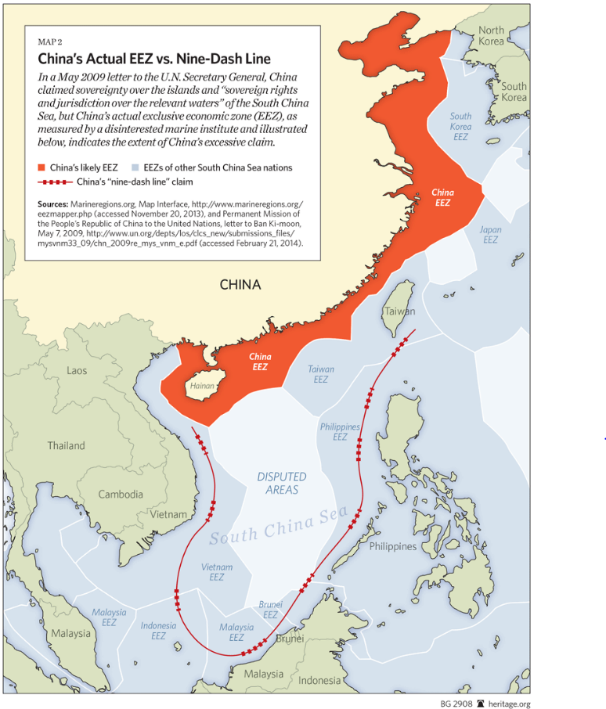
    Why less risk?  The SCS is close to the mainland and very far from the US mainland.  The Chinese would operate on shorter lines of communication and present the US with multiple dilemmas. The Chinese see opportunities to consolidate their gains with smaller and quickly completed military operations directed at the edges of US interests.  These operations present US and regional decision makers with having to respond fait accompli to CCP gains.  If the Chinese can keep away from direct PI and Japanese interventions then they steer clear of US treaty obligations.  It would be hard to mobilize the American people to support the claims of Vietnam, Malaysia or Brunei.  If China directly assails the PI and then coerce or bribe the Philippine government into disavowing combat or recognize the Chinese claims hoping to sate the dragon’s hunger then US reactions are massively limited.  The payoff for China for consolidating their claims in the SCS would be huge if they can do so without triggering a very destructive war with the US.  The map shows the scale of the economic benefit that would result from capturing the exclusive use of those resources and being able to restrict free trade.


    The military advantage gained would be huge as well.  China would gain unobstructed access to the Central Pacific and hold every regional economy at risk.  The diplomatic impact of success would demonstrate to the region and world that China must be accounted for and that their approval would be vital for local regime stability.

    So what are some options for the US concerning the SCS?

    The options presented to the US all have downsides because of baked in prior treaties and policy decisions.  The choices the US faces also involve multiple secondary and tertiary impacts that cannot be fully known at almost any point of decision.  A well-known truism of strategic decision making is: decisions made concerning one issue never completely solve that issue, they just help define the next issues that will need to be dealt with.

    Renouncing or changing defense alliances and treaties is always a possibility.  These changes come with known and unknown risks as all parties relook their internal and external calculus.  For example: The PRC and the PI are both confident that a major military action against the Philippines will bring the US into the conflict.  Any change to the US/PI defense treaty will be quickly known by all three countries and will change the decision calculus.  The PRC may take a more aggressive step and seize a PI claimed SCS feature confident that the US would not become involved.  But even under the new treaty, the US may still enter the conflict for its own reasons using the old, or revised, treaty as a public rational.  Strong defense treaties are made to reduce confusion on the part of potential adversaries, so any changes the US seeks will need to be carefully thought out.

    The US can withdraw from the SCS area and explicitly or implicitly recognize the PRC’s claims.  The US stepping away from the current global hegemon role in respect to the western Pacific Region could save us in current military related expenses (Carrier Groups are not cheap to own or operate) but again this COA will have second and third order impacts.  Except for the PRC’s designs on Taiwan, the modern history of China rarely features major grasps for territorial expansionism. Besides the current SCS efforts the PRC has demonstrated expansionism in the past in regards to Vietnam and the 1950 invasion of Tibet.  Xi and the CCP would most probably grab their entire SCS claims quickly filling any perceived vacuum left by the US.  The next steps are more a mystery but the economic impacts of preventing or regulating and taxing maritime and aerial transit of the SCS would rapidly roil the global economy.

    The US loss of access to the western Pacific will have diplomatic and defense impacts as well. The US currently is seen as the “cop on the beat” by nations all over the world.  If the US is seen voluntarily taking a major step away from that role in the SCS it will cause the rest of the world to relook all aspects of America’s role in defense.  As a matter of public debate leaving the SCS would quickly eclipse the worthwhile exit from Syria and drawdowns in Iraq and Afghanistan. Would pulling back from the SCS embolden Russia, Iran, or others in making additional extraterritorial grabs of terrain or establishing “satellite states” and thereby create new defense issues?

    The PRC already is attempting to establish their currency as an international benchmark and pulling away from a long term defense commitment would influence many nations to replace dollars for yuan in part or in whole.  This would impact interest rates and the relative strength of the dollar for us to buy Romanian wine, Japanese noodles or German hops.

    The US can maintain the status quo in the SCS.  The current US policy is that the SCS issues must be handled peacefully by the various claimants. The US also supports the international tribunal findings between the PRC and PI mentioned above.   The US has stated that we regard the SCS as non-territorial waters and not part of the territorial waters or EEZ by any claimant, but especially China.  The US deciding to continue maritime and aerial operations backing free navigation through the SCS waters and air will keep potential adversaries internal calculus including the question of “What if…?” around the world.

    The US can work with ASEAN and interested nations to draw a new path for the SCS which reduces US open ended commitments while securing the vital SCS transportation lines of communication and economic assets for all parties.  China will continue to oppose this COA and will regard this COA as a way to “fence in” proper Chinese aspirations and the US attempting to influence other states to gang up on China.  China dislikes any multilateral agreement unless they feel comfortable with their ability to ignore the agreement without serious repercussions.  (See the Paris Accords, MTO and IMF agreements.)  Despite the difficulties with this COA, it is probably the best way, over (significant) time to reduce the threat of war while maintaining economic progress.  Just don’t think that this way will be quick or easy.


  • South China Sea: Fair Seas or Foul Weather? Part 1


    Normandy, Argonne Forest, Anzio, and Iwo Jima are all names that many Americans recognize as American military campaigns. 

    Lesser known campaigns are recognized in the names Peleliu, Biak, and Khe Sahn.  There is an unfortunate possibility that the names Mischief Reef, Parcells and Woody Reef might enter the American lexicon of battlefields.  The last three names are all within the South China Sea (SCS), a Mediterranean sized body of water bounded by China, Vietnam, Malaysia and the Philippines.  Why might the US and China fight over a body of water far, far away?  (Except for our Japanese and Korean bridgeheads.) The SCS is a hot topic.  Recently “Foreign Policy” and “Foreign Affairs” have both weighed in, as well as many other authors.  So what the heck, here is a primer from me. This little bit of writing will hopefully help the Glibertariat to understand some of the issues and to be able to engage with others on what the US’s policy options are.


    So who are the players on this game board? 

    The biggest by far is China and primarily the People’s Liberation Army Navy (PLAN), People’s Liberation Army Air Force (PLAAF), Chinese Sea Police (aka Coast Guard), the People’s Armed Force Maritime Militia (PAFMM) and the People’s Liberation Army Rocket Force (PLARF).  China is also has one of the world’s largest merchant marine fleets and uses the SCS to bring and send resources and products to every continent.

    The PLAN is executing the world’s most extensive and aggressive fleet expansion and modernization campaigns.  It is estimated that by 2020 the PLAN will be the 2d largest navy in the world as counted by tonnage and frigate and larger warships. The PLAN will exceed the USN in the number of combatants. The PLAN is beginning to execute extended blue water operations, determining how to make carrier groups effective warfighting tools, and executing submarine operations well beyond their coastal water.  Their stated goal is to be capable of conducting “regional offensive operations” and they currently are part of the combined anti-piracy effort off of Somalia.  The PLAN also has two brigades of Marines, with a third being formed.  All these units are on Hainan Island or the adjacent mainland coastal region.

    The PLAAF is fielding large numbers of modern 4th generation aircraft that can go toe to toe with many US aircraft and outperform Taiwanese aircraft. The PLAAF is preparing to field significant numbers of 5th generation aircraft as well.  Like the PLAN they are expanding and modernizing faster than any other nation.  It appears that they are also loosening combat control of their formations to enable pilots to use more initiative.  The PLAAF is already large and still growing under recent PRC military reorganization.

    The CSP is really a second navy but painted white instead of gray. The Chinese recently transferred control of the CSP from the police to the military.  The CSP is by far the largest coast guard on the planet and its largest ships are the size of US guided missile cruisers.  The CSP operates throughout the SCS and not just around Chinese made features conducting both traditional coast guard missions and para-military operations.

    The PAFMM is a newer and less understood military component. They are almost unique in the world with the primary mission to engage in gray zone operations to frustrate effective response by the other parties involved. These vessels can be purpose built or much more frequently are reconfigured otherwise “civil” vessels. The PAFMM are widely seen participating in low-intensity coercion during maritime disputes including harassing or ramming vessels from other nations and even occupying disputed maritime features.

    The PLARF controls Chinese tactical to strategic, conventional and nuclear, rockets and missiles. Doctrinally the PLARF conducts deterrence, compellence, and coercive operations. In the event that deterrence fails, the missions of a conventional missile strike campaign could include “launching firepower strikes against important targets in the enemy’s campaign and strategic deep areas.” including command centers, communications hubs, radar stations, guided missile positions, air force and naval facilities, transport and logistical facilities, fuel depots, electrical power centers, and aircraft carrier strike groups. Writers also stress that, “In all, Chinese military writings on conventional missile campaigns stress the importance of surprise and suggest a preference for preemptive strikes.” Preemptive missile strikes to initiate active hostilities are also consistent with China’s overall military strategy of “active defense.”   Leaving aside strategic nuclear weapons, China has more conventional missiles than any other nation and is not signatory to the IMF. By being free of the IMF China is not constrained to distances and methods like the US (and Russia).  The PLARF like the rest of the PLA believes that “quantity is a quality itself” and so their missiles are in greater numbers, shoot longer distances and with bigger warheads than other nations.  Recently they have started fielding the DF-26 which can range Guam from the Chinese mainland with both conventional and nuclear warheads.  The PLARF makes no bones about their possible targets since their interior China test range uses model US airfields, ships and ports for targeting.

    It is useful to remember that the term “deterrence” is used differently by the US/West and China.  To us “deterrence” means taking actions to prevent another party from taking an action. So actions taken to keep the peace.  To the Chinese “deterrence” means the use of force to stop another party from continuing an action. This mismatch in definitions could lead to a dangerous situation.

    The People’s Liberation Army (PLA) is a relatively minor player in the SCS.  They are undergoing a large scale modernization campaign.  The PLA is also reducing in size as the other components are growing. Ground pounders are less of a player

    The second player in the SCS is the Republic of China (aka Taiwan). Their armed forces are small in number and nowhere as modern as the PRC’s new equipment.  Taiwan’s F-16’s are capable, but there are too few of them to make much difference.  The Taiwanese most likely would try to sit out any SCS brouhaha that does not directly impact them since any active participation would invite a major PRC attack or an invasion of Taiwan.

    The third major players are the Philippines, Malaysia and Vietnam.  They have smaller militaries than China, but have intense economic interests in the SCS. None of them has the mass or modern enough equipment to take on a concerted PRC effort in the SCS. Vietnam has demonstrated a long history of challenging the PRC while the PI has weakened their opposition under Duerte.  Despite winning their legal challenge the PI’s President has been very friendly with Xi and the PRC.

    The fourth major player is the United States.  Since our founding the United States has fought multiple wars over freedom of the seas, both declared and undeclared.  We have naval forces and aircraft that operate within the SCS for freedom of navigation (FONOPS) and intelligence reasons.  While we have no permanent military installations within the Philippines we do have Special Operations, Ground, Air and Maritime forces operating throughout the country on a regular basis. Our attack submarine force is very advanced, but the SCS is not a great operating area.  We, and several other countries, conduct FONOPS around the multiple features and we have been known to send one or more complete Carrier Groups through the Formosa Strait to deliver a point.

    These operations are not without risk.  During the early days of the Bush the Younger administration, a P-3 and a Chinese J-8 bumped over the SCS.  The J-8 was destroyed (the pilot died) and the P-3 made an emergency landing in the PRC on Hainan Island.  After much brouhaha we got the crew back and eventually most of the P-3 shipped back in crates. More recently we had military aircraft, surface combat ships and support ships repeatedly harassed and threatened with unsafe maneuvers by Chinese aircraft and vessels. The latest that made the news was in October and involved the USS Decatur and a PLAN destroyer near Gaven Reefs which are claimed by Vietnam, China and the Philippines and are located approximately 1000km from China’s Hainan Island.


    Gaven Reefs 2014 Construction


    Gaven Reefs Recent


    FONOPS also cause debate within the international defense community.  Some regard FONOPS as too provocative, while others regard them as too timid.  The two camps arguments can be summarized.  The provocative camp says why twist the dragon’s tail and ruin negotiations? The too timid camp’s thrust is that 12 mile nautical free passage FONOPS are granting recognition for rights that don’t exist under international law. Therefore FONOPS undercut the correct legal position that the features are not islands so have no exclusionary or economic zones. Under this viewpoint we could sail as close as we want while conducting military operations and be fully lawful.

    Other regional nations with a considerable interest in the SCS are Japan, Republic of Korea and Australia because of the importance of the SCS in trade and seaborne transportation. Japan is more concerned with their disputes with China over the East China Seas and islands.  While the Japanese does have a Self Defense Force with modern equipment, the SCS is only a secondary issue until the Chinese shut free transit of vessels.  The ROK concentrates on the Norks and their view of the SCS mirror Japans concerns.  Australia sits outside the island chains and has more concern over free access and Chinese interests in New Guinea and the Solomon Islands.  (Say hello to the Guadalcanal Campaign V2.0?)


    What does SCS playing board look like?

    The SCS is a salt water sea bounded at the north by Taiwan, the south by the Strait of Malacca area the east by the “first island chain and on the west by mainland Asia.  For an idea of scale the SCS, less the Gulf of Thailand, is roughly 1.4 times the size of the Mediterranean with China claiming sovereignty over almost the entire space.  They are doing this through the “nine dash line” and construction.  “The nine dash line” is the PRC’s claimed area of sovereignty and reaches throughout the SCS, at times encroaching on the 12 mile limits of the various states.

    “The first island chain” stretches from the Japanese home islands, through the Ryukus (home of US military bases on Okinawa), Taiwan, the Philippines, Borneo and closing at the Strait of Malacca. The Chinese view this as “their” lake and their military publications stress the first island chain as the area it must secure and disable from American bases, aircraft and aircraft carrier groups.  The PLA states that within this area it must be prepared to tactically unleash pre-emptive strikes against an enemy with the aim of sealing off the SCS and ECS.

    “The second island chain” stretches through the Japanese home islands, the US territory of Guam and the Northern Mariana Islands, the Federated States of Micronesia and to New Guinea and the Solomon Islands. This is the area that the PRC wants to achieve maritime and air dominance over to provide a buffer zone for the SCS and mainland.


    Sea lanes, fish and oil.  These three things are a large part of the why the PRC and the neighboring nations are squabbling about the SCS.  Fifty percent of all the oil shipped in the world transits the SCS; the bulk of the rest of the world’s maritime traffic moves through the SCS (the America’s), or the SCS and the Strait of Malacca to get to/from, India, Africa, Europe and the Middle East.  Over half of the planet’s population lives in nations near or adjacent to the SCS.  The SCS is one of the last great fishing grounds so everybody is interested in this source of protein.  And that brings us to oil.  There are large known or suspected oil fields in the SCS and the nation that controls them will gain a regional advantage. By not having to bring oil from the far side of the planet makes this resource cheaper to use or sell.


    SCS maritime trade routes and densities


    The fisheries in the SCS provide ~12-14% of all the commercially caught fish on the planet.  China harvests ~73% of all the fish they consume or sell from the SCS.  If you buy Chinese seafood you have most probably consumed animals harvested from the SCS. While there is some oil production in the SCS the fisheries are the here and now reason why the Nations surrounding the SCS all are concerned about China’s claims.


    Claimant EEZ 200 miles boundaries (blue) and Nine Hash Line (red)


    Twelve and 200 nautical miles.  International law states that a nation has sovereignty over large bodies of water out to 12 nautical miles.  That means that they can regulate “innocent passage” and in some cases prohibit transit of vessels and aircraft which are not registered to that nation out to that distance.  After that distance the water (and air above it) is open for the transit of any user, and for nation permitted commercial uses.  So a Russian or Chinese “oceanic research vessel” with a forest of antennas can hover 13 miles off of Cape Cod or Los Angeles with no legal objection.  By the same token a US Navy carrier strike group can transit the Formosa Strait between the PRC mainland coast and Taiwan.  Commercial aviation also makes use of this legal principle all over the world.  So a Singapore Air flight from Singapore to Tokyo can overflight the SCS seeking without permission of anybody except for Japan.  There are some exceptions to this law.  Where there is less than 12 nautical miles the border is equidistant.  For bays and gulfs the rules are a bit more convoluted.  Ronald Reagan and Qudafi famously disagreed about this point in the Gulf of Sidra.

    Why do we care about 200 nautical miles?  This is the exclusive economic zone for a country over salty water. Within that space a nation controls the use of natural resources above, in, and below the water.  They may reserve it for their exclusive use or set up means to regulate persons from other nations to use it.  This is why both the UK and Norway control only parts of the North Sea oil fields and there are no French platforms.  Like the 12 mile limit, if there isn’t 200 miles between nations the zone boundaries meet at the midline.

    Shoals, Rocks, Islands and manmade features.  See the illustration.  The key point being that features must be naturally occurring and not manmade. Manmade features receive no mileage around them.  China is taking shoals and rocks and constructing large manmade features within the SCS then claiming the features as islands and hence that the 12 and 200 miles laws apply.  The map shows China is claiming all the oil and fish within the Nine Dash Line in the SCS.  China’s opinion is that has exclusive use to the natural resources and it can close the SCS to maritime and aerial traffic. This has gotten the neighbors, and others like the USA, concerned because of the economic and free trade impacts.  To be clear the Chinese have not announced any maritime exclusion or air defense zones, yet.  They have claimed an air defense identification zone a bit farther north over the East China Sea which the US ignores and has stated it will not comply with.


    The Chinese efforts are not small scale.  They have created multiple square miles of “land” replete with jet capable runways, multiple military radars, missile farms and supporting structures.  More worrisome is that over the last half decade the pace and scope on construction steadily increases.

    Mischief Reef


    At first the Chinese claimed the features were to aid navigation and search and rescue, now they openly fly modern fighters in and out of them and increase their arming of the features by adding modern radar systems, as well as anti-ship and anti-aircraft weaponry.


    SCS Spratly outposts and Slightly old Claimant EEZ 200 miles boundaries (blue) and Nine Hash Line (red)


    The Chinese actions in the SCS started in 1974 when it seized the Vietnamese claimed Parcell Islands.  This led to a long term feud which culminated in 1988 when the Chinese machine gunned and killed 72 Viet fisherman and sunk two boats at South Johnson Reef.  China continues to dispute Vietnamese claims and has multiple steps top block fishing and drilling.  The PRC has carefully watched the international scene and in 2012 started making their move.  First they seized Scarborough Shoal from the PI. They watched what the US would do and when they saw acquiescence from the Obama administration they moved to the next phase to construct new features.  Their main dredger (the Tianjing) can dredge and hose out 4,530 cubic meters of soil per hour.  They first used it at South Johnson Reef where it created an 11 hectare “island” in less than four months.  Again the US, ASEAN and the West took no action.  The Chinese started building at an ever increasing pace and now have seven features in the SCS.

    Now these features have port facilities, military buildings, radar and sensor installations, hardened shelters for missiles, logistical warehouses for fuel, water and ammunition. Most tellingly these features now have heavy transport and military jet capable runways and airstrips and the PRC has landed these aircraft on them. The international tribunal ruled against China actions in 2016 and China ignored the ruling, again without any cost.  Now the PRC has expanded their control further by strong-arming the other SCS nations into suspending the exploitation of natural resources within their own 200 mile exclusive economic zones.  The new USINDOPACOM Commander during his confirmation hearings told the US Senate that for all practical purposes the PRC had won the race to develop a military capacity on these features in the SCS and now the US needs to determine the next steps to take.

    Fiery Cross Reef construction and recent


    Stay tuned for Part 2.


  • The Wall

    I personally did not watch President Trump’s address.  As it turns out, Tuesday is a gym day and I was not going to watch it anyway.  A physical impediment strikes me as a foolhardy expendeture because where there is not a long stretch of desert, a mountain range, a wide river patrolled by Texans, or generally something else that is going to kill you before you reach civilization, there is already something there.  I travel to Mexico at least twice a year, believe me the fence is already there.  This is entertaining to watch however, as the amount of money they are quibbling over is a trifle compared to the overall federal budget.  While the effectiveness of a wall or fence is debatable, the amount of money is small enough compared to budget to not matter yet large enough the average person will never see in their lifetime.  I also find declaring a national emergency to fund it as a needless power grab, that will bite team red in the ass later on.

    That said, the winner of this wins in terms of optics only.  Personally, I think Trump is going to get the funding or something resembling it for two reasons:

    1 – Unfortunately, government employees are a team blue constituency…

    OBEY

    2 – While the jokes on social media centered around the team blue response being akin to Bond villians or your parents staying up to yell at you because you came home after curfew….for me something else came to mind.

    The loser in these things always seems to be the one that looks like the bigger asshole and lets face it, Trump is blessed by his enemies.  As much as I dislike the 33 dimensional chess argument, one might ask why did Trump not try to pull this before?

    What? Pull this on Paul Ryan, and be the bigly man that kicks a puppy?


    This is my review of Clown Shoes Brewery North of Sonora:

    This reminds me of a story…

    In the beginning, there was the Treaty of Guadalupe-Hidalgo, this marked the end of the Mexican-American War and resulted in the map looking almost like it does today with one exception.  Due to lobbying efforts from the railroad industry; because of the Gadsden Purchase in 1853 the map now looks like it does today. I spoke of this before; it is when my family became American but this story is not about me.  This story takes place on August 27, 1918 and is called the Battle of Ambos Nogales.

    You think the border is open now…

    Prior to this incident, Nogales was a single town between two countries, and today in a sense it still is.  Back then though there was no fence.  There was a street called la Calle Internacíonal or International Street with the exact border being marked by an obelisk.  I have driven on it myself, and crossed it more times than I can remember.

    At the time US Customs allowed residents of Nogales, Son to walk across the street and purchase food and other goods from Nogales, AZ.  Tensions between the two countries became strained due to the Zimmerman Note.  You might recall that from your American History class.  The conspiracy was Germany wanted to bring Mexico into the War against the United States. Hopefully, by the time this article goes live that link comes without the disclaimer about the government shutdown… To account for the frequent crossings, US Customs issued passes to residents of Nogales, Son.  The Mexican government also followed suit resulting in a confusing process—to cross the street.

    This incident began when…

    […]a carpenter named Gil Lamadrid was walking back into Mexico. As he crossed the border, a U.S. Customs Inspector ordered him to halt, curious about the large parcel he was carrying. Only a few feet away, Mexican customs officers directed him to ignore the summons and continue into Mexico. Gil Lamadrid became confused and hesitated as the two competing groups of customs agents shouted instructions to him. At this point, a U.S. Infantryman raised his Springfield rifle to encourage his return. In the midst of the ensuing commotion a shot was fired, and the carpenter dropped to the ground.

    Thinking that the man had been shot, a Mexican Customs Officer grabbed his pistol and opened fire on the U.S. guards, wounding an army private in the face. A U.S. Inspector drew his revolver and returned fire, killing two Mexican Customs Officers. Shaken but unhurt, Gil Lamadrid jumped up and sprinted down a nearby street. As the sound of gunfire rattled the neighborhood, citizens on the Mexican side of the border ran to their homes and picked up rifles to join the Mexican troops

    …and hillarity ensued.

    In response, the famous 10th Cavalry was deployed to the town….where enlisted were not allowed in a few establishments in Nogales, AZ.  If you ever go to Nogales, you will notice it is sprawled across several hills.  Perfect for guerilla warfare.  A white flag was eventually raised on the Mexican side of town around 5:45 PM but shots were still fired until 7PM.  It resulted in the death of the mayor of Nogales, Son who attempted to stop the violence by walking on International Street with a white hankerchief tied to his cane to plead with both sides. Him along with 129 other Mexicans and 4 Americans.  With an additional 330 wounded.

    Later both sides decided the only way to keep this from reoccurring was to separate both sides, and other towns quickly followed suit.  At the cost of what was then, $5000 ($80,250 today), a fence was errected between two sides of a town split between two countries.

    Paid for in part by Mexico.

    Now this beer is interesting because it is flavored with agave.  Making it rather sweet, too sweet perhaps but they call it a porter so it sort of works.  There is also some vanilla worked in there somewhere and it is aged in rum barrels resulting in something you will want to share with somebody else, a neighbor perhaps, so you at least are not alone in the experience.  Fitting, but given the price tag one that I am not likely to buy again.  Clown Shoes North of Sonora: 2.9/5.