Category: Guns

  • Thirty-Something Rifle Cartridges II – The Thirty-Threes

    Thirty-Something Rifle Cartridges I:  The 33s

    I find the thirty-threes to be some of the most useful of the thirty-something calibers for the North American game fields.  Most of them are easily capable of taking the largest American big game.  There is a wealth of projectiles available.  Some of them, like Winchester’s excellent .338 Winchester Magnum, have been around for decades, and as a result there is a great deal of loading data available.

    As a result, there are a lot of .33 caliber rounds out there to discuss.  So, without further ado…

    At the End of the Black-Powder Era…

    As we saw back in the series on level guns, the famous John Browning/Winchester collaboration started with a big, tough lever gun called the Model 1886, which could handle some pretty heavy cartridges.  In 1902 Winchester made this rifle available for a new cartridge, the first commercially available thirty-three, the smokeless-powder .33 WCF.

    This was a pretty hot load for its time, launching a 200-grain cast bullet at 2,200 fps.  With more modern, jacketed bullets, it quickly gained a reputation as a hard hitter, ideal for deer, elk and bear at ranges out to about 200 yards.  Besides the Model 1886 Winchester, it was also available in the 1885 single-shot and the lever-action 1895 Marlin.

    The .33 WCF was interesting because it came at a transitional moment in American shooting.  As we’ve noted previously, the end of the Great War resulted in a lot of American shooters and hunters returning home with the memory of their issue 1903 Springfield and Pattern 17 Enfield bolt guns in mind, along with the powerful .30-06 round they fired.  The lever gun was due to lose some popularity; the age of the bolt gun was dawning.

    And the .33 WCF, while a groundbreaking round, was a rimmed lever-gun cartridge.

    The .33 WCF was offered in the Model 1886 until 1935, when Winchester replaced the 1886 with the beefier Model 71 and its .348 Winchester cartridge.  But this first of the thirty-threes had set the stage for some modern bolt-gun rounds to come, and one of those pioneering bolt-gun rounds came (in part) from the mind of someone we’ve discussed before:  Elmer Keith.

    The Mid-Century

    Early in the 20th century Elmer Keith, along with his colleagues Charles O’Neil and Don Hopkins, developed a new .33 wildcat based on the .30-06 case necked up.  The .333 OKH was intended to use the same .333 diameter bullets as the .333 Jeffries then popular in Britain, and while it delivered some good performance it was hampered by the lack of bullets, and since wildcatters live and die by the availability of suitable projectiles, this didn’t bode well for the .333.  The logical evolution was to increase the bullet size to .338, resulting in the .338-06 wildcat.

    This same trio also developed the .334 OKH, based on the .375 H&H case; this ended up being remarkably similar to the .340 Weatherby Magnum, about which we’ll talk in a moment.

    In fact, the tale of the mid-twentieth century thirty-threes is somewhat convoluted, with plenty of wildcats and experiments mixed into the developments by major gun and ammo manufacturers.  But one thing very quickly became apparent – launching a big, heavy projectile at significant velocity called for a magnum-sized case.

    Precedent was already in place.  During WW2 Roy Weatherby had introduced three standard (2 ½”) length cartridges based on the .375 H&H belted case, shortened and necked down.  These three were the .257, .270 and 7mm Weatherby magnums, and they soon gained a following among those fond of high-velocity rounds.

    In 1958, at the urging of Elmer Keith, Winchester took that precedent and applied it to Keith’s and others work with the medium bores.  They followed Weatherby’s example, took the .375 H&H case, shortened it to fit standard-length actions, straightened the case walls a tad and necked it down to take a .338 pill.

    The result of this was the great .338 Winchester Magnum, introduced along with the .264 Winchester Magnum and the .458 Winchester Magnum as a family of cartridges.

    Now the American sportsman had a real world-beater.  The big new medium-bore magnum put out a 225-grain projectile at 2,800 fps in factory loadings, and with the right slug would easily handle any North American big game, including big Alaskan grizzlies and moose.

    The .375H&H, .338 Win Mag, and a quarter for scale.

    It should come as no surprise to anyone that’s been paying attention that this round is a favorite of mine.  My .338, Thunder Speaker, is built on a 1908 DWM large-ring Mauser action with a Douglas barrel and a Bell & Carlson stock.  The .338, while delivering plenty of punch, does it on both ends, having a reputation for recoil as well as hitting power.  Thunder Speaker, in addition to the big, wide recoil pad on that B&C stock, is Mag-Na-Ported and weighs almost ten pounds loaded, which makes it very manageable – at least for me.  I’m large and not recoil-sensitive, so your mileage may vary.

    My favorite load in that big, tough Mauser action is a 225-grain Barnes TTSX boat-tail over 67 grains of IMR 4350.  This gives me about 2,800 fps for almost two tons of muzzle energy.  This load will easily lengthwise an elk or moose, and that’s what Winchester intended the round should be able to do, so I’m pretty satisfied; in Thunder Speaker, with me at the wheel, it will also put three rounds into a 3” circle at 200 yards.  The best shot I’ve ever made on a game animal was with this rifle; a fat meat mulie buck in the open sage country south of Parshall, Colorado.  The buck paused to look back on the edge of an arroyo; I tossed my cap on a flat rock, laid down in the snow, laid my rifle on the rock, took aim and sent one round down the hill.  The .338 slug hit the mulie at the base of the neck, dropping him in his tracks at 280 yards.

    She still does kick, though.  My son-in-law once got a case of Kaibab eye after asking to try out Thunder Speaker off the bench-rest; I warned him not to choke up on the scope!

    The .338 Winchester Magnum was quickly a big commercial success.  In addition to its introductory chambering in another shooting legend, the pre-64 Winchester Model 70, it was quickly picked up in the Remington and eventually, the Ruger, Savage and many other lines.  Browning made it available in the BAR, making it the most powerful semi-auto rifle available at the time.  Wildcatters quickly picked up on the usefulness of the case, bringing about among other things the .30-338 Magnum, which Winchester later legitimized as the .300 Winchester Magnum – bringing the standard-length magnum case back to America’s caliber.

    But the competition was paying attention.

    Only four years after Winchester brought out their thirty-three, Roy Weatherby upped the ante.  His entry into the field was the .340 Weatherby Magnum, on the same magnum-length case as the .378 Weatherby Magnum.  This was a real whopper, sending the same .338 225-grain slug forth at 3,100 fps.  But the .340 Weatherby suffered from the same issues as the 8mm Remington Magnum we discussed in the last installment:  It was limited to a magnum-length action.  What’s more, it was a proprietary round.  When the .340- Weatherby was introduced one could only have one in the Weatherby Mark V, with factory ammo initially only available from Weatherby.  Even today, the only company loading this round besides Weatherby is A-Square, and the ammo is pricey.

    The place of the thirty-three in the American shooting scene was now secure.  But the explosion of rounds to come was to prove an embarrassment of riches.

    Today

    In the magnum world, the .338 Winchester Magnum and the .340 Weatherby Magnum have been joined by some new contenders.  The .338 Ruger Compact Magnum came out in 2008, a 2,700fps thumper intended to be chambered in short-action rifles like the M77 Mk II Compact.

    There are a couple of newer Weatherby-level steamrollers available as well.  In 1989, A Norwegian/Finnish munitions company named NAMMO (Nordic Ammunition Company) saw a market for a powerful, long-range military sniper round; their answer was the .338 Lapua, which was adopted in civilian as well as military applications.  The Lapua is a real rocker, sending out a 250-grain slug at over 3,000 fps.

    In 2002 Remington responded with an expansion of their Ultra Magnum line, the .338 RUM (Remington Ultra Mag.)  This fell a bit short of the .338 Lapua and produces very similar ballistics.

    But both ultra-mag rounds have the same shortcomings:  They both require magnum-length actions, and they both run at very high pressures, resulting in significant barrel wear at a much lower round count than the older .338s.  Still, there’s still news in the non-magnum world.

    2006 saw the introduction of the .338 Federal, which was simply the .308 Winchester case necked up to the .338.  This introduction not only gave .33-caliber thumping to short-action bolt guns, but it also added a medium-bore alternative to the AR-10 platform that was becoming popular as the Tacticool craze accelerated.  The Federal round yielded only modest performance compared to the magnums, propelling a 210-grain slug at about 2,600 fps.  But the use of the .308 case made for a versatile round that punches well above its weight class.

    Finally, in 2009, Marlin brought the thirty-threes full circle by introducing the .338 Marlin Express, a semi-rimmed lever-gun round intended to punch up the power level of that company’s 336-series rifles well above the original .30WCF level.  In fact, at ranges up to about 200-250 yards, the Marlin Express round delivers performance in excess of most .30-06 loads, which makes the 336 rifles far more versatile on bigger, thicker-skinned game – and brings the lever-gun world back to the levels of punch known in the original 1886 Winchester.

    The thirty-threes are many, powerful and versatile. The late 20th-early 21st century proliferation of .338-caliber rounds has been interesting, but none of them have quite managed to knock the good old .338 Winchester Magnum off the top of the heap.

    In the next installment, we’ll examine a group of rifle cartridges that are a little lighter on the long-range magnum loudenboomers and a little heavier on the short-range woods rounds – so stay tuned for an in-depth look at the thirty-fives.

  • Thirty-Something Rifle Cartridges I – The Thirty-Twos

    Thirty-Something Rifle Cartridges I:  The 32s and 8mms

    Mid-caliber rifle cartridges are very useful.

    A qualifier:  I’ve said before that if you can only afford one rifle for big game in North America, buy a .30-06.  That fine old round, properly loaded, can handle any game in North America, even though it’s a tad on the light side for big Alaskan grizzlies and moose.

    But there are a whole family of rifle cartridges that are useful, solid, and versatile; these are generally known as the mid-range or mid-caliber cartridges.  I’ll refer to them in this series as the Thirty-Somethings.  These rounds launch bullets ranging from the .32 to the .375 and have a wide range of power selections for almost any eventuality.

    In this series we’ll focus mostly on rounds widely used in North America.  So, while we’ll look mostly at American cartridges, we’ll also examine some from other parts of the world that have seen a lot of use here, like the 8X57mm Mauser and the great old .375 H&H.  So, let’s start with the first group – the Thirty-Twos.

    At the End of the Black-Powder Era…

    Remember when we were talking about the history of lever guns?  In 1894 Winchester Repeating Arms Co. and the DaVinci of firearms, John Browning, brought out the great Model 1894 Winchester lever gun.  While that rifle is so intimately associated with the .30WCF cartridge that the terms “.30-30” and “94 Winchester” are damn near synonymous, it’s rather less well-known that the Model 94 wasn’t originally introduced in that caliber; instead, it was chambered in its first year for two thirty-somethings, the .32-40 and the .38-55.

    In 1894 the .32-40 Ballard was a popular round.  It had been introduced ten years earlier in the Ballard Union Hill #8 and #9 target rifles, loaded with a 165-grain cast bullet over 40 grains of black powder, resulting in a muzzle velocity of about 1,450 fps.  The long, straight-tapered case allowed for a smooth, even powder burn and resulted in a good reputation for accuracy.  Famed barrel-smith Harry Pope was fond of the round and made it the basis of his .33-40 wildcat.  This round looks somewhat odd by today’s standard but it successfully made the transition into the smokeless powder era, and was offered in a sporadic manner in Winchester lever guns through most of the twentieth century, although mostly in the commemorative editions of which Winchester was so fond.

    The .32-40 was overshadowed in 1895 when Winchester released the Model 94 in the smokeless powder .30WCF, but the New Haven gunmakers weren’t done with .32s yet.  In 1901 they released the Model 94 chambered for the .32 Winchester Special, which took the .30WCF case and expanded the neck to take a .321 bullet.

    At first glance it’s hard to see a reason for this round.  The .32 WS, in its primary load, fired a 170-grain bullet, like its smaller-bored cousin.  Ballistics were near-identical, with the .32WS having less power past 150 yards or so due to the lower sectional density of the bullet.

    But for the hand-loader who was sitting on a big supply of lead and black powder – not an uncommon thing in 1901 – the prevalent wisdom of the day claimed that the .32 had a couple of advantages.  First, its slightly larger bore was claimed to make for easier cleanup of the messy black powder residue.  Also, Winchester used a 1-16 rifling twist in the Model 94s chambered for the .32, as opposed to the 1-10 twist of the.30WCF; this, again, supposedly made for easier cleaning.

    So, the .32 Special may have been just the ticket for the guy with a lot of black powder to burn, or maybe for the occasional recalcitrant old coot who thought that smokeless powder wasn’t here to stay.

    Like the .32-40, the .32 Special hung on through most of the twentieth century, in later years mostly in commemorative Winchester models.

    Another variation came from Remington, who was determined not to be outdone by Winchester.  In 1905 Remington introduced their Model 8 autoloader, followed in 1914 by the Model 14 pump-gun.  Both rifles saw a fair amount of market, and both were chambered for (among other rounds) the .25, .30 and .32 Remington cartridges, essentially rimless versions of the .25-35, .30-30 and .32 Special.  Unlike Winchester, Remington didn’t fiddle around with different twist rates in their guns and the Model 8 auto – the famed old Remington “piano leg” – was fussy about ammo, fouling and hanging up quickly if black-powder loads were used.  It’s hard to see what Remington had in mind with this range of cartridges other than ensuring that they had an offering in every bore size to compete with Winchester.

    Winchester did have another .32 caliber round, the .32WCF, better known as the .32-20.  This was mostly a small-game round of modest power; while it’s a great old cartridge for big hares, bobcats or raccoons, I’m going to restrict this discussion to big-game rifles – in spite of the fact that I’d love to have an original Model 92 Winchester in .32-20 or .25-20 for hunting snowshoe hares and jackrabbits.

    In 1914, as we’ve seen, the shooting world saw some new influences hit, and the thirty-something rifle cartridges were affected along with everything else.

    The Mid-Century

    In 1898 the famous Mauser-Werke, down in the small town of Oberndorf in Bavaria’s Neckar River valley, introduced a world-changing bolt gun, the Model 1898.  We’ve already discussed this rifle and its significance, so now let’s look at the cartridge that was paired with this rifle for use by the German military – the 7.92x57mm, more commonly known as the 8mm Mauser.

    The 8mm Mauser predates the Mauser 98 by ten years, having been first introduced in the 1888 Commission rifle.  The original cartridge was the Patrone 88, launching a .319, 227-grain round-nose jacketed bullet at about 2,000 fps.  As a first-generation smokeless powder cartridge, the Patrone 88 carried over the heavy, round-nose bullet design common in the last generation of black-powder rounds.  In 1895 the bullet/bore size was changed slightly to reduce barrel wear and ease cleaning (supposedly) resulting in the .323 bullet diameter that would stick with the cartridge in military loadings.

    In 1904 and 1905, the cartridge got a facelift; the neck dimensions were slightly altered, and the brass thickness increased a tad.  The new round was loaded with a 153-grain spitzer bullet, producing about 2,700 fps.  This made the new round, the S Patrone, more effective at extended ranges due to the higher velocity and better bullet design.

    The 7.9×57 S Patrone was the standard German military’s rifle and machine gun cartridge in both World Wars.  Interestingly, after the Great War, the Treaty of Versailles forbade the use of the round in civilian arms, but by 1930 or so the German manufacturers were roundly ignoring the Treaty, and the cartridge again became popular in civilian hunting rifles; a rimmed version, the 7.9x57mm IRS, was even developed for single-shot and multi-barreled rifles.

    The 7.9x57mm remains a popular hunting cartridge in Europe today, at least in those jurisdictions that still allow the unwashed peasantry to own rifles.  In the United States, the round gained a significant following when surplus Mausers became widely available at bargain prices; the 8mm Mauser offers performance very similar to the .30-06, and in fact the round is still loaded by many American ammunition makers today.  In fact, the 8mm Mauser remained the only .32/8mm bolt-gun round commercially loaded in the United States until 1978.

    In the latter half of the twentieth century, Big Green had realized a commercial success with its excellent (then) Model 700 rifle and with their 7mm Remington Magnum cartridge.  I always thought the 7mm Magnum a tad overrated; an old elk-hunting friend of mine shot one and was fond of bragging about its velocity and flat trajectory with his favorite factory load, until I pointed out that in my big commercial Mauser I was shooting a .30-06 handload that ran a 165-grain Barnes bullet at only 100fps less than his factory 140-grain 7mm loads, and took to his brother’s chronograph to prove it.

    In the late Seventies, Remington determined that they wanted to compete with Winchester’s beefier .300 and .338 Winchester Magnums.  Remington’s engineers came up with the 8mm Remington Magnum, but they made one key mistake:  They used the full-length .375 H&H case as the basis for their new round, mandating its use only in Magnum-length actions.  The new 8mm round was intended to compete with the excellent .338 Winchester Magnum, but Winchester’s offering had a thirty-year head-start and could be chambered in standard-length actions.  While the 8mm Remington Magnum was a powerful round that could easily handle any game in North America, launching a 200-grain pill at a bit over 3,000 fps, it never gained much following.  The .32/8mm was generally considered a European bore size, and components (chiefly bullets) were not available in as many options as either .30 or .338 offerings.  The 8mm Remington Magnum is still in use today, but as sporting rifle cartridges go, it’s a footnote.

    Today

    Speaking of footnotes; since the new century dawned, the American shooting scene has seen only one new .32/8mm round.

    In 2000, Winchester and Browning introduced American shooters to the .300 Winchester Short Magnum, a fat round with a rebated rim that provided magnum horsepower in a short-action rifle.  The “short fat” case supposedly allowed powder to burn quicker and cleaner, and soon the WMS rounds gained a modest following.  In 2005, Winchester introduced the .325 Winchester Short Magnum, which actually fired a .323 180-grain bullet at about 3,000 fps.

    After its release, Winchester engineers allowed that the .32/8mm bullet was the largest that could be efficiently paired with the WSM case, and so no larger offerings were forthcoming.  Unlike the 8mm Remington Magnum, the .325 WSM did gain some following, and like its older brother, the .338 Win Mag, it is capable of taking any game in North America with the right load.

    The .32/8mm bore diameter has never been overly popular with American shooters.  If any caliber is America’s caliber, it’s the .30.  It doesn’t help that American manufacturers have never really gone in for this bore size in a big way, and it helps even less that one of the few major offerings was a commercial flop.

    But step up one bore size to the thirty-threes, and the picture changes quite a bit.  My own favorite hunting rifle is one of those; I’ve described my .338 Win Mag, the inestimable Thunder Speaker, in these virtual pages before.  So stay tuned for the next installment, in which will examine the Thirty-Threes.

  • GlibFit 4.0 – Strength and Self-Defense

    Remember the old Charles Atlas ad that ran in comic books?  I do.  When I was a kid, I was sure that if you were a big enough guy you wouldn’t have to worry about anyone picking on you.  That may be largely true, but it overlooked all sorts of other things.  I spent the first six years of my legal career practicing criminal defense.  I was exposed to nearly every kind of deprivation one person could inflict on another person.  Between that and my full-blown libertarianism, there was no doubt I would become a gun owner.

    Fast forward umpteen years, I’m married, own a home and have two kids.  One night in our low crime suburb, we accidentally left the garage door open overnight.  Wifey’s car was burglarized.  No one entered our house, but she was badly shaken up.  She called the police to report the incident.  I was at work when she did this.  I came home to be told we had to get a dog for protection.

    This didn’t compute for me.  I knew she wasn’t talking about getting a trained attack dog especially with two young children in the house.  No, it wasn’t that.  The cop she spoke to told her to get a dog for protection.  I laughed and told her if we were going to do anything it was get a shotgun. No, she replied, the cop said to get a dog.

    I met wifey when we were both working as public defenders.  I can’t adequately describe the mutual skepticism we shared about cops.  Their truthfulness, training, “expertise,” note taking, record keeping, interview skills, and on and on.  There wasn’t anything we didn’t criticize.  Despite all this, she was insistent we had to get a dog.  I was insistent we had to get a gun.  So, in the best Glibertarian tradition we did both.

    I bought a Mossberg 590.  I love that gun.  Wifey and I both got trained by a private instructor.  I definitely caught the gun bug.  Wifey not as much.  I started looking at pistols.  Life intervened in the form of all sorts of stuff with our kids (good lord those ankle biters take a lot of time) and Moe; my best fried for the last nine years.

    Nine years later, one kid is off to college, the other is a teenager, and Moe is a grumpy old man.  I finally have a glimmer of getting a little bit of time for myself.  I’ve engaged in idle talk about finally buying a pistol.  Wifey called my bluff.  For our last anniversary she told me to go buy a pistol.  I told her California requires a written test and I’m not buying a gun without having some idea how to safely handle it.  For my birthday she bought me a basic handgun class which includes California’s ridiculous written test.

    Yesterday I attended the class.  It was taught by two active duty cops.  One of them aspires to having Clancy Wiggum’s physique.  The other is futilely trying to stave it off.  They better be good with a gun because there is no way these guys could engage in anything physical for more than a minute without being completely winded.

    The class was a mix of very useful safety information, completely irrelevant cop stories, and firing a Glock 17 under supervision.  We constantly joke about cops believing the most important thing is they go home at the end of their shift.  This mentality was confirmed during the class.

    Now that I’ve banged on these guys enough, the safe handling and shooting instruction made it all worth it.  I finished the class understanding how to safely handle a pistol.  The live fire instruction was very helpful.  I only fired twenty rounds.  The instruction and feedback on how to properly hold the pistol, aim, and pull the trigger greatly improved my shooting in a short time.  Now, I have to buy a pistol and go practice.

    I’m strongly considering a Sig Sauer P226 or P229.  My only concern is these aren’t striker type pistols so I’m wondering if this means I’ll be pulling shots due to the action.  I’d love some feedback from handgun owning Glibs.


  • Building A Safe – Part 1

    Here’s the background story – it was a dark and stormy night and I was canoeing with all of my firearms as we all do from time to time. All of a sudden a rogue wave came up and capsized my canoe, and I lost ALL of my firearms to the depths of the oceans. It’s a tragic story. Completely 100% true too. I’m still really bummed about it, so I decided I would build a safe for future firearms to cheer me up.

    I don’t have a traditional firearm safe, but I do have a couple of the green metal cabinets that you can lock. That’s always been good enough for me, but it means I need a closet or space big enough to house it all. For the last several years everything has been piled in a closet along with boxes and storage bins from the last move. I decided I was going to build a storage cabinet that I can lock everything inside, that doesn’t say “guns in here” to my guests. I can simply say “we keep some valuables in here, along with some important documents.” Plus I have a lot of wood laying around and I need to do something with it.


    My plan was to have it big enough to house both the big and small green metal cabinets, with a shelf area between the two. So I made a dado jig to cut dadoes in ¾ inch plywood for the sides and the back that would all be the same width and more importantly in the same spot.

    For the sides, I cut the dadoes with a router  then ripped the sheet of plywood in half to get the two sides.

    While I was cutting the rabbets along the edge the bit wandered out from the collet of my router and my rabbets ended up being deeper than I needed.  Turns out you should leave a little space between the bit and the collet, say ⅛ if an inch or so. Thank you Internet for that tip. So to fill in the void, I just glued some scrap wood into the rabbet –

    And then rerouted the rabbet –

    Next I glued the back, sides, and shelf together-

    But had to improvise with some of my clamps because I didn’t have enough of the right size. Well actually, I had plenty of 36 inch clamps, I just made the width 37 inches so I couldn’t use them (stupid math).

    So everything was going smoothly until I saw this –

    Oops. Fortunately the piece in the picture that is too long is actually too long so after a trim with the circular saw, another pass with the router, and some chisel work where the router couldn’t reach all was good. 


    More clamping and glueing for the top and bottom pieces –

    And now for the final test –

    If you are not familiar with these green cabinets there are holes in the back to mount them to studs or something that will keep them from wandering off. The ¾ inch plywood wasn’t going to be enough so I decided to build a frame that I could lag bolt the cabinets to.


    I had a half dozen pine 1x4s that I glued together to make 2x4s –

    But I ended up gluing them together –

    Fortunately it was just a few drips of the squeeze out and they came apart pretty easily. When building the Murphy bed I used pocket screws, but decided I would do mortise and tenons for all of the pieces –

    I have a mortise machine which made that task easy, and each mortise only required a little bit of cleanup. I measured for the mortise and realized it was going to be shorter than I wanted, so I scribbled out the line and then redrew where I wanted it. I somehow still stopped at the scribbled line?

    For the tenons I just used a dado stack on my table saw and used a block plane and a chisel to get them to size.

    The 2x8s are located where the lag bolts for the cabinets will go, and the stile in the center is offset so I can screw some standards in for adjustable shelving. I added a base to accommodate some casters so I can roll it around –

    The bottom attached with some through tenons which I have never done before. I couldn’t use the mortise machine so I did these by hand with a drill and chisel. They’re not as clean as the machines mortise, and I should have used a backer to prevent chipping where the bit came through –

    I added some glue to fill in the void, plus I used construction adhesive to glue the case to the frame so it’s pretty sturdy –

    It’s not exactly square and is off by about 1/8th of an inch in a couple of spots –

    The above picture shows the case sticking out a smidge from the frame. It’s not enough to be mad about, and I think if I built it differently and paid more attention to each piece I could have gotten it spot on.

    Part 2 will have the trim work, plus the door, and hopefully paint.

    Now what to replace my AR-15 with? The one I had used a composite lower from Cavalry Arms which is no longer in business. It had the iron sights and the handle, and I thought about buying one with a rail to mount an optic light a red dot or something. Any recommendations would be appreciated.


  • Gold Standards IV – The 1851 Colt Navy

    The Perfect Single-Action Revolver

    Resolved:  The 1851 Colt Navy is the standard by which all succeeding single-action revolvers must be judged.  Now that that’s established, let’s take a look at this ground-breaking product of the mind of Colonel Colt, how it changed forever the concept of what a revolver should be, and how it affected every single-action sixgun model that followed – including its famous offspring, the Single Action Army.

    The Forerunners

    The 1849 Colt Pocket Model

    Colt’s production of revolvers up to this point had not yielded a reliable, effective piece for belt holsters.  The Paterson guns were underpowered and had fragile folding triggers; their popularity was mostly due to their being the only effective mass-produced revolver available in the 1830s and 1840s.

    The Paterson guns had five-shot cylinders, but prudence dictated loading only four and leaving the hammer down on an empty chamber; this precaution was required for Colt revolvers up to and including the Single Action Army.  Further, the Paterson guns were loaded using a separate tool for seating bullets.  If that tool was lost, what the shooter was left with was an expensive and rather ineffective hammer.

    The later Colt Walker and First, Second and Third Model Dragoon revolvers were significant improvements.  They had a loading lever attached to the gun under the barrel.  They were also big, powerful guns, firing a .44 caliber ball propelled by a stiff charge of black powder from a six-round cylinder.  The Walker and Dragoon guns were reliable and powerful, but they were also heavy and cumbersome, so much so that many were fitted with shoulder stocks, making rather effective carbines.  But it’s important to note that these were, as named, dragoon pistols, meant to be carried in saddle holsters by mounted troops.

    Contemporaneous with the Dragoon guns were a small selection of Colt “Pocket” revolvers, .31 caliber six-shot revolvers that began with the 1847 Baby Dragoon and continuing with the 1849 and 1850 Pocket Models.  These were, effectively, scaled-down versions of the Dragoon pistols.  Barrel lengths ran from four to six inches, allowing for a decent sight radius for the small-framed guns, but the .31-caliber cylinder put them back in the Paterson level for power; most loads yielded performance roughly equivalent to a modern .32 ACP full-metal-jacket round.

    So as of 1850, your choice in Colt revolvers faced a strange dichotomy; you could either have a big, powerful, heavy horse pistol, or a pocket-sized pipsqueak.  Clearly something new was needed.  Colt decided the answer was obvious:  Split the difference.

    The New Holster Gun

    An original Colt Navy

    In 1851 Colt revealed their new gun.  The 1851 Colt Navy revolver was a scaled-up 1849 Pocket Model, but it differed in several significant ways:  It fired a .36-caliber ball, yielding power roughly equivalent to the later .38 Special 158-grain RNL standard loads; it had a 7 ½” barrel, yielding a good sight radius while maintaining portability; and it was lighter than the Dragoon models, making it easily portable in a belt holster.  It did retain the odd sighting arrangement from the earlier guns, using a small conical brass front sight and a notch on the hammer as the rear sight; despite the rather crude sighting arrangement the new gun quickly developed a reputation for accuracy.

    Another innovation, oddly, didn’t quite catch on; some early Navies were made with a “safety peg” in between chambers on the six-shot cylinder that fit into a recess on the hammer face, allowing the gun to be safely carried with all six chambers loaded.  For some reason this feature wasn’t carried over into later models, and even the famous Single Action Army is only safely carried with the hammer down on an empty chamber.

    Rooster Cogburn’s pair of Colt Navy sixguns, correctly depicted as in Charles Portis’ novel.

    The new revolver was well received, and with good reason.  It was more powerful than the Pocket Models or the Paterson guns, while still being light enough to allow easy carry in a belt holster.  Its grip frame, adapted from the earlier guns, was designed for a one-hand shooting style, making it easily usable either on horseback or on foot.  Further, the curved grip meant that, like later single-actions from Colt, revolved upwards on recoil rather than slamming into the web of the hand.  This made follow-up shots a fraction slower but was much easier on the hand and wrist in repeated shot strings.

    While the majority of Colt Navies were made in the Colt works in Hartford, Connecticut, some were also made in the London Armoury near Vauxhall Bridge; a few other copies were made in Belgium and (unlicensed) in Russia.  They say imitation is the sincerest form of flattery, and that holds true for guns as well as people.  During the war, the Confederate Army widely used the Leech & Rigdon revolver, an unlicensed copy of the 1851 Navy made in several locations throughout the war.

    Interestingly, the appellation “Navy” was not intended to denote a sidearm designed for naval use.  In fact, the production 1851 Colt revolvers cylinders were engraved with a scene of the victory of the Second Texas Navy at the Battle of Campeche on May 16, 1843; this decoration was intended to commemorate the Republic of Texas’ purchase of Paterson Colt revolvers, which was Colt’s first major commercial success.  In fact, most of the Colt Navy revolvers were sold to Army and civilian customers.

    The 1851 Navy proved a great commercial success, remaining in production until 1873, when its niche as a fast-handling holster gun was taken by the next Colt Legend:  The Single Action Army.  It’s important to note that while the SAA improved in several ways over the Colt cap-and-ball guns, it retained the grip shape introduced with the Colt 1851 Navy.  You don’t mess with success, and it was largely the shape of the grip that made the Navy handle so well.

    The Gunfighters

    Wild Bill with his pair of Colt Navy revolvers.

    During the years leading up to the Civil War, the 1851 Navy gained a strong following.  The new gun was popular among outdoorsmen and Army officers, but it also gained a powerful following amongst professional guntwists and outlaws.  Why?  The Navy Colt, even today regarded as perhaps the best-handling single-action sixgun ever made, was the ideal model at that time for the gunfighter.

    The 1851 Navy was the best sidearm yet made for the guntwist.  It was lighter than the Dragoons and thus faster to place into operation.  It was more powerful and, with a longer sight radius, more accurate than the pocket models.  It could be carried on a saddle or in a belt holster and was slim enough to be well concealed beneath a long coat or vest if one was of a mind to do so.

    Famous users of the Navy sixgun were legion, including such historic names as John Henry “Doc” Holliday, Jack Hays, Ned Kelly, John “Rip” Ford and Frank Gardiner.  And, not least, one of the West’s more notorious professional guntwists also favored the Navy Colt:  John Butler “Wild Bill” Hickok.

    Bill Hickock and the Navy Colt

    Wild Bill would be a great subject for a future Profile in Toxic Masculinity, but a lengthy discussion of his life is probably well outside the scope of this article.

    Suffice it to say that Hickock was one of the more notorious figures of the Old West; in his career he worked as a scout for the Army, a cattle drover, a wagon master, a lawman, a gambler and, not least, a gunfighter.  He was involved in several high-profile gunfights and was said to prefer the Navy Colt for its power, light weight and accuracy.

    Unlike many of his contemporaries, Hickock took shooting seriously as an art unto itself, reportedly practicing quick-draw, rapid-fire and slow fire for an hour or more each day.  This served him will on July 21, 1865, when he took part in one of the few actual, recorded instances of the kind of quick-draw duel generally only seen in movies.

    Wild Bill’s guns

    On that day Hickock was playing cards in the Lyon House Hotel in Springfield, Missouri.  Another gambler, one Davis Tutt, stood nearby.  Tutt was known to dislike Hickock and was continually lending the other gamblers money as they continued to lose to Wild Bill.

    One thing led to another and, eventually, the two repaired to the street to settle their differences.  They faced each other at the range of 25 yards; when hostilities commenced, Hickock drew his Navy Colt and promptly plugged his adversary between the fifth and sixth ribs.  Tutt shouted to his friends, “Boys, I’m killed,” and collapsed.

    Eventually Wild Bill was himself killed over a card game, yielding the famous “dead man’s hand” legend, but his death was not due to any failure of his pair of Navy Colts, who continued to serve him well until the end.

    Today

    There are a wealth of 1851 Navy replicas for sale today.  Colt themselves reintroduced the 1851 Navy in the late 1970s and made them for a while, but it was a pricey item and had difficulty competing with the many cheaper versions.  I had one for a while, a brass frame model made by an outfit called Early Modern Firearms (EMF), about which I’ve written here before.  It was a neat piece and I shot it until the brass frame deformed so badly that it wasn’t safe to operate.

    The Uberti Navy model.

    Uberti makes a great steel-frame replica.  So does Cimarron.  There is a wealth of replica guns on the market, but I’d give one precautionary note based on my own experience:  Avoid the brass-frame guns if you intend to do a lot of shooting.  A steel-frame gun will last a lot longer.

    As time goes on, I’m thinking more seriously of picking up one of the Uberti replicas.  I’ve handed a few Uberti guns and find them to be excellent pieces, and I still remember my original Navy Colt replica fondly.  As I’ve written before, it was light, accurate, fast to clear leather and slick as a snake.  Even at the age of fourteen, when I bought the gun and started practicing quick-draw and reflex shooting, I could easily see why the old gunfighters preferred this piece.

    The 1851 Colt Navy was a ground-breaking gun, one which set the pattern for all single-action sixguns that followed.  It was a seminal piece, changing the sixgun market and the expectations of sixgun shooters more than any preceding gun.  The Navy Colt also had long-lasting impact on sixgun design, not just by Colt but also Remington and later, Ruger, as well as Great American, Cimarron, Uberti and other replica makers; this qualifies it as the Gold Standard of single-action revolvers.

  • I Fucking Hate New York, Part II: The Self-Defensining

    If you can remember back to this post, I was and am in the process of getting legal with the Empire State with respect to items that go BLAM!  A bit more than a year ago, I received permission from his most gracious and beneficent judge of Saratoga County to take possession and assume actual physical control of a handgun.  A (as in singular) handgun (a 1965 Ruger Standard with a 6″ barrel).

    Ruger Mark I with a 6" barrel
    There are many like it, but this one is MINE.

    Since that time, I have amended that license a few times, paying $3 each time I had enough money lying around to add to the collection.   This license didn’t allow me to defend myself with it, that would still be very illegal.  But having had it for a year, and only having put holes in non-human objects I am now permitted to shell out another $200, spend another day in class and then re-apply to be granted such permissions as stopping for gasoline or lunch on the way to and/or from a gun range.

    Why does this class cost $200?  Well first of all it can be.  Regulatory capture and all that.  But adding to that cost is undoubtedly this (underlining, bolding and italicizing in the original):

    New York State Penal Law provisions including but not limited to the SAFE Act;
    Article 35 (justification of the use of force); reporting requirements for the theft or
    loss of a firearm or ammunition; where it is lawful to carry and possess a firearm;
    and proactive awareness of surroundings, home, and car while carrying a firearm.
    Classroom instruction on Penal Law Article 35 must be provided by an attorney licensed to practice in New York State.

    NY looooves the shit out of its Top. Men.  So much so that it’s simultaneously trying to eradicate the NRA, but also relying on the NRA to determine when freemen can travel through the King’s Land with their weapons.

    The class itself was ridonkulously basic and exactly like every other gun safety class you have ever been exposed to, with the one exception of the Article 35 review mentioned above.  That part was given by a lawyer that happened to be the club’s treasurer and gave off a whiff of gun-nuttery.  He was a enthusiastic fanboi of Massad Ayoob and encouraged us to subscribe to Combat Handgunner and because they both had columns written by Mr. Ayoob.  This lawyer’s reasoning was that if you have a subscription to these magazines, any article in them could be presented in your defense as training as part of the “reasonable person*” defense.  I have no idea how often this works, and didn’t ask him about his success rate in actual trials.

    New York’s self defense laws are pretty straightforward if you follow the logic of “you need a really good reason to kill someone,” and “you need to de-escalate.”  However, there is a fuckton of nuance and interpretation in implementation that I am sure gets abused.  New York distinguishes between “Physical Force” and “Deadly Physical force”**  Basically, you have a duty to retreat in public, but do not have a duty to put yourself at a tactical disadvantage.  You cannot use Deadly Physical Force against someone that is only using Physical Force, unless the person is in the act of committing a kidnapping, a rape, or arson.  (Yes, in NY arson is the sole exception to being able to defend property with force).  There is a “castle doctrine,” but only to the extent that “duty to retreat” does not apply within a residence that you are authorized to be in.  You still can’t shoot (or stab or club) someone who is in your house unless they are attacking you or committing one of those aforementioned crimes, supra.  You can only defend an “innocent” third party (so that White Hispanic dude with the Kel-Tec would likely have been convicted in NY).

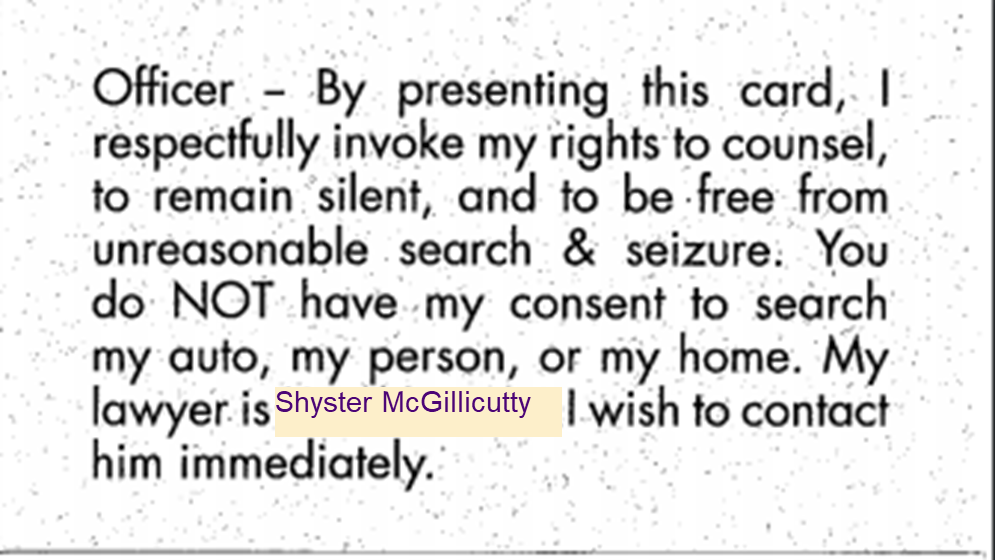
    The lawyer also did something extremely useful, which was to pass out his business card which immediately went into the wallet because it is printed thusly:  ‘

    Need to get this thing laminated

    The rest of the course consisted of me getting yelled at by a Range Safety Officer for not having a correct shooting grip while practice drawing a rubber Sig P220 from a provided right-handed paddle holster.  I am not right-handed.

    I did not muzzle myself or anyone else during the drills. But some people become RSOs to have an excuse to yell at people I guess.

    Then we went for a live-fire qualification where I shot 500/500 on an AP1 target over distances ranging from 15 yards to 3, and with times allowed ranging from “completely adequate” to “literally forever.” The fact that this was considered a notable accomplishment makes me weep, and reminds me that the NRA was founded by a bunch of Civil War veterans from New York who were appalled by their cohort’s marksmanship (or lack thereof).  Apparently nothing has changed in the last 150 years.  I then received a suitable-for-framing certificate of completion and was told the correct way to request that my permit be switched to “unrestricted.”  There isn’t actually any indication on the forms that you want to do that.  You just ask to have a duplicate permit made and the nice ladies at the Sheriff’s Office (no sarcasm this time) are supposed to telepathically determine that you want an upgrade (though I suppose the fact that you hand them your certificate should be a big hint — still, there is no official paperwork AFAICT.)  This triggers another round  of background checks with now a higher standard for acceptance (or rather a lower bar for rejection***).  Again, this standard is completely at the whim of his most gracious judicial majesty of the County of X.  A rejection at this stage is appealable, but successful appeals have never happened ever in the history of “who the fuck do you think you are peasant?”  Unlike the initial permitting process, this upgrading is supposed to happen quickly.  We shall see.

    *turns in paperwork*

    *waits*


    via GIPHY

    *receives phone call from Sheriff’s Office.*  Apparently when I traded in my 22/45 for my Mark IV, the gun store paperwork got the gun I was trading in and the gun I was taking home BACKWARDS.  Fortunately the sheriff isn’t arresting me.  Yet.

    *waits*

    via GIPHY

    One week later…

    “Mr. Adahn, could you come down to the Sheriff’s office on [names two days of the week] between [names a three hour window]?  You’ll need to bring your pistol license with you.”

    While this might be a trap, they already know where I live and that I’m (vaguely and lightly) armed, and they haven’t sent a SWAT team after me (yet).  So I go at the next opportunity (which is 20 hours later).  The nice ladies at the Sheriff’s office take a new picture of me, have me wait while they warm up the card printer, then have me wait some more while they warm up the card laminator.  Then they hand me a card very similar to my earlier one, only this one has the picture of a less fat guy on it, has my pistols printed on it instead of being written in sharpie, and most importantly, in the lower let corner it says UNRESTRICTED.  I am now less likely to commit a felony than I was before.

    I celebrate by getting a coffee and bagel at a Panera drive through (French toast with cream cheese) while having a pistol in the car.


    *NY’s “reasonable person” definition apparently includes that a reasonable person would have the same knowledge as the defendant.  Thus if you smoke someone who has a knife that is five yards away and you have been trained on the Tuller Drill, a “reasonable person” knows that an armed attacker within seven yards presents a lethal threat.

    **Kicking someone barefooted is Physical Force.  Kicking someone with a shoe on is Deadly Physical Force.

    ***All of the information about this unrestricted permitting process makes it very clear that they will reject your ass for a single DUI.  You even have to acknowledge this before the class begins.  During the practice session for SSRG’s multi-gun event, I talked to three members who were avid clay shooters that were denied pistol permits for that very reason, which is why the club chose the “2×4” format for the matches.  You can’t assume that a NYS resident will be able to legally complete with a pistol.

  • The Loss of American Social Power – Homelessness (with an aside on the racist origins of gun control)


    Asks a man for what he can spare with shame in his eyes...


    I have to confess to being interested in politics, perhaps unhealthily so. I wasn’t always. It wasn’t like I had some childhood fascination with my local senator. In truth, I think I’ve only ever voted in one Presidential election. (I may have voted for Perot, but I can’t honestly say for sure). Which is a nice way of saying that the current election cycle is a nightmare for me,* as it is for many thinking and principled Americans. It feels like the devolution of our country. To those who see politics as the public barometer of the state of a Nation, it feels like a forceful bellwether of decline, the dying gasp of a once great and moral Country.

    We’ve all seen the man at the liquor store beggin’ for your change
    The hair on his face is dirty, dreadlocked and full of mange
    He asked a man for what he could spare with shame in his eyes
    “Get a job, you fuckin’ slob” ‘s all he replied

    [CHORUS]
    God forbid you ever had to walk a mile in his shoes
    ‘Cause then you really might know what it’s like to sing the blues
    Then you really might know what it’s like…

    I had occasion to find myself in South Bend, Indiana, (yes, the one where Notre Dame is) for work. Driving up and down a particular main avenue running some errands, I noticed a man standing on the corner near the onramp to a highway. He was disheveled, though not too badly, and holding the ubiquitous sign that told his (alleged) story: “Homeless and I need to feed my family” read the message in red paint on the cardboard. I passed him in the afternoon without too much thought, though the prevalence of veterans among the homeless always makes me hesitate and ponder long after I’ve passed. Sometimes, if the timing is right, I’ll give what I can or have on me, though not always. I would imagine I’m like most people in both my thoughts and deeds with regard to the homeless. Perhaps better than some, certainly worse than some others. I’ve worked the odd soup kitchen or two for a church function or for a community service project that my kids had to and I rolled along.

    Albert Jay Nock was a brilliant and radical philosopher of the early 20th century. Born in 1870, he lived to see the First World War and died just as the Second one ended in 1945. One of his more well-known and seminal works was “Our Enemy, The State.” Finished and published during the height of FDR’s “New Deal” in 1935, Nock believed that the most effective form of government, and protective of individual rights, was the tribal “anarchism” of the early Native Americans. In an earlier work, titled simply, Jefferson, Nock argued that Thomas Jefferson was a firm believer that the smallest possible governmental units, or wards, allowed the people to, in Jefferson’s own words, “crush regularly and peaceably the usurpations of their unfaithful agents.”

    Nock’s later work in Our Enemy, The State focused on the difference between the spontaneous “social power” of individuals coming together for common cause and the forceful usurpation of social power by “State power.” His central thesis was set forth very clearly in the early part of the book and, in three short pages, Nock compels even the casual, disinterested, or even adverse reader to reconsider their entire understanding of State intervention in human affairs.

    One might wonder just what the hell all of this has to do with an (apparently) homeless guy standing on a corner in South Bend, Indiana, in mid-October, as I drove by him more than once over the course of several hours. Fair question. Let me convince you by pointing to one of the most trenchant parts of Nock’s argument that stuck with me:

    …just as the State has no money of its own, so it has no power of its own. All the power it has is what society gives it, plus what it confiscates from time to time on one pretext or another; there is no other source from which State power can be drawn. Therefore every assumption of State power, whether by gift or seizure, leaves society with so much less power. There is never, nor can there be, any strengthening of State power without a corresponding and roughly equivalent depletion of social power.

    Our Enemy, The State, p. 5 (emphasis added).

    The thesis seemed interesting to me, but I wasn’t quite sure what Nock meant by “social power” versus “State power.” I thought I quite understood the latter, but I wasn’t quite sure what the former was. Nock’s examples left me with a permanently-altered view of government attempts to intercede to “help” the citizenry. Nock provided two (then)-contemporary examples to illustrate his point more clearly.

    …it follows that with any exercise of State power, not only the exercise of social power in the same direction, but the disposition to exercise it in that direction, tends to dwindle. Mayor Gaynor astonished the whole of New York when he pointed out to a correspondent who had been complaining about the inefficiency of the police, that any citizen has the right to arrest a malefactor and bring him before a magistrate. ‘The law of England and of this country,’ he wrote, ‘has been very careful to confer no more right in that respect upon policemen and constables than it confers on every citizen.’ State exercise of that right through a police force had gone on so steadily that not only were citizens indisposed to exercise it, but probably not one in ten thousand knew he had it.

    (emphasis mine). We discussed the idea of a citizen’s arrest in law school, but I couldn’t and can’t recall much of what was said. My initial reaction reading Nock was to recoil at the thought that we all had the same powers of arrest as against each other as any officer of the law does, but then again, how much of the current problems in troubled neighborhoods stems from the fact that the local citizens who live there have abandoned even the most modest attempts at reducing the crime, violence, poverty, homelessness, drug abuse, etc., in their neighborhoods? The rejoinder is that the people are not armed and the drug dealers and gangs are and thus the people are at a distinct disadvantage, and hence comes the justification for military-grade police forces armed as well as or better than combat troops for the national defense; yet aren’t their some fundamental factors missing from that analysis? If the drug dealers and gang members inhabit those self-same neighborhoods, who is giving them succor? How do they put their heads on their pillows at night and feel secure in these same neighborhoods where they prowl and prey? These are, perhaps not coincidentally, the very same issues that confronted me while I was in Afghanistan, attempting to “police” a particular area that was rife with terrorism (and narco-traffickers, as well). I’ve watched many a frustrated military member talking to village elders asking, “Why are there rockets being launched from this area at our base every week? How is that happening?? Where do these people come from and sleep??”

    Upon careful inspection, what one finds is: first, the police do not actually live in the same neighborhoods that they patrol. In point of fact, they live in suburban outposts, miles and miles from the streets they pass through in their cars, as distant from the citizenry they supposedly serve and protect as they are from the gangs they are supposed to be interdicting. A lot of that is economics and has to do with the pay disparity between cops and the average inner city neighborhood they’re patrolling. Second, the people are at an “arms disadvantage” specifically because the State has disarmed them! It is a well-established historical fact that modern gun control suddenly became vogue during the late-1960s after armed blacks showed up to the California State Capitol armed with – (gasp) – “assault rifles!” (and shotguns, and pistols, as the above-linked article notes). As an aside, Clayton Cramer, a software engineer, does about as good a job as a law professor could in explaining that virtually ALL gun control laws have been racist in their origins and intent. This might seem self-evident when one considers that the right of a freeman to own weapons goes back to the days of sword ownership in England. If not still convinced, the Supreme Court made this explicitly clear in Dred Scott v. Sanford, 60 U.S. 393 (1857). Yes, that Dred Scott. The case itself should be required reading as a part of any basic civics course because of just how many incredible statements of historical significance for Constitutional law are in it – including statements by the Court about what defines a “citizen” and the Congressional power to “naturalize;” the right of states to admit immigrants, the status of descendants of slaves in free states vs. those of native Americans, the limits of judicial construction, and more – but of paramount importance for this discussion is what the Supreme Court used as one of its Constitutional justifications for finding Dred Scott could not sue for his freedom:

    More especially, it cannot be believed that the large slaveholding States regarded them as included in the word citizens, or would have consented to a Constitution which might compel them to receive them in that character from another State. For if they were so received, and entitled to the privileges and immunities of citizens, it would exempt them from the operation of the special laws and from the police regulations which they considered to be necessary for their own safety. It would give to persons of the negro race, who were recognised as citizens in any one State of the Union, the right to enter every other State whenever they pleased, singly or in companies, without pass or passport, and without obstruction, to sojourn there as long as they pleased, to go where they pleased at every hour of the day or night without molestation, unless they committed some violation of law for which a white man would be punished; and it would give them the full liberty of speech in public and in private upon all subjects upon which its own citizens might speak; to hold public meetings upon political affairs, and to keep and carry arms wherever they went.

    Dred Scott, 60 U. S., 416-17.

    To return to Nock’s point about social power and state power, what has happened in inner city black, and other minority, neighborhoods more broadly, is that the state has systematically usurped the “social power” – and the ability to wield it – that was originally resident in most neighborhoods and replaced with state power, which is only intermittently there “on patrol,” but not resident in that area.

    If you’re still not sure about Nock’s thesis, he provides many more examples that will shock the modern sensibility about how this country used to work.

    Heretofore in this country sudden crises of misfortune have been met by a mobilization of social power. In fact — except for certain institutional enterprises like the home for the aged, the lunatic asylum, city hospital, and county poorhouse — destitution, unemployment, “depression,” and similar ills, have been no concern of the State, but have been relieved by the application of social power. Under Mr. Roosevelt, however, the State assumed this function, publicly announcing the doctrine, brand new in our history, that the State owes its citizens a living.

    Students of politics, of course, saw in this merely an astute proposal for a prodigious enhancement of State power; merely what, as long ago as 1794, James Madison called “the old trick of turning every contingency into a resource for accumulating force in the government”; and the passage of time has proved that they were right. The effect of this upon the balance between State power and social power is clear, and also its effect of a general indoctrination with the idea that an exercise of social power upon such matters is no longer called for.

    Our Enemy, p. 5.

    Nock’s second example involved natural disasters and this is a matter I have given some thought, particularly in light of the revelations regarding the Clinton Foundation’s actions in Haiti.

    It is largely in this way that the progressive conversion of social power into State power becomes acceptable and gets itself accepted. When the Johnstown flood occurred, social power was immediately mobilized and applied with intelligence and vigor. Its abundance, measured by money alone, was so great that when everything was finally put in order, something like a million dollars remained.

    If such a catastrophe happened now, not only is social power perhaps too depleted for the like exercise, but the general instinct would be to let the State see to it. Not only has social power atrophied to that extent, but the disposition to exercise it in that particular direction has atrophied with it. If the State has made such matters its business, and has confiscated the social power necessary to deal with them, why, let it deal with them[!]

    Id.(emphasis added)

    I think the power of this example is that it has been repeatedly demonstrated through the modern era, considering the string of well-publicized failed federal disaster relief efforts through FEMA. A fairly comprehensive history of US disaster relief efforts proves the exact point that Nock was trying to make. Over time, as the federal government has increasingly intervened, local disaster relief efforts have tailed off and, in the ultimate slap-in-the-face, have even been prohibited and physically turned away by FEMA, most notably during the Katrina debacle in New Orleans.

    Nock’s final example of this diminution of social power was the one that stuck with me, though. Writing during the horrors of the Depression, Nock opined:

    We can get some kind of rough measure of this general atrophy by our own disposition when approached by a beggar. Two years ago we might have been moved to give him something; today we are moved to refer him to the State’s relief agency. The State has said to society, “You are either not exercising enough power to meet the emergency, or are exercising it in what I think is an incompetent way, so I shall confiscate your power, and exercise it to suit myself.” Hence when a beggar asks us for a quarter, our instinct is to say that the State has already confiscated our quarter for his benefit, and he should go to the State about it.

    Id.

    Guilt-free?
    Humor works best as a vector for Truth.

    And NOW we come back around to our homeless man on the street in South Bend, Indiana. (And Thanks! for sticking around).

    As I drove by him for the final time, it was past sunset, but not quite fully dark yet. He stood there in the same place holding the same sign. I couldn’t even tell if he had moved. I started to reach for my wallet but then the light turned green, so I accelerated away, leaving the man dwindling in my rearview mirror.

    “Aaaaahhhh….” I looked in the mirror as I went under the overpass, headed toward the comfort and warmth of my hotel. It was a rather warm October night, one of those last gasps of Summer before Fall fully settles in, he’d be alright… I thought of Nock’s words. “Fuuuuuck….” I muttered, rubbing my chin.

    I made an abrupt U-turn like any person who learned to drive in Rhode Island would, went past him, “banged another U-ee,” and there I was – and there he was – still holding his sign. It wasn’t the nicest part of town, but it wasn’t the worst, either. All I had was a ten and twenty dollar bill in my wallet.

    While stopped at the light, I looked left quickly where another car had pulled up to the light. There were three young black kids, all teenagers, ranging from perhaps thirteen to seventeen. The car was a bit dented up and they were watching me as I fumbled with my money, then tried to find the window unlock button in my rental car. I finally managed it all and motioned the man on the corner over; I handed him the ten as he leaned in my passenger window. He didn’t see it at first in the dark, but as he stepped back he said, “Oh My God, thank you. Thank you!” He started to walk away and I could hear his voice crack as he said: “I’ve been standing here for hours…”

    “I know,” I started to say, but it died on my lips. I’d driven by him all those times…

    I looked left and the three black kids were holding their thumbs up. The young kid in back was clapping. I just shrugged sheepishly. Then the car door opened and for a moment I thought, “Aw, fuck. Here we go. He’s going to ask for what I have left.” Then it became clear as I looked at the car it was because the window wouldn’t roll down. The teen leaned out and yelled: “I wanted to give him something, but I don’t have any money!”

    “Well…good on ya.” I said back. I couldn’t think of anything clever to say. “He needed that more than I did,” I yelled. “And I had it, so…” They smiled, waved, honked, and drove away as the light changed.

    And that was it.

    At a time when our country is rife with divisions over political parties, where we are told which lives matter, where we are no longer allowed to speak without fear of retribution if someone should be offended, where “hate speech” is now all the rage, and where I am told a car full of black teens should concern me because they are “superpredators,” where statisticians write papers claiming that abortions of black kids have helped drive down crime rates, where 1 in 4 or 5 or 7 homeless folks are military veterans, I think the “soft revolution” is what I now hope for…

    I hope that people will recognize that we all could and would be far more inclined to be charitable to our fellow man if we got to keep a little  more of our hard earned money, if our government wouldn’t tell us that IT is the ONLY possible solution to our problems, and if we all decided to simply act more charitably toward our fellow man – to take back our “social power” instead of waiting for the State to fix whatever the need is of the moment. Individual US citizens gave $258 Billion (yep, with a “B”) in 2014 – a record. At a time when the economy isn’t exactly humming. We should be proud of that, but how much better could we do if we got to keep more and decided to “just do it” ourselves, locally?

    Regardless of which shitheel gets elected, we should ignore their grand plans to “cure” _______ (drug use, poverty, racism, school shootings, or whatever the issue du jour is) and start exercising our social power. We don’t need to be told what the right thing to do is. We don’t need government to tell us to be kind to one another.

    We need to realize that we have to be the change we seek in the world and start doing it in the small ways that we can. Maybe eventually we’ll figure out we don’t need a three or four or five-letter federal agency to fake like it’s doing something while it hands out contracts to favored political donors and the people who really need help go wanting. Else I fear we risk continuing to ignore those in need among us because we have the excuse that “someone else” – like some bureaucratic agency or even the police – is going to do it. They’re not and they never have – and even if they did solve a problem, when was the last time you heard of some federal agency announcing that it had accomplished its purpose and thus was folding up so as not to waste taxpayer money? I won’t hold my breath waiting for the numerous examples…I’ll just try to exercise Nock’s social power to make the world around me a little bit better.


    *This post was originally written in the lead-up to the 2016 election.


    _____________

    Liked it? Take a second to visit www.theabjectlesson.com and support The Abject Lesson via Patreon.

  • Animal’s 2019 Hunt Report

    My hunt this year got cut short.  Loyal sidekick Rat and I ascended into the Routt National Forest early on the Friday before Opening Day; Tuesday at noon we passed through the dusty little mountain town of Kremmling, where I checked my phone and discovered my daughter was to give birth to my fifth grandchild that evening.  So we broke camp and, venison-less, headed back to town.

    My new grandson, of course, made that all worthwhile.

    This was what it was like Friday when we set up.

    There’s not too much to report from the hunt.  Saturday was clear and warm, and we enjoyed wandering around in the woods even though it wasn’t good weather for hunting.  Saturday night the snow started, sending the deer and elk into the dark timber, where the only way you’ll find them is to look literally under every tree.  By the time we left mid-day Tuesday there was over a foot of snow on the ground.

    But since I don’t have much to report, I thought I’d present something else.

    Some years back I wrote an article for a U.K. waterfowling website, which site I let have the article gratis.   Well, that little article has grown legs, as it has been reproduced in several academic point/counterpoint publications, all of whom actually paid me for secondary/tertiary/variousotheriary publishing privileges.

    That being the case, it seemed logical to reproduce it here.

    Why hunt?

    Modern hunters seem to find they are answering that question frequently.  Sometimes the question is put by the genuinely curious; sometimes it is a hostile demand for justification.  In the first case, the answer is complex and thought provoking.  In the second, the answer is simple – “because it suits me to do so.”  Hunting in and of itself requires no justification.  The hunt is not only natural and healthful; it’s an inextricable part of our heritage as human beings.  Man is and has long been a terminal predator, as marvelously equipped for hunting by our intellect as a lion is by his claws and fangs, as a wolf by his swift legs and pack instinct.  No matter whether humans today hunt directly, or employ middlemen to prepare their prey for them on farms and meat packing plants, the fact of our status as predator is in our very DNA.  We owe the very fact of our world-conquering intellect on the hunt, on the stimulus that drove us to overcome the handicap of our clawless, blunt-toothed bodies, to develop weapons to match the feats of the greatest of animal predators; we owe our great brains to the access to high-quality diets of meat, marrow, and fat that predatory behavior allowed.

    But, the question remains nonetheless.  Why, now, do we hunt?

    Some hunt for the meat.  A good reason in itself; game meat is lean, healthy, and free from additives; the process of obtaining it provides exercise and time in the outdoors, away from work pressures and the temptations of couches and televisions.  The fruits of the hunt, properly cared for, are welcomed on the most discriminating of tables.

    Some hunt for the camaraderie, another fine reason; for many of these, the actual hunt is secondary to the outing with friends, sharing the campfire with others of like mind and feeling.  Another good reason; it is in the enjoyment of fine companions that we grow as social animals.  The annual ritual of the mountain elk camp is a vital part of the year for many.

    But, there is frequently another reason.  A reason that’s more compelling, and at the same time harder to explain.

    This was what it was like Monday afternoon.

    Henry David Thoreau, in the great classic Walden, wrote “Go fish and hunt far and wide day by day — farther and wider — and rest thee by many brooks and hearth-sides without misgiving.  Remember thy Creator in the days of thy youth.  Rise free from care before the dawn, and seek adventures.  Let the noon find thee by other lakes, and the night overtake thee everywhere at home.  There are no larger fields than these, no worthier games than may here be played.”  Thoreau spoke for many hunters in those words, hunters who hunt not solely for the meat, or for the company, but for the ageless, timeless experience of the hunt itself.

    For it’s true that for some of us the hunt is an answer in itself.  It’s enough to awake hours before the dawn, and to know the utter silence of a late autumn morning.  To hear the crunch of snow under your boots as you begin the hike into the distant, silent mountains.  To smell the pines along the trail, and see the silent sentinel spruces on the ridges, barely glimpsed in the pre-dawn dark.  It’s enough to sit, shivering, at that best spot on the top rim of a remote basin, watching the east grow bright, waiting for the first rays of warm sunshine to break though the trees and drive away the bitter cold of night.

    But those moments, treasured as they are, pale before the ultimate goal of the hunt.  It’s a part of the hunter’s soul, to carry the knowledge that somewhere, out among the pines, in the dark timber or the frost-covered meadows, a bull awaits, and the chance of the day may bring him within your awareness.  The snap of a branch, the ghosting shape of antlers through the aspens, the sudden ringing bugle of a bull elk, as he appears, suddenly, where no bull was a moment before.  His breath plumes out in the cold as he screams his challenge, and your hands and will freeze momentarily in awe of his magnificence.

    It’s enough to know that the day may bring the chance of a stalk, through the darkness under the trees, along the edges of the golden grasses of a meadow, creeping, creeping, under the streamside willows, silently, slowly, ever closer, testing the wind, watching underfoot for twigs, whispering a silent prayer to the forests and fields to allow you to close the gap, to make the shot.

    With luck, you’ll raise your rifle or draw your bow, and make your shot.  More often than not, though, the bull escapes, to play the game of predator and prey another day, in another valley.

    You can’t buy moments like that; you can’t find them on the Internet, or at the movie theatre.  When the alarm rings in the icy cold of a pre-dawn tent at 9,000 feet, this type of hunter doesn’t groan at the prospect of climbing out of the warm sleeping bag; instead, the prospects of the day are enough incentive to brave the cold, to pull on wool and leather, to step into the pitch-black outdoors, under ice-chip stars.  It is with pleasure and anticipation that this hunter begins a day that will likely end back at the same tent, in the freezing dark, hours after sunset, at the end of a long hike out of the wild.

    For hunting requires a level of participation unknown in any other human venture – hunting requires a communion with the very primal forces of Nature, taking life so that life may be.  Hunting requires a contact that the non-hunter can never know, a contact with life itself.  The hunter eschews supporting his or her life through a middleman; knowing the cost of one’s diet, engenders respect for the lives that must be taken to sustain one’s own life.

    Early hunters knew this very well, as they revered their primary prey.  For example, Plains Indians referred to the bison as “uncle” and “brother.”  Paleolithic cave drawings of game animals and hunt scenes are rendered with a loving reverence that is still evident today, thousands of years later.  Modern hunters are much the same.  Enter a hunter’s home, and you’ll likely find framed prints of deer and elk, waterfowl sculptures, photography of upland birds.

    To some it seems contradictory; to express respect, reverence, even love for an animal that you pursue, hunt, kill, and eat.  It’s true that this seeming contradiction is as hard for hunters to explain as it is for non-hunters to understand.

    Perhaps the answer lies in the very understanding of our role in nature. nature has but one law; life feeds on life, and life gives life to life.  People who obtain their steaks, chicken, and burgers from supermarkets and butcher’s shops can lose sight of this fundamental truth, and perhaps they would prefer to have that process sanitized in just such a manner.  In our modern, urbanized society, many like to imagine their own existence is bloodless, clean, and sanitary.  But such an outlook is self-deluding.

    The hunter knows very well the cost for the steaks that grace his plate.  A year has been spent in preparation for the hunt, planning, caring for equipment, and practicing marksmanship.  Without complaint or reservation, the hunter has arisen before dawn, as described above, and walked the many miles to where the game awaits.  In the bright sun of a meadow, in the twilight of dusk, or in the shadows of the forest he has made the stalk, taken the shot with painstaking care, and dressed the animal.  He has packed out quarters of elk, perhaps a two or three-day process, often through rough, grueling country.  The hunter has cared for hides and antler and meat, and the price for the meal of elk steak is ever with the one for whose life the elk’s life has given way.

    Loyal sidekick Rat contemplates another stretch of dark timber.

    Most of all, the hunter has seen the sudden transition from a living animal to an inanimate food source, from animate life to meat for the table.  The non-hunting urbanite likely has never seen this take place, and would not care to do so; but the hunter knows, with bittersweet regularity, the price that must be paid for continued existence.

    It is for this very reason that the hunter reveres his prey.  The intimate, timeless knowledge that Life springs from Life can only lead to reverence for the source of that Life.  The bull elk in the dark timber, ghosting through the trees silently as smoke, will live on in the blood, bone and sinew of the hunter waiting on the ridge above; and the hunter, in his turn, will return to the Earth, to nourish the soil, to give rise to the grasses that will feed the elk.  And how can the hunter not revere the greathearted bull, revere the magnificence of the great deer that will go to feed the hunter’s family in the winter to come?  Reverence for the game, reverence for the wellspring of life, reverence for the great, largely unknowable cycles of the Earth, all come from the intimacy with Nature found in the hunt.

    Hunting is indeed what makes us human; hunting is what led humans to cooperate, to plan, to anticipate, to form society.  The first great turning point in Mankind’s development was when two unrelated families found they could hunt large animals by working together, and so be more efficient at obtaining high-quality food; thus was the first tribe born.  Hunting has made us what we are.

    It’s unfortunate that the non-hunter often cannot see past the fact that the hunt results in the death of an animal.  The death of an animal, it’s true, is the goal of the hunt; but a greater goal is to be found in the overall experience, of which the actual kill is only the climactic moment.  The hunter’s soul often thrills as much, if not more, to the blown stalk, the bull that senses something amiss and vanishes into the mountains like a puff of smoke on the breeze, leaving no trace in his wake.  Fond memories include the grouse that explodes from underfoot at the worst possible moment, the squirrel that set up a warning chatter in the penultimate seconds of a carefully planned approach.  The vista of a great gulch viewed from the rim, with a herd of elk grazing peacefully, undisturbed, and totally unapproachable on the far side.  And, indeed, in the final moment of success, when the hunter approaches, cautiously, the downed bull, lying still now against the bed of needles; the heart-pounding thrill of success, weighted against the bittersweet regret of the necessity of taking the life, facing the final truth that for life to be, another life must give way.

    Life feeds on life, and life gives life to life. The hunter in success understands this great truth as no other human possibly can.

    Why hunt?

    We hunt to pay homage to nature, to life, to the earth.  To make our annual pilgrimage to our beginnings, to lay hands on our heritage as members of the biotic community.  To affirm once more that life feeds on life, and life gives life to life.  We hunt for the gift of an elk to a family, the gift of life from the earth.  In the hunt lies an affirmation, a recognition that we too will one day return to the earth that has fed and nurtured us, and the elk will then feed on the minerals and nutrients returned to the soil from our bodies.  That affirmation alone is enough for many of us who hunt, to send us once more out of our tents, trailers, and ranch houses, out into the freezing darkness under the glittering stars, to climb an unseen mountain for the chance at an elk.

    Hunting has a fundamental truth that few non-hunters understand.

    It’s not about death.  It’s about life.

    That’s why.

  • Gold Standards III – The Smith & Wesson Triple Lock

    The Perfect Double-Action Revolver

    A very fine Triple Lock.

    Resolved:  The Smith & Wesson .44 Hand Ejector 1st Model “New Century,” otherwise known as the “Triple Lock” is the standard by which all double-action revolvers must be judged.  Now that that’s established, let’s take a closer look at this scion of modern double-action sixguns, how it came to be, who used it, who made it famous, how it changed the way shooters looked at sixguns and what they expected from them; and not least, let’s take a closer look at why it remains today perhaps the most significant double-action revolver ever made.

    The Forerunners

    First, we must cast our optics back to the year 1889.  During and since the War of the Northern Aggression, the folks at Colt had dominated the military sidearm market, leaving Smith & Wesson to fend off the civilian trade.  Their offerings were all variations of a kind; top-break revolvers that were fast to reload but had a significant weakness in their hinged frames.

    The first, a .32 Hand Ejector.

    But in 1889, Colt introduced something new.  This (as we saw in the History of Sixguns series) was the Colt Model 1889, the first production double-action revolver with a solid frame and a swing-out cylinder.  Colt quickly followed this up with the M1892 Army and Navy and the excellent, big, tough Colt New Service, which was available in heavy revolver rounds like the .44WCF and .45 Colt.

    Smith & Wesson rose to the challenge, but their first swing-out double-action was a pipsqueak; in 1896 they introduced the .32 Hand Ejector in .32 Long, and in 1905 they followed up with the 1905 Hand Ejector in .38 Special.  This last gun was to give rise to the K frame revolvers and the near-immortal Model 10, but that’s not the gun we’re here to discuss.

    It was in 1908 that Smith & Wesson hit the home run.

    The New .44

    It’s not often that a gun manufacturer comes up with the perfect blending of gun and cartridge.  Winchester did it with the .30WCF and the M1894 lever gun.  Colt and John Browning did it with the M1911 and the .45 ACP.  And Smith & Wesson did it with the Triple Lock and the .44 Special.

    A 1905 Hand Ejector, in .38 caliber

    The .44 Hand Ejector First Model’s designers did more than just scale up Smith & Wesson’s smaller .32 and .38 revolvers.  The new gun retained the swing-out cylinder, but added the feature that gave the gun its nickname; in addition to the lockup at the cylinder face and the end of the ejector rod, taken from the earlier Smiths, the new gun added a locking lug on the crane that locked into a recess in the frame.

    This was the first of Smith & Wesson’s big-frame revolvers.  This frame, which would become known as the N frame, would go on to yield such famous pieces as George Patton’s Registered Magnum and Harry Callahan’s Model 29, but the Triple Lock was the first.

    This combination of three locking features – the Triple Lock – yielded a revolver that was strong enough for the new load, which was took the old .44 Russian case that Smith & Wesson had chambered in the break-top Schofield revolvers, and lengthened it, adding powder capacity.  The first loads used 26 grains of black powder and a 246-grain round nose lead bullet, but in these early years hand-loaders were already experimenting.  New bullets and newfangled smokeless powders were becoming available, new power levels were being achieved, and the big, tough new Smith made a perfect test bed.

    The First Model guns were expensive.  The Triple-Lock required a lot of careful hand-fitting and tuning to make it lock up properly and maintain cylinder timing, but when well-set up it was utterly reliable with almost any ammunition.  And the Triple Lock is a joy to handle; smooth, with a long but glassy double action pull and a crisp single-action trigger.  Over the years I’ve had the opportunity to handle and shoot two .44 Special Triple Locks, and I’ve been watching for the opportunity to add one to my own collection for some time.

    Elmer Keith and the .44 Special

    One of Keith’s Triple Locks, along with some of his other works.

    As much as any of Smith & Wesson’s marketing people, it was a Montana cowboy, hunter, guntwist and adventurer named Elmer Keith that was responsible for the fame of the new revolver and cartridge.

    Keith had cut his teeth on single-action sixguns and always remained fond of the Colt Single Action Army and the .45 Colt round, but he was also quick to see the advantages of the big new Smith and its swing-out cylinder.  A committed big-bore fan, Keith liked to stoke his sixgun handloads up plenty strong, and the big-framed Smith was plenty tough enough for the hot loads he cooked up.

    In his benchmark work Sixguns, Keith wrote of the Triple Lock and its cartridge:

    Daniel B. Wesson, after fifty-two years of distinguished service, passed away in 1906. In 1907 Smith & Wesson brought out their Triple Lock, perhaps the finest revolver ever manufactured anywhere, at any time. Today no example of finer revolver making is to be had. The rear end of the barrel and the cylinder steel of the old triple lock are not as strong as in the present 1950 model Target S&W. .44 calibers or the .357 S&W. Magnum, but the old New Century was, and still is, one fine gun in any company.

    They designed the .44 Special cartridge for this arm with 26 grains of black powder, instead of the 23 used in the .44 Russian cartridge. The .44 Special is simply a longer version of the .44 Russian and no more accurate sixgun load exists.[i]

    The Triple Lock mechanism.

    Keith experimented extensively with heavy loads for the .44 Special in both Triple Locks and the later N-frame Smith & Wesson 1950 Target revolvers.  He pressured friends at Remington and Smith & Wesson to legitimize his efforts until, in 1955, Smith & Wesson introduced an offspring of the Triple Lock that would become the Model 29.  While Bill Ruger had beat Smith & Wesson to the punch by a few months, making the single-action Ruger Blackhawk the first production .44 Magnum, Smith & Wesson’s Model 29 caught on quickly, not least of which was because of Elmer Keith’s enthusiastic advocacy – and thus, the Triple Lock’s legacy lived on.

    The Triple Lock itself, however, was gone by this time.  The gun, as we noted, was expensive to make.  In 1915, after only seven years of production, the revolver was redesigned.  The Second Model did away with the third locking lug and the ejector shroud, making the gun cheaper to build and sell, and the Triple Lock production ended with a total of only 15,376 copies built.

    The N Frame Revolvers

    The true legacy of the Triple Lock, of course, is in its descendants, those being all the various N-frame sixguns that Smith & Wesson has produced and continues to produce to this day.  The third locking lug has not been seen since the original .44 Hand Ejector 1st Model New Century, but the N-frame remains perfect for heavy sixgun loads; a big, beefy steel frame with a strong topstrap, stout crane and thick sidewalls, more than capable for hot handloads in the .44 Special and .45 Colt, not to mention the .44 Magnum.

    The CCW market has driven handgun producers to an ever-increasing diversity of small, light concealable pieces, mostly semi-autos; I own a few such and favor the Glock 36 for everyday carry.  But there will always be a place for a heavy holster sixgun for serious work in forest and field, and the N-frame guns are admirably suited for just that.

    As I have described here before on several occasions, my own favorite holster iron for outdoor work is a grandchild of the Triple Lock; mine is a 1970s-vintage Smith & Wesson 25-5 in .45 Colt, heavy but not too heavy to carry all day without complaint, and plenty tough enough for the hot .45 Colt loads I push through it.

    The Triple Lock’s children and grandchildren are even tougher, mostly due to greatly improved machining techniques and metallurgy, but the Triple Lock remains, as Keith pointed out, a fine gun in any company.

    Today

    The big N-frame Smith & Wessons are still made.  The big sixguns are no longer offered new in the .44 Special but, of course, the .44 Magnum is still available.

    I confess, though, to being a little disappointed in the new Smith & Wessons.  In 2000, Smith & Wesson added to all their revolvers an internal safety lock actuated by a key via an aperture above the cylinder lock slide; this bit of lawyerly pettifoggery has a bad reputation for failing at the wrong moment.  Triggers are heavier than on older guns, although Smith & Wesson’s fit and finish remains generally good.

    Happily, the various online auction and sale sites have plenty of older guns for sale.  Triple Locks are scarce and command high prices, but there are enough other, less scarce N-frame guns to satisfy the collecting urges of almost any big-bore sixgunner.

    The Triple Lock was a once-in-a-century sidearm – innovative, well-made, well-fitted, reliable and tough, with a new cartridge that proved to have great potential.  From its initial design descended an entire series of handguns, used by millions in forests, fields, streets and battlefields.  We haven’t seen its like since, which is why the Smith & Wesson .44 Hand Ejector 1st Model “New Century” remains the standard by which all double-action revolvers must be judged.

    [i] Keith, Elmer. Sixguns. Sportsman’s Vintage Press. Kindle Edition.

  • Profiles in Toxic Masculinity V: Roy Chapman Andrews

    Profiles in Toxic Masculinity, Part 5

    Appearances Can Be Deceiving

    The fellow to the right looks like a banker, stockbroker, maybe a corporate executive of some type, doesn’t he?  A solid, stable, reliable, boring guy, one you’d never find pulling off anything dangerous or exciting.

    What he was, in fact, was something completely different.  This character is Roy Chapman Andrews, one of the most groundbreaking scientists of the early 20th century, a pioneer in dinosaur paleontology, possibly one of the inspirations for the character of Indiana Jones, and a considerable badass in several different ways.

    His Maculate Origin

    Roy Chapman Andrews was born to Charles and Cora Chapman Andrews in 1884 in an unassuming house on an unassuming street in the unassuming town of Beloit, Wisconsin.  He spent a good part of his youth wandering the hills and fields around Beloit, becoming a crack shot, a careful amateur naturalist and a taxidermist.  It was his skill at that latter avocation that leveraged him into Beloit College and in part paid for that education.

    He graduated that institution in the year of 1906, with a degree in English and classes in archaeology and evolution added to the mix.  He was determined to move into the larger world.  And so, on leaving Beloit College, the young Andrews made his way to New York City, where he determined that he would enter employment at The American Museum of Natural History.  To that end he arranged to speak to the Museum’s Director, one Dr. Bumpus, who in the course of the interview dashed the young Andrews’ hopes – almost, as Andrews himself describes in his autobiography Under A Lucky Star – A Lifetime of Adventure:

    At last he said, regretfully, that there wasn’t a position of any kind open in the Museum. My heart dropped into my shoes. Finally I blurted out, “I’m not asking for a position. I just want to work here. You have to have someone to clean the floors. Couldn’t I do that?” “But,” he said, “a man with a college education doesn’t want to clean floors!” “No,” I said, “not just any floors. But the Museum floors are different. I’ll clean them and love it, if you’ll let me.” [i]

    He did indeed end up starting his career mopping floors.  But young Andrews was destined for greater things, as his subsequent career proved beyond anyone’s capacity to doubt.

    His One-Man War Adventures

    For a man who is best remembered today for his adventures in various deserts pursuing dinosaur bones, it is surprising to some that Andrews first earned his adventuring stripes chasing snakes, lizards and whales.

    Scarcely had he entered his employment at the American Museum of Natural History than the young Andrews found himself packed off aboard the USS Albatross to the East Indies, where he collected various reptile specimens and watched marine mammals at play.  This led to an interest in whales, and soon Andrews was in British Columbia at a whaling station, where he went to sea on the schooner Adventuress to try to obtain a bowhead whale skeleton for the Museum.  In this Andrews was uncharacteristically unsuccessful, but he did obtain some sterling film footage of seals, the best that had ever been available to the American public at that point.

    But careering around the ocean in whaling vessels quickly grew boring for Andrews; something more exotic was in order.  In 1914 he had married Yvette Borup, and in 1916, with his new wife along for the adventure, Andrews led an expedition across China’s southern and western provinces, cataloging the flora and fauna of that area.

    It was in 1920, however, that the plans Andrews’ most well-known adventures began to take shape.

    Bear in mind that the automobile was still kind of a brand-new thing in the early 1920s.  But Andrews wasn’t afraid of breaking new ground in more than just looking for fossils, so her determined to take a fleet of Dodge automobiles west out of Peking and into the Mongolian deserts, there to seek fossils.  The automobiles and personnel were assembled, and in 1921 the group set out.

    Mongolia in those days wasn’t the most stable of places; armed bandits were everywhere, and so were corrupt provincial police, little better than bandits themselves.  But the fossil pickings were rich.  Andrews’ expedition uncovered fossils of indricotheres, a giant hornless rhino four times as heavy as an elephant, and the rhino-sized hoofed carnivore that was named after him, Andrewsarchus. 

    Human fossils were also a goal, as Andrews adhered to the then-popular “Out of Asia” theory of human origins, which posited that mankind’s ancient ancestors arose in Asia, but while fossils of the creature now known as Homo erectus were found in China in 1923 (then described as Pithecanthropus or “Peking Man”) Andrews’ group was not destined to find any early human remains.  In fact, in 1924, anthropologist Raymond Dart found the first fossil of an australopithecine in South Africa, the “Taung child” later classified as Australopithecus africanus.  It is not known whether this discover dissuaded Andrews from the “Out of Asia” theory.

    Andrews in Mongolia, on his horse Kublai Khan.

    Andrews’ adventures in Mongolia were not entirely peaceable.  On one occasion he and a partner were driving down a desert valley when they were ambushed by bandits.  The bandits fired several shots at Andrews’ automobile, but as befitting a man with a big brass pair, the heroic explorer from Beloit just wasn’t having any of it.  As Andrews himself described it, he and his partner drove into a canyon, grabbed rifles and set up to ambush their ambushers:

    Soon our potential murderers started to climb down the cliff, evidently bent on finishing off what they had begun. But we weren’t having any. Charlie picked one fellow silhouetted against the sky. I lined my sights on another in front. Bang, bang went our rifles. Charlie’s client sat down suddenly and rolled over. Mine did a magnificent swan dive right off the cliff. The other three ducked back among the rocks. It must have been a bit of a surprise to them. [ii]

    Apparently, Andrews was a fan of Savage rifles.  From the horseback photo here, it appears Andrews favored the 99 Savage lever guns, which gives me another reason to add one to my collection.  In another photo he appears with what looks like a Model 20 Savage lying on a rock nearby.  I have not yet found a photo that clearly shows the revolver he routinely carried, although he describes it as a .38.  That covers a lot of ground, six-gun wise.

    It was on July 23rd, 1923, that Andrews and his team made the discovery that he is best remembered for today.  On that fateful day, one of the party uncovered several oval objects in Cretaceous strata and went back to camp joking about having found dinosaur eggs.  Andrews returned to the site and determined that yes, these were indeed fossilized dinosaur eggs – the first ever found.  Initially thought to be from the common Cretaceous ceratopsian Protoceratops, the eggs were many years later found to belong to a species of oviraptor.  But dinosaur eggs they were, the very first; Andrews wrote about that day:

    Dino Eggs!

    Then our indifference suddenly evaporated. It was certain they really were eggs. Three of them were exposed and evidently had broken out of the sandstone ledge beside which they lay. Other shell fragments were partially embedded in the rock and just under the shelf we could see the ends of two more eggs. [iii]

    In 1927, the first rounds of the Chinese Civil War began, wherein the Kuomintang-led government was battling for control of the country against Chinese communists.  We all know now how that turned out, but at the time it was beginning to be very dicey indeed for a band of American dinosaur hunters.  After some wrangling with bureaucrats and much difficulty in getting specimens released for export – and after one incident wherein Andrews and colleagues fled down a gravel road in their automobile with machine-gun bullets cracking past their ears, escaping only after a Chinese officer directed them to drive down the ditch to escape the worst of the fire.  After this even Andrews had had enough.  He described the aftermath of their narrow escape thusly:

    It was a difficult job to navigate over the plowed ground, but somehow we got to the gate of Peking and into the city. The experience affected each of us differently. I had been so busy driving that there was no time to be scared; or at least not to give in to the feeling. I had got the other fellows into the jam and had to get them out. But once back in Peking I felt awfully weak and sick. One of the other men who was staying with me had been perfectly cool throughout the entire performance and afterward. At two o’clock the next morning he went into violent hysterics. I had a beautiful time getting him back to normal[iv]

    His Golden Years

    Andrews, with his habitual holstered revolver.

    Andrews returned to the United States in 1930.  In 1934, he ascended to the Director’s chair in the Museum of Natural History, where he had begun his employment mopping floors.  He had chronicled many of his adventures prior to this, but on his retirement to California (which was not nearly as nutty a place then as it is today) in 1942, he began writing in earnest, churning out memoirs and tales of adventure which were all the more gripping because he really lived them.  His published works include:

    • Monographs of the Pacific Cetacea (1914–16)
    • Whale Hunting With Gun and Camera (1916)
    • Camps and Trails in China (1918)
    • Across Mongolian Plains (1921)
    • On The Trail of Ancient Man (1926)
    • Ends of the Earth (1929)
    • The New Conquest of Central Asia (1932)
    • This Business of Exploring (1935)
    • Exploring with Andrews (1938)
    • This Amazing Planet (1939)
    • Under a Lucky Star (1943)
    • Meet your Ancestors, A Biography of Primitive Man (1945)
    • An Explorer Comes Home (1947)
    • My Favorite Stories of the Great Outdoors Editor (1950)
    • Quest in the Desert (1950)
    • Heart of Asia: True Tales of the Far East (1951)
    • Nature’s Way: How Nature Takes Care of Her Own (1951)
    • All About Dinosaurs (1953)
    • All About Whales (1954)
    • Beyond Adventure: The Lives of Three Explorers (1954)
    • Quest of the Snow Leopard (1955)
    • All About Strange Beasts of the Past (1956)
    • In the Days of the Dinosaurs (1959)

    If time allows you to read only one, make it his Under A Lucky Star. 

    Roy Chapman Andrews passed away on March 11, 1960 and was buried in his hometown of Beloit, Wisconsin.  He left behind him a legacy of adventure that few could match.  Today’s batch of scientists seem poor stuff by comparison to the gun-toting, hellraising, fearless Roy Chapman Andrews.

    [i] Andrews, Roy Chapman. Under a Lucky Star – A Lifetime of Adventure. Read Books Ltd. Kindle Edition.

    [ii] ibid

    [iii] ibid

    [iv] ibid