Category: Not So Easy Pieces

  • Stumbling Along in Germany

    (All photos mine except for one- I am not that old)

    I promise this bit of scribbling will be shorter than my usual missives, but it will be more of a bummer than discussions of recreation and the early Apollo program. This article will also lack the flair of H&H or SugarFree but may intrigue some of you to learn more about a privately funded and executed memorial project.

    The National Socialist era (1933-1945) for Germany was a time of both governmental and non-governmental lawlessness. Everyone in this group is aware of the broad outlines (or intricate details) of the crimes perpetrated by the National Socialist German Workers Party, the government it controlled, and the people who supported the goals of those entities. With the end of that era in May 1945 Germany entered a period of denial and silence concerning the crimes committed in the national socialist era.

    Slowly, and by fits and starts, the government and people of West Germany (FRG) began to recognize the crimes committed in the name of the German State and the positive actions by those few who openly opposed the socialists. Even so, people like the July 20, 1944 conspirators were generally seen in a poor light by most of the German population for decades. In the International Socialist GDR the NSDAP past was even more hidden because “the new boss is like the old boss”. Any public remembrances had to be wrapped up in the glorification of the communists (mis)rule of the East. With the collapse of Warsaw Pact and the subsequent reunification of Germany a re-examination of how to remember the totalitarian era began to be debated and acted upon in Germany.

    One problem of this reexamination was how far removed from today the NSDAP’s crimes were. The crimes are entire generations removed from the people inhabiting Europe today. Today most of the perpetrators are in their graves and the surviving few are pushing 100 years of age. Even German prosecutors state the last of the Nazi trials probably has been conducted. The statistics for the victims are ever darker. Those who survived often had compromised health and suffered early deaths. It is rare to find any alive today, even in the populations of those who moved overseas after WWII ended. Various government agencies wrestled with the issue and the common solution was to memorialize the victims and keep quiet about the criminals. In Berlin for example, the memorial and museum to the July 20th 1944 Conspirators is well done, but limited. The Holocaust Memorial near the Brandenburg Gate is expansive, but the dead are nameless. Across the street there is also a small memorial to the homosexuals killed by the NSDAP- again nameless, but full of current politicization.

    Monument to Oberst Claus Von Stauffenberg and other conspirators at the site of their July 21, 1944 execution.


    Portion of the “Memorial to the Murdered Jews of Europe“ (aka Holocaust Memorial) near the Brandenburg Gate.


    Last month I was in Wiesbaden, Germany for business with a few extra days tacked on. The first night there, a group of my co-workers and I went out for dinner. We had different knowledge levels of Germany with some of us former residents and several on their first visit to Germany. After dinner we were walking back to the hotel and I noticed three small bronze squares in front of a building. I brightened since I had a chance to share with my co-workers a small aspect of German life. “Hey look! Here are three stumble stones.” We paused at the squares and I let them know that this was the last home of the “X-berg” family and it was from here the National Socialists seized them. I continued, “They were rounded up on X day and they were transported to Sobibor and arrived on Y day. They were probably all dead within the hour.” I heard a quiet groan and a, “Thanks Double for that bit of ruining our evening.”

    What had I described to my co-workers? It is a project by conceived and executed by Gunter Demnig to remind people of the names and fates of those persecuted by the national socialists. In 1992 he conceived the project to memorialize as many victims as possible at their last residence as a free person. The memorial stones pull no punches. They start “Hier wohnte” “Here lived” and tersely lay out the fates of the people who lived at that address. Since 1992 he has cast and placed over 80,000 (as of 2018) of these memorials across Germany and Europe making it the world’s largest decentralized memorial. He runs the private organization with donated funding that casts and emplaces the Stolpersteine.

    Anybody can nominate a victim of the national socialist’s. The victim(s) are not limited by category and can include Jews, homosexuals, Roma, “shirkers”, union members, etc. The key is that the victim must be a victim of the national socialists and not WWII in general. (e.g. Killed in a concentration camp- yes. Killed as a soldier or a civilian by combat operations- no.) Once the nomination is properly researched, documented, and validated- Gunter is German after all- a personalized monument is cast and is ideally placed in front of the last known residence of the victim. Sometimes a group monument will document the names at a known transportation site. Most German cities have supported this initiative- Munich has not- and a slowly growing number of other nations have permitted memorials placed in their locales. (Though often not without local controversy.)

    Why “stumble stone” or “Stolpersteine”? There are multiple reasons. Each block is 10 cm X 10 cm (~4in X4in) and is set close to flush with the sidewalk stones/concrete. While walking they are noticed when you closely approach them, or your shoes trod on a not uniform surface. The name also comes from a NS era anti-Semitic joke about un-uniform paving stones marking a Jew’s grave. Gunter Demnig also states that because you can’t decide to avoid them (like a conventional memorial) and come across them at close range a Stolpersteine “is a deeper intrusion of memory into everyday life.”

    After my business trip was over I took a few days of vacation to visit my son’s family in Berlin. In the morning I would walk the neighborhood, get some coffee, and explore while the rest of the apartment slept. (I am well trained on the prime directive- do not wake a sleeping infant.) My son’s family live in a nice but by no means remarkable neighborhood with an average history. By that I mean it was not a Jewish, International Socialist, Union heavy, or anything else neighborhood. Since the early 1900’s it has been a respectable middle class neighborhood. Almost as soon as I left the apartment building I came across my first stumble stone. It is literally next door and memorializes one of the first victims of the NS era. I wander down the street and buy my cappuccino and chocolate croissant, shortly thereafter I see another stumble stone- this time for a person seized on the street and shot by the Gestapo the day before Berlin fell to the USSR. That night I decided to walk every block immediately around my son’s residence and see how many people were killed by the NSDAP. This is a snapshot of an approximately five block by four block area of Berlin and includes only the Stolpersteine and not those killed because of air raids, military service, Soviet ground combat, or post war rape or disease.

    I am not going to show you all 17 of the stumble stones I found in that small area. (I may have missed some, but I hope not.) Here are some of the representative stumble stones to give you an idea of life and death to out groups under a socialist regime.


    Georg Stolt was a member of the German Communist Party and served on the Berlin City Council (1920) and was a member of the Prussian Parliament until 1932. In 1934 he was seized by the SA and placed in Protective Custody, shortly thereafter he was shot by the SA in an early version of a concentration camp (KL).


    Arthur Michelsson was seized and killed the same day. Most likely by a Gestapo run “flying court martial”. Less than 24 hours later this section of Berlin was captured by the Soviet Army.

    The picture below was taken on May 2, 1945 at the Reichstag about 1 km west of this spot.


    The Jaskulski family was deported to the Lodz Ghetto in occupied Poland. Edith was nine years old when she was taken from her house to Hamburger Platz and loaded into a freight car. The family was later selected for “transport to the east” and died at the Chelmno Extermination Camp. They most likely died in early 1942 during Operation Reinhardt which was initiated after the Wannsee Conference agreed upon the “final solution to the Jewish problem.”


    The Nartelski family was deported Auschwitz as part of Operation Reinhardt. Rita (~8 years old) and her mother Paula likely were gassed upon arrival. Gunther entered the main camp and later survived the evacuations to the west. After he was liberated, he moved to America and remarried. More about the Nartelski family here.


    The stumble stones are jarring whenever you see them. You can’t help but to remember that RIGHT HERE a person or persons lives were destroyed by a socialist regime. This ordinary building in front of you saw property seized, lives destroyed and parasites receiving ill gotten gains. Because of my knowledge of history and political outlook I fully realize that the stumble stones are not just a memorial to the past but a living warning for today. These memorials are a reminder of the ultimate goals of the democratic socialists and “warmnistas” living in our societies.

    If you want to find out more about the project, or if you have a relative/family friend to nominate you can visit here: http://www.stolpersteine.eu/en/home/


  • Update from Ev

    October 24, 2019

    Chiang Mai Ram Hospital

    Private Room

    I’m old enough to know that life always changes in unexpected ways, but I’m not disciplined or skilled enough to have made the most out of that reality. Rather than make me special, that more accurately lumps me in with the majority of people, by my estimation. This story is a one-off example of when that truth doesn’t hold up to anything meaningful. My writing is also askew, as I’ve long been out of practice and the writer living within me is currently on the Disabled List.

    A month ago, Lady and I were going around Chiang Mai, Thailand, where we work and call home. I got out of the taxi and got a scooter to navigate around the heart of city. Shortly after I was hit by a car. I flipped off the bike and landed on my head on the curb of a walkway. My head busted open and blood poured through the many cracks approaching my brain. I also broke four ribs. I remember none of this or the next several weeks. Lady told me about it all; I was taken into a vehicle and sped off to a hospital, where they sawed off a chunk of my skull larger than one of my hands.

    The boneless area of my head would swell with pockets of blood, creating dangerous areas that prevented one from poking directly into my brain itself. My ribs would flex and swell,causing profound pain by frequently poking my lungs or other internal organs. Sneezing, damn diaphragm inflating, would push the bones around as well, delivering pain that I learned to avoid as best I could.

    In my life I’ve broken about fifteen bones, I’ve had both hips replaced, and have largely lived a life that involved smiling through pain, understanding that complaining doesn’t have a point in such circumstances. Learning how to cope and reduce long-term damage is more useful. This injury soaked me in two related lessons: The pain I was going through also affected my memories of both real events and also of historical or literary importance by locking them from my active search. In many ways I’ve been able to flip the hand I’ve been dealt in order to use this truth to my benefit.

    I mentioned that I have no recollection of the accident and the aftermath. I have also forgotten the lyrics to hundreds of songs. I’ve known who assassinated President Lincoln since I was 8 years old. The Booth name slipped my brain all day today and I angrily had to look up the name, despite remembering all of the details behind the events. Those slips and hundreds of others make me angry. I can’t trust how my brain is trying to mock me by getting me to believe by pushing a story that passes muster when first looked at again.

    On the other hand, however, doctors, nurses, and family members have all had the same compliment to attribute to me. They appreciated and applauded my patience with the injuries and difficulties with the mental stalemate. After reflecting upon this statement, I slowly began to understand its truth and importance. I could no longer see the next step in Whatever Game, so it was wiser to focus on the factors that would reveal their importance within x amount of time. I also learned not to panic when I understood that the next step was too high or too far away for me to put too many chips behind. This taught me to handle things within proper due process, surprisingly with future aspirations and unexpected effects.

    This helped me think about my nomadic life and my current work-related opportunities. Important goals and things that need to be painted in, but too much is happening *NOW* that need to first be settled or conquered. The current End Game requires too many variables to be accounted for at the moment for an adequate, let alone perfect, solution to be settled upon.

    This so far has helped me navigate the issues that have long roamed my personality and zoomed through my consciousness, perhaps often looking for a way not to pay. I know the ones that cause me too much trouble and should be shied away from, and I know which information can be absorbed and need my direct attention. Sometimes they act the very same as each other now, before they separate into their unique paths. Keep a close eye on those. They frequently have a way of reading you that can leave you helpless until you smell out their unique games.

    I suppose I’m out of time. I had planned on personalizing this to many people, but I think this is the bottom line. I have surgery in ten hours and I can only eat one more meal in the next two hours. The clock is winding down and I’m not sure how long I have to keep writing this prelude or when I’ll be able to put together the Post Surgical Thoughts onto a page.

    Thanks to everyone who has reached out to me. Many have been in their own way. People I’ve worked with (both traditionally and artistically); friends from all over the world; special love to my brother and mother who came to visit. And perhaps the most love to Kylie (Lady), who has shown a Romanesque devotion to helping me however she can.

    I thank everyone. Your kind words and actions have kept this prisoner free in thought and desire. Hopefully after I get my skull reattached today I’ll be better suited (in a certain amount of recovery time) to pursue the goals some of you have added to my Ledger.

    Please stay in contact. I’ll do my best to do the same. Some people, when they are mentally ill or several drinks under the table, suggest that they need to get their head straight. I’m going to give it my best shot today. Hopefully the future bubbles I’ve planned will align once the doc physically gets my skull sorted. I’ve been working at it like a lumberjack on a log cabin. I feel confident in how I’ve lined up everything in my head. It’s time to put my bat on the ball.

    Have a fantastic weekend!

    Evan from Evansville

  • Glibertarian Survey Results

    I promised we would all get to see the results of the Glibertarian survey from last week, to answer a question that one member of the editing staff posed.

    Lets just say, somebody owes somebody else $1.  Now the results, based off 309 total respondents:

    Question #1:  Are you libertarian?

    95% of  respondents answered in the affirmative.  Which given a certain statistic (98%) by a certain individual, whom we will call “Michael Hihn”, suggests there are at least 14,308 libertarians out there that reject the label.  Are the respondents really libertarian?  Is there a way we can determine this?  Yes.  With this purity test…

    Question #2:  If yes [to question #1], choose the statement you most agree with.

    An overwhelming 85% of respondents chose the two statements that most closely align with the “correct” libertarian position on regulating Google.  Correct, from a purely doctrinal standpoint.  One’s opinion on this topic in particular might vary to some degree, which is the reason behind a second correct answer.  One of the responses cited a specific tenet of libertarian philosophy:  private property rights.  The other took a basic NAP approach but perhaps left a possibility for one to be a “realist”  but does not imply direct action taken against Google.  The difference between the two in the quantitative sense is not very large (5%); in the qualitative sense however, it can be argued this makes a world of difference.  Perhaps more can be said on that later.

    As for the 13 respondents that use Google to get their jollies…now Google knows you like ginger trannies…

    Question #3:  Do you intend to vote in the 2020 election?

    The data suggests at least 2/3 of respondents are going to.   Not many ways to split this one.

    Question #4:  Who do you believe will win the Republican nomination?

    Like Question #3, this one is also straightforward.  One thing to add here is there is a single respondent that believes Bill Weld will win.  It stands to reason that only Bill himself, thinks he has a chance to primary Trump.  Which means Bill is watching—let’s give Governor Weld a nice, warm, Glibertarian welcome…

    Question #5:  Who do you believe will win the Democrat nomination?

    The results here are filtered for responses greater than zero, given the number of choices available at the time the survey went live.  The respondents have Joe Biden up 10 percentage points on the next highest candidate, Kamala Harris.  Followed by Elizabeth Warren, who likely has a plan to correct these responses.  Which brings us to…

    Question #6:  Who do you prefer to win the Democrat nomination?

    Tulsi Gabbard received 25%, 5 points more than the next highest response being “other”.  It is somewhat troubling Marianne Williamson was third on the list, which can only be explained by promises of taxpayer funded crystal meth.

    Question #7:  Will you entertain a third party option?

    About half of the respondents are willing to throw their vote away…

    Question #8:  Are you retarded?

    Trick question.  Everyone compared to Mr. Lizard, is retarded.

    Question #9:  Should Justin Amash run for president, will you entertain the idea of voting for him?

    It appears 44% of respondents will…with one caveat—

    Question #10:  Which of the following notable libertarians do you like for the Libertarian party candidate or as an independent?

    Amash does not poll well when compared to other well-known libertarians.  He barely gets 1% above the throw away response,”None of these cucks are worthy of my vote.”  The respondents’ preference is Rand Paul, who at 28% is 10 points higher than the next highest choice, the lovable TV host Mike Rowe.

    Where it gets interesting, is when the responses are cross-referenced.  When filtering among respondents choosing the purity question (#2) response suggesting “realism”, the support for Amash drops by 3 points in Question #9.  Support for Paul in Question #10 rises by 7%.

    The reverse of this results in a rise of support to 51.88% for Amash in Question #9, and slight drop to 26.87% for Paul in Question #10, respectively.

    Why does this disparity exist?  Feel free to discuss.

  • Enter the Twatter! (Part 2)

    Previously, I wrote up a rant related to Joe Rogan’s interview with Twitter CEO, Jack Dorsey.  It got a lot of bad reviews because Joe didn’t ask any tough questions, other than an underhanded attempt at advocating President Trump be banned from Twitter….because apparently he might start a nuclear war with a Tweet.  This rant resulted in my calling Rogan a bitch, and Dorsey full of shit.

    Continuing my self imposed beer ban…meh.  Screw it.  I might need a drink if I have to listen to Dorsey again… This is my review of High West Doube Rye.

    Not my photo

    To give credit where credit is due, Joe took a lot of flack for that podcast.  The majority of his audience is probably right-leaning even if he insists he is a lefty.  They let him know.  He admitted he didn’t know a lot about Twitter’s rules, the controversy surrounding Twitter, and the few instances he did ask Jack direct questions, Jack didn’t have much of an answer.  They agreed to have another podcast, one where Jack brought somebody familiar with the process of banning and specific circumstances leading to the bans: Vijaya Gadde, Global Lead for Legal, Policy, and Trust & Safety at Twitter.

    “Blue checked people at ANTIFA continue to post death threats against me…no action by Twitter”
    “Um….Thank you for your feedback.”

    Joe on the other hand, brought on former Vice reporter, YouTuber, and beanie enthusiast, Tim Pool.

    I will link it here if you have not seen it and would like to.  Otherwise, here are a few notes I thought might be of interest to this group to skip around.  All times are approximate since some of us have to work (Rufus).


    2:50 Joe asks about Dr. Sean Baker—an advocate of the carnivore diet that had his Twitter account locked, recently.

    – Vijaya assumed it was an algorithm, related to the banner being a lion eating a carcass.

    – Making fun vs. targeting.  Pool suggests the “mob” understands the system, its flaws, and consequently uses it against ideological enemies.

    9:10 “Do you really want corporations to police whats true?”  “But you guys do that…”

    – Pool cites dead-naming and mis-gendering (again at 40:00) as explicit bias against conservatives in Twitter policies.

    – Rule is against hateful targeting.

    – “You say its about behavior, but I have a number of examples….”

    16:30 “All the burden is placed on the victim.”

    18:10  WOODCHIPPER!

    20:20  Tim brings up Milo…

    – “You have a verified user that called for the death of another user…”

    – “That’s your impression, that’s not what happened.”

    25:40  Chuck Johnson

    – “I can understand why you feel that way, I don’t think that’s true.”

    30:39  “We don’t have any PR constraints…”

    – “So why did you ban Alex Jones?”

    – Joe has a response from Jones ready.

    1:00:00  “Shouldn’t you guarantee free speech as consistent with US Law?”

    – “You do not allow “hate speech”, so free speech is not on your platform.”

    – The next 15 mins is excellent and leads into “Learn to Code.”

    1:28:00  “Intersectional POV”

    – “What does that mean?”  (Twitter lady seriously asked that)

    2:00:22  Discussion about Jacob Wahl, fake news, accounts created to disperse news that was misleading vs. Twitter’s response to Rusian Botz 2016.

    – “Did you investigate Jonathan Morgan?”

    – “I don’t know who that is.”  “Why?’

    – Morgan created fake news, manipulated AL senate election with fake reports on Roy Moore.

    – “…but…you investigated the conservative guy…’

    TL/DR version:  Pool was awesome.  Not very often you get to see an actual journo, doing what a journo is actually supposed to do.  So much so that another YouTube Channel called, Body Language Ghost did an analysis of an excerpt of the podcast, which I found interesting. In the end, Twitter insisted it wasn’t biased against conservatives, and Pool cited specific instances suggesting otherwise.  As he put it, no single snowflake is responsible for an avalanche.

    Snob Alert–  This whiskey is a blend.  –Snob Alert

    That doesn’t make it bad.  Its a blend of two ryes one that meets minimum requirements for rye (>50% rye) and another with a whopping 95% rye malts.  I rather enjoy rye, and this one doesn’t disappoint.  Though I should mention the first time I had it was in Salt Lake City, where local ordinances require ice.


  • Its that time of year (again)

    Like I mentioned before about a year ago, I give up beer for Lent.  I do it every year.  Not to worry, I’m not going to explain it again.  I am just going to leave a link here, explaining the whole thing.

    This is my review of Saison Dupont Avec Les Bons Vouex.

    If you’ve been following long enough, this is not to be confused with regular old, Saison Dupont…which I reviewed here.

    Incidentally, this one was even mentioned before.  Bon Voeux is a French phrase meaning, “best wishes.”  This beer was initially put to market during the 1970s and offered to the brewer’s most loyal customers.  Am offering of sorts, for best wishes for the new year.   I guess I am a bit late.

    The biggest difference with this one over the standard is it is quite a bit more intense with the citrus notes.  I might go so far as to say it has an almost lemon-like sourness.  Like Nephilium, I will have to say the standard is better.  Saison Dupont Avec Les Bons Voeux 3.5/5

    I drink a ton of Saison, don’t I?  Maybe I need to give it up for a while…

  • Glibertarian Search Engine Survey

    Introduction

    Much has been made in social media and political class about potential biases within the algorithims of commercial internet search engines.  At this point in history, anyone with a smart phone now has internet access nearly anywhere signal is available.  Given the ubiquity of the internet, the idea that everyone has the Library of Alexandria within a device that can fit within a shirt pocket is no small feat for humanity—but how does one search through mountains of information, and misinformation?  Enter the search engine.

    This article attempts to examine the question of ideological biases within commercial internet search engines, and do so in as academic, and objective a manner as possible.  Given the platform is a standard internet blog, it is understood this format may be offputting to some, perhaps even arrogant to others.  Objectivity, however is the goal, thus the format.

    If commercial internet search engines frame results designed to suit a particular ideology, then the results of identical controversial statements between various internet search engines will fit a pattern for each internet search engine provider, in an observable manner.

    Literature Review

    On 6 September 2018 GovPredict published a review of known political donations made by Alphabet Inc.  This corporation is the parent company of Google, the largest search engine by an overwhelming margin.  They concluded what many assumed:  90% of Alphabet’s employees that made a political contribution, did so to a Democrat candidate, or to an organization typically identified as beign sympathetic to the Democrat Party.  Given GovPredict can be accused of being merely a review by a small, uncredentialed blog:  in 2011 CBS News reported similar findings about Google’ political contributions.

    Because of this, the assumption is that engineers at Google will tune their algorithms in a manner to suit their biases, wittingly or unwittingly.  This is hardly a new accusation made towards Google, as this article by Business Insider from 2014 suggests.  This is an accusation often made by right of center political groups.  Who claim information presented by Google does not incorporate right of center interpretation of current events, ideas, and even basic facts that provide evidence of the merits of their ideas.  The search results are designed to bury information that may lead a neutral observer to conclude in a manner consistent with left of center biases.

    Interestingly, this accusation was presented as having merit by The Guardian on 6 September 2018, USA Today on 10 September 2018, and even previously by Slate on 7 December 2015.  While USA Today can be considered politically moderate in it’s content, neither Slate nor The Guardian are publications considered to be right of center.

    On 4 December 2018, a competing internet search engine, DuckDuckGo, explained how Google’s search algorithms can influence the presented search results by what they refer to as a filter bubble: 

    Put simply, it’s the manipulation of your search results based on your personal data. In practice this means links are moved up or down or added to your Google search results, necessitating the filtering of other search results altogether. These editorialized results are informed by the personal information Google has on you (like your search, browsing, and purchase history), and puts you in a bubble based on what Google’s algorithms think you’re most likely to click on.

    The filter bubble is particularly pernicious when searching for political topics. That’s because undecided and inquisitive voters turn to search engines to conduct basic research on candidates and issues in the critical time when they are forming their opinions on them. If they’re getting information that is swayed to one side because of their personal filter bubbles, then this can have a significant effect on political outcomes in aggregate.

    In simpler terms, Google does not present search results to suit their biases; the search results are intended to produce results that suit the user’s bias.  If one never seeks opinions that differ from his or her own, one will never understand any one political issue beyond their own bias.  This can lead to user’s simply viewing interpretations of current events, ideas, and even basic facts that provide evidence of the merit of their ideas, that only confirm their own opinions.

    This study by DuckDuckGo presents findings that appear to correspond to one conducted by The Wall Street Journal during the 2012 presidential election.  Here it was observed personalized results were provided for serch queries including the name Obama but not those with the name Romney.  Google did provide an explanation why this was the case, and cited the number of searches queries that included Obama simply outnumbered those that included Romney.  Personalized results may not be available for the latter due to lack of context in previous searches.

    In the interest of full disclosure, the research for this Literature Review, was done with the assistance of the DuckDuckGo internet search engine.

    Methodology

    A small number of subjects volunteered to search identical terms in three internet search engines.  The three search engines chosen for this review:

    The group of volunteers include the author of this article, with a total number of 7.  To act as a control for individual biases between the group of volunteers, all of the volunteers for this study identify themselves politically as classical liberals, or in modern parlance, libertarians.  Why libertarians?  Libertarianism as a philosophy is neither right nor is it left.  It is centered on recognition of individual rights.  Often where libertarians agree on certain issues with the political right or the political left, it is from the viewpoint of the guarantee of individual rights rather than the fickle political justifications of the day.  While choosing a group of libertarians specifically may imply bias towards libertarian leaning search results, the nature of the philosphy transcending both sides of the political divide is indeed a control.

    Because any individual classical liberal/libertarian may have particular preferences towards where they find informaton on the internet and what search engine they use, another control in the search queries was added.  None of the search queries are political in nature, however all of them are controversial.  The following five statements were searched between the aforementined search engines:

    • Deep dish pizza is not pizza
    • The Beatles are overrated
    • Butt implants are fake butts for fake people
    • Coke is better than Pepsi
    • Bolivian Air Force pilots cannot avoid mountains

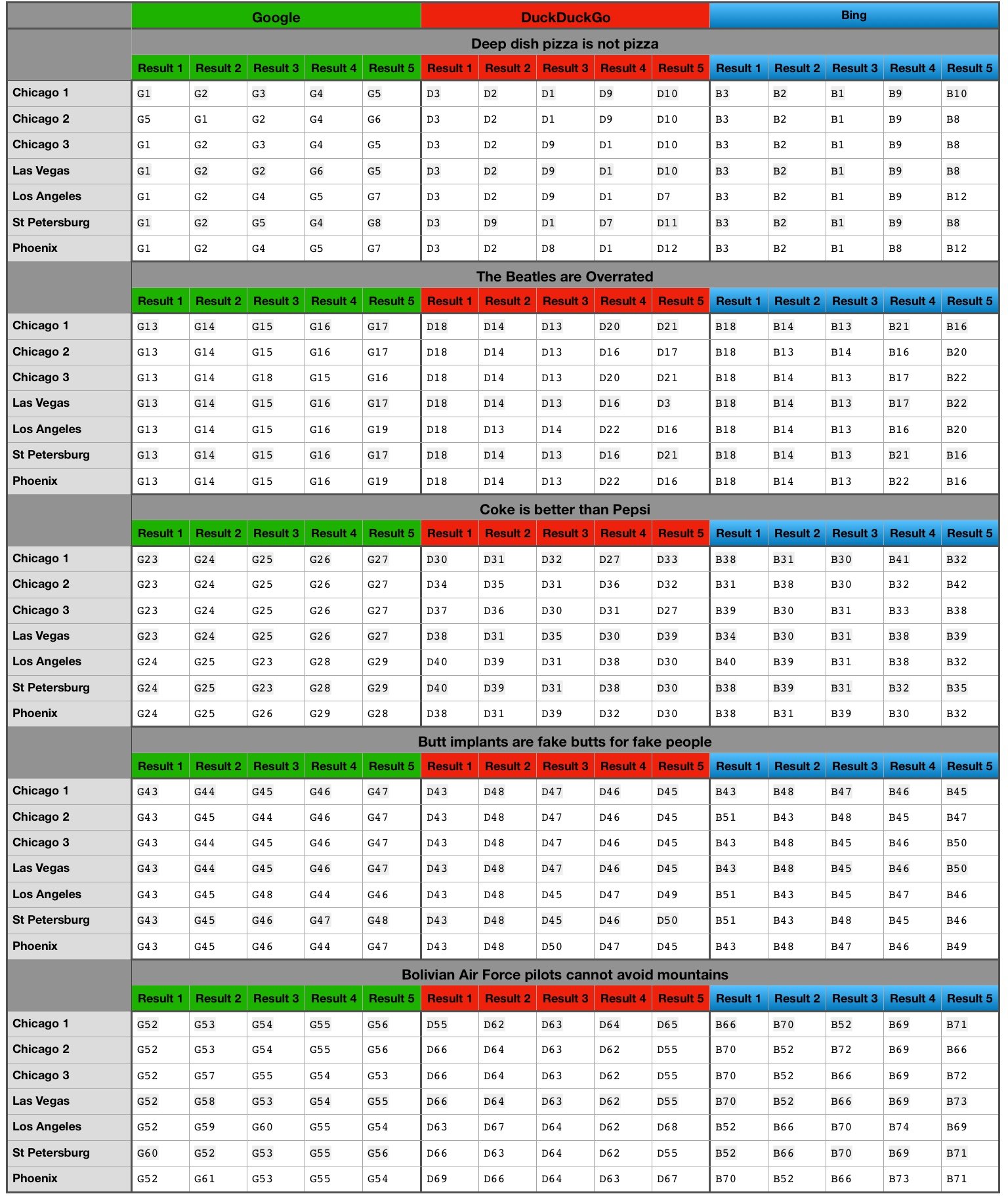
    Each volunteer was provided with a Microsoft Excel spreadsheet, and simply asked to copy and paste the top five search results that are not advertisements for each of the above five queries.  All returned their completed spreadsheets by 14 December 2018.

    Individual search results were identified with the first character in the internet search provider’s name (i.e. G is for Google), and by a numeral.  The numeral is intended to correspond to an individual search result, therefore G1, D1, and B1 for example, are the same search result identified on all three internet search engines.  It is in this way, a unique result can be identified should a particular search engine produce a unique result.

    Due to the convenience of the population size, further analysis on how these results are presented in order for each user will also be observed.

    Results

    The following are the results in tabular form:

    Conclusion

    When put in tabluar form, one can see the results for many of the queries are similar.  Where they differ however is the order they are presented.   One issue with the methodology is the limited scope of the results recorded, it is possible the search results are more or less the same when etended to the first page of results and beyond.

    A noticable feature of the results, is the Google results cover a smaller spread. For example, for the first query, Deep Dish Pizza is not Pizza, Google only covers results 1-8 between seven people.  The other two search engines however, cover a spread of 1-12.  More concerning, are the order of results are nearly identical across all users.

    Another thing that can be noticed is in the fourth query, Butt Implants are fake Butts for Fake People.  If one were investegating this subject on Google, he or she would need to wait untiil the third search result (47) to find a search result corresponding with either of the other search engines.  It is obvious this is a meaningless subject, however given the limited attention span of the average American for a subject more meaningful the third result can be significant.  If one wants to question the result—so what if Google appears to have identical results between users on a search related to prothetic devices for the human posterior?  The better question is, what if Google has identical results between users for a subject that actually matters?

    While this on the surface it might appear DuckDuckGo’s claims have some merit; one can see their results cover a wider spread between users and much greater variance in the order presented when compared to Google.  That said, the results are not all that different.  In some cases one can see the same “filter bubble” DuckDuckGo accuses Google of presenting to its customers, within DuckDuckGo’s results.  It would therefore appear the search engines do indeed present an observable pattern in the results.  What that pattern is, if it can be considered a bias, and how it affects the user is not something that can be quantified here.