Category: Regulation

  • Term Limits, Part I

    Freedom's just another word for...?
    Imagine being arrested and thrown in jail merely for expressing an unpopular opinion. Okay, now analyze and explain “hate speech.”

    Campaign Finance Reform – A Primer

    All attempts at Campaign Finance Reform in these United States have failed. ALL. Every single one of them.

    If that sounds like exaggeration, just consider that attempts to limit the influence of money in politics is typically taught in history or civics classes as beginning (in earnest) shortly after the presidency of Andrew Jackson, the pro-slavery founder of the Democratic party whose administration ultimately produced the political “spoils system.” That would put us back to the mid- to late- 1830’s. Good ol’ “Honest Abe” himself was bankrupted trying to personally finance his first Senatorial campaign in 1858, so he had to rely upon businessman from Philadelphia and New York to finance his Presidential campaign in 1860. According to some historians, however, money was in politics from the beginning of the Republic.

    In the United States, concerns over financing campaigns for public office have been around since before the writing of the Constitution. Candidates traded influence, power, and gifts, for constituents’ money and votes even before the dawn of the Republic. George Washington – later President, but at the time, a candidate for the Virginia House of Burgesses – bestowed upon the 391 voters in his district the “customary means” of winning votes: “28 gallons of rum, 50 gallons of rum punch, 34 gallons of wine, 46 gallons of beer, and 2 gallons of cider royal.” James Madison lost his reelection campaign to the Virginia legislature 20 years later because he refused to provide voters with the customary whiskey.

    Gardner and Charles, “Election Law in the American Political System,” p. 637.

    In 1867, just two years after the Civil War, the first legislative attempt at campaign finance reform appeared in a Naval Appropriations bill. It forbade government officials from soliciting (i.e. “shaking down”) Navy Yard workers for money to finance the ruling party’s election campaigns. This had become a routine practice in prior years. So routine was it that federal employees would have some portion of their pay directly “assessed” by the government to the Party’s re-election fund. The protections of the 1867 Navy yard workers were eventually extended to all civil service workers… (But not the rest of us, evidently.) The Presidential campaign of 1896 was so openly a case of dueling donors obtaining political promises from each Parties’ respectively well-financed candidates – William Jennings Bryan for Team Blue and William McKinley for Team Red – that the public began yelling for campaign finance reform… and here we are 120 years later. This brief timeline of attempts at reform shows just how fruitless they all have been.

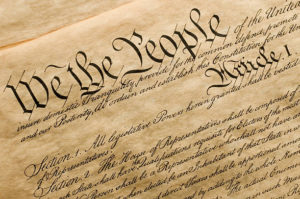
    Modern, seemingly sophisticated attempts at campaign finance reform, by people from both political parties in Congress, have ultimately been set aside by Supreme Court decisions. While it may be unpalatable or politically inexpedient to say this, the Supreme Court’s rulings in these cases are very solid reads of the First Amendment… proving yet again the old adage that “sometimes even a blind squirrel finds a nut” or  that “even a broken clock is right twice a day.” Lawsuits by public interest groups have ultimately failed to produce anything even close to a good result. Now the public feels so desperate for something to happen that they’ll embrace even nonsensical calls for reform by (of all people!!) Hilary Clinton. The much-ballyhooed, and almost totally misunderstood, case of Citizens United, 558 U.S. 310 (210) was about a non-profit movie company that made a film about then Senator Clinton. The Federal Election Commission agreed that the movie would be subject to a federal campaign finance law that would have imposed criminal and civil penalties on the movie company. That is to say, the law as it was made it a crime for a collection of people – using a corporate form – from expressing their political opinions, quintessential First Amendment conduct. Hard to imagine that the words “Congress shall make NO LAW” are ambiguous, but here we are, with a mountain of laws collectively regarding each and every one of the subjects specifically listed as exempt from regulation in the First Amendment.

    Either We Are a Republic With a Charter To Be Faithfully Followed, or We Are Not.

    Understanding How the (Legislative) Sausage Gets Made

    To understand why campaign finance reform doesn’t work – and what simple fix would work – you have to understand some basic economics around how the political sausage gets made, so to speak.

    First, you must know what politicians all know: there has only been one time in the last 42 years that the rate of re-election for Congressional incumbents dipped below 90% – that was 1974, when it was only 89.7%, a rounding of tenths away from being 90%. Muse on that for minute – Congress has had historically bad approval ratings – like below 20%, for decades, by any polling company. Everyone thinks Congress sucks; yet Congressional incumbents get re-elected over 90% of the time. It’s a near-certainty. Many people have speculated or offered reasoned opinions about this phenomenon, but I don’t really care about the “why” because the mere statistical truth of it is all that matters for my argument.

    Second, we must make the rather short “hop” of faith and assume that politicians are at least as self-interested as the rest of us… one might humbly suggest that they are (perhaps) even a bit more self-interested than the rest of us, or make the claim that the job attracts the type, but I don’t need to prove that as crucial to my theory. Suffice it that my claim rests on what I believe to be a rather well-observed phenomenon about the self-interest of politicians. Lord Acton wrote an entire tract explaining this, but unfortunately no one reads it and all that we remember (if at all) is this quote: “Power corrupts, and absolute power corrupts absolutely.” My own observation from many years of government service and being an American is simply that the government does not choose its prospective employees from some magical pool of magnanimous, morally benevolent, and personally-disinterested human beings. If you think I am incorrect, you’ve obviously never been to the Department of Motor Vehicles to register your car, or change the title, or correct a typo on a Vehicle Identification Number (VIN). Try to manage that over your lunch break and let me know how it goes; and ask yourself about how good the customer service is while you’re there.

    The Currency of the Politician is Law – Legislation For Some and Against Others

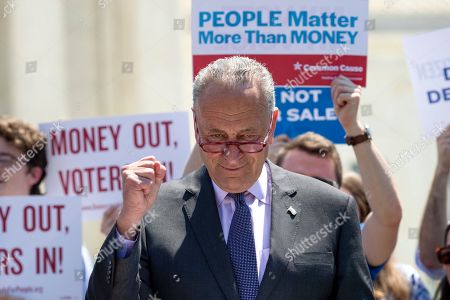
    He's Lying!
    Rep. Chuck Schumer (D, NY) explains how he can’t read, doesn’t understand, and doesn’t care about the 1st Amendment.

    To the above facts we have to add some economics. In my opinion, the best way to begin to understand this is to ask a very simple question: if you were a legislator looking to raise some cash, what would you have to sell? (Think about it seriously for a moment).

    ANS: Legislation. i.e. Laws.

    Legislation is the only thing that a lawmaker can offer any prospective “buyer.” It is the medium of exchange (i.e. the currency) of the political class and a specific instance of the more general “Law of the Instrument.”* In return for a piece of favorable legislation, or a clause in the next omnibus bill – or exemption from cuts or regulation – political donors deposit sums into re-elections campaigns, or exchange different favors with lobbyists – the “middlemen” of the entire Money-for-Favor-for-Reelection Triangle.

    If this seems unduly cynical, it shouldn’t be. If you have a friend who is a cop, who hasn’t heard of, or considered, asking him or her to “look into” a ticket…? Now magnify that onto a scale where instead of your hundred-fifty bucks plus court costs being at stake, it’s someone else’s multi-million dollar, multinational business and a piece of legislation that would ensure government contracts flowing that direction for the next 10 years. Or a promise to keep government regulators out of your business for at least your friendly Senator’s next 6 years of office. If all of this seems speculative or just too much to swallow at once, consider this quote right from the horse’s mouth, as it were:

    You send us to Congress; we pass laws under which you make money…and out of your profits, you further contribute to our campaign funds to send us back again to pass more laws to enable you to make more money.

    — Senator Boies Penrose, (R, PA) 1896 (quoted in Id., Gardner and Charles, p. 638.)

    I always hear people complain about the influence of “corporate money” in politics and yet no one ever seems to consider that if their Senator wasn’t offering legislation for sale, the corporation wouldn’t be able to make a purchase. And it is in no way solely corporations buying-off politicians. Unions are at least as powerful and well-off as any corporation and billionaires with agendas sit on both the left and the right of the political spectrum. In fact, if we’re dealing in generalities, it is worth wondering: if corporations are filled with greedy, capital-obsessed Scrooges, why would any of those money-grubbers ever voluntarily give their money to a politician in the first place? To ask the question is to destroy the premise.

    When you’re starting a company in your garage you don’t start by setting aside your political lobbying budget, then make whatever widget, software, computer, or other item that is the money-making aspect of your new venture. You first have to make something that a large enough number of people are willing to voluntarily pay you such that you have a growing enterprise, be it a successful song, an iPhone, the personal computer, or a rubber tire. Legislators don’t enter your mind until well down the road in the business cycle. Thus, perhaps it is enough to agree that legislators aren’t the unfortunate victims of a “system” that is foisted upon them. What Senators and Congressman do to fill the coffers of their re-elections campaigns is a perfectly natural, foreseeable byproduct of the funding of the political system.

    Part Two explains how it works in greater detail.

  • Chapter 15 – The Stay

    “Well, if they’re going to issue the stay at all, now would be a good time! I mean, if no stay today, by tomorrow night my guy is eating with the big metal spoon, if you know what I mean.” I’m on the phone to appellate defense in Washington, D.C. I look at my watch. The digital face reads 00:31. Ten-thirty in the morning east coast time.

    “Alright, bye.” I hang up. I’m looking at documents, but I’m not really seeing anything – David Ponder’s record book, letter from his wife, character statements, and I’m trying to imagine how I’m going to defend him tomorrow. I’ve got one last motion that I’ll bring at the close of the government’s case. One last grasp that has a sound basis in law, but the judge will deny it, at this point. It’s a technicality.

    From the beginning I’ve had the sense that they have mischarged the offense, perhaps intentionally. The prosecution has charged it as willful disobedience of a superior commissioned officer. Under the UCMJ, that has a stiffer penalty than the more general charge of violating a lawful general order, such as the order from the Secretary of Defense, to take the anthrax shot. The government has charged it as violating the specific Navy Lieutenant’s order, but there is an old case that stands for the proposition that merely repeating a higher order can not make an orders violation the more egregious willful disobedience of a superior commissioned officer. It is called the “ultimate offense doctrine,” but it probably isn’t going to work. Nothing else has.

    I’m tired. I haven’t slept much, I need a shave, and my back is killing me from my tiny desk chair at home and my broken desk chair at work. I need to get David’s sentencing case together, review my opening statement and closing argument, and make sure all of the documents are in my case file, with necessary copies for each of the jurors…

    My head nods and I realize I’ve drifted off at my desk. I look at my watch and see it’s 2:33 am. I rub my face and decide to take a walk.

    The building is dark and empty, except for me and the feisty Okinawan cockroaches. I stroll the dark corridors, my sneakers making a light tread on the tile. I stretch my arms over my head as I walk to the entrance. Out the window, the open field beside our building is dark. I can barely see the slope that I know rises up to a road that runs next to the next set of office buildings and the barracks.

    I hear the phone in the clerk’s office ring, but there’s nothing particularly unusual about that at this hour because of the time difference; people frequently fax documents from the States during our nighttime in Okinawa. The fax ticks away, a counterpoint to the flying bugs banging into the glass on the door and the light just outside of it. Tick-tick-tick. In seven hours, David Ponder is going to be facing a jury, and likely going to jail. Unless that fax. . .

    I walk hurriedly to the defense clerk’s office and go to the fax machine behind the clerk’s desk. Letter-sized sheets are spitting out, face down. I grab one and flip it over to see if it has anything to do with me. The cover sheet is from the Washington Navy Yard. I grab the whole stack while more keep sliding out.

    My eyes flick over the words.

    “YEAHHHHHHHHHHH!!!!!” I let out a guttural yell that echoes throughout the empty building. “Can you feel that, huh!?! Baby, can ya’!?” My best Ace Ventura, hips thrusting, fist pumping. I want to cry with relief. We beat the clock by seven hours. I’ve kept my promise to David and his wife, to Jason Stonewall, and Vittolino Arroyo. We have a stay from the Navy Marine Corps Court of Criminal Appeals. No one’s going to jail tomorrow.


    I take my time packing up and make a few copies of the stay. Before I leave, somewhere near 3 am, I take a ten-penny nail and hammer the stay to the prosecution’s office door. I don’t do it right through the middle, however, because I’m still a Marine Officer and someone might bitch to the CO about a nail in the door. I hammer the nail just deep enough to look like someone was careless; but not all the way through the door, for example. I also place the nail an inch or two above the middle of the sheet, close enough to the top of the sheet that it doesn’t look like it was intentionally in the middle, but far enough down that someone will have to either rip the paper in half to get it off or pry out the nail. It’s an asshole move, to be certain, but I know it might be all the satisfaction I’m going to get in the long run, so I indulge myself. It’s the little “fuck yous” that matter in life. It won’t be the last laugh, but it’s enough to make me smile as I walk to my car for the drive back to Kadena Air Base officer housing and my wife and four daughters.

  • Chapter 14 – Secretary Cohen’s “Four Points”

    In December of 1997, the anthrax vaccine manufacturer was shut down and could not manufacture anything related to the AVA. Notwithstanding that hurdle, Secretary of Defense William Cohen announced that before the mandatory program would begin, it would have to meet four prerequisites:

    1. Supplemental testing, consistent with Food and Drug Administration standards, to assure sterility, safety, potency and purity of the vaccine;
    2. Implementation of a system for fully tracking personnel who receive the anthrax vaccinations;
    3. Approval of appropriate operational plans to administer the immunizations and communications plans to inform military personnel of the overall program;
    4. Review of health and medical issues of the program by an independent expert.

    (My emphasis added). One cannot help but wonder why condition number one would need to be in place if the DoD was confident in the safety and potency of the AVA, as it had started saying publicly. In fact, this appears to have been nothing more than a media campaign to assuage fears because none of these four “prerequisites” were ever met before the program kicked off, which is exactly why the manufacturer had been shut down in the first instance. Each of these factors revealed fundamental flaws with the program from its inception.

    With regard to point 1, “supplemental testing” may well have been the worst idea for the DoD could have ever come up with because what it demonstrated, unequivocally, was failure of lot, after lot, after lot of the vaccine.[1] One of the first findings in CBER’s February 1998 inspection was that “there is no validation of the length of time sublots are held until they are used in a lot. Sublots have been held longer than three years prior to use. There is no stability data to support this hold time.”[i] Lest this seem picayune, consider a little more history of one particular Sublot:

    Sublot AV456 was produced . . . in 5/95 [and stored] until 3/97 at which time it was transported to the formulation room . . . with other sublots to make FAV039. Here it was discovered that AV456 was contaminated with mold, and it was destroyed.[ii]

    While some may say that the fact that it was caught is good news, it ignores the other, older sublots where mold or other impurities were not caught. One finding (among many like this) is particularly noteworthy:

    Lot FAV023 was filled on 12/13/93 and passed a potency test on 3/29/94. It was submitted for redating on 4/2/97 and was placed in the stability program (zero time) at the same time. It is reported as failing potency on 4/2/97. It was tested again on 8/12/97 and is reported as failing potency. A fourth potency test conducted on 10/6/97 is listed as passing by 0.01. There is no investigation into the original result and justifying the additional testing.[iii]

    This finding is most disturbing because it indicates a testing regime that ignores negative test results – twice! – and somehow chooses to validate a subsequent positive after two negatives. How can one know which test result is correct with two failing and two passing results? And how many people would like to line up, roll up their sleeve, and take their shots from that particular vial of the vaccine? Stability testing of biological products is crucial because of the possibility for these products to break down over time. Note that this lot was “filled” in 1993. Four years later it passes a test by .01 after having failed twice previously. This particular finding is in no way isolated: Lots FAV 010, 011, 018, 021, 022, 025, 028, 040, 041, 042, 043, and 044 all had at least one failed potency test that was not investigated and then a passing result was somehow chosen over the negative one.

    FAV016 has its own uniquely disturbing history.

    Lot FAV016 had 6579 vials rejected due to particulates during post-filling inspection. These particulates were not identified, nor was an investigation conducted. The batch was released.

    Someone, somewhere, had unidentified “particulates” injected into them. As a practical aside, one has to wonder how those individuals will get VA compensation if they have an illness as a result of this contaminated product being injected into them in light of the DoD’s positions that there had only been 74 adverse events from the vaccine.

    The list of violations goes on and on and includes several different lots being tested and found with such contaminants as “penicillum species” – a danger to anyone allergic to penicillin; cladosporium – a fungus that can cause infections leading to “rough skin, black lesions on the hands, and sometimes a brain abscess”; altenaria – a fungus that can cause dermatitis in humans; micrococcus – a contaminant that is relatively harmless to humans; staphylococcus saprophyticus – a significant cause of urinary tract infections; staphylococcus epidermis – a significant cause of opportunistic infections, usually for those with some skin puncturing, such as needle/IV intrusions, medical appliances, or surgery; and staphylococcus capitis – another infection causing bacteria.

    Despite all of these findings and more in February of 1998, the program was launched on May 15, 1998, with Secretary Cohen claiming, with a straight face, that “all conditions for implementing the anthrax vaccination program for the total force have now been met.”[iv] There is simply no possible way Secretary Cohen could have said that in good conscience if he was aware of the inspection results in February. And given everything going on around the program, it is impossible to imagine that he didn’t know – because he manufacturer “voluntarily” shut down for “renovations” in January 1998. In reality it shut down as a result of the Notice of Intent to Revoke letter by the FDA, otherwise the February inspection results would have resulted in the facility’s license revocation.

    The second condition of the program was tracking of immunizations. Two DoD briefers talked extensively on November 6th, 1997, about a new program that would be used to track immunizations and of the terrific job the new system had done in Bosnia.[v] At a March 1998 Senate Armed Services Committee hearing, however, Dr. Randolph Wykoff, the Associate Commissioner for operations at the FDA, and Mark Gebicke of the GAO, pointed out that the Bosnia experience left a lot to be desired, particularly of the tracking of immunizations under an IND protocol for an investigational encephalitis vaccine.[vi] In fact, one report used the word “abysmal” to describe it.[vii] Once again, the Assistant Secretary of Defense for Health Affairs promised to get better, but also talked about a new procedure for getting relief from the FDA from the requirements of an IND.  The FDA associate director maintained that the “FDA firmly believes the IND process, as defined in our rules and regulations, is sufficiently flexible [for DoD’s needs]. Additionally, FDA is convinced the Department of Defense has the scientific, clinical, and logistic capability necessary to comply with the requirements of the IND process.”[viii] Evidently, however, they could not and did not do it in Bosnia. A GAO report issued the same day stressed the importance of being able to track vaccine immunizations in order to ensure “that (1) sufficient supplies of vaccines will be available at the various worldwide immunization sites; (2) vaccines that are older than their 1-year shelf life are destroyed; and (3) records of vaccines received, administered, and destroyed are kept to allow for monitoring and tracking.”[ix] Worse yet, the GAO found that during the “Bosnia deployment in 1997 . . . DOD could not account for more than 3,000 (20 percent) of the total number of doses sent to Bosnia.”[x]

    Requirement number three was that there would be approved operational plans to communicate to service members about the anthrax vaccine program. Whatever the operational plans were, in May 1999, the Department of the Air Force circulated a memo to its judge advocates, specifically defense counsel, telling them that “a small number of military members have refused to follow their commander’s direct order to take the [anthrax] vaccine” and that the cause of their fear in taking the shot is “misinformation obtained from web sites set up by special interest groups[.]”[xi] This was a frequent refrain of the DoD, in front of Congress and in the press. The memo also points members to the DoD’s own website, which was established after the program had begun, in order to “counter” in DoD parlance “internet misinformation.” Evidently then, in March of 1998, when the program was about to begin, prong number three hadn’t been met, either.

    It is worth noting that the Army’s AVIP Agency existed solely for the promotion of the anthrax vaccine. It was budgeted at $74 million over a six-year period (FY99-FY05).[xii] No other military medicine program has ever needed to be forced on servicemembers with an orchestrated campaign of this type. William Arkin, a defense writer and former Army intelligence officer observed that “. . . this is the Pentagon versus its own service members. It is a depressing window into the breakdown of discipline and basic confidence in the political and military leadership. That has nothing to do with the Web.”[xiii]

    Criterion number four probably cost the DoD as much credibility (if one can say it had any to begin with) as number one. It would be comical were it not for the stakes involved. Secretary of Defense Cohen announced that there would be a “review of the health and medical aspects of the program by an independent expert.”[xiv]

    Doctor Gerard N. Burrow was the doctor who allegedly reviewed the program at the request of Deputy Secretary of Defense Rudy DeLeon. Dr. Burrow concluded that “[t]he anthrax vaccine appears to be safe and offers the best available protection against wild-type anthrax as a biological warfare agent.”[xv] Unfortunately, Dr. Burrow is a professor of gynecology at Yale University School of Medicine, a specialty that one would not normally associate with some expertise in weaponized anthrax toxins. When that unfortunate snippet from his CV leaked out, Dr. Burrow was subsequently asked by Congress to testify about his review at a 29 Apr 1999 hearing. He declined to appear. Instead, in a 26 Apr 1999 letter to Representative Christopher Shays (R-CT), Burrow stated that

    “[t]he Defense Department was looking for some [sic] to review the program in general and make suggestions, and I accepted out of patriotism. I was very clear that I had no expertise in Anthrax and they were very clear they were looking for a general oversight of the vaccination program.”[xvi]

    The DoD’s claims of misinformation on the internet had a particularly hollow ring in light of its blatant lack of honesty and candor in having something as simple as an independent review conducted. Nothing was ever done about this lie that was foisted off on American servicemembers. No one has ever been taken to task for this laughably blatant fraud perpetrated on U.S. military members and the broader American public.

    Thus, in the end, the DoD’s four-point plan to reassure the public and servicemembers of the safety of the anthrax program – as a prerequisite to beginning inoculation – was nothing more than a PR campaign that ultimately cost the DoD credibility that it did not have to spare. As the truth came out, and was certainly made available on the internet and elsewhere, the DoD’s cries of “misinformation” went unheeded. Service members on active duty and in the reserves began to refuse or leave the service rather than take the anthrax shot.

    If the DoD’s actions appear incredible, the FDA’s inaction is equally baffling.  The FDA is charged, under the Administrative Procedures Act, with the duty and authority to regulate, among many other things, the safety of drugs and biologic products. The FDA has had no hesitation in cracking down on manufacturers who do not comply with its regulations or decisions. The cases in the D.C circuit are legion with the FDA disciplining manufacturers who try to market a drug for a purpose not clearly delineated on the approved labeling or who otherwise fail to comply with IND protocols.[xvii] For some reason, however, in the case of the AVA, the FDA had an absolutely incestuous relationship with the DoD, a third-party who was NOT even the manufacturer! Letters were exchanged between the two agencies regarding non-compliance with IND protocols after the IND protocol was not properly administered in Bosnia. At the March 17, 1998, hearing, the following colloquy took place on this issue between Senator Rockefeller and Dr. Wykoff, the FDA’s associate director for operations.

    Rockefeller:  . . . It’s also not clear to me that FDA’s shoes are entirely clear or clean on this matter. In fact, some would say lax.  I think that FDA and DoD have been exchanging letters about all of this for some months now. And the fact is that seven years after the Gulf War, the situation is still not resolved. If DoD does not adequately answer FDA’s questions with respect to these matters and others, what is FDA going to do about it?  . . . And why, for example, was it necessary for the Presidential Advisory Commission to address the waived informed consent matter six years after the end of the war? So I put to you what FDA would recommend and would do if DoD does not come in compliance more?

    Wykoff:  . . . We have tried very hard to make sure that they are absolutely clear what our rules and regulations are and what our expectations are. We believe that they understand that. We believe that they have the capability of complying with all of our IND rules and regulations. As to whether they will comply in the next deployment situation, obviously we can’t predict that.

    Rockefeller: And if they don’t, is there anything that you can do about it?

    Wykoff: Yes, sir. Obviously, there are a range of options that we have. We would have to determine what the specific concerns are. That drives what are specific actions would be.

    Rockefeller: What are some of the options?

    Wykoff: Well, as we interact with any trial sponsor, we learn more about their ability to conduct IND trials, we would be more or less willing to grant waivers or exemptions to particular requirements.  We could hold them to more – all of the requirements as outlined in the rules and regulations – based on their performance.[xviii]

    It boggles the mind to think that the first words out of the FDA’s mouth are talk of waivers for non-compliance with regulations, particularly in light of DoD’s history in this area. There was, and is, a clearly documented squeamishness on the part of the FDA to step in and bring the DoD into compliance. In downright shocking testimony before a House Committee, Dr. Kathryn Zoon of CBER was questioned by Rep. Christopher Shays (R-CT) about the FDA’s regulatory responsibility.

    ZOON: This is a licensed vaccine. If a physician uses it or DoD uses it, that does not really fall under our jurisdiction.

    SHAYS: So it’s your statement before us now that if DoD doesn’t abide by the protocol, you have no responsibility? That you have set out a requirement? Who is responsible then? Who’s going to make sure that DoD abides by the protocol, if you don’t do it?

    ZOON: We don’t have the authority.

    SHAYS: I can’t believe – I just want to say, Dr. Zoon, I cannot believe that you have just said under oath that you do not have the responsibility to deal with this issue or the authority. You said you don’t have the authority.

    ZOON: I said – yes, that’s correct.

    SHAYS: That is your testimony.

    ZOON: We don’t have the authority.

    SHAYS: Well then who is going to protect our men and women if you aren’t going to do it? Who? Who has the authority?

    The tricky part of this testimony is that it is partly correct. The FDA does not regulate end-users of a product, normally. That is, they do not tell an individual doctor, for example, that he cannot use a drug off-label. Two important caveats to that “normal” example, however. First, the normal patient can’t and isn’t being compelled by their doctor to take anything; they can decline, and they can also sue if something happens as a result of the doctor’s malpractice. A military member has neither of those options. Second, and more directly on point, if the end-user is participating in a clinical protocol, then the FDA does regulate that user. Thus, the DoD’s participation in BioPort’s IND application in order to get an indication against aerosolized anthrax should make them subject to FDA regulation, just as the DoD was during the Gulf War when applying for a Rule 23(d) waiver. FDA’s willingness to accede to DoD’s interpretation essentially allowed the DoD to completely slide on their responsibilities. Some lawyer’s or regulator’s intentional misinterpretation of the FDA’s own regulations resulted in an open abdication of the FDA’s regulatory role over the AVA.

    FDA officials have repeatedly acceded to DoD doctors’ interpretations of the anthrax vaccine label, as well. This is an absurdity, particularly appalling in light of the DoD’s involvement in the manufacturing process. The DoD fundamentally became a manufacturer, for all intents and purposes, and the FDA looked the other way, hiding behind the fiction that the DoD was an “end-user” when convenient. The DoD was involved from the very beginning in the development of the anthrax vaccine. Additionally, when problems arose with the manufacturer, the DoD sent in its own ‘inspection’ teams to ensure the supply of the vaccine. The DoD had paramount liens on every piece of equipment that the manufacturer has. A GAO report in June 1999 found that

    DOD has made a significant investment in renovating BioPort’s biologic facility to meet the military’s requirements for anthrax vaccine . . . Since 1988, DOD has provided about $112 million in contracts, including options, to help ensure the viability of the anthrax vaccine biologic facility. As shown in figure 1, DoD’s contracts provided monies to (1) produce the vaccine, (2) renovate and expand the production facility, (3) provide various support services, and (4) purchase equipment to enhance production capacity. DoD has also provided contract terms and conditions to help ensure the success of the anthrax vaccine program. For example, under Public Law 85-804, which allows for government indemnification of contractors for unusually hazardous risks, DoD indemnified BioPort against product liability. In addition, DoD agreed to allow the company to sell up to 200,000 doses of anthrax vaccine to others, using government-furnished equipment rent-free, after DoD’s requirements are met.[xix]

    Amazingly, this is chump change compared to what the Defense Contract Auditing Agency found in 2000! That report led to an Inspector General Investigation. Notwithstanding numerous audits that found that the company was not financially viable, BioPort requested contract amendments that included $1.28 million in bonuses for senior management that amounted to 109% of the managers’ base salary. This was deemed an “unreasonable expenditure” by the DCAA in light of “BioPort’s current financial condition.”[xx] Okay, so someone disapproved, right? Well, sort of, because the manufacturer had almost no real financial incentive to produce an FDA approved vaccine under its contracts with DoD to begin with: the contract paid the manufacturer 90% of the contract price before the FDA ever inspected the vaccine. Yes, read that again.

    Put another way, BioPort only got paid 10% more for the product being approved by the FDA. At one point, the Department of Justice was looking into criminal charges as some $6 to $8 Million of the money provided to the manufacturer was unaccounted for.  Additionally, the fact the former Chairman of the Joint Chiefs of Staff Admiral William Crowe was a co-owner of the facility, as well as Dr. Robert Myers, (formerly of MDPH and MBPI) can hardly escape attention. Crowe was the first senior military officer to have come out publicly in support of then-Democratic party candidate for the Presidency, Arkansas governor Bill Clinton. While both Crowe and Myers disavowed any “inside” preferential treatment from the DoD, one must wonder if the decision to award BioPort the contract had anything to do with either’s presence as an owner. Finally, emails from inside the DoD suggest that the agency actually had its own people “on site.” During hearings held by Representative Christopher Shays in May 1999, an email was sent from Brigadier General Eddie Cain, the Director of the Joint Program Office for Biological Defense, to an Army Colonel John V. Wade. In the email Cain warned that “[I]f you think Congressman Shays was critical of the current relationship between FDA & DOD, wait until he finds out that DOD is calling the shots on-sight.” [sic][xxi] When this email surfaced during the court-martial of Air Force Captain (and medical Doctor) John Buck, the FDA had “no comment.”

    The FDA has, for whatever reasons, backed down from the DoD to the point that after the warning letters, the notice of intent to revoke, and a failed inspection thereafter, the agency still withheld pulling the manufacturer’s license because the DoD interceded on behalf of the company. In a June 25, 2000, interview with the Vancouver newspaper The Province, Mark Elengold, the Deputy Director for CBER, explained what happened.

    The FDA held off pulling the licence, in part because it would have left the U.S. Department of Defence [sic] – which had just announced that all soldiers were to receive anthrax vaccine – with no domestic source.

    “This is a one-source product so we tend to try to work with firms and put additional monitoring steps in to avoid revoking the licence,” said Elengold.  The prestigious British medical journal Lancet reported at the time that ‘a plea from the Pentagon has prevented an ‘eleventh-hour’ closure of the only U.S. producer of anthrax vaccine,” according to an e-mail to DND [DOD?] medical headquarters in February 1998.

    Elengold confirmed the Pentagon sat in on a crucial call to the company in which he discussed revoking the licence.”[xxii]

    Electronic mails surfaced in and around 2000 show not only did the DoD convince the FDA not to revoke the license, but DoD also attempted to bully both the manufacturer and the Government Accounting Office at the same time. In one e-mail, a Pentagon official discusses how other agency supervisors were urging the U.S. Food and Drug Administration and the manufacturer of the vaccine to release lots that had been held up for scrutiny by them (the FDA). This despite Secretary Cohen’s public insistence on supplemental testing to ensure safety of the vaccine, one should remember.

    On Feb. 22. 1999, Dr. Michael Gilbreath, a civilian Pentagon biological defense employee sent an email to U.S. Army Brig. Gen. Eddie Cain, then Director of the Joint Program Office of Biological Defense (JPOBD). Gilbreath wrote that he had “received information this morning from BioPort that individuals within the DOD contacted them and threatened that DOD would circumvent BioPort and contact the FDA regarding availability of anthrax vaccine lots currently under review at the FDA . . . Any such actions by DOD would be inappropriate.”[xxiii]

    E-mails also reveal that the Pentagon was having trouble countering the U.S. General Accounting Office’s assertion that the vaccine is improperly licensed, and that it has not been proven safe and effective. Cain indicated in one e-mail that then Secretary of Defense William Cohen would be writing to the GAO, whose findings have consistently gone against the Pentagon, to protest “the expertise put on this (vaccine) project” by the watchdog agency.

    “If we cannot answer these questions, we (DOD and the Administration) are in big time trouble,” Cain said in the May 3 e-mail. “…We are digging ourselves a hole that will be too difficult to crawl out of.”[xxiv]

    The FDA also stood by when adulterated vaccine was shipped to the Canadian military and when 59 Marines were given shots from expired lots of the vaccine.[xxv] The FDA’s complicity with the DoD’s actions has left service members with no recourse but to either take the shot, be court-martialed for refusing, or leave the service somehow if their commitment allows it. If the service member simply will not take the chance on the vaccine’s safety, the penalty for refusing is court-martial with a certain conviction. Military Judges simply would not hear that the vaccine is investigational, nor would they even allow service members to present that information to a jury. The FDA’s refusal to act leaves the judge with an out: if the FDA thought it was investigational, why wouldn’t they just issue an opinion to that effect? Worse yet, some military judges would not wade through the necessary materials in order to understand the FDA regulatory process and what an IND is, or they would find that the Secretary of Defense’s actions were in legal parlance “non-justiciable” disputes between “co-equal branches of government.”

    The member who fights will be convicted and punished. When an Air Force Doctor, John Buck, tried to submit evidence that the specific lot that he was to have received, FAV044, was subject to a recall because it was expired, the judge did not allow the evidence to come into court. The only option left for service members was to resign quietly, leave at the end of a service obligation, or fight behind the scenes to ensure that the law is followed. That is what a group of persistent officers had been doing from the word go.

    Endnotes

    [1] It would take up too much space to detail all of the failed lots, for their various reasons during the February 20, 1998, CBER inspection on the lots of AVA. Some of the more egregious violations are listed. See CBER Inspection report dtd 2/20/98 for a complete listing.

    [i] FDA Form 483 Inspectional Observations Feb. 4-20, 1998.

    [ii] Id.

    [iii] Id.

    [iv] May 15, 1998, SecDef memo.

    [v] Nov 6, 1997, background briefing

    [vi] Mar 17, 1998 Senate Hearing, Committee on Veterans Affairs Holds Hearing on the Nomination of Togo West as Secretary of Veterans Affairs and on U.S. Biologic Vaccines for Gulf War Veterans.

    [vii] “Abysmal” tracking job quote ????

    [viii] Id.

    [ix] GAO Report T–NSIAD-98-83 p.8 (March 17, 1998).

    [x] Id.

    [xi] 18 May 99 AF memo

    [xii] Charles Cragin, PDASD Reserve Affairs, testimony, 3 Oct 2000.  See: http://www.house.gov/reform/hearings/healthcare/00.10.03/cragin.htm

    [xiii] William Arkin, “Bugged by the Net”, Washington Post online, 27 Sep 1999.  See: http://www.washingtonpost.com/wp-srv/national/dotmil/arkin092799.htm

    [xiv] AVIP Impl ltr 18 May 98

    [xv]  See: http://www.defenselink.mil/other_info/burrows.html

    [xvi] Id.

    [xvii]

    [xviii] Mar 17, 1998 Senate Hearing, Committee on Veterans Affairs Holds Hearing on the Nomination of Togo West as Secretary of Veterans Affairs and on U.S. Biologic Vaccines for Gulf War Veterans.

    [xix] GAO Report GAO T-NSIAD-99-214,  (June 30, 1999)

    [xx] IG Report dtd March 22, 2000.

    [xxi] Dave Eberhart, Stars and Stripes.  May, 2001.

    [xxii] Ann Rees, “Their Dangerous Dose”, The Province [Vancouver, Canada], 25 Jun 2000

    [xxiii] E-mails Suggest Pentagon Pressured FDA On Anthrax Vaccine, Thomas D. Williams, Hartford Courant, May 17, 2001.

    [xxiv] Id.

    [xxv] See Most Dangerous Dose (Canadian article on vaccine) and GAO report on Marines T-NSIAD-00-36.

  • Chapter 12: The DoD “Evolves” on the Anthrax Vaccine

    Mary PENDERGAST (FDA):  As I indicated to you, it was not the type or quantity of information we would have hoped for.

    SHAYS (R-CT): That’s an understatement.

    PENDERGAST: It – it was.  We don’t disagree with you. This was war. This was the first time, and it didn’t work particularly well. We are in full agreement with you on that.

    SHAYS: This isn’t the first time the military has conducted themselves this way. And as long as they know the FDA’s going to be a paper tiger with the military, they will continue to do this. They will continue to basically say, bug off. And . . . as far as I’m concerned, that’s what they’ve said, and that’s what you’ve accepted. . .

    . . . And so we’re going to pursue this with the FDA, because in my judgment, the FDA allowed the military to do what they have to do in time of war, to have gotten a waiver from informed consent. They should have required that the troops technically, not just in spirit, be notified. And they should have made sure that it was being enforced . . . and [it’s] an outrage that it was not kept and data was not kept.

    And the FDA has not, in fact, really overseen this . . . And frankly, if you had said to me, we really blew it, just like the military, I could accept it. But you’re defending it, so now we’re going to pursue it.

    During the hearings on the Nixon impeachment, Senator Howard Baker (R-TN) asked the now famous question: “What did the President know and when did he know it?”[i] This same question is equally applicable to both FDA and DoD officials regarding the anthrax vaccine program. There has been a startling lack of candor and double-speak from both of these government agencies. While some of this could be attributed to normal bureaucrat-ese inside the Beltway, the level to which it has risen with this particular program goes so far beyond the “norm” as to be risible – and imputes far less honorable motives to those involved.

    _______________________________________________________

    In 1985, at the same time that the FDA’s panel was preparing its review on the anthrax vaccine, the Army had conducted its own review and sent out a Request for Proposals (RFP) for a contract to develop a new anthrax vaccine. The purpose of the RFP was to solicit manufacturers for their willingness to enter into a contract to create a new anthrax vaccine and the stated justification for fielding such a vaccine was that “[t]here is an operational requirement to develop a safe and effective product which will protect US troops against exposure from virulent strains of Bacillus anthracis.” This would seem to be a fairly straightforward proposition, but it immediately raises the question: why would the Army need a new vaccine, in light of the existing AVA? The Army RFP explains it quite simply:

    There is no vaccine in current use which will safely and effectively protect military personnel against exposure to this hazardous bacterial agent.[ii]

    In light of later DoD statements already examined and the ongoing program, it seems rather incredible that the Army announced in 1985, when there was only one existing license for anthrax vaccine (as there has been since the AVA was fist developed), that no vaccine in current use was safe or was effective – the two fundamental legal requirements for licensure by the FDA – safety and efficacy.

    The RFP singles out MBPI’s anthrax vaccine, noting that there is “a licensed vaccine against anthrax, which appears to afford some protection from the disease . . . [but]  [t]he vaccine is . . . highly reactogenic, requires multiple boosters to maintain immunity, and may not be protective against all strains of the anthrax bacillus.”[iii] Now, contrast this with statements by Dr. Kathryn Zoon of the Center for Biologics Evaluation and Research (CBER), who claimed in Congressional testimony in 1999 of the same exact vaccine that “to our knowledge . . . the vaccine that we are using protects against all known natural strains of anthrax.”[iv] She is either completely misinformed or lying. Setting that aside for the moment, what is even more troubling – and revealing – about her statement is that Dr. Zoon, a member of the FDA, the agency that is supposed to regulate Biologics, refers to the vaccine as one that “we are using[!]” Dr. Zoon is a senior government official in the Division that is supposed to regulate the safety of vaccines and monitor compliance with Good Manufacturing Practices.

    In this same hearing, Dr. Zoon dismissed the previous Notice of Intent to Revoke (NOIR) letter given to MBPI by her own Agency as if it were a minor matter. When asked directly “what the most serious problems are with the manufacturing of the vaccine and whether the manufacturer is taking steps to remedy those problems” Dr. Zoon replied that “. . . the manufacturer has had a notice of an intent to revoke. There were GMP deficiencies, and the manufacturer is currently engage in remedying those deficiencies.”[v] This is from the head of an agency that has found continuous and repeated cGMP violations, to such an extent that the Agency has called the manufacturing process “not validated,” had issued an NOIR which led to a “voluntary” shutdown of the entire facility just 20 months prior, had found that when the FDA was not notified that “[o]n 6/30/98, the firm installed a new reaction tank mixer on Tank (redacted).” Finally, one month after Dr. Zoon is telling Congress that this vaccine works against all known strains of anthrax, in November, 1999, the FDA inspectors would find again that “[t]he manufacturing process for Anthrax Vaccine Adsorbed is not validated.”[vi]

    In 1989 the DoD actually defended its position that the (then)-current vaccines were not good enough for mass troop inoculation. A DoD letter to Senator John Glenn of the Senate Committee on Government Affairs from Assistant Secretary of Defense Robert Barker proffered that “[c]urrent vaccines, particularly the anthrax vaccine, do not readily lend themselves to use in mass troop immunization for a variety of reasons: the requirement in many cases for multiple immunizations to accomplish protective immunity, a higher than desirable rate of reactogenicity, and, in some cases, lack of strong enough efficacy against infection by the aerosol route of exposure.”[vii] This can be contrasted with Dr. Sue Bailey’s claims on behalf of the DoD in 1999 that “[t]he vaccine . . . is effective and has an incredibly safe record. The evidence of vaccine effectiveness against aerosol exposure to anthrax is very persuasive.”[viii] Dr. Bailey was the Assistant Secretary of Defense for Health Affairs. She also offered that “[w]e have a vaccine that can protect our troops from this deadly weapon. It would be irresponsible for us to deploy our servicemen and women without using this safe and efficacious vaccine.”[ix] Evidently, the same exact vaccine, which in the intervening ten years had failed almost every conceivable FDA inspection for sterility and purity and potency and quality, had managed to transform itself in the eyes of the DoD from being “highly reactogenic” in 1985 and again in 1989 and lacking in “effectiveness against aerosol exposure” to being an essential force protection measure against anthrax. The only comparable transformation for a liquid involves water, wine, and a Jewish carpenter.

    In March of 1990, two Army doctors, Col. Takafuji, of the Army Surgeon General office and Col. Philip K. Russell of Fort Detrick, Maryland, describe the anthrax vaccine as a “limited use vaccine  . . . unlicensed experimental vaccine.”[x] This is interesting because in the same year that two prominent Army doctors were calling the anthrax vaccine “unlicensed” and “experimental”, the DoD was arguing to the FDA that it didn’t need a Rule 50.23(d) waiver for anthrax – or any other drugs, actually, regardless of their status. This medical admission, however, appears to have been an aberration in the DoD’s medical community, or at least in its messaging. The more consistent opinion, from senior Army physicians was actually that the vaccine was unlicensed and potentially hazardous. In 1994, Major General Ronal Blanck, later the Army’s Surgeon General, testified before the Senate Armed Services Committee about the anthrax vaccine as a possible cause of Gulf War Illness.

    Although anthrax vaccine had been considered approved prior to the Persian Gulf War, it was rarely used. Therefore, its safety, particularly when given to thousands of soldiers in conjunction with other vaccines, is not well established. Anthrax vaccine should continue to be considered as a potential cause for undiagnosed illnesses in Persian Gulf military personnel because many of the support troops received anthrax vaccine, and because the DoD believes that the incidence of undiagnosed illnesses in support troops may be higher than that in combat troops.[xi]

    This position was reiterated by Colonel Arthur Friedlander, the Army’s Chief anthrax vaccine researcher, in a chapter in a medical textbook, Plotkin’s Vaccines, stating that the anthrax vaccine was “unsatisfactory for several reasons.”[xii] Among these reasons were the high adverse reactions and the unknown “degree of purity” of the vaccine. The Senate Committee on Veterans’ Affairs, after hearing Major General Blanck’s testimony and many others, found in its 1994 report that “the vaccine’s effectiveness against inhaled anthrax is unknown. Unfortunately, when anthrax is used as a biological weapon, it is likely to be aerosolized and thus inhaled. Therefore, the efficacy of the vaccine against biological warfare is unknown. . . . The vaccine should therefore be considered investigational when used as a protection against biological warfare.[xiii]

    By 1995, the DoD had, it appears, two plans in place to gain licensure for the anthrax vaccine as a pretreatment for a biological warfare attack. The U.S. Army Medical Research Institute of Infectious Diseases (USAMRIID) had “developed a new recombinant protective antigen vaccine against anthrax. This vaccine was successfully tested in experiments using animals but has not been tested on humans.”[xiv] USAMRIID officials stated that the testing on this new vaccine “would take about 3 years, and FDA approval of the manufacturing of the vaccine could take years longer.”[xv] Either this dissuaded the DoD from pursuing this approach or the DoD had a concurrent plan to approach MDPH to see what kind of arrangement could be made with respect to the existing vaccine. In light of the previous DoD articles, responses, letters and statements, it appears that the length of time to bring an updated, recombinant vaccine through the FDA approval process was unacceptable and the project was abandoned.[1] A House Committee attributed the DoD’s abandonment of the new generation vaccine to the time it would take to complete FDA approval, perhaps 6 to 8 years.[xvi] In 1999, the “DOD consider[ed] further development of this [new] vaccine candidate an unfunded requirement.”[xvii] One has to wonder if this new vaccine’s status had anything to do with fear of undermining the new anthrax program that was announced in 1997. The GAO and Congress both criticized the DoD for focusing “almost exclusively on the older, FDA approved vaccine, to the exclusion of development work on newer, recombinant vaccine formulations.”[xviii] Whatever the reasons,[2] in 1995, the DoD shifted its focus from developing a newer, better vaccine to amending the license for the existing vaccine.

    In September 1995, the DoD contracted with Science Applications International Corporation (SAIC) to develop a plan to obtain FDA approval for use of the existing anthrax vaccine as a pretreatment for aerosol exposure to anthrax in a Biological Warfare (BW) environment. SAIC conducted an analysis and presented a plan to the Army that explained that there would be a significant informed consent obstacle to implementing this change in order to meet the regulatory requirements of the FDA and CBER. Dr. Anna Johnson-Winegar (U.S. Army) explained the legal status of the vaccine to Dr. Robert Myers (MDPH) in quite simple terms:

    “This vaccine is not licensed for aerosol exposure expected in a biological warfare environment.”[xix]

    Here is incontrovertible evidence that DoD officials at significant levels were acutely aware of the legal status of the anthrax vaccine at least two years before the anthrax program was commenced. While this is damning, it is only so because of the subsequent DoD actions. At the time, however, it appeared that DoD was preparing to comply with the regulatory requirements for obtaining a change to the existing license in order to get an indication for use against inhalational (aerosol) anthrax exposure expected in the BW environment.

    In October 1995, the Joint Program Office for Biological Defense (JPOBD) held a meeting to develop a plan for obtaining the necessary FDA approval for amending the existing AVA license. The minutes from that meeting indicate that the Army knew it had two big problems in obtaining FDA approval of a new licensed indication for inhalation anthrax. First, the efficacy tests used to license the vaccine were for a different vaccine, the Merck vaccine used by the Brachman study rather than the MDPH vaccine. Second, there was no scientific data (the necessary two “well-controlled human studies”) to support this change by FDA. [xx] A meeting was held on 20 Oct 1995 to discuss the process for modifying the MDPH anthrax vaccine license for several purposes: to indicate a reduced number of injections, to include a different route of administration (intramuscularly as opposed to subcutaneous), and to expand the indication to include protection against aerosol challenge of spores. Col. Arthur Friedlander said that “the original series of 6 doses was established in the 1950’s for an anthrax vaccine similar to but not identical with the MDPH vaccine.”[xxi] The minutes also noted what had been commented on by the 1985 FDA panel review of the AVA: “Studies of vaccine (not MDPH product) effectiveness in humans working in tanneries showed protection against cutaneous disease, but there was insufficient data to demonstrate protection against inhalation disease.”[xxii]

    This meeting also portended the beginning of the public relations campaign for the anthrax vaccine. Prior to that, however, Brigadier General Busby, the Joint Program Manager for Biological Defense, stated that: “the DoD’s position is ‘soldiers are citizens first’ and whatever studies are formulated, they have to be done with this concept in mind. Soldiers have the same Constitutional rights as other citizens.” These comments may have been addressing one of the SAIC briefing slides at that meeting. The slide is entitled “Volunteer Considerations” and is a comparison of two groups for use in any studies to amend the license for the vaccine. It depicts two rows: on one side is “At-Risk Forces” and on the other is “Normal Volunteers.” There are bulleted points on either side, indicating pros and cons of using the two groups. The At-Risk Forces have in their favor, it would appear, that using them would serve “Dual Purpose[s]” – “Immunized (??) force” and “Study needs.”  However, on the down side, At-Risk forces have “Informed consent complications,” which include record keeping and “assignment issues,” probably referring to the frequent rotation of service members. “Normal” volunteers have the problem of availability, but once you have them, there is better “access for study needs and record keeping”. They also come with a “cost” and using them “doesn’t support immediate readiness needs.” Finally, the last point against using soldiers points out the DoD’s concerns with public relations from the beginning: “Soldier ‘guinea pigs’ criticism.”[xxiii] Whether BGen Busby had his mind changed on soldier’s rights by the brief or not, he made an odd pronouncement at a meeting on the license amendment for the vaccine. According to the minutes, he “addressed the need to make the case that anthrax is currently the principal biological warfare threat. By protecting against anthrax and other BW threats, the vaccines serve as a deterrent.”[xxiv] We do not have transcipts of those meetings and we don’t know how exactly he “addressed” this supposed “need,” but it is troubling on many levels because it is a sweeping statement justifying the use of vaccines against an invisible, perhaps even non-existent, threat. A cynical person might reasonably infer that the General is suggesting running a PR campaign on the American people to justify knowingly using an unlicensed vaccine. It is also odd because this is not a meeting of operational planners discussing the terrorist threat to U.S. Forces. These are doctors mostly, discussing how to get a license amendment for the anthrax vaccine and suddenly a one-star starts talking about the need to make a case for the vaccine as a BW deterrent. There is no discussion about the intelligence or evidentiary basis for such a conclusion, nor an explanation as to why military doctors would need to ‘make the case.’ One can imagine the hushed silence or, perhaps worse, the nodding heads, after the General makes that statement. Was this an implication that informed consent was to be side-stepped and patients were to be told that this was a great deterrent to anthrax attack? Was this to begin some media campaign to justify the use of this vaccine off-label?  Whatever it was, the idea of soldiers having the same rights as other citizens did not ultimately win out.

    In accordance with one of the decision tree slides from the 1995 briefing, the U.S. Army was supposed to help MDPH prepare an Investigational New Drug Application in an effort to amend the license for three reasons: (1) a new route of administration, (2) a reduced shot schedule (from 6 to 3), and (3) to obtain an indication against aerosolized anthrax. This IND application was pending with the FDA at the time of all of the courts-martials mentioned in the prior chapters. The importance of this application cannot be overstated. By law, that application becomes effective thirty days after it is submitted for the purposes set forth therein. This means that if someone administers the drug in accordance with the IND submission protocol, by definition and by law it is an investigational use of the drug. That IND was not withdrawn, modified, or otherwise dismissed by the FDA.

    If the above wasn’t enough to demonstrate conclusively the absurdity of the DoD position, consider this: the clinical protocol for this IND was being conducted at Fort Detrick, Maryland, a U.S. Army base; it was being run by DoD doctors and administrators; and the volunteers were U.S. Army soldiers. Amazingly, in the coup de gras, the soldiers in that study were given information about the anthrax vaccine, filled out and signed consent forms, and they were using the exact same vaccine that DoD was concurrently compelling regular troops to take under threat of court martial. The IND application was submitted following an Army, Joint Staff, and OSD staff process in which there was concurrence that it was necessary to obtain FDA approval of a new licensed indication for inhalation anthrax before DoD could start mass anthrax vaccinations.[xxv]

    For whatever reason, this consensus was reversed within a month of William Cohen’s confirmation in January of 1997 as Secretary of Defense. This followed significant DoD pressure on the FDA, much like in 1990 prior to the Gulf War, to get permission to begin use of the anthrax vaccine for inhalation anthrax without obtaining a new licensed indication or completing the scientific investigation proposed by the Army in the IND application.[xxvi] There were phone calls made, including one by Admiral Ed Martin, a U.S. Navy doctor and the Deputy Assistant Secretary of Defense for Health Affairs, looking for a new interpretation of the anthrax vaccine license, one different than the DoD’s long-standing position that the vaccine was not licensed for inhalational anthrax.

    Now (in 1997) the DoD wanted the FDA to say that the anthrax vaccine was licensed for such a use. On March 4, 1997, four days after the retirement of long-time FDA commissioner Dr. David Kessler, the man who had negotiated and required DoD to get a Rule 23(d) waiver on the verge of the Gulf War, Dr. Stephen Joseph, the Assistant Secretary of Defense for Health Affairs, wrote to the acting FDA commissioner and stated that the “DoD has long interpreted the scope of the license to include inhalation exposure, including that which would occur in a biological warfare context.”[xxvii] Given what was already on the record by DoD officials, that statement cannot be spun any other way than as a bald-faced lie. In addition, Dr. Joseph asked “whether FDA has any objection to our interpretation of the scope of the licensure for the anthrax vaccine.” If Joseph’s assertion regarding the DoD’s position on the anthrax vaccine was correct and this belief was “long-standing”, then why would the DoD need to join in a clinical protocol and get an indication against aerosolized anthrax? Why did they even need to address that indication with the manufacturers? And why would the holder of the license, the maker of the vaccine, who presumably knows something about its own licenses and products, ask for an amendment to get the vaccine indicated for inhalational anthrax?  The answer is quite simple and mandated by the Food, Drug, and Cosmetic Act: it is because the AVA was never licensed for use against an aerosolized biological warfare attack.

    On March 13, 1997, acting FDA commissioner Dr. David Friedman abandoned the FDA’s regulatory role. He offered that “[w]hile there is a paucity of data regarding the effectiveness of Anthrax Vaccine for prevention of inhalation anthrax, the current package insert does not preclude this use . . . Therefore, I believe your interpretation is not inconsistent with the current label.”[xxviii] Notice that Friedman has now completely turned the law and FDA regulations – and the English language – completely on its head. The DoD now (apparently) had the green light it wanted and needed to go forward claiming that the vaccine was “FDA approved” for inhalational anthrax… Almost.

    There are obvious problems with these type of back-door, inter-office memos serving as policy statements of an agency: they circumvent the entire regulatory process. One person does not simply wave a magic wand and make a vaccine or drug licensed. Fortunately, enough people were apparently cognizant of the fact that outside entities might place undue reliance on the private informal opinion of FDA staff that the FDA drafted strict requirements for what it refers to as “advisory opinions” that might bind or commit the agency. 21 C.F.R. § 10.85(k) specifically states:

    a statement made or advice provided by an FDA employee constitutes an advisory opinion only if it is issued in writing under this Section. A statement or advice given by an FDA employee orally, or given in writing but not under this Section or §10.90 is an informal communication that represents the best judgment of that employee at that time but does not constitute an advisory opinion, does not necessarily represent the formal position of the FDA, and does not bind or otherwise obligate or commit the agency to the views expressed.[3]

    The above-mentioned “Friedman letter,” while consistently and extensively relied upon by the DoD as “proof” that the AVA was not an Investigational New Drug, was not issued under either of the required C.F.R sections. Accordingly, the letter is nothing more than an “informal communication” that has absolutely no legal effect. As such, the letter cannot modify the clearly defined legal status of the AVA that results from filing of the IND application by MBPI. What is even more bizarre about the DoD trying to solicit a favorable opinion about the AVA from the brand-new head of the FDA is that they are not even the manufacturer: they are a third party that wants to use it, but in no way does DoD have any ‘standing’ to do this where the company that makes the drug did not seek the FDA’s opinion on the vaccine’s status. This would be like Dow Chemical or Merck having an IND application for a drug pending before the FDA and then the American Medical Association steps in to ask the FDA to announce that the drug is actually not an IND, but licensed for the exact purpose that the drug’s own manufacturer is running a clinical testing protocol.

    The second reason that the letter is of no legal effect is that the Supreme Court had recently decided a similar case, Christensen, et al v. Harris Country, et al.[xxix] The Supreme Court specifically found that agency “personal opinion” letters are not entitled to deference by the Court, but only to “respect” – and then only to the extent that the letter’s interpretations are persuasive.[xxx] In this case, in light of the FDA regulations, Dr. Friedman’s letter is completely illogical because it rewrites the entire FDA regulatory scheme. His letter states that the DoD’s interpretation is “not inconsistent” with the approved labeling. This is nonsensical because drugs are designed, tested, and licensed for a specific purpose, not licensed for what’s on their label AND anything not inconsistent with that label. How could such be the case with the requirements for showing efficacy through two well-controlled human studies? In short, Dr. Friedman’s letter was worth little more than the combined total of the ink and paper with which it was written. Indeed, there could be no other result, given the fact that the letter is totally at odds with the IND application language of the manufacturer. It makes absolutely no sense to believe that an FDA official writing in his personal capacity can single-handedly invalidate the regulatory scheme adopted by the FDA to prevent the licensing and interstate movement of Investigational New Drugs at the request of some third party.

    What is truly mind-boggling about Dr. Friedman’s response is that just one week later, on March 20, 1997, CBER, the sub-agency of the FDA responsible for monitoring and inspecting the vaccine’s manufacturer, would issue the Notice of Intent to Revoke (NOIR) letter. To emphasize the recurring problems FDA had found at the manufacturer’s plant, the FDA letter stated:

    While these deviations were documented in the most recent inspection, we note that significant deviations have been documented during previous FDA inspections of May 4 through May 7,1993; May 31 through June 3, 1994; and April 24 through May 5, 1995. The seriousness of these deficiencies was emphasized to you in a letter dated December 22, 1993, and a Warning Letter dated August 31, 1995.[xxxi]

    To sum up, at the exact moment that the DoD is soliciting a favorable opinion/back-door approval from the head of the FDA for the AVA, the manufacturer is about to have its entire manufacturing process invalidated and threatened with having its license to manufacture the vaccine pulled by the results of FDA inspections. In an interview with the Canadian newspaper The Province, Mark Elengold, the Deputy Director for Operations at CBER, explained the significance of an NOIR letter. “. . . In the three years I have been in this job, I have done it about three times,” said Elengold. “It is a very serious tool. We view it . . . to be equivalent to an injunction . . . where we get a court to order compliance.”[xxxii] While the legal effect of Dr. Friedman’s letter is nil, it does make for great Public Relations and that’s exactly how the DoD would use the letter in seeking to win the PR battle that was about to begin. A number of interesting initiatives, press briefings, and press releases began not long after Dr. Joseph’s letter and Dr. Friedman’s response in March 1997.

    In retrospect, an overall pattern starts to emerge. There were several fronts on which the Secretary of Defense and the DoD tried to outdistance criticism of the program. The first claim was that the vaccine was “licensed.” This category had several sub-claims, such as long-term safety, use on veterinarians, and proven effectiveness of the AVA. The problem with these statements is, of course, their lack of completeness and/or their outright falsity. Some of these statements were well-beyond being just “spin.” As another example, at a background briefing on December 15, 1997, two senior defense officials laid out the upcoming anthrax vaccine immunization program (AVIP), noting that it was still six months away. There reporters asked some questions.

    Q:  The availability of the vaccine at this point, if you wanted to do a large program tomorrow, is there a stockpile of this vaccine available?

    A:  There’s a stockpile right now of seven million shots, which is about 1.2 TED – troop equivalent doses – of six shots, if you will. So there’s a large stockpile.

    A:  But that’s the stockpile . . .  We’re redoing the testing on it just to be absolutely certain before we go out. There’s been a great attention to safety in this.

    Q:  You found no impurities in the stockpile…

    A:  No.

    This answer came six months after the process for manufacture had been invalidated by CBER.

    The second area where the DoD attempted to promote the AVA harkens back to Brigadier General Busby’s statements at the meeting about the license amendment plan. There he talked about the need to “make the case” that anthrax was the number one biological threat. This was relatively easy to accomplish because anthrax is a real biological threat, but the DoD would engage in an unprecedented fear-mongering campaign in order to support the vaccine. Making it even easier were events in the headlines, such as Aum Shinryuko cult’s sarin gas attack on the Tokyo subway, and the U.S. members of the U.N. inspection teams being forbidden from participating in Iraqi weapons’ inspections by Saddam Hussein. DoD briefers never missed an opportunity to point to the possibility of a terrorist attack on U.S. soil or to exaggerate the lethality of anthrax.[xxxiii] This is not to say that it is not lethal, but DoD briefers constantly called it “100% lethal,” which is a bizarrely hyperbolic claim. What does “one-hundred percent lethal” even mean? Does that mean everyone who breathes in even a molecule of anthrax spores? The answer to that is unequivocally “No.” What amount constitutes a lethal dose then? One briefer referred to 10,000 spores, while other DoD information refers to the LD50 as the number in thousands of spores that constitutes a lethal dose. The SecDef himself participated in this campaign with his then-famous quote during a live TV appearance with Cokie Roberts on ABC’s “This Week.” While holding a five pound bag of sugar, Cohen said that if “this was anthrax, it could wipe out half the population of Washington, D.C.”[xxxiv] One expert later called that “one of the most irresponsible statements ever made by a politician.”[xxxv] Additionally, Secretary of Defense Cohen gave several speeches about the proliferation of these weapons, exaggerating the number of countries capable of manufacturing and delivering such weapons. In three different speeches, Cohen put the number(s) of countries capable of weaponizing anthrax at 30, 25, and finally 10.[xxxvi]

    The final area of this media campaign was a kind of rhetorical fallback position, which consisted of a series of statements that can be summarized as “what else are we supposed to do?” The old “if it saves even one life” play. A number of high-ranking DoD officials made statements to the effect that they would be “derelict” if they didn’t give this vaccine in light of the threat, or that they were “morally obligated” to vaccinate soldiers, or that “it’s the best response” or “it’s the only response” that we have. These statements frequently relied upon the record of the individual making the statement as a testimonial to the vaccine’s necessity.

    The problem with all of this is that it ignores three critical aspects of immunizing people against their will. First, it ignores the law requiring informed consent. Second, it ignores the lack of efficacy for the claims being made in support of the anthrax vaccine. In other words, there had been no studies, and could never be ethically, proving the effectiveness of the vaccine against aerosolized anthrax. Even the animal studies, while promising, indicated a less than stellar performance against certain strains of the anthrax bacillus.[xxxvii] Finally, it completely elides the validity and viability of other (non-vaccine) treatments.

    There existed at the time a highly effective, fully licensed antibiotic with studies showing excellent success rates against anthrax if taken right after exposure. This has been a common military method of response to a number of other chemical agents, so there didn’t seem to be any explanation as to why the DoD couldn’t use these already licensed antibiotics in the event of an anthrax attack.[4] An illustration of the DoD’s refusal to consider other treatments occurred at the December 15th press briefing, when a reporter asked about other treatments against anthrax. The briefer’s answer:

    With regard to those medical countermeasures, antibiotics. They’re effective in sustaining service members until antibodies are built. Provides immediate protection, but it has to be sustained over a period of time, until the antibodies are developed. There are limited minor side effects with the dosage required of the antibiotics. Antiserum is a very fast reacting, immediately protection capability, but again, it’s limited, and it has to be re-administered to sustain protection. It’s expensive and the same minor side effects are associated with it.

    Vaccines are the way to go. It takes time to develop the immunity, but the immunity lasts for a long time. Limited, minor side effects. I think the rate of those folks that we’ve vaccinated over the last five years associated with their jobs — either lab workers, workers in industry in the private sector, special operations forces, there’s been about a 96-97 percent rate of no reaction at all, and those that did have had limited topical reactions, minor swelling or redness, things like that.

    It’s extremely difficult to circumvent a vaccine. This would ward against genetic engineering of other strains. Once that vaccine’s in, it takes a major effort for an unfriendly nation to try to develop another type of anthrax strain that we would have to dissect, if you will, figure out what it was and then rework our vaccine. But it is very effective. It provides the protection we need over the long haul.

    The briefer acknowledges the immediate nature of antibiotics and the long time necessary to develop immunity for vaccines, but offers that “vaccines are the way to go.” Additionally, probably most surprising, are the briefer’s references to the “minor reactions” (with a negative implication – “you’ve still got those minor reactions”) and the incredible claim of “96-97 percent no reaction at all” with the AVA, something that had never been true of the AVA. The briefer’s claims that the vaccine “would ward against genetic engineering” of other strains also had no evidence to support it. This makes the briefing read rather like an unsubstantiated point-by-point denial of the criticisms that had been levelled against the program. Either the briefer was unaware of BioPort’s problems, the DoD’s own studies on the highly reactogenic nature of the AVA, badly informed, or he was straight-up lying. With the DoD and this program, it is difficult to know which one.

    The DoD’s media campaign was fairly extensive, involving many briefings with the press in each of the above areas. For example, On April 16th, 1997, two senior defense officials gave a briefing on the DoD’s role in helping to train and “enhance the capability of federal, state, and local emergency response agencies to prevent and respond to domestic terrorist incidents involving weapons of mass destruction.”[xxxviii] On April 25, 1997, a notice was sent to the press that the Marine Corps’ Chemical Biological Incident Response Force (CBIRF) would conduct “demonstrate its ability to effect consequence management following the simulated detonation of a chemical-biological terrorist device” in the Washington, D.C. area on April 30th. On April 28th, 1997, Secretary of Defense Cohen gave a speech at the University of Georgia, speaking at a conference on Terrorism, and told listeners that a rogue state attack using chemical-biological weapons was “not only plausible, it’s really quite real.”[xxxix] In fact, he told his audience that “about 30 countries now possess mature chemical and biological weapons programs with 12 having advanced missile capabilities.”[xl] Secretary Cohen emphasized a comprehensive response that included active and passive measures against such attacks. By November 1997, when U.S. members of the U.N. Inspection teams were not allowed by Saddam Hussein to participate in weapons’ inspections, anthrax and chemical-biological warfare (CBW) and weapons of mass destruction (WMD) were being talked about as imminent. There was November 14, 1997, briefing by a senior defense official on Iraq’s CBW capability.[xli] On related fronts, General Ronald Blanck, the Army’s Surgeon General, and Vice Admiral Dennis Blair, on November 6, 1997, were briefing the press on the DoD’s improved ability to track vaccine’s and medical health of service members.[xlii] This would of course be a crucial part of any DoD vaccine program because of its historically atrocious record (including in the Persian Gulf War), which has already been laid out in prior chapters.

    In sum, the DoD’s position on the AVA went from an open acknowledgment of the vaccine’s scientific and legal limitations in light of the vaccine’s history, to one of hyperbolic and straight-up false statements about its biological safety and efficacy and its legal status. This cannot be explained by bureaucratic turnover, or loss of institutional knowledge, because in many cases it involved the exact same people and agencies reversing their position within weeks, or even days, in some cases.

    Endnotes

    [1] Ironically, had this approach been taken, by 2002 the DoD would have had a new generation anthrax vaccine, presumably more effective and less reactogenic than the current vaccine, but more importantly, one actually licensed for its intended use. The quick fix did not turn out that way. A Congressional committee reached the same conclusion in 2000. See House Committee on Government Reform, 106 H. Rpt. 556.

    [2] I do offer some hypotheses and supporting evidence for them as to why the DoD changed courses in later chapters. It is for the reader to decide if that evidence is compelling enough to support those assertions.

    [3] The informal and non-binding nature of such “advice” is also made clear in the IND regulations themselves.  21 C.F.R. § 312.41(c).  Moreover, it is noted that the communication did not even involve the IND applicant, Bioport, Inc.

    [4] I address possible/likely reasons that the DoD insisted on this particular vaccine over all other possibilities in later chapters and let the reader decide.

    [i] Congressional Impeachment hearings on Pres. Richard Nixon.

    [ii] Request for Proposals (RFP) No. DAMD 17-85-R-0078, US Army Medical Research Acquisition Activity, Fort Detrick, Frederick, MD, 16 May 1985.

    [iii] Id.

    [iv] Congressional Hearings on the Anthrax Vaccination Program, Oct 12, 1999, NSVAIR (II), testimony of Dr. Kathryn Zoon, cited in H. Rep. 106-556, fn 22, “DoD AVIP: Unproven Force Protection.”

    [v] Id.

    [vi] FDA Form 483 Inspectional Observations, 25-23 November 1999.

    [vii] Letter from former Assistant Secretary of Defense Robert B. Barker to former U.S. Sen. John Glenn, chairman of the Senate Governmental Affairs Committee, 24 Aug 1989, transcript of Senate Hearing 101-744. The letter and quotes from Barker to Glenn are on page 474 and 480.

    [viii] Congressional Hearings on the Anthrax Vaccination Program, Oct 12, 1999, NSVAIR (II), testimony of Dr. Sue Bailey, cited in H. Rep. 106-556, fn 22, “DoD AVIP: Unproven Force Protection.”

    [ix] Id.

    [x] Infectious Disease Clinics of North America, 3/90, p. 156

    [xi] Maj. Gen. Ronald Blanck, Commanding General, Walter Reed Army Hospital, to Committee staff, 414 Russell Senate Office Bldg., Washington, DC, 4 Feb 1994, from Senate Report 103-97, 8 Dec 94, page 35.

    [xii] Plotkin’s Vaccines, ed. Stanley A. Plotkin, Walter A. Orenstein, Kathryn M. Edwards. See chapter by Dr. Arthur Friedlander on anthrax.

    [xiii] Senate Veterans Affaires Committee staff report 103-97, 414 Russell Senate Office Bldg., Washington, DC, 4 Feb 1994, from Senate Report 103-97, 8 Dec 94, Note 61-63.

    [xiv] GAO T-NSIAD-99-226, July 21, 1999 (p. 10)

    [xv] Id.

    [xvi] H. Rep. 106-556, p. 32.

    [xvii] GAO report 99-226 p. 10

    [xviii] H. Rep. 106-556

    [xix] SAIC Corporation plan, 29 Sep 1995, enclosure to memorandum from Dr. Anna Johnson-Winegar (US Army) to Dr. Robert Myers (MDPH), US Army Medical Research and Material Command, Fort Detrick, Frederick, MD, 5 Oct 1995.

    [xx] LTC David Danley, “Minutes of the Meeting on Changing the Food and Drug Administration License for the Michigan Department of Public Health (MDPH) Anthrax Vaccine to Meet Military Requirements”, held on 20 Oct 1995 meeting; Joint Program Office for Biological Defense memorandum, 13 Nov 1995.

    [xxi] Id.

    [xxii] Id.

    [xxiii] Briefing slide from Anthrax Vaccine License Amendment Plan: Information Briefing for Joint Program Manager, DoD Biological Defense, page 18. Oct 19, 1995.

    [xxiv] LTC David Danley, “Minutes of the Meeting on Changing the Food and Drug Administration License for the Michigan Department of Public Health (MDPH) Anthrax Vaccine to Meet Military Requirements,” held on 20 Oct 1995 meeting; Joint Program Office for Biological Defense memorandum, 13 Nov 1995.

    [xxv] Id.

    [xxvi] Dr. Stephen C. Joseph, DoD ASD/Health Affairs, letter to FDA Lead Deputy Commissioner Michael Friedman, 4 Mar 1997

    [xxvii] Id.

    [xxviii] Id.

    [xxix] 120 S. Ct. 1655, 2000 U.S. LEXIS 3003 (May 1, 2000).

    [xxx]  Christensen, 2000 U.S. LEXIS 3003 at 19-20.

    [xxxi] FDA letter to MBPI, 20 Feb 1997.

    [xxxii] Ann Rees, “Their Dangerous Dose,” The Province [Vancouver, Canada], 25 Jun 2000

    [xxxiii] See, e.g., DoD Press Briefing, Dec. 15, 1997.

    [xxxiv] SecDef William Cohen on “This Week” with Cokie Roberts, Nov. 1997.

    [xxxv] Paul Richter, “Experts Assess Risk of ‘New Terrorism’ Threat,” Los Angeles Times, Feb. 7, 2000.

    [xxxvi] Combating Weapons of Mass destruction, by Jim Garamone, AFPS, 4/30/97; William S. Cohen, “Preparing for a Grave New World”, Washington Post, Op Ed., July 26, 1999; William S. Cohen, “Force Protection is My Priority”, Army Times, July 31, 2000.

    [xxxvii] See GAO Report T-NSIAD-99-148, FN 4, 5.

    [xxxviii] DoD Background Briefing, Apr 6, 1997.

    [xxxix] Combating Weapons of Mass destruction, by Jim Garamone, AFPS, 4/30/97

    [xl] Id.

    [xli] Nov 14, 1997, DoD background briefing

    [xlii] DoD News Briefing, Nov 6, 1997.
  • Chapter 11: United States v. Stonewall, July 2000

    “Are you ready?’  Justin and I collected our paperwork. I had defended Marines and sailors facing a lot more time or charged with much more serious crimes, yet I was more nervous than I had ever been before walking into court.

    “Hope so.” I muttered. I did not have my usual confidence. It wasn’t because I didn’t believe I would give a good presentation, or that the law and facts weren’t on my side – which is the norm in criminal defense. It was because I knew that it wouldn’t matter. I had reached the inevitable conclusion that no matter what I did, the judge was not going to find the order to take the anthrax vaccine unlawful or, even a lower standard, allow us to overcome the government’s presumption of lawfulness and get in front of a jury. It simply wasn’t going to happen.

    “Are you ready, Lance Corporal Stonewall?” I turned to Jason Stonewall, who sat in the chair, hands folded in his lap. He had a slight, beatific smile on his face. Jason Stonewall had four plus years of college and was a bright young man; he also had a sterling reputation as a machine-gunner. He believed in the Marine Corps, in its officers, and in its legal system.

    “Yes, sir!” He stood up. Whenever Stonewall spoke, he reminded me of Cuba Gooding, Jr. He looked a bit like the actor except that Stonewall was broader in the face and chest. His voice even had the same raspy quality. I once told him this and he laughed.

    “Captain S,” Stonewall began, “if anybody was ever ready for this argument, it’s you.” I wanted to say thank you, but I just smiled in return, the pinched kind, the one I knew I used to avoid having to say anything inadequate or lie. Lance Corporal Stonewall also believed in us – in Justin and me – so completely and that was what disturbed me the most. I felt like an actor in a badly written play.

    “Let’s go.” We headed to the courtroom.

    We took our seats, me on the inside, closest to the opposing counsel and the judge, Justin at the far end of the table, with Stonewall in between us. Just yesterday we had sat here with our expert witness, Doctor Michael Cohen, on the stand, explaining the microbiology of the anthrax vaccine in detail. While his testimony helped, it hadn’t won the day, which we knew anyway. Mike Cohen wasn’t an anthrax expert. In fact, when he first walked into my office, I pegged him as something else entirely. He had a briefcase and an inquisitive manner and he had read about my court case involving Petty Officer Ponder.

    Reporter, I had thought, except something was a bit…eccentric about him. After a bit of conversation, I finally figured out he was a scientist and felt guilty. I could easily have been Mike Cohen had it not been for choices earlier in my life. I once wanted to be a research scientist and had spent the summer between my junior and senior years of high school studying astronomy at the University of Georgia under the Director of the Astronomy and Physics Department.  Later, I submitted a paper based upon that research to the annual Westinghouse Science Talent Search. I came in the Top Forty in the Nation and was invited to Washington, D.C. to compete with 39 other students for some serious scholarship money. I learned two things at that week-long competition: first, that there were some incredibly smart high school scientists out there(!); second, I was not cut-out to be one of them.

    Mike Cohen reminded me of some of those students. Incredibly intelligent, knowledgeable about his chosen subject matter, but not necessarily able to communicate it outside of the circle of academia to the layperson. Mike had come through when the court refused all of our experts from the states to come testify. A biology professor at the University of Maryland, he had his Ph.D. in microbiology and had offered his help in Petty Officer Ponder’s case because of his belief that the anthrax vaccine was not properly made, nor safe, and nor based upon scientifically valid data. He had Marines in his biology class who had adverse reactions form the vaccine and as a scientist, he had to investigate. I was grateful for his help, but he was just another actor in the U.S. military’s comedy of errors.

    “All rise,” Captain Kolomjec intoned as the Judge came in.

    After getting through the preliminaries, Judge Stone got down to business.

    “Okay. Let’s talk about who should begin first. It is, after all, the government’s motion in limine, but the defense has the burden of rebutting a presumption in the government’s favor. I think we could probably cut to the chase and let the defense go first, given that presumption, unless either party objects.”

    There were no objections. Major Stone turned to me.

    “Sir, you have the floor.”

    I stood up and moved out away from our table and out into the well, the middle of the courtroom.

    “Thank you, sir. First, I would like to point out where we are and where we are going. The government has a presumption in its favor, a rebuttable presumption, which is not impossible to overcome. The defense need only put on enough evidence to overcome that presumption in order for the accused, Lance Corporal Stonewall,” I turned and gestured to Jason, who looked studious with his glasses on, “to get his day in court.”

    “What’s the quantum? I mean, clearly you can rebut, but what is the quantum of evidence required?” Thankfully, I had looked into this. My law school civil and criminal procedure professor had prepared me well.

    “Sir, the case law isn’t clear that it’s a preponderance, but it would certainly seem contrary to notions of fairness if it were beyond a reasonable doubt. Having analyzed this–”

    “Well, is it just some evidence? A scintilla, as it were?”

    “Sir, it is the defense’s opinion that procedurally this is like a motion for summary judgment in the civilian legal system. The government has essentially asked you to find that there are no genuine issues of material fact with respect to the lawfulness of the order and that the accused therefore has no right to get into court at all, sir. Thus, we find ourselves procedurally, in a similar situation to a motion for summary judgment.” I waited for the Judge’s reaction.

    “In reverse, you mean.” He caught right on. That’s what I liked most about Judge Eric Stone.

    “Exactly, sir – in reverse. Therefore, if the accused can show there is or are genuine issues of material fact, then the case should be allowed to go forward. Support for that, sir, comes form the case of Unger versus Ziemniak, which we think is a propos of our current circumstances.” I paused a moment to see if he was following, and as I gathered myself for the crux of this first part, Justin quietly slipped a copy of the Unger case onto the podium for me. Thank you, I mouthed silently, as I tuned to pick it up from the lectern behind me.

    This was the most clever play I had, something I had labored over, discussed with other lawyers, researched, and thought was the one chance we had to win this case. I would never be able to convince the judge straight up to say the order was illegal. It would throw the entire Anthrax Vaccine Program into disarray. A military judge in some obscure outpost on the edges of the Empire – Camp Foster, Okinawa, Japan – was not going to invalidate the entire DoD Anthrax program. I thought I was good, but I wasn’t that in love with my arguments. No, instead, I was simply trying to get the judge to give me one, small thing: let me put what evidence I had before a jury. I might not trust “the system” to get it right, but I did trust military juries. Even though I had only a few months as a lawyer, I had interned as a prosecutor, been a legal officer in my squadron, and been an officer for almost ten years. That experience convinced me of one ineluctable fact: Marines, especially on juries, want to do the right thing and will do so regardless of what it means to broader equities, if they’re allowed to see the evidence.

    I just needed to convince the judge that we were entitled to an opportunity to at least put on some evidence to a jury.

    “In Unger, sir, a female Navy Lieutenant refused a mandatory urinalysis test. Appellate case law by then had made clear the validity of the order to submit to a urinalysis in the military. There was no question about the validity of that order. Such orders had already been challenged on Fourth Amendment and a number of other grounds and failed.

    Lieutenant Unger specifically challenged the validity of the provision in the military’s urinalysis program – in the written order – that required direct observation of the act of urinating into the cup. She filed a motion that the order was unlawful as a matter of law. The trial judge ruled against her and she took an extraordinary writ, an appeal of the judge’s decision, all the way to the Court of Appeals for the Armed Forces.” Judge Stone was leaning forward, squinting, and appeared genuinely interested… or so I hoped.

    “Interestingly, sir, CAAF decided against Lieutenant Unger on the lawfulness of the order. The Court said, as we would all expect, that the order was lawful. However, the Court did not dismiss her claim. Instead the Court found, essentially, that there still existed ‘genuine issues of fact’ about the circumstances under which she would be required to take the test that a jury might find violated her statutory and Constitutional rights. The Court pointed out, for example, while direct observation might be lawful, if the direct observation were required by a male, that might be an “unreasonable” seizure under the Fourth Amendment. Or, if the order in question had a procedure or was being conducted such that the observer was required to watch from within 18 inches, their face, um, right there, as it were,” I held up my hands as if I were a Hollywood director framing a shot, or at least like I had seen other people mimic, “then the Court noted that a factfinder might conclude that was unreasonable.” I had gotten through that entire exposition with no disagreements, no argument from the Bench, which could mean one of two things – either he agreed or didn’t care.

    “This is exactly where we find ourselves today, sir. The defense has, under four prongs I will address in a moment, put forth sufficient evidence to show that there exist genuine issues of material fact about the lawfulness of the order. Like Lieutenant Unger, the process under which the shot is given could be viewed by a finder of fact as unlawful because of matters that the defense has submitted. This does not mean that we will win at trial. It might be that a jury decides, after hearing the defense evidence, that it still was lawful and therefore we lose. But for the purposes of this motion and whether you should find that as a matter of law the order was lawful, there exist genuine issue of material fact about the lawfulness. I would like to turn to those matters now.” Still no disagreement, so I ploughed on.

    “First of all sir, we turn to 10 USSC, section 1107.” I was warmed up now and somewhere I still believed that a military judge, this military judge, might do the right thing. Justin put the statute in front and sat back down.

    “Sir, there is no straight-faced argument that the anthrax vaccine is not an investigational new drug or a drug unapproved for its applied use. Those are the words of the statute. If it is either an IND or a drug unapproved for its applied use, then there is a real question about the lawfulness of the order to take the shot. You have, sir – the defense has given you in previous submissions, the 1996 application by the manufacturer of the drug that requests an amendment to the existing license to get an indication for aerosolized anthrax. This is presumptive – conclusive evidence, I would say – that the drug is an IND.” I paused and Justin slid the affidavit of Mr. Sammie Young onto the podium, another gift from Lou Michels and several other persons who were involved in fighting this back in the states. Sammie Young had been Deputy Director of the FDA during the time that AVA had been licensed and the procedures for licensing a vaccine had been developed. He simply couldn’t believe that the FDA had given the DoD a pass on the whole issue.

    “The idea being why would the manufacturer put it in an IND status if you yourself, if the manufacturer, didn’t think it was an IND,” the military judge supplied.

    “Exactly, sir. Also, it’s an IND because, as you can see from the affidavit of Mr. Sammie Young, former Deputy Director of the FDA, that once a company submits an IND, the drug becomes an IND thirty days after the submission when used for the purposes listed in the IND. Thus, one of the listed reasons for the IND is an aerosolized indication, if it I being used for an aerosolized indication, it’s an IND. Period.”

    “Okay,” the judge held up his hand, “suppose I agree with you.”

    “Yes, sir.” Suddenly this seemed to be going too well and I was wary. I had never had a time, in any real or mock proceeding where a judge began with “suppose I agree . . .” or “suppose I grant your point . . .” that ended particularly well.

    “…That it’s an investigational new drug in accordance with 1107. I mean, you can put on, it appears, a lot of evidence on that and it may in fact, be the case. What I’m really interested in is why should this accused be able to, in law, use 1107 in a military court-martial?” There was a strange moment after that question, of complete Zen-like clarity, where I saw exactly where this was all leading, but my mind simply refused to acknowledge it. I had only had two of those moments of satori, of seeing into the heart of things, in my life. The first was as a troubled teenager, not long after I had run away from home, but the second one was the only other time in my life where I could recall a moment, a specific, measurable instant, where my mind simply refused to accept what I could see was about to happen: that other time, I was in a hover at one-hundred and fifty feet when the second engine on my helicopter quit and we started to lose turns on our rotor head and fallout of the sky. I felt connected across time in that instant in the courtroom, and then my mind walled it off.

    The judge must have caught that something was wrong.

    “I don’t mean to cut you off, but –”

    “No… No, sir.”

    “Your evidence in support of the argument you have just made is extensive, and it is before me to consider. And I’m telling you that I understand the logic of your argument. But I’m interested in why this accused should be able to raise that federal law in this court-martial in the absence of a direct statutory conferral of rights.”

    “Yes, sir, then I’m more than happy to move on to save the court’s time.” But this was a lie, I was not more than happy. Nothing could have been further from the truth. I knew then that the case was over. I should have responded the way I immediately wanted to – “Because it’s a fucking federal law, you honor. You mean we get to ignore federal law we don’t like in courts-martial now? I can’t point out the LAW in a military court, that’s what you’re saying?” I stopped, picked up a pen off of the lectern, and pretended to write something.

    Suddenly, an idea popped into my head that I hadn’t thought of before. I had been reading a ton of constitutional law and perhaps…

    “I would point out, sir, that when we’re talking about substantive rights, it is the history of our country that rights are not stated in the affirmative, as in ‘you have a right to X’, but rather are listed as limitations upon the acts of others, particularly the government. For example, the Fourth Amendment doesn’t say you have a right to privacy, but instead says that you have a right to be free from unreasonable searches and seizures. The Bill of Rights, sir, is almost entirely comprised of limitations on government, not as positive statements of rights. But let’s move on to the more concrete, to 1107.”  My thoughts started to coalesce.

    “Okay.” He paused and wrote something down.

    “First of all, the DoD has always held the position, and still does today, that ‘soldiers are citizens first’ and have the same Constitutional rights as other citizens –’”

    “But that’s a non-lawyer speaking about ethics.”

    “True, sir, but the rule – the law – since Nuremberg has been that informed consent is a prerequisite to experimenting on human subjects. And that was adopted into federal law, sir, at 50 U.S.C. section 1520a. It prohibits military medical experimentation.”

    “But it’s not your position that the force protection argument by the government is somehow a cover for an experiment?”

    “Sir, the motives may be well-intentioned –”

    “– but you’re saying it could be an experiment de facto or something?”

    “No, sir, I am saying it is an experiment. By definition. When you are giving someone a vaccine and you have parts of it that are, by Dr. Cohen’s testimony and the DoD’s own words ‘not well-defined’, you don’t know what’s going to happen. You have a hypothesis that this should provide some protection, but the DoD doesn’t know that. You might have a hypothesis that it doesn’t cause long-term reactions, but you don’t know that because we know there have been no long-term studies. And we also know this: we know that there is a lot of research in the peer-reviewed literature that suggests a connection to Gulf War Illness, that the vaccine causes bad things to happen to the human body, like the reaction to the amount of aluminum in the vaccine that Doctor Cohen talked about, or the high antigen load that he discussed and its possible adverse effect on the immune system.”

    “So, yes, it is an experiment, sir, and unfortunately, the results aren’t in yet. And 2.4 million service members are going to be the guinea pigs.” I should have left the point there, but I couldn’t.

    “We tend, sir, to put ourselves above this – we say Nuremberg was passed because of the Nazis, and we tend to forget that many of their experiments were non-lethal and some of them produced important knowledge for medicine today. But the harm is not just what was done as a result of the experiment; it’s not just the experiment, it’s that informed consent was not obtained from the human beings on the other end of the needle. That itself is the harm.” The judge’s face told me all I needed to know; he thought I was loony. We had had this same argument in Ponder’s case since he was the same judge for all three anthrax refusal cases. His view was that the Nuremberg Code applied to Nazis, not “good guys” in the U.S. military. I decided to move on.

    “Now, sir, why does 1107 apply is the real question?”

    “Well, not necessarily ‘why.’ Let’s assume that Congress wanted consent to be derived in this class of drugs.”

    “Yes, sir.”

    “And that does seem reasonable. I’m with you that Congress wanted to have an informed consent procedure in place.”

    “It’s an individual right, sir. It doesn’t belong to the Secretary of Defense.” He held up his hand.

    “Why should this court not assume that they were putting constraints on the Secretary of Defense? Why should I assume that they weren’t – I mean, what is the intended mechanism of enforcement? It’s silent on it. You’re asking this court to believe – or to infer – that the mechanism to enforce or uphold this right – is to judicially confer rights upon the accused. That is, recognizing the matter on paper and allowing a defendant to use this law to defend himself against such an inoculation.” I was confused.  To this day I still am.

    “To read it otherwise, sir, is to put a strained interpretation on it. Because what else can be done? What else can this person do when they are told to take a drug that is clearly investigational, or experimental? If it is interpreted to mean that it confers nothing to service members, the SecDef could order them injected with anything – arsenic – as long as he thinks it’s a good force protection measure. What do they do in the meantime?  Go to jail while they wait for Congress to hold the SecDef in contempt of Congress?”

    There were a lot better, more eloquent arguments. As I sit here today, I can think of several. But I was spent. I could hear my own incredulity. I could not believe that the judge was saying that if a military order that violates a federal law, even if you can prove it violates federal law, unless that law says specifically that the law is meant or allowed to be used in courts-martial, he simply wouldn’t look at it.

    I felt like a drowning man who knows he is too far from shore to make it, but swims on anyway because of the organism’s instinct for survival. I argued on, but it was fruitless. We took a recess. Back in my office, I fell into my chair.

    “Dale, I think that was one of the best arguments I’ve seen.” Justin patted me on the back. I appreciated the compliments, but I had a feeling he was trying to prop me up.

    “Thanks, man.” Lance Corporal Stonewall sat watching me. I couldn’t look him in the eyes.

    “Lance Corporal Stonewall, can you give us a minute. I want to discuss some other stuff with Captain Constantine?” Stonewall replied yes, stood up, came to attention, and then stepped out. When he was gone I swore.

    “I just couldn’t sit here with him looking at me, knowing that we’re going in the tank.” Justin didn’t say anything for a minute.

    “Think he’s going to rule against us?”

    “It’s a bet. I had a talk with him and Kolomjec in his office, might have been regarding Ponder’s case, but I kept arguing with him about this conferral of rights crap that he says you need. I threw out the hypothetical in our brief, that what if a Lance Corporal is a driver and the General orders him to speed, to do fifty-five in a school zone and the driver refuses and then he’s later court-martialed. Under Stone’s theory, the Lance Coolie can’t plead the speed limit as a defense to the lawfulness of the order; it doesn’t confer any rights! The state legislature never intended it to be used as a defense in a court-martial! Fuck.”

    “Then he started lecturing me about paradigms and how the military is different than the civilian world. ‘It’s a different paradigm, he said.’ Fuck. Fuck.” I was rambling and Justin knew me well enough to let me blow off some steam.

    “Well, what do we do now?” he asked. A pragmatic question.

    “Let me think.” I rubbed my forehead. “Well, he’ll announce his findings and then we’ll probably take pleas. Then, maybe, we’ll set a date for the court next week or something. Once he rules, I don’t think he’s going to give us a lot of time before the court. What’s today, the 25th?” I no longer could keep track of days. I wasn’t sleeping much at all, and when I did sleep it was usually because I had dozed off at the desk in my base housing quarters, with my office in a section of the living room, where my wife would find me in front of the computer if she happened to get up in the middle of the night.

    Justin looked at his watch. “Twenty-six July.”

    “Oh. Okay. Well, let’s get back into court.” I stood up.

    “Dale?” I looked back at Justin and raised my eyebrows. “We gave it our best shot, man. You… we couldn’t have done any more than we did.” I nodded my head, but it didn’t make me feel any better. I walked out the door feeling like a man on his way to his execution.


    “The defense contends that the order to submit to anthrax vaccination violates a Presidential Executive Order and Federal and International Laws and is therefore an illegal order, so the accused could lawfully refuse to obey. As the court sees it, there are four issues presented. We’ll discuss them in order.” I sat watching as Major Stone read from a sheet he had prepared. He hadn’t written it in the recess since our last session, so I knew that he had been drafting it before I had finished my argument. He’d already decided before oral argument and I’d done nothing to change his mind. I already knew the outcome.

    “The first one, does Executive Order 13139 confer legal rights upon the accused enforceable at courts‑martial?” Just the way he framed the question bothered me. The question wasn’t who got what conferred, it was whether the order was lawful or not. That question had been lost a long time ago and it wasn’t going to get answered in this courtroom.

    “Answer: no. The Executive Order in question is a policy decision of the President taken in his capacity as Commander‑in‑Chief of the Armed Forces. Also, violations of an Executive Order are not judicially enforceable unless the Constitution or Federal Law otherwise requires enforcement.

    “Two: Does 10 U.S.C. 1107 confer legal rights upon the accused enforceable at courts‑martial? No. 10 U.S.C. 1107 imposes obligations on the Secretary of Defense to obtain the informed consent of service members in the event that the Secretary desires to employ an investigational new drug or to use a drug in a manner inconsistent with its FDA approved usage. The text of the law does not directly state that the Secretary’s obligations are also legal rights of service members enforceable at courts‑martial, nor does the statute provide a fair basis for conferral of rights by implication because the statue does not employ wording typically associated with such a legislative conferral of rights. Other federal statutes, in particular, criminal statutes expressly provide for the conferral of rights upon service members. Given that Congress has in the past specifically provided for the rights of service members in other‑statutes and could have done so in 10 U.S.C. 1107, it would be judicial speculation to presume that Congress would desire to do so in this case. In fact, it may well be that Congress does not desire to grant individual rights to two million or so service members, but rather chose to make one officer, the Secretary of Defense, accountable for obtaining the informed consent of service members.”

    I looked down and noticed I was scribbling notes. Habit. None of it made any sense.

    “Finally, along the same lines, any inquiry as to whether or not the Secretary of Defense, a civilian political appointee, has complied with 10 U.S.C. 1107 is a non-justiciable political issue between Congress and the Secretary, that is, it is beyond the reach of decision by military courts‑martial.” There it was. I had known that was coming. There was no way he was going to rule that the Secretary of Defense had violated the law, no matter how clear it was.

    “Issue 3: Does the Nuremberg Code as codified at 50 U.S.C. 1520(a) confer rights on the accused enforceable at courts‑martial?” Now this was the real coup. The Nuremberg Code, despite its clear language, did not apply to one class of persons:  second class citizens, known as U.S. service members.

    “Answer of this court: No. 50 U.S.C. 1520(a) prevents experimentation on service members without their informed consent. The defense claims that the anthrax vaccination program is essentially a large‑scale medical experiment and, therefore, 50 U.S.C. 1520(a) applies. More specifically, the defense argues that because there have been no long‑term studies of the effects of the anthrax vaccination, the DoD ­inoculation program is a de facto medical experiment. This court declines to adopt that view.

    “The DoD vaccination program on its face appears to be a reasonable and time‑tested force protection measure. That is, inoculation against disease designed to counter a real‑world threat of biological attack.” I looked over at Lance Corporal Stonewall. He looked back at me and gently put his hand on my arm, grimacing a little, but other than that, no reaction. It was all I could do not to cry. Some lawyers would say that I had become too personally involved in my case, something I had thought about a lot in my brief time as a defense attorney: my reply would be “so what?”

    “Four: Is an order for a service member to submit to the anthrax vaccination so inherently unsafe and dangerous in light of its proper justification as to make it arbitrary or capricious and, therefore, illegal? Answer: No. The defense has provided no evidence of any death or serious bodily injury that has resulted from administration of the anthrax vaccine to over 1.7 million service members. The government, on the other hand, has presented evidence that anthrax is 100 percent fatal if inhaled, that several actual military adversaries presently have the capability to attack U.S. Armed Forces with aerosolized anthrax, and that animal modeling studies suggest that inoculation may provide a significant measure of protection against aerosolized anthrax attack.” I had heard a Navy doctor explain that he read the DoD website, but we hadn’t been allowed to bring an expert to show the falsity of those statements and conclusions.

    “In sum, then, I find the order to submit to the anthrax inoculation was a legal order as a matter of law and will so instruct the members if that is the forum selected in this case. Accordingly then, based on the reasoning above, as for the two defense requests for experts in this case, those requests are denied.” The cart had come before the horse. We were denied experts to rebut the government’s doctor and that had led to a ruling that our requests were denied. The ol’ Catch-22.

    “Does the defense have any other motions to present?” I stood up slowly.

    “No, sir.” At that point, I finally believed what Lou Michels, our helpful Reserve Air Force attorney and partner in big-time law firm, had said to me on the phone one day: no military judge was going to find the order to take the anthrax vaccine illegal. It wouldn’t matter how twisted the reasoning it took to get there.

    “Then this court is in recess.”


  • Chapter 9 – The History of the Anthrax Vaccine Adsorbed (AVA)

    The first use of a human anthrax vaccine took place in 1954.[i] The primary purpose for an anthrax vaccine, like all vaccines, was to provide some prophylaxis for human beings from contracting the anthrax bacteria, which is typically found in cattle and other livestock hides. The people most likely to come into contact with the anthrax spores were (a) livestock handlers, and (b) people who might be handling animal hides in leather-working factories or similar places. The first comprehensive field trial of a human anthrax vaccine was conducted at goat-hair processing mills from 1955-59 in the northeastern United States by Dr. Philip Brachman. This study has come to be known as the Brachman Study because it is, essentially, the only data available on the subject.[ii] In this study, 369 workers in the mill who handled animal hides were vaccinated against the bacteria. The results, while not spectacular, certainly indicated that the vaccine was effective against catching anthrax from handling pelts and hides that had the spores: to be precise, the vaccine trial was designed to provide prophylaxis against contacting anthrax via contact with the skin, the most likely method of encountering the spores. The study showed a “high confidence level of 93% effectiveness” for the vaccine and a low of 65%, a significant spread.

    The Michigan Department of Public Health first produced the Anthrax Vaccine Adsorbed (AVA) under an Investigational New Drug application (DBS-IND 180) in 1966. MDPH filed a license application for the manufacture of Anthrax Protective Antigen, Aluminum Hydroxide Adsorbed in 1967. The specification for manufacture is based on U.S. Patent 3,208,909. The license application references an article published in “Applied Microbiology” that details the production process. The license to manufacture AVA, granted in 1970, has two parts. One license is for the facility, the Establishment License Application (ELA); the other is for the product itself, the Product License Application (PLA). MDPH produced AVA continuously (if in small quantities) from its first contract (PH21-68-2064) in 1968 until 1997 when MDPH split off its biologics division and privatized it into the Michigan Biologic Products Institute. MBPI in turn sold the facility and its licenses to BioPort, Incorporated, in 1998, a subject to which we will return in detail later.

    Bacillus anthracis is a bacteria that survives in its environment by exuding enzymes that break down surrounding compounds, such as fats, proteins, and polysaccharides (complex sugar molecules). The bacteria then absorb these byproducts. In addition to secreting the enzymes, which serve a nutritional gathering function for the bacteria, anthrax also secretes two toxins, or poisons, known as lethal factor (LF) and edema factor (EF). These two toxins only work, however, when combined with a protein known as Protective Antigen (PA). A vaccine will be effective against anthrax if it confers a certain level of antibody response to the PA, thus inhibiting the expression of LF/EF. In other words, if the vaccine causes the immune system to create enough antibodies that will fight and overwhelm the Protective Antigen, it is considered effective.

    The anthrax vaccine is unique among vaccines in that there is no step in the manufacturing process for purifying the active fraction of the vaccine. The vaccine is made by growing a non-virulent strain of anthrax in a culture. This culture is filtered to remove the bacteria, but the remainder, including the proteins and enzymes, is absorbed onto aluminum oxyhydroxide. The antigens that are absorbed are then centrifuged out of the solution and, without being “washed”, are then resuspended into a saline solution with some preservatives. Because of the way in which the bacteria secretes enzymes and absorbs proteins, the vaccine is

    composed of an undefined crude culture of supernatant adsorbed to aluminum hydroxide. There has been no quantification of the protective antigen content of the vaccine or of any of the other constituents, so the degree of purity is unknown. Standardization is determined by an animal potency test.[iii]

    One would think that this statement must have come from an anthrax vaccine opponent, except that it is from an article authored by Colonel (Dr.) Arthur Friedlander, U.S. Army – as of 2004, the Chief Researcher at the U.S. Army’s Medical Research laboratory at Ft. Detrick, Maryland – and Dr. Philip Brachman, head of the original study on the previous Merck Pharmaceuticals-manufactured anthrax vaccine. As Dr. Friedlander notes, the antibody titer – the level of antibodies produced by the body in response to the vaccine, measured by a blood test – varies widely from lot to lot of the vaccine and is measured by injecting guinea pigs and measuring antibody response. This variety is due, in part, because the manufacturing process, developed in the 1960s, is antiquated by modern microbiology standards, which now control how a vaccine is judged for licensing purposes. All of this means that even under ideal conditions, the vaccine is likely to produce significant differences in potency from batch to batch. The problem with the AVA is that it has never been manufactured under anything even approaching ideal conditions.

    At the same time that the original Brachman study’s results were being published in 1954, the development of the anthrax vaccine continued apace. Interestingly, the vaccine used in the Brachman study was originally made by Merck Pharmaceutical, but it was changed in both content and production method by a new manufacturer, the Michigan Department of Public Health. This changed vaccine, not the original one used in the Brachman study, was what was patented by the U.S. Army in 1965.[iv]

    In 1967, an application was submitted to the National Institute of Health’s Division of Biologics Standards to get a license for the patented vaccine. A study was conducted at a Talladega mill using the newly-patented vaccine: but this study’s results have never been published. There was correspondence between the NIH and the head of the Talladega study indicating that there were problems with the methodology. Dr. Philip Coleman, the head investigator, wrote candidly to the NIH: “As to the efficacy of the vaccine, we have no real method of determining the protection afforded.”[v] There were also memos exchanged regarding the scientific validity of the Talladega study. An ad hoc licensing oversight committee sent a memo to a Dr. Margaret Pittman of the Department of Health Education and Welfare (HEW), the forerunner to the Dept. of Health and Human Services (DHHS), pointing out that “[t]he lack of cases of anthrax in an uncontrolled population of approximately 600 persons in the Talladega mill can hardly be accepted as scientific evidence for efficacy of the vaccine.”[vi] Notwithstanding these problems, Doctor Pittman recommended licensure of the vaccine on February 10, 1969, while acknowledging that “clinical data establishing efficacy of the product had not been submitted and that data be requested from NCDC (National Communicable Disease Center).”[vii] Efficacy data was a prerequisite to licensure by the 1962 Kefauver-Harris Amendments to the Federal Food, Drug and Cosmetic Act, previously detailed in Chapter 5.[1]

    On November 2, 1970, the license for the anthrax vaccine was recommended for approval by HEW without any of the required efficacy data. [viii] The License was granted on 10 November 1970. In an interesting twist, the efficacy data from the earlier Brachman Study was substituted, submitted, and accepted (yet no documentation of this submission has been uncovered). The Brachman Study is actually referenced on the approved package insert, even though the vaccine used in the Brachman Study differed from the licensed vaccine in strain, formulation, and production method. While there are those who will argue (and DoD representatives have before Congress) that the vaccines are sufficiently similar to allow conclusions to be drawn, that is a scientific debate. As a legal matter, it holds no weight. There is absolutely no way today, under the existing regulatory-licensing framework, that a company could get a license for a drug from the FDA by substituting a study from some other company’s drug, made by a different production method, using a different strain of bacteria, from a study done decades before. As one former FDA official who worked in the Department at that time sheepishly admitted, “these were the days when we were trying to help the industry.”[ix]

    When the Department of Biologics Standards was transferred under the FDA in 1973, a review began of all previously licensed vaccines that had not been required to show the necessary efficacy data. The anthrax vaccine would not undergo the necessary review for efficacy data until 12 years later, in 1985. During this review, the FDA concluded that “safety of this product is not a major concern, especially considering its very limited distribution…”[x] The committee also noted that “[a]nthrax vaccine poses no serious special problems other than the fact that its efficacy against inhalation anthrax is not well documented.”[xi] Finally, the Panel concluded that “there is sufficient evidence to conclude that anthrax vaccine is safe and effective under the limited circumstances for which this vaccine is employed.”[xii]

    During the Anthrax Vaccine Immunization Program (AVIP) rollout, the DoD publicly long claimed that “the vaccine has ‘an impressive safety record’” and that “it has been widely used for thirty years,” but neither of those statements can be squared with the 1985 review, which resulted in a proposed rule that was never been acted upon.[xiii] The 1985 review noted that “[i]mmunization with this vaccine is indicated only for certain occupational groups with risk of uncontrollable or unavoidable exposure to the organism. It is recommended for individuals who come in contact with imported animal hides, furs, wool, hair (especially goat hair), bristles, and bone meal, as well as laboratory workers involved in ongoing studies on the organism[xiv] The license was granted in 1970, but the vaccine was not widely distributed nor widely used, given the narrow slice of the population involved in animal hide handling. In fact, in November of 1971, the Division of Biologics Standards of the National Institutes of Health, noting an apparent increase in reports of adverse reactions after individuals received booster shots, published guidance on the vaccine’s shot regimen.

    The Division considered it advisable to reevaluate the need for annual boosters and possibly the amount of the booster dose . . . Although the record is unclear as to whether or not the Division requested the manufacturer to conduct a reevaluation, no such reevaluation has been done to date.[xv]

    Part of the problem may stem from the vaccine’s shot regimen, which consists of the first three shots given within 2 weeks of each other, and then another 3 shots spread out over the remainder of a year, for a total of 6 shots to complete the series, with annual boosters thereafter.

    The DoD’s media campaign, though, rising to over $70 million dollars spent for a website and other educational information for the troops, includes literature that says the anthrax vaccine “has been safely and routinely administered in the United States to veterinarians, laboratory workers, and livestock handlers for more than 25 years.”[xvi] An April 2000 Congressional House report noted, however, that “testimony at the March 24 hearing indicated between 100 and 300 civilians may receive the vaccine each year. Since approval, and prior to the AVIP, fewer than 68,000 doses had been distributed apart from stocks used in Operation Desert Storm.”[xvii] Shortly after the vaccine was licensed, the mills began closing as the garment industry changed. The risk of exposure and infection from anthrax spores by the general public disappeared. The vaccine’s use became limited to experiments on laboratory animals, the researchers conducting the experiments, and the staff at the manufacturing plant. Proof of this is that from its licensing until 1988, when the DoD sought to increase the production lines for it, only 68,000 doses of the vaccine had been produced by MDPH and MDPH had never made a lot of more than 7500 doses at one time. If vaccination consists of six shots plus annual boosters, the number of possible persons inoculated is so small as to not even be statistically significant for long-term epidemiological studies. The 1985 Panel noted that “[t]he vaccine manufactured by the Michigan Department of Public Health has not been employed in a controlled field trial.”[xviii]

    Finally, there was never any effort to track long-term health effects from those who received the vaccine. There was no database maintained or other central records kept to track an individual’s long-term reactions to the vaccine. The Institute of Medicine conducted a review of all available literature and concluded that “[t]here is a paucity of published peer-reviewed literature on the safety of the anthrax vaccine.”[xix] It also noted that “[t]here have been no studies of the anthrax vaccine in which the long-term health outcomes have been systematically evaluated with active surveillance.”[xx] At no time in the history of the anthrax vaccine did their exist, or has their existed, support for the DoD’s claims of “an impressive safety record.” In truth, the DoD’s claims are particularly hollow and appear to be part of a campaign of disinformation. As a Congressional Committee noted in April 2000, “[p]reposterously low adverse report rates generated by DOD point to a program far more concerned with public relations than effective force protection or the practice of medicine.”

    The vaccine’s licensed product insert expresses an expected systemic adverse reaction rate of 0.2 %. In May, 1999, the Department of Defense reported a total of 123 Vaccine Adverse Events Report System (VAERS) filings with the FDA, but included only 65 of those in the calculation of an adverse reaction rate of 0.007 percent of 890,888 vaccinations given to that date. This means one of two things: either the vaccine is more safe than the product label indicates by a factor of 100, or the data is being underreported. Under pressure to conduct at least some studies, the DoD has done so and those studies have suggested much higher adverse reaction rates than the PR claims. In a study at Tripler Army Hospital, Hawaii, the data showed that 2.2% of men missed one or more shifts of duty after the first shot, 2.0% after the second, and .9% after the third. For women, the numbers were higher, consistent with other studies conducted. Women in the Tripler study indicated rates of 5.5%, 5.0%, and 3.9% for the first second and third shots, respectively.[xxi] A study on soldiers in Korea on systemic reactions also revealed significantly higher adverse reaction rates. Men and women were surveyed regarding symptoms of fever, malaise, and chills. In each of these categories, the numbers reflect numbers that are in some cases 1000 times higher than what DoD has testified to before Congress or stated in press releases. The Korea study’s numbers for men and women after the first shot are:

    Fever – 0.9 % men, 2.8% women; Malaise – 6.0% men, 15.6% women; Chills – 1.5% men, 5.5% women. Second shot systemic reaction rates are similar or higher.[xxii]  What is disturbing about these numbers is not the adverse report rates themselves; the most disturbing thing is that DoD had similar numbers from a survey taken of soldiers inoculated from 1977-1996 at Fort Detrick, Maryland.[xxiii] This means that the DoD has had similar adverse reaction rates the whole time it has been claiming publicly that the vaccine has the “preposterously low” rates that they have been reporting. Completely provable lies.

    The problems with the anthrax vaccine are not mere quibbling, but rather raise significant questions about how this vaccine is made, its component parts, and the actual lots that are currently sitting on the shelf at the manufacturer’s facility, ready to be shipped or already shipped to the DoD for use on service members.[2]

    Endnotes

    [1] See Chapter 5, pp. 48-50.

    [2] I would remiss if I did not give credit to the research conducted by Major Russ Dingle, USAFR, whose knowledge about the anthrax vaccine manufacturing process is encyclopedic in its breadth and depth. Any errors are entirely mine.

    [i] Wright, GG. Et al. Studies on Immunity in Anthrax. The Journal of Immunology. Vol. 73 No. 6 pp387-391

    [ii] Brachman. P.S. et al. Field Evaluation of a Human Anthrax Vaccine. American Journal of Public Health. Vol. 52 pp. 632-645

    [iii] A.M Friedlander and P.S. Brachman, “Vaccines”, ed. Plotkin and Mortimer, 1994 edition chapter 26, pg. 737.

    [iv] Pubis, M. Wright, GG. Anaerobic Process for Production of a Gel-adsorbed Anthrax Immunization Antigen. United States Patent Office Record. September 28, 1965. page 1471

    [v] Philip Coleman, Acting Chief, Investigational Vaccines Activity , letter to Division of Biologics Standards, National Institutes of Health, 25 January 1968.

    [vi] Ad Hoc Committee letter to Dr. Margaret Pittman, 6 February 1969.

    [vii] Dr. Margaret Pittman, letter to Dr. Sam Gibson, 10 February 1969.

    [viii] HEW memorandum from Margaret Pittman to Reference No. file 67-70. 2 November 1970.

    [ix] Conversation with Mr. Sammie Young, former Director of Biologics Division of the FDA.

    [x] 21 C.F.R. 51002, 51008

    [xi] Id.

    [xii] Id.

    [xiii] DoD Press Briefing, Dec. 5, 1997.  Available at http://www.defenselink.mil/news/  then follow links to 1997 archives.

    [xiv] 21 C.F.R. 51002, 51008

    [xv] GAO Report T-NSIAD-00-48, Testimony of Dr. Kwai-Cheung Chan, Director, Special Studies and Evaluations, National Security and International Affairs Division

    [xvi] See note xii.

    [xvii] April 2000 Shays’ report, citing Prepared statement of Dr. Kathryn Zoon, Director, FDA Center for Biologics Evaluation and Research, NSVAIR anthrax hearing (II), pp. 52-53.

    [xviii] 21 CFR 51002, 51008

    [xix] “An Assessment of the Safety of the Anthrax Vaccine”, A Letter Report, Committee on Health Effects Associated with Exposures During the Gulf War, Institute of Medicine, 30 Mar 2000

    [xx] Id.

    [xxi] GAO Report, T00-48, Table 3.

    [xxii] GAO Report T00-48, Table 2.

    [xxiii] See GAO Report T-NSIAD-99-226, July 21, 1999.  Table below shows the results of Ft. Detrick study.

    Dose number Males percent (# of doses) Females % (# of doses)
    First 3.75 (1013) 3.86 (259)
    Second 3.06 (979) 7.29 (247)
    Third 1.71 (938) 5.06 (237)
    Fourth & Later 3.40 (5062) 7.06 (747)


  • Chapter 5 – The FDA, DHHS, & Vaccines: Anthrax Slides By

    The quality of a vaccine is closely linked to its manufacturing process, which must be rigorously controlled to ensure that batches of vaccines produced on different occasions are of reproducible and consistent quality. In general, quality is achieved by applying the current good manufacturing practice [cGMP] . . . Such principles also apply to the facilities and equipment in which products are manufactured.  Accordingly, vaccine production is very highly regulated to ensure that the products are of consistent quality and safe and effective for the purpose(s) for which regulatory approval was granted.[i]

    Before 1962, vaccines, drugs, and other such products did not undergo nearly the kind of scrutiny that they do today in order to become licensed.  It wasn’t until the thalidomide disaster of the 1960’s that federal regulation of drugs came to be what it is today. As of 2003, the Department of Health and Human Services (DHHS) is “United States government’s principal agency for protecting the health of all Americans and providing essential human services, especially for those who are least able to help themselves.”[ii] This is a monumental undertaking and is why the DHHS is one of the largest government agencies with over 63,000 employees and an annual budge of $429 billion. It has a number of sub-agencies with their own areas of responsibility, including the Food and drug Administration. The history of these organizations bears some consideration because it is between the historical cracks in legislation and regulation that the current anthrax vaccine would slip.

    In 1906, the first Food and Drug Act was passed, authorizing the federal government to monitor the purity of foods and safety of medicines. The 1906 Act was fairly light, even inadequate by most standards. False statements made about a drug by its manufacturer (i.e., public advertising) were not considered as misbranding by the courts. Additionally, the Act did not grant authority to ban unsafe drugs. For a drug to be legal under the 1906 law, it only had to meet the standards for composition of the United States Pharmacopoeia or the National Formulary. The Bureau of Chemistry – the forerunner to the modern FDA – enforced this law.

    It wasn’t until 1938 that the Food and Drug Administration received broad statutory authority to regulate interstate shipment of unapproved new drugs for investigational use. This kind of federal regulation was a direct result of President Franklin Delano Roosevelt’s policies and the Great Depression. Prior to the Great Depression, the federal government exerted nothing even approaching the kind of regulatory authority that it does today.

    The Sulfanilamide Disaster of 1937 brought the first modification to the 1906 act. Soldiers originally used sulfanilamide as a treatment for wounds. In powder form it was sprinkled over a wound as an antiseptic, to prevent infection. [This is one of the substances the Nazi doctors used in experiments named in the indictment at the Nuremberg Trials. Thus, their defense that what they did differed little from previous U.S. experiments.] A manufacturer decided to expand the anti-infective use of the drug by mixing sulfanilamide with diethylene glycol – diethylene glycol currently enjoys a more popular following among American consumers as anti-freeze in car radiators. The manufacturer marketed the mixture of glycol and sulfanilamide as an elixir for sore throats. No clinical tests were performed prior to marketing. There were 107 reported deaths from this product.

    Subsequently, the Federal Food, Drug, and Cosmetic Act of 1938 was enacted, expanding the government’s control to include advertising and labeling of products.  More importantly, it authorized the Food and Drug Administration (for the first time) to establish a regulatory system for obtaining pre-marketing clearance of an investigational new drug. Manufacturers were now required to submit a new drug application (NDA) containing evidence that a drug was safe for its intended use. Despite this grant of authority, the FDA was fairly ‘light’ (by modern standards) in its regulation. These regulations, which remained in effect without change until 1962, left the protection of human subjects almost entirely to the discretion of sponsors and investigators. For example, it did not require a notice for conducting investigational trials to be submitted to the FDA; it did not require pre-clinical safety studies prior to administration of a drug into humans; and, notwithstanding the Nuremberg Trials, the 1938 Act did not require informed consent of test subjects.

    In 1962, thalidomide, a sleeping pill developed and widely used abroad for several years, was being studied for use in the United States. The FDA did not approve this drug for marketing in the U.S. because of the requirements in the Federal Food, Drug, and Cosmetic Act, and because of the refusal of an FDA medical officer, Dr. Frances Kelsey, to clear the drug on what she believed to be inadequate safety evidence provided by the manufacturer. Notwithstanding this, and even though the drug was restricted to investigational use in the U.S., the sponsoring pharmaceutical company widely distributed it to doctors for their use. [This practice continues to this day by some drug manufacturers.] Later, of course, thalidomide was learned to be a human teratogen which caused malformations in many European children. Children were being born without arms or with other severe deformities. A series of lawsuits demonstrated that, in general, prescribers of drugs had been relying on manufacturers for information pertaining to the drugs, and that this information in some instances had been based on inadequate testing, or even on deliberate falsification and deception. The Kefauver-Harris amendments of 1962 were finally enacted as a result of this incident.

    These amendments contained several important new provisions to the FD&C Act. First, it required that all clinical testing of investigational drugs be conducted under applications submitted to the FDA (Investigational New Drug Applications). Additionally, sponsors were required to submit reports of pre-clinical studies to justify their proposed clinical testing in humans, obtain informed consent from test subjects prior to their entry into a study, and report all findings resulting from the investigational studies to the FDA. Second, Good Manufacturing Practices (GMP) were established. Any drug not produced in accordance with CGMP would be considered adulterated. Prescription drug advertising was also placed under the supervision of the FDA.

    Finally, the 1962 amendments required that all new drugs, in addition to being safe, must be shown to be effective for their intended use, prior to marketing. The standard for scientific evidence acceptable for demonstrating substantial effectiveness was defined by Congress as:

    adequate and well controlled investigations, including clinical investigations, conducted by experts qualified by scientific training and experience to evaluate the effectiveness of the drug involved, on the basis of which it could be fairly and responsible be concluded by such experts that the drug will have the effect it purports or is represented to have under the conditions of use prescribed, recommended, or suggested in the labeling.[iii]

    The FDA had actually proposed new regulations before the 1962 amendments were enacted, and it issued final rules three months after the new law took effect. These regulations are the broad outlines of the investigational drug regulatory system that remains in effect today.

    The former Division of Biologics Standards (DBS), currently the Center for Biological Evaluation and Research (CBER), was involuntarily transferred to the FDA from the Public Health Service in 1973. Its transfer was triggered by the failed Polio vaccine release, on the grounds that old-world style management encumbered it. The DBS was viewed as incapable of protecting the public health because it was too closely involved with the industry it was supposed to regulate (so-called “unholy marriages” between industry and government regulation). This was the same problem that existed with a number of industries and agencies, including the Atomic Energy Commission.  The same agency was tasked with both promoting and regulating a given industry. The AEC was partly responsible for radiation exposure experiments on troops in the 1940’s.  [AEC regulators actually wore protective suits during experiments while soldiers were completely exposed to the radiation from atomic bomb detonations.]

    An important slip occurred between the time of the passage of the Kefauver-Harris Amendments and the time when the Division of Biologics Standards was transferred from the National Institute of Health’s/PHS’s DBS was put under the FDA.  The FDA was charged with enforcing the Act and passing regulations to do so – which it did. However, a certain class of drugs, biologics (which includes vaccines and other blood products), were under the auspices of the DBS, which was under the Public Health Service, a different agency. Unfortunately, because of the hodgepodge manner in which agencies had sprung up, the DBS, which saw itself as controlled by the Public Health Service Act and also sought to promote the industry it was regulating, did not necessarily require efficacy data for approval of its products, namely, vaccines. Thus, it was not until some ten years later when the DBS was transferred under the FDA (because of the failed polio vaccine release mentioned above) and became the Center for Biological Evaluation and Research (CBER) that vaccines were truly required to show efficacy data – notwithstanding a law requiring it some ten years earlier.

    When CBER finally came under the FDA, all of the previously licensed vaccines that had been given without the required efficacy data would be reviewed and placed into categories. Category I products were considered safe, effective, and not misbranded.  Category II products were unsafe, ineffective, or misbranded. Category III products were split into A and B. Category IIIA products had inconclusive data, but the product would remain on the market pending further study and IIIB drugs were data inconclusive, product to be removed from the market. This review would take an incredibly long time and the review of the anthrax vaccine, licensed in 1970 without any efficacy data, would not be done until 1985.


    With the creation of so many federal agencies came an increase in the administrative regulations over the industries the agencies were set to watch. The Supreme Court repeatedly deferred to these agencies’ decisions and upheld their regulations. Agencies such as the Equal Employment Opportunity Commission and the Food and Drug Administration (FDA) had increasing roles in their respective areas of concern. As part of the passage of regulations in its area of concern, the Agency first proposes a rule in the federal register for a period of time and invites comment on the proposed rule. The rule is then viewed in practice and left open for comment, then, if necessary, the rule is amended and a final proposed rule is ultimately published. While these regulations do not have the same force and effect as law, if they do not conflict with any preexisting laws and are not inconsistent with the agency’s charter, these rules in effect become law because they are binding upon persons, corporations, or agencies operating in the particular agency’s area of concern.

    The rule regarding testing on human subjects passed with little, if any, comment. Who could disagree with the principle that “no investigator may involve a human being as a subject in research . . . unless the investigator has obtained the legally effective informed consent of the subject[.]”[iv] In fact, almost every federal agency adopted the same or similar version of the regulation regarding human subjects and informed consent. This rule was passed by the Department of Health and Human Services (DHHS) in 1981. The full version of the FDA’s regulations are virtually identical to the full DHHS ones.  They read that

    no investigator may involve a human being as a subject in research covered by these regulations unless the investigator has obtained the legally effective informed consent of the subject or the subject’s legally authorized representative. An investigator shall seek such consent only under circumstances that provide the prospective subject or the representative sufficient opportunity to consider whether or not to participate and that minimize the possibility of coercion or undue influence. The information that is given to the subject or the representative shall be in language understandable to the subject or the representative. No informed consent, whether oral or written, may include any exculpatory language through which the subject or the representative is made to waive or appear to waive any of the subject’s legal rights, or releases or appears to release the investigator, the sponsor, the institution, or its agents from liability for negligence.[v]

    Even the Department of Defense adopted regulations with much the same lack of fanfare in 32 C.F.R. 219.116-117. These regulations state, just as above, that “[e]xcept as provided elsewhere in this policy, no investigator may involve a human being as a subject in research covered by this policy unless the investigator has obtained the legally effective informed consent of the subject or the subject’s legally authorized representative.” The 2003 version of the DoD regulations are identical to the FDA’s.  Everyone seemed to agree that when it comes to experimenting on human subjects, consent was a prerequisite. As an important corollary, DHHS also published some definitions of what research would be covered by the informed consent requirements. It is an extremely broad definition.

    Research means a systematic investigation, including research development, testing and evaluation, designed to develop or contribute to generalizable knowledge. Activities which meet this definition constitute research for purposes of this policy, whether or not they are conducted or supported under a program which is considered research for other purposes . . . Research subject to regulation, and similar terms are intended to encompass those research activities for which a federal department or agency has specific responsibility for regulating as a research activity, (for example, Investigational New Drug requirements administered by the Food and Drug Administration).[vi]

    This last “for example” is critical, as it repeats and reinforces the FDA’s requirements that using Investigational New Drugs for the purpose stated in the New Drug Application is research requiring informed consent. This deserves some explanation as it is crucial to understanding one of the reasons why the anthrax program was illegal.

    The FDA regulates the manufacturers of drugs through the licensing and regulatory process, but it does not control the end-user of the product – i.e. a doctor, or in this case, the Department of Defense. Vaccines are subject to the requirements of the FDA under the Food, Drug and Cosmetic Act (FDCA, Title 21, Chapter 9) as prescription drugs and the requirements of the Public Health Service Act (42 U.S.C. 262) as a biologic. The two acts are not exclusive, but complimentary. Typically, a manufacturer submits a proposed New Drug Application with the FDA setting forth what “clinical protocol” or experiment it is going to do in order to demonstrate the efficacy of its drug. At the same time, the manufacturer also must comply with FDA regulations for how its manufacturing process takes place. Normally an approved drug must have a dual part license, a PLA (product license amendment) for the drug, and an ELA (establishment license amendment) for the facility. This ensures that the product meets the four necessary prerequisites for licensing:  sterility, safety, potency, and efficacy.

    The ELA helps ensure that the drug/biologic is sterile in its manufacturing process and potent. The FDA regulates this process in the facility by enforcing CGMPs (Current Good Manufacturing Practices). These practices are industry practices surrounding such procedures as sterility of the filtering systems, handling of the material, and random testing of the finished product to ensure uniformity from batch to batch. Potency is a good measure for quality control and to ensure efficacy of the manufacturer’s claims and proposed advertising. If random samplings of different batches reveal widely differing potency levels, it calls into question the consistency of the manufacturing process (a quality issue) and whether the drug can support the claims of efficacy. FDA inspectors, supposedly experts in the field, go check the facility to ensure compliance.

    The PLA sets forth the clinical protocol for the product. This includes what studies and data the manufacturer will use to demonstrate effectiveness. In other words, a company cannot simply claim they made a product cleanly and safely, that covers the ELA – one half of the license – they have to show the product does what it is advertised to do. This PLA will set forth how the product will be used (or has already been used) and the data from those controlled studies. Initially, in most cases, animal studies and basic research will be used to gather data. The company will then submit a New Drug Application (NDA), for completely new drugs, or an Investigational New Drug (IND) application for drugs already licensed that the company is seeking to modify somehow.  The PLA, and ultimately license for a drug, is so specific, that any change requires a modification to the existing license. The PLA gives the company an “indication” for using the drug. The “indication” in the license will include the route of administration of the drug (taken by injection or by mouth, for example), the number of shots or pills to be taken (twice daily or once a month?), what form it will be in if necessary (pills, liquid, caplets), dosage (20, 30 or 40 mg, for example), and what exactly the drug is designed to prevent, cure, or ameliorate.

    In the typical course of business, the drug will have advanced from the “experimental” stage to the Investigational New Drug (IND) stage, whether it is a new drug or an existing licensed drug, where some animal studies or other data exists indicating the drug’s likely effect. At this point, in order to gain licensure and prove efficacy in human beings, there must be two well-controlled human studies to prove efficacy of the drug. This point cannot be overstated: before a manufacturer can prove efficacy of a drug for its licensed indication, it must have two human studies. This means that no company manufacturing a drug as a pretreatment for chemical warfare can ever get beyond the Investigational stage. As two Army doctors pointed out in an article in 1992,

    For products designed to protect against chemical and biological agents, a clear demonstration of efficacy would require exposure to humans to these lethal agents. Since this practice would be unethical and immoral, these products never advanced beyond the investigational stage.[vii]

    This requirement proved to be the insuperable obstacle for any DoD contractor trying to make a vaccine as a pretreatment for biological warfare agents – because it would be unethical to test drugs on human beings as pre-treatments for chemical warfare.  HOWEVER, if there were an already existing vaccine that could be used as a pretreatment for a chemical or biological agent and it was licensed for some other purpose, the DoD could use that without being subject to FDA regulation, which brings us full circle to the question of whom the FDA regulates.

    The FDA requirements above all apply to manufacturers, not the end-user. Thus, as an example, let us suppose that there is a drug we will call PB that is used to block a particular chemical from being produced by the brain in patients with a certain disease, we will name MG. Let us suppose this has been licensed for many years and shows no side-effects on these patients in the dosages they take for 35 years of licensed use. Now, let us suppose that the DoD gains knowledge about a certain nerve agent named SM that, as its mechanism of attack, causes the brain to massively produce the same chemical that our licensed drug, MG, blocks the production of. The agent is usually delivered in bombs in aerosol form. The DoD could, it would appear, buy large quantities of this drug and give it to troops in order to prevent the effects of the nerve agent SM.  This use of the drug is considered off-label and investigational. This is because the drug is normally used (and has been licensed) to fight a particular disease, not be a prophylaxis against a nerve agent, and so there is no licensed indication for the drug as a pretreatment as a nerve agent. There is certainly no proof of efficacy for this use. Thus, the manufacturer could certainly not advertise the product as a pretreatment for the hypothetical SM without incurring the regulatory wrath of the FDA, but what about the DoD? The DoD could use the drug in such a fashion, provided it obtained informed consent from the individuals it was giving the drug to. While the FDA would have no way to regulate an end-user relationship normally, the FDA is responsible for monitoring IND applications and clinical trials under an IND application. If the above drug were not licensed fully and the DoD intended to use the drug and track who it was given to and when and how many times and record that in servicemembers record books, that would be research as defined under FDA, DHHS, and even the DoD’s own regulations.  Research requires informed consent. Such administration of the product, vaccine or drug, would have to be performed under an IND clinical protocol.

    On the eve of the Gulf War, the DoD was up against the regulations requiring informed consent, with the concomitant intelligence and history showing that Saddam Hussein (a) possessed such agents and (b) had previously used chemical (and perhaps biological) weapons on minorities in his own country. The DoD therefore lobbied the FDA for a waiver from the requirements of Rule 50.23(d) of the FDA’s regulations.[viii] This would happen for a number of licensed, investigational, and even experimental products, with servicemembers having no say in the matter.


    Endnotes

    [i] GAO Report T-NSIAD-99-148 (April 29, 1999)

    [ii] Quote from the DHHS website, http://www.hhs.gov/about/profile.html.

    [iii] 21 U.S.C. §355(i) (2000)

    [iv] 45 C.F.R. 46.116 (2000)

    [v] 21 CFR 50.20 (2000)

    [vi] 45 CFR 46.12 (2000)

    [vii] Col. Garland E. McCarty and Lt. Col. Gregory P. Berezuk, Military Medicine, Vol. 157, p. 404 (August 1992)

    [viii] 21 CFR 50.23(d) (1990)

  • Scrot…. SCOTUS summary 2018-2019 session

    June is a very interesting time for very boring people. Namely, those who are obsessed with the Supreme Court. Most of the opinions of the Court for a session begin to trickle out in June.

    Anyway, we have two relatively new justices, Kavanaugh and Gorsuch, and seven old friends. Let’s see what they decided this year! I tried to work in some snark into what is a really dry topic, but there’s only so much snark you can work into some devastatingly boring subject matter.


    Here lies RBG, 1318-2018

    Weyerhaeuser Company v. United States Fish and Wildlife Service  – 8-0

    The court clarified that the standard for judicial review of a USFWS designation of a “critical habitat” is if that determination was “arbitrary, capricious, or an abuse of discretion.”

    Mount Lemmon Fire District v. Guido – 8-0

    The court clarified that public employers are not exempt from age discrimination law even if below the 20 employee limit set for private employers.

    Madison v. Alabama – 5-3 (Kagan wrote the opinion, with Roberts, Ginsburg, Breyer, and Sotomayor joining)(Alito wrote a dissent with Gorsuch and Thomas joining)

    In this case, Madison is on death row for killing a cop. He has late-stage dementia due to multiple strokes and can’t remember his crime. The majority emphasizes that the criminal only need to understand why they are being killed. They don’t have to actually remember their criminal act. The dissent was mostly procedural. Essentially, Alito was pissed that the petitioner pulled a bait and switch on the court with their arguments and wanted the court to boot the case without ruling.

    New Prime Inc. v. Oliveira – 8-0

    The court ruled in favor of interpreting “contracts of employment” to include independent contractors in a case where there was an arbitration provision in the contract but federal law bars such a provision.

    The court ruled in favor of considering burglary of a mobile home or RV as a violent crime.

    Stokeling v. United States – 5-4 (Thomas wrote the opinion, with Alito, Kavanaugh, Gorsuch, and Breyer joining)(Sotomayor wrote the dissent, with Roberts, Kagan, and Ginsburg joining)

    Stokeling was picked up on a felon in possession of a firearm charge. His sentencing fell into a 15 year mandatory minimum because he had a prior “violent crime” conviction. This supposed violent crime was a robbery in Florida, where one of the required elements of the crime is “overcoming a victim’s resistance.” Thomas said that was enough to be considered a violent crime. Sotomayor called it “at most, a half-notch above garden-variety pickpocketing or shoplifting.”

    There’s a provision requiring INS to arrest and hold certain noncitizens without bond after they are released from jail after committing certain crimes. The statute says INS must do so “when [they are] released”. The 9th circus interpreted that as immediately after they are released, and if the person evades capture for a period of time (e.g. a day), this mandatory arrest is no longer applicable, and once arrested the person should be offered bond. Alito said that the 9th circus was wrong and that it doesn’t mean immediately after. Breyer was concerned about the interpretation meaning that INS could pick up a  criminal alien decades after the fact under Alito’s interpretation.

    Air and Liquid Systems Corp. v. Devries – 6-3 (Kavanaugh wrote the opinion, with Kagan, Roberts, Sotomayor, Breyer, and Ginsburg joining) (Gorsuch wrote the dissent with Thomas and Alito joining)

    Two Navy sailors died due to asbestos exposure. Their widows sued a product manufacturer of the product they were working on, but that product didn’t have any asbestos. However, the product required asbestos in order to function. Kavanaugh said that under maritime law, the product manufacturer has a duty to warn about hazards that may come from third-party components necessarily integrated into the product. Gorsuch criticizes this duty to warn because it doesn’t go much beyond requiring warning when a dangerous action is “foreseeable”.

    • To me, this is Kavanaugh’s first disappointment. This is a plain attempt at going after big pockets, and it increases the scope creep of products liability.

    Lamps Plus Inc. v. Varela – 5-4 (Roberts wrote the opinion, with Alito, Kavanaugh, and Gorsuch joining. Thomas wrote a concurrence)(There were a bunch of individual dissents)

    Employees brought a class action because Lamps Plus gave their personal info to a hacker through a phishing scam. The issue at hand is whether the class consented to class arbitration. The contract was ambiguous. Roberts says you can’t construe consent out of ambiguity. The dissents had more of a policy-based power imbalance theme to them because class arbitration benefits the employees.

    Henry Schein Inc. v. Archer and White Sales Inc. – 9-0

    Contract between two companies had an arbitration clause and specified that an arbitrator would decide whether an issue was arbitrable. The court affirmed that there isn’t some policy-based exception to the plain language of the contract for “wholly groundless” claims of arbitrability to be dismissed by a court.

    Cougar Den is a fuel wholesaler owned by an Indian tribe. The state of Washington sent them a bill for fuel tax for the fuel they transported on Washington highways and for import fees. Cougar Den claimed this violated the treaty between the US and the Yakama tribe that, among other things, gives them “the right, in common with citizens of the United States, to travel upon all public highways.” Breyer says that the treaty covers commercial activities on the highway, and thus the tribe cannot be taxed for their fuel importation. Roberts distinguishes the fuel tax, which is for possession of the fuel, from a right to travel, which is not infringed by the tax. Kavanaugh adds to Roberts’ dissent by saying that “in common with” means subject to the same non-discriminatory regulations of, including the fuel tax.

    Garza was charged with aggravated assault and possession with intent to distribute. He pled out and got a 10 year sentence instead of a possible life in prison sentence if it went to trial. Part of the plea agreements was a waiver of his right to appeal the cases. Later, Garza instructed his attorney to appeal the cases. This case is about whether the attorney was ineffective because he didn’t file the appeal. Sotomayor says yes, because appeal waivers aren’t universal, and there are often opportunities to appeal consistent with the waiver. Thomas says no, because the requested appeal was challenging the sentence which was negotiated in the plea agreement along with the appeal waiver.

    • You can start to see the teams forming in the court when it comes to accused criminal rights. The liberal justices vote as a fairly unified block for anything that improves an accused criminal’s standing. Roberts is a bit less predictable but still pretty pro-accused criminal. Kavanaugh is the swing vote, and Thomas, Alito, and Gorsuch are pretty strongly in the L&O camp. I’m personally on the majority side on this one. I’ve seen how plea deals can be used quite coercively, and anything that balances the power between DA and defendant is good.

    Class action was filed against Google for selling users’ search terms to third party sites in violation of a federal law. The class action was settled with a cy pres payment of $5.3M. Cy pres means donate the money to charity. Turns out the charities included the alma mater of the counsel representing the class and other charities that Google already had a relationship with. The question was whether this arrangement was “fair, reasonable, and adequate” compensation to the class. Additional issues of standing popped up regarding those who objected to the settlement. Specifically, the objectors weren’t part of the original lawsuit. The majority punted back to the lower courts to deal with the standing issue. Thomas didn’t think the standing issue was a problem and would’ve reversed the 9th circus’s decision to certify the class and proceed with the settlement.

    International Finance Corp is an international organization like the IMF, WHO, World Bank, etc. They funded a utility project in India that polluted the environment and killed a bunch of fish. IFC is granted sovereign immunity “same as” what foreign sovereigns receive. The question was whether IFC is granted sovereign immunity over commercial activities. If IFC’s immunity is “same as” current day foreign government sovereign immunity, the answer is that it isn’t necessarily immune. If IFC’s immunity is “same as” foreign government immunity in the 1940s when the law in question was passed, then IFC has blanket immunity. Roberts says it is same as current day foreign government immunity, and booted it to the circuit court for further consideration. Breyer says it’s the same immunity as foreign governments had at the time the law was passed.

    Dude got caught on a hovercraft in a national park. But wait! Turns out the river isn’t actually federal property. It’s within the park, but owned by the state. Hovercraft 1 – Smokey the Bear 0.

    Dude worked on the railroad. He fell and hurt himself one day. He successfully won a negligence case against the railroad for, among other things, lost wages. The question is whether payroll taxes should be deducted from the lost wages. Ginsburg says yes, these are wages being paid to an employee. Gorsuch says no, this is compensation for an injury, not payment for hours never worked.

    • I’m trying not to read too far into this, but it seems that the majority is pushing the all-too-pernicious concept that anything ever given to an employee by an employer is a taxable wage.

    "I just came from a looovely party at Hillary's"

    Death row inmate has a condition that he claims will cause him to choke on his blood when given lethal injection. Justices ignore the questions at hand and have an up or down vote on the death penalty disguised as an 8th Amendment debate.

    Families of those who were killed on the USS Cole sued Sudan for sponsoring that attack. They served notice of the suit on the Sudanese embassy in the US. Sudan said they had to serve notice to the foreign minister in Sudan. Alito says that routing it through the embassy was improper. Thomas says this is one of the basic purposes of embassies.

    Attorney represented people trying to get past due SS benefits. He represented them directly against the SS agency and also against the SS in court. There’s a 25% cap on attorneys fees for this. The court ruled that the cap only applies to fees relating to the court case, and the agency representation is separate.

    Pepper sued on behalf of Apple users for anti-trust violations relating to the App Store. Kavanaugh wrote that customers who buy apps from the App Store are direct customers and thus have standing to sue over monopolistic practices. Gorsuch’s dissent points out that if anybody has standing, it’s the app developers who are being directly charged by Apple.

    • This is the second time Kavanaugh has disappointed. He is consistently voting in favor of companies having responsibility for downstream effects of their products, whether it be holding the metal component manufacturer liable for the asbestos they don’t sell, or holding Apple liable to the customers for pricing that passes through app developers.

    Dude turned in his homework (petition for appeal) late. 9th circus let him turn it in for full credit. SCOTUS gave him no credit.

    Timbs was arrested for dealing drugs. He had his $42k Land Rover confiscated by the state in criminal asset forfeiture, despite being sentenced to 1 year in prison and paying a $1000 fine. The court universally ruled that the 8th Amendment is incorporated to the states via the 14th Amendment, and thus excessive fines are illegal. The court didn’t rule on the broader legality/illegality of criminal and civil asset forfeiture.

    • The court came to the right conclusion in this case. The entirety of the bill of rights should be incorporated by the 14th Amendment. The idea that the United States recognizes a fundamental right, but a state doesn’t have to is the evil mirror version of laboratories of democracy.

    Lorenzo sent an email including false information intending to defraud investors. There are three elements to be satisfied for one of these fraud claims. 1) Materially false information; 2) The person charged “made” (has ultimate authority over) the statements; and 3) the person intended to deceive with the statements. Elements 1 and 3 are undisputedly true. Element 2 is undisputedly false. Breyer says that the fraud claim can be repackaged as a “fraudulent scheme” claim if Element 2 isn’t met. Thomas says that doing so would render Element 2 moot.

    • Again I don’t want to read too much into the case, but I think you see a divide between policy-based voting by the majority (this was a clear conspiracy, and they shouldn’t get off on a technicality) versus the textual-based voting by the dissenters. I’m mildly surprised that Alito was in the majority.

    State gov’t retirement benefits weren’t taxed by the state, but fed gov’t retirement benefits were. Court says this is illegal under intergovernmental tax immunity principles.

    Guy applied for SS disability. Court approved it after a certain date, but pointed to expert testimony that he had “other work” available prior to that date. Guy asked expert to enter data into record supporting his testimony, which never happened. Kagan wrote that the expert testimony is sufficient to deny disability. Dissents point out that the expert testimony relied on data that was never produced when requested, making it insufficient.

    Confidential sales are sales nonetheless for the purposes of the “on sale” bar from receiving a patent. This was one of those corner cases I remember learning about in patent law class where the prof said that there’s technically no case law on this specific issue, but it’s pretty obvious how it would go. Well, now there’s case law on this issue.

    Merck was stuck between a rock and a FDA place. They got sued for failure-to-warn about a side effect of a drug. Why? Because the FDA didn’t approve their warning. This is a procedural case where the question is whether the reasoning for the FDA rejection should be handled by the judge or the jury. The court sent it back to the judge.

    Guy has his house foreclosed on. Bank hires a firm to do a non-judicial foreclosure. The question is whether a firm that only does non-judicial foreclosures is a “debt collector” as defined in the Fair Debt Collection Practices Act. Court says they’re not.

    Some Indians were hunting elk on their reservation. They crossed into Bighorn National Forest before shooting the elk. They were charged with hunting without a license. The Crow tribe has a treaty with the US that gives them the right to hunt on “unoccupied lands of the US.” Sotomayor says that Wyoming’s intervening statehood had no impact on this treaty and that designating the national forest didn’t make that land become “occupied.” Alito says that the same provision was interpreted in another case in the 1860s, and that the statehood invalidated the hunting portion of the treaty.

    • I’ll admit that I have no clue what the conservative bloc is attempting here. This seems to be some sort of dual sovereignty argument where Wyoming retains rights that the federal government has given to the Crow tribe. IMO, it screams of the sort of double dealing that the US had with Indians throughout the 18th and 19th centuries.

    Copyrights are “registered” when the Copyright Office registers them. No sooner.

    Guy was audited by the FTB of Cali. He sued the FTB in Nevada, which didn’t grant immunity to other states’ governments. Thomas wrote that they were overturning the precedent which conditioned sovereign immunity on whether the host state grants immunity to other states. Instead, sovereign immunity is inherent, even across state lines. Breyer had tinges of federalism in his dissent.

    • On one hand, the dissent has emotional appeal. I like the idea that a governmental entity can be hauled into court and be held accountable for their actions. I just don’t know that another State’s courts are the right venue for that sort of litigation. I’d much rather it be accomplished through the reduction of sovereign immunity.

    Yes, the TVA is still around. They were putting up power lines and ended up electrocuting a dude and seriously injuring another one. The question was whether the commercial activity of putting up power lines was a part of the “discretionary-function” exception to sovereign immunity. It was.

    She Dead


    Rimini street illegally downloaded software from Oracle’s website and sold it. The question was about damages associated with copyright infringement. Yawn.

    Tempnology licensed out one of its trademarks. It subsequently went into Chapter 11 bankruptcy. During the bankruptcy, Tempnology “rejected” the license contract, which is essentially a breach of contract. The question is whether Mission can still use the trademark or not. Kagan says yes. Gorsuch says the case shouldn’t have been decided because it wasn’t ripe yet.

    Munitions cleanup company for Iraq was scamming the US. Hunt went to jail for it, but is suing his former company under the False Claims Act. It’s a statute of limitations question as to whether it started running when Hunt knew about the scam or when the US government knew about it. Court said it was the latter.

    Guy was arrested for harassment and other crimes. He claimed it was a retaliatory arrest. The question was whether probable cause defeats a retaliatory arrest claim as a matter of law.  Roberts says yes, probable cause kills a retaliatory arrest claim. Gorsuch would rather probable cause be a factor to consider instead of dispositive.

    Home Depot U.S.A. Inc. v. Jackson – 5-4 (Thomas wrote the opinion with Ginsburg, Breyer, Sotomayor, and Kagan joining)(Alito wrote the dissent with Roberts, Gorsuch, and Kavanaugh joining)

    Guy gets sued by the bank in North Carolina state court for not paying his Home Depot credit card bill. He countersues and also files a third-party class action against Home Depot for deceptive sales practices. Home Depot tries to remove the case from state court and send it to federal court. Essentially the question is whether Home Depot, as a third party defendant, can initiate removal proceedings for a class-action counterclaim against the defendant of a case. Thomas says that only defendants can remove, and a defendant on a counterclaim is technically a plaintiff. Alito says that Thomas was picking nits, and that a third-party defendant on a counterclaim is a defendant.

    Smith v. Berryhill – 9-0

    Guy mailed in his disability renewal late. SS denied him benefits. He claims that the decision is judicially reviewable as a “final decision” from a regulatory body. Court agreed.

    Azar v. Allina Health Services – 7-1 (Gorsuch wrote the opinion)(Breyer wrote the dissent)(Kavanaugh recused)

    HHS adjusted a payment rate for Medicare-covered hospital services in low income areas. A number of hospitals challenged the change because it wasn’t put through the normal notice and comment period that regulatory changes are required to go through. Gorsuch wrote that this change didn’t meet any exception to the notice and comment period requirement. Breyer was worried that forcing rate changes to go through a multi year notice and comment process would cripple Medicare.

    • This is yet another example of how Breyer is the worst justice on the court. His dissent was policy-based garbage.

    Fort Bend County, Texas v. Davis – 9-0

    Under Title VII of the CRA, there’s an administrative process to be followed when alleging discrimination. Davis filed a religious discrimination claim, but bypassed parts of the administrative process to go straight to federal court. The question is whether the administrative process is a pre-requisite to taking it to court. There was a circuit split on this issue. The court says it is not a pre-requisite, but merely claim-processing guidance.

    Mont v. United States – 5-4 (Thomas wrote the opinion with Roberts, Ginsburg, Alito and Kavanaugh joining)(Sotomayor wrote the dissent with Kagan, Breyer, and Gorsuch joining)

    Guy was convicted of federal drug crimes. Served a federal sentence and had a 5 year supervised release. During the supervised release, he was charged in state court for additional drug crimes. The question is whether the time he spent in state prison prior to trial counted toward his supervised release. Thomas says that because the state court credited that time, and because supervised release doesn’t count time imprisoned, the supervised release is paused during that pre-trial incarceration. Sotomayor says that the statute refers to imprisonment “in connection with a conviction”, which doesn’t apply to pre-trial incarceration.

    Taggart v. Lorenzen – 9-0

    Guy gets sued for shady real estate transactions. He goes into bankruptcy. After he is discharge from bankruptcy, the people suing him try to get attorneys fees for the work done after he was discharged from bankruptcy. The bankruptcy court holds them in contempt for violating the bankruptcy dicharge. Supreme court holds that the standard for holding contempt is more than just their subjective good faith belief that they aren’t violating the discharge. If it is objectively unreasonable to believe that they weren’t violating the discharge, then they can still be held in contempt.

    Quarles v. United States – 9-0

    Guy gets busted carrying a firearm as a felon… while burglarizing a house. The question is about sentencing, where if he was committing “generic burglary” it amplifies the sentence. Generic burglary requires intent to commit a crime. The question was whether the intent had to exist when entering the building or whether the intent could be formed while he remained in the building. The court says it doesn’t matter exactly when the intent was formed.

    The USPS challenged a patent held by Return Mail in an Covered Business Method Review (CBM) proceeding. The relevant statute says that CBM petitions can be brought by “persons.” We know from Citizens United that corporations are people, but is the government people? There is a long-standing rule of judicial interpretation that says sans-explicit instructions otherwise, the sovereign is not a person. Sotomayor said that there was nothing to indicate that this specific instance of “person” should be interpreted otherwise, so USPS is ineligible to challenge the patent. Breyer shows, yet again, why he’s my least favorite justice, making a not-very-convincing efficiency argument.

    An oil rig worker off the coast of CA sued his employer under CA law for not providing lunch breaks. The employer moved the case to federal court, and the federal court dismissed the case because federal wage and overtime laws pre-empted the CA laws for offshore workers under the Outer Continental Shelf Lands Act. The 9th court overturned this ruling and said that the OCSLA incorporates the the adjacent state law (CA law) no matter what the relevant federal law says. The Supreme Court unanimously upheld pre-emption as a concept. CA law can be used to fill in the gaps of federal law, but when state and federal law are at odds, federal wins.

    A public access cable network fired a couple of guys for harassing other employees. The guys sued for suppression of their First Amendment rights. First Amendment only applies to state actors. “Congress shall make no law”… Is a public access cable network a state actor? Kavanaugh says no. Just because they are granted certain privileges by the government (bandwidth, funding, etc.) doesn’t mean that they’re beholden to governmental restrictions on operation like the First Amendment.  Sotomayor says that the public access network is essentially acting as a proxy for the government, and is thus a state actor beholden to the First Amendment.

    • This case is a microcosm of the economics of the two wings of the court. The conservative wing sees companies, even in highly regulated areas (see also, Internet/social media, healthcare, etc.) as independent entities. The progressive wing envisions a proto-fascism here where a little bit of state inteference snowballs into a whole lot more. I think this case would have been similar to Griswold v. Connecticut as a stepping stone to something much more earthshattering (Roe v. Wade, in the case of Griswold) if Hillary had been elected. Social media giants could be brought to heel (not that they need it), healthcare companies could be gutted, and many other industries would be vulnerable if the vote went the other way.

    Virginia bans uranium mining. Virginia Uranium found a deposit and wants to mine it. The federal Atomic Energy Act regulates most of the uranium fuel cycle from mining safety practices to transportation to disposal, but doesn’t directly regulate the mining itself. The question is whether the AEA pre-empts the Virginia law, even though the AEA doesn’t speak on the regulation of mining.  Gorsuch says no. If the AEA doesn’t cover that area, it doesn’t pre-empt Virginia’s ban. Roberts says that while techincally the AEA doesn’t cover that area, the Virginia law (based on the legislative history) is being used as an end around to override safety rules in the AEA.

    Gamble v. United States – 7-2 (Alito wrote the opinion with Thomas, Breyer, Kagan, Sotomayor, Roberts, and Kavanaugh joining)(Gorsuch and Ginsburg wrote dissents)

    Gamble was convicted in both Alabama court and Federal court of possession of a firearm by a felon. He challenged the dual convictions as double jeopardy. The long-standing interpretation is that there are dual sovereigns (state and fedgov), and each get s a bite at the apple. Alito wrote that they are staying with precedent, which is that each sovereign gets a bite at the apple. Ginsburg’s dissent is a bit troubling as it has a very “modern” view of federalism. She wrote, “The notion that the Federal Government and the States are separate sovereigns overlooks a basic tenet of our federal system.” Gorsuch hits a home run on this one, and has vaulted over Thomas as my favorite justice with this dissent alone. He wrote, “This ‘separate sovereigns exception’ to the bar against double jeopardy finds no meaningful support in the text of the Constitution, its original public meaning, structure, or history. Instead, the Constitution promises all Americans that they will never suffer double jeopardy. I would enforce that guarantee.”

    • I’m disappointed with the entire court except for Gorsuch, but I think that my disappointment is strongest with Thomas. He wrote a special concurrence getting into his pet issue of his dislike for the reverence placed on often erroneous precedent. However, he didn’t follow that through to the correct outcome. I think I would’ve pursued an incorporation theory for how double jeopardy applies to two theoretically separate sovereigns, but Gorsuch was raining holy fire down in this dissent. Here’s another quote:

    Nor has only the law changed; the world has too. And when “far-reaching systemic and structural changes” make an “earlier error all the more egregious and harmful,” stare decisis can lose its force. In the era when the separate sovereigns exception first emerged, the federal criminal code was new, thin, modest, and restrained. Today, it can make none of those of boasts. Some suggest that “the federal government has [now] duplicated virtually every major state crime.” Others estimate that the U. S. Code contains more than 4,500 criminal statutes, not even counting the hundreds of thousands of federal regulations that can trigger criminal penalties. Still others suggest that “‘[t]here is no one in the United States over the age of 18 who cannot be indicted for some federal crime.’” If long ago the Court could have thought “the benignant spirit” of prosecutors rather than unwavering enforcement of the Constitution sufficient protection against the threat of double prosecutions, it’s unclear how we still might.


    This person is definitely alive. Certainly not taxidermied and puppeteered by Elena Kagan

    Virginia House of Delegates v. Bethune-Hill – 5-4 (Ginsburg wrote the opinion with Gorsuch, Thomas, Sotomayor and Kagan joining) (Alito wrote the dissent with Roberts, Kavanaugh, and Breyer joining)

    The Virginia House of Delegates was redistricting voting districts for the state. Their plan ended up in court for racial disparities under the Voting Rights Act. The legislature sued because the remedial plan created by a special master (literally a poli sci prof in the University of California system… no bias there) was a biased mess. Ginsberg wrote that the legislature didn’t have standing and that the State (attorney general) would have to bring the suit. Alito believes that the legislature itself suffers an injury when the plan is rejected.

    • If you want to see some brazen electoral hijinks, this is a case worth reading about.

    Gundy got busted for sexual assault and drug charges. Once he was paroled out of a PA federal prison, he voluntarily transferred to a halfway house in NY. However, when he crossed state lines, he triggered the sex offender registry act (SORNA) requirement to register, which he didn’t do. He was convicted prior to the passing of SORNA, and SORNA itself basically punted to the Attorney General on how to handle registering those convicted prior to SORNA passing. How this isn’t an ex-post facto law, I have no clue.

    Anyway, this implicates another issue that I mentioned last December. the non-delegation doctrine. Basically, prior to FDR STEVE SMITHING the SCOTUS, the court held that Congress did the legislating, the Executive did the executing, and the Judiciary did the judging. Congress couldn’t delegate rulemaking to the Executive, among other things. Well, this was really inconvenient for the proggy planners of the day, so they just ignored it.

    Anyway, this was a situation where the progs on the court were predictably pro-government overreach, Gorsuch wrote a kickass dissent that called Alito out for self-castrating and handing his nuts over to Kagan, and a beautiful opportunity was missed because Kavanaugh wasn’t ready yet when this case was argued. Alito basically said “I don’t want my name on a worthless dissent that defends a sex offender, even though I agree with the dissent.” Fuck him.

    McDonough (Election Commissioner, D-NY) was charged with forging a bunch of ballots during the 2009 primary. Dickbag prosecutor may have faked some evidence during McDonough’s criminal trial, resulting in a mistrial and an eventual acquittal. Typical NY politics so far. There’s a statute that lets a criminal defendant sue a prosecutor who fakes evidence. The statute of limitations is 3 years. The question is whether the 3 years starts when the defendant is acquitted or when the defendant becomes aware of the tainted evidence. The court says it’s the former, when the defendant is acquitted.

    As always, expect Ginsburg to write any opinion/dissent against a religious party. Not saying she’s wrong, just that she’s predictable. This issue is of an old WWI monument on public land. The monument is a cross, but doesn’t really have particularly theological meaning. It’s more of a war memorial. The question is whether the continued presence and upkeep is a violation of the religious Establishment Clause. Majority says no. There are a bevy of concurrences that I didn’t list, but I think Gorsuch’s is the best. He argues that the AHA doesn’t have standing, because taxpayer standing isn’t sufficient standing to challenge an expenditure. This case is one of those where I’m not sure there’s a good answer except to sell the thing to a private owner.

    PDR send spam faxes to C&H. C&H sued under the Hobbs Act, which prohibits fax spam. The question is whether certain language of the Hobbs Act requires the court to defer to the FCC’s interpretation of some terms. Court says no, Chevron deference applies. Some concurrences say that this is the kind of mess caused by Chevron deference in the first place.

    Flowers was eventually convicted and sentenced to death for killing 4 people. It took 6 trials before he was actually convicted. There was an issue of the prosecutor striking black jurors from the pool that caused problems. The prosecutor was slapped on the wrist for two of the trials. Anyway, in the 6th trial, he struck 5 of the 6 black jurors in the pool, and one specifically was “similarly situated” to white jurors who were empaneled, according to Kav. Question was whether this violated a law against racial bias in selecting jurors. Majority said yes. Thomas wrote this in his dissent:

    The only clear errors in this case are committed by today’s majority. Confirming that we never should have taken this case, the Court almost entirely ignores—and certainly does not refute—the race-neutral reasons given by the State for striking Wright and four other black prospective jurors. …
    Today’s decision distorts the record of this case, eviscerates our standard of review, and vacates four murder convictions because the State struck a juror who would have been stricken by any competent attorney. I dissent.

    A trust was created for an heir who lived in NC. The trustee lived in CT. The trustee, for years, paid NC taxes on the income accrued by the trust, but no money was distributed to the beneficiary in NC. The question was whether NC needed to pay that money back because there was no taxable event in NC. Court said NC owed the money back to the trust.

    Rehaif overstayed his visa and was here illegally. He decided, while being here illegally, to go to the gun range. He got busted for unlawful possession of a firearm. One element of the crime is “knowingly” possessing the firearm. However, it’s ambiguous whether the defendant must only knowingly possess the firearm or whether they must also knowingly be doing so illegally (specifically, he must know that he is here illegally). Majority says that the defendant must both knowingly possess the firearm AND know that they are of a status (illegal immigrant) that is not allowed to. Dissent says the plain text of the statute clearly means “knowingly” only applies to the possession element.

    Knick was challenging an ordinance passed by the township as a takings claim. Previous SCOTUS precedent require a takings plaintiff to “exhaust” all state paths for remedy before taking the case to the federal court. The majority overturned this precedent and allows takings claims to come up to federal court prior to exhausting all state remedies.

    Davis was convicted of possessing a firearm during a “crime of violence.” The question is whether the phrase “crime of violence” is unconstitutionally vague. Gorsuch’s opinion is that the text and context of the statute don’t provide enough of a framework to define a “crime of violence.” Kavanaugh’s dissent is not great. It’s mainly policy based and has a whiff of “know it when you see it.”

    • Yet another strike against Kavanaugh and for Gorsuch. I think the conservative bench whiffed on this one, letting their policy preferences get in the way of their rationality. Honestly, I was a bit surprised Roberts didn’t end up on the majority side of this one.

    The USDA had collected some private financial information about FMI. Argus filed a FOIA to try to get that financial information about FMI. The question is whether the information fell into an exception of FOIA. Majority says yes. Breyer basically said that the majority missed the invisible “no blood, no foul” exception to the exception. I didn’t read his whole dissent, because it’s typical Breyer garbage.

    Brunetti tried to register the trademark “Fuct”. The Lanham Act (trademarks) prohibits registration of immoral or scandalous trademarks. Issue is whether the Lanham Act violates the First Amendment. Kagan’s opinion said that “immoral or scandalous” is overbroad and thus violates the First Amendement. She leaves the door open for the language to be tightened up in the Lanham Act, maybe to prohibit “obscenities”. Alito, complete with freshly polished testicles, went further in his concurrence and said that this is a violation of the First Amendment because it’s viewpoint discrimination. “Obscenities” probably doesn’t make it over Alito’s hurdle. The dissents were mostly policy based.

    Batterton got battered by a faulty hatch on a ship he was repairing. The question is whether, under maritime law, an injury caused by a problem that makes a ship unseaworthy can result in punitive damages being awarded to the injured party. This is a traditional “circuit split” case. Majority says no punitive damages.

    Child predator was out on supervised release. During a surprise search of his belongings, it was found that he had violated his release terms (he had porn on the computer and some other issues). The statute required him be imprisoned for 5 years for this violation. The question is whether this violates his due process rights. Specifically, whether this supervised release program feels more like a parole program or like an unconstitutional “go directly to jail without passing a jury” program. Gorsuch strongly believes the latter. Breyer was playing the game well, because he basically wrote a dissent but did a switcharoo at the last second and turned it into a concurrence. Alito’s dissent is serviceable.

    I’ve talked about Chevron deference here (see the link above in  PDR Networks) in the past, but I haven’t particularly address Auer deference. Chevron is about the court deferring to an agency’s interpretation of a law. Auer is about deferring to an agency’s interpretation of a regulation. This case was a trial balloon for overturning Auer deference. They didn’t have enough votes. Courts still have to defer to reasonable agency interpretations of a regulation.

    Tennessee Wine & Spirits Retailers Association v. Byrd – 7-2 (Alito wrote the opinion, with Roberts, Kavanaugh, Breyer, Ginsburg, Sotomayor, and Kagan joining)(Gorsuch wrote the dissent, with Thomas joining)

    A couple of out of state retailers applied for liquor licenses. Tennessee’s ABC didn’t issue those licenses. The question posed to the court was whether the 21st amendment in combination with the dormant commerce clause allows the state to discriminate against out of state liquor license applicants. Alito says that it it unconstitutional because it favors residents over out of state applicants. Gorsuch has some weird appeal to history that falls flat. This is a rare misfire from Gorsuch and Thomas.

    Mitchell v. Wisconsin – 5-4 (Alito wrote the opinion, with Roberts, Breyer, and Kavanaugh joining; Thomas wrote a concurrence) (Sotomayor wrote a dissent joined by Kagan and Ginsburg; Gorsuch also wrote a dissent)

    Drunk driver was arrested. On the way to jail he passed out and was clearly having medical issues. Cop took him to the emergency room where, in the ER, he read him a form about the state’s implied blood draw consent and asked him whether he withdrew his consent. Being that the drunk driver was unconscious, he didn’t withdraw consent. Subsequently a blood draw was taken, and he was eventually found guilty of drunk driving.  The question is whether a warrant was required. Alito relies on the “exigent circumstances” doctrine for not needing a warrant. If it doesn’t sound familiar, the exigent circumstances doctrine is found in article F section Y paragraph T line W. This is probably the single most disappointing opinion I’ve come across for the conservative bloc. Good on Gorsuch for dissenting. However, Sotomayor stole the show with this paragraph in her dissent:

    The plurality’s decision rests on the false premise that today’s holding is necessary to spare law enforcement from a choice between attending to emergency situations and securing evidence used to enforce state drunk-driving laws. Not so. To be sure, drunk driving poses significant dangers that Wisconsin and other States must be able to curb. But the question here is narrow: What must police do before ordering a blood draw of a person suspected of drunk driving who has become unconscious? Under the Fourth Amendment, the answer is clear: If there is time, get a warrant.

    Rucho v. Common Cause  & Lamone v. Benisek- 5-4 (Roberts wrote the opinions with Alito, Gorsuch, Kavanaugh, and Thomas joining)(Kagan wrote a dissent with Breyer, Sotomayor, and Ginsburg joining)

    These are gerrymandering cases challenging districting being done by Republican state legislatures. Roberts asserts that this is not justiciable because the Constitution assigns districting to the legislature. They boot the cases on political question doctrine grounds. The dissenters don’t really believe in the political question doctrine and would love to get their grubby hands on the districting levers of power.

    Department of Commerce v. New York – 5-4 (Roberts wrote the opinion with Breyer, Kagan, Sotomayor, and Ginsburg joining)(A mess of partial concurrences and partial dissents from Breyer, Alito, Gorsuch, Kavanaugh, and Thomas)

    Hoo boy, here’s the next round of FYTW. This was the case about the citizenship question on the census. Essentially, when it comes to an administrative procedure like what goes on the census, the test as to whether something is discriminatory is the “arbitrary or capricious” standard. Roberts decided the citizenship question reasonably had a legitimate reason to be on the census. Great! We’ll see the question on the 2020 census!

    NOT SO FAST, MY FRIENDS! Enter the FYTW clause. Roberts decided that the case presented, despite being reasonable, was in bad faith. Thus no citizenship question! The Cocktail Circuit Chief Justice struck again!


    Well, that was the Fall 2018 session of SCOTUS. Overall, a mixed bag. Join me next year for another one of these.

  • A day at the park

    In the summer of ’81, I was 15 years old. I wasn’t your average teen. I was a committed juvenile delinquent and drug “enthusiast,” with a somewhat troubled past. My parents were hippies who–like many counter culture rebels–became hard core drug addicts. They divorced during a state mandated custody battle. The cops seized my siblings and myself because my parents refused to snitch on their dealer, basically. I spent two years (’76-’77) with my grandmother, who was a vicious and mean, high-strung stress case with an extreme superiority complex. My Mom eventually regained custody of us and we returned to our outlaw life. After a few years, and developing a drug habit, I tired of the poverty and stress of it all. I was offered to return to my Grandma’s house and I accepted. I returned much more street smart and ready to party it up.

    The San Fernando valley in the early eighties was a great place to party. Cruising Van Nuys Blvd (if you google “cruising Van Nuys Blvd” you can see what it was like) had been shut down about a year earlier and that scene had moved to a large park called Balboa Park. The lot would fill with cars, all of which would tune their radios to KMET, and a huge party would happen. Every once in awhile, the cops would drive through and everyone would hide their beers and what have you. It was a great scene.

    My friends and I would buy six packs of Mickey’s big mouths and split them. You’d put one beer in each back pocket and drink the third. That way, if you had to run, you only lose one beer. We had a plan for everything. This informal gathering happened every Wednesday night, just like the Van Nuys Blvd scene it replaced. We had many memorable times there, and this story centers around the last one I had there, during the summer of ’81.

    This photo was actually taken at Balboa Park on a Wednesday in 1981 or 1982 . Obviously it’s early in the day and things were just getting started.


    I had a friend named Marvin. Marvin was far more criminally minded than I. He had been to juvie a few times and had a huge record. He’d dive right in to any criminally oriented situation with aplomb. He pushed me to expand my lack of respect for the law. I was positively small-time by comparison.

    Marvin was very small. I was about 6” taller than him. I was kind of a protector of his. He’d get belligerent often and at ill-advised times, and I’d usually smooth things over with whomever wanted to kill him this time. Sometimes a fight would be unavoidable. Those times we’d just fight it out.

    This particular Wednesday night was off to a good start when I ran into Marvin. I was already a little drunk, had my three Mickey’s big mouths and was raring to go. Marvin pulls out some ‘ludes and gives me two of them. I was starting to feel really good about things, a feeling later proven to be misguided. As we walked the rows of cars, talking to girls and checking out hot-rods, this big dude runs up and starts hassling Marvin. Here we go again.

    I go to assess the situation. It seems that the ‘ludes Marvin had given me earlier had been fronted to him and he had no plan to pay for them. The big dude seemed very agitated and was demanding his 20 bucks. I sprang into negotiating mode and asked what he needed that we could maybe actually get for him. After some back and forth, we agreed that Marvin and I would go steal a car battery as payment. This seemed like an easy was to avoid violence, and we were sure it’d be quick and painless.

    There was really only one option for stealing car batteries near this park, a row of apartment buildings across the street. We went to the first car, in the first space of the first building. It turned out to be a horrible choice. There was an overhead storage locker which covered the front half of the hood. I told Marvin to be the lookout, so he stood at the edge of the lot watching out. I had no tools, but I figured I could just wind the clamps off. The hood crashed loudly into the storage bin when opened. I got the negative cable off as planned, but the positive side would not budge more than a slight partial turn. Eventually, I decided to just yank it out and hope the inertia would pop it off. Drugs and booze famously spawn bad decisions. We had both the former and the latter.

    Well, after one particularly loud crashing noise I see Marvin waving at me frantically. I start waving back to say, “I can’t help it,” but he responds as if to say, “NO, not that.” Then, he raises both his hands like a stick-up victim from the movies. I was perplexed until I saw the three people with guns pointed at him. They told me to come out with my hands up, so I did. They ushered us into one of the apartments and sat us on the couch inside. There were more armed residents inside and now we had about 6 guns pointed at us. I remember one of them looked like a flint lock taken from a plaque off the wall. Anyway, they held us until the cops arrived. I’m sure the proximity of the park caused them much concern, with all the partying and such, explaining the guns and quickness with which they used them.

    The cops took us down to the station and handcuffed us to bench. After about an hour, Marvin’s Mom came and picked him up. I assumed my grandmother would come for me next. Well, an hour later, she still hadn’t come. Finally the cops came and told me that she had told them to keep me. I was going to be driven to Juvenile Hall. Whoo-hoo! After another hour on the bench, they walked me out to a waiting car and we were on our way.

    Juvie was pretty much what I expected. It was a huge concrete building with only tiny windows way up high on one wall. It was three floors high and the lesser offenders like me were on the upper floor. That meant we could watch the traffic on the overpass through our window slits, if we stood up on our beds. The food was disgusting and the place was noisy and smelly and fucking cold all the time. We stayed in our cells almost all day. Ate in there and everything. There were some tables in the hall area outside the cells and we’d go out for about an hour every day. I spent about two months there going to trial and then waiting to get shipped out. I remember the radio played the Stevie Nicks/Tom Petty duet over and over because it had just came out. I will always connect that song to that place and time.

    This is the actual juvenile hall I was in, as seen from one of the cars we would watch pass by.


    Juvenile court is (or, at least, was…) unlike any other depiction or reality of court I had ever seen. As a minor, you have NO rights at all. There’s no concerns about proportionate punishments, rights to confront accusers, even the right to defend oneself. Marvin’s Mom had hired a lawyer for him and he (the lawyer) was the only one who spoke, other than the judge and, briefly, some kind of social worker/probation person, who made recommendations to the judge. Marvin’s lawyer gave a dissertation on what a good kid he was and how the only reason he was in trouble was because of my bad influence. I was steaming mad and kept raising my hand. The judge seemed irritated by me and kept waving me to shut up. After awhile he proclaimed that he had heard enough. Marvin was sentenced to house arrest and probation and I was sentenced to “suitable placement.” For how long, I had no idea. What suitable placement was, again, no clue. All I knew was I got jacked in that courtroom.

    Well, one day they drove me out to my “suitable placement.” It was a large group of brick buildings arranged like a school, with a quad, dorms and a cafeteria. It was run by Catholic monks. Everyone was “Brother X, Brother Z,” etc. There weren’t any walls or fences, so escape was always an option. Only the knowledge that I would be hunted down kept me from just leaving, well, that and the constant reminders that the next place was gonna be much worse. There was a school adjacent to the facility and we would spend regular school hours there. I was assigned a job in the kitchen and a dorm space with a cabinet and a bed. We had group therapy every day, where we’d talk about our problems and receive any news about our status, etc. The staff got to determine how long we would have to stay. We got weekend passes which we could earn in various ways. I had to talk my grandma into letting me go to a few at her house (I’m pretty sure the staff called her and made it happen). I got two weekend passes, one of which turned out to be transformative.

    There was three things that stood out as notable events while there. First, when I had just arrived, a guy in the kitchen had a half a joint. He was gonna share it with me. I figured we could put a ladder all the way up to the vent so the smoke could escape without smelling the place up. Then, we decided to cover any remaining smell with a mixture of all the cleaning products available, particularly the strong smelling ones.

    It turns out that mixing these chemicals can cause a variety of symptoms, including loss of consciousness and even death. Who knew? All the fumes rose to the top of the room, where we were atop the ladder. The fumes were so overwhelming, I couldn’t tell if the pot had any effect. The other guy fell off the ladder, hurt himself and I had to go get him help. The whole thing was viewed as us mixing the wrong chemicals and we never got into trouble because they never found out about the pot.

    The second thing was much more consequential. On my second weekend pass, I was out looking to get high. I ran into a friend and asked if he had any dope. He said he didn’t but he was going to a meeting and I was welcome to go. I had to cram as much into my time as possible and there was nothing going on so I said, “yes.”

    We drove to some little room in a church. I walked in and immediately thought, “there’s no way these are my kind of people.” They all had cars and jobs and they seemed like normal people. Then they started talking. They talked about all the things I was doing as a delinquent and how they had done similar and felt bad about it. They talked about having a conscience and how it seemed no-one else did. They talked about how it felt to know you were gonna keep doing dope, no matter if it killed you and how hopeless it felt. They seemed to have a window into my soul and made me look at myself in ways I never thought I could.

    Prior to that I had all those thoughts and feelings, I just never considered saying them so out loud. I watched people (in my fucked up outlaw world, anyway) go steal, fight, scam and do any manner of devious stuff and never seem to have any feelings of guilt. I assumed that I had to do these things and I would force myself to, but I was wracked with guilt. I thought my guilt was a personal defect which kept me from being all I could be. My life to that point had been a constant battle with my morality to overcome its influence and finally feel the way others looked like they felt. I had never imagined that they all experienced the same turmoil. Now I had proof. I was hooked. I got sober and stayed that way for 30 years.

    I was the only one at my placement who had gotten sober. I began to explore my soul and how it worked to regulate my morality. I completely changed my outlook and focus. In the group therapy sessions, I started actually being helpful to the other kids. I started helping them to solve their problems or at least begin to. The average stay there was about 6 months. Some people stayed 5 and some 7. I stayed a whole year. I’m pretty sure some of that was to find a suitable foster home (more on the “suitability” later) but I’m pretty sure my effectiveness at counseling the other kids played a part in extending my stay, as well. In any case, I set the record for longest stay for at least that era. Even a couple of other kids who went to foster homes were released after 6 months.

    It was during this time that I developed an ulcer. I was taken to the doctor who injected me with some dye and then x-rayed me. Back then, they had no real drugs for this so they just gave me a list of what not to eat. It was basically everything. Because I was institutionalized, they made me actually stick to it. I spent the last month there eating plain mashed potatoes and egg whites with no seasonings. It was hell. Every meal was a plate of bland whiteness. It sucked balls. I was getting really fed up with the system and wanted out bad.

    Eventually, the day came when I was allowed to leave. I was to move to a foster home in a good neighborhood with one other kid who already lived there. Oddly, the “parent” was just a single man, not a couple. I was happy to be leaving and ready to go out into the world. The guy seemed nice enough and the other kid was OK, I guess. I was happy to able to go to meetings and be out in the world, finally. It was about 14 months after I had tried to steal the car battery, and I was finally free to walk the streets, or so I thought.

    The other kid that lived there was a full-on fuck-up. He would waltz in with a shiny new stereo and claim he found it in an alley. He’d say that he hoped it worked and then try it out. Amazingly they always worked. The “parent” seemed to buy all of this hook, line and sinker. This kid never got in any trouble whatsoever. He even got brought home by the cops once for some crime or another. The guy never even asked about any of this. In my case, however, if I was a few minutes past curfew, there’d be handcuffs on the tables and endless threats to send me back. It was clear that the other kid was immune from trouble and I had a target on my back. I was young and at least somewhat naive, so I never really understood what was going on until after I decided to leave.

    One day I had had enough. I decided to find my bank book with my kitchen job earnings (about $300.00) and split. It was over a year and a half since my crime. I figured that I had paid my debt and was not going to live under this cloud of threats any more. I ditched high school and went hunting for my bank book. As I rifled the drawers in the “parent’s” room, I hit one that was locked. I assumed my stuff was in there, so I used a playing card to open it. Inside was a huge cache of gay porn and some sex toys that seemed like they were aimed towards women, IYNWIMAITYD. That’s when I started to remember a bunch of details. I would come home in the middle of the day and both the “parent” and the other kid would be in bath robes. Sometimes the kid would be taking a bath and the parent guy would go into the bathroom and stay 20 minutes or so. I realized that this guy was fucking the kid and knew I wasn’t going to be down with that. He was trying to get rid of me to cover it up. At that moment, he came in and started yelling about me being a thief, because I jimmied open his drawer. I really wanted to beat the living hell out of him with a lamp. I mean badly. The guy was a minister at a huge church, someone who convinced the state he could look after wayward teenaged boys, and this was what he did. I restrained myself and just left, not even bothering to find my bank book.

    It was not easy, being alone on the streets at 16 years old. On top of that, I had a warrant for going AWOL. I started using a fake name, at least for anything official (like talking to the cops). I slept in an abandoned bar across the street from my AA clubhouse for a few months. I would put 4 bar stools together for a bed. I spent my days in bookstores reading book after book. I really can’t remember how I fed myself.

    Eventually, I started getting jobs doing drywall or framing houses. Back then, you could buy a tool belt full of tools and just walk up to a jobsite and ask for work. 8 or 10 bucks an hour and if you worked really hard, they’d keep you. Nobody asked for ID or social security info. I did phone sales, auto repos and a bunch of other crap, too. Eventually, I got a job from a guy at the meeting in title insurance. It paid OK and I started saving a bit. Finally, I went to trade school for auto repair and became a mechanic.

    One day, I hitchhiked to Santa Barbara with a friend of mine. We just went to hang out and have fun. We were walking down State Street and as we walked, I was cleaning my finger nails with a buck knife. My friend bumped into me a few times. I kept telling him to watch where he was going, but he persisted. Finally, I stopped and adamantly told him to knock it off. Right as I was doing this, a guy walks up and asks, “what are you doing?” He was just a regular looking guy with a Levi’s jacket on. I said, “nothing, just messing around,” and realized I had my knife in my hand, so I folded it and put it away. Well, he opened his coat and pulled out a gun and yelled, “Freeze!” which was silly, because we weren’t moving. We put our hands up and he took his coat off to reveal a Santa Barbara Police shirt. He arrested me for “disturbing the peace.” I used my middle name for a first name and my Mom’s maiden name for the last one. I told him I was 18 years old, so they took me to the county jail. This was on a Friday night.

    I sat in jail until Sunday evening, when they called out my alias. I had forgotten it by then so there was significant lag time in my responding. Eventually, I caught on and answered up. The officer told me to roll ’em up because I had made bail. I was shocked. The only one who even knew I was there was my friend and he was 16 also and penniless. The cop walked me down some halls and finally stopped me in a quiet spot. He told me that some friends from L.A. had come up to look for me after my friend hitched back down there and told them what happened. They went to juvenile hall, the police station, the hospital, basically everywhere before ending up at the jail. They tried every combination of my name with no luck (they didn’t know what my alias was).

    Finally, they asked to see pictures of arrestees from Friday night and found me that way. The cop said they told him my whole story and he was impressed. He said he was gonna let me them bail me out, but first he took me on a scared straight tour. This guy killed his mom, that guy stole a car, etc. Then he gave me a hundred bucks and said, “don’t come back to my jail,” and I was out.

    I tried to make good on his admonition, but it wasn’t to be. About 2 years later, I was riding my motorcycle around and got pulled over. I had long since stopped using fake names, so I gave them my real name. They gave me a chicken shit ticket for loud pipes or dim tail lights or something and after I signed it, they whipped my hands behind my back and handcuffed me. I asked what they were doing and they said I had a warrant from Santa Barbara. Damnit!

    This time, I went to L.A. County Jail and had to sit there for 5 days until a bus left for up north. I rode up with all the people who were sentenced to state prison. I got to Santa Barbara jail on Friday, so I had to wait until Monday to see a judge. When I finally did, he seemed pissed that I was there. He said, “years ago you did basically nothing on State Street, there’s not even any peace on State Street to disturb! Now, you’ve spent ten days in jail, and forfeited $100.00 bail for no good reason. I apologize and the case is dismissed.” So now, I get released at like 11 p.m. in Santa Barbara with no money and no way home. I hitched home and it took all fucking night. When I finally got home, my motorcycle had been impounded and cost me about $600.00 to get it out.

    I could go on, but this seems like as good of a place as any to end this story. My life, both before and after these events, has been filled with the similar craziness, this is just one sliver of it. BTW, Santa Barbara County Jail, circa early 1980s, was a WAY better place to be an inmate than either L.A. County Jail or Sylmar Juvenile Hall.


    P.S. When I adopted my son 7 years ago, I told this story in somewhat abbreviated form, to our social worker. She was amazed, not by that fact that it happened, but by the fact that I turned out OK. She said, basically, “ most of those kids end up spending their whole lives in prison.”


  • Free to Ask Permission

    When I was younger, I used to be a robotic hacker.  There’s like four ways to parse that, but I was the most boring kind.  I hacked at it until it worked. And I wasn’t a robot, I made robots. It was a great hobby back when you had to dumpster dive for a Pentium II board, take measurements, and then beg time on a Bridgeport to make a Lexan case to whatever size the board was.

    I learned a lot.  I learned that science is more like art.  I learned about technical debt before it was even a term.  I learned that if you treat your support staff well, they are your best friends and will let you have time on the Bridgeport after hours.

    I learned that the best part of programming a robot is that they do exactly what you tell them.  Also, I learned that the worst part of programming a robot is that they do exactly what you tell them to.

    Two decades later, and I’m not making fighting robots anymore.  Or any kind of robots, really. Unless I’m doing it with my first kid.  On easy mode. With Legos or Arduino. The kid is funny. He also does exactly what I tell him to, which is really pretty weird for a kid, right?

    Everyone thinks their kids are great.  And smart. And special. And cute. So how is a Dad supposed to know when their kid really is great.  And smart. And special. And cute. Well, my son is cute. He’s gorgeous. He has the warmest, most soulful eyes God’s ever put into man.  We’ve had pro, working photographers give us free sessions in exchange for a release to photograph him for their portfolio. And he’s smart.  He’s not even in middle school, and he’s reading at a college level. He’s been playing piano for a couple months, and he’s working on books for adults in their third or fourth year.  He breaks every paper-based standardized test he takes because he doesn’t get any of the questions wrong. And he’s great. He has more empathy in his heart than even his eyes would lead you to believe.  If I come home from work and have a bad day, he doesn’t say anything to me. He just comes over, puts his arms out, and lumbers in the last few steps for an awkward hug.

    Why is it awkward?  Because he has to think about every step, and every motion of his hands, and where to place his chin.  Why does he do that? Same reason he’s always awkward. He needs me to show him how to take all kinds of physical actions and he repeats them.  Exactly. Robotically. Because he’s special.  

    Special.  I’ve never said that before, or typed it out.  My son is Special. He is “On the Spectrum” is how it’s usually put now.  And it only took me half a decade to figure it out and another half a decade to admit it.

    I always knew this was a statistical possibility.  I have all the risk factors. My ancestry is in the high risk ethnicity.  My IQ is… high. On my paternal side of the family it’s… scary high. Theoretical physicist high.  World-level ELO in chess high. I’m educated. Suburban. Upper middle class. And I’m… how do I put this.. A systematic thinker that has trouble interpreting social cues and making eye contact and finds comfort in converting normal social situations into mathematical models.  The Spectrum is just that. It’s a spectrum of behavior. If it’s not a problem for you, it’s not a problem. You just have these behaviors and modes of thought. If its a problem for you, it’s not a problem just because you have these behaviors and these modes of thought. Its a problem because you have these behaviors and modes of thought too much and it makes you feel bad.  I have them a lot, but not so much it causes problems. I’m generally happy and well adjusted.

    The first time my infant son made eye contact with me and giggled, my stomach dropped out.  Babies who can’t do this sometimes never do. It’s an early sign of Autism if they can’t. I felt like I was out of the woods  As my kid grew up, it became very clear that he was very social. He never made a lot of eye contact, but he would play mirror games with adults, and he would make prosocial hand-to-hand contact.  He would echo back baby noises. He would laugh and giggle and cuddle up with anyone within arm-range. Normal baby stuff. Normal toddler stuff.

    But as he grew older, the behaviors and modes of thought common to people on the spectrum started showing up more and more.  The aversion to eye contact got worse. He always needs something to chew on. He likes heavy blankets and one-piece pajamas.  He freezes when confronted with confrontation. He keeps a pair of earmuffs in his book bag because he can’t process the noise and chaos of a school bus some days.

    Most days, it’s not a problem.  But sometimes it is. This year, his mother and I agreed that he was responsible enough to own a firearm.  Honestly, I think he could have handled it years ago, but we don’t own land and public ranges have age restrictions.  But now we have Secret Outdoor Range we can go to, so now he owns a bolt action .22.

    And if you sat down in a lab to design up a hobby that’s perfect for my kid, you couldn’t do better than target shooting with his Dad.  For a systematic thinking, the hobby provides SO. MANY. SYSTEMS. There are four rules. Would you like to hear them? Because he can spout them off at the drop of a hat.  You want a series of repeatable physical motions? Ask him what the steps are to load, shoulder, fire, and cycle his rifle. When he goes to execute these motions he is smooth and fast.  I’ve seen more variation out of a FANUC. Safety checklist? This is a kid that makes checklists for fun. Social contact with someone like him, but where there’s no pressure to make eye contact?  Target shooting with Dad requires close social contact and has a big rule that says you have to keep your eyes down range and on your gun.

    It is perfect.  Except for one small problem.

    Boom.

    Or more accurately, one big problem.  A big BOOM!

    You see, .22LR out of a rifle is pretty damn quiet.  The first time we went to Secret Outdoor Range, it was all we shot.  And it was the best day of his life. His big soulful eyes were wide above the most confident grin you have ever seen.  A year ago he looked like a cross between a baby colt and a baby giraffe. Dedicated exercise has solved most of that, but this activity merged his mind and his body in a way he’s never felt before, and his pride at his mastery of self rolled off him in waves.

    So we went to Secret Outdoor Range again recently with a couple friends.  It was our second time there. I brought my 12 gauge that I always try to put a few rounds of buckshot through, just to stay in muscle memory.  The friends’ Dads both brought a few of their own firearms, including a few AR-15. After “.22 Time” it was “Daddy Gun Time” and we started with the buckshot and 5.56.  12 gauges are loud. 5.56 is loud. Daddy Gun Time is loud.  

    Daddy… is an idiot.

    Stress is a funny thing for a body.  It doesn’t really matter where it comes from, it impacts the body the same way.  I know of one doctor who teaches his patients how to meditate so that they can meditate before he cuts them open.  Exposing internal organs to atmosphere is incredibly stressful, and leads to Postoperative Nausea and Vomiting (PONV).  Anything you can do to reduce stress before surgery reduces the incidence of PONV. He swears by this meditation trick.

    Some stress responses include white face, the shakes, and anxiety.  About 15 seconds into Daddy Gun Time, and my son’s face is white as a ghost, his whole body is quivering like a leaf, and he’s wobbling his way into the cabin by Secret Outdoor Range to get away from the noise.  A few hours later, and he’s puking up the contents of his stomach.

    You see, my son, who is On the Spectrum but generally doesn’t have a problem, now has a problem.  This hobby, the one that has helped him grow more in one day than anything we’ve ever seen, produces Very Loud Noises.  Noises his body interprets as stress.

    In a civilized society, the answer is simple.  Go to the hardware store and pick up a few mufflers back by the auto parts.  Stick em on the end of your guns and you are good to go.

    But we do not live in a civilized society.  In order to purchase this safety device, we need to play mother may I with the ATF, wait for the better part of a year for approval, and pay $200 for the pleasure.  And this needs to be done for each and every purchase. Then, once you’ve done that, you need to try to navigate a Byzantine web of state and federal laws where, if you accidently fuck up, you are instantly and accidentally a felon.

    So I’ve been doing a lot of reading in the past couple of days.  Some of it has been about the ballistics properties of a little misfit round that has come to be called the .300 Blackout.  Some of it has been about the properties of various mufflers. But mostly, I’ve been trying to learn about the Byzantine web of state and federal laws surrounding the purchasing and ownership of these safety devices.

    And it feels like I’m walking on a balance beam.  At the end is quality time spent with my special son in the most supportive environment he’s ever been in.  But there’s no net. If I slip, I’m a felon.

    Happy 4th of July.  We’ll probably skip the fireworks again.  They go Boom.