Category: Regulation

  • Standard Libertarian Disclaimer Episode 2: EPA

    I think that environmental law is the single biggest issue I “struggle” with when I do thought experiments about the philosophy of libertarianism. How does self- and property ownership interact with the externalities caused by the things that you do pursuant with your ownership of yourself and your property? There are many answers, but the currently implemented one is the EPA.

    [Insert Standard Libertarian Disclaimer Here]

    Everybody has that annoying neighbor. The one who shoots off fireworks at 2am on Thursday April 17th. The one who blows all of the lawn trimmings into your vegetable garden. The one who honks his horn every time he drives past his friend’s house (yeah, I’m looking at you, jackass!). A core competency of government is balancing your annoying neighbor’s habits with your want for peace and quiet. Noise ordinances keep the fireworks to a reasonable hour, trespass laws keep the lawn trimmings out of your food, and I’m pretty sure I’ll be given the keys to the city when I complete my horn-triggered IED.

    One could argue, however, that a well-constructed civil court system may prevent the need for all of these laws and regulations. Between monetary damages and injunctive relief, a civil court could restore me to whole and prevent my annoying neighbor from further annoying me. Tort law has been a hallmark of government for millennia, and its classic application is neighbor v. neighbor.

    I'm glad that Spud and Winston's mom made up

    Great! We’re done! Torts take care of annoying neighbors. On to minarchy!

    Not so fast, my friend!

    There is a genre of annoying neighbor that is downright toxic. Let’s say, for example, that I have a well pulling groundwater from the regional aquifer, and my neighbor’s in-ground heating oil tank leaks heating oil into the aquifer. If the amount of heating oil is enough to spoil the aquifer and make it non-potable, tort law make for an easy, albeit inefficient, resolution to the issue. Neighbor pays everybody who uses the aquifer enough money to get them hooked up to an alternative water source, and voila!  Everybody is restored to whole!

    Oh wait, the neighbor is living in a house still using heating oil in 2019, and the aquifer supplies 15,000 people. Neighbor is judgement proof, and those 15,000 people will not be made whole again.

    Animal in a previous life?

    Not For Sale

    This exposes one of the core issues with the tort system as currently formulated. The default relief from damages is cash money. If, for some reason or another, the cash judgment is insufficient or left unpaid, many people are left damaged by the negligence/recklessness/idiocy of Neighbor.

    I can hear the rejoinder already. In beautiful harmony, a thousand libertarians belt out “Insurance!” There are two issues with that answer, though.

    First, insurance is protection against bearing the full consequences of an injustice. It doesn’t prevent the injustice. Insurance may pay out enough money to tap into the local city’s water system, but it can’t unpollute the aquifer. Insurance still doesn’t make the person whole again, because the insured is paying for the service. Insurance is akin to hanging a portrait over a hole in the drywall. As long as you’re happy with that portrait staying there for the foreseeable future, it’s a decent restoration. However, there’s still a hole in the wall.

    Second, insurance operates on the convenient fiction that everything has an objective value. It’s a fine assumption for commodities and furniture, but it starts to break down when more unique property is involved. The easiest example is life insurance. That’s not an even trade. I’m not gonna off myself for a few hundred thousand dollars. Even if the insurance pays way over the “market value” of unique property (like a family farmhouse), the sentimental value can’t be replaced. Properties that are “not for sale” are not easily compensated for when they are damaged.

    If the aquifer under my “not for sale” 5th generation family homestead is poisoned to the point that there is no convenient way to get potable water to the house, Neighbor has done irreparable, uninsurable harm to me. I may have some of the harm reversed through cash payments, but nothing is going to restore me to being able to live in that house again.

    There are three solutions that come to mind for handling this issue. The first one isn’t all that appealing: tell victims of such environmental harm to suck it up and deal with it. Maybe you can get some traction telling somebody displaced from a sentimental property to get over it and smile about your payday, but this one doesn’t translate well when the damage is to people instead of things. “Suck it up and deal with your 5 year old dying of leukemia” isn’t a winning argument.

    The second option is prevention. There may theoretically be some libertopian way to do this without using government force, but color me skeptical. Unfortunately for libertarians, the two most effective ways to prevent environmental damage are 1) an expansive growth of the use of injunctions by courts; or 2) a regulatory agency (e.g. the EPA). Self-policing doesn’t work. Communities usually don’t even know enough about the issue (because it’s occurring on a company’s private property) to be able to gin up an angry mob in time. Heck, the injunctive power of the court only works if the community knows that the polluter is planning on polluting. Short of a whistleblower giving his/her best Louis Armstrong impression, it’s too late for injunctive relief by the time it ends up in court. That only leaves the regulatory option. Hello EPA!

    The third option is remediation. This is a “sometimes” solution in cases where pollution can be reduced or made inert using chemical or mechanical processes. It’s great when it works, but it’s not all encompassing, and it’s not a substitute for prevention. As they say, “an ounce of prevention is worth a pound of cure.”
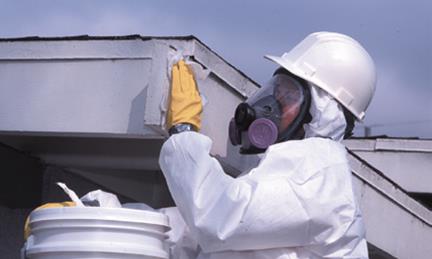
    Don't lick the walls!

    A Wafting Stench of Statistical Significance

    Another issue causes the reactive systems of justice to bind up. Risk factors. In a car accident, for example, it’s pretty easy to prove that Neighbor swerved out of his lane, causing his car to impact my car, causing me to smack my head into the steering wheel, breaking my nose. It doesn’t always work that way with environmental contaminants. To take an obvious case, not everybody got cancer in Hiroshima and Nagasaki. However, epidemiological surveys show a massive uptick in the amount of certain cancers and birth defects.

    Exactly how much is a 3x elevated risk of leukemia worth in Benjamins? Can you even say that it was caused by environmental contaminant X if somebody gets lung disease after being exposed to it? Again, the reactive system of justice fails when these unique harms are merely compensated ex post facto with greenbacks.

    Libertarians apply the NAP in situations where somebody employs force, fraud, or coercion, but it may be appropriate to expand that to “risk” as well. It’s a bit of a blurry line, and it’s rife with totalitarian pitfalls, but risk is just diluted force, and the pollution itself is a form of force and/or coercion. Much like celebratory gunfire, the lack of a guaranteed harm doesn’t prevent the community from proactively stopping behavior that presents a high risk to others.

    The EPA may be a bloated monstrosity these days, but the preventative justice it affords to the community is a unique form of protection for land, life, and limb that would otherwise be sacrificed to short-sighted and irresponsible polluters.

    [/SLDs]

  • Poll: Zoning

    Last time I asked the Glibertariat how they felt about HOAs. This week, let’s keep the controversy going by discussing zoning laws!

    Although an exceptional human by 95% of objective measures, there was nothing very libertarian about my Mom. In fact, she was appointed the chair of the planning board in her village. During her (very long) tenure, the planning board decided to undertake a revision of the local zoning laws. I happened to be visiting her one day when the documents were laid out on her desk. I was astonished that a village with a year round population of 2000 needed so many rules and regulations.

    Granted, things there are somewhat complicated by being the home to three universities. Additionally, practically the entire village proper is a designated Historic District. However, the sheer volume and insane amount of detail of the regs was mind blowing.

    Now, I’d be lying if I didn’t say that some of the revisions were an improvement. Mom was big on clear and unequivocal language, so she insisted that vague edicts open to interpretation by a code enforcement officer (or village flunky) be changed. So, instead of, say, a regulation stating, “fences must be no higher than is reasonable and placed safely,” Mom insisted they pass the change to be something along the lines of, “fences seen from the street frontage of the property may be no taller than 4 feet and may not be placed so as to obstruct the view of vehicles operating on village streets.” At least under those sorts of revisions, it was more clear what was and was not allowed.

    However.

    Being a very small college town, off-campus housing is at a premium always.  Own a house that’s bigger than you need? Why not rent out a room or two to meet market demand and help offset your own housing costs?


    HAHAHAHAHAHAHA. Stop it, you’re killing me.

    Where is this house? Is it in the Historic District? How many square feet? How big is the driveway? How does the driveway intersect the street? Is there a garage or barn? How many bathrooms does it have? How many entrances and exits? Are the people living there related by blood or law? How many days per month will it be occupied by how many people? How many residents per square foot? Will any interior or exterior structural changes be made to accommodate the new use? What will the rent per square foot of leased space be?

    You get the picture.

    And permits? That would be an entire series of posts.


    So, zoning, yea or nay? (Yeah, yeah, I know, property values. Yeah, yeah, I know, bars next to churches. Yeah, yeah, liquor stores next to elementary schools.)


    Let’s hear what Glibs think!

  • Economics Corner with Paul Krugman and Winston’s Mom

    Hey fellas?  How ya been?

    Here’s tonight’s drivel from your favorite Nobel Laureate!

    A peculiar chapter in the 2020 presidential race ended Monday, when Bernie Sanders, after months of foot-dragging, finally released his tax returns. The odd thing was that the returns appear to be perfectly innocuous. So what was all that about?

    The answer seems to be that Sanders got a lot of book royalties after the 2016 campaign, and was afraid that revealing this fact would produce headlines mocking him for now being part of the 1 Percent. Indeed, some journalists did try to make his income an issue.

    This line of attack is, however, deeply stupid. Politicians who support policies that would raise their own taxes and strengthen a social safety net they’re unlikely to need aren’t being hypocrites; if anything, they’re demonstrating their civic virtue.

    This criticism is perfectly valid as Bernie’s entire message is the wealthiest among us should pay for every tom, dick, and harry snatch of a government program that he never seems to have an issue supporting.  If he himself makes more money than nearly all Americans and programs where he can pay more in taxes than is required by law, yet fails to do so demonstrates hypocrisy on his part. He can’t even say he donated to charity, as he donated a pittance compared to what he made.  Bernie is no saint and neither are you for defending him.

    But failure to understand what hypocrisy means isn’t the only way our discourse about politics and inequality goes off the rails. The catchphrase “the 1 Percent” has also become a problem, obscuring the nature of class in 21st-century America.

    Focusing on the top percentile of the income distribution was originally intended as a corrective to the comforting but false notion that growing inequality was mainly about a rising payoff to education. The reality is that over the past few decades the typical college graduate has seen only modest gains, with the big money going to a small group at the top. Talking about “the 1 Percent” was shorthand for acknowledging this reality, and tying that reality to readily available data.

    But putting Bernie Sanders and the Koch brothers in the same class is obviously getting things wrong in a different way.

    This is absolutely correct.  The Kock brothers donate generously to charity, as well as have a number of foundations in their name, including educations grants, research, k-12…. How much did Bernie donate again?

    True, there’s a huge difference between being affluent enough that you don’t have to worry much about money and living with the financial insecurity that afflicts many Americans who consider themselves middle class. According to the Federal Reserve, 40 percent of U.S. adults don’t have enough cash to meet a $400 emergency expense; a much larger number of Americans would be severely strained by the kinds of costs that routinely arise when, say, illness strikes, even for those who have health insurance.

    $400?  Sounds like a personal problem.  Even I have $2000 in cash hidden in my ass.

    So if you have an income high enough that you can easily afford health care and good housing, have plenty of liquid assets and find it hard to imagine ever needing food stamps, you’re part of a privileged minority.

    But there’s also a big difference between being affluent, even very affluent, and having the kind of wealth that puts you in a completely separate social universe. It’s a difference summed up three decades ago in the movie “Wall Street,” when Gordon Gekko mocks the limited ambitions of someone who just wants to be “a $400,000-a-year working Wall Street stiff flying first class and being comfortable.”

    Even now, most Americans don’t seem to realize just how rich today’s rich are. At a recent event, my CUNY colleague Janet Gornick was greeted with disbelief when she mentioned in passing that the top 25 hedge fund managers make an average of $850 million a year. But her number was correct.

    One survey found that Americans, on average, think that corporate C.E.O.s are paid about 30 times as much as ordinary workers, which hasn’t been true since the 1970s. These days the ratio is more like 300 to 1.

    Why should we care about the very rich? It’s not about envy, it’s about oligarchy.

    With great wealth comes both great power and a separation from the concerns of ordinary citizens. What the very rich want, they often get; but what they want is often harmful to the rest of the nation. There are some public-spirited billionaires, some very wealthy liberals. But they aren’t typical of their class.

    Its not about millionaires like Bernie.  No, the problem is billionaires.  You’re starting to sound like this guy.

    The very rich don’t need Medicare or Social Security; they don’t use public education or public transit; they may not even be that reliant on public roads (there are helicopters, after all). Meanwhile, they don’t want to pay taxes.

    …but…but…muh ROOOOOOAAAAAAAADZ.  Billionaires never use ROOOOOOOOAAAAAAADZ.

    Sure enough, and contrary to popular belief, billionaires mostly (although often stealthily) wield their political power on behalf of tax cuts at the top, a weaker safety net and deregulation. And financial support from the very rich is the most important force sustaining the extremist right-wing politics that now dominates the Republican Party.

    Well shit.  Could it be prominent politicians in the Democrat Party, like Bernie, having anything to do with that?

    That’s why it’s important to understand who we mean when we talk about the very rich. It’s not doctors, lawyers or, yes, authors, some of whom make it into “the 1 Percent.” It’s a much more rarefied social stratum.

    None of this means that the merely affluent should be exempt from the burden of creating a more decent society. The Affordable Care Act was paid for in part by taxes on incomes in excess of $200,000, so 400K-a-year working stiffs did pay some of the cost. That’s O.K.: They (we) can afford it. And whining that $200,000 a year isn’t really rich is unseemly.

    But we should be able to understand both that the affluent in general should be paying more in taxes, and that the very rich are different from you and me ­— and Bernie Sanders. The class divide that lies at the root of our political polarization is much starker, much more extreme than most people seem to realize.

    Last I checked, with a single exception, none of the billionaires you are lambasting are running for president.  The number of billionaires is also such a tiny number in comparison to the general population that simply taking their money will never pay for his programs.  No, he will have to tax people like him, like you and nearly everyone else to pay for turning the entire country into a marauding gang of whores.  When given the chance to pay more than his “fair share” of taxes, or even to charities that do a lot of good helping the poor and downtrodden, he chose not to.  This is what makes him a hypocrite, because he knows better than everyone else who actually produced anything of value to society and was rewarded with wealth beyond what any one person might require, until it cums to his own money.

    Which is fine for you to defend him, you advocate the same bullshit he does, and as it turns out, you also donated absolutely nothing to charity, either.

  • I’m on Vacation

    As the title says, I am not here.  Please do not attempt to contact me directly as I am most certainly out of the country.  I contacted the editors regarding my absence but was met with a response that was as predictable as it was unhelpful.

    While I will not explicitly inform you of my wherabouts, I’ll give a bit of a hint.  Unfortunately, I already wrote about an appropriate beer for this occasion so I will just go ahead and throw you all for a loop… this is my review of Jameson Caskmates Stout Edition.

    I know what you’re thinking, “that’s not beer, your wheelhouse is beer, and that looks like whiskey.”  Well…you’d be right, but who’s stopping me?


    Irish Whiskey has an interesting history.  It is said, the first written example of distillation occured during the 1st Century AD (or CE).  The Arabs are creditied with discovering the process as applied to perfumes, but the first known example was found in Alexandria.  Later during the 7th Century Irish monks trained in the process, applied it to create a drinkable spirit, called Uisce Beatha.  It is from this spirit, we ultimately get Whiskey.  Once again, leave it to the Irish to be at the forefront of drinking technology.

    Which means…Whiskey predates Whisky, sort of.  To explain, by the 18th Century Irish Whiskey was held in higher regard than its Scottish counterpart.  It was not until in 1820 that Irish Whiskey as we know it today came about.  The Single Pot style was developed in response to a tax levied by the English on malt.  The Irish distillers responded simply by using both unmalted barley and malted barley, resulting in a distinctive flavor.

    Over the next century Irish Whiskey fell out of favor for a variety of reasons:  Temperance movements in Ireland (seriously), potato famines, mass migrations, restrictions on exports to the rest of Britain, Irish Revolution, Irish Civil War, two world wars, prohibition in it’s largest customer (The United States), American servicemen stationed in England developing a taste for Scotch Whisky during the war, and the Scots developing the Coffey Still and the blended whisky that suited the palates of the day.

    Mostly, it was war and the government being bad for business.

    Irish distilleries began to add the “e” to differentiate themselves from the distilleries in Scotland.  At the time, Irish whiskey was more popular than Scotch, even in Scotland.  Americans simply adopted the spelling.  Hence my statement, whiskey predated whisky.

    So does it taste like beer?   No.  This tastes like whiskey.   By aging whiskey in old beer barrels rather than the other way around, they took a fun idea and turned it on its head.  I’m not even going to rate it, because its not beer of course, and rating it implies that whiskey is equivalent to beer.  Its not.  It is smooth however, and has an ever so slight chocolate notes.  I might have to try the IPA barrel next, just out of curiosity.


  • Portland Boat Tours

    “Hello?”  I asked.  Who would call me at 0538?  I looked at the call ID and predictably it said, “BLOCKED NUMBER.”

    ”This Pratibha, with Swiss Corps Interational Industries.  How you doing this morning?”  He got a new secretary…from India?

    ”Fine, I guess.  Can this be handled later?  I mean its not exactly polite to call befo—“

    “Mr. Swiss want you to get off you brown ass and wake the fuck up, you late for conference call.”  Pratibha said, to my surprise.

    ”I didn’t make an appointment, and if I did, I wouldn’t make it before sunrise.”  I replied.

    ”I not work for you.  I work for Mr. Swiss.  His only available appointment today is at 7am.  It is not incumbent upon me to reschedule because you cannot adjust to time zone.”

    ”I don’t know if they explained to you how this sort of thing works in outsourcing school, both parties have to agree to a time.”

    ”Outsource?  Huh huh huh huh.”  Good lord that laugh was fake.  “You hillarious.  You fucking funny it only 7:41 am and you the thirrrrrd beaner to make that joke.”  She replied. “I transfer you now.  Next time save the wise cracks for somebody else you wall hopping, piece of monkey shit.”

    I wasn’t even mad…

    “MAGA, BITCH.”


    “mex!  You’re late!”  Swiss yelled into the phone as he is wont to do.

    ”That’s some new secretary you got there.  She always this pleasant?”  I asked.

    ”Pratibha?  Oh, yeah she’s the best.  She’s allowed me to outsource my contempt.  I save a ton of money this way.”  Swiss replied.

    ”Right, so why the appointment before sunrise?”

    ”What? Its 0745 here.  Sunrise was an hour ago.”

    ”Fine, what do you need?”

    ”Are you by a computer?”  Swiss asked.

    ”Not really.  Why?”

    “I need you to setup something for me…”

    As Swiss explained, his Swiss overlords saw an opportunity in the United States to set up a service in response to Elizabeth Warren’s plan to tax 2% of the net worth of people worth over $50 million, or 3% should they be effective enough to be worth over $1 billion.  Because Warren is not the front-runner but certainly isn’t going away and quite frankly other thieves in the government seem to have latched on to the idea like the blood sucking leeches they are, they’ll probably take measures to keep high net worth individuals in the country.  After all, they probably assume the Grand Cayman is going to sink if enough people store their money there, or more likely try to move there.

    ”I need you to set up the Kickstarter.”  Swiss said.

    ”What?  You work for a international corporation, why are you funding this via Kickstarter….you know what, nevermind.  Fine, I’m on the site.”  I conceded.   There’s no point in arguing with these people after they send STEVE SMITH to kidnap your dog.

    “Okay Swiss, what category?”

    “Caregory?  Business? Dumbass.”  Swiss replied.  I wasn’t sure if he knew what I meant.

    ”Okay, Art.  Next question: ‘Describe what you’ll be creating.’”

    ”Service to shuttle high net worth individuals out of the country on a Cigarette Boat.”  Swiss answered.

    ”A Cigarette Boat?  Those aren’t exactly cheap.”  I explained.  “Not something people will fund on Kickstarter.  Normally they fund these things with some kind of return.”

    ”mex, you ever try to out run the Coast Guard?  It ain’t cheap.”  Swiss asked.

    ”As a matter of fact, I have.”

    ”Really?”

    ”No.”

    *narrowed gaze*

    “What country is the account located?”  I asked, breaking the silence.

    ”The Netherlands.”

    ”I thought you worked for a Swiss company.”

    ”I do.”

    ”Speaking of which, I’ve never done an article on a Dutch beer.  You’ve been to the Netherlands.  Are there any that are any good?”  I asked.

    ”No.”

    ”None?”

    ”Nope.”

    ”Not even Oranjeboom?”

    ”Not unless you are a college student, homeless, or otherwise an alcoholic.  The Belgians broke off and took all the good beer with them.”

    ”There’s gotta be one.”

    ”You think so?  mex are you a betting man?”

    ”Possibly.”

    ”You will not be able to find a single Dutch beer worth reccomending.  I will wager a Krugerrand, and trust me, we all know when you’re lying.”

    ”Fair enough,  I will need the IBAN and SWIFT Code…wait, how is the account located in…you know what, nevermind.”  I managed to answer the next few questions without his input.  “Okay, its called Portland Boat Tours.  The page can be found here.”

    ”Portland Boat Tours?”  Swiss asked.

    ”Trust me.  I worked for the federal government once, the last place they will look for anything, is Oregone.”

    ”That makes sense.  This call is over.”


    The first place I asked of course, was the Glibs.  Somebody would have a good suggestion, right?

    Perhaps not.  I did get one that was serious (H/T Nephilium, naturally) but sadly I was unable to locate it locally.  Others, still…seemed determined to make me fail.

    I had to try any I could find.

    Heineken?

    No, thats still Dutch piss.

    Grolsch?

    Cool bottle, but ultimately the proper pronunciation sounded like the sound one makes while puking.


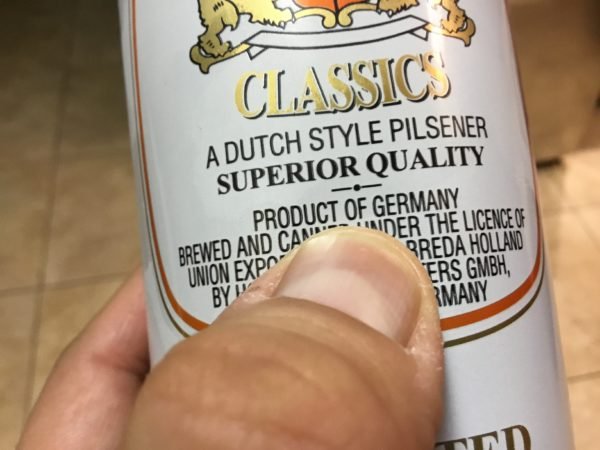
    Finally, I thought I found one at Trader Joe’s:

    It was light, crisp, balanced and had a pleasant finish.  Sadly, that was before I read the fine print.

    …and so it goes …