Category: Rule of Law

  • Chapter 1 – A Brief History, or “I’m from the government and I’m here to experiment on you.”

    I think it speaks to the undercurrent of distrust of the government and the military,” said Lt. Gen. Ronald R. Blanck, the Surgeon General of the Army, the service that oversees the [anthrax] vaccination program.  “Agent Orange. Nuclear tests in the ’50s. People say, ‘How can you say this is safe?’  Clearly, we have a credibility problem.”

    ~ Steven Lee Myers, Armed Services Opt to Discharge Those Who Refuse Vaccine, N.Y. Times, March 11, 1999.

    The United States Armed Forces has a long and not-so illustrious history of testing nuclear, biological, and chemical weapons… on its own citizens. From at least the 1940’s on (and if you want to include Native Americans, we can go back a lot further!), the Department of Defense has conducted experiments on U.S. servicemembers using ‘unconventional’ weapons. A report prepared by the staff of the Senate Committee on Veteran’s Affairs in 1994 concluded that “[f]or at least 50 years, [the] DOD has intentionally exposed military personnel to potentially dangerous substances, often in secret[.]”[i] That report followed a Government Accounting Office inquiry into experiments conducted on servicemembers by the Department of Defense.[ii] The GAO report detailed many different programs, some of which the DoD still lists as classified, in which servicemembers were given experimental drugs and other treatments without their knowledge or consent. A few of the more stunning examples of experimentation are worth discussing in detail, not simply to attack the Department of Defense or the military establishment, but rather as context because it is against this history that the DoD’s anthrax program was launched. And it is against this background of secret experimentation and tests conducted on coerced subjects that the DoD asks members of the Armed Services to “trust us” with regards to vaccines and inoculations claimed to be safe and effective.


    [i] An Institute of Medicine report looking at the history of mustard and lewisite gas found the Armed Forces researching chemical warfare after World War I and up through World War II.  The report even traces some research back before the Civil War.  See Senate Report No. 103-97, at 15 (1994).

    [ii] The Government Accounting Office (GAO) is the watchdog arm of Congress that investigates government agencies.  See “Human Experimentation, An Overview on Cold War Era Programs,” U.S. General Accounting Office, September 28, 1994, GAO/T-NSIAD-94-266.


    In the 1940’s, the Department of the Navy began soliciting volunteers to participate in a program to test protective clothing. In reality, the program was designed to test mustard and lewisite gases, chemical agents that the United States thought might be used by the desperate Axis powers at the end of World War II. There are some who claim that the tests were done simply to see what effect mustard gas had on soldiers in order to determine the offensive potential of chemical weapons. The truth is likely that these are not exclusive propositions. Either way, the program solicited potential ‘volunteers’ with the promise of two weeks of extra leave or some other similar incentive. “Due to the strategic importance of these experiments [however], the Navy deemed it inappropriate to inform potential volunteers as to the precise nature of the tests.  Instead . . . the . . . volunteers were led to believe that they would be testing uniforms for use in tropical climates.”[iii]  These ‘volunteers’ were sworn to secrecy and threatened with court-martial if they told anyone about the program for which they had just ‘volunteered.’  Of course, at this point, because no one had told them exactly what they volunteered for, it was relatively easy to extract such a promise. It is rather doubtful that most members would have agreed had they known that they were about to be experimented upon with chemical weapons.

    Nathan Schnurman was a young sailor who figured he could use the extra few days off. He had just finished boot camp and was stationed at Bainbridge, Maryland, awaiting further orders when he volunteered for the program. He was put on a bus for Anacostia, Maryland, where the experiments actually took place. Young Nathan Schnurman, along with the other volunteers, was given a bunk in a Quonset hut and some blankets for that evening. All of the volunteers were issued protective clothing, including a gas mask, given a physical, and the next morning the experiments began. The protective clothing and masks were fitted and checked and then the ten volunteers were led to the testing building. At this point, the volunteers had still only been told that they were testing clothing for tropical weather.

    The building itself was a simple structure with an entrance platform and test chamber. A single door separated the platform from the chamber and an intercom allowed for communication between the subjects inside the chamber and the corpsmen on the platform. The subjects were told that, once inside, a vapor was to be introduced into the chamber and that they were to remain in the chamber for one hour. The subjects were not told what the vapor was, but were told that it might produce a slight irritation on the subjects’ skin, similar to a sunburn. The subjects were admonished not to discuss the experiment with anyone.[iv]

    The volunteers were exposed to the vapor for the one hour, as advertised. After that, they were instructed to continue to wear the protective clothing for another four hours, to eat meals and pass the time in their Quonset hut. They later disrobed and were given physical exams to check primarily for burns on the skin. This routine repeated itself the next day. The second day’s physical was the last one that any volunteer ever received as a part of the experiment.

    The hour-long gas exposures continued on a daily basis for the next four days without incident, save the departure of a few of the subjects due to painful burns. On one of those days, just prior to the morning’s exposure, plaintiff [Schnurman] was informed by a corpsman that they would be testing mustard and lewisite gas that day.

    On the sixth test day, while inside the chambers, plaintiff’s gas mask malfunctioned and plaintiff breathed the noxious vapor being tested. The inhalation of the gas produced extreme nausea and a burning in his eyes, nose and throat. Before being helped out of the chamber, plaintiff regurgitated in his mask. Once outside the chambers and free of his mask, plaintiff continued to experience nausea and dizziness, plus an intense pain in his chest. After further vomiting, plaintiff lost consciousness. No record was made of this incident.

    Upon regaining consciousness, plaintiff was informed that he would no longer be needed for the experiment and that he could return to Bainbridge. He was not given any physical examination or treatment with the exception of local treatment for the minor burns on his skin. Plaintiff left the site of the experiment and traveled to his home in Roanoke, Virginia for a ten-day leave.[v]

    Mr. Schnurman went on with his life, experiencing long-term health problems. Sworn to secrecy, Schnurman felt that he could not tell his personal physician about the source of his ailments because of his oath and the threat of punishment. Thus, he did not provide essential information to his doctors about his health because of his fears of what would happen to him if he told. This scenario was not uncommon.

    A Mr. John T. Harrison described to a senate committee how he was sworn to secrecy in 1943 when mustard gas tests were conducted on him.[vi] Because of these vows to which the man had been sworn, it was not until much later in life that plaintiffs, such as Mr. Schnurman, (1) learned of what had been used on them, and (b) then filed lawsuits against the government.

    A very similar incident happened to a John William Allen in 1945, according to a statement before the Senate Committee on Veterans’ Affairs. Mr. Allen testified that the real purpose of the testing was to determine how much sulfur mustard a man could take before being overcome: these were known as ‘man-break tests.’  “He was exposed several times to sulfur mustard and was removed from further exposure on May 5, 1945, when he passed out in the gas chamber. A physical examination on May 14, 1945, revealed many wounds as the result of exposure to mustard gas.”[vii]

    It is important to understand that these are not isolated incidents.  An Institute of Medicine report in 1993 estimated that some 60,000 military members were used as human subjects in the 1940’s to test just for two particular chemical agents, mustard gas and lewisite, and the majority of these people were not informed about the nature of the experiments, nor were they given proper medical care or follow up after the research.[viii]


    [iii] Few things have amazed me more in my time in service than what members of the Armed Forces – even moreso Marines – will do for just a few extra days of leave or liberty. I am still not sure what that says about the military, but leave and liberty are the promise land to most servicemembers.

    [iv] Schnurman v. United States, 490 F. Supp. 429, 430 (E. D. Va. 1980).

    [v] Schnurman, at 431.

    [vi] Is Military Research Hazardous to Veterans’ Health? Lessons from World War II, the Persian Gulf War, and Today, Senate Committee on Veterans’ Affairs, 103rd Cong. May 6, 1994.

    [vii] S. Rep. 103-97, at 18 (1994).

    [viii] Veterans at Risk: The Health Effects of Mustard Gas and Lewisite, Pechura, C.M. & Rall, D.P. (Eds.) Institute of Medicine, National Academy Press, Washington, DC, 1993, p. 3-4, 6-8, 50-52, 224-226.


    During the 1950’s and 60’s, the CIA and the Army engaged in experimentation on U.S. servicemembers, both with and without their knowledge. In several different experiments, the DoD caused servicemembers to unknowingly ingest hallucinogens. Most of the experiments centered around ‘mind control’ and interrogation of persons under the effects of hallucinogens. This was prompted by the perception in U.S. intelligence that China and the Soviet Union had used, and were using, hallucinogens for ‘brainwashing’ and interrogation of prisoners of war. This program was known by the code name MKULTRA. It involved giving LSD and another substance known as quinuclidinyl benzilate, a hallucinogen code-named BZ, to unsuspecting members of both the Armed Forces and civilian communities.

    In 1958, Master Sergeant James Stanley responded to a posting on Fort Knox, Kentucky, that solicited volunteers to help the Army develop methods for testing and defending against chemical weapons. Ironically, the volunteers were told they would be testing protective clothing (just as in World War II). MSgt Stanley was transferred to Aberdeen, Maryland, for the testing. He did not learn until seventeen years later that he had been unknowingly given LSD during the program. He found this out accidentally in 1975 when contacted by Walter Reed Army Medical Center, which was conducting follow-up on those who had participated in the 1958 test. Walter Reed wanted to know of any long-term health consequences to MSgt Stanley from his ingestion of the hallucinogen. MSgt Stanley in the intervening years had suffered health problems and hallucinations that he had no explanation for that eventually led to a divorce. See United States v. Stanley, 483 U.S. 669 (1987).

    In another instance, Lloyd Gamble, who enlisted in the U.S. Air Force in 1950, volunteered for a special program to (yet again!) test new military protective clothing in 1957.

    He was offered various incentives to participate in the program, including a liberal leave policy, family visitations, and superior living and recreational facilities. However, the greatest incentive to Mr. Gamble was the official recognition he would receive as a career-oriented noncommissioned officer, through letters of commendation and certification of participation in the program. During the 3 weeks of testing new clothing, he was given two or three water-size glasses of a liquid containing LSD to drink. Thereafter, Mr. Gamble developed erratic behavior and even attempted suicide. He did not learn that he had received LSD as a human subject until 18 years later, as a result of congressional hearings in 1975.  Even then, the Department of the Army initially denied that he had participated in the experiments, although an official DOD publicity photograph showed him as one of the valiant servicemen volunteering for “a program that was in the highest national security interest.”[ix]

    What is worth noting about these programs, beyond the experimentation on servicemembers without their informed consent, are the arguments offered by the proponents and defenders of these programs. According to Sidney Gottlieb, a doctor and former CIA officer, MKULTRA was established to investigate whether and how an individual’s behavior could be modified by covert means. Dr. Gottlieb testified before Congress that “it was felt to be mandatory and of the utmost urgency for our intelligence organization to establish what was possible in this field on a high priority basis.”[x] Although many human subjects were not informed or protected, Dr. Gottlieb’s defended these actions by stating, “. . . harsh as it may seem in retrospect, it was felt that in an issue where national survival might be concerned, such a procedure and such a risk was a reasonable one to take.”[xi]

    These attitudes persist even today. Dr. Gottleib’s responses in the 1970’s sound remarkably like the reasons offered to justify mandatory vaccination of troops today with unapproved, unlicensed, or investigational drugs. In a television appearance in 1997, Secretary of Defense Cohen held up a five-pound bag of sugar and stated that if the bag were filled with anthrax spores, it could wipe out half of the population of Washington, D.C.[xii] In a later opinion editorial appearing in Army Times, Secretary Cohen wrote that

    At least 25 countries, including Iraq and North Korea, now have – or are in the process of acquiring and developing – weapons of mass destruction . . . This is not hyperbole. It is reality . . . The race is on between our preparations and those of our adversaries. We are preparing for the possibility of a chemical or biological attack on American soil because we must. There is not a moment to lose.[xiii]

    The truth of these matters will be examined in greater detail later. The point to be made here is that Secretary Cohen’s defense of the anthrax program, and the justification for biological warfare programs generally, distilled to its essence, is nothing more than “the ends justifies the means.” Where matters of national security (Gottleib called it “national survival”) are at stake, it does not matter how we go about defending ourselves, even if it means experimenting on unsuspecting troops, because it involves ‘National Security’.

    This is a particularly dangerous path for a number of reasons, some obvious and others not as obvious. While there are any number of moral points of view about using troops in this way, one’s opinion about whether it is right or wrong to experiment on troops in this fashion depends largely on one’s view of individual liberty for the citizen-soldier and the limits of a nation state’s ability to protect ‘itself.’ These arguments inevitably devolve into philosophical debates, punctuated by twelve-letter words and citations to long-dead philosophers, spoken by people far removed from the gas chambers and vomiting victims on their hands and knees; much like Dr. Gottleib’s testimony in an air-conditioned chamber in front of politicians and cameras during the famous Church Committee hearings. More importantly, where ‘military’ or ‘national security’ matters are concerned, the academics inevitably defer to those wearing uniforms with stars on their collars.

    It would appear on the surface that this issue was decisively concluded at the end of World War II in favor of the rights of the individual. In August 1947, the Nuremberg Trials of the Nazi Doctors, including those such as Karl Brandt, came to a close, resulting in the death penalty for many of the doctors who conducted such experiments on unwilling prisoners in concentration camps across Hitler’s Reich. It is there that we must turn briefly in order to understand the law of informed consent and how it applies to the military, if at all. But if it seems that the present author is ‘laying it on a little thick,’ compare Secretary Cohen’s above remark about the necessity of the mandatory anthrax vaccine program to this one:

    We are not conducting these experiments, as a matter of fact, for the sake of some fixed scientific idea, but to be of practical help to the armed forces and beyond that to the . . . people in a possible emergency.

    This is from a letter written by Doctor Wolfram Sievers, Colonel in the German Army in November, 1942, to Dr. Karl Brandt, both convicted Nazi War Criminals, excerpted from Prosecution Exhibit No. 263 at their trial.


    [ix] Id., notes omitted.

    [x] Human Drug Testing by the CIA, 1977: Hearings Before the Subcommittee on Health and Scientific Research, Committee on Human Resources, U.S. Senate, September 20-21, p. 169 (1977).

    [xi] Id., pp. 169-217.

    [xii] Paul Richter, Experts Assess Risk of ‘New Terrorism’ Threat, Los Angeles Times, Feb. 7, 2000.

    [xiii] William S. Cohen, Preparing for a Grave New World, Washington Post, Jul. 26, 1999.


    beginning | next

  • The Untold Story of the DoD’s Anthrax Vaccine Program, Serialized: Prologue

    “This court will come to order in the case of United States versus Petty Officer David M. Ponder, United States Navy, at Marine Corps Base Camp Foster, Okinawa, Japan.” I’m a little nervous, like I am at the beginning of every trial, but I don’t show it. It’s just an arraignment anyway. We’re mostly here to arrange dates for trial and I’ve already talked to the prosecutor, known as the “trial counsel” in military parlance, a professional Marine Captain by the name of Chris Kolomjec, and we’ve agreed to push the dates out a bit on this case. Like me, he had another specialty in the Marine Corps before becoming an attorney, so we have a collegial relationship. Chris is going on temporary duty to an exercise in Thailand called “Cobra Gold” and I’m in the beginning stages of a plan to plead this case out under very favorable terms if I can get in to see the Convening Authority – my client’s Commanding Officer – while he’s out of town. In courts-martial, the prosecution has one-hundred twenty (120) days to be ready to go to trial and the arraignment stops that clock from running.

    In David Ponder’s case, stopping the clock is mutually agreeable, but we have to coordinate our plans with the judge’s trial schedule.
    I put on the required lawyerly mask of indifference, but inside, my guts still twist a little. A trial is like the start of a “big” game in sports, except the stakes are a whole lot higher. I am, as one might expect, extremely competitive, particularly in sports, but I’ve played and lost enough games to have perspective – at the end of a game, even after a loss, nobody goes to jail, gets busted, kicked out of the service, or loses their pay. On the other hand, as a defense counsel I also have a standard line to my clients: “At the end of the day, I’m not the one going to jail. I’m going home to my wife and four daughters.” Notwithstanding this shpiel, I’m a bit new at this and keenly feel the punishment hanging over my clients, the mythical sword of Damocles hanging there, waiting to fall. One mistake on my part…. On the Defense side of the courtroom, it is your intellect, initiative, imagination – and a ball point and legal pad – against the resources of “The United States of America.” While it can be a unique intellectual challenge, it is also daunting because I am gambling with another person’s liberty. Anyone who ignores that is either another class of lawyer than I am or a fool.

    I edge a little closer to Petty Officer Third Class Ponder, a sailor who refused the controversial anthrax vaccine. My move closer might appear to outsiders as a sign of my solidarity with my client; and in David’s case, it’s got some truth. We’ve only just met, but I like him. In most cases, however, being proximate to my client makes me feel less alone. I am six months removed from Naval Justice School, nine months from passing the Bar, eleven months from law school graduation, and a lifetime away from my former occupation in the Marine Corps as a Cobra attack helicopter pilot.

    Captain Kolomjec finishes reciting his bona fides and how the court came to be created by the Commanding Officer of Naval Mobile Constriction Battalion Seventy-Four, Petty Officer Ponder’s C.O. This part really was boring, scripted, and I waited for my turn to speak.
    “Captain Saran?” the military judge, Lieutenant Colonel Tim Miller, looked up from his Military Judges’ Benchbook in my direction, my cue to do my part.

    “Sir, I have been detailed to this court-martial by Major J.R. Woodworth, Senior Defense Counsel, Legal Services Support Section, Third Force Service Support Group, Camp Foster, Okinawa, Japan. I am qualified and certified under Article 27(b) and sworn under article 42(a) of the Uniform Code of Military Justice.” I don’t need to look down at my trial guide for this, which is a script for Navy and Marine Corps trial proceedings for the repetitive parts in the process. It keeps everyone tracking where the trial is, but the real reason for it is to make for better records of trial. Anyone who receives a punitive discharge in the military gets an automatic appeal up to their service specific appellate court. Given the number of courts-martial in the military, this helps the appellate courts do their jobs. Arguably, it also helps the accused get a better, cleaner trial. The familiar recitation helps my nerves dissipate; I suspect it has something to do with being raised Catholic.

    “I have not acted in any manner which might tend to disqualify me in this court-martial and no other defense counsel, either military or civilian, have either been detailed to or are on this case.” I start to sit down and then stay on my feet in anticipation of my client standing up when the judge speaks to him for the first time – just as I instructed him to do.

    “Are you Petty Officer Ponder, the accused in this case?” David Ponder stands up to the position of attention.

    “Yes, sir.” Firmly, not too loud, perfect. He looks good in his uniform, as well. I know because I inspected him myself before we came into court. The defense shop keeps an extra set of uniforms, spare ribbons and devices, and whatever else we can scavenge for when our clients are brought in by the chasers – military escorts – from the brig. They come over in those ubiquitous orange jumpsuits in shackles; while their units are supposed to provide the uniforms for them, we always wind up with clients missing ribbons and sundry uniform items, so we have a small stock available.

    “Okay, Petty Officer Ponder, you may take a seat, and you may remain seated unless I otherwise direct you to stand.” Lieutenant Colonel Miller nods gently from behind his glasses. I notice he’s still rubbing his hand as he continues, a habit since the pins were removed. The judge flipped over the handlebars of his bike and busted his wrist up pretty badly and I knew the scar must itch where the pins had come out. Reconstructive shoulder surgery at 15 left me with an intimate understanding of that feeling.

    We finish with the preliminaries; I rattle off all of the awards which David Ponder had earned during his three years as a Navy Seabee. The judge goes through my client’s rights to counsel, military and civilian, and then his own qualifications. He then gives us a chance to challenge him or ask any questions if we think he might be partial for any reason, a formality at this point, because I’m pretty sure that Lieutenant Colonel Miller isn’t even going to hear this case if we go to trial. He’s likely to pass it to Major Eric Stone, the other military judge on Okinawa, because of some scheduling conflicts with other cases in the Pacific region, which includes mainland Japan and Korea. We all do a good bit of traveling because of the odd and disbursed units that have occasional courts-martial, but the bulk of the work is on Okinawa.

    I look over at my client; David Ponder looks young to me – and I just turned thirty. He has the beginnings of a moustache, but it’s just that, the beginnings. The good thing is that he likes to keep his hair short by Navy standards, which helps in a Marine court. He’s also a genuinely squared-away sailor. I liked him, which is supposed to be irrelevant to attorneys, but it’s not. Everyone gets the same level of representation; it’s just a question of whether you like defending them or not and whether or not you’ll feel badly if they’re convicted. It also helps in generating the emotional energy to work late nights and long hours cheerfully, as opposed to drearily.

    “Petty Officer Ponder,” the judge breaks into my thoughts, “I now ask you how do you plead, but before accepting your pleas, I advise you that any motion to dismiss or grant any other relief should be made at this time. Captain Saran?”

    I stand up, my stomach now fully settled, which is great because we’re just about done; we have our dates for trial, but I’m thinking this gets pled to a Summary Court martial, where my client can get no more than 30 days in the brig and no punitive discharge, but he’s probably going to have to waive his right to an Administrative Discharge Board and they’ll kick him out with ‘bad paper’ – an ‘Other Than Honorable’ discharge, which is like being fired from the military.

    “Sir, at this time Petty Officer Ponder requests to defer entry of pleas and motions in accordance with the schedule the court has already set forth.”

    The judge goes through the dates Kolomjec and I have already picked for motions, responses, witness requests, and discovery. All parties are agreed.

    “Anything else from either party before we adjourn?”

    “No, sir,” both Kolomjec and I answer after glancing at each other.

    “Then this court is in recess.”

    “All rise!” Kolomjec intones. I’m already on my feet and David joins me as the judge passingly says “Carry on” and departs.

    As my client and I walk out, we almost bump square into David Allen, a reporter from the Pacific “Stars and Stripes.” I’ve only been on the island for a few months, but my reaction is immediate – I step in and tell David Allen we’ll give a statement at some point and he’ll be the first to know. Blah blah blah.

    The first thing any decent defense attorney wants regarding his client’s talking – to anyone, but particularly law enforcement and the press – is to STFU and let the lawyer do the talking. The cop shows and movies are dead-on in one respect: anything you say can and will be used against you. Plus, offhand I can’t remember either the Code of Professional Responsibility or the more stringent Navy Instruction for all Judge Advocates on speaking to the press. I know generally it’s frowned upon, if not outright verboten, to speak to the press. Add to that my natural aversion to the media as a military officer and I’m curt, but polite.

    Oddly enough, this is one of the few times it likely won’t matter. It’s not as if David could say anything damning – he had refused a direct order to take the anthrax vaccine and even talked about it in interviews with local media in his homeport of Biloxi, Mississippi. There isn’t a whole lot of dispute factually. I don’t want to give the government any additional ammunition for sentencing, however, should we ever get there. A jury or military judge would probably not look kindly on someone who was bashing the military in the local paper. So, we pass on the “exclusive.”

    Back in my office, I drop into my chair.

    “Sir,” Petty Officer Ponder begins, “what happens now?”

    “Well, you heard the dates for motions. That’s the next big milestone. It’s likely that the prosecutor will file a motion asking the judge to find the order to take the vaccine lawful. That’s been the standard in the few other anthrax cases that have gone to trial. The good thing is that Captain Kolomjec leaves for Thailand the day that our response is due. Likelihood is he won’t be around in the afternoon when I drop the response off on the prosecution. He also won’t be back until right before the motions session and I’m betting no one else is going to pick up our response and run with the ball. So, it may not win the day, but it will certainly limit his time to be ready to answer our motion.” David Ponder nods, but I can tell he’s nervous. I would be, too, if I were in his shoes.

    “Sir, did you get in touch with Major Bates’s attorney, Mister Smith, at that number I gave you?” David Ponder put me in touch with an attorney in the States named Bruce Smith, an administrative judge in North Carolina and Major in the Air Force Reserve. He defended Air Force Major Sonnie Bates, the highest ranking officer to refuse the anthrax vaccine. He had been discharged with ‘good paper’ as a result of a plea negotiation.

    “Yeah. I talked to him. Interesting conversation.”

    When I spoke to Bruce Smith, he calmly asked me if I could consider that the order to take the anthrax vaccine was unlawful. Not quite expecting the question, I had said, sure, albeit hesitantly. In my own mind, I figured he was a loon, a conspiracy theorist, but he had gotten a good result for Major Bates, so what did I have to lose by listening to the guy? He told me to look up a particular federal statute and then said he would send me some other materials and asked if I would I please keep them “close hold.” His manner was so cordial, I casually agreed, thinking nothing of it.

    My boss, Major John Woodworth, figured he had done me a favor by assigning me – a brand new judge advocate – three of the four anthrax refusal cases on the island of Okinawa. The assumption was that these were guys looking for an excuse to get out of the military and the units would likely agree to Summary Court deals with a Board waiver and these would be over in short order. Like Tom Cruise in a “Few Good Men” I came to David Ponder’s case with the goal to get him the best deal possible, and do it quickly and quietly. I also have several major cases pending, including a rape defense.

    I got the first three of my anthrax shots just before coming to Okinawa. I took them somewhat reluctantly, as I had read an article in a major news magazine about the possibility of some experimental substance called squalene being in the anthrax vaccine given to soldiers during Desert Storm. I had sat in the medical clinic at Naval Justice School in Newport, Rhode Island, discussing the matter with another Marine attorney. Both of us had served previously as officers in the Fleet Marine Force and while we tended to think that squalene had been used in the anthrax vaccine, our leaders wouldn’t allow it to be used now. Quite simply, we trusted our chain of command, our senior officers.

    David breaks into my thoughts.

    “Do you think my CO might consider not court-martialing me or something if you explained this to him?” David Ponder’s question was laden with ethical implications that I was glad I explained to him. While the anthrax vaccine was getting a lot of attention in the press back in the States, and the issue was very interesting legally, I couldn’t let that interfere with my duty to my client, which is to advocate his interests. If he wanted to deal, to plead guilty, no matter how much I might like to litigate the issue, it was his ass on the line. I explained as much to him from the start. David Ponder didn’t have a Juris Doctor, but he was sharp and understood the bottom line.

    “Well, I’m going to set up a meeting while Kolomjec’s away and see if the C.O. won’t listen to what we’ve got to say. I’ll get back to you as soon as I get out of that meeting, okay?” I smiled at him.

    “Okay, sir. I’m going to change up. Where can I go to have a smoke?”

    “Out on the stairs at the end of the building.” I nodded toward the general direction. When he left, I went back to work. I was concerned with the other fifteen other clients who were counting on me to keep them out of jail. At the time, I had no idea that David Ponder’s case would take us both from Okinawa to the highest military court of appeals, to the doorstep of the Supreme Court, and eventually to testifying in front of Congress. It would also eventually cost me my active duty career, but that was a long way off.


  • Spygate: A Summary of Events


    Spygate can make your head swim if you get too far into the weeds for those with an intense interest let alone a passing one.  Hopefully, providing a simple summary will help clarify the conspiracy especially with the pending declassification of many documents related to the Russian collusion hoax and the release of Inspector General Horowitz’s report on FISA abuse.

    Spygate has been covered by a few mainstream journalists such as John Solomon and Sara Carter, covered extensively by Dan Bongino (former secret service agent and current pundit and Fox News contributor) who has written a book on the subject with another follow-up book set to be released in October, and covered by various open source citizen journalists some of which are anonymous.  Although some of the conspiracy has been exposed by inside sources, what’s incredible is how much has been exposed by open source journalism.


    A summary of the theorized events:

    • The NSA database was searched for political purposes by private contractors (one of which is theorized to be Fusion GPS).  Mike Rogers (former director of the NSA) discovers the illegal use of the database and shuts it down.  Ten days after the election Rogers visits Trump and warns Trump of the spying, the next day Trump evacuates Trump Tower and calls come out for Rogers to be fired.
    • After getting shutdown, Obama’s admin switches over to other means of spying via the abuse of the FISA courts based off of a political opposition research dossier written by Christopher Steele (a former MI6 spy) which was funded by Fusion GPS (headed by Glenn Simpson) who was hired by the law firm Perkins Coie hired by Hillary Clinton’s campaign.  Remarkably, Steele’s Dossier has a hell of a lot of similarities to an article written by Glenn Simpson back in 2007.  Steele leaks his own dossier to the media, the media articles are then used by the FBI to corroborate the information in Steele’s dossier to obtain the FISA warrants on Carter Page (a former foreign-policy adviser to Trump who was never charged with a crime).  It is also believed that other FISA warrants existed targeting others including Paul Manafort, Michael Flynn, and George Papadopolous.
    • Speaking of George Papadopolous, the FBI’s official story is that Crossfire Hurricane (the official name of the FBI’s investigation into Trump’s campaign) was allegedly started when: Alexander Downer (a former Australian diplomat) claimed that George Papadopolous (a former foreign policy adviser for Trump’s 2016 campaign), while drunk at a bar, told him that Joseph Mifsud (a Maltese academic with allegedly high level connections to Russia) told Papadopolous Russia has dirt on Hillary in the form of thousands of her hacked emails.  Papadopolous claims he was not drunk and had one drink and he never mentioned anything about his meeting with Mifsud and the information given to him regarding Russia and Hillary’s emails.
    • Papadopolous was setup.  Mifsud worked for western intelligence, had no Russian connections, and the meetings with both him and Downer were orchestrated.  Mifsud had Papadopolous meet with a woman that he claimed was Putin’s niece.  Needless to say, she was not Putin’s niece.  While in Israel, Papadopolous is offered $10,000 in US cash by Charles Tawil (an Israeli American businessman).  He thought the incident was bizarre and proceeds to leave the $10,000 with his lawyer in Greece before returning back to the US.  On return, he was stopped at the airport and is detained and searched.  He is then arrested without a warrant, an indictment or criminal complaint.  Coincidentally, you are required by law to declare that you have more than $10,000 in cash on you when you enter the US.  Almost as if they searched him for the money, did not find it and then scrambled and arrested him and threw charges together after the fact.  Papadopolous was ultimately charged with a process crime for lying to the FBI and was sentenced to 14 days in jail.  He claims his charges are related to misremembering the date he spoke to Mifsud.
    • FBI director James Comey was fired by Trump after Trump’s frustration of being told privately by Comey that he was not under investigation and refusing to tell the public.  Which led to the hiring of former FBI director Bob Mueller by former deputy attorney general Rod Rosenstein as special counsel to investigate the matter.  Mueller proceeded to investigate Trump and Russian interference for two years knowing full well that Russian collusion was a hoax and did not inform the public until after the Midterm election when his investigation concluded.
    • The Mueller investigation was a cover-up, an attempt to find anything on Trump, coordinate leaks with the media to turn the public against him, pressure him to “obstruct justice” or claim he did with weak allegations in order to setup an impeachment all in order to cover-up the Obama Admin’s and intelligence community’s malfeasance and massive abuse of power.  His report is already being proven to have been written in a way that paints Trump in as negative light as possible.


    There is much I left out to try to simplify the events as best as I could.  If you are interested in more details here are two videos one by Dan Bongino from last November and one recently from Tracy Diaz who do a fantastic summary of events.

    Hold on to your seats.  The next few months are going to be completely insane if the full story comes to light.

  • Talk to the Cops!? Are You Crazy ? Part 2: When Do Constitutional Rights “Attach?”

    So you’ve always been wondering, (I’m sure you have) when it comes to criminal procedure when does a person’s individual rights, under the Constitution, “attach” to a situation. . . haven’t you?

    In an earlier Part One, (view Part One here), I talked about how cops try to help themselves in the future, and prosecutors as well, by the way police reports are written. It’s a good guy/bad guy set up, which makes it easier to get a conviction.

    Trust me, I have seen it happen. And even when a defendant has eloquent and thorough defense counsel, and some facts in his or her favor, juries want to see “justice” for the alleged victim, which is why prosecutors have such a high rate of success. “  . . . . About 90 percent of the cases end with a plea bargain, and of those cases going to trial, about 90 percent end in a guilty verdict,” says a former U.S. attorney. (sorry -paywall, Dallas news). Perhaps that is grist for another article.

    Anyhow, the thing is, you do have rights under the constitution, which say that you’re not required to provide evidence against yourself, or “self-incriminate.”

    The idea comes from the Fifth Amendment, that tells us “no person . . . shall be compelled in any criminal case to be a witness against himself,” among other protections for persons accused of a crime.

    Simply put, a person can’t be compelled (forced, coerced, etc) to give evidence against him or herself. The problem having been that in earlier times, forced confessions were common, in fact, they could have been the rule rather than the exception. I guess that the idea being that confession is good for the soul. . . so forcing a confession would mean you were helping someone get closer to his or her Maker.

    This idea also works in conjunction with the Sixth Amendment, which states that a defendant also can “have the Assistance of Counsel for his [or her] defense.”

    To illustrate the Fifth Amendment: Let’s go back to our earlier scenario from Part 1, where a police officer calls someone to “assist him” in inquiries about an assault. Police Officer tells Joe Defendant, “Well, Mr. Johnson said you went after Tom with a carving knife.”

    Thoughts are racing through Joe Defendant’s mind, and at this point he should realize he has options. Option 1: invoke the Fifth. Option 2: invoke the Sixth. Option 3: get the whole thing off his chest, because it is bugging him all night long.

    In other words, the idea that Joe’s rights are at issue is correct! They are at issue immediately! And Joe may invoke his rights as soon as he thinks it is appropriate. So let’s hope Joe goes with Option 1, or Option 2.

    One way to say this is “I’m not sure officer, are you accusing me of a crime? I might talk to you, but only once my lawyer is with me.”

    To illustrate the Sixth amendment: Once Joe Defendant says “I might talk to you, but only once my lawyer is with me,” he is also invoking that he has the right to an attorney.

    Anecdotally I have seen this actually work for a client. I had been representing the client in a divorce. The wife moved out a few months after filing for divorce, then decided to charge my client with the crime of non-consensual sex. First, she got a personal protection order, then she called the cops, and “reported” the incident. Cops called the client – whose best friend, Ron, is a defense attorney (and my pal from law school). Client has Ron call the cops back for him. The gist of that phone call was “we have nothing to say at this time.” I call the client and tell him “listen to Ron! He’s right!”  No charges were issued.

    But this is why, when officers question someone, the legal requirement is that they get a consent signed that Joe Defendant is aware of, and voluntarily waives,  his Miranda rights – to remain silent,  the right to an attorney, and that whatever testimony he gives may be used against him.

    I may be preaching to the choir here, but Joe’s right attach as soon as he thinks 1. anything he says may be used in proceedings against him or 2. he is being interrogated in custody (aka “custodial interrogation.”)

    Where does custodial interrogation occur? Wherever police are present, is my answer. Street scene where a brawl has taken place? Police are present? Police are talking to witnesses (or potential suspects)? Even if a person is not in a squad car, handcuffs, or police department interview room, then the police may be interrogating him or her.

    If the person does not feel “free to leave” the scene, then interrogation may be taking place, and rights to counsel, to silence, etc. can be asserted.


  • Portland Boat Tours

    “Hello?”  I asked.  Who would call me at 0538?  I looked at the call ID and predictably it said, “BLOCKED NUMBER.”

    ”This Pratibha, with Swiss Corps Interational Industries.  How you doing this morning?”  He got a new secretary…from India?

    ”Fine, I guess.  Can this be handled later?  I mean its not exactly polite to call befo—“

    “Mr. Swiss want you to get off you brown ass and wake the fuck up, you late for conference call.”  Pratibha said, to my surprise.

    ”I didn’t make an appointment, and if I did, I wouldn’t make it before sunrise.”  I replied.

    ”I not work for you.  I work for Mr. Swiss.  His only available appointment today is at 7am.  It is not incumbent upon me to reschedule because you cannot adjust to time zone.”

    ”I don’t know if they explained to you how this sort of thing works in outsourcing school, both parties have to agree to a time.”

    ”Outsource?  Huh huh huh huh.”  Good lord that laugh was fake.  “You hillarious.  You fucking funny it only 7:41 am and you the thirrrrrd beaner to make that joke.”  She replied. “I transfer you now.  Next time save the wise cracks for somebody else you wall hopping, piece of monkey shit.”

    I wasn’t even mad…

    “MAGA, BITCH.”


    “mex!  You’re late!”  Swiss yelled into the phone as he is wont to do.

    ”That’s some new secretary you got there.  She always this pleasant?”  I asked.

    ”Pratibha?  Oh, yeah she’s the best.  She’s allowed me to outsource my contempt.  I save a ton of money this way.”  Swiss replied.

    ”Right, so why the appointment before sunrise?”

    ”What? Its 0745 here.  Sunrise was an hour ago.”

    ”Fine, what do you need?”

    ”Are you by a computer?”  Swiss asked.

    ”Not really.  Why?”

    “I need you to setup something for me…”

    As Swiss explained, his Swiss overlords saw an opportunity in the United States to set up a service in response to Elizabeth Warren’s plan to tax 2% of the net worth of people worth over $50 million, or 3% should they be effective enough to be worth over $1 billion.  Because Warren is not the front-runner but certainly isn’t going away and quite frankly other thieves in the government seem to have latched on to the idea like the blood sucking leeches they are, they’ll probably take measures to keep high net worth individuals in the country.  After all, they probably assume the Grand Cayman is going to sink if enough people store their money there, or more likely try to move there.

    ”I need you to set up the Kickstarter.”  Swiss said.

    ”What?  You work for a international corporation, why are you funding this via Kickstarter….you know what, nevermind.  Fine, I’m on the site.”  I conceded.   There’s no point in arguing with these people after they send STEVE SMITH to kidnap your dog.

    “Okay Swiss, what category?”

    “Caregory?  Business? Dumbass.”  Swiss replied.  I wasn’t sure if he knew what I meant.

    ”Okay, Art.  Next question: ‘Describe what you’ll be creating.’”

    ”Service to shuttle high net worth individuals out of the country on a Cigarette Boat.”  Swiss answered.

    ”A Cigarette Boat?  Those aren’t exactly cheap.”  I explained.  “Not something people will fund on Kickstarter.  Normally they fund these things with some kind of return.”
    ”mex, you ever try to out run the Coast Guard?  It ain’t cheap.”  Swiss asked.

    ”As a matter of fact, I have.”

    ”Really?”

    ”No.”

    *narrowed gaze*

    “What country is the account located?”  I asked, breaking the silence.

    ”The Netherlands.”

    ”I thought you worked for a Swiss company.”

    ”I do.”

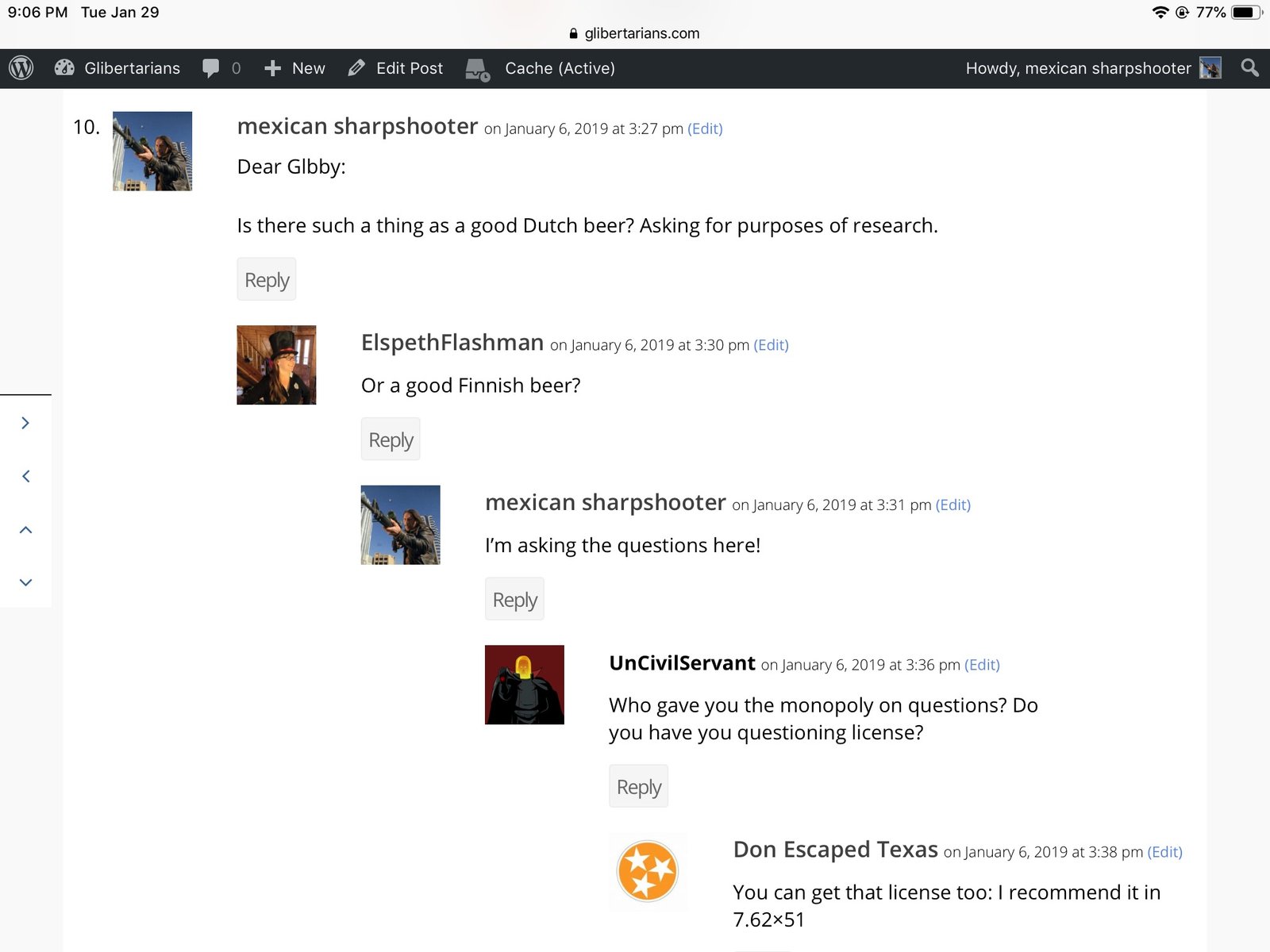
    ”Speaking of which, I’ve never done an article on a Dutch beer.  You’ve been to the Netherlands.  Are there any that are any good?”  I asked.

    ”No.”

    ”None?”

    ”Nope.”

    ”Not even Oranjeboom?”

    ”Not unless you are a college student, homeless, or otherwise an alcoholic.  The Belgians broke off and took all the good beer with them.”

    ”There’s gotta be one.”

    ”You think so?  mex are you a betting man?”

    ”Possibly.”

    ”You will not be able to find a single Dutch beer worth reccomending.  I will wager a Krugerrand, and trust me, we all know when you’re lying.”

    ”Fair enough,  I will need the IBAN and SWIFT Code…wait, how is the account located in…you know what, nevermind.”  I managed to answer the next few questions without his input.  “Okay, its called Portland Boat Tours.  The page can be found here.”

    ”Portland Boat Tours?”  Swiss asked.

    ”Trust me.  I worked for the federal government once, the last place they will look for anything, is Oregone.”

    ”That makes sense.  This call is over.”


    The first place I asked of course, was the Glibs.  Somebody would have a good suggestion, right?

    Perhaps not.  I did get one that was serious (H/T Nephilium, naturally) but sadly I was unable to locate it locally.  Others, still…seemed determined to make me fail.

    I had to try any I could find.

    Heineken?

    No, thats still Dutch piss.

    Grolsch?

    Cool bottle, but ultimately the proper pronunciation sounded like the sound one makes while puking.


    Finally, I thought I found one at Trader Joe’s:

    It was light, crisp, balanced and had a pleasant finish.  Sadly, that was before I read the fine print.

    …and so it goes …

  • Aligning the incentives in the Union

    I liked Not Adahn’s post on changes to the political system enough that I thought I’d write one of my own. While I could wax philosophical about democracy and republicanism and the like, that’s all been hashed through 1000x by people much smarter than me.

    Instead, I wanted to approach some moderate changes that could be made to the current system to make them much more responsive to citizens’ revealed preferences and personal priorities rather than their stated preferences and social priorities. I’m under no illusion that any of this could ever happen, but it’s a fun discussion to have.

    I mentioned in Not Adahn’s post that barriers to entry aren’t going to affect the incentive to acquire power because power, once acquired is lucrative enough to render those barriers to entry useless.

    I wrote:

    The only way to curb abuses is to kill the incentive to accumulate power via fedgov. That’s an incentive that cant easily be counterbalanced with barriers to entry or other disincentives. It’s also very hard to reduce or kill that incentive. As long as fedgov is the sovereign, no amount of legislation will prevent power seekers from eventually maximizing the reach of their institution.

    What’s the best way to curb the social greed of those who seek power and the complacency of the electorate that gives the power to the seekers? How about an even stronger and more acute incentive? Personal greed.

    Perhaps not this half-cocked.

    My half-cocked idea is as follows. Tax day is now election day. The total government budget is set by popular vote, but with a twist. You have 5 choices: Budget stays the same as last year (zero based, no adjustments). Budget plus 5%, Budget minus 5%, Budget plus 10%, Budget minus 10%. Once you are done voting, you get a receipt for your votes (like usual), as well as a bill for your taxes owed at the percentage you voted for. Taxes are due immediately, and there are representatives of the IRS and the various localities in the building to take payment.

    If you do not pay, your vote is marked provisional and you have 30 days to pay your bill (plus interest) and have the vote counted. After 30 days, your vote no longer counts, and while you still owe the money (and interest), it is no longer considered part of the annual budget and is saved in a rainy day fund that requires massive agreement to access (2/3 states and 2/3 of each legislative body).

    This delineation is important because the federal budget is given to Congress based on actual tax receipts within the 30 day window. Balanced budget is constitutionally required, but Congress has the authority to allocate the specific expenditures within the money received on voting day. However, once you run out of money, you’re done.

    Obviously, it would require a massive simplification of the tax code. It would probably also require some sort of assurance that everybody has to contribute at least something.

    The benefit of this plan is that it aligns incentives for the populace limiting taxation and government expenditures.  Of course, it would never happen because 1) it takes away the meticulously crafted system where costs of government are hidden and benefits are touted; and 2) anything that associates taxation with voting will be lambasted as “POLL TAXXXXX!!!!”