Category: Social Justice

  • The Loss of American Social Power – Homelessness (with an aside on the racist origins of gun control)


    Asks a man for what he can spare with shame in his eyes...


    I have to confess to being interested in politics, perhaps unhealthily so. I wasn’t always. It wasn’t like I had some childhood fascination with my local senator. In truth, I think I’ve only ever voted in one Presidential election. (I may have voted for Perot, but I can’t honestly say for sure). Which is a nice way of saying that the current election cycle is a nightmare for me,* as it is for many thinking and principled Americans. It feels like the devolution of our country. To those who see politics as the public barometer of the state of a Nation, it feels like a forceful bellwether of decline, the dying gasp of a once great and moral Country.

    We’ve all seen the man at the liquor store beggin’ for your change
    The hair on his face is dirty, dreadlocked and full of mange
    He asked a man for what he could spare with shame in his eyes
    “Get a job, you fuckin’ slob” ‘s all he replied

    [CHORUS]
    God forbid you ever had to walk a mile in his shoes
    ‘Cause then you really might know what it’s like to sing the blues
    Then you really might know what it’s like…

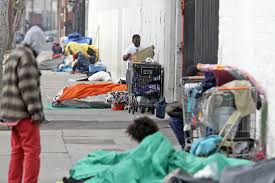
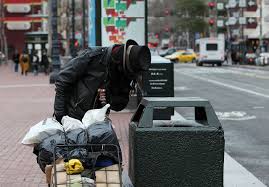
    I had occasion to find myself in South Bend, Indiana, (yes, the one where Notre Dame is) for work. Driving up and down a particular main avenue running some errands, I noticed a man standing on the corner near the onramp to a highway. He was disheveled, though not too badly, and holding the ubiquitous sign that told his (alleged) story: “Homeless and I need to feed my family” read the message in red paint on the cardboard. I passed him in the afternoon without too much thought, though the prevalence of veterans among the homeless always makes me hesitate and ponder long after I’ve passed. Sometimes, if the timing is right, I’ll give what I can or have on me, though not always. I would imagine I’m like most people in both my thoughts and deeds with regard to the homeless. Perhaps better than some, certainly worse than some others. I’ve worked the odd soup kitchen or two for a church function or for a community service project that my kids had to and I rolled along.
    Albert Jay Nock was a brilliant and radical philosopher of the early 20th century. Born in 1870, he lived to see the First World War and died just as the Second one ended in 1945. One of his more well-known and seminal works was “Our Enemy, The State.” Finished and published during the height of FDR’s “New Deal” in 1935, Nock believed that the most effective form of government, and protective of individual rights, was the tribal “anarchism” of the early Native Americans. In an earlier work, titled simply, Jefferson, Nock argued that Thomas Jefferson was a firm believer that the smallest possible governmental units, or wards, allowed the people to, in Jefferson’s own words, “crush regularly and peaceably the usurpations of their unfaithful agents.”

    Nock’s later work in Our Enemy, The State focused on the difference between the spontaneous “social power” of individuals coming together for common cause and the forceful usurpation of social power by “State power.” His central thesis was set forth very clearly in the early part of the book and, in three short pages, Nock compels even the casual, disinterested, or even adverse reader to reconsider their entire understanding of State intervention in human affairs.

    One might wonder just what the hell all of this has to do with an (apparently) homeless guy standing on a corner in South Bend, Indiana, in mid-October, as I drove by him more than once over the course of several hours. Fair question. Let me convince you by pointing to one of the most trenchant parts of Nock’s argument that stuck with me:

    …just as the State has no money of its own, so it has no power of its own. All the power it has is what society gives it, plus what it confiscates from time to time on one pretext or another; there is no other source from which State power can be drawn. Therefore every assumption of State power, whether by gift or seizure, leaves society with so much less power. There is never, nor can there be, any strengthening of State power without a corresponding and roughly equivalent depletion of social power.

    Our Enemy, The State, p. 5 (emphasis added).

    The thesis seemed interesting to me, but I wasn’t quite sure what Nock meant by “social power” versus “State power.” I thought I quite understood the latter, but I wasn’t quite sure what the former was. Nock’s examples left me with a permanently-altered view of government attempts to intercede to “help” the citizenry. Nock provided two (then)-contemporary examples to illustrate his point more clearly.

    …it follows that with any exercise of State power, not only the exercise of social power in the same direction, but the disposition to exercise it in that direction, tends to dwindle. Mayor Gaynor astonished the whole of New York when he pointed out to a correspondent who had been complaining about the inefficiency of the police, that any citizen has the right to arrest a malefactor and bring him before a magistrate. ‘The law of England and of this country,’ he wrote, ‘has been very careful to confer no more right in that respect upon policemen and constables than it confers on every citizen.’ State exercise of that right through a police force had gone on so steadily that not only were citizens indisposed to exercise it, but probably not one in ten thousand knew he had it.

    (emphasis mine). We discussed the idea of a citizen’s arrest in law school, but I couldn’t and can’t recall much of what was said. My initial reaction reading Nock was to recoil at the thought that we all had the same powers of arrest as against each other as any officer of the law does, but then again, how much of the current problems in troubled neighborhoods stems from the fact that the local citizens who live there have abandoned even the most modest attempts at reducing the crime, violence, poverty, homelessness, drug abuse, etc., in their neighborhoods? The rejoinder is that the people are not armed and the drug dealers and gangs are and thus the people are at a distinct disadvantage, and hence comes the justification for military-grade police forces armed as well as or better than combat troops for the national defense; yet aren’t their some fundamental factors missing from that analysis? If the drug dealers and gang members inhabit those self-same neighborhoods, who is giving them succor? How do they put their heads on their pillows at night and feel secure in these same neighborhoods where they prowl and prey? These are, perhaps not coincidentally, the very same issues that confronted me while I was in Afghanistan, attempting to “police” a particular area that was rife with terrorism (and narco-traffickers, as well). I’ve watched many a frustrated military member talking to village elders asking, “Why are there rockets being launched from this area at our base every week? How is that happening?? Where do these people come from and sleep??”

    Upon careful inspection, what one finds is: first, the police do not actually live in the same neighborhoods that they patrol. In point of fact, they live in suburban outposts, miles and miles from the streets they pass through in their cars, as distant from the citizenry they supposedly serve and protect as they are from the gangs they are supposed to be interdicting. A lot of that is economics and has to do with the pay disparity between cops and the average inner city neighborhood they’re patrolling. Second, the people are at an “arms disadvantage” specifically because the State has disarmed them! It is a well-established historical fact that modern gun control suddenly became vogue during the late-1960s after armed blacks showed up to the California State Capitol armed with – (gasp) – “assault rifles!” (and shotguns, and pistols, as the above-linked article notes). As an aside, Clayton Cramer, a software engineer, does about as good a job as a law professor could in explaining that virtually ALL gun control laws have been racist in their origins and intent. This might seem self-evident when one considers that the right of a freeman to own weapons goes back to the days of sword ownership in England. If not still convinced, the Supreme Court made this explicitly clear in Dred Scott v. Sanford, 60 U.S. 393 (1857). Yes, that Dred Scott. The case itself should be required reading as a part of any basic civics course because of just how many incredible statements of historical significance for Constitutional law are in it – including statements by the Court about what defines a “citizen” and the Congressional power to “naturalize;” the right of states to admit immigrants, the status of descendants of slaves in free states vs. those of native Americans, the limits of judicial construction, and more – but of paramount importance for this discussion is what the Supreme Court used as one of its Constitutional justifications for finding Dred Scott could not sue for his freedom:

    More especially, it cannot be believed that the large slaveholding States regarded them as included in the word citizens, or would have consented to a Constitution which might compel them to receive them in that character from another State. For if they were so received, and entitled to the privileges and immunities of citizens, it would exempt them from the operation of the special laws and from the police regulations which they considered to be necessary for their own safety. It would give to persons of the negro race, who were recognised as citizens in any one State of the Union, the right to enter every other State whenever they pleased, singly or in companies, without pass or passport, and without obstruction, to sojourn there as long as they pleased, to go where they pleased at every hour of the day or night without molestation, unless they committed some violation of law for which a white man would be punished; and it would give them the full liberty of speech in public and in private upon all subjects upon which its own citizens might speak; to hold public meetings upon political affairs, and to keep and carry arms wherever they went.

    Dred Scott, 60 U. S., 416-17.

    To return to Nock’s point about social power and state power, what has happened in inner city black, and other minority, neighborhoods more broadly, is that the state has systematically usurped the “social power” – and the ability to wield it – that was originally resident in most neighborhoods and replaced with state power, which is only intermittently there “on patrol,” but not resident in that area.

    If you’re still not sure about Nock’s thesis, he provides many more examples that will shock the modern sensibility about how this country used to work.

    Heretofore in this country sudden crises of misfortune have been met by a mobilization of social power. In fact — except for certain institutional enterprises like the home for the aged, the lunatic asylum, city hospital, and county poorhouse — destitution, unemployment, “depression,” and similar ills, have been no concern of the State, but have been relieved by the application of social power. Under Mr. Roosevelt, however, the State assumed this function, publicly announcing the doctrine, brand new in our history, that the State owes its citizens a living.

    Students of politics, of course, saw in this merely an astute proposal for a prodigious enhancement of State power; merely what, as long ago as 1794, James Madison called “the old trick of turning every contingency into a resource for accumulating force in the government”; and the passage of time has proved that they were right. The effect of this upon the balance between State power and social power is clear, and also its effect of a general indoctrination with the idea that an exercise of social power upon such matters is no longer called for.

    Our Enemy, p. 5.

    Nock’s second example involved natural disasters and this is a matter I have given some thought, particularly in light of the revelations regarding the Clinton Foundation’s actions in Haiti.

    It is largely in this way that the progressive conversion of social power into State power becomes acceptable and gets itself accepted. When the Johnstown flood occurred, social power was immediately mobilized and applied with intelligence and vigor. Its abundance, measured by money alone, was so great that when everything was finally put in order, something like a million dollars remained.

    If such a catastrophe happened now, not only is social power perhaps too depleted for the like exercise, but the general instinct would be to let the State see to it. Not only has social power atrophied to that extent, but the disposition to exercise it in that particular direction has atrophied with it. If the State has made such matters its business, and has confiscated the social power necessary to deal with them, why, let it deal with them[!]

    Id.(emphasis added)

    I think the power of this example is that it has been repeatedly demonstrated through the modern era, considering the string of well-publicized failed federal disaster relief efforts through FEMA. A fairly comprehensive history of US disaster relief efforts proves the exact point that Nock was trying to make. Over time, as the federal government has increasingly intervened, local disaster relief efforts have tailed off and, in the ultimate slap-in-the-face, have even been prohibited and physically turned away by FEMA, most notably during the Katrina debacle in New Orleans.

    Nock’s final example of this diminution of social power was the one that stuck with me, though. Writing during the horrors of the Depression, Nock opined:

    We can get some kind of rough measure of this general atrophy by our own disposition when approached by a beggar. Two years ago we might have been moved to give him something; today we are moved to refer him to the State’s relief agency. The State has said to society, “You are either not exercising enough power to meet the emergency, or are exercising it in what I think is an incompetent way, so I shall confiscate your power, and exercise it to suit myself.” Hence when a beggar asks us for a quarter, our instinct is to say that the State has already confiscated our quarter for his benefit, and he should go to the State about it.

    Id.
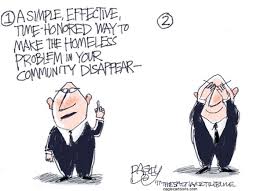
    Guilt-free?
    Humor works best as a vector for Truth.

    And NOW we come back around to our homeless man on the street in South Bend, Indiana. (And Thanks! for sticking around).

    As I drove by him for the final time, it was past sunset, but not quite fully dark yet. He stood there in the same place holding the same sign. I couldn’t even tell if he had moved. I started to reach for my wallet but then the light turned green, so I accelerated away, leaving the man dwindling in my rearview mirror.

    “Aaaaahhhh….” I looked in the mirror as I went under the overpass, headed toward the comfort and warmth of my hotel. It was a rather warm October night, one of those last gasps of Summer before Fall fully settles in, he’d be alright… I thought of Nock’s words. “Fuuuuuck….” I muttered, rubbing my chin.

    I made an abrupt U-turn like any person who learned to drive in Rhode Island would, went past him, “banged another U-ee,” and there I was – and there he was – still holding his sign. It wasn’t the nicest part of town, but it wasn’t the worst, either. All I had was a ten and twenty dollar bill in my wallet.

    While stopped at the light, I looked left quickly where another car had pulled up to the light. There were three young black kids, all teenagers, ranging from perhaps thirteen to seventeen. The car was a bit dented up and they were watching me as I fumbled with my money, then tried to find the window unlock button in my rental car. I finally managed it all and motioned the man on the corner over; I handed him the ten as he leaned in my passenger window. He didn’t see it at first in the dark, but as he stepped back he said, “Oh My God, thank you. Thank you!” He started to walk away and I could hear his voice crack as he said: “I’ve been standing here for hours…”

    “I know,” I started to say, but it died on my lips. I’d driven by him all those times…

    I looked left and the three black kids were holding their thumbs up. The young kid in back was clapping. I just shrugged sheepishly. Then the car door opened and for a moment I thought, “Aw, fuck. Here we go. He’s going to ask for what I have left.” Then it became clear as I looked at the car it was because the window wouldn’t roll down. The teen leaned out and yelled: “I wanted to give him something, but I don’t have any money!”

    “Well…good on ya.” I said back. I couldn’t think of anything clever to say. “He needed that more than I did,” I yelled. “And I had it, so…” They smiled, waved, honked, and drove away as the light changed.

    And that was it.

    At a time when our country is rife with divisions over political parties, where we are told which lives matter, where we are no longer allowed to speak without fear of retribution if someone should be offended, where “hate speech” is now all the rage, and where I am told a car full of black teens should concern me because they are “superpredators,” where statisticians write papers claiming that abortions of black kids have helped drive down crime rates, where 1 in 4 or 5 or 7 homeless folks are military veterans, I think the “soft revolution” is what I now hope for…

    I hope that people will recognize that we all could and would be far more inclined to be charitable to our fellow man if we got to keep a little  more of our hard earned money, if our government wouldn’t tell us that IT is the ONLY possible solution to our problems, and if we all decided to simply act more charitably toward our fellow man – to take back our “social power” instead of waiting for the State to fix whatever the need is of the moment. Individual US citizens gave $258 Billion (yep, with a “B”) in 2014 – a record. At a time when the economy isn’t exactly humming. We should be proud of that, but how much better could we do if we got to keep more and decided to “just do it” ourselves, locally?

    Regardless of which shitheel gets elected, we should ignore their grand plans to “cure” _______ (drug use, poverty, racism, school shootings, or whatever the issue du jour is) and start exercising our social power. We don’t need to be told what the right thing to do is. We don’t need government to tell us to be kind to one another.

    We need to realize that we have to be the change we seek in the world and start doing it in the small ways that we can. Maybe eventually we’ll figure out we don’t need a three or four or five-letter federal agency to fake like it’s doing something while it hands out contracts to favored political donors and the people who really need help go wanting. Else I fear we risk continuing to ignore those in need among us because we have the excuse that “someone else” – like some bureaucratic agency or even the police – is going to do it. They’re not and they never have – and even if they did solve a problem, when was the last time you heard of some federal agency announcing that it had accomplished its purpose and thus was folding up so as not to waste taxpayer money? I won’t hold my breath waiting for the numerous examples…I’ll just try to exercise Nock’s social power to make the world around me a little bit better.


    *This post was originally written in the lead-up to the 2016 election.


    _____________

    Liked it? Take a second to visit www.theabjectlesson.com and support The Abject Lesson via Patreon.

  • The Moral Panic of Joanna Schroeder

    Joanna Schroeder as pictured in the CNN article.

    California mother and serious writer Joanna Schroeder recently got her fifteen minutes of fame courtesy of breathless CNN reporter Sara Sidner. Why, exactly? You see, Ms. Schroeder is very, very concerned about the well-being of her teenage sons, as a good mother should be, and wanted to raise the alarm for other mothers of teenage boys to be aware of the insidious reach of right-wing propaganda. She valiantly warned her fellow naive do-gooders about the sinister extremist messaging being used to target youth, lest they be “drawn in by snarky memes.”

    Words to watch for

    Snowflake: used to mock people deemed too sensitive, especially about issues impacting minorities

    SJW: stands for “social justice warrior,” a term used to mock civil rights activists

    Sidner does offer the rote, perfunctory disclaimer that Schroeder “does not shun mainstream conservative thought,” yet curiously fails to provide any evidence of that, or any example of what constitutes mainstream conservative thought. This claim is completely and laughably undermined by the inclusion of the terms “snowflake,” and “SJW” in the sidebar list of forbidden speech.

    Those terms have been part of conservative dialogue for years. National Review is the leading organ of that mainstream conservative thought which Schroeder claims to not shun, yet of which she is blissfully unaware. A quick web search of the National Review website yielded articles from early 2015 by James Lileks and Jennifer Kabbany with the contemporary usage of “snowflake” as a term for overly-sensitive, nominally adult humans. Rather prophetically, Kabbany’s piece is titled “The Death of College Humor.” The term “SJW” was first used by National Review in late 2015 in articles by George Leef and Katherine Timpf.

    Those who use the phrase sarcastically, as most do, imply that the snowflakes’ sensibilities are impossibly delicate, and shatter when confronted with the horrible realities of the world, such as capitalism or people who are insufficiently troubled by the link between climate change and industrial lettuce production. –James Lileks

    Four and a half years is forever ago in the age of internet and twenty-four hour news. Yet, somehow, concerned mother Schroeder and professional journalist Sidner both missed those and all the subsequent references in National Review and other conservative media. And all the serious, informed, and rational discussion about the chilling effect of speech codes, and the erosion of first amendment rights.

    Words to watch for
    Beta… Cuck…
    Femenoid/femoid…
    Redpilled…
    Blood and Soil…
    14 or 88…
    ((( )))…

    That’s quite an impressive list that they have assembled, and some of them are actual white supremacist dogwhistles: “Blood and Soil;” 14; 88; and the “echo,” those three nested parentheses denoting the thing contained within is (((Jewish))). But it should be noted that the echo has also been coopted by Jews and is often used ironically. Schroeder is right to be concerned about teenagers using those phrases. But including the phrases “SJW,” “snowflake,” and “triggered” in that laundry list only fans the flames of hysteria and undermines Schroeder’s already dubious credibility.

    The first word I heard was “triggered,” and that’s a tough one. You may hear this from your conservative uncle, and you may also hear this from a kid who’s getting a lot of alt-right messaging online, and that’s everyone’s too sensitive today. -Schroeder, CNN interview

    About the term “triggering” – Schroeder seems unaware that the term was originally a legit feminist term, explained to us back in June, 2015, by Gillian Brown on that unimpeachably feminist website Everyday Feminism. That the term has been so thoroughly co-opted by relentless parody that she is only familiar with its ironic usage must be as disappointing to Schroeder as having her lack of familiarity with feminist rhetoric exposed.

    This guy understood the role of media in creating moral panics all the way back in 1964. He would have referred to Schroeder as a “moral entrepreneur.”

    Schroeder does grudgingly acknowledge during her CNN interview that not all those “words to watch for” are racist, but some are “gateways.” The slippery slope argument, hinted at. Just like Marijuana is a “gateway drug” and every person who takes a puff from a “reefer” will eventually end up a heroin addict. And then there is the slippery conflation of mere mockery with inevitable racism and homophobia, since according to the article the term Snowflake is used to mock people “especially [emphasis added] about issues impacting minorities.” SJW, we are informed, “is a term used to mock civil rights activists.”

    These terms are being used to mock and push back against the speech police, wannabe censors and their enablers such as Schroeder. The whole point of “triggering,” in the original usage anyway, is the conflation of speech with actual physical violence. This is unacceptable to those of use in the Liberty community, and moral scolds such as Schroeder must always be seen as enemies of free speech.

  • Just the Tip

    One day I went to a restaurant/bar that my sister worked at in college.  She was just paying her way, and I really just showed up because I didn’t have much anything better to do after work and it didn’t make sense to drive home if I was just going to have to drive back out again to pick her up.  So I ordered a beer and told her to bring the check with her.   Under the gratuity tab I wrote:

    $0.00  HA!!!*

    This is my review of Brasserie Caracoule Nostradamus Belgian Brown Ale

    Earlier this summer, this article from Politico ruffled a few feathers.  It is an editorial discusing a piece of legislation that will not only raise the nation minimum wage to $15, it also contains a provision that will eliminate tipping.

    There’s another provision in the legislation—eliminating the subminimum tipped wage—that corrects a wrong that goes much further back than the previous federal minimum wage increase. For workers regularly making more than $30 a month in tips, employers can currently pay as little as $2.13 an hour. That subminimum wage has been frozen at this level for decades. Should the Raise the Wage Act pass the House, it will mark the first time that either chamber of Congress has moved to eliminate the subminimum wage, which not only deepens economic inequalities but also happens to be a relic of slavery.

    I suppose that makes it problematic the most racist president in American History happens to carry a bunch of $20’s in his back pocket specifically for tips–and it is.  He is supposedly a billionaire, I expect $100’s.  Chances are pretty good he made a fortune in the hospitality industry and knows those workers are often motivated to work hard if he tips well.

    Should’ve shown more leg

    Is the United States emblematic of it’s underlying racism by perpetuating a tipping culture in the services industry?  Lets check in with the supposed most perfect country of them all, and an actual racist country and see if there is a tipping culture there…I guess they showed me.  Or did they?  Chances are the most reasonable explanation for such a disparity between these two countries is—its complicated.  After all, in Japan tipping is considered rude.

    Here’s my problem:  I happen to be a person of color, and while I have experienced casual racism on occasion nobody is lynching me.  From the “inherently racist society” standpoint, sometimes somebody will say something stupid.  To be honest all it really tells me is that person is an idiot, if all they are doing is saying stupid things there is no sense in letting that affect my mood.  From the “inherently racist society therefore racist government” standpoint, some Janet Reno type is not sending anybody to kick down my door, and take me back to where I came from.  Yes, immigration raids are a thing, but given that I’m a natural born citizen that’s not really a concern for me.  Besides, that’s more a symptom of a our quasi-eunuch culture that practically begs for an enormous overbearing bureaucracy to step in, and make things all better…

    The worst I normally experience is from other Mexicans, who assume I primarily speak Spanish based entirely on appearances.  Let’s face it, if I put on a Panama Hat, tuck in a collared shirt, and walk around a bit somebody is going to ask if I need hands on my hacienda.  Its a look I pull off.

    That said, the only way we can fix this is for some to recognize society has moved on from sins of the past.  Was it bad?  Absolutely.  Is it a custom with roots in an unsavory part of history?  Okay fine, yes.  Is it a custom that continues to be justified by this unsavory history?  No, it absolutely is not.  We tip because we know some occupations do not make a particularly affluent living, but it is a living because the expectation is the service they provide can be rewarded IF it is exemplary.  Failure to provide said service in even an acceptable manner, will result in the employer to fire said employee because that service is not particularly difficult and a replacement is easily found.

    People making this argument against tipping culture, conveniently forget the owner of the establishment also loses if the service is bad.  The food may be fantastic, but it doesn’t do anybody any good if I am staring at my empty water glass because I am not presently eating that fantastic meal.  If I should leave, nobody gets paid and the owner is stuck with the cost of the unserved food.  Repeat this process for a year and none of the servers and the owner are without work—because the restaurant is out of business.  But servers in Europe are paid without tips… In my experience, the service and food in France sucked, the service in England and Ireland was good even if the food also sucked.  Guess which countries I was expected to tip?

    Want people to move on from our racist past?  Stop trying to scour every single aspect of culture and society in an attempt to root out a nearly extinct boogeyman.  The rest of us moved on, perhaps you should too.


    Is this beer any good?  Hell yeah it is.  It is similar to red label Chimay but does not bear the Trappist mark for those that prefer Catholics not fly their freak flag.  Not quite as good.  What?  Did you think I was going to yammer on about Nostradamus?

    In the year the emperor’s robe turns ablaze. Drink will spill.  The libation bearing my name, flows to enhance the good times they will.

    How is that?  Brasserie Caracoule Nostradamus Belgian Brown Ale 3.8/5

    *Relax, I had $2 in cash on hand and left it on the table.  Not enough to pay for the beer, but plenty for a tip.  Why wouldn’t I tip my own sister?

  • Antisocial Media

    Social justice is a term that gets thrown around a lot these days, so it’s worth taking a little time to define it and talk a little bit about its history. In its original and broadest sense, social justice refers to the rights an individual possesses in relationship to the society of which the individual is a part. For centuries, to the extent that social justice was distinguished as a separate concept it had to do with the moral obligations that either institutions had to individuals within society or that members of society had to one another above and beyond their legal obligations. The Catholic Church in particular used the latter meaning to promote charity as a moral duty.

    To sum it up, social justice is the idea that being a member of society entails certain obligations to society in exchange for certain benefits from society; social justice, then, is that state wherein an individual fulfills those obligations to society and vice versa. This isn’t just a matter of expecting that your garbage will be picked up because you’ve paid your bill. This has more to do with the individual’s role as a part of society, and the less transactional, more ephemeral expectations one might have of society. In some cases this overlaps with more traditional senses of justice, e.g. you would expect equal treatment under the law no matter your ethnic background, while in others it goes into ideas such as the expectation of being treated with dignity or respect.

    The idea of social justice changed rapidly towards the beginning of the 20th century as the Progressive movement and the Socialist movement both seized it to add moral gravitas to their platforms. The idea itself is deliciously vague. If society has an obligation, who specifically has to fulfill it? Who determines if a person has fulfilled their duties to society? What are those duties, and what does society owe in exchange? As those movements and others since have adopted social justice as a moral justification they’ve offered their own answers, giving us social justice as we know it today.

    Social justice in the modern era has a few key characteristics. It is first and foremost a revolutionary movement very similar to the Cultural Revolution. It is largely a vehicle by which a minority composed largely of young academics attempt to gain political power by breaking down traditional moral norms and establishing themselves as a new moral authority. Like the Cultural Revolution, adherents want to destroy tradition, which they see as a tool of oppression. Also like the Cultural Revolution, it is a movement based more on faith than evidence, and sees logic as a tool to be used or discarded depending on its utility in achieving goals rather than as a set of rules by which ideas should be evaluated. Finally, just like the Cultural Revolution, adherents use social pressure, fear, and shame to attack rivals or foes, particularly those who they perceive as being members of a cultural or political majority. It is this aspect in particular which makes social media, especially outlets such as Twitter, so appealing to the social justice movement.

    One might think of social media in terms of eras. The ancestor of modern social media is the BBS, or Bulletin Board System, a simple, popular, effective format that lives on today in comment sections across the Internet, for better or worse. As access to the Internet became cheaper and more widespread and as web technology advanced, people began making their own websites. Later, services arose that offered an individual web presence without requiring any technical knowledge, with a heavy emphasis on personalization, such as MySpace and LiveJournal, and ultimately Facebook, which took the basic format of a personal webpage and added a social aspect. The prevalence of mobile devices brought us full circle with services like Twitter, which sacrificed some of the “webby” flavor of services like Facebook in favor of rapid broadcast communications not unlike the BBS of old. Social media started off with people talking to each other, then went to people advertising themselves, and has now arrived at people advertising themselves and talking to each other. Or, if you’d prefer, we talked to other cat owners about our cats, then made websites so that people we don’t know could look at our cats, tried to meet other people with cats, and now keep everyone updated about our cats whether they care or not.

    An important trend in the development of social media is that the barrier to entry has lowered significantly. Access is dramatically cheaper and easier than it was thirty years ago, for instance. This means more people have access to social media, which means more cat updates, more responses to cat updates in terms of volume and frequency, and faster responses to the responses. Instead of sitting down at a computer, dialing the modem, waiting for the connection, and downloading text, anyone with a smartphone can post something in seconds while doing something else–unthinkingly, one might say.

    This has not been an unvarnished blessing for humanity. It has, however, done wonders for the adherents of the modern social justice movement. Modern social media, in particular Twitter, is arguably the lifeblood of the social justice movement as it exists today for a number of reasons.

    Recall that the social justice movement is motivated by a desire to attack and displace what it views as the dominant power structure using tactics such as public shaming and ridicule, upsetting traditional social structures and values, and replacing them with its own, with social justice adherents taking political power from the old guard. Now, consider a platform such as Twitter. It’s a free communications service that lets users broadcast short messages to groups. It offers an extremely low transaction cost, which is to say that a person can broadcast a message instantaneously without fear of interruption, immediate physical reprisal, or damage to reputation–provided that the user has insulated himself or herself by using a pseudonym. Contrast this to, for instance, public speaking, where a person can be shouted down by a crowd, threatened with physical violence, or attacked.

    Consider also the nature of social media as its own parallel social environment. Social connections made via the Internet differ from those made in any other venue not just in geographic distance but in the way in which Internet societies tend to exist in isolation from other traditional societies. In every other context, be it face-to-face, print media, television, or radio, participants maintain a connection to their personal lives. On the Internet it’s much more common, in fact it’s the default condition, that people create a separate persona. How many people reading this are using their real names as user ids, for instance? It’s not a coincidence that the phenomenon of “doxxing” didn’t arise until social media, despite the fact that for centuries now people have been able to write something anonymously and send it to a printer for publication.

    One way to think of social media is as if it were taking the game of traditional social interaction and shaking the board. In this new environment you can recreate yourself. A cat may look at a king, as the saying goes, but even further, the cat can become a king. Clout in social media is largely based on one’s ability to attract attention. There’s also a deep personal investment that’s encouraged by the medium despite the potential for anonymity. Social media attention is measured in metrics such as “likes” or followers or friends. It is an environment that is extremely personal and driven by noise, rather than truth. It is, ultimately, a clamoring mob looking for direction from the loudest member, without regard for credibility. And the emotion that it evokes has consequences in the real world.

    If you’ve observed discussions about topics of social justice in person, you may have noticed that they tend to falter once they start to get to details. The inability of the term itself to support any rigorous defense quickly leads to a situation where advocates must rephrase their argument more specifically and lose the moral cushion of the broader, meaningless term. In a social media context, however, the medium lends itself to an emotional argument to the crowd. Most people can explain why, for instance, a minimum wage is counterproductive to the people it’s supposed to help, but if forced to do so in a Facebook comment or a tweet, that’s a much more difficult proposition. Anyone who has tried to explain to a toddler that they can’t have ice cream until tomorrow has seen this first-hand.

    So, how do you handle social justice and social media?

    Ideally, don’t. Don’t engage. Social media’s low transaction cost means that people who don’t value your time or attention can throw a thoughtless comment out and go on with their day. It also means that people who have more energy and vitriol than sense and responsibility can occupy the field longer than you. Bear in mind also that these people are trolls. The goal is to get attention, not to resolve a conflict or arrive at a deeper truth. There is no scenario in which you engage in reasonable debate and both arrive at a better place.

    If you absolutely must, however, never–NEVER–apologize. Never concede the point. Never even concede the terms of the argument. This not only lends credibility to their argument but it puts you in a position of guilt you won’t escape. Celebrity after celebrity makes the mistake of offering a conditional apology–”If I’ve offended anyone I apologize…”–and suffers for it. You will not be forgiven just because you did nothing wrong. The point was the attention. Therefore, if you must engage, ridicule. Poison the attention they’re getting. If there’s one thing that is absolutely deadly in the world of social media, it’s humor. Few survive becoming a laughingstock.

    The shame of the modern social justice movement is that they took a benign but meaningless term and used it as a hammer for socialism and radical Progressivism. A society can neither be just or unjust; only people can be just or unjust. To say that a society can act in that sense is the same fallacy that lies behind people saying that a market failed to do X; it’s no coincidence that these same people tend to advocate for statist solutions, believing as they do that the state, whether it’s called “society” or “the market” dictate human choice. Social media is dominated by statists because statists dominate social media. In this sense it’s no different than traditional media.

  • A Pessimistic Assessment

    I think libertarians (and normies of all political persuasions) need to admit to themselves that they have lost the culture wars, and that trying to refight battles over freedom of association, color-blind government and institutions, individualism not tribalism/collectivism, even the priority of objective reality over subjective “truth” is worse than pointless, it is counterproductive.  We can wax nostalgic all we want for a Constitution enforced as written, etc., etc., but that’s all it is – nostalgia.

    Face it:  The crypto-Marxist Left’s long march through the institutions is over.  They won.  The commanding cultural heights belong to them – government, academia, media.  The evolution of Marxism from economic class warfare to identity politics has been a smashing success, to the point where the long march has moved on from the cultural heights to the economic heights.  Key infrastructure businesses are now implementing their agenda – banking, the big data and platform quasi-monopolies, ISPs, and misc. other businesses are purging dissenters not only from the public square, but from the marketplace as well.  They are shooting the survivors, and there’s not a damn thing we can do about it, because they have the backing (enthusiastic support?) of the administrative state and judiciary.

    We aren’t going back.  The cultural DNA that formed the foundation of American civil society is being eradicated from the societal gene pool.  The long march has given the Left a massive indoctrination and enforcement regime.  Their hold on the cultural heights is heavily fortified and self-reinforcing.  You can say “oh, its just a small, noisy minority”, but look at the trends: central cultural and government institutions are now under their control, we now have unprecedented support for socialism in this country, agency after agency and business after business are now pushing the Leftist agenda, a major political party is pushing the Leftist agenda, hard, in its Presidential nomination process, and its now non-Leftists, not Leftists, who are reluctant to go public with their beliefs.

    There is no marginal, gradual, incremental reform that can be brought about through rational discourse that will end Leftism.  They ruthlessly police entry into their institutions, so they can’t be subverted from within or even, increasingly, communicated with.  Leftist institutions will have to collapse of their own weight and inherent flaws.   There is no upside, no good reason to engage with the Left and their useful idiots.

    Worse, engaging with the Left only reinforces their tribalist/collectivist mindset. By engaging with them, you confirm to them that there are still dissenters, so that, in their minds, they have enemies, there is an “other” that needs opposing.  This is a key component of their group and individual identities.  They define themselves by who they oppose; their identity is largely negative, not positive.  Engaging with Leftists leads only to escalation and reinforcement of their beliefs.

    Naturally, a form of the NAP applies here.  If attacked by the Left, by all means defend yourself, if the attack merits a response.  If not attacked by the Left, just ignore them.  Disengage.

    We aren’t going to retake the commanding cultural heights until these Leftist institutions collapse on their own.  Unfortunately the damage they will inflict on society when this happens cannot be avoided.  I think you can see the early symptoms of this collapse, at least in academia and the media, but these are old, powerful, wealthy institutions that will persist for a long time.  There’s a lot of ruin in a nation, as they say, and I fear we may just see how much ruin there is in the wealthiest, most powerful nation to ever exist.

    I think non-Leftists have three tasks before them:

    (1)        Figure out how we lost, and how the Left won.  We won’t get anywhere fighting with strategy and tactics that are proven losers.

    (2)        Prepare for the damage the inevitable collapse the Leftist institutions will bring.  They won’t go down easy, and because the Left is inherently negative and oppositional, they will lash out.  Figure out how to avoid/mitigate the damage.  Disengagement, where possible, seems like a no brainer.  Scrubbing your social media (if you don’t just leave), minimizing your participation  in the data cattle industry, avoiding anything to do with academia all seem like good defensive measures.

    Of course, the administrative state is much harder to disengage from.  But make no mistake, the odds are that in most of our lifetimes, the current US government will suffer a catastrophic failure and will be, what’s the phrase?  Oh, yeah, “fundamentally transformed”.

    The cultural glue that held the United States together is being systematically removed, and no replacement is on offer.  Why do you think there is a relentless push for a fragmented, tribalistic, “diverse”, “multicultural” country?  Because the Total State will fill the vacuum left by the absence of a shared culture.  The fundamental transformation may initially be “Everything for the State, nothing outside the State, nothing against the State.”  But I believe their Total State is doomed, that the United States is ungovernable without a significant degree of consent from its citizens.

    (3)        Start developing what will replace the collapsed institutions.  What stands a chance of replacing the collapsed institutions that will be more resistant to the Left’s tribalist/collectivist virus?  What kind of fundamentally transformed society do you want to live in?  Because you will live in one, like it or not.

    As the title says, this is a pessimistic assessment, which comes easily to me.  If anyone wants to put up an optimistic assessment, I would love to have my mind changed.

  • Bias, Liberty and the Market

    Hello and welcome back to “Pie ponders”, in which Pie – that is me, for those who are new – raises questions on various topics of great importance. Today, we talk about the evil of bias.

    Talk of bias in hiring, wage gaps, and glass ceilings is all the rage these days. I will take advantage of glibertarians being a safe space and voice an opinion that would be routinely excoriated in a different environment: bias is inevitable and preventing it is no business of government, as long as no aggression is involved.

    But what about the wymminz, you ask? Make love to them if they are pretty and to someone else if they are plain, to paraphrase some shitlord from a while back, a different age it was, because no one would say such a thing in our enlightened time. But seriously, I kid, I kid… I would never say anything so crass. Well, about the women or minorities or whatever the answer is simple: a free market will penalize, although not eliminate, bias and bigotry, and will constantly create new opportunities. Beyond that, life sometimes sucks and you cannot prevent that by giving vast powers to bureaucrats.

    Something else controversial: bias is inherent in human experience. People are biased in every aspect of their life- it is called subjective preference. Business is an aspect of life like any other. As I said before, the whole economic/social liberty dichotomy complete nonsense. Human life is a continuum of many aspects and you cannot draw clear boundaries between them. But… but… it’s not fair… Well, life ain’t fair, depending on your definition of fair. Some things are unpleasant or sad or unfortunate. That is the way it is. Luck of the draw, as I mentioned in an earlier article. But whatever you view on the fairness of it all, you will not solve it by government aggression. I can tell you that much. Getting back to bias in the economic area of life, in the end it is no different than choosing who you date. You make decisions based on knowledge and personal preference. And, just like dating, it is an issue of skin in the game (and/or superglue).

     I do not avoid Russian women, Mandrake...but I do deny them my essenceLet’s say I own a property which I rent using Airbnb. That property is worth money and it is part of my wealth. It also can be damaged, reducing its value. If this happens, I lose money, so I have a direct interest of it not happening. Maybe, based on personal prejudice, I do not want to rent said Airbnb to say… hot Russian women. That is maybe unpleasant for the group of hot Russian women on a girl’s only vacation in Bucharest who really likes that apartment, but it is my right not to rent them my property. But maybe it is not that simple.  Maybe in my personal experience – based on the last 3 times I rented to a group of Russian women – Russian women get drunk and mess things up, it is my right and my decision to avoid property damage and, as such, loss of money. I will instead rent it out to that group of Mormon missionaries.  It is probably unfair to these 5 nice Russian girls who just want to see the museums and quietly read some books in the evening. It may even be true that statistically, worldwide, Mormon missionaries do more damage to Airbnb rentals then hot Russian women (based on OECD data for 2015). But, in the end, it is my apartment, my experience of damage, my preference and I choose how to best avoid issues, even if it means stereotyping.

    And while some groups had significant historical discrimination – imposed by law, custom and oftentimes both, I am sorry to say that this has nothing to do with individuals in the present. Collectivism tries to make it about groups throughout history, but collectivism is full of shit. Each makes choices based on personal experience and has nothing to do with other groups in the past. Furthermore, not unlike minimum wage, I have significant doubts anti-discrimination legislation, at this point in time, helps various groups more than it hurts. There is always a way to get around it.

    As a personal anecdote, the first time I left Romania as a kid in the 90s, I went on a trip to Italy, where it was sufficient to go into a store and be heard speaking Romanian for a shop assistant to constantly keep an eye on us, even follow us around, assuming we were there to steal. Was it unpleasant? Yes. Did it enrage my mom? Sure. But in the end, prejudice or experience, those shop keepers had a right to keep an eye on what they decided to be suspicious persons, as unpleasant as that may have been for me.

    If I have a business which I start with my work and my money, and I am the one at risk to go bankrupt, I get to choose who I hire, which customers I target, what products I make, where I source my raw materials and every other aspect about running the business. If I believe hiring a good looking employee helps my business, I will not hire someone I consider ugly. Is it unfair? Maybe. Here some people will say you should hire based on merit, and then exclude looks from the merit part. But can you do that? Not always and not in every business. In the end, the employer decides what merit is, based on the position they are hiring for. Hooters hires for different reasons than the local hardware store.

    I do not hire adults in my factories, clearly ageistBias will not go away. All people are biased, and sometimes – regardless of how often -with reason. You depend on various heuristics – stereotypes among them- in order to make decisions about unknown things and an unknowable future. Some of this bias can be simply bigotry. Thems be the breaks. But, in the end, when you take the risk of a business, no one without similar risk in it should get to tell you what to do, or who to hire. Because if the business fails, it should fail due to your decisions, not ones imposed by others with no skin in the game. And no one can tell you this or that “has nothing to do with the business”. There are a million ways a business can succeed or fail, and they are not clear or known. Hence all the failures. So the owner gets to decide what they want to do. You can avoid hiring women, if you think they work less overtime or they will inevitably leave to have children, or you are just plain misogynist; gays if you think your customers prefer heterosexuals or they make your best employee uncomfortable, or you are just plain against homosexuality; fat people, if you think they are weak-willed or more prone to miss work due to illness, or just don’t like the fatties. You and only you should get to make those judgments. Because it is your business at play.

    While a lot of the talk of various gaps can be proven wrong by looking at the actual data, it would not be a correct conclusion that there is zero bias. Bias in individual companies or people is not the same as widespread bias in every company or person. You will always have people who are prejudiced and make biased decisions due to that, people who are incompetent and make biased decisions due to that, people who have been burned before and make more or less excessively biased decisions due to that. But in a free market situation, there are inherent feed-backs that punish bad decision making, whether the bad decision taking is prejudice or incompetence or simply choosing wrong among various uncertainties.

    To give a final example, certain businesses in Romania do not hire people from poor non-EU country like say Armenia or India. This would cause fury among certain circles. But it is a simple calculation. People from these countries want to immigrate to the EU, but not really to Romania, and use Romania as a stepping stone to reach Germany or France or whatever. For a company that has hired such people, who then leave the second they find a job further west, it means the company paid them money in the initial stages when they were being trained and not that productive, and the moment they would become productive they left. This can lead to the company to prefer not hiring these people, based on a heuristic they developed from experience. Maybe some of them think Romania is the country for them, but there is little point in taking such a chance. Alternatively, there was great outrage in Romania when some unreproducible study or other showed that in Sweden, for identical CVs, the ones with Swedish names get a higher rate of interview offers compared to ones with Romanian names. But this makes a sort of sense, for a Swedish company, all other things equal, to prefer a Swedish person, at the very least they speak the language and have more predictable habits.

    No one is entitled to a certain job or a certain wage or a certain promotion, so being denied one of those things is not a business of government. Well, what about the social justice side of the issue? Well there is no social justice side of the issues, social justice has no skin in the game and also fuck social justice it is a stupid concept.

  • If You Can Beat Them, Join Them

    A Chronicle of the Insurgency, Part Two:

    If You Can Beat Them, Join Them

    by Tonio


    “So, the second time I got pregnant I had gotten really drunk with this boy who seemed so nice and said he had a condom, but when I was cleaning up the room the next day I didn’t see a condom in the trash. I missed my next period and tested pregnant, then he was a total shitlord douchenugget when I asked for abortion money. I had just joined Campus Action Feminists and Professor Kudchuian told us about Rescue This! I told her I was pregnant and asked if she could put me in touch with them.

    A week later I took the train up to DC and met the RT! activists. They took me to this out-of-the-way toilet they had found at the Immaculate Conception Basilica and kept watch while I aborted. That time was pretty quick and easy. Then they stickered the inside of the stall with their ‘ABORTED FETUS IN TOILET’ bumper stickers and locked the door. Once we were back on the Metro they emailed the church and the media.”

    “And we all know the rest of the story,” said Angelica Cortasio-Ortez. She remembered the news footage of the clerical outrage, and the countless crying and praying nuns, and then the of the Knights of Columbus in their silly fucking patriarchal antique British Navy hats staging a full dress funeral for the news cameras.

    “So Moira,” asked Ella, “how many people know that you’re a fully fledged RT! activist?”

    “Outside of the RT! women, only Professor Kudchuian.”

    Ella ticked her pen against her teeth. “If this ever comes out the entire right will turn into poo-flinging monkeys, just like they did the first time. And then you will own the abortion debate from the left for a few news cycles. You can always distance yourself from her if she becomes too hot.” She looked at Moira. “Everyone is expendable except your officeholder, dear. That’s the first thing you learn in politics.”

    Angelica nodded at her chief of staff.

    “May I excuse myself, Congresswoman,” asked Ella, “I want to be there to greet the Superintendent of Buildings people for your next appointment. You know how they like to wander off.”

    “Of course, Ella. Thanks. ”

    Angelica waited for the door to close.

    “Do you still want the job?”

    “Oh, yes,” answered Moira, her voice squeaking.

    Angelica’s desk phone did the intercom buzz. As she picked up the phone she heard the receptionist scream “can’t go in there…” and then silence.

    A cold breeze blew in through the closed office door. Moira shivered and huddled, drawing her feet up into her chair. “It’s him,” she whispered hoarsely.

    Every woman’s worst nighmare, thought Angelica, your boyfriend going violent after he learns that you aborted your pregnancy. Earlier, Moira had said that her current boyfriend was some sort of church leader and that she had kept the pregnancy from him. It had to be one of the patriarchal religions since progressive boys understood it wasn’t their decision to make.

    She pressed the alarm button under her desk and hoped that the receptionist had already pushed hers. The wind intensified and her office door became somehow different, like there were extra angles in the doorframe. The wind blew colder and faster and was now accompanied by howling. The door now appeared to be made of dark roiling clouds. Suddenly there was a thing in the room, a vastly large and incomprehensible tentacled thing. The thing loomed over Moira and yelled at her in a loud booming voice.


    “YOU ABORTED MY SPAWN, THEN BEAT IT WITH YOUR SHOE. FOOLISH HUMAN FEMALE.”

    Yoko Ono wasn’t right enough, thought Angelica, not just the world, but apparently the entire universe. “Now look here,” she said, then everything just stopped for her. She was paralyzed with her mouth open and her index finger extended. She could see and hear, but could not move; she couldn’t tell if she was breathing but did not feel out of breath. How patriarchal to police the speech of women.

    “Here we go again,” said Moira rolling her eyes, “‘I am an elder god.’”

    “I AM A GREAT OLD ONE.”

    “‘And I’ve destroyed races greater than yours.’”

    “STOP THAT, YOU IMPUDENT SLUT. YOU ARE THE ONLY BREEDING VESSEL IN ANY TIME, PLACE OR DIMENSION WHO HAS DARED TO TRY TO HARM MY SPAWN. I AM ANGRY. VERY ANGRY INDEED. BUT I AM ALSO IMPRESSED. NOT ONLY WILL I ALLOW YOU TO LIVE, BUT I WILL GIVE YOU A BIRTHING GIFT BEYOND ALL MEASURE.”

    Angelica just couldn’t even.

    “Birthing gift? You mean…”

    “OF COURSE YOU DIDN’T KILL HIM, BUT HE’S SCARED AND HUNGRY AND TRYING TO FIND YOU.”

    Moira didn’t like the sound of that. “Hey, I can’t…”

    “I KNOW YOU CAN’T TAKE CARE OF HIM.”

    How typical, thought Angelica, angry patriarchs telling women they were incapable of proper motherhood – like they’d know anything about that.

    From inside the bathroom came the sound of water, first a stream, then a gush. Just as the carpet outside the door started to darken with fluid there was a great whoosh and the door was sucked open from within. Then the pipe where the toilet had been erupted with a geyser of sewer gas and moisture and a parsnip came screaming out and made a bee-line towards Moira. At least it looked like a parsnip, only fatter; it was conical and wrinkly and had small rootlike tendrils. The parsnip was scooting along on its wide flat base, leaving a moist trail on the carpet.

    “SOMEONE HAS LEARNED HOW TO FEED ALL BY HIMSELF,” boomed the tentacled thing, proudly.

    The parsnip reached Moira’s chair and stopped. “Mama,” it cried in a voice that was at once both high and low, mewling and echoing. The parsnip then scrunched down and quivered its tip like a cat tensing for a vertical jump.

    “WE’LL HAVE NONE OF THAT, YOUNG MAN,” said the great being, quickly extruding a long tentacle and coiling it tightly around the parsnip pinning the base to the floor so that only the top third protruded. “YOUR MOTHER’S BIRTH CANAL IS OFF-LIMITS. YOU’RE A BIG BOY NOW THAT YOU CAN FEED YOURSELF.”

    Just like his father, going straight for the pussy, thought Moira. Ick-factor aside, she was glad that the baby, or whatever it was was being restrained. Her son had grown considerably in the half-hour or so since his birth. Her son. She’d have to get used to that.

    The parsnip opened a mouth and clamped a set of sharp teeth down on the tentacle encircling it.

    “WHY YOU LITTLE…” There was a flash and a pop and the parsnip emitted a small shriek. The sewer smell was punctuated by the smell one experiences after a thunderstorm.

    Using electroshock on a fussy newborn, thought Angelica. That’s the most despicable thing I’ve ever heard of.

    “Can I hold him,” asked Moira?

    “AFTER WHAT YOU TRIED TO DO,” asked the large tentacled being.

    Moira tilted her head down and stuck out her lower lip ever so slightly and looked up at the being.

    “YOU ARE TREACHEROUS AND YOU EXEMPLIFY THE BANALITY OF EVIL. I AM TOUCHED,” boomed the being and extended the tentacle containing the parsnip and placed it atop Moira’s ample bosom, then resting the tentacle on Moira’s shoulder. Moira encircled the smelly little monster with her arms. The parsnip snuggled in to her cleavage and made a happy sound.


    “So what comes next,” asked Moira.

    “I WILL TAKE HIM TO LIVE WITH MOTHER HYDRA; SHE HAS RAISED MY FAMILY’S SPAWN FOR EONS AND HAS THE POWER TO KEEP HIM UNDER CONTROL.”

    “WE’LL WORK OUT VISITATION, IF YOU LIKE.”

    Moira nodded, tears running down her cheeks. Her son’s eyes shut one by one and he started a low vibrating noise that she was felt as much as heard.

    “MAYBE WE COULD ALL DO THINGS TOGETHER…”

    “Oh Hastur, that is so sweet.”

    “HE IS ASLEEP. WE WILL GO BEFORE HE WAKES AND NEEDS TO FEED AGAIN.”

    Hastur copped a major feel as he retrieved his son, and they exited via the method by which he had arrived. Angelica found herself unparalyzed.

    Then the Capitol Police arrived, followed by fire and rescue people, then people in yellow plastic hooded suits with reflective letters that said HAZMAT. Angelica and Moira spent the next hour being alternately hosed off and scrubbed; the water was cold and the detergents harsh. And then they were given blister packs of antibiotics and told to be prepared to spend the next 48-72 hours shitting and to stock up on Pedialyte. “And you won’t be able to go back into your office for a few days, anyway, Congresswoman.” The little weasel from building management was enjoying kicking her out of her office.

    The evening news was full of stories of sewer eruptions on Capitol Hill with workers and residents terrified by what the DC Water and Sewer Authority claimed were sewer rats expelled by the pressure. Mayor Bowser demanded more money from Congress to update the sewer system.

    And it was the next day before anyone noticed that Amy Klobuchar was missing.