Author: Sensei

  • It Ain’t Easy Using a Japanese Dictionary

    One of the many painful things about learning Japanese was learning how to use a Japanese dictionary.  It is something that students aren’t usually taught by native Japanese.  They already know how to use a Japanese dictionary and input Japanese into a PC or smartphone.  It seems not to have occurred to any of my instructors to discuss how to get an alternative character set on your PC or phone and how to look up a word in a dictionary.

    Japanese learners owe a huge debt to Jim Breen at Monash University in Australia.  Way back in 1991 he started a project that became the EDICT / JMDict Dictionary File. It is a public domain multi language Japanese dictionary database.  Prior to this most electronic Japanese to English dictionaries were expensive proprietary devices designed for Japanese speakers to look up English.  Almost every dictionary application on the web and the various smartphone dictionaries use Jim Breen’s data file.  So the all dictionary programs may have better or worse usability and search logic, but nine out of ten times the definition they provide will be identical.  The exception to this is the dictionaries designed for native Japanese speakers to look up English.  That’s a topic for another day.

    As an Android user the dictionary on my phone that I use all the time is called Aedict.  One of the interesting things about whatever he used to develop the application is that he als runs a web version that is identical to the phone application.  It’s available here:

    https://aedict-online.eu/

    So let’s suppose that you are reading some Japanese and come across the following word:

    出る

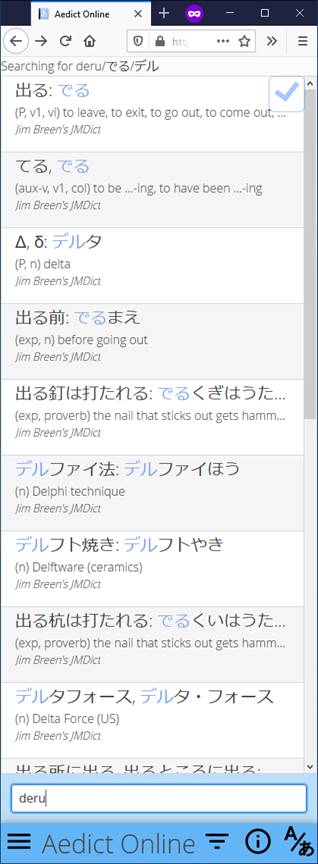
    What do you do if you have no idea how it is read or pronounced?  If it’s on the computer the easiest thing to do is copy the word and past it into the dictionary.  If you can’t do that you got several options each of them increasingly annoying.  First, let’s suppose you actually know the reading – in this case it is “deru”.  I can type that in romaji right into the search box.

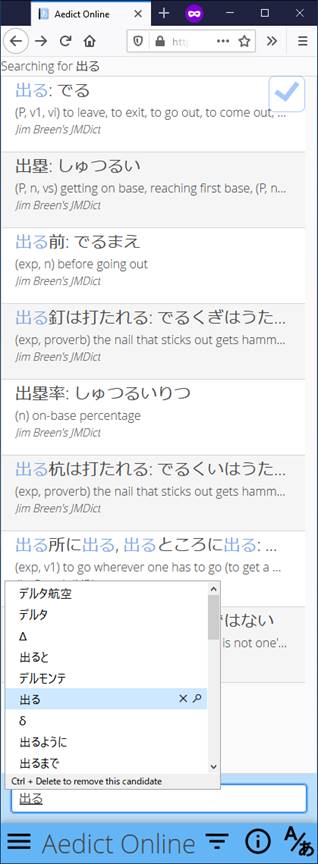
    Your second option is to actually type the word in either hiragana or katakana.  The dictionary will recognized the hiragana or katakana the same as if you used romaji.  However, your phone (or here my Windows 10 PC) will also bring up list of characters that are written with those same hiragana characters.  Take a look in the middle of the box in the second illustration.
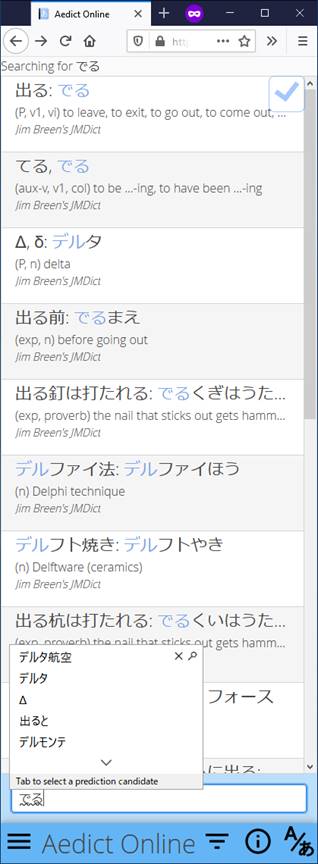
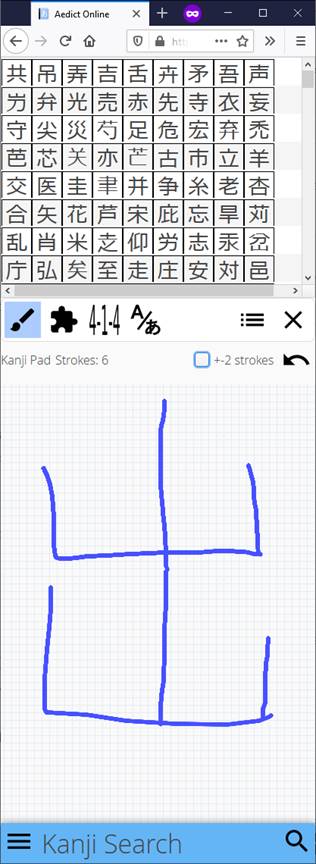
    Next, let’s suppose the character is physically written somewhere and you have no idea what it means or how to read it.  You have several options.  Below you see icons for a paintbrush or fude brush a puzzle piece and 4-1-4.

    I’ll skip the puzzle piece and 4-14 approaches as those particular methods work based on the structure and shape of the character and the number of strokes and are even more complex.  Instead let’s focus on the paintbrush.  We can actually draw the character right on the phone! (Or in the example below  with my mouse – which explains why it looks so bad.)
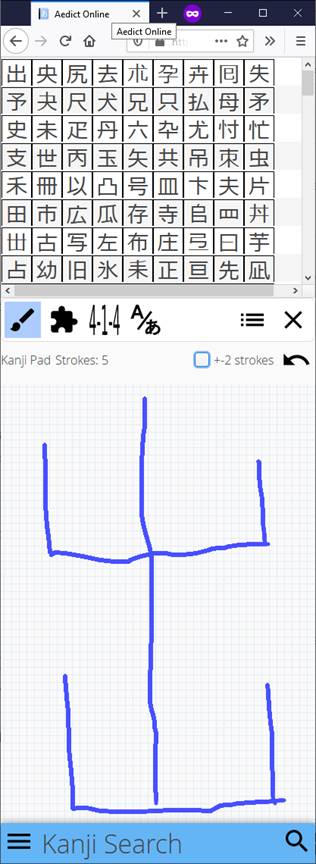
    The problem is that all of the character drawing applications for Japanese assume a basic knowledge of stroke order and number and type of stroke.  In the first example above I drew the character with the proper number and type of strokes.  You can see at the very top the very first character the application guessed is the correct kanji.  The second character may look drawn almost exactly the same, but it isn’t.

    Look in the middle of the illustration – it says Strokes: 6.  This character is only drawn with 5 strokes.  In small stroke character like this it isn’t too problematic, but in significantly more complex characters adding or missing a stroke can make this particular input method daunting.  You can see there is a check box to allow the program to guess +- 2 Strokes.  Sometimes this works and sometimes it doesn’t.

    Below Aedict displays both the proper way to draw this character and the definition. I picked “deru” because I find this word maddening.  It usage matches up to multiple different English meanings. The definition scrolls on beyond what I have displayed here.
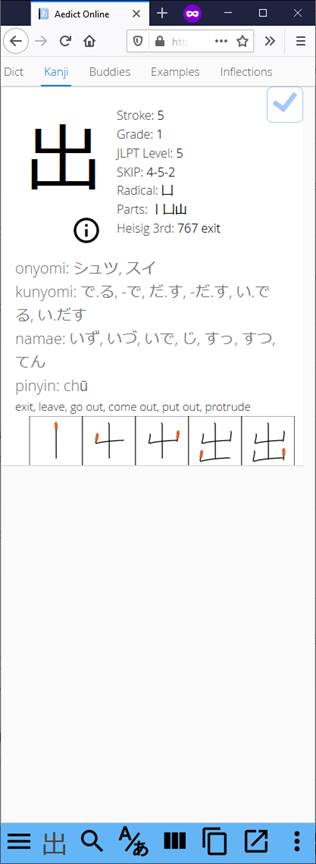
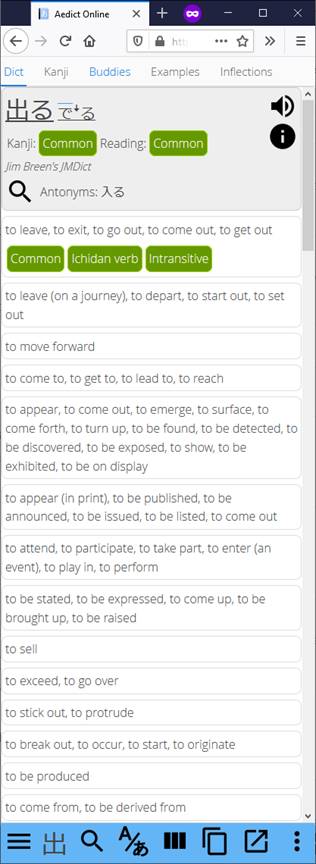
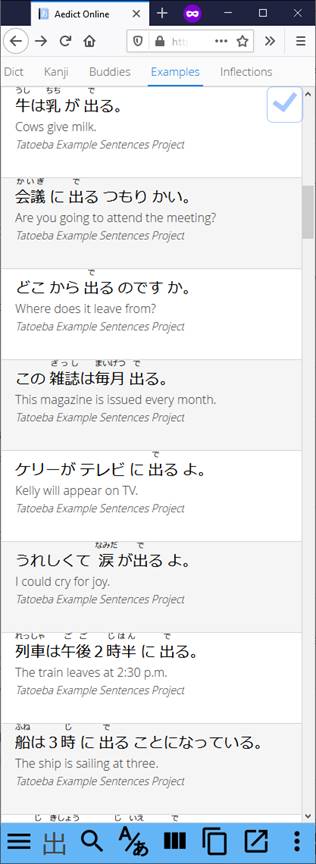
    The application also provides other words and other readings that use the same character.  It also uses another wonderful public domain project called the Tatoeaba Project that a collection of Japanese sentences and translations in multiple languages.

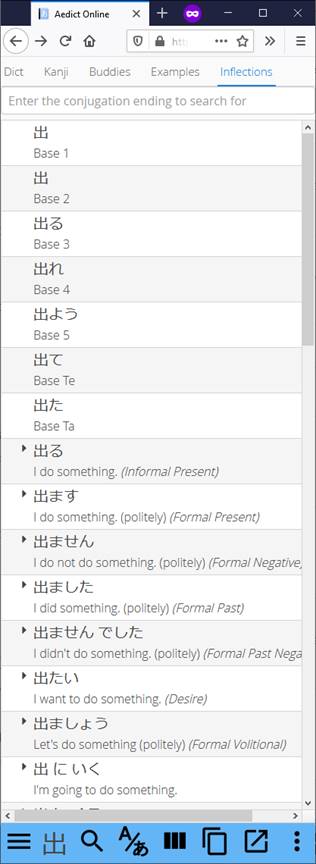
    And finally because I chose a verb to look up the dictionary program tells us how to inflect it to make various grammar forms like present and past tenses.   In the old days you used to have also input verbs into electronic dictionaries in what is actually called “dictionary form”, but now most dictionary programs, including this one, will “de-inflect” verbs so that you can simply input the word as you read it.  That was huge deal because certain Japanese verbs are inflected in one of five ways and it can be difficult to tell which of the five was to use to get the dictionary form.
    There you go!  Simple right?  Happy Japanese learning everyone.
  • Learn Japanese Through Anime Titles – ご注文はうさぎですか?- Is the Order a Rabbit?

    Image source: Wikipedia Image

    Once again let’s summarize the premise:

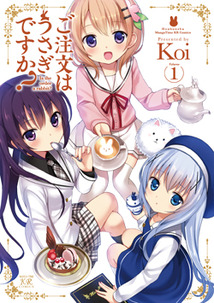
    Cocoa Hoto enters the cafe Rabbit House, assuming there are rabbits to be cuddled. What Cocoa actually finds is her high school boarding house, staffed by the owner’s daughter, Chino Kafū, a small, precocious, and somewhat shy girl with an angora rabbit on her head. She quickly befriends Chino with the full intention of becoming like her older sister, much to Chino’s annoyance. From there she will experience her new life and befriend many others, including the military-influenced, yet feminine Rize Tedeza, the playful Chiya Ujimatsu who goes at her own pace, and the impoverished Syaro Kirima who commands an air of nobility and admiration despite her background. Slowly, through slices of life, often comedic, Cocoa becomes irreplaceable in her new friends’ lives, with Chino at the forefront.

    Source: Wikipedia

    This anime isn’t as awful as the summary makes it appear.  It’s a standard slice of life comedy with around six or so characters who simply make small talk and do funny and cute things.  It is by no means high art, but a fun way to spend 20 minutes an episode if you like anime.  Nothing to recommend for a non-anime person to watch, however.


    Japanese: ご注文はうさぎですか?

    Romanized: Gochuumon wa Usagi Desu ka?

    English Title: Is the Order a Rabbit?

    ご – go – this is an honorific. This is essentially untranslatable in English, but if you have to get point across you can use “honorable”.  The reason it’s used here is that when you are asked for your food order at a restaurant, even in the most casual of places, the staff will almost always use “go” in front of the word for your order which is…

    注文 – chuumon – order or request.

    は – ha – (pronounce “wa”) – grammar particle used to denote the topic of the sentence.

    うさぎ – usagi – rabbit.  Normally animal names are written in katakana – ウサギ – and I’m not sure why the hiragana is used here.   The word rabbit is quite common so that may be part of the reason.  Female names are also frequently written in hiragana as as it it tends to be viewed as “cuter” so that could also be part of the reasoning here.  The story is about a cafe full of cute girls.

    です – copula. More below on this.  In this particular case it is translated as “is”.

    か?- ka – another grammar particle that changes a declarative statement into a question. Technically the question mark, borrowed from the west, is unnecessary, but frequently used.

    A literal translation would be “as for your (honorable) order, it’s a rabbit?”  The actual English title is very close to the Japanese.


    When I first started learning Japanese I had little interest in linguistics.  However, I’ve always had an interest in English grammar.  So I had no idea in English the verb “to be” served dual purposes. It can be used as a copula and for the purpose of existence.

    In linguistics, a copula (plural: copulas or copulae; abbreviated cop) is a word that links the subject of a sentence to a subject complement, such as the word is in the sentence “The sky is blue.” The word copula derives from the Latin noun for a “link” or “tie” that connects two different things. – Wikipedia

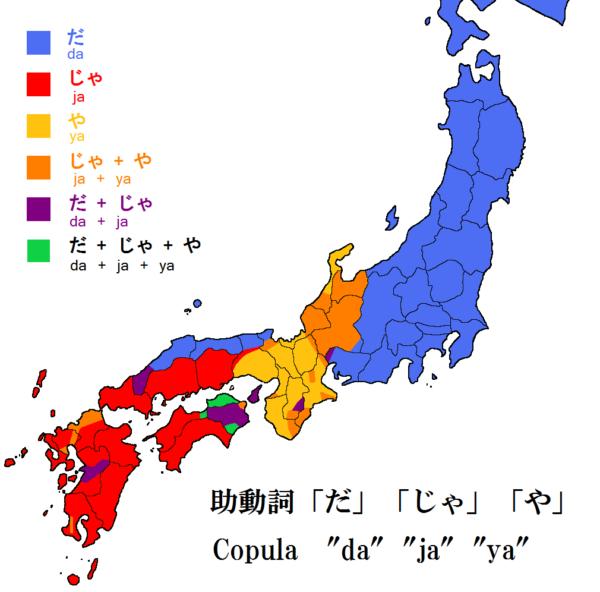
    In Japanese the somewhat well known “desu” or です is used as a copula.  Note that “desu” is polite.  There is a plain form that is also very commonly used “da” or だ.  A big thing note here – the plain form copula also varies depending on dialect and region.

    Copula usage across Japan


    Source: Wikipedia

    To provide an example let’s look at the following:

    この部屋は台所です。Kono heya wa daidokoro desu.

    “As for this room it is the/a kitchen.”  More naturally – “This room is the kitchen”.

    Japanese doesn’t have articles (“a” or “the”) like English.  My Japanese friends learning English find figuring out which article to use in English maddening.


    However, unlike English, Japanese has two other words that are used for existence – “aru” or  ある and  “iru” or いる.  In the polite form they are “arimasu” or  あります and “imasu” or います.   Why are there two forms?  Because it’s Japanese and things need to be difficult.  Animate objects take “iru” and inanimate objects use “aru”.

    台所に猫がいます。Daidokoro ni neko ga imasu.

    “There is a cat in the kitchen.” OR “The cat is in the kitchen.”  Without context we don’t know if we are talking about our family pet or if the neighbor’s cat climbed through the window. Welcome to the obscurity of Japanese.   A cat is animate so we use “imasu”.  Note that the particles we are using here are different compared to the sentence with “desu”.  We are using the particles “ni” and “ga” and not “wa”.

    台所に冷蔵庫があります。Daidokoro ni reizouko ga arimasu.

    “The refrigerator is in the kitchen.”  Last time I checked a refrigerator isn’t able to move on its own volition so we use “arimasu”.  A car also doesn’t move of its own volition so we use “aru” when describing the existence of a car.  However, a robot despite being a machine does move by its own volition so robots use “iru”.  Simple, right?


    There you have it.  In English the verb “to be” accomplishes what takes three different words in Japanese – desu, arimasu and imasu.  In their plain forms these are iru, aru and da in standard Japanese.

    Actually, thinking about it further, if we use very polite forms of Japanese we need some additional forms for existence and the copula.  I’ll save that maddening topic that is polite Japanese for our more fluent in Japanese Glibs…

  • Learn Japanese Through Anime Titles – ソウナンですか?- Are You Lost?

    Image source: Wikipedia Image

    Let’s start this particular post with the summary of the premise:

    Four girls enjoying a school life witness their lives take a turn for the unexpected when they are suddenly stranded on a deserted island. Fortunately, Homare Onishima has experience in surviving in the wild and teaches the other girls on how to make the best of their current situation but it will take true teamwork if the girls are to survive and return home.

    Source: Wikipedia

    Hard pass on this one.  Pretty much everything that is wrong with recent anime.  Why the girls are stranded has yet to be explained and the characters continue to most of the time wear their full school uniforms that never get dirty.  That would make things too difficult to animate in way the industry currently operates.  The show mostly shows the girls overcoming their revulsion of eating insects, various creatures and the like in semi-humorous ways along with obligatory fan service.  The punchline to most of the gags in the anime usually ends with “sou nan desu ka?”


    Japanese: ソウナンですか?

    Romanized: sou nan desu ka?

    English: Are You Lost?

    The title is intentionally written in katakana.  Katakana is usually used for foreign words, but also may be used similar to they way we use italics in English.  Here it is done to obfuscate the meaning.  Written in hiragana  そうなんですか? it is used like “really?” in English.  However, written in kanji (Chinese derived characters) 遭難ですか? it means “is it a disaster(or shipwreck or accident)?”  It’s essentially a rather untranslatable play on words.


    What I wanted to show with this anime was the practice of “active listening” used in Japanese.  During a conversation the listener uses a variety of expressions while the other person is speaking.  In English the amount of interruptions used by the listener in a Japanese conversation would be considered rude.  However in Japanese it’s the reverse and not actively listening shows disinterest and is considered rude.  For a more comprehensive look at this I’d point interested readers to this webpage – The Art of Aizuchi: Active Listening in Japanese Conversation.

    What I wanted to highlight from this anime title was the word “sou”.  There are a myriad of meanings for this word, but the usage used here is “so, really or seeming”.  Recall the stereotypical pre-woke Hollywood portrayal of Japanese people saying things like, “Ah So, Smith-san!” for “That’s right Mr. Smith”.  It shows agreement and an active participation in the conversation.

    For me personally, it took about four years of study before I unconsciously started to begin using the various active listening expressions.  The most common for me are the many variations of “sou”, “hai, hai,hai” (yes, yes, yes) and “un… un… un…” essentially a grunting sound in English that is casual “yes” in English.  I just about fell off the chair when I suddenly realized I was using that one.

    The one that I’ve resisted using, but now actually do use is “heeeeeeeeeeee” (sounds like “hey” in English) said with a rising intonation.  It’s always sounded ridiculous to me, but it’s incredibly common in Japanese.  It expresses surprise.  You’ll hear Japanese all say it in unison on TV variety shows and the like.

    I’ll leave you with 12 seconds of video that actually uses all the expressions I’ve discussed in active listening as spoken by the woman on the left, Saori Oonishi.  The video will start at 25:25.

    25:28 – hai, hai, hai

    25:30 – honto ni (really, truly)

    25:36 – heeeeeeee

    25:38 – un,un,un

    25:40 – sou desu ne

    None of these really add any information to the conversation.  They just demonstrate her interest in what the speaker is saying.

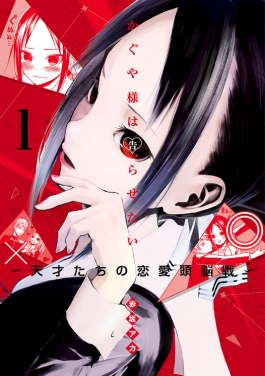
  • Learn Japanese Through Anime Titles – かぐや様は告らせたい ~天才たちの恋愛頭脳戦~ Kaguya-sama: Love Is War

    Source – Source: Wikipedia Image

    For our third installment of learning Japanese through anime titles I’ve picked a title to introduce honorifics in Japanese.

    Japanese: かぐや様は告らせたい ~天才たちの恋愛頭脳戦~

    Romanized :Kaguya-sama wa Kokurasetai – Tensai-tachi no Ren’ai Zunōsen

    Common English Title: “Kaguya-sama: Love Is War”.


    かぐや – “Kaguya” – female given name.

    様 – “sama” – honorific – equivalent to Mr., Mrs, Miss, Ms, etc. In Japanese it can be used with both first and last names.

    は – “ha” romanized as either “ha” or “wa”, but pronounced “wa”in this usage.  This is the  topic marker – frequently translated as “as for” in English.

    告らせたい “kokurasetai” – passive form of the verb “kokuru”  – to confess (one’s love), to propose (marriage), to ask out (on a date) plus “tai” which expresses desire.

    I should probably do another entry on passive verb use in Japanese.  The passive voice is widely used in Japanese as compared to English.  Things happen in Japanese “just happen” similar to the way police officers’ guns just simply discharge in English news stories.  Culturally it helps save face and nobody has to accept blame for causing a problem.

    ~ used as a dash here as far as I can tell.  If any of our more Japanese fluent Glibs want to explain the Japanese use of the tilde I’m interested.

    天才 – “tensai” – genius

    たち “tachi” – makes things plural as relates to people.  Japanese usually doesn’t distinguish between singular and plural unless there is a reason to be specific.

    の – “no” shows possession.  Similar to ” ‘s” in English.

    恋愛 – “renai” – love, love-making, passion, emotion, affections.

    頭脳 – “zunou” – head, brains.

    戦 – “sen” – war, battle.

    So a literal translation is “(As for) Kaguya-sama (she) wants to be confessed to ~ geniuses’ love brain battle”.  Not particularly close to the English title.


    Here is your quick lesson on honorifics in Japanese.  There are many honorifics so I’m only going to touch on the most common ones here. I’m also freely going to “borrow” and summarize from Wikipedia.

    San (さん) is the most commonplace honorific and is a title of respect typically used between equals of any age. Although the closest analog in English are the honorifics “Mr.”, “Miss”, “Ms.”, or “Mrs.”, -san is almost universally added to a person’s name; -san can be used in formal and informal contexts and for both genders.

    Sama (様【さま】) is a more respectful version for people of a higher rank than oneself or divine, toward one’s guests or customers, and sometimes toward people one greatly admires. Deities such as native Shinto kami and the Christian God are referred to as kami-sama. When used to refer to oneself, -sama expresses extreme arrogance (or self-effacing irony), as in praising oneself to be of a higher rank, as with ore-sama (俺様, “my esteemed self”).

    Kun (君【くん】) is generally used by people of senior status addressing or referring to those of junior status, by anyone addressing or it can be used when referring to men in general, male children or male teenagers, or among male friends. It can be used by males or females when addressing a male to whom they are emotionally attached, or who they have known for a long time. The suffix is also used by juniors when referring to seniors in both academic situations and workplaces. Although -kun is generally used for boys, it is not a hard rule. In business settings, young female employees are addressed as -kun by older males of senior status.

    Chan (ちゃん) is a diminutive suffix; it expresses that the speaker finds a person endearing. In general, -chan is used for babies, young children, close friends, grandparents and sometimes female adolescents. Although traditionally, honorifics are not applied to oneself, some people adopt the childlike affectation of referring to themselves in the third person using -chan (childlike because it suggests that one has not learned to distinguish between names used for oneself and names used by others). “Chan” is only used between people who have known each other for a long time or who are of the same gender.

    So with this little bit of knowledge you can now quickly determine the relationship of people and social status by how they address each other.  Note that for word order in Japanese for native Japanese people your family name goes first followed by your given name.  BUT for the gaijin you retain western name order of first name followed by last name.

    Japanese people generally don’t use first names until they have an established relationship with a person.  However, since westerners don’t usually follow this practice most of the time westerners will be referred to by first name + “san”.  This tends to annoy “woke” Westerners in Japan from my readings.  It’s never been an issue for me.

    Most older Japanese will almost universally use an honorific plus either first or last name. The only time the honorifics get dropped is if the relationship is very close or you intend to be insulting.  My understanding is this may be changing with younger people.  However all the Japanese people I communicate with including my close friends, we all use honorifics.  In the case of my friends first name plus honorific.  If any the Glibs that actually live in Japan want to comment about this I’d be interested to hear how they address their close friends and what their experiences are.


    Summary

    Student council president Miyuki Shirogane and vice-president Kaguya Shinomiya appear to be the perfect couple. Kaguya is the daughter of a wealthy conglomerate family, and Miyuki is the top student at the school and well-known across the prefecture. Although they like each other, they are too proud to confess their love as they believe whoever does so first would lose. The story follows their many schemes to make the other one confess.

    Source: Wikipedia

    This one I can actually recommend.  It’s a spoof on the usual high school student council romantic comedy.  The two protagonists obviously like each other, but continuously scheme to get the other one to try to confess his or her romantic interest.  It doesn’t take itself too seriously and the “will they or won’t they get together” isn’t the point of the series, it’s the gags.  Specifically the reason the protagonist is dressed as first name + “sama” is done to suggest high class status and the idea of aloofness.

  • Learn Japanese Through Anime Titles – 俺の妹がこんなに可愛いわけがない – “My Little Sister Can’t Be This Cute”

    Source: Wikipedia Image

    For our second installment of learning Japanese through anime titles I’d like to suggest that some Japanese animation does, in fact, revolve around an unnatural attraction to one’s younger sister.

    Japanese: 俺の妹がこんなに可愛いわけがない (Ore no Imōto ga Konna ni Kawaii Wake ga Nai)

    English: “My Little Sister Can’t Be This Cute”

    俺 “ore” – pronoun for “I”.  It’s masculine and casual.  So we immediately assume the speaker is likely male.

    の – “no” -equivalent to ” ‘s” in English.

    妹 – “imouto” – my younger sister.

    が – “ga” – grammar particle – marks the subject of a sentence.

    こんな -“konna” – “like this”.

    に – “ni” – grammar particle – turns the phrase above into an adverb.

    可愛い – “kawaii” – word that encompasses “cute” and whole lot more in Japanese.  (1) cute, adorable, charming, lovely, pretty, (2) dear, darling, pet, (3) little, tiny.  Just to make things interesting this word is an i-adjective in Japanese and has the properties of a verb in English.

    わけがない – “wakeganai” – we can break this phrase down into individual words and grammar, but it is much easier to think of it as set phrase “(there is) no reason”.


    What I want to draw attention to is that Japanese makes distinctions between “in groups” and “out groups” and within the family based on birth order.

    Here we have “imouto” all by itself so the inference would be that it is the speaker’s younger sentence.  If someone says “imouto-san” we would assume he or she was speaking about someone else’s little sister.  The “san” prefix works like “Mr, Ms, etc.” but can attach to first and last names as well as certain nouns.

    However, not all family related words work like this.  Let’s look the Japanese for “older sister”.

    姉 (あね) – “ane”.  This would refer to my older sister.  However, that’s not what most siblings would call her.  They most likely would use お姉さん (おねえさん) – “oneesan” when speaking directly to her.  If he or she were speaking to a third party about his or her older sister, however, the speaker would use “ane”.  For example, “ane is married” or “my older sister is married”.

    An outsider will always use the “-san” form.  “How is your imouto-san doing?”  or “How is your onee-san doing?”.

    Within the family names for the older sister things get interesting.  Usually the older sister would refer to her younger sister by first name (without “san”) or by some nickname.  However, in most families the younger sister will refer to her older sister with some variation of “oneesan” or possibly a nickname with some suffix showing respect such as “san”.  For example, “oneesan, dinner is ready”.


    Summary:

    Kyosuke Kosaka, a normal 17-year-old high school student living in Chiba, has not gotten along with his younger sister Kirino in years. For longer than he can remember, Kirino has ignored his comings and goings and looked at him with spurning eyes. It seemed as if the relationship between Kyosuke and his sister, now fourteen, would continue this way forever. One day however, Kyosuke finds a DVD case of a magical girl anime which had fallen in his house’s entrance way. To Kyosuke’s surprise, he finds a hidden eroge inside the case and he soon learns that both the DVD and the game belong to Kirino. That night, Kirino brings Kyosuke to her room and reveals herself to be an otaku with an extensive collection of moe anime and younger sister-themed eroge she has been collecting in secret. Kyosuke quickly becomes Kirino’s confidant for her secret hobby. The series then follows Kyosuke’s efforts to help his sister to reconcile her personal life with her secret hobbies, while restoring their broken relationship and coming to terms with their true feelings for each other.

    Source: Wikipedia

    There are two ways to view this anime.  One is that it is a meta criticism of all the current anime tropes that are so popular right now.  It has absolutely mediocre animation, but an “A-list” cast of Japanese voice talent. I don’t think you could have more stereotypes in one series.  It actually has different endings, similar to Japanese gal games, where the protagonist ends up with different heroines. The other, and sadly quite possible, viewpoint is that they threw as much stuff as they possibly could into one work and cynically knew that it would be a hit whatever they did.

    Not recommended for anyone but hardcore anime otaku.

  • Learn Japanese Through Anime Titles – 千と千尋の神隠し – “Spirited Away”

    Source: Wikipedia Image

    Trying to rise to the call for content I figured I’d try to combine both my interest in Japanese language and anime into a single quick read.  I also want to suggest that all Japanese animation doesn’t revolve around  an unnatural attraction to one’s younger sister.  If there is interest I’ll do more.  For the first attempt I figured I’d review an anime that I can actually recommend, Hayao Miyazaki’s “Spirited Away”.

    Japanese: 千と千尋の神隠し

    English: “Spirited Away”

    千  – “Sen”- In this case what the main character is called through most of the film.  It’s an odd name and the reason is explained in the film.

    と – “to” this a particle equivalent to “and” here in English and links nouns together.  Japanese is a bit more interesting because “to”is generally use link things exhaustively.   “I went to the store and purchased (only) milk and bread“.  However, Japanese also as another version や or “ya” which is used on a non-exhaustive list  “I went to the store and purchased milk や bread” which means “I went to the store and bought milk, bread and other things“.

    千尋 – “Chihiro” – Name of the protagonist

    の – “no” – shows possession or used to link nouns together.  Similar to ” ‘s”  in English.

    神隠し – “Kamikakushi- noun-  mysterious disappearance, spirited away.

    So we actually have the rare case where the Japanese title mostly matches the English one.  “Sen to Chihiro no Kamikakushi” or “Sen and Chihiro’s Spiriting Away”

    The key point  I want to make here is the different reading of 千.  In the first reading it uses onyomi or sound (aka Chinese) reading and in the second 千尋 it is kunyomi or Japanese reading and sounds like “chi”.

    The character has  the 尋 (hiro) removed from her name and her memory in the film and becomes “Sen” through most of the film.  This kind of word play happens throughout the film and would be instantly recognizable to the Japanese audience and is essentially untranslatable in English.

    It also stresses just how important kanji or the Chinese characters that Japanese uses are to convey meaning with written Japanese.  This kind of word play is central to all kinds of Japanese humor and literature.

    Spirited Away (Japanese: 千と千尋の神隠し Hepburn: Sen to Chihiro no Kamikakushi, “Sen and Chihiro’s Spiriting Away”) is a 2001 Japanese animated coming-of-age fantasy film written and directed by Hayao Miyazaki, animated by Studio Ghibli for Tokuma Shoten, Nippon Television Network, Dentsu, Buena Vista Home Entertainment, Tohokushinsha Film and Mitsubishi and distributed by Toho…and tells the story of Chihiro Ogino (Hiiragi), a sullen 10-year-old girl who, while moving to a new neighborhood, enters the world of Kami (spirits) of Japanese Shinto folklore. After her parents are transformed into pigs by the witch Yubaba (Natsuki), Chihiro takes a job working in Yubaba’s bathhouse to find a way to free herself and her parents and return to the human world.Wikipedia

    Studio Ghibli films are generally top notch and “Spirited Away” is no exception.  There are other more highly rated films from the studio, but near the top of my list is “Spirited Away” for it message of growing up and responsibility. It works as simple and fun story for children while still having many parts that will be interesting and thought provoking for an adult audience.