Category: History

  • Thirty-Something Rifle Cartridges II – The Thirty-Threes

    Thirty-Something Rifle Cartridges I:  The 33s

    I find the thirty-threes to be some of the most useful of the thirty-something calibers for the North American game fields.  Most of them are easily capable of taking the largest American big game.  There is a wealth of projectiles available.  Some of them, like Winchester’s excellent .338 Winchester Magnum, have been around for decades, and as a result there is a great deal of loading data available.

    As a result, there are a lot of .33 caliber rounds out there to discuss.  So, without further ado…

    At the End of the Black-Powder Era…

    As we saw back in the series on level guns, the famous John Browning/Winchester collaboration started with a big, tough lever gun called the Model 1886, which could handle some pretty heavy cartridges.  In 1902 Winchester made this rifle available for a new cartridge, the first commercially available thirty-three, the smokeless-powder .33 WCF.

    This was a pretty hot load for its time, launching a 200-grain cast bullet at 2,200 fps.  With more modern, jacketed bullets, it quickly gained a reputation as a hard hitter, ideal for deer, elk and bear at ranges out to about 200 yards.  Besides the Model 1886 Winchester, it was also available in the 1885 single-shot and the lever-action 1895 Marlin.

    The .33 WCF was interesting because it came at a transitional moment in American shooting.  As we’ve noted previously, the end of the Great War resulted in a lot of American shooters and hunters returning home with the memory of their issue 1903 Springfield and Pattern 17 Enfield bolt guns in mind, along with the powerful .30-06 round they fired.  The lever gun was due to lose some popularity; the age of the bolt gun was dawning.

    And the .33 WCF, while a groundbreaking round, was a rimmed lever-gun cartridge.

    The .33 WCF was offered in the Model 1886 until 1935, when Winchester replaced the 1886 with the beefier Model 71 and its .348 Winchester cartridge.  But this first of the thirty-threes had set the stage for some modern bolt-gun rounds to come, and one of those pioneering bolt-gun rounds came (in part) from the mind of someone we’ve discussed before:  Elmer Keith.

    The Mid-Century

    Early in the 20th century Elmer Keith, along with his colleagues Charles O’Neil and Don Hopkins, developed a new .33 wildcat based on the .30-06 case necked up.  The .333 OKH was intended to use the same .333 diameter bullets as the .333 Jeffries then popular in Britain, and while it delivered some good performance it was hampered by the lack of bullets, and since wildcatters live and die by the availability of suitable projectiles, this didn’t bode well for the .333.  The logical evolution was to increase the bullet size to .338, resulting in the .338-06 wildcat.

    This same trio also developed the .334 OKH, based on the .375 H&H case; this ended up being remarkably similar to the .340 Weatherby Magnum, about which we’ll talk in a moment.

    In fact, the tale of the mid-twentieth century thirty-threes is somewhat convoluted, with plenty of wildcats and experiments mixed into the developments by major gun and ammo manufacturers.  But one thing very quickly became apparent – launching a big, heavy projectile at significant velocity called for a magnum-sized case.

    Precedent was already in place.  During WW2 Roy Weatherby had introduced three standard (2 ½”) length cartridges based on the .375 H&H belted case, shortened and necked down.  These three were the .257, .270 and 7mm Weatherby magnums, and they soon gained a following among those fond of high-velocity rounds.

    In 1958, at the urging of Elmer Keith, Winchester took that precedent and applied it to Keith’s and others work with the medium bores.  They followed Weatherby’s example, took the .375 H&H case, shortened it to fit standard-length actions, straightened the case walls a tad and necked it down to take a .338 pill.

    The result of this was the great .338 Winchester Magnum, introduced along with the .264 Winchester Magnum and the .458 Winchester Magnum as a family of cartridges.

    Now the American sportsman had a real world-beater.  The big new medium-bore magnum put out a 225-grain projectile at 2,800 fps in factory loadings, and with the right slug would easily handle any North American big game, including big Alaskan grizzlies and moose.

    The .375H&H, .338 Win Mag, and a quarter for scale.

    It should come as no surprise to anyone that’s been paying attention that this round is a favorite of mine.  My .338, Thunder Speaker, is built on a 1908 DWM large-ring Mauser action with a Douglas barrel and a Bell & Carlson stock.  The .338, while delivering plenty of punch, does it on both ends, having a reputation for recoil as well as hitting power.  Thunder Speaker, in addition to the big, wide recoil pad on that B&C stock, is Mag-Na-Ported and weighs almost ten pounds loaded, which makes it very manageable – at least for me.  I’m large and not recoil-sensitive, so your mileage may vary.

    My favorite load in that big, tough Mauser action is a 225-grain Barnes TTSX boat-tail over 67 grains of IMR 4350.  This gives me about 2,800 fps for almost two tons of muzzle energy.  This load will easily lengthwise an elk or moose, and that’s what Winchester intended the round should be able to do, so I’m pretty satisfied; in Thunder Speaker, with me at the wheel, it will also put three rounds into a 3” circle at 200 yards.  The best shot I’ve ever made on a game animal was with this rifle; a fat meat mulie buck in the open sage country south of Parshall, Colorado.  The buck paused to look back on the edge of an arroyo; I tossed my cap on a flat rock, laid down in the snow, laid my rifle on the rock, took aim and sent one round down the hill.  The .338 slug hit the mulie at the base of the neck, dropping him in his tracks at 280 yards.

    She still does kick, though.  My son-in-law once got a case of Kaibab eye after asking to try out Thunder Speaker off the bench-rest; I warned him not to choke up on the scope!

    The .338 Winchester Magnum was quickly a big commercial success.  In addition to its introductory chambering in another shooting legend, the pre-64 Winchester Model 70, it was quickly picked up in the Remington and eventually, the Ruger, Savage and many other lines.  Browning made it available in the BAR, making it the most powerful semi-auto rifle available at the time.  Wildcatters quickly picked up on the usefulness of the case, bringing about among other things the .30-338 Magnum, which Winchester later legitimized as the .300 Winchester Magnum – bringing the standard-length magnum case back to America’s caliber.

    But the competition was paying attention.

    Only four years after Winchester brought out their thirty-three, Roy Weatherby upped the ante.  His entry into the field was the .340 Weatherby Magnum, on the same magnum-length case as the .378 Weatherby Magnum.  This was a real whopper, sending the same .338 225-grain slug forth at 3,100 fps.  But the .340 Weatherby suffered from the same issues as the 8mm Remington Magnum we discussed in the last installment:  It was limited to a magnum-length action.  What’s more, it was a proprietary round.  When the .340- Weatherby was introduced one could only have one in the Weatherby Mark V, with factory ammo initially only available from Weatherby.  Even today, the only company loading this round besides Weatherby is A-Square, and the ammo is pricey.

    The place of the thirty-three in the American shooting scene was now secure.  But the explosion of rounds to come was to prove an embarrassment of riches.

    Today

    In the magnum world, the .338 Winchester Magnum and the .340 Weatherby Magnum have been joined by some new contenders.  The .338 Ruger Compact Magnum came out in 2008, a 2,700fps thumper intended to be chambered in short-action rifles like the M77 Mk II Compact.

    There are a couple of newer Weatherby-level steamrollers available as well.  In 1989, A Norwegian/Finnish munitions company named NAMMO (Nordic Ammunition Company) saw a market for a powerful, long-range military sniper round; their answer was the .338 Lapua, which was adopted in civilian as well as military applications.  The Lapua is a real rocker, sending out a 250-grain slug at over 3,000 fps.

    In 2002 Remington responded with an expansion of their Ultra Magnum line, the .338 RUM (Remington Ultra Mag.)  This fell a bit short of the .338 Lapua and produces very similar ballistics.

    But both ultra-mag rounds have the same shortcomings:  They both require magnum-length actions, and they both run at very high pressures, resulting in significant barrel wear at a much lower round count than the older .338s.  Still, there’s still news in the non-magnum world.

    2006 saw the introduction of the .338 Federal, which was simply the .308 Winchester case necked up to the .338.  This introduction not only gave .33-caliber thumping to short-action bolt guns, but it also added a medium-bore alternative to the AR-10 platform that was becoming popular as the Tacticool craze accelerated.  The Federal round yielded only modest performance compared to the magnums, propelling a 210-grain slug at about 2,600 fps.  But the use of the .308 case made for a versatile round that punches well above its weight class.

    Finally, in 2009, Marlin brought the thirty-threes full circle by introducing the .338 Marlin Express, a semi-rimmed lever-gun round intended to punch up the power level of that company’s 336-series rifles well above the original .30WCF level.  In fact, at ranges up to about 200-250 yards, the Marlin Express round delivers performance in excess of most .30-06 loads, which makes the 336 rifles far more versatile on bigger, thicker-skinned game – and brings the lever-gun world back to the levels of punch known in the original 1886 Winchester.

    The thirty-threes are many, powerful and versatile. The late 20th-early 21st century proliferation of .338-caliber rounds has been interesting, but none of them have quite managed to knock the good old .338 Winchester Magnum off the top of the heap.

    In the next installment, we’ll examine a group of rifle cartridges that are a little lighter on the long-range magnum loudenboomers and a little heavier on the short-range woods rounds – so stay tuned for an in-depth look at the thirty-fives.

  • Thirty-Something Rifle Cartridges I – The Thirty-Twos

    Thirty-Something Rifle Cartridges I:  The 32s and 8mms

    Mid-caliber rifle cartridges are very useful.

    A qualifier:  I’ve said before that if you can only afford one rifle for big game in North America, buy a .30-06.  That fine old round, properly loaded, can handle any game in North America, even though it’s a tad on the light side for big Alaskan grizzlies and moose.

    But there are a whole family of rifle cartridges that are useful, solid, and versatile; these are generally known as the mid-range or mid-caliber cartridges.  I’ll refer to them in this series as the Thirty-Somethings.  These rounds launch bullets ranging from the .32 to the .375 and have a wide range of power selections for almost any eventuality.

    In this series we’ll focus mostly on rounds widely used in North America.  So, while we’ll look mostly at American cartridges, we’ll also examine some from other parts of the world that have seen a lot of use here, like the 8X57mm Mauser and the great old .375 H&H.  So, let’s start with the first group – the Thirty-Twos.

    At the End of the Black-Powder Era…

    Remember when we were talking about the history of lever guns?  In 1894 Winchester Repeating Arms Co. and the DaVinci of firearms, John Browning, brought out the great Model 1894 Winchester lever gun.  While that rifle is so intimately associated with the .30WCF cartridge that the terms “.30-30” and “94 Winchester” are damn near synonymous, it’s rather less well-known that the Model 94 wasn’t originally introduced in that caliber; instead, it was chambered in its first year for two thirty-somethings, the .32-40 and the .38-55.

    In 1894 the .32-40 Ballard was a popular round.  It had been introduced ten years earlier in the Ballard Union Hill #8 and #9 target rifles, loaded with a 165-grain cast bullet over 40 grains of black powder, resulting in a muzzle velocity of about 1,450 fps.  The long, straight-tapered case allowed for a smooth, even powder burn and resulted in a good reputation for accuracy.  Famed barrel-smith Harry Pope was fond of the round and made it the basis of his .33-40 wildcat.  This round looks somewhat odd by today’s standard but it successfully made the transition into the smokeless powder era, and was offered in a sporadic manner in Winchester lever guns through most of the twentieth century, although mostly in the commemorative editions of which Winchester was so fond.

    The .32-40 was overshadowed in 1895 when Winchester released the Model 94 in the smokeless powder .30WCF, but the New Haven gunmakers weren’t done with .32s yet.  In 1901 they released the Model 94 chambered for the .32 Winchester Special, which took the .30WCF case and expanded the neck to take a .321 bullet.

    At first glance it’s hard to see a reason for this round.  The .32 WS, in its primary load, fired a 170-grain bullet, like its smaller-bored cousin.  Ballistics were near-identical, with the .32WS having less power past 150 yards or so due to the lower sectional density of the bullet.

    But for the hand-loader who was sitting on a big supply of lead and black powder – not an uncommon thing in 1901 – the prevalent wisdom of the day claimed that the .32 had a couple of advantages.  First, its slightly larger bore was claimed to make for easier cleanup of the messy black powder residue.  Also, Winchester used a 1-16 rifling twist in the Model 94s chambered for the .32, as opposed to the 1-10 twist of the.30WCF; this, again, supposedly made for easier cleaning.

    So, the .32 Special may have been just the ticket for the guy with a lot of black powder to burn, or maybe for the occasional recalcitrant old coot who thought that smokeless powder wasn’t here to stay.

    Like the .32-40, the .32 Special hung on through most of the twentieth century, in later years mostly in commemorative Winchester models.

    Another variation came from Remington, who was determined not to be outdone by Winchester.  In 1905 Remington introduced their Model 8 autoloader, followed in 1914 by the Model 14 pump-gun.  Both rifles saw a fair amount of market, and both were chambered for (among other rounds) the .25, .30 and .32 Remington cartridges, essentially rimless versions of the .25-35, .30-30 and .32 Special.  Unlike Winchester, Remington didn’t fiddle around with different twist rates in their guns and the Model 8 auto – the famed old Remington “piano leg” – was fussy about ammo, fouling and hanging up quickly if black-powder loads were used.  It’s hard to see what Remington had in mind with this range of cartridges other than ensuring that they had an offering in every bore size to compete with Winchester.

    Winchester did have another .32 caliber round, the .32WCF, better known as the .32-20.  This was mostly a small-game round of modest power; while it’s a great old cartridge for big hares, bobcats or raccoons, I’m going to restrict this discussion to big-game rifles – in spite of the fact that I’d love to have an original Model 92 Winchester in .32-20 or .25-20 for hunting snowshoe hares and jackrabbits.

    In 1914, as we’ve seen, the shooting world saw some new influences hit, and the thirty-something rifle cartridges were affected along with everything else.

    The Mid-Century

    In 1898 the famous Mauser-Werke, down in the small town of Oberndorf in Bavaria’s Neckar River valley, introduced a world-changing bolt gun, the Model 1898.  We’ve already discussed this rifle and its significance, so now let’s look at the cartridge that was paired with this rifle for use by the German military – the 7.92x57mm, more commonly known as the 8mm Mauser.

    The 8mm Mauser predates the Mauser 98 by ten years, having been first introduced in the 1888 Commission rifle.  The original cartridge was the Patrone 88, launching a .319, 227-grain round-nose jacketed bullet at about 2,000 fps.  As a first-generation smokeless powder cartridge, the Patrone 88 carried over the heavy, round-nose bullet design common in the last generation of black-powder rounds.  In 1895 the bullet/bore size was changed slightly to reduce barrel wear and ease cleaning (supposedly) resulting in the .323 bullet diameter that would stick with the cartridge in military loadings.

    In 1904 and 1905, the cartridge got a facelift; the neck dimensions were slightly altered, and the brass thickness increased a tad.  The new round was loaded with a 153-grain spitzer bullet, producing about 2,700 fps.  This made the new round, the S Patrone, more effective at extended ranges due to the higher velocity and better bullet design.

    The 7.9×57 S Patrone was the standard German military’s rifle and machine gun cartridge in both World Wars.  Interestingly, after the Great War, the Treaty of Versailles forbade the use of the round in civilian arms, but by 1930 or so the German manufacturers were roundly ignoring the Treaty, and the cartridge again became popular in civilian hunting rifles; a rimmed version, the 7.9x57mm IRS, was even developed for single-shot and multi-barreled rifles.

    The 7.9x57mm remains a popular hunting cartridge in Europe today, at least in those jurisdictions that still allow the unwashed peasantry to own rifles.  In the United States, the round gained a significant following when surplus Mausers became widely available at bargain prices; the 8mm Mauser offers performance very similar to the .30-06, and in fact the round is still loaded by many American ammunition makers today.  In fact, the 8mm Mauser remained the only .32/8mm bolt-gun round commercially loaded in the United States until 1978.

    In the latter half of the twentieth century, Big Green had realized a commercial success with its excellent (then) Model 700 rifle and with their 7mm Remington Magnum cartridge.  I always thought the 7mm Magnum a tad overrated; an old elk-hunting friend of mine shot one and was fond of bragging about its velocity and flat trajectory with his favorite factory load, until I pointed out that in my big commercial Mauser I was shooting a .30-06 handload that ran a 165-grain Barnes bullet at only 100fps less than his factory 140-grain 7mm loads, and took to his brother’s chronograph to prove it.

    In the late Seventies, Remington determined that they wanted to compete with Winchester’s beefier .300 and .338 Winchester Magnums.  Remington’s engineers came up with the 8mm Remington Magnum, but they made one key mistake:  They used the full-length .375 H&H case as the basis for their new round, mandating its use only in Magnum-length actions.  The new 8mm round was intended to compete with the excellent .338 Winchester Magnum, but Winchester’s offering had a thirty-year head-start and could be chambered in standard-length actions.  While the 8mm Remington Magnum was a powerful round that could easily handle any game in North America, launching a 200-grain pill at a bit over 3,000 fps, it never gained much following.  The .32/8mm was generally considered a European bore size, and components (chiefly bullets) were not available in as many options as either .30 or .338 offerings.  The 8mm Remington Magnum is still in use today, but as sporting rifle cartridges go, it’s a footnote.

    Today

    Speaking of footnotes; since the new century dawned, the American shooting scene has seen only one new .32/8mm round.

    In 2000, Winchester and Browning introduced American shooters to the .300 Winchester Short Magnum, a fat round with a rebated rim that provided magnum horsepower in a short-action rifle.  The “short fat” case supposedly allowed powder to burn quicker and cleaner, and soon the WMS rounds gained a modest following.  In 2005, Winchester introduced the .325 Winchester Short Magnum, which actually fired a .323 180-grain bullet at about 3,000 fps.

    After its release, Winchester engineers allowed that the .32/8mm bullet was the largest that could be efficiently paired with the WSM case, and so no larger offerings were forthcoming.  Unlike the 8mm Remington Magnum, the .325 WSM did gain some following, and like its older brother, the .338 Win Mag, it is capable of taking any game in North America with the right load.

    The .32/8mm bore diameter has never been overly popular with American shooters.  If any caliber is America’s caliber, it’s the .30.  It doesn’t help that American manufacturers have never really gone in for this bore size in a big way, and it helps even less that one of the few major offerings was a commercial flop.

    But step up one bore size to the thirty-threes, and the picture changes quite a bit.  My own favorite hunting rifle is one of those; I’ve described my .338 Win Mag, the inestimable Thunder Speaker, in these virtual pages before.  So stay tuned for the next installment, in which will examine the Thirty-Threes.

  • Profiles in Toxic Masculinity VIII – Ernest Hemingway

    Young Hemingway.

    Profiles in Toxic Masculinity, Part 8

    Appearances Can Be Deceiving

    The young fellow to the right doesn’t look like anything special, does he?  A young man probably away from home for the first time, looking a little uncomfortable in his uniform, looking a little apprehensive about what lies ahead.

    I have a pretty good idea what that feels like, having been in much the same situation myself.

    But this young man, while he may well have felt the way I have described when he posed for this photo, ended up being something else entirely.  This is the young Ernest Hemingway, one of America’s greatest novelists, an adventurer, outdoorsman and bon vivant, winner of a Pulitzer Prize and the Nobel Prize in Literature, one of my personal literary heroes and today’s Profile in Toxic Masculinity.

    His Maculate Origin

    Ernest Miller Hemingway was born to Clarence Edmonds and Grace Hall Hemingway in Oak Park, Illinois, on July 21, 1899.  Named for his paternal grandfather, young Ernest attended school in Oak Park, excelling in boxing, track, football and water polo.  He also took a journalism class and worked with the newspaper of his school, the River Forest High School.

    As a youth, Hemingway spent summers with his family in their vacation home near Petoskey, Michigan.  The home was called Windemere, and it was located on Walloon Lake.  This setting was to have great influence on the young man and would become the location for many of his later works, especially the semi-autobiographical Nick Adams stories.  In this setting he grew to love fishing, camping and hunting, which avocations he would pursue throughout his life.

    I’ve been to Walloon Lake.  It’s a rather idyllic setting, even today; a quiet, medium-sized lake surrounded by the deep pine woods of the north.  I would have liked to have spent more time there; it reminded me of the Boundary Waters canoe area, where I spent some time myself as a young man.  On that same trip Mrs. Animal and I went up to Petoskey, where I drank a beer seated on a barstool that Hemingway reportedly occupied regularly as a young man.

    From such humble beginnings came one of America’s greatest writers.

    Hemingway wrote of those early days often, both literally and in his semi-autobiographical Nick Adams stories; in Fathers and Sons he describes an early encounter with an Indian girl named Trudy:

    “Could you say she did first what no one has ever done better and mention plump brown legs, flat belly, hard little breasts, well-holding arms, quick searching tongue, the flat eyes, the good taste of mouth, the uncomfortably, tightly, sweetly, moistly, lovely, tightly, achingly, fully, finally, unendingly, never-endingly, never-to-endingly, suddenly ended, the great bird flown like an owl in the twilight, only it daylight in the woods and hemlock needles stuck against your belly.”

    But Michigan wouldn’t contain the young Hemingway for long.  While the environs of Michigan had ample opportunities for hunting, fishing and screwing Indian girls, all things the young Hemingway enjoyed, there was a larger world out there for the exploring.

    His Adventurous Career

    After graduating high school, the young Hemingway went to work for the Kansas City Star.  That newspaper at the time had a brief style guide:

    • Use short sentences.
    • Use short paragraphs.
    • Use vigorous English.
    • Be positive.

    It was this writing style that would characterize his work for the rest of his life.

    Come 1918, with America’s entry into the Great War, young Ernest attempted to volunteer.  He went in turn to the Army, the Navy and the Marine Corps, but was turned down due to poor eyesight.

    Determined to get into action, in 1918 Hemingway answered an advertisement and ended up as a Red Cross ambulance driver on the Italian front.  He arrived in Paris as the city was under bombardment from German artillery and moved quickly on to Italy, where one of his first tasks was removing body parts of civilian workers after a Milan munitions factory explosion, which incident he later described in Death in the Afternoon.

    On July 8th, Hemingway was hit in the legs by mortar fragments.  Despite his wound he refused immediate evacuation, instead moving to assist injured Italian soldiers to safety, for which action he was given the Italian Silver Medal of Bravery.

    He was eighteen years old at the time.

    Later, Hemingway again used his avatar of Nick Adams to describe his own return home in one of the best outdoor stories ever written.  The Big Two-Hearted River, interestingly, does not take place on the Lower Peninsula’s Two-Hearted River but rather on the You-Pee’s Fox River north of the town of Seney; one of my bucket list items is to fish that same stretch of river.  In that story Hemingway describes Nick’s first night in camp:

    Out through the front of the tent he watched the glow of the fire when the night wind blew on it. It was a quiet night. The swamp was perfectly quiet. Nick stretched under the blanket comfortably. A mosquito hummed close to his ear. Nick sat up and lit a match. The mosquito was on the canvas, over his head. Nick moved the match quickly up to it. The mosquito made a satisfactory hiss in the flame. The match went out. Nick lay down again under the blankets. He turned on his side and shut his eyes. He was sleepy. He felt sleep coming. He curled up under the blanket and went to sleep.”

    Reporter Hemingway.

    After the war Hemingway accepted a position with the Toronto Star Weekly, where he met and started a romance with his roommate’s cousin, Hadley Richardson.  In time, the two married and relocated to Paris, which this time wasn’t under fire from German artillery.  During the Paris years Hemingway hung around with several other well-known literary and artistic figures, such as F. Scott Fitzgerald, Gertrude Stein, Ezra Pound, James Joyce and Pablo Picasso.  It was from this period that arose a famous and yet apocryphal exchange between Fitzgerald and Hemingway in which Fitzgerald observed, “…the very rich, they are different than you and I,” to which Hemingway supposedly replied, “Yes, they have more money.”  His first son Jack (nicknamed “Bumby,” because why not) was born in 1923 and became father to some of Hemingway’s most famous descendants, the actors and models Margot and Mariel Hemingway.

    It was during this time in Europe that Hemingway first visited Spain, where he became interested in bullfighting; he also published his first successful book, Three Stories and Ten Poems, and his first major novel, The Sun Also Rises.

    In 1927 Hemingway published his third work, Men Without Women, divorced his first wife Hadley, married his second wife Pauline Pfeiffer, and moved to Key West, Florida.  He announced that thereafter he would never again live in a big city, which he never did.

    For the next ten years Hemingway split his time between Key West in the winters and Wyoming in the summer.  He described in Wyoming “the most beautiful country I’ve seen in the American West,” and spent a considerable amount of time fishing and hunting deer, elk and bear.

    In this time, he wrote such works as A Farewell to Arms, Death in the Afternoon and The Green Hills of Africa, among others.  With his wife Pauline, he embarked on an extensive African safari in 1933, which yielded much of the background for that latter book.

    In 1937, Hemingway covered the Spanish Civil War for the North American Newspaper Alliance.  After that he sailed his yacht, the Pilar, to Cuba, where he lived for some time in the Hotel Ambos Mundos.  While in Cuba he was inspired (somehow) by a woman named Martha Gellhorn to write his most famous work, For Whom the Bell Tolls, of which book I have a first edition on my bookshelf.  This work, on publication, sold a half-million copies within the first year and resulted in Hemingway’s nomination for a Pulitzer prize.  His success did not translate into his personal life, however; in 1939 he divorced second wife Pauline and married Martha Gellhorn.

    But in 1941, events unfolded that would see Hemingway on some of his greatest adventures.

    His One-Man War

    In Wyoming.

    Hemingway had been fascinated by war and how men behave in war for most of his life.  When the Great War Part Two broke out, he seized the opportunity to see the raw face of war up close and personal.

    Traveling to London as a journalist, he flew several missions cross-Channel with the Royal Air Force.  His wife Martha was forced to seek passage on a munitions ship to join him, which apparently fazed Hemingway very little.  While in London he fell hard for an American correspondent for Time magazine, one Mary Welsh.  In 1945 he would finally divorce Martha Gellhorn and marry Mary Walsh, with whom he would spend the rest of his turbulent life.

    But before that:  In 1944, Hemingway wangled a spot on a ship bound for the Normandy landings.  He was not permitted to go ashore until the second day, although he was within sight of the landings for some time aboard the ship Dorothea Dix.

    When he finally was allowed ashore, Hemingway attached himself to the 22nd Infantry Regiment, commanded by Colonel Charles Lanham.  On the drive to Paris, Hemingway befriended a small band of French partisan fighters in the small village of Rambouillet; he acted, as some of the American infantry claimed later, as their de facto commander until the liberation of Paris.  One American infantryman, Paul Fussel, who would later become a well-known author himself, remarked that “…Hemingway got into considerable trouble playing infantry captain to a group of Resistance people that he gathered because a correspondent is not supposed to lead troops, even if he does it well.”

    Ernest Hemingway was present at the liberation of Paris.  He covered the vicious fighting in the Hürtgenwald where the U.S. First Army clashed with Walter Model’s 275th and 353rd infantry divisions.  He was present at the Battle of the Bulge until a bout of pneumonia forced his evacuation.

    His “leadership” of the French partisans in the summer of 1944 yielded unexpected fruit, as Hemingway was formally charged with a violation of the Geneva Convention for acting as a civilian partisan, but he was acquitted after insisting that he “only provided advice.”

    The professionals in the American Army recognized Hemingway for his courage and his knowledge of military matters, and in 1947 he was awarded the Bronze Star for his courage and willingness to come under fire to cover the movements of the troops.

    After the war, however, Hemingway’s life took a darker turn.

    His Golden Years

    Partying in Cuba.

    After the war Hemingway returned to Cuba.  In 1950 an unconsummated affair with the 19-year old Adriana Ivanovich led to Hemingway’s writing and publishing his novel Across the River and Into the Trees, which was not well received; in a fit of pique, Hemingway produced the novella The Old Man and the Sea, which finally netted him the Pulitzer Prize in 1952.

    In those post-war years, Hemingway’s life continued to deteriorate.  In 1954, during another African safari, he and wife Mary narrowly escaped death in two plane crashes in as many days; these left Hemingway with a severe concussion.  Later that year he suffered burns in a brush fire.  These injuries resulted in the author increasingly turning to alcohol.

    In October 1954 Hemingway received the Nobel Prize in Literature, about which he remarked that “…Writing, at its best, is a lonely life.  Organizations for writers palliate the writer’s loneliness for I doubt they improve his writing.  He grows in public stature as he sheds his loneliness and often his work deteriorates.  For he does his work alone and if he is a good enough writer he must face eternity, or the lack of it, each day.”

    This loneliness may have been one of the demons that plagued him in his final years.  He moved to his home in Ketchum, Idaho, where he compiled his observations of Paris into the novel A Moveable Feast.  He grew increasingly paranoid, thinking that the FBI was monitoring him (they were.)  In 1960 he underwent electroshock therapy in the Mayo Clinic, which did little good, and finally, in April of 1961, Hemingway took his favorite shotgun, a 12-gauge double (possibly a Browning Superposed, but that bit is unclear), from the safe and shot himself.

    In A Farewell to Arms, Hemingway wrote:  The world breaks everyone and afterward many are strong in the broken places. But those that will not break it kills. It kills the very good and the very gentle and the very brave impartially. If you are none of these you can be sure it will kill you too but there will be no special hurry.

    Unfortunately, Hemingway was one of the ones the world killed.

    He was an interesting man; he faced German bullets with great courage and produced many works of literature that are still regarded as some of the best in American literature.  But his own life was a train wreck; he could find happiness neither in marriage nor in his work.  Success in a chosen field, obviously, is not a panacea.  If we learn nothing else from the life of Ernest Hemingway, we can learn that.

    His Bibliography

    On the cover of Life.

    Below are all of Hemingway’s works (some, obviously, were published posthumously.)  I’ve read most of them and enjoyed them all.

    Fiction Books

    • (1926) The Torrents of Spring
    • (1926) The Sun Also Rises
    • (1929) A Farewell to Arms
    • (1937) To Have and Have Not
    • (1940) For Whom the Bell Tolls
    • (1950) Across the River and into the Trees
    • (1952) The Old Man and the Sea
    • (1970) Islands in the Stream
    • (1986) The Garden of Eden
    • (1999) True at First Light

    Nonfiction Books

    • (1932) Death in the Afternoon
    • (1935) Green Hills of Africa
    • (1962) Hemingway, The Wild Years
    • (1964) A Moveable Feast
    • (1967) By-Line: Ernest Hemingway
    • (1970) Ernest Hemingway: Cub Reporter
    • (1985) The Dangerous Summer
    • (1985) Dateline: Toronto
    • (2005) Under Kilimanjaro

    Short Story Collections

    • (1923) Three Stories and Ten Poems
    • (1925) In Our Time
    • (1927) Men Without Women
    • (1933) Winner Take Nothing
    • (1938) The Fifth Column and the First Forty-Nine Stories
    • (1947) The Essential Hemingway
    • (1961) The Snows of Kilimanjaro and Other Stories
    • (1969) The Fifth Column and Four Stories of the Spanish Civil War
    • (1972) The Nick Adams Stories
    • (1979) 88 Poems
    • (1979) Complete Poems
    • (1984) The Short Stories of Ernest Hemingway
    • (1987) The Complete Short Stories of Ernest Hemingway
    • (1995) The Collected Stories (Everyman’s Library)
    • (1999) Hemingway on Writing
    • (2000) Hemingway on Fishing
    • (2003) Hemingway on Hunting
    • (2003) Hemingway on War
    • (2008) Hemingway on Paris
  • Gold Standards IV – The 1851 Colt Navy

    The Perfect Single-Action Revolver

    Resolved:  The 1851 Colt Navy is the standard by which all succeeding single-action revolvers must be judged.  Now that that’s established, let’s take a look at this ground-breaking product of the mind of Colonel Colt, how it changed forever the concept of what a revolver should be, and how it affected every single-action sixgun model that followed – including its famous offspring, the Single Action Army.

    The Forerunners

    The 1849 Colt Pocket Model

    Colt’s production of revolvers up to this point had not yielded a reliable, effective piece for belt holsters.  The Paterson guns were underpowered and had fragile folding triggers; their popularity was mostly due to their being the only effective mass-produced revolver available in the 1830s and 1840s.

    The Paterson guns had five-shot cylinders, but prudence dictated loading only four and leaving the hammer down on an empty chamber; this precaution was required for Colt revolvers up to and including the Single Action Army.  Further, the Paterson guns were loaded using a separate tool for seating bullets.  If that tool was lost, what the shooter was left with was an expensive and rather ineffective hammer.

    The later Colt Walker and First, Second and Third Model Dragoon revolvers were significant improvements.  They had a loading lever attached to the gun under the barrel.  They were also big, powerful guns, firing a .44 caliber ball propelled by a stiff charge of black powder from a six-round cylinder.  The Walker and Dragoon guns were reliable and powerful, but they were also heavy and cumbersome, so much so that many were fitted with shoulder stocks, making rather effective carbines.  But it’s important to note that these were, as named, dragoon pistols, meant to be carried in saddle holsters by mounted troops.

    Contemporaneous with the Dragoon guns were a small selection of Colt “Pocket” revolvers, .31 caliber six-shot revolvers that began with the 1847 Baby Dragoon and continuing with the 1849 and 1850 Pocket Models.  These were, effectively, scaled-down versions of the Dragoon pistols.  Barrel lengths ran from four to six inches, allowing for a decent sight radius for the small-framed guns, but the .31-caliber cylinder put them back in the Paterson level for power; most loads yielded performance roughly equivalent to a modern .32 ACP full-metal-jacket round.

    So as of 1850, your choice in Colt revolvers faced a strange dichotomy; you could either have a big, powerful, heavy horse pistol, or a pocket-sized pipsqueak.  Clearly something new was needed.  Colt decided the answer was obvious:  Split the difference.

    The New Holster Gun

    An original Colt Navy

    In 1851 Colt revealed their new gun.  The 1851 Colt Navy revolver was a scaled-up 1849 Pocket Model, but it differed in several significant ways:  It fired a .36-caliber ball, yielding power roughly equivalent to the later .38 Special 158-grain RNL standard loads; it had a 7 ½” barrel, yielding a good sight radius while maintaining portability; and it was lighter than the Dragoon models, making it easily portable in a belt holster.  It did retain the odd sighting arrangement from the earlier guns, using a small conical brass front sight and a notch on the hammer as the rear sight; despite the rather crude sighting arrangement the new gun quickly developed a reputation for accuracy.

    Another innovation, oddly, didn’t quite catch on; some early Navies were made with a “safety peg” in between chambers on the six-shot cylinder that fit into a recess on the hammer face, allowing the gun to be safely carried with all six chambers loaded.  For some reason this feature wasn’t carried over into later models, and even the famous Single Action Army is only safely carried with the hammer down on an empty chamber.

    Rooster Cogburn’s pair of Colt Navy sixguns, correctly depicted as in Charles Portis’ novel.

    The new revolver was well received, and with good reason.  It was more powerful than the Pocket Models or the Paterson guns, while still being light enough to allow easy carry in a belt holster.  Its grip frame, adapted from the earlier guns, was designed for a one-hand shooting style, making it easily usable either on horseback or on foot.  Further, the curved grip meant that, like later single-actions from Colt, revolved upwards on recoil rather than slamming into the web of the hand.  This made follow-up shots a fraction slower but was much easier on the hand and wrist in repeated shot strings.

    While the majority of Colt Navies were made in the Colt works in Hartford, Connecticut, some were also made in the London Armoury near Vauxhall Bridge; a few other copies were made in Belgium and (unlicensed) in Russia.  They say imitation is the sincerest form of flattery, and that holds true for guns as well as people.  During the war, the Confederate Army widely used the Leech & Rigdon revolver, an unlicensed copy of the 1851 Navy made in several locations throughout the war.

    Interestingly, the appellation “Navy” was not intended to denote a sidearm designed for naval use.  In fact, the production 1851 Colt revolvers cylinders were engraved with a scene of the victory of the Second Texas Navy at the Battle of Campeche on May 16, 1843; this decoration was intended to commemorate the Republic of Texas’ purchase of Paterson Colt revolvers, which was Colt’s first major commercial success.  In fact, most of the Colt Navy revolvers were sold to Army and civilian customers.

    The 1851 Navy proved a great commercial success, remaining in production until 1873, when its niche as a fast-handling holster gun was taken by the next Colt Legend:  The Single Action Army.  It’s important to note that while the SAA improved in several ways over the Colt cap-and-ball guns, it retained the grip shape introduced with the Colt 1851 Navy.  You don’t mess with success, and it was largely the shape of the grip that made the Navy handle so well.

    The Gunfighters

    Wild Bill with his pair of Colt Navy revolvers.

    During the years leading up to the Civil War, the 1851 Navy gained a strong following.  The new gun was popular among outdoorsmen and Army officers, but it also gained a powerful following amongst professional guntwists and outlaws.  Why?  The Navy Colt, even today regarded as perhaps the best-handling single-action sixgun ever made, was the ideal model at that time for the gunfighter.

    The 1851 Navy was the best sidearm yet made for the guntwist.  It was lighter than the Dragoons and thus faster to place into operation.  It was more powerful and, with a longer sight radius, more accurate than the pocket models.  It could be carried on a saddle or in a belt holster and was slim enough to be well concealed beneath a long coat or vest if one was of a mind to do so.

    Famous users of the Navy sixgun were legion, including such historic names as John Henry “Doc” Holliday, Jack Hays, Ned Kelly, John “Rip” Ford and Frank Gardiner.  And, not least, one of the West’s more notorious professional guntwists also favored the Navy Colt:  John Butler “Wild Bill” Hickok.

    Bill Hickock and the Navy Colt

    Wild Bill would be a great subject for a future Profile in Toxic Masculinity, but a lengthy discussion of his life is probably well outside the scope of this article.

    Suffice it to say that Hickock was one of the more notorious figures of the Old West; in his career he worked as a scout for the Army, a cattle drover, a wagon master, a lawman, a gambler and, not least, a gunfighter.  He was involved in several high-profile gunfights and was said to prefer the Navy Colt for its power, light weight and accuracy.

    Unlike many of his contemporaries, Hickock took shooting seriously as an art unto itself, reportedly practicing quick-draw, rapid-fire and slow fire for an hour or more each day.  This served him will on July 21, 1865, when he took part in one of the few actual, recorded instances of the kind of quick-draw duel generally only seen in movies.

    Wild Bill’s guns

    On that day Hickock was playing cards in the Lyon House Hotel in Springfield, Missouri.  Another gambler, one Davis Tutt, stood nearby.  Tutt was known to dislike Hickock and was continually lending the other gamblers money as they continued to lose to Wild Bill.

    One thing led to another and, eventually, the two repaired to the street to settle their differences.  They faced each other at the range of 25 yards; when hostilities commenced, Hickock drew his Navy Colt and promptly plugged his adversary between the fifth and sixth ribs.  Tutt shouted to his friends, “Boys, I’m killed,” and collapsed.

    Eventually Wild Bill was himself killed over a card game, yielding the famous “dead man’s hand” legend, but his death was not due to any failure of his pair of Navy Colts, who continued to serve him well until the end.

    Today

    There are a wealth of 1851 Navy replicas for sale today.  Colt themselves reintroduced the 1851 Navy in the late 1970s and made them for a while, but it was a pricey item and had difficulty competing with the many cheaper versions.  I had one for a while, a brass frame model made by an outfit called Early Modern Firearms (EMF), about which I’ve written here before.  It was a neat piece and I shot it until the brass frame deformed so badly that it wasn’t safe to operate.

    The Uberti Navy model.

    Uberti makes a great steel-frame replica.  So does Cimarron.  There is a wealth of replica guns on the market, but I’d give one precautionary note based on my own experience:  Avoid the brass-frame guns if you intend to do a lot of shooting.  A steel-frame gun will last a lot longer.

    As time goes on, I’m thinking more seriously of picking up one of the Uberti replicas.  I’ve handed a few Uberti guns and find them to be excellent pieces, and I still remember my original Navy Colt replica fondly.  As I’ve written before, it was light, accurate, fast to clear leather and slick as a snake.  Even at the age of fourteen, when I bought the gun and started practicing quick-draw and reflex shooting, I could easily see why the old gunfighters preferred this piece.

    The 1851 Colt Navy was a ground-breaking gun, one which set the pattern for all single-action sixguns that followed.  It was a seminal piece, changing the sixgun market and the expectations of sixgun shooters more than any preceding gun.  The Navy Colt also had long-lasting impact on sixgun design, not just by Colt but also Remington and later, Ruger, as well as Great American, Cimarron, Uberti and other replica makers; this qualifies it as the Gold Standard of single-action revolvers.

  • Gobble gobble b*tches!

    Another year, another successful holiday passing without another inane controversy.  But what am I saying?

    This is my review of Clown Shoes Undead American Imperial Stout.

    Evidently, Trump joked the turkey he pardoned kept his cool, even under threat of subpoena from Rep. Adam Schiff.

    “It seems the Democrats are accusing me of being too soft on turkey,” Mr. Trump said, turning to the birds. “But Bread and Butter, I should note that unlike previous witnesses, you and I have actually met. It’s very unusual.”

    President Taft pardoned exactly zero turkeys. Bring it fact check clowns!

    Which was a joke.  Clearly, it was a joke.

    The pardoning of a turkey however is one of the more benign presidential traditions.  While the holiday itself is credited with Washington declaring a day of thanksgiving, the first turkey was pardoned by Lincoln.  According to lore, Lincoln’s son Tad befriended a turkey, whom he named Jack, destined to become Christmas dinner. Tad pleaded for Jack’s life and the tradition of pardoning a turkey was born.  Of course, the tradition itself was to send a turkey for the president to eat, and quite frankly thats what most of them did.

    Once pardoned, the turkeys live the high life as far as a farm fowl is concerned.  Some live out their days at petting zoos, avoid being massacred at Virginia Tech, or even standing in as a grand marshal for parades at Disney while their cousins are smoked and sold to tourists.  Some animal rights activists are not fond of the tradition, since these turkeys are farm fowl and are bred specifically to get fat and be eaten.  Their joints are not up to the task of a long life as a fat bird and keeping them alive is therefore cruel.  Then of course, there are the vegans…

    The trend of sparing a turkey’s life publicly is credited to Kennedy.  The joke was on Kennedy, because Marylin Monroe killed herself and the bird outlived them both. Perhaps Oswald was a vegan?

    This beer though, woof.  You are greeted with whiff of straight booze, followed by burned chocolate and coffee.  Its like a traditional Irish lunch, with the only thing missing is the fish and chips. Clown Shoes Undead American Imperial Stout 4.1/5


  • How about a nice cup…

    It was in my best interest recently to be awake, alert, and somewhat sharp.  As in knife sharp?  Well, if that’s the standard, I needed to be sharper than that.  Unfortunately, I was out of coffee.

    This is my review of Kiuchi Brewery Hitachio Nest Espresso Stout.

    There were a lot of choices but I wound up buying this one from LavAzza since I happen to fancy this blend and it was coincidentally on sale.  Plus, I’ve been siting on this beer for a while…

    Can I get one that isn’t fair trade?

    There is a misconception about espresso somehow being stronger than regular coffee.  This is a sort of a myth.  Most of this is drawn from espresso having a much more robust coffee flavor than the typical scoop of Yuban on mashed potatoes.  In truth, a serving of coffee from the traditional drip system Americans know and love contains 65-120mg of caffeine.  A serving of espresso on the other hand is merely 30-50mg.  The difference if course, is in how it is served.  Drip coffee is spread out over what is normally 8oz or more.  At 8-15mg per ounce, that venti adds up to a higher volume overall.  Espresso is served in a single ounce, and is 30-50mg.  It is similar to a pint of beer vs. a shot of whiskey.

    Espresso of course isn’t really a different type of bean, nor is it roasted in a remarkably different way.  The difference of course is the machine used to make it.  It is surprisingly fun from an engineering perspective, especially if you are into steampunk.  It is essentially a boiler, heating water to 1.5Bar, forcing steam through a series of pipes to condense and force water at even higher pressures through a densely packed “cake” of ground coffee.  This machine was designed in the 1880’s to brew as it filled the tiny mug in a minute or two.  In a sense, Espresso is one of the first versions of instant coffee, because once the machine is primed it will make Espresso on demand.

    Hence the name “Espresso”.

    How does this beer stack up?  Being a product of Japan it is exactly what you expect:  well crafted, and good qualify for a more than fair price.  The problem of course it is also understated and almost boring. Good, solid coffee stout though, so its a good call for daydrinking. Kiuchi Brewery Hitachio Nest Espresso Stout 3.5/5


  • Le roi est mort; vive le roi


    It was warm for November, at least by the standards of most of the men who had just arrived at Camp Kilmer, New Jersey, for the pending Trans-Atlantic voyage. The temperature on November 2, 1944, was in the mid-fifties throughout the day, even made it into the sixties. Two transport ships – the MS John Ericsson and the SS Santa Maria – waited at a pier not far away in New York, both bound for England and the War. The men, most of whom hailed from Ohio, Pennsylvania, New York, and New Jersey, spent a comparatively idyllic twelve days in the area, using twelve and twenty-four hour passes to visit the Big City. The average age of the men was twenty-one. At least one of them came from the small town of Johnston, in the smallest state, Rhode Island. That was my grandfather. If he was unusual, it was only by his comparative age: his twenty-fifth birthday had passed a week earlier and at home waited a wife and three children.

    The 272nd Infantry Regiment officially became a part of the 69th Infantry Division on May 15, 1943, with its activation at Camp Shelby, Mississippi. The original cadre of 23 officers and 228 enlisted men came from the 96th Infantry Division at Camp Adair, Oregon. By the time the unit received its reinforcements from the Northeast and finished training in Mississippi, it was “the Fighting 272nd, the Battle Axe Regiment,” under the command of Colonel Walter Buie, United States Army.

    The men sweated under a special kind of nervous anticipation; it comes only from knowing you are headed to War. There is some of the bravado often associated with high school sports, as young men fall back on the only remotely analogous contest-of-wills they have ever known. The thoughtful ones are almost always quiet; they know that sports do not contemplate Death and Destruction as their ultimate objective. Despite this, however, optimism reigned.

    While the War in Europe was raging, it had been turning steadily in the Allies’ favor. Even the Japanese were beginning to lose ground to the U.S. in the Western Pacific: in early October, the Allies landed forces on Crete; Canadian forces crossed into the Netherlands; and the Soviet Red Army entered Hungary. By mid-October, the first battle on German soil – at Aachen – began. On October 20th, 1944, MacArthur landed in the Philippines to announce that he had returned, good to his word.

    By the time the men of the 272nd make it across the Atlantic and establish their headquarters near Salisbury, England, the war appears to be firmly in hand for the Allied powers. It is now being fought on the German homeland; the men of the 272nd are almost jovial as the word gets to them about the course of events.


    *     *      *      *     *     *      *      *     *     *      *      *


    Fraaann-cisss!” The kids yelled my middle name as a taunt. I tried to hide in the bushes, but they know I’m in there. Every day going to and coming home from school is like this. It’s a girl’s name some older kids say. Fraaann-sisss. It always came out that way. My first name – Dale – hardly made the case against me any better. The kids who do it are older, bigger, and worst of all, they come from money. Their family name is on local stores. I curse them from the bottom of my soul every day, wishing them horrible misfortune. Years later when passing through town I notice the stores have changed names. I ask around and learn the family suffered terrible tragedy and lost everything; the feeling of schadenfreude that comes over me can only be described as decadent and sinful.

    At some point I remember asking my father why my name was what it was: just why (oh why?) did you name me this, Dad?

    “You got your first name from my Staff Non-Commissioned Officer in Charge. He was a really good man when I was young Airman in the Air Force. His name was Dale. And, of course, your middle name came from my father, your grandfather, Francis Norman Saran.”

    None of that meant anything at five years young.


    *     *      *      *     *     *      *      *     *     *      *      *


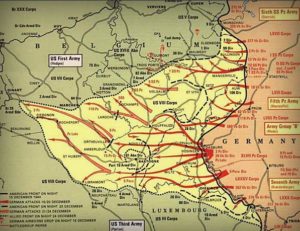
    The morale in the 272nd whipsaws on December 16, 1944 when the German Army launches a massive counteroffensive into the Ardennes forest in Belgium, beginning what will come to be known as the “Battle of the Bulge.” The German military had used the exact same tactic in the exact same place three times previously – September 1870, August 1914, and May 1940. Despite this, the Allies leave the Ardennes lightly defended by two inexperienced and two battered American divisions and the Germans catch them flat-footed. Three German armies – more than 410,000 men, along with all of the supporting arms – launch the deadliest and most desperate battle of the European campaign in the heavily wooded, rugged terrain of the Ardennes. The once-quiet region is overrun with the German counter-offensive. The 1st SS Panzer Division takes the town of Malmedy on December 17, 1944, and eighty-four U.S. soldiers are executed in the Malmedy Massacre. The U.S. 106th Infantry Division will be decimated before the battle’s end, as it seeks to buy precious time for Patton’s Eighth Army to execute an impossible ninety-degree pivot from the town of Lorraine to protect the American flank at Bastogne.

    The Wehrmacht, led by Hitler’s own disciple, Sepp Dietrich along with SS Troops, penetrates the Allied lines along an eighty mile front. Only at Elsenborn Ridge do the Americans hold. The possibility exists that the German Army will run all the way to the Belgian coast at Antwerp – that is indeed Hitler’s plan – severing the line between the U.S. and British forces and leaving four entire Allied Armies trapped behind German lines. The hope for the Germans is a separate peace with the Allies and then a chance to fight their arch-nemesis Russia – alone – on the Eastern Front.


    My grandfather’s unit yearbook grimly records the events:

    Morale was high, and war seemed to be far away during the first part of December. Then came the newsflash of the German breakthrough in Belgium on 16 December 1944. War now seemed close at hand, and our attitude changed from one of the casual interest to one of serious personal regard. On Christmas Day, 700 men were taken from the Regiment for immediate shipment to Belgium to help stop the German onslaught. It was about this time that the Regiment was warned to prepare for shipment to the battlefront. During the remainder of the cold days of December and the first part of similar January days, we continued to train and readjust from the Christmas Day losses.


    *     *      *      *     *     *      *      *     *     *      *      *


    My father leaves the Air Force in 1968 while the Vietnam War rages on; we wind up near his sister and I am born in a small town in Eastern Texas. That doesn’t last during the tumult of civil rights marches and desegregation and my mother home alone with two infants. We move back home to the Northeast – back to the home my father helped build, alongside his father and brothers: my grandfather’s house.

    We don’t stay there long, but my early childhood revolves around my father’s parents and the family headquarters, as it were, on a small plot in Johnston, Rhode Island. My grandmother, the family matriarch, presides over the chaos of her six children with all of their kids, while my grandfather is the very definition of the kind, gentle Stoic in the midst of it all.  His pipe smoke – first Borkum Riff, later Captain Black Apple-flavor – are like incense in the front room, where he can be found staring out the front door into the trees beyond the driveway. He stands like that for long moments, for what seems like forever to my young eyes, and I can never figure out what he’s seeing.

    The Red Sox are always on in the background, either on the television set if we can get reception with the proper combination of rabbit ears, tin foil, and luck; or on the radio, if none of the above coalesce for visuals. On Sundays, my grandfather attends the church where he helped lay the cornerstone. When he returns, we all know we’re getting “dough-boys” – Pèpè’s special “recipe” of bread dough with a whole cut or ripped in the center, fried in some oil. Every once in a while he’ll gift us with french toast if we beg.

    He smiles, his blue eyes clear and twinkling, never looking past you, always right into yours.

    “Alright, my boy!” he says with unadulterated enthusiasm. “Here we go!” as he puts the plate of steaming fried dough on the table and we all chafe to cover ours with whatever we like: my father eats his with butter and jelly, carefully preparing each bite, while my sister and I rip the dough into pieces, lightly burning our fingers with impatience, and then slathering the bits with maple syrup.

    My grandfather always sits patiently at the table with us, or hangs around the kitchen watching us eat, a smile across his face. He listens, watches, sometimes participates in the conversation, but always smiles watching us eat. It doesn’t dawn on me until decades later that having been born in 1919, his childhood would have been right in the middle of the Great Depression. Once over some holidays one of my grandfather’s brothers comes by to visits and I hear the adults in the kitchen from where I am snooping, just outside of the threshold:

    “Remember those lard sandwiches, Frank? We used to take those to school every day.” Everyone turns to my grandfather – I can hear it by the silence.

    “Oh yeah,” he answers evenly. “Yeah. Every day…” The other adults – my father’s generation – turn to my great-uncle and urge him to explain.

    “Mom would cook the bacon in the morning,” he begins, “and then when it cooled to a solid, she’d put that right on some bread and that’s what we brought to school: lard, with some of those bits in it, on bread.” You can hear the recoil and disgust from my father and his siblings. I cringe where I’m standing.

    “Ehh, I didn’t think it was so bad…” I hear my grandfather’s voice into the silence and the room erupts in laughter and jeers. My grandfather almost sounds sheepish, but it’s so genuine I’m filled with sorrow for him, though I can’t quite articulate why in my six-year-old mind.

    Later, I realize that my grandfather is the only person who could express such simple, genuine gratitude for eating leftover lard. He doesn’t know how to be ungrateful.


    *     *      *      *     *     *      *      *     *     *      *      *


    The 272nd is rushed to the front in January of 1945, while the Allies try to hold the bulge in the lines and contain the German break. The Regiment crosses the English Channel during a blizzard. They land at Le Havre on D+189. The 3rd Bn Commander recorded their rush to the lines in his reports:

    The remark, “That truck ride,” will never refer to any but the one from Le Havre in open trucks.  “Standing room only” and “Destination unknown” are both understatements, although the application is sufficient.  If people scoff at your tale of standing on only one foot during an eight-hour ride at night in a blinding snowstorm while the convoy was lost, any doctor will admit it is possible if the near-corpse is frozen stiff.

    Leaving the Château de Vallalet, an 18th-century edifice that had seen rough usage under the Boche occupation, and the surrounding area of Romescamp and Gaillefontaine, the Battalion squeezed into boxcars that jerked along for days.  No fiendish torture device could have left the Battalion’s body in worse shape.  At last, the arrival was made at port, and the historic events of the present 3rd Battalion began with a muddy boot, a sloppy tent, and the foreign sounds of “Oui, oui” and “Cidre.”

    Those ‘foreign’ sounds would have been native to my Quebecois grandfather. I imagine him quietly speaking the pidgin French of his ancestors, and of his wife (née Messier), who used to switch to the French whenever she didn’t want the kids to know what she was saying. We were raised in an English-speaking household, but it frequently swore in French.

    By the time the 272nd reaches Belgium, the German offensive has spent itself. The Wehrmacht Army has run out of fuel, men, and momentum, in large part due to heroic losses sustained and inflicted by the Americans in thwarting the blitz. The defense at St. Vith, at Elsenborn Ridge, and famously portrayed at Bastogne, coupled with Patton’s impossible 90 degree right-wheel of his entire 8th Army, is enough to hold the Allied defenses. My grandfather’s unit now moves forward to confront Der Fuhrer’s Army as it pulls back to its defensive positions at the Siegfried Line. The 272nd, along with its sister units, will have to punch through it to finish off Hitler’s war machine.


    *     *      *      *     *     *      *      *     *     *      *      *


    After I complete Officer Candidate School, I pass by my grandfather’s house just to say hi. I visit far less than I should and rationalize it a million ways, but the truth is that it’s because they are old – like, really old, and I am young. I don’t know how to talk to them. They want to reminisce about the child I was… while I am trying desperately to prove that I no longer am. I want to talk my upcoming commissioning as an Officer of Marines, Leader of Warriors…

    “My boy, whatever you do, you don’t volunteer for nothing, okay!?” My grandfather is serious. “I am telling you. Whatever you do, you don’t volunteer for anything, okay?”

    “I promise, Pep. Not me.” I make a solemn vow.

    “The only thing I ever volunteered for in the Army…boy, they got me, I tell you.” He jabs in the air with his pipe for emphasis. He shakes his head and I can see he is looking somewhere far away, somewhere I haven’t been…

    He looks toward the television set, but it’s turned off.

    “We came back from a long march and boy, I tell you, was it hot in Mississippi!? Whew! With our packs and rifles…” He shakes his head at the memory. “The drill sergeant got up in front of us and said, ‘Okay, is anyone here tired? Does anyone want to volunteer for a different job where you won’t have to carry your pack and rifle?’ My boy, I was so tired… and I’m a little guy!”

    My grandfather turns to me with his eyebrows raised. I laugh because at 5’9″, he’s three inches taller than I am, but I know what he means. He is still healthy at 80, but he slight-framed, always has been, unlike his own sons, who are tall, broad-shouldered, and thick of chest and limb.

    “Those packs and rifles and all the stuff they made us carry… it was so heavy!” It is the infantryman’s lament and I have had a nice heaping spoonful of it over the last weeks, but I shut my mouth out of respect. I know where he has been and where I haven’t.

    “So…so I looked around and I says, ‘Sure! Sure thing Drill Sergeant. I’ll do it!’” My grandfather stops staring, turns back and looks at me, genuine surprise in his eyes, like he still can’t believe this happened.

    “I stepped forward, and the Sergeant said, ‘Okay. Now you’re now a bazookaman. You carry the bazooka.’ And I knew he got me. Boy, he sure got me good.”

    I laugh out loud so hard that it comes out as a bark, myself having just returned from a summer at the hands of Marine Corps Drill Instructors. As I look into his eyes, however, I can see, my blessed grandfather is and was genuinely hurt by that. He was, and maybe still is, that trusting. He cannot believe his Drill Sergeant pulled one over on him like that.

    “So don’t you volunteer for nothing, my boy.” He says, pointing his pipe at me. It’s the final word on the matter. I enjoy his presence for a few minutes while he puffs and stares peacefully, the clouds of smoke with apple and spices float over, and I try to be as patient as a twenty year-old can be. I want badly to ask him about what that was like, but I just can’t bring myself to do it. The gap is too wide; the chasm too deep… I don’t know how.


    *     *      *      *     *     *      *      *     *     *      *      *


    Nevertheless, a night in the woods isn’t housing, and nothing short of a steam radiator could have made the bivouac area among the Belgium firs a comfortable one. These were the most miserable of the bad nights spent. Foxholes were to be dug, but the spadework never passed the slit trench depth. The ground was frozen, and even all the ponchos and blankets that could be mustered were little help. Teeth still chattered between fits of sleep. Moreover, the puddle in the bottom of the hole got deeper and deeper. Nevertheless, it felt less damaging than the wind that blew overhead.

    One night, the darkness was so intense that men wandered away towards both the enemy and the rear. Pfc. Arnold of B Company walked 10 yards from his tent and spent the next 15 minutes trying to get back. Guard reliefs that night were unreliable, too. Even when the relief was to be called by the guard himself, there was no certainty that his tent could be located. Just before dark, S Sgt. Slaich carefully marked the path he was to walk to awaken the next guard, but two hours later, that path was invisible. After an hour’s fruitless search, with nothing to show but scratched hands and face, he returned to his post and the easiest choice – to take the next guard shift.

    “But those nights weren’t the worst,” Pfc. Nyland constantly repeats. “I remember a short jaunt of 13 miles we were to take through the woods one afternoon. Trucks were to pick us up at 2 o’clock. We were waiting beside the road long before that time rolled around. About 9 o’clock that night, the buggies finally arrived. It was raining harder than I’ve ever seen over here, and the wind blew it cold into our faces.”

    “After the duffle bags were thrown into the truck, we piled on – 25 of us with our packs on our backs. I sat on top of the cab, where I thought I could find plenty of room. But when the rain came down harder and it grew colder later that night, I regretted that move. To keep warm, I cursed everything connected with the Army, with Europe, and with winter warfare.” Those 13 miles took 12 hours to cover, and the rain never stopped as long as the ride went on. History of 1st Bn, 272nd Infantry Unit

    My grandfather carried a bazooka as a member of “King” Company in the 3rd Battalion, 272nd Infantry. I’ve stared at the picture that has his name underneath it and no matter how hard I try, I can’t tell who he is. The picture is black and white and the men are too far away to see more than dark slits for eyes. There’s a large building in the background with “Apotheke” on it – the German word, derived from the Greeks, for “Pharmacy.” The men are in neat rows, like every military picture ever taken or painted, row upon row, tallest in the back, shortest up front, and somewhere conspicuously out front or at the sides are the leaders… but this is an after picture, of that there can be no doubt. These men are different than the men who started in Le Havre…

    On moving into positions opposite the Siegfried Line, the Battalion climbed the muddiest, steepest and longest hills in our history.  The going was so rough that walking on knees was nothing unusual.  Even though there was a possibility that the shoulders were mined, everyone had to stop for occasional breaks on the way up.  The entire Battalion started off in regular formation, but within an hour each company was spread over at least 800 yards.  In another month, though, the troops were to wish that they could have gotten that much dispersion.

    At Kamberg, the Battalion received its first real baptism of fire, with no wish remaining for further communion.  The troops were told what to expect and what to look for by the group being relieved.  They gave constructive and helpful advice.  This in itself gave everyone a feeling of confidence; the men were getting first-hand information from the boys who knew.

    The first day there, a patrol of Lt’s Cox and Young, Sgt Johnson, Pfc’s Hagquist, Fulcher, and Schellman of King were pinned down by mortar and 88 fire.  Two days later, 2nd Lt Entzminger, leading his 1st Platoon patrol, was caught in the crossfire of two pillboxes.  The Lieutenant observed the enemy position 200 yards to his immediate front and, upon ordering his patrol to withdraw to safety, he remained in a forward, exposed position, calling for and adjusting artillery fire upon the enemy pillboxes.  Although subject to danger from friendly artillery as well as enemy small-arms fire, he remained in the position until after the supporting artillery barrage was lifted.  Immediately after the barrage, while shifting his position, he was mortally wounded by enemy small-arms fire.  Two others were wounded, and several men of the Platoon distinguished themselves by their efficient and courageous leadership.

    Immediately afterwards, 1st Lt Coppock was ordered to take out a Battle Patrol of four enlisted men to determine the strength of the enemy in the immediate front of his position from which artillery, Nebelwerfer and intense machine-gun fire were being received across the entire Regimental front.  Lt Coppock* pursued his task with such vigor and disregard for danger that, during the night, he succeeded in penetrating 1,200 yards from the Siegfried defenses into the enemy position.  Having collected the information he sought, he then led his patrol safely back with vital information necessary for military operations.  As a result of 1st Lt Coppock’s action and report, a decision was reached in higher headquarters that greatly accelerated the advance of our troops through this sector. –History of the 3rd Bn, 272nd Infantry Unit

    (*) Lt Coppock won the Silver Star for his actions, the 3rd highest award for valor in the U.S. military


    *     *      *      *     *     *      *      *     *     *      *      *


    Life in the military takes me away, as it does to everyone who makes it a career. We move our own young family all around the country and the world at the whims of the Marine Corps and my career. Holidays are a chance to reconnect, but with not a lot of leave on the books and a passel of kids to bring along, we rarely see my grandparents. I spend some time off of the Bosnian coast in 1995 during that unpleasantness. We hear the war, read it intel reports, study it, study the geography, plan routes, even rescue an Air Force pilot, but we don’t see the war… We don’t live it. At the time, the notoriety of the rescue and the relative dearth of conflict gives us what we think is “cred.” People chase “red ink” – combat time in pilot logbooks is logged in red ink – because we are fools.

    I talk to my grandmother about that 6 month deployment aboard ship. She’s lamenting the time away from my kids and then she makes a backhanded comment that pulls me up short.

    “I remember when your grandfather was away at the war…” She begins.

    “Oh? Really? What was it like?”

    “Ohh, he used to write me all the time… Such letters! Oh. Your pèpè, he would send me such romantic letters…” She exaggerates the word to the point of absurdity. I laugh.

    “How long was he gone for?” I ask.

    “Ohhh…psshh… I think about three years or something like that…?”

    Gulp. Holy shit.

    “Saving Private Ryan” comes out in July of 1998. I am in law school at the time with four children. By the time the Bar is over, and Naval Justice School completed, we have orders for Okinawa, Japan and are gone the day after I swear into the Bar. I finally see the movie at Marine Corps Air Station Iawakuni, Japan, while working on a case with a colleague and friend. I am as awed by it as every other American seems to be. It is an amazing movie and I vow to talk to my grandfather about his service after seeing it.

    When we return from Okinawa for Christmas of 2000, we visit my grandparents. I want them to meet our daughters, so we trek the whole carload up those same roads of my childhood. Except now the woods seem impossibly thin, the distances far shorter than I remember, the driveway and the big spruce in the front yard… are not very big.

    At some point my grandfather is standing by the door, talking to the parakeets in their cages, whistling to them while they chirp back. They know his voice and always respond when he talks to them. Outside the wind whips at the screen door.

    “Hey, Pep?” I am sitting in his chair.

    “Yes, m’boy?” He looks up from the birds and smiles.

    “You hear about that movie – ‘Saving Private Ryan?’” He squints at me and then seems to finally have heard my question.

    “Oh. Yeah… yeah, I did.” He stands up and puts his hands in his pockets, fumbling with some change and walks to the door.

    “Would you like to go see it… together… uh, with me?” He never turns around, and he talks at the door, but I can still hear his voice today, like he’s in my room right now.

    “Naaaahhh, my boy… I don’t wanna go see that… I… I seen all that already.” He turns back to me and smiles, but his eyes are pinched at the corners.

    The shame washes over me. What an arrogant thing to ask, to assume… I regret asking that question to this day.


    *     *      *      *     *     *      *      *     *     *      *      *
     

    Third night at Kamberg was the busiest for the outpost.  At about 2130, the King (K) Patrol returned, bearing two casualties.  About midnight, the demolitions patrol of T Sgt Farley came by the OP (Operations Post) for last-minute instructions before jumping off on their attempt to blow up the pillboxes.  The patrol soon left and returned about 0300 with their mission accomplished.  The outpost had front-row seats for this exhibition, and can testify that those boys did a good job.

    In addition, Item Company is justly proud of its Aid Men.  Their deeds shine brightly through the darkness as memories take the place of battle life.  One day, as mortar shells were coming in pretty thick, Jenkins of Item was wounded.  Out there could be seen the figure of a man running swiftly and without hesitation – Mike DiCubellis.  A medic was needed, and mortar fire or not, Mike was going to where he was needed.  In just a moment he had reached the fallen Doughboy.  Working feverishly in a field where individual movement meant danger, the Medic never flinched, seemingly not realizing that death flew through the air with each burst.  After the engagement, he remarked, “Didn’t have time to dig in.  The guy was hurt bad; had to work fast.”

    The Communications Section must be praised especially for its fine job at Kamberg.  Although harried by mortar fire day and night, the lines between the rear and forward CPs and each line company were in service at all times.  The whole week at Kamberg was, as one man put it, a thin solution of night.  We were like owls, having eyes only for darkness.

    Leapfrogging nimbly over the last perimeter of the Siegfried line, the Battalion took Dahlem, our first town, in a walk – literally – and what a walk.  The troops were loaded down like a convoy of one-man bands. Mind you, at that time, it was mostly GI equipment, not boodle!

    Leaving Waldorf, the Battalion went on First Army Security Guard al the way to Stolberg and Aachen, big cities wrecked by American bombing.  This meant working with engineer guards with white SGs on their helmets.  This was the Battalion’s chance to get in on some of the luxuries of rear echelon – beer, movies, showers.  That good deal was over in five days, and the Battalion crossed the Rhine in trucks on the 28th of March.

    Arriving in the ancient town of Arzbach near the Lahn River late at night, the Battalion settled down for a few days with little action except intensive patrolling of the area.  For the next week, the Battalion moved by vehicle or foot from town to town, trying to catch up with the Krauts.  Leaving the town of Dehrn, which is memorable for the 100 slave workers who were living in a lice-infested seven-room house, the troops rode the TDs (Tank Destroyers) and other vehicles 100 miles to Lohne without incident.  The second day at Lohne, the order came for a march to Altenstadt and surrounding villages, a 10-mile jaunt with full field and boodle. Everyone soon swore off, “No more loot.”

    An early call the following morning started the Battalion on its unforgettable 28-mile march to Kassel, even though aching and blistered feet characterized the day.  The men made it, however, and pulled into Bettenhausen on the outskirts of Kassel.  Nevertheless, boodling that night took sheer guts.  The troops had not been so exhausted since the aftermath of forced marches at Camp Shelby.  –History 3rd Bn, 272nd Infantry Unit


    *     *      *      *     *     *      *      *     *     *      *      *


    My grandmother and grandfather’s wedding picture hangs on their wall, as it always has. When I was young, I once looked at the picture and asked my mother, “Who are those people?” I could not reconcile the young woman in the picture – blonde-haired, blue-eyed, and statuesque – 5’10” anyway, with the woman in the kitchen smoking Virginia Slims – imagine Ursula from “The Little Mermaid” with a flower print dress … but my grandfather is unmistakable in the picture. I know the look on his face – I recognize it instantly – because I’ve seen it reflected back at me in the mirror before; he is crazy in love with that woman next to him…my grandmother.

    Sixty-four years later they’re still together, but now the dementia or Alzheimer’s has left my Mèmè, the powerful matriarch, a shade of her former self. She has been in and out of the hospital and ultimately is back in the house at my grandfather’s insistence. The last time I was there, she had about 10 minutes where she recognized me and we were able to communicate, but now… now she has only one word. She rocks back and forth and calls my grandfather’s name: “Franny. Franny. Franny.”

    “I’m right here.” He pats her hand and smiles. She only stops when he touches her, or talks to her, or coos at her, like the birds. I realize in that moment it’s not what he says, it’s how soothing his voice is, how much love he outs into the sounds. It’s like baby-talk, but this isn’t cute or funny, or self-aware at all; it’s a man trying to convey over 60 years of love while he watches his wife dissipate before his eyes. Fifteen minutes is almost more than I can take, but it’s not her calling “Franny” that affects me: it’s being present. I feel like a voyeur. This is theirs and theirs alone.

    My grandfather and I talk about the Red Sox, our family history – his family history – and he mentions that he is the only one left. I’m not sure what he means.

    “Of my brothers and sisters… I’m the last one,” he says.

    “How many brothers and sisters did you have, Pep?”

    “There were twelve of us.”

    I can’t fathom any of that; not eleven siblings, not growing up in the Depression, not carrying a bazooka in World War 2, and not outliving all of my family at age 82.

    I just stand next to him and put my hand on his shoulder while he looks outside.

    My grandmother passes while I am in training to go to Afghanistan.


    *     *      *      *     *     *      *      *     *     *      *      *


    The 272nd Infantry Regiment’s history is a surreal walk through war, told by the men who lived it. There is the time the 3rd Battalion gets shelled by German artillery after crossing the Werra River and takes shelter in the basement of a building… that turns out to hold cases and cases of wine and French champagne. Two men are killed and three wounded, but the 272nd pushes on to Eichenberg. “Love” Company takes the town and King mops up.

    They push on toward a town called Nieder-Gandern, but receive Tiger tank fire beginning in a town called Hebenhausen all the way to their objective. Even after they take Nieder-Gandern, the Tigers never stop their fire and four men are killed during the night and morning. A German night counter-attack is repulsed at close quarters.

    Early the next morning, the Battalion bypassed all the dead Krauts who had counterattacked during the night. King Company led over a circuitous route, through the woods and onto the road. One sniper was flushed out by the lead squad under S Sgt Smith, Sgt Jonassen and Pfc Tarkington, and in the second town, 21 men were captured and 10 wounded or killed. The light machine gun section of the 4th Platoon of King accounted for one man. Along the way, M Company caught a group of the Boches running up a hill. The HMGs (Heavy Machine Guns) gave ‘em the hot foot, and the Company proceeded unmolested, leaving behind over a dozen dead Krauts. That night was spent in almost forgotten comfort, complete with soft beds and electric lights in Heiligenstadt.

    Bad Kösen. Naumburg. Kottochau. The names of towns tick of as a checklist of objectives. The Regiment continues to pursue the Wehrmacht ever deeper into German territory. At Thiessen, the Regiment narrowly avoids walking into an ambush when a patrol discovers some wounded Germans from a nearby village, who explain that Thiessen is going to be a “last stand” for that unit. The Regiment hastily forms up and attacks the German 88mm dual purpose machine guns emplaced in the town. There are 36 of the anti-aircraft/anti-tank guns, which are considered among the best guns ever made, given their ability to take down allied aircraft or destroy allied tanks. The 272nd catches the German gunners by surprise and, along with some excellent gunnery from supporting artillery, it takes 249 enemy prisoners.

    Germany’s 5th largest city, Leipzig, is the next target on the Regiment’s checklist. It takes hand-to-hand combat, but the 272nd captures a German barracks, and over the course of a day and night of fighting, another 234 enemy soldiers are captured.

    The activities were climaxed the next morning when a feminine voice was heard rendering some smooth English. The voice belonged to a gal from Boston named the Countess de Maduit, the former Roberta Lorrie of Boston.  She could not believe the Yanks were there until a few cuss words cinched the fact.  The perfect portrait of an overjoyed woman, even though she bore the scars of an unforgettable past, she showed Love Company the concentration camp.  Tears rolled down the cheeks of the men as they were shown the sea of people subjected to the barbarous treatment.  The worst came when they saw what remained of a building the SS had burned to the ground.  To keep the record of the Krauts straight, they had crowded some 200 patients into it before igniting the fireworks.  The sight was not a pleasant one.  The troops realized that the enemy was all and more than anyone had ever imagined.

    It is not long after that the 272nd makes contact with the Soviets coming from the east. The German Army is vanquished.


    *     *      *      *     *     *      *      *     *     *      *      *


    When the Red Sox come back from three games down against the Yankees and win the American League Pennant, I have to choke back tears. I am in Afghanistan at the time. The tears are not for me; baseball has never been my love the way it is for my grandfather. I break protocol and sneak a phone call; I can dial the number to my grandfather’s from memory. His 85th birthday is just weeks away and now, one year removed from another Yankees heartbreak that I thought might kill him. I know the Sox will beat the Cardinals. They have to.
    I hear his voice over the scratchy connection.

    “Hello?”

    “Pèpè? Hello? It’s me, Dale.”

    “Yes?” We step on each other’s voices because of the delay, but finally I can hear his recognition that it’s me. I start shouting like a fool.

    “They did it, Pep! They did the impossible!”

    “I KNOW IT, MY BOY!! I THINK THEY’RE GONNA DO IT THIS YEAR!” I can hear the joy in his voice. I look around to see that no one is there and I let the tears run freely down my face.

    He was born the year after they won their last World Series (1918) and he has watched eighty years or more of Red Sox tragedies, one piled upon another. He has borne it all with a patience that would make Job nod in approval. I’ve endured a good deal of it with him and never, not once, have I ever heard him swear. Not a single curse word. We watch Bucky Dent rip our hearts out in ’78 and all he does is throw his hands up, look at me in complete disbelief, and turn off the little black and white television set. He walks to the door and stares while he puffs away. I come to hate the Red Sox for the pain they inflict upon him…

    When they sweep the Cardinals in ’04, I almost don’t care if I die in Afghanistan. He finally got to see them win it all. Finally.


    *     *      *      *     *     *      *      *     *     *      *      *


    By the time my wars have ended, the Red Sox win their second World Series and when I visit my grandfather, we discuss Mike Lowell for governor of Massachusetts, the ’04 win… we relive our favorite parts in glorious detail. His sad-sack Patriots are now officially a dynasty and even the Celtics are looking good. Neither of us can believe this new world we inhabit.

    He’s switched from a pipe to cigars, much to the chagrin of his children.

    “I’m worried about these cigars he’s smoking,” says a relative about my grandfather’s new habit, to which I riposte that he is now in his late 80’s, and entitled to pick up a heroin habit, as far as I’m concerned… it’s no one’s business.

    I happily indulge my Pepe with illicit Cohibas I’ve managed to get my hands on from a friend who is a ship’s captain in a country that doesn’t have an embargo on Cuban rum or cigars. I hate cigars, but we smoke them together in celebration. It’s the best smoke of my life.


    *     *      *      *     *     *      *      *     *     *      *      *


    Under the experienced command of Lt Col Edward J. Thompson, the 3rd Battalion of the “Battle Axe Regiment” had proven itself well in combat.  Over hill, trails, and to the magnificent woods that spelled digging, smoky fires, makeshift shelters and excitement, the 3rd Battalion has caught in its wake of fire, memories that surround themselves with flesh and blood, with hope and sorrow, and with laughs and experience.  During that time, a Battalion changed from a carefree, bivouac-inured herd to a confident, battle-tried team of fighting men.  Only one medium can effect the change; only one process can bring about the metamorphosis.  That one process is war.  The actual struggle of meat and bone remains, as through the centuries, the unique method of shaping troops from the whims and idiosyncrasies of rear echelon to the positive qualities need to fight a battle.  The way has been hard; it could have been harder.  A spirited Battalion now exists that will function well under any conditions.


    *     *      *      *     *     *      *      *     *     *      *      *


    A little while after my grandfather’s return from Germany, he and Meme conceive their fourth child – my father. A true “Baby Boomer,” he is born in the shadow of that terrible war. Twenty-two years after his birth, I am born in the shadow of the Vietnam War.

    My grandfather lived quietly and simply, occasionally growing peppers and tomatoes in the garden out back. He loved purely, his blue eyes windows into the soul of a godly man. He helped build the nearby church, never missed a Mass while I was growing up, and yet I never heard him preach, judge, nor condemn a single person. I never heard him swear, nor lie, either.

    He was an exceptional man from what feels like a bygone era, when decency, and good manners, were considered essential traits of all citizens. It’s hard to fathom the changes he saw in his ninety-eight years, but no matter what the fashions or trends, from the Flappers to the Hippies, from Disco to Heavy Metal, his brand of kindness never went out of style. It was never old-fashioned and neither was he – just the purest font of light, with a whistle for the birds and a smile for your troubles.

    On Thursday, July 26, 2018, Francis Norman Saran, 98, passed away peacefully in his home, the one he built with his own hands. No palace of Versailles or manse for a Lord, it nevertheless sheltered generations of my family – his family – through stormy summers, hurricane season, and the bitter cold New England winters.

    He will be remembered and missed.


    _____________

    Liked it? Visit www.theabjectlesson.com and take a moment to support The Abject Lesson on Patreon.
  • Chapter 15 – The Stay

    “Well, if they’re going to issue the stay at all, now would be a good time! I mean, if no stay today, by tomorrow night my guy is eating with the big metal spoon, if you know what I mean.” I’m on the phone to appellate defense in Washington, D.C. I look at my watch. The digital face reads 00:31. Ten-thirty in the morning east coast time.

    “Alright, bye.” I hang up. I’m looking at documents, but I’m not really seeing anything – David Ponder’s record book, letter from his wife, character statements, and I’m trying to imagine how I’m going to defend him tomorrow. I’ve got one last motion that I’ll bring at the close of the government’s case. One last grasp that has a sound basis in law, but the judge will deny it, at this point. It’s a technicality.

    From the beginning I’ve had the sense that they have mischarged the offense, perhaps intentionally. The prosecution has charged it as willful disobedience of a superior commissioned officer. Under the UCMJ, that has a stiffer penalty than the more general charge of violating a lawful general order, such as the order from the Secretary of Defense, to take the anthrax shot. The government has charged it as violating the specific Navy Lieutenant’s order, but there is an old case that stands for the proposition that merely repeating a higher order can not make an orders violation the more egregious willful disobedience of a superior commissioned officer. It is called the “ultimate offense doctrine,” but it probably isn’t going to work. Nothing else has.

    I’m tired. I haven’t slept much, I need a shave, and my back is killing me from my tiny desk chair at home and my broken desk chair at work. I need to get David’s sentencing case together, review my opening statement and closing argument, and make sure all of the documents are in my case file, with necessary copies for each of the jurors…

    My head nods and I realize I’ve drifted off at my desk. I look at my watch and see it’s 2:33 am. I rub my face and decide to take a walk.

    The building is dark and empty, except for me and the feisty Okinawan cockroaches. I stroll the dark corridors, my sneakers making a light tread on the tile. I stretch my arms over my head as I walk to the entrance. Out the window, the open field beside our building is dark. I can barely see the slope that I know rises up to a road that runs next to the next set of office buildings and the barracks.

    I hear the phone in the clerk’s office ring, but there’s nothing particularly unusual about that at this hour because of the time difference; people frequently fax documents from the States during our nighttime in Okinawa. The fax ticks away, a counterpoint to the flying bugs banging into the glass on the door and the light just outside of it. Tick-tick-tick. In seven hours, David Ponder is going to be facing a jury, and likely going to jail. Unless that fax. . .

    I walk hurriedly to the defense clerk’s office and go to the fax machine behind the clerk’s desk. Letter-sized sheets are spitting out, face down. I grab one and flip it over to see if it has anything to do with me. The cover sheet is from the Washington Navy Yard. I grab the whole stack while more keep sliding out.

    My eyes flick over the words.

    “YEAHHHHHHHHHHH!!!!!” I let out a guttural yell that echoes throughout the empty building. “Can you feel that, huh!?! Baby, can ya’!?” My best Ace Ventura, hips thrusting, fist pumping. I want to cry with relief. We beat the clock by seven hours. I’ve kept my promise to David and his wife, to Jason Stonewall, and Vittolino Arroyo. We have a stay from the Navy Marine Corps Court of Criminal Appeals. No one’s going to jail tomorrow.


    I take my time packing up and make a few copies of the stay. Before I leave, somewhere near 3 am, I take a ten-penny nail and hammer the stay to the prosecution’s office door. I don’t do it right through the middle, however, because I’m still a Marine Officer and someone might bitch to the CO about a nail in the door. I hammer the nail just deep enough to look like someone was careless; but not all the way through the door, for example. I also place the nail an inch or two above the middle of the sheet, close enough to the top of the sheet that it doesn’t look like it was intentionally in the middle, but far enough down that someone will have to either rip the paper in half to get it off or pry out the nail. It’s an asshole move, to be certain, but I know it might be all the satisfaction I’m going to get in the long run, so I indulge myself. It’s the little “fuck yous” that matter in life. It won’t be the last laugh, but it’s enough to make me smile as I walk to my car for the drive back to Kadena Air Base officer housing and my wife and four daughters.

  • Chapter 14 – Secretary Cohen’s “Four Points”

    In December of 1997, the anthrax vaccine manufacturer was shut down and could not manufacture anything related to the AVA. Notwithstanding that hurdle, Secretary of Defense William Cohen announced that before the mandatory program would begin, it would have to meet four prerequisites:

    1. Supplemental testing, consistent with Food and Drug Administration standards, to assure sterility, safety, potency and purity of the vaccine;
    2. Implementation of a system for fully tracking personnel who receive the anthrax vaccinations;
    3. Approval of appropriate operational plans to administer the immunizations and communications plans to inform military personnel of the overall program;
    4. Review of health and medical issues of the program by an independent expert.

    (My emphasis added). One cannot help but wonder why condition number one would need to be in place if the DoD was confident in the safety and potency of the AVA, as it had started saying publicly. In fact, this appears to have been nothing more than a media campaign to assuage fears because none of these four “prerequisites” were ever met before the program kicked off, which is exactly why the manufacturer had been shut down in the first instance. Each of these factors revealed fundamental flaws with the program from its inception.

    With regard to point 1, “supplemental testing” may well have been the worst idea for the DoD could have ever come up with because what it demonstrated, unequivocally, was failure of lot, after lot, after lot of the vaccine.[1] One of the first findings in CBER’s February 1998 inspection was that “there is no validation of the length of time sublots are held until they are used in a lot. Sublots have been held longer than three years prior to use. There is no stability data to support this hold time.”[i] Lest this seem picayune, consider a little more history of one particular Sublot:

    Sublot AV456 was produced . . . in 5/95 [and stored] until 3/97 at which time it was transported to the formulation room . . . with other sublots to make FAV039. Here it was discovered that AV456 was contaminated with mold, and it was destroyed.[ii]

    While some may say that the fact that it was caught is good news, it ignores the other, older sublots where mold or other impurities were not caught. One finding (among many like this) is particularly noteworthy:

    Lot FAV023 was filled on 12/13/93 and passed a potency test on 3/29/94. It was submitted for redating on 4/2/97 and was placed in the stability program (zero time) at the same time. It is reported as failing potency on 4/2/97. It was tested again on 8/12/97 and is reported as failing potency. A fourth potency test conducted on 10/6/97 is listed as passing by 0.01. There is no investigation into the original result and justifying the additional testing.[iii]

    This finding is most disturbing because it indicates a testing regime that ignores negative test results – twice! – and somehow chooses to validate a subsequent positive after two negatives. How can one know which test result is correct with two failing and two passing results? And how many people would like to line up, roll up their sleeve, and take their shots from that particular vial of the vaccine? Stability testing of biological products is crucial because of the possibility for these products to break down over time. Note that this lot was “filled” in 1993. Four years later it passes a test by .01 after having failed twice previously. This particular finding is in no way isolated: Lots FAV 010, 011, 018, 021, 022, 025, 028, 040, 041, 042, 043, and 044 all had at least one failed potency test that was not investigated and then a passing result was somehow chosen over the negative one.

    FAV016 has its own uniquely disturbing history.

    Lot FAV016 had 6579 vials rejected due to particulates during post-filling inspection. These particulates were not identified, nor was an investigation conducted. The batch was released.

    Someone, somewhere, had unidentified “particulates” injected into them. As a practical aside, one has to wonder how those individuals will get VA compensation if they have an illness as a result of this contaminated product being injected into them in light of the DoD’s positions that there had only been 74 adverse events from the vaccine.

    The list of violations goes on and on and includes several different lots being tested and found with such contaminants as “penicillum species” – a danger to anyone allergic to penicillin; cladosporium – a fungus that can cause infections leading to “rough skin, black lesions on the hands, and sometimes a brain abscess”; altenaria – a fungus that can cause dermatitis in humans; micrococcus – a contaminant that is relatively harmless to humans; staphylococcus saprophyticus – a significant cause of urinary tract infections; staphylococcus epidermis – a significant cause of opportunistic infections, usually for those with some skin puncturing, such as needle/IV intrusions, medical appliances, or surgery; and staphylococcus capitis – another infection causing bacteria.

    Despite all of these findings and more in February of 1998, the program was launched on May 15, 1998, with Secretary Cohen claiming, with a straight face, that “all conditions for implementing the anthrax vaccination program for the total force have now been met.”[iv] There is simply no possible way Secretary Cohen could have said that in good conscience if he was aware of the inspection results in February. And given everything going on around the program, it is impossible to imagine that he didn’t know – because he manufacturer “voluntarily” shut down for “renovations” in January 1998. In reality it shut down as a result of the Notice of Intent to Revoke letter by the FDA, otherwise the February inspection results would have resulted in the facility’s license revocation.

    The second condition of the program was tracking of immunizations. Two DoD briefers talked extensively on November 6th, 1997, about a new program that would be used to track immunizations and of the terrific job the new system had done in Bosnia.[v] At a March 1998 Senate Armed Services Committee hearing, however, Dr. Randolph Wykoff, the Associate Commissioner for operations at the FDA, and Mark Gebicke of the GAO, pointed out that the Bosnia experience left a lot to be desired, particularly of the tracking of immunizations under an IND protocol for an investigational encephalitis vaccine.[vi] In fact, one report used the word “abysmal” to describe it.[vii] Once again, the Assistant Secretary of Defense for Health Affairs promised to get better, but also talked about a new procedure for getting relief from the FDA from the requirements of an IND.  The FDA associate director maintained that the “FDA firmly believes the IND process, as defined in our rules and regulations, is sufficiently flexible [for DoD’s needs]. Additionally, FDA is convinced the Department of Defense has the scientific, clinical, and logistic capability necessary to comply with the requirements of the IND process.”[viii] Evidently, however, they could not and did not do it in Bosnia. A GAO report issued the same day stressed the importance of being able to track vaccine immunizations in order to ensure “that (1) sufficient supplies of vaccines will be available at the various worldwide immunization sites; (2) vaccines that are older than their 1-year shelf life are destroyed; and (3) records of vaccines received, administered, and destroyed are kept to allow for monitoring and tracking.”[ix] Worse yet, the GAO found that during the “Bosnia deployment in 1997 . . . DOD could not account for more than 3,000 (20 percent) of the total number of doses sent to Bosnia.”[x]

    Requirement number three was that there would be approved operational plans to communicate to service members about the anthrax vaccine program. Whatever the operational plans were, in May 1999, the Department of the Air Force circulated a memo to its judge advocates, specifically defense counsel, telling them that “a small number of military members have refused to follow their commander’s direct order to take the [anthrax] vaccine” and that the cause of their fear in taking the shot is “misinformation obtained from web sites set up by special interest groups[.]”[xi] This was a frequent refrain of the DoD, in front of Congress and in the press. The memo also points members to the DoD’s own website, which was established after the program had begun, in order to “counter” in DoD parlance “internet misinformation.” Evidently then, in March of 1998, when the program was about to begin, prong number three hadn’t been met, either.

    It is worth noting that the Army’s AVIP Agency existed solely for the promotion of the anthrax vaccine. It was budgeted at $74 million over a six-year period (FY99-FY05).[xii] No other military medicine program has ever needed to be forced on servicemembers with an orchestrated campaign of this type. William Arkin, a defense writer and former Army intelligence officer observed that “. . . this is the Pentagon versus its own service members. It is a depressing window into the breakdown of discipline and basic confidence in the political and military leadership. That has nothing to do with the Web.”[xiii]

    Criterion number four probably cost the DoD as much credibility (if one can say it had any to begin with) as number one. It would be comical were it not for the stakes involved. Secretary of Defense Cohen announced that there would be a “review of the health and medical aspects of the program by an independent expert.”[xiv]

    Doctor Gerard N. Burrow was the doctor who allegedly reviewed the program at the request of Deputy Secretary of Defense Rudy DeLeon. Dr. Burrow concluded that “[t]he anthrax vaccine appears to be safe and offers the best available protection against wild-type anthrax as a biological warfare agent.”[xv] Unfortunately, Dr. Burrow is a professor of gynecology at Yale University School of Medicine, a specialty that one would not normally associate with some expertise in weaponized anthrax toxins. When that unfortunate snippet from his CV leaked out, Dr. Burrow was subsequently asked by Congress to testify about his review at a 29 Apr 1999 hearing. He declined to appear. Instead, in a 26 Apr 1999 letter to Representative Christopher Shays (R-CT), Burrow stated that

    “[t]he Defense Department was looking for some [sic] to review the program in general and make suggestions, and I accepted out of patriotism. I was very clear that I had no expertise in Anthrax and they were very clear they were looking for a general oversight of the vaccination program.”[xvi]

    The DoD’s claims of misinformation on the internet had a particularly hollow ring in light of its blatant lack of honesty and candor in having something as simple as an independent review conducted. Nothing was ever done about this lie that was foisted off on American servicemembers. No one has ever been taken to task for this laughably blatant fraud perpetrated on U.S. military members and the broader American public.

    Thus, in the end, the DoD’s four-point plan to reassure the public and servicemembers of the safety of the anthrax program – as a prerequisite to beginning inoculation – was nothing more than a PR campaign that ultimately cost the DoD credibility that it did not have to spare. As the truth came out, and was certainly made available on the internet and elsewhere, the DoD’s cries of “misinformation” went unheeded. Service members on active duty and in the reserves began to refuse or leave the service rather than take the anthrax shot.

    If the DoD’s actions appear incredible, the FDA’s inaction is equally baffling.  The FDA is charged, under the Administrative Procedures Act, with the duty and authority to regulate, among many other things, the safety of drugs and biologic products. The FDA has had no hesitation in cracking down on manufacturers who do not comply with its regulations or decisions. The cases in the D.C circuit are legion with the FDA disciplining manufacturers who try to market a drug for a purpose not clearly delineated on the approved labeling or who otherwise fail to comply with IND protocols.[xvii] For some reason, however, in the case of the AVA, the FDA had an absolutely incestuous relationship with the DoD, a third-party who was NOT even the manufacturer! Letters were exchanged between the two agencies regarding non-compliance with IND protocols after the IND protocol was not properly administered in Bosnia. At the March 17, 1998, hearing, the following colloquy took place on this issue between Senator Rockefeller and Dr. Wykoff, the FDA’s associate director for operations.

    Rockefeller:  . . . It’s also not clear to me that FDA’s shoes are entirely clear or clean on this matter. In fact, some would say lax.  I think that FDA and DoD have been exchanging letters about all of this for some months now. And the fact is that seven years after the Gulf War, the situation is still not resolved. If DoD does not adequately answer FDA’s questions with respect to these matters and others, what is FDA going to do about it?  . . . And why, for example, was it necessary for the Presidential Advisory Commission to address the waived informed consent matter six years after the end of the war? So I put to you what FDA would recommend and would do if DoD does not come in compliance more?

    Wykoff:  . . . We have tried very hard to make sure that they are absolutely clear what our rules and regulations are and what our expectations are. We believe that they understand that. We believe that they have the capability of complying with all of our IND rules and regulations. As to whether they will comply in the next deployment situation, obviously we can’t predict that.

    Rockefeller: And if they don’t, is there anything that you can do about it?

    Wykoff: Yes, sir. Obviously, there are a range of options that we have. We would have to determine what the specific concerns are. That drives what are specific actions would be.

    Rockefeller: What are some of the options?

    Wykoff: Well, as we interact with any trial sponsor, we learn more about their ability to conduct IND trials, we would be more or less willing to grant waivers or exemptions to particular requirements.  We could hold them to more – all of the requirements as outlined in the rules and regulations – based on their performance.[xviii]

    It boggles the mind to think that the first words out of the FDA’s mouth are talk of waivers for non-compliance with regulations, particularly in light of DoD’s history in this area. There was, and is, a clearly documented squeamishness on the part of the FDA to step in and bring the DoD into compliance. In downright shocking testimony before a House Committee, Dr. Kathryn Zoon of CBER was questioned by Rep. Christopher Shays (R-CT) about the FDA’s regulatory responsibility.

    ZOON: This is a licensed vaccine. If a physician uses it or DoD uses it, that does not really fall under our jurisdiction.

    SHAYS: So it’s your statement before us now that if DoD doesn’t abide by the protocol, you have no responsibility? That you have set out a requirement? Who is responsible then? Who’s going to make sure that DoD abides by the protocol, if you don’t do it?

    ZOON: We don’t have the authority.

    SHAYS: I can’t believe – I just want to say, Dr. Zoon, I cannot believe that you have just said under oath that you do not have the responsibility to deal with this issue or the authority. You said you don’t have the authority.

    ZOON: I said – yes, that’s correct.

    SHAYS: That is your testimony.

    ZOON: We don’t have the authority.

    SHAYS: Well then who is going to protect our men and women if you aren’t going to do it? Who? Who has the authority?

    The tricky part of this testimony is that it is partly correct. The FDA does not regulate end-users of a product, normally. That is, they do not tell an individual doctor, for example, that he cannot use a drug off-label. Two important caveats to that “normal” example, however. First, the normal patient can’t and isn’t being compelled by their doctor to take anything; they can decline, and they can also sue if something happens as a result of the doctor’s malpractice. A military member has neither of those options. Second, and more directly on point, if the end-user is participating in a clinical protocol, then the FDA does regulate that user. Thus, the DoD’s participation in BioPort’s IND application in order to get an indication against aerosolized anthrax should make them subject to FDA regulation, just as the DoD was during the Gulf War when applying for a Rule 23(d) waiver. FDA’s willingness to accede to DoD’s interpretation essentially allowed the DoD to completely slide on their responsibilities. Some lawyer’s or regulator’s intentional misinterpretation of the FDA’s own regulations resulted in an open abdication of the FDA’s regulatory role over the AVA.

    FDA officials have repeatedly acceded to DoD doctors’ interpretations of the anthrax vaccine label, as well. This is an absurdity, particularly appalling in light of the DoD’s involvement in the manufacturing process. The DoD fundamentally became a manufacturer, for all intents and purposes, and the FDA looked the other way, hiding behind the fiction that the DoD was an “end-user” when convenient. The DoD was involved from the very beginning in the development of the anthrax vaccine. Additionally, when problems arose with the manufacturer, the DoD sent in its own ‘inspection’ teams to ensure the supply of the vaccine. The DoD had paramount liens on every piece of equipment that the manufacturer has. A GAO report in June 1999 found that

    DOD has made a significant investment in renovating BioPort’s biologic facility to meet the military’s requirements for anthrax vaccine . . . Since 1988, DOD has provided about $112 million in contracts, including options, to help ensure the viability of the anthrax vaccine biologic facility. As shown in figure 1, DoD’s contracts provided monies to (1) produce the vaccine, (2) renovate and expand the production facility, (3) provide various support services, and (4) purchase equipment to enhance production capacity. DoD has also provided contract terms and conditions to help ensure the success of the anthrax vaccine program. For example, under Public Law 85-804, which allows for government indemnification of contractors for unusually hazardous risks, DoD indemnified BioPort against product liability. In addition, DoD agreed to allow the company to sell up to 200,000 doses of anthrax vaccine to others, using government-furnished equipment rent-free, after DoD’s requirements are met.[xix]

    Amazingly, this is chump change compared to what the Defense Contract Auditing Agency found in 2000! That report led to an Inspector General Investigation. Notwithstanding numerous audits that found that the company was not financially viable, BioPort requested contract amendments that included $1.28 million in bonuses for senior management that amounted to 109% of the managers’ base salary. This was deemed an “unreasonable expenditure” by the DCAA in light of “BioPort’s current financial condition.”[xx] Okay, so someone disapproved, right? Well, sort of, because the manufacturer had almost no real financial incentive to produce an FDA approved vaccine under its contracts with DoD to begin with: the contract paid the manufacturer 90% of the contract price before the FDA ever inspected the vaccine. Yes, read that again.

    Put another way, BioPort only got paid 10% more for the product being approved by the FDA. At one point, the Department of Justice was looking into criminal charges as some $6 to $8 Million of the money provided to the manufacturer was unaccounted for.  Additionally, the fact the former Chairman of the Joint Chiefs of Staff Admiral William Crowe was a co-owner of the facility, as well as Dr. Robert Myers, (formerly of MDPH and MBPI) can hardly escape attention. Crowe was the first senior military officer to have come out publicly in support of then-Democratic party candidate for the Presidency, Arkansas governor Bill Clinton. While both Crowe and Myers disavowed any “inside” preferential treatment from the DoD, one must wonder if the decision to award BioPort the contract had anything to do with either’s presence as an owner. Finally, emails from inside the DoD suggest that the agency actually had its own people “on site.” During hearings held by Representative Christopher Shays in May 1999, an email was sent from Brigadier General Eddie Cain, the Director of the Joint Program Office for Biological Defense, to an Army Colonel John V. Wade. In the email Cain warned that “[I]f you think Congressman Shays was critical of the current relationship between FDA & DOD, wait until he finds out that DOD is calling the shots on-sight.” [sic][xxi] When this email surfaced during the court-martial of Air Force Captain (and medical Doctor) John Buck, the FDA had “no comment.”

    The FDA has, for whatever reasons, backed down from the DoD to the point that after the warning letters, the notice of intent to revoke, and a failed inspection thereafter, the agency still withheld pulling the manufacturer’s license because the DoD interceded on behalf of the company. In a June 25, 2000, interview with the Vancouver newspaper The Province, Mark Elengold, the Deputy Director for CBER, explained what happened.

    The FDA held off pulling the licence, in part because it would have left the U.S. Department of Defence [sic] – which had just announced that all soldiers were to receive anthrax vaccine – with no domestic source.

    “This is a one-source product so we tend to try to work with firms and put additional monitoring steps in to avoid revoking the licence,” said Elengold.  The prestigious British medical journal Lancet reported at the time that ‘a plea from the Pentagon has prevented an ‘eleventh-hour’ closure of the only U.S. producer of anthrax vaccine,” according to an e-mail to DND [DOD?] medical headquarters in February 1998.

    Elengold confirmed the Pentagon sat in on a crucial call to the company in which he discussed revoking the licence.”[xxii]

    Electronic mails surfaced in and around 2000 show not only did the DoD convince the FDA not to revoke the license, but DoD also attempted to bully both the manufacturer and the Government Accounting Office at the same time. In one e-mail, a Pentagon official discusses how other agency supervisors were urging the U.S. Food and Drug Administration and the manufacturer of the vaccine to release lots that had been held up for scrutiny by them (the FDA). This despite Secretary Cohen’s public insistence on supplemental testing to ensure safety of the vaccine, one should remember.

    On Feb. 22. 1999, Dr. Michael Gilbreath, a civilian Pentagon biological defense employee sent an email to U.S. Army Brig. Gen. Eddie Cain, then Director of the Joint Program Office of Biological Defense (JPOBD). Gilbreath wrote that he had “received information this morning from BioPort that individuals within the DOD contacted them and threatened that DOD would circumvent BioPort and contact the FDA regarding availability of anthrax vaccine lots currently under review at the FDA . . . Any such actions by DOD would be inappropriate.”[xxiii]

    E-mails also reveal that the Pentagon was having trouble countering the U.S. General Accounting Office’s assertion that the vaccine is improperly licensed, and that it has not been proven safe and effective. Cain indicated in one e-mail that then Secretary of Defense William Cohen would be writing to the GAO, whose findings have consistently gone against the Pentagon, to protest “the expertise put on this (vaccine) project” by the watchdog agency.

    “If we cannot answer these questions, we (DOD and the Administration) are in big time trouble,” Cain said in the May 3 e-mail. “…We are digging ourselves a hole that will be too difficult to crawl out of.”[xxiv]

    The FDA also stood by when adulterated vaccine was shipped to the Canadian military and when 59 Marines were given shots from expired lots of the vaccine.[xxv] The FDA’s complicity with the DoD’s actions has left service members with no recourse but to either take the shot, be court-martialed for refusing, or leave the service somehow if their commitment allows it. If the service member simply will not take the chance on the vaccine’s safety, the penalty for refusing is court-martial with a certain conviction. Military Judges simply would not hear that the vaccine is investigational, nor would they even allow service members to present that information to a jury. The FDA’s refusal to act leaves the judge with an out: if the FDA thought it was investigational, why wouldn’t they just issue an opinion to that effect? Worse yet, some military judges would not wade through the necessary materials in order to understand the FDA regulatory process and what an IND is, or they would find that the Secretary of Defense’s actions were in legal parlance “non-justiciable” disputes between “co-equal branches of government.”

    The member who fights will be convicted and punished. When an Air Force Doctor, John Buck, tried to submit evidence that the specific lot that he was to have received, FAV044, was subject to a recall because it was expired, the judge did not allow the evidence to come into court. The only option left for service members was to resign quietly, leave at the end of a service obligation, or fight behind the scenes to ensure that the law is followed. That is what a group of persistent officers had been doing from the word go.

    Endnotes

    [1] It would take up too much space to detail all of the failed lots, for their various reasons during the February 20, 1998, CBER inspection on the lots of AVA. Some of the more egregious violations are listed. See CBER Inspection report dtd 2/20/98 for a complete listing.

    [i] FDA Form 483 Inspectional Observations Feb. 4-20, 1998.

    [ii] Id.

    [iii] Id.

    [iv] May 15, 1998, SecDef memo.

    [v] Nov 6, 1997, background briefing

    [vi] Mar 17, 1998 Senate Hearing, Committee on Veterans Affairs Holds Hearing on the Nomination of Togo West as Secretary of Veterans Affairs and on U.S. Biologic Vaccines for Gulf War Veterans.

    [vii] “Abysmal” tracking job quote ????

    [viii] Id.

    [ix] GAO Report T–NSIAD-98-83 p.8 (March 17, 1998).

    [x] Id.

    [xi] 18 May 99 AF memo

    [xii] Charles Cragin, PDASD Reserve Affairs, testimony, 3 Oct 2000.  See: http://www.house.gov/reform/hearings/healthcare/00.10.03/cragin.htm

    [xiii] William Arkin, “Bugged by the Net”, Washington Post online, 27 Sep 1999.  See: http://www.washingtonpost.com/wp-srv/national/dotmil/arkin092799.htm

    [xiv] AVIP Impl ltr 18 May 98

    [xv]  See: http://www.defenselink.mil/other_info/burrows.html

    [xvi] Id.

    [xvii]

    [xviii] Mar 17, 1998 Senate Hearing, Committee on Veterans Affairs Holds Hearing on the Nomination of Togo West as Secretary of Veterans Affairs and on U.S. Biologic Vaccines for Gulf War Veterans.

    [xix] GAO Report GAO T-NSIAD-99-214,  (June 30, 1999)

    [xx] IG Report dtd March 22, 2000.

    [xxi] Dave Eberhart, Stars and Stripes.  May, 2001.

    [xxii] Ann Rees, “Their Dangerous Dose”, The Province [Vancouver, Canada], 25 Jun 2000

    [xxiii] E-mails Suggest Pentagon Pressured FDA On Anthrax Vaccine, Thomas D. Williams, Hartford Courant, May 17, 2001.

    [xxiv] Id.

    [xxv] See Most Dangerous Dose (Canadian article on vaccine) and GAO report on Marines T-NSIAD-00-36.

  • Stumbling Along in Germany

    (All photos mine except for one- I am not that old)

    I promise this bit of scribbling will be shorter than my usual missives, but it will be more of a bummer than discussions of recreation and the early Apollo program. This article will also lack the flair of H&H or SugarFree but may intrigue some of you to learn more about a privately funded and executed memorial project.

    The National Socialist era (1933-1945) for Germany was a time of both governmental and non-governmental lawlessness. Everyone in this group is aware of the broad outlines (or intricate details) of the crimes perpetrated by the National Socialist German Workers Party, the government it controlled, and the people who supported the goals of those entities. With the end of that era in May 1945 Germany entered a period of denial and silence concerning the crimes committed in the national socialist era.

    Slowly, and by fits and starts, the government and people of West Germany (FRG) began to recognize the crimes committed in the name of the German State and the positive actions by those few who openly opposed the socialists. Even so, people like the July 20, 1944 conspirators were generally seen in a poor light by most of the German population for decades. In the International Socialist GDR the NSDAP past was even more hidden because “the new boss is like the old boss”. Any public remembrances had to be wrapped up in the glorification of the communists (mis)rule of the East. With the collapse of Warsaw Pact and the subsequent reunification of Germany a re-examination of how to remember the totalitarian era began to be debated and acted upon in Germany.

    One problem of this reexamination was how far removed from today the NSDAP’s crimes were. The crimes are entire generations removed from the people inhabiting Europe today. Today most of the perpetrators are in their graves and the surviving few are pushing 100 years of age. Even German prosecutors state the last of the Nazi trials probably has been conducted. The statistics for the victims are ever darker. Those who survived often had compromised health and suffered early deaths. It is rare to find any alive today, even in the populations of those who moved overseas after WWII ended. Various government agencies wrestled with the issue and the common solution was to memorialize the victims and keep quiet about the criminals. In Berlin for example, the memorial and museum to the July 20th 1944 Conspirators is well done, but limited. The Holocaust Memorial near the Brandenburg Gate is expansive, but the dead are nameless. Across the street there is also a small memorial to the homosexuals killed by the NSDAP- again nameless, but full of current politicization.

    Monument to Oberst Claus Von Stauffenberg and other conspirators at the site of their July 21, 1944 execution.


    Portion of the “Memorial to the Murdered Jews of Europe“ (aka Holocaust Memorial) near the Brandenburg Gate.


    Last month I was in Wiesbaden, Germany for business with a few extra days tacked on. The first night there, a group of my co-workers and I went out for dinner. We had different knowledge levels of Germany with some of us former residents and several on their first visit to Germany. After dinner we were walking back to the hotel and I noticed three small bronze squares in front of a building. I brightened since I had a chance to share with my co-workers a small aspect of German life. “Hey look! Here are three stumble stones.” We paused at the squares and I let them know that this was the last home of the “X-berg” family and it was from here the National Socialists seized them. I continued, “They were rounded up on X day and they were transported to Sobibor and arrived on Y day. They were probably all dead within the hour.” I heard a quiet groan and a, “Thanks Double for that bit of ruining our evening.”

    What had I described to my co-workers? It is a project by conceived and executed by Gunter Demnig to remind people of the names and fates of those persecuted by the national socialists. In 1992 he conceived the project to memorialize as many victims as possible at their last residence as a free person. The memorial stones pull no punches. They start “Hier wohnte” “Here lived” and tersely lay out the fates of the people who lived at that address. Since 1992 he has cast and placed over 80,000 (as of 2018) of these memorials across Germany and Europe making it the world’s largest decentralized memorial. He runs the private organization with donated funding that casts and emplaces the Stolpersteine.

    Anybody can nominate a victim of the national socialist’s. The victim(s) are not limited by category and can include Jews, homosexuals, Roma, “shirkers”, union members, etc. The key is that the victim must be a victim of the national socialists and not WWII in general. (e.g. Killed in a concentration camp- yes. Killed as a soldier or a civilian by combat operations- no.) Once the nomination is properly researched, documented, and validated- Gunter is German after all- a personalized monument is cast and is ideally placed in front of the last known residence of the victim. Sometimes a group monument will document the names at a known transportation site. Most German cities have supported this initiative- Munich has not- and a slowly growing number of other nations have permitted memorials placed in their locales. (Though often not without local controversy.)

    Why “stumble stone” or “Stolpersteine”? There are multiple reasons. Each block is 10 cm X 10 cm (~4in X4in) and is set close to flush with the sidewalk stones/concrete. While walking they are noticed when you closely approach them, or your shoes trod on a not uniform surface. The name also comes from a NS era anti-Semitic joke about un-uniform paving stones marking a Jew’s grave. Gunter Demnig also states that because you can’t decide to avoid them (like a conventional memorial) and come across them at close range a Stolpersteine “is a deeper intrusion of memory into everyday life.”

    After my business trip was over I took a few days of vacation to visit my son’s family in Berlin. In the morning I would walk the neighborhood, get some coffee, and explore while the rest of the apartment slept. (I am well trained on the prime directive- do not wake a sleeping infant.) My son’s family live in a nice but by no means remarkable neighborhood with an average history. By that I mean it was not a Jewish, International Socialist, Union heavy, or anything else neighborhood. Since the early 1900’s it has been a respectable middle class neighborhood. Almost as soon as I left the apartment building I came across my first stumble stone. It is literally next door and memorializes one of the first victims of the NS era. I wander down the street and buy my cappuccino and chocolate croissant, shortly thereafter I see another stumble stone- this time for a person seized on the street and shot by the Gestapo the day before Berlin fell to the USSR. That night I decided to walk every block immediately around my son’s residence and see how many people were killed by the NSDAP. This is a snapshot of an approximately five block by four block area of Berlin and includes only the Stolpersteine and not those killed because of air raids, military service, Soviet ground combat, or post war rape or disease.

    I am not going to show you all 17 of the stumble stones I found in that small area. (I may have missed some, but I hope not.) Here are some of the representative stumble stones to give you an idea of life and death to out groups under a socialist regime.


    Georg Stolt was a member of the German Communist Party and served on the Berlin City Council (1920) and was a member of the Prussian Parliament until 1932. In 1934 he was seized by the SA and placed in Protective Custody, shortly thereafter he was shot by the SA in an early version of a concentration camp (KL).


    Arthur Michelsson was seized and killed the same day. Most likely by a Gestapo run “flying court martial”. Less than 24 hours later this section of Berlin was captured by the Soviet Army.

    The picture below was taken on May 2, 1945 at the Reichstag about 1 km west of this spot.


    The Jaskulski family was deported to the Lodz Ghetto in occupied Poland. Edith was nine years old when she was taken from her house to Hamburger Platz and loaded into a freight car. The family was later selected for “transport to the east” and died at the Chelmno Extermination Camp. They most likely died in early 1942 during Operation Reinhardt which was initiated after the Wannsee Conference agreed upon the “final solution to the Jewish problem.”


    The Nartelski family was deported Auschwitz as part of Operation Reinhardt. Rita (~8 years old) and her mother Paula likely were gassed upon arrival. Gunther entered the main camp and later survived the evacuations to the west. After he was liberated, he moved to America and remarried. More about the Nartelski family here.


    The stumble stones are jarring whenever you see them. You can’t help but to remember that RIGHT HERE a person or persons lives were destroyed by a socialist regime. This ordinary building in front of you saw property seized, lives destroyed and parasites receiving ill gotten gains. Because of my knowledge of history and political outlook I fully realize that the stumble stones are not just a memorial to the past but a living warning for today. These memorials are a reminder of the ultimate goals of the democratic socialists and “warmnistas” living in our societies.

    If you want to find out more about the project, or if you have a relative/family friend to nominate you can visit here: http://www.stolpersteine.eu/en/home/