Category: History

  • A History of The Six-gun, Part Six

    The Six-Gun as It Stands

    Today’s Market

    It’s interesting to note that, aside from a few details, the only real improvements in revolvers since the mid-20th century has been in machining techniques, metallurgy and ammunition.  The “classic” Model 25-5 Smith & Wesson made today has the same lockwork and ergonomics as my mid-Seventies version; the highly-regarded Ruger Blackhawk likewise hasn’t changed much since the old 3-screw version gave way to the newer, transfer-bar action.

    But the market sure has changed, and in the last twenty to thirty years gunmakers have responded with an explosion of new sixguns – and some five-guns.

    Concealed-Carry revolvers

    Most folks prefer autos for concealed carry guns.  I’m one of those folks, normally toting around a Glock 36 on my daily errands.  But there are plenty of good compact revolvers out there suited for concealed carry as well.  And, some of the best of them have been around for a long time.

    A typical snubbie, the Smith & Wesson 642

    The classic, of course, is the 2” barrel, .32 or .38 caliber snubbie.  These certainly aren’t target pieces; an old friend of mine once derisively commented that the standard 2” snubnose was only useful if you were in a shootout inside a crowded elevator.  But a 2” revolver can be an effective CCW piece, especially at the ranges where such confrontations actually occur.

    Snubnose revolvers tend to two categories; standard frame guns with short barrels, and small frame dedicated snubnose guns.

    An example of the first is the Ruger GP-100, K-frame Smith & Wesson Model 19 or the Colt Python, all of these being full-frame .357 Magnum guns with 2 ½” barrels.  These are fine pieces, but it seems to me that, if you’re going to carry a full-size frame gun, you may as well go with more barrel.  A 4” barrel is no harder to carry than a 2 ½” one, and the added velocity and sight radius is conducive to better shooting.

    The other side of the coin are the dedicated snubbies like the Ruger SP-101, the newer Ruger LCR, the six-shot Colt Detective Special and the five-shot Smith & Wesson 638 and 642 Airweights.  These are light, easy to hide in lightweight summer clothing, and most of the newer guns are capable of handling .38 Special +P ammo – not unlike Elmer Keith’s old “38-44” loads – if you’re willing to shoot a short, light gun with heavy loads.  If I were to choose a snubbie for concealed carry, it would be one of these in the latter category.

    One interesting little carry wheelgun is the Charter Arms Bulldog, a 2 ½” barreled powerhouse chambered for the .44 Special.  The 5-shot Bulldog is available with an open hammer, a shrouded hammer and a double-action only hammerless version.  It’s well worth checking out if you’re not too recoil-adverse and want a concealable revolver that packs a punch.

    Now the second recent trend in revolver development, one that hearkens back to the old Colt Walker, finds manufacturers going in the opposite direction altogether.

    The Behemoths

    The Smith & Wesson line of X-frame monster revolvers had their genesis at the 2002 SHOT show, when Smith & Wesson’s Handgun Product Manager Herb Belin pitched the idea of a huge-framed mega-revolver to the sales staff.  The sales staff must have liked the idea, because S&W worked with Cor-Bon on ammo, and the X-frame revolver and the .500 S&W cartridge was born.  A powerhouse it is, too, launching a 400-grain bullet at 1600 feet per second.  But it’s not a holster gun; the first model 500 weighted 73 ounces, compared to 37 for a .45 Colt Vaquero or 47 for an 8 3/8” Model 29 .44 Magnum.  The X frame was visibly heavier and longer than the N-frame guns, making this monster unsuitable for casual holster carry; the release of the model 500 saw a corresponding rush by holster makers to find a way to carry the damn thing.

    A few years later Smith & Wesson doubled down by offering the same X-frame in the .460 S&W Magnum, basically a .454 Casull on steroids.  Like the Model 500, this wasn’t really a holster gun.

    Ruger entered the game in 2003, bringing out the .480 Ruger (actually a .475 caliber) on the 53-ounce, double-action Super Redhawk.  The cartridge was a slightly attenuated version of John Linebaugh’s .475, and the beefy Redhawk frame allowed for a six-shot cylinder even with the big round.  Here was something different; a monster-caliber handgun that was more easily portable, at least more so than the X-frame Smiths.  There is even a 2” and 4” version, called the Alaskan.  Even in this trim, the huge-framed Super Redhawk is a chore to carry around in a traditional holster and slow to clear leather.  Later Ruger brought out the .480 in the single-action Super Blackhawk, which was somewhat better from the carry standpoint.

    The BRF – now this is just silly.

    But the king of the monsters may be Magnum Research’s .45-70 revolver, the aptly named BFR.  This is a perfectly ridiculous object, weighing in at from 4.7 to 5.3 pounds, overall length from 15” to 17.5”.  It’s also available in .30WCF, .460 and .500 S&W chamberings.  The question is “why?”  It’s only marginally handier to tote around than a rifle, and the same rounds in a carbine would be far easier to shoot well and deliver more velocity to boot.  The BFR packs a pretty good punch but is far too heavy and cumbersome to put into action quickly.  I’m hard-pressed to determine a reason for this piece.

    A few years back, an outfit called Century Arms made a .45-70 revolver, but the two examples I’ve handled were of such poor workmanship that I wouldn’t care to try firing one unless I pulled the trigger with a string from a safe distance.

    Monster revolvers are interesting novelties, but that’s about all I can say for them.  Further, I can’t see how most casual shooters would care to shoot them enough to develop any real proficiency.  Even the .44 Magnum is more flash and bang than some shooters care for; my son-in-law was looking to buy a .500 S&W revolver until he made a good deal on a Ruger Super Blackhawk, which he shot some and happily went back to his .357.  A sidearm is just that, a sidearm, meant to be carried all day in reasonable comfort.  I know from personal experience that my favored .45 Colt loads will lengthwise a big Iowa farm-country whitetail, and that should be enough power for most handgun work.  I’ll stick with that.  Your mileage may vary.

    And, as always, there are still some odd ducks still floating around the sixgun world.

    Oddballs

    Every time period that has seen revolvers built has seen some oddball guns, and the present day is no exception.  Nowadays the oddball contingent contains two of a kind, brothers by another mother if you will:  The Taurus Judge and the Smith & Wesson Governor, but fine examples of a solution looking around for a problem.

    Both (ugly, in my eye) guns are double-action revolvers ostensibly chambered for the .45 Colt, but with elongated cylinders enabling them to also chamber and fire 2 ½” .410 shotgun shells.  Why, I have very little idea.

    The Mateba.

    The short .410 round is of very limited use when fired from a shotgun; from a short revolver barrel, I can only see it being useful if you are shooting rats in tight quarters at very short range, or possibly for dealing with snakes.  There are slug loads for the short .410, but a standard .38 special 158-grain RNL easily outclasses them.  Buckshot?  Again, why?  Get a standard revolver, learn to shoot it well, use good quality ammo and you’ll accomplish anything that needs done.

    Another odd duck is the Mateba Auto revolver.  Yes, you read that right; an automatic revolver.  The Brits made something similar back in the early 20th century, the Webley-Fosbury automatic revolver, but the Mateba is bigger, brawnier and more powerful, being available in .44 Magnum and .454 Casull.  And unlike standard revolvers, the Mateba (like the Webley-Fosbury) uses the gun’s recoil to turn the cylinder and cock the hammer for the next shot.

    Fortunately, there’s a wide variety of traditional holster iron available.

    Traditional Holster Guns

    The standard holster gun market today is an embarrassment of riches.

    The two oldest players still in the game, Colt and Smith & Wesson, are still going strong.  Colt has focused their handgun line mostly on autos, though, and today only offers two wheelguns:  The Cobra snubbie and the excellent Single Action Army, still in the market after almost a century and a half.

    Smith & Wesson offers a much, much richer variety.  Ranging from compact snubbie carry guns to their “Classic” series that reproduces such great works as the Model 17 “K-22” Masterpiece, the original Model 27 “Registered Magnum,” Dirty Harry’s Model 29, and my own favorite Model 25.  Whatever your wheelgun needs, Smith & Wesson can likely supply something.

    You’ve all seen these before, but three of our own holster guns; a .357 and two .45 Colts.

    Ruger produces some great guns today as well.  The classic Blackhawk in original trim as well as a Bisley flat-top model and, of course, the 19th-century themed Vaquero and the magnum Super Blackhawk.  Ruger also provides their carry revolvers described above as well as the GP-100 series and the big Redhawk and even bigger Super Redhawk in a variety of trims.

    If replicas are your cup of tea, I recommend Uberti.  This Italian manufacturer produces first-rate replicas not only of Colt’s Single Action Army but also of the Smith & Wesson #3, and a wide variety of cap-and-ball replicas too; the Walker Colt, the various Colt Dragoons, the 1851 Navy and 1860 Army as well as the 1858 Remington Army.

    The wealth of modern and replica wheelgun manufacturers and models is such that the bandwidth I’m allotted won’t allow me to describe them all.  But what more fun could you have than shopping around for yourselves?  It’s a hell of a great time to be a sixgun fan.

    And Then This Happened

    The series concluded.

    Why do I like revolvers?  Well, there are several reasons.  Partly because I cut my teeth on one, the 1851 Navy Colt replica I described in Part 2.  Partly because it’s easier to handload for wheelguns, as case and overall load length and bullet configuration isn’t as critical.  Partly because revolvers run generally more powerful than autos of similar bullet diameter, at least autos of manageable size, and I spend a fair amount of time out in the boonies where toothy critters roam and concealment isn’t an issue.  Mostly, though, it’s just because I like them.  I wouldn’t surrender by 25-5 Smith for all the tea in China.

    This has been great fun to research and write.  Now that I’m done talking six-guns, I’m sort of wondering what to do next.  Something I’m fond of, to be sure; a history of lever guns?  American made double shotguns?  An in-depth bio of John Browning or Paul Mauser?  I’m not entirely sure.  Maybe I’ll just crank out a few more anecdotes of life in Allamakee County in the Seventies in the meantime.

    I guess you will all just have to wait and find out.

  • A History of The Six-gun, Part Five

    The Young Elmer Keith

    The Twentieth Century

    The Keith Revolution

    Elmer Keith’s contributions to the development of the modern revolver/cartridge combination cannot be overstated.

    Born in 1899 in Missouri but raised in Montana, Keith cut his teeth on the single-action Colt but early on became a proponent of the swing-out cylinder double-action revolver.  His advocacy of double-action sixguns began with the 1908 introduction of the Smith & Wesson First Model New Century, the “Triple Lock” and its .44 Special cartridge, but his impact on the handgun world didn’t stop there.

    A eulogy of Elmer Keith could easily take up a six-part series unto itself, but we can summarize.  His work with heavy revolver loads led to the Keith-type semi-wadcutter with its characteristic convex shoulder and 70% emplat; the Keith SWC cuts a clean hole in paper while its hard alloy composition allows the bullet to be driven at high enough velocities to give good penetration on big game.  This I can vouch for from personal experience.

    Keith’s heavy loads were the basis for the modern magnum revolver cartridges we know so well.  In the late Twenties and early Thirties, Keith, dissatisfied with the anemic performance of the standard 158-grain RNL .38 Special load, experimented with heavy .38 loads with 180 and 200-grain SWC bullets in the big Smith & Wesson N-frame “38-44” revolvers.  These loads, after discussion with Remington and Smith & Wesson, led to the .357 Magnum cartridge.  Likewise, Keith’s heavy .44 Special loads in the Triple Lock and 1950 Target revolvers led him to pester Smith & Wesson and Remington until, in 1955, they introduced the .44 Remington Magnum and the Smith & Wesson Model 29 to handle it.  Keith was also instrumental in the development of the excellent but less successful .41 Magnum.

    An Older Elmer Keith

    While Remington and Smith & Wesson were listening to Keith, the folks at Colt were a little less prescient.  Colt had discontinued the famous Single Action Army revolver in 1941 and re-introduced it in 1955, but the latest SAA guns were built to pretty much the same pattern as the original black-powder Colts; Keith advised Colt to update their fine old gun’s lockwork and sights, but Colt left the SAA as was – which didn’t stop Keith from collecting and using many examples of this fine old gun.

    Smith & Wesson historian Roy Jinks referred to Keith as the father of big-bore handgunning, and that’s a title that is well deserved.  And speaking of Smith & Wesson:

    Smith & Wesson Ascendant

    Smith & Wesson’s 20th century successes began with the Triple Lock, but they sure didn’t end there.  A string of revolver and cartridge designs were about to make Smith & Wesson the gun builder to watch.

    The constraints of the format here won’t allow me to describe all the revolvers Smith & Wesson brought out in the 20th century.  So, instead of attempting that, I’ll describe a few of Smith & Wesson’s standouts.

    The K-22 Masterpiece.  Later relabeled the Model 17 Masterpiece, the K-frame .22 is one of the best double-action revolvers available for folks just learning the art.  It’s the same frame and much the same weight as many of Smith’s .38 and .357 offerings while retaining the low recoil and economy of a .22 – it’s also a great sidearm for taking the occasional squirrel, rabbit or mountain grouse.  It was also offered in stainless steel as the Model 617.

    Patton’s Registered Magnums.

    The Combat Magnum/Model 19.  Developed at the request of gun writer and lawman Bill Jordan for a medium-frame .357, the Combat Magnum was a lighter, handier version of Smith & Wesson’s original N-frame .357, the Registered Magnum/Model 27.  While no less than George Patton favored the Registered Magnum – he often carried a pair of them he referred to as his “killing guns” – may highway patrolmen, Border Patrol officers and local cops preferred the lighter version.  The Model 19 also has a stainless-steel version, the Model 66.

    We already mentioned the Model 29, developed at the urging of Elmer Keith and made an icon of popular culture by Clint Eastwood in the Dirty Harry features.  While Detective Callahan described the .44 Magnum as “the most powerful handgun in the world,” the .44 Magnum only nominally held that title, as the 1957 .454 Casull outstripped it but was only available (then) in custom-shop jobs, and later developments far outweighed the .44 Magnum.  But for quite a few years it was the most powerful handgun cartridge offered in mass-produced revolvers suitable for all-day holster carry, and that’s what made the .44 Magnum as popular as it remains today.

    Any discussion of Smith & Wesson revolvers should not neglect the .38 Hand Ejector/Military and Police/Victory Model/Model 10, not necessarily because if was groundbreaking or iconic in design – it wasn’t – but because it was damn near ubiquitous in police departments for much of the century.  For some years I had a pre-war .38 Hand Ejector that still carried markings for the Lake County, Colorado Sheriff’s Department; it had the thin 6” barrel, and I referred to it as my “Barney Fife revolver.”  It was an unremarkable piece but, like most mid-century Smiths, solid and reliable.

    My very favorite holster gun for outdoors is a late 20th century Smith & Wesson.  The 25-5 uses the same N frame as the .44 Magnum Model 29, but is chambered for the grand old .45 Colt, which cartridge I have been loading since the early Eighties.  My example was made in the mid-Seventies, has a target hammer and trigger and the rather rare 4” barrel.  It’s a fine piece, easy to handle and accurate.

    Throughout the Depression, WW2 and the post-war years, Smith & Wesson largely dominated the sixgun market, but that doesn’t mean Colt was just sitting around.

    Colt Reacts

    The Python.

    Colt still managed to hit a home run in the 20th century:  The Python.

    Colt’s 20th century story is dominated by one sidearm, although not a revolver:  The Colt/Browning 1911 automatic.  But Colt still was in the revolver business, not only with the famed single actions but also with their double -action guns based on the original 1889 design.  While Colt brought out such fine pieces as the Official Police, the Police Positive and the Officer’s Target on that basic frame, the Python was the culmination.  A hand-fitted, polished gun, you won’t find a more beautiful revolver than an original Python in the Colt Royal Blue finish.

    Back in the Eighties my friend Dave had a 6” blue Python he used to compete in bowling pin shoots.  I tried it a few times myself at the pin shoots.  The Python’s slick, smooth double-action pull made it almost ridiculously easy to wipe five bowling pins off a table in a big hurry; a lot of those pin shooters used Pythons for that very reason.  Like the 1851 Navy before it, the Python is one of the best-handling sixguns around.

    The “Snake” family of Colt revolvers also included include the .38 and .22 caliber Diamondback and the .44 Magnum Anaconda.  Colt also offered a lower-priced .357 in the form of the Trooper.  Like the reintroduced Single Action Army, all these double-action guns save the Anaconda shared an old frame design and much of their lockwork, which had not changed a great deal since the M1889 model; this led to an opening by one of America’s new generation of gun designers.

    The New Guy – Bill Ruger

    While Colt wasn’t listening to Elmer Keith’s calls for a modern single-action, someone else was.

    Bill Ruger’s entry into the handgun market was the Ruger Standard, a neat, trim semi-auto vaguely resembling the Luger in form and grip configuration.  It was a nice-handling gun, and unlike some autos it had its barrel and receiver attached in a single unit, and the sights firmly mounted on each.  It was good enough to attract the attention of my notoriously frugal father, who bought one mail-order (!) around 1955; I still have that old 6” Standard in my handgun safe.

    We aren’t here to discuss the Standard, though.

    A funny thing happened in the early Fifties.  The post-war years led to a return to traditional entertainments; also, the rise of television gave an outlet for that most favored of post-war American entertainments, the Western.  The popularity of Westerns led to a quick-draw craze, which led to an increase in demand for traditionally styled single-action revolvers.

    An Early 3-Screw Blackhawk.

    During these years Colt’s Single Action Army was a custom shop piece, pricey enough to be out of the reach of plenty of folks.  Some replicas were made by Great American and a few other companies, but quality was iffy and the design different little from the 19th century Colt pattern.  While Elmer Keith was unable to convince Colt of the need to modernize the single-action revolver, in Bill Ruger he found a more receptive audience.  In 1953 Ruger brought out the Single-Six, a .22 caliber single-action revolver, followed in 1955 by the Blackhawk, offered in .357 Magnum and .45 Colt – later in a wider variety of chamberings from .32 H&R to the .480 Ruger.  In 1957 a Ruger employee found some discarded .44 Magnum cases on a range frequented by Smith & Wesson engineers, deduced that S&W was bringing out a new cartridge; this resulted in Ruger’s introduction of their single-action .44 Magnum, the Super Blackhawk, right on the heels of Smith & Wesson’s announcement of the Model 29 and the .44 Magnum cartridge.

    Ruger’s revolvers were something new:  Solid, with a slightly beefier frame than the traditional Colt, and using modern coil springs in the lockwork rather than the more fragile leaf springs used by other makers.  They very quickly gained a solid reputation with shooters.  While Ruger didn’t introduce a double action revolver until 1977, those guns quickly gained a following as well, but it was the Single-Six, the Blackhawk and the Super Blackhawk that brought the single-action revolver into the modern era.  The final variation on that theme was the Ruger Vaquero, which took the strong frame and modern guts of the Blackhawk and outfitted it with the traditional style (including fixed sights) of the traditional Colts; thus, the single-action came full circle, with a traditional style and modern hardware.  I have one, a 4 5/8” barreled stainless steel model with ivory polymer grips, and it’s a joy; it handles my heavy .45 Colt loads with aplomb and is light enough at 38 ounces to carry around all day.

    And Then This Happened

    In 1987 the state of Florida did something unprecedented; they changed their laws on the issue of carrying concealed handguns.  Previously, like every other state at that time, Florida’s laws left the issuance of concealed-carry permits up to the discretion of local law enforcement, which meant that in many jurisdictions it was impossible to get such a permit unless you were wealthy, well-connected or both.  Under the new law, assuming you passed a background check and a class, law enforcement was prohibited from denying one a permit; this was to lead to an explosion of such new laws changing the process from “may-issue” to “shall-issue.”

    The dawn of the 21st century saw most states with liberalized concealed-carry laws, and this had changed the emphasis of gun designers.  Where the bulk of the 20th century’s target markets for handgun builders were hunters, ranchers and outdoorsmen of every stripe, the new focus was on the concealed-carry market.  The demand was for smaller, lighter revolvers that still packed enough punch for self-defense use.

    But there was another, contradictory trend that began in the late 20th century, and that was the advent of the “monster” revolver.  These two trends, along with the remaining traditional holster gun market, would finalize the present state of the six-gun; we’ll look at that in Part 6, when we wrap up the History of The Six-gun.

  • The Wall

    I personally did not watch President Trump’s address.  As it turns out, Tuesday is a gym day and I was not going to watch it anyway.  A physical impediment strikes me as a foolhardy expendeture because where there is not a long stretch of desert, a mountain range, a wide river patrolled by Texans, or generally something else that is going to kill you before you reach civilization, there is already something there.  I travel to Mexico at least twice a year, believe me the fence is already there.  This is entertaining to watch however, as the amount of money they are quibbling over is a trifle compared to the overall federal budget.  While the effectiveness of a wall or fence is debatable, the amount of money is small enough compared to budget to not matter yet large enough the average person will never see in their lifetime.  I also find declaring a national emergency to fund it as a needless power grab, that will bite team red in the ass later on.

    That said, the winner of this wins in terms of optics only.  Personally, I think Trump is going to get the funding or something resembling it for two reasons:

    1 – Unfortunately, government employees are a team blue constituency…

    OBEY

    2 – While the jokes on social media centered around the team blue response being akin to Bond villians or your parents staying up to yell at you because you came home after curfew….for me something else came to mind.

    The loser in these things always seems to be the one that looks like the bigger asshole and lets face it, Trump is blessed by his enemies.  As much as I dislike the 33 dimensional chess argument, one might ask why did Trump not try to pull this before?

    What? Pull this on Paul Ryan, and be the bigly man that kicks a puppy?


    This is my review of Clown Shoes Brewery North of Sonora:

    This reminds me of a story…

    In the beginning, there was the Treaty of Guadalupe-Hidalgo, this marked the end of the Mexican-American War and resulted in the map looking almost like it does today with one exception.  Due to lobbying efforts from the railroad industry; because of the Gadsden Purchase in 1853 the map now looks like it does today. I spoke of this before; it is when my family became American but this story is not about me.  This story takes place on August 27, 1918 and is called the Battle of Ambos Nogales.

    You think the border is open now…

    Prior to this incident, Nogales was a single town between two countries, and today in a sense it still is.  Back then though there was no fence.  There was a street called la Calle Internacíonal or International Street with the exact border being marked by an obelisk.  I have driven on it myself, and crossed it more times than I can remember.

    At the time US Customs allowed residents of Nogales, Son to walk across the street and purchase food and other goods from Nogales, AZ.  Tensions between the two countries became strained due to the Zimmerman Note.  You might recall that from your American History class.  The conspiracy was Germany wanted to bring Mexico into the War against the United States. Hopefully, by the time this article goes live that link comes without the disclaimer about the government shutdown… To account for the frequent crossings, US Customs issued passes to residents of Nogales, Son.  The Mexican government also followed suit resulting in a confusing process—to cross the street.

    This incident began when…

    […]a carpenter named Gil Lamadrid was walking back into Mexico. As he crossed the border, a U.S. Customs Inspector ordered him to halt, curious about the large parcel he was carrying. Only a few feet away, Mexican customs officers directed him to ignore the summons and continue into Mexico. Gil Lamadrid became confused and hesitated as the two competing groups of customs agents shouted instructions to him. At this point, a U.S. Infantryman raised his Springfield rifle to encourage his return. In the midst of the ensuing commotion a shot was fired, and the carpenter dropped to the ground.

    Thinking that the man had been shot, a Mexican Customs Officer grabbed his pistol and opened fire on the U.S. guards, wounding an army private in the face. A U.S. Inspector drew his revolver and returned fire, killing two Mexican Customs Officers. Shaken but unhurt, Gil Lamadrid jumped up and sprinted down a nearby street. As the sound of gunfire rattled the neighborhood, citizens on the Mexican side of the border ran to their homes and picked up rifles to join the Mexican troops

    …and hillarity ensued.

    In response, the famous 10th Cavalry was deployed to the town….where enlisted were not allowed in a few establishments in Nogales, AZ.  If you ever go to Nogales, you will notice it is sprawled across several hills.  Perfect for guerilla warfare.  A white flag was eventually raised on the Mexican side of town around 5:45 PM but shots were still fired until 7PM.  It resulted in the death of the mayor of Nogales, Son who attempted to stop the violence by walking on International Street with a white hankerchief tied to his cane to plead with both sides. Him along with 129 other Mexicans and 4 Americans.  With an additional 330 wounded.

    Later both sides decided the only way to keep this from reoccurring was to separate both sides, and other towns quickly followed suit.  At the cost of what was then, $5000 ($80,250 today), a fence was errected between two sides of a town split between two countries.

    Paid for in part by Mexico.

    Now this beer is interesting because it is flavored with agave.  Making it rather sweet, too sweet perhaps but they call it a porter so it sort of works.  There is also some vanilla worked in there somewhere and it is aged in rum barrels resulting in something you will want to share with somebody else, a neighbor perhaps, so you at least are not alone in the experience.  Fitting, but given the price tag one that I am not likely to buy again.  Clown Shoes North of Sonora: 2.9/5.

  • A History of The Six-gun, Part Four

    The Cartridge Era Begins

    At the end of the Civil War, big changes were coming to the world of sixguns, and those changes were originating in Springfield, Massachusetts.  Still, revolver manufacturers in general were about to see some busy times – and the state of the art in revolvers was destined to change dramatically over the next forty-odd years.

    Smith & Wesson

    The Smith & Wesson #1 and #2 revolvers served as proof of concept, but the pipsqueak factor didn’t do S&W’s sales any favors.  If a pistolero wanted something that packed a real punch, he still had to go to a cap and ball revolver.  So, in 1870, the Springfield company brought out the #3, the gun that would change things for the cartridge revolver market.

    Bear in mind that Smith & Wesson still held Rollin White’s patent at this time, guaranteeing them to be the only ones that could make a revolver with a bored-through cylinder in the United States.  This did White little good, as the terms of the patent agreement with S&W required White to defend against patent infringement, a bonehead move on White’s part that left him penniless while Smith & Wesson was coining a lot of money with their modern revolvers.

    The S&W #3 with a famous user.

    The #3 was made in two versions.  The first was the Russian, chambered for the .44 Russian cartridge, and the second became known as the Schofield after Major George W. Schofield, who offered design advice to Smith & Wesson; the latter arm was initially chambered for the .44 S&W American, which later became the basis for the .44 Special and the .44 Remington Magnum cartridges.  S&W later offered the Schofield in .44 Henry Rimfire, .44-40, .32-44, .38-44, and .45 Schofield.

    Unlike the #1 and #2, the #3 guns were hinged at the bottom of the frame in front of the cylinder.  This removed the necessity of removing the cylinder for loading and allowed the addition of an extractor to make the removal of spent brass easier.  Now the soldier, hunter or pistolero had a gun that was quick to load, reliable and powerful.  Quite a few notorious personages favored the big Smith, including Jesse James, John Wesley Harding, Pat Garrett, Wyatt Earp, Billy the Kid and a young fellow named Theodore Roosevelt.

    Later, Smith & Wesson continued to innovate, bringing out some of the first production double-action revolvers.  The New Departure double-actions were offered for sale beginning in 1887 in .32S&W and .38S&W calibers, with the break-top design of the #3.  Also known as the “Safety Hammerless,” these guns were striker-fired and had a grip safety.

    But while Smith & Wesson was cranking out revolvers, the competition wasn’t idle.  During the post-war years the folks at Colt went through some bad times but were about to come roaring back in spectacular fashion.

    Colt Wasn’t Just Sitting Around

    Smith & Wesson notwithstanding, the late 19th century story of revolvers is largely Colt’s story.

    An old Colt ad.

    Sam Colt’s decision to sell a mess of sixguns to the newly-formed Confederacy was to end up costing the company badly.  Sam Colt had been derided in the press as a traitor, and the Colt manufactory lost both reputation and revenue due to that decision.  But when Rollin White’s patent expired in 1869, the folks at Smith & Wesson soon learned that the Colt people hadn’t just been sitting on their hands; they were planning a comeback in their own cartridge revolvers.

    The first production cartridge-firing Colt, the 1871-72 Open Top, firing the .44 Henry Flat cartridge.  The Open Top seemed as much as anything like a reason to use up a bunch of old cap & ball parts, and indeed prior to its introduction Colt did convert a lot of old percussion guns.  The Open Top was never a big seller, carrying over the percussion Colt’s open topped frame and primitive sights.  Colt also offered two versions of a pipsqueak revolver chambered in .41 Rimfire, the 5-shot House Gun and the 4-shot Cloverleaf.

    But in 1873, everything in Colt’s past was wiped away when they introduced a gun the likes of which only comes along a few times in a century, a gun that was to become the stuff of legend:  The Single Action Army.

    Also known as the Model P, the Peacemaker, the M1873, the Frontier Six-Shooter (in .44-40 caliber) and the Gun That Won the West, the SAA was quickly adopted by the U.S. Army, who purchased many of these guns in two forms, the 7 ½” barreled “cavalry” revolver and the 5 ½” barreled “artillery” version.  A 4 ¾” version was available for civilians, and quickly became much sought after by lawmen, cowboys and guntwists of all sorts.  Colt’s new single action was remarkably well balanced, had a grip that was admirably suited to be fired one-handed while the shooter’s other hand was holding reins.  In fact, many modern shooters may look at the Colt and wonder about the placement of the loading gate on the strong side of most shooters which can make reloading a bit awkward, but it’s important to remember that the gun was designed for military use – and in those days, that meant use by horsemen.

    The SAA was initially offered in .45 Colt but later also chambered in over thirty calibers, from the .22 rimfire to the .44-40, .44 Special and .357 Magnum.  In 1890 Colt offered a flat-t

    If it’s good enough for The Duke…

    op target model with improved sights, and in 1894 the Bisley model was brought out, named for the famous Bisley pistol range in England a

    Patton with his SAA.

    nd intended to appeal to target shooters.  Barrel lengths were eventually offered ranging from the 3” “Shopkeeper” to the 18” “Buntline” versions.

    The Peacemaker quickly overshadowed Smith & Wesson’s offerings for several reasons.  First, the solid frame of the Colt was generally regarded as much stronger than the hinged-frame Smith.  If a cowboy or gunsel ran out of ammo and had to settle a scrap by banging his sidearm over an opponent’s head, the Smith was liable to break at the hinge or the catch; the solid-frame Colt was far more likely to survive being abused in this manner.  But the primary reason was that the Colt was much handier, better balanced and performed better under conditions of dust, dirt, damp and cold.  It was a one-in-a-thousand design, one that persists today not only from Colt but from a dozen or more replica manufacturers.

    Colt didn’t neglect the double-action market, either; in 1877 they introduced the 1877 double-action, which loaded through a gate in the same manner as the Peacemaker; it was offered in .32 Colt (the Rainmaker) .38 Long Colt (the Lightning) and .41 Long Colt (the Thunderer.)  No less than Billy the Kid favored the Thunderer, carrying a brace of them on his adventures.  In 1878 they brought out the last of their rod-ejector double-actions, the big Colt Alaskan in .45 Colt.

    In 1889, Colt made another technological innovation when they introduced the M1889, the first production double-action revolver with a swing-out cylinder released by a sliding latch; thus, was the modern form of the double-action revolver completed.  The .38 Long Colt cartridge it used, however, was sorely lacking.  But in 1898 Colt addressed that by releasing the New Service revolver, a big, tough handgun chambered in            .38-40, .44 Russian, .44-40, .45 Colt, .455 Webley, and later .45 ACP, .38 Special, .357 Magnum and .44 Special.  This was the first modern combat magnum and following the much-discussed failure of the Colt 1889 revolver and its anemic .38 Long Colt cartridge in the Philippines and other venues, both Army and Marines bought a number of .45 Colt New Service revolvers as the Model 1909, which remained in use even after the adoption of the 1911 automatic.

    M1889 Colt.

    A few years back I ran into a guy on our gun club’s pistol range who had an old 1909 Colt.  I fired a couple cylinders through it, and while this big gun was adequately tough for its day, I wouldn’t run any of my own heavy .45 Colt loads through it; in an abundance of caution I restrict those to my own modern revolvers.  With factory ammo, the New Service points naturally, shoots well one-handed or two, and the gun’s weight makes the recoil very manageable and quick follow-up shots are easy.  It’s a damned fine piece.

    Meanwhile, though, while Colt was moving from triumph to triumph, those folks up in Ilion were busy as well.

    Remington Stays in The Fray

    Remington Arms was beginning to transition more and more into a company that made rifles and shotguns more than handguns, but in 1875 they did introduce their answer to Colt’s Single Action Army.  The 1875 Remington Improved Army revolver was a near-copy of Colt’s more successful Single Action Army, using most of the lockwork of the old 1858 Army revolver and retaining that gun’s removable cylinder.  The 1875 was later refined into the 1890 Army, but Remington never succeeded in landing any big U.S. Army contracts, and so the Ilion company’s revolver line eventually fizzled out.

    And a Surprise Entry!

    A Winchester prototype.

    It’s not widely known, but Winchester made a few prototype revolvers, intending to market them alongside the company’s famous lever-action rifles.  Four prototypes were built, including one double-action with a swing-out cylinder; the prototypes were designed by Winchester engineer Hugo Borchardt.  If that name sounds familiar, it is because he also was the brain behind the toggle-action Borchardt pistol, which formed the basis for the Luger.  So, it isn’t unreasonable to say that the Winchester revolver prototypes were first cousins to the European P-08.

    Even so, no Winchester revolvers ever saw production.  While the history is uncertain, word is that a gentleman’s agreement was struck between Colt and Winchester, the result of which was Colt discontinuing their Colt-Burgess lever-action rifle, and Winchester giving up on the revolver market.  This agreement still holds true today.

    And Then This Happened

    In 1908, a combination of events occurred that would once again shake up the sixgun market.  The first was Smith & Wesson’s introduction of the very fine First Model New Century and its .44 Special cartridge.  The New Century became known as the Triple Lock, due to its three locking mechanisms.  It was by many accounts the best revolver made to date.  In fact, some consider it to be the finest double-action revolver ever made, and it’s true that the Triple Lock with its redundant mechanisms and fair amount of hand-fitting would likely cost several thousand dollars were the identical gun made today.  (In 1908 the gun sold for the princely sum of $21.)

    The second thing that happened had longer-lasting implications.  The excellent Triple Lock caught the attention of a young Montana cowboy, pistolero and novice gun writer.  That young man’s name was Elmer Keith, and his work with the Triple Lock and his own heavy loads for Smith & Wesson’s “38-44” and .44 Special cartridges, along with his own trademark hard-cast, flat point bullets, would change the rules for handgunners once again.  In fact, Keith’s bullets and his loads for various rounds are in large part the basis for my own experiments with heavy .45 Colt loads.

    More on that in the penultimate segment of this history, Part 5.

  • A History of The Six-gun, Part Three

    The Other Percussion Guns

    Meanwhile, in Ilion, New York

    Sam Colt wasn’t the only one out there designing and building great cap-and-ball six-shooters.

    Eliphalet Remington

    In 1816, the son of a small-town blacksmith had built himself a flintlock rifle, which won such acclaim from his neighbors that soon everyone wanted one.  Eliphalet Remington responded by going into the gun business.  That business grew quickly, and in 1828 Eliphalet (I had to look up how to pronounce that, so I’m going to make you all look it up, too) opened a plant in Ilion, New York.  That plant holds a big chunk of American firearms history, as the Remington Arms Company is the oldest surviving incorporated company in the United States and the Ilion plant, the oldest manufacturing facility in the country that still produces the same type of product it was built for.

    But back to sixguns.

    In the late 1850s, the aging Remington had working in his plant a gunsmith named Fordyce Beals.  (I’m going to make you look up that one, too.)  Mr. Beals had in mind a revolver; Remington was agreeable, and the result was the Remington-Beals revolver, commonly known as the 1858 Remington Army revolver.  Bear in mind that this was only a few short years after the Remington-Beals revolver hit the market, a group of southern states declared themselves the Confederate States of America and it was Molly-bar-the-door time.  Remington began building revolvers in 1862.  The Remington revolvers were made in a variety of frame sizes and calibers from .31 to .44, but the most common is the big .44; over 230,000 guns were made.

    In 1862, martial sidearms were suddenly in demand, and Remington produced a good one.  The Remington Army revolver, in fact, finalized the form of the modern sixgun as it is today, with a solid frame including a stout top strap with the rear sight firmly fixed thereon.  It was a tad heavier than the 1860 Colt Army, but the conscientious horse soldier could carry around a couple of extra cylinders and reload the piece quickly.  The Remington had another advantage; Beals was savvy enough to mill slots in the rear of the receiver between the nipple recesses, so one could lower the hammer nose safely into one of these and thus carry the piece safely with all six chambers loaded.  This was a first for percussion sixguns, and in wartime, quite possibly a lifesaving one.

    Bloody Bill Anderson with a brace of Remingtons.

    The legacy of this fine revolver lives on today.  In 1972 the folks at Ruger were thinking of brining to market a modern cap and ball revolver, built with modern lockwork and manufacturing standards.  The result was the outstanding Ruger Old Army, and you can see a lot of the Remington legacy in that piece.  Ruger even offers the gun in stainless steel, which is nice when you consider the mess black-powder guns can be to clean; one writer back in the day experimented with his stainless Old Army by shooting a hundred rounds or so, then sticking the gun in the dishwasher.  It came out spotless, requiring only a wipe-down and oiling.

    But I digress.

    The Remington revolver was manufactured from 1862 to 1875, including some versions converted to fire the newfangled brass cartridges.  It was replaced by a gun purpose-built for brass cartridges, but we’ll come back to that later.

    Other Makers

    With Colt’s patent expiring, more folks wanted to get into the revolver business.  European manufacturers even got in on the trend, but I’ll try to limit this to American manufacturers for the moment.

    Starr

    The Starr revolver.

    We tend to think of double-action wheelguns as being a more recent thing, usually beginning our mental tabulation with the .38 Colt Lightning and the beefier .41 Colt Thunderer, but at least one double-action sixgun was in use in the Civil War, that being the Starr revolver.

    The Starr Arms Company of Yonkers and Binghamton made two variations of their double-action revolver, a .36 caliber piece made in 1859 and 1860 and a .44 caliber gun made in 1862 and 1863.  When war broke out, the U.S. government persuaded Starr to produce a cheaper single-action piece, which was made in .44 caliber only from 1863 to 1864, with over 23,000 made and used heavily by Union troops.  Plenty of Starrs, especially the earlier double-action models, were used by Confederate officers and cavalrymen as well.

    Leech and Rigdon

    During the War of the Northern Aggression the Confederates used mostly imported and Union-made revolvers, with the 1860 Colt in particular seeing a lot of use on both sides.  The Confederacy hade a few native-built revolvers, but not many.  The Leech and Rigdon was one such, and its story is the story of the Confederate armaments industry, which was ended almost before it began.

    A Leech and Rigdon revolver.

    In 1861 Thomas Leech and Charles Rigdon set up shop in Columbus, Mississippi, to make revolvers.  Leech, a cotton factor, provided the capital, while Rigdon, a scale maker with some gunsmithing experience, provided the know-how.  The revolver they produced was a near-exact copy of the 1851 Colt Navy, a light, lively .36 caliber piece.  They had a contract from Richmond for 1500 revolvers, but it is unclear how many were produced for beginning in late 1862 Leech and Rigdon quite literally produced their revolvers on the run, moving from Columbus first to Selma, Alabama then to Greensboro, Georgia, to evade Federal forces.  They gave up on the venture in 1863.  Maybe a thousand guns were produced, and they command pretty good prices among Civil War re-enactors and collectors today.

    An Oddball – the LeMat

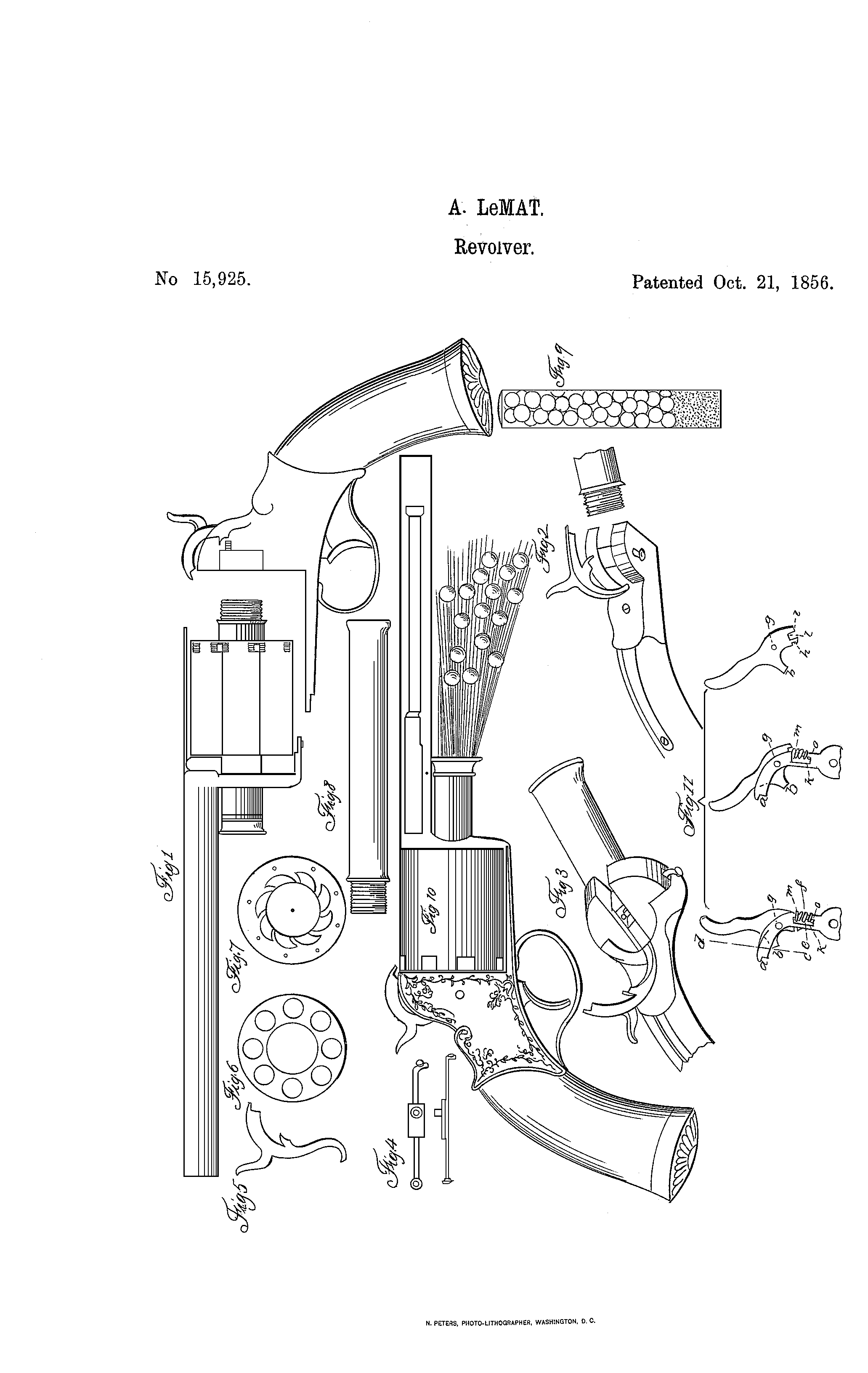
    Ever wanted a ten-shooter?  If you had such an urge in the late 1850s, the LeMat revolver was your baby.  That interesting sidearm had a nine-shot cylinder in either .36 or .42 caliber, with rotated around a 20-gauge shotgun barrel.

    LeMat’s patent.

    Sometimes called the grapeshot revolver, the big piece was originally designed by Jean Alexander Le Mat of New Orleans on or about 1856.  A few of these guns, probably less than a hundred, were manufactured in Philadelphia, while the balance, close to 3,000 guns in all, were made in Europe.  A fair number were smuggled into the Confederacy during the “Unpleasantness,” where they were much sought-after as cavalry sidearms.

    Le Mat had originally hoped to market his revolver to the US Army as a dragoon pistol.  A US Army Major named Pierre-Gustave Toutant (P.G.T.) de Beauregard was his advocate to the Ordnance Department (as well as his cousin) but the US Army was not interested.  In 1861, after Cousin Pierre-Gustave abandoned the US to serve in the Confederate Army, he secured a contract for 5,000 LeMat revolvers from Richmond.  Only about 2,500 made it through Scott’s Anaconda, but the LeMat grapeshot revolver’s place in history was secure; at least one manufacturer makes a replica available today.

    The idea of the combination gun in general is still popular, such pieces ranging from high-dollar German Drillings to the old Savage 24 over/under, usually mounting a .22 rimfire barrel over a .410 or 20-gauge shotgun.  But the combination of revolver with shotgun barrel belongs solely to the LeMat.

    Then There Were These Guys

    Meanwhile, Horace Smith and Daniel B. Wesson weren’t sitting on their hands.

    When Sam Colt’s revolver patent expired in 1856, Smith & Wesson were ready, but they had some new ideas.  They quickly secured the services of former Colt gunsmith Rollin White, who held the patent on a revolver with bored-through cylinders to take the newfangled brass cartridges.  Their first model, called the #1, wasn’t a very effective piece as it was chambered only in .22 short.  But it had not only the bored-through cylinder but a hinged frame, with the hinge at the front of the topstrap; this allowed the barrel to swing up and rearward, so the shooter could remove the cylinder to reload.

    Smith & Wesson #2.

    This was fast and, with the new brass cartridges, handy and clean.  The brass cartridges were much less susceptible to moisture and wind than loose powder and ball, and less likely to disintegrate in the pockets or saddlebags than paper cartridges.  Smith and Wesson knew they were on to something, and so in 1862 scaled up their revolver into the #2, chambered for the .32 S&W Rimfire Long cartridge.

    Now the Union troops had something interesting; a light, handy sidearm that reloaded in a hurry.  The black powder cartridge still made a mess, and even in .32 caliber the gun was something of a pipsqueak.  But there was a complication; in 1865, peace was breaking out all over, and the market for martial sidearms was about to take a nosedive.

    And Then This Happened

    But America, now that the “Recent Unpleasantness” had ended, was looking West again, and with that westward movement came the desire for sidearms.  Colt was still in the mix, but for the time being could offer only cap-and-ball guns, unlike their esteemed competition.

    Speaking of Smith and Wesson:  They had been busy improving on their basic sixgun while all this other stuff was going on.  When the War of the Northern Aggression ended, they held that patent that said to the nation that they were the only ones that could manufacture revolvers with bored-through cylinders for metallic cartridges, and they were about to take that idea and run with it.   Things in the sixgun world were about to leap forward once again, and the Colt folks were about to face some hard times.  More on that in Part 4.