The movie Labyrinth (1986) is a tale of an adolescent girl’s quest/hero’s journey/sexual awakening. It’s a fantasy that features muppets good and slightly evil and everything in between. It also features David Bowie in very tight tights with his cod on obvious display. You can’t miss it—and that’s the point.
But why is it the point?
THE SETUP:
Jareth the Goblin King and his co-star. No, not the muppet.
Our intrepid heroine, Sarah, is a girl whose mother ran out on the family to become an actress and from what tidbits one can glean, a relatively successful stage actress. Sarah is not resentful. In fact, she finds this wistfully romantic. Sarah has a baby brother by her not-very-new stepmother, whose treatment of Sarah is (per Sarah’s point of view) borderline abusive because she asks Sarah to babysit while Dad and she go out on a date. The viewer doesn’t get much but that the stepmother would not ask Sarah to babysit if she had a date or parties to go to and that she is frustrated that Sarah doesn’t want friends nor does she want to date or go out. Sarah just wants to live in her own fantasy world alone, cosplaying and dreaming about her mother’s glamorous life, which distresses the stepmother to no end.
Stepmom: She treats me like the wicked stepmother in a fairy story no matter what I do.
We get the point: Sarah’s living in her head in the starring role of Cinderella and loving every second of her victimhood. But she’s a teenager whose mother ran out on her, so that is to be expected.
So Dad and Wicked Stepmother leave and there’s poor Sarah wandering around the house in a romantic and fanciful poet’s shirt and vest, in the dark while it’s storming outside, bemoaning her fate and talking to the baby rather hatefully, yet handling him gently.
Sarah: I wish the Goblin King would come take you away.
And … cue baby vanishing. An owl thumps at the window and (because she is very smart), she opens it.
Then there stands a man, a tall man with freakish hair in RenFest garb. He’s the personification of desire, and Sarah is breathless with fear and attraction. He is Jareth the Goblin King, and she knows this instantly. She begs for her brother back. He plays with his balls to demonstrate his magic while giving her a challenge/quest/dare. If she can complete the labyrinth that surrounds the Goblin City in 13 hours, he’ll give her her baby brother back, but if she doesn’t, he will turn the baby into a goblin forever.
And off she goes on her quest like a good little hero/ine on his/her journey, encountering all sorts of obstacles along the way, the main one being her hubris that she can defeat the Goblin King
“Don’t go that way … If she’d’a gone that way, she’d’a gone straight to the castle.”
On the surface, the movie is a morality tale and is very explicit about it: Don’t take anything for granted and stop it with the hubris. A teenage girl watching this movie will get that. She will be breathless at the idea of Jareth the Goblin King taking an interest in a lowly teenage girl, but she won’t parse that. Why do that when she has a powerful, magical man’s attention and his lust (which is in plain sight), tempting her to the pleasures of hedonism? And he blatantly uses his cod to tempt her with his presence, his devotion to her, his love and desire for her as a woman.
Jareth: I ask for so little. Just let me rule you and you can have everything you want. … Fear me, love me, do as I say, and I will be your slave.
THE DECONSTRUCTION:
The story is a constant struggle between Sarah’s sense of adult responsibility, her burgeoning womanhood/sexuality, and her girlish dreams, desires, and fantasies.
The struggle comes down to two pivotal moments in the movie:
She falls in the darkness, eventually winding up on her own bed, which is frilly. Was it a dream? Was it real? Her bedroom is full of stuffed animals (that look remarkably like her muppet friends), RenFest clothing, a shelf full of elaborately bound fairy tales, a vanity on which there’s makeup and knickknacks. Every single thing in her room is a three-dimensional representation of everything going on in the fantasy. Most importantly (which you will miss in a blink), there is a newspaper clipping of a review of her mother’s play. It’s a picture of her mother standing with her costar, who happens to look exactly like Jareth the Goblin King.
The Goblin King is in the details.
She sits confused at her vanity while a character shoves all her old comforts at her and reminds her of how nice it is to be in her comfy warm and welcoming and fantastical bedroom, tempting her to stay a little girl. She’s painfully disoriented, but it’s her own room, her childhood in 108 square feet, her shelter from the world of adulthood, adult decisions, adult problems.
On the edge of her mind, though, is a purpose, a purpose she doesn’t remember until she sees one of her fairy tales and remembers. On she forges. You know she successfully retrieves her baby brother because that’s how the quest works. Humans like that.
In the last scene, she’s back in her house, the baby’s in the crib asleep, she goes to her room and starts putting away her childish things, Dad and Stepmom come home. The stuffed animals come to life and regretfully must leave, but they reassure her that should she ever need them …
They don’t finish the thought, but she dances with them while an owl (femininity, fertility, darkness) sits on a tree limb outside her window and watches them before flying away.
For now, she is firmly on the edge of girlhood and womanhood, having rejected both—for the time being—but knowing that it’s inevitable and she will leave her friends behind.
THE CIRCUMSTANCE:
I was not aware of this movie when it was released in June of 1986. My parents had bought a house on the opposite corner of the metro area from where I grew up and I was busy moving us. I and our trusty 1.5-ton passenger van moved that house almost all by ourselves. I was also getting ready to go to BYU. I would stay in the new house for a grand 2.5 weeks before I left for another adventure.
I was leaving my frilly childhood bedroom and stuffed animals behind and in a month, I would be dropped off at a dorm 1200 miles away from home watching my parents drive away and going back to my dorm room alone. But what was home? A new bedroom in a new house in a suburban neighborhood like the one I’d always fantasized about? Naw. “Home” was no more home than the dorm room was. My home was gone forever and we all know you can’t go home again.
The movie didn’t come to the BYU on-campus theater until late spring or early fall semester 1987. I don’t remember. I went with this gorgeous, funny, hyperactive Korean dude I was majorly crushing on. He couldn’t keep his leg still, bouncing it all the way through.
But the movie worked its spell no matter how irritated and distracted I was.
THE BREAKDOWN:
Fast forward 20 years. I found the online romance novel scene. Self-proclaimed feminists and budding SWJs were out pounding the internet pavement preaching the gospel of the Feminist Agenda of Romance Novels. Why? Because they liked them, they felt guilty about liking them with some of their problematic themes, and wanted mainstream feminism to stop sneering at what they liked. It was simultaneous defiance and begging for approval.
They didn’t get it. I was a romance-novel veteran and they hated the early ones where the heroine was brave and gutsy and involved herself in all sorts of feats of derring-do. They were bad. “This isn’t your mother’s rapetastic romance novel,” they would screech, not actually knowing what they were talking about. The romance novels of yesteryear had kick-ass heroines and more explicit sex than the namby-pamby stuff of the aughts.
A major participant in Romancelandia was a women’s studies professor. Her husband was Jewish. She was Catholic, but converted to marry him. He got a job at some rinky-dink college and she was a spousal hire (“You don’t get me if you don’t hire my wife”). Instant tenure. Hot stuff in her field (ORLY).
She had heard much wistful sighing over Labyrinth in Romancelandia so she sat down with her two tween sons and watched it. Like a good feminist and women’s studies professor, she broke it down to three things: David Bowie’s cod, phallic imagery everywhere, men (Henson and Lucas) telling such a stupid tale to fulfill their own perverse desires for a young girl. She thought it was hilarious and ridiculous, a sausagefest (with one sausage).
She, whose respected romance novel blog* with thrice-weekly posts would routinely get close to a hundred comments (impressive even in those days, for a one-chick blog), garnered a few vague “Oh, that’s an interesting take” type comments.
It sat there. For a week. Getting nothing more. She let it sit for a few more days. Nothing.
Finally, I said, “I really don’t understand how you missed the entire point of the movie.” And went on to summarize the above but far more briefly and only so I wouldn’t come off as totally unhinged with rage at her stupidity.
Because I was.
How in the world does a feminist women’s study professor—who “loves” romance novels (but only the politically virtuous ones) (zzzzzzz) and screams to her disdainful colleagues how empowering and feminist they are—miss this?
I stopped just shy of telling her she was a stupid traditional housewife who converted to a man’s religion to marry him, followed him to his profession, got a job on his coattails, and promptly had two children. Betty Friedan would be ashamed. There was nothing “feminist” about her, and then she missed this.
She gave me a polite, “That’s an interesting take,” but the floodgates opened. And the comments section exploded with other gently made points about Labyrinth’s importance to both feminism and the hero’s journey and the fact that a girl was on the hero’s journey (quite groundbreaking for 1986) and a girl’s sexual awakening—and that Jim Henson and George Lucas knew more about it than any other filmmakers at the time (and maybe still) and portrayed it accurately. Details and symbolism got pulled out left and right.
Dr. Hot Stuff: “Well, maybe I should watch it again.”
Ya think?
She lost a lot of credibility in Romancelandia that day, credibility that was, inexplicably, very important to her.
Congratulations. We’ve made it through another week. This one, sadly, is ending with a head cold for me. But that’s what happens when winter arrives and it gets down into the high 40s. I’m sure some of you can relate to this arctic blast, so I won’t dwell on it.
The best player ever. Also pictured: President’s Cup Captain Tiger Woods.
Tiger Woods the captain has picked…Tiger Woods the player to be on his President’s Cup team. Sounds like a solid plan with the way he’s been playing lately. Although I’m a bit shocked Rickie Fowler was left off the squad.
Seminoles fans, meet your (potential) next head coach.
Vlad the Impaler was born on this day. I bet Pie is out celebrating by sucking the blood out of something. Also born on this day were/are comet-spotter Edmond Halley, author Bram Stoker (ironically), board game magnate Milton Bradley, writer Margaret Mitchell, engineer Jack Kilby, football coaching legend Bobby Bowden, NRA exec Wayne LaPierre, drag queen Chi Chi LaRue, TV’s favorite asshole Gordon Ramsay, and recipient of a bad boob job Tara Reid.
That’s not too shabby a list. Now on to…the links!
“You fucked up. you trusted us.” Somebody is gonna lose their license over this and an insurance company is gonna wish they hadn’t written that malpractice policy. Yikes!
Few of the top teams in the game played this weekend, but, with the first Committee meeting and the blues dealt at Statesboro and Memphis, the sport held onto its title as the preeminent nationwide shitshow. With only five opinions on the line, three (kinda) came true this week:
Week Ten Most OverRated Football Program Results
1 San Diego Statedidn’t make the Committee’s list at all
2 SMU lost at Memphis in an over-televised much-to-do-about-nothing throw-down and fell eight places
3 Appalachian State lost to Georgia Southern and fell over six places, totally out of the AP top 25
4 Minnesota was off but will get stomped by Penn State next weekend
5 Oregon had to wake up and play to beat USC
That totals three more toldjaso™ this week to end the purely AP portion of the year.
Here at ground zero, the SMU-Memphis hype was unavoidable. Neither team had proven to be a top thirty squad, but both have bobbed about the bottom of the AP 25 because they had failed to lose to a bunch of nobodies. Suddenly GameDay sets up stage on Beale Street and the Liberty Bowls sells the most tickets ever. Fine. Whatevs.
The Tigers had a big night; good for them. Myself, I repented of SMU a decade ago.
Meanwhile, the Committee finally flew to meet in Tarrant County (motto: We’re so Tired of being called “Dallas”). Their first opinion of the season shouldn’t be too important, but there’s a certain stickiness to these votes: no one wants to admit that they’ve been wrong and change. There are some big games to come, but this is their first pass at the playoffs:
Ohio State
LSU
Alabama
Penn State
Clemson
Georgia
College Football Playoff Oughta Be
Big TenOhio State or Penn State
SECAlabama or LSU after Florida excused itself from the proceedings via Athens
ACCClemson survived UNC, so now they’re around for the rest of the year
PAC64 Oregon is just too weak; expect a second team from the Big Ten or SEC instead
Big XII Oklahoma is the best one-loss team in the nation even after losing to Kansas State
Notre Dame is not as good as Oregon and merely survived Virginia Tech
SMU: you damned well know it’s not a good idea
Much of this settles out soon: Ohio State and Penn State will likely settle the Big Ten when they meet on the 23d; Alabama hosts LSU this weekend and should win by about 8. I’m okay with the Committee except that I think Oklahoma and Oregon are better than Georgia; Georgia is a mistake. Back to our weekly idiocy: who’s who and what’s what?
First CFP Week N + 1 Most OverRated Football Programs
1 Minnesota is not a wild favorite of the Committee and will be stomped by Penn State
2 Oregon is barely overrated and has a clear road to winning the PAC256
We just don’t have much to talk about after the Committee weighed in.
Honorable Mentions
The Season is Kinda Over Already Edition
I still like LSU, but they’re still not Numero Uno.
Previously-bagged Georgia is only a ten but is on their way to Atlanta, a very, very short drive. Even if they lose there, some will still have them near the top despite their losing to South Carolina who has since lost to Tennessee who has lost to Atlanta standard-bearer Georgia State who lost to Western Michigan 57-10 who lost to Eastern Michigan who has lost to Toledo and Buffalo and, well, you get the picture. This weekend NewWife’s Dawgs host toothless Missouri and your humble correspondent: pray for me as I drink my way through an SEC sorority soiree in Athens.
SMU: you can lose your fool head over those girls
Previously-bagged Utah won’t play anyone until Oregon in the Pacific punch-out. Previously-bagged Florida is about four spots strong but won’t play anyone for the rest of the year. Previously-bagged Memphis has Cincinnati left, so one or the other will plummet and the other will be seemingly legitimized, but I won’t be sticking my toe back in the AAC filth again this year. Previously-bagged Wake Forest will lose to Va Tech and Clemson; make of that what you will.
Kansas State plays several twenty-somethings yet and will lose to one of them and then fall out of the top twenty, but I don’t think I care to waste a stronger opinion on them than that. Boise State buoys in the competency vacuum but plays no one for the rest of the year. SMU is still overrated after tanking to the Tigers because no voter wants to admit that he voted a team a good twenty spots higher than he should have.
Year to Date Hides on the Wall
1 Georgia lost at home to the second-best team from South Carolina that almost lost to UNC
2 Utah lost to an unrated USC but seems to be coming back
2 Stanford was revealed by USC
2 Syracuse was unranked after Maryland
2 Michigan was blown out by Wisconsin
2 Notre Dame sold off after losing to a highly ranked Georgia
7 UCF was edged by an unranked Pitt and continues to muddle
7 Iowa was no number 15 as Michigan proved
7 Wake Forest allowed Louisville to hang 62 on them
7 Cal was dumped from the AP after losing to Arizona State
11 Boise State lost by three to toothless BYU
11 Iowa State was dethroned before their decent showing against Iowa
11 Memphis lost to possibly 80th best team in the nation Temple and disappeared for a while
11 SMUlost at Memphis fell eight places
15 Michigan State slowly fell out of the ratings, so I was right after all
15 Clemson was dethroned by barely edging Mack Brown retirement project UNC
15 Texas lost to OU (mid-season toldjasos™) and has continued to suck and plummet
15 Texas probably over-paid for losing to titan LSU (early-season toldjasos™), but then they let Kansas hang 48 on them at home
15 Appalachian State got a case of the Statesboro Blues and fell over six slots
20 Auburn over-paid for losing to Florida
20 Texas A&M probably over-paid for quality losses against Clemson and Auburn . . . or maybe not
20 Washington State was de-ranked after becoming lowly UCLA’s first win
20 Virginia continues to lose after losing to can-play-with-UGA Notre Dame
24 Oklahoma lost to Kansas State . . . inexcusable
25 San Diego State didn’t make the Committee’s list at all
Year to Date It-Would-Seem Blown Calls Because They’re Doing OkayReally Well
1 LSU
2 Florida seems to have earned their status by defeating top-ten Auburn
3 Oklahoma is no longer a blown call because Kansas State
4UCF is now a skin on the wall after Pitt
5 Michigan is no longer a blown call because Wisconsin
6 Washington State is no longer a blown call because UCLA
Our year now stands at 25-2-4. The week endeth thus!
SMU: just walk away . . . there will be other girls
The Moon, Jupiter, Jupiter’s moons through a binoculars-October 2019
Editor’s Note: Some photos may be enlarged by clicking on them.
Well, after the “downer” tone of my last piece, this piece will look up and away. The night sky captured the imagination of our ancestors. Every known culture has used the sky to capture reminisces of some of their tales. Every week Not Adahn pitches us on how the stars foretells our futures. But in the modern world many of us have lost our connections to the wonders of the night skies. We can go inside where it is warm and well-lit and we can amuse ourselves in ways that were undreamed of even 50 years ago. Our cities have also robbed the night sky of the ability to grab our attention. Ambient light obscures our chance to even see what is visible. None of this is bad. Warm, lit evenings with plenty of food and entertainment has been a goal of mankind for thousands of years. But sometimes you may wonder “What is that light up there in the night sky?”
You can observe the night sky year round but the summer and fall are easier times to break the problem of not seeing the night sky. During the summer the night sky faces to center of our galaxy and the night sky has lots of things to look at. The evenings are warm. The autumn in some ways is even more favored because many people hunt and are arriving at dark locations away from cities before dawn and remaining until well after sunset. Others are out for morning or evening walks and night clings longer so the opportunity to see the night sky is more easily presented.
This article is for the casual sky observer. I assume the readers have no precision telescopes, special software or the other equipment that serious amateur sky observers use. If you have an internet connection (if you don’t you’re not reading this anyway), working eyes, binoculars, maybe a spotting scope or a kid Xmas gift grade telescope* you have all the equipment you need.
(* This is a smaller refraction telescope with no electronics and generally with pedestrian quality lenses. Typically they have low magnification around 35X and higher magnification around 80-90X.)
What will you see when you look up? Stuff. Most of which is beyond the care and concerns of humanity. Some of the stuff is from mankind and can be humbling to see it whiz along. Some of it is our neighbors. The rocky or gassy planets which formed around us. Maybe you’ll see a visitor from the icy far suburb of the Solar System. I guarantee that you’ll see our companion orb. With patience and luck maybe you’ll see reminders of the power of the universe to alter life, planets or entire star systems.
One word of warning. What you will see in with your own eyes is one sense, disappointing. You won’t observe the rich colors, incredible details and literally otherworldly viewpoints in the best images released by the elite observatories, NASA, or the ESA. But that will be more than made up by the fact you will be seeing the objects first hand with your own eyeballs and mind. You will be able to combine the seen with the presented and hopefully be able to better enjoy both.
What do you need to observe the night sky? 1) A night without solid cloudiness.; 2) Your eyeballs at a minimum; 3) Something to tell you what is out where and when. (More in a bit); and it helps if 4) you have some type of optical aid. This doesn’t need to be a $10,000 telescope. It can be a decent pair of binoculars, a kid xmas present type telescope, a spotting scope, or even a decent rifle scope. The more magnification and light gathering ability device has the more detail it will enable you to see. It will also help if you give your eyes some time to adjust to the night away from lights.
This scribbling will be broken down into Solar System sky objects and manmade objects. I’ll try to keep the jargon down so as the Hitchhikers Guide advises, “Don’t panic”. So let’s head out to the deer stand, or out for the evening walk, and make sure to look up from time to time.
The Solar System and Manmade Sky
Let’s start with the easy stuff in our immediate neighborhood of the universe. The Sun, Moon, planets, comets, manmade stuff and others. Seeing these objects rates from really easy to challenging (or lucky). For the most part these things are bright, it is easy to observe their movement, and they show details even with the most basic binoculars or scopes.
The Moon
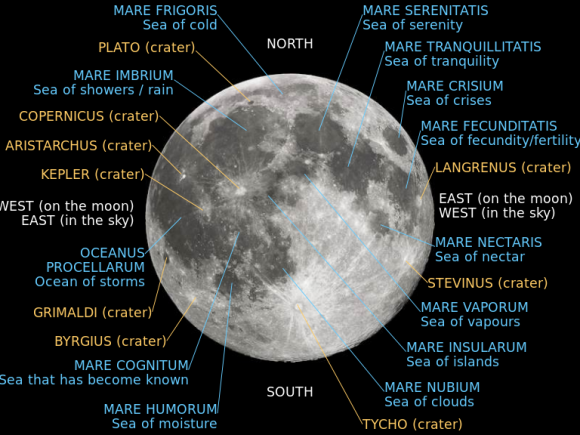
This is the earliest known night sky object and for the most of a month it takes no great skill to find it, even in a city. The Moon is a delight to observe as the terminator (line of light and night) crosses the lunar surface. The area around the terminator is full of shadows which allows surface features to “pop” into view. Mountains thousands of feet tall cast their shadows miles deep into the cooled lava “Sea” that surround them. Large craters will have bight rims with inky black interiors, and occasionally you’ll see the top of a crater’s central peak poking into the sunlight from the dark void.
So when is it best to observe the moon? Any time you can see it, except for the 4 days or so around a full moon. During that period the moon appears flat because the light doesn’t cast noticeable shadows
Through binoculars or your scope the view changes by the hour as the edge of the night rushes along the surface. One cold, dark, and clear pre-dawn in Montana I got into position and waited for daylight and the elk. While I tried to stay, warm, quiet, and unscented I had a great view of the terminator and as I looked at the moon through my binos I caught the moment the sun rose high enough to pass through a breach in a crater wall and send a narrow beam of light spilling across the crater floor.
Even with no optics the face of the moon changes between nights. If the moon is already up at sunset, you are approaching the full moon. If at sunset, it is the full moon. If there is a noticeable period between sunset and the moon- the moon is waning. Finally if the moon is bright and high in the sky around noon, it is about a week to no visible moon. AKA- the new moon.
Fun fact about the Moon. Because of a small wobble in the lunar orbit an Earth observer over time can see almost 60% of the lunar surface as the wobbles (libration) let us peek around the corner of the Moon. Also, most lunar sea surface material is about the same color as a middle aged asphalt parking lot.
The Moon’s features seen through binoculars
The Sun
In short don’t look at the sun without eye protection. Especially now since even there are very few sunspots to see (aka solar minimum). Welding goggles are not usually dark enough to protect you since most commercial welding goggles are a level 12 darkness and the sun requires level 14. Small “XMAS Telescopes” usually come with a “solar filter” which can be used with the lowest power lens configuration. In other times you can carefully observe the Sun’s face for sunspots. Right now the risk is probably not worth the view. But, unless you have specialized equipment, the Sun is best observed online from a solar observatory website. There are three exceptions to this: solar eclipses, planetary transits, and the green flash. I’ll discuss solar eclipses later.
Planetary transits are the rare occasions when Mercury or Venus actually are seen crossing the face of the Sun for a few hours. Because the planets don’t follow the Solar equator the geometry required for the Earth to experience this view are few and fleeting. The last transit by Venus was June 5, 2012 and was fun to see. The next will be December of 2117. A Venus transit was how the atmosphere was discovered and that led to a rush to have observing sites around the world in 1769. Today science has moved beyond transits for scientific purposes but watching the progress of a planet across the face of the Sun puts the scale of the Solar System in perspective. While my bet is that I’ll miss 2117 transit of Venus, I am holding out hope for the Mercury’s November 11, 2019 transit of the Sun. The transit will be visible from all of North America and much of Europe. Japan, you’ll have to catch it online. I live near an east facing beach so I’ll be able to experience it at dawn. What you’ll see is a black dot that moves across the face of the Sun. This website will provide you the information for your location including where on the solar disk you will see Mercury. If you miss this transit your next opportunity will be November 13, 2032.
Venus Transit 2012
To observe the “green flash” you need an unobstructed view of a flat horizon at sunset or sunrise. It works best if you use an ocean or a Great Lake. I have heard people have seen the “green flash” on the Great Plains, but I had no luck when I lived in the KC area.
A “green flash” occurs because the atmosphere acts like a prism and just as the solar disk disappears (appears) at the horizon the prism causes a 1-2 flash of green to appear at the top of the solar disk. Again, a fun thing to see if you are aware and lucky.
Green Flash over Pacific Ocean
Jupiter
In the current night sky at sunset Jupiter reigns. Venus is usually brighter but right now it is close to the Sun and hides in the glare of sunset. In contrast if you look west of south after sunset the largest planet with be the first “star” to come out and remains the brightest object in that part of the sky. With the naked eye Jupiter is very bright silver white “star”, while through even the smallest binoculars it appears clearly as a disk instead of a point of light like a star. You can do a quick check if this. Find Jupiter and check it out. Now make a closed fist and extend your arm. Place it just below Jupiter and look at 5 o’clock. That bright red star is Antares. Now look at Antares in your binos. Antares is the 15th brightest star in the sky. It a red super giant of about 12 solar masses only about 550 light years away and if it swapped places with the Sun it would fill the Solar System until midway between Mars and Jupiter. It is truly big. Even that close and big Antares is a mere pinpoint of light. Every major planet is clearly a disk and not a point of light. (See opening picture)
In a dark location with good binos (with large front lenses to gather light) you can see Jupiter’s four large moons. They appear as distinct “stars” along Jupiter’s equator. With any scope these stand out. Depending where they are in their orbits you can see up to four of the moons Galileo discovered. All four are fascinating for their own reasons, but the inner two moons (Io and Europa) move so quickly that observing even an hour apart will reveal clear movement. With a scope as well you’ll be able to make out some of Jupiter’s banding which look like brownish stripes north and south of the equator. Jupiter takes about a year to move one zodiacal constellation. So once you find it, it’ll be easy to follow.
Jupiter and four largest moons through a small telescope
If you look at Jupiter or Saturn near the horizon you may be tempted to say, “WTF Double Eagle? Either you lied about where the moons (rings) are, or the planet tipped over. Not to fear. This is just an optical illusion because you are essentially looking sideways at the planet. Look closer to when it is at the highest point it’ll reach in the night sky (AKA zenith) and things will appear normally.
Fun Fact: The gas giant Jupiter rotates so rapidly (a day is about 12 hours) that even though binos it visibly bulges along the equator.
Io eclipse on Jupiter’s southern hemisphere from Juno pass Sep 2019
Venus
Venus is the Earth’s nearest twin in size and our closest planetary neighbor on average. (Depending on locations in their respective orbits both Venus and Mars can be closer on any given day.) Because Venus is closer to the Sun it sometimes appears in the morning and other times in the evening (aka Morning and Evening Stars) and can never appear all night like the plants farther from the Sun than us. Venus is even brighter than Jupiter and at peak times on moonless nights can cast a faint shadow.
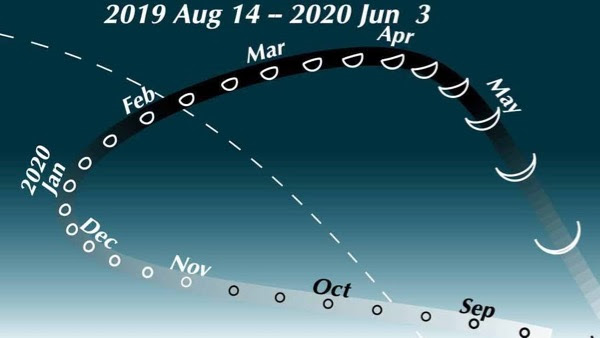
Unfortunately, Venus is not a fascinating view through your optics. It appears as a silvery disk but with no moons so you don’t get the obvious movements as the moons parade around Jupiter. The only real trick Venus will display for you is that it goes through phases like the moon, less a “full” Venus. The fuller Venus appears, the farther it is from Earth; and the more crescent it appears, the closer it is. Because of this, the apparent brightness of the planet remains fairly constant. A crescent Venus is noticeably larger in your optics than an almost full Venus.
Venus is not much of a visual treat right now since it just passed behind the Sun. It sets within minutes of the Sun and is not visible to the casual observer. In a few months it will return to easy visibility. In fact, Venus can be seen during daylight hours and is sometimes reported as an UFO near the Sun. Here is how and where Venus will appear after sunset for the next few months.
Venus phases and location late 2019
Fun Fact: Venus’s surface runs about 900F and the atmosphere is so dense that the pressure at the surface is the same as the deepest parts of the Marianas Trench. The odd thing is that the planet rotates so slowly that a Venusian day is longer than a Venusian year.
Venus surface in true colors from USSR Venera 14
Saturn
Saturn is the third brightest planet and is brighter than almost every star. As a bonus, now it is near Jupiter in the evening sky so it is really easy to find. To find Saturn locate Jupiter. Using the same closed fist stretched out arm technique, go left a bit over two fists and up slightly (10 o’clock position). That yellowish star is Saturn. Through even a small scope Saturn will grab your attention because the rings are right there and easy to make out. (Most binos make Saturn look like a yellowish football. If you have high quality lenses and steady them against something you can just make out the rings in good conditions.) Saturn and Jupiter are slowly closing together so over the next months they will be easier to see together. In December 2020 they will appear to almost touch they will be so close together in the night sky (AKA conjuction).
Saturn’s rings are “open” and easier to see now. In fact even a cheap telescope will reveal that there are “rings” and not a ring. As the years continue on we will move more in line with the rings and they’ll almost disappear. Then they’ll open to the other side. (14 year cycle). It takes a bit over two years for Saturn to move between constellations which is why Jupiter will “catch up” next year.
Saturn through low power scope in poor conditions
Fun Fact: Gallieo was the first to observe the planets though a telescope and discovered Jupiter’s moons and phases on Venus. He could only make out that Saturn bulged and it was a later scientist who discovered the nature of the rings. The rings are almost all small pieces of water ice ranging 1cm to 1M in size and the most visible rings are ~63,000 km wide, but only 10-30 meters deep.
Night side of Saturn from Cassini. Earth visible at 10 o’clock through the rings.
Mars
Mars may not be our closest neighbor planet, but it is the most “earthlike” neighbor with seasons, clouds, snow, occasionally running water, and hosts of other similarities. In the night sky Mars is an odd duck because it zips through the constellations (a Mars year is 687 Earth days) and changes brightness and apparent size dramatically over a short period of time. Right now? It is so close to the Sun it is hidden in the glare. Come March it’ll escape the Sun’s glare to appear as a bright red point of light around dawn. By as the months go on the distance between us and Mars will fall until October when we will be only 0.4 AU apart and Mars will be bright bloody red and one of the brightest objects in the sky.
Mars through a year with the moon for scale.
Through your binos or spotting scope Mars appears a red disk (Mars’ surface is covered with rust colored rocks). As the months go on the disk will get larger and the white polar cap will become easier to see. You need to keep your eye on Mars because it crosses constellations about every other month unlike the dawdling Jupiter (1 per year) and Saturn (1 every other year). It also spends part of the year “going backwards” as the Earth catches up as it passes the planet.
Fun Fact: It has the largest known mountain, Olympus Mons, which is visible through a moderate sized telescope. It was discovered on Earth in the 19th Century and named Nix Olympia but it was an unknown object. It took until Mariner 9 orbited in Mars in late 1971 to determine what it was. Olympus Mons is a shield volcano that stands 14 miles high above the base and covers a surface area almost equal to the size of France. In comparison, Mauna Kea in Hawaii is the tallest volcano on Earth and rises only 6.3 miles from the ocean floor to the summit. Olympus Mons weighs so much that it has deformed the crust and sits in a 2km deep depression surrounding mountain.
Curiosity photo of Murray Butte 2019.
First photo from the surface of Mars July 1976.
Mercury
For your basic sky observer Mercury is like Venus but more so. With a year of only 88 days it rapidly transitions between the morning and evening sky. Because it is closer to the Sun it never gets far from the horizon. But sometimes when you are out and the day is transitioning a “star” is seen low in the sky. If the time of the year is right you are looking at Mercury. Through our optics it appears as a small oddly shaped disk or crescent similar to Venus but much smaller. See “Transits” (above) to take advantage of the rare opportunity to watch Mercury cross the face of the Sun.
Fun Fact: Mercury is smaller than some moons. Both Ganymede (Jupiter) and Titan (Saturn) are all larger than Mercury. Ice has been detected in several craters near Mercury’s poles in pockets that are perpetually in darkness.
The Outer and Minor Worlds
How about the rest of the solar system? The planet Uranus is dimly visible to the naked eye in a dark location and “good seeing”. (“Good seeing” is a dark night with little to no wind and a steady temperature gradient through the atmosphere so the atmosphere is moving very little.) But for the casual observer Uranus is best seen when it is near an easier see thing. During a lunar eclipse in 2014 Uranus was right below the moon and any observation of the moon meant you couldn’t miss a gray green disk. That disk was Uranus. My suggestion is don’t try and find Uranus without the aid of an easy object nearby. Many websites will be happy to let you know when these days are approaching.
Total lunar eclipse and Uranus 2014 (Uranus at 5 o’clock)
Fun Fact: Early in the Solar System Uranus was smacked by another object near the same size. Now it rotates on the side and essentially rolls around the Sun. Uranus was not recognized as a planet by early astronomers and shows up as a “star” in several sky maps.
Neptune is invisible to the naked eye but like Uranus can be found with optics when it is near something else. One morning when I was out before dawn getting into position for a turkey hunt Neptune was near the crescent Moon. In my binos I could make it out as a very small bluish disk. Even with a small scope that is the best you can hope for.
Neptune through small telescope
Fun fact: Neptune was discovered by two astronomers independently doing the math on small perturbations of Uranus. It has been visited only once by an Earth launched space probe. Voyager 2 passed by the planet in 1989.
The dwarf plant Pluto. Forgetaboutit. Even through the largest earth based scopes Pluto is a speck of light that can only be made out by how it moves over several nights.
Fun Fact: With a very elongated orbit, Pluto actually moves inside of Neptune’s orbit for 20 years every orbit (248 Earth years). The last time it did so was 1979-1999 ce.
The dwarf planet Ceres is another dwarf planet but is more conveniently located in the asteroid belt between Mars and Jupiter. Under almost perfect conditions it can be made out as a dim star. It is not worth the effort to find unless you start getting hooked by amateur astronomy.
Eclipses
I’ll discuss only the two most common, solar and lunar. Solar eclipses only take place during a new moon, because that is when the moon is directly between us and the Sun. Because of the tipping of our orbits it is only sometimes the Moon’s shadow crosses the earth’s surface.
The next totality that will cross the US is April 8, 2024 and totality will cross Texas and cross west of the Appalachians through eastern NY and curve into eastern Canukistan.
Solar eclipses – North America
Lunar eclipses only take place at a full moon and only sometimes for the same reasons. But since the earth’s shadow is so much larger the area for observed totality covers a larger part of the planet and for a longer time. As the bulk of the Earth’s shadow hits the face of the moon it starts turning dark, usually orange-ish, but rarely black. This is because our atmosphere always bends some light through.
The next lunar totality for the US is January 21st. The mainland will be in position for the entire thing, while on my island hideaway the moon will rise a bit before totality and I’ll get to observe the rest. Convenient and warm for me, if not for some of you.
Occultation
These are when one object crosses in front of another. It is the astronomy equivalent of the saying, “Standing there makes you a better door than a window. “ Almost all of the most visible of these events take minutes to a few hours and cover a fairly small portion of the surface of the Earth. There are websites that highlight the most noteworthy of these. No real science to be learned, but they are fun to see. Watching a planet disappear and reappear from behind the moon is a kick. Visible from naked eye to scope.
Saturn about to go behind the Moon 2014 through small telescope
Meteors and Meteorites
A meteoroid is a small bit of metal, stone or a metal/stone mix in space. A meteor is a meteoroid burning up in the atmosphere. A meteorite is a meteoroid that makes it to the surface of the Earth. The average visible meteorite was the size of a marble when it hit the atmosphere. Most meteoroids burn up at 75-50 miles above the Earth.
Seeing a meteor is a matter of chance and luck. You can improve your odds by watching after local midnight so your chunk of Earth is facing our direction of movement. The other way is to watch during known periods of “meteor showers”. (See a good website for info.) These are the times when the earth passes through the orbital paths of larger comets and sweep up the dust and small objects left behind comets in their flight. If you get really lucky you can watch a fireball which is a larger meteor burning brightly. Sometimes they leave a visible smoke path, or even break apart into multiple pieces while you watch. The best fireball I ever saw was one early morning in 1992. We were out for the Javalina hunt. I had left camp and was walking up a hill to get into position when the hill in front of me blazed white and I saw my shadow. I quickly turned around and saw a huge fireball traveling across the sky. As I watched it broke into 4 pieces and kept going, eventually blinking out far to the southwest. The light from the still hidden Sun caught the smoke and lit it up in the pre-dawn sky. I thought it was space debris but when I checked with the local observatory a few days later they confirmed it as a meteor.
Fireball meteor
As much as many of us hoped for the “Sweet Meteorite of Death” in 2016 and will do so again in 2020 the odds are small that the next extinction level meteorite strike will happen then. You can play around with this website and find how your very own SMOD will impact you. Have fun with it. Can you design the next KT event?
Fun Fact: The change of definition from meteoroid to small asteroid was formally defined only in 2017. A meteoroid is grain sized to one meter in size. Smaller size are micrometeoroids and larger are small asteroids.
Comets
Here is Comet 1A. Comets are dirty snowballs left over from the formation of the solar system. Well outside of the planets there is a large cloud of dust and ice stretching out over 100,000 Astronomical Units (AU = roughly the distance from the Sun to the Earth). This cloud is known as the Oort Cloud and is the home of the comets. Passing objects and stellar events give the cloud gravitational nudges and some of these nudges eventually result in a dirty snowball to start to fall into the Sun’s gravity well. (It may take millions of years between the nudge and the solar pass.) Those snowballs which come in close to the Sun start to warm up and give off ionized gas and dust. These are known as comets. Every year dozens of comets are found and most remain faint and fuzzy telescope objects, but every few years (on average) a comet becomes a bino and naked eye object. About once a decade a comet will shine bright and luminous thus becoming a spectacular sky show. Since most bright comets take a long period to orbit the sun their arrival is a once in a lifetime event. Even Halley’s Comet takes 76 years per orbit so at best you might get two chances to see it. Spectacular Comet Hale-Bopp passed within 1 AU of Jupiter so the orbit was considerably shortened. If you are around in 4380ce Hale-Bopp should put on a good a good show.
Right now the night sky doesn’t feature any worthwhile comets for the casual observer.
Comet Wirtanen- average visible comet Nov 2018
Comet McNaugt in daylight Jan 2007
Aurora
Aurora form when Solar Wind particles hit the Earth’s magnetosphere and then ionize. Lower energy particles are blue and green while high energy particles display red. The map shows the band of common occurrence over North America. Especially energetic solar storms can result in red aurora appearing throughout the continental USA. More here: https://en.wikipedia.org/wiki/Aurora
Manmade Stuff
There is a bunch of it up there, so much in fact that some areas of prime “real estate” are getting downright crowded. Most manmade stuff is not easily visible to a casual observer, but some of it is. The biggest and brightest object is the International Space Station (ISS). This is my recommendation to try and find first. It is BRIGHT, moves relatively slowly and is impressive. It is often mistaken for an airplane heading to a nearby airport. When you see the ISS, you will know you saw it. Conveniently the nature of the ISS orbital parameters means that it will be visible for multiple days from your location before it goes dark again. The ISS will be visible from your location during passes for several hours before dawn and after dusk. I recommend using Heavens-Above.com for finding your visible passes. (More info below). For other satellites a find a dark location on a night with no moon. Watch and you’ll see small lights than are too small to be passing planes moving along. If you are ambitious yu can use Heavens-Above.com Db to find specific satellites.
If you are near Commiefornia or the Floridaman Atlantic coast you can occasionally see launch vehicles heading to orbit. It is impressive to watch a small object at the head of a rapidly lengthening cloud as it is gaining speed and altitude. After the vehicles cross the sky you can watch the remaining gas plumes be twisted by the winds alofy. They often make surreal shapes with transient splotches of the spectrum. Both the Kennedy Center (FL) and Vandenburg Air Force Base (CA) will publicly announce non military launches to the public. Most military launches may get only a few minutes, or no, public announcements.
ISS passing in front of the moon. Time of transit less than two seconds.
A Smattering of Websites
There are scores of astronomy related websites out there. In fact, there are more potential websites for you to visit than the number of fleshy globes that Q offers for viewing to the Glib community each month. But here are a few websites that are easy to use and are geared toward the interested general public.
Astronomy Picture of the Day. You might as well visit it since your tax dollars pay for it. This is a great site which features just what the name says. Each picture has a clear description of what you are seeing. The photos origins are diverse (in the good sense) from NASA, other space agencies, observatories from across the globe, and from amateurs sending in some incredibly artistic works. The archive goes back to the mid 1990’s. This has been my first website daily since 1997.
EarthSkyNews. This organization covers what is going on for the general sky observer. You can sign up for a free daily email newsletter. It has observing updates, news from space, photos, and only a small touch of occasional “climate change” stuff. They also keep your subscription information tight. I can’t think of a time when I got unsolicited emails that would have come from them selling my info.
Heavens-Above. This is a serious but easily accessible site. It is “THE” public website to track satellites, get sky charts, past and future night skies etc. When you first visit this site note the upper right corner of the page. There is a box there. Open it and set your location from a database. It will not change all the data for your location and remember it. Look down the left side and the ISS is highlighted. Click on it and it will give you the visible passes for the next 10 days. Click on the day and BINGO, there is a sky chart for that pass.
Keep following down the left side and you get to the astronomy portion with easy to use interfaces. You want to see what was going on the sky at the moment of your birth? Just put in the data and there will be the sky for that time. Want to see the sky for 4th of July 3000 years ahead? It is there.
These three websites will serve a casual observer. There are hundreds of other websites out there from the USG, other governments, private organizations and amateurs. If there is interest after this article I can do a “Part Two” with easy to observe deep sky objects. With just binos, or in some cases a deep dark sky, you can observe a host of objects, including a galaxy that will one day crash into our own.
Today was awesome for me. All my direct reports and managers were busy doing other things, so I wrote a little program to help me get around the absolutely wretched MS Flows Power Automate interface. Best described as: Everything is drag-and-drop (as long as you are doing simple things)! If you want to do grown-up things (like only start a flow if a record changes to a certain status or use the fields in that changed record without doing another lookup), here’s a whole new syntax that isn’t quite the same as other syntaxes used in Azure. After I spent 4 hours figuring it out yesterday, I just decided to write a translator from something I already understand pretty well and can easily produce. I can still code! I have skillz!
I suspect this story is wildly overblown, but I am kind of hoping that permanent Federal supervisory class finds itself engaged in a bloody war of attrition with the political class that leaves both sides substantially weakened for a couple of decades.
Bill Gates demonstrates actual “fuck you” money, tells Warren and Dem establishment to pound sand over wealth tax.
I have to confess to being interested in politics, perhaps unhealthily so. I wasn’t always. It wasn’t like I had some childhood fascination with my local senator. In truth, I think I’ve only ever voted in one Presidential election. (I may have voted for Perot, but I can’t honestly say for sure). Which is a nice way of saying that the current election cycle is a nightmare for me,* as it is for many thinking and principled Americans. It feels like the devolution of our country. To those who see politics as the public barometer of the state of a Nation, it feels like a forceful bellwether of decline, the dying gasp of a once great and moral Country.
We’ve all seen the man at the liquor store beggin’ for your change
The hair on his face is dirty, dreadlocked and full of mange
He asked a man for what he could spare with shame in his eyes
“Get a job, you fuckin’ slob” ‘s all he replied
[CHORUS]
God forbid you ever had to walk a mile in his shoes
‘Cause then you really might know what it’s like to sing the blues
Then you really might know what it’s like…
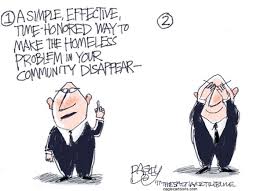
I had occasion to find myself in South Bend, Indiana, (yes, the one where Notre Dame is) for work. Driving up and down a particular main avenue running some errands, I noticed a man standing on the corner near the onramp to a highway. He was disheveled, though not too badly, and holding the ubiquitous sign that told his (alleged) story: “Homeless and I need to feed my family” read the message in red paint on the cardboard. I passed him in the afternoon without too much thought, though the prevalence of veterans among the homeless always makes me hesitate and ponder long after I’ve passed. Sometimes, if the timing is right, I’ll give what I can or have on me, though not always. I would imagine I’m like most people in both my thoughts and deeds with regard to the homeless. Perhaps better than some, certainly worse than some others. I’ve worked the odd soup kitchen or two for a church function or for a community service project that my kids had to and I rolled along.
Albert Jay Nock was a brilliant and radical philosopher of the early 20th century. Born in 1870, he lived to see the First World War and died just as the Second one ended in 1945. One of his more well-known and seminal works was “Our Enemy, The State.” Finished and published during the height of FDR’s “New Deal” in 1935, Nock believed that the most effective form of government, and protective of individual rights, was the tribal “anarchism” of the early Native Americans. In an earlier work, titled simply, Jefferson, Nock argued that Thomas Jefferson was a firm believer that the smallest possible governmental units, or wards, allowed the people to, in Jefferson’s own words, “crush regularly and peaceably the usurpations of their unfaithful agents.”
Nock’s later work in Our Enemy, The State focused on the difference between the spontaneous “social power” of individuals coming together for common cause and the forceful usurpation of social power by “State power.” His central thesis was set forth very clearly in the early part of the book and, in three short pages, Nock compels even the casual, disinterested, or even adverse reader to reconsider their entire understanding of State intervention in human affairs.
One might wonder just what the hell all of this has to do with an (apparently) homeless guy standing on a corner in South Bend, Indiana, in mid-October, as I drove by him more than once over the course of several hours. Fair question. Let me convince you by pointing to one of the most trenchant parts of Nock’s argument that stuck with me:
…just as the State has no money of its own, so it has no power of its own. All the power it has is what society gives it, plus what it confiscates from time to time on one pretext or another; there is no other source from which State power can be drawn. Therefore every assumption of State power, whether by gift or seizure, leaves society with so much less power. There is never, nor can there be, any strengthening of State power without a corresponding and roughly equivalent depletion of social power.
Our Enemy, The State, p. 5 (emphasis added).
The thesis seemed interesting to me, but I wasn’t quite sure what Nock meant by “social power” versus “State power.” I thought I quite understood the latter, but I wasn’t quite sure what the former was. Nock’s examples left me with a permanently-altered view of government attempts to intercede to “help” the citizenry. Nock provided two (then)-contemporary examples to illustrate his point more clearly.
…it follows that with any exercise of State power, not only the exercise of social power in the same direction, but the disposition to exercise it in that direction, tends to dwindle. Mayor Gaynor astonished the whole of New York when he pointed out to a correspondent who had been complaining about the inefficiency of the police, that any citizen has the right to arrest a malefactor and bring him before a magistrate. ‘The law of England and of this country,’ he wrote, ‘has been very careful to confer no more right in that respect upon policemen and constables than it confers on every citizen.’ State exercise of that right through a police force had gone on so steadily that not only were citizens indisposed to exercise it, but probably not one in ten thousand knew he had it.
(emphasis mine). We discussed the idea of a citizen’s arrest in law school, but I couldn’t and can’t recall much of what was said. My initial reaction reading Nock was to recoil at the thought that we all had the same powers of arrest as against each other as any officer of the law does, but then again, how much of the current problems in troubled neighborhoods stems from the fact that the local citizens who live there have abandoned even the most modest attempts at reducing the crime, violence, poverty, homelessness, drug abuse, etc., in their neighborhoods? The rejoinder is that the people are not armed and the drug dealers and gangs are and thus the people are at a distinct disadvantage, and hence comes the justification for military-grade police forces armed as well as or better than combat troops for the national defense; yet aren’t their some fundamental factors missing from that analysis? If the drug dealers and gang members inhabit those self-same neighborhoods, who is giving them succor? How do they put their heads on their pillows at night and feel secure in these same neighborhoods where they prowl and prey? These are, perhaps not coincidentally, the very same issues that confronted me while I was in Afghanistan, attempting to “police” a particular area that was rife with terrorism (and narco-traffickers, as well). I’ve watched many a frustrated military member talking to village elders asking, “Why are there rockets being launched from this area at our base every week? How is that happening?? Where do these people come from and sleep??”
Upon careful inspection, what one finds is: first, the police do not actually live in the same neighborhoods that they patrol. In point of fact, they live in suburban outposts, miles and miles from the streets they pass through in their cars, as distant from the citizenry they supposedly serve and protect as they are from the gangs they are supposed to be interdicting. A lot of that is economics and has to do with the pay disparity between cops and the average inner city neighborhood they’re patrolling. Second, the people are at an “arms disadvantage” specifically because the State has disarmed them! It is a well-established historical fact that modern gun control suddenly became vogue during the late-1960s after armed blacks showed up to the California State Capitol armed with – (gasp) – “assault rifles!” (and shotguns, and pistols, as the above-linked article notes). As an aside, Clayton Cramer, a software engineer, does about as good a job as a law professor could in explaining that virtually ALL gun control laws have been racist in their origins and intent. This might seem self-evident when one considers that the right of a freeman to own weapons goes back to the days of sword ownership in England. If not still convinced, the Supreme Court made this explicitly clear in Dred Scott v. Sanford, 60 U.S. 393 (1857). Yes, that Dred Scott. The case itself should be required reading as a part of any basic civics course because of just how many incredible statements of historical significance for Constitutional law are in it – including statements by the Court about what defines a “citizen” and the Congressional power to “naturalize;” the right of states to admit immigrants, the status of descendants of slaves in free states vs. those of native Americans, the limits of judicial construction, and more – but of paramount importance for this discussion is what the Supreme Court used as one of its Constitutional justifications for finding Dred Scott could not sue for his freedom:
More especially, it cannot be believed that the large slaveholding States regarded them as included in the word citizens, or would have consented to a Constitution which might compel them to receive them in that character from another State. For if they were so received, and entitled to the privileges and immunities of citizens, it would exempt them from the operation of the special laws and from the police regulations which they considered to be necessary for their own safety. It would give to persons of the negro race, who were recognised as citizens in any one State of the Union, the right to enter every other State whenever they pleased, singly or in companies, without pass or passport, and without obstruction, to sojourn there as long as they pleased, to go where they pleased at every hour of the day or night without molestation, unless they committed some violation of law for which a white man would be punished; and it would give them the full liberty of speech in public and in private upon all subjects upon which its own citizens might speak; to hold public meetings upon political affairs, and to keep and carry arms wherever they went.
Dred Scott, 60 U. S., 416-17.
To return to Nock’s point about social power and state power, what has happened in inner city black, and other minority, neighborhoods more broadly, is that the state has systematically usurped the “social power” – and the ability to wield it – that was originally resident in most neighborhoods and replaced with state power, which is only intermittently there “on patrol,” but not resident in that area.
If you’re still not sure about Nock’s thesis, he provides many more examples that will shock the modern sensibility about how this country used to work.
Heretofore in this country sudden crises of misfortune have been met by a mobilization of social power. In fact — except for certain institutional enterprises like the home for the aged, the lunatic asylum, city hospital, and county poorhouse — destitution, unemployment, “depression,” and similar ills, have been no concern of the State, but have been relieved by the application of social power. Under Mr. Roosevelt, however, the State assumed this function, publicly announcing the doctrine, brand new in our history, that the State owes its citizens a living.
Students of politics, of course, saw in this merely an astute proposal for a prodigious enhancement of State power; merely what, as long ago as 1794, James Madison called “the old trick of turning every contingency into a resource for accumulating force in the government”; and the passage of time has proved that they were right. The effect of this upon the balance between State power and social power is clear, and also its effect of a general indoctrination with the idea that an exercise of social power upon such matters is no longer called for.
Our Enemy, p. 5.
Nock’s second example involved natural disasters and this is a matter I have given some thought, particularly in light of the revelations regarding the Clinton Foundation’s actions in Haiti.
It is largely in this way that the progressive conversion of social power into State power becomes acceptable and gets itself accepted. When the Johnstown flood occurred, social power was immediately mobilized and applied with intelligence and vigor. Its abundance, measured by money alone, was so great that when everything was finally put in order, something like a million dollars remained.
If such a catastrophe happened now, not only is social power perhaps too depleted for the like exercise, but the general instinct would be to let the State see to it. Not only has social power atrophied to that extent, but the disposition to exercise it in that particular direction has atrophied with it. If the State has made such matters its business, and has confiscated the social power necessary to deal with them, why, let it deal with them[!]
Id.(emphasis added)
I think the power of this example is that it has been repeatedly demonstrated through the modern era, considering the string of well-publicized failed federal disaster relief efforts through FEMA. A fairly comprehensive history of US disaster relief efforts proves the exact point that Nock was trying to make. Over time, as the federal government has increasingly intervened, local disaster relief efforts have tailed off and, in the ultimate slap-in-the-face, have even been prohibited and physically turned away by FEMA, most notably during the Katrina debacle in New Orleans.
Nock’s final example of this diminution of social power was the one that stuck with me, though. Writing during the horrors of the Depression, Nock opined:
We can get some kind of rough measure of this general atrophy by our own disposition when approached by a beggar. Two years ago we might have been moved to give him something; today we are moved to refer him to the State’s relief agency. The State has said to society, “You are either not exercising enough power to meet the emergency, or are exercising it in what I think is an incompetent way, so I shall confiscate your power, and exercise it to suit myself.” Hence when a beggar asks us for a quarter, our instinct is to say that the State has already confiscated our quarter for his benefit, and he should go to the State about it.
Id.
Humor works best as a vector for Truth.
And NOW we come back around to our homeless man on the street in South Bend, Indiana. (And Thanks! for sticking around).
As I drove by him for the final time, it was past sunset, but not quite fully dark yet. He stood there in the same place holding the same sign. I couldn’t even tell if he had moved. I started to reach for my wallet but then the light turned green, so I accelerated away, leaving the man dwindling in my rearview mirror.
“Aaaaahhhh….” I looked in the mirror as I went under the overpass, headed toward the comfort and warmth of my hotel. It was a rather warm October night, one of those last gasps of Summer before Fall fully settles in, he’d be alright… I thought of Nock’s words. “Fuuuuuck….” I muttered, rubbing my chin.
I made an abrupt U-turn like any person who learned to drive in Rhode Island would, went past him, “banged another U-ee,” and there I was – and there he was – still holding his sign. It wasn’t the nicest part of town, but it wasn’t the worst, either. All I had was a ten and twenty dollar bill in my wallet.
While stopped at the light, I looked left quickly where another car had pulled up to the light. There were three young black kids, all teenagers, ranging from perhaps thirteen to seventeen. The car was a bit dented up and they were watching me as I fumbled with my money, then tried to find the window unlock button in my rental car. I finally managed it all and motioned the man on the corner over; I handed him the ten as he leaned in my passenger window. He didn’t see it at first in the dark, but as he stepped back he said, “Oh My God, thank you. Thank you!” He started to walk away and I could hear his voice crack as he said: “I’ve been standing here for hours…”
“I know,” I started to say, but it died on my lips. I’d driven by him all those times…
I looked left and the three black kids were holding their thumbs up. The young kid in back was clapping. I just shrugged sheepishly. Then the car door opened and for a moment I thought, “Aw, fuck. Here we go. He’s going to ask for what I have left.” Then it became clear as I looked at the car it was because the window wouldn’t roll down. The teen leaned out and yelled: “I wanted to give him something, but I don’t have any money!”
“Well…good on ya.” I said back. I couldn’t think of anything clever to say. “He needed that more than I did,” I yelled. “And I had it, so…” They smiled, waved, honked, and drove away as the light changed.
And that was it.
At a time when our country is rife with divisions over political parties, where we are told which lives matter, where we are no longer allowed to speak without fear of retribution if someone should be offended, where “hate speech” is now all the rage, and where I am told a car full of black teens should concern me because they are “superpredators,” where statisticians write papers claiming that abortions of black kids have helped drive down crime rates, where 1 in 4 or 5 or 7 homeless folks are military veterans, I think the “soft revolution” is what I now hope for…
I hope that people will recognize that we all could and would be far more inclined to be charitable to our fellow man if we got to keep a little more of our hard earned money, if our government wouldn’t tell us that IT is the ONLY possible solution to our problems, and if we all decided to simply act more charitably toward our fellow man – to take back our “social power” instead of waiting for the State to fix whatever the need is of the moment. Individual US citizens gave $258 Billion (yep, with a “B”) in 2014 – a record. At a time when the economy isn’t exactly humming. We should be proud of that, but how much better could we do if we got to keep more and decided to “just do it” ourselves, locally?
Regardless of which shitheel gets elected, we should ignore their grand plans to “cure” _______ (drug use, poverty, racism, school shootings, or whatever the issue du jour is) and start exercising our social power. We don’t need to be told what the right thing to do is. We don’t need government to tell us to be kind to one another.
We need to realize that we have to be the change we seek in the world and start doing it in the small ways that we can. Maybe eventually we’ll figure out we don’t need a three or four or five-letter federal agency to fake like it’s doing something while it hands out contracts to favored political donors and the people who really need help go wanting. Else I fear we risk continuing to ignore those in need among us because we have the excuse that “someone else” – like some bureaucratic agency or even the police – is going to do it. They’re not and they never have – and even if they did solve a problem, when was the last time you heard of some federal agency announcing that it had accomplished its purpose and thus was folding up so as not to waste taxpayer money? I won’t hold my breath waiting for the numerous examples…I’ll just try to exercise Nock’s social power to make the world around me a little bit better.
*This post was originally written in the lead-up to the 2016 election.
Stuck in Dallas working today with a terrific head cold, completely locked up sinuses and a sore throat. Good times! Oh, and it’s started raining outside.
Almost here…
Man City were held to a draw ahead of their mega-clash with Liverpool this weekend. Juventus, Bayern and PSG all won their group early. Links like we have to wait for the others to shake out.Ohio State topped Cincinnati in college basketball, which is still being played a couple weeks too early for me to really get into it. And your winners on the ice were St Louis and the New York Rangers. That’s it. Those were the only two games they had on the schedule. In the whole league.
The Goden Age of wrestling
Marie Curie was born on this day. As were sociopath Leon Trotsky, writer Albert Camus, the Reverend Billy Graham, singer Joni Mitchell, knuckleballer Joe Niekro, wrestling legend King Kong Bundy, actor Jeremy London, Navy SEAL Marcus Luttrell, and child actress fuckup Dana Plato.
That list pretty much sucked. But I can’t control the past. So let’s look forward to…the links!
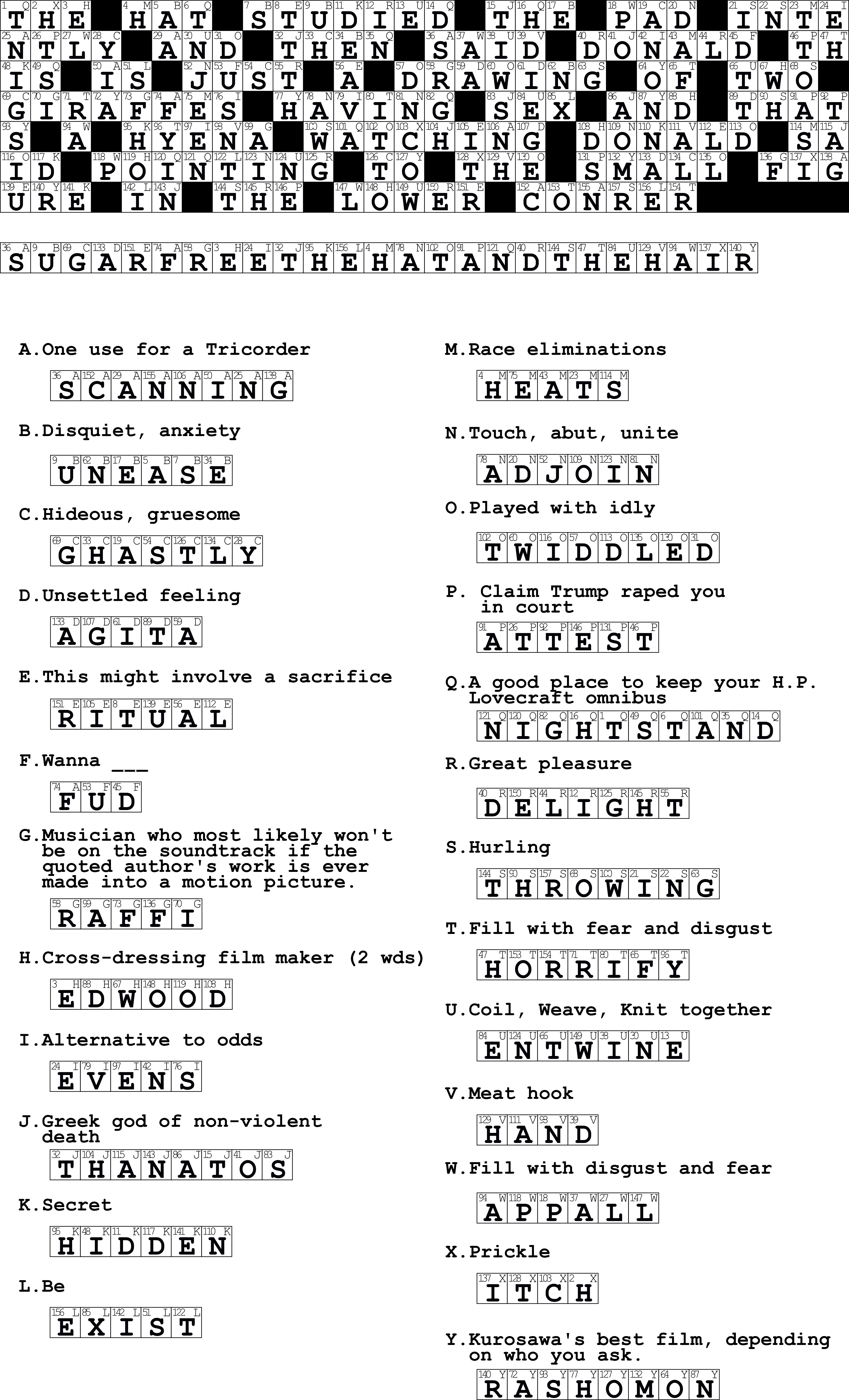
Someone challenged me to make an acrostic (or maybe they just asked if I thought I could, I took that as a challenge either way) so here it is. For those of you not familiar with these puzzles this is how they work – The main grid is a quote, the line directly below that is the author (always contains last name, first or initials of first are sometimes included) and the title of the work quoted, also that line sets the number of clues and the first letter of each clue’s answer. The letters of the quote make up the answers to the clues, the little numbers and letters in the top corners of the squares are for cross referencing purposes. Often the answers are thematically connected to the quote although not always straight forwardly, para ejemplo, if the quote is from a Sherlock Holmes story, one answer might be WATSON but it would be clued “Tom who won 8 golfing majors in the 70’s and 80’s”. For what its worth I found this to be easier to make than the standard crossword puzzle, finding a quote that contains the requisite letters to spell out the author and title with out being too long might be the hardest part, scrambling up the letters to make all the answers was far easier than filling a crossword grid. That said since I couldn’t find an acrostic building program I had to do this ‘by hand’ and that was a bit of a pain in the ass, also because of that I have no interactive version, your stuck saving the image below and printing it out or opening it in paint or something. Remember this is for entertainment purposes only, please no wagering. Good luck, we’re all counting on you. And as always enjoy.
“Beto is out! He’s out of the primary race!” the hat crowed. He farted with manic glee.
“Who?” Donald asked.
“Beto O’Rourke,” the hat said.
“Who?” Donald asked again.
“Tall guy, goofy-looking, got the panties of the Dems all wet? Especially the guys?”
“This guy is gay?” Donald asked.
“No, straight, just attractive to all the hopeless romantics in the left media.” the hair said. He was stretched out flat on the floor, basking in a sunbeam.
“But one of them is gay, right?” Donald asked.
“Mayor Pete,” the hair said lazily.
“And he’s barely gay,” the hat said. “He has a husband and so I assume he’s technically gay.”
“Like census form gay,” the hair said.
“Raising your hand and saying “present” sort of gay,” the hat said.
“Sleeping in pajamas gay,” the hair said.
“This is confusing,” Donald said.
“Unfabulously gay, Donald,” the hat said. “Respectable gay.”
“The sort of gay that dresses up for Pride by taking off his suit jacket,” the hair said.
“Barely detectable by our most sensitive gaydar units,” the hat said. “Even Warren–who longs to be a lesbian just so there would at least be something interesting about her–put on a rainboa for Pride.”
“Rainboa?” Donald asked himself, mystified. “Warren?” he asked the others.
“Elizabeth Warren?” the hair prompted. “We’ve been reviewing debate strategies against her for months?”
“Pocahontas, Donald,” the hat provided. “Big Chief Dripping Clam.”
“Ew,” Donald said. “Her. I will never sign a treaty with her. Not even one I know I’m going to break.”
“OK, good job, you got it,” the hat said encouragingly.
“So then who is this ‘Beto’ character?” Donald asked.
“Cory Booker’s boyfriend,” the hat said, chortling.
“I thought you said he wasn’t gay?” Donald asked.
“Everyone’s a little gay for someone, Donald,” the hair said.
“Like you’re gay for Big Macs,” the hat said.
“I like their secret sauce,” Donald said.
“That’s what Cory said about Beto!” the hat said loudly and laughed.
He kept laughing about his own joke for a long time, finally letting it dwindle to an occasional self-satisfied chuckle as the business of the Oval Office continued around him.