I enjoyed Paperbacks from Hell: The Twisted History of ‘70s and ‘80s Horror Fiction, Grady Hendrix’s romp through the post-Stephen King boom in horror publishing. I’m consumed quite a bit of horror from this era and I still found quite a few books–bizarre, deranged, amazing books– that I want to read.
For example, here is Hendrix describing Toy Cemetary, by William C. Johnstone:
Toy Cemetery (1987) achieves maximum Johnstone. Vietnam vet Jay Clute returns to Victory, Missouri, where he grew up, with nine-year-old daughter Kelly in tow. Within hours of his arrival, Jay discovers that the two major local landmarks are (1) an enormous doll factory in the center of town run by an obese pedophile named Bruno Dixon, who films satanic kiddie porn in it, and (2) a high-security hospital/mental institution/underground research facility that houses the “products of incest,” enormous man-monsters with apple-sized heads and superhuman strength. Tiny toys run amok, as does incest. Jay and his daughter almost hook up their first night, only to snap out of it when the crosses they’re wearing clink together.
Reading this book is like driving through a dust storm while in a post-concussion haze: the harder you try to focus, the more everything slips away into an insanity vortex. A supermarket check-out girl’s head explodes, but no one seems to mind. Possessed teenage boys follow Kelly through town, waggling their inappropriate boners until she fights them with karate and kills one with an ax. Everyone has a secret doll collection. A tiny French general leads a toy army.
Johnstone piles incident on incident, trope on trope, and if something isn’t working he keeps on piling. When time itself needs to be brought to a screeching halt, Jay Clute just pulls out his gun and shoots a clock. Because clocks make time, right? In William W. Johnstone’s world, why not?
Who could possibly resist?
OMWC
Partway through painful progress on Quantum Mechanics and Path Integrals by Richard Feynman and Albert Hibbs. At one time, this would have been light reading for me… in any case, this is a much deeper dive into the basic concepts outlined in Volume 3 of the Feynman Lectures at a math level that’s challenging but not impenetrable. Feynman basically disassembled the foundations of quantum theory and recast it in a novel approach to least-action and uses this method to attack the classical problems in quantum theory (e.g., harmonic oscillators, many-body, perturbation theory) in literally a more dynamic fashion than the basic Heisenberg/Schroedinger/Dirac approaches I was taught.
Yes, I’m a geek.
SP
I’ve been reading more escapist books. This month it’s been the Ruth Galloway series by Elly Griffiths. Ruth is a forensic archaeologist in Norfolk, England, who is sometimes brought in by the local police to lend her expertise when bones crop up in various places and situations. One of her best friends is a practicing Druid. Good, light reading.
Brett L
I haven’t read a damn thing worth a damn this month. Limitless Lands is probably the best of a bad bunch on Kindle Unlimited. I’m coming out of the closet, I’m kind of a Lit-RPG fan. Anyhow, I like the character and the writing of this one. A little military worshipful for me, and the character somehow joins a faction that is basically the Roman Empire if it had outlawed slavery and other brutal practices.
Jesse.in.mb
The Vine Witch by Luanne G. Smith. A light read, pretty perfect for a flight and killing time while I can’t sleep on CET. Some of the plots go unresolved, but nothing too egregious.
JW
I feel like I’ve graduated. This morning, I read the back of an oatmeal box. Did you know that Quakers had buckles on their shoes?
First of all, thanks to all who tried the challenge. Whether you spent hours and hours trying to improve your sketching or simply made a few attempts, I’m sure we’d all love to see what you got. Post in the comments.
I watched about 20 YouTube sketching tutorials and tried to follow what they were saying. But, I didn’t know what they were saying. Blending stump? Cast vs occlusion shadow? Values? Contour shading? I went down rabbit hole after rabbit hole trying to figure stuff out. I was Alice if she had nuts and hit them on every protruding root.
Can you really learn how to be good at sketching in a month? Not when the extent of your artistic talent is drawing dicks on your older sister’s Brownie troupe group photo. I did learn some things that couldn’t possibly be useful in any other aspect of life:
1. There are shadows everywhere. There are shadows inside shadows and the shapes they make are just as real as the objects and light creating them.
2. Contrast is how you make things pop. If you don’t go bold in order to find the edges of possibility, you won’t be able to create subtleties.
3. Sometimes you gotta draw a line no matter how shaky your hand is and live with it. The next time you’ll be more careful with your construction lines.
4. Relax. Stress can cause of spaz hand. It may take a while to discover a method to relax that works for you. Keep trying because eventually you’ll be able to slip into that frame of mind easily.
5. People have interesting faces. If you think a person is ugly, try drawing his or her face. You’ll find at least one point that is intriguing if not beautiful.
My final work sketches. Not going to quit my day job.
Note: A preview from my upcoming autobiography, Life’s Too Short to Smoke Cheap Cigars (Or to Drink Cheap Whiskey.)
No Ducks!
This One Time…
The howling November wind screamed in from the frigid, ice-choked river, blasting against the sides of my friend Jon’s rickety old van, rocking the vehicle back and forth. Jon and I hunched down, pulling our sleeping bags over our heads; the temperature was dropping precipitously. Our breath plumed out in the light of the Coleman lantern; Jon’s tiny catalytic heater sputtered weakly, lending almost no heat to the freezing interior. The remnants of a large saucepan of pork and beans bubbled softly on the propane stove; the beans were a last-ditch effort to bring some warmth to our frozen bodies.
“Man” Jon observed, “We really put ourselves through all this just for a few dang ducks?”
“You tell me.” I replied. “We didn’t see any ducks today.”
“That’s for sure. Whose idea was this anyway?”
It had in fact been Jon’s idea.
“Well, maybe we’ll get into the birds tomorrow,” I offered. “This storm should bring a fresh bunch down from Minnesota.”
“This storm will probably bring polar bears down from Canada, too,” Jon muttered. “We gonna hang around and wait for them?”
“Quit griping and pass the beans.”
Whose Idea Was This, Anyway?
The weekend had started with promise. We had been planning the Great Upper Mississippi Duck Hunting Trip for weeks. Several Saturdays were spent touching up Jon’s tiny string of decoys, replacing old anchor lines with new, repainting Jon’s tiny johnboat, sorting and packing camping and hunting gear. When the great day finally came, the excitement had built to a crescendo; we were primed and ready for a legendary duck-shooting weekend. Jon and I packed his ancient, arthritic Dodge van on Thursday night, rode to school together Friday morning, and on that glorious, sunny, warm Friday afternoon, left school and drove straight to the Waukon Junction entrance to the Upper Mississippi Wildlife Refuge.
When we arrived at the boat ramp parking area where we intended to camp, the sun was already low in the sky, but the air was warm. We kindled a large campfire and sat in our T-shirts, lazily toasting hot dogs on green willow sticks.
Jon leaned back in his lawn chair, yawned pleasurably, and looked up at the sky. “Hope we get a few clouds tomorrow. Don’t want to hunt on no blue-bird day.” Jon’s observation was destined to fall into the ‘be careful what you wish for’ category, but now all was well with the world.
We stayed up until a little past ten o’clock, drinking bottles of pop, toasting hot dogs, passing a bag of potato chips back and forth. The johnboat rocked slowly where it lay against the bank, secured with rope to a large tree; the decoys were already loaded; our shooting vests shell loops were filled with newly purchased steel shot shells. We were ready to go forth and seek web-footed fowl. Then, with the stars winking companionably overhead, we decided to toss our sleeping bags out on the grass and sleep next to our dying fire; the last thing I remember of that evening was the sight or the glowing bed of coals, and the cooling air of a remarkable early November Indian Summer evening.
The Next Day
The air had cooled quite a bit more by morning. When my little battery alarm clock buzzed at four o’clock, I awoke pulled down inside my old sleeping bag; when I opened the bag a little, a blast of ice-cold air hit my nose. I opened up a little farther, trying to get a look out over the Mississippi; the stars were gone, and only darkness greeted my searching eyes. I leaned over and smacked Jon’s sleeping form.
“Wake up!” I prodded. “You got your wish, it clouded over!”
Jon muttered something under his breath, rolled over, struck a match and lit his Coleman lantern. The sputtering light glimmered off the crystalline sheen of a hard frost all around us, on the grass, on the fallen leaves, on our sleeping bags. We hopped about in the pre-dawn blackness, frantically pulling on every scrap of clothing we’d brought, our invective accompanied by the hissing of the propane lantern. I attempted to rekindle the fire without success; apparently the wood was too cold to burn and matches only sputtered fitfully for seconds before dying out. Breakfast consisted of toaster pastries, frozen to the consistency of marble.
“Well,” Jon finally offered, “let’s get the boat loaded and shove off, OK?” Already in the distance we could hear the drone of outboard motors; competition for good spots was fierce.
“Yeah, I suppose so! Hope it warms up some.” I replied, using a piece of frozen pastry to scrape some mud off my boot.
It was the work of moments to load guns, ammo, decoys and lunch, and then we pushed off into the black icy water. Jon grabbed the pull-cord for the motor and yanked.
Nothing.
With the weak beam of a flashlight older than he, Jon checked the spark plug wire and the gas level. All fine. With a frown, he yanked the cord again. And again. And again.
Still nothing.
We looked at each other with dread. The wind was slowly pushing us back towards the bank, the johnboat rotating slowly in the sluggish backwater current.
“Guess we’ll have to row for it, huh?” I ventured.
We took turns on the oars. The exertion soon had us shedding outer garments, sweating even as we squinted into the icy wind. The eastern horizon was already starting to brighten by the time we got to a decent spot, a U-shaped inlet on a small island. The bank was hidden by a tall stand of cattails, forming a natural blind.
The actual by-gosh Upper Mississippi Wildlife Refuge in winter.
I cast a nervous eye at the slowly brightening sky as we set out Jon’s ten decoys. As far as you could see, the sky was an angry mass of low, scudding gray snow clouds. The river water was icy, black, and choppy with the freshening wind. A few snowflakes began to drift down as we finished and set up our folding stools behind an improvised screen of cattails. Still, things seemed brighter once we were set up, ready and comfortable, guns, food and hot drinks at hand.
“Well, this ain’t so bad, is it?” Jon wanted to know.
“Hey, this’ll be great!” I was mostly speaking for my own benefit, sort of a whistling in the dark comment. “At least it isn’t a blue-bird day, huh?” We both chuckled. It was time to get into some birds.
Trouble was that the ducks weren’t cooperating.
Our first sighting of waterfowl was a coot, who swam through our paltry decoy layout and picked in a desultory fashion at some waterweed, mildly insulted a large drake mallard decoy, and puttered away.
Another hour later, the next sign of life came in the form of a muskrat, nosing along through the cattails. He gazed at us myopically for a moment, panicked and dove with a loud splash.
“Should have bought some muskrat traps,” Jon groused, “might have got some more action that way.”
The Storm
Just as things were starting to get boring, the wind picked up, and a hard, gritty snow began to pelt us. We had still – still – seen no ducks; in fact, there had been no shots fired that we could hear, despite the hundreds of waterfowlers camouflaged in this stretch of backwater. With uncommon fortitude, we hunkered down to tough it out.
At eleven o’clock, we heard a shot in the distance. Then, another, slightly closer; more followed, a series of shots working their way down the river towards us. Jon looked at me, wincing comically under the weight of the ice forming on his eyebrows.
“Birds comin’ in!”
No birds came in. Whatever the other hunters were shooting at didn’t make it as far as our stand.
By noon, our thermos jugs of hot chocolate were drained. Jon had demonstrated uncommon foresight in placing his propane stove in the boat; together we discovered the logistical difficulties in warming up a ham-and-cheese sandwich over the open flame of a propane burner, using no tools but a mittened hand. We finally gave up and ate the sandwiches cold. Jon chipped a front tooth on a bit of frozen ham.
Around one, the wind picked up. The cattails behind which we were trying to hide bent flat against the roiled surface of the water. Jon’s decoys pulled tight against the anchor lines. Since the spread no longer looked too realistic, with all the blocks facing upwind with military precision, we rowed out and gathered the ten fake fowl in.
“M-m-m-maybe we’ll still get some p-p-p-pass shooting.” Jon hoped.
“I s-s-s-s-ure hope so,” I shivered in reply. “Hate t-t-t-o think we d-d-did all this f-f-for nothing.”
Two o’clock came and went, and all the ducks were apparently still in Minnesota. The temperature, on the other hand, was something right off Hudson Bay, or perhaps points north of that. A skim of ice now clung to the sides of Jon’s johnboat. A similar skin of ice now clung to my face. Jon had chipped two more teeth due to violent chattering.
Three o’clock rolled around. Jon’s teeth had finally stopped chattering, because they were frozen together. Both of us hunched in the boat, our shivering forms covered with snow. Life had assumed the proportions of a Norse saga, with the two heroic figures battling wind, snow, ice, and the elements in an epic duel. The only thing missing was the end-goal of our quest, the web-footed fowl we sought, our Golden Fleece, our El Dorado, our Holy Grail. The wind now drove the snow sideways, blasting it under our parka hoods, ripping away at our tender, frozen skin.
Four o’clock. The light was fading from the birdless sky.
“We may as well start back,” I offered.
Jon growled in reply, “I reckon we might. Maybe rowing will warm us up.” He tossed an angry epithet at the failed outboard motor, which I won’t repeat here.
Amazing as it may seem, we had a spot of bad luck rowing back to the boat ramp. If you look at a map of the Upper Mississippi Wildlife Refuge, you’ll note that Iowa lies on the west side of the river; that afternoon, the gale-force wind was howling out of the west. Several boats with functioning outboards were tacking into wind at angles, trying to fight their way back to the ramp; even powered boats were having difficulty. Jon strained at the oars to get us out of our inlet and into open water, but the moment he faced into the wind the howling gale spun us sideways, pushing us back east.
“GET ON AN OAR!” Jon shouted over the roaring storm. I hopped onto the middle seat next to Jon; he took one oar, I the other, and we strained away until our muscles popped. Our progress was painfully slow; we’d make a few yards headway, and a gust of wind would blow us back. About halfway across the channel, fighting current and wind, we were overflown by the only bird of the day, a hen wood duck, screaming downwind at approximately Mach Two. Both of us grabbed shotguns, and blasted away at the hurtling form, with predictable results; the duck was probably traveling faster than the shot leaving our gun barrels. While we were thus engaged, the wind pushed us back a hundred yards. Groaning in frustration, we took to our oars again.
“One duck, and it got away clean.” Jon grumped.
It was past seven o’clock, and pitch dark, when we finally arrived back at the boat ramp. My face was frozen into a grim mask, my parka covered with a rime of ice, my arms felt as though I had soaked them in molten lead.
Against our better judgment, we elected to camp overnight and try again in the morning. Jon hauled the motor up into the back of his van, and an hour’s tinkering had it sputtering to life; at least we wouldn’t be rowing. We repasted on still more frozen ham sandwiches, and the aforementioned pork and beans. The van was still icy cold when we crawled into our sleeping bags, hoping to shiver ourselves warm and try to sleep. Exhaustion eventually overcame the cold.
And Then This Happened
The actual by-gosh Bear Creek, right in front of our house, one January morning.
Four AM Sunday came all too soon, announced again by the buzzing of my tiny alarm clock. I cautiously opened the top end of my sleeping bag and poked my nose out. The air was frigid, and my abused nose protested the exposure to the cold; but there was something else, something it took my sleep-befuddled mind a few moments to catch onto.
Silence.
“Hey, Jon!” I smacked the side of his sleeping bag. “Hear that?”
“Whaa?” Jon muttered sleepily. “Don’ hear nothing.”
“That’s what I mean, nitwit.” I shot back. “The storm stopped.”
Jon sat up, rubbing his eyes. “Yeah. Doesn’t feel as cold, either.”
We popped open the back door of the van and looked out on a winter wonderland. A good four inches of snow had fallen, coating everything in white; large flakes continued to drift down silently in the light of the lantern. The wind had stopped, and all was dead still. The only break in the blanket of snow was the black muddy river itself, carrying a burden of ice chunks downstream.
“You want to try to take the boat out in that?” I asked.
Jon considered the churning black water, the gray chunks of ice, the still-falling snow.
“Hell, no!” he reached his decision. “We crash out a few more hours and go over to the State forest and shoot some grouse.”
“Works for me.” I pulled my sleeping bag back up over my head.
Late that afternoon, I burst in my parent’s front door, a brace of ruffed grouse in hand, and began stomping snow off my boots. The white stuff was a good foot deep by now.
“Funny looking ducks,” Dad commented.
“You should have seen the one that got away.” I assured him.
We eventually mastered the art of hunting the Mississippi, but never again did we go out that late in the season. Although it might be a stretch to say that we learned something as proved when, a week later, the mercury dropped to twenty below and stayed there or lower for three days. School was cancelled not for snow, but because all the school buses were hors de combat from the Arctic cold. At seven o’clock the first morning, with the temperature at twenty-eight below, the phone rang; it was Jon on the other end.
“No school!” he exulted. “Let’s go shoot some pheasants!”
“I’m in!” More than ready to make the most of our free day, I raced for my parka and shotgun.
It was half-past spring before we thawed out all the way.
Here’s the background story – it was a dark and stormy night and I was canoeing with all of my firearms as we all do from time to time. All of a sudden a rogue wave came up and capsized my canoe, and I lost ALL of my firearms to the depths of the oceans. It’s a tragic story. Completely 100% true too. I’m still really bummed about it, so I decided I would build a safe for future firearms to cheer me up.
I don’t have a traditional firearm safe, but I do have a couple of the green metal cabinets that you can lock. That’s always been good enough for me, but it means I need a closet or space big enough to house it all. For the last several years everything has been piled in a closet along with boxes and storage bins from the last move. I decided I was going to build a storage cabinet that I can lock everything inside, that doesn’t say “guns in here” to my guests. I can simply say “we keep some valuables in here, along with some important documents.” Plus I have a lot of wood laying around and I need to do something with it.
My plan was to have it big enough to house both the big and small green metal cabinets, with a shelf area between the two. So I made a dado jig to cut dadoes in ¾ inch plywood for the sides and the back that would all be the same width and more importantly in the same spot.
For the sides, I cut the dadoes with a router then ripped the sheet of plywood in half to get the two sides.
While I was cutting the rabbets along the edge the bit wandered out from the collet of my router and my rabbets ended up being deeper than I needed. Turns out you should leave a little space between the bit and the collet, say ⅛ if an inch or so. Thank you Internet for that tip. So to fill in the void, I just glued some scrap wood into the rabbet –
And then rerouted the rabbet –
Next I glued the back, sides, and shelf together-
But had to improvise with some of my clamps because I didn’t have enough of the right size. Well actually, I had plenty of 36 inch clamps, I just made the width 37 inches so I couldn’t use them (stupid math).
So everything was going smoothly until I saw this –
Oops. Fortunately the piece in the picture that is too long is actually too long so after a trim with the circular saw, another pass with the router, and some chisel work where the router couldn’t reach all was good.
More clamping and glueing for the top and bottom pieces –
And now for the final test –
If you are not familiar with these green cabinets there are holes in the back to mount them to studs or something that will keep them from wandering off. The ¾ inch plywood wasn’t going to be enough so I decided to build a frame that I could lag bolt the cabinets to.
I had a half dozen pine 1x4s that I glued together to make 2x4s –
But I ended up gluing them together –
Fortunately it was just a few drips of the squeeze out and they came apart pretty easily. When building the Murphy bed I used pocket screws, but decided I would do mortise and tenons for all of the pieces –
I have a mortise machine which made that task easy, and each mortise only required a little bit of cleanup. I measured for the mortise and realized it was going to be shorter than I wanted, so I scribbled out the line and then redrew where I wanted it. I somehow still stopped at the scribbled line?
For the tenons I just used a dado stack on my table saw and used a block plane and a chisel to get them to size.
The 2x8s are located where the lag bolts for the cabinets will go, and the stile in the center is offset so I can screw some standards in for adjustable shelving. I added a base to accommodate some casters so I can roll it around –
The bottom attached with some through tenons which I have never done before. I couldn’t use the mortise machine so I did these by hand with a drill and chisel. They’re not as clean as the machines mortise, and I should have used a backer to prevent chipping where the bit came through –
I added some glue to fill in the void, plus I used construction adhesive to glue the case to the frame so it’s pretty sturdy –
It’s not exactly square and is off by about 1/8th of an inch in a couple of spots –
The above picture shows the case sticking out a smidge from the frame. It’s not enough to be mad about, and I think if I built it differently and paid more attention to each piece I could have gotten it spot on.
Part 2 will have the trim work, plus the door, and hopefully paint.
Now what to replace my AR-15 with? The one I had used a composite lower from Cavalry Arms which is no longer in business. It had the iron sights and the handle, and I thought about buying one with a rail to mount an optic light a red dot or something. Any recommendations would be appreciated.
In a previous article I looked at how the polls for the Democratic nominee for President compared to the bookmakers’ odds. This is an update to see how things have changed in the last two and a half months.
A snapshot taken of the polls and odds on three dates presents a good summary of what has happened: (i) August 15, when Elizabeth Warren’s odds first passed Joe Biden’s, (ii) October 13, when Warren’s odds peaked, and (iii) November 20, the most recent data when this article was written. This time all data are taken from averages compiled by RealClearPolitics.com.
First, the poll numbers, in % (values below 2.0 are not shown):
Next, the odds, in % (anyone who has never been above about 5% not shown):
We see that the poll numbers are much more stable, especially for Biden and Sanders. Warren had a small rise, mostly at the expense of Harris, only to give it back as Buttigieg gained ground and Bloomberg entered the race.
The odds are much more volatile: Warren had a huge surge, taking favor from the next four contenders. Clinton (Hillary, that is) and Yang were the only others to gain traction in October. Of course, Clinton is not in the polls data since she has not declared and therefore (I assume) the pollsters don’t include her in the choices, although I wonder if some people chose her and those votes were discarded or called Undecided.
Since her peak, Warren gave it all back as Biden and Sanders recovered and Buttigieg surged into third place. Harris’s support wilted even further to the point where the bettors seem to consider her a nonfactor. Bloomberg actually reached 8.9% right after declaring, but dropped back some since then.
It will be interesting to see how the numbers change between now and the Iowa caucuses. According to RealClearPolitics.com, the polls for Iowa now have Buttigieg in the lead (23.5%), with Warren (17.8%), Sanders (17.0%), and Biden (17.0%) in a virtual three-way tie for second. Klobuchar (5.3%), Harris (3.3%), Yang (2.8%), and Steyer (2.5) are next. Steyer has been saturating Iowa (and therefore me) with ads claiming that the U.S. government has been bought by corporations; his national numbers are about half of his Iowa numbers. I for one will be glad when the Iowa caucuses are over.
There is much more detail at RealClearPolitics.com, if you want the complete picture (they have really nice graphs over time). I leave further analysis and conspiracy theories to the Glibertariat.
I turned fiddy this month and was thinking about things that I’ve always avoided because I sucked at them. Sketching is a huge weak point, so I decided to try and improve as much as I can over a month. I’m not going to classes or anything. I’m just going to watch YouTube videos and visit other websites to see what tips I can add to my arsenal. Why not join me? Saying you can’t because you are terrible is not much of an excuse given it’s not about how good you are. It’s about what you can pick up in your free time over a month.
Guidelines:
Choose a pic or something real that you can sketch again in a month.
Spend no more than 45 minutes sketching it as well as you can.
Use online or other resources to improve.
Do the same sketching again in a month. (30 days as of this posting)
The only thing I ask is that you post your first attempt in the comments here. Even if the thread is dead and you’re a couple days or weeks late, plop it in the comments. When the month is up, we’ll do another write up and have you post your pictures in the comments. Even better, if you can send your pics to TPTB before the posting, we can put your pics up top for all to see without clicking.
Here are some of my attempts for the first sketch. Hope I get better, cuz ugh…. A mouth, nose and eye.
So you decided to buy a kite and have fun like Yusef, but where to start….
Let’s start with a nice little single line kite, $5 on eBay, pocket size, comes with line and handle.
Wendy’s kite:
I bought a kite reel to better run the single, it is Wendy’s kite, so I made it easy.
200 meters of low stretch line, with a brake. You can hang on to it or set a stake in the ground, and enjoy it while prepping your next kite….
Welcome to Deltas
I was short of money, what’s new, so instead of a Ferrari kite, I grabbed two cheap Delta kites for the #1 Grandson and I, set up some new lines and went out. 20+ mph winds, I set up and Bang! the thing took off like a rocket, way too fast at first, then my lessons took over and I had an exciting flight with a good landing. The thing made an awesome, spooky sound as it flew, which adds to the drama. The next day we went out in 5-10 mph winds and the delta flew just as well in light winds as heavy, a nice feature.
Equipment
The easy part, get some Mason line at the hardware store in the color of your choice, try to buy at least 200 feet, it’s cheap, this will be your kite line. I had some half-inch PVC pipe and conduit to make handles with.
Yes, that’s Paracord, good stuff for this, so I made my own, but straps and bars are an option.
A stake is important, you need to secure your control lines so your kite doesn’t take off without you, usually a line between your controls. Believe me, it’s a good thing, a tent stake from Wally World works well.
Oh yeah, the Arsenal.
1 Delta, 48″ Wingspan
2 parafoils 70″ws and 102″ws
1 single line parafoil,24″ws
5 dual Line sets@ 82 ft long
1 kite reel at 200m long
various handles and Paracord
Total cost $85 and it all fits in a $5 soft cooler from Walmart.
The Moon, Jupiter, Jupiter’s moons through a binoculars-October 2019
Editor’s Note: Some photos may be enlarged by clicking on them.
Well, after the “downer” tone of my last piece, this piece will look up and away. The night sky captured the imagination of our ancestors. Every known culture has used the sky to capture reminisces of some of their tales. Every week Not Adahn pitches us on how the stars foretells our futures. But in the modern world many of us have lost our connections to the wonders of the night skies. We can go inside where it is warm and well-lit and we can amuse ourselves in ways that were undreamed of even 50 years ago. Our cities have also robbed the night sky of the ability to grab our attention. Ambient light obscures our chance to even see what is visible. None of this is bad. Warm, lit evenings with plenty of food and entertainment has been a goal of mankind for thousands of years. But sometimes you may wonder “What is that light up there in the night sky?”
You can observe the night sky year round but the summer and fall are easier times to break the problem of not seeing the night sky. During the summer the night sky faces to center of our galaxy and the night sky has lots of things to look at. The evenings are warm. The autumn in some ways is even more favored because many people hunt and are arriving at dark locations away from cities before dawn and remaining until well after sunset. Others are out for morning or evening walks and night clings longer so the opportunity to see the night sky is more easily presented.
This article is for the casual sky observer. I assume the readers have no precision telescopes, special software or the other equipment that serious amateur sky observers use. If you have an internet connection (if you don’t you’re not reading this anyway), working eyes, binoculars, maybe a spotting scope or a kid Xmas gift grade telescope* you have all the equipment you need.
(* This is a smaller refraction telescope with no electronics and generally with pedestrian quality lenses. Typically they have low magnification around 35X and higher magnification around 80-90X.)
What will you see when you look up? Stuff. Most of which is beyond the care and concerns of humanity. Some of the stuff is from mankind and can be humbling to see it whiz along. Some of it is our neighbors. The rocky or gassy planets which formed around us. Maybe you’ll see a visitor from the icy far suburb of the Solar System. I guarantee that you’ll see our companion orb. With patience and luck maybe you’ll see reminders of the power of the universe to alter life, planets or entire star systems.
One word of warning. What you will see in with your own eyes is one sense, disappointing. You won’t observe the rich colors, incredible details and literally otherworldly viewpoints in the best images released by the elite observatories, NASA, or the ESA. But that will be more than made up by the fact you will be seeing the objects first hand with your own eyeballs and mind. You will be able to combine the seen with the presented and hopefully be able to better enjoy both.
What do you need to observe the night sky? 1) A night without solid cloudiness.; 2) Your eyeballs at a minimum; 3) Something to tell you what is out where and when. (More in a bit); and it helps if 4) you have some type of optical aid. This doesn’t need to be a $10,000 telescope. It can be a decent pair of binoculars, a kid xmas present type telescope, a spotting scope, or even a decent rifle scope. The more magnification and light gathering ability device has the more detail it will enable you to see. It will also help if you give your eyes some time to adjust to the night away from lights.
This scribbling will be broken down into Solar System sky objects and manmade objects. I’ll try to keep the jargon down so as the Hitchhikers Guide advises, “Don’t panic”. So let’s head out to the deer stand, or out for the evening walk, and make sure to look up from time to time.
The Solar System and Manmade Sky
Let’s start with the easy stuff in our immediate neighborhood of the universe. The Sun, Moon, planets, comets, manmade stuff and others. Seeing these objects rates from really easy to challenging (or lucky). For the most part these things are bright, it is easy to observe their movement, and they show details even with the most basic binoculars or scopes.
The Moon
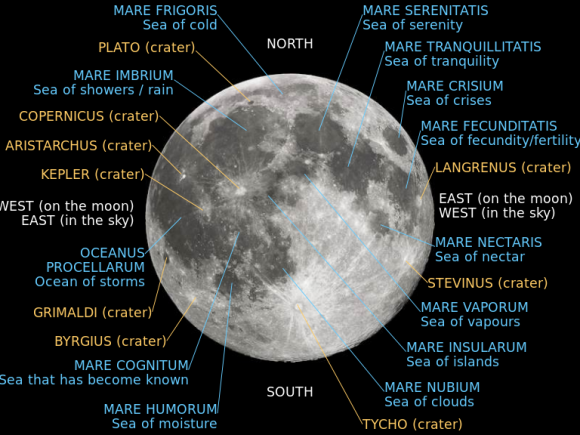
This is the earliest known night sky object and for the most of a month it takes no great skill to find it, even in a city. The Moon is a delight to observe as the terminator (line of light and night) crosses the lunar surface. The area around the terminator is full of shadows which allows surface features to “pop” into view. Mountains thousands of feet tall cast their shadows miles deep into the cooled lava “Sea” that surround them. Large craters will have bight rims with inky black interiors, and occasionally you’ll see the top of a crater’s central peak poking into the sunlight from the dark void.
So when is it best to observe the moon? Any time you can see it, except for the 4 days or so around a full moon. During that period the moon appears flat because the light doesn’t cast noticeable shadows
Through binoculars or your scope the view changes by the hour as the edge of the night rushes along the surface. One cold, dark, and clear pre-dawn in Montana I got into position and waited for daylight and the elk. While I tried to stay, warm, quiet, and unscented I had a great view of the terminator and as I looked at the moon through my binos I caught the moment the sun rose high enough to pass through a breach in a crater wall and send a narrow beam of light spilling across the crater floor.
Even with no optics the face of the moon changes between nights. If the moon is already up at sunset, you are approaching the full moon. If at sunset, it is the full moon. If there is a noticeable period between sunset and the moon- the moon is waning. Finally if the moon is bright and high in the sky around noon, it is about a week to no visible moon. AKA- the new moon.
Fun fact about the Moon. Because of a small wobble in the lunar orbit an Earth observer over time can see almost 60% of the lunar surface as the wobbles (libration) let us peek around the corner of the Moon. Also, most lunar sea surface material is about the same color as a middle aged asphalt parking lot.
The Moon’s features seen through binoculars
The Sun
In short don’t look at the sun without eye protection. Especially now since even there are very few sunspots to see (aka solar minimum). Welding goggles are not usually dark enough to protect you since most commercial welding goggles are a level 12 darkness and the sun requires level 14. Small “XMAS Telescopes” usually come with a “solar filter” which can be used with the lowest power lens configuration. In other times you can carefully observe the Sun’s face for sunspots. Right now the risk is probably not worth the view. But, unless you have specialized equipment, the Sun is best observed online from a solar observatory website. There are three exceptions to this: solar eclipses, planetary transits, and the green flash. I’ll discuss solar eclipses later.
Planetary transits are the rare occasions when Mercury or Venus actually are seen crossing the face of the Sun for a few hours. Because the planets don’t follow the Solar equator the geometry required for the Earth to experience this view are few and fleeting. The last transit by Venus was June 5, 2012 and was fun to see. The next will be December of 2117. A Venus transit was how the atmosphere was discovered and that led to a rush to have observing sites around the world in 1769. Today science has moved beyond transits for scientific purposes but watching the progress of a planet across the face of the Sun puts the scale of the Solar System in perspective. While my bet is that I’ll miss 2117 transit of Venus, I am holding out hope for the Mercury’s November 11, 2019 transit of the Sun. The transit will be visible from all of North America and much of Europe. Japan, you’ll have to catch it online. I live near an east facing beach so I’ll be able to experience it at dawn. What you’ll see is a black dot that moves across the face of the Sun. This website will provide you the information for your location including where on the solar disk you will see Mercury. If you miss this transit your next opportunity will be November 13, 2032.
Venus Transit 2012
To observe the “green flash” you need an unobstructed view of a flat horizon at sunset or sunrise. It works best if you use an ocean or a Great Lake. I have heard people have seen the “green flash” on the Great Plains, but I had no luck when I lived in the KC area.
A “green flash” occurs because the atmosphere acts like a prism and just as the solar disk disappears (appears) at the horizon the prism causes a 1-2 flash of green to appear at the top of the solar disk. Again, a fun thing to see if you are aware and lucky.
Green Flash over Pacific Ocean
Jupiter
In the current night sky at sunset Jupiter reigns. Venus is usually brighter but right now it is close to the Sun and hides in the glare of sunset. In contrast if you look west of south after sunset the largest planet with be the first “star” to come out and remains the brightest object in that part of the sky. With the naked eye Jupiter is very bright silver white “star”, while through even the smallest binoculars it appears clearly as a disk instead of a point of light like a star. You can do a quick check if this. Find Jupiter and check it out. Now make a closed fist and extend your arm. Place it just below Jupiter and look at 5 o’clock. That bright red star is Antares. Now look at Antares in your binos. Antares is the 15th brightest star in the sky. It a red super giant of about 12 solar masses only about 550 light years away and if it swapped places with the Sun it would fill the Solar System until midway between Mars and Jupiter. It is truly big. Even that close and big Antares is a mere pinpoint of light. Every major planet is clearly a disk and not a point of light. (See opening picture)
In a dark location with good binos (with large front lenses to gather light) you can see Jupiter’s four large moons. They appear as distinct “stars” along Jupiter’s equator. With any scope these stand out. Depending where they are in their orbits you can see up to four of the moons Galileo discovered. All four are fascinating for their own reasons, but the inner two moons (Io and Europa) move so quickly that observing even an hour apart will reveal clear movement. With a scope as well you’ll be able to make out some of Jupiter’s banding which look like brownish stripes north and south of the equator. Jupiter takes about a year to move one zodiacal constellation. So once you find it, it’ll be easy to follow.
Jupiter and four largest moons through a small telescope
If you look at Jupiter or Saturn near the horizon you may be tempted to say, “WTF Double Eagle? Either you lied about where the moons (rings) are, or the planet tipped over. Not to fear. This is just an optical illusion because you are essentially looking sideways at the planet. Look closer to when it is at the highest point it’ll reach in the night sky (AKA zenith) and things will appear normally.
Fun Fact: The gas giant Jupiter rotates so rapidly (a day is about 12 hours) that even though binos it visibly bulges along the equator.
Io eclipse on Jupiter’s southern hemisphere from Juno pass Sep 2019
Venus
Venus is the Earth’s nearest twin in size and our closest planetary neighbor on average. (Depending on locations in their respective orbits both Venus and Mars can be closer on any given day.) Because Venus is closer to the Sun it sometimes appears in the morning and other times in the evening (aka Morning and Evening Stars) and can never appear all night like the plants farther from the Sun than us. Venus is even brighter than Jupiter and at peak times on moonless nights can cast a faint shadow.
Unfortunately, Venus is not a fascinating view through your optics. It appears as a silvery disk but with no moons so you don’t get the obvious movements as the moons parade around Jupiter. The only real trick Venus will display for you is that it goes through phases like the moon, less a “full” Venus. The fuller Venus appears, the farther it is from Earth; and the more crescent it appears, the closer it is. Because of this, the apparent brightness of the planet remains fairly constant. A crescent Venus is noticeably larger in your optics than an almost full Venus.
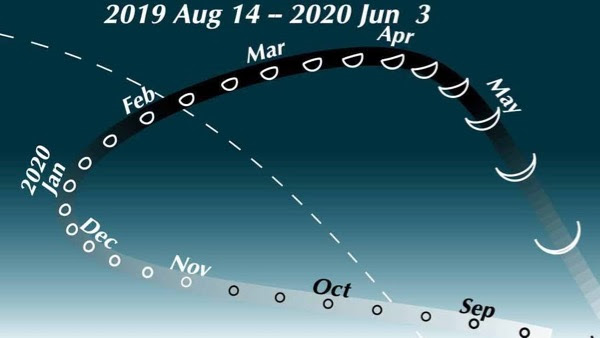
Venus is not much of a visual treat right now since it just passed behind the Sun. It sets within minutes of the Sun and is not visible to the casual observer. In a few months it will return to easy visibility. In fact, Venus can be seen during daylight hours and is sometimes reported as an UFO near the Sun. Here is how and where Venus will appear after sunset for the next few months.
Venus phases and location late 2019
Fun Fact: Venus’s surface runs about 900F and the atmosphere is so dense that the pressure at the surface is the same as the deepest parts of the Marianas Trench. The odd thing is that the planet rotates so slowly that a Venusian day is longer than a Venusian year.
Venus surface in true colors from USSR Venera 14
Saturn
Saturn is the third brightest planet and is brighter than almost every star. As a bonus, now it is near Jupiter in the evening sky so it is really easy to find. To find Saturn locate Jupiter. Using the same closed fist stretched out arm technique, go left a bit over two fists and up slightly (10 o’clock position). That yellowish star is Saturn. Through even a small scope Saturn will grab your attention because the rings are right there and easy to make out. (Most binos make Saturn look like a yellowish football. If you have high quality lenses and steady them against something you can just make out the rings in good conditions.) Saturn and Jupiter are slowly closing together so over the next months they will be easier to see together. In December 2020 they will appear to almost touch they will be so close together in the night sky (AKA conjuction).
Saturn’s rings are “open” and easier to see now. In fact even a cheap telescope will reveal that there are “rings” and not a ring. As the years continue on we will move more in line with the rings and they’ll almost disappear. Then they’ll open to the other side. (14 year cycle). It takes a bit over two years for Saturn to move between constellations which is why Jupiter will “catch up” next year.
Saturn through low power scope in poor conditions
Fun Fact: Gallieo was the first to observe the planets though a telescope and discovered Jupiter’s moons and phases on Venus. He could only make out that Saturn bulged and it was a later scientist who discovered the nature of the rings. The rings are almost all small pieces of water ice ranging 1cm to 1M in size and the most visible rings are ~63,000 km wide, but only 10-30 meters deep.
Night side of Saturn from Cassini. Earth visible at 10 o’clock through the rings.
Mars
Mars may not be our closest neighbor planet, but it is the most “earthlike” neighbor with seasons, clouds, snow, occasionally running water, and hosts of other similarities. In the night sky Mars is an odd duck because it zips through the constellations (a Mars year is 687 Earth days) and changes brightness and apparent size dramatically over a short period of time. Right now? It is so close to the Sun it is hidden in the glare. Come March it’ll escape the Sun’s glare to appear as a bright red point of light around dawn. By as the months go on the distance between us and Mars will fall until October when we will be only 0.4 AU apart and Mars will be bright bloody red and one of the brightest objects in the sky.
Mars through a year with the moon for scale.
Through your binos or spotting scope Mars appears a red disk (Mars’ surface is covered with rust colored rocks). As the months go on the disk will get larger and the white polar cap will become easier to see. You need to keep your eye on Mars because it crosses constellations about every other month unlike the dawdling Jupiter (1 per year) and Saturn (1 every other year). It also spends part of the year “going backwards” as the Earth catches up as it passes the planet.
Fun Fact: It has the largest known mountain, Olympus Mons, which is visible through a moderate sized telescope. It was discovered on Earth in the 19th Century and named Nix Olympia but it was an unknown object. It took until Mariner 9 orbited in Mars in late 1971 to determine what it was. Olympus Mons is a shield volcano that stands 14 miles high above the base and covers a surface area almost equal to the size of France. In comparison, Mauna Kea in Hawaii is the tallest volcano on Earth and rises only 6.3 miles from the ocean floor to the summit. Olympus Mons weighs so much that it has deformed the crust and sits in a 2km deep depression surrounding mountain.
Curiosity photo of Murray Butte 2019.
First photo from the surface of Mars July 1976.
Mercury
For your basic sky observer Mercury is like Venus but more so. With a year of only 88 days it rapidly transitions between the morning and evening sky. Because it is closer to the Sun it never gets far from the horizon. But sometimes when you are out and the day is transitioning a “star” is seen low in the sky. If the time of the year is right you are looking at Mercury. Through our optics it appears as a small oddly shaped disk or crescent similar to Venus but much smaller. See “Transits” (above) to take advantage of the rare opportunity to watch Mercury cross the face of the Sun.
Fun Fact: Mercury is smaller than some moons. Both Ganymede (Jupiter) and Titan (Saturn) are all larger than Mercury. Ice has been detected in several craters near Mercury’s poles in pockets that are perpetually in darkness.
The Outer and Minor Worlds
How about the rest of the solar system? The planet Uranus is dimly visible to the naked eye in a dark location and “good seeing”. (“Good seeing” is a dark night with little to no wind and a steady temperature gradient through the atmosphere so the atmosphere is moving very little.) But for the casual observer Uranus is best seen when it is near an easier see thing. During a lunar eclipse in 2014 Uranus was right below the moon and any observation of the moon meant you couldn’t miss a gray green disk. That disk was Uranus. My suggestion is don’t try and find Uranus without the aid of an easy object nearby. Many websites will be happy to let you know when these days are approaching.
Total lunar eclipse and Uranus 2014 (Uranus at 5 o’clock)
Fun Fact: Early in the Solar System Uranus was smacked by another object near the same size. Now it rotates on the side and essentially rolls around the Sun. Uranus was not recognized as a planet by early astronomers and shows up as a “star” in several sky maps.
Neptune is invisible to the naked eye but like Uranus can be found with optics when it is near something else. One morning when I was out before dawn getting into position for a turkey hunt Neptune was near the crescent Moon. In my binos I could make it out as a very small bluish disk. Even with a small scope that is the best you can hope for.
Neptune through small telescope
Fun fact: Neptune was discovered by two astronomers independently doing the math on small perturbations of Uranus. It has been visited only once by an Earth launched space probe. Voyager 2 passed by the planet in 1989.
The dwarf plant Pluto. Forgetaboutit. Even through the largest earth based scopes Pluto is a speck of light that can only be made out by how it moves over several nights.
Fun Fact: With a very elongated orbit, Pluto actually moves inside of Neptune’s orbit for 20 years every orbit (248 Earth years). The last time it did so was 1979-1999 ce.
The dwarf planet Ceres is another dwarf planet but is more conveniently located in the asteroid belt between Mars and Jupiter. Under almost perfect conditions it can be made out as a dim star. It is not worth the effort to find unless you start getting hooked by amateur astronomy.
Eclipses
I’ll discuss only the two most common, solar and lunar. Solar eclipses only take place during a new moon, because that is when the moon is directly between us and the Sun. Because of the tipping of our orbits it is only sometimes the Moon’s shadow crosses the earth’s surface.
The next totality that will cross the US is April 8, 2024 and totality will cross Texas and cross west of the Appalachians through eastern NY and curve into eastern Canukistan.
Solar eclipses – North America
Lunar eclipses only take place at a full moon and only sometimes for the same reasons. But since the earth’s shadow is so much larger the area for observed totality covers a larger part of the planet and for a longer time. As the bulk of the Earth’s shadow hits the face of the moon it starts turning dark, usually orange-ish, but rarely black. This is because our atmosphere always bends some light through.
The next lunar totality for the US is January 21st. The mainland will be in position for the entire thing, while on my island hideaway the moon will rise a bit before totality and I’ll get to observe the rest. Convenient and warm for me, if not for some of you.
Occultation
These are when one object crosses in front of another. It is the astronomy equivalent of the saying, “Standing there makes you a better door than a window. “ Almost all of the most visible of these events take minutes to a few hours and cover a fairly small portion of the surface of the Earth. There are websites that highlight the most noteworthy of these. No real science to be learned, but they are fun to see. Watching a planet disappear and reappear from behind the moon is a kick. Visible from naked eye to scope.
Saturn about to go behind the Moon 2014 through small telescope
Meteors and Meteorites
A meteoroid is a small bit of metal, stone or a metal/stone mix in space. A meteor is a meteoroid burning up in the atmosphere. A meteorite is a meteoroid that makes it to the surface of the Earth. The average visible meteorite was the size of a marble when it hit the atmosphere. Most meteoroids burn up at 75-50 miles above the Earth.
Seeing a meteor is a matter of chance and luck. You can improve your odds by watching after local midnight so your chunk of Earth is facing our direction of movement. The other way is to watch during known periods of “meteor showers”. (See a good website for info.) These are the times when the earth passes through the orbital paths of larger comets and sweep up the dust and small objects left behind comets in their flight. If you get really lucky you can watch a fireball which is a larger meteor burning brightly. Sometimes they leave a visible smoke path, or even break apart into multiple pieces while you watch. The best fireball I ever saw was one early morning in 1992. We were out for the Javalina hunt. I had left camp and was walking up a hill to get into position when the hill in front of me blazed white and I saw my shadow. I quickly turned around and saw a huge fireball traveling across the sky. As I watched it broke into 4 pieces and kept going, eventually blinking out far to the southwest. The light from the still hidden Sun caught the smoke and lit it up in the pre-dawn sky. I thought it was space debris but when I checked with the local observatory a few days later they confirmed it as a meteor.
Fireball meteor
As much as many of us hoped for the “Sweet Meteorite of Death” in 2016 and will do so again in 2020 the odds are small that the next extinction level meteorite strike will happen then. You can play around with this website and find how your very own SMOD will impact you. Have fun with it. Can you design the next KT event?
Fun Fact: The change of definition from meteoroid to small asteroid was formally defined only in 2017. A meteoroid is grain sized to one meter in size. Smaller size are micrometeoroids and larger are small asteroids.
Comets
Here is Comet 1A. Comets are dirty snowballs left over from the formation of the solar system. Well outside of the planets there is a large cloud of dust and ice stretching out over 100,000 Astronomical Units (AU = roughly the distance from the Sun to the Earth). This cloud is known as the Oort Cloud and is the home of the comets. Passing objects and stellar events give the cloud gravitational nudges and some of these nudges eventually result in a dirty snowball to start to fall into the Sun’s gravity well. (It may take millions of years between the nudge and the solar pass.) Those snowballs which come in close to the Sun start to warm up and give off ionized gas and dust. These are known as comets. Every year dozens of comets are found and most remain faint and fuzzy telescope objects, but every few years (on average) a comet becomes a bino and naked eye object. About once a decade a comet will shine bright and luminous thus becoming a spectacular sky show. Since most bright comets take a long period to orbit the sun their arrival is a once in a lifetime event. Even Halley’s Comet takes 76 years per orbit so at best you might get two chances to see it. Spectacular Comet Hale-Bopp passed within 1 AU of Jupiter so the orbit was considerably shortened. If you are around in 4380ce Hale-Bopp should put on a good a good show.
Right now the night sky doesn’t feature any worthwhile comets for the casual observer.
Comet Wirtanen- average visible comet Nov 2018
Comet McNaugt in daylight Jan 2007
Aurora
Aurora form when Solar Wind particles hit the Earth’s magnetosphere and then ionize. Lower energy particles are blue and green while high energy particles display red. The map shows the band of common occurrence over North America. Especially energetic solar storms can result in red aurora appearing throughout the continental USA. More here: https://en.wikipedia.org/wiki/Aurora
Manmade Stuff
There is a bunch of it up there, so much in fact that some areas of prime “real estate” are getting downright crowded. Most manmade stuff is not easily visible to a casual observer, but some of it is. The biggest and brightest object is the International Space Station (ISS). This is my recommendation to try and find first. It is BRIGHT, moves relatively slowly and is impressive. It is often mistaken for an airplane heading to a nearby airport. When you see the ISS, you will know you saw it. Conveniently the nature of the ISS orbital parameters means that it will be visible for multiple days from your location before it goes dark again. The ISS will be visible from your location during passes for several hours before dawn and after dusk. I recommend using Heavens-Above.com for finding your visible passes. (More info below). For other satellites a find a dark location on a night with no moon. Watch and you’ll see small lights than are too small to be passing planes moving along. If you are ambitious yu can use Heavens-Above.com Db to find specific satellites.
If you are near Commiefornia or the Floridaman Atlantic coast you can occasionally see launch vehicles heading to orbit. It is impressive to watch a small object at the head of a rapidly lengthening cloud as it is gaining speed and altitude. After the vehicles cross the sky you can watch the remaining gas plumes be twisted by the winds alofy. They often make surreal shapes with transient splotches of the spectrum. Both the Kennedy Center (FL) and Vandenburg Air Force Base (CA) will publicly announce non military launches to the public. Most military launches may get only a few minutes, or no, public announcements.
ISS passing in front of the moon. Time of transit less than two seconds.
A Smattering of Websites
There are scores of astronomy related websites out there. In fact, there are more potential websites for you to visit than the number of fleshy globes that Q offers for viewing to the Glib community each month. But here are a few websites that are easy to use and are geared toward the interested general public.
Astronomy Picture of the Day. You might as well visit it since your tax dollars pay for it. This is a great site which features just what the name says. Each picture has a clear description of what you are seeing. The photos origins are diverse (in the good sense) from NASA, other space agencies, observatories from across the globe, and from amateurs sending in some incredibly artistic works. The archive goes back to the mid 1990’s. This has been my first website daily since 1997.
EarthSkyNews. This organization covers what is going on for the general sky observer. You can sign up for a free daily email newsletter. It has observing updates, news from space, photos, and only a small touch of occasional “climate change” stuff. They also keep your subscription information tight. I can’t think of a time when I got unsolicited emails that would have come from them selling my info.
Heavens-Above. This is a serious but easily accessible site. It is “THE” public website to track satellites, get sky charts, past and future night skies etc. When you first visit this site note the upper right corner of the page. There is a box there. Open it and set your location from a database. It will not change all the data for your location and remember it. Look down the left side and the ISS is highlighted. Click on it and it will give you the visible passes for the next 10 days. Click on the day and BINGO, there is a sky chart for that pass.
Keep following down the left side and you get to the astronomy portion with easy to use interfaces. You want to see what was going on the sky at the moment of your birth? Just put in the data and there will be the sky for that time. Want to see the sky for 4th of July 3000 years ahead? It is there.
These three websites will serve a casual observer. There are hundreds of other websites out there from the USG, other governments, private organizations and amateurs. If there is interest after this article I can do a “Part Two” with easy to observe deep sky objects. With just binos, or in some cases a deep dark sky, you can observe a host of objects, including a galaxy that will one day crash into our own.
Everybody likes to see a kite in the sky, peaceful and tranquil, hovering in the air, but there is much more to kite flying in the 21st Century as you may have guessed, let’s take a look.
First things first, I have flown R/C for 16 years, with 8 spent on 3D flying, and have a lot of time/money invested in the hobby, then I moved to Bullhead City AZ……
Way too much wind to fly my big boys, let alone my little quadcopters and such so, what to do?
I knew 2 line kites existed, and thought about giving them a try, with a bit of research I found a nice, cheap Parafoil to start out with, and then went to YT, oh boy…. Did you know they make 4 line kites? 5 line kites? time to back up and study. It appears that a 4 line kite has what they call brakes, actually a wing flexing reminiscent of the Wright Brothers original design, but WAAAY better, you can potentially fly your kite Backwards, Spin on a dime, and land anywhere you want, pretty cool.
When the kite came in the mail, we proceeded to RTFM and all the Bridle lines came into focus, it made sense, after a few bowline knots, we hooked everything up and went up. Power! control! Crashes! it was great fun til the bridles and lines Tangled, bad, so we go back to YT and see what we did wrong……
Kite Types
So many types, let’s run through a few:
Single line – what we grew up flying, add a tail and have fun, there are a variety of fun singles, 75 foot tails, cubes, animals, all sorts of fun.
Dual Line – these come in Delta wing and Parafoil designs, and they perform! crossing the sky sideways, loops, dives, the wind window is your only limit.
Four Line – these are the bad boys, dual control lines and dual brakes. Very testy, very fun.
Five Line – these are the big, kiteboarding kites. The fifth line is a Bailout line; they need it.
Controls
This is fun, as there are many ways do control a kite:
Single Line – kind of obvious.
Dual Line – you are taking the entire wing and turning it to go where. you want to go. Arms parallel, and pull straight back, pull the left line to turn left, the right line to turn right, etc. Watch your loop numbers, then reverse them to clear your lines.
Four Line – the extra lines add the ability to shape the wing structure, meaning tight turns and loops, and the ability to land anywhere. But, if you aren’t on it, you crash….
You can start with stock handle controls or mod some. I did because I’m Bob the Builder, or you can buy some big boy toys for big kites. These are nice tools for Big kites, say 3meters and above, so far I’m at 1.8 meters and getting a 2.5 meter, baby steps. I recommend trying out the smaller control kites, they are a lot of fun, and if you want to fly get the bigger ones next.
I built a set of brakelines, and if I’m feeling saucy I’ll set up a four line kite. The park I just found is awesome, not just for flying either – two dog parks, one with all the ability features built in. Should be fun!
Kiteboarding, I wish they had it when I was young and strong, no need to send you to a YT link. Too much for me.
Kites are cool, since writing this imma gonna buy some single lines just for fun, you should too,
Have a lot of fun!
Next week, I’m getting a Prism Nexus, will report back. Prism is the go-to for good kites.
My hunt this year got cut short. Loyal sidekick Rat and I ascended into the Routt National Forest early on the Friday before Opening Day; Tuesday at noon we passed through the dusty little mountain town of Kremmling, where I checked my phone and discovered my daughter was to give birth to my fifth grandchild that evening. So we broke camp and, venison-less, headed back to town.
My new grandson, of course, made that all worthwhile.
This was what it was like Friday when we set up.
There’s not too much to report from the hunt. Saturday was clear and warm, and we enjoyed wandering around in the woods even though it wasn’t good weather for hunting. Saturday night the snow started, sending the deer and elk into the dark timber, where the only way you’ll find them is to look literally under every tree. By the time we left mid-day Tuesday there was over a foot of snow on the ground.
But since I don’t have much to report, I thought I’d present something else.
Some years back I wrote an article for a U.K. waterfowling website, which site I let have the article gratis. Well, that little article has grown legs, as it has been reproduced in several academic point/counterpoint publications, all of whom actually paid me for secondary/tertiary/variousotheriary publishing privileges.
That being the case, it seemed logical to reproduce it here.
Why hunt?
Modern hunters seem to find they are answering that question frequently. Sometimes the question is put by the genuinely curious; sometimes it is a hostile demand for justification. In the first case, the answer is complex and thought provoking. In the second, the answer is simple – “because it suits me to do so.” Hunting in and of itself requires no justification. The hunt is not only natural and healthful; it’s an inextricable part of our heritage as human beings. Man is and has long been a terminal predator, as marvelously equipped for hunting by our intellect as a lion is by his claws and fangs, as a wolf by his swift legs and pack instinct. No matter whether humans today hunt directly, or employ middlemen to prepare their prey for them on farms and meat packing plants, the fact of our status as predator is in our very DNA. We owe the very fact of our world-conquering intellect on the hunt, on the stimulus that drove us to overcome the handicap of our clawless, blunt-toothed bodies, to develop weapons to match the feats of the greatest of animal predators; we owe our great brains to the access to high-quality diets of meat, marrow, and fat that predatory behavior allowed.
But, the question remains nonetheless. Why, now, do we hunt?
Some hunt for the meat. A good reason in itself; game meat is lean, healthy, and free from additives; the process of obtaining it provides exercise and time in the outdoors, away from work pressures and the temptations of couches and televisions. The fruits of the hunt, properly cared for, are welcomed on the most discriminating of tables.
Some hunt for the camaraderie, another fine reason; for many of these, the actual hunt is secondary to the outing with friends, sharing the campfire with others of like mind and feeling. Another good reason; it is in the enjoyment of fine companions that we grow as social animals. The annual ritual of the mountain elk camp is a vital part of the year for many.
But, there is frequently another reason. A reason that’s more compelling, and at the same time harder to explain.
This was what it was like Monday afternoon.
Henry David Thoreau, in the great classic Walden, wrote “Go fish and hunt far and wide day by day — farther and wider — and rest thee by many brooks and hearth-sides without misgiving. Remember thy Creator in the days of thy youth. Rise free from care before the dawn, and seek adventures. Let the noon find thee by other lakes, and the night overtake thee everywhere at home. There are no larger fields than these, no worthier games than may here be played.” Thoreau spoke for many hunters in those words, hunters who hunt not solely for the meat, or for the company, but for the ageless, timeless experience of the hunt itself.
For it’s true that for some of us the hunt is an answer in itself. It’s enough to awake hours before the dawn, and to know the utter silence of a late autumn morning. To hear the crunch of snow under your boots as you begin the hike into the distant, silent mountains. To smell the pines along the trail, and see the silent sentinel spruces on the ridges, barely glimpsed in the pre-dawn dark. It’s enough to sit, shivering, at that best spot on the top rim of a remote basin, watching the east grow bright, waiting for the first rays of warm sunshine to break though the trees and drive away the bitter cold of night.
But those moments, treasured as they are, pale before the ultimate goal of the hunt. It’s a part of the hunter’s soul, to carry the knowledge that somewhere, out among the pines, in the dark timber or the frost-covered meadows, a bull awaits, and the chance of the day may bring him within your awareness. The snap of a branch, the ghosting shape of antlers through the aspens, the sudden ringing bugle of a bull elk, as he appears, suddenly, where no bull was a moment before. His breath plumes out in the cold as he screams his challenge, and your hands and will freeze momentarily in awe of his magnificence.
It’s enough to know that the day may bring the chance of a stalk, through the darkness under the trees, along the edges of the golden grasses of a meadow, creeping, creeping, under the streamside willows, silently, slowly, ever closer, testing the wind, watching underfoot for twigs, whispering a silent prayer to the forests and fields to allow you to close the gap, to make the shot.
With luck, you’ll raise your rifle or draw your bow, and make your shot. More often than not, though, the bull escapes, to play the game of predator and prey another day, in another valley.
You can’t buy moments like that; you can’t find them on the Internet, or at the movie theatre. When the alarm rings in the icy cold of a pre-dawn tent at 9,000 feet, this type of hunter doesn’t groan at the prospect of climbing out of the warm sleeping bag; instead, the prospects of the day are enough incentive to brave the cold, to pull on wool and leather, to step into the pitch-black outdoors, under ice-chip stars. It is with pleasure and anticipation that this hunter begins a day that will likely end back at the same tent, in the freezing dark, hours after sunset, at the end of a long hike out of the wild.
For hunting requires a level of participation unknown in any other human venture – hunting requires a communion with the very primal forces of Nature, taking life so that life may be. Hunting requires a contact that the non-hunter can never know, a contact with life itself. The hunter eschews supporting his or her life through a middleman; knowing the cost of one’s diet, engenders respect for the lives that must be taken to sustain one’s own life.
Early hunters knew this very well, as they revered their primary prey. For example, Plains Indians referred to the bison as “uncle” and “brother.” Paleolithic cave drawings of game animals and hunt scenes are rendered with a loving reverence that is still evident today, thousands of years later. Modern hunters are much the same. Enter a hunter’s home, and you’ll likely find framed prints of deer and elk, waterfowl sculptures, photography of upland birds.
To some it seems contradictory; to express respect, reverence, even love for an animal that you pursue, hunt, kill, and eat. It’s true that this seeming contradiction is as hard for hunters to explain as it is for non-hunters to understand.
Perhaps the answer lies in the very understanding of our role in nature. nature has but one law; life feeds on life, and life gives life to life. People who obtain their steaks, chicken, and burgers from supermarkets and butcher’s shops can lose sight of this fundamental truth, and perhaps they would prefer to have that process sanitized in just such a manner. In our modern, urbanized society, many like to imagine their own existence is bloodless, clean, and sanitary. But such an outlook is self-deluding.
The hunter knows very well the cost for the steaks that grace his plate. A year has been spent in preparation for the hunt, planning, caring for equipment, and practicing marksmanship. Without complaint or reservation, the hunter has arisen before dawn, as described above, and walked the many miles to where the game awaits. In the bright sun of a meadow, in the twilight of dusk, or in the shadows of the forest he has made the stalk, taken the shot with painstaking care, and dressed the animal. He has packed out quarters of elk, perhaps a two or three-day process, often through rough, grueling country. The hunter has cared for hides and antler and meat, and the price for the meal of elk steak is ever with the one for whose life the elk’s life has given way.
Loyal sidekick Rat contemplates another stretch of dark timber.
Most of all, the hunter has seen the sudden transition from a living animal to an inanimate food source, from animate life to meat for the table. The non-hunting urbanite likely has never seen this take place, and would not care to do so; but the hunter knows, with bittersweet regularity, the price that must be paid for continued existence.
It is for this very reason that the hunter reveres his prey. The intimate, timeless knowledge that Life springs from Life can only lead to reverence for the source of that Life. The bull elk in the dark timber, ghosting through the trees silently as smoke, will live on in the blood, bone and sinew of the hunter waiting on the ridge above; and the hunter, in his turn, will return to the Earth, to nourish the soil, to give rise to the grasses that will feed the elk. And how can the hunter not revere the greathearted bull, revere the magnificence of the great deer that will go to feed the hunter’s family in the winter to come? Reverence for the game, reverence for the wellspring of life, reverence for the great, largely unknowable cycles of the Earth, all come from the intimacy with Nature found in the hunt.
Hunting is indeed what makes us human; hunting is what led humans to cooperate, to plan, to anticipate, to form society. The first great turning point in Mankind’s development was when two unrelated families found they could hunt large animals by working together, and so be more efficient at obtaining high-quality food; thus was the first tribe born. Hunting has made us what we are.
It’s unfortunate that the non-hunter often cannot see past the fact that the hunt results in the death of an animal. The death of an animal, it’s true, is the goal of the hunt; but a greater goal is to be found in the overall experience, of which the actual kill is only the climactic moment. The hunter’s soul often thrills as much, if not more, to the blown stalk, the bull that senses something amiss and vanishes into the mountains like a puff of smoke on the breeze, leaving no trace in his wake. Fond memories include the grouse that explodes from underfoot at the worst possible moment, the squirrel that set up a warning chatter in the penultimate seconds of a carefully planned approach. The vista of a great gulch viewed from the rim, with a herd of elk grazing peacefully, undisturbed, and totally unapproachable on the far side. And, indeed, in the final moment of success, when the hunter approaches, cautiously, the downed bull, lying still now against the bed of needles; the heart-pounding thrill of success, weighted against the bittersweet regret of the necessity of taking the life, facing the final truth that for life to be, another life must give way.
Life feeds on life, and life gives life to life. The hunter in success understands this great truth as no other human possibly can.
Why hunt?
We hunt to pay homage to nature, to life, to the earth. To make our annual pilgrimage to our beginnings, to lay hands on our heritage as members of the biotic community. To affirm once more that life feeds on life, and life gives life to life. We hunt for the gift of an elk to a family, the gift of life from the earth. In the hunt lies an affirmation, a recognition that we too will one day return to the earth that has fed and nurtured us, and the elk will then feed on the minerals and nutrients returned to the soil from our bodies. That affirmation alone is enough for many of us who hunt, to send us once more out of our tents, trailers, and ranch houses, out into the freezing darkness under the glittering stars, to climb an unseen mountain for the chance at an elk.
Hunting has a fundamental truth that few non-hunters understand.