Category: Pastimes

  • Japanese Swords – Part 1 – The Samurai and Their Swords

    In the following exposition I will try to explain my understanding of Japanese swords – a subject which first enchanted me about 50 years ago – with common English terms. I will refrain from using Japanese terms when not required.

    Understand that Samurai and their weapons were part of Japanese history over several centuries. To say that some item or use never was accepted or it was the one, true item or way a real Samurai would use or act often cannot be pinned down as customs and usage did evolve over time. In this discussion I will mainly be presenting the ultimate condition of the Samurai caste and the swords they carried up to the middle of the 19th century.

    The sword was considered the soul of the Samurai. But exactly what was a Samurai?

    From the 12th century until 1868 Japanese society was rigidly structured into 4 castes (with numerous other groups outside and socially beneath these castes) placing the Samurai at the top, followed by Farmers, then Artisans, with Merchants at the bottom. At the end of this feudal period Samurai made up only 7% of the Japanese population. The Samurai and royalty were the only Japanese to bear family names.

    In the beginning, the primary weapon of the Samurai was the bow and arrow, with the spear being secondary. The sword was a personal weapon and almost always the weapon of last resort. In combat, should the Samurai run out of arrows and lose or break his spear, upon drawing his sword it was not uncommon for him to discard the scabbard signaling that he did not intend to live long enough to need it anymore.

    As you would expect for a country with a strict social caste system ruled by warriors Japan never really knew peace for much of its history. However, for most Samurai much of their time was spent in cities and fortresses which made every day carry of a bow or spear impractical. For this reason over time the sword became their primary weapon mostly because it was what he could expect to have immediately available.

    Samurai were the only Japanese who could legally carry a pair of swords – the long sword, either Katana or Tachi, and the shorter sword known as Wakizashi. This pair of swords was the badge of their caste. The Katana differs from the Tachi mostly in the format of the scabbard furnishings – the Katana scabbard was thrust through the Obi (waist sash) with the cutting edge upwards while the Tachi had two metal hangers or attachments with a cord which was to be wrapped and tied around the waist, suspending the blade with the cutting edge downwards. As the Katana was easier to remove from one’s body – something one would do often in an urban lifestyle – it became the preferred long blade over the Tachi. For this reason I will be focusing my discussion on the Katana.

    The Japanese sword differs from swords of most other cultures in that it was constructed to be easily disassembled. The entire assembly was held together by a single, bamboo pin. The handle was constructed of two halves of wood, glued and often pinned together in a single unit. It had a flat guard and an end cap where the pommel would have been on a European sword.

    The handle had a hole bored through it side to side at a point that corresponded to a hole in the tang. The bamboo pin was sized to fit in this hole and hold the sword assembly together with a friction fit that put slight tension on the tang of the sword.

    Japanese sword furnishings are a standard pattern for all Japanese blades from short daggers to immense, two handed swords often longer than the men who carried them. While the pattern was a common standard for any fighting blade the nomenclature had some slight variations. In general, one can expect that each of these items will be ornate and even have gilded features or inlaid with precious metals. I will give the most commonly used Japanese name for each item in parenthesis – but use the English equivalent in my explanation.

    Here are the components of a standard Katana – Scabbard, blade with Hit-extension, Washer, Guard, and Handle assembly. Like many old blades the one here has more than one hole showing that it has been re-shaped and re-polished three times. Often this is does when the tip has been broken or damaged and requires a new hole to be drilled through the tang.

    Hilt-extension (Habaki) – this is a wedge-shaped copper, brass, or bronze tapered block which the blade’s tang passes through. It is fit tightly to the base of the blade and fits snuggly into the mouth of the scabbard. This holds the blade securely in place while in the scabbard.

    Hilt-washer (Seppa) – This is a thin washer which the tang passes through after the Hilt-extension and before the Guard. These would be changed with thicker or thinner replacements as the different components of the handle and furnishings became worn or were replaced over time. It is not unusual for a blade to have more than one Hilt-washer – usually on opposite sides of the Guard.

    Guard (Tsuba) – This is the handguard which protects the user’s hand from being struck by the opponent’s blade. The tang passes through this before attaching the handle assembly.

    Hilt-collar (Fuchi) – This is a metal ferrule on the handle which goes against the inside of the Guard.

    Handle (Tsuka) – This is the wooden handle which goes over the tang.

    Sharkskin (Samehada) – This is a single sheet of polished shark (or ray) skin which is wrapped around the handle.

    Cord wrapping (Tsukamaki) – The Cord wrapping which goes around the Sharkskin. This is a flat silk or cotton woven cord which is folded or twisted in intervals which gives the traditional diamond-pattern seen on most Japanese swords. This pattern also provides a practical grip surface.

    Pin covers (Menuki) – These are a pair of flat metal ornaments, one on each side, held in place by the Cord wrapping. These covered the pin holes and would hold the pin in place should it somehow become loose.

    Pin (Mekugi) – This is the bamboo pin which holds the Handle on the tang.

    Endcap (Kashira) – This is a cap which goes on the end of the Handle opposite the hilt end. The Endcap is held on the Handle by the Cord wrapping which passes through holes in the Endcap.

    Scabbard (Saya) – This is the housing for the blade in which the sword is carried. It has its own group of standard furnishings with numerous examples where some items are omitted.

    Scabbards were made of wood and generally lacquered or sometimes covered in metal, or ray or shark skin. These were the primary surface treatments although other finishes or coverings may be encountered. The scabbard has a small wooden (sometimes metal) protrusion (Kurigata) on the outside (away from the body) surface at the balance point of the sword and scabbard. This had a hole for attaching a long cord which could be used to secure the scabbard to the Samurai’s sash when the he was expecting to be moving vigorously. Alternatively, this cord could be used to tie back the voluminous Kimono sleeves when a fight was expected. The cord was tied to the scabbard with an elaborate knot which could be instantly unraveled by pulling on the ends of the cord.

    There is one major variant of the above handle and scabbard pattern – a plain wood set which is used for storing a blade and not designed for fighting. The only pieces of the standard furnishings which would be used with this set are the pin and the Hilt-extension. It is unusual to see these decorated.

    There were two predominant types of rack which were made for Japanese swords – at the time these were basically furniture, somewhere to put one’s swords when not wearing them. In present time I see these used to display swords but it seems few people, even Japanese, understand the correct way to place swords on these. One common rack is made for two swords held horizontally. This is made for a pair of swords, the Katana on top and Wakizashi on the lower position. Both blades should be placed on the rack cutting edge up. If a Tachi is on this type of rack in place of the Katana the Tachi is placed on the rack with the cutting edge down.

    The other type of rack you might encounter is made for a single, long blade and holds the sword upright at a slight angle. The sword would be placed on this rack with the handle downward and the cutting edge towards the rack. This orientation may seem unintuitive until you realize that this would be on a Tatami mat next to you while you were seated on the mat. Preparing to leave, before standing you would first reach for your sword in which case is more practical to have the balance point towards the bottom and closer to you.

    I would say something about Ninja swords but in the 50 years I have been interested in Japanese blades, having visited dozens of sword shops and museums in Japan, and in the hundreds of books I have seen in both English and Japanese, I have never seen nor even heard of an historic example. The only examples I have seen are fantasy replicas.

  • What Are We Reading for July 2019

    OMWC

    One of my “reading words” is “chrestomathy.” I have no idea how to pronounce it, and I keep forgetting to look it up. At least I know what it means, a selection of passages from an author to aid in understanding a language. So between reading “help wanted” ads, writing 75 different versions of my resume, and finishing up a couple paid articles, I grabbed the two volumes of HL Mencken’s eponymous Chrestomathies off our shelves for some comfort. And they really are quite soothing if you are a cantankerous and cynical person, as I am. In this case, the chrestomathy is designed to teach the language of criticism and invective, with a sharp turn toward literary and social insight. Besides his considerable wit, Mencken had a wonderful ear for the sound of language.

    It is not by accident that there has never been a book on Socialism which was also a work of art. Papa Marx’s Das Kapital at once comes to mind. It is as wholly devoid of graces as The Origin of Species or Science and Health; one simply cannot conceive a reasonable man reading it without aversion; it is as revolting as a barrel organ.

    -from “Jack London”

    He is a man who has lied and dissembled, and a man who has crawled. He knows the taste of boot-polish. He has suffered kicks in the tonneau of his pantaloons. He has taken orders from his superiors in knavery and he has wooed and flattered his inferiors in sense. His public life is an endless series of evasions and false pretenses. He is willing to embrace any issue, no matter how idiotic, that will get him votes,and he is willing to sacrifice any principle, however sound, that will lose them for him. I do not describe the democratic politician at his inordinate worst; I describe him as he is encountered in the full sunshine of normalcy

    -from “Notes on Democracy”


    SugarFree

    I was all over the place this month, reeling drunkenly from short story to short story, genre to genre, the only novel of note was a re-read of Fight Club, which I’ve done every couple of years since it was published in 1996. It is very, very close to being a perfect novel: black as night, funny and angry, well-written and bold. The novel has been overshadowed by the movie adaption, but the movie is all straight from the book, even lifting large chunks of dialogue directly, but neither diminishes the other. Both should be studied as how to adapt a piece of fiction for the screen, namely, if there’s a good reason to adapt it, maybe don’t throw out all the parts that made the work worth adapting in the first place. [casts Swiss’ patented narrowed-gaze at Altered Carbon, Less Than Zero, World War Z, Starship Troopers, Wanted, ad infinitum]


    jesse.in.mb

    My will to read has been blunted by two months of legal documents, application forms and fixing the sub-literate internal and outward-facing forms, paperwork and notices of my workplace. Perhaps I’ll finish the novel I’ve been 2/3 of the way through for four months on my flight to New Jersey today, but I’ll probably just watch a shitty movie on the in-light entertainment system instead.

    mexican sharpshooter

    I am afraid the only thing I read of consequence in the last month is my company’s compliance policy with GDPR, the SOP related to it, and the proposed rewrite I drew up and sent to the lawyers for approval.

    JW

    This week JW is reading palms…with his dick. Drop by JW’s Boutique Palmistry shop and find out the intimate details of your future by giving JW a handy.*


    *Lubricant will be provided gratis by jesse.in.mb, apparently this shit has an expiration date.

    SP

    I’m continuing to work my way through Jon Talton’s David Mapstone series in eBooks borrowed from the Maricopa County Library District. I’m on High Country Nocturne. I’m still enjoying them, but the emotional drama with the protagonist’s personal relationships has started wearing on me. I don’t do emotional drama in my own relationships, and I generally don’t want to deal with it in my escapist reading, either.

    However, what I’m mostly concentrating on currently are books on Alzheimer’s, dementia, memory loss, cognitive decline, and how to be an effective caregiver to people undergoing the process. I’m not necessarily fooling myself that we’ll be able to reverse it, but we might be able to slow the progression. Maybe.

    The neuroscience is always fascinating to me, but right now I am really reading to understand more of what my mother-in-law is experiencing and learn new ways to cope with the exhaustion and sadness I am encountering as we enfold her into our home and daily life. We didn’t expect it to be easy, but I’m not sure I fully understood how draining it is emotionally to witness her struggle all day every day.

    If I find any of the books particularly helpful or insightful, I’ll write a standalone post on the topic in August.

  • Allamakee County Chronicles III – The Van

    Note:  A preview from my upcoming autobiography, Life’s Too Short to Smoke Cheap Cigars (Or to Drink Cheap Whiskey.)

    The First Longings

    When I was a young man, facing the first hints of adulthood at the ripe age of 15, it dawned on me that I had the urge for independence.  This urge was somewhat hampered by my lack of a driver’s license, and that the areas I wished to be independent in were separated from my Northeast Iowa childhood home by twenty or thirty miles, minimum.

    To every problem, however, there is a solution, if only one is willing to search for it; in my case, the solution was my hunting partner Del.  Del had the distinction of being 16 and possessing that great prize of 16-year-oldness, a driver’s license.

    To every solution, though, there is generally an underlying problem.  In Del’s case, it was the vehicle in which we made our teenage journeys, questing after ducks, squirrels, grouse, and teenage girls with similar longings for independence.  (Of course, we always hoped to meet girls with other longings as well, longings that sort of corresponded with certain of our own.  That sort of luck rarely materialized until I was in college.  But I digress.)  Every silver lining has a big fat cloud, and the cloud behind the silver lining of Del’s driver’s license was The Van.

    Every Problem Has a Solution

    It looked something like this, but more beat-up.

    The Van was an ancient, asthmatic, arthritic Dodge, of indeterminate age, rusted fenders, flat front, and a slant-six engine that produced slightly less horsepower than a treadmill run by an aged gerbil with a bad heart murmur.  The Van’s muffler was a masterpiece of coat hangers and duct tape; the transmission, a three-speed manual so full of ancient, stiffened grease that it required using both hands to shift gears.  This made driving The Van on steep and winding roads somewhat of an exercise in contortion.

    Northeast Iowa is, of course, full of steep and winding roads.

    On the plus side, The Van had four tires that held air for several days, and enough room behind the two bucket seats and engine cover for a case of cheap motor oil, a set of jumper cables, a spare tire and a week’s worth of camping gear.

    Del, being a teenager possessed of greater imagination than means, spent considerable time planning the dramatic conversion of The Van.  This was in the late Seventies, when conversion vans first became popular, and “If This Van’s a-Rockin’” bumper stickers became de rigueur.  Del’s plans included wood paneling, foldaway beds, murals, and megabuck sounds systems based on eight-track tape players.  It probably would have been better if Del’s plans had included a new engine, a new transmission, a new exhaust system, and several thousand dollars of bodywork.

    Of course, Del’s plans would have been better served by the purchase of a less ancient vehicle, and indeed that was eventually what happened; but in our teenage years, a newer vehicle, say, one manufactured at any point more recent than the Upper Cretaceous, wasn’t practical financially.  For us, purchasing enough gas to drive from the house to the barn was frequently impractical financially.

    So, we bravely made do with The Van, and of such stuff are legends born.

    As pointed out earlier, Northeast Iowa is full of steep, winding roads.  Along the Mississippi River, they frequently run along some pretty spectacular drop-offs.  Navigating these roads in The Van frequently involved Del steering with his right knee, pushing the clutch pedal with his left foot and using both hands to drag the reluctant shift lever from first gear to second.  We did this frequently enough that Del even became pretty accomplished at adjusting the drivers’ door mirror with his forehead.

    It was on just such a trip that a large, short-tempered bumblebee somehow blundered in through the driver’s side window of The Van, just as we were approaching a particularly nasty turn.  The bee caught Del just as he was attempting to downshift from second to first.

    Bumblebee behavior may just make a young biologist’s fortune some day.  I, for one, would love to hear speculation from one such learned person, as to what motivation drove this bee to fly in the sleeve of Del’s t-shirt, and proceed from there to the approximate location of his left pectoral muscle.  The bee, after some contemplation, decided then to plant one of the most excruciating stings ever in the history of teenage boys and bumblebees.

    Del let out a whoop and let go of the shift lever, then stuck partway between second and first.  The Van responded by freewheeling towards the curve, and thence towards the Mississippi River some forty feet below.

    Yes, Iowa has hills. Like this.

    The fact that a similar drop-off awaited on the right side of the van persuaded me away from my first instinctive choice of action, which involved my bailing out the door and going it alone.  In most circumstances, I’d have preferred the odds of my not being a passenger in The Van at that point, but the fact that the right-side wheels were pinging bits of gravel into space dissuaded me.

    At this point, it had sunk in that my fate was irretrievably interlaced with Del and The Van, so I began to consider my options.  Option One, a bloodcurdling shriek, made the most sense as a first course of action, and since Del was likewise engaged in a scream that reached the approximate decibel level of a jet on takeoff, I followed my instincts as well.  Option Two, grabbing the steering wheel, seemed impractical, as Del’s right knee was still there, and wise people of all ages and genders kept their hands well away from any portions of Del’s anatomy at the best of times anyway.

    But the fact that The Van was rolling towards a forty-foot drop into the Mississippi caused me to disregard that rule.  Even though Del’s feet, the most dangerous part of his anatomy for reasons I won’t go into in case any readers have just eaten, were perched near the brake pedal, Option Three involved diving for the brakes.

    Exercising Option Three probably saved our lives, but unfortunately it involved a quick dive over the engine cover and under the dash, where I slammed my hand down on the brake pedal.  While I managed to bring The Van to a halt, having my face in close proximity to Del’s feet caused migraine headaches and hallucinations for weeks afterwards.  Had I known of the serious consequences of Post-Traumatic Stress Disorder I might have been inclined to seek psychiatric help.

    That event paled in significance in short order, however, as traveling in The Van was a constant stream of near-death experiences.  Even in such times of peril, some episodes stand out with unnatural clarity as truly terrifying.

    Sometimes the Solution is Worse Than the Problem.

    The Van’s electrical system, such as it was, had the unique property of reducing brand-new batteries to junk in a matter of months.  In the instance a battery failed, and finances disallowed a new one, The Van was started by the simple expedient of the “Pop-Start.”  This, for those of you who aren’t familiar with the term, involved rolling The Van forward until the speed reached approximately five miles per hour, and “popping” the clutch to start the engine.  Unfortunately, this frequently caused several backfires before the engine caught.

    On one bright Iowa summer Saturday, Del stopped by in his father’s pickup with a question.

    “Hey, The Van’s carburetor linkage is busted.  Come on help me fix it.  I need you to help me get the coat hanger wired up right from the gas pedal.”  It’s a testament to teenage bravery – or perhaps stupidity – that this request didn’t send me screaming for the hills.  Instead, I accompanied Del to where The Van sat at the top of his parent’s long, steep drive awaiting repair.

    Something like an hour was spent in the creative fabrication of a coat-hanger repair to the fragmented remains of the carburetor linkage.  It was then that the excitement began.  Repairs supposedly complete, The Van was ready to be fired up.

    “Let’s leave the engine cover off,” Del said.  “That way you’ll be able to watch the linkage to make sure it’s not bending or anything.”  Resisting the urge to sprint for the treeline, I agreed.

    Unfortunately, all my bad premonitions about the upcoming event were about to be proved out, in spades.

    Del hopped behind the wheel of The Van and turned the key in the ignition.  Only a buzzing from the direction of the starter motor rewarded him.

    “Dang.  Guess the battery’s dead.  We’ll have to pop-start it.”  Fortunately, The Van was located nicely at the top of Del’s family’s driveway, known locally as Suicide Hill.  The Van’s recurring electrical problems left Del inclined to park The Van on a slope whenever possible, and the driveway in question provided a slope that would make mountain goats shudder in terror just from looking at it in a photograph.

    “Del,” I warned, “The Van’s facing up the hill.  Shouldn’t we try to turn it around?”

    “Naw,” Del replied.  “I’ll only have to roll a few feet, I’ll just pop start it in reverse.”

    The sense of foreboding had now drawn around me, like a dark, dark cloud.  All my fight-or-flight instincts were screaming at me to run, run, RUN!

    These guys would have been terrified.

    We don’t always listen to our better judgment.  Teenage boys almost never do.  I remained in the passenger seat of The Van as Del struggled the shift lever into reverse, left the key on, and released the brake.  The Van began the roll.

    About ten feet into the roll, at a speed of roughly ten miles per hour, Del stepped down on the gas pedal and popped the clutch.  The Van, ever a seemingly sentient construct, chose this moment to let the games begin.

    A hearty backfire began the trauma, accompanied by a jet of flame a good three feet from the exposed carburetor.  Since I was sitting about eighteen inches from the flame, which was approximately the temperature of a thermonuclear device at ground zero, I leaned away against the door, which popped open.  In a moment, I was suspended between my right hand on the window frame of the open door, and my buttocks, which were still on the seat.  My left hand had nowhere to go that wasn’t near the carburetor/flame thrower.  That being the case, I held on to the door with a grip that left permanent finger marks in the sheet metal and tried as best as I could to maintain a grip on the seat with my rear.

    The engine sputtered to life, but the situation had not yet begun to deteriorate.  At that moment, Del’s heroic fabrication of coat hanger wire gave way, and the gas pedal went to the floor with no effect.

    We were now encased in a van, rolling backwards down a steep slope towards the highway, with a volcano erupting in between the front seats.  Del stomped down hard on the brakes – too hard, in fact, as a brake line that was originally installed using tools chipped from flint gave way and the brake pedal slammed uselessly down, much like the gas pedal, to the floor.  The Van picked up speed.

    “I’m gonna shift gears, you’ll have to hit the gas!”  Del shouted.  I carefully considered my reply, and calmly opined, “WWWAAAUUGGHHH!” or some such.

    Del got a firm grip on the steering wheel with his right knee, shoved his left foot down on the clutch, and began the torturous process of hauling the shift lever into first gear.

    The shift lever broke off in his hand.

    The Van was now hurtling backwards down the slope at forty miles an hour.  The screams emanating from within The Van cause dogs to howl in agony for miles around.

    With a strength borne of desperation, Del grabbed the stub of the shift lever and managed to haul it into first gear.  Del began to slip the clutch.

    “Hit the gas!!” Del shouted at me.

    “WWWAAAUUGGHHH!” I shouted back.  My left hand was still free, and so I grabbed the carburetor linkage remnant and hauled the gas open.

    The Van’s rear tires began to bite into the dirt of the drive.  However, since we were at this point rolling backwards down a steep slope at over forty miles per hour, this had a predictable effect.  The Van began to tip over backwards.  The front wheels left the ground, and the view through the windshield changed from dirt driveway, grass and trees to sky, sky, and nothing but sky.

    “WWWAAAUUGGHHH!”  I shouted at Del.

    “WWWAAAUUGGHHH!” Del shouted back.

    The carburetor, unperturbed, continued its impersonation of Mt. St. Helens.

    At the ultimate point, during which Del and I both came very close to an involuntary physical reaction that would have led to the embarrassing necessity of clean underwear, The Van stopped, upright at approximately a forty-five-degree angle.  Then, with the grinding slowness of a glacier, it began to tip, slowly…  forwards.

    The Van’s front wheels slammed back down on the dirt drive.  My hand, by now fused to the red-hot metal of the carburetor linkage, yanked down hard, racing the engine, and putting out the fire.  Del held the clutch in against the engine until I could bail out the door and, resisting the urge to run screaming for home, brace a large rock under a rear tire.  Del then shut off the engine, and we both collapsed in the grass, hearts pounding like a herd of stampeding bison.

    “Well.”  Del gasped.  “Guess I’ll have to get another coat hanger.  Can you help me push The Van back up to the house?”

    I may have over-reacted, but I don’t really think so.  After all, Del was back on solid food again only two weeks later.

    But Then…

    Eventually, (and perhaps amazingly) I myself reached the ripe old age of 16 and was duly awarded with the coveted driver’s license.  This enabled me to drive legally on my own, something I had been doing for several years on farm equipment and the Old Man’s dump truck.  A year earlier I had already completed the purchase of my own car, for the considerable sum of fifty dollars.  It was an ancient, asthmatic, arthritic Ford, of indeterminate age, rusted fenders, badly dented front end, and a straight-six engine that produced slightly less horsepower than a treadmill run by an aged gerbil with a bad heart murmur…  But, surely that’s a story for another day.

  • The Hyperbole’s How-to Handbook Chapter Two: Crokinole Boards

    In the last chapter we discussed ‘Is Libertarianism inherently self-reliant?’ Well, I did anyway, you lot mostly went straight to commenting on the pizza sauce and some sportsball game. This time around let us look at environmentalism. It seems to me that many libertarians and conservatives are dismissive or outright hostile to environmentalism, and I get it… to a point. Environmentalists are generally annoying smug asshats, or annoying filthy hippies. Many of the ‘movement’,or Big ‘E’ Environmentalists are outright commies, hence the watermelon tag. What I don’t get is when this animosity is turned from the people to behavior, actions which in and of themselves are pretty sensible – being frugal, conserving energy, not polluting, that kind of thing. Heck, not long ago four out of the ‘5 R’s of sustainability’ would have made a decent mantra for conservatives. I’m always amused come Earth Day when some redneck proclaims that he’s fixin’ to leave every light in his house on, open all his faucets, let his cars idle in the drive, and burn a pile of tires out back to cap off the evening. I know 90% of that is just bluster, an effort to trigger the green crowd, but I suspect there are a few Bubbas out there angry enough to actually do it. Wasting money and inhaling toxic fumes to own the libs!  Anyway, there is literally tons of waste on a home building/renovation job, I try and do my part. I set aside scrap metal and old fixtures for Big Joe, the local rag and bone man, I keep old windows and cabinets, scrap lumber, sheathing, siding and shingles until I have enough to build a storage shed, and when I come across some old two by four handrails that turn out to be redwood I find a new and exciting purpose for them.

    Crokinole Boards

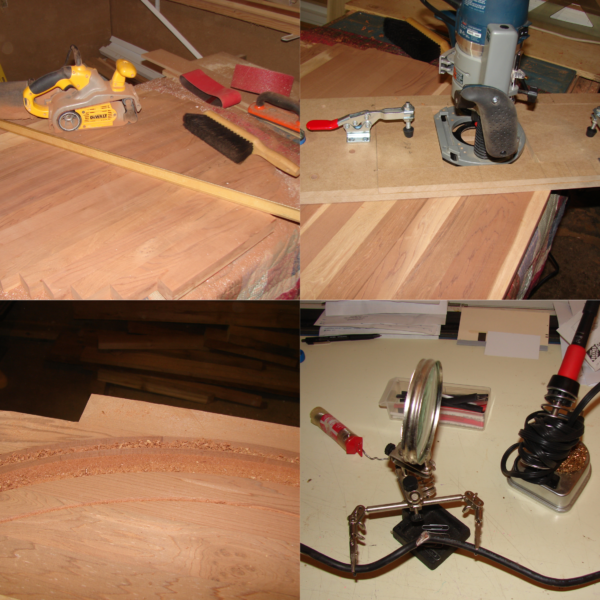
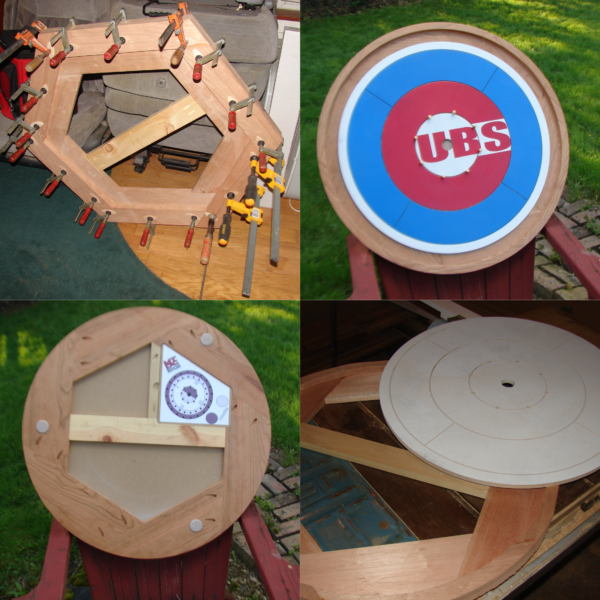
    Step 1. (not pictured) Get a job replacing some 2×4 handrails, discover that under the white paint is some beautiful redwood.

    Step 2. Recall the game that Nephilium mentioned a while back, do some design work and determine that with careful resawing you have just enough material to make two crokinole boards.

    Step 3. Select the best looking sides and layout and glue up the ~2×2’s into blanks.

    Step 4. Build a jig for your router, you could of course use a store bought circle jig, but I wanted mine to also be a template for the peg holes and to use it as a guide for the straight lines as well


    Step 5. Wish you owned a 32″ drum sander (or any drum sander) and attempt flattening the blanks with your belt and disc sanders.

    Step 6. Get to routing, spinning router and jig round and round, round and round, round and round.

    Step 7. Marvel at how well your jig is working, start round and rounding too fast and have an accident.

    Step 8. Off to the soldering iron and the shrink tubing


    Step 9. Get back to routing.

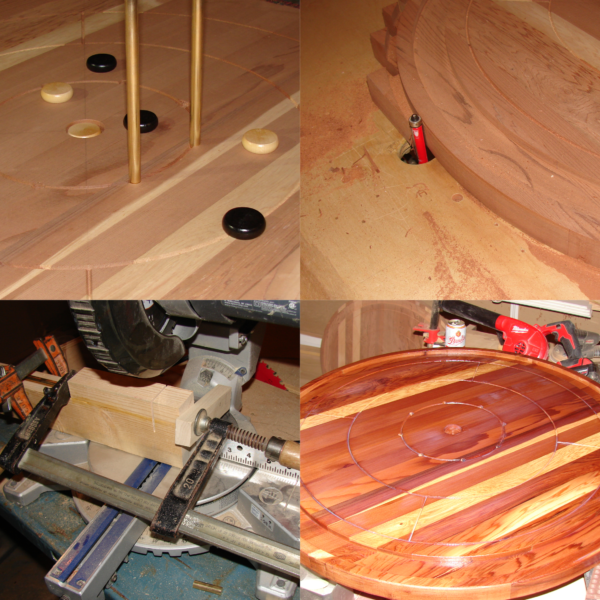
    Step 10. Drill peg holes

    Step 11. Glue sandpaper onto curved pieces of wood for some custom sanding blocks.

    Step 12. Get to sanding


    Step 13. Take time out to test drive your new game board.

    Step 14. Use a flush cutting bit to trim excess.

    Step 15. Make another jig to hold and cut brass pegs to size.

    Step 16. put on a few coats of Poly.

    Step 17. Glue in the pegs.  Et voila, Bob’s your uncle, and there you have it.


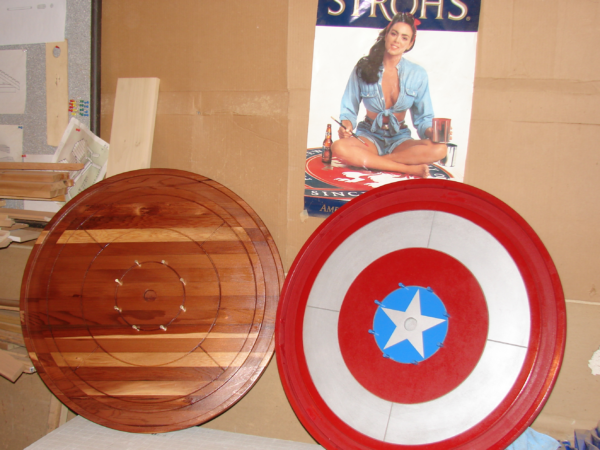
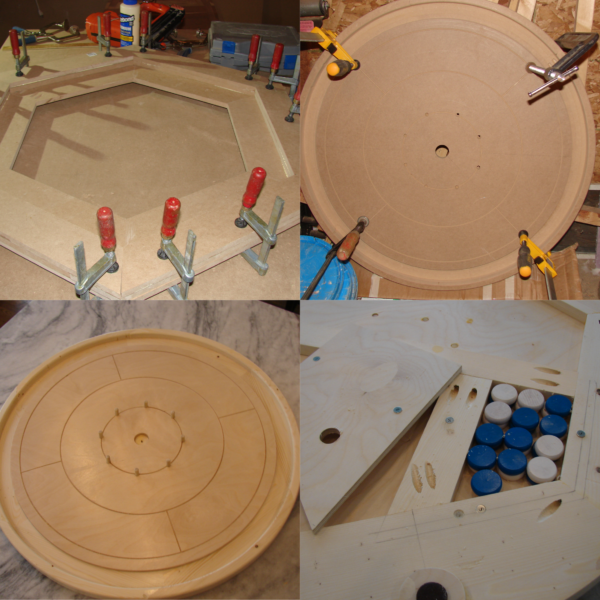
    As you can see I also built a ‘Murica!! themed board for my Jarhead bother, I made it out of MDF  built up in several rings to save material, which also allowed me to have the outermost lip higher than the playing surface which is a better design than the redwood ones, where sometimes over-shot or ricocheting biscuits will fly off the table instead of into the ditch. Since then I have built one out of standard pine 1×6’s for the frame and birch plywood for the top. I integrated storage for the biscuits on the underside.


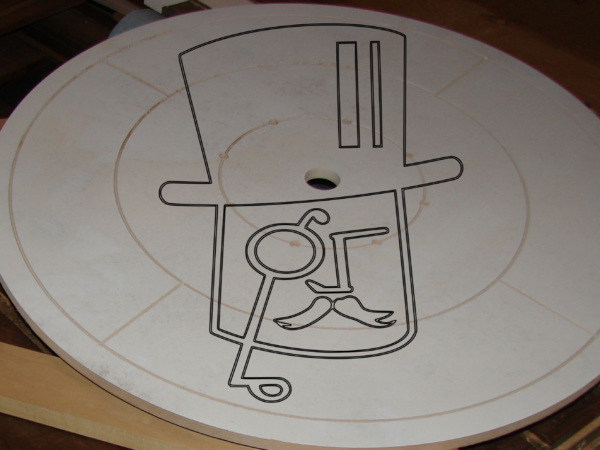
    You may want to customize your tops and due to the circular nature of the playing surface one might be tempted to use any number of the many sports team or popular product logos that are often circular as well. Don’t do that, it would violate copyrights, and IP law. But don’t let that curb your creativity, for example, I made this one for the Ubs family, with a cherry frame. I inset the storage area lid which I also made into a scoring peg board. Currently I’m working on a mahogany frame and still have a blank playing surface, I wonder what I should put on there?


    ….hmmm, maybe…


  • Gone Fishing….

    I know that many of you Glibs are fishermen or have had some experiences fishing, hopefully with your father or older brother as a teacher or guide. I remember with fondness the first time my Dad took me fishing, alone, with no older brothers along, just the two of us. An old wooden boat that leaked a bit (with a soup can to bail it out once in a while).

    Small lake in Minnesoda, no cabins on it, appropriately called Mud Lake and for a reason. We got our feet wet walking through the swamp grass to the boat, but it was a going to be a glorious day. My Dad was fishing with minnows and he probably put one on my line. At some point of not catching any fish I found a skinny angle worm crawling in the bottom of the boat. I knew that those things caught fish so I rigged a worm on my short cane pole and before long caught a HUGE sunfish/perch/bream about 5 or 6 inches long. It was the first fish I’d ever caught! I was excited and happy. I pleaded with my Dad and he let me keep it, telling me I’d have to eat it and so on.

    A while later I caught a bullhead, 7-8 inches long, and we repeated the process of keeping the fish. Now I was onto something, but no more worms in the boat but I didn’t care, I had caught fish! Not one but two! When we got back to the cabin I gave my Mom, who wasn’t a fisherperson, a blow-by-blow description of how men catch their fish. I was hooked and no pun.

    I knew that I had to make some changes if I was going to be competitive with two older and experienced brothers the following year. I started saving money, begging, running cash errands, whatever it took because I needed a rod and reel, like my Dad, if I was going to chase the big ones the next summer. By Springtime I had put together a treasure chest of about 5 dollars, enough for some decent equipment. Not a Pfleuger or a Shakespeare maybe but some quality gear anyway. One thing I knew for certain, though, it had to have a level wind, not some kid reel but a real grown up reel like my Dad’s. By this time WWII was over and products of all sorts were available.

    My Dad worked a half day on Saturdays, but agreed to stop on his way home and chose the best one he could find for my money. I gave him my life’s savings and one Saturday afternoon in May he came home with the nicest and best piece of fishing gear I’d ever seen, better than either brother’s, and the reel had a level wind. He’d thoughtfully bought a roll of 50 yards of black line, a bobber, some leaders and a small round tin with 50 assorted hooks. I was ready! I couldn’t wait ’til we went Up North to a lake cabin on vacation.


    Like all things, vacation came, Saturday morning in June we had the ’35 Chevvie packed up and headed north. We were going to an honest-to-goodness resort on a small lake with beautiful clear water. My Dad would take the brothers out early in the morning, I could cast and catch fish off the dock and he would take me later in the day and we caught fish! I caught fish! Mostly sunfish, a few bass and northerns, maybe some perch and bullheads, I don’t know but I pulled my weight. The week flew by, but I was equal to anyone and my Dad bragged equally about my fishing skills.

    As time went by I learned a lot watching and reading about fishing and hunting. We had lots of sports magazines around, reading the stories and exploits were a great winter’s pastime and summer fishing always was good times.


    Time passes and as I got older I did more and more fishing with my next older brother, but he wasn’t quite as passionate as I was. As we drifted off to explore the world the fishing opportunities sort of receded into the background. I ended up in Spain sitting at the next desk to a man that was consumed with fishing and hunting. He lived to fish and quickly made me his sidekick. We talked all day and spent many Saturdays fishing in the nicer weather and hunting ducks when the rain fell in the winter. He taught me about quality equipment, got me interested in skeet/trap shooting and brought me up to date on all the latest techniques and I was back on board, adding reloading to my repertoire.


    As life progressed and I got back to my old neighborhood I had the opportunity to be that kid again, only now with a boat and motor and lots of quality equipment. Instead of one bait casting reel I have a dozen and more, 3-4 tackle boxes with stuff I will never use, the folly of every fisherman. Now the problem is not finding the time but rather the difficulty of getting out of the recliner. 


    Yesterday was one of those life’s moments that a person wants to relive over and over. My youngest grand daughter came and wanted to go fishing. She hasn’t had much of an opportunity in doing some fun things because of school and other interference in her life but she recently graduated from college and has a little time. Anyway, we fished and talked about life, I outfitted her with some quality stuff and we caught enough fish for lunch today. She helped me clean the fish, didn’t mind the guts and smell, though her skill level needs to be upgraded some what but that will come in time.

    She wants to get the hunting /shooting class done so she can sit in a deer stand this fall. We’ll start the gun handling in a couple weeks and with enough practice and patience (on my part) she will be ready by fall. My own kids never expressed much interest in hunting so this will be enjoyable for both of us. She’s an outdoor girl and if things work out the way I hope she’ll be the owner of a Marlin 336 this fall.

    I think she will work on her oldest sister and encourage her to join us for the shooting fun. Both of them claim libertarian leanings so we’re off to a good start already.

    Oh yeah, we had venison sausage for breakfast, Grandma cooked the fish for lunch. This girl knows how to pull on a Grandpa’s heart strings and make Grandma happy by eating everything on the menu. I’m so glad that my own parents put up with my nonsense and let me spear suckers in the spring and how to run when I saw headlights on the road. These kinds of memories will be lost to the kids with their phones and games.


  • A Fist Full of Bullion

    As good glibertarians, I know none of you actually touch pocket change unless it is a gold coin minted in Galt’s Gulch.  However, I also know all good glibs have an orphan with them at all times to carry your coinage in a monogrammed satchel.  This short piece may give you tips to convey in your “Daily Instructions” to your change orphan on what coins to save and which to circulate.

    Coinage is as old as the concept of money itself. In fact, it is thousands of years older than script, and until relatively recently, the most valued script was tied to specie.  “In Specie is a Latin term describing the provision of an asset in its physical form rather than in the cash value of the asset.” (Merriam-Webster)  The most common forms of coinage since ancient times have been gold and silver with copper reserved for small denominations.  The same was true for the United States from 1793 until 1933 when FDR withdrew gold coinage and the death blow was in 1965 when LBJ effectively killed silver coinage.  Today all general circulation US coinage, except for the nickel is clad. Some “real” money is still in circulation and I have given my change orphan “Warty strict” instructions to locate it and present it to me so I can remove these coins from circulation for the bullion value.

    The US does still mint some silver and gold coins for collectors, but that coinage is not designed for general use so I will not discuss them. These gold and silver coins have nominal denominations making them legal for use- but if they enter circulation it is because of a FU in a bitter divorce or family members not knowing what the recently dead relative had saved.

    I also won’t be covering obsolete coinage, it is still legal tender*, but your orphan won’t be getting any 2 or 3 cent pieces handed to them at your local store.  So bellow for your orphan to “Bring me my change satchel most ricky-tic and then get prostrate in front of me NOW!”  Let’s examine what we may find.


    The Cent

    The cent has traditionally been made of copper and Abe Lincoln has been going strong on the obverse (front) of the cent since 1909.  Your change handling orphan will see plenty of these.  The three versions are the Wheatback (1909-1958), Memorial (1959-2008), and the Union Shield (2010-date).  There was a special 4 different design issue in 2009 for Abe’s 200th birthday.  Most cents can be just put back into circulation without a second thought.  Cents were copper from 1793 on, but since 1983 they are a minted with a very thin copper plate over a zinc (spit) core.

    However, I advise you inform your coinage orphan to save all copper cents.  The test is easy.  All cents minted in 1981 and before are copper (with exception of 1943).  Also test all 1982 cents by dropping them on something hard and listening to the sound made. A dull sound means it is zinc, a good clear ring means copper. If you can’t tell the difference- drop a cent from a copper year with any post 1982 cent-after a couple of drops, the difference will be clear.  A copper cent has a $0.018 melt value so copper cents have almost doubled intrinsic value.  (All melt values are from Jun 26, 2019)

    Wheatback cents have an even higher numismatic (coin collector) value than their intrinsic (bullion) value.  Older Memorial cents in a shiny copper state and with little wear also have a higher numismatic value.  Among the zinc (spit) cents, only the 2009 series have any numismatic value.

    Your orphan will probably not find a 1943 cent in circulation since they were steel with a shiny zinc covering.  If one is found it will be nearly black.  The War demanded required lots of copper and this was an experiment on saving copper which failed.  The coin was hated by the public because of the similarity to a dime when new and turning dark quickly.  This bad idea was ditched before the end of the year.  In 1944 and 1945 cents were partially made with melted down shell casings from training ranges in the US in order to free up “fresh” copper. It doesn’t make them more valuable, but are interesting to see.   If your orphan finds a 1943 copper or 1944 steel cent you are doing very well since these rarities are worth north of $1,000,00 for a 43 and over $100,000 for a 44.  I will be called a softie for suggesting it, but you might consider giving your change orphan an entire White Castle burger for finding such a rarity for you.

    The melt value of the current cent is 0.0067¢, but today the cent costs almost two cents to make, so make of that what you will.

    The Nickel

    TJ, the man and not the store, has been rocking the front of the nickel since 1938.  The nickel has remained a 75% Copper and 25% alloy since it was first minted in 1866.  The exception is during WWII. Then the nickel was  minted with 35% silver and 9% manganese.  More about this later.

    The modern nickel hasn’t changed much with two exceptions.  During the Lewis & Clark bicentennial years (2004-2005) each year featured two different reverses for the Corps of Discovery.  They have a slight numismatic value so you might want your orphans to hold them out for you, but then again you may not.  In 2006 the traditional Monticello reverse returned but the obverse changed to Jefferson facing the observer.  This didn’t change the value but changed the look.

    Have your orphan hang onto all 1942-1945 war nickels they encounter since their bullion value is $0.86.  They are easy to tell since they have large mint marks (P, D or S) above Monticello’s dome on the reverse.  (See picture above) War nickels also have what I would call a streaky or greasy look from their alloy. Your orphans may want to follow metal prices since the nickel may get the content changed because the bullion value hovers around the 5¢ face value.  The mint has experimented with several designs but can’t get one that meets lifespan tests while being recognized by vending machines.

    When I was a kid in the 60’s you would find an occasional “Buffalo” nickel (1913-1938) in the change.  If your orphan finds one you might want to pretend to smack them for having a counterfeit, but then smile at them since the coin is real. But odds are the date is worn off and it is only worth face value. (You would think that with 120 years of minting experience the mint would have known not to make the date the highest point on a coin, but with government employees watchya’ going to do?)


    The “Clads” or Former Silver Coinage

    From 1793 until 1965 dimes and larger denominations were minted with a 90% silver content. The debasement of coinage in 1965 stemmed from the value of the silver exceeding the face value of the coins starting in 1963.  By 1964 there were severe shortages of coinage since people were saving the coins for their bullion value and not using them.  When the same issue happened in the 1800’s Congress just made the coinage slightly lighter. The new lighter coins were the same design but with arrows by the dates. The “with arrow” coins returned to a face value slightly greater than the bullion value so they remained in circulation-problem solved.  In 1965 Congress went a new direction and just debased the hell out of coinage.  Henceforth dimes and quarters would be cupronickel and the half dollar was debased from 90% silver to 40% silver.  In 1971 the half dollar was further debased to cupronickel.

    The most important thing about the older bullion coins is that they still have an intrinsic value that far exceeds their face value.  Currently it runs about 11 times face value.  Your change orphan can tell these coins at a glance because of two key qualities: 1) they have an obvious different color of real silver vice the current cupronickel tone which should attract their eye.  (If there were any libertarian women they could instantly tell you the difference in look between silver jewelry and “silver” jewelry and be happy to explain it while beating you for trying to give them junk.); 2) silver coins have a single color side and cupronickel coinage looks like a copper sandwich.  If your orphan’s eyesight is less than optimal (why is he your change orphan then?) just note the date.  Save any dime or quarter minted 1964 or before.  Again, silver is worth 11x face value and clad is worth 5-8% face value.

    If your vending machine orphan notes a young lass running a coin through a vending machine over and it is rejected each time have them be a gentleorphan.  They should approach the lass and ask if they could be of assistance. Have the orphan examine the coin and offer to trade the lass a shiny new coin to replace the icky old silver coin that stands between them and their stale vending machine Poptart. One of the last silver quarters I found in the wild was obtained with precisely this bit of generosity.  (Yes, I told her, and yet her hunger was more important than silver to her.) That is correct, vending machines may take a credit card but do not recognize legal silver coins.


    The Dime

    While it is tempting to demand your change orphan never let you see the obverse of the FDR dime, scratch that.  I advise you to tell your change orphan to never let you see this coin.  The likeness of FDR has been polluting change drawers since 1946 without a significant change- boring.  Have them save all dated 1964 and before since they have a bullion value of $1.11, the rest should be kept away from your gaze and returned to circulation.

    “Two Bits” or the Quarter

    George Washington has had his slave owning, cis-heteronormative face on the quarter since 1932 but the reverse of this denomination has been a palette of history in 1975-1976 and since 1999. This is the most interesting coin currently minted by the US.  It is very common and you will need to give your change orphan clear instructions on which quarters to save and which to place back into circulation.  The first instruction for your change orphan I recommend is to save all minted in 1964 and before since their bullion value is $2.77. Now the instructions will become more personal.   The Washington quarter is on track to have over 100 different reverses since 1999.  On one extreme is “Fey! All coins minted since 1965 shall be immediately returned to circulation less the cruel stench of cupro-nickel befoul me.” The other extreme is, “Save and classify each quarter then lay them before me on baby seal skins so I may admire them as I snack upon a bald eagle egg omelet and quaffing champagne.”  I recommend having your orphan identify any quarters you may like and circulate the rest.

    The first change was for the Bicentennial celebration.  Special quarters, halves and dollars were struck with 1776-1976 on the obverse and a bicentennial themed reverse- the quarter had a drummer boy.  Then in 1997, over the objections of the Treasury Department, the Congress mandated the 50 State Quarters program.  Five states were featured each year, in the order of entering the Union. The program was later expanded to include the territories and DC.  Congress liked the program so much it basically repeated the program with the “America the Beautiful” featuring natural highlights (national parks etc.) starting in 2010 and running through 2021.  There are too many images to show, but here are links to the various reverse sides.

    https://en.wikipedia.org/wiki/50_State_Quarters

    https://en.wikipedia.org/wiki/District_of_Columbia_and_United_States_Territories_Quarters

    https://en.wikipedia.org/wiki/America_the_Beautiful_Quarters

    The interesting thing about the state program is that each state developed and nominated the design for “their” quarter.  The mint then tweaked the design to meet the demands of mass production.  Some states clearly put effort into it, others not so much.  (I’m looking at you Michigan, Texas, and Wyoming.) The current quarters run to lots of damn birds looking pretty much the same, but the Louisiana quarter has a very good image of a wild turkey in flight.  My only advice to my fellow glibertarians is that if a particular reverse is striking to you, go ahead and have your change orphan save your choices and keep the rest in circulation.  In addition, you may want to have your orphan quickly check to make sure no silver proofs are in your change satchel. Proofs are struck in silver on specially prepared blanks and double struck to bring out all the details. No proofs are released into general circulation, but my orphan found a proof Iowa quarter which I kept.  Evidence once again of a bitter divorce or a family not realizing what grandpa left to them in his will.


    Half Dollars

    This coin is rarely encountered in the wild. Because of that, it is one of the easiest denominations to find bullion coins when your change orphan gets one.  I really dislike the Kennedy Half Dollar because it is an unapologetic suck up to the cult of the imperial presidency.  The reverse is nothing more than the presidential seal.  The Bicentennial version at least has Independence Hall on the reverse. The 1964 mintage were HUGE because of the recent assassination and were saved by the millions.  I recommend saving them because they are 90% silver and contain $5.54 in silver.  From 1965-1970 the coins were debased to 40% silver but are worth a respectable $2.26 in bullion. From 1971-2001 the coin was struck in cupro-nickel.  Since then it is no longer minted for general circulation. If your orphan finds a recent year half is from a cut apart uncirculated set (matte finish) or a silver proof.

    The half dollar was a popular coin and in wide circulation until the 1963 coin crises.  The large quantity of silver made this denomination the first to leave general circulation.  Then millions of the new Kennedy dollars went straight into collections for several years.  With the shortages of half dollars in daily use Americans grew out of the habit of using them. The lack of coins in circulation meant vending machines stopped accepting them and the coin withered away.  But this long term lack of use is a good situation for a glibertarian.  When your minions do actual in the bank banking have them ask for a roll of half dollars.  Chances are decent your help will identify some silver coinage.  My monetary orphans have even found earlier (Ben Franklin and Walking Liberty) halves in a roll handed over by unsuspecting bank tellers as recently as three months ago. If there is nothing but Kennedy Halves in the roll, enjoy watching clerks look at your orphan with WTF? faces when they use these coins to purchase goods and services.


    Dollars or “cartwheels”

    The true “silver dollar” of lore was last minted for general circulation in 1935 (melt value $11.84) and will not be found in your change from the “Mexican Pot and Ass Sex Shop”.  Your orphan might approach you with an Eisenhower Dollar (1971-1978).  This coin features the patch from the Apollo 11 mission on the reverse (except for the Bicentennial version).  Make a quick check for of the side to see if it is a 40% silver collector version and smile benevolently since your orphan found a $4.84 bullion coin; if it is a copper sandwich, curse them mightily for wasting your time.

    If your change orphan has been hanging around Post Offices, NY, SF or DC subways and other suspicious locations, get them deloused and their rags promptly replaced before checking the change satchel.  Inside you may find the modern small dollar coins. There is actually a law mandating that PO’s and transportation systems accepting Federal dollars must have vending machines able to accept and disburse dollar coins. Among the usual coins there might be some coins that look like a slightly oversized quarter with an angry woman on the front and dated from 1979-1981 and 1999.  These are the Susan B. Anthony dollars. The “Susie” is one of the stupidest outpourings from the government.  The vending machine and casino industries desperately wanted a dollar coin that was better sized for their customers and the government responded by making 1,500,000,000 or so coins that were almost exactly the same size and color of the quarter.  Casinos, merchants and the public were not amused and the coin was rarely seen.  Even today store clerks curse me when my change orphan offers Susies in exchange for a good or service.

    Congress told the Treasury Department to try again with a “gold colored” coin and in 2000 the Sacajawea Dollar was released.  Unfortunately, it is a clad coin of little intrinsic value. Fortunately, the mint designed well and this coin is quite striking.  It is easy to use and tell from smaller coinage, with smart designs on both sides of somebody besides a president.  In the 18 years since the Susie was thrust upon the American people the vending machine and casino industries developed other solutions to the shortage of dollar coins so the new dollar coin never became popular.  Since this was an attractive coin, Congress mucked around again and decided to change the reverse each year starting in 2009. Now this dollar is the most PC coin the nation produces. Each year a new Native American theme is on the reverse.  While none of the designs will make your orphan gag from ugliness (yet), they aren’t as striking as the original eagle in flight. (2019 features “Native Americans and the space program”)  But the law since 2007 requires that 1/5th of dollars produced each year must be in coins- so these dollars are stacking up in vaults by the many tens of millions annually since demand does not meet supply.

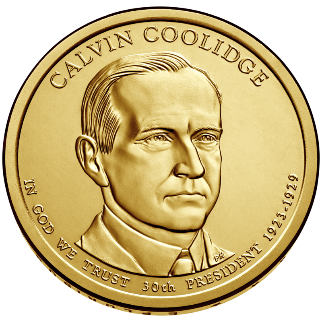
    The final coins that might emerge from the satchel are the Presidential Dollar coins. Why were these coins made? Because if a striking coin like the Sacajawea dollar isn’t being widely used it must be time to double down.**  In 2007 the new coins were released with four presidents a year until they caught up with the last dead president.  The reverse features the Statue of Liberty. The new coins caught fire like a water balloon and by 2011 there were 1, 400,000,000+ uncirculated coins stockpiled. So Washington (1) to Garfield (20) were released for circulation.  From Chester Arthur on the mint struck only smaller numbers (still around 10,000,000 each) for collectors.  These later coins are legal tender and occasionally found in general circulation as well.  Reagan was the last president on a coin. To satisfy my Glib heart, Jimmy Carter was never on a coin because of the requirement that the ex-president be actually dead. My orphan has found an occasional proof version of a presidential dollar and brought it to my attention.  They are worth about $2 each. So go ahead and circulate them freely since your tax dollars purchased hundreds of million extra.

    The GAO has published a report that if the Bureau of Engraving stopped making $1 bills and the country switched to dollar coins it estimates a savings of at least $5.5B over thirty years. With the billions of coins sitting in vaults and already produced I think that estimate is probably low. The vending industry is now fighting retiring the dollar bill because it invested heavily in adding bill readers to vending machines.

    That’s About It

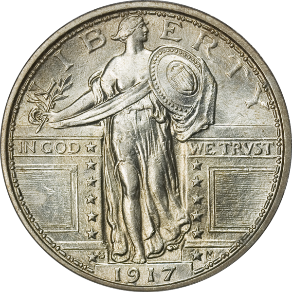
    One other place that I have found silver coins for face value or less have been estate sales.  Families often don’t know what grandpa was saving so coins appear in a variety of ways.  I once picked up eleven Standing Liberty quarters for five cents each because they were in a bowl as “movie prop money.”  The selling agent clearly did not know what she had in the estate.  Another time my ex came home from an estate sale with a few minor purchases.  A few days later I needed some change and found two silver quarters that she just got as change at the sale. Of course it was too late for me to go back and get more real quarters in change.

    The story of America’s money changing from representing Liberty as an ideal to a collection of small scale tokens of presidential worship is an interesting one and perhaps the subject of another article in the future.  Now please excuse me while I go swim in my collection of gold coins.

    Oh yeah.  Here are a couple of websites to help you determine the melt value of your American coinage.

    https://www.ngccoin.com/price-guide/coin-melt-values.aspx

    or

    http://www.coinflation.com/coins/basemetal_coin_calculator.html

    ———————————————————————————————-

    *The Trade Dollar (1873-1885) was a dollar minted for overseas use, primarily in China.  It was demonetized by Congress in 1876 to prevent their use in the US.  Congress re-monetized the Trade Dollar in 1965 when it was too late to matter.


    ** Not really.  The dollar and quarters programs rely upon seniorage to “make” money for the Treasury.  Quarters cost around 4 cents to make, but the Treasury sells them to the bank for 25 cents. That means the Treasury has a reserve of 21 cents per coin which in theory reduces the amount of funding required from Congress.  Collectors also create seniorage by removing coins from circulation and then they are not turned in as damaged for replacement.  During the quarters program alone collectors have created an estimated $6B in seniorage.

  • Whycome We Explode Things to Celebrate?

    “Some Swiss Servo guy is holed up in there.”

    I used to love fireworks. As a kid, that was the best part of Independence Day. Fireworks shows, shooting off bottle rockets and Roman candles…. ah.

    Then a year in NE Afghanistan went by. Came home and went to a Class A baseball game near my town, that featured a fireworks show afterward. First shot started a bit of a panicked reaction from me. (No, really Chipwooder, it did!) It was the sound, not the flash or such. I excused myself, and figured I would wait it out in the restroom. WRONG. Being a Single A park, it was cinderblock and sheetmetal…it actually amplified everything. Before I could really freak out, I got back to tell my wife, that I kind of needed to leave. As we walked back to the car, the show ended. Haven’t been a big fan since. Going to Iraq for the second half of TEH SURGE didn’t help any adjusting, I am guessing.

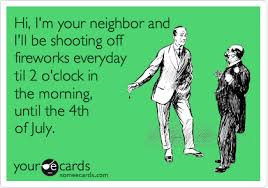
    Later, being a bit discomfited by my fireworks enthusiast neighbors, I wondered….why of all days, is this the one people blow stuff up to celebrate? [NOTE: by the time this started happening, I had started to transmogrify into a libertarian. No police were called, no complaints to the City, no going out and yelling at them….especially since their kids seemed to love it.]. I mean, there is some history of noisemaking on New Year’s Eve…firing off guns seems to be a tradition in many places. [When I was a prosecutor, I spent 8 months running a branch court location in a city with…a sizable Messican, um, transient population. New Year’s Eve 1998, we had 286 calls of shots fired. The next year, the cops got smart – they had a Spanish speaking officer in each car, and they would simply go the area and have the cop tell everyone…”Happy New Year. By the way. No shooting here, please. People think it is a gang war. Thank you and good night.”] But nothing on the scale of July 4.

    As with most problems in the entire world IT STARTED WITH A DEAD WHITE MALE!!!!!!!!!!!!!!!!!!!!!!!!!!!!!!

    (Missing by only two days, due to the difference in the vote of Congress and the Declaration being dated)….John Adams explained to his wife

    “The second day of July, 1776, will be the most memorable epoch in the history of America. I am apt to believe that it will be celebrated by succeeding generations as the great anniversary festival. It ought to be commemorated as the day of deliverance, by solemn acts of devotion to God Almighty. It ought to be solemnized with pomp and parade, with shows, games, sports, guns, bells, bonfires, and illuminations, from one end of this continent to the other, from this time forward forever more.”

    OK, so I see where this started.

    And as any libertarian could tell you – what started as a sort of spontaneous celebration was slowly co-opted and somewhat smothered by the gubermint. Eventually fixed as a holiday, then an unpaid Federal Holiday…then, of course, a paid Federal Holiday. The guns, bonfires and bells got shushed or extinguished. But the fireworks remained. Until the nanny-statists started getting them banned, or taken over by the G. Some cooperation with sponsors and such has kept many a civic fireworks show going (“Macy’s Fourth of July Fireworks, as seen on NBC! Chicago Navy Pier Fireworks show, brought to you by Miller Lite”). In many liberty oriented states, fireworks are legal (Hi, Indiana!) and often brought by the carload into more nanny-scold states (Illinois) and blasted away with a complete disregard for rules, laws and finger-wagging. While I may not care for it, I say “good!” At least one little bit of defiance of the Panopticon State.

    Go shoot off a Roman Candle and pack of bottle rockets for me, will you? I’ll be in the basement with the dog and some imperial stout or whisky (or both).

    May or may not be Brett L
  • Decorate That Cake!

    I started baking as part of my half-assed, slow-motion, car crash of a mid-life crisis.  I needed a creative outlet. My first decorating attempt was truly pathetic.

    Peppermint Cake by Tulip


    It was a peppermint cake and I wanted to make it look like a peppermint candy.  I failed. I lacked technical skill (and proper tools) in decorating.  So, I regrouped and focused on making the cakes impressive on the inside by figuring out how to make checkerboard cakes.

    But, I really wanted them to be pretty on the outside as well.

    I decided to focus on what I was capable of doing.  I bought basic tools, an offset spatula and basic tips and a pastry bag.  With just these tools, you can make impressive cakes if you think carefully about what you are doing.

    offset spatula


    Before we get to decorating, I do want to tell you about ermine – or boiled– frosting.  This is the best frosting I have ever tasted.  It is fluffy, light, and just sweet enough.  It’s made by combining 5 T flour, 1 cup sugar and 1 cup milk (you can use coconut milk or almond milk to make it vegan) in a saucepan and cook, stirring constantly, until it has the texture of mashed potatoes.  Let that cool, then beat it a little at a time into 1 cup of butter (or margarine) with a pinch of salt and vanilla or other flavoring.


    It will seem to curdle, keep going, and it will turn into something with the texture of whipped cream.   Now, we’re ready to talk about decorating.


    First, you can make a swirled frosting, then sprinkle stuff on top.  I made a coconut lime cake with lime curd between the layers.  I used coconut  milk to make the ermine frosting and balance the fresh lime curd between the layers.  I used the offset spatula to make it swirly.  It really takes no skill at all – just smear it on the cake.   Then I sprinkled dried coconut on top along with a few lime slices.  I think this is a pretty and inviting cake.


    I’ve also made an almond cake with raspberry between the layers.  I decorated this one with sliced almonds and fruit.  I toasted the slivered almonds and used them to make ‘flowers’ with a berry in the center. Just stick them into the frosting in a circular pattern – it’s hard to mess up.  I smoothed out the sides, and I’ll explain how I got it smooth in a moment, but you don’t have to do that.  You could leave it swirled.  I pressed toasted almonds around the bottom of the cake as well.  Again, I think this is a pretty and inviting cake.


    You can make a very cute or a very elegant cake just by making blobs of frosting.  When I do this, I leave the sides unfrosted.  This is for two reasons: I like the look, and I use butter cream and the blobs are thick.  That is a lot of butter cream on the top of the cake and I don’t want the sweetness of the butter cream to overwhelm the cake.  I made this cake (along with StraffinRun who never posted pics – glares) back in  October.  I just made blobs using different tips and colors and then added candy eyes.


    The simplicity of the idea inspired me.  I thought instead of cute, this could be used for an elegant cake.  And, you don’t actually need tips to make the elegant version.  It can be done with just a Ziploc bag.  Put the frosting into the Ziploc, cut off part of one corner and go to town. I made a lemon cake and put cherry jam between the layers.  I just made blobs and then sprinkled a little colored sugar over it.  I think it looks elegant.


    Lastly, drip cakes are very popular and hip these days and they are easy.  I made a peanut butter cake and put chopped peanuts between the layers


    For a drip cake, you want the frosting smooth on the top and sides.  I made a peanut butter butter cream, and smoothed it over the cake.


    You make it smooth by putting frosting on the outside of the cake.  It doesn’t need to smooth at that point, but you’re not trying to make a swirled cake. Then, put the offset spatula under hot running water.  Use it to smooth the sides by running it around the outside.  It takes repeated efforts, under the hot water, smooth, repeat until you are happy with it.  Once it is smooth, stick it in the refrigerator to chill.  A drip works best over a cold, frosted cake.

    Next make the ganache for the drip.  I made chocolate ganache which is equal weights of chocolate and cream.  Do weight it, it makes a difference.  Chop up the chocolate then pour hot cream (heated in the microwave) over it and stir.  Add a little corn syrup (1 tablespoon or less) to make it shiny.


    Pour a little ganache on top, then smooth it toward the edge of the cake.  When you reach the edge, give it a little push to make it drip over the side.  It’s that easy.  You can add more decorations, like chopped Reese’s peanut butter cups or other candies if you like.


    I’m enjoying learning to decorate cakes.  It gives me a creative outlet and has pushed me to think about how to get an effect within my skill level.  I hope you enjoyed seeing these easy methods and take inspiration for your own cakes.


  • What Are We Reading – June 2019

    jesse.in.mb

    Gregory Maguire – Hiddensee: A Tale of the Once and Future Nutcracker. I’m honestly not sure how I feel about this book. Everything about it feels like it doesn’t resolve, but maybe it’s just a good reflection of life and the small role we play in it.

    Currently working on Arundhati Roy’s The Ministry of Utmost Happiness, I’m not sure why I like post-Colonial/Indian diaspora literature as much as I do. I distinctly remember reading Roy’s first novel The God of Small Things years ago but couldn’t tell you the plot now. TMoUH reminds me a bit of Rushdie’s Midnight’s Children with long ambling digressions and personal stories inextricably tied to the historical moment of independence and the partitioning of India and Pakistan. Like MC, I am constantly flipping between getting lost in the daily moments of the characters and just wanting her to get to the fucking point.


    OMWC

    I have the Alpha and Omega of essay collections. Let’s start with Alpha, and it encompasses the startling fact that, once upon a time, Fran Lebowitz was actually funny. Yes, amazing. While unpacking boxes of books to be shelved in our new home, I ran across my copy of Social Studies, which was a birthday present given to me when I was in grad school (and admittedly had a bit of a crush on her). This was before she had her long period of writer’s blockade, and morphed into a shrieking harpy resembling Linda Hunt on a bad day. These essays are actually funny, self-deprecating, and showing some insight into the culture of the time. Nothing profound, mind you, but fun and amusing, reminiscent of a similar oeuvre of Robert Benchley forty years previous to this. If you see a remaindered or used copy, grab it.

    The omega is my later-in-life idol, Jorge Luis Borges, who could do it all- novels, short stories, poems, and essays. A brilliant and profound talent, with an imagination that only comes once every few centuries. Being the dullard I am, I have been enjoying another book dug up in our move, Selected Nonfictions, which covers language, history, culture, literature, politics, art… well, everything, really. And in this collection is my single favorite Borges essay, “The Art of Verbal Abuse.” I bet you were thinking I’d pick, “I, a Jew,” you fucking anti-semite. But every essay in here is a gem, immaculately translated, and bursting with insight and beauty.,Don’t wait for a sale or remainder, just buy this. Now.


    mexicansharpshooter

    I read this.  I read it for ALL OF YOU.  That’s it.


    JW

    Staff: We asked JW to tell us about what he was reading, but we found him curled up, sobbing in a blanket fort with a flashlight and a dog-eared copy of Old Yeller and figured he’d get to it later.

    SugarFree

    I have continued my Lovecraft Mythos kick, reading both early Mythos contributors, especially those writing while Lovecraft was still alive: Robert E. Howard, Robert Bloch, Edward Belknap Long, Clark Ashton Smith, August Derleth, Henry Kuttner; and Lovecraft’s self-identified influences, collected in H. P. Lovecraft’s Favorite Weird Tales: The Roots of Modern Horror, edited by Douglas A. Anderson. While familiar faces appear–Poe, Machen, Bierce–I enjoyed reading the more obscure authors like M. L. Humphreys, whose story in the collection, “The Floor Above” (1923), is the only story he or she ever published and oft-anthologized “The Night Wire” (1926) by H. F. Arnold, another lost author. (His or her only other two short stories have never been republished since they originally appeared in pulps.)


    Swiss Servator

    Beer list, wine list, spirits list, contract for work, contract for work, contract for work, continuing legal education, continuing legal education…wait here it is!

    Luther’s Small Catechism

    So the United Methodist district I live in is shriveling under the sweaty hand of the bishop who is ever so slightly to the left of Chairman Mao. She has packed the district with mini-mes. And this coterie of pudgy, earnest leftwing, 50-60 somethings are too engaged in various protests and public temper tantrums to conduct much of a church. So I went Protestant shopping. Just across the bean field from my house sits a Lutheran church. So I wandered over, went to a traditional service. Met the pastor later on and he gave me a copy of said book. I got homework. Man, these people are serious. But, I guess it is good to do some due diligence, so I am about 20-25% through right now. I get a bit wary of the “with Explanation” part, but that is just the libertarian in me, I guess.

    As I am in the Commandments, and the basics still, I can’t say much about the more advanced points. Also, I have not been ordered to burn OMWC’s house yet. So I have that going for me.

  • IFLA: The “Maybe it’s a Puppy?” Edition of the Horoscope for the Week of June 16


    This week has an interesting couple of intersecting alignments:  We’ve got Jupiter (retrograde)-Luna-Terra-Sol indicating change/chaos/disruption at home” with Saturn(retrograde)-Terra-Mercury “News of a new beginning.”  So basically, home life made all higgledy-piggiedy as the result of a new addition to the family dynamic.  This can be an excellent status check, because if you have a birth, new pet, or your SO gets a new FWB, you can  rejoice in the fact that you are important enough for the stars to foretell the events that happen under your roof.  For other celestial advice, expect slander and scurrilous accusations (Mercury and Mars in Cancer) and well, let’s say careful phrasing and selective chronicling of events may prove useful to your love life (Venus and the Sun in Gemini).  The moon in Virgo also encourages subtlety, euphemism, and oblique suggestions.

    The cards this week has a certain indication of something going wrong in a very unfair way.  There is another pronounced but odd sign that… well, the best I can translate it is “violence at an orgy?”  It’s not  typical “you’re going to get rolled by a whore” notification, there’s a much more ritualistic aspect to the whole thing.  Is someone going to attend a Gnostic mass maybe?  An O.T.O. initiation?  And will they be too embarrassed to tell us about it?  There is an overarching aspect of formality and protocol to the week.

    Gemini:  10 of Swords – Pain, affliction, tears, sadness, desolation

    Cancer:  2 of Swords reversed – imposture, falsehood, duplicity, disloyalty, misplaced vengeance

    Leo:  10 of Wands reversed – Contrariness, intrigues, difficulties from excessive abundance

    Virgo:  The Hierophant – Alliance through marriage, servitude, mercy, goodness, inspiration

    Libra:  7 of Wands – Valor, success, discussion, trade war, spycraft

    Scorpio:  Justice reversed – Bigotry, bias, excessive severity, malicious compliance

    Sagittarius:  6 of Coins – Gifts, gratification, attention

    Capricorn:  The High Priestess reversed – Passion, moral or physical ardor, shallow knowledge, conceit

    Aquarius:  6 of Cups – The past, pleasant memories, ephemeral enjoyment

    Pisces:  Judgment reversed –  Weakness, simplicity, deliberation, pusillanimity, sentence

    Aries:  Queen of Wands – Friendly dark woman, honorable, well disposed towards a fat man.

    Taurus:  Knight of Coins reversed – Inertia, idleness, discouragement, carelessness