Category: Politics

  • Chapter 19: Working Behind the Scenes

    Executive Order 13139, which implements 10 U.S.C. § 1107, clearly states that the requirements it incorporated from the statute are for internal management only and confer no right enforceable by any party against the United States. E.O. 13139, §6(b).  Additionally, Secretary of the Navy Instruction 6230.4 of 29 April 1998, which implements the Department’s anthrax vaccination implementation program states that the anthrax vaccine is a FDA-licensed product and not an IND requiring informed consent for its administration.[1]

    “Someone from the editorial board will be down to get you and bring you up to the Boardroom in a minute,” the secretary smiled politely and then went back to answering the telephone, no longer concerned with my presence. I looked around the foyer of the Army Times Publishing Company.  It was a large, open-air affair. Just past the circular receptionist’s desk there was a staircase leading to the upper floors. Beyond that the ceiling opened up all the way to the top of the building and I could see people moving on the upper catwalks, worker-bees in the hive. Off to my left was a hallway that disappeared out of view, with an elevator at the beginning where it opened into the foyer.  To the right looked like a glass-enclosed company store with the usual assortment of sweatshirts, tee-shirts, and coffee mugs with the company logo on them. Army Times published a newspaper dedicated to each service, with the imprint Marine Corps Times, Navy Times, etc. The papers were widely read and respected in each service. I didn’t know how it had happened, but my friends had gotten us a meeting with the Editorial Board of the parent company.

    The door behind me came open and I could feel the cold December air blow in. I played with the zipper on my flight jacket, trying not to fidget. A Marine officer in uniform should not appear nervous. An older gentleman walking by with a long-sleeve tee-shirt with the company logo smiled at me.

    “How are you today, Captain?” He was looking at the leather patch with the wings on it on the front of my jacket.

    “Fine, sir. Thank you.” I flipped my fore and aft cap around in my hand and then looked at my watch. I was forty-five minutes late but the receptionist told me when I asked that the meeting had gotten a late start. I hoped my part hadn’t come up yet. I started thinking that maybe I should have brought my briefcase in with me. Right then a young black woman appeared from the stairs and looked at me for confirmation.

    “Captain Saran?” I nodded. “Come with me, please.”

    “Thank you,” I responded and followed her up the stairs. As we turned for the second flight I saw a familiar face. Colonel John Richardson, United States Air Force Reserve, was coming down the stairs in a light blue power-suit. He smiled and stuck out his hand.

    “Great to see you, Dale, traffic was terrible, huh?” We shook hands as he reached my step.

    “Meh, just sick as a dog. I would have stayed home had my boss not made me go in this morning.” I tried not to whine but I felt like crap. My wife and four girls were all sick at home with some kind of stomach virus that had everyone throwing up, including me. I had gotten back from the hospital with my wife the night before at 2:00 am and I still felt weak and achy.

    “Well, go on up,” he said. “Lou is on right now, then Russ, then you. Are you sure you’re still okay doing this? You know you don’t have to?”

    “No, JR, I’m fine. I just don’t care anymore. Lou and I talked about my status and the relevant instructions. This is a freely made decision. Sometimes a man’s gotta stand up and be counted.” Though he was quite senior to me, I had come to know and think of him by his nickname from our many e-mail chats.

    “Okay,” he nodded reassuringly. “I’ll be up in a minute.” JR turned and continued down the stairs.

    “Great,” I answered with more enthusiasm then my body had in it.

    It wasn’t bravado, nor some inflated sense of honor; I felt comfortable talking to John Richardson about such matters as personal honor and integrity. All of the members of our small band had incurred significant professional risks and opprobrium already in order to bring the flaws and illegality of the anthrax program to light. I couldn’t very well be a part of their group and not be willing to stick out my neck. They had all done a lot more.

    My guide and I reached the top of the stairs, turned left, and I could see a set of large oak wooden doors. As we got closer, I could see a little placard that read “Main Boardroom.”

    “Here you are,” the young lady said and turned away as I reached for the door. I could hear voices. I wanted to make as unobtrusive an entrance as possible so I turned the doorknob slowly and tried to slip in.

    I took in the room with a glance. There were two groups of people – ours and theirs. About seven or eight reporters and editors on the far side of a long meeting table, none of whom I knew or recognized. Everyone had a placard identifying them, but I didn’t have time to read each one. Behind “them” was a bright light with an umbrella behind it and a photographer taking pictures. On “our” side of the table there were five men, three I knew, two I guessed at their identities by our email correspondence. ‘Lou’ Michels – actually J.J. Michels, Lieutenant Colonel, USAFR, attorney-at-law, as well as partner at McGuire, Battle, and Woods, whom I had met at David Ponder’s Congressional testimony – was speaking intently.

    “Hey, Dale! Come on in,” he waved me in without breaking stride. “Hey, Lou” I replied and started to take off my coat, heading for the seat on his left, farthest from the door.  “So again,” he went on, “the informed consent issue is completely separate from the issue about whether or not the vaccine is safe and effective.” As I reached the seat beside him and slid into it, I could feel people on the other side of the table watching me. The photographer started snapping pictures of me.

    I am not impressive in uniform, but I had a few “been there” ribbons from when the squadron I was with rescued Air Force Captain Scott O’Grady from inside Bosnia-Herzegovinia in 1995. Atop the few ribbons I had was a set of gold Naval Aviator’s wings. I could tell the reporters on the other side of the table were curious about where I fit into all of this. Not wanting to appear self-conscious, I swiveled my chair to face Lou as he spoke. I could hear the shutter of the camera clicking. I could only imagine what my boss was going to think if a color photo of me showed up in the next issue of Marine Corps Times. I began to wonder if I should have agreed to do this after all. I was just snapping into my new job as a prosecutor and here I was (still) playing defense attorney – to the media, no less, against the entire U.S. military.

    I listened attentively, even though I had heard Lou make this argument before Congress and I had made a more detailed version of the same one to a judge on several occasions myself. Lou Michels is a seasoned attorney at a prestigious law firm and a former active duty Air Force officer. He is articulate and confident when he speaks, particularly on the legality of the anthrax vaccine. Although I was a Captain and he was a Lieutenant Colonel in the Reserves, I had come to think of Lou, and all the members of our group as a kind of Robin Hood and His Merry Men-like affair. There was JR who was the most senior of all, a full bird Colonel; Tom “Buzz” Rempfer, a Major, Air Force Academy graduate, F-16 and A-10 pilot; Russ Dingle, also a Major and A-10 pilot, and Redmond Handy, another Colonel. Despite the fact that I was by far the junior member of the group, it all felt quite easy and natural. I was conscious of my place in the hierarchy, but certainly not anything like a chain-of-command. Perhaps it was because more than a few of us were former pilots and pilots have a long history of being somewhat less conscious of rank and more conscious of ability, a byproduct of the nature of aviation.

    “It’s like Rogaine,” Lou continued on, “which has some particular relevance to my own situation,” he added parenthetically, looking upward with his eyes toward his own hairline. I noticed for the first time that he had a small patch of thinning hair on the back of his head. “It was originally licensed by the Food and Drug Administration as a blood pressure medication. Now, during some of the trials they determined that it would grow hair on a billiard ball. Notwithstanding the fact that it was already licensed, they had to go back and get a change in the license because of the change in the purpose for which it was going to be used.” He paused for that to sink in. He looked around the table at each of the editors and reporters, the shutter of the camera clicked away. “That’s the law for getting medications legally approved. It is even more imperative when it involves biologics like vaccines.”

    Lou went on for a while longer, hitting the high points of his brief and then excusing himself. I knew he had another meeting to attend at his law firm. We had talked on the phone the day before and everyone knew what their role was in this presentation.

    Russ Dingle, Major, USAFR, went next. He gave a presentation of how the vaccine was, by the definition in the FDA regulations, an “adulterated product” and thus should not be allowed to be shipped in interstate commerce. I had not heard his presentation and I had not met Russ before, except to exchange a few emails over the previous nine months. His knowledge of the company that makes the anthrax vaccine, BioPort, Inc., was unmatched. The reporters asked questions and Russ always had an answer and could cite to the document from which he got it. I was known among my colleagues for being able to pull legal case cites out of my ass on demand, but Russ made me envious.

    I had read all of the FDA inspection reports, but he obviously had access to information that I had never even guessed at. John Richardson had told me that he and Russ had been going through twenty-six boxes of information that they had gotten access to from the House Committee on Government Reform. Russ appeared to have memorized all twenty-six boxes. When he started describing how BioPort’s predecessor in interest, Michigan Biologic Products Institute had added two fermenters to its production line without FDA approval, then added two more and removed the original fermenter from the production line, I felt like my defense of David Ponder and Jason Stonewall had been inadequate.

    As I listened to Russ detail the failed inspections – the dripping paint into production vats, contaminated product lots containing other medicines like penicillin in them, and a list of other egregious quality control violations – the anger and frustration of nine months of defending David ponder and Jason Stonewall welled-up in me. Even worse, the Navy-Marine Corps Court of Criminal Appeals had denied our writ-appeal of the judge’s ruling on our motions. I had until today to submit an appeal of the NMCCA decision to the highest military appellate court, the Court of Appeals for the Armed Forces, one step below the Supreme Court of the United States. My turn was approaching, so I tried to focus and make sure I maintained the momentum in our joint presentation. I  also knew I had to control my mouth; the Judge Advocate General (JAG) Instruction that controls the conduct of Navy and Marine Corps attorneys had strict limits on what attorneys could say to the press and I still technically had pending cases on this issue.

    As a practical matter, most Judge Advocates (myself included) avoided the press completely and referred any questions to the Public Affairs Office (PAO). I was cognizant of the Code of Professional Responsibility for lawyers that also prohibits using the press to influence the outcome of a court. I had just moved to Quantico, Virginia, and, due to my daughter’s health problems, I was now working as a prosecutor in the Office of the Staff Judge Advocate, Marine Corps Base Quantico, Virginia. I didn’t think my new boss, a long-time Colonel, would be particularly enthused to see my name popping up in the Marine Corps Times bashing the government’s anthrax program.

    An Air Force doctor, Captain John Buck in Biloxi, Mississippi, had requested me to be his Individual Military Counsel (IMC) and that request had been denied by my bosses – they had good legal reasons, but in my heart I had hoped that they would carve an exception and let me do it. It dawned on me that perhaps I had become too personally involved with the anthrax issue and that it might be affecting my judgment as a lawyer, but I had been over that ground both in my own mind and with my clients many times.

    “And that’s the vaccine that the Department of Defense is making your service members take, under threat of imprisonment,” I heard Buzz saying. He and Russ had been thrown out of their Connecticut Guard unit over the Anthrax Vaccine Immunization Program (AVIP). Tom looked nothing like what I had imagined. He was young, lean, and a poster-boy for an Air Force pilot. I had pictured him much older from my conversations on e-mail with him.

    “And now,” he went on, “Captain Dale Saran, U.S. Marine Corps, will brief you on some of the current anthrax cases and their status. Dale,” Tom turned to me and winked.

    “Thanks, Buzz,” I answered and turned to my section in the briefing book that John Richardson and some of the others had put together the previous few days. I looked up at the reporters across from me. I tried to ignore the photographer snapping pictures. I could handle my portion of the brief any number of ways. Cool, dispassionate, the quintessential picture of a lawyer. A bit of an act for me, as I am a much more direct and blunt naturally, but I was trying to gauge my audience. What would be most convincing to a group of reporters? I could be more intense, somewhat exasperated at the situation my clients find themselves in. I decided against that – the last thing I wanted to do was come across as histrionic. I had thought a lot about this moment and had never been able to arrive at a decision. I decided to just start speaking and see where it took me.

    I cannot remember exactly what I said, but at one point I recall answering some questions about the status of our appeal.

    “This is nothing new,” I blurted out. There was silence from the other side of the table. “I invite any of you to look at the history behind the current version of Title Ten, section eleven-oh-seven.” And then I launched into my argument. I could feel myself heating-up as I recounted the use of the investigational and experimental drugs on troops prior to and during the Gulf War. I explained how the Food and Drug Administration had struck a deal with the Department of Defense to grant a waiver to allow these drugs to be used on service members without telling them what was being used on them. I recounted the withdrawal of this waiver and the reports of Gulf War Illness. I spoke forcefully, passionately, without consideration for what the ramifications might be to me. I spoke The Truth as I had come to know it in the past year defending my clients.

    I took a breath and looked around. Tom Rempfer and my cohorts were looking at me, waiting for more. I gathered myself, the calm after the storm.

    “That is exactly why this statute was passed, to prevent these types of things from happening again, to prevent another Gulf War-type Illness.” There were some questions. I answered and eventually Tom or someone else picked up a thread and my turn was done. I had so much more I wanted to say. I wanted them to know The Truth, The Whole Truth, as I had come to know it down to the marrow in my bones.

    I looked at my watch. Shit! I thought. I still had to get to CAAF in downtown D.C. and turn in Petty Officer Ponder’s writ-appeal of the NMCCA decision rejecting our request for extraordinary relief. I had to go.

    I listened for a while and slipped out at an appropriate time, saying my goodbyes by touching each man’s shoulder briefly as I passed on the way out. I was proud to have been invited to be a part of their panel.

    Outside the snow was beginning to fall more heavily. I started our family minivan and quickly got into the flow of traffic inbound on I-395 for the District. I had a writ-appeal to finish typing on my laptop and I didn’t have much time to get it into the Court.  With the NMCCA decision, the stay on our court-martial had been lifted. Although David Ponder had come home to Mississippi and his wife and son, Jason Stonewall and Vitolino Arroyo were still in Okinawa, six months after their unit had left and returned to Camp Lejeune, North Carolina, and all three were facing the brig unless I got a higher court to listen to me and overturn the lower appellate court. I looked at my watch again.  Suddenly that stay – and the nail in Kolomjec’s door on Okinawa – seemed a very hollow victory.

    [1] Ponder v. Stone, 56 M.J. 613 (NMCCA, 2000)

  • On the Composition of the US Military and Being a World Power

    In the comments on Pie’s article about the Internet (Thursday, 5 Dec Noon Post), I saw some comments in a subthread about the size and composition of the military that sparked some thoughts I decided to share because I find it a fascinating discussion topic for libertarians. I hope it hasn’t already been covered before, but even if it does, I hope I can offer something new on the subject for the Glibertariat.

    I first must ‘confess’ that I subscribe to agreeing (generally) with George Nash’s configuration of where libertarians fall in the political taxonomy in his seminal work “The Conservative Intellectual Movement in America since 1945.” First published in 1976 as a graduate thesis, it’s been reprinted and I’ve read a more recent, updated edition. Some of you may disagree and that’s fair enough, but in any serious consideration of the size and scope of the military, undergirding has to be some coherent theory of valid political action of the government in the area of foreign affairs, trade, and immigration, all of which impact what specie of military you think is valid to have. As a concrete example, do you think the US military should protect US commercial shipping the world over? The Founding Fathers themselves certainly did, and since I consider myself a ‘constitutional libertarian,’ I note that even President ‘Mr. Yeoman Farmer’ Jefferson was willing to “send in the Marines!” to “the Shores of Tripoli” to stop the Barbary pirates from playing around with US shipping. It was an issue that Jefferson explicitly ran on against John Adams – the payment of US tribute of to the “petty tyrant of Algiers.” This dated to the Founding of the republic, by the way, and so it can’t be claimed this didn’t inform the creation of the Constitution itself. From the wiki:

    The United States had signed treaties with all of the Barbary states after its independence was recognized between 1786-1794 to pay tribute in exchange for leaving American merchantmen alone, and by 1797, the United States had paid out $1.25 million or a fifth of the government’s annual budget then in tribute.[12] These demands for tribute had imposed a heavy financial drain and by 1799 the U.S. was in arrears of $140,000 to Algiers and some $150,000 to Tripoli.[13] Many Americans resented these payments, arguing that the money would be better spent on a navy that would protect American ships from the attacks of the Barbary pirates, and in the 1800 Presidential Election, Thomas Jefferson won against incumbent second President John Adams, in part by noting that the United States was “subjected to the spoliations of foreign cruisers” and was humiliated by paying “an enormous tribute to the petty tyrant of Algiers”.[14]

    Washington himself as the very first President asked Congress in 1794 – at the urging of the people – to appropriate money for a Navy to deal with the problem as the US tried to grow its economy by participating in international commerce.

    Which brings us back again to a serious question about the size and scope of the military and what capabilities should the US military have. Should the US have some capability to do Non-Combatant Evacuation Operations (NEOs, in military acronymese) from places like US Embassies around the globe? If so, what does that imply about the capability required to operate in the environments where embassies are found: from mountains, to jungles, to deserts, to large cities, to coastlines, in all weather conditions, in extremis, day or night? What about places from which one must be able to launch those operations if you don’t have bases around the world? Should this capability be expanded enough to cover the ability to pull out a large US expat population living abroad in a country that suddenly turns shitty in a short time? Or is your foreign policy one that includes the ability to tell the American people: “Meh. Tough shit. Shouldn’t live in those kinds of places.” Or does your foreign policy include only an economic response to such provocations? How about if someone shoots down/blows up a US commercial passenger jet in foreign airspace, for example, like the one over Locherbie, Scotland. As an interesting footnote, a high school classmate and friend of mine, Rob “Shaggy” Schlageter (with a pair of burgundy corduroys and green shirt, he would was a dead ringer for Sccoby’s partner!) was killed aboard that plane.

    Which brings us to a much more interesting question, I think, about the size and scope of the US military and its capability. Most of us have grown up for most, if not all, of our lives with the US as an (or THE) unquestioned military superpower. It isn’t just the nukes, either. We can put a missile in your bedroom window or men with guns over your bed while you sleep anywhere in the world on relatively short notice. It is a truly awesome capability and I give you my solemn vow it is true as someone who has seen and been a part of what we can do at the very, very pointy tip of that spear. But it has always been an article of faith for me that the most powerful military in the world should be commanded, led by, and serve the most moral/ethical people. And I can’t envision any sane theory of morals or ethics in which it is any other way. That is to say, I would like to hear Sam Harris, or Zombie Hitchens, or any moral relativist defend the notion that it makes no difference whether the US had the stronger military or Imperial Japan did. Or Nazi Germany. Now if this all seems a bit farfetched or Ivory Tower, let me offer up the thought experiment that really has formed the basis for this entire piece:

    Close your eyes and try imagine that the United States is NOT the world’s pre-eminent military. Imagine instead that Jane’s and all of the other publications that track such things consider the U.S. to be the 6th strongest/most capable military in the world. Once you have really got that in your head, the first thing that pops into my mind is ‘who are numbers 1 through 5?’ And if you can’t imagine five countries above you that make your blood run cold, I hope you will take my word and know it comes from a place of love when I say that you haven’t traveled enough to have an informed opinion on the debate about the size and scope of the U.S. military. Because I can sure imagine 5 countries I wouldn’t want to see above us on that list; and I can also imagine what it might mean if the list ever looked like that in some dystopian future, and what that would mean for human suffering the world over, much less right in our own backyards.

    I am staunchly against military adventurism the world over because it costs lives and for over two decades a good chunk of those were my friends. Or at least it sure does seem like it because I have and know of a fair number of dead guys and gals, including some by their own hand. I have also seen the horrors of what people are capable of doing to each other the world over and I know that the US military acts as some kind of brake on those horrors, even if it’s just in an ancillary way by protecting sea lanes of commerce, for example. Piracy still claims a measurable chunk of the world’s commerce every year. I believe I’ve read that rust destroys 10% of the world’s (steel) infrastructure every year in a book called, boringly, “Rust.” It’s the bane of any salt-water Navy. For perspective, in the mid-1980’s Ronald Reagan’s Secretary of the Navy James Webb – yes, later Senator Webb (D. Va) and Dem. Presidential-candidate – quit in protest over the refusal of Congress to fund a 600-ship Navy. We are currently at 430 ships.

    I want to add one final coda to this piece and that is to state that even in the principle of self-defense you can’t escape the costs necessary to engage in it. Thus, I believe any discussion about the Nation’s military should also include a discussion of how much GDP (as a percentage) one is willing to spend on it. The budget need not be anywhere near as complicated as it is if we simply allocated as a percentage of prior year’s GDP. It’s how NATO allocates its member funding requirements. Trump has made the point recently that we spend “4.2% GDP in real numbers” for our military. Google claims it is 3.145%. Whatever the number is, we could likely agree that some % is sufficient for our needs, set it there as a matter of statute or even Amendment,  and allow for additional spending only in the event of a Congressional Declaration of War or contingency for 60 days or less (tie the Amendment to the War Powers Act for all I care). I will also set aside for the moment the notion that these kinds of discussions

    The point is that if there is a justification for having a military then we, as a Nation, should have a conception of what that is in both a philosophical and a practical sense, which informs its missions and capabilities, as well as its costs. Clausewitz said famously: “We see, therefore, that War is not merely a political act, but also a real political instrument, a continuation of political commerce, a carrying out of the same by other means. War is the continuation of politics by other means.” While one can argue about definitions enough to perhaps find some kinds of violence between people that doesn’t quite fit the definitions, for my purposes and those of this article it suffices to describe the relationship between a military and the political institutions of a modern nation-state. The Founding Fathers found out quite early on that the world would not simply let us ply our trade and mind our own isolationist business. The realities of modern shipping and aviation, along with the number of Americans living abroad, suggest that we must have some kind of military with some kind and level of capability, which implies training, equipment, etc. (It also implies a certain level of economy to produce material in peacetime sufficient to support those military capabilities, a place for them to be stationed, places to train, etc.)

    Could it and should it cost less? Absolutely. I could tell stories to make you blush from my friends at the Pentagon in procurement. My own experiences in the military validate the notion of September splurging in order to maintain at least last year’s funding, as just one example. But I think sweeping statements about wiping out entire branches of the military need to be considered in light of both the needs and the capabilities of a military and what that really means. In my opinion, too many libertarians (at least that I’ve seen) simply wave this all away or argue for absolutes with nary a word turned toward what I see as essential considerations that any serious person would at least mention in broad discussion of these subjects.

    Wanting to end the military adventurism abroad is a laudable goal, towards which we should all be working, but we undermine its cause with simplistic screeds. The people who wrote the Constitution were rightfully leery about standing armies, having just expelled one. They also conceived of – and led – a nation of independent-minded citizens who could and would defend themselves by force of arms on their own account and believed, as a people of commerce, that they would rather pay for a military than pay tributes to warlords attacking and kidnapping US citizens abroad.

    I’ll let the Glibertariat hash out the details and point out the flaws in my thinking in the comments.

    Ozy

  • Term Limits, Part III (Fin)

    Read the previous installments: Part 1, Part 2

    Reduce the Market Itself

    Donald Trump campaigned explicitly on term limits. His proposal was that Senators serve only two terms (for a total of 12 years) and that Congressmen and Congresswomen serve only 3 terms (a total of 6 years, for those of you who slept during civics class). This might be the smartest idea that Donald Trump has ever had (proving – yet again – the wisdom in the aphorisms about the blind squirrel and the broken clock).

    The surest way to drastically reduce (notice I said “reduce,” not “rid”) the political system of the vast sums of money that pour in from both Democrat and Republican PACS, SuperPACs, Unions, lobbyists, etc., is to make the “market” for politicians be so low that the amounts involved wouldn’t rise high enough to finance a political campaign. You want to discourage both buyers and sellers from even attempting the transaction by making the transaction worth as close to zero as possible.

    I have one friend who believes the answer is what I consider the “death penalty” for re-election campaigns: one term only for all politicians, effectively killing the re-election campaign market entirely. Senators would serve their single 6 year term and Congress-critters would get only 2, then it’s just like they say at the barber shop: “Next!” No one would then be able to use the cover of a re-election campaign as their primary vehicle for soliciting donations – and, more importantly, for paying off those donations by changing the legal status of either the donor or the rest of the citizenry, via legislation, or favorable tax status, or whatever form the payoff takes. I believe this is too radical an approach and undermines some of the institutional considerations that led the Founders to structure the government the way they did. My friend’s idea is too much like Congress’ approach for me. “When all you have is a hammer, everything looks like a nail” to quote Maslow’s Law of the Instrument.

    Congress’ approach to things they don’t like, as illustrated in part II, is simply to declare it illegal and then order the King’s Men to enforce the edict. What has been repeatedly demonstrated, however, is that simply prohibiting something by declaration – even with draconian enforcement methods and penalties – is an abysmal failure in every instance, including campaign finance reform. Prohibition of alcohol didn’t stop drinking; the War on ________ hasn’t stopped ________. Feel free to fill in your pet cause: Poverty rates are the same today as they were right before Lyndon Johnson declared “War!” on it, notwithstanding the billions and perhaps trillions spent on that war. It’s even worse for Drugs.

    I think this attempt to obliterate the entire re-election market has too much downside, no matter how much it personally appeals to me. There are valid arguments for some continuity and retained “corporate knowledge” in the legislative arm of the U.S. government. I believe a middle-ground between the current system and the “no re-election” position is – and I can’t believe I’m saying this – exactly what Trump campaigned on: 12 years for Senators, though I would give 8 years (4 terms) to Congressman, because of the shorter terms. While it doesn’t completely eliminate re-election campaigns, what it would do – along with staggered elections every two years for one-third of each legislative chamber – is drastically reduce the “value” of any given legislator to near zero, because:

    1. There  is a “lag time” required for new legislators to build up their graft mechanisms er, re-election campaigns. It takes some time to find one’s way around. I would give the incoming Senators and House members the benefit of the doubt for one Senatorial term. Twelve years is plenty of time to pursue something, do some legislative “good”… and then it’s time to go back to the productive/working class. The same is true of the 8 year limit for Congressman. After that, as far as I’m concerned, you’re a government welfare recipient of the worst kind.
    2. Term limits act as a natural check on legislative overreach and ambition. Legislators know that 90% reelection stat and they all are “banking” that they won’t be in the 10% who get sacked. The law is NEVER applied to Senators and House members like it is to the rest of us, as Obamacare showed everyone. (No Senator waits in line at the DMV like you do, either). If, however, the clock is already set for a fixed term, old Congressman Know-Nothing might think twice about what he does to you and me with his pen if he knows in the not-very-distant future, someone may very well be looking at his or her cell phone records, just like yours and mine.
    3. Large donors would have to take far greater risks with the possibility of no payback for their dollars. Given the current system involves tiered rates for those higher up in the food chain, the time compression of term limits would mean that by the time someone gains the experience to become a Committee Chair, they would likely no longer be facing a re-election campaign to solicit donations, perhaps one or two in Congress. In other words, as one spent more time in the Senate or House with the clock ticking in the background, one’s “value” (measured as the ability to control a legislative agenda, pass legislation, or the like) would get lower with the passing of each day because of dwindling chances for re-election.
    There are other means to fortify this Amendment, in my opinion, but those are best left to a different post.

    More Possible than Ever?

    Term limits has been an issue many times in the past. It typically draws favorable polling from both sides of the political aisle. Republicans currently control 33 state legislatures and hold 32 governorships. It takes 34 states (2/3) to call for a Constitutional Convention. It takes 38 to ratify an Amendment. If Trump – and Republican allies – are truly the party of limited government, or want to leave a legacy that would make everything else they ever do pale in comparison, they should be activating on this issue. If the people of these United States want to begin the process of taking their Freedom back, this should be what is one everyone’s lips and on their state and federal representative’s agenda: Term Limits. The Chicago Tribune pointed this out just after the election. They – as a mouthpiece for Democrats since their inception – lament such an idea, but it’s the only form of “campaign finance reform” that will ever work. Given Democrats (and most Republicans) complete ignorance of economics and free-, gray-, and black-markets (the latter two of which are created by politicians via taxes and legislation), don’t expect a big push for this forgotten promise any time soon. Politicians know how their bread gets buttered and they aren’t anxious to see that change. It’s the one campaign promise Trump made – and got right – without sticking his foot in his mouth. We should actually hold him to this one.

  • Polls vs. Odds: Part II

    In a previous article I looked at how the polls for the Democratic nominee for President compared to the bookmakers’ odds. This is an update to see how things have changed in the last two and a half months.

    A snapshot taken of the polls and odds on three dates presents a good summary of what has happened: (i) August 15, when Elizabeth Warren’s odds first passed Joe Biden’s, (ii) October 13, when Warren’s odds peaked, and (iii) November 20, the most recent data when this article was written. This time all data are taken from averages compiled by RealClearPolitics.com.

    First, the poll numbers, in % (values below 2.0 are not shown):

    Next, the odds, in % (anyone who has never been above about 5% not shown):


    We see that the poll numbers are much more stable, especially for Biden and Sanders. Warren had a small rise, mostly at the expense of Harris, only to give it back as Buttigieg gained ground and Bloomberg entered the race.

    The odds are much more volatile: Warren had a huge surge, taking favor from the next four contenders. Clinton (Hillary, that is) and Yang were the only others to gain traction in October. Of course, Clinton is not in the polls data since she has not declared and therefore (I assume) the pollsters don’t include her in the choices, although I wonder if some people chose her and those votes were discarded or called Undecided.

    Since her peak, Warren gave it all back as Biden and Sanders recovered and Buttigieg surged into third place. Harris’s support wilted even further to the point where the bettors seem to consider her a nonfactor. Bloomberg actually reached 8.9% right after declaring, but dropped back some since then.

    It will be interesting to see how the numbers change between now and the Iowa caucuses. According to RealClearPolitics.com, the polls for Iowa now have Buttigieg in the lead (23.5%), with Warren (17.8%), Sanders (17.0%), and Biden (17.0%) in a virtual three-way tie for second. Klobuchar (5.3%), Harris (3.3%), Yang (2.8%), and Steyer (2.5) are next. Steyer has been saturating Iowa (and therefore me) with ads claiming that the U.S. government has been bought by corporations; his national numbers are about half of his Iowa numbers. I for one will be glad when the Iowa caucuses are over.

    There is much more detail at RealClearPolitics.com, if you want the complete picture (they have really nice graphs over time). I leave further analysis and conspiracy theories to the Glibertariat.


  • Term Limits, Part II

    Filthy Lucre
    A. Take money/donation; then 1. Gin up angst; 2. Claim “dire consequences, UNLESS;” 3. Pass law; 4. Start Over at A

    How to Justify Legislation

    Every problem, no matter how small or inconsequential, can never fail to be magnified, exaggerated, or – with a suitably agenda-driven Media – simply concocted out of whole cloth by partisan hacks and flacks, and then subsequently painted as requiring government intervention of one kind or another. This typically take the form of regulation, spearheaded by those fearsome warriors of the quill, our legislators! Boies Penrose, the PA legislator and US Senator (quoted in Part I) was famous for his “squeeze bills.” These were essentially extortion threats to businesses within a given industry that they would be strictly regulated by Congress…unless they paid a certain fee to the re-election campaign of a given politician. If you think this is some relic of the past, please understand: your Congressional representatives do this to businesses ALL. OF. THE. TIME. In other words, Virginia, not only is there not a Santa Claus, but Congress is also not very different in result from the Mafia in its shakedowns of legitimate businesses. It is nothing more or less than the same ol’ protection rackets, except the armed thugs who enforce it will not be Bent-Nose Tony or One-Eyed-Vito, instead it will be the police who, like good soldiers, will dutifully take to the streets to ensure the dictates of their legislative masters are not being ignored by the tax-donkeys citizenry.

    If this seems unduly harsh on the police, consider the underlying circumstances that instigated the encounter between Eric Garner and New York police in 2014. All of the hoopla was around choke holds, police training, and racism, but flushed down the memory-hole is the reason police had an interaction with Eric Garner in the first place: he had been picked up previously in that same area for selling “loosies,” a term for single cigarettes. “Why is selling loose cigarettes a crime in the first place?” you might ask. Well, that was made a crime by the New York legislature, which came on the heels of massive sin taxes they placed on cigarettes, which created the black market for “loosies” in the first place. In summary then, the police killed a man, Eric Garner, who wasn’t even selling cigarettes at the time, but was in the same location where he had been arrested for it previously, and when the police encountered him trying to break up a fight, the fatal encounter began. The real tragedy goes unaddressed amidst all of the hoopla over whether the encounter/actions of the police were racially motivated or not. It wasn’t racially motivated: it was economically motivated… by the legislature. Tobacco companies, demonized (justly or not) by the public because of their actions in hiding what they knew about tobacco’s addictive properties and higher statistical propensity to cause lung cancer, became easy, easy targets for legalized extortion by your elected representatives: the legislative branch. No one stood up in defense of those companies’ rights – and that is exactly how everyone’s rights are diminished. If you won’t stand up for the rights of the most odious among us, then you don’t really believe in those rights. You just like to tell yourself that you do.

    Only a rare few magazines or authors have focused on this point.

    Why were the cops so hell-bent on stamping out the sales of loosies, which typically sell for 75 cents a pop in Staten Island (and two times or more that in Manhattan)? New York City boasts the highest cost for cigarettes in the nation, with a pack ranging anywhere from $12 and up. The city lays its own taxes on top of the state’s, in an effort both to raise revenue and discourage use of tobacco.

    The result is a thriving market in sales of loosies and black-market cigarettes more generally. Since 2006, the tax on cigarettes in New York have risen 190 percent and cigarette smuggling has risen by 59 percent, writes Lawrence J. McQuillan of the Independent Institute. Whether it’s liquor, drugs, or cigarettes, when you try to stamp out something consenting adults want, you cause as many or more problems as you ameliorate.

    – Nick Gillespie (from the above-linked article).

    And if you didn’t believe these phenomenon are in any way related, note this article from the Wall Street Journal, subtitled, “The New York Police Department has made nearly 33% fewer arrests citywide so far this year for selling untaxed cigarettes.”

    The police enforce the will of the legislature. The legislature sells legislation to political donors. Political donors, both corporate and individual, become ‘constituents’ only one way… You aren’t a recognized constituent until you start donating to politicians’ campaigns. Prior to that time, the only time politicians can “hear you” is if you manage to make a big, loud, angry mess that gets picked up by the Media and either (a) they see an opportunity to leverage you/your issue, or (b) might harm their reelection chances.

    In summary thus far, we know that (a) even the previously-believed-to-be-a-saint Father of the Country, George Washington, bribed the voters in his district to win election; (b) no modern legislator comes anywhere moderately close to being even half of the gentlemen that George Washington genuinely was; (c) and Lord Acton was entirely correct.

    Devalue Politicians by Changing the Economics

    Having identified the root of the problem, the question becomes how to control the flow of money into politicians’ coffers. Every attempt has failed because even honest and well-intentioned reformers seek to attack the “money” – and not the underlying economics that are at the heart of the entire corrupt enterprise. It is unfortunately the same kind of animist thinking that sees banning guns as the only way to stop shootings, or banning drugs as the way to lower drug addiction, etc. The simplest, most effective solution is to attack the basis of the underlying economy: in this case, to make politicians not worth buying. (In the other examples, it’s to stop re-enacting Prohibition by legislative fiat over and over again, but those are separate subjects for their own space another time.)

    What does it Cost for Legislation?

    The primary method politicians use to avoid the sticky problem of being directly bribed by their political donors has been the “re-election campaign as front for political quid pro quo.” That is the current popular way to solicit money from paying customers. (i.e. political constituents who would be affected by a given piece of legislation). While it is true some politicians have found other, more ingenious variations on this theme, political campaigns continue to be the primary vehicle for buying legislation.*

    (*One could, however, set up a really bizarre shell Foundation/corporation/non-profit with subchapters in other countries, and then launder your political payoffs through said Foundation, where all of your friends, family, political lackeys, and supporters also happen to work and draw a handsome salary… some while simultaneously drawing a government salary! You might even get your disbarred spouse to give highly-paid speaking engagement in countries where you might be able to affect United States foreign policy in favor of those paying for said speaking gigs… just an idea, of course.)

    Buying legislation (i.e. making a large donation to a campaign) for your own benefit, or to the detriment of your competitors or smaller businesses, always comes with the possibility that the legislative promise can’t be kept. The best thing the Founding Fathers did was to spread the legislative power out over a wide geographical and political area, and make it procedurally difficult to gain a consensus. Congress is filled with a myriad of committees and subcommittees and byzantine rules of procedure. That reality is already priced into the market for legislation. It’s why politicians are constantly campaigning – they don’t just get big sacks of money by promising they’re going to pass a law. It’s not that simple.

    The junior Congresswoman from Nebraska, for example, is unlikely to be able to do squat legislatively for several terms. Thus, what she can expect to solicit in campaign donations is not very much. Committee Chairs, however, have power to control agendas for their committees, including what legislation gets “tabled” or considered. Consequently, those committee chairs are “worth” more on the market for legislation/campaign donations. Speakers, the Whip, and other senior party members are obviously worth even more again, and so on up the line, which is why Presidential elections are like the Super Bowl of political campaigns: the money spent is a direct reflection of the power that the “marketplace” for political control sees in the Presidency: the veto power, the right to appoint Supreme Court justices for life, foreign policy, the military, etc.

    Now that we start to understand how the legislative sausage is made, or perhaps more importantly, who actually pays to have the legislative sausage made, we’re in a better position tot understand what real “reform” would look like. It also helps explain why reform never really happens: because the people who pass the laws are in no way going to slaughter their own cash cow. In the next part I explain how to change the economics around politics.

  • Term Limits, Part I

    Freedom's just another word for...?
    Imagine being arrested and thrown in jail merely for expressing an unpopular opinion. Okay, now analyze and explain “hate speech.”

    Campaign Finance Reform – A Primer

    All attempts at Campaign Finance Reform in these United States have failed. ALL. Every single one of them.

    If that sounds like exaggeration, just consider that attempts to limit the influence of money in politics is typically taught in history or civics classes as beginning (in earnest) shortly after the presidency of Andrew Jackson, the pro-slavery founder of the Democratic party whose administration ultimately produced the political “spoils system.” That would put us back to the mid- to late- 1830’s. Good ol’ “Honest Abe” himself was bankrupted trying to personally finance his first Senatorial campaign in 1858, so he had to rely upon businessman from Philadelphia and New York to finance his Presidential campaign in 1860. According to some historians, however, money was in politics from the beginning of the Republic.

    In the United States, concerns over financing campaigns for public office have been around since before the writing of the Constitution. Candidates traded influence, power, and gifts, for constituents’ money and votes even before the dawn of the Republic. George Washington – later President, but at the time, a candidate for the Virginia House of Burgesses – bestowed upon the 391 voters in his district the “customary means” of winning votes: “28 gallons of rum, 50 gallons of rum punch, 34 gallons of wine, 46 gallons of beer, and 2 gallons of cider royal.” James Madison lost his reelection campaign to the Virginia legislature 20 years later because he refused to provide voters with the customary whiskey.

    Gardner and Charles, “Election Law in the American Political System,” p. 637.

    In 1867, just two years after the Civil War, the first legislative attempt at campaign finance reform appeared in a Naval Appropriations bill. It forbade government officials from soliciting (i.e. “shaking down”) Navy Yard workers for money to finance the ruling party’s election campaigns. This had become a routine practice in prior years. So routine was it that federal employees would have some portion of their pay directly “assessed” by the government to the Party’s re-election fund. The protections of the 1867 Navy yard workers were eventually extended to all civil service workers… (But not the rest of us, evidently.) The Presidential campaign of 1896 was so openly a case of dueling donors obtaining political promises from each Parties’ respectively well-financed candidates – William Jennings Bryan for Team Blue and William McKinley for Team Red – that the public began yelling for campaign finance reform… and here we are 120 years later. This brief timeline of attempts at reform shows just how fruitless they all have been.

    Modern, seemingly sophisticated attempts at campaign finance reform, by people from both political parties in Congress, have ultimately been set aside by Supreme Court decisions. While it may be unpalatable or politically inexpedient to say this, the Supreme Court’s rulings in these cases are very solid reads of the First Amendment… proving yet again the old adage that “sometimes even a blind squirrel finds a nut” or  that “even a broken clock is right twice a day.” Lawsuits by public interest groups have ultimately failed to produce anything even close to a good result. Now the public feels so desperate for something to happen that they’ll embrace even nonsensical calls for reform by (of all people!!) Hilary Clinton. The much-ballyhooed, and almost totally misunderstood, case of Citizens United, 558 U.S. 310 (210) was about a non-profit movie company that made a film about then Senator Clinton. The Federal Election Commission agreed that the movie would be subject to a federal campaign finance law that would have imposed criminal and civil penalties on the movie company. That is to say, the law as it was made it a crime for a collection of people – using a corporate form – from expressing their political opinions, quintessential First Amendment conduct. Hard to imagine that the words “Congress shall make NO LAW” are ambiguous, but here we are, with a mountain of laws collectively regarding each and every one of the subjects specifically listed as exempt from regulation in the First Amendment.

    Either We Are a Republic With a Charter To Be Faithfully Followed, or We Are Not.

    Understanding How the (Legislative) Sausage Gets Made

    To understand why campaign finance reform doesn’t work – and what simple fix would work – you have to understand some basic economics around how the political sausage gets made, so to speak.

    First, you must know what politicians all know: there has only been one time in the last 42 years that the rate of re-election for Congressional incumbents dipped below 90% – that was 1974, when it was only 89.7%, a rounding of tenths away from being 90%. Muse on that for minute – Congress has had historically bad approval ratings – like below 20%, for decades, by any polling company. Everyone thinks Congress sucks; yet Congressional incumbents get re-elected over 90% of the time. It’s a near-certainty. Many people have speculated or offered reasoned opinions about this phenomenon, but I don’t really care about the “why” because the mere statistical truth of it is all that matters for my argument.

    Second, we must make the rather short “hop” of faith and assume that politicians are at least as self-interested as the rest of us… one might humbly suggest that they are (perhaps) even a bit more self-interested than the rest of us, or make the claim that the job attracts the type, but I don’t need to prove that as crucial to my theory. Suffice it that my claim rests on what I believe to be a rather well-observed phenomenon about the self-interest of politicians. Lord Acton wrote an entire tract explaining this, but unfortunately no one reads it and all that we remember (if at all) is this quote: “Power corrupts, and absolute power corrupts absolutely.” My own observation from many years of government service and being an American is simply that the government does not choose its prospective employees from some magical pool of magnanimous, morally benevolent, and personally-disinterested human beings. If you think I am incorrect, you’ve obviously never been to the Department of Motor Vehicles to register your car, or change the title, or correct a typo on a Vehicle Identification Number (VIN). Try to manage that over your lunch break and let me know how it goes; and ask yourself about how good the customer service is while you’re there.

    The Currency of the Politician is Law – Legislation For Some and Against Others

    He's Lying!
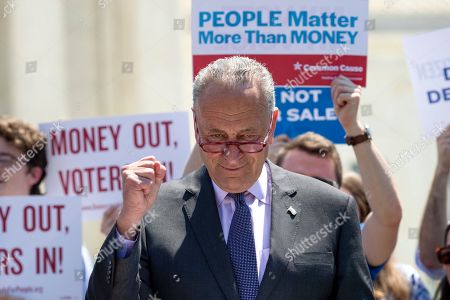
    Rep. Chuck Schumer (D, NY) explains how he can’t read, doesn’t understand, and doesn’t care about the 1st Amendment.

    To the above facts we have to add some economics. In my opinion, the best way to begin to understand this is to ask a very simple question: if you were a legislator looking to raise some cash, what would you have to sell? (Think about it seriously for a moment).

    ANS: Legislation. i.e. Laws.

    Legislation is the only thing that a lawmaker can offer any prospective “buyer.” It is the medium of exchange (i.e. the currency) of the political class and a specific instance of the more general “Law of the Instrument.”* In return for a piece of favorable legislation, or a clause in the next omnibus bill – or exemption from cuts or regulation – political donors deposit sums into re-elections campaigns, or exchange different favors with lobbyists – the “middlemen” of the entire Money-for-Favor-for-Reelection Triangle.

    If this seems unduly cynical, it shouldn’t be. If you have a friend who is a cop, who hasn’t heard of, or considered, asking him or her to “look into” a ticket…? Now magnify that onto a scale where instead of your hundred-fifty bucks plus court costs being at stake, it’s someone else’s multi-million dollar, multinational business and a piece of legislation that would ensure government contracts flowing that direction for the next 10 years. Or a promise to keep government regulators out of your business for at least your friendly Senator’s next 6 years of office. If all of this seems speculative or just too much to swallow at once, consider this quote right from the horse’s mouth, as it were:

    You send us to Congress; we pass laws under which you make money…and out of your profits, you further contribute to our campaign funds to send us back again to pass more laws to enable you to make more money.

    — Senator Boies Penrose, (R, PA) 1896 (quoted in Id., Gardner and Charles, p. 638.)

    I always hear people complain about the influence of “corporate money” in politics and yet no one ever seems to consider that if their Senator wasn’t offering legislation for sale, the corporation wouldn’t be able to make a purchase. And it is in no way solely corporations buying-off politicians. Unions are at least as powerful and well-off as any corporation and billionaires with agendas sit on both the left and the right of the political spectrum. In fact, if we’re dealing in generalities, it is worth wondering: if corporations are filled with greedy, capital-obsessed Scrooges, why would any of those money-grubbers ever voluntarily give their money to a politician in the first place? To ask the question is to destroy the premise.

    When you’re starting a company in your garage you don’t start by setting aside your political lobbying budget, then make whatever widget, software, computer, or other item that is the money-making aspect of your new venture. You first have to make something that a large enough number of people are willing to voluntarily pay you such that you have a growing enterprise, be it a successful song, an iPhone, the personal computer, or a rubber tire. Legislators don’t enter your mind until well down the road in the business cycle. Thus, perhaps it is enough to agree that legislators aren’t the unfortunate victims of a “system” that is foisted upon them. What Senators and Congressman do to fill the coffers of their re-elections campaigns is a perfectly natural, foreseeable byproduct of the funding of the political system.

    Part Two explains how it works in greater detail.

  • Chapter 14 – Secretary Cohen’s “Four Points”

    In December of 1997, the anthrax vaccine manufacturer was shut down and could not manufacture anything related to the AVA. Notwithstanding that hurdle, Secretary of Defense William Cohen announced that before the mandatory program would begin, it would have to meet four prerequisites:

    1. Supplemental testing, consistent with Food and Drug Administration standards, to assure sterility, safety, potency and purity of the vaccine;
    2. Implementation of a system for fully tracking personnel who receive the anthrax vaccinations;
    3. Approval of appropriate operational plans to administer the immunizations and communications plans to inform military personnel of the overall program;
    4. Review of health and medical issues of the program by an independent expert.

    (My emphasis added). One cannot help but wonder why condition number one would need to be in place if the DoD was confident in the safety and potency of the AVA, as it had started saying publicly. In fact, this appears to have been nothing more than a media campaign to assuage fears because none of these four “prerequisites” were ever met before the program kicked off, which is exactly why the manufacturer had been shut down in the first instance. Each of these factors revealed fundamental flaws with the program from its inception.

    With regard to point 1, “supplemental testing” may well have been the worst idea for the DoD could have ever come up with because what it demonstrated, unequivocally, was failure of lot, after lot, after lot of the vaccine.[1] One of the first findings in CBER’s February 1998 inspection was that “there is no validation of the length of time sublots are held until they are used in a lot. Sublots have been held longer than three years prior to use. There is no stability data to support this hold time.”[i] Lest this seem picayune, consider a little more history of one particular Sublot:

    Sublot AV456 was produced . . . in 5/95 [and stored] until 3/97 at which time it was transported to the formulation room . . . with other sublots to make FAV039. Here it was discovered that AV456 was contaminated with mold, and it was destroyed.[ii]

    While some may say that the fact that it was caught is good news, it ignores the other, older sublots where mold or other impurities were not caught. One finding (among many like this) is particularly noteworthy:

    Lot FAV023 was filled on 12/13/93 and passed a potency test on 3/29/94. It was submitted for redating on 4/2/97 and was placed in the stability program (zero time) at the same time. It is reported as failing potency on 4/2/97. It was tested again on 8/12/97 and is reported as failing potency. A fourth potency test conducted on 10/6/97 is listed as passing by 0.01. There is no investigation into the original result and justifying the additional testing.[iii]

    This finding is most disturbing because it indicates a testing regime that ignores negative test results – twice! – and somehow chooses to validate a subsequent positive after two negatives. How can one know which test result is correct with two failing and two passing results? And how many people would like to line up, roll up their sleeve, and take their shots from that particular vial of the vaccine? Stability testing of biological products is crucial because of the possibility for these products to break down over time. Note that this lot was “filled” in 1993. Four years later it passes a test by .01 after having failed twice previously. This particular finding is in no way isolated: Lots FAV 010, 011, 018, 021, 022, 025, 028, 040, 041, 042, 043, and 044 all had at least one failed potency test that was not investigated and then a passing result was somehow chosen over the negative one.

    FAV016 has its own uniquely disturbing history.

    Lot FAV016 had 6579 vials rejected due to particulates during post-filling inspection. These particulates were not identified, nor was an investigation conducted. The batch was released.

    Someone, somewhere, had unidentified “particulates” injected into them. As a practical aside, one has to wonder how those individuals will get VA compensation if they have an illness as a result of this contaminated product being injected into them in light of the DoD’s positions that there had only been 74 adverse events from the vaccine.

    The list of violations goes on and on and includes several different lots being tested and found with such contaminants as “penicillum species” – a danger to anyone allergic to penicillin; cladosporium – a fungus that can cause infections leading to “rough skin, black lesions on the hands, and sometimes a brain abscess”; altenaria – a fungus that can cause dermatitis in humans; micrococcus – a contaminant that is relatively harmless to humans; staphylococcus saprophyticus – a significant cause of urinary tract infections; staphylococcus epidermis – a significant cause of opportunistic infections, usually for those with some skin puncturing, such as needle/IV intrusions, medical appliances, or surgery; and staphylococcus capitis – another infection causing bacteria.

    Despite all of these findings and more in February of 1998, the program was launched on May 15, 1998, with Secretary Cohen claiming, with a straight face, that “all conditions for implementing the anthrax vaccination program for the total force have now been met.”[iv] There is simply no possible way Secretary Cohen could have said that in good conscience if he was aware of the inspection results in February. And given everything going on around the program, it is impossible to imagine that he didn’t know – because he manufacturer “voluntarily” shut down for “renovations” in January 1998. In reality it shut down as a result of the Notice of Intent to Revoke letter by the FDA, otherwise the February inspection results would have resulted in the facility’s license revocation.

    The second condition of the program was tracking of immunizations. Two DoD briefers talked extensively on November 6th, 1997, about a new program that would be used to track immunizations and of the terrific job the new system had done in Bosnia.[v] At a March 1998 Senate Armed Services Committee hearing, however, Dr. Randolph Wykoff, the Associate Commissioner for operations at the FDA, and Mark Gebicke of the GAO, pointed out that the Bosnia experience left a lot to be desired, particularly of the tracking of immunizations under an IND protocol for an investigational encephalitis vaccine.[vi] In fact, one report used the word “abysmal” to describe it.[vii] Once again, the Assistant Secretary of Defense for Health Affairs promised to get better, but also talked about a new procedure for getting relief from the FDA from the requirements of an IND.  The FDA associate director maintained that the “FDA firmly believes the IND process, as defined in our rules and regulations, is sufficiently flexible [for DoD’s needs]. Additionally, FDA is convinced the Department of Defense has the scientific, clinical, and logistic capability necessary to comply with the requirements of the IND process.”[viii] Evidently, however, they could not and did not do it in Bosnia. A GAO report issued the same day stressed the importance of being able to track vaccine immunizations in order to ensure “that (1) sufficient supplies of vaccines will be available at the various worldwide immunization sites; (2) vaccines that are older than their 1-year shelf life are destroyed; and (3) records of vaccines received, administered, and destroyed are kept to allow for monitoring and tracking.”[ix] Worse yet, the GAO found that during the “Bosnia deployment in 1997 . . . DOD could not account for more than 3,000 (20 percent) of the total number of doses sent to Bosnia.”[x]

    Requirement number three was that there would be approved operational plans to communicate to service members about the anthrax vaccine program. Whatever the operational plans were, in May 1999, the Department of the Air Force circulated a memo to its judge advocates, specifically defense counsel, telling them that “a small number of military members have refused to follow their commander’s direct order to take the [anthrax] vaccine” and that the cause of their fear in taking the shot is “misinformation obtained from web sites set up by special interest groups[.]”[xi] This was a frequent refrain of the DoD, in front of Congress and in the press. The memo also points members to the DoD’s own website, which was established after the program had begun, in order to “counter” in DoD parlance “internet misinformation.” Evidently then, in March of 1998, when the program was about to begin, prong number three hadn’t been met, either.

    It is worth noting that the Army’s AVIP Agency existed solely for the promotion of the anthrax vaccine. It was budgeted at $74 million over a six-year period (FY99-FY05).[xii] No other military medicine program has ever needed to be forced on servicemembers with an orchestrated campaign of this type. William Arkin, a defense writer and former Army intelligence officer observed that “. . . this is the Pentagon versus its own service members. It is a depressing window into the breakdown of discipline and basic confidence in the political and military leadership. That has nothing to do with the Web.”[xiii]

    Criterion number four probably cost the DoD as much credibility (if one can say it had any to begin with) as number one. It would be comical were it not for the stakes involved. Secretary of Defense Cohen announced that there would be a “review of the health and medical aspects of the program by an independent expert.”[xiv]

    Doctor Gerard N. Burrow was the doctor who allegedly reviewed the program at the request of Deputy Secretary of Defense Rudy DeLeon. Dr. Burrow concluded that “[t]he anthrax vaccine appears to be safe and offers the best available protection against wild-type anthrax as a biological warfare agent.”[xv] Unfortunately, Dr. Burrow is a professor of gynecology at Yale University School of Medicine, a specialty that one would not normally associate with some expertise in weaponized anthrax toxins. When that unfortunate snippet from his CV leaked out, Dr. Burrow was subsequently asked by Congress to testify about his review at a 29 Apr 1999 hearing. He declined to appear. Instead, in a 26 Apr 1999 letter to Representative Christopher Shays (R-CT), Burrow stated that

    “[t]he Defense Department was looking for some [sic] to review the program in general and make suggestions, and I accepted out of patriotism. I was very clear that I had no expertise in Anthrax and they were very clear they were looking for a general oversight of the vaccination program.”[xvi]

    The DoD’s claims of misinformation on the internet had a particularly hollow ring in light of its blatant lack of honesty and candor in having something as simple as an independent review conducted. Nothing was ever done about this lie that was foisted off on American servicemembers. No one has ever been taken to task for this laughably blatant fraud perpetrated on U.S. military members and the broader American public.

    Thus, in the end, the DoD’s four-point plan to reassure the public and servicemembers of the safety of the anthrax program – as a prerequisite to beginning inoculation – was nothing more than a PR campaign that ultimately cost the DoD credibility that it did not have to spare. As the truth came out, and was certainly made available on the internet and elsewhere, the DoD’s cries of “misinformation” went unheeded. Service members on active duty and in the reserves began to refuse or leave the service rather than take the anthrax shot.

    If the DoD’s actions appear incredible, the FDA’s inaction is equally baffling.  The FDA is charged, under the Administrative Procedures Act, with the duty and authority to regulate, among many other things, the safety of drugs and biologic products. The FDA has had no hesitation in cracking down on manufacturers who do not comply with its regulations or decisions. The cases in the D.C circuit are legion with the FDA disciplining manufacturers who try to market a drug for a purpose not clearly delineated on the approved labeling or who otherwise fail to comply with IND protocols.[xvii] For some reason, however, in the case of the AVA, the FDA had an absolutely incestuous relationship with the DoD, a third-party who was NOT even the manufacturer! Letters were exchanged between the two agencies regarding non-compliance with IND protocols after the IND protocol was not properly administered in Bosnia. At the March 17, 1998, hearing, the following colloquy took place on this issue between Senator Rockefeller and Dr. Wykoff, the FDA’s associate director for operations.

    Rockefeller:  . . . It’s also not clear to me that FDA’s shoes are entirely clear or clean on this matter. In fact, some would say lax.  I think that FDA and DoD have been exchanging letters about all of this for some months now. And the fact is that seven years after the Gulf War, the situation is still not resolved. If DoD does not adequately answer FDA’s questions with respect to these matters and others, what is FDA going to do about it?  . . . And why, for example, was it necessary for the Presidential Advisory Commission to address the waived informed consent matter six years after the end of the war? So I put to you what FDA would recommend and would do if DoD does not come in compliance more?

    Wykoff:  . . . We have tried very hard to make sure that they are absolutely clear what our rules and regulations are and what our expectations are. We believe that they understand that. We believe that they have the capability of complying with all of our IND rules and regulations. As to whether they will comply in the next deployment situation, obviously we can’t predict that.

    Rockefeller: And if they don’t, is there anything that you can do about it?

    Wykoff: Yes, sir. Obviously, there are a range of options that we have. We would have to determine what the specific concerns are. That drives what are specific actions would be.

    Rockefeller: What are some of the options?

    Wykoff: Well, as we interact with any trial sponsor, we learn more about their ability to conduct IND trials, we would be more or less willing to grant waivers or exemptions to particular requirements.  We could hold them to more – all of the requirements as outlined in the rules and regulations – based on their performance.[xviii]

    It boggles the mind to think that the first words out of the FDA’s mouth are talk of waivers for non-compliance with regulations, particularly in light of DoD’s history in this area. There was, and is, a clearly documented squeamishness on the part of the FDA to step in and bring the DoD into compliance. In downright shocking testimony before a House Committee, Dr. Kathryn Zoon of CBER was questioned by Rep. Christopher Shays (R-CT) about the FDA’s regulatory responsibility.

    ZOON: This is a licensed vaccine. If a physician uses it or DoD uses it, that does not really fall under our jurisdiction.

    SHAYS: So it’s your statement before us now that if DoD doesn’t abide by the protocol, you have no responsibility? That you have set out a requirement? Who is responsible then? Who’s going to make sure that DoD abides by the protocol, if you don’t do it?

    ZOON: We don’t have the authority.

    SHAYS: I can’t believe – I just want to say, Dr. Zoon, I cannot believe that you have just said under oath that you do not have the responsibility to deal with this issue or the authority. You said you don’t have the authority.

    ZOON: I said – yes, that’s correct.

    SHAYS: That is your testimony.

    ZOON: We don’t have the authority.

    SHAYS: Well then who is going to protect our men and women if you aren’t going to do it? Who? Who has the authority?

    The tricky part of this testimony is that it is partly correct. The FDA does not regulate end-users of a product, normally. That is, they do not tell an individual doctor, for example, that he cannot use a drug off-label. Two important caveats to that “normal” example, however. First, the normal patient can’t and isn’t being compelled by their doctor to take anything; they can decline, and they can also sue if something happens as a result of the doctor’s malpractice. A military member has neither of those options. Second, and more directly on point, if the end-user is participating in a clinical protocol, then the FDA does regulate that user. Thus, the DoD’s participation in BioPort’s IND application in order to get an indication against aerosolized anthrax should make them subject to FDA regulation, just as the DoD was during the Gulf War when applying for a Rule 23(d) waiver. FDA’s willingness to accede to DoD’s interpretation essentially allowed the DoD to completely slide on their responsibilities. Some lawyer’s or regulator’s intentional misinterpretation of the FDA’s own regulations resulted in an open abdication of the FDA’s regulatory role over the AVA.

    FDA officials have repeatedly acceded to DoD doctors’ interpretations of the anthrax vaccine label, as well. This is an absurdity, particularly appalling in light of the DoD’s involvement in the manufacturing process. The DoD fundamentally became a manufacturer, for all intents and purposes, and the FDA looked the other way, hiding behind the fiction that the DoD was an “end-user” when convenient. The DoD was involved from the very beginning in the development of the anthrax vaccine. Additionally, when problems arose with the manufacturer, the DoD sent in its own ‘inspection’ teams to ensure the supply of the vaccine. The DoD had paramount liens on every piece of equipment that the manufacturer has. A GAO report in June 1999 found that

    DOD has made a significant investment in renovating BioPort’s biologic facility to meet the military’s requirements for anthrax vaccine . . . Since 1988, DOD has provided about $112 million in contracts, including options, to help ensure the viability of the anthrax vaccine biologic facility. As shown in figure 1, DoD’s contracts provided monies to (1) produce the vaccine, (2) renovate and expand the production facility, (3) provide various support services, and (4) purchase equipment to enhance production capacity. DoD has also provided contract terms and conditions to help ensure the success of the anthrax vaccine program. For example, under Public Law 85-804, which allows for government indemnification of contractors for unusually hazardous risks, DoD indemnified BioPort against product liability. In addition, DoD agreed to allow the company to sell up to 200,000 doses of anthrax vaccine to others, using government-furnished equipment rent-free, after DoD’s requirements are met.[xix]

    Amazingly, this is chump change compared to what the Defense Contract Auditing Agency found in 2000! That report led to an Inspector General Investigation. Notwithstanding numerous audits that found that the company was not financially viable, BioPort requested contract amendments that included $1.28 million in bonuses for senior management that amounted to 109% of the managers’ base salary. This was deemed an “unreasonable expenditure” by the DCAA in light of “BioPort’s current financial condition.”[xx] Okay, so someone disapproved, right? Well, sort of, because the manufacturer had almost no real financial incentive to produce an FDA approved vaccine under its contracts with DoD to begin with: the contract paid the manufacturer 90% of the contract price before the FDA ever inspected the vaccine. Yes, read that again.

    Put another way, BioPort only got paid 10% more for the product being approved by the FDA. At one point, the Department of Justice was looking into criminal charges as some $6 to $8 Million of the money provided to the manufacturer was unaccounted for.  Additionally, the fact the former Chairman of the Joint Chiefs of Staff Admiral William Crowe was a co-owner of the facility, as well as Dr. Robert Myers, (formerly of MDPH and MBPI) can hardly escape attention. Crowe was the first senior military officer to have come out publicly in support of then-Democratic party candidate for the Presidency, Arkansas governor Bill Clinton. While both Crowe and Myers disavowed any “inside” preferential treatment from the DoD, one must wonder if the decision to award BioPort the contract had anything to do with either’s presence as an owner. Finally, emails from inside the DoD suggest that the agency actually had its own people “on site.” During hearings held by Representative Christopher Shays in May 1999, an email was sent from Brigadier General Eddie Cain, the Director of the Joint Program Office for Biological Defense, to an Army Colonel John V. Wade. In the email Cain warned that “[I]f you think Congressman Shays was critical of the current relationship between FDA & DOD, wait until he finds out that DOD is calling the shots on-sight.” [sic][xxi] When this email surfaced during the court-martial of Air Force Captain (and medical Doctor) John Buck, the FDA had “no comment.”

    The FDA has, for whatever reasons, backed down from the DoD to the point that after the warning letters, the notice of intent to revoke, and a failed inspection thereafter, the agency still withheld pulling the manufacturer’s license because the DoD interceded on behalf of the company. In a June 25, 2000, interview with the Vancouver newspaper The Province, Mark Elengold, the Deputy Director for CBER, explained what happened.

    The FDA held off pulling the licence, in part because it would have left the U.S. Department of Defence [sic] – which had just announced that all soldiers were to receive anthrax vaccine – with no domestic source.

    “This is a one-source product so we tend to try to work with firms and put additional monitoring steps in to avoid revoking the licence,” said Elengold.  The prestigious British medical journal Lancet reported at the time that ‘a plea from the Pentagon has prevented an ‘eleventh-hour’ closure of the only U.S. producer of anthrax vaccine,” according to an e-mail to DND [DOD?] medical headquarters in February 1998.

    Elengold confirmed the Pentagon sat in on a crucial call to the company in which he discussed revoking the licence.”[xxii]

    Electronic mails surfaced in and around 2000 show not only did the DoD convince the FDA not to revoke the license, but DoD also attempted to bully both the manufacturer and the Government Accounting Office at the same time. In one e-mail, a Pentagon official discusses how other agency supervisors were urging the U.S. Food and Drug Administration and the manufacturer of the vaccine to release lots that had been held up for scrutiny by them (the FDA). This despite Secretary Cohen’s public insistence on supplemental testing to ensure safety of the vaccine, one should remember.

    On Feb. 22. 1999, Dr. Michael Gilbreath, a civilian Pentagon biological defense employee sent an email to U.S. Army Brig. Gen. Eddie Cain, then Director of the Joint Program Office of Biological Defense (JPOBD). Gilbreath wrote that he had “received information this morning from BioPort that individuals within the DOD contacted them and threatened that DOD would circumvent BioPort and contact the FDA regarding availability of anthrax vaccine lots currently under review at the FDA . . . Any such actions by DOD would be inappropriate.”[xxiii]

    E-mails also reveal that the Pentagon was having trouble countering the U.S. General Accounting Office’s assertion that the vaccine is improperly licensed, and that it has not been proven safe and effective. Cain indicated in one e-mail that then Secretary of Defense William Cohen would be writing to the GAO, whose findings have consistently gone against the Pentagon, to protest “the expertise put on this (vaccine) project” by the watchdog agency.

    “If we cannot answer these questions, we (DOD and the Administration) are in big time trouble,” Cain said in the May 3 e-mail. “…We are digging ourselves a hole that will be too difficult to crawl out of.”[xxiv]

    The FDA also stood by when adulterated vaccine was shipped to the Canadian military and when 59 Marines were given shots from expired lots of the vaccine.[xxv] The FDA’s complicity with the DoD’s actions has left service members with no recourse but to either take the shot, be court-martialed for refusing, or leave the service somehow if their commitment allows it. If the service member simply will not take the chance on the vaccine’s safety, the penalty for refusing is court-martial with a certain conviction. Military Judges simply would not hear that the vaccine is investigational, nor would they even allow service members to present that information to a jury. The FDA’s refusal to act leaves the judge with an out: if the FDA thought it was investigational, why wouldn’t they just issue an opinion to that effect? Worse yet, some military judges would not wade through the necessary materials in order to understand the FDA regulatory process and what an IND is, or they would find that the Secretary of Defense’s actions were in legal parlance “non-justiciable” disputes between “co-equal branches of government.”

    The member who fights will be convicted and punished. When an Air Force Doctor, John Buck, tried to submit evidence that the specific lot that he was to have received, FAV044, was subject to a recall because it was expired, the judge did not allow the evidence to come into court. The only option left for service members was to resign quietly, leave at the end of a service obligation, or fight behind the scenes to ensure that the law is followed. That is what a group of persistent officers had been doing from the word go.

    Endnotes

    [1] It would take up too much space to detail all of the failed lots, for their various reasons during the February 20, 1998, CBER inspection on the lots of AVA. Some of the more egregious violations are listed. See CBER Inspection report dtd 2/20/98 for a complete listing.

    [i] FDA Form 483 Inspectional Observations Feb. 4-20, 1998.

    [ii] Id.

    [iii] Id.

    [iv] May 15, 1998, SecDef memo.

    [v] Nov 6, 1997, background briefing

    [vi] Mar 17, 1998 Senate Hearing, Committee on Veterans Affairs Holds Hearing on the Nomination of Togo West as Secretary of Veterans Affairs and on U.S. Biologic Vaccines for Gulf War Veterans.

    [vii] “Abysmal” tracking job quote ????

    [viii] Id.

    [ix] GAO Report T–NSIAD-98-83 p.8 (March 17, 1998).

    [x] Id.

    [xi] 18 May 99 AF memo

    [xii] Charles Cragin, PDASD Reserve Affairs, testimony, 3 Oct 2000.  See: http://www.house.gov/reform/hearings/healthcare/00.10.03/cragin.htm

    [xiii] William Arkin, “Bugged by the Net”, Washington Post online, 27 Sep 1999.  See: http://www.washingtonpost.com/wp-srv/national/dotmil/arkin092799.htm

    [xiv] AVIP Impl ltr 18 May 98

    [xv]  See: http://www.defenselink.mil/other_info/burrows.html

    [xvi] Id.

    [xvii]

    [xviii] Mar 17, 1998 Senate Hearing, Committee on Veterans Affairs Holds Hearing on the Nomination of Togo West as Secretary of Veterans Affairs and on U.S. Biologic Vaccines for Gulf War Veterans.

    [xix] GAO Report GAO T-NSIAD-99-214,  (June 30, 1999)

    [xx] IG Report dtd March 22, 2000.

    [xxi] Dave Eberhart, Stars and Stripes.  May, 2001.

    [xxii] Ann Rees, “Their Dangerous Dose”, The Province [Vancouver, Canada], 25 Jun 2000

    [xxiii] E-mails Suggest Pentagon Pressured FDA On Anthrax Vaccine, Thomas D. Williams, Hartford Courant, May 17, 2001.

    [xxiv] Id.

    [xxv] See Most Dangerous Dose (Canadian article on vaccine) and GAO report on Marines T-NSIAD-00-36.

  • House Resolution 660: Congress Formalizes the Impeachment Inquiry

    H. Res 660 (complete text here) was approved 232-196, and lays out the rules of the investigation for two of those certain committees. At some point the investigations will conclude. The house can then choose to vote to impeach. Or not. Upon impeachment by the house, the Senate conducts a trial which ends with a vote on whether to remove the impeachee from office. So we are on step one of a three-step process. Let’s do a quick march through H. Res 660 and see what it actually says.

    “[It] bein’ the biggest crime of the last fifty Years and everybody wanted to get in the newspaper story about it,” as Arlo Guthrie once famously said. The ponderously-named House Permanent Select Committee on Intelligence is Chaired by Adam Schiff; the ranking minority member is Devin Nunes.

    (1), the chair and ranking minority member of the Permanent Select Committee shall be permitted to question witnesses for equal specified periods of longer than five minutes, as determined by the chair.

    This seems hopeful. A congressman from each of the two political parties gets to question each witness – the chairman (a Democrat since that party currently is in the majority in the House), and the ranking minority member (the party not in the majority, ie currently Republican). The “ranking member” may also subpoena witnesses subject to the approval of the chairman, and should the chairman deny the subpoena request the ranking member may appeal that decision to the committee as a whole. Currently this committee consists of thirteen Democrats and nine Republicans. There is also a provision for questioning of witnesses by employees of the permanent select committee upon request from the chair or the ranking member, though apparently other members of the committee may not question witnesses. The chairman is authorized, though notably not required, to release to the public transcripts of depositions, properly redacted. Finally, the committee is directed to issue a report with its findings and recommendations.

    The Judiciary Committee is chaired by Jerrold Nadler, who the author would like to personally thank for making his research easier by listing his name at the top of the committee’s homepage in all caps, then repeating it liberally throughout the site; other chairs made me dig for that info. Somewhat harder to find was the name of ranking member Doug Collins. The primary duty of the committee is overseeing the administration of the federal courts and federal law enforcement agencies. This committee traditionally conducts impeachment investigations. H. Res 660 outlines an investigation protocol for the Judiciary Committee which is similar to that imposed on the Intelligence Committee.

    So what about those other committees? Is your author slacking? No, the “guidance” of H. Res 660, to use the bureaucratese term of art, stops with the standing committee on the Judiciary and the permanent select committee on Intelligence. That open and transparent thing is not defined for those other named committees, who we shall now briefly introduce.

    The Financial Services Committee is chaired by the charming and stateswomanly Maxine Waters, with Patrick McHenry of North Carolina as the ranking minority member. Foreign Affairs is chaired by the Eliot L. Engel of the Bronx with Michael McCaul as the ranking member; Ilhan Omar is also on the committee.

    The Oversight and Reform Committee webpage, at of the time this article was written, still lists the late Elijah Cummings of Maryland as its chairman with Jim Jordan of Ohio as ranking member. Resigned member Katie Hill of California is also still listed. The committee also includes such congressional luminaries as longtime nonvoting member Eleanor Norton from the District of Columbia, IT-savvy Debbie Wasserman Schultz of Florida, crusading freshman Alexandria Ocasio-Cortez of New York, Ayanna Pressley of Massachusetts, and Rashida Tlaib of Michigan.

    The Committee on Ways and Means is the oldest committee of the United States Congress, and is the chief tax-writing committee in the House of Representatives. The Committee derives a large share of its jurisdiction from Article I, Section VII of the U.S. Constitution which declares, “All Bills for raising Revenue shall originate in the House of Representatives.” -Committee Website

    While seemingly unimportant, the House Ways and Means Committee is the committee which writes tax legislation and claims jurisdiction over basically everything because of that. The committee is chaired by Richard Neal and the ranking member is Kevin Brady.

    So there you have it. The stage is set. The roles cast. The House Select Committee on Intelligence seems to be taking the lead on this, and is the seeming star of the show. The House Committee on the Judiciary, though the traditional lead is cast in a supporting role. But keep an eye on the Oversight and Reform Committee; the committee contains three-quarters of the squad, and it will be interesting to see who replaces Cummings and Hill. Enjoy the show.

  • Stumbling Along in Germany

    (All photos mine except for one- I am not that old)

    I promise this bit of scribbling will be shorter than my usual missives, but it will be more of a bummer than discussions of recreation and the early Apollo program. This article will also lack the flair of H&H or SugarFree but may intrigue some of you to learn more about a privately funded and executed memorial project.

    The National Socialist era (1933-1945) for Germany was a time of both governmental and non-governmental lawlessness. Everyone in this group is aware of the broad outlines (or intricate details) of the crimes perpetrated by the National Socialist German Workers Party, the government it controlled, and the people who supported the goals of those entities. With the end of that era in May 1945 Germany entered a period of denial and silence concerning the crimes committed in the national socialist era.

    Slowly, and by fits and starts, the government and people of West Germany (FRG) began to recognize the crimes committed in the name of the German State and the positive actions by those few who openly opposed the socialists. Even so, people like the July 20, 1944 conspirators were generally seen in a poor light by most of the German population for decades. In the International Socialist GDR the NSDAP past was even more hidden because “the new boss is like the old boss”. Any public remembrances had to be wrapped up in the glorification of the communists (mis)rule of the East. With the collapse of Warsaw Pact and the subsequent reunification of Germany a re-examination of how to remember the totalitarian era began to be debated and acted upon in Germany.

    One problem of this reexamination was how far removed from today the NSDAP’s crimes were. The crimes are entire generations removed from the people inhabiting Europe today. Today most of the perpetrators are in their graves and the surviving few are pushing 100 years of age. Even German prosecutors state the last of the Nazi trials probably has been conducted. The statistics for the victims are ever darker. Those who survived often had compromised health and suffered early deaths. It is rare to find any alive today, even in the populations of those who moved overseas after WWII ended. Various government agencies wrestled with the issue and the common solution was to memorialize the victims and keep quiet about the criminals. In Berlin for example, the memorial and museum to the July 20th 1944 Conspirators is well done, but limited. The Holocaust Memorial near the Brandenburg Gate is expansive, but the dead are nameless. Across the street there is also a small memorial to the homosexuals killed by the NSDAP- again nameless, but full of current politicization.

    Monument to Oberst Claus Von Stauffenberg and other conspirators at the site of their July 21, 1944 execution.


    Portion of the “Memorial to the Murdered Jews of Europe“ (aka Holocaust Memorial) near the Brandenburg Gate.


    Last month I was in Wiesbaden, Germany for business with a few extra days tacked on. The first night there, a group of my co-workers and I went out for dinner. We had different knowledge levels of Germany with some of us former residents and several on their first visit to Germany. After dinner we were walking back to the hotel and I noticed three small bronze squares in front of a building. I brightened since I had a chance to share with my co-workers a small aspect of German life. “Hey look! Here are three stumble stones.” We paused at the squares and I let them know that this was the last home of the “X-berg” family and it was from here the National Socialists seized them. I continued, “They were rounded up on X day and they were transported to Sobibor and arrived on Y day. They were probably all dead within the hour.” I heard a quiet groan and a, “Thanks Double for that bit of ruining our evening.”

    What had I described to my co-workers? It is a project by conceived and executed by Gunter Demnig to remind people of the names and fates of those persecuted by the national socialists. In 1992 he conceived the project to memorialize as many victims as possible at their last residence as a free person. The memorial stones pull no punches. They start “Hier wohnte” “Here lived” and tersely lay out the fates of the people who lived at that address. Since 1992 he has cast and placed over 80,000 (as of 2018) of these memorials across Germany and Europe making it the world’s largest decentralized memorial. He runs the private organization with donated funding that casts and emplaces the Stolpersteine.

    Anybody can nominate a victim of the national socialist’s. The victim(s) are not limited by category and can include Jews, homosexuals, Roma, “shirkers”, union members, etc. The key is that the victim must be a victim of the national socialists and not WWII in general. (e.g. Killed in a concentration camp- yes. Killed as a soldier or a civilian by combat operations- no.) Once the nomination is properly researched, documented, and validated- Gunter is German after all- a personalized monument is cast and is ideally placed in front of the last known residence of the victim. Sometimes a group monument will document the names at a known transportation site. Most German cities have supported this initiative- Munich has not- and a slowly growing number of other nations have permitted memorials placed in their locales. (Though often not without local controversy.)

    Why “stumble stone” or “Stolpersteine”? There are multiple reasons. Each block is 10 cm X 10 cm (~4in X4in) and is set close to flush with the sidewalk stones/concrete. While walking they are noticed when you closely approach them, or your shoes trod on a not uniform surface. The name also comes from a NS era anti-Semitic joke about un-uniform paving stones marking a Jew’s grave. Gunter Demnig also states that because you can’t decide to avoid them (like a conventional memorial) and come across them at close range a Stolpersteine “is a deeper intrusion of memory into everyday life.”

    After my business trip was over I took a few days of vacation to visit my son’s family in Berlin. In the morning I would walk the neighborhood, get some coffee, and explore while the rest of the apartment slept. (I am well trained on the prime directive- do not wake a sleeping infant.) My son’s family live in a nice but by no means remarkable neighborhood with an average history. By that I mean it was not a Jewish, International Socialist, Union heavy, or anything else neighborhood. Since the early 1900’s it has been a respectable middle class neighborhood. Almost as soon as I left the apartment building I came across my first stumble stone. It is literally next door and memorializes one of the first victims of the NS era. I wander down the street and buy my cappuccino and chocolate croissant, shortly thereafter I see another stumble stone- this time for a person seized on the street and shot by the Gestapo the day before Berlin fell to the USSR. That night I decided to walk every block immediately around my son’s residence and see how many people were killed by the NSDAP. This is a snapshot of an approximately five block by four block area of Berlin and includes only the Stolpersteine and not those killed because of air raids, military service, Soviet ground combat, or post war rape or disease.

    I am not going to show you all 17 of the stumble stones I found in that small area. (I may have missed some, but I hope not.) Here are some of the representative stumble stones to give you an idea of life and death to out groups under a socialist regime.


    Georg Stolt was a member of the German Communist Party and served on the Berlin City Council (1920) and was a member of the Prussian Parliament until 1932. In 1934 he was seized by the SA and placed in Protective Custody, shortly thereafter he was shot by the SA in an early version of a concentration camp (KL).


    Arthur Michelsson was seized and killed the same day. Most likely by a Gestapo run “flying court martial”. Less than 24 hours later this section of Berlin was captured by the Soviet Army.

    The picture below was taken on May 2, 1945 at the Reichstag about 1 km west of this spot.


    The Jaskulski family was deported to the Lodz Ghetto in occupied Poland. Edith was nine years old when she was taken from her house to Hamburger Platz and loaded into a freight car. The family was later selected for “transport to the east” and died at the Chelmno Extermination Camp. They most likely died in early 1942 during Operation Reinhardt which was initiated after the Wannsee Conference agreed upon the “final solution to the Jewish problem.”


    The Nartelski family was deported Auschwitz as part of Operation Reinhardt. Rita (~8 years old) and her mother Paula likely were gassed upon arrival. Gunther entered the main camp and later survived the evacuations to the west. After he was liberated, he moved to America and remarried. More about the Nartelski family here.


    The stumble stones are jarring whenever you see them. You can’t help but to remember that RIGHT HERE a person or persons lives were destroyed by a socialist regime. This ordinary building in front of you saw property seized, lives destroyed and parasites receiving ill gotten gains. Because of my knowledge of history and political outlook I fully realize that the stumble stones are not just a memorial to the past but a living warning for today. These memorials are a reminder of the ultimate goals of the democratic socialists and “warmnistas” living in our societies.

    If you want to find out more about the project, or if you have a relative/family friend to nominate you can visit here: http://www.stolpersteine.eu/en/home/


  • Injun Zombie Presidential Candidate: Devouring Heritage

    Read all the Zombie Presidential Candidate Episodes!


    Lizzie was bored. After spending months touring the United States in an Airstream, laying low in Bumfuck Oklahoma was a torment beyond her capacity to bear. The Demon was simmering beneath the surface, breaking through on an increasingly frequent basis. The doublewide that served as housing and a laboratory for the Scientist, Charlie, and Elizabeth Warren was torn up, courtesy of the Demon. Maybe it didn’t look any worse than the neighbors’s trailers, but it was horrific enough for these upper crust New Englanders to constantly be at each other’s throats. A Lizzie drifted off into the nightly ether of terror tshe listened to the Scientist and Charlie bicker about her. The destruction she had wrought, the plan for her future, parenting style. The analytical style of the Scientist clashed against Charlie’s bond with Lizzie, and the results were often explosive. Lizzie, still not entirely understanding the subtleties of human interaction, vaccillated between hating herself, hating the Scientist, and hating the world. She channeled much of that hatred into studying human behavior so that she could create a relatable, even charismatic, public persona. Wearing a mask made unsuspecting people trust more freely.

    As it became painfully apparent that their assassination-related exile was going to last a while, Charlie made a concerted attempt to get Lizzie out into the real world.  Her cloistered upbringing, if you could call it that, led to crippling social anxiety. Lizzie could be out in public if she had a mission, but unscripted social interaction was still hard. Her personality was an undisciplined mix of egotistical leader, lecturing scold, insecure 12 year old, and naive shut-in. Of course, the Demon surfaced from time to time to make its presence felt.

    One particularly warm day, Charlie goaded Lizzie out of the trailer and into the real world. Everybody was outside sitting under the sprawling live oak trees, soaking up the wispy breeze that carried off the stagnant swelter of early summer. Muttering invective under her breath, Lizzie began an unmotivated shuffle that all parents of teenagers would instantly recognize. The “chuff, chuff, chuff” of her Chuck Taylors kicking dust into the air warded off any would be passersby, not that anybody was walking around in the sun that mid-morning.

    Despite her obvious pouting, she didn’t make it far along the road before a calm feminine voice reached her.

    “Little girl! Little girl, come over here for a moment,” the voice cajoled. Lizzie cringed at the diminutive, but felt a small jolt of pride. She had noticed that her appearance was trending younger ever since the Demon began to eat its fill. Charlie and the Scientist didn’t even expect that she was feeding the Demon, as demonstrated by their recent admonitions to stay out of the Scientist’s anti-aging serum.

    Lizzie, originally looking a haggard, scarred 40 when incarnated, now looked a homely, if cute, 14 or 15. Many women of the Tulsa underworld sacrificed for the greater good of making Lizzie look like one of those pretty girls in Cosmopolitan. She licked her lips as she thought about trying to sneak out to eat another one. In the back of her mind, a disembodied memory plainly explained “they must be alive, or there are unforeseen complications like in the Kennedy creature.” Every time that memory surfaced, she wracked her brain for the context. It sounded like the Scientist, but she couldn’t figure out when or why he would say such a thing.

    Lizzie, after a perceptible delay, turned to face the speaker. It was an old indian woman, dressed in a linen shirt and trousers tattered into short shorts. The wrinkles hadn’t yet consumed her face, but one could see her hard life imprinted in her facial features.

    “Young lady, come over here and help an old woman out.” She melodiously beckoned, the mischievous undertones eluding Lizzie’s underdeveloped social senses. Lizzie, her sense of curiosity overwhelming her teenage angst, cautiously approached the old indian, ducking under a low hanging branch and narrowly missing a talisman hanging from a branch. The entire underside of the tree fluttered with movement, a whole host of talismans and dreamcatchers and other paraphenalia gently drifting in the wind.

    “Young woman, go inside my home and grab a glass from the kitchen counter. Bring the green bottle as well.” The old indian coaxed Lizzie into compliance. Lizzie, not used to doing anything but the bidding of others, complied, despite noticing that a glass already sat mere inches from the indian’s hand. She pushed the bead curtain aside and her senses were simultaneously assaulted and deprived. The trailer was dark enough that her eyes had trouble adjusting enough to avoid tripping over the shadowy furniture between the entry and the kitchen. Her nostrils filled with the discordant note of multiple incense sticks broadcasting their scents throughout the trailer.

    Lizzie found a stack of glasses, and pulled the top one off the stack. They were probably “clean”, but living with a meticulous scientist and his assistant had developed a standard in Lizzie where oily fingerprints and specks of detritus were not acceptable. She wiped the glass clean on her shirt, simultaneously finding the green bottle. It was not hard to find the bottle, a translucent glass apothecary implement, ringed by crudely painted native designs, and corked shut. Like everything else in the trailer, it was covered in a layer of smudges and dust. Lizzie grabbed the bottle and walked back out of the trailer.

    With a clink, the indian woman put out two settings and began to wrestle the cork out of the bottle. She motioned Lizzie to the other chair, but Lizzie missed the subtle indication.

    “Here you are, ma’am. Is that all?” Lizzie’s tone betrayed her desire to leave. She began to turn away when the indian woman’s voice cut through silence.

    “Come join me young girl, there are many things we should discuss.” She finally dislodged the cork from the bottle and dosed out a generous portion of elixir in each glass. “Your spirit is fractured and I see a great darkness in you. You must be quite tormented.”

    The trap being set, the indian woman sat silently as Lizzie processed her statements. Lizzie was conflicted. Her cloistered upbringing and general disdain for people told her to walk away. Her insecurity, curiosity, and boredom told her to join the woman. She sank into the chair, eyes darting from side to side like a raccoon getting into the bird seed container.

    “Take. Drink. We shall confront your demons together.”  The indian woman opened a wooden box, smoke billowing from an impossible fire, embers moving as if attracted to Lizzie.

    This one tries to separate us. Destroy her. Absorb her essence.

    Lizzie twitched as she tried to ignore the inner voice of the Demon. She calmed her mind and employed the tricks that Charlie taught her to retain control over her actions. With a sip from the red solo cup, her self-control slipped.

    The indian woman had closed her eyes, swaying and chanting nearly inaudibly. Lizzie was transported from the plains of Oklahoma to a desert cliff dotted with adobe huts. The swirling incense from the wooden box transformed into a campfire flickering its last life away. The Oklahoma swelter was replaced by a dry Sonoran chill. The ambiance reminded Lizzie of some of her nightmares, but she was fully lucid.

    Across from Lizzie, the old woman looked older and more decrepit, a faded aura surrounding her. A spotlight glow caught Lizzie’s peripheral vision, another person standing behind her casting deep shadows across the indian woman’s face. She turned to see a striking man that reminded her of a certain Twilight Zone episode. The Demon was a handsome man, much different from the caricature she had conjured up in her mind.

    This feeble wretch dares challenge us.

    Despite the incarnate form of the Demon standing behind her, the voice echoed in Lizzie’s mind as if it originated in her hippocampus.

    “Be gone foul thing! Your presence is not wanted!” The indian woman screeched, a wave of psychic energy hitting Lizzie like a breaker in a gale. The Demon absorbed the energy without the slightest flinch. The next few moments passed in anticipatory silence, the tension building as the indian woman’s impotence sank in. Lizzie, despite her inner conflict, just wanted to be a normal girl, sans demon. Her face sank as she saw the last chance to be rid of the spectre slip away.

    After a pause that probably had more to do with gloating than preparation, the Demon set off a nuke. A literal flesh-vaporizing nuke. Lizzie simultaneously was and wasn’t. She watched the indian woman dissolve into nothing, rearticulate, and dissolve once again in a blinding flash of fire and heat. Lizzie wanted to scream out in pain, and she wanted to laugh at the silliness of it all. As fast as her world had exploded, it sucked back in, collapsing within her, balling up tighter and tighter. With a nearly audible pop, all of the tension was gone. An uncomfortable warmth spread across her exposed neck.

    She opened her eyes and looked up. She was slumped across the table. The mottled shade of the live oak had moved off of her, and she was quickly overheating. She looked across to the indian woman, only to find a chair knocked carelessly to the ground. A streak of red ran across the table, intersecting with Lizzie’s arms. She picked up her hands and ran her thumbs through the thick viscous blood. She looked on the ground and saw a finger, the last vestiges of the indian woman.

    In the past, Lizzie would be beset with a combination of anxiety and terror when the Demon satisfied its hunger. This time was different. There was no fear, only resolve. She finally had focus. She finally was whole.

    It is time. The paleface must pay for his transgressions. I am Cherokee. I am vengeance.

    The Demon, the indian woman, Elizabeth Warren; once three in conflict, now one in harmony. With a determined swipe of her fingers, Lizzie put on her warpaint.