Category: Politics

  • Inequality and The Great Decoupling

    Introduction
    In this series, I will be examining an economic event known as The Great Decoupling its causes, and how they drive economic inequality. The first part of the article will deal solely with delving into the background of the Great Decoupling and developing a theory for what caused it. Part 2 will go into wealth and income inequality and how they are caused/driven by those factors.

    What is The Great Decoupling
    The Great Decoupling is a term that has been coined to describe the sudden divergence between productivity growth and wage growth in the early 1970s. Prior to that going back to at least the end of World War 2 wages and productivity moved in lockstep indicating that they were tightly coupled and that in effect workers were claiming a constant percentage of their growing productivity. You can see this graphically in images like the one below.

    There are other versions of this graph comparing different wage metrics, they all tell the same basic story however so there is no need to go into them.

    And that graph does tell us that something profound happened to the economy in the early 1970s and if you look closely at the graph that it is clear that this event was not a form of slow gradual change but rather a specific event that occurred between 1972 and 1974. What the event was the cause for the decoupling of wages from productivity is not so clear.

    Before I go into my own theories for what is behind this event, I will go over the 2 most commonly promoted/believed theories and examine them to see if they have any validity to explain the phenomenon.

    There are a few other theories for what caused the Great Decoupling but none of them are particularly widespread or developed as these and so I will not go into them but suffice it to say that every theory I have seen proposed for the cause of the Great Decoupling has been lacking and not backed up by any evidence that fits the evidence

    Theory 1: Automation driving workers out of their jobs
    The basic idea behind this theory is that as automation of factory jobs grew demand for labor shrank and while it never shrank enough to create mass unemployment, it did deprive workers of the negotiating power needed to demand higher wages. Being an essentially neo-Luddite theory, you will often see this mixed with some claims about declining union membership/power as an aggravating factor.

    In fairness, there is some validity to this theory as automation was a growing force in the economy in the post-war years that have accelerated as time went on. There are some flaws to the theory. First, automation did not come onto the scene from nowhere in the early 1970s, it had been an ever-growing force in the economy since the industrial revolution. Had this been the primary driving cause of the Great Decoupling you would not see a sharp line of demarcation where wages and productivity diverged, rather you would see a slow departure as wages gradually fell behind productivity growth. In other words, as automation grew steadily since the 1880’s wages and productivity would never have been coupled in the first place. Second, the growth in automation would have only impacted a few sectors of the economy, primarily manufacturing and farming. Over the period of the Great Decoupling those 2 sectors represented a shrinking portion of the overall economy and as a result, there were plenty of jobs for the workers impacted by automation to go to in other sectors of the economy to find work leaving them with plenty of bargaining power to increase wages.

    Ultimately this theory is used to back either an Organized Labor narrative or to support dire predictions of a coming singularity where automation renders huge percentages of the workforce obsolete and while that may or may not have some validity going forward it is a very poor fit to describe what actually happened to the economy between 72 and 74. The best you can say is that Automation was one factor among many that helped keep wage growth decoupled from productivity growth, it could not have been the causal factor which initiated the decoupling.

    Theory 2: Deregulation and tax cuts for the wealthy transferred ever-growing wealth from workers to capitalists
    This is your standard Progressive/Neo-Marxist talking point. Basically, the greedy rich people convinced the government to change the rules so that they can seize ever more money from the proletariat. Often by having government itself redistribute the income/wealth upwards through cuts in services to the poor being funneled into tax cuts for the rich. Unlike with Theory 1 however, there is pretty much no validity to this claim whatsoever.

    As the graph shows, the deviation between real wages (real wages have been adjusted for inflation) and productivity are clearly indicated to have occurred suddenly between 1972 and 1974. For government regulation or tax changes to be the driving force, there would by necessity have had to have been some major new legislation on taxes or regulations that drove the change within a handful of years immediately prior to the time period in question. What we instead see in the years immediately prior to the decoupling event is a period of massive increases in regulation with the government going so far as to impose wage and price controls as well as the creation of 2 of the largest and most powerful regulatory bodies in our government, OSHA and the EPA. On Taxes the only significant changes being the imposition of entirely new payroll taxes and while those taxes were not progressive in nature, they were small and offset by massive increases in welfare spending transferring income to the poor. You do not see significant tax cuts or pushes for deregulation going into effect until 1982 a full decade after the decoupling event.

    The best factual case that progressives and left-wing economists can make is that the decoupling was initiated by something else and then reinforced by the tax and regulatory changes of the Reagan administration and even that is a weakly supported claim based on the evidence.

    What really happened
    Admittedly not being a trained economist or having access to all of the data to back this theory up or prove it this is just a theory but what I can say about what is to follow is that it is a far more complete vision of what happened and is totally consistent with all of the evidence which I took into account.

    Before we can really understand what drove the decoupling we must understand when and how it happened. If you look very closely at the graph in the image you will see that in 1972 productivity and wages remained in synch, in 1973 they had begun to diverge however the divergence was within what was expected based on how the 2 metrics had moved in the past and by 1974 the 2 metrics were moving along completely different curves. This is a very sharp line of demarcation it can be placed to somewhere in an 18-month period from the start of 1972 through mid-1973 that a 24-year-old trend suddenly changed. Since it was not some kind of a gradual event there must have been a specific change that drove it and it had to have occurred no earlier than 1970 and no later than 1973. When we look at history there happens to be just 1 significant political-economic event that matches this time period, the end of the Bretton Woods system.

    Breton Woods
    What was the Breton Woods System? Following World War 2 the major nations of the world agreed to a system of international currency valuations with other currencies being marked to the dollar and the dollar being directly convertible into gold. The system worked well enough for a while, but it was originally based on the political and economic realities of 1944 where most of the economies of the world had been smashed to rubble and the only significant industrial economy remaining was the US. By the 1960s that was no longer true, England and France had resumed their prewar positions as major economic players, Germany was not far behind and Japan was an up and comer hot on their heels. Compounding this was the fact that the global economy was growing so much faster than the US economy that the US lacked the gold reserves to sufficiently guarantee the currency.

    In 1971 the G10 held a summit to try and rescue the Bretton Woods system devaluing the dollar from $35 to $38 per oz of gold and in August of that year the US stopped the practice of allowing dollars to be directly exchanged for gold by closing the “Gold Window”. These steps did not help, and the dollar reached $44 per oz of gold in 1972. The end came in 1973 when the US and the rest of the world abandoned the Bretton Woods system and the gold standard altogether for a system of fiat currency backed by nothing where exchange rates would be determined by market forces. Under this system, a country can manipulate its currency by just creating new money as needed without the need to worry about whether they have the gold reserves to back that new money. Basically, the end of Breton Woods was the birth of the Inflationary monetary regime.

    So now we have a candidate that at least could, in theory, cause the decoupling and fits the timeline, but this is still not a complete enough explanation as a move from fixed to floating currency can merely cause inflation, there is no real mechanism for it to suppress wages in relation to productivity changes, or at all for that matter. While wages generally trail inflation, they do rise with it. So, If the end of Breton Woods were the sole cause of the decoupling event then what we not have seen a decoupling between real wages and productivity as there would have been nothing to prevent workers from continuing to capture the same portion of productivity growth as they had in the past

    What’s missing?
    Now we have a temporal event that acted as a trigger in the decoupling but that event is not in and of itself capable of producing the result we have seen so there must also be other forces at play here, we have to come up with a reason why wages are not only not rising with productivity but also not rising with inflation as they always have in the past and economic theory says they should. We need to come up with some kind of economic force or combination of forces that are capable of completely counteracting inflation and productivity growth which are working to pull wages up and results in wages that have essentially flatlined for 45 years.

    The link between wages and prices
    Before we can get into what is driving the wage stagnation there is an important relationship we need to understand, the link between prices and wages. Economists argue over whether wages drive prices or prices drive wages, but they all agree that prices and wages are intimately linked. The actual evidence seems to say that the link is bi-directional, that is, an increase in wages in an economy will drive a corresponding increase in prices and an increase in prices will drive a corresponding increase in wages. There is good reason to believe in this bi-directional link between the two as it fits in with much we know about human motivations.

    When a worker accepts a wage, he is not really agreeing to the absolute magnitude of the wage he is evaluating that wage in relation to what it costs him to live and the lifestyle that the wage will afford him. If prices are rising, then he will eventually decide that the current wage no longer satisfies his needs and seek a higher one. On the reverse side when a company offers a wage for a position, they are taking the same factors into account and if prices are falling they may not be able to get their current workers to accept lowered wages but they certainly will offer new workers lower wages in response and in extreme cases will replace current higher paid workers with new workers at lower wages. So, this is how wages respond to changes in price levels within an economy.

    Prices also respond to changes in wages. If a worker’s wages are increasing, he will be more willing to spend increasing amounts on goods and services that he was in the past with the lower wage, companies seeking to maximize profit will note this increased financial flexibility within the market and adjust their prices higher accordingly. Additionally, if a company finds itself having to pay higher wages for workers that represents an increase in costs and therefore they have a strong incentive to raise prices to compensate for the increase In cost.

    So as you can see there are multiple forces on each side of the wage-price equation that work to keep the two in close correlation and when one looks at real wages (that is wages adjusted for price inflation) over this time period one does indeed see that both wages AND prices have been flat.

    We find ourselves in a world driven by inflationary fiat currencies which according to pretty much all economic theories should be producing increasing prices and wages, but we find that neither are really increasing at all and so the questions that must be answered are why neither is increasing because if either was increasing then the other would be.

    What has been keeping wages down?
    In addition to there not having been any upward pressure on wages from increasing prices it boils down to supply and demand. Coming out of World War 2 the US had a rapidly growing labor force as productivity increases in farm work freed up large numbers of workers to go to work in more valuable endeavors and the number of women in the workforce began to grow steadily. This trend was then reinforced by improvements in public health driving up the median age as well as the age to which one was healthy enough to work and eventually the Baby Boomer generation entering the workforce. This was not a problem in the immediate postwar years as the US had a massive export economy and virtually no import economy to compete with thanks to the US being the sole remaining industrial power in the world. Even in the face of this rapidly growing workforce, there was still plenty of work to go around.

    By the mid 1960s this began to change, even though the growth in the US workforce was not slowing countries had largely rebuilt from the war and not only could satisfy many of their material needs themselves they were beginning to export large quantities of goods into the US so while there was still plenty of work to go around companies and consumers began to have alternatives to just paying higher prices for US labor.

    As time has gone by this trend has only continued to accelerate as more and more countries became first major export players and eventually economic powers in their own right. At the same time technology has been expanding to make the world a more global place. Yes, the US is still the leading economic power, but it is no longer the only economic power so that workers in the US are no longer just competing with their neighbors but with people across the globe who often can work for a tiny fraction of what a US worker needs to earn and still survive. The result of this is massive downward pressure on wages, there is plenty of work and we do not see widescale unemployment but there is little flexibility for workers to place upward pressure on wages because if US workers ask for too much the work will just go overseas.

    What is keeping prices low?
    The first thing to recognize is that a fiat currency regime need not be inherently inflationary. It is only inflationary to the extent that the money supply grows faster than the growth in goods and services produced within the economy which means that new money created up to the level of the gains in productivity + population growth would simply have the impact of counteracting the natural deflationary tendency of productivity and population growth and work to hold prices steady. It is only money creation beyond this level which could cause actual inflation in prices.

    That said with the monetary policies created following the end of Bretton Woods were significantly beyond this point and so a common refrain you hear to challenge economists opposed to the monetary policies of the Fed and US Government is “Where is the inflation”? Prices have been essentially flat for decades even though the monetary base has been increasing near exponentially, so those theories are falsified, right?

    Not so fast. The first thing that needs to be realized is that both increases in productivity and population exert deflationary pressure on prices.

    Given that an increase in population represents more workers producing goods and services however while this represents a deflationary pressure on prices as there are fewer dollars available for each unit of production in the economy so the monetary supply had to grow by the same proportion as population growth (more specifically workforce growth but they are interchangeable if we assume a steady portion of the population in the workforce) before you would see any price inflation.

    Additionally, an increase in productivity means a decrease in production cost. Growing productivity will by necessity produce some combination of a decrease in price, an increase in wages, or an increase in profits the question becomes what proportion of each. That is, who claims the benefit from the growing productivity, the workers, the owners, or the consumers?

    All other things being equal standard economic theory says that competition in the market place will result in the companies benefiting from productivity growth trying to realize the increased profits but over time being forced to cut prices to stave off competition and in the end the consumer receiving the benefit in the form of lower prices for goods and services. Workers will also try to claim a portion of this windfall from increased productivity by demanding increased wages. Historically this could be seen by the link between productivity gains and wages. Workers claimed a constant portion of the productivity gains, the company’s owners received a short-term benefit and over time prices would fall so that in the long term the remaining benefit would flow to consumers in the form of a decrease in prices.

    Over the period of the Great Decoupling, we have seen quite large gains in both productivity and population which in the absence of an inflationary monetary policy would have served to drive prices down, these trends have been in effect canceling out some of the price inflation that you would have expected to see.

    Finally just as workers began to find themselves in competition with other workers all over the globe companies also began to find themselves in the same position. You no longer had to contend with one or two competitors inside your own country you also had to deal with foreign competition both in the form of a foreign entity beginning to import products that compete directly with yours as well as competitors cutting costs and prices by outsourcing their work to foreign workers. This increased environment between companies acted to make it harder for those companies to raise prices to stay in line with inflation and so in order to maintain their bottom line they began to actively find ways to cut production costs which both drove some of the gains in productivity and worked to place yet more downward pressure on wages.

    Putting the pieces together
    Now we can tell a complete story of how the Great Decoupling came to be.

    As a result of a growing workforce and globalization, there has been persistent downward pressure on wages starting in the mid to late 1960s. Due to technological growth and the aforementioned globalization economic productivity began to grow at never before seen rates. The end of the Bretton Woods system and a switch from hard currency to fiat currency accompanied by an inflationary monetary policy acted as the trigger event that allowed those two forces to cause both wages and consumer prices to stagnate in real terms. As productivity continued to grow and the gains from the productivity growth are no longer being divided between workers (in the form of higher wages) and consumers (in the form of lower prices) but are rather being counteracted by inflation. The net impact has been growing productivity with stagnant wages and low consumer price inflation.

    Now I cannot prove this theory is true, not being a professional economist, I do not have easy access to the data which could do that but what I can say is that this theory is both more complete and fits the actual historical data better than any other theory as to what is behind this economic event. To the extent that what I have laid out here is true, it shatters the progressive claim that the Great Decoupling is an inevitable result of “unfettered capitalism and proof that we live in an era of unbridled greed.”

    Up next, looking into how these factors are the key drivers of income and wealth inequality.

  • On the Political Compass and What Truly Divides Us

    The US has never been so divided. As the armies of California march through Utah burning everything in their path, one cannot help but wonder how we got here. Wait, no, there is no civil war, just twitter arguments about muh Social Justiz. Carry on. But in that scenario, would Utah put up a good fight? Is the terrain suited for guerilla warfare? What is the difference between military equipment stationed in Utah versus California? Will parts of California join Utah against the rest? These are all questions.

    Libertarian used to mean socialist !!! They're thieves! They're thieves! They're filthy little thieves! Where is it? Where is it? They stole it from us, our precious. Curse them! WE hates them! it's ours it is, and we wants it! We wants it, we needs it. Must have the precious. They stole it from us. Sneaky little libertarianses. Wicked, tricksy, false!

    The world is similarly split. What can we do about it (get drunk and say fuck it)? Can we understand it (nope… now where is that bottle of scotch)? Maybe if we have a political test or a sociological study (ice? What am I a savage? Where is my Glencairn glass). If we analyze what divides us maybe we can heal (right… good luck with that… ahhh peat smoke)

    While annoying and right down aggravating, there is some fascination on how some otherwise competent people can so differ on the issues. It is amazing how they simply cease to use the reason and methods they do in other aspects of life, like a switch flips.  If you take a group of good plumbers or programmers or whatever, they tend to be good in relatively the same way, they often reach similar conclusions on how to do their job. These same people can have wildly different views on politics. Some ore stupid leftists, some are ignorant right-wingers, some are evil libertarians.

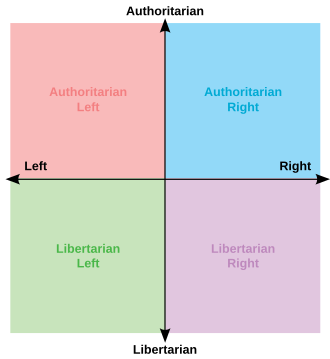
    Among the actions taken by the current crop of political philosophers (there’s a bunch with useful skills in the post-apocalypse) is to analyze these orientation by means of political tests or compasses which get more and more complex, but remain equally worthless beyond having something to share on Facebook on a slow night when the cats are nowhere to be seen.

    The classic left-right divide is thoroughly meaningless by now – if it ever was truly meaningful – though it still causes most divisions and even the wise Pie often uses words like left-winger and right-winger. The first wave of more advanced compasses have the already classic two dimensions economic and social, as if there truly is a distinction between the two. People are trying to innovate and add even further dimensions, although what use this has is beyond me. What point can it have to say well this on economy, this on social issues, and this in nationalism and this on the concept of colonizing Jupiter etc. It may become a way to split into finer grained groups, but brings not much insight or not much of a solution for what ails the world.

    I am sure we can do better than this shit

    For libertarians, it can be a little more straight forward. In the words of Bobby H:

    “Political tags—such as royalist, communist, democrat, populist, fascist, liberal conservative, and so forth—are never basic criteria. The human race divides politically into those who want people to be controlled and those who have no such desire. The former are idealists acting from highest motives for the greatest good of the greatest number. The latter are surly curmudgeons, suspicious and lacking in altruism. But they are more comfortable neighbours than the other sort.”

    The conclusion of this being, I don’t really care if someone who wants to impose his shit on me is doing it on the social or economic axis, often both. I would rather they just stop, please and thank you.

    I can myself split people into various groups: those who understand the difference between what they want and what is possible, and those that do not. The difference between the thought that they want something and the thought that they somehow should get to force that something on others. The difference between seeing a problem and knowing a solution. The difference between what is seen and what is unseen when applying a certain policy. Believing you know better than others what is good for them and realizing you, in fact, do not know better. Utopians versus sane people. All these dimensions, in a way, divide us. But probably a lot of them are rendered moot by the Heinlein principle.

    I will, as usual, randomly drop this quote right here cause it is one of my favorites.Pictured: not C. S. Lewis

    Of all tyrannies, a tyranny sincerely exercised for the good of its victims may be the most oppressive. It would be better to live under robber barons than under omnipotent moral busybodies. The robber baron’s cruelty may sometimes sleep, his cupidity may at some point be satiated; but those who torment us for our own good will torment us without end for they do so with the approval of their own conscience.
    — C. S. Lewis

    So what is your favorite compass? What questions would you add? Maybe we should make the Glib political compass.

    I will start with a rough draft of Pie’s political compass, which can be left at just one question or expanded, but overall I think it may be self-sufficient, like the proud libertarians.


    Pie will leave you be. Will you leave Pie be?

    1. Yes
    2. No
    3. Depends
    4. I don’t know
    5. Fuck off slaver
    6. That is literally hate speech
    7. As long as you don’t sin
    8. We live in a society you know, we’re all in this together
    9. But what about the children?
    10. I am Emily Ratajkowski (or equivalent) and I want to have sex with Pie
    11. STEVE SMITH LEAVE PIE BE AND BY THAT MEAN…
    12. Gravity is oppressive
    13. Other (you bunch of dirty otherers)
    14. All of the above.


  • 1,703 Words

    1,703 words.

    Christ, what an asshole!
    Christ, what an asshole!

    That is the amount CNN columnist, John Blake used to express what could have been expressed in four: Lynn Patton is a coon.

    Progressives, typically academics, as well,  often labor under the delusion that they can mask their slimy, bile-coated race-hatred with verbosity. Indeed, the laconic honesty of a simple racial or ethnic slur hurled in impotent rage seems refreshing to utterly craven attempt at slur through obscurantism.

    What rankles the most, however, is that not only will Blake continue to build a career out of dehumanizing black and brown folk who don’t march in lockstep with his radical left-wing societal and political views, but he will continue to be well-compensated for serving as hatchet-man for the vastly majority-white CNN editorial board by running interference for one of their newest poster-children, Rashida Tlaib who, to the delight of progressive media,has helped to successfully bring Jeremy Corbyn ‘Wolf-Who-Cried-Boy’-style antisemitism to American politics. Blake represents just one member of a brigade of CNN’s house, ahem, ‘slaves’ that at the order of their paymasters rushed to spew racial grievance and divisiveness all over its Op-Ed page in a frantic attempt to steer their narrative out of its nosedive after Tlaib beclowned herself at Michael Cohen’s first appearance before the congressional committee by unwittingly insulting the (Democratic) chairman’s “best friend,” which prompted Elijah Cummings to speak eloquently against the identity politics trafficked by this newest crop of elected sea-monsters that make up the progressive wing of the Democratic Party.

    And this dusty ass lookin’ motherfucker has the balls to call Patton a ‘token Negro’? This is all I have to say about that, and notice I took only 290 words to say what I could have said in two.

  • Glib is a social construct

    Hello and welcome back to “Pie ponders”, in which Pie – that is me, for those who are well… slow – raises questions on various topics of great importance. Today, we talk about social constructs and their role in the world. The usual disclaimers apply, this is not an academic opinion (for whatever those are worth) cause the internet is full of them. It is just some random musing.

    First things first… What do you mean, social constructs? Well a social construct means, conveniently, whatever you need it to mean to suit your argument. I will analyze but a minor aspect of this vast topic, in my typical way of doing such things. But let’s start by giving The Grandfather of All Knowledge, Wikipedia, and a quick quote

    A social construct or construction concerns the meaning, notion, or connotation placed on an object or event by a society, and adopted by the inhabitants of that society with respect to how they view or deal with the object or event.[citation needed] In that respect, a social construct as an idea would be widely accepted as natural by the society.

    A major focus of social constructionism is to uncover the ways in which individuals and groups participate in the construction of their perceived social reality. It involves looking at the ways social phenomena are developed, institutionalized, known, and made into tradition by humans.

    Alt text is disrespectful for things Holy

    Social constructs seem, in my experience, to have a more prominent role in the discourse of the more progressive part of the political mess. This is part of a fairly straight forward strategy: declare things they do not like as being social constructs imposed by some sort of oppressive structure and decide those things can be changed at will, to suit whatever social justice goals. I want to try to have a quick look at this claim and all the activism it underlies.

    There are two ways, in my view off course, to address social construct. The wrong way, which comes from the frankly ridiculous purely social constructionist / blank slate view of humanity, and the correct way, by looking at human history and how social contracts appeared and evolved.

    In past posts I have briefly mentioned the nature vs nurture debate of the individual human – with my view that it is combination of both and the boundary is blurry at this time (time is a social construct). Nature can have two components human nature, which was built by millions of years of evolution, and non-human environment which shapes the underlying human material.  As a side note, I have always found the blank slate view on the left curious, given those people mock the religious for not believing in evolution, but somehow think that evolution created a total blank slate human. It is awful silly.

    Now… to address the concept of social constructs. To a point, and depending on definitions, everything is a social construct in human interaction. Humans are, after all, social being and they have enough intelligence and self-awareness to go beyond pure nature and instinct, this is what makes humans human.

    A good number of social constructs have their origin in some biological / environmental factor or other and have evolved slowly over the years. They are old and similar in many civilizations, some of which evolved independently throughout history.  So how did they come to be? Chance? The social construct fairy? For others, the “social” element is stronger, especially when the origin is let us say murky. I would give, as an example of this, various rituals and superstitions and taboos born out of the general human fear of the unknown and of the supernatural. They can take a wide variety of forms from the same deep roots.

    Many social changes came after technological changes, which took humans further from nature and, as such, less constrained by pure biology. Social constructs of the hunter gatherer pack may have existed for many years until the first village came to be. Those villages had their social constructs until the town, the city, the kingdom, the empire made their way. Social constructs, for the most part, did not change suddenly and randomly. And while they were shaped by various humans – especially ones in position of influence – to suit their wishes, this was a slow process and, for most cases, not in any way designed or planned in advance.

    Off course, there being a lot of variables, there were differences between various cultures. Some of this influenced by environment, some by small random divergences which accumulated over many years. But you can also find plenty in common.

    The more technology and economy evolved, the more population grew – all interlinked things – the more humans moved away from the pure natural world. Humans began to shape the world as the world shaped them. Societies and forms of organization became more complex, and social constructs kept pace, to the point that some have very little purely biological origin, or better said very little tApparently puff puff pass is not a social cosntructhat can be easily discerned.

    There is no underlying patriarchy permeating human society and molding social constructs to oppress women by imposing purely social gender roles, as your friendly neighborhood feminist may tell you. There are, however, patriarchal organizations of human society, that being a different thing.  It is not like men secretly got together in 11345 BC and held a council in which they decided to start oppressing the wymminz and formulated a plan to that effect. Off course, no one with half a brain actually suggests this, but the interwebz are vast and much derp exists. Most of the gender roles had some of their roots in biology and were slowly shaped – for better or worse – over the years.

    It is, off course, absolutely true that social organizations throughout human history had oppressive elements, sometimes fewer, sometimes more, depending. But while this is true, it is, in isolation, meaningless. There are oppressive elements, so what? If you do not understand them properly, you will not be able to fix them. And ignoring biology and environment stops that understanding in its tracks.

    One can say religion in general has roots in human biology, while acknowledging that the different forms of many religions have less of a direct root in nature. But many of those religions started as basic animism and were molded by a developing humanity over many thousands of years to reach the current state where any random Sci-Fi writer can start his own cult.

    The fact that something may be a social construct does not mean it is necessarily bad or that needs be changed or that it does not have a serious reason for existing, this is something that needs proving. It does not mean it does not have strong roots in nature and environment. It does not mean it can be changed at will and, if it can be change, maybe not to whatever idealistic view some have. There may be many ramifications and secondary effects. A lot of social constructs are well established, old, powerful and difficult to alter. On the other side of things, this does not necessarily mean one should give up on change, just that one needs be very careful with it. Change what to what how and can we have a metric of a successful change?

    Many things exist for a reason and you cannot just tear them down and replace them with nothing. You can rebuild some from the ground up, but not all at once. A revolutionary approach to social change rarely works. To use a meaningless analogy – if the pillars to a building need repair, you do not knock them down all at once.

    And in the end, if what you are trying to build strays too much from human nature as constrained by the current environment, you will fail. Fortunately, in such cases, you need never admit failure because it was not the concept that failed, but just that the wrong people were involved, there was a vast conspiracy against them, and yes some eggs may have been broken but that does not mean you give up, you try again even harder.

    I was going to write more about it but I decided to keep it short. Brevity is the soul of Pie. To leave one last though to illustrate the point, we can agree big boobs – broadly speaking, thicc-ness in general – and large penises are pure social constructs, while on the other hand, the NBA being better than MLB is simply objective reality. Discuss.

  • Economics Corner with Winston’s Mom & Paul Krugman

    Note from the Glibertarians.com editing staff:  Here at Glibertarians.com, we are constantly searching for new features.  We noticed a niche in our features was lacking:  macroeconomic analysis.  Because of this, we reached out to Yaron Brook of the Ayn Rand institute.  Unfortunately, that guy wants to get paid for his work.  So we found the next best thing:

    Winston’s Mom.

    First thing I want to say is, hi Winston, Mom got a new gig!

    Now that we got thst out of the way, let me begin here,

    In 1961, America faced what conservatives considered a mortal threat: calls for a national health insurance program covering senior citizens. In an attempt to avert this awful fate, the American Medical Association launched what it called Operation Coffee Cup, a pioneering attempt at viral marketing.

    Here’s how it worked: Doctors’ wives (hey, it was 1961) were asked to invite their friends over and play them a recording in which Ronald Reagan explained that socialized medicine would destroy American freedom. The housewives, in turn, were supposed to write letters to Congress denouncing the menace of Medicare.

    In 1961, I recall a doctor that would send his wife down to Biloxi, MS with her girl friends.  He was into fisting for some reason but that didn’t stop him from penetrating everything.  He was a lousy (((tipper))) as I recall.

    What do Trump’s people, or conservatives in general, mean by “socialism”? The answer is, it depends.

    Sometimes it means any kind of economic liberalism. Thus after the SOTU, Steven Mnuchin, the Treasury secretary, lauded the Trump economy and declared that “we’re not going back to socialism” — i.e., apparently America itself was a socialist hellhole as recently as 2016. Who knew?

    Ever try telling the lady at the methadone clinic you’re on Medicaid?  What a bitch.

    Other times, however, it means Soviet-style central planning, or Venezuela-style nationalization of industry, never mind the reality that there is essentially nobody in American political life who advocates such things.

    That broad from NY, always on TV, always smiling with her squeaky voice.  Whats her name?

    Trump’s economists clearly had a hard time fitting the reality of Nordic societies into their anti-socialist manifesto. In some places they say that the Nordics aren’t really socialist; in others they try desperately to show that despite appearances, Danes and Swedes are suffering — for example, it’s expensive for them to operate a pickup truck. I am not making this up.

    What about the slippery slope from liberalism to totalitarianism? There’s absolutely no evidence that it exists. Medicare didn’t destroy freedom. Stalinist Russia and Maoist China didn’t evolve out of social democracies. Venezuela was a corrupt petrostate long before Hugo Chávez came along. If there’s a road to serfdom, I can’t think of any nation that took it.

    Who was it that wrote that book and who was he writing about anyway?

    So scaremongering over socialism is both silly and dishonest. But will it be politically effective?

    Probably not. After all, voters overwhelmingly support most of the policies proposed by American “socialists,” including higher taxes on the wealthy and making Medicare available to everyone (although they don’t support plans that would force people to give up private insurance — a warning to Democrats not to make single-payer purity a litmus test).

    On the other hand, we should never discount the power of dishonesty. Right-wing media will portray whomever the Democrats nominate for president as the second coming of Leon Trotsky, and millions of people will believe them. Let’s just hope that the rest of the media report the clean little secret of American socialism, which is that it isn’t radical at all.

    I do have a story from 1973 about a Danish john named Viggo.  We bargained a bit, but he started small.  First he asked how much to finger my ass, so I said 5 Kroner, and when he said he had real money i said $5.  Then he asked how much to finger his ass and I’m all well the first one is free dear, but the second will cost another $5.  One thing lead to another, and eventually we built up a lather using the hotel soap and I had an bottle of vodka in his ass while I was rubbing him out.  Doesn’t seem so weird now, but back then I might not have opened up the bottle and taken a swig after the fact.

    What were we talking about?  Right, slippery slopes.  It starts small but if you keep slipping, it might net you $58 in the end.


  • Jussie Smollett’s saga DID expose hateful bigotry, no matter what they say

    As we conclude yet another round of Culture War: Red versus Blue, it’s important to realize that just because Jussie Smollett hired his coworkers/friends to simulate a bigoted hate crime doesn’t absolve the bigotry of the situation. There is still hatefully bigoted behavior happening, and it’s a growing trend that is quite troubling. Smollett may not have been lynched, but a lynch mob was formed, and it was the usual suspects that were holding the noose and wearing the pointy white hats.

    That’s right, the progressive left is at it again! They may have admitted defeat in the 1960s when the Klan began to collapse and Jim Crow was given a swift boot into the rearview mirror of history, but the racial supremacist instinct of the progressive left has been simmering in the dark recesses of academia, mass media, and activist organizations across the country. The progressive left up to the 1960s had always been composed of two rival factions that agreed on more than they’d like to admit. The elitist northerners were the scientific eugenicists, the social Darwinists, the people who cheered the Supreme Court on when they ruled that mentally handicapped people should be sterilized in Buck v. Bell. Their superiority didn’t attach to whiteness, per se, but it was attached to a misplaced Protestant work ethic (a remnant of the original Progressives who, by the early 20th century, had been jettisoned by the progressive movement to eventually become the social conservative movement). Immigrants, catholics, and blacks were in the inferior working class, and the elites lorded over them, secretly despising them. The dixiecrat southerners approached the dynamic a bit differently. They came from a long tradition of looking down on blacks due to the slave relationship, and the fact that the South got their noses rubbed in their mess during Reconstruction still smarted. Add in the religious dynamic of 2nd Great Awakening revivalism emphasizing anti-intellectualism, and the dixiecrats were much less nuanced, much more emotion-driven racists. They were your true “white supremacists” in a less effective caricature of the German model that eventually became Nazism.

    Some people believe the vapid notion that the parties “switched sides” in the 1960s or 1970s, but the reality is much different. In the middle of the 20th century, there was a shift going on, but it was much more limited and much different than your self-conscious progressive know-it-all friend realizes. Essentially, the dixiecrats all died off. In the “greatest generation” (I hate that moniker) and the prior generation, they lived knowing people who had seen the Civil War and Reconstruction. The roiling hatred the rebels felt for the yanks was passed on to those younger generations. This resulted in two things: 1) a regional pride that still exists to this day; and 2) white supremacy. In the 1930s, 1940s and 1950s, those two generations were in their primacy, and the worst abuses of Jim Crow were in effect. By the time the 1960s and 1970s rolled around, those two generations were waning, and the baby boomers were supplanting them. The baby boomers never knew the scars left by Reconstruction. Their great-great grandparents were dead before they were born, and the boomers in the South only got second hand hatred. The boomers were also the first generation to be unified under a central and pervasive mass media. Sure, Hollywood had been king since the end of the vaudeville days, but news and entertainment was still highly localized until the mid-to-late 1950s when shows like American Bandstand were in the zeitgeist. Once the mass media took hold, the boomers were exposed to a very northern mass media, and their voting habits reflected that.

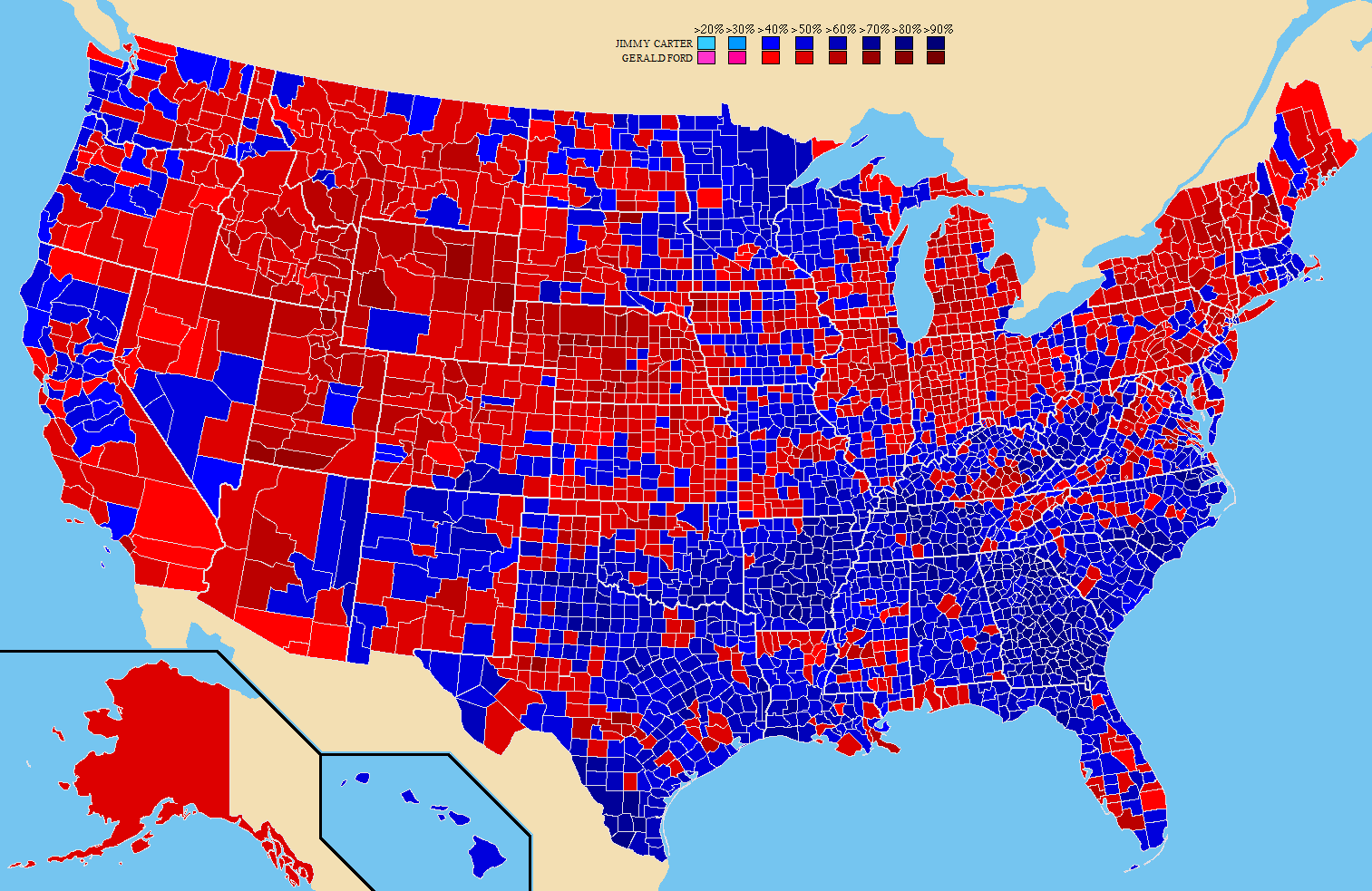
    The 1976 presidential election is probably the best microcosm of this shift. George Wallace and Jimmy Carter were the two Democrat frontrunners in the primary. Wallace was the last gasp of the Dixiecrat contingent, and Carter was the compromise candidate. Carter was a northern elitist in a southern peanut farmer’s body. Carter won out, and the last nail was placed in the Dixiecrats’ coffin. The more erudite and cosmopolitan boomers were the main force in politics. However, they didn’t just magically flip to being Republicans. Party identification doesn’t tend to flip on a dime, and you can see that there are only a few Republican cracks in the Democrat southern hegemony in 1976. However, these were votes for a Democrat that was, by lineage, style, and heritage, a Southerner, but by ideology a northern elitist. The southerners were holding their noses and voting for a progressive because voting Republican was out of the question.


    You can really see the death of the dixiecrats when you compare 1976 (above) to 1968 (below) where Wallace swept the south and Humphrey swept the northeast. Note that in the 1968 map, all of the states in blue and orange were won by Democrats in spite of there being two Democrats on the ballot in the general election (Yes, technically Wallace was an Independent).


    File:ElectoralCollege1968.svg


    Anyway, all of this has a point. The northern elitist bigots never went away. The dixiecrats died off and the southern boomers voted Republican in large numbers in the 1980 election, but the huge contingent of new england Democrats didn’t go anywhere, and became entrenched in positions of power. They were elitists, and thus they became elites.

    Through the 20th century, the northern elitist progressives carried with them the identitarian philosophies that flowed from Marxism (class conscious reality morphed into critical theory, feminist theory, etc.), and in true leftist fashion, the target of their ire settled on their idiot political bedfellows, the dixiecrats. It was just happy chance that the “backwards hillbilly bible thumper” stereotype was shifted over to their rival party when the southern boomers revolted en masse in 1980. The progressives also did a pretty damn good job of making the dixiecrats’ perception of racism carry over to the GOP, too. However, the progressives had been undergoing their own changes in the middle of the 20th century. They quickly recognized that the civil rights movement was exploitable and they sloppily cut and pasted their “working class oppression” schtick from the 20s and 30s onto the civil rights struggles in the 60s and 70s. Scratch out “Irish” and replace with “black”.

    Those roots they set in the civil rights movement didn’t strip away their eugenic, bigoted foundation. They are and have always been elitists who only see the world skin deep. They will do and say anything to have the cultural upperhand, and they’re not above stoking racial tension, sexual tension, or any other difference between people to cause the public to give them social power.

    Jussie Smollett may not be aware of the history of the progressive movement, but he’s influenced by it. He’s the latest to throw himself on the sacrificial pyre of identitarian leftism, and the frothing mob that backed him up is the culmination of 100 years of work by the American progressive left. The prevalence of bigoted identitarian strife seemed to be tailing off through the 80s, 90s, and early 2000s, but the progressive left, which was dealt a massive blow in the 1980s with the near extinction of their fellow traveler dixiecrats, has recovered to national prominence in the past 15 years by rebuilding a coalition of identitarian groups of all stripes, all deluded under the Marxist lie that their truth is in their identity.  Bigotry is back, and it’s likely going to stay for a while.

  • SOTU Open Thread

    It’s going to be the best.Bigly speech. Not for losers. Comment so I can remember. I’m timing my second handle of vodka to start at 9pm.

  • Political Daydreams Part II: The Great Divorce

    Let’s assume that nothing in Part I worked, and we have one group of people bound and determined to rule another one.  In order to prevent a shooting war, we agree to split the population apart in such a way that prevents authority from being exerted across some new boundaries.  How do we do this?  Here are some ideas.  Again, like the previous this is mostly to inspire creative ideas or at least entertaining arguments among the Glibertariat.

    Ideas 1-4:  the various sorts of “-exit” scenarios that have been floated before, which you don’t need me to reiterate here.  Free Cascadia!

    Idea 5:  Matched Cal- and Texit.  California and Texas are simultaneously split off into their own countries, The Democratic People’s Red Star Commonwealth and the Second Lone Star Republic.  If we wanted to be complete dicks about this, we would draw the boundaries starting at the state line, but retaining adjacent counties that wished to remain part of the Untied States.  A set period of time, say 20-50 years would then elapse, at the end of which time either of the two new countries could apply to rejoin the union or other states in the US could apply to TNCOTB.

    Idea 6:  The rise of the City-States.  When a municipality reaches a certain population, it can build a wall along its boundaries and be granted self-rule.  At that point, the residents of that city-state cease to have voting rights in state and federal elections.  The HoR seats would also be re-apportioned.  The City-State status could also be imposed by a plebiscite of the non-city state residents with some sort of overwhelming majority (2/3 at least) being required for passage.  I actually kind of like that idea, since the Great Divide here seems to be less geographic, and more urban/rural.  I also like the idea of Escape from New York and Escape from LA being things that would actually happen.  But mainly I like the idea of the population centers having to deal with the agricultural people as equals rather than simply imposing their desires on them from mere dint of numbers.

    You may now begin to tell me what an idiot I am.

  • On changing one’s mind

    Artist's represantion of a political debate in a Romanian pub after circa. 8 beersA long time ago, humans invented language. This may or may not have been a good idea, but it is here now, the damage is done, there is no going back. So what do we do with it? Talk nonsense and get very worked up about it. This is sometimes called a debate, other times a shouting match. Whenever a debate is on, let’s say for the sake of this article about politics, there can be more than one purpose in theory, but that is rarely the case in practice.

    In theory most people debate to win, to either change the mind of the opponent or persuade the audience of something. In practice, many people debate because it is in their nature to do so, with little expectation of achieving anything.

    If applied properly, a debate can be useful beyond changing other people’s opinions.  It can help one with their own doubts or uncertainties, be a good way to go through some issues, clarify some things and even reach a conclusion. When I am unsure of something, a conversation in which people take multiple sides can help. This only works when people debate in good faith, and this can occasionally happen for example on glibertarians, where people are generally overall agreeable to each other, even though they may differ on some issues.

    Across the aisle, it is different. Most conversations between side A and side B are rarely in good faith. Both sides convince themselves the other side are stupid and evil, and are quite satisfied with this results, because that was what they wanted to get out of the debate anyway. Scream a little and go away thinking the other is an idiot. Can this be changed though? Honestly, I doubt it. One of the main issues is that people differ in fundamental values, and this is unlikely to change. Most of these values, usually of the moral kind, are not based on reason or argument, and as such will not be changed by those means. Furthermore, people get very angry when their base values are questioned.

    People seem set in their ways, and opinions are not different. In controversial conversations, I rarely see people listen carefully to the entire argument made by the opposite side and then try to give a appropriate answer. It is not that they are not convinced, they don’t really try to listen and process it. You can see their eyes glaze over and then they give a standard counter response, as if reciting from rote learning. Why this is the case, I do not know.

    This got me thinking, after a few debates with friends on the left and right. Is it possible to change my mind at this point, and if so how I include random immages so there is not to much textmuch? Can I have minor changes on my views on one issue or other or can I even fully reconsider libertarianism in favor of social democracy? For good or bad, I think the answer is yes to the former and a clear no to the latter. Some say: well you must be open to change your mind… well I am open, I just do not see that happening. I am, after all, people.

    For one thing, among my fundamental values you will find individualism and individual liberty. You cannot have an argument to make me turn collectivist – especially since I find it quite objectively true that humans are unique individuals not an eusocial group. For another, I did not reach my opinions lightly, I have spent a long time reading, writing and thinking about it, and if that process led me here, I cannot see what could lead me in another direction. I have not heard, for what must be years now, a new and different argument, from either left or right. So if old arguments did not convince me, and no new arguments appear, can there be a way to change minds?

    Of course others may say those exact same things, but with the vast majority of people I met I easily come ahead on knowledge of the issues, of history, economics, political philosophy and the like. Most people I ask know very little which they did not learn on the big TV network programs. Most people cannot tell me of a topic they spent multiple hours thinking about. Most have not tried to write 10 coherent pages on why they believe what they believe to see if it makes sense. Most say things that can be proven wrong by a 30 second google search.  For whatever all this is worth, I feel I can be more assured of my views.

    Changing is even harder for a proponent of deontology. Consequentialists  may sometimes be swayed by proving that their desired outcome can be better achieved in another way. A deontological socialist or an-cap will not be swayed in any such argument. Fiat iustitia pereat mundus, if you will. I am not quite like that – I have made the case for a certain small dose of pragmatism and I think this goes for most people, which have a preferred outcome. So there will maybe be some wiggle room in a debate, but overall not that much. In the end, most are not 100% utilitarian or 100% deontological, but each has core values – which I cannot see as being anything other than deontological – which are hard if not impossible to change.

    I, off course, believe that my fundamental values come from a place of reason. Do others believe the same? I would say most – with the exception of people who get everything from religion – strongly claim they do, although in the end many seem to me to appeal to emotion a little too often. I believe my conclusions, beyond fundamental values, also have reality and logic behind them. So do many others.

    You would, don't lie...

    There are plenty of people on the internet who write about “how to win debates”, but I saw little evidence this actually works. Yes, some politicians convince people to vote for them, but I am not sure that it is more than being disliked less than the other side and little to do with changing fundamental opinions of people. Opinions do change, off course, but it is usually due to multiple years of personal experiences eroding one belief and replacing it with another, not after a two hour talk. In the end, in many a democracy, you have a majority of people voting sort of the same and a small central group which swings both ways. So the debate issue boils down to: how to get the undecided to vote for you this one time.

    If you are not running for office or making a living as a pundit, I really am trying to see the point of it all. In my experience, people cannot even start from a basic foundation of fact, as people do not agree to the facts. If we have a pencil on the table, A sees a cup and B sees a glass, what can be debated?

    This is another one of my thought pieces which, in the end, has not much of a conclusion. It is one of the things that I classify in the category: if it were possible, the world would be different right now. But I still find the question interesting: to what point, fellow glibs, do you think a series of arguments would change your mind? Can you learn to stop worrying and embrace Ocasio-Cortez? Discuss.

  • The Wall

    I personally did not watch President Trump’s address.  As it turns out, Tuesday is a gym day and I was not going to watch it anyway.  A physical impediment strikes me as a foolhardy expendeture because where there is not a long stretch of desert, a mountain range, a wide river patrolled by Texans, or generally something else that is going to kill you before you reach civilization, there is already something there.  I travel to Mexico at least twice a year, believe me the fence is already there.  This is entertaining to watch however, as the amount of money they are quibbling over is a trifle compared to the overall federal budget.  While the effectiveness of a wall or fence is debatable, the amount of money is small enough compared to budget to not matter yet large enough the average person will never see in their lifetime.  I also find declaring a national emergency to fund it as a needless power grab, that will bite team red in the ass later on.

    That said, the winner of this wins in terms of optics only.  Personally, I think Trump is going to get the funding or something resembling it for two reasons:

    1 – Unfortunately, government employees are a team blue constituency…

    OBEY

    2 – While the jokes on social media centered around the team blue response being akin to Bond villians or your parents staying up to yell at you because you came home after curfew….for me something else came to mind.

    The loser in these things always seems to be the one that looks like the bigger asshole and lets face it, Trump is blessed by his enemies.  As much as I dislike the 33 dimensional chess argument, one might ask why did Trump not try to pull this before?

    What? Pull this on Paul Ryan, and be the bigly man that kicks a puppy?


    This is my review of Clown Shoes Brewery North of Sonora:

    This reminds me of a story…

    In the beginning, there was the Treaty of Guadalupe-Hidalgo, this marked the end of the Mexican-American War and resulted in the map looking almost like it does today with one exception.  Due to lobbying efforts from the railroad industry; because of the Gadsden Purchase in 1853 the map now looks like it does today. I spoke of this before; it is when my family became American but this story is not about me.  This story takes place on August 27, 1918 and is called the Battle of Ambos Nogales.

    You think the border is open now…

    Prior to this incident, Nogales was a single town between two countries, and today in a sense it still is.  Back then though there was no fence.  There was a street called la Calle Internacíonal or International Street with the exact border being marked by an obelisk.  I have driven on it myself, and crossed it more times than I can remember.

    At the time US Customs allowed residents of Nogales, Son to walk across the street and purchase food and other goods from Nogales, AZ.  Tensions between the two countries became strained due to the Zimmerman Note.  You might recall that from your American History class.  The conspiracy was Germany wanted to bring Mexico into the War against the United States. Hopefully, by the time this article goes live that link comes without the disclaimer about the government shutdown… To account for the frequent crossings, US Customs issued passes to residents of Nogales, Son.  The Mexican government also followed suit resulting in a confusing process—to cross the street.

    This incident began when…

    […]a carpenter named Gil Lamadrid was walking back into Mexico. As he crossed the border, a U.S. Customs Inspector ordered him to halt, curious about the large parcel he was carrying. Only a few feet away, Mexican customs officers directed him to ignore the summons and continue into Mexico. Gil Lamadrid became confused and hesitated as the two competing groups of customs agents shouted instructions to him. At this point, a U.S. Infantryman raised his Springfield rifle to encourage his return. In the midst of the ensuing commotion a shot was fired, and the carpenter dropped to the ground.

    Thinking that the man had been shot, a Mexican Customs Officer grabbed his pistol and opened fire on the U.S. guards, wounding an army private in the face. A U.S. Inspector drew his revolver and returned fire, killing two Mexican Customs Officers. Shaken but unhurt, Gil Lamadrid jumped up and sprinted down a nearby street. As the sound of gunfire rattled the neighborhood, citizens on the Mexican side of the border ran to their homes and picked up rifles to join the Mexican troops

    …and hillarity ensued.

    In response, the famous 10th Cavalry was deployed to the town….where enlisted were not allowed in a few establishments in Nogales, AZ.  If you ever go to Nogales, you will notice it is sprawled across several hills.  Perfect for guerilla warfare.  A white flag was eventually raised on the Mexican side of town around 5:45 PM but shots were still fired until 7PM.  It resulted in the death of the mayor of Nogales, Son who attempted to stop the violence by walking on International Street with a white hankerchief tied to his cane to plead with both sides. Him along with 129 other Mexicans and 4 Americans.  With an additional 330 wounded.

    Later both sides decided the only way to keep this from reoccurring was to separate both sides, and other towns quickly followed suit.  At the cost of what was then, $5000 ($80,250 today), a fence was errected between two sides of a town split between two countries.

    Paid for in part by Mexico.

    Now this beer is interesting because it is flavored with agave.  Making it rather sweet, too sweet perhaps but they call it a porter so it sort of works.  There is also some vanilla worked in there somewhere and it is aged in rum barrels resulting in something you will want to share with somebody else, a neighbor perhaps, so you at least are not alone in the experience.  Fitting, but given the price tag one that I am not likely to buy again.  Clown Shoes North of Sonora: 2.9/5.