Category: Food & Drink

  • Secret Squirrel

    I recently took a short road trip to California…sorry, I didn’t try to light it on fire or anything.  I was there for a wedding.  Fortunately for me I managed to squirrel away an hour or so to meet up with another Glib to administer each other a Turing Test.

    This is my review of Smog City Saber-Tooth Squirrel Amber Ale (H/T:  Jesse.in.mb)

    With such a freakish label, this was a interesting gift considering the typical Glib’s fear of squirrels.  Fear not!  This gets better.  I actually misread it at first thinking it said “Secret Squirrel.”

    “Secret Squirrel” is a slang term.  It is one of those phrases that comes up from time to time that brings a small chuckle, because seriously how we make up words and phrases like this and give it random meaning?

    Slang has a bad rep; gets a bad rap. Negative value judgments: “sub-standard,” “low,” “vulgar,” “unauthorized”. The word we are seeking is street. Street as noun, more recently street as adjective. The vulgar tongue. The gutter language. It’s a truly man-made language. Women are objects, never subjects. Maybe it’s not just the street but that corner where the guys hang.

    Slang has a story, and that story has universal themes. Slang’s thematic range is not wide, though its synonymy runs very deep, and one can see the same ideas recurring from classical Greek and Latin onwards. Even if the individual terms that make up the vocabulary may be dismissed as “ephemeral” — and more stay than disappear — the persistence of these themes ensures that slang lasts.

    That totally doesn’t answer my question, and since it’s Huffpo I don’t blame you for skipping that link altogether.  Now my English teacher informed me this type of speech came about in small communities, often as technical jargon.  While this is true to a point, slang terms as part of language was developed in the 16th century among gamblers, in saloons, and among people that were otherwise deemed criminal. This led to the discouragement of such terms among academics and the elite, because of its association with societal miscreants.

    “Secret Squirrel” of course, means something that should be kept secret, like basic mission plans, troop movements, flight schedules, and the like.  I like to think the origin is from Ill Will Press, where the character Foamy the Squirrel partakes in missions to spread his squirrely rage among things he hates the most…like Starbucks.  Foamy is hilarious.

    Nope, its origin actually dates to the first Gulf War:

    Secrecy was vital for several reasons. The Air Force wanted the CALCMs to be a complete surprise if they were ever employed. Also, externally, the AGM-86Cs were almost indistinguishable from their nuclear counterparts and might, if revealed, derail or at least complicate pending arms control agreements with the USSR. Lastly, only a few GPS satellites were in operation in the late 1980s and an enemy, knowing when the satellites would be in position, might also know when to expect the missiles and thus when to prepare for them.

    Flight testing began in August 1987, and a year later the CALCM was declared operational. More than three dozen were put into storage igloos at Barksdale, where they waited for three years.

    When Iraqi forces rolled into Kuwait on August 2, 1990, US forces in the region were few and certainly not up to the task of repelling an invasion of Saudi Arabia.

    The CALCMs were unsheathed. “We stood them up on alert because we were trying to give the national command authorities some options,” recalled Lt. Gen. Buster C. Glosson, one of the Persian Gulf air war’s chief architects and targeters.

    Air Force leaders advised the National Security Council that CALCMs were available to send against Iraq’s command, control, and communications nodes, its electrical grid, and other high-value targets, all within a day’s flying time.

    “We wanted to give them a capability, even though admittedly it was limited,” General Glosson said, “because at that point in time there weren’t that many other options available for any action the President might have wanted to take.”

    Because of the limited number of CALCMs, and the inability to follow through immediately with a wider air campaign, the weapon chiefly offered a chance to make “a political statement” rather than deal a crippling blow, General Glosson said.

    Lt. Col. Jay Beard, commander of the 596th Bomb Squadron, was ordered to get ready. Access to the CALCM had been kept “to an absolute minimum,” Colonel Beard said. Only one crew–which had flight-tested the weapon–was available to operate it. More would be needed to carry out the kind of strike Strategic Air Command had offered the White House.

    In just a few weeks, fifteen crews were introduced to the “Secret Squirrel,” a moniker picked because “we couldn’t say the real code name [“Senior Surprise”] out loud, and it had the same initials,” noted Maj. Steve Hess, chief weapon system officer for the unit.

    TL/DR version:  In the late 80’s the Air Force shoved a cruise missile into a B-52, and decided to drop them on strategic targets in the opening days of the war.  Knowledge of the project was kept to a minimum number of people.

    The sad part is as I looked into this, I found blurbs of an old cartoon by Hannah-Barberra.

    Is this beer any good?  Of course it is, but not just because it was a gift.  It is an amber ale.  It had been a while since I had an amber since it is somewhat out of season in Arizona and I simply was not interested in picking up Fat Tire.  This one is overall balanced to the hoppy end of the spectrum, but not overpowering.  If it is available in the area, I highly recommend it.  Smog City Saber-Tooth Squirrel Amber Ale:  4/5

  • I Can Pickle That!

    Summer is coming. I think there is nothing better than an icy cold martini on a hot summer evening. What food goes well with a martini? Something pickled! I love a plate of cheese and crackers with an array of pickled fruits and vegetables to accompany my martini.

    Everything I’m going to discuss is a refrigerator pickle, not canned. They aren’t shelf stable and need to be kept in the refrigerator. This means you are free to experiment.1 I have read hundreds (literally) of pickling recipes in an attempt to come up with a base recipe that you could riff off of and create your own recipes – much like dressing is a 3:1 oil to vinegar ratio. I cannot claim that I have defined one from my investigation. The recipes are all over the place. Some have no salt or no sugar. Others use lots of sugar, but no salt, some use lots of salt and no sugar.

    Michael Ruhlman in Ratio says a brine should be a 20:1 ratio of water to salt (2 ½ cups water to 2 T Morton’s kosher salt) and he uses it for some fermented style pickles, though not refrigerator pickles. Tamar Adler of An Everlasting Meal gives several suggestions. First, she says you can use nothing but vinegar and salt. For a brine, she suggests using one and a half times as much vinegar as water and for every four cups of liquid, add ¼ cup salt and ¼ cup sugar and simmer until they dissolve. Or, don’t measure and adjust the salt and sugar until you like it (Chapter 18). I find her suggestion a little too sweet and salty, so I adjust. The goal is to help you understand the techniques used.

    In general, for the kind of pickles I’m talking about, you need vinegar, water, salt, sugar and spices. For my experiments, I use 1 cup water, 1 cup vinegar, 1 tablespoon each salt and sugar. Then add additional spices depending on what you are pickling and your own tastes. It is easy to scale up if necessary and I frequently adjust the level of salt or sugar.

    I have used this to pickle cherries by adding cinnamon and cloves. Pack a clean jar with pitted cherries. Put the vinegar, water, salt and sugar in a pan, add a cinnamon stick and a teaspoon of cloves and bring to boil (for the basic brine – scale up as necessary). Once the brine is boiling, remove from heat and pour over the packed cherries. Make sure all the cherries are covered with the brine. Let cool uncovered to room temperature, then cover tightly and store in the refrigerator. They are ready to eat after sitting overnight (12 hours). I love them with duck or tossed into a salad.

    I’ve used this basic brine with cauliflower adding onion and a few sprigs of fresh thyme. I put the onion and thyme in the jar with the cauliflower and poured the basic brine over it. Again, cool to room temperature then close tightly and put in the refrigerator. They were crunchy and made an excellent addition to salads (as well as just eating them with a martini) or alongside fish.

    The next few recipes all come from someone else, but are ones I really like. They also show the wide variety of pickling recipes. I will note that when I follow the recipes, I don’t often have enough brine. In those cases, I just top up the jars with vinegar. What I hope you learn is that there are many ways to make pickles. Each recipe is done in a different way.

    First, are pickled carrots. I have this recipe written on a card and have no idea where it came from. I cut the carrots into matchsticks and slice onions thin. I pack them into a quart jar. Then, I toast 1 T mustard seed, 2 t coriander and 2 t black pepper corns. Then I add the brine ingredients. The brine is 1 cup apple cider vinegar, 1 cup water, 2 T kosher salt and 3 T sugar. Bring that to a boil, stirring to make sure the salt and sugar dissolve, then pour over the carrots. Cool to room temperature, then cover tightly and store in the refrigerator. I use them in fish tacos or serve them with pork chops. These are addictive and I make them frequently -they should last for up to a month though mine never last that long because I eat them a cup at a time. I also make smaller recipes and eat them, so that I don’t have to worry about getting bored. I’ve also used the leftover brine in place of vinegar in salad dressings. Works really well.

    Oscar disapprovingly notes, “I cannot eat that.”


    My pickled mushrooms recipe comes from the Washington Post. These are supposed to sit in the refrigerator for a week before eating. I never make it – day 5 I’m eating some of them with a roast chicken, a steak, or just on their own. The recipe says they will last for several months, but again, mine don’t last that long (though I usually only make half a recipe.)

    Next are pickled grapes. The recipe comes from Simple, Fresh, Southern by The Lee Brothers. I enjoy these because they are sweet and spicy. I’ve given them to a neighbor who used them in martinis instead of an olive. I toss these in salads and also serve with roast pork. The recipe is 6 cups mixed red and green seedless grapes (I just use red), 2 cups of white vinegar, 1 cup of water, 2 tablespoons kosher salt, 2 teaspoons sugar, 3 cloves of garlic, peeled and crushed, leaves from a four inch sprig of rosemary, ½ teaspoon crushed red chile flakes.

    Pack the grapes into 3 pint sized glass containers with lids. Put water and vinegar into a sauce pan, and add the salt, sugar, garlic, rosemary and chile flakes. Heat to a simmer, then remove from heat and divide among the three pint sized containers. Cover loosely and let cool to room temperature. Then cover tightly and store in the refrigerator. They are ready to eat after an hour in the refrigerator. Keep for two weeks if they last that long.

    The last recipe I want to discuss is pickled apples. This recipe comes from the apple council and I don’t have a link. Served with cheddar cheese (and a martini), these are awesome. I’ve also laid pickled apple slices on top of a pork loin for the last ten to fifteen minutes of cooking. This recipe is different in that you don’t heat the vinegar mixture. Tamar Adler of An Everlasting Meal suggests just putting vegetables into leftover brine from pickles or capers and letting them pickle, so this is similar to that idea.

    Use 1 English cucumber (unpeeled), sliced thin and tossed with 1 tablespoon salt. Let sit for 20 minutes, then rinse and drain. Meanwhile, core and slice thin two apples (unpeeled), 2 medium shallots (or ½ red onion) and 1 jalapeno pepper, sliced crosswise. Whisk together ¾ c apple cider vinegar, 1 cup water and ½ cup sugar (I use ¼ cup). Add a cinnamon stick and a star anise pod to the vinegar mixture and pour over the apples, shallots and jalapeno. Add the cucumber and toss. Let sit for 30 minutes and serve. Keeps in the refrigerator in a tightly covered container for two weeks. These are great on sandwiches. I’ll also note that when I haven’t had a jalapeno available, I’ve substituted crushed red pepper flakes.

    I hope the recipes I’ve shown here demonstrate the wide variety of things that can be pickled and the wide variety of pickling brines that can be used. I’ve also given you a few basic brines to use for experiments. I hope this inspires you try pickling vegetables or fruit. I can imagine using a basic recipe to pickle peaches with habanero peppers, or green beans with some marjoram and garlic. Much like salad dressings, pickling fruits and vegetables is an opportunity to experiment and be creative. There aren’t any wrong answers, just make what you like.

    —-
    1 If you find a canned pickle recipe you like, you can use it for refrigerator pickles. You can’t go the other way. Don’t screw around with canning recipes. Botulism doesn’t make you sick; it makes you dead.

    “Wait. Why did you wake me up?”
  • Fitting, given the Mexican holiday

    …but you guys are alright, don’t ever let anyone tell you otherwise.  In light of yet another passing of a holiday in Mexico that seems to be celebrated more in the United States because it is a convenient marketing pitch for companies selling tequila, tortillas, Ford pickup trucks, etc.

    This is my review of Modelo Chelada

    Why on God’s Green Earth did I drink this?  Somebody here was yammering on about it for a couple days and probably thought he was being ignored.

    Then he/she/xe/ did it again the next day to a much less…tepid response.

    I assure you, just because something is terrible does not mean it is fake.

    What is this crap anyways?  Chelada, or Michelada is a popular Mexican drink.  The difference being that Michelada contains spices and chilli.  No spices and chillies are not necessarily the same thing, but that is another matter for another time.  Chelada is simply beer served in a chilled glass, with lime, and a salt rim like a Margarita.  I decided this would be less nauseating than the Michelada in a can.  If you want to actually have a Michelada or a Chelada cocktail, might I suggest actually making the cocktail, which I leave the below recipe:

    Ingredients

    – 2teaspoons honey (spread into a thin layer on a plate)
    – 1/4cup kosher salt
    – 1/2teaspoon smoked paprika
    – 1/8teaspoon cayenne pepper (optional)
    – 2limes (juiced, plus extra lime wedges to garnish)
    – 2cups beer (light Mexican)
    – 2 1/2teaspoons worcestershire sauce
    – 2teaspoons hot sauce (preferably a more vinegar based hot sauce such as Tabasco)
    – 1teaspoon low sodium soy sauce
    – 1/2jalapeno (seeded and diced, optional)
    – cracked black pepper (freshly)
    Directions:
    1. Dip the rims of two glasses into the honey. (you want only a very thin layer)
    2. Place salt, paprika and cayenne (if using) onto a plate and stir together with a fork until combined. Finish rimming glasses with salt mixture, fill with ice and set aside.
    3. Fill a large shaker partially with ice followed by the remaining ingredients, except for the jalapeno. Close and shake until well mixed. Divide mixture among the two prepared glasses and finish with lime wedges, black pepper and jalpaenos (if using). Serve.

    How is it in cans?  Well to be honest I might be inclined to buy Modelo in the tall can again in the future, but not necessarily the Chelada version.  It’s more or less like the abominable lime in the Corona thing that everyone seems to think is fashionable.  Seriously, it’s just beer and lime, and adding salt tickles the salt receptors on the tongue.  No, this is not urine.  Stop telling yourself that.  No, this does not exist because there is no potable water in Mexico.  The totality of slightly palatable seawater mixed with beer and lime leads me to believe this has to be some kind of awful trick played on Gringos.

    Indeed it is. Modelo Chelada 1.5/5


  • Back to Beer!

    Easter passed.  I can drink beer now.  But of all the beer on Earth I can now drink, which should it be?

    This is my review of Guinness Milk Stout.

    Yes you read that correctly, milk stout.  One of the first things I discovered in Ireland was Guinness makes an entire line of beer for sale all over Ireland.  The actual first thing I discovered?  Not every toll booth on the M50 has a human working in it, so should you find yourself confused by road signs in English and Gaelic, and at a toll without a human…have exact change.  The second thing I discovered?  Not a single Dubliner honked waiting for my wife to dismount and walk over to a booth that could give us change for €20.   None.  They didn’t care.

    WTF does that say?

    As far as others I got a chance to sample…

    O’hara’s  leann folláin (left).  No idea how that is pronounced and I am glad I found this one.  I got it at a supermarket in Clontarf near the hotel I was staying at. They do make a barrel age version, but since I don’t recommend paying Irish taxes I went with this one.  Traditional Irish dry stout, like Guinness but overall has a more complex maltiness.  Seems to be made with more regard; I highly recommend. 4.2/5

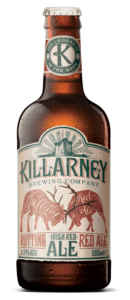
    (right)Next stop was in Killarney where I spent the next couple of days.  I found this at a local pub where I discovered they play a version of soccer with their hands.  This was pretty solid, but not anything to write home about.  Killarney Irish Red. 3/5.


    Hop House 13.  Made by Guinness.  This is pretty much everywhere in Ireland, and they do a good job of making sure you are aware it exists.  Ever had Spitfire?  Its like that.  Apparently everything Guinness makes is made with their coveted in-house yeast, which makes for a lager that is mostly confused given that Guinness is an ale.  Its a translager. 2.5/5

    Later I moved up to the North where I had the aforementioned Carlsberg Unfiltered.  Belfast is pretty cool, but not surprisingly struck me as a rough town.

    Finally, returned to Dublin where I picked up a couple of stouts at the airport because exchanging Euro to Dollars sucks.  I just didn’t think the Czech girl was going to open it for me at 0745.  If this brings to mind their infamous foreign export stout, this lives up to the hype. Guinness West Indies Porter 4.7/5

    Which meant I was saving the milk stout for when I got back home.  I wish the Czech girl at the airport opened this to be honest but it’s still pretty good.  Sweeter than regular Guinness and doesn’t hide behind a mountain of nitrogen fueled foam.  Guinness Milk Stout:  4/5

  • Lets play a game…

    I’ve been stationed in a few places while in the service, and my favorite  station was in Colorado.  Most likely because I left there a few months after they passed that ridiculous magazine law.

    This is my review of Wild Tonic Mango Ginger Kombucha

    What?  I’ll get to it.

    What piqued my interest in this was the multiple County Sheriffs in Colorado that openly denounced the new “Red Flag” Law law that went into effect recently.  While I was living there, the then local sheriff, Terry Maketa of El Paso County, declared the magazine law unenforceable and refused to even try.  As for the new law, per the Colorado Springs Gazette:

    The Democrat-sponsored law allows family, household members or law enforcement to petition a court for an “extreme risk protection order” (ERPO) to have guns seized from an owner if they believe he or she poses a threat to themselves or others.

    The gun owner will be given legal counsel and a hearing within 14 days to determine if a longer-term order should be put in place for up to 364 days. The court can order a mental health evaluation, as well as mental health treatment.

    The bill places the burden of proof on the gun owner to prove that he or she no longer poses a risk in order to get the firearms back.

    The law allows courts to start accepting requests for ERPOs on Jan. 1. In the meantime, the state Police Office Standards Board, which is under Weiser’s office, along with chiefs of police, are working on policies for law enforcement in how to implement the law.

    Let it be known that due process and presumption of innocence no longer exists.

    So we’re going to play a game called, “Gun or Cellphone?”  I scour the internet for creep-shots of people that might have a cellphone…or a handgun, but which one can it be?  I leave it to you to decide…

    Why would it matter?  Unlike the Colorado legislature all of us here are aware that no law is just going to magically make the guns disappear, and are aware of the utter lack of statistical likelihood the person next to you is mentally insane insane enough to murder everyone in the room.  We’re also much more aware if the FBI crime statistics that suggest the overwhelming number of murders with a firearm are handguns, so it seems more relevant.  So lets play…

    #1 Gun or Cellphone?
    #2 Gun or Cellphone?
    #3 Gun or Cellphone?
    #4 Gun or Cellphone?
    #5 Gun or cellphone?
    #6 Gun or cellphone?
    #7 Gun or cellphone?
    #8 Gun or cellphone?


    #9 Gun or cellphone?

    I don’t have an answer key…

    I should warn you about this kombucha—some of the offerings from this brand are 5.6% alcohol which means this MAY be good for stealth day drinking.  Even though those are clearly labeled, the nannies at the Glibertarians.com legal department wished me to put up the following disclaimer:  drink this at work at your own risk…

  • My First Time

    It was 1998 or so, I can’t place it exactly.  My friend B worked for a company with a client in Southern Indiana.  He heard from some co-workers about this place with really good pizza and an unheard of beer selection.  As a fan of craft beer, such as it was in Kentucky at the time,  it sounded like a place worth the trip.

    Before the rest, here is a little backstory, as best as I understand it.  There was a sports bar called Sportstime Pizza.  Not a creative name, but it was exactly what it was.  They served the expected BMC beers, in regular and light versions, along with a better pizza than you would expect.  Their specialty was a deep dish that is closer to Detroit-style than Chicago-style, but not quite that either.  Let’s just call it New Albany style pizza, because I have never run into exactly it anywhere else.  The son-in-law of the owner convinced the father-in-law to let him open the space next door in the strip mall.  They would share the kitchen and the new place would serve craft and foreign beers.  At the beginning, they served Bud, Miller, and Coors, but never light beer.  Or Lite.  There wasn’t much at first, I think for the first month Guinness was the only option.  But by the time of this story, Rich O’s, as the place was called, had an extensive list of American craft and foreign beers, on bottle and on tap.  A death and a divorce later, the two daughters and an ex-husband would combine them into one name, New Albanian Brewing Company.  But everyone still calls the two sides Sportstime and Rich O’s.

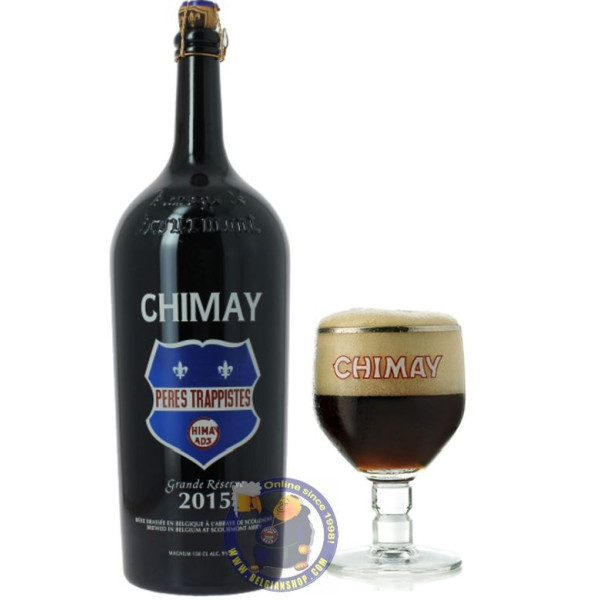
    Back to the story, as I knew none of that at the time.  I was enjoying good pizza and good beer, trying some beers I had never had before, but in styles that I was comfortable with.  I wasn’t pushing the envelope.  My friend and I ended up in conversation with the two very drunk guys at the next table.  That were drinking beers from wine-sized bottles.  They had gone through at least a ½ dozen bottles between them.  They were regulars and were leaving the next day for a hunting trip in Canada to hunt beer or moose or elk or something.  When they discovered they neither of us had ever tried Belgian beer, they bought us a bottle of Chimay Grande Reserve.


    That night, my life changed.  I had never tasted anything like that beer before.  Learning more about beer, trying everything I could, homebrewing, starting a brewery, all these events could be traced back to that night.  Chimay Blue will always be one of my favorite beers.  If you want to tell me that St Bernardus ABT 12 is a better beer in that style, I won’t argue with you.  It might even be true.  I have never had Westy, but most who have say it is better.  But those beers don’t have the history.  There isn’t an emotional attachment.

    I don’t know what happened to these guys.  B and I have joked over the years that they were eaten by bears.  I do know we never saw them at Rich O’s again, as often as we were there.  They may have gotten a DUI on their way home and never made it to Canada.  Lots of possibilities.  But whenever I drink a Chimay, as I did while celebrating my 5th wedding anniversary recently, I think back to over 20 years ago, and toast them with my Chalice.


  • Can of Whoop@$$

    My oldest son asked to try his hand at baseball about a month or so ago. He’s a bit awkward with a lot of the fundamentals but he’s new at it.  I was never great at it either, so I was surprised when the coach asked me to assist.  The other day one of the other players asked me a question:  ”What does your shirt say?”

    ”It says, This shirt is made from four plastic bottles.”  It was a souvenir I bought at Coca-Cola World in Atlanta in the 50% off bin that I thought was a fun conversation piece.  The polyethylene (PET) that made up the Coke bottles was simply repurposed for polyester.  It was and is in essence, a regular t-shirt.

    This is my review of Dark Horse Pinot Grigio.

    Recycling has been in the news recently.  The bottom line up front is that nobody is willing to purchase garbage anymore.  When local municipalities offer recycling services, like my hometown of Phoenix, they simply have the homeowner separate “recyclables” from bulk trash as a first step.  Then a contractor sorts it further and “disposes” of it.  What they were actually doing of course, was turning garbage into gold:

    Recycling is the globe’s bizarro commodity, created by the richest people on Earth and sold to the developing world. Like all commodities, its price reflects a staggering string of interconnected happenings. Your 2011-era empty Coke bottle wasn’t just worth a lot because of high oil prices—it was worth a lot because Pakistan had suffered devastating monsoons in the summer of 2010. Flooding in the Indus River was one of a cascading series of events that sent cotton, in April 2011, to its highest nominal price since records began in 1870. Jeans were going to be more expensive, Levi’s announced. And so, it turned out, was recycled PET plastic, because for Chinese manufacturers of articles like teddy bears and blue jeans, polyester fibers made from old plastic bottles were a cost-effective replacement for cotton. Cotton was up; plastic was up; recycled PET prices went up. As when cotton hit its previous high price in 1995, the scramble was on for old bottles. Which you, American reader, the world’s leading consumer of soda and bottled water, had in spades.

    That is until 2017, when China announced it is no longer purchasing the world’s trash.  So where have all the empty bottles gone?

    Nowhere.  Some cities burn it, some put it quietly in landfills, but mostly it is all just piling up.

    As the trash piles up, American cities are scrambling to figure out what to do with everything they had previously sent to China. But few businesses want it domestically, for one very big reason: Despite all those advertising campaigns, Americans are terrible at recycling.

    About 25 percent of what ends up in the blue bins is contaminated, according to the National Waste & Recycling Association. For decades, we’ve been throwing just about whatever we wanted—wire hangers and pizza boxes and ketchup bottles and yogurt containers—into the bin and sending it to China, where low-paid workers sorted through it and cleaned it up. That’s no longer an option. And in the United States, at least, it rarely makes sense to employ people to sort through our recycling so that it can be made into new material, because virgin plastics and paper are still cheaper in comparison.

    Which begs the question, if China never bought the sorted trash in the first place, would recycling ever be a viable endeavor?

    I of course do not have an easy answer as to what to do with this.  If I did I wouldn’t be here, I’d be off getting filthy rich.  Chances are pretty good somebody will figure something out now that there is an incentive to do so.  In the meantime if you want to recycle because it makes you feel good…okay go for it.  Otherwise a good way to find out if there is a market for you trash is to put it in front of your house like you would an old couch.  Put a sign that says, “free” on it and see if its there the next day.

    Need cans for cash, cash for alcohol research

    Chances are pretty good a homeless guy knows exactly what will still fetch a few pennies for recycling, and will happily take it off your hands.

    I bought canned wine with the intention of aggravating OMWC, but that didn’t work.  I’m going to have to make a quesadilla with some Manchego to do that.  The wine in a can is fruity, crisp, and has the ever so slight aftertaste of the epoxy liner to keep the wine from reacting with the 100% recyclable aluminum can.

  • Faith and Begorrah!

    "Climb in my pants, little fella?"
    Let’s make some corned beef.


    The Irish look at us celebrating St. Patrick’s Day and just shake their heads. And they sure don’t gorge on corned beef. Well, screw ’em.

    I had a small brisket in the deep freeze, so I separated the point from the flat and cured them separately.

    Corned beef did originate in Ireland but the history is complicated. “Corn” referred to the large grain salt the meat was preserved in. This was well before refrigeration and preserving meat in salt was a standard practice throughout the world. This is a pretty entertaining read on the history of salt.

    Most modern corned beef is wet cured in a brine solution but having done it both ways, I like the texture that results from dry curing. It also takes much less space.

    Okay, as we discussed with bacon, the amount of cure is critical to developing a safe product. I weighed out my two pieces and plugged them into the cure calculator on the Digging Dog Farm website.

    Next up are the seasonings:

    3tbsp black pepper

    1.5tbsp ground coriander

    .75tsp mustard powder

    .75tbsp brown sugar

    1.5tsp garlic powder

    1.5tsp onion powder

    Pepper and coriander were toasted and ground up. All the ingredients were combined, split in half and blended with the cure for each cut of beef. A note on quantities, this is roughly based on the weight of the meat. You can be creative here and do what you want. There are plenty of spice recipes out there on the Interwebs.

    Ziplock bags will work just fine for the curing process, but I find vacuum sealing works slightly better and the vacuum gives better penetration of the cure and seasonings.

    Each piece of meat is put in a bag and half the cure mixture is poured in on each side. *euphemism alert* You need to massage your meat well to get the rub evenly distributed. Seal the bag, getting as much air out as you can, if you’re using a Ziplock bag, mark with the date and toss it in the fridge. Flip it every couple of days and give it a little massage. I let mine go two weeks.

    When we reach the day of reckoning, remove the meat from the bags, rinse them well, trying to get as much of the rub off as possible. There will still be some leftover. Slice off a small piece and do a fry test. You’re looking for flavor and salt level. Any off odors or flavors, out it goes. If you’re going to continue on to pastrami and the fry test is too salty, you can soak it overnight in cold water. Dry the meat and toss in the fridge on a rack overnight.

    I decided to turn the flat into pastrami. After it had dried overnight, I rubbed it with a bit of whiskey, and then coated it with equal amounts of coarse ground black pepper and coriander. Then into the smoker at 240 on cherry, until it reaches an internal temperature of 200-205.

    For the point on St. Patty’s Day, I like to braise in Guinness. Any dark beer will work but, hey. Time depends on the size of the cut, I believe this small piece took 2 – 2 1/2 hours.

    Now the style points. You could easily pull it, let it rest why you cook your vegetables, or you could go an extra step. I like to take some of the braising liquid, add a touch of honey and mustard, and cook it down to a glaze. The meat goes into a roasting pan and gets glazed several times over 20 minutes while in a 350 degree oven while the vegetables cook. Trust me, it’s worth it. Just make sure to adjust the sweetness in the glaze, if necessary before using it.

    Slice and serve with your favorite Irish beverage of the day.

    Enjoy!

  • Access Denied — Web Filter Alert: Alcohol

    The wild wacky world of beer and brewing is replete with innocuous terms that appear meaningless for the average consumer.  Lager vs. Ale or Pilsner vs. Urine for example.  There is one, however that to my understanding has not been covered yet, so I will pull one from the archive…

    This is my review of Carlsburg Unfiltered

    We’re heard the old commercial for Miller Genuine Draft.  It includes the phrase “cold filtered”, which is pretty much meaningless given the product being peddled.  Filtering beer is a similar process to filtering any other liquid:

    There are two basic types of filtration: depth and surface. Depth filtration, also called powder filtration, uses a convoluted labyrinth of channels in the filter media to trap particles. The media can be diatomaceous earth (DE), Perlite, or other porous media.

    Adjust for beer accordingly

    Depth filtration works similar to a pool filter.  Where the pump simply pulls water from the pool to a tank filled with either sand or diatomaceous earth (DE).  The filter media creates a path that is smaller than the dissolved solid the user desires to not be in the water.  The pump puts pressure on the water through the filter media, which gets trapped in the tank on top of the filter media.  The result is clean water flowing back into the pool.

    Surface filtration uses a thin film material with pores smaller than the particles to be removed. Particles remain on the surface of the filter while clarified liquid flows through. If the pores are of a defined size (for instance, up to 5 μm), filtration is said to be “absolute” to the pore size. Membrane and cross-flow filtration are examples.

    This is more like reverse-osmosis.  It produces a cleaner end product but as one might expect is a more cost intensive process.

    In both circumstances the desired substances to be removed from the beer include hops, dead yeast and other microbes that in high enough concentration can result in unpalatable beer.  In the case of commercially produced pilsners, a crystal clear appearance is also highly desired by both the brewer and consumer.  So why then do so many seem to obsess over unfiltered beer?

    Some will say filtering removes too much from the finished product, leaving it with a “sterile” flavor.  Others will go on and on about “mouthfeel” when the words “texture” and “body” have an almost identical meaning and does not bring connotations related to fellatio.  There are even specific styles that happen to be unfiltered by tradition, Hefeweizen and Belgian Abbey ales for example, where some would prefer not to be made any other way.

    In the above example, I had at a fine dining establishment in Northern Ireland and I pretty much had Guinness with every meal for about a week so I wanted something different.  I can’t really say it went well with my braised duck but it was rather nice on it’s own.  I recommend it over regular Carlsburg, which in of itself is nothing to write home about.  Carlsburg Unfiltered: 3.2/5

  • A Quart of Blinker Fluid

    Upon leaving work one afternoon, I heard the most annoying sound in the world.  What is that noise?  I asked myself as I put on my seatbelt.  So I checked the messages.

    Stupid Chrysler product and their stupid defects.  Time to go to Wal-Mart.

    This is my review of Brady’s Barrel Aged Irish Whiskey Coffee.

    Nope. Still no beer.

    Later that evening, while I was showing my son how to use the electronic tool to lookup the proper lamp for a 2012 Jeep Grand Cherokee, the thought occurred to me.  It isn’t a particularly difficult item to replace, nor is it prohibitively expensive, yet people neglect to change these out in a timely manner.  If people were more responsible, perhaps a cop wouldn’t have to pull people over when their tail lights are out.  Then again, I’d hate to see the creative lengths small towns would go through to replace the lost revenue.

    Sure enough, the boy found the lamp number:  3157.  Wait…red or amber?  I never look at the back of my car, so I don’t know off the top of my head.  But I bet if I look it up…Here we go, Jalopnik says:

    the US (and Canada, but they’re just piggybacking on our regs) is the only place in the world where the rear turn indicator may be red, instead of orange/yellow/amber. Up front, indicators need to cast an amber light to differentiate from the white headlamps, but out rear you can actually just use one red-shining bulb for stop/tail/turn functions, as many cars do — especially trucks and jeeps and other vehicles that use off-the-shelf cheap trailer-type lights.

    Okay so red is okay, right?  Lets make sure and hit the next link.

    American regulators, alone in the world, have dismissed the idea that there might be something wrong with trying to convey two very different messages with two (or just one!) identical red lights. So automakers play “now it’s amber, now it’s red” with rear turn signal color in the American market: amber this year, red next year, back to amber at the next facelift. Even imports have red rear signals in America, sometime because stylists will use any tool at their disposal to differentiate this year’s model from last year’s.

    You’re not helping…

    Some of the problem goes away if the two identical red lights, the brake light and the turn signal, are widely separated from each other. It’s instructive to look at the ECE regulations, used just about everywhere but in North America. They don’t allow red rear turn signals, but they do require two bright red lights in the back: the brake light and the rear fog light, an extra-bright tail light activated by the driver when it’s foggy, so following drivers can still see the car. They look similar to each other, just like the American red brake and red turn signal, so the ECE regulations say their closest lit edges have to be at least 10 cm (4 inches) apart. That way, drivers have no problem seeing and discerning both functions. But there’s no such separation requirement for brake lights and red turn signals in American regulations.

    This is ridiculous, red or amber?  At this point my son was wondering what I was up to.

    Shortly after releasing their tentative and preliminary 2008-09 findings, NHTSA opened a public docket requesting comment on the matter. Naturally, there are opinions on both sides. But it’s interesting to see how many ordinary drivers, with no ulterior motive or axe to grind, strongly urged NHTSA to please require amber signals.

    Perhaps it’s time to think about taking a deep breath and moving the American turn signal regulation boldly into line with what the rest of the world has known since before the Beatles.

    I don’t care what the &@#*% nannies in the rest if the world think they know.  Red or amber!

    “Dad.  Right here.  3157W.”

    White.  A white lamp will work.


    I found this coffee at a tourist shop in Galway (H/T Swiss).  It looked interesting enough but seemed a tad steep for what I paid for it.  Now they take green beans and store them in old Irish whiskey barrels.  Once it ages for the time they want it to age they roast the beans in-house.  The result is a product thst smells nothing like coffee.

    In the end though, its not very acidic, and seems meant to add a particular ingredient; I’ll let you guess what that is.  In the cold brew setup it winds up tasting like muddy water, but it smells like something you probably shouldn’t take to work.  Good luck finding it.