Sorry about that. I took it upon myself to make sure there was a midday post. It is in this spirit I propose this as a topic of discussion: Cole Slaw. The most hated of slaws, but why?
Is it the cabbage?
Is it because its cold…too cold…cold enough you feel it in the fillings in the back of your teeth?
Did some crackerjack in your youth turn you off because they put some bloody Miracle Whip in is instead of Mayonaise like the Devil himself intended?
Personally the only time I like cole slaw is on a BBQ pork sandwich. The creamy tanginess and the crisp cabbage is a nice counter to what I often find is a too sweet BBQ sauce. Unless I’m in NC, then it counters the bitterness of their vinegar sauce just as well.
So discover your tribe, the slaws vs. the anti-slaws. I am not responsible for anything that becomes of this discussion.
Last Friday Twitter Founder and CEO, Jack Dorsey was interviewed by Joe “that’s a complex issue” Rogan. Should you be of a mind to actually listen to the podcast, the YouTube link is here: Joe Rogan Experience #1236
…but be warned. It is two hours long, Joe is in an exceptionally passive mood, and Jack is pretty much the pompous bullshitter you expect him to be.
This is my review of Pizza Port Brewery Bacon and Eggs Imperial Coffee Porter.
To my understanding, Joe has a bit of a marmite effect around here. Much of the criticism of Rogan’s show is that he rarely challenges his guest, accepts facts from his guests with little question, engages in conspiracy theory, and overall he can be a bit of a meathead. It is the first item here I wish to focus. The reason I like his show, aside from constantly having UFC fighters on the show, is Joe does not drive the conversation. He mostly has a few questions that act as prompts and lets the guest yammer away.
This allows me to determine if the guest if full of shit in a reasonable amount of time. For example, prior to the multiple episodes where he interviewed Jordan Peterson, I thought Peterson was just a guy writing self help books and wasn’t particularly interesting. Boy was I wrong. Another example is Peter Schiff, where my only exposure was a brief video from TOS where he yells at Occupy Wall Street. Its cool he did that, but who didn’t want to yell at those idiots?
Ban me from twatting…. I’m starting my own twatter! With gay frogs! Blackjack, and Green Hookers! AH! The hell with it!
Back to Dorsey. Where I want to focus is around the 48 minute mark where Joe asks him about why Alex Jones was banned…if you don’t know what he said by now I’ll let you hit the link here, where his explanation begins. I’ll wait.
…
…
…
My ass he doesn’t know! “It’s just my platform, I don’t always know what goes on in the day to day…..” whatever Jack. “Oh, he didn’t violate the terms of service, there was a succession [incoherent mumbling] [more mumbling]…” Okay, that makes a lot of sense, Alex does have a history of getting in people’s faces, and saying stupid things. A history that predates Twitter…. No matter what you think of Jones he has the right to say stupid things, excommunicating only feeds the perception social media companies are silencing dissenting voices. It certainly doesn’t help they enforce their code of conduct subjectively and only seem to drop the hammer on conservatives. Keep on bullshitting Jack, we get it.
The problem people have with Joe here is he didn’t challenge Dorsey at all. He has acknowledged Twitter’s subjectivity in enforcing its rules in the past and that social media is overwhelmingly left wing. He is even perfectly capable of challenging his guests when he wants to, such as arguing with Dave Rubin over enforcement of building codes, Steven Crowder over his ambivalence with marijuana use, Candace Owens over her “wrong” opinion on Climate Change, or Gavin McInnes for of all things—being Catholic. Okay, Gavin was either intentionally being an idiot or a troll.
Jack is full of shit. Even if one of Dorsey’s companies sponsors Joe’s show (Cash App), Joe could’ve at least pointed out the inconsistencies. He even apologized for it earlier this week…sort of.
For a guy that constantly tells people not to be a bitch, Rogan sure bitched out. As of this writing, the ratio is ?11k to ?73k.
This beer is rather expensive but at least you get six full pint cans. It is really heavy on the coffee, which means its probably a good choice for day drinking. Your wife, boss, and mother-in-law will never know the difference. Pizza Port Brewery Bacon and Eggs Imperial Coffee Porter: 3.5/5.
So, what is mead? Well, “mead” is a simple alcoholic beverage made with just honey, water, and yeast. Or, alternatively, “mead” is a sprawling family of different types of alcoholic beverages where the primary fermentable sugar comes from honey. Mead can be still or sparkling; bone dry or syrupy sweet; low or high in alcohol; and everything in between. Thus, there are as many different ways to make mead as there are types of mead. The following diagram shows which products generally fall under the umbrella of “mead”.
Click to enlarge
The common element in all these products is honey. The color, aroma, and flavor of the honey used to make any given type of mead impacts the color, aroma, and flavor of the resulting product. In a traditional mead, honey is the primary source of the aroma and flavor of the product although the choice of yeast can also have a dramatic impact on the final aroma and flavor as well. In the other three types of products, we are trying to create a harmonious balance between the aroma and flavor of the honey and the aroma and flavor of the fruit, spice, and/or malt that you are pairing up with the honey. Note that it is possible to screw this up and produce an unpleasant tasting product without suffering any actual brewing failures (yes, I have done this). There can be a significant amount of trial and error involved.
Monofloral versus polyfloral honey:
The floral sources of the honey can and do have an enormous impact on the resulting mead. If the bees visit many species of flowering plants when gathering nectar to make honey, the resulting honey is referred to as “polyfloral” honey – usually called “wildflower” honey. If the bees visit a single species of flowering plant, then resulting honey is called “monofloral” honey – usually called a “varietal” honey. Note that a product labelled as a “varietal” honey may include other floral sources, but at least 51% of the honey is from the named floral source.
In general, varietal honeys are produced by placing the hives where commercial agriculture is producing vast fields of a specific crop (see alfalfa, buckwheat, avocado, blueberry, and clover below). However, a single floral source honey can also be produced in the wild where large stands of a specific plant type – usually trees – are in bloom while few other plants are in bloom (see basswood below).
Click to enlarge
Note the dramatic difference in color of these honeys. There is a corresponding difference in aroma and flavor as well. Light colored honey tends to have a more delicate aroma and flavor. However, there are exceptions such as basswood which has intense aroma and flavor in spite of being very light colored. Dark colored honey tends to have a more robust aroma and flavor. However, there are exceptions such as tulip poplar honey which is almost as dark as buckwheat but has a very mild, mellow flavor.
I prefer to work with single-variety honey, because I think the results are more predictable and repeatable. Wildflower honey can taste great and can make an awesome mead. But you can only repeat the results if you buy from the same supplier who puts the hives in the same place every season of every year and harvests the honey at the same time each year. Hobbyists and very small producers generally do this. But wildflower honey from large-scale producers can be very different each time you buy honey. In contrast, I have purchased single-variety honeys from different suppliers in different parts of the country in different years and the honey is always recognizable as being the same honey. Note that terroir and climate affect honey production in the same way that it does grapes. For example, your Napa Cab is different from your Aussie Cab, but they are both still recognizable as being Cab. The same thing is true with single-variety honey.
Let’s take a look at two of my favorite honey varieties to make mead with. The following descriptions of the honey come from the National Honey Board.
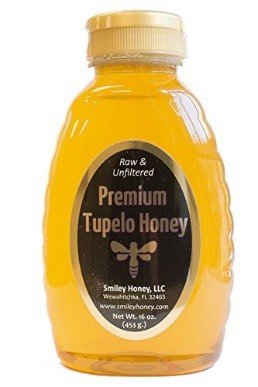
Tupelo Honey
Tupelo honey is a premium honey produced in northwest Florida. It is heavy bodied and is usually light golden amber with a greenish cast and has a mild, distinctive taste. Because of the high fructose content in Tupelo honey, it granulates very slowly.
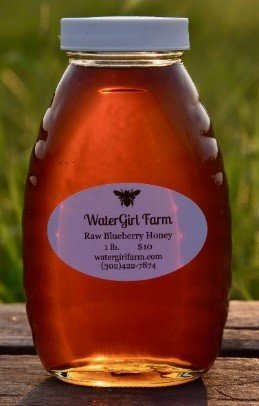
Blueberry Honey
Taken from the tiny white flowers of the blueberry bush, the nectar makes a honey which is typically light amber in color and with a full, well-rounded flavor. Blueberry honey is produced in New England and in Michigan.
Note that blueberry honey gets it aroma and flavor from the nectar of the flowers of the blueberry plant (just like every other type of honey). Blueberry honey does not taste like the berries that are produced later.
As you can see, there are dramatic differences in the color of these two types of honey. Thus, we expect to see dramatic differences in the color of the resulting mead. Would it surprise anyone that there will also be dramatic differences in the aroma and flavor of each of the mead as well?
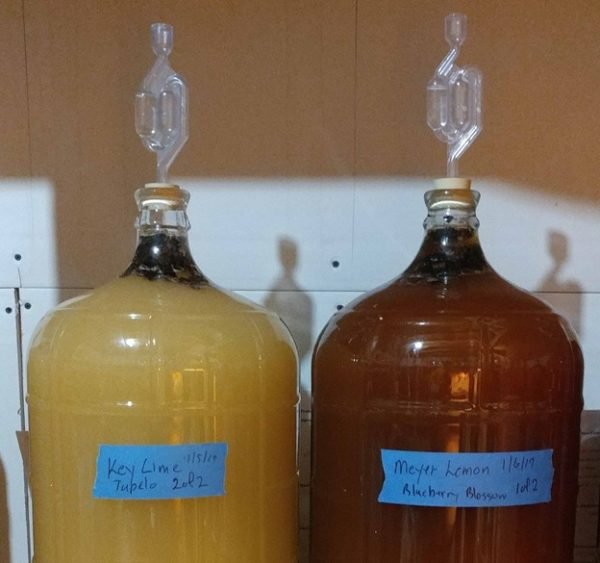
The following picture shows two batches of mead made with roughly the same recipe but different varieties of honey. The batch on the left is made with Tupelo Honey and Key Limes. The batch on the right is made with Blueberry Honey and Meyer Lemons.
These batches are two weeks old and are still actively fermenting. They have just been racked from the primary and into the secondary. They will stay in the secondary for 2 to 3 months. For those with sharp eyes, there is 1 ounce of medium toast French oak beans (cubes) floating in the neck of the carboys. The oak beans will eventually become water-logged and sink to the bottom of the carboy.
So, color is all we need to worry about, right? Well, no it doesn’t work that way. See the two photos below: Orange Blossom Honey and Goldenrod Honey. They look pretty much the same; but do they taste the same?
Orange Blossom Honey is well known for having a bright citrusy aroma and a mildly citrusy flavor. As for the goldenrod . . . let’s let the producer explain:
The goldenrod blooms in late fall. It is one if the last flowers to bloom before winter sets in. This is one of the few types of nectar that we can smell as we enter the bee yard. Wikipedia calls the odor “rank”. It does smell like dirty gym socks. But do not let that turn you off to this unique honey.
I have used goldenrod to make mead. The honey is not particularly pleasant, but the mead turns out pretty good with a deep earthy aroma and flavor – the magic of fermentation and aging produces a transformation in the positive direction. As a traditional mead, it works. It might work in a braggot mixed with dark malts and suitably earthy hops. But as a base for any fruit melomel, it probably isn’t going to work so well.
Honey processing:
The processing of the honey can also have an enormous impact on the mead produced from the honey. The following definitions also come from the National Honey Board:
Extracted honey: Honey removed from the comb and presented in several forms, as defined in the United States Department of Agriculture Standards for Grades: (1) liquid, (2) crystallized or granulated, or (3) partially crystallized. This is commonly known, and referred throughout the document, as “honey.”
Raw Honey: Honey as it exists in the beehive or as obtained by extraction, settling or straining without adding heat.
Strained Honey: Honey which has been passed through a mesh material to remove particulate material (pieces of wax, propolis, other defects) without removing pollen.
Filtered Honey: Honey processed by filtration to remove extraneous solids and pollen grains.
And then, we’ll borrow a description from Bee Maid on pasteurizing honey:
Pasteurizing honey is a very different thing than pasteurizing milk or other dairy products, and it’s done for very different reasons. Because of its low moisture content and high acidity, bacteria and other harmful organisms cannot live or reproduce in honey, so pasteurization is not done for that purpose. One of the few things that can live in honey is yeast, although if the moisture content is below 18% (as it normally is), the yeast cells cannot reproduce. All nectar (the source for all honey) contains osmophilic yeasts, which can reproduce in higher-moisture content honey and cause fermentation. While fermented honey does not necessarily pose any health risk, we try to discourage it, so Bee Maid pasteurizes its honey to kill any latent yeast cells that might be present and to remove any chance of fermentation.
The bulk of honey that is available in grocery stores or big-box retailers has been pasteurized and filtered. So that stuff in 8 oz jars you buy at the grocery store to put on your biscuits, well that has had the life processed out of it. From a mead-maker’s point of view, the more processing that is applied to the honey, the greater the reduction in the aroma and flavor of the honey as well as the greater the reduction in the aroma, flavor, and mouthfeel of the finished mead. To make mead, you need to buy minimally processed honey directly from the producer whenever you can. The less heat involved in the processing, the better the honey will be for making mead. {This thing here – the less heat involved – we’ll come back to this topic later.}
Making Mead:
Honey is full of yeast. Dilute it with water and wait. It will ferment. Voilà.
I have a friend that has done this. He put a bucket of honey and water in his garage and left it there all summer in Missouri. He came back in the fall and had mead. He said it turned out pretty good, but I did not get a chance to sample the product. And I can’t say that I would actually recommend anyone try this, but this is probably how mead was made for several thousands of years.
At some point in the middle ages, people starting boiling honey and water and then pitching ale yeast. The following is the oldest written recipe.
ffor to make mede. Tak .i. galoun of fyne hony and to þat .4. galouns of water and hete þat water til it be as lengh þanne dissolue þe hony in þe water. thanne set hem ouer þe fier & let hem boyle and ever scomme it as longe as any filthe rysith þer on. and þanne tak it doun of þe fier and let it kole in oþer vesselle til it be as kold as melk whan it komith from þe koow. than tak drestis of þe fynest ale or elles berme and kast in to þe water & þe hony. and stere al wel to gedre but ferst loke er þu put þy berme in. that þe water with þe hony be put in a fayr stonde & þanne put in þy berme or elles þi drestis for þat is best & stere wel to gedre/ and ley straw or elles clothis a bowte þe vessel & a boue gif þe wedir be kolde and so let it stande .3. dayes & .3. nygthis gif þe wedir be kold And gif it be hoot wedir .i. day and .1. nyght is a nogh at þe fulle But ever after .i. hour or .2. at þe moste a say þer of and gif þu wilt have it swete tak it þe sonere from þe drestis & gif þu wilt have it scharpe let it stand þe lenger þer with. Thanne draw it from þe drestis as cler as þu may in to an oþer vessel clene & let it stonde .1. nyght or .2. & þanne draw it in to an oþer clene vessel & serve it forth
For to make mead. Take 1 gallon of fine honey and to that 4 gallons of water and heat that water til it be as long then dissolve the honey in the water, then set them over the fire and let them boil and ever scum it as long as any filth rises thereon. Then take it down off the fire and let it cool in another vessel til it be as cold as milk when it comes from the cow. Then take lees from the finest ale or else yeast and cast it into the water and honey and stir all well together, but first look before putting your yeast in that the water with the honey be put in a clean tub and then put in your yeast or else the lees for that is best and stir well together. Lay straw or else cloths about the vessel and above if the weather is cold and so let it stand 3 days and 3 nights if the weather is cold. And if it is hot weather, 1 day and 1 night is enough at the full. But ever after 1 hour or 2 at the most assay thereof and if you will have it sweet take it the sooner from the lees and if you will have it sharp let it stand the longer therewith. Then draw it from the lees as clear as you may into another vessel clean and let it stand 1 night or 2 and then draw it into another clean vessel and serve it forth.
This is essentially the process that is used by most mead makers today. Put honey and water in a pot; boil it; and remove the scum that rises to the top. The only difference is that most modern mead makers will just raise the temperature of the honey water to 150 degrees or so to pasteurize the mixture and to remove the scum that rises to the top. This is considered critical by many to getting the mead to clear properly after fermentation.
Wait a minute. What was that thing I said earlier – the less heat involved in the processing, the better the honey will be for making mead. Why would I go to the trouble of getting unpasteurized honey only to put it into a pot with some water and then pasteurize it. This is where a big schism occurs between mead makers. About two-thirds of mead makers “cook” their honey and water mixture. The two primary arguments for cooking the honey and water are that it 1) provides a clean slate for pitching whichever cultured yeast you want to use and it 2) removes the proteins and waxes and whatnot that makes it very, very difficult to get mead clear. The other one-third of mead makers say this is nuts because you are driving off all the aromatics that make the honey and the resulting mead so awesome. So, I am in that one-third of mead makers that do not cook the honey and water. I believe that a no-heat process produces superior aroma, flavor, and mouthfeel in the resulting products.
And it is possible to get crystal clear mead without cooking the honey and water to remove the scum. The key is using the right fining agents. In wine making, the particles that cause haze in the wine carry a negative charge. So fining agents that carry a positive charge will attach to the haze particles, and then they will drop out of suspension. Wine makers will use egg whites (the proteins are positively charged) or gelatin (also proteins) or bentonite to clear wine. It works great. However, these types of fining agents fail miserably with mead because the particles in mead that cause the haze also carry a positive charge (being proteins and waxes and whatnot). So, to clear mead, we need fining agents that are negatively charged.
What works well is Super Kleer. This product is actually two separate fining agents (Kieselsol and Chitosan) that get added to the mead at separate times. From some website I have lost track of:
Kieselsol (negative charge): Also known as silicon dioxide. Kieselsol works well with gelatine as a clearing agent, since it acts as a tannin substitute and works well to remove bitterness from white wines. When used with gelatine, the gelatine is added to the wine first, and then 24 to 48 hours later, a very small amount of Kieselsol is added, and should be racked off within 2 weeks. Kieselsol also works with chitosan.
Chitosan (positive charge): As the name implies, it is composed of chitin, which is the structural element of the exoskeletons of crustaceans, such as crabs, shrimp and other shell fish. Chitosan is especially popular in clearing white wines, since it does not require the aid of tannins to clear, as do some fining agents like gelatine. When used with negatively-charged Kieselsol it is an effective remover of most suspended proteins and solids.
Chitosan and Kieselsol are often sold as a set, in sealed liquid envelopes as fining A (negatively charged Kieselsol) which is added to the wine first, and then fining B (positively charged chitosan) added about a day afterwards. Chitosan has a reputation for being fairly gentle on the character of finished wine.
The following picture is an example of the results of using Super Kleer in mead. Note that I frequently print out brew sheets to keep track of what I am doing. I usually lean the brew sheet against the wall behind the carboy. This image shows 12-point font printed on standard paper sitting just behind a five-gallon carboy full of mead. When you can read a newspaper through a carboy full of product, the product is clear.
Now someone out there is thinking “If negative particles make wine hazy and positive particles make mead hazy, will a mixture of wine and mead clear up on its own?”. The answer is yes, in many cases. This makes melomels (fruit meads) one of the easier categories of mead products for beginners to make, because melomels are more likely to clear up on their own without using fining agents.
And that brings us to the end for today. The next article will be on making melomels with a focus on how to be successful as a beginner with little prior brewing experience.
“Hello?” I asked. Who would call me at 0538? I looked at the call ID and predictably it said, “BLOCKED NUMBER.”
”This Pratibha, with Swiss Corps Interational Industries. How you doing this morning?” He got a new secretary…from India?
”Fine, I guess. Can this be handled later? I mean its not exactly polite to call befo—“
“Mr. Swiss want you to get off you brown ass and wake the fuck up, you late for conference call.” Pratibha said, to my surprise.
”I didn’t make an appointment, and if I did, I wouldn’t make it before sunrise.” I replied.
”I not work for you. I work for Mr. Swiss. His only available appointment today is at 7am. It is not incumbent upon me to reschedule because you cannot adjust to time zone.”
”I don’t know if they explained to you how this sort of thing works in outsourcing school, both parties have to agree to a time.”
”Outsource? Huh huh huh huh.” Good lord that laugh was fake. “You hillarious. You fucking funny it only 7:41 am and you the thirrrrrd beaner to make that joke.” She replied. “I transfer you now. Next time save the wise cracks for somebody else you wall hopping, piece of monkey shit.”
I wasn’t even mad…
“MAGA, BITCH.”
“mex! You’re late!” Swiss yelled into the phone as he is wont to do.
”That’s some new secretary you got there. She always this pleasant?” I asked.
”Pratibha? Oh, yeah she’s the best. She’s allowed me to outsource my contempt. I save a ton of money this way.” Swiss replied.
”Right, so why the appointment before sunrise?”
”What? Its 0745 here. Sunrise was an hour ago.”
”Fine, what do you need?”
”Are you by a computer?” Swiss asked.
”Not really. Why?”
“I need you to setup something for me…”
As Swiss explained, his Swiss overlords saw an opportunity in the United States to set up a service in response to Elizabeth Warren’s plan to tax 2% of the net worth of people worth over $50 million, or 3% should they be effective enough to be worth over $1 billion. Because Warren is not the front-runner but certainly isn’t going away and quite frankly other thieves in the government seem to have latched on to the idea like the blood sucking leeches they are, they’ll probably take measures to keep high net worth individuals in the country. After all, they probably assume the Grand Cayman is going to sink if enough people store their money there, or more likely try to move there.
”I need you to set up the Kickstarter.” Swiss said.
”What? You work for a international corporation, why are you funding this via Kickstarter….you know what, nevermind. Fine, I’m on the site.” I conceded. There’s no point in arguing with these people after they send STEVE SMITH to kidnap your dog.
“Okay Swiss, what category?”
“Caregory? Business? Dumbass.” Swiss replied. I wasn’t sure if he knew what I meant.
”Okay, Art. Next question: ‘Describe what you’ll be creating.’”
”Service to shuttle high net worth individuals out of the country on a Cigarette Boat.” Swiss answered.
”A Cigarette Boat? Those aren’t exactly cheap.” I explained. “Not something people will fund on Kickstarter. Normally they fund these things with some kind of return.”
”mex, you ever try to out run the Coast Guard? It ain’t cheap.” Swiss asked.
”As a matter of fact, I have.”
”Really?”
”No.”
*narrowed gaze*
…
…
…
…
“What country is the account located?” I asked, breaking the silence.
”The Netherlands.”
”I thought you worked for a Swiss company.”
”I do.”
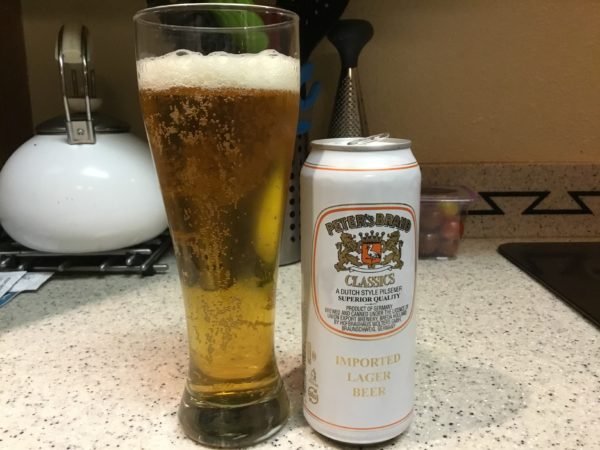
”Speaking of which, I’ve never done an article on a Dutch beer. You’ve been to the Netherlands. Are there any that are any good?” I asked.
”No.”
”None?”
”Nope.”
”Not even Oranjeboom?”
”Not unless you are a college student, homeless, or otherwise an alcoholic. The Belgians broke off and took all the good beer with them.”
”There’s gotta be one.”
”You think so? mex are you a betting man?”
”Possibly.”
”You will not be able to find a single Dutch beer worth reccomending. I will wager a Krugerrand, and trust me, we all know when you’re lying.”
”Fair enough, I will need the IBAN and SWIFT Code…wait, how is the account located in…you know what, nevermind.” I managed to answer the next few questions without his input. “Okay, its called Portland Boat Tours. The page can be found here.”
”Portland Boat Tours?” Swiss asked.
”Trust me. I worked for the federal government once, the last place they will look for anything, is Oregone.”
”That makes sense. This call is over.”
The first place I asked of course, was the Glibs. Somebody would have a good suggestion, right?
Perhaps not. I did get one that was serious (H/T Nephilium, naturally) but sadly I was unable to locate it locally. Others, still…seemed determined to make me fail.
I had to try any I could find.
Heineken?
No, thats still Dutch piss.
Grolsch?
Cool bottle, but ultimately the proper pronunciation sounded like the sound one makes while puking.
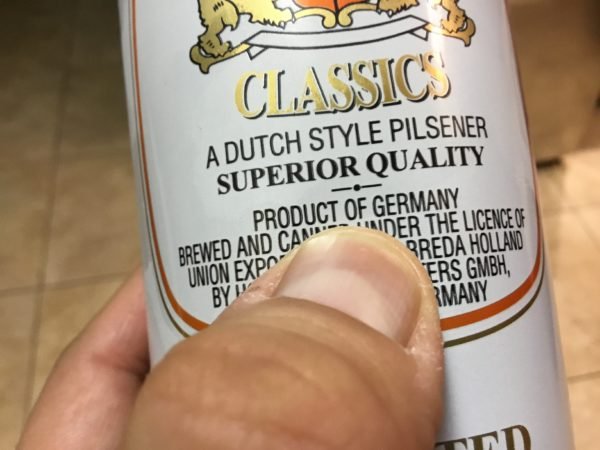
Finally, I thought I found one at Trader Joe’s:
It was light, crisp, balanced and had a pleasant finish. Sadly, that was before I read the fine print.
My local Kroger had something interesting in the cooler. Not only was it a reasonably priced Barleywine, it had a cool looking wizard or something on the label.
This is my review of Ninkasi Critical Hit R&D:
Typically, this is where I go off on a tangent and explain something I researched from a trigger on the label. Unfortunately, I am not really a gamer so the best I can do is this:
There are two basic R&D structures that have emerged in companies throughout the commerce spectrum. One R&D model is a department that is staffed primarily by engineers who develop new products, a task that typically involves extensive research. The other model involves a department composed of industrial scientists or researchers, all tasked with applied research in technical, scientific or industrial fields, which is aimed at the facilitation of the development of future products or the improvement of current products and/or operating procedures.
I don’t think that’s right. Somebody correct me on this one.
A critical hit means that you roll your damage twice (adding to each roll all your usual bonuses, including any additional damage from special abilities) and then add the rolls together to determine the damage dealt.
That appears more relevant.
What is a barleywine? A barleywine is a style of beer not wine. The name harkens back to a time where beer was typically sold at 5-7% abv. Being 10-15% abv, this style is more in line with wine. While a stout or IPA sold at 10% is not unheard of today, a barleywine transcends both because unlike the other two where the flavor profile is dominated by hops or malt, this is meant to be balanced.
This means the immense amount of malt is equally met with an immense amount of hops, resulting in a complex flavor profile—like wine. Also like wine, it can be aged because of the high alcohol content. This is not one for the faint of heart.
Ninkasi put out several others to market in my area that I liked. This one does not dissapoint. Critical Hit R&D easily scores a 4.5/5.
Sorry for the delay in getting a post up for you, Glibs! I have no excuse. I just forgot. January has been a month of constant jackassery. I don’t have any water in the kitchen — and haven’t since the weekend — because of the sub zero temperatures.
This has been such a stressful month so far that when I sat down to write this Products You Need post all I could think about is alcohol.
So, tonight I present to you: Cocktails You Need.
1. Rob Roy
So far as I can tell, this seems to basically be a Scotch version of a Manhattan. Admittedly, I first heard of this in Venture Brothers.
2. Cucumber Gin Ricky
This recipe is simple and makes me daydream about warmer weather coming and thawing out my pipes (not a euphemism). Cucumber, gin, lime, sodawater, and simple syrup.
3. Mango Habanero Margarita
I cannot wait to try this. Tequila, triple sec, mango, habanero, grapefruit soda, lime, and lemon.
4. Red Velvet Cake Martini
Perfect for those who want their cake and to drink it, too. Dessert with booze. What’s not to love?
5. Gold Rush
And, because, whisky, I have one more for you. Whisky, honey syrup, and some other stuff.
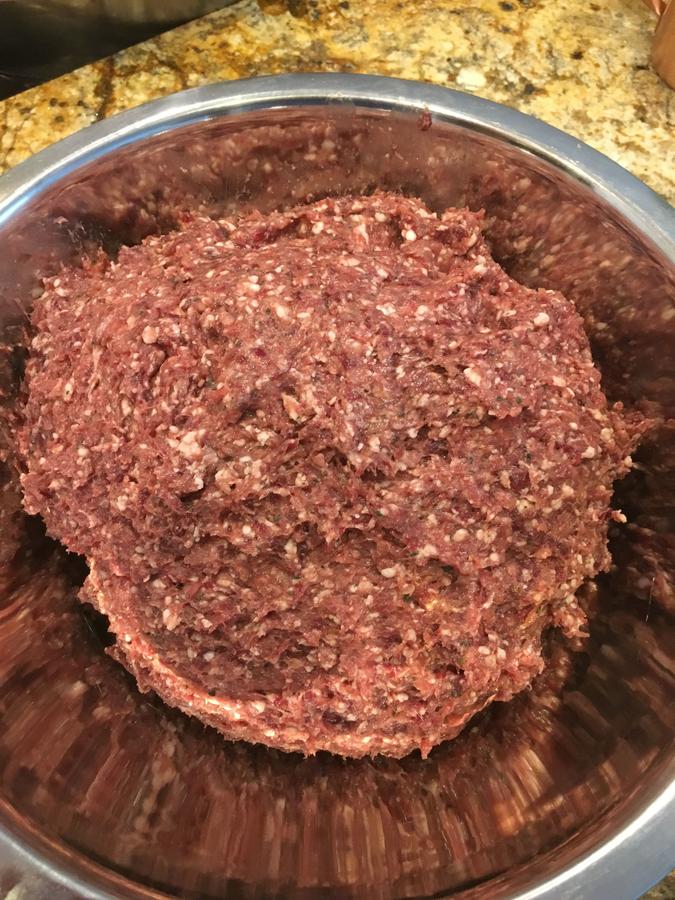
I typically have several different types of sausage in the freezer. Smoked kielbasa is one of my favorite and most versatile. I’m using duck and pork here, but beef and pork is the standard.
I’m primarily Irish, so it’s easier for me to metric. It also comes in handy when you need to be precise on things like curing salts and such.
The animal parts:
2lbs duck breast
2lbs pork shoulder
1lb pork back fat
The other stuff:
40 gm kosher salt
5.5 gm Cure #1
10 gm sugar
3 gm marjoram
6 cloves garlic
1/2 cup ice cold water
I’ll apologize for gearing this towards people that know how to make sausage. If I made it for the generic crowd, it would be a multi-part series.The one thing that I will put out there is that cleanliness is next to godliness. Just like the booze making series, everything has to be clean, clean, clean.
Cube the duck and pork, add the seasonings and leave in the fridge overnight. The water will be hand mixed in for two minutes after the second grind.
You want the meat to be close to freezing when you grind it for a proper texture. Let it sit in the freezer for awhile before the first and second grind. I did the first grind through the coarse plate and the second through the medium plate. I usually like kielbasa a little finer, but I’m gun shy after my last batch of breakfast sausage turned out gummy and tough. Duck can’t handle a lot of grinding.
It was below 60 degrees in the garage, so after stuffing, I was able to hang the links overnight on my custom drying rack/target stand. If your temps are above that, you will have to shorten the hang time. The purpose is to let the flavors meld and develop the pellicle the smoke will stick to. The different lengths are due to the craptacular casings I had on hand.
I smoked for four hours on cherry starting at 120 and slowly ramping up to 180. Final IT was 145. Into an ice bath to stop the cooking and then hung in the garage for a couple of hours. I’m pretty happy with this batch.
These sausages are fully cooked and ready to eat. Grill until hot, or in a 300 degree oven. Or split them and brown in a skillet. Or slice in rounds as an ingredient in another dish. You can even skip the casings and keep it as fresh, unsmoked sausage. As I said, this is a very versatile sausage.
A lot of chatter happening this week, which made me postpone what I planned to write about for another week. As many are undoubtedly aware Gillette, a company that markets razors to both men and women, aired a controversial commercial linked here.
This is my review of Full Sail Malted Milkshake IPA:
Many took the message as a negative, saying the commercial insults their customer base. Making a statement like this their critics say, will drive their customers away, that disagree with the social statement being made. Strange, given the company itself profits from one of the defining physical characteristics of men—having a beard.
Gillette itself is not a stand alone company that will suffer as a result of this, rather they are a subsidiary of Proctor & Gamble. As of this writing P&G was not immediately shorted by a large number of investors, like what happened with Nike. Their stock price was rather flat for the week. Unlike Nike, their product lines are diverse and are necessities that nearly everyone uses. People will continue buying their soap, their toothpaste and Double Quilted Charmin Toilet Paper. While it can be argued this is not the first time P&G made such a social statement with one of its brands (remember the ‘like a girl’ campaign?) this is different because they did not criticize previously. Rather they took what was a pejorative often used by men toward other men (i.e. you play ball like a girl!) and turned it into something positive. Here it appeared to be open criticism, constructive or not.
Interestingly enough, another P&G brand is Old Spice, whose marketing campaign a few years ago appealed to the lighter side of masculinity, to great success.
H/T: You know who you are, you MAGNIFICENT….
The merits of the message itself, and whether it was intended to insult is not a question to be answered here. As usual such interpretation is best left to the individual. Will I buy Gillette’s products? No. Recently, a fellow Glib challeneged me with an incredibly thoughtful gift. Should I do what I always do and pick up yet another skill, I may never need to buy a razor again.
A better question is, are the attributes commonly associated with men something we evolved beyond? Men typically are more predictable than women at any given time, more assertive, are motivated by physical things, are driven to compete and succeed at different interests than women. The downside to this, is men more often than women will behave recklessly, and aggressively. These characteristics though are even now being portrayed as positive attributes—in women, as this recruiting commercial for the United States Marines Corps suggests.
Have we moved past the point where the potential for the negative is too much of a liability for any benefit it can provide? Competition often breeds adversity, which does not have to be a bad thing. Teaching others in that sense, to overcome adversity and handle it when it defeats them while they are young may be in their best interests later on. Others might be less assertive, and might have a more difficult time adjusting so the argument to show respect for the brainy kid also has merit, because one might not grow up and cure cancer if he or she is always being put down. Is developing confidence through physical strength best frowned upon, to allow for the more cerebral, even one that might go so far as to act (ahem) like a girl?
Why does it have to be one or the other? As I write this, I am at my son’s Tae Kwon Do class. I am reminded of last week while he was sparring a older boy, with a higher belt. My son comes across as the brainy kid; in fact he takes an advanced math course because it comes easy to him. That day, his opponent moved to strike with a round kick. In response, he stepped in closer to avoid the kick’s impact and landed a front kick to his opponent. His opponent, a larger and more experienced martial artist, lost his balance and found himself on the floor. At that moment, my son beat his opponent by outsmarting him. He learned more about himself than I could ever teach, but he’s still a math geek.
In the end they shook hands and moved to their next opponent. No hard feelings.
If men acting like men are frowned upon, perhaps a way to fight this perception is to understand why those attributes are positive and where to apply them. The fact these attributes are being encouraged in women is proof enough then are a benefit to society. The attributes cannot be negated, unlearned, or taken away, they are hard wired psychologically and genetically. The trick then becomes learning how and when to strike, and use the inherent strengths tactically. Perhaps then, critics will see the problem is not masculinity, but in their own shortcomings.
As for the beer, it appears Full Sail went and rebranded unfiltered Sculpin. Which for the IPA…people is not a bad thing. Not the hoppiest of IPA out there, but if you dig grapefruit and texture this will not dissapoint. Full Sail Malted Milkshake IPA: 2.7/5
The grape genus Vitis splits into three natural groups based on geographical location: North American, Eurasian, and Asiatic. There are roughly 25 to 30 species of American origin and about the same number for Asia. But there is only a single grape species for Eurasia, the Vitus vinifera. Vitis vinifera is itself comprised by the wild grape vine Vitis vinifera sylvestris (commonly referred to as V. sylvestris) and the cultivated grape vine Vitis vinifera vinifera (commonly referred to as V. vinifera). So, all the well-known varieties/cultivars of grapes used for making wine today (such as Cabernet Sauvignon and Chardonnay) are members of a single species of grape vine, V. vinifera, and are the result of some combination of natural mutations and human tinkering over the course of several thousand years.
There is no clear point in time where the cultivated V. vinifera became distinct from V. sylvestris. In fact, hybridization occurs naturally between the two subspecies and occurred continuously throughout ancient times. We know that the native range of that the wild grape vine V. sylvestris included the Mediterranean shores of modern Lebanon and Syria as well the border between Syria and Turkey. However, there is archeological evidence of grapes being cultivated far outside the native range of V. sylvestris and into the far reaches of Israel, Egypt, and ancient Babylonia inside the geographical known as the ‘Fertile Crescent’.
The cultivation of grapes did not occur in a vacuum, but was part of the overall development of agriculture in the Fertile Crescent. Archeological finds indicate that wine was being made on a large scale as early as the 4th millennium B.C, in the ancient city of Godin Tepe in western Iran. In addition to the traditional archeological evidence of wine making such as finds of broken pottery, some of the pottery still had residue that was subjected to an in-depth chemical analysis that confirmed the presence of grape products (assumed to be wine). So, in the ongoing debate between wine people, beer people, and mead people over who started brewing first, the wine people now have scientific proof that puts start of intentional wine making back to at least the 4th millennium B.C.
The cultivation of V. vinifera, and presumably the making of wine, spread from Iran and the Fertile Crescent throughout the Middle East and Turkey eventually making its way to Greece. The Greeks spread viticulture to many locations around the Mediterranean including Italy and southern France; the Romans continued the spread viticulture throughout Western Europe. Fast forward through several thousand years of history including the dark ages, the middle ages, and the renaissance and we get to modern viticulture (growing grapes) and viniculture (making wine) using any of several hundred cultivars of V. vinifera which humans have new carried around the globe.
So how do we make wine. It’s easy. Crush the grapes; press out the juice; pour it into a vessel; and wait. Wine will happen; it can’t not happen. It might be good wine (lots of great commercial wine use spontaneous fermentation). But it might be terrible wine as well. To ensure success then, most wine makers inoculate with cultured yeast (someone got lucky with a spontaneous fermentation and has been culturing the yeast ever since).
First off, we need to grab some grapes. I guess we need white grapes to make white wine and red grapes to make red wine, right? Not exactly. V. vinifera grapes generally come in two types: green grapes and black grapes. There are other colors as well, but they are just not as common as green or black grapes. Regardless of the color of the skin, the flesh of the grapes is generally colorless ranging from pale green (green grapes) to pale grey (black grapes). And the juice from V. vinifera grapes is also generally colorless ranging from pale green (green grapes) to pale grey (black grapes) – amazing how that works out. Therefore, white wine can be made from almost any variety of V. vinifera grapes, but red wine is made from black grapes (or blends of grapes where the majority of the grapes are black).
Thus, we can make white wine from Chardonnay grapes which are green; Gewürztraminer grapes which are dark pink; and Pinot Noir grapes which are black. Yes, you really can make white wine (Blanc de Noirs); rosé wine (Sancerre Rosé); and red wine (Burgundy) from 100% black Pinot Noir grapes. How can that be you ask? Great question. And the answer is that white wine is made with a white-wine process and that red wine is made with a red-wine process (duh). The making of rosé wines straddles the fence.
The white-wine process is as follows:
1)	Crush the grapes
2)	Press the juice from the crushed grapes
3)	Clarify the juice (let the pulp from the crushed grapes settle in a tank)
4)	Transfer the clarified juice to a fermentation tank
5)	Inoculate with an appropriate wine yeast
6)	Wait until fermentation is complete (with some caveats)
7)	Clear the wine using fining agents or power filters
8)	Bottle the wine
Dry white wine is made by letting the yeast consume all the available sugar in the juice. Semi-dry to semi-sweet wines are made by chilling the fermentation tank to just above freezing right before the yeast consumes all the sugar. This puts the yeast into hibernation. Then the wine is power-filtered through increasingly fine filter pads until the live yeast is filtered from the wine. Finally, a big dose of potassium metabisulfite is added to ensure that refermentation does not occur once the wine is in the bottle.
The red-wine process is as follows:
1)	Crush the grapes
2)	Transfer the mixture of juice and skins (known as must) to a fermentation tank
3)	Inoculate with an appropriate wine yeast
4)	Work the must until fermentation is complete
        a. The grape skins (and pulp) still have juice in them
        b. The yeast will ferment the juice in the skins
        c. The resulting CO2 will puff up the skins like little balloons so they will rise up from the liquid below
        d. The skins also form a cap which traps CO2 from the liquid below while it ferments
        e. Thus, the skins will rise up out of the liquid below and will begin to dry out
        f. Fermentation releases heat, so you get warm moist skins which can become a great environment to grow many bad organisms, so
                i. You push the skins back into the cooler liquid below two or three times a day (punching down the cap)
               ii. Or you pump cooler liquid from the bottom of the tank on top of the skins
5)	Release the free-run wine from the tank (whatever wine flows out without pressing)
6)	Transfer the skins to a press
7)	Press out the remaining wine from the skins
8)	Age the wine (typically in barrels, but tanks with wooden slats can be used)
        a. Premium wines typically age the free-run wine and pressed-wine separately to be blended to taste at the end
        b. Bulk wine will have the free-run wine and pressed-wine blended before aging
9)	Clear the wine using fining agents or power filters
10)	Bottle the wine
Some premium wines will have an extended period of maceration (soaking the finished wines on the skins) after fermentation is complete to extract as much color, aroma, and flavor from the skins as possible. This is one way to make amazingly intense wines. It is also a way to make hideously harsh crap. Know what you are doing if you choose this path.
Many red wines and some white wines will undergo malolactic fermentation at some point in the process. Tartaric acid is the dominant acid in grapes, but grapes also have significant amounts of malic acid. Malic acid is tart and harsh on the palate. Certain bacteria (Oenoccocus Oeni) will convert malic acid to lactic acid which is softer on the palate and can provide a creamy, oily mouth-feel. This malolactic conversion is not true fermentation, but it does release CO2 resulting in the appearance of a “secondary” fermentation in the wine.
Alright, let’s go get some grapes. Hmm, you better live on the west coast or near one of the handful of places in the Eastern or Southern US where the climate is moderated by proximity to an ocean, a river valley, or the Great Lakes. Otherwise, you aren’t getting fresh V. vinifera grapes unless you have friends willing to jointly buy several tons of grapes and pay for refrigerated shipping. Otherwise you are buying kits.
All juice is just that. 23 Liters (6 gallons) of pure wine grape juice. You put it in a fermenter and go. This provides the truest flavor profile for the wine.
High-quality kits are around 16 liters (4 gallons) of juice concentrate. You add 2 gallons of water to get to normal concentration and then ferment.
Mid-quality kits are around 10 to 12 liters (2.5 to 3 gallons) of juice concentrate. You have enough water to get to 6 gallons and then ferment.
The canned stuff is basically crap. You add one or two cans of concentrate and a bunch of sugar into the primary. Then add enough water to get to 5 or 6 gallons.
The key is that the more concentrated the kit, the less of the true grape varietal flavor and aroma carries over into the final product. It is possible to buy premium wine kits that have the juice still on the skins, but they are hard to come by. You need to order in advance from some dealer, and the must comes refrigerated or frozen in 5-gallon pails. I’ve seen friends use them, but I have no relevant experience.
So how are wine kits made, in particular red wine kits? We know that red wine is made by leaving the juice in contact with the skins during fermentation. But kits aren’t fermented (otherwise, they would already be wine). Here is one quick summary:
White grapes are pressed, and the juice is pumped into a settling tank. Enzymes are added to break down pectins and gums, which would make clearing difficult after fermentation. Bentonite is added to the juice and re-circulated. After several hours the circulation is shut off, and the tank is crash-chilled below freezing. This helps precipitate grape solids, and prevents spoilage.
Red grapes are crushed, sulfited and pumped through a chiller to a maceration tank, where special enzymes are added. These break down the cellulose membrane of the grape skins, extracting color, aroma and flavor. The tank is chilled to near freezing to prevent the must from fermenting. After two to three days the red must is pumped off, pressed and settled much the same way as the whites.
When the tank is settled, and the juice almost clear, it is roughly filtered, the sulfite is adjusted, and it is either pumped into tanker trucks for shipment to the kit facility, or into a vacuum concentrator.
Vacuum concentrators work like the reverse of a pressure cooker. By lowering the pressure inside the tank, water can be made to boil at very low temperatures. By boiling the juice at low temperature browning and caramelization are prevented. The water comes off as vapor, leaving behind concentrated grape juice. Because some aromatic compounds can be carried away in this vapor, a fractional distillation apparatus on the concentrator recovers these essences, returning them to the concentrate after processing.
Enzymes are used to extract color, aroma, and flavor from the skins of black grapes. They do a good job of capturing the basic flavor profile of the grape variety, but it is not the same as fermenting on the skins. It is similar to making beer with extracts versus all-grain. You can get good products from extracts, but finesse is only achieved through total control of the mashing process. It is the same story when making wine. Concentrate kits make good wine. Exceptional wine requires working with fresh grapes.
So, what does an aspiring winemaker do if he doesn’t live where V. vinifera is grown and doesn’t want to work with kits? The answer is hybrid grapes.
Starting in the late 1800s, the French had a little problem. Some “important person” in Germany imported grape vines from the United States to plant as curiosities. Top Men did that kind of thing for amusement – creating gardens of plants from around the world. The problem is that North American grapes evolved with a nearly microscopic insect called phylloxera which eats the roots and leaves of the grape vines (the insect lives underground all year except for a few weeks when they go airborne to reproduce). It turns out that V. vinifera had a bit of trouble dealing with phylloxera, and phylloxera destroyed 3 million acres of vines in France. Wine production was cut in half, and the trend was going from bad to worse. Fortunately, some professor in Missouri figured out you could graft V. vinifera to American rootstock and the vines would survive, even thrive (and that’s an entirely different article). European wine was saved!
Until the gentlemen from Missouri saved the day, viticulturists (people that grow grapes) in France were frantically trying to hybridize V. vinifera with American grapes to get something to survive. And they had some successes. Several French/American grape hybrids were produced then that are now grown throughout the United States, but they have since been regulated out of existence in France to preserve the cultural integrity of French wine (and because the grapes aren’t anywhere near as good V. vinifera). In the 1940s, a Wisconsin farmer named Elmer Swenson began hybridizing the French/American hybrids with American species found in the upper Midwest trying to find varieties that would survive in cold climates. Elmer also had a lot of success. Many of his grape varieties are in production around the Midwest. In more recent years, Cornell University in Geneva, NY and the University of Minnesota have continued to have great success creating many new cold-hardy varieties. Thus, wine grapes can now be grown in many places where V. vinifera cannot. And while many of these varieties can produce wine that is quite good, none of them have reached equality with V. vinifera. But if you live in Iowa and want to make wine with local grapes, you need to make do with the hybrids that grow close by.
Finally, let’s make some wine.
Remember that apple crusher we just bought to make cider. I got bad news. It won’t work. You need to go drop another $500 on a grape crusher/destemmer. You put the grapes in the hopper and turn the crank. Crushed grapes fall out of the bottom, and the stems traverse a down a long tube of sorts to the end of the destemmer. The destemmer part works, mostly. But you still need to stick your arms into the crushed grapes and pull out the pieces of stems that make it all the way through.
Crushing and destemming the grapes.
Then we’ll splurge and buy a nice big wine press. It’s big, and it’s heavy, and it’s awkward. So, we’ll mount it to a platform with castors – castors that don’t lock. Note when I say we, I mean the dude that bought the press; it ain’t mine. Since the castors don’t lock, make sure you have 5 or 6 other people around that are willing to grab on to handles that don’t exit to hold the press in one place while you crank away.
Pressing the grapes.
And the beautiful juice flows out of the press. Wait, why isn’t it colorless. I was told that black grapes produce colorless juice. Well, that’s V. vinifera. This is a lovely French/American hybrid called Frontenac created by the wonderful folks at U of MN. Unlike V. vinifera, the pulp of Frontenac is purple and the juice is a vivid red. Even though we are following a “white-wine” process and pressing juice from the fresh grapes, we will be making a medium-bodied red wine. The reason we are not fermenting on the skins is that Frontenac is notorious for smelling of green vegetation (i.e., like “someone just opened can of green beans”). The common wisdom is that avoiding skin contact during fermentation reduces the undesirable aromas in the wine.
Frontenac produces vivid red juice.
Oh, and the acid level of Frontenac is about double the acid level of high-quality V. vinifera grapes. So, don’t be thinking you’re making a nice dry red wine. You’ll be making a sweet wine (or in my case, a type of mead called pyment). There’s reason why no one pays 50 bucks for a nice bottle of Frontenac from Iowa.
Disposing of the cake.
Once all the juice has been extracted from the grapes, the outer frame is disassembled exposing the “cake” which is the dry, compacted grape skins. In this case, a nylon bag is used as a screen to prevent the skins and seeds from being pushed out between the wooden slats in the frame. The cake is dumped into a handy bin and then disposed of in a way that honors Gaia (e.g., composting, feeding to livestock, sending it FedX Ground to your Representative, etc.).
We are still settling into new Casa Dominatrix, and haven’t fully unpacked the kitchen, so this week’s recipe has only been made once, but it was delicious.
I am guessing on the spice measurements because my measuring spoons are still packed away, so adjust to taste.
Nutritional yeast is a core component of this recipe. I prefer the Anthony’s brand and you can get it on Amazon.
This dish tastes rich and meaty, yet uses no meat, or oils of any kind. I served it over white rice.
Random Curryish
2.5 cups red lentils
2 cans chick peas (drained, not rinsed)
1 lg carrot (diced)
2 tbsp red onion (minced)
1/5 cups nutritional yeast
2 tbsp curry powder
1 tsp Balti seasoning
2 tsp garam masala
2 tsp smoked paprika
dash celery salt
salt (to taste)
black pepper (to taste)
In a pot over medium heat, add the lentils and cover with water. Cook until the lentils are cooked through. Skim off the froth as necessary.
Add the chick peas, carrots, onions, nutritional yeast. and enough water to cover. Plus 1/4″ in the pot. Stir.
Add the spices, adjusting to taste as needed.
Simmer, stirring occasionally to avoid sticking. It’s done when it’s slightly thicker than stew.


 Blueberry Honey


 ”What? You work for a international corporation, why are you funding this via Kickstarter….you know what, nevermind. Fine, I’m on the site.” I conceded. There’s no point in arguing with these people after they send
  ”A Cigarette Boat? Those aren’t exactly

 No, thats still Dutch piss.




 Why does it have to be one or the other?


