I’ve tried many times over the years to give up coffee, but man it’s hard. I don’t drink a ton of it; maybe 5 cups a week, but I have noticed when I don’t drink any at all for a whole week I’m really cranky.
Part of it is the caffeine, and part of it is that I really love coffee.
Like love love.
I’ve loved coffee since I was 15 years old to a degree that has been known to frustrate my loved ones because I can’t settle for just plain average coffee.
I love the flavour of good coffee. I love the process of crafting a perfect latte with velvety microfoam. And yeah, I love the pick-me-up.
So for this edition of Products You Need, I thought I’d share my favourite coffees and coffee tools.
Hario Ceramic Coffee Grinder
This is a staple in my household. I buy whole bean coffee, and grind it fresh “to order” every morning.
I dislike the traditional blade grinders for coffee because they chop the beans while this manual burr grinder crushes the beans.
The grinder attaches to any standard mason jar, but I only grind as much as I need. The grind is adjustable all the way down to Turkish.
Some reviewers have voiced complaints about the screw coming loose during grinding. I have noticed this, but that was solved by having NotUsidore tighten it for me. Tightening the screw doesn’t adjust the grind setting on my grinder.
When I got into pour over coffee I searched long and hard for the perfect pour over maker, and after a lot of research I settled on the Bodum Pour Over.
After much experimentation with my Hario, the best grind for making hot coffee in the Bodum, use a fine-medium grind with the filter in.
But in recent years, cold brew is my preferred drink.
To make cold brew with the Bodum, a medium-coarse grind works best. Too fine and the water doesn’t reach the grinds on the bottom, which causes a weak and watery brew. Too coarse and the flavour is weak due to under extraction.
For cold brew, I pour the grinds right in the bottom of the Bodum, and then filter for serving.
Coffee Gator French Press
I’ll never forget when Thermos came out with a French Press. I was so excited. I took it everywhere because if you have a Thermos french press and grinds, you can have awesome coffee at a gas station or truck stop.
The Coffee Gator French Press is even better as fewer grinds make it into the cup. It’s quite easy to clean. If you use it regularly, I suggest soaking the filter in white vinegar once a week to remove any build up of oils.
Coffee stays hot for about 2 hours, and as an added bonus, it has a handy canister for your grinds.
If you travel a lot, especially if you do a lot of road trips, this french press is a must-have.
Add grinds and water before bed, and in the morning you just have to grab the bottle out of the fridge on your way out the door.
This filter requires a medium-course grind in my experience.
You can also use this for making hot coffee or hot tea. It comes with a sleeve so you can avoid burning yourself.
I’ve never had any problems with leaking due to the silicone gaskets inside the lids. That said though, make sure to remove the gasket at the bottom (under the filter basket) when you clean it. I didn’t for the first few weeks and my coffee started tasting weird.
It’s fairly easy to clean.
Stok Cold Brew Coffee
I am soooo not a morning person, and some mornings I’m incapable of making coffee before I’ve had coffee. I recently discovered Stok Cold Brew Coffee.
Yes, it’s cheating, but I like having a bottle in the fridge for the mornings I just simply can’t function, and I’m out of cold brew.
It’s a lot better than I expected. I was expecting it to be filled with all sorts of extra crap like most store bought cold brews, but that’s not the case. It’s coffee, and water. Each bottle is consistent. I mix with a little soy milk, though it’s perfectly fine without.
I’d love to hear about your favourite coffee tools. Share! Enlighten me!
It’s your ol’ buddy, Sir Digby, once again. If you remember Part 1, I was about to have a delicious lunch, when I realized I still had a t-shirt with a certain grinning politician that needed to be introduced to the world at large. As I was working on getting the finishing touches of my last article complete, I had a lot on my mind: Where would I go to showcase Gropin’ Joe? How would my first article be received, and, when? Did I just sleep funny, or is that a more serious pain?
Well, my article went up, and I was very happy with the reception (TYVM). I was actually doing work-related training on the day it posted, so, I wasn’t on my regular night shift. I’m not much of a sunlight person, so, I was a bit out of sorts that day, but, very glad it went up in the evening time. I found out that participating in comments about your own article is…strange. Even more so when there are Dem presidential debates going on. Ultimately, it was all good. Although, I will say, some of you seemed like you were hoping I got my ass kicked. In a purple H&H shirt. E tu, glibe?
As it turns out, my schedule that week allowed me to take care of some business that I was not only dreading, but, that I knew would take forty forevers. You guessed it: I had to renew my driver license. If you recall, in my first article, I made a side joke about not going to the DMV in the H&H shirt. Doing so never really crossed my mind, even though I knew I had to do the renewal dance.
I wanted a pic of carousel from Logan’s Run.
Much like Carousel, I wasn’t sure that I would come out of my trip to the DMV office alive. OK; that’s, maybe, a little heavy-handed. However, my previous experiences cause me to view a trip there like I would a trip to the unemployment office—the dregs of humanity, along with some unfortunate souls (like me) having to wade through the dark sea of government bureaucracy. I’ve spoken of my love for my Texas on several occasions. I also warn that, as much of a reputation that the state has earned for possibly being “Wild West” in our collective outlook, we actually do love us some government. More than we should and, more than you might think, if you’ve never been here. Almost 50 years of this, and I continue to be amazed and bothered by it. Technically, I’m a government employee, too, so I see it from inside and out. It’s just that I’m trained to move a little faster in completing my tasks.
I will now try to build you a picture of all this (without my own photos). Driver license offices in Texas—technically, Texas Department of Public Safety-Driver License Division—are at least as much a pain as whatever your state has. There has always been a wait for customers, if you had to go in to one of the offices.
Might as well be.
Even with online renewals, it’s a crap-fest, since DPS requires that you come in on every other renewal. Renewed online last go-round? Congrats! You get to climb on the hamster wheel! I think renewing your Texas CHL is less a pain in the ass, even when you have to re-qualify. At least then, you can pretend the target is IN NO WAY a bureaucrat, or, a state employee…::ahem::
At some point, the powers that be decided that they would give “mega centers” a shot. Essentially, a really big driver license office, based in larger metropolitan areas. I happen to be less than six miles from one of these beasts, so, it was the obvious choice. I had to research online to see where, exactly, it’s located, as I have been by the supposed area many times, and never saw the building. Big mistake. Just look at the Yelp pictures for this very location:
What the hell was I getting myself into? No—what the hell was I being forced into by the State of Texas? It turns out that, at these mega centers, you can get in line online. According to my supervisor, it has to be done right at opening, regardless of where you are. Of course, when I get online at 7:01 in the a.m., the appointment time wasn’t until almost 2:30. But, I needed to stay up for about 24 hours this particular day, so, why not??
As fate would have it, I was there less than 30 minutes. This includes registering as “arrived” at a computer kiosk, sitting for less than 10 minutes, then, getting ushered with a couple of other people to start a new line away from the others. I was actually sitting down with a clerk in less than 15 minutes. “What? My application? Ack!” I had forgotten to fill one out (FML). The clerk gave me a sort-of sideways glance (was it because of Gropin’ Joe’s visage?), and, with that, handed me a blank form (Go Joe!). I even had my official Texas Driver License picture taken in “the shirt”, and was on my way soon after.
Huh…that was really a big nothing-burger. I think I’m beginning to see a trend with my wearing of these shirts: Other than quick glances at the design, no one was saying squat.
Not the author’s actual eyebrows.
I was going to have to come up with another outing with Gropin’ Joe to complete the experiment, and, I came up with what I figured would be the crowning jewel of this thought experiment. Thing is, I’ve started having monthly dinner-and-coffee meet-ups with a life-long friend/former LE co-worker who has a very libertarian disposition. He tends to joke around with wait staff, especially staff of the female variety, which might be just the ticket for an H&H merchandise discussion. On a side note, I would like to get him posting here; I think he would fit right in with the gliberati, even if he is Tulpa.
The meet-up Saturday rolled around, and we got started a couple of hours earlier than usual. I explained the social experiment aspect of my attire, and what I would be watching for while we were out. He was on-board with my quasi-plan, and, after discussing possibly playing some pool, we decided that the standard places were a fine choice after all, and we headed out for delicious Tex-Mex. But, wouldn’t you know it–our normal Mexican food hang-out was packed, so, we settled on some Mongolian stir-fry.
Tasty Mongolian stir-fry
I hadn’t been to Genghis in a while, and this place always seems to be re-inventing some portion of itself. The hostess was a real pistol, and was willing to joke with my friend, as he started his banter. This would end up being the most promising point in the night for an interaction over my apparel. And, by that, I mean, I am almost positive that she saw my shirt, and was sharing in my friend’s humor a bit. Beyond that? Nada. The meal was good, but, my friend was so exhausted from his week’s work that he didn’t even want to eat. It was also busy enough that we weren’t going to delve too deeply into our usual conversations in the restaurant, so I finished up my bowl, and we headed off to the coffee house.
Home of the bottomless, er…endless coffee cup.
Presuming you don’t know, Café Brazil is a coffee house/diner with (wait for it…) a Brazilian flair. Their food has always been middlin’ to excellent, but, we just come for the endless coffee cups. They usually set out three or so of their blends, their unleaded counterparts, and dairy-based additives. My friend, being a smoker, prefers to sit outside on what passes for their patio. I’m OK with this, even if it is a Texas Summer, although I was a bit worried about our earlier starting time this evening.
It had actually cooled down quite a bit by the time we arrived and took our seats. I mean, it doesn’t really “cool down” in a North Texas Summer, but, this was tolerable. We had our usual discussion about family, work, and just how effed up people are vis-à-vis government power, especially in the realm of law enforcement. Of course, talk like that is inherently boring, and in no way should there be any website that deals in such what builds and strengthens friendships, and I highly recommend that you try it sometime!
Well, the foot traffic was rather light that evening. One of the better things about sitting outside is to see the parade of people without being so close that you inherently get pulled in to any stranger drama, or, having them drawn into yours. This particular location just happens to be a couple of miles from Southern Methodist University. For those in the know, or, who’ve ever been around an American university in a Southern state*, you can probably envision the types that make their way into said coffee-diner. Depending on particulars, my friend has been known to engage with some of these strangers. However, the combination of multiple factors, not the least of which was the dearth of interesting candidates, meant that no friendly banter would be forthcoming this night.
*What’s that? “That image would apply to just about any American university, Sir Digby”, you say? Meh…I don’t get out much.
As you might have guessed, it wasn’t long after this rather humid evening that I received my oh-so-precious license. Since I went into the endeavor with a purpose other than staying ‘street-legal’, I have to say that I’m rather happy with the final product:
The Gropin’ Joe shirt: Immortalized for 5-10 years
OK—only the collar is visible. She’s not Ansel Adams, so I’m not going to down her for that. It was, overall, not a bad experience; much better than the visions that played in my imagination prior to the appointment. I got my permission from my benevolent overlords to convey myself on the motorways, and it only cost me $25. Woo. Hoo.
So; there you have it. The shirts got some quick glances, but generated no conversations. I’m not the most approachable person; I’m no Mr. Suave, to be sure. I did, however, have a pretty wide swath of potential victims, er… takers in my travels, and I would think that I would have had at least just one person express curiosity. But, noooooo! Not these unsophisticated yokels! And, let me assure you: I bathed prior to each outing, so it wasn’t my natural funk driving the masses away. Nor was it the shirts themselves: They are definitely high-quality products, and you, too, can pick up a couple over at www.redbubble.com/people/cprm/. If you’re looking for a comfy, snazzy shirt that supports a fellow glib, and a minimum amount of interactions with strangers is your preference, I highly recommend. My shirts are currently hanging up; freshly laundered, and waiting for their turn in the rotation. If I manage to generate any conversations with either of them, I’m sure I’ll let you all know.
Maybe I’ll take Crusty Juggler with me on the next outing…
Some time back I stumbled across an interesting discussion on the appropriate firearm for the farm or country home, much like the country home my folks maintained for many decades.
The Old Man was, of course, a farmer for much of his life, and an old school country gentleman. His attitude towards firearms reflected most of his type and his generation; firearms were tools essential to the maintenance and protection of homestead and crops, in the same order as a chainsaw, a scythe, or a tractor. They were selected and maintained as such, with strictly utilitarian considerations. Childhood in the Great Depression and young adulthood during WW2 made most of the Old Man’s generation practically minded people.
That being the case, the Old Man maintained three firearms on and about the place. They were a 12-gauge pump shotgun, a .22 rimfire rifle, and a .22 handgun. The shotgun was his first purchase with his demobilization pay when he returned from the Army in 1946, the .22 rifle was a third anniversary present from my mother in 1950, and the .22 pistol he bought for recreational shooting sometime in the mid-1960s. I still have all three firearms, and no amount of money could persuade me to part with them, so don’t ask. And, in what should come as a surprise to no one, these are the three types of guns I think are most useful around your typical country home.
If You Can Have Only One Gun
Winchester Model 12 and Stevens 520A.
Now, on to the country home: If a family can only maintain one firearm on a country homestead, one would be wise to pick up something along the lines of the Old Man’s first post-war purchase, a simple 12-gauge pump-action shotgun. The Old Man’s Stevens pump-gun hasn’t been manufactured for many years, although used examples are sometimes available at bargain prices. The old Stevens 520/620 series are great guns, John Browning designed take-down pump guns with solid steel receivers. They’re reliable and brutally tough, and if you can find them around, come pretty cheap.
The Mossberg 500 series or the Remington 870 are likewise solid guns that will give long service; my own pair of Mossbergs, a 12 and a 20, have been functioning flawlessly in the game fields for 35 and 40 years now. There are plenty of others on the market, but were I equipping an outpost myself, I’d probably go for a Mossberg or a Remington, for the primary reason that parts will be easy to find.
The advantages of the 12 gauge are many. Ammo is readily available anywhere and various loads/shot sizes can handle anything from garden pests to turkeys, while a slug will dispatch a deer or even a bear. Pump guns are solid, reliable and easy to operate. Most hold five or six rounds in the magazine, which should be enough ammo for most chores.
I’m a big fan of old shotguns, particularly the pre-64 Winchester Model 12 and the Belgian Browning Auto-5s. I have a fair stable of those pieces and over time will probably buy more. But these are collector’s pieces, and while I shoot them and hunt with them, I would not necessarily drag them through mud and bad weather. For that, a rougher piece is in order – a utility shotgun, suitable for the only gun on a country homestead.
Even though I will always love my old Brownings and Winchesters, I will always keep the old Mossbergs around as utility shotguns, especially after our move north. Of course, my attitudes towards firearms are somewhat different than the Old Man’s, and so the Mossbergs will still have plenty of company in the rack.
I’ve seen some great shooting done with simple 12-gauge pumps, too. Despite his utilitarian attitude towards shotguns, the Old Man was nevertheless as artist with his old Stevens. He was known to go 100 straight on the skeet range in his Army days, and he was highly skilled at making a shot charge arrive in the same location as a fleeing pheasant or grouse. In his early 80s he cut off the tip of his trigger finger in a jointer, and since that time firing a gun with any recoil caused a stab of pain through his shooting hand, but before moving to town he capped his hunting career in a blaze of glory by stalking and killing four wild turkeys with a bolt-action .410, causing our old friend Dave to comment, “if anyone but your Dad told me that, I’d call him a damned liar.” I was always disappointed by my failure to catch up to Dad on the trap range, although he would have admitted I was better than he with a rifle.
Which brings us to…
If You Can Have Only Two Guns
Mossberg 44US. Not the one I had but one just like it.
But let’s say you can have two guns around your place. I’d recommend the second be a .22 rifle.
Oddly enough, while my gun rack contains several .22LR semi-autos, if you were to keep a .22 rifle in a rural setting, I’d recommend a bolt gun. Why? Several reasons:
Bolt guns are simple, they generally break down easily and are easy to clean and repair.
Even in a .22LR, bolt guns are accurate. Not that semi-autos can’t be accurate – but bolt guns are generally a hair ahead.
Simplicity leads to reliability. Fewer moving parts means less wear, although any well-maintained firearm should last a lifetime.
Some semi-autos, like my own slicked-up Ruger 10/22, can be finicky about ammo. Bolt guns generally digest any ammo with aplomb, and generally give you the option to run quiet .22 Shorts if you are shooting at close quarters. A subsonic .22 Short round fired from a rifle isn’t much louder than a finger-snap, and that can come in downright handy.
The other advantage to a .22LR bolt gun is price. There are literally millions of inexpensive and yet reliable and accurate .22 bolt guns around. You don’t need high polish or fancy walnut for accuracy in a .22 (although those things sure are nice). Anyone who has handled an old Mossberg or Marlin bolt .22 should be able to attest to that. Back in the day I bought a Mossberg bolt-action .22 with US Government markings for the grand sum of ten dollars, and I could shoot pop-bottle caps off fence posts at 25 yards with it – with iron sights. That Mossberg today would cost you more than that, even adjusted for inflation, but not all that much more. In fact, the same gun without the US Government markings, for some reason, will cost you a lot less.
A lot of the comments above will apply to a lever gun as well, except that .22LR lever guns are generally pricier and more complicated to maintain.
If You Can Have Only Three Guns
For your third gun, I’d recommend a medium-to-major power handgun, one you can carry in a belt holster and shoot accurately. Anything from a 9mm auto to a .44 Magnum will work; it’s far more important that you can handle the sidearm well. Revolvers, though, are generally simpler, easier to maintain and less fussy about ammo than autos. Revolvers also have the capability of handling more powerful loads in a reasonably sized piece. Bear in mind that if you’re in a remote location, you may have to repair the thing yourself. Some of us are better tinkerers than others.
With the above in mind, though, take into consideration any possible uses you might be putting that sidearm to – caliber considerations in Georgia may be quite different than those in Alaska.
Most people find handguns more difficult to handle well than a rifle or shotgun, so be prepared to spend some money on practice ammo.
Parts Is Parts
In a rural home, it’s a good idea to keep some parts on hand. Firing pins, springs, screws and action pins, all good things to keep a supply of. You’ll also need tools, as gunsmithing tools are somewhat specialized; Brownell’s Basic Gunsmith Tool Kit contains a good assortment of tools, gauges and so on to keep your shooting irons shooting. Keep a good supply of cleaning solvents and lubricant on hand.
If your pump shotgun has a barrel that can be swapped out easily, as does the Remington 870 and the Mossberg 500, an extra barrel isn’t a bad idea. And speaking of barrels, while I’m fond of Briley choke tubes and run them on a lot of my shotguns, an ugly but solid Poly-Choke type collet choke may be a better idea for a country-homestead gun; you can lose choke tubes, but that Poly-Choke is there for keeps.
Last-Ditch
No, I’m not kidding.
If “prepping” is your thing, or you’re just very remote and are worried about supplies being hard to get, here’s something to think about: What would you do if cut off from a supply of ammo?
The answer may be to scale your technology back some – say, to about 1800. A smooth bore flintlock musket is versatile, will kill birds with shot or moose with round balls, and if you have bar lead, a mold, flint and a supply of sulfur you can make everything else you’ll need to keep shooting. Charcoal isn’t hard to come by, and if you have a latrine, you can make saltpeter. You’ll need a fair amount, as the recipe is generally 75% saltpeter, 15% charcoal and 10% sulfur.
That’s something to think about, anyway.
And So…
A country home requires a lot of tools to keep the place maintained, safe and tidy. Even if you’re not a hobby shooter or (like me) a collector, a firearm is one of those essential tools. Whether your immediate need is rabbit stew, pest control, dissuading something big and toothy or something two-legged and belligerent, sometimes a firearm is the only thing that will work.
I want a report on your initial excursions wearing the shirts. That could be a nice article.
You could have pictures of the shirts, and such. It’s time you Contributed, boy!
– CPRM
As you probably know by now, CPRM has a The Hat and The Hair merch store on CafePress, and, after heeding my advice, has opened one on Redbubble, too. I’ve been buying crap stuff from Redbubble over the last several months, and really like the scope/variety and quality of what they offer. It also helps that Redbubble is always having some kind of sale/online coupon (hint, hint). So, when his store went up, of course I was gonna buy something. And, that something was t-shirts.
I decided on the classic H&H design, as well as a Gropin’ Joe 2020 shirt. Redbubble has a lot of different styles of shirts for men/unisex, women, and kids. I always go with their ‘classic’ t-shirt, which is made using Gildan tees—medium weight with easy-to-remove tags. I can’t speak as to what the other styles use. Maybe you should go check them out and see what they offer.
The shirt color selection was the most difficult part of this process. I usually eschew lighter colors in t-shirts. However, the designs require a lighter background in order to see everything clearly—to really make ‘em pop! On top of this, I try to have some variety in my t-shirt collection, which I usually accomplish with t-shirts of various (dark) colors. Purple seemed to preview the H&H design well on the site, so, purple it was. I broke with my usual habit, and chose light blue for the Gropin’ Joe shirt. It just seemed so…correct. After a few button pushes, they were paid for, and all I had to do was wait for them to arrive.
In a mere eight days, it was mail call. Here’s the star of our show:
The Namesake
Here’s Joe—with a smile that just takes hold of you:
That smile….
An interesting fact about Redbubble’s shirts: They stink. I mean, the chemical smell is pretty strong. It’s a glue-like smell that’s from the manufacturing process. They even come with these little notes, attached by miniature clothes pins, that I could have sworn talked about the smell. I must be remembering something from an earlier order. Anyway, here are a couple of pics of those tags:
I thought it told you the shirts stink. Guess I was wrong.They sure know how to promote themselves.
They put these on each and every t-shirt in an order. Why? Make-ready work, I guess. In any event, it doesn’t seem very eco-friendly to me. I note this because Redbubble is an Aussie company, whose State-side presence is an office in San Francisco. They also include at least one company sticker in each order, although they sometimes put in several.
Zombie Pandas?A smattering of stickers
They are a quasi-nice little ‘extra’, and, I admit I look forward to seeing which ones I get. They seem to have a rather limited pool of designs from which they pick, so, the experience can be kind of ‘meh’. I have to admit that I’m not keen on “zombie pandas”; cute, or, gruesome, but not both. If I had my druthers, I would go with the quasi-The Quiet Earth design. They probably know this, and are just screwing with me. Now that the shirts have arrived, though, they need to be washed, air-dried, then put through a few “fluff” cycles (I am not a Philistine!), which will take the better part of a day.
Though all of this, CPRM’s words kept sounding in my brain: “It’s time you Contributed, boy!” Do a write-up of buying and wearing t-shirts. Not exactly Hunter S. Thompson territory, but I’d give it a shot. That led me to the question: Just where would I carry out this task? CPRM suggested that I go to a Starbucks –he’s such a kidder! If I did that, I probably wouldn’t stick around after getting my order, considering I even managed to find something worth giving them money. No, this was going to have to be somewhere where I would conceivably spend time productively, while surrounded by other humans, which also ruled out the DMV.
A fancy Target, apparently.
I figured that I might as well get some regular retail shopping done, and, this just happened to be the location of previous unexpected interactions with strangers (no changing rooms were involved, dammit). I considered the fact that it has a Starbuck’s inside only slightly ironic. “Slightly”, because it is a Target in Plano, Texas: an area where people seem to crave burnt, over-priced coffee. I’d have to swing a really big “dead cat” to find suitable alternatives, and, yes-I’m excluding McCafé.
The first associate that said “Hi” to me did seem to take a quick scan of my shirt, but nothing came of it. That would describe just about every interaction I had that day. Moms with their kids; busy clerks merchandising whatever section they happened to be in; wanderers like me. Some eye contact, and, maybe a quick scan of the shirt, but, no reactions. I shopped for about an hour and a half. Actually, it was mostly just wandering around and seeing if I could find anything worthwhile. I actually had a mission of sorts, that I will get to in the next section. While I probably missed out on a greater opportunity for chat by going to a self-checkout line, I did end up getting assistance from the poor guy who has to fix screw-ups (I scanned the wrong barcode on a sale item). Nada from him, too. Paid, and out the door, it was time for a quick stop at the booze shop.
Just use your imagination, people!
I didn’t even think of taking a picture of the store. Mostly because, I was on a mission to get the FIL a belated Father’s Day gift. It seems Amazon just up and lost track of it sometime over the holiday weekend, and, we didn’t find out until this particular day. As it was, we were headed up to see my In-laws the day after all of this, so, we would just take him some hooch. He is fond of a certain blackberry Merlot that I had introduced him to some years back, and I needed to stop at the only store I could find that carried it. It was a last-minute addition to my excursion, and it only barely registered with me that I might have an opportunity for explaining this cartoon president on my shirt. I needed help finding this back-water gem, and the clerk that drew the short straw with me was very helpful. I didn’t sense much interest in him, until just as we were parting company. I saw that he gave the shirt a scan (Hey! My eyes are up here!), when I thought I caught just the barest hint of a question forming about it. I guess he thought better about getting wrapped up in a conversation about a funny YouTube animated series. Your loss, Mr. alcohol-finder-helper-guy. A quick monetary exchange at the register—I couldn’t sense any curiosity in the cashier—and I was off to…
It’s some kind of thumb, I think.
I had to buy rice. It was as thrilling and lively as that sounds. Most of the shoppers were older folk. A couple of moms with kids. It was a big goose egg. Even the checkout clerk managed to avoid eye contact. So much for customer service, I guess. I went with Success Boil-in-bag rice, and, some Tony Chachere’s Chicken flavored rice, if you’re curious. Of course, I remembered to take a picture here, where there was no place that allowed for an unobstructed shot. After almost burning out my retinas in the noon sun, I was ready for my last stop.
Not just a partial Costco, you see.
While I had hoped that the Mecca of warehouse-club consumerism would be more fertile ground, I had become sort of pessimistic. The greeter/card-checker was pleasant enough, and, he did seem to look directly at the shirt for a good second. We exchanged “hellos”, and in I went. Damn; I thought he might jump. OK, I had my shopping list, and figured that I would take a sort of ‘hover/saunter’ approach. I would take my time making picks, in order to give others a chance to get a good look at the shirt. I would consider the area to be conservative, and, it wouldn’t be out of line to find some people that got a chuckle out of the design. Pork chops: check. Cherries and blueberries: check. USDA Prime tenderloin cuts: you better believe that’s a check. I was in my grocery element, trying to not be too obvious in flaunting my wardrobe choice. As it turns out, I wasn’t too obvious. At all. Even when I picked up a Costco rotisserie chicken, the guys in the back barely took notice of me. And, it was a glorious chicken, indeed.
Golden Brown Perfection
C’mon—the butcher/meat counter guys should be a prime demographic for a curious chuckle at the expense of The Hat and The Hair. Really? Did I need to wave them down? Tom Thumb meat counter dudes were always talkative; maybe Costco thought their people didn’t need to go that route when it came to cutting up meat for their customers? After what seemed like a Target amount of time wandering the store, I was ready to check out. They had self-checkout lines, which was new to me. Probably another poor choice on my part if I wanted human interaction, but I was curious to see if these were a good idea for Costco (they were/are). I had also come to not expect much conversation from these employees, due to the need to keep the lines moving. They had a screw-up fixer who hovered around the kiosks to watch for whatever evil might crop up in a Costco checkout line. He did a quick sweep by me, with some kind of greeting. I was actually concentrating on the process, as I didn’t bring my bags inside with me, and I was trying to calculate if I had enough room on the pressurized counter. It was awkward unloading a cart, just to load it back up the same way, but I got through the ordeal unscathed. On the way out, while passing the food court seating, I realized I was being stared at by a young guy who was aaalmost in the right league for the half-ugly blonde sitting next to him.
You eye-ballin’ me, son? ‘Cause I’ll whoop you like Patton for a-
Oh, right; the t-shirt! Actually, he was giving me a sort of half-sneer that could have either been aimed at me, or, the shirt. Maybe both; I’m sure I presented some sort of challenge to his sexual primacy, wearing this funky fresh example of CPRM’s cleverness. In hindsight, I really shouldn’t blame the guy. Hell, if I had to do it over again, I would have let him know that he could get his own H&H swag at www.redbubble.com/people/cprm It might actually make a man out of him.
And, that was that. I was finished with my excursion and needed to get home so I could unpack. It was pretty much a goose egg for me in this experiment. I just needed to record my observations and thoughts on the day. I arrived just before a shipment of some of the finest coffee around was delivered, which picked up my spirits immensely. I think the postal delivery lady scanned the shirt, but I can’t be sure—she was already smiling when we exchanged pleasantries. It was about this time that CPRM’s words crept up on me again: “wearing the shirts.” Right! I have a Gropin’ Joe t-shirt that the world hasn’t seen. Damn… Well, I’ll have to worry about that later.
Right now, I have a lunch date with a Costco rotisserie chicken.
Consider this something of an epilogue to my History of Bolt Guns series.
The shooting sports is a place where one man can have a big influence. In the post-World War II sporting rifle market, few people can claim to have had as big an influence as Roy Weatherby. His iconic guns and cartridges weren’t to everyone’s tastes, but they made a big mark on the American sporting gun scene.
The Man
Roy Weatherby.
Born in Kansas in 1910, 1945 found the young Roy Weatherby in Huntingon Beach, California, fortunately before that state became a garbage- and feces-covered shithole. He and his wife Camilla had a house there, and Roy had a business – a 25×70 foot closet that bore the name “Weatherby’s Sporting Goods.”
Weatherby was an incorrigible tinkerer. It is not known if the late Charles Newton had any influence on the young Weatherby, but it would not be surprising if that was the case, because Weatherby’s first efforts were directed at the development of high-velocity centerfire rifle cartridges. In 1945, the velocity race that Newton had started was about to shift into high gear; Roy Weatherby was positioned to take a commanding lead in that race.
The Plan
In 1945, many gun writers like Elmer Keith were proponents of large-bore rifles firing heavy bullets at moderate velocities. The .30-06 was already something of a standard in the game fields of North America. A few people used the .300H&H, a real powerhouse for the time, and the .35 Whelen, using the .30-06 case necked up to .35 caliber, was a popular wildcat.
Around 1945, Roy Weatherby’s tinkering produced his first proprietary cartridge, the .220 Weatherby Rocket. This was something of an “improved” .220 Swift, based on that case but blown out some to increase powder capacity. Until this point the .220 Swift had been the velocity champion in bolt-action (and indeed, any) rifles, firing a 40-grain .22 slug at over 4,000 fps. The Weatherby round improved on this some, managing to drive a 50-grain slug at the speeds achieved in the Swift with a bullet 20% lighter; but the Rocket wasn’t to be the pattern Weatherby would follow.
The Cartridges
In that same year of 1945, Weatherby was looking to introduce his high-velocity ideas into the world of big game cartridges. He hit upon the big belted .300 and .375 H&H cases as the idea starting point, as they had considerably greater powder capacity than the .30-06 family of cases. To improve gas flow in the cartridge, he came up with a double-radius shoulder, something new that made forming the cases a little more complicated and therefore a little more expensive; but Weatherby rounds and rifles were never budget items.
Weatherby saw the advantages of celebrity endorsements.
In 1944 and 1945, Weatherby introduced three new cartridges:
The .257 Weatherby Magnum was based on the .375 H&H cartridge shortened to 2.5 inches, blown out with the double-radius shoulder and necked down. This round, rumored to have been Roy Weatherby’s personal favorite, can launch a 115-grain bullet at 3,400 fps. That, folks, is smoking, even by today’s standards.
The .270 Weatherby Magnum drove a 130-grain bullet at 3,300 fps, about 400 fps than the standard .270 Winchester load favored by Jack O’Connor. This round was, again, based on the .375H&H case shortened and necked down.
The .300 Weatherby Magnum is the most popular of Weatherby’s proprietary cartridges. The big .300, until recently the most powerful .30 caliber commercial rifle cartridge made, was based on a blown-out .300 H&H case and launched a 180-grain pill at over 3,200 fps.
Weatherby was looking for velocity, and his new cartridges gave shooters that, in spades. In marketing his cartridges and later, his rifles, Weatherby maintained that high-velocity cartridges gave more killing power than lower-velocity rounds firing bigger, heavier slugs. In this he ran afoul of some of the older-school gun scribes like Elmer Keith, but Weatherby stuck to his guns, and gradually his cartridges gained a following. Quite a few notable people endorsed Weatherby’s rifles, John Wayne among them; the resulting publicity sold more rifles and funded development of more high-velocity rounds.
In 1947 Weatherby came out with two more cartridges, again based on the H&H case:
The 7mm Weatherby Magnum was next; the big 7mm on the same case as the .300 Weatherby launched a 140-grain 7mm slug at 3,200 fps and would heft even the big 175 grain A-Frame slugs at over 3,000.
In that same year Weatherby broke into the heavy rifle market, blowing out the .375 H&H case with the double-radius shoulder and naming this the .375 Weatherby Magnum. In this round Weatherby actually missed the mark a bit; while the new heavy round would loft a 270-grain projectile at 2,800 fps, pretty respectable for a rifle intended for African plains game, its performance wasn’t enough greater than the time-tested .375 H&H to gain a lot of traction. The Weatherby did have the advantage of being able to fire .375 H&H rounds in the rifle, thus fire-forming the case to Weatherby’s specs for use thereafter, making it in essence a “.375H&H Improved,” but this wasn’t to prove popular; that may well have led Roy Weatherby to his next step.
Southgate Weatherby.
In 1955 Weatherby scaled up, with two new cartridges based on a new, larger case of Weatherby’s design. As the basis of his new rounds, Weatherby basically took the .416 Rigby case, added a belt, and introduced two versions: The .378 Weatherby Magnum and the .460 Weatherby Magnum. The latter round was, at the time of its introduction, the most powerful commercial rifle cartridge in production. Now, at last, Weatherby caught the attention of the safari market. Within a few years, the big .460 was as popular among African safari guides and professional hunters as the old reliable .458 Winchester.
One other well-known dangerous game cartridge resulted from this, but it wasn’t a Weatherby product; in 1976 Colonel Arthur Alphin necked up the .460 case to produce his .500 A-Square.
1963 Saw the introduction of the .340 Weatherby Magnum, introduced as a response to Winchester’s .338 Magnum. This new round left the .338 Winchester Magnum in the dust, firing a 225-grain slug at over 3,000 fps. With my own .338, I’ve never broken 2,800 with a bullet of that weight, and I’m not shy about pushing my loads up to the line.
In 1964, Weatherby introduced the only .22 caliber belted magnum at that time, the .224 Weatherby Magnum. This foray into small bores finally displaced the .220 Swift as the velocity champion of the .22 calibers. And finally, in 1968, Weatherby’s last magnum, the .240 Weatherby Magnum, set new speed records for commercial 6mm cartridges.
Still, cartridges are of little use without a rifle, and Weatherby’s rifles were as distinctive as his cartridges.
The Guns
To be honest, I was never a fan of Weatherby’s style in bolt rifles. The appearance of his first rifles was very distinctive. Weatherby used beautiful wood and fine, high-polished bluing, but the stocks feathered a high Monte Carlo and a big cheekpiece, contrasting rosewood fore-end and pistol grip caps with white spacers, and white spacers on the butt pad. Many people liked them, based on how they sold, but even back in the Seventies when I was coming up, I always found them a little garish.
But you can’t argue with success. Shiny Weatherby rifles may have been, and on the expensive side to boot, but the combination of solid bolt actions and powerful, high-velocity cartridges was a seller.
Weatherby’s first rifles, the so-called “Southgate” rifles after Roy’s big new store in Southgate, California, were built on FN ’98 Mauser actions. Most of the Southgate rifles were built for Weatherby calibers, but old Roy would turn out a fine rifle in a standard caliber as a custom item if a customer asked for one. In 1956, Weatherby contracted with Schultz & Larsen to build rifles for the big new .378 and .460 Magnums on their beefy Model 54 bolt action, but that situation only lasted a couple of years, as Roy Weatherby’s crowning achievement was in the works.
The Mark V.
In 1958, Roy Weatherby’s ideal rifle finally took form with the introduction of the Mark V. This was something unlike the Mauser 98 and Schultz & Larsen actions of previous Weatherby rifles; the Mark V had nine small locking lugs at the front of the big, hefty bolt. When carefully fitted, as was generally the case with Weatherby rifles, this made for a very strong action. The first Mark V actions were made by Pacific Founders, Inc and assembled at South Gate, but demand quickly outstripped Pacific’s capacity, so Weatherby moved production to Sauer, who was similarity unable to keep up, and then to Howa in Japan.
Mark V production muddled along unchanged from 1958 to 1963, the only notable difference being the relocation of the safety from the receiver to the bolt shroud when the manufacture moved from Pacific to Sauer. But in 1964, Weatherby determined the need for a scaled down version to go with the new .224 Weatherby Magnum, and so the six-lug “Varmintmaster” was born. The six-lug Varmintmaster was later offered in .22-250, the first production Weatherby in a non-Weatherby commercial caliber (the company would build a Mark V custom in almost any caliber) and later the full-size Mark V was offered in the immortal .30-06.
Some years later Weatherby would begin offering the Mark V in a variety of non-Weatherby calibers, but only in the six-lug versions. This has added some collector’s value to the few nine-lug .30-06s out there. If you have one, let me know; I’d happily give you a couple hundred bucks for it.
This new Weatherby had some significant things going for it. The nine locking lugs were placed on a reduced bolt head, meaning there was no necessity for locking lug races in the action; this made the action very smooth in operation. As the action was designed for high-pressure, high-velocity rounds, the bolt body had three holes to vent hot gases in the event of a case failure, and the oversize bolt shroud likewise shielded the shooter’s face from hot gas in such an event. The later bolt-mounted safety was robust, locking the firing pin in place – although I maintain to this day that the only safety that one should rely on is the one between your ears.
The Mark V was a fine rifle if a bit showy, but it was also expensive. So, in 1970, Weatherby made a deal with Howa to produce a rifle with the traditional Weatherby style using Howa’s Model 1500 action, chambered in standard, non-Weatherby calibers. This became the Weatherby Vanguard, and with this rifle Weatherby took aim (hah) at the market held firmly by the Remington 700 and Winchester Model 70 rifles.
Weatherby didn’t neglect the rimfire market, either. In 1964, Weatherby released the semi-auto Mark XXII, a slick, pretty rifle firing from a 10-round detachable magazine. My oldest friend Dave had one for some time and enjoyed it, but it was an expensive proposition for killing squirrels, so he eventually traded it off; but I remember it as a real tack-driver.
Current Mark V barreled actions are built by ATEK of Brainerd, Minnesota, while the Vanguard continues to be manufactured by Howa in Japan. The semi-auto Mk XXII, sadly, has gone out of production as of 1989, although currently Weatherby offers an Anschutz .22 bolt gun bearing the “Weatherby Mk XXII” label.
The Legacy
The Orion over/under shotgun.
Roy Weatherby died in 1988 at age 77, having changed the American sporting rifle world forever. Five years earlier he had passed leadership of Weatherby, Inc. to his son Ed Weatherby, who still runs the company today. Last year the company announced it was finally leaving southern California for the more gun-friendly environs of Sheridan, Wyoming. A portion of the Weatherby estate went to fund the Weatherby Foundation International, a non-profit organization dedicated to educating the non-hunting public of the benefits of ethical, scientifically managed sport hunting.
Most of Weatherby’s current rifles – and shotguns – are a tad more subdued, most of the current production bearing synthetic stocks. These have many advantages on a hunting rifle, and indeed my hunting rifles tend to wear synthetic stocks, but I’m still pleased that Weatherby does continue to offer the Mark V and the Howa-actioned Vanguard, as well as the Orion shotguns, with fine walnut furniture as well. The same applies for Weatherby’s current scattergun offerings, which include the very fine Orion over/under and the 181, Element and SA-08 semi-autos.
And the Weatherby Magnum line of cartridges has been expanded by two, the 6.5-300 Weatherby Magnum and the .30-378 Weatherby Magnum.
The pairing of a Weatherby rifle and an appropriate Weatherby cartridge will still serve as a fine rifle for the game fields anywhere on the planet. John Browning or Sam Colt he wasn’t, but he broke some new ground in sporting rifles and founded a company that persists today. That’s not a bad legacy; not bad at all. And not too shabby for a guy who started building rifles in his garage.
Let’s take a highly condensed look at the state of the bolt gun market as it stands today.
Remington
The Remington 700 SPS
Winchester got first billing last time, so this time we’ll give it to Remington.
The Remington 700 is still going strong, offered in a variety of configurations from wood-stock sporters to full-up Tacticool. The great old BDL is still for sale, along with the lower-priced, blind-magazine ADL. And Remington is still offering the carriage trade, $2400 Model 700 200th Anniversary Limited Edition Model 700, of which rifles only 2,016 have been made. Remington even offers a muzzle-loader on the Model 700 action, in which the bolt opens to allow a 209 shotgun primer to be placed into the breech for ignition.
Remington also offers the light and handy little Model 7, a short-action, light-barreled carbine in several varieties with wood, laminate and synthetic stocks. I considered one of these rifles for Mrs. Animal and handled several although I didn’t take the chance to shoot one. It’s a neat little rifle and would be great for close-quarters work, as they handle quickly and point very naturally.
The Model 783 is something new. This rifle started out life as the Marlin X-7 rifle and was absorbed into Big Green when Remington acquired the old lever gun manufacturer. The 783 and continues that weapon’s floating bolt head, detachable box magazine and small ejection port, which makes for a very strong receiver. The 783 more or less fills the role once held by the old Model 788.
Winchester
The Immortal Model 70
This great old company now offers two bolt rifles. The first is of course the Rifleman’s Rifle, the Model 70, now only offered with the blade ejector and controlled-feed claw extractor. An improved trigger was recently added. You can get this fine old rifle in Super Grade with a French walnut, American black walnut, or fine blonde maple stocks. Stainless versions are offered, with wood or synthetic stocks.
If you’re on a budget Winchester has the XPR, a push-feed, synthetic-stocked, no frills hunting rifle. The XPR, like the Remington 783, departs from the traditional Model 70 with its 3-lug bolt, detachable magazine and slide safety.
One thing I find interesting about Winchester is that they have eschewed the Tacticool craze in their bolt guns. While Remington offers several Tacticool varieties of the Model 700, Winchester’s rifles are sporting rifles, pure and simple. Mind you I’m not saying that’s good or bad, but it’s interesting, speaks somewhat to the new Winchester’s marketing strategy, and honestly, makes me like that company just a little bit more.
It’s probably a bit odd that I don’t have a Model 70 in the rack. If I could find a Safari-grade, pre-64 rifle in .375 H&H, I might just be tempted to buy it – if I could get it for a price that wouldn’t put me in Mrs. Animal’s sights.
There are, of course, lots of other bolt guns on the market.
The Other Guys
It should come as a surprise to no one that I’m a fan of Browning products. While the modern-day Browning and the modern-day Winchester share their corporate owners, their bolt gun offerings are quite different.
The Browning A-bolt has been discontinued, but the general pattern of the action lives on in the AB3 and, to some extent, the X-bolt, both of which shares the earlier rifle’s three locking lugs and 60-degree bolt throw. Both rifles feature detachable magazines, but while the AB3 uses the traditional style box magazine, the X-bolt uses a new design, a rotary magazine roughly like that of the Savage 99.
While both rifles have good reputations, I haven’t fired or handled either, so can’t offer any personal recommendation. Ruger bolt guns, on the other hand, I am more familiar with, and I have to say my experiences have been positive.
Of all the American manufacturers, Ruger probably has the largest lineup of bolt guns. Ruger’s supply covers a very wide range, so I’ll mention a couple I find particularly interesting.
The latest version of the basic Model 77 platform is the Hawkeye Standard Rifle. Like the original M77, it uses an updated, modernized version of the 98 Mauser action, but unlike the original M77 it uses a Winchester-style three position four-and-aft safety. It comes in a good variety of calibers and finishes. Ruger sells cheaper rifles on the same basic action, but the American has a cleaner finish and is available with some good wood furniture.
Ruger Gunsite Scout.
An interesting variant on the M77 is the Gunsite Scout, made to the concept first floated by the late Colonel Jeff Cooper. This bolt gun has an 18” barrel, muzzle brake, a Picatinny rail allowing for an intermediate eye relief scope, a ten round detachable magazine and either a laminated wood or synthetic stock. Unlike the late Colonel Cooper, I see little application for this rifle in a modern military, but it is even so a short, handy rifle; five round mags are available to meet most state’s hunting rifle restrictions. The Scout was first put out in .308 Winchester and .243 Winchester but is available now in the thumping .450 Bushmaster, which would make an interesting brush gun. If they only made it in .358 Winchester, I would probably own one by now.
Both rifles, along with most of Ruger’s stable, are available in left-handed versions for you southpaws.
Mossberg may be better known for their shotguns, but after some experimentation that old family-owned company offers a couple of good bolt guns. The Mossberg Patriot is a standard push-feed bolt gun offered in traditional wood furniture as well as synthetics. The bolt body is cut with spiral flutes for some reason; the Patriot also has a good, clean externally adjustable trigger unique to Mossberg. Also available is the MVP, which mates the Patriot action to a synthetic stock and detachable, AR-pattern magazines. If you live in a jurisdiction that is hostile to AR-pattern rifles, you can at least get a bolt gun to use your stockpile of AR magazines.
And then we have Savage. Their entry into riflery may have been the Model 99 lever gun, but we have already discussed their 110 bolt gun. Savage these days seems to be in competition with Ruger for the biggest variety of bolt guns for sale; they still offer the 110 in a great variety of finishes and calibers but also the Axis bolt gun and the Savage 11 hunting and 12 target rifles. Like the original 110, Savage offerings tend to be robust, reliable and affordable. Better, their more recent offerings are more attractive than the original, clunky 110, but only the 11 and 111 Hunter rifles feature wood stocks.
I’ve only scratched the surface of standard domestic bolt gun offerings, but I wanted to take a little space to describe some upscale offerings as well.
The Semi-Customs
The Cooper.
Up in Kalispell, Montana, there is a company making high-end bolt guns based on what is essentially a 98 Mauser action with a Winchester 70-style fore and aft safety. Their basic model, the American Standard Rifle, starts at about $1,500; the price of the fancier models rises rapidly from there. I’ve toyed with the idea of buying their American Legends Rifle in my favored .338 Win Mag, and in so doing gain a rifle that for all intents and purposes is a brand-new pre-64 Model 70 Winchester. But given our pending move north to the Great Land, I may instead look at The Alaskan, a stainless steel and synthetic rifle made for wet, cold climates. One of these in .375 H&H would be good medicine for big bears and moose.
A step up the price and fanciness ladder will get you another Montana production from the Cooper Firearms company. Their Model 21 (.17 Fireball through .300 Blackout) and Model 22 (.22BR through .35 Whelen, including belted magnums) Classic rifles carry a ½ MOA accuracy guarantee, AA Claro walnut stocks, hand-cut checkering and a detachable box magazine for quick reloads.
Kimber is a company known for some fancy 1911 clones, but they also produce some high-end bolt guns. The Kimber bolt action, like the Montana, is a well-made clone of the pre-64 Model 70. Kimber offers their Traditional and Dangerous Game versions with fine walnut furniture, along with the likes of the Hunter and Mountain series with synthetic stocks.
Meanwhile, in other parts of the world, more great bolt guns are being cranked out.
Around the World
Advertising themselves as Das Original, Mauser is still in the bolt gun game, producing their Mauser 12 bolt gun. It’s interesting that this latest Mauser lacks the classic big claw extractor of the classic Model 98, but the M12 is gathering a good reputation as a solid, smooth reliable rifle, especially in those European nations where the peasantry is still allowed to own firearms.
Best of all, though, is the fact that Mauser still – still, after almost 120 years – offers a Model 98 sporting rifle.
The M98 Expert. I have to show this one page width. Boy howdy do I want one. I really, really want one.
The new Model 98 presents that classic action in both standard and magnum versions, featuring a fully milled action, a cold hammer-forged barrel, plasma nitride finish on the steel parts, a three-position safety and a gorgeous European walnut stock. The Magnum version features a beefy square-bridge, double cross-bolted action and one of the highest capacities in a dangerous-game bolt gun; six shots in the .375 H&H, five in the .416 and .450 Rigby calibers. And if you really want to drop some bucks into a beauty, Mauser offers the 98 Standard Diplomat with Grade 7 walnut furniture, guaranteed to cause excess salivation in anyone who loves fine guns.
Mind you these rifles start at the $7-8,000 range, so much as I’d love to own one, it’s probably not in the cards any time soon.
The Blaser R8.
Mauser isn’t the only German manufactory to produce bolt guns I can’t afford. Blaser produces their pricey R8 and R93 bolt guns, which couldn’t be more different than the great old Mauser. The Blaser is a straight-pull bolt gun, very fast in operation, and with one big advantage: The action has no ejection port, instead opening the top of the action when the bolt is withdrawn. This is a neat feature in a hunting rifle, as when the action is in battery it is sealed up, with no way for moisture or dirt to get in and gum things up. The Blaser action is also shorter than traditional bolt guns, allowing for a shorter overall length with a standard barrel. Combine that with a smooth, simple trigger and coil spring throughout, and you’ve got an innovative, well-made sporting rifle.
Still, tradition has a place in the gun world, and across the Channel, the Brits are big on tradition. Rigby offers three classes of bolt guns, all on 98 Mauser actions: The Highland Stalker, The Big Game, and The London Best. Were I suddenly discovered to be a long-lost heir of John Rockefeller – unlikely, as the Animal family tree is already pretty well documented, and not a billionaire in the bunch – I would be interested in The London Best, hand-fitted from end to end, with Grade 7 Turkish walnut and London Best oil finish, hand-blued and hand-fitted. Given that one of these costs as much as a good-sized house, I suspect I will have to keep wishing.
The Rigby London Best. I have to show this one page width too. I really, really love this rifle.
Holland & Holland is still in the game as well. H&H today still offers the what they call “The Bolt Action Magazine Rifle” (those Brits just aren’t big on euphemistic names) in standard and magnum versions. Like the Rigby, Holland & Holland rifles are based on Model 98 actions; like the Rigby, they are hand-built and hand-fitted, with high-grade walnut stocks; like the Rigby, I can’t afford one, and neither can you, so we’re going to have to settle for looking longingly at the pictures.
European companies seem to be determined to produce expensive bolt guns, but in Japan, a company called Howa is aiming at the middle-class trade. Howa has a history in martial arms, having produced Arisaka rifles during World War II and copies of the M1 Garand and M1 Carbine after the war for the Japanese Self Defense Forces. Nowadays they produce the M1500 bolt gun; Howa bolt guns have been imported into the U.S. as the Smith & Wesson 1500 and now under Howa’s own name. Mrs. Animal once owned a Howa 1500 rifle in .270 Winchester; it was a decent, solid push-feed bolt gun, nothing fancy but certainly reliable and reasonably accurate, regularly turning in 1.5 MOA groups.
Again, I’ve barely scratched the surface of the non-U.S. bolt gun market. Doing the topic justice would make a fair-sized book. But we’re not done yet; the modern Tacticool craze hasn’t left the bolt gun market behind.
The Tacticool Stuff
I commented earlier that Winchester seems to have eschewed the hardcore Tacticool market, and that I like that about them – I do. But other American gun companies have shown no such restraint.
The Remington 700 is available with what that company calls a “Tactical Chassis,” with an adjustable, telescoping stock, a Picatinny rail running from the dear of the action to the front of the fore-end, a pistol grip and a muzzle brake.
Mossberg offers the MVP, which we discussed previously, in a Tacticool version with (again) an adjustable stock, a Picatinny rail atop the action and, like the sporter version, the ability to use AR-style magazines, something unique among bolt guns.
Ruger has their Precision Rifle series, in standard and magnum calibers. This piece, as the other Tacticool offerings, offers an adjustable stock, an abundance of Picatinny railage, and a muzzle brake; but the Precision has the look of a dedicated sniper piece. Personally, I’ll stick with my M77 Mk IIT for long-range riflery, but given Ruger’s reputation, I don’t doubt this piece would likewise get the job done at extended distances.
The Savage 110 Tactical.
Savage offers tactical versions of their 110 bolt gun, most notably the 110 Tactical with their AccuFit stock and AccuFit adjustable trigger, a barrel threaded for suppressors and a 10-round detachable magazine.
There are, of course, many more.
It’s been a while since the bolt gun market was given a book-length treatment. It certainly merits one; were my personal bandwidth a little less crowded, I might consider taking the project one. Meanwhile, I hope I have at least given you a good thumbnail sketch here.
And Then This Happened
Another series draws to a close.
I’ve noted previously the omission of Roy Weatherby from this series. People either seem to love Weatherby’s work or hate it, and while I admire his marketing acumen and his innovation with the old Mark V action and his stable of high-velocity, proprietary cartridges, I didn’t care for the flashiness of the first couple of generations of Weatherby rifles. I also don’t care for the direction the company has gone now that old Roy is gone. But that’s a story for another day.
So, what’s next? Honestly, I don’t have another six-part history in me for a few weeks, at least. But I have the Weatherby piece and at least one more Profile in Toxic Masculinity in the works, as well as a couple more (hopefully) amusing tales of my mis-spent youth in northeast Iowa. So, stay tuned! I find I really enjoy bringing all you folks this stuff and will try to keep up the pace to the extent my meat-space workload and my aging and partially fossilized brain allows.
You should save this link so that if anyone tells you we only have 12 years left to solve the climate change problem, you can point them to the correct amount of time left.
“If you live in the Midwest, where else do you want to live besides Chicago? You don’t want to live in Cincinnati or Cleveland or, you know, these armpits of America.” So declaredStephen Moore, the man Donald Trump wants to install on the Federal Reserve’s Board of Governors, during a 2014 event held at a think tank called, yes, the Heartland Institute.
The crowd laughed.
Moore is an indefensible choice on many grounds. Even if he hadn’t shown himself to be extraordinarily misogynistic and have an ugly personal history, his track record on economics — always wrong, never admitting error or learning from it — is utterly disqualifying.
His remarks about the Midwest, however, highlight more than his unsuitability for the Fed. They also provide an illustration of something I’ve been noticing for a while: The thinly veiled contempt conservative elites feel for the middle-American voters they depend on.
This guy again? Stephen Moore. Stephen Moore? Stephen Moore! Motherfucking STEPHEN MOORE. How many moore of these columns are you going to dedicate to STEPHEN MOORE
Seriously, did he sleep with your wife or something?
This is not the story you usually hear. On the contrary, we’re inundated with claims that liberals feel disdain for the heartland. Even liberals themselves often buy into these claims, berate themselves for having been condescending and pledge to do better.
But what’s the source of that narrative? Look at where the belief that liberals don’t respect the heartland comes from, and it turns out that it has little to do with things Democrats actually say, let alone their policies. It is, instead, a story line pushed relentlessly by Fox News and other propaganda organizations, relying on out-of-context quotes and sheer fabrication.
Conservative contempt, by contrast, is real. Moore’s “armpit” line evidently didn’t shock his audience, probably because disparaging views about middle America are widespread among right-wing intellectuals and, more discreetly, right-wing politicians.
Hey dumbass. Everyone makes fun of Cleveland. It’s an easy target, plus people there cheerful and have pretty good humor about it.. Contrast this with Chicago where walking in the wrong neighborhood will get you shot by the locals, or some asshole says you have weed and the cops break down the door of your business looking for kickbacks and shooting my workers.
…and lets be real, I hate fucking cops. They think they can get everything for free…
…and he’s making me defend Cleveland. Christ, what an asshole…
Let’s be clear: There is a real economic and social crisis in what one recent analysis calls the “Eastern Heartland.” This region suffers from persistently low employment among working-age men and has seen a surge in mortality from alcohol, suicide and opioids — “deaths of despair,” in the phrase of Anne Case and Angus Deaton.
What lies behind this crisis? The view of most liberals, as far as I can tell, is that it reflects declining economic opportunity, changes in the economy that have favored metropolitan areas over rural communities. On this view, declining opportunity has led to social disruption, in the same way that the disappearance of urban industry undermined inner-city communities a half century ago.
Those industries didn’t disappear, they went to Texass.
Many conservatives, however, blame the victims. They attribute the heartland’s woes to a mysterious collapse in morality and family values that somehow hasn’t affected coastal cities. Moral collapse is the theme of books like Charles Murray’s “Coming Apart: The State of White America,” and of innumerable articles. One widely read essay in National Review went so far as to label the troubled Eastern Heartland “the white ghetto,” whose people are too indolent to move to where the jobs are.
So who, exactly, doesn’t respect middle America?
When it comes to politicians, of course, what they say is much less important than what they do. So what do the policy choices of liberal and conservative pols say about how they value the heartland? Some Democrats, notably Elizabeth Warren, have been offering real proposals to help rural areas. They’re probably not enough to reverse rural and small-town economic decline, which would be hard to do even with plenty of money and the best will in the world. But they would help.
…but you guys are alright, don’t ever let anyone tell you otherwise. In light of yet another passing of a holiday in Mexico that seems to be celebrated more in the United States because it is a convenient marketing pitch for companies selling tequila, tortillas, Ford pickup trucks, etc.
This is my review of Modelo Chelada
Why on God’s Green Earth did I drink this? Somebody here was yammering on about it for a couple days and probably thought he was being ignored.
Then he/she/xe/ did it again the next day to a much less…tepid response.
I assure you, just because something is terrible does not mean it is fake.
What is this crap anyways? Chelada, or Michelada is a popular Mexican drink. The difference being that Michelada contains spices and chilli. No spices and chillies are not necessarily the same thing, but that is another matter for another time. Chelada is simply beer served in a chilled glass, with lime, and a salt rim like a Margarita. I decided this would be less nauseating than the Michelada in a can. If you want to actually have a Michelada or a Chelada cocktail, might I suggest actually making the cocktail, which I leave the below recipe:
Ingredients
– 2teaspoons honey (spread into a thin layer on a plate)
– 1/4cup kosher salt
– 1/2teaspoon smoked paprika
– 1/8teaspoon cayenne pepper (optional)
– 2limes (juiced, plus extra lime wedges to garnish)
– 2cups beer (light Mexican)
– 2 1/2teaspoons worcestershire sauce
– 2teaspoons hot sauce (preferably a more vinegar based hot sauce such as Tabasco)
– 1teaspoon low sodium soy sauce
– 1/2jalapeno (seeded and diced, optional)
– cracked black pepper (freshly)
Directions:
1. Dip the rims of two glasses into the honey. (you want only a very thin layer)
2. Place salt, paprika and cayenne (if using) onto a plate and stir together with a fork until combined. Finish rimming glasses with salt mixture, fill with ice and set aside.
3. Fill a large shaker partially with ice followed by the remaining ingredients, except for the jalapeno. Close and shake until well mixed. Divide mixture among the two prepared glasses and finish with lime wedges, black pepper and jalpaenos (if using). Serve.
How is it in cans? Well to be honest I might be inclined to buy Modelo in the tall can again in the future, but not necessarily the Chelada version. It’s more or less like the abominable lime in the Corona thing that everyone seems to think is fashionable. Seriously, it’s just beer and lime, and adding salt tickles the salt receptors on the tongue. No, this is not urine. Stop telling yourself that. No, this does not exist because there is no potable water in Mexico. The totality of slightly palatable seawater mixed with beer and lime leads me to believe this has to be some kind of awful trick played on Gringos.
It was 1998 or so, I can’t place it exactly. My friend B worked for a company with a client in Southern Indiana. He heard from some co-workers about this place with really good pizza and an unheard of beer selection. As a fan of craft beer, such as it was in Kentucky at the time, it sounded like a place worth the trip.
Before the rest, here is a little backstory, as best as I understand it. There was a sports bar called Sportstime Pizza. Not a creative name, but it was exactly what it was. They served the expected BMC beers, in regular and light versions, along with a better pizza than you would expect. Their specialty was a deep dish that is closer to Detroit-style than Chicago-style, but not quite that either. Let’s just call it New Albany style pizza, because I have never run into exactly it anywhere else. The son-in-law of the owner convinced the father-in-law to let him open the space next door in the strip mall. They would share the kitchen and the new place would serve craft and foreign beers. At the beginning, they served Bud, Miller, and Coors, but never light beer. Or Lite. There wasn’t much at first, I think for the first month Guinness was the only option. But by the time of this story, Rich O’s, as the place was called, had an extensive list of American craft and foreign beers, on bottle and on tap. A death and a divorce later, the two daughters and an ex-husband would combine them into one name, New Albanian Brewing Company. But everyone still calls the two sides Sportstime and Rich O’s.
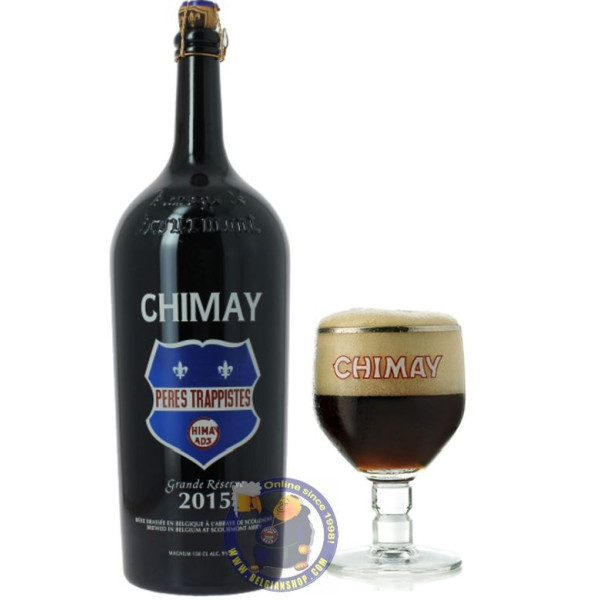
Back to the story, as I knew none of that at the time. I was enjoying good pizza and good beer, trying some beers I had never had before, but in styles that I was comfortable with. I wasn’t pushing the envelope. My friend and I ended up in conversation with the two very drunk guys at the next table. That were drinking beers from wine-sized bottles. They had gone through at least a ½ dozen bottles between them. They were regulars and were leaving the next day for a hunting trip in Canada to hunt beer or moose or elk or something. When they discovered they neither of us had ever tried Belgian beer, they bought us a bottle of Chimay Grande Reserve.
That night, my life changed. I had never tasted anything like that beer before. Learning more about beer, trying everything I could, homebrewing, starting a brewery, all these events could be traced back to that night. Chimay Blue will always be one of my favorite beers. If you want to tell me that St Bernardus ABT 12 is a better beer in that style, I won’t argue with you. It might even be true. I have never had Westy, but most who have say it is better. But those beers don’t have the history. There isn’t an emotional attachment.
I don’t know what happened to these guys. B and I have joked over the years that they were eaten by bears. I do know we never saw them at Rich O’s again, as often as we were there. They may have gotten a DUI on their way home and never made it to Canada. Lots of possibilities. But whenever I drink a Chimay, as I did while celebrating my 5th wedding anniversary recently, I think back to over 20 years ago, and toast them with my Chalice.
 Hario Ceramic Coffee Grinder
 Bodum Pour Over
 Coffee Gator French Press
 Primula Portable Cold Brew Bottle
 Stok Cold Brew Coffee