Blog

  • Wednesday Afternoon Links

    The Tiny Terror (my 3 year old, not the one in my pants) wanted to have a 1am party. Took about an hour to get him settled down, then he was up again at 5am. I’m basically less functional than a zombie at this point of the day. Here, have some links.

    The US Supreme Court seems to have indicated that civil forfeiture of a value greater than the maximum fine for the crime of which a person has been convicted is unconstitutional. It does not appear to me, not a lawyer, that the decision addresses whether or not a person must be convicted of a crime before such proceedings can be undertaken.

    Looks like Andy McCabe might have spoiled the party for the Collusionists. It looks like Mueller may be issuing his report next week. The skeptic in me says that this is because the FBI has decided that they do not want any further attention on their behavior in the 2016-2017 timeframe.

    Apparently teh gheyz not only infiltrated The Vatican, they run it like a shadowy cabal of Italian merchant families. Hey guys, take it from this lapsed Catholic: YOU were in charge of making sure children weren’t raped and abused. I don’t give a fuck about your sexuality because THE ENTIRE POINT OF TAKING THE VOW OF CHASTITY IS TO SUBSUME YOUR SEXUAL IDENTITY TO THE SERVICE OF THE CHURCH. It doesn’t matter if priests were raping boys or girls. Whatever good individual priests and nuns do (and I still believe there are a lot of them honoring their vows and doing good deeds in the service of the least among us), the Church itself is entirely rotten at this point.

    Looks like Bernie can afford himself a 4th house.

    After a rant like that, I guess I’m gonna go to Hell.

  • The Hat and The Hair: Episode 110

    Read President Trump’s Speech Declaring a National Emergency


    FRIDAY AFTERNOON, LEAVING THE ROSE GARDEN

    “That was an absolute rambling mess, Donald,” the hair told him.

    “It was incoherent. Just a wreck,” the hat agreed.

    He was riding on Donald’s shoulder like some deranged parrot as the man stalked through the halls of the White House. Staffers kept popping out of offices and withdrawing, slamming doors, clicking locks into place. Ringing phones were silenced. Someone could be heard being violently sick into a trashcan.

    With regal dignity, Donald drew himself to his full height and began to strut. “Coherent isn’t consistent with my brand,” he said.

    “Sarah wrote you such a nice speech,” the hair said. “Why couldn’t you just have read it? You did such a good job at the State of the Union.”

    “Focused like a laser,” the hat said. “Like a laser.”

    “I engage,” Donald sniffed. “I beguile and bedazzle. Off the cuff. Maverick, but not in the McCain way. Ford F-150 has the greatest towing capacity in its class. Classy.”

    “Is he stroking out?” the hat asked the hair.

    “No, but something is going on,” the hair replied. “His mind is a raging storm of fast food jingles.”

    “Classy,” Donald said again. “Classy, classy, classy. I contain billions of nuclears.”

    Sarah stepped out of her office and directly into Donald’s path.

    “Sir?” she asked.

    Donald walked past her.

    “Sir? Mr. President?”

    Donald stopped and turned. “Yes, young lady? Can I help you?”

    “That’s Sarah,” the hair hissed. “You know her.”

    “Pie, Donald,” the hat said. “That’s Pie. She’s your White House Press Secretary. Sort of.”

    “Ah, yes,” Donald said. “Pie, dear squishy. How have you been? Tremendous, I hope?”

    “Sir, was the speech I wrote bad?” Sarah asked. “Did you not like it or something.” She nervously shifted her considerable weight from foot to foot.

    “It was a tremendous speech. Just great,” Donald said. “I really enjoyed listening to you give it. It was better than Cats.”

    “No, sir. I mean the speech I wrote for the National Emergency Declaration. You didn’t read it just now at the press conference.”

    “Did you see Cats? Terrible, just terrible. The whole set looked like a pile of garbage. Gay guys dressed like some sort of animal came out into the audience. Ridiculous. I hate theater. The characters never come out into the audience when you go to the movies.”

    Sarah bit her lip and tried to hold back her tears. “Yes, Mr. President,” she whispered.

    Donald reached out and squeezed her right breast twice. “Womp, womp!” he said, smiling, wrinkles digging into the leather of his face, cheekbones struggle to rise through the tough flesh. The tears started then, rivulets of mascara running down her face. She cradled the breast he had fondled like a wounded fawn as Donald turned and wandered away.


    Donald Trump makes secret White Power Signal during racist press conference.
  • STEVE SMITH WEDNESDAY MORNING LINKS

    STEVE SMITH SAY “IT OK, HIM HELP WITH LINKS!”


    STEVE SMITH WANT HELP OUT. HIM DO LINKS THIS MORNING. THEM GOOD LINKS! HOPE FUNNY GLIBERTARIAN PEOPLE LIKE. STEVE SMITH KNOW ALL FUNNY GLIBERTARIAN PEOPLE WILL READ LINKS AND COMMENT ON LINKS. DID STEVE SMITH TELL THAT THEM GOOD LINKS? THEM GOOD LINKS.

    1. WANT FUN? LOOK PAPERS IN FUNNY LANDS.
    2. AUSTRALIA DANGEROUS. STEVE SMITH WORRIED HOOMANS WILL NOT BE OK.
    3. MAYBE STEVE SMITH START HIM OWN STORY LINE – “THE SWISS SANCTION!” STEVE SMITH NO FORGET LAST SUMMER.
    4. STEVE SMITH LAUGH – LOOK LIKE “BETO” BAD NAME WIN ELECTION.


    IF NO LIKE LINKS…

    HIT ON HEAD WITH BIG ROCK!

    FREE CASCADIA!

  • As Seen On TV: Pilot

    Welcome to the first(last?) in a new feature where I talk TV*.  I’d like to explore some lesser-known or forgotten TV shows*, not just because they are shows* I like but also to see what impact they had on the industry.


    Today’s Episode: Captain Power and the Soldiers of the Future (1987)

    Captain Power was a 1987 live action toy commercial TV series set in a distant future after the ‘Metal Wars’, and the machines have won.  A group of rebel soldiers let by Captain Jonathan Power use Power Suit armor to take on the evil Lord Dread and his robot army.

    It’s a little ham-fisted, to be sure, but it was a children’s show meant to sell toys.  It was about watching future soldiers use cool armor and weapons to fight evil robots, but there are a few things that make it stand out today when looking back on it.

    First of all, even though it was a show designed to sell toys, the creators sought to make something more compelling:

    Captain Power, to the public at large, is perceived as just another excuse to sell toys. It is a notion that rubs story editor Larry DiTillio the wrong way.

    “We’re not writing stories with the idea of turning each episode of Captain Power into a video game,” declares DiTillio. But DiTillio, a first season staff writer who became story editor when J. Michael Straczynski (Starlog #111) left the position for a similar post with the revived Twilight Zone, claimed that ramrodding the script side of Captain Power hasn’t been easy.

    “This show has definitely not made my life easier,” chuckles DiTillio. “This is not just another kid’s cartoon show. The writing is always to an adult level. There is the interactivity which has been centered mainly in the battle sequences but we aren’t in a position of having to write X amount of animation and interactivity into each episode. I want to make it very clear that around here, we’re working for the story.” –Starlog #128

    Indeed, the story of Captain Power deals with the horrors of war, human relationships and what it means to be human.  In one story line the villain, Lord Dread, is confronted with the pain his war has inflicted on the woman he once loved.  The story was written as much for the parents watching as for the kids.

    But, I bet you’re wondering what DiTillio meant by  “animation and interactivity into each episode”.  Well, as stated the show was created to sell toys, the toys in question were a way for Mattel to use a new technology they had developed, a light sensing technology like that of Laser Tag or the NES Power gun.  The play feature was that the vehicles for the action figures could interact with each other, if you ‘shot’ another jet with your jet it was a hit point, enough hit points and your pilot was ejected from the jet.  This same technology was built into the show, allowing kids to interact and with enemies on the TV by shooting them as well as being shot. It was an interactive game built into the TV show, and pretty innovative for the time.  You could also buy VHS tapes that had longer sequences on them to play the game any time you wanted.


    This wasn’t the only innovation the show had on it’s side.  Remember how the army of bad guys were robots?  Well, the show runners decided to use a new technology called ‘computer generated imagery’ to create the robots instead of opting for guys in costumes.  That’s right, they used CGI to create characters for a TV show in 1987, they were the first TV show to do it.

    Impressive but, yeah it didn’t look too great back then and really doesn’t hold up well today.  They may have been the first, but it was something that was on it’s way without them, eventually.  The last great innovation Captain Power made probably had the most impact on the film and TV industry as we know it today.

    Film and TV have been shot all over the world for many different reasons, but a staple of the industry for the last three decades has been shooting in Canada for that sweet, sweet government lucre. I bet you’ve already guessed it, Captain Power was one of the first major US television shows to entirely move its production to the great white hat of America. The show runners had to build the resources there from scratch and retrain local canooks to be able to shoot and edit an American Sci-Fi Action TV show.They leased an old bus terminal and converted it into a film lot. The writers from Hollywood would ‘modem’ the scripts to Canada and the rest of the production process was done there.

    So what happened to such a fun, inventive, and successful TV show?  Guns killed it!  Well, not guns, but fear of guns.  This was the 80s when busybodies started trying to get rid of violence on TV. The show had high ratings at the onset, but because of controversy surrounding the violence on the show it kept getting moved around time slots, which can kill just about any show. Also the toys weren’t selling as well as Mattel wanted. Also CGI was very expensive back than (a lot more so than today when it is still expensive.)

    It is a show I remember fondly and when I started looking back on it I was surprised to learn how innovative the show really was.  I’m currently re-watching it.  There is also a good documentary on Youtube that goes into more depth of what I’ve talked about if you’re interested.


    POWER ON!


    *Probably some movies as well.

  • Tuesday Afternoon Links

    Hey guys, this one is kinda rushed because I have several errands to run this afternoon. Love ya, mean it!

    Oh, Florida Man. I think this guy is old enough for a pack of angry moms to take him.

    Well, this guy is a moron. The KKK is the violent wing of the Southern Democratic party.

    As long as my wife and kids are still on a five day workweek, I can totally be just as productive in four days. Whose law is “work expands to fill the available time”?

    Come on, SMOD!

    All the talk about Winston’s Mom last night got this song stuck in my head.


    “I vant to suck your accumulated surplus capital! Ah, ah, ah!”
  • And Now for Some Fabulous Fruit Mead


    I started making mead in 2003. Most people start with the Compleat Meadmaker by Ken Schramm. I did too. I have my signed copy, but I haven’t actually read it since about 2004. I started making wine from fresh grapes in 2008, and it influenced how I made mead. I started making beer in 2013, and it too influenced how I made mead. This article condenses my nearly 16 years of experience in making mead. It’s a long article, but I didn’t want to split up the content. So here it is.

    Let’s start with a few definitions: Session Mead (hydromel); Standard Mead; and Sack Mead. Per the 2015 Mead Style Guidelines from the Beer Judge Certification Program (BJCP), the “strength” of mead is classified as Hydromel, Standard, or Sack.

    Strength. A mead may be categorized as hydromel, standard, or sack strength. Strength refers to the alcohol content of the mead (and also, therefore, the amount of honey and fermentables used to make the mead).

    Personally, I hate the term “hydromel” which basically means watery mead. So, I prefer to use the term “Session Mead” for anything that I make in the 6% to 10% ABV range. The alcohol level of Standard Mead would be in the range of 12% to 16% ABV which is typical of table wine. And Sack Mead would be 18% ABV and beyond. There is an assumption that the higher the alcohol level, the more honey aroma and flavor will be present due to the increase in fermentable sugar. Yet a bone-dry mead at 16% ABV and dessert sweet mead at 8% ABV can have about the same amount of honey in the recipe. It all depends on the brewing process – what yeast is used; whether all the fermentable sugars are consumed in fermentation; whether or not the product is back-sweetened after fermentation; what the product is back-sweetened with (honey or cane sugar). But in general, a session mead is going to start with a lower original gravity (less fermentable sugar) than a standard mead which has a lower original gravity that a sack mead.


    Session Mead and Ale Yeast

    I use ale yeast when I am making a session mead. Ale yeast produces a different flavor profile than wine yeast. With the right ale yeast, the yeast can accentuate the honey character in the product to overcome the lower levels of honey in the recipe. I am particularly fond of Wyeast 1318 (London III). My second favorite is 1728 (Scottish Ale). I have had good results in yeast trials with 1335 (British Ale III); 1968 (London ESB); 1214 (Belgian Abbey Style); 1762 (Belgian Abbey Style II); and 3787 (Trappist Style High Gravity). The three Belgian style yeasts – 1214, 1762, and 3787 – are very good for making a stronger mead at 10% to 12% (nearly a standard mead) but with different flavors than you would get with a wine yeast.

    A key feature of ale yeast is “attenuation” which means the yeast does not consume all of the available sugar during fermentation. Most ale yeasts will consume between 65% and 80% of the available sugar during fermentation, and different ale yeasts attenuate at different levels. This allows a brewer to produce dryer or sweeter products by changing the yeast strain during fermentation. For any given yeast, there will be variations in the attenuation depending upon the type of sugar available – simple sugars vs complex sugars as well as the fermentation temperature and other factors.

    My favorite yeast, 1318, generally attenuates at around 75% in beer (malt sugars). It attenuates at dramatically different levels in other products. In cider, it attenuates at around 90% because apple juice is primarily simple sugars. In mead, the results are all over the place depending upon the type of honey used and the type of fruit used. This makes it nearly impossible to predict in advance whether the product will finish sweet or dry. It also makes bottle conditioning extremely unpredictable (can you say “gusher”?). While I love the flavor produced by the yeast, I have given up on bottle-conditioning anything I make with it. So, I almost always back-sweeten to taste; stabilize with potassium sorbate; then keg and force carbonate.


    Small-Scale Kegging

    A big challenge for beginners is how to keg and force carbonate small batches if you are not already set up to keg beer. The answer is that there is a growing marketplace for mini-keg and/or stainless-steel growlers which have lids with connectors for micro-regulators and picnic taps. There are many products available on the market (go peruse Amazon) and the variety of products can be confusing.

    A key issue is whether or not you want compatibility between small-scale kegging equipment and the standard kegging equipment used by most home brewers. In my case, I was already well-equipped with standard ball-lock equipment, so I focused on finding mini-kegs, micro-regulators and taps using ball-lock connectors. For me, I generally force carbonate in standard sized equipment. Yet, there are times when I want to dispense to a small system so that I take products to a party or class and then dispense under typical CO2 pressures. But I also want to be able to force carbonate an experimental batch without tying up my full-sized equipment. So, I looked for small-scale equipment with ball-lock connections.

    Here is a small sample of equipment you can find in the marketplace (these examples are all ball-lock connections):

    Small Cornelius kegs:

    • 1 ¾ gallon kegs (shorter versions of a standard 5-gallon keg) $85
    • Mini-regulator (get one that goes up to 25+ PSI to support force carbonation) $80
    • One-time use (non-refillable) 74gr CO2 cartridge $ 5
    • Keg Faucet (complete with ball-lock connector) $35

    Mini-kegs (growlers):

    • 5L stainless-steel growler/mini-keg (also available in 2L, 4L, and 10L sizes) $55
    • Ball-Lock lid for growler/mini-keg $35
    • Micro-regulator (get one that goes up to 25+ PSI to support force carbonation) $45
    • One-time use (non-refillable) 16gr CO2 cartridge (go buy in bulk on Amazon) $ 2
    • Picnic tap faucet and line $11

    Note: I have purchased from Williams Brewing in the past and have been happy with the quality and their prices. I have at least one of everything in the list above. I have also purchased from other suppliers and have been just as happy. All the ball-lock parts are standard and will work with any ball-lock keg or mini-keg. I have no idea if the size and threading of ball-lock lids for growler/mini-kegs is standardized so that products from different manufacturers will be compatible. As of this time, I have only purchased from the single manufacturer linked above.


    Session Mead Recipes:

    Finally, we get to the point. What do I put in the primary to make a nice fruit mead? Here is a generic recipe for session mead that will produce one gallon of finished product:

    • 2 lbs of honey
    • 3 lbs of frozen fruit
    • 1 gallon of water
    • 1 package of ale yeast

    This will produce about 8% alcohol by volume (ABV) assuming the product finishes nearly dry. You can bottle condition the product assuming you want semi-dry to dry product. Otherwise, you can back-sweeten to taste, then stabilize, keg, and force carbonate. For quick and simple fruit meads, I generally back-sweeten with cane sugar. If you back-sweeten with honey, it will get cloudy all over again and may not clear back up (depending on the honey you are using).

    One thing to note is that acid and tannin levels will vary dramatically by the type of fruit you use. I know some people that like dry mead, but they are in the minority, so most meads are packaged semi-sweet to sweet. Therefore, a decent level of acid (similar to wine) is pretty much a requirement to balance the sweetness of most meads. Tannins are optional in mead, but I think they are highly desirable. Thus, the mead maker needs to understand how much acid and tannin are in the fruits used to make mead to keep everything in balance. Fortunately, there are websites out there that provide detailed acid and tannin level information on a wide variety of fruits used to make wine and mead.

    The following are two example meads that I am making for a class this spring. All the ingredients, except for the yeast, were purchased at Walmart or Target.

    Blueberry Melomel

    • 2 lbs of Nature Nate’s Raw Unfiltered Honey (presumably clover)
    • 3 lbs of Wild Blueberries
    • 2 Meyer Lemons, zested and juiced (not shown)
    • 1 gallon of drinking water
    • 1 pkg of Wyeast 1318 London III ale yeast

    Blueberries are very low in acid. So, the zest and the juice of two large Meyer lemons is added to boost the acidity and provide a wonderful secondary aroma to the blueberry mead. Note that Meyer lemons have far less acid that normal lemons. Use only one large lemon if using regular lemons.

    All these ingredients will go into the primary. Fermentation is done on the whole fruit to provide the maximum extraction of color, aroma, and flavor from the fruit.

    This recipe produced a sugar concentration of 15.2° Brix (refractometer reading) which is equivalent to 1.062 S.G. and 8.3% potential alcohol.

    Raspberry Melomel

    • 2 lbs of Nature Nate’s Raw Unfiltered Honey (presumably clover)
    • 3 lbs of Raspberries
    • 1 gallon of drinking water
    • 1 pkg of Wyest 1318 London III ale yeast

    Raspberries are fairly high in acid. No adjustment is needed to make a well-balanced product. As before, all ingredients go into the primary. Note that raspberries mostly disintegrate in the primary. The product will probably need to be poured through a strainer at some point to remove all the bits and pieces of raspberry pulp from the product. This can be done as late as the final racking into a bottling bucket just before packaging.

    This recipe produced a sugar concentration of 14.8° Brix (refractometer reading) which is equivalent to 1.060 S.G. and 8.1% potential alcohol.


    Standard Mead and Wine Yeast

    Most mead makers try to make standard strength mead or sack strength mead and will use wine yeast to achieve anywhere from 12% ABV to 18% ABV or more. Some general considerations:

    • The strain of wine yeast used to make mead can have a dramatic impact on how long it takes the mead to mature (mellow out enough to be pleasant to drink).
    • The higher the alcohol level, the longer the mead takes to mature.
    • The higher the sweetness level, the easier it is to cover up the fact that the mead is still too young to drink.

    So, a sweet mead at 12% ABV will be pleasant to drink much sooner than a bone-dry mead at 16% ABV.

    Other important considerations:

    • Wine yeast can only survive until the alcohol concentration hits a certain level – its alcohol tolerance. Note that ale yeast also has an alcohol tolerance but it rarely comes into play in beer or session mead.
    • The alcohol tolerance of yeast varies by the strain of yeast – it typically ranges from 14% ABV to 18% ABV.
    • Wine yeast does not attenuate; it will consume all the available sugar until it hits its alcohol tolerance and then it will stop fermenting.

    One method to make sweet mead is to exceed the alcohol tolerance of the yeast. After the yeast hits is alcohol tolerance, any remaining sugar will not be fermented. So, you can start with a lot of honey or you can make honey additions during fermentation. Either way, this will result in the yeast hitting its tolerance and leaving residual sweetness in the product. This process is easy to abuse in my opinion. I know lots of people that will use champagne yeast to make syrupy-sweet mead at 18% ABV using this process. I generally loathe these meads.

    Another method is to start with just enough fermentable sugar to hit a desired alcohol level (somewhere lower that the alcohol tolerance of the yeast). The yeast will consume all the available sugar then fermentation will stall out leaving a dry product (basically how dry red wine is made). If sugar is added after this point, the yeast will start to ferment the added sugar. To prevent this, potassium sorbate is added first. The sorbate will prevent the yeast from fermenting any added sugar. Thus, one can make a sweet mead at a target alcohol level below the alcohol tolerance of the yeast. This is generally what I do.

    There are a lot of options out there for wine yeasts. I have only used the products from Lalvin. I have done yeast trails with five strains of yeast (shown below) that are commonly found in home brew shops:

    I’ve taken the results of my yeast trials to tastings when the products were about 4 months old, 9 months old, and 15 months old. In the earliest tasting (when the products were about 4 months old), 71B was the clear winner. It matures far sooner than any other yeast. RC-212 came in second place. D-47 was blah. K1V-1116 and EC-1118 (champagne yeast) were pretty terrible at that point. In the second tasting, (when the products were about 9 months old), RC-212 was considered the best having the richest, most complex flavor. But 71B was still a strong contender. D-47 and K1V-1116 were considered mediocre, and EC-1118 still was harsh and unpleasant. In the final tasting (when the products were about 15 months old), RC-212 was still in 1st place, and 71B was still a strong 2nd. K1V-1116 was finally maturing and pleasant to drink. D-47 was still bland and boring. EC-1118 still was harsh and unpleasant.

    Let me be clear. Champagne yeast is for making dry sparkling white wine, and it sucks in almost every other application (I don’t care what the chart up above says). Wine kits universally include EC-1118 because it is almost impossible to have fermentation failures using this yeast (it is aggressive, ferments fast, and will overcome most spoilage organisms unless you really, really fuck up sanitation). However, that does not make it a good yeast that produces good mead or wine. {Should you ever buy a wine kit, pick up a packet of 71B for a white wine or RC-212 for a red wine and throw away the EC-1118}

    In summary, if you are a beginner (I know you are not going to wait a year to drink your first batch) use Lalvin 71B. When you get to the point you have the patience to wait a year to drink your meads, both 71B and RC-212 are very good options. K1V-1116 produces nice characteristics in dark, bold fruits (think tart cherries, black currants, etc). D-47 will always be bland, so don’t bother. Don’t ever user EC-1118. {My opinions; your mileage may vary.}


    Bottling Standard Mead

    Bottle conditioning wine or mead that was made with wine yeast is a complex process (see méthode champenoise) that is an entire article by itself. This is not for beginners, so we will assume that everyone is packaging still (uncarbonated) products. There are three basic options at this point:

    • Wine bottles sealed with a cork
    • Beer bottles sealed with a cap
    • Beer bottles sealed with a swing top (grolsch bottles)

    Whether they are trying to cork or cap a bottle, most beginners start with the cheapest piece of equipment they can get their hands on. This results in poorly sealed bottles that tend to leak and also tend to produce grumpy brewers. I, on the other hand, have a habit of going big. My first corker was the little red “Portuguese” floor corker. I put 1500 or so corks through it. I eventually sold it and then went up scale to the blue “Italian” floor corker. I have put a couple thousand corks through it, and it is working great. I highly recommend starting with a floor corker if you have any intention of using standard wine bottles and corking them. My first capper was a light-weight bench capper that worked reasonably well, but one of the plastic parts broke after several hundred caps. There are no replacement parts, so I bought a second. Later, I bought two heavy-duty bench cappers on sale and gave away the one with the plastic parts. I bought two cappers so that I can bottle 12 oz and 22 oz (or 750 ml) bottles without resetting the equipment in the middle of a batch.

    For beginners, I would recommend the grolsch bottles. No equipment required to seal the bottle, and the product isn’t going to sit around long enough to benefit from bottle-aging in a standard wine bottle with a cork closure.


    Standard Mead Recipes

    One of the first considerations for the mead maker is to decide how to balance the honey and fruit characteristics in the final product. The honey can provide the primary aroma and flavor with the fruit in a supporting role. Or the fruit can provide the primary aroma and flavor with the honey in a supporting role. Or the honey and fruit can be in roughly equal balance. All three choices are considered legitimate, and I have made all three types of products. Some basic considerations:

    • Honey can be quite expensive. So, using a lot of high-sugar fruits or fruit-juices can allow less honey to be used thus saving a few bucks. Note that this skews the flavor profile towards the fruit in the finished product.
    • Fresh fruit is generally far to expensive to use in brewing unless you have direct access to the producer of the fruit and can buy it cheap. Store-bought fresh fruit is picked partially ripe and allowed to ripen on the way to the store with negative impacts on aroma, flavor, and sugar levels.
    • Frozen fruit is generally much less expensive than fresh fruit. And it is picked ripe and then flash frozen; so, it is actually better fruit for brewing. Freezing fruit also helps release the juice in the fruit. So, even if you acquire fresh fruit, it is still a good idea to freeze it.
    • Processed juices are generally much less expensive that frozen fruit. It is quick and easy way to add a lot of fruit flavor to mead. However, some of the nuance in the aroma and flavor is lost in the processing of the fruit into juice (see the wine article on how wine kits are made).
    • A nicely balanced product can be made at a reasonable price by using some combination of honey, frozen fruit, and fruit juice.


    Thus, we have three generic recipes that produce a gallon of finished product:

    Honey forward mead

    • 2 ¾ lbs (~1 qt) of honey
    • 2 to 3 lbs of frozen fruit
    • 1 gallon of water
    • 1 package of wine yeast

    This recipe will finish dry with any wine yeast and will produce 11% to 13% alcohol by volume (ABV) depending upon the fruit.

    Fruit forward mead

    • 2 lbs of honey
    • 2 to 3 lbs of frozen fruit
    • ½ gallon of fruit juice
    • ½ gallon of water
    • 1 package of wine yeast

    This recipe will finish dry with any wine yeast and will produce 12% to 14% alcohol by volume (ABV) depending upon the fruit and fruit juice.

    Balanced mead

    • 2 ¾ lbs of honey
    • 2 to 3 lbs of frozen fruit
    • ½ gallon of fruit juice
    • ½ gallon of water
    • 1 package of wine yeast

    This recipe will finish dry with most wine yeasts and will produce 13% to 16% alcohol by volume (ABV) depending upon the fruit and fruit juice.

    Any of these recipes can be back-sweetened with sugar or honey and stabilized with potassium sorbate prior to bottling.

    The following are two more example meads that I am making for a class this spring. Again, all the ingredients, except for the yeast, were purchased at Walmart or Target.

    Triple Berry Melomel

    • 2 lbs of Nature Nate’s Raw Unfiltered Honey (presumably clover)
    • 3 lbs of mixed Raspberries, Blackberries, and Blueberries
    • 2 quarts of White Grape Juice (Niagra)
    • 2 quarts of drinking water
    • 1 pkg of Lalvin 71B wine yeast

    Raspberries, blackberries, and white grape juice all have plenty of acid in them. The acid level in this product will be noticeably higher than in either of the two session meads above. This product will need to be back-sweetened to at least semi-sweet to be in balance. As always, all these ingredients will go into the primary.

    This recipe produced a sugar concentration of 20.4° Brix (refractometer reading) which is equivalent to 1.085 S.G. and 11.8% potential alcohol.

    Dark Sweet Cherry Melomel

    • 2 lbs of Nature Nate’s Raw Unfiltered Honey (presumably clover)
    • 3 lbs of Dark Sweet Cherries
    • 2 quarts of White Grape Juice (Niagra)
    • 2 quarts of drinking water
    • 1 pkg of Lalvin 71B wine yeast

    Dark sweet cherries have some acid, but not a lot. The white grape juice in the recipe provides the acid to give the finished product the proper structure. The acid level in this product will be similar to the two session meads above. This product can to be back-sweetened from semi-dry to semi-sweet and be in balance. As always, all these ingredients will go into the primary.

    This recipe produced a sugar concentration of 22.6° Brix (refractometer reading) which is equivalent to 1.095 S.G. and 13.3% potential alcohol. Note that cherries have a lot more sugar than most berries.


    Making the Example Recipes

    All these example recipes state they will make 1 gallon of finished product. A lot more than 1 gallon of volume is going into the primary, so the primary needs to have plenty of room for honey, water, juice, and whole fruit plus headspace for the foam that is produced during fermentation.

    I am using a 2 ½ gallon plastic bucket with a screw top as a primary fermenter for these small, experimental batches.

    A ½ inch hole is drilled in the lid for the bucket. A standard grommet (found on the lids of most commercial wine pails) is inserted into the hole. An airlock is inserted into the grommet to allow CO2 to escape during fermentation.

    After 3 weeks in the primary, I rack the product into a 4-liter wine jug from the plastic primary.

    I use a slotted spoon to remove the floating fruit from the product in the primary. I put the fruit into a standard kitchen strainer and press out as much juice as I can. Note that all my brewing equipment is dedicated to brewing. I never reuse my kitchen equipment in the brewing room.

    Depending upon how much juice is released from the fruit and how deep the sediment is on the bottom of the primary, there can be more than 4 liters of clear product in the primary.

    So, I start by racking part of the product into a pitcher then rack the remaining product into the jug. I top off the jug from the pitcher. Sometimes you have leftovers.

    After another three weeks in the 4-liter jug, the product is racked into a 1-gallon jug.

    There typically is enough clear liquid above the sediment in the 4-liter jug to fill the 1-gallon jug (sometimes not quite enough).

    The product will be left in the 1-gallon jug for another 3 weeks. Then it will be racked into a bucket and it will be back-sweetened to taste; sorbate will be added; and then it will be packaged (kegged or bottled).

    So, nine weeks from pitching yeast to packaging the product.

    All these products will be used as examples in a class less than three months after pitching the yeast. They will all be mature enough to enjoy, but a few more months of aging will be beneficial.

    There you have it. What are you waiting for? Go make some fabulous fruit mead.

  • Swiss Tuesday Libertarian Linkings of Links

    How now, Swiss Brown Cow?

    The SMITHS were not answering the GlibPhone, and ZARDOZ had yesterday morning…so, looks like we are stuck with Swiss Links. Sorry, not as fun as, say… SEA SMITH NAUTICAL LINKS O’ RAPEY FUN…but they should serve, nonetheless.

    And here are your links to get the day rolling:

    • Don Swissxote Update – Come see the violence inherent in the system! Catalonia Trial.
      We protest!


    • Somalia! Pirates! Lists! I am sure every swingin’ one o’ ye is going to read #10 and say “squandered?!” … well, I did.

      Yaarrrr?
    • ROADZ!  For a good laugh, read this and compare with reality. “We are dedicated to public service and strive for excellence and customer satisfaction.” HAHAHAHAHA!
      O Golden state!


    • And finally….A question I am sure we are all burning to find out the answer to…


    Uh, go forth and FREE CASCADIA from the Brutals, or whatever.

  • Jussie Smollett’s saga DID expose hateful bigotry, no matter what they say

    As we conclude yet another round of Culture War: Red versus Blue, it’s important to realize that just because Jussie Smollett hired his coworkers/friends to simulate a bigoted hate crime doesn’t absolve the bigotry of the situation. There is still hatefully bigoted behavior happening, and it’s a growing trend that is quite troubling. Smollett may not have been lynched, but a lynch mob was formed, and it was the usual suspects that were holding the noose and wearing the pointy white hats.

    That’s right, the progressive left is at it again! They may have admitted defeat in the 1960s when the Klan began to collapse and Jim Crow was given a swift boot into the rearview mirror of history, but the racial supremacist instinct of the progressive left has been simmering in the dark recesses of academia, mass media, and activist organizations across the country. The progressive left up to the 1960s had always been composed of two rival factions that agreed on more than they’d like to admit. The elitist northerners were the scientific eugenicists, the social Darwinists, the people who cheered the Supreme Court on when they ruled that mentally handicapped people should be sterilized in Buck v. Bell. Their superiority didn’t attach to whiteness, per se, but it was attached to a misplaced Protestant work ethic (a remnant of the original Progressives who, by the early 20th century, had been jettisoned by the progressive movement to eventually become the social conservative movement). Immigrants, catholics, and blacks were in the inferior working class, and the elites lorded over them, secretly despising them. The dixiecrat southerners approached the dynamic a bit differently. They came from a long tradition of looking down on blacks due to the slave relationship, and the fact that the South got their noses rubbed in their mess during Reconstruction still smarted. Add in the religious dynamic of 2nd Great Awakening revivalism emphasizing anti-intellectualism, and the dixiecrats were much less nuanced, much more emotion-driven racists. They were your true “white supremacists” in a less effective caricature of the German model that eventually became Nazism.

    Some people believe the vapid notion that the parties “switched sides” in the 1960s or 1970s, but the reality is much different. In the middle of the 20th century, there was a shift going on, but it was much more limited and much different than your self-conscious progressive know-it-all friend realizes. Essentially, the dixiecrats all died off. In the “greatest generation” (I hate that moniker) and the prior generation, they lived knowing people who had seen the Civil War and Reconstruction. The roiling hatred the rebels felt for the yanks was passed on to those younger generations. This resulted in two things: 1) a regional pride that still exists to this day; and 2) white supremacy. In the 1930s, 1940s and 1950s, those two generations were in their primacy, and the worst abuses of Jim Crow were in effect. By the time the 1960s and 1970s rolled around, those two generations were waning, and the baby boomers were supplanting them. The baby boomers never knew the scars left by Reconstruction. Their great-great grandparents were dead before they were born, and the boomers in the South only got second hand hatred. The boomers were also the first generation to be unified under a central and pervasive mass media. Sure, Hollywood had been king since the end of the vaudeville days, but news and entertainment was still highly localized until the mid-to-late 1950s when shows like American Bandstand were in the zeitgeist. Once the mass media took hold, the boomers were exposed to a very northern mass media, and their voting habits reflected that.

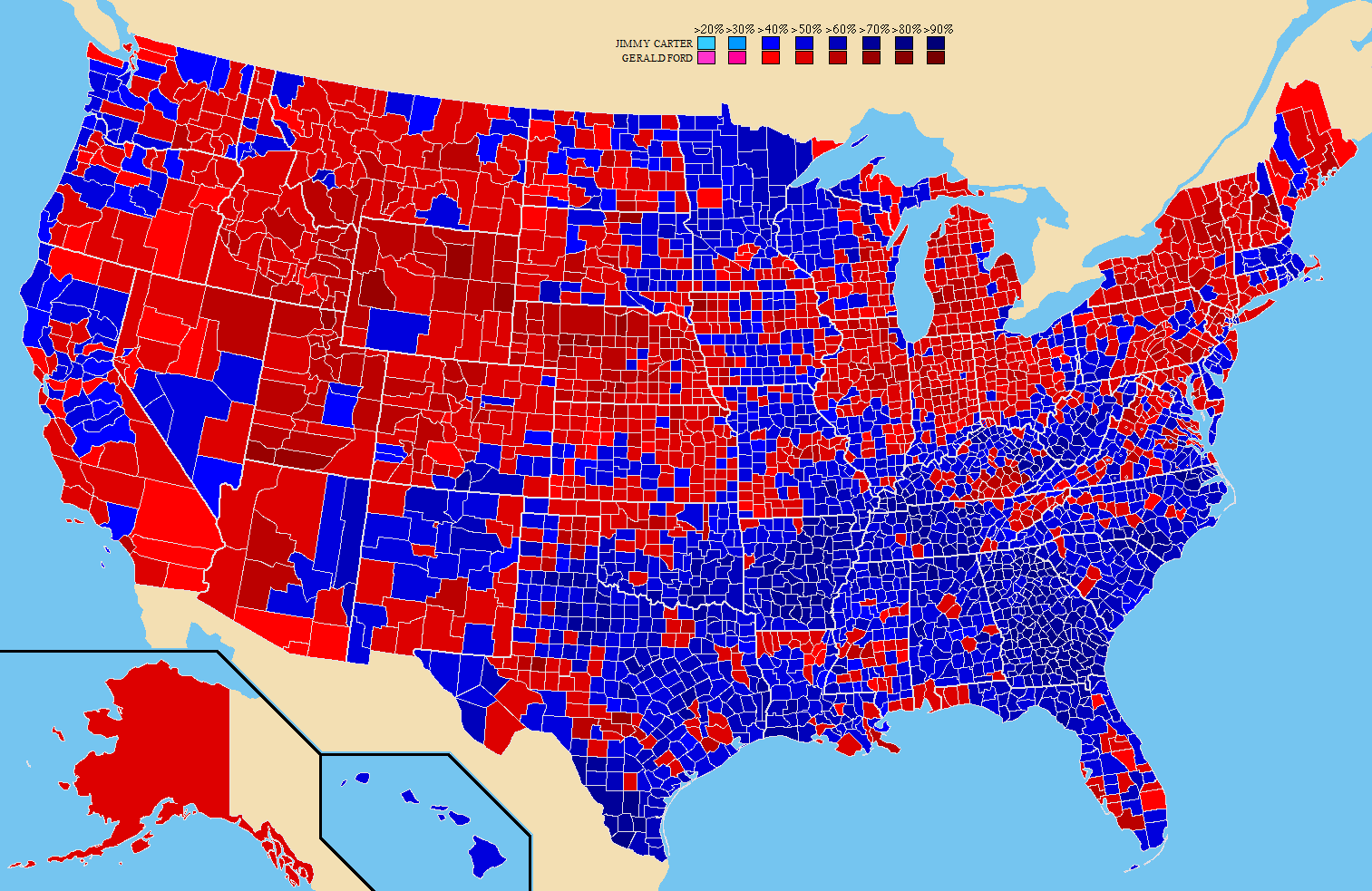
    The 1976 presidential election is probably the best microcosm of this shift. George Wallace and Jimmy Carter were the two Democrat frontrunners in the primary. Wallace was the last gasp of the Dixiecrat contingent, and Carter was the compromise candidate. Carter was a northern elitist in a southern peanut farmer’s body. Carter won out, and the last nail was placed in the Dixiecrats’ coffin. The more erudite and cosmopolitan boomers were the main force in politics. However, they didn’t just magically flip to being Republicans. Party identification doesn’t tend to flip on a dime, and you can see that there are only a few Republican cracks in the Democrat southern hegemony in 1976. However, these were votes for a Democrat that was, by lineage, style, and heritage, a Southerner, but by ideology a northern elitist. The southerners were holding their noses and voting for a progressive because voting Republican was out of the question.


    You can really see the death of the dixiecrats when you compare 1976 (above) to 1968 (below) where Wallace swept the south and Humphrey swept the northeast. Note that in the 1968 map, all of the states in blue and orange were won by Democrats in spite of there being two Democrats on the ballot in the general election (Yes, technically Wallace was an Independent).


    File:ElectoralCollege1968.svg


    Anyway, all of this has a point. The northern elitist bigots never went away. The dixiecrats died off and the southern boomers voted Republican in large numbers in the 1980 election, but the huge contingent of new england Democrats didn’t go anywhere, and became entrenched in positions of power. They were elitists, and thus they became elites.

    Through the 20th century, the northern elitist progressives carried with them the identitarian philosophies that flowed from Marxism (class conscious reality morphed into critical theory, feminist theory, etc.), and in true leftist fashion, the target of their ire settled on their idiot political bedfellows, the dixiecrats. It was just happy chance that the “backwards hillbilly bible thumper” stereotype was shifted over to their rival party when the southern boomers revolted en masse in 1980. The progressives also did a pretty damn good job of making the dixiecrats’ perception of racism carry over to the GOP, too. However, the progressives had been undergoing their own changes in the middle of the 20th century. They quickly recognized that the civil rights movement was exploitable and they sloppily cut and pasted their “working class oppression” schtick from the 20s and 30s onto the civil rights struggles in the 60s and 70s. Scratch out “Irish” and replace with “black”.

    Those roots they set in the civil rights movement didn’t strip away their eugenic, bigoted foundation. They are and have always been elitists who only see the world skin deep. They will do and say anything to have the cultural upperhand, and they’re not above stoking racial tension, sexual tension, or any other difference between people to cause the public to give them social power.

    Jussie Smollett may not be aware of the history of the progressive movement, but he’s influenced by it. He’s the latest to throw himself on the sacrificial pyre of identitarian leftism, and the frothing mob that backed him up is the culmination of 100 years of work by the American progressive left. The prevalence of bigoted identitarian strife seemed to be tailing off through the 80s, 90s, and early 2000s, but the progressive left, which was dealt a massive blow in the 1980s with the near extinction of their fellow traveler dixiecrats, has recovered to national prominence in the past 15 years by rebuilding a coalition of identitarian groups of all stripes, all deluded under the Marxist lie that their truth is in their identity.  Bigotry is back, and it’s likely going to stay for a while.

  • Blue Monday Afternoon Links

    Its kind of a blue Monday here. Its been gray and shitty (but warm) all day. My wife is home sick, hacking like a COPD patient taking a smoke break. But hey, it could be worse.

    Hey guys, did you know that you can be a Democratic Socialist AND a Capitalist? I suppose in the same way you can be a libertarian in favor of… well, I’ll let you guys fill in the blanks.

    I hope Jussie is paying attention, THIS is how you stage politically inspired violence. You know, have the police identify both the assailant, the victim, and the weapon. (I give this about an 85% chance of being true. MAGA dude is a dumbass if true. Why would you follow some dude who just drew a gun on you into the parking lot for more talk?)

    AOC as the Left’s Manic Pixie Dream Girl. I fucking love it, because it is 100% true, and they sneer at that trope as simplistic and toxic masculinity defeminizing complex, strong, wimmenz.

    NOPD injures five bystanders in shootout with rival gangmember.

    Hit the day’s theme music!

  • Eyeball


    As you can see, I’m an eyeball, someone took me out of a perfectly good head and stuck me here, in this black ooze, so here I am.

    I don’t look like much, but then again, neither do you.

    I see a lot of things, in fact that’s all I do, see things, forget all the Santa Claus sees you when your waking stuff, I see all the Time. I’m found in out of the way places, always looking, at You.


    Only one problem, without a brain for storage, I got nothin’ I tells ya,no memories at all, I come home, and can’t remember what I saw half the time.

    What kind of life is this for a normal, common eyeball?

    Black ooze? Who thought of that? And a Tail? Who was the idiot that decided Eye need a tail? It comes with the ooze so Eye’m stuck with it, What about Contacts? I am getting older Dammit! there’s no Social Security! Eye Carumba!

    Ever try getting a Savings account at a bank? “Sorry Mr. ,Eyeball, we don’t serve your kind” A job? I’m a greeter at Walmart for Cornea’s sake! and the customers keep complaining about the Black ooze, what’s an Eyeball to do?

    “But, you must have Super powers, right?”

    Sure, I can stare at you til you die of boredom, but that’s about it, Eye’ll tell you what, rip your eye out, stick it in some 40 weight motor oil then we’ll talk.

    It’s tough out there for a common Eyeball, always looking for the best view, watching your back, and constantly getting pecked at by Birds, not to mention the lighting at night is terrible. A pimp is usually the best way to go, we call them “agents” but they keep us from getting poked, as it were, and they get 20%, and of course they get a personal view IYKWIM

    People ask “where do you see yourself in 20 years, when your old and needing glasses, after all you can’t keep your looks forever”
    I have some good safe investments, so when I retire I’ll get a place with nice view, and that’s good enough for an old eyeball like me…..

    I met another like me once, a real eyeful, and we went for drinks, Bourbon for him and Vodka with Visine for me, and I was regaled in stories of him Eyeing chicks, getting an eyeful and all that went with that kind of thing, I wasn’t impressed. I mean what, stare them into an orgasm? I soon left him in a pitiful state, having crushed his dreams of what? sweet lookable Pussy? Ladies, be on the lookout for this Eye, he only looks good.

    Sometimes when I look at the stars, and I wish I had a Telescope.

    I wish I knew what this Black ooze was all about, it’s hard to get out of the upholstery.

    My Wife asked how it was I could speak to you, I could only reply “Damn your eyes Woman!” but that got me thinking, how am I talking? how am I thinking? how did I get here? Why do I feel like Hedley LaMar right now?

    Maybe the Ghost of Napolitanos past?

    Here’s looking at You,