I have zero guilt about pointing out how awful compulsory public education is. Now, when I say awful, I don’t just mean bad like everyone else who’s lamenting the woes of publicly funded education in the aftermath of U.S. test scores being released; I mean it as a matter of morals. Forced state education isn’t just another item in a mind-numbingly long list of overfunded, underdelivering government institutions that swallow vast sums of taxpayer dollars while completely ignoring its original charter… like Congress or the Supreme Court, for example. No, compulsory public education is worse because it is an indoctrination center for our children’s minds, an obedience machine, that feeds and fuels the rest of the items on the above list of bad government, irrespective of whether it’s my list, or your list, or your neighbor’s list.
If anyone truly wants to fix what’s ailing America and make it a livable bastion of freedom into the future, it won’t matter what other arguments you make in the public square or what legislation We, the People, get our bought-and-paid-for politicians to finally push through to tinker with some other broken institution. None of that will matter one whit; it will be only a temporary band-aid on the sucking chest wound of the body politic until we destroy compulsory public education.
I know what you’re thinking: Don’t sugarcoat it, Dale; tell us what you really think.
I love learning; always have. I consider myself a perpetual student and tell friends and loved ones that the day I stop learning will be the day you all are kicking dirt over me. But that love of learning is exactly why I hate public education as it currently is constituted. When I graduated from Boston University in 1991, I told everyone I knew: “I swear to God I will never go to school again. I’m done.” Sixteen years of the U.S. education system had ruined my love for not just education, but learning itself.
Paul Lockhart’s brilliant essay-turned-book, “A Mathematician’s Lament,” explains how public education destroyed his favorite subject, mathematics, but it applies with equal force to all subjects. Indeed, one might well observe that Lockhart’s Lament is simply a slight-variant of the Gell-Mann Amnesia effect, in which a person reads the front page of the newspaper, noting to herself how completely wrong it is, only to turn the page and treat every subsequent story with complete credulity, as if they were somehow of a different specie. I don’t want to impute opinions to Lockhart that he doesn’t hold, but his introduction strongly implies that he recognizes public education hasn’t only ruined mathematics.
A musician wakes from a terrible nightmare. In his dream he finds himself in a society where music education has been made mandatory. “We are helping our students become more competitive in an increasingly sound-filled world.” Educators, school systems, and the state are put in charge of this vital project. Studies are commissioned, committees are formed, and decisions are made – all without the advice or participation of the single working musician or composer.[1]
Lockhart fleshes out this nightmare in the succeeding pages in satire worthy of Swift, finishing the scene with the devastating postlude: “Meanwhile, on the other side of town, a painter has just awakened from a similar nightmare…”[2] The critique repeats itself for that subject and it doesn’t take a genius to recognize that the same issues raised in the musician’s and painter’s nightmare apply with equal vigor to all subjects.[3]
I had a great personal experience with the Gell-Mann amnesia effect before I had even heard of the term. Over breakfast one day, I asked an older business associate about a long-form article I had read the day before; it concerned a subject that I knew he had extensive knowledge and experience with.
“What did you think of that story?” I asked, quoting the source.
“It was garbage – complete and total shit,” he said over bites of his breakfast burrito. I raised my eyebrows in response.
“Really?”
“I only know one subject really well and that author has no idea what he’s talking about.” I made an “Ahhh” face and dug into my breakfast.
“Let me ask you something,” he went on after a brief pause, “You ever read a newspaper or magazine article about a subject you know really well… like flying helicopters, for example?”
I thought for a moment.
“Sure.”
“Well? Were they ever any good? Did they accurately portray what flying helicopters was like?” I gave it some thought.
“Nah. Not even close,” I replied. Probably 90% of the stories I’d ever read that were about just being in the military fell into that category, as well.
“Then why do you assume that it’s only the subject that you know about that’s like that and not anyone else’s…?”
I sat there with my mouth open for several moments while that sunk in and changed my entire worldview on the press.
As Fate would have it, when I matriculated from BU with half an English degree and half an Engineering degree (and not in that order), notwithstanding my proclamation that I was done with formal education, I knew I was headed right back into another “education” pipeline as a newly commissioned Second Lieutenant of Marines. Like all new Marine lieutenants, I would spend the next 26 weeks learning how to be a basic infantry platoon commander and Marine officer at the aptly named “Basic School.” The acronym TBS (include “The” at the front) would get all kinds of wonderful student monikers, such as “Ticks, Bugs, and Snakes,” or “Time Between Saturdays,” a fair description of the general Monday thru Friday routine, with Sunday largely devoted to getting uniforms ready and prepping for the upcoming week’s field exercises, live fires, or patrolling, or – worst of all – hours spent sitting in the classroom getting lectured on everything from military administration (Marine Corps-style) to the German war machine’s blitzkrieg campaign to military customs and courtesies to how to write a fitness report, thus earning it my favorite nickname, “Thousands of Boring Slides.” Yet as bad as it was at “The Baby School” – and whatever justified criticisms can be leveled at military training and education – it was a considerable upgrade from what I had endured in the prior sixteen years.
First, I note that TBS had training, a necessary sanity-check and counterpoint to classroom education. There may be some merit to sitting in a classroom being force-fed hours of lectures, slides, and discussions about any subject, but those benefits are shadows compared to the benefits of hands-on training, particularly when the subjects are closely related.
As an example, when I went on to flight school, i.e. Naval Aviation Flight Training at NAS Pensacola, Florida, our first six weeks consisted of something called AI, Aviation Indoctrination. The best cultural reference I can call upon is “An Officer and a Gentleman,” except that all of us were already officers and had gone through Officers Candidate School, so we didn’t have Lou Gosset breaking our balls.[4] The altitude chamber and dunkers, swimming tests and obstacle courses, the boxing and academics, and all of that other fun stuff, however, was fairly well-depicted.
What they don’t show in the movie is the genuine interest our instructors had in wanting the students to learn the material. They viewed and treated us as fellow professionals who might be in the air with them someday, a not-too-ridiculous possibility. Most of our instructors were just there as a temporary duty away from the cockpit after a successful tour as a pilot. So, there is Huge Difference Number One between real education and academe. Universities and even high schools have raised ‘academic freedom’ to a deity-like status; tenure for professors is supposed to inure them from bureaucratic concerns, yet nothing could be further from the truth. Most academics have not even a nodding acquaintance with the practical application of whatever subject they’re teaching, as Lockhart notes – and this is, in my experience, even more prevalent, worse in every way, the higher one goes up the education ladder. Take a look at how many economics or MBA professors have a track record of successful business endeavors. How many are heading back out to ‘the real world’ after just 3 or 4 years of teaching? This also makes a huge difference in the relationship between teacher and student.
Our course on jet engines wasn’t only tons of pages of reading from a book and hours of lectures – although there were plenty of both of those. We also had two jet engines in our classroom, cutaways that you could rotate, and see the various sections and how they worked together: the intakes, combustion chamber, the stator vanes, compressor, the accessory gear box and where other components attached, the splined shaft that ran the length of the engine, etc. One of the engines was a very close cousin to the one that would be powering our training aircraft, the T-34C Turbo Mentor. Thus, we had not merely dry recitation of theory, but also hands-on experience with a no-kidding jet engine that we would see in a month bolted inside of our aircraft’s engine compartment.
One can, of course, point to a myriad of other factors that differentiate military training and education from “regular” everyday education of the citizenry, not the least of which is the ‘death’ factor. Military training at its core is about killing other people, who will likely be trying to avoid that fate and also to inflict it upon you; that has a tendency to sharpen the mind in ways little else can. The differences in education needs, however, are not as significant as one would imagine. First, there are many professions that are significantly more dangerous to life and limb on a daily basis than the military – (and no, the police isn’t one of them. Not even close. Firefighting usually doesn’t crack the top 30 either). Tree work almost always ranks among the deadliest professions on the planet. Underwater welding is also no picnic and the margins for error are razor thin, yet none of the aforementioned careers relies upon the model that we as a nation are currently inflicting upon our children to train and educate them for their future. Second, having put four daughters through a variety of education systems, from DoD schools, to very highly rated school systems in Boston suburbs, my takeaway from it was that they truly are about indoctrination, and in some cases, it’s not even subtle. To wit: when the last President was running for his second term, I had three daughters in high school together. ALL of them were mandated to read a sitting President’s autobiography and write a paper about it; the oldest would be eligible to vote in the upcoming election. Worst of all, the youngest wrote a paper critical of the autobiography, and got her worst grade in all of high school because of it. The other two were smart enough to regurgitate what their teachers had already made clear in class – and they were graded accordingly. I read all of the papers
Training and Education together are wonderful complements, facilitating learning, yet it strikes me now that the only training there ever was in public education took place in the arts: whether it was Music, Language, Art, or Gym class. (I purposely eschew the term ‘physical education’ for ‘gym’ because it is another one of those wonderful, modern malapropisms that is helping systematically destroy the English language). Vocational training has all but disappeared from high school and middle school. I know this because I’m old enough to have been in school when public education shifted from its Prussian roots of identifying who the laborers would be and who was destined for college – and therefore middle management – and schools instead became college-entrance mills, a pipeline for everyone, regardless of aptitude or even desire, to go to almighty college. By the time I was in high school in the mid-80’s, society had almost gotten to the point where we are now – where anyone who didn’t want to go to college was considered somehow a less than. Despite my best efforts, my four daughters cannot help but believe that anyone who does not go to college will shortly become part of the homeless population.
Ohmygod, you’re not going to college?! What will you do?? How will you even get a job?!
It is likely not surprising to anyone with a little history, or experience in that part of the world, that the Germans first established the public funding of compulsory education.
Utilization of the property tax to support public schools is an Anglo-Saxon tradition, in the history of the tax is inseparable from the movement for universal, compulsory, and free education that arose from the Reformation and constituted one of its greatest influences on Western culture. There was a nascent belief among the Protestant peoples, particularly in Germany and England, that universal education was necessary to ensure the welfare of the “state” in a period of rising secular nationalism, to assure that individuals could read and interpret scripture for themselves under the Protestant religious systems, and to ameliorate ecclesiastical and monastic control of education previously exercised by the Catholic Church.[5]
This experiment and tradition managed to transmit itself across the channel to the English, and also over the Atlantic Ocean to the early New England colonies. The Puritans in the Massachusetts Bay Colony passed the first compulsory education law in 1647. It called for every town of 50 families or more to have a schoolmaster and every town of 100 or more families to have someone who could teach Latin and prepare students for Harvard College, which had been established in 1636. (Just for perspective, consider that two years later the first printing press in the colonies was established at Harvard.)
The intent of the Act of 1647, called the “Old Deluder Satan Law,” was to ensure that every child could read the bible and knew the central tenets of their Puritan faith. The law got very little traction outside of New England, although the district system it established with local control over the curriculum would eventually come to be the model for the Nation – several hundred years later. It’s also worth noting that 45 years after the law was passed the Salem Witch trials took place in Massachusetts. So much for the merits of education abolishing ignorance!
But Dale, there’s proof right there that compulsory education has been a part of the Republic since the very beginning!
True enough – all manner of slavery was extant in the early colonies, but that’s no justification for its continued existence. It’s a naked appeal to tradition as authority. An interesting historical fact often overlooked by scholars to me, however, is that the early colonists established various legal regimes, done so under their authority as British Crown subjects, that continued ‘on the books’ as it were, even after the Declaration of Independence and Constitution had undercut or outlawed the foundational principles upon which these legal regimes rested. (‘Sovereign immunity’ is a good example of this).
In the case of compulsory education, the colonial law of Massachusetts rested upon notions of authority that emanated from the Crown, as the Divine Head of State, with his/her authority coming directly from God. The most radical notion in the Declaration of Independence was not that a group of subjects rebelled and declared their independence from a monarch – that had been happening for as long as there had been monarchs, both on the Continent and elsewhere – nor was it that “all men are created equal” and imbued with “unalienable rights.” Such notions had justification in the Bible and other significant religious and political movements prior to the Founding Fathers. No, the most radical political notion in the Declaration of Independence was that “Governments… deriv[e] their just powers from the consent of the governed” and furthermore, that ‘the governed’ could “alter or abolish” these forms of governance whenever it suited them to do so.
Compare that sentiment to the notion in the Old Deluder Satan Act that ‘the State’ could compel the citizenry of every town to (1) appoint someone to educate their children, and (2) pay for it out of their own pockets. And if one still insists that there is no conflict, or that the people of Massachusetts ‘consented’ to such a form of governance, that argument falls apart when run up against the First Amendment’s anti-Establishment clause 140 years later. Early colonial schools were not beacons of secular Enlightenment thinking, teaching scientific ‘truths,’ or other anti-religious curricula – they were explicitly religious indoctrination centers designed to ensure the continuation of the Puritan strain of religious thought.
Lest this seem like a mere academic argument in political theory, it’s worth noting that John Hathorne, the chief inquisitor during the Salem Witch Trials, was born in 1641. He would have been 6 years old when the aforementioned Law was passed. While I cannot find direct evidence of his attending the schools so established, there is significant circumstantial evidence of his having received an education under that system, given the prominence of his family in Salem and surrounding Essex County, and biographical evidence of his start as a bookkeeper, later land speculator, and then his having served as a significant political and judicial figure in Salem, Mass., and Essex County.
Oh, c’mon Dale, you’re using an extreme example, a strawman of what modern education really is to justify your hostility to it. You’re not seriously suggesting modern education is equivalent to the Puritan education model.
“Modern” education certainly didn’t begin with the Puritans, although the vast majority of states that eventually created their own compulsory education did so based upon the original Massachusetts Act of 1647, or upon land grants similar to the “Land Ordinance of 1785” by the federal government that established Ohio into 640 acre parcels, with a set aside for schools. Widespread adoption, however, of compulsory state education had to overcome a number of hurdles, chief among them being the unwillingness of the poor (and most everyone else) to pay the taxes necessary to fund the system. Again, it’s worth remembering that the early colonists were people who resorted to acts of war over a 2 pence tax on their tea, even though it actually lowered the price of British tea in the colonies from what it had been. That tax – the Townsend duty – was a subsidy to prop up the failing British East India Company, an early example of the kind of political cronyism that is rampant and openly accepted today. Back then, however, the colonists went to war with the greatest Land and Naval Force history had ever seen over the principle of “taxation without representation” and the British abuses of what they saw as their God-given rights.
The other reason that compulsory education was ‘on the books’ but largely ignored (until 1852 when Massachusetts passed the first mandatory state education law) was that most people lived in rural areas. Outside of the few ‘big cities’ of the day, most people lived on a farm where parents were the major source of education, and which consisted principally of the skills necessary for daily living: farming, hunting, and/or whatever trade a person’s father practiced to make ends meet. Finally, there was – and continues to be – the common agreement that education itself is a “good thing.” The average person would be hard-pressed to argue against education, much less to make the distinction between private education and publicly-funded education and to argue the merits of either. Thus, there was no public outcry in 1779 when Thomas Jefferson proposed a “two-track” educational system for “the laboring and the learned.” Indeed, that Prussian model held sway until late in my childhood. Jefferson received no clapback, nor did he get ratioed on Twitter, for observing that the education system for laborers might “rake… a few geniuses from the rubbish.”[6]
Given these realities, one has to wonder what it took to finally see widespread adoption of the Massachusetts Model: much like every other plank in the platform of Progressivism, it was spurred on by good old-fashioned racism and fear-mongering, of the exact same kind that animated state education in the first place. The attempt by the Puritans to ensure their ‘posterity’ against the Catholic church was adopted by the broader Protestant population of the United States after waves of Irish Catholic immigration in the 1840s. Over a million Irish immigrants came to the United States fleeing the Potato Famine in their homeland. In the decade from 1846 to 1856, roughly 3 million immigrants arrived in the New World. That number represented about 1/8th of the entire U.S. population – and those Catholic immigrants didn’t want their children being taught Protestant theocracy. Private Catholic schools began to pop up in larger numbers via private endowments and other funding mechanisms. The Industrial Revolution also put large numbers of people in cities and factory owners needed compliant workers. It is no coincidence that Horace Mann, considered by many to be the leading figure in the history of compulsory “free” education, when he was appointed head of the Massachusetts State Board of Education in 1837, had offers to supplement his meager state salary from the pocket of industrialist Edmund Dwight, among others.
The justification used in the 1840’s and thereafter in favor of compulsory education was the ubiquitous “for the children.” Specifically, “assimilation” of immigrant children. The New York streets were beset by gangs of kids who spent much of their free time in mischief and crime. Nor was it a happenstance that the Ku Klux Klan was a vocal supporter of compulsory state education acts into the 1920s that would ensure the “papists” would not change the character of the Nation. Lest this seem like character assassination by lumping in the KKK with education reformers, they were following in a tradition that included people like Thomas
Jefferson, who was also an ardent supporter of public education for the same reasons:
Preach, my dear Sir, a crusade against ignorance; establish and improve the law for educating the common people. Let our countrymen know that the people alone can protect us against these evils, and that the tax which will be paid for this purpose is not more than the thousandth part of what will be paid to kings, priests and nobles who will rise up among us if we leave the people in ignorance.
Jefferson wrote the above to George Wythe in 1786, a legal mentor and friend, while Jefferson was in Paris, commenting repeatedly on the problems he saw with the influence of the Catholic Church in education in France.[7] Indeed, Protestant anti-Catholic animus remains a staple in American public discourse, from John F. Kennedy’s run for the presidency in the late 1950’s to Congressional hearings over Supreme Court nominations as recently as last year.
Okay, Dale. Fine. Regardless of your historical point, you’re not seriously arguing that we should end free public education. Where will kids go during the day? What will happen to poor children who can’t afford education? What will they do all day?
Some will claim that I’m belittling the best of the arguments for compulsory public education, but the above questions are a fair summation of what I usually get in response to my occasional rants on public education to those who will stand still long enough to listen. It’s also not an unfair summation of all of the arguments offered in favor of compulsory education over the history of our Republic. I want to give them their due, but because there are so many implicit assumptions that underlie these questions, I’ll ask for a little indulgence and “back into” my answer and proposed solutions. In an attempt to give air to these concerns, however, I’ll note that the ‘horrible hypothetical’[8] of gangs of indigent kids running amok on the streets if they’re not in school is not without validity. As I noted above, it was one of the factors that helped make forced primary education in the U.S. a reality in the first place.
I’ll also add two anecdotes to that sentiment: first, my friends and I grew up on the streets of Providence, Rhode Island. I attended Oliver Hazard Perry Middle School on Hartford Avenue, right across the street from the Hartford Projects, the same school my mother attended when she was a child living in those same housing projects. We – meaning me and my knucklehead friends – were just one of many gangs of (mostly, latchkey) kids roaming the surrounding streets and neighborhoods causing mayhem, much like the guy on the All State commercials, as soon as school let out. Second, a well-traveled business friend of mine once observed that his standard for judging the likely criminality of a society, or even a particular section of it, was by how many young men he would see standing around on corners or walking the streets with nothing to do. Reams of studies bear this out, however uncomfortable that may be for the male of the species.
Now, before I return to answer this concern and others, let me begin with the most devastating takedown of the public education system of which I’m aware.
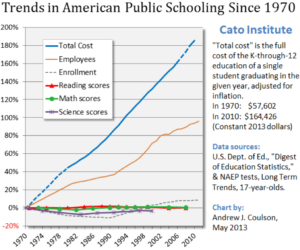
Data. Placed onto graphs.
The late Andrew Coulson of the CATO Institute did yeoman work on the subject of education and its costs, along with numerous papers and studies over decades of research. It really doesn’t matter how the numbers are graphed, however, what domain or range is used, whether they’re placed on the abscissa or ordinate line, because the underlying data is all the same: the costs of compulsory state education almost always go in one direction – up – and the product that is supposed to result, student test scores, or literacy rates, no matter how they are controlled or measured, always stay flat, or worse yet, go down. It doesn’t matter if it’s per pupil spending, or by percentage from a zero line (such as the start of the Department of Education), total dollars spent (hundreds of billions), if it’s fixed to 2009 inflation dollars, or 2013, or 1975, on and on and on. The data only shows one thing: no matter how much this country spends on education, the results show little to no impact.
None of this data tells the complete story, either.
Consider that the DoE isn’t judged by some independent body, like the American National Standards Institute, for example, or audited by an outside agency. In fact, the DoE actually gets to determine what the standards are by which it will be judged, what the curriculum will be, and it administers the tests through its agents (the public school system and administrators). Notwithstanding all of this, it still fails. It’s like a student being able to write the questions for his own test and then complaining its unfair when he can’t answer his own questions. Only in the government, however, could one fail so miserably after spending tens of billions of dollars, and then with an absolutely straight face, look into a camera and say, “We need more money.”
It’s not enough to show that test scores and literacy rates haven’t improved, though. Nor to show the depressing amount of money spent with flat achievement lines. That’s just the tip of the iceberg. The real tragedy is that none of the benefits that the most ardent compulsory education advocates told us would undoubtedly occur did; and none of the ills that they claimed would be solved were.
For a diverse nation, we share a remarkable consensus with respect to educating children. As reflected in polls and focus groups, Americans are nearly unanimous in their commitment to certain fundamental ideals: that all children have access to a quality education regardless of family income; that they be prepared for happy and productive lives; that they be taught the rights and duties of citizenship; and that the schools help to foster strong and cohesive communities. These are the ideals of public education.
One hundred and fifty years ago, a band of dedicated reformers declared that progress toward those ideals was too slow and proposed that a new institution be created to more effectively promote them. Led by Bostonian Horace Mann, the reformers campaigned for a greater state role in education. They argued that a universal, centrally planned system of tax-funded schools would be superior in every respect to the seemingly disorganized market of independent schools that existed at the time. Shifting the reins of educational power from private to public hands would, they promised, yield better teaching methods and materials, greater efficiency, superior service to the poor, and a stronger, more cohesive nation. Mann even ventured the prediction that if public schooling were widely adopted and given enough time to work, “nine-tenths of the crimes in the penal code would become obsolete,” and “the long catalogue of human ills would be abridged.”[9]
I can only imagine that the ghost of Horace Mann is spinning his grave like a cornish game hen on a spit powered by a gas-turbine engine. Let’s forget Mann’s hyperbole and limit ourselves to the ideals in the first paragraph and answering the questions I asked above, which are touched upon in Coulson’s first paragraph:
Have public schools eliminated gangs? No, they’ve simply extended their reach from the streets into the schools in the same neighborhoods.
Have they prevented crime? Not even close. It’s why we now have cops (er, SRO’s) patrolling inner city schools, metal detectors at the entrances, and turf fights by drug dealers in the hallways.
Have public schools produced an educated citizenry capable of understanding complex issues in a pluralistic society? It is hard to even write the question without wanting to stop and laugh.
In other words, none of the “horrible hypotheticals” that helped justify compulsory state education have been eliminated. Conversely, none of the supposed benefits of the ideals of compulsory education have been achieved… And we’ve managed to flush several nations worth of GDP down the toilet in the process.
None of this even begins to address school shootings, the outsized influence of teacher’s unions, the continuous degradation of curricula, the college-loan debt fiasco that is a direct consequence of the “everyone must go to college” mantra, the millions of unfilled jobs in the skilled trades, and a list of horribles that are in no way hypothetical, but entirely real and ongoing. NOW add in the taxpayer dollars that have been poured into this bottomless money pit, and an honest person can reach only one conclusion: the entire experiment has been a complete and total failure and one that was entirely predictable. Blow it up.
This failure is just another example of what Friedrich Hayek and other economists of the Austrian and Chicago schools would have called the failure of central planning. The idea that a school guidance counselor, or any government official, knows whether or not your 12 year-old son or daughter should go to college for some particular future career a decade hence imputes a level of sagacity and foresight to that person approaching Godlike omniscience. It is just one among many laughable assumptions at the heart of the entire compulsory education system. It presupposes that social engineers in government are qualified to make qualitative value judgments about your child’s future career from their limited interactions with that child – and several hundred others, too. Worst of all, you – the parent – are a mere witness to all of it, lashed to that ship, in fact, pressured by our entire brainwashed society into accepting its false premises.
I recently learned a new word: introjection. It’s when you unconsciously adopt the ideas of others. I was reading a wonderful book by Anthony De Mello called “Awareness” and he suggests that a good test to tell if you’re brainwashed is by your emotional reaction to someone attacking an idea that isn’t your own. If you defend it reflexively, that’s a pretty good sign that you’ve been brainwashed.
Now ask yourself this: do the things I say about public education offend you? Do you find yourself reacting emotionally, defending the system of which you were a part? Did you think up the idea of public education yourself? Now ask yourself if public education is really as necessary as you think it is.
Even if one argues that it was a necessary service in the 1700s, or 1800s, or even 1900s because of a lack of access to information, scarcity of the written word, or any other factor, does any of that hold true today? Even the most unfortunate children in the country have access to all of the world’s information on a public library computer, or, much more commonly, in the palm of their hand.
The solution to this problem – and many others – will require the abolition of state schools and a completely free market in education, but teacher’s unions and their grip on the political class – or should I say the grip their donations have on the political class – will never allow that to happen, so it begins with school choice, an incremental approach that will return education decisions and tax money to parents. Will it solve the problem for poor people? Not initially, but as has already been demonstrated, neither has the public school system. It’s not a satisfactory answer, really, and I understand that, but what we’re doing isn’t just “not working,” it is a blight on the country and a national embarrassment.
Consider this, though: if I had told you in 1985 that people living in housing projects would have cell phones comparable to the richest among us, tools that would be able to do everything that Captain Kirk’s communicator could (except vaporize bad guys) and shoot professional quality video and photographs – it would have been laughably absurd. Yet here we are living in that reality through the miracle of (relatively) free markets. It is long past overdue for this Nation to give markets a chance to deliver on the ideals of education that the State and its staunchest advocates and defenders have promised for several centuries and spectacularly failed to do.
Q.E.D.
[1] Paul Lockhart, A Mathematician’s Lament, p.15
[2] Ibid., p.18
[3] This includes science. Most notable among compulsory state education failures is what has been done to degrade science and turn it into politics: “consensus” – where we ‘science’ by vote. Because the subject itself is so vast, ranging from the replication crisis to Karl Popper (and the Irrationalists) to Daubert v. Merrell Dow Pharmaceuticals, I request a bit of indulgence and leave it in favor of its own separate post, so that this piece does not bog down and detract from the larger, broader point about education.
[4] The movie depicts AOCS candidates, whom we would occasionally see during our training. They kept us segregated largely, I believe, so we didn’t ruin those kids with kindness. After all, just a few years ago that had been us during our last college summer, enduring the roasting humidity of Quantico, Virginia, at Marine Officer’s Candidate School. We had a lot of empathy for them – and we hadn’t been simultaneously trying to learn to fly a plane!
[5] Walker, Billy D. “The Local Property Tax for Public Schools: Some Historical Perspectives.” Journal of Education Finance 9, no. 3 (1984): 265-88. http://www.jstor.org/stable/40703424.
[6] From: Notes On Virginia. viii, 388. Ford Ed., iii, 251. (1782.), as quoted in The Jefferson Cyclopedia, a comprehensive collection of the views of Thomas Jefferson, Ed. John P. Foley, Funk and Wagnalls Company, New York, 1900, page 275.
[7] “From Thomas Jefferson to George Wythe, 13 August 1786,” Founders Online, National Archives, accessed April 30, 2019
[8] Hat tip to my 1L Civil Procedure professor Mel Zarr, who first coined that phrase – and occasionally used it as a bludgeon against students. As in: “Ah. The old horrible hypo; without the position you’re advocating, the Republic will crumble.”
[9] Andrew J. Coulson, “Are Public Schools Hazardus to Public Education?” Education Week, April 7 1999, Vol. 18, No. 30


