

[et_pb_section bb_built=”1″][et_pb_row][et_pb_column type=”4_4″][et_pb_divider _builder_version=”3.26.6″ color=”#ffffff” divider_weight=”12px” box_shadow_horizontal_tablet=”0px” box_shadow_vertical_tablet=”0px” box_shadow_blur_tablet=”40px” box_shadow_spread_tablet=”0px” z_index_tablet=”500″ /][/et_pb_column][/et_pb_row][et_pb_row][et_pb_column type=”1_4″][/et_pb_column][et_pb_column type=”1_2″][et_pb_text _builder_version=”3.26.6″ text_text_shadow_horizontal_length=”text_text_shadow_style,%91object Object%93″ text_text_shadow_horizontal_length_tablet=”0px” text_text_shadow_vertical_length=”text_text_shadow_style,%91object Object%93″ text_text_shadow_vertical_length_tablet=”0px” text_text_shadow_blur_strength=”text_text_shadow_style,%91object Object%93″ text_text_shadow_blur_strength_tablet=”1px” link_text_shadow_horizontal_length=”link_text_shadow_style,%91object Object%93″ link_text_shadow_horizontal_length_tablet=”0px” link_text_shadow_vertical_length=”link_text_shadow_style,%91object Object%93″ link_text_shadow_vertical_length_tablet=”0px” link_text_shadow_blur_strength=”link_text_shadow_style,%91object Object%93″ link_text_shadow_blur_strength_tablet=”1px” ul_text_shadow_horizontal_length=”ul_text_shadow_style,%91object Object%93″ ul_text_shadow_horizontal_length_tablet=”0px” ul_text_shadow_vertical_length=”ul_text_shadow_style,%91object Object%93″ ul_text_shadow_vertical_length_tablet=”0px” ul_text_shadow_blur_strength=”ul_text_shadow_style,%91object Object%93″ ul_text_shadow_blur_strength_tablet=”1px” ol_text_shadow_horizontal_length=”ol_text_shadow_style,%91object Object%93″ ol_text_shadow_horizontal_length_tablet=”0px” ol_text_shadow_vertical_length=”ol_text_shadow_style,%91object Object%93″ ol_text_shadow_vertical_length_tablet=”0px” ol_text_shadow_blur_strength=”ol_text_shadow_style,%91object Object%93″ ol_text_shadow_blur_strength_tablet=”1px” quote_text_shadow_horizontal_length=”quote_text_shadow_style,%91object Object%93″ quote_text_shadow_horizontal_length_tablet=”0px” quote_text_shadow_vertical_length=”quote_text_shadow_style,%91object Object%93″ quote_text_shadow_vertical_length_tablet=”0px” quote_text_shadow_blur_strength=”quote_text_shadow_style,%91object Object%93″ quote_text_shadow_blur_strength_tablet=”1px” header_text_shadow_horizontal_length=”header_text_shadow_style,%91object Object%93″ header_text_shadow_horizontal_length_tablet=”0px” header_text_shadow_vertical_length=”header_text_shadow_style,%91object Object%93″ header_text_shadow_vertical_length_tablet=”0px” header_text_shadow_blur_strength=”header_text_shadow_style,%91object Object%93″ header_text_shadow_blur_strength_tablet=”1px” header_2_text_shadow_horizontal_length=”header_2_text_shadow_style,%91object Object%93″ header_2_text_shadow_horizontal_length_tablet=”0px” header_2_text_shadow_vertical_length=”header_2_text_shadow_style,%91object Object%93″ header_2_text_shadow_vertical_length_tablet=”0px” header_2_text_shadow_blur_strength=”header_2_text_shadow_style,%91object Object%93″ header_2_text_shadow_blur_strength_tablet=”1px” header_3_text_shadow_horizontal_length=”header_3_text_shadow_style,%91object Object%93″ header_3_text_shadow_horizontal_length_tablet=”0px” header_3_text_shadow_vertical_length=”header_3_text_shadow_style,%91object Object%93″ header_3_text_shadow_vertical_length_tablet=”0px” header_3_text_shadow_blur_strength=”header_3_text_shadow_style,%91object Object%93″ header_3_text_shadow_blur_strength_tablet=”1px” header_4_text_shadow_horizontal_length=”header_4_text_shadow_style,%91object Object%93″ header_4_text_shadow_horizontal_length_tablet=”0px” header_4_text_shadow_vertical_length=”header_4_text_shadow_style,%91object Object%93″ header_4_text_shadow_vertical_length_tablet=”0px” header_4_text_shadow_blur_strength=”header_4_text_shadow_style,%91object Object%93″ header_4_text_shadow_blur_strength_tablet=”1px” header_5_text_shadow_horizontal_length=”header_5_text_shadow_style,%91object Object%93″ header_5_text_shadow_horizontal_length_tablet=”0px” header_5_text_shadow_vertical_length=”header_5_text_shadow_style,%91object Object%93″ header_5_text_shadow_vertical_length_tablet=”0px” header_5_text_shadow_blur_strength=”header_5_text_shadow_style,%91object Object%93″ header_5_text_shadow_blur_strength_tablet=”1px” header_6_text_shadow_horizontal_length=”header_6_text_shadow_style,%91object Object%93″ header_6_text_shadow_horizontal_length_tablet=”0px” header_6_text_shadow_vertical_length=”header_6_text_shadow_style,%91object Object%93″ header_6_text_shadow_vertical_length_tablet=”0px” header_6_text_shadow_blur_strength=”header_6_text_shadow_style,%91object Object%93″ header_6_text_shadow_blur_strength_tablet=”1px” box_shadow_horizontal_tablet=”0px” box_shadow_vertical_tablet=”0px” box_shadow_blur_tablet=”40px” box_shadow_spread_tablet=”0px” z_index_tablet=”500″]
SP: Good morning, Mom. Happy Thursday!
MIL: Good morning, honey! What day is it?
SP: Thursday, August 15, 2019.
MIL: Omigahhd! What year is it?
SP: 2019.
MIL: Omigahhd! How old am I?
SP: 86.
MIL: Omigahhd! How did I get so old???!
SP: Would you like a cup of coffee?
MIL: What day is it?
SP: Thursday.
MIL: You know what? Maybe I’d like a cup of coffee.
SP: Coming right up!
MIL: What day is it?
SP: Thursday. Here’s your coffee.
MIL: Oh! I think I’d like a cup of coffee.
SP: Your wish is my command!
MIL: Oh, thank you! You know what, my mind is so blank. What day is it?
SP: Thursday.
MIL: How did I get here? As a matter of fact, I don’t know where “here” is. How long am I staying with you?
SP: You’re in Phoenix, Arizona. You’ve moved here. You walked out barefoot all the way from Florida, and when people would stop by the side of the road and ask if you wanted a ride, you’d say, “No thanks, I need the exercise!”
MIL: *laughing* That doesn’t sound like me. I would have taken the ride!
MIL: What day is it?
[/et_pb_text][/et_pb_column][et_pb_column type=”1_4″][/et_pb_column][/et_pb_row][/et_pb_section]

Libertarians often believe in what is de facto open borders. But let’s look at the consequences.
Yes, we are a nation of immigrants, but our current situation is different than it was in the past. The country is suffering from immigration indigestion. The existing laws of the United States now exclude certain classes of immigrants who, we can all understand, would be most undesirable additions to our population. These exclusions have been enforced, and the results have been beneficial; but the excluded classes are extremely limited and do not by any means cover all or even any considerable part of the immigrants whose presence here is undesirable or injurious, nor do they have any adequate effect in properly reducing the great body of immigration to this country. There can be no doubt that there is a very significant and heartfelt desire on the part of the American people to restrict further, and much more extensively than has yet been done, immigration to the United States.
I needn’t mention the economic side of the general policy of restricting immigration. In this direction the argument is unanswerable. If we have any regard for the welfare, the wages, or the standard of life of American workers, we absolutely must restrict immigration. There is no danger to American workers from the entry of skilled or trained and educated immigrants with an established occupation or pursuit, for immigrants of this class will never seek to lower the American standard of life and wages. On the contrary, they desire the same standard for themselves. But there is an appalling danger to the American wage earner from the flood of low, unskilled, ignorant, immigrant labor which has poured into the country for some years and which not only takes lower wages, but accepts a standard of life and living so low that Americans cannot compete with it. In essence, the current wave of immigrants is merely cheap competition for American workers, and a heavier drain on the welfare system. It has been well documented that reliance on foreign workers in low-wage, low-skill occupations, such as farm work, creates disincentives for employers to improve pay and working conditions for American workers. When employers fail to recruit domestically or to pay wages that meet industry-wide standards, the resulting dependence — even on professionals — may adversely affect both U.S. workers in that occupation and U.S. companies that adhere to appropriate labor standards.
New arrivals should be limited to our capacity to absorb them into the ranks of good citizenship. America must be kept American. For this purpose, it is necessary to continue a policy of restricted immigration. It would be well to make such immigration of a selective nature with some inspection at the source, and based either on a prior census or upon the record of naturalization. Either method would insure the admission of those with the largest capacity and best intention of becoming citizens.
To sum up, we have been called the melting pot of the world. We have experienced a situation where it looks as though we have allowed influences to enter our borders that are about to melt the pot in place of us being the melting pot. There has come about a general realization of the fact that the immigrants who have been coming to us in recent years are wholly dissimilar to native-born Americans; that they are unfamiliar and perhaps hostile to self-government, something that has taken us many centuries to acquire. America is also beginning also to feel the pain from the internal ‘foreign colonies’- those groups of aliens, either in city slums or in country districts, who speak a foreign language and live a foreign life, and who want neither to learn our English nor to share our common life. Instead, let’s keep what we have, protect and preserve what we have, make what we have the realization of the dream of those who wrote the Constitution.
(yes, this is a pastiche of contemporary comments from politicians in the early 20th century with some archaisms updated. They argued that Italians, Slavs, Asians, and Jews were qualitatively different than previous immigrants. Thus did half my family perish in Hitler’s concentration camps.)

The oldest started kindergarten today. Apparently, taking your kids to their classroom on the first day is something that parents do now. Whatever, I feel bad enough about sending my kid to kiddie jail without having to see how the sausage is made. I took my wife for a drink afterwards. Because, yeah, we’re those kinds of parents. Man, was it quiet in the house today. It was… excellent.
Russian government to citizens: Oops, we fucked up. You should probably leave your homes.
Deep State working against Trump impeachment! Or, you know, just doing their jobs.
I am so disappointed about the details of this fatal taco eating contest.
Its SugarFree’s timeline, we’re just living in it.

“We all enjoyed your work in California,” Hillary said, a wheeze in her voice. She slipped a gelatinous arm through Kamala’s and lead her down the long hallway.
“Thank you, Madam President,” Kamala said demurely. She felt Hillary shiver liquidly.
“Willie is not the easiest person to deal with. He expects… a lot of the women we assign to him.”
“Like suckin’ the last bit of meat offa broken rib bone,” Kamala said in her best approximation of AAVE.
“Yew dona hafta do that here, honey,” Hillary said in her own bad version of a Southern accent.
“Oh, thank God,” Kamala replied, but Hillary frowned.
“We do not thank The Patriarch here,” Hillary whispered, stroking the labial folds of her hideous neck.
“Yes, ma’am,” Kamala whispered, eyes downcast.
“The penis is evil,” Hillary said, touching both breasts and then her crotch. “The Demiurge rapes the Earth with it. We are the Earth.”
“Yes, ma’am,” Kamala whispered again.
“Hurry, we must hurry,” Hillary told her. “Grandmother awaits.”
They walked along the dark hallway, Hillary putting more and more of her considerable weight on Kamala. The walls were daubed with glowing runes and scenes of sex between women and creatures with impossible anatomies. Focusing on any scene for too long gave Kamala a piercing headache, so she looked at her feet while they shuffled along. The floor was soft and wet. It seemed to be breathing.
“Where are we?” Kamala asked.
“Far beneath Washington, in the places forgotten to all but us, the weirding women,” Hillary said. “A place of our power.”
They stepped out into a vast hall carved from the muck of Maryland swamps. The walls pulsed and fluoresced weakly, creating a baleful blue-green light that suffused the entire space. “Die Gebärmutter des Wurms!” Hillary said grandly, throwing her bingo wings out wide.
“Wow,” said Kamala, wrinkling her nose at the smell of old blood and mildew.
“Yes,” Hillary said, “‘Wow,’ indeed. This is the beating center of our power, not the thrusting penis monuments or the mutilated boob of the Capitol Building. Come, meet Grandmother.”
Hilary took Kamala by the wrist a dragged her toward the huddled group of women in the center of the great wombroom.
“Away, ladies, away,” Hillary said, making shooing gestures with her free hand, the fingers curved into cruel claws. They scattered and cooed like kicked pigeons.
“Grandmother! Grandmother! I have brought her! The new anointed one!” Hillary said excitedly.
Kamala looked at the small figure in the wheelchair before her, tiny and dry, shriveled and shrunken.
“Is she OK?” Kamala asked Hillary quietly.
“Grandmother is eternal!” Hillary insisted.
“This is the one, Grandmother,” Hillary said to the swaddled form. “Bless her, I pray.”
“Yes,” Kalama said after Hillary poked her in the ribs with a sharp fingernail. “Bless me, Grandmother.”
The figure in the chair said nothing. There was the faint squeak of a pulley and its hand raised briefly with the rustling sound of dead leaves and paper.
“She approves, she approves!” Hillary said.
“So brave,” the pigeon women cooed. “Much intersectional.”
“Kiss her!” Hillary said. “Kiss Grandmother.”
Vinegar and the corruption of flesh flooded her nostrils as she got close to the thing. She pursed her lips and got as close as she could.
“We must feast” Hillary cried as a Kamala stood and straighten and swallowed hard against the rising contents of her stomach.
A knife appeared in Hillary’s hand and before Kamala even registered it, the crone had made a long slice along the loose flesh of her own arm. There was no blood.
“Eat,” Hillary said, holding out the writhing piece of her own flesh to Kamala.
 ¡Buenos dias! Yesterday was a more of an impromptu selection of links I would otherwise have posted this morning…so what to do?
It was to my understanding, Australia solved that whole the mass…murder…thing.
A recession indicator. Perhaps this time both sides might be so preoccupied with owning each other they manage to do exactly nothing in response…yeah I know. Crisis going to waste. BTW the current price of Bitcoin…
Yeah, I’d probably seek damages if I was enough of a wimp to get my ass kicked in a barfight by — Don Lemon?
They’re gonna party like its 1989.
Meanwhile…the NY Times is taking issue with team Trump’s ambivalence over tensions is Asia.
But as violence escalates and old animosities are rekindled across Asia, Washington has chosen inaction, and governments are ignoring the Trump administration’s mild admonitions and calls for calm. Whether it is the internal battles in India and Hong Kong or the rivalry between two American allies, Japan and South Korea, Mr. Trump and his advisers are staying on the sidelines.
The inability or unwillingness of Washington to help defuse the flash points is one of the clearest signs yet of the erosion of American power and global influence under Mr. Trump, who has stuck to his “America First” idea of disengagement, analysts say.
Meh. If they really wanted to do something I’m sure they would do something. Nah, lets do…nothing. Yes, I will feel really bad for Hong Kong and Taiwan, but they fucked up and trusted the Chicoms.
Here’s some tunes. Happy hump day.
Members of the military are not shorn of their constitutional rights while they remain in the military service. Blackstone said: ‘. . . he puts not off the citizen when he enters the camp; but it is because he is a citizen, and would wish to continue so, that he makes himself for a while a soldier.’[i]
After the Germans were defeated in World War II, it was not long before both an International War Crimes Tribunal was created, and a separate Military Tribunal, to try members of the German High Command and others for their “War Crimes, Crimes Against Peace and Against Humanity.”[ii] These military tribunals were held under the auspices of the four individual Zone Commanders, into which Germany had been divided at the end of the war. The Chief Prosecutor for the military tribunals in the American Zone was General Telford Taylor, U.S. Army. There were twelve separate trials held at Nuremberg by the American Military Governor, promulgated by Military Government Ordinance Number Seven, dated 25 October 1946. This ordinance was passed pursuant to the authority granted by Control Council Law Number 10, which set forth exactly who and what could be prosecuted and how the process was to occur (including that someone sentenced to death would be executed no later than 30 days after the “decision has become final”).[iii] It was in the American occupation zone that the second “series” of trials occurred in 1947 against the doctors who performed medical experiments on Jews, Poles, and other persons who were being held prisoner. These trials came to be known as the “Doctors Trials” or the “Medical Trials”. German scientists, some of them renowned in their fields, were tried as war criminals because of the experiments they had performed on behalf of the German High Command on unwilling victims.
Some of the experiments named in the indictment against the German doctors were startlingly similar to those detailed previously in Chapter 1. For example, Count II of the indictment, entitled War Crimes, [specification] Number 6 alleges that
Between September 1939 and April 1945 all of the defendants herein unlawfully, willfully, and knowingly committed war crimes, as defined by Article II of Control Council Law No. 10, in that they were principals in, accessories to, ordered, abetted, took a consenting part in, and were connected with plans and enterprises involving medical experiments without the subjects’ consent, upon civilians and members of the armed forces of nations then at war with the German Reich and who were in the custody of the German Reich in exercise of belligerent control.[iv]
The indictment goes on to list a number of different experiments, the most similar to American experiments of which were the lost (mustard) gas experiments. These were “[c]onducted at Sachsenhausen, Natzweiler, and other concentration camps for the benefit of the German Armed Forces to investigate the most effective treatment of wounds caused by Lost gas. Lost is a poison gas which is commonly known as mustard gas.”[v] One of the most horrifying aspects of the experiments was the scientific precision, and simultaneously the complete disregard for the subjects’ humanity, with which they were carried out – as if they were being conducted on mice. Many of the experiments had obvious utility for all Armed Forces. The U.S. prosecutor acknowledged as much in his opening statement.
A sort of rough pattern is apparent on the face of the indictment. Experiments concerning high altitude, the effect of cold, and the potability of processed sea water have an obvious relation to aeronautical and naval combat and rescue problems. The mustard gas and phosphorous burn experiments, as well as those relating to the healing value of sulfanilamide for wounds, can be related to air-raid and battlefield medical problems. It is well known that malaria, epidemic jaundice, and typhus were among the principal diseases which had to be combated by the German Armed Forces and by German authorities in occupied territories.
To some degree, the therapeutic pattern outlined above is undoubtedly a valid one, and explains why the Wehrmacht, and especially the German Air Force, participated in these experiments. Fanatically bent upon conquest, utterly ruthless as to the means or instruments to be used in achieving victory, and callous to the sufferings of people whom they regarded as inferior, the German militarists were willing to gather whatever scientific fruit these experiments might yield.[vi]
The high altitude tests were done to determine how high pilots would be able to fly; freezing tests on human subjects were done to learn how cold a person could get before dying, as well as what the best ways were to re-heat a freezing person. This had important implications for the Germans fighting on the brutally cold Russian front. Of more specific import for the anthrax vaccine herein discussed, the Germans also conducted a number of experiments involving chemical and biological warfare.
The most basic mustard gas tests involved simply gassing subjects and measuring its effect upon them. The Germans operated with the complete permission and authority of both their government and the society generally; the subjects weren’t even German soldiers, but captured enemy civilians or belligerents, so some of the tests went a step further and wounded some prisoners first to determine the effect the gas would have upon a wound under battlefield conditions. While it is important to state that none of the experiments involving the U.S. Department of Defense (of which we are aware) involved this kind of treatment, the ‘baseline’ experiments conducted by the German doctors were identical to the U.S. Department of Defense’s ‘man break’ tests conducted in the late Forties and Fifties. In fact, the lawyers for several of the Nazi doctors argued at trial that the German experiments were identical to the experiments conducted by the U.S. and Britain using human subjects in the period between World Wars War and Two. Of course, as has already been shown, the U.S. experiments were conducted, in most cases, AFTER the Nuremberg Trials, and in secret, and on U.S. citizens.
During their trial, the Nazi doctors offered several legal defenses to their actions, chief among these was that the doctors had not known that anything they were doing was wrongful because the experiments (in some cases) were no different than ones which had been regularly carried out by the Americans and Germans prior to the War. In other words, the argument is essentially a combination of challenging the war crimes tribunal’s charges as ex post facto laws, as well as a challenge to the notion of being on ‘notice’ that one’s actions are prohibited. i.e. The doctors argued that there existed no agreed-upon international common law on the use of human beings as subjects. While the world might say now, after victory, that the German doctors’ actions were wrongful, there was no law in existence prior to their actions to let them know what they were doing was criminal. This is a fundamental tenet of criminal law generally: the necessary existence of some law making the act criminal before it is committed, in order to provide notice to the actor that such acts are forbidden. This isn’t merely a matter of legal theory; while the reasons aren’t given, four of the seven defendants charged with experiments involving lost gas were acquitted.
Two doctors who worked with the U.S. prosecution team at Nuremberg, Drs. Andrew Ivy and Leo Alexander, were concerned with the defense arguments about there being no previous international statement or standard regarding the treatment of human subjects and their consent in medical experimentation. In April 1947, Dr. Alexander submitted a memorandum to the American Counsel of six points regarding medical experimentation on human subjects. The verdict against the doctors was returned on August 19, 1947. In the verdict, each of the six points was covered and expanded into ten points under a section entitled “Permissible Medical Experiments.” This came to be known as “The Nuremberg Code.” The Nuremberg Code’s first principle was that “the voluntary consent of the human subject is absolutely essential.” The principles of the Nuremberg Code were adopted by the U.S. Department of Defense in 1953 when the Secretaries of the Army, Navy, and Air Force all adopted a memorandum entitled “Use of Human Volunteers in Experimental Research.” The first principle was verbatim from the Nuremberg Code. In 1964, the World Medical Association in its “Helsinki Declaration” adopted the Nuremberg Code. Eventually, these principles were codified in U.S. law as Title 50, section 1520a, but this didn’t happen until 1977, two years after the famous Church Committee hearings on the CIA and DoD experiments herein discussed.
There is, however, a seminal case from the Supreme Court called The Paquete Habana, which international law professors will say stands for the proposition that international law, in the form of treaties, executive agreements, and international norms and customs, are an essential part of U.S. domestic law.[vii] If that legal proposition is true, then the DoD’s experiments on its own soldiers without their informed consent was pushing up against the propositions that had been adopted in the aftermath of the Nuremberg Trials. It is certainly clear that by 1977, Congress thought something ‘wrongful’ had happened with the CIA’s MKULTRA program. At the opening of the hearings regarding the program, Senator Inouye, presiding, stated that “[i]t is also the purpose of this hearing to address the issues raised by any additional illegal or improper activities that have emerged from the files and to develop remedies to prevent such improper activities from occurring again.”[viii] Notice, however, what is conspicuously absent from that statement: any mention of holding people accountable for those putative violations of the law.
Admiral Stansfield Turner, director of the CIA, also seemed to believe that something illegal had happened because he conspicuously noted that (a) he was cooperating with the Attorney General, and (b) reminded the committee that MKULTRA did not occur on his watch, but was a program of another director and that the events were some 12-24 years past at the time of the hearings. MKULTRA lasted from 1953 to 1964 and was conducted in concert with the Department of the Army.[ix]
Interestingly, no one ever stated exactly what law they believed had been broken, nor what the penalty was for this crime. There was not then, and is not now, any federal criminal statute prohibiting a person or agency from conducting experiments on military members or ordinary citizens without their informed consent. Some members of the committees invoked the then-newly passed that was the product of a 1975 initial inquiry into these matters, but it wasn’t a criminal statute – it simply mandated informed consent with no actual punishment or remedy listed for violations. Chapter 3 delves into judicial remedies against a government agent or agency conducting such experiments. Technically, an unconsented medical procedure would constitute a battery or an assault consummated by a battery, but there is no federal “battery” statute; criminal law is almost entirely a matter for the states.
This raises an uncomfortable moral/ethical/legal question: which is worse, the German doctors who operated (they claimed) out of a genuine ignorance that their actions were wrong – and historically speaking they have a fair case for it – or the DoD and its doctors who clearly knew that their actions were wrongful in light of the German doctors’ trials? Someone will undoubtedly want to take me to task for comparing the CIA’s or DoD’s doctors to the Nazi doctors of World War II, however, either the principles of the Nuremberg Code are the standards of the medical profession or they are not – they cannot be called principles if they can be bent to the will of the doctor performing the particular tests, or justified and waived away after-the-fact with vague references to ‘national survival’ because short of the Revolution or the War of 1812, the U.S. has never faced the kind of military pressure against the homeland as Germany did in WW2.
The first principle enunciated in the Nuremberg Code is that “the informed consent of the subject is absolutely essential.” There is nothing equivocal about that statement. It does not say, for example, that “the informed consent of the subject is somewhat or mostly essential.” Nor does it manifest any limitation to only Nazi doctors or doctors of defeated Axis powers. As one author has noted, “[t]here is no exception for soldiers or for wartime.”[x] Which all goes to this simple point: there is no “greater good” exception or argument against the principle, because that is exactly what the Nazi doctors said they were doing.
Sidney Gottleib’s statement that it was considered a matter of ‘national survival’ has two dangerous flaws in it, one obvious, the other insidious. The first, obvious flaw is that it is exactly the same argument that the U.S. and other Allied powers forbade as a defense in Control Council Law Number 10. The Wehrmacht doctors certainly performed a number of experiments whose results had only one possible practical application and that was in the war effort in which they were engaged. In fact, the German doctors, involved as their country was in a losing battle against foreign powers with bombs dropping on them daily, probably had a much better claim to Gottleib’s “national survival” argument than the CIA or DoD had in the continental United States post World War II with the U.S. as one of the world’s only two (nuclear) superpowers.
More insidious, and hidden in Gottleib’s argument, however, is a claim of moral superiority. Gottleib’s argument allows that either he, or someone else on behalf of the state, can take away the subject’s right to decide the most fundamental question of humanity: the right to live. It is an objectification of the person – the person as tool of the State. As was pointed out by Supreme Court Justice William Brennan’s dissent in the Stanley case, quoting a law review article,
[Human experimentation authorized by the state] dramatizes the notion that the state is free to treat its nationals in the manner it chooses because it perceives itself as the source of all rights, and therefore as beyond the reach of law, rather than regarding rights as inalienable, that is, not subject to arbitrary cancellation by the State.[xi]
This is more insidious because it sounds academic and benign, perhaps even agreeable, because, after all, doesn’t each of us owe our way of life to the state? This simple, yet bankrupt, logic, and consequent objectification of human beings can easily be turned on particular groups and yields exactly the kind of thinking that helped create the Holocaust in the first instance. I do not want to oversimplify a tragedy on the scale of the Holocaust into one short sentence; it doesn’t do it justice nor does it take into account the myriad other factors in involving anti-Semitism in Europe that help account for what happened in Europe from 1933 to 1945. It is, however, critical to recognize arguments like Gottleib’s “national survival” and follow them to their logical conclusion, otherwise tragedies like the Holocaust get put aside as historical anomalies and when programs like MKULTRA, the Tuskegee experiments, and yes, even the current DoD anthrax program are announced, apologists differentiate them because, clearly, WE are not in any way morally comparable to the (gasp!) Nazi doctors… even when government actors are violating the exact same principle in the same way.
It may be that our government agents do not use specifically identical means that the Nazi doctors did: that is, brute force at the point of a gun. Instead, however, the CIA doctors in the MKULTRA program and the DoD doctors in the mustard and lewisite gas tests, or the Atomic Energy Commission in its radiation tests on soldiers, used deception or trickery, additionally backed by the very credible threat of future punishment (court-martial), in order to silence those who might bring their actions to light. In normal criminal trials, attempting to hide conduct is frequently admissible as “consciousness of guilt” – that is, evidence that the actor was aware of the wrongfulness of their actions. Worse than Gottleib’s public justification, however, is that in some cases, government actors consciously change history or the law: destroy documents, close test sites, classify evidence they don’t want to become public, and then offer some higher moral calling as justification – the threat of an invisible enemy, international terrorism, the ticking time bomb, etc. The end result is that these excuses either gain public acceptance, or create a sense of public indifference, to the rights of their fellow citizens.
Lest there be any question about whether this line of reasoning was ever explored by the Army or CIA doctors at the time, internal documents that were accidentally discovered because they were mis-filed and did not get destroyed like the rest of the more direct source documents became public and put a finer point on it. In 1977 hearings in front of the Senate, internal CIA documents revealed that the CIA believed that it must “conceal these activities from the American public in general,” because public knowledge of the “unethical and illicit activities would have serious repercussions in political and diplomatic circles and would be detrimental to the accomplishment of its mission.”[xii]
In a 1959 Staff Study, the United States Army Intelligence Corps (USAINTC) even more candidly explained its justification for abandoning the principles of the Nuremberg Code.
It was always a tenet of Army Intelligence that the basic American principle of dignity and welfare of the individual will not be violated . . . In intelligence, the stakes involved and the interests of national security may permit a more tolerant interpretation of moral-ethical values, but not legal limits, through necessity . . . Any claim against the US Government for alleged injury due to EA 1729 [LSD] must be legally shown to have been due to the material. Proper security and appropriate operational techniques can protect the fact of employment of EA 1729.[xiii]
That is to say, legal liability could be avoided by covering up the LSD experiments. If no one could prove they had been given the drug, no one on the administering side would ever have to pay the consequences for their actions.
Putting aside the moral reprehensibility of this position, the issue of the legality of the DoD’s tests is beyond cavil: the experiments violated a slew of laws. They certainly violated the spirit and letter of the Nuremberg Code. They violated any number of state criminal battery or assault statutes: an unconsented drug in one’s drink is a battery. By common law, the person administering such a treatment would be criminally liable for whatever happened to the person taking the drug.[1] These batteries would also be actionable in a tort suit for damages were the doctors in private practice. They violated the “common rule” and accepted standards of medical practice. They violated the civil rights of U.S. citizens, yet no one was ever prosecuted for these (and other) acts; no government agent or agency was ever forced to pay a service member a dime by any court for the harms done to them. The explanation as to why is a sobering bit of legal legerdemain.
[1] “During the Rockefeller Commission and Church Committee investigations in 1975, the cryptonym [MKULTRA] became publicly known when details of the drug-related death of Dr. Frank Olsen were publicized. In 1953 Dr. Olsen, a civilian employee of the Army at Fort Dietrick, leaped to his death from a hotel room window in New York City about a week after having unwittingly consumed LSD administered to him as an experiment at a meeting of LSD researchers called by CIA.” Prepared statement of Adm. Stansfield Turner, Director of the CIA, before a Senate Committee, August 3, 1977.
[i] U.S. v. Manuel, 43 M.J. 282, 286 (C.A.A.F. 1995)(citations omitted).
[ii] Trials of War Criminals before the Nuremberg Military Tribunals under Control Council Law No. 10., Nuremberg, October 1946–April 1949. Washington, D.C.: U.S. G.P.O, 1949–1953.
[iii] Control Council Law No. 10, Dec. 20, 1945.
[iv] From the indictment, U.S. v . Brandt, et al. (The Medical Case), 2 Trials of War Criminals Before the Nuremberg Military Tribunals Under Control Council Law No. 10, (1949).
[v] Id.
[vi] U.S. v . Brandt, et al. (The Medical Case), 2 Trials of War Criminals Before the Nuremberg Military Tribunals Under Control Council Law No. 10, p. 37 (1949).
[vii] The Paquete Habana, 175 U.S. 677 (1900).
[viii] Project MKULTRA: The CIA’s Program of Research in Behavioral Modification, Hearings Before the Senate Committee on Intelligence and the Subcommittee on Health and Scientific Research of the Committee on Health and Human Resources, p. 2, August 3, 1977.
[ix] Id. at pp. 9-14.
[x] G.J. Annas, Changing the Consent Rules for Desert Storm, 326 New Eng. J. Med. 770 (1992).
[xi] Bassiouni, Baffes, & Evrard, An Appraisal of Human Experimentation in International Law and Practice: The Need for International Regulation of Human Experimentation, 72 J. of Crim. L. & C. 1597, 1607 (1981).
[xii] S. Rep. No. 94-755, Book I, p. 385 (1976)(quoting CIA Inspector General’s Survey of the Technical Services Division, p. 217 (1957)).
[xiii] Id., at 416-417 (emphasis added)(quoting USAINTC Staff Study, Material Testing Program EA 1729, p. 26 (Oct. 15, 1959)).
Families come in all different packages, especially in today’s world. Many of us, perhaps most of us have brothers or sisters or both. Some have step siblings, some have half brothers or sisters and various combinations of all the possibilities. Some, I believe the less fortunate, are from a one child family. I say this because I was lucky enough to have two brothers, both older.
There were times however that conflicts arose, petty jealousies or maybe out right dislike. My oldest brother, we’ll call him Bob ’cause that was his nickname for Robert, was seven years older than me. That’s a big age difference when one is young. He was in junior high as I started school. While it was nice to have an older brother we really didn’t play together and my first memories of him are probably when I was seven or eight.
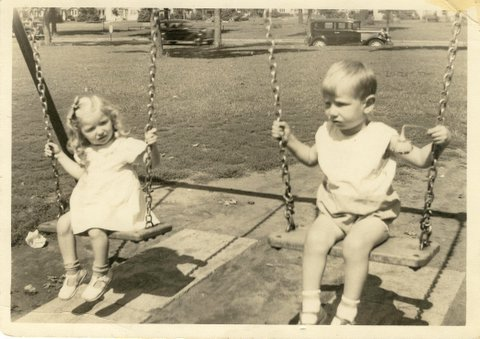
Resources were rather limited in our household but it seemed that a teen age Bob had more access to things than I did. In retrospect I realize that older kids have more responsibilities than the younger ones. For example, he might have to stay home to sort of babysit his kid brother(s) which probably he didn’t get compensated for (other than my sparkling personality) when he’d rather have been out playing with his own friends. Teenagers need more trendy clothes, though I doubt they were very trendy in our family. Bob also needed cash to take his romantic interests to the Friday night movie and my Dad would always find him a paying job, baling cardboard boxes at a grocery store or some such thing.
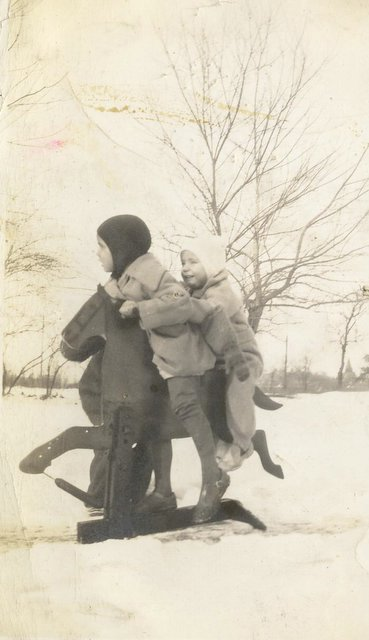
I recall that during WW2 we all played WAR, Bob got to be Mike, the pilot or sergeant while I was always a Kraut, a Hynie or a Nip. I was never on a winning team. Since I didn’t know what any of those were it probably didn’t leave any lasting trauma in my life. I did know that Mike or sergeant was something to aspire to be, otherwise why would he pull rank on me. Sometimes we played a card game called War which was just each player turning a card over and the highest card won the rest of the players’ cards that had been turned up.. The beauty of that was all the broken decks of cards could be used and it didn’t matter. The winner was declared by whoever ended up with the most cards when supper was announced.
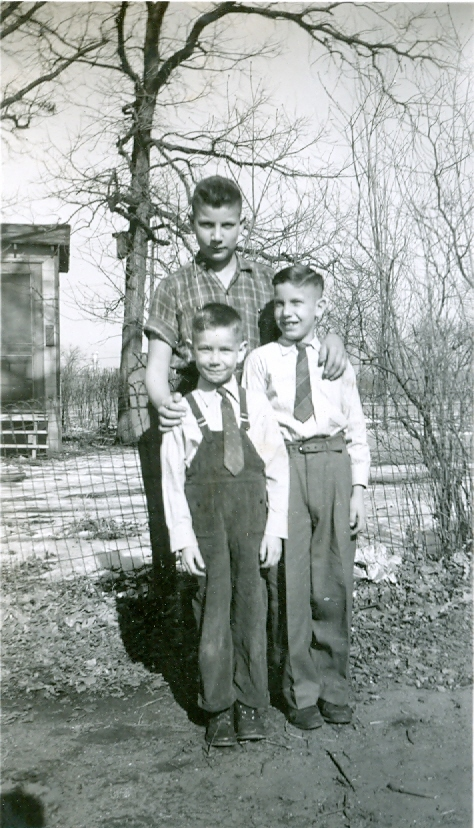
Bob was a big kid, played high school football but his academic career was cut short because of algebra. His high school grades reflected more interest in football and romance and he convinced our parents that he should drop out of school half way through his junior year and join the army the day he was 17.He was disappointed that his birthday fell on a Sunday but Monday morning Dad took him downtown Minneapolis to the recruiting office and signed his permission and Bob had his wish come true. Thus ended any sibling rivalry,if there ever really was any. I was 10 and though I missed him it wasn’t bad because we had never been friends, only brothers.
Brother William or Bill was two years older and the one I followed around. He was sort of my teacher or coach when it came to sports. He too was a big guy for his age but we played together, handy to have a play mate in the same house. After Bob had left Bill and I didn’t have to share the same bed, Bill moved into Bob’s area, I stayed in the bedroom.

Bill wasn’t academically oriented either so my mother would tell me to help him with his math homework but I usually just ended up doing it so we could get outside faster to play . There wasn’t really much homework back then, I guess teachers taught during the classroom time.
Hand-me-down clothes were the norm in our household, Bill had grown into whatever Bob had left and my mother was always busy making the larger sizes smaller so the clothes could be used. Because I was a skinny kid not much fit without a major re-tailoring. I was envious of Bill because he seemed so self assured, being bigger and all. He was a good ice skater while I was barely able to stand up. He always got chosen first at our pick up games while I was hoping not to be picked last. No one really is chosen last, the last one standing goes to the team whose turn it was to pick.

It was good though to have a big brother that could guide me through the intricacies of junior high, walk to school and a ready play mate. We had the squabbles like most siblings but since he always won the physical matches I learned quickly not to go that route. I could out debate (argue) him until my mother couldn’t stand it anymore and would either separate us or make us go outside.
My Dad’s health was in decline and we moved from Minneapolis to a farm in northern Minnesoda. It was a cultural shock for two city kids but we took to the rural life in a big way. We’d always had guns but now we could shoot, hunt and fish. The sort of rivalry continued on but now on a more equal footing. I learned to trap, Bill didn’t care much about that. We lived 16 miles from school. Bill was now a senior, big, good looking, and played a good game of high school football and football players could get a ride home after practice.
My folks were not keen on school sports because of the injury possibility and it took away from our work schedule at home. Anyway, Bill’s interest in the ladies continued while I was still a skinny, introverted kid. He graduated, left home but missed his romantic interests and came back soon. By this time I was a very tall skinny introverted kid. Though I was very shy, my SIL, Bob’s wife, had taught me how to dance. Many of my contemporaries were still a little awkward and embarrassed but when the music started I was the first one to get a partner and do some steppin’. Of course, the girls had taught one another how to dance and wanted to dance with a boy and didn’t want to get chosen last or not chosen at all. I was a different person on the dance floor while my brothers were holding back and waiting for a slow tune.
Then school is over, the birds had to leave the nest, learn to fly on their own. As with many families we moved in different directions, my brothers and I rarely got back to see our parents. We seldom saw one another for thirty years and then it was only for a day or so.
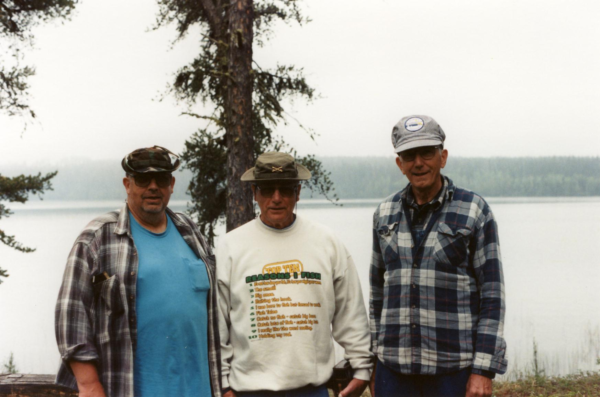
As we aged we found ourselves living closer to each other, sort of migrating back towards our roots. I retired near my brother Bill, Bob would make several trips each year to visit, fish and hunt with us. We always ended up at my house, I had room, Mrs Fourscore would put up with us. She said she enjoyed having them around because they ate everything. We would laugh and tease each other again, much as we had done when we were growing up. It was great having two brothers again. We had about 25 good years of camaraderie and then reality set in.

Both left this earthly world about 8 years ago. I hung up my dancing shoes a long time ago. I have two old friends from high school that live nearby, they too have become their family patriarchs and we’ve sort of adopted each other.
I’m grateful for the Glib community, having younger friends even if we don’t know one another on a really personal level. Its a good place to trade ideas, ask questions and not feel so alone in the libertarian wilderness. TPTB have done a magnificent job.
*We’ll be having the Honey Harvest on Sunday, Sep 15th. All glibs and lurkers are invited. We live in North Central MN, draw a line from Duluth to Fargo and we’re ½ way in between, 100 miles in each direction. Pot luck, family friendly, a little educational. Friends, family and neighbors will be in attendance as well and we hope some of you good folks can make it. It’ll be a great way to meet new people. If you are interested give a shout out for directions.
There are several glibs that should be here so you’ll meet someone you know from these pages.
 You know Brett. He’s double booked between two clients trying to pick up product from him, the problem of course he only has enough product for one of them, and will likely make them fight to the death to see who gets the privilege of purchasing from Don Brett.
For the links!
The big news down south is coming from Argentina. Yesterday their stock exchange dropped a gut wrenching 48%. Why? This guy, no, not Peron. Peron is dead, but his dumbass ideas are not. The Argentines have compulsory primary elections and the current, pro-business president Macri and his policies of austerity, lost in the primary. Now the actual election is in October but he lost by a 15% margin. Which makes it Brazil–in reverse.
Speaking of Brazil, a well-known drug trafficker attempts to escape from prison by disguising himself as his daughter.
Around 300 protesters, mostly female, descended on the Mexican capital’s prosecutor’s office on Monday. Armed with pink glitter and spray paint, they advanced on the building, smashing its door and leaving a pig’s head outside. The protests were sparked by two recent rape cases. The first involves a 17-year-old girl who said four policemen raped her in their patrol car in Azcapotzalco, in the capital’s north, on 3 August. The second concerns a 16-year-old girl who said a policeman raped her in a museum in the city centre days later.
An interesting article on the lengths Venezuela needs to go to evade US Sanctions.
Here’s some tunes sure to irritate…probably all of you. Have a great day…
As in any country, not all Japanese of the top social caste were necessarily wealthy. Towards the end of the feudal era in Japan poor and even destitute Samurai did exist. Many Samurai were just making ends meet and only a few Samurai could afford a sword of high quality. While a low to medium grade Japanese sword was still a marvelous piece of technology for its time it was the finer swords which were truly amazing.
In forging a Japanese sword the master would crouch on one knee at the anvil, holding the red hot billet with tongs in his left hand and strike it with a hammer in his right hand (Japanese of any social standing, had they been born left-handed, were forced to become right-handed). During the forging process there were three apprentices standing around the anvil – one opposite the master, and one on either side. When the master struck the billet they would, in sequence, strike the exact same spot on the billet with larger, two handed hammers.
While common Japanese swords were forged from a single billet, the best quality blades were composed of separate billets of different composition, forge welded together for the end product. Usually this was done with two billets, each having started as a piece of iron forged to a piece of steel, heated, folded over on itself, then hammered together. This folding and hammering process was repeated many times to create thousands of layers within the width of the billet. Two of these iron-steel multi-layered billets would be forged to a pure steel billet between them, then forged into a sword blank. This resulted in a sword having a body of layered iron-steel with a center core and cutting edge of pure steel.
A blade forged like this, when heat treated, would have layers of iron which were still flexible while the layers of steel would be more rigid, resulting in a blade which is much more difficult to break. In addition, forging a blade in this way would align the steel molecules more uniformly while driving out inclusions (microscopic spaces or impurities) resulting in a harder and more rigid material with less tendency to break or crack.
But that’s not all. Japanese sword makers had a unique process for quenching blades which was the same for all Japanese swords. When the sword had been forged, shaped, and ready for heat treatment it was covered in a layer of clay mixed with ash. This layer of clay was about one quarter to three-eighths inch thick. After application of the clay, before it dried, the clay was scrapped off the part of the blade which was to be the cutting edge. When the blade was heated then quenched in water the exposed edge cooled quicker than the body of the blade, making the steel at the edge much harder than the rest of the blade.
When this quenching process is used the difference in hardness shows up when the blade is polished. The body of the blade, being relatively softer, comes to a brighter shine while the harder edge is still duller. In fact, a Japanese blade polisher (not the same as a blade maker) will apply a slightly courser grit to this harder edge area to highlight this difference. The result is a blade with a very high polish on most of the surface with a cloudy finish on the area at the cutting edge.

It was known that meteorite was prized by Japanese swordsmiths for use in making their blades. I have also read that some swords tested with modern equipment have been shown to have chromium in the steel. I have no idea how a feudal era Japanese swordsmith would find and identify natural examples of chromium and then blend it uniformly into a steel billet. I can only assume they had an empirical understanding about how some ore looked different and how that related to the end product.
In the late 13th and early 14th century lived a man by the name Masamune who is regarded as the finest Japanese swordsmith ever. In his own lifetime his blades were so highly regarded that after one point he would no longer sign them (Japanese swordsmiths sign their blades on one side of the tang using hammer and chisel) believing that if a person could not recognize the quality of his work that person didn’t deserve to know who made it.
While blade testing in Japan was not particularly common there are known historic examples of this practice. One test involved securing a blade of average quality in a solid fixture and cutting it with the blade being tested. To pass this test the superior blade should not show any nick or crack where it cut the other blade.
Another testing method involved cutting through human bodies. In some cases this was done while executing a convicted criminal. A superior Japanese blade was expected to be able to cut diagonally through a human torso from one shoulder, through ribs, spine, and on through the ribs on the opposite side without damaging the blade. In one legendary case I have read about the blade had the inscription “five body sword” on the tang opposite the maker’s signature. Legend has it that this blade had cut through five stacked human cadavers in a single stroke.
75 years ago US troops fighting the Imperial Japanese in the Pacific often faced Banzai charges of massed troops, some with little more than rifle-mounted bayonets and swords after running out of ammunition. In fact, there was a training film shown to some Imperial troops which described how to disable an American machinegun with the stroke of a sword in which a sword expert did just that with captured American equipment.
During WWII and the following occupation of Japan many Japanese swords made their way to the US – a number of them true museum pieces. There still are some significantly valuable Japanese swords in the US market but you can expect that the best examples of them have already been identified and repatriated to the much higher priced market in Japan. Should you happen to possess or find one and wish to have it reconditioned please understand that only a person properly trained to polish Japanese blades will be able to do the job without seriously detracting from its value. This is a very expensive proposition and only worth it if you have a blade of exceptional value. Any collector can immediately tell the difference between a blade which was polished by a traditionally trained polisher and one which was polished with modern equipment.