So, what is mead? Well, “mead” is a simple alcoholic beverage made with just honey, water, and yeast. Or, alternatively, “mead” is a sprawling family of different types of alcoholic beverages where the primary fermentable sugar comes from honey. Mead can be still or sparkling; bone dry or syrupy sweet; low or high in alcohol; and everything in between. Thus, there are as many different ways to make mead as there are types of mead. The following diagram shows which products generally fall under the umbrella of “mead”.

The common element in all these products is honey. The color, aroma, and flavor of the honey used to make any given type of mead impacts the color, aroma, and flavor of the resulting product. In a traditional mead, honey is the primary source of the aroma and flavor of the product although the choice of yeast can also have a dramatic impact on the final aroma and flavor as well. In the other three types of products, we are trying to create a harmonious balance between the aroma and flavor of the honey and the aroma and flavor of the fruit, spice, and/or malt that you are pairing up with the honey. Note that it is possible to screw this up and produce an unpleasant tasting product without suffering any actual brewing failures (yes, I have done this). There can be a significant amount of trial and error involved.
Monofloral versus polyfloral honey:
The floral sources of the honey can and do have an enormous impact on the resulting mead. If the bees visit many species of flowering plants when gathering nectar to make honey, the resulting honey is referred to as “polyfloral” honey – usually called “wildflower” honey. If the bees visit a single species of flowering plant, then resulting honey is called “monofloral” honey – usually called a “varietal” honey. Note that a product labelled as a “varietal” honey may include other floral sources, but at least 51% of the honey is from the named floral source.
In general, varietal honeys are produced by placing the hives where commercial agriculture is producing vast fields of a specific crop (see alfalfa, buckwheat, avocado, blueberry, and clover below). However, a single floral source honey can also be produced in the wild where large stands of a specific plant type – usually trees – are in bloom while few other plants are in bloom (see basswood below).

Note the dramatic difference in color of these honeys. There is a corresponding difference in aroma and flavor as well. Light colored honey tends to have a more delicate aroma and flavor. However, there are exceptions such as basswood which has intense aroma and flavor in spite of being very light colored. Dark colored honey tends to have a more robust aroma and flavor. However, there are exceptions such as tulip poplar honey which is almost as dark as buckwheat but has a very mild, mellow flavor.
I prefer to work with single-variety honey, because I think the results are more predictable and repeatable. Wildflower honey can taste great and can make an awesome mead. But you can only repeat the results if you buy from the same supplier who puts the hives in the same place every season of every year and harvests the honey at the same time each year. Hobbyists and very small producers generally do this. But wildflower honey from large-scale producers can be very different each time you buy honey. In contrast, I have purchased single-variety honeys from different suppliers in different parts of the country in different years and the honey is always recognizable as being the same honey. Note that terroir and climate affect honey production in the same way that it does grapes. For example, your Napa Cab is different from your Aussie Cab, but they are both still recognizable as being Cab. The same thing is true with single-variety honey.
Let’s take a look at two of my favorite honey varieties to make mead with. The following descriptions of the honey come from the National Honey Board.
|
Tupelo Honey
Tupelo honey is a premium honey produced in northwest Florida. It is heavy bodied and is usually light golden amber with a greenish cast and has a mild, distinctive taste. Because of the high fructose content in Tupelo honey, it granulates very slowly. |
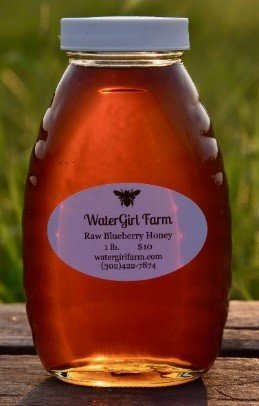 Blueberry Honey Blueberry Honey
Taken from the tiny white flowers of the blueberry bush, the nectar makes a honey which is typically light amber in color and with a full, well-rounded flavor. Blueberry honey is produced in New England and in Michigan.
Note that blueberry honey gets it aroma and flavor from the nectar of the flowers of the blueberry plant (just like every other type of honey). Blueberry honey does not taste like the berries that are produced later. |
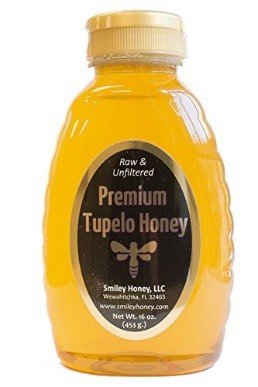
As you can see, there are dramatic differences in the color of these two types of honey. Thus, we expect to see dramatic differences in the color of the resulting mead. Would it surprise anyone that there will also be dramatic differences in the aroma and flavor of each of the mead as well?
The following picture shows two batches of mead made with roughly the same recipe but different varieties of honey. The batch on the left is made with Tupelo Honey and Key Limes. The batch on the right is made with Blueberry Honey and Meyer Lemons.
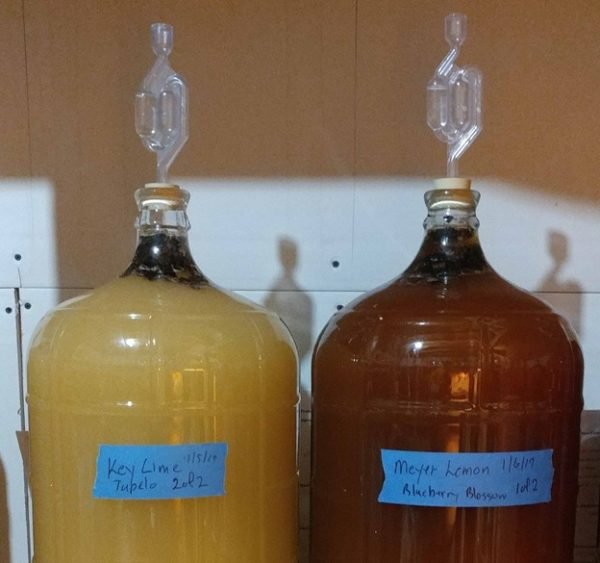
These batches are two weeks old and are still actively fermenting. They have just been racked from the primary and into the secondary. They will stay in the secondary for 2 to 3 months. For those with sharp eyes, there is 1 ounce of medium toast French oak beans (cubes) floating in the neck of the carboys. The oak beans will eventually become water-logged and sink to the bottom of the carboy.
So, color is all we need to worry about, right? Well, no it doesn’t work that way. See the two photos below: Orange Blossom Honey and Goldenrod Honey. They look pretty much the same; but do they taste the same?

Orange Blossom Honey is well known for having a bright citrusy aroma and a mildly citrusy flavor. As for the goldenrod . . . let’s let the producer explain:
The goldenrod blooms in late fall. It is one if the last flowers to bloom before winter sets in. This is one of the few types of nectar that we can smell as we enter the bee yard. Wikipedia calls the odor “rank”. It does smell like dirty gym socks. But do not let that turn you off to this unique honey.
I have used goldenrod to make mead. The honey is not particularly pleasant, but the mead turns out pretty good with a deep earthy aroma and flavor – the magic of fermentation and aging produces a transformation in the positive direction. As a traditional mead, it works. It might work in a braggot mixed with dark malts and suitably earthy hops. But as a base for any fruit melomel, it probably isn’t going to work so well.
Honey processing:
The processing of the honey can also have an enormous impact on the mead produced from the honey. The following definitions also come from the National Honey Board:
Extracted honey: Honey removed from the comb and presented in several forms, as defined in the United States Department of Agriculture Standards for Grades: (1) liquid, (2) crystallized or granulated, or (3) partially crystallized. This is commonly known, and referred throughout the document, as “honey.”
Raw Honey: Honey as it exists in the beehive or as obtained by extraction, settling or straining without adding heat.
Strained Honey: Honey which has been passed through a mesh material to remove particulate material (pieces of wax, propolis, other defects) without removing pollen.
Filtered Honey: Honey processed by filtration to remove extraneous solids and pollen grains.
And then, we’ll borrow a description from Bee Maid on pasteurizing honey:
Pasteurizing honey is a very different thing than pasteurizing milk or other dairy products, and it’s done for very different reasons. Because of its low moisture content and high acidity, bacteria and other harmful organisms cannot live or reproduce in honey, so pasteurization is not done for that purpose. One of the few things that can live in honey is yeast, although if the moisture content is below 18% (as it normally is), the yeast cells cannot reproduce. All nectar (the source for all honey) contains osmophilic yeasts, which can reproduce in higher-moisture content honey and cause fermentation. While fermented honey does not necessarily pose any health risk, we try to discourage it, so Bee Maid pasteurizes its honey to kill any latent yeast cells that might be present and to remove any chance of fermentation.
The bulk of honey that is available in grocery stores or big-box retailers has been pasteurized and filtered. So that stuff in 8 oz jars you buy at the grocery store to put on your biscuits, well that has had the life processed out of it. From a mead-maker’s point of view, the more processing that is applied to the honey, the greater the reduction in the aroma and flavor of the honey as well as the greater the reduction in the aroma, flavor, and mouthfeel of the finished mead. To make mead, you need to buy minimally processed honey directly from the producer whenever you can. The less heat involved in the processing, the better the honey will be for making mead. {This thing here – the less heat involved – we’ll come back to this topic later.}
Making Mead:
Honey is full of yeast. Dilute it with water and wait. It will ferment. Voilà.
I have a friend that has done this. He put a bucket of honey and water in his garage and left it there all summer in Missouri. He came back in the fall and had mead. He said it turned out pretty good, but I did not get a chance to sample the product. And I can’t say that I would actually recommend anyone try this, but this is probably how mead was made for several thousands of years.
At some point in the middle ages, people starting boiling honey and water and then pitching ale yeast. The following is the oldest written recipe.
ffor to make mede. Tak .i. galoun of fyne hony and to þat .4. galouns of water and hete þat water til it be as lengh þanne dissolue þe hony in þe water. thanne set hem ouer þe fier & let hem boyle and ever scomme it as longe as any filthe rysith þer on. and þanne tak it doun of þe fier and let it kole in oþer vesselle til it be as kold as melk whan it komith from þe koow. than tak drestis of þe fynest ale or elles berme and kast in to þe water & þe hony. and stere al wel to gedre but ferst loke er þu put þy berme in. that þe water with þe hony be put in a fayr stonde & þanne put in þy berme or elles þi drestis for þat is best & stere wel to gedre/ and ley straw or elles clothis a bowte þe vessel & a boue gif þe wedir be kolde and so let it stande .3. dayes & .3. nygthis gif þe wedir be kold And gif it be hoot wedir .i. day and .1. nyght is a nogh at þe fulle But ever after .i. hour or .2. at þe moste a say þer of and gif þu wilt have it swete tak it þe sonere from þe drestis & gif þu wilt have it scharpe let it stand þe lenger þer with. Thanne draw it from þe drestis as cler as þu may in to an oþer vessel clene & let it stonde .1. nyght or .2. & þanne draw it in to an oþer clene vessel & serve it forth
A modern redaction of this recipe is:
For to make mead. Take 1 gallon of fine honey and to that 4 gallons of water and heat that water til it be as long then dissolve the honey in the water, then set them over the fire and let them boil and ever scum it as long as any filth rises thereon. Then take it down off the fire and let it cool in another vessel til it be as cold as milk when it comes from the cow. Then take lees from the finest ale or else yeast and cast it into the water and honey and stir all well together, but first look before putting your yeast in that the water with the honey be put in a clean tub and then put in your yeast or else the lees for that is best and stir well together. Lay straw or else cloths about the vessel and above if the weather is cold and so let it stand 3 days and 3 nights if the weather is cold. And if it is hot weather, 1 day and 1 night is enough at the full. But ever after 1 hour or 2 at the most assay thereof and if you will have it sweet take it the sooner from the lees and if you will have it sharp let it stand the longer therewith. Then draw it from the lees as clear as you may into another vessel clean and let it stand 1 night or 2 and then draw it into another clean vessel and serve it forth.
This is essentially the process that is used by most mead makers today. Put honey and water in a pot; boil it; and remove the scum that rises to the top. The only difference is that most modern mead makers will just raise the temperature of the honey water to 150 degrees or so to pasteurize the mixture and to remove the scum that rises to the top. This is considered critical by many to getting the mead to clear properly after fermentation.
Wait a minute. What was that thing I said earlier – the less heat involved in the processing, the better the honey will be for making mead. Why would I go to the trouble of getting unpasteurized honey only to put it into a pot with some water and then pasteurize it. This is where a big schism occurs between mead makers. About two-thirds of mead makers “cook” their honey and water mixture. The two primary arguments for cooking the honey and water are that it 1) provides a clean slate for pitching whichever cultured yeast you want to use and it 2) removes the proteins and waxes and whatnot that makes it very, very difficult to get mead clear. The other one-third of mead makers say this is nuts because you are driving off all the aromatics that make the honey and the resulting mead so awesome. So, I am in that one-third of mead makers that do not cook the honey and water. I believe that a no-heat process produces superior aroma, flavor, and mouthfeel in the resulting products.
And it is possible to get crystal clear mead without cooking the honey and water to remove the scum. The key is using the right fining agents. In wine making, the particles that cause haze in the wine carry a negative charge. So fining agents that carry a positive charge will attach to the haze particles, and then they will drop out of suspension. Wine makers will use egg whites (the proteins are positively charged) or gelatin (also proteins) or bentonite to clear wine. It works great. However, these types of fining agents fail miserably with mead because the particles in mead that cause the haze also carry a positive charge (being proteins and waxes and whatnot). So, to clear mead, we need fining agents that are negatively charged.
What works well is Super Kleer. This product is actually two separate fining agents (Kieselsol and Chitosan) that get added to the mead at separate times. From some website I have lost track of:
Kieselsol (negative charge): Also known as silicon dioxide. Kieselsol works well with gelatine as a clearing agent, since it acts as a tannin substitute and works well to remove bitterness from white wines. When used with gelatine, the gelatine is added to the wine first, and then 24 to 48 hours later, a very small amount of Kieselsol is added, and should be racked off within 2 weeks. Kieselsol also works with chitosan.
Chitosan (positive charge): As the name implies, it is composed of chitin, which is the structural element of the exoskeletons of crustaceans, such as crabs, shrimp and other shell fish. Chitosan is especially popular in clearing white wines, since it does not require the aid of tannins to clear, as do some fining agents like gelatine. When used with negatively-charged Kieselsol it is an effective remover of most suspended proteins and solids.
Chitosan and Kieselsol are often sold as a set, in sealed liquid envelopes as fining A (negatively charged Kieselsol) which is added to the wine first, and then fining B (positively charged chitosan) added about a day afterwards. Chitosan has a reputation for being fairly gentle on the character of finished wine.
The following picture is an example of the results of using Super Kleer in mead. Note that I frequently print out brew sheets to keep track of what I am doing. I usually lean the brew sheet against the wall behind the carboy. This image shows 12-point font printed on standard paper sitting just behind a five-gallon carboy full of mead. When you can read a newspaper through a carboy full of product, the product is clear.

Now someone out there is thinking “If negative particles make wine hazy and positive particles make mead hazy, will a mixture of wine and mead clear up on its own?”. The answer is yes, in many cases. This makes melomels (fruit meads) one of the easier categories of mead products for beginners to make, because melomels are more likely to clear up on their own without using fining agents.
And that brings us to the end for today. The next article will be on making melomels with a focus on how to be successful as a beginner with little prior brewing experience.
Comments
97 responses to “The Nectar of the Gods”
I like nectar.
I’ve had good results adding warm/hot water to a fermenter, sealing it up and mixing it up. The aromatics should be kept in the fermenter, as long as you let it cool down before pitching yeasts. Of course, in general I deal with 1 gallon batches of mead instead of 6 gallon batches.
Great write up, Kinnath. Unlike most of these reprobates, I read the articles.
What do you think of the mead kits on the market? There are a number of different nano mead kits to choose from.
While I’m not Kinnath, I don’t see much value in getting a kit for mead. As long as you can source the honey you want (either locally or on-line), you can make all sorts of mead in small batches.
You need to go to a brew shop to get yeast, but that is all you need from them.
My next article will show four products made from ingredients bought at Target and Walmart. I just racked them out of secondary for final aging and clarifying. They are turning out great.
Buy honey from local apiaries if you can. Or order from apiaries online and have it shipped to you. Any honey you buy from a brew shop is going to be marked up in price. Who knows how long it has been sitting there.
Cool, thanks. I have access to plenty of quality raw local honey here.
One gallon recipe:
1 quart honey
1 gallon water
3lbs frozen berries
1 pkg wine yeast (Lalvin 71b works great).
Mix it all up in a bucket; add yeast; wait three weeks.
Rack it into a secondary; wait three weeks.
Rack it again; wait three weeks;
Rack to a bottling bucket; back-sweeten to taste; add 1/4 tsp potassium sorbate; and bottle.
Wait two weeks, then drink
I can see it now. The shelves in the guest bedroom closet lined with gallon carboys of beer and mead.
And I think I have three pounds of home grown raspberries in the freezer.
Raspberries are great. The flavor carries through into the final product very well. Good acid levels.
If you’re willing to go wildflower, I’ve found the bulk World Market honey was the best value for cost/quality. You will get some strange looks filling up a gallon jug though.
I will probably use a quart of local, raw, unfiltered clover honey. Not cheap at $23 a quart but I’ve eaten quite a bit of it and it’s very good.
So yeah, the next fermentation project is a gallon of clover honey and raspberry mead.
I add hot water to the honey when trying to dissolve old, crystalized honey. What I disagree with is raising the temperature of the must to 150 degrees and holding there in a pot for half an hour or so.
If I ever drank mead, I would feel compelled to do so out of a leather mug.
You want a drinking horn.
Just like this.
Seriously dude, it’s like you don’t even mead.
I’d prefer the skull of a worthy enemy, or a mug of some sort-whichever was handy.
Hey Kinnath,
Great write up! It’s always cool to see the wide range of topics that Glibs can cover.
Thanks.
Unfortunately, this leads me to strongly desire a large mug/drinking horn (yes, I have one) of mead….and I don’t happen to have any right now.
It’s a good thing there are instructional articles somewhere so you could start making your own…
This Cream Ale wort doesn’t carry near the sweetness of the IPA. I think I’m going to like this one with lower alcohol and much less hoppiness.
Was there any grain other then barley in that kit? I usually like a pound of corn in my cream ale (but that’s for a 5 gallon batch).
1.5lb 2 row
.1lb Carapils
.4lbs rice solids, 15 minute boil
.2oz Liberty hops at beginning and end of boil
.47gm Whirlfoc tablet, 15 minute boil
Ok, they went with rice solids as the adjunct. Short boil time though, and you probably don’t need the Whirlfloc for this recipe (I’ve found one recipe that I’ve brewed that needed Whirlfloc to clear).
There were no directions for the rice, so I went a Googling. Everything from in the mash to 15 minute boil. For the lagers, it seemed to lean more towards the shorter boil. It’s a done deal at this point.
I’d toss it in near the end of the boil, rice solids are essentially a sugar addition. The flaked corn I use would need to have been part of the mash. I go with 8 lb 2-row and 1 lb of flaked corn with an ounce of Fuggle for my Cream ale (and use a cream ale blend yeast). It comes in at about 4.5% ABV.
This recipe was adapted from a malt extract/grain recipe. The guy working the grain room helped me with the conversion to an all grain recipe. It’s supposedly ends up at 5.7% ABV. We’ll see.
If I end up liking what I’m making, I’m in trouble. Fortunately, brewing season for me will be December-March only. Too warm and too many other things to do the rest of the year.
Good article, K. Since I don’t drink alcohol any more, I know, I know, turn in my Glib registration, I’m curious as to what local honey goes for in your neighborhood? I never sell any ’cause I don’t have much and it makes a nice gift. When I go shopping I always check the price for local honey and am surprised at how inexpensive it is relative to my cost. I think the gift shops get a much bigger price by selling it in small containers, 1/2 pint or 12 oz.
Your finished product can’t be cheap to make. Anyone know what mead costs in a liquor store? Just curious is all.
Hope you are available for Honey Harvest, 3rd Sunday in Sep. Other glibs will be here, I’ hoping
I am keeping it in mind.
These folks don’t show their prices, but I think they the are in the range of $20 a bottle:
http://eastgrovefarms.com/mead.html
http://www.buzzed-bee-meadery.com/
Commercial meads are frequently quite dreadful. I would never buy a bottle with tasting it first. The local bottle shop has a mead tasting about once a year. Some are very good, most are not.
It’s OK if you don’t drink. Don’t forget we’ve got several freaky Mormons here.
And a non beer drinking Ted, yippee?
Ken Schramm “wrote the book” on mead making.
He now makes and sells mead. I have had his mead; it’s great. It’s $50 to $100 a bottle.
https://www.schrammsmead.com/
A bottle of mead in a wine store will generally run you a minimum of $20/750mL bottle. One of the local places does mostly 375/500 mL bottles due to the cost. But they do have names that will cause Swissy to have a stroke.
The cheapest honey that I have used is Basswood from Wisconsin. I had to drive up there to get it. Just over $2 per pound plus 10 bucks for the 5 gallon pail. I bought 4 pails for about $130 per pail — it was worth the drive. So that’s about $30 in honey per 5-gallon batch of mead.
The most expensive honey was Fireweed that I paid $15 per pound for. So that’s about $225 for a 5-gallon batch of mead. The mead is exquisite. I found a better source and only paid $10 a pound for Fireweed that is being delivered tomorrow. So only $150 for a 5-gallon batch.
So a quart of basswood is about 6 bucks plus the container. We buy the bees every year, this year the price has jumped a bit. With a good harvest we’ll have about $6 a quart in costs, plus a little extra odds and ends. We call ours wildflower since its the gamut of a summer run. Looks like a 750 is about $20, a 750 is about the same as a fifth, which I can relate to.
And alcohol content? Like beer? Harder stuff?
The basswood was an exception.
Most high-quality honey from the apiary is running 4 to 6 bucks per pound in large containers. So $48 to $72 per gallon. In 2 lb jars it’s more like $8 to $10 per pound.
Most commercial mead is like table wine. So 12% to 16% ABV.
Time to run to see the grand-daughter in orchestra.
Jeebur, though – $50 – $100 a bottle? Sounds like a good market to get into. Also, you can sell to nerds playing medieval RPGs (D & D and such). Nerd market, alterni-booze market, never have to deal with Photoshop, sounds good to me.
Large upfront costs, government licensing, regulated market… anything dealing with alcohol has all sorts of rules.
Don’t forget the harpsichord. You have to have the harpsichord.
You have to have the harpsichord.
Okay, that’s a deal killer.
Thanks K
Fourscore: A lot of honey producers in the US import Chinese honey and pass it off as their own. Just had a local guy here busted for that. Also, a lot of honey producers will mix corn syrup into their honey to increase volume. Beekeeping is hard work and expensive. That inspires a lot of less than honorable types to cheat. Once they do that it drives the price of honey down for everyone and straight beekeepers have a hard time selling the real thing at a reasonable price.
Honey fraud is a thing. I keep getting notices about it… attached to offers from the people notifying me about it to sell me an NMR to detect it.
I don’t do food chemistry (anymore), but I would like an NMR.
I saw “Honey Product” at the dollar store. It was 10 % honey, 90 % corn syrup. As I remember it was a product of India. I like to look through the honey at different stores. See a lot of labels with “China/Brazil/Mexico or other country of origin”. Yeah, easy to fudge, corn syrup is about .60 a lb or cheaper.
I would tend to trust the roadside stands and boutique type but the profit motive is hard to overcome.
If you want to see how bad it can get, I suggest watching the first episode of Rotten on Netflix (it’s all about honey).
I will never do this. But I might drive to Iowa and bribe kinnath to try his.
Great job, man. I can’t believe how much I learn from You People.
Mead is relatively easy to make. You should do it.
Do it…
DO IT!!!
The way I make mead, it’s the easiest thing I make.
I may have exaggerated. It does actually look pretty easy.
Oh, and just because:
Tupelo Honey
Sublime.
That song will definitely get you laid.
Dude, I think you’re a really nice guy, but I don’t swing that way!
You have no idea what you’re missing.
Story of my life, Spud.
Cooking anything interesting this weekend?
Just cooked up a batch of beer. I’ll be phoning it in tonight.
It will be raining all day tomorrow, so Chile verde is probably on the menu.
Great minds. I was about to start a batch of Chile Verde tonight ( I like it best the next day), but instead I’m headed down to a local winter festival with some friends.
38 degrees!
‘Chile verde’
Dudes, you know that stuff is green, right? Green.
And full of delightfully braised chunks of pork butt.
Well, Fourscore is trying to talk me into driving up to MN next September. So maybe a Glib-a-thon can be arranged.
We just about killed the jar of honey he gifted us – it was fan-fucking-tastic!
I feel like I need to provide labor to show my appreciation. It would be fun to get a bunch of degenerates up there. The Pontiff and family made it last year.
I’m gonna be in the TC on March 22nd, same routine as the last time. I’m not sure of the schedule just yet, maybe we can figure something out. I think there may be a surprise in the deepest reaches of the hidden closet, I’ll take a look.
Just let me know! Fridays are almost always good. You’re on the calendar.
I’ve been trying to convince the girlfriend we should head up there to help produce honey.
Yeah, I read these and think I should do that, but I won’t. I’d gladly pay to try someone else’s.
Do it! Just start with a growler or a gallon size container.
I can attest to how simple it is to make mead. Many of you here spend far more time and energy making one meal than it takes to make a batch of mead. Seriously.
And really, if you want a quick batch to make… Joe’s Ancient Orange Mead exists for a reason.
Like, at once?
Per year, 200 gallons if you have two adults (over the age of 21) living in the household.
So… sand?
Mead is yummy. One of the best parts of working renfairs is the abundance of homemade hooch.
https://www.txbrewing.com/storeblog/fining-agents-for-wine-bentonite-chitosan-and-kieselsol.html
Bentonite is a type of super absorbent clay that is usually added prior to fermentation. This volcanic-ash clay can absorb many times its own weight in other compounds.
Chitosan is a positively charged fining made from chitin, a compound that makes up the exoskeleton of crustaceans, such as shrimp, crabs, and lobsters. Kieselsol is a negatively charged fining made from silicon dioxide (silica) which is mostly found in quartz.
Yup, sand, clay, dead shrimp. It’s all good.
I’m sensing a beach theme here.
Bentonite is also used to seal pond bottoms and around irrigation piping. We had our neighborhood irrigation pumping station redone last year and there must be at least five yards of bentonite down there to make sure everything is sealed.
I will never make mead. But a very interesting article, Kinnath. You have a nice writing style. Thanks for sharing!
I might not make it…but I DAMN SURE will drink it.
Hell yeah!
Currently, I’m drinking pinot grigio and Perrier. I don’t know why. But that’s what I’m drinking this afternoon.
Cheers!
These articles from Kinnath and Nephilium have got me thinking about making booze again.
Thanks guys!
DO IT!!!!!!
Articles like this and Suthen’s hand-loading articles make me think I need a bigger place.
‘We’re gonna need a bigger back yard.’ / Brody (ish)
Frankly, I’m a little lazy. Me putting forth effort is driving to the liquor store or ordering from sgammo.com
sgammo is my go-to ammo source
I’ve got a bottle of mead that my bee-keeping friend gave me. Im guessing it will keep for quite a long time ?
Depending on the style, it should last for quite some time.
Hmm. I have been trying to ignore the booze articles. The last thing I need is another hobby, but I may have to try this mead thing. I already make lots of muscadine wine. This seems simple and interesting enough that it wont add much in the way of time and expense.
*The legal definition of Tupelo Honey is different than actual tupelo honey. True tupelo honey is honey produced from tupelo gum trees. There are large stands of them in swamps all around the gulf coast. I think Louisiana may have more than Florida. The reason the honey is so prized is that tupelo gum trees produce very clean flowers. The primary reason honey crystallizes are impurities (dirt and pollen) that get into the honey by bees tracking it in on their feet. Just like every rain drop contains a speck of dust, the particulates the bees track in provide a substrate for the sugars to begin crystallizing on. Tupelo flowers are so clean that in fact that the honey made from them will never crystallize in your lifetime.
When honey is produced and sold samples of each batch are sent off for an assay of the pollens in it to determine what species it is collected from.
It is categorized bye the results of the assay. Somehow or other the northwest florida beekeepers managed to get a lock on the name and reputation of this honey. We produce as much here in La or more than they do but we cant call it that. Same is true for Vidalia Onions. Vidalia is in Louisiana for fuck’s sake, not Mississippi.
It has also crossed my mind to try and rig some kind of door mat for the bees and have them wipe their feet a bit before going into the hive.
* The most interesting honey I ever tasted was honey produced in Southwest Louisiana from a guy who won a contract to task his bees with pollenating 1500 acres of Tabasco peppers. A very noticeable but subtle bite. Think about that for a minute. What I wouldn’t do to get another batch of that. I bet it would make an interesting mead as well.
I’ve linked the article before, but the most interesting honey I’ve heard of was the one in England. A candy factory dumped a bunch of red peppermint candy, and the bees took it up to make honey. The honey they made was pinkish and tasted of peppermint. I would have loved to get a batch of that to make mead.
Same is true for Vidalia Onions. Vidalia is in Louisiana for fuck’s sake, not Mississippi.
That’s all well and good, but Vidalia onions come from around Vidalia, GA.
My favorite is Tokay wine. The river extends ever so slightly into Slovakia, but the Hungarians had a shitfit when the Slovaks started exoprting it.
Oh, I forgot about Jawja. Those fuckers. Sibling rivalry I guess. I had read about the vidalia onion before and knew the history I just forgot. They grow a shit ton of them around Vidalia, La. but sell them as ‘sweet onion’.
Just north of Dayton, Ohio is the city of Vandalia.
“Vandalia onion” is a frequently heard malapropism.
I was entertained when I had someone in the grocery store see I was picking up shallots, and he walked up and asked what they were (and what the tasted like).
Kept reading but never found the part where Meade kicks Lee’s ass at Gettysburg.
“The most interesting honey I ever tasted was honey produced in Southwest Louisiana from a guy who won a contract to task his bees with pollenating 1500 acres of Tabasco peppers.”
Every large field in Idaho has honey bee sheds in it. I may need to start tracking down the owners of the hives. Honey from a field of mint could be quite excellent.
Went to the grocery store. Thought about buying a few jalapenos, but maintained.